


Abstract
For rural adolescent girls in the Bolivian Andes, adolescence is not a “protected” transitional life stage but a gendered laboring condition. This article explores the lived experiences of adolescent girls in a rural Quechua community in Cochabamba, drawing on the initial phase of a longitudinal Community-Based Participatory Research (CBPR) project (2023–2024). By integrating Silvia Federici’s theory of social reproduction with Axel Honneth’s recognition theory, the study conceptualizes a “laboring subjectivity” defined by a ch’ixi reality where two dimensions of labor exist in constant, dynamic interaction. The findings reveal these dimensions of labor: “Working to Do,” which encompasses the invisible, naturalized reproductive and agricultural work and unremunerated affective work required to sustain family life as a form of cultural pedagogy; and “Working to Be,” which refers to the subjective labor girls perform to negotiate recognition. Through this structural arrangement, Honneth’s spheres of love, rights, and social esteem are systematically compromised, creating a distinct recognition deficit as girls carry adult responsibilities without structural protection. Ultimately, this article argues that seasonal migration to regions such as El Trópico functions as an existential terrain where girls seek the symbolic and economic recognition denied within the local rural order. By centering adolescent girls as active laboring subjects, the research challenges Western developmental biases in youth studies and offers a nuanced reframing of the nexus between labor, mobility, and identity formation in the Global South.
1. Introduction
“Being a woman is a lot of work” (Ser mujer es mucho trabajo). Clarita said it with a smile, and the other girls nodded in agreement. This quote did not emerge from a structured interview or a predefined research question; rather, it surfaced through dialogic exchange during a Community-Based Participatory Research (CBPR) process with adolescent girls in a rural Quechua community in Cochabamba, Bolivia. The research question that guided this first CBPR stage of relating to and learning to know the community has been: What is it like to be an adolescent girl in an indigenous rural community in Cochabamba, Bolivia?
In the aforementioned single sentence, Clarita captured a profound sociological reality. For rural adolescent girls in Bolivia, adolescence is not perceived as a Westernized “protected” stage of transition, but rather as a rigorous, gendered laboring condition. In Bolivia, national demographic data indicate that approximately 730,000 minors (ages 5–17) are engaged in work, with girls representing 46% of this figure, primarily in unpaid, domestic, and agricultural spheres [1]. While boys are often concentrated on paid activities, girls are disproportionately engaged in unpaid labor within the family and community spheres [2]. In rural regions, nearly 90% of the labor is agricultural. Most adolescents characterize their participation as “helping” their families or as a “learning process,” a framing that effectively renders their rigorous workload invisible [2].
Furthermore, rurality in Bolivia functions as a complex social and political category that extends beyond the formal designation of Indígena Originario Campesino (Indigenous Native Peasant) [3] It is increasingly characterized by what Silvia Rivera Cusicanqui describes as a mottled identity (ch’ixi). Rather than referring to cultural hybridity or harmonious fusion, Rivera Cusicanqui [4] conceptualizes the ch’ixi condition as the parallel coexistence of heterogeneous and often contradictory elements that remain distinct while inhabiting the same social space. This framework is crucial for understanding the “new rurality” emerging in specific regions of the country, where ancestral communal practices and gendered labor obligations cohabit with intense market integration, digital connectivity, and internal migration.
This spatial and cultural friction is explicitly visible in the department of Cochabamba. For the first time in two decades, according to the last Census in Bolivia, the city of Cochabamba has reached a peak in its internal migration balance for the youth population (ages 5–17), with a net gain of +3136 individuals. This mobility reveals a significant ‘mottled’ shift across the territory. While the traditional urban center of Cochabamba (Cercado) recorded a massive exodus of −5205 young residents, the ‘new rurality’ of the Tropics has emerged as a primary destination [5].
Thus, research on rural Bolivian youth has largely focused on two streams: migration as a “rite of passage” for labor market integration [6,7,8,9,10] and the vulnerabilities of those “left behind” in communities marked by high mobility [9].
Studies have shown how women’s agricultural and domestic work often escapes formal recognition and statistical accounting [11], while regional analyses in Latin America underline the centrality of care and agricultural labor to rural sustainability [12]. Also, labor performed by children and adolescents in indigenous communities may culturally be framed as strengthening communal life [2] this cultural validation has not yet been socially recognized and translated into labor rights and protection.
While Calle Quispe and Bascopé Guzman [13] note the multilocality of these adolescents, treat adolescent girls as dependent within household labor regimes or as future migrants. They also note that there are few studies on the experiences and perspectives of migrating adolescents, not even on those of adolescent girls who are left in their communities.
Rather than approaching adolescence as a predefined developmental stage, or migration as an external economic strategy, this research asks how the girls themselves understand what it means to live, work, and move within their rural context. In this sense, the article adopts an inductive approach through the CBPR process [14], placing the girls’ articulation in conversation with existing debates on rural migration, labor subjectivity, and recognition. Labor subjectivity is understood as the ways in which work and labor contribute not only to material reproduction but also to the formation of the subject’s identity. In the sociology of work, authors like Angella [15] establish this link by showing that labor is a major constituent of a subject’s identity and self-esteem.
To extend this concept to rural adolescent girls, the study integrates the sociology of work perspective with feminist political economy [16] with critical recognition theory [17]. This integrating framework allows us to see labor not just as a task attributed to being a woman, but as a site of both exploitation and identity formation. More specifically, to understand this laboring condition, this article draws on Silvia Federici’s [16] theory of social reproduction, which identifies domestic work and subsistence farming as the ‘unwaged’ foundation of the global economy. In rural contexts, this labor is often naturalized as a feminine attribute, rendering it invisible as productive work. As Amaral [18] notes, women’s labor in these communities is laden with cultural determinations where “what they do” supersedes “who they are”. However, this labor is not merely a site of enclosure; it is also the root of the individual’s identity [15] where the performance of work becomes the primary mechanism for seeking social esteem.
Recognition theory clarifies the tensions in this condition. Honneth [17] argues that positive self-relation depends on three spheres: love, rights, and solidarity. In rural gender orders, girls often face misrecognition; their contributions are essential for communal survival (Social Reproduction), but are systematically undervalued or denied legal and social protection (Misrecognition). This study explores how migration and labor become the terrains in which girls negotiate these distorted forms of recognition to shape their future aspirations.
This article makes two contributions. First, it reconceptualizes rural adolescent girlhood not as a transitional life stage or a derivative of household strategies, but as a condition structured by labor, a primary site of subject formation. Second, it introduces the analytical distinction between “Working to Do” and “Working to Be” to capture how productive, reproductive, and subjective forms of labor are co-constitutive in shaping both social positioning and identity. In doing so, the article extends feminist and migration scholarship by foregrounding adolescence as a present, laboring condition rather than a preparatory phase for adulthood.
2. Materials and Methods
As mentioned earlier, the study represents the initial phase of a Community-Based Participatory Research (CBPR) process, which prioritized establishing a relational foundation with adolescent girls in a rural Quechua community in Cochabamba, Bolivia. Within CBPR research, knowledge is considered to be co-created through a sustained mutual engagement rather than being externally extracted. The initial phase of CBPR focuses on relational immersion and curious learning to know a community and its members, with the aim of co-defining a research focus that is important to the community.
In this case, the research was conducted in a high valley region where migration has historically shaped the demographic and economic structure [19]. Seasonal mobility continues to form part of community life. The majority of the population (99.2%) speak Quechua as their mother tongue, with the remainder primarily identifying with Aymara cultures. To protect the identities of the minor participants and prevent community identification, the specific municipality and community names have been omitted. This decision follows ethical safeguarding protocols for vulnerable populations in rural settings, where the risk of social identification via geographic markers is high.
Field entry followed an emergent sampling strategy where the research site was identified through community dialogue. Initial engagement began in the local market through informal conversations with qhateras, or indigenous female street vendors. Their reflections on their own youth directed the analytical focus toward the lived experiences of adolescent girls, eventually leading to collaboration with the district education office and a local secondary school. This trajectory ensures that the research remains grounded in community-identified needs rather than external selection. This initial engagement led to co-defining the research question, “What is it like to be an adolescent girl in this community?”, to be investigated in collaboration with the adolescent girls themselves. Building trust required a sustained presence, achieved through weekly meetings and informal interactions in school and community settings. This relational phase was central to establishing a safe space for discussing sensitive topics. Rather than treating rapport-building as a preliminary step, it was considered an integral component of the knowledge production process.
2.1. Participants
Participants purposively self-selected into the study based on three eligibility criteria: (1) identifying as female, (2) being between 12 and 17 years of age, and (3) being enrolled at the participating local secondary school. Prior to any data generation, written parental informed consent and written adolescent assent were obtained. To ensure a comprehensive understanding of the research objectives and the nature of the weekly meetings, the first author conducted individual, face-to-face conversations with each participant’s mother or father. These dialogues allowed for a culturally grounded explanation of the CBPR process, while addressing parental concerns and ensuring that the consent was truly informed within the local social context.
Table 1 details the socio-demographic characteristics of the participants, illustrating the structural context of their daily lives, including household composition and mobility patterns. Most participants engaged in circular seasonal mobility to the Trópico region for agricultural labor, specifically harvesting coca leaves. Notably, all participants balanced their education with significant productive and caregiving responsibilities within their households. During the study, two participants withdrew due to pregnancy and shifting family obligations, an occurrence that underscores the fluid and vulnerable nature of adolescent participation within these specific rural labor regimes.
Table 1.
Participant demographics.
This core group of five participants is highly consistent with the CBPR approach and is epistemologically justified by the concept of “information power” [20]. Rather than seeking empirical generalization through a large sample, this methodology relies on dense information power, achieved here through participants’ highly relevant lived experiences and a strong relational floor that enabled a deep communicative space. This intense, longitudinal engagement provided the necessary depth to generate “thick description.” Consequently, the analytical weight of this research rests on contextualized knowledge. By tracing the complex, situated mechanisms linking rural labor, mobility, and subject formation, the findings are theoretically transferable to similar rural labor regimes rather than statistically representative of all rural contexts.
Consistent with CBPR principles, the research process also involved ongoing reflexivity regarding the researchers’ positionality and the power dynamics inherent in working with adolescent participants. This included continuous negotiation of roles, expectations, and boundaries within the research space.
2.2. Positionality and Reflexivity
Consistent with CBPR principles, the research team maintained continuous reflexivity regarding intersecting power asymmetries. Occupying a ch’ixi (mottled) positionality, a state of negotiation between ancestral roots and academic knowledge, an ongoing consultation between the authors to monitor the relational power dynamics and manage the emotional demands of the fieldwork of the first author. Initially, community members addressed the researcher with a nickname of “La Joverita”, a term highlighting her lighter skin tone and her status as a young, institutional outsider. This address shifted to calling her by her name in a tender way, culturally used in these communities, as the research progressed, marking a change in the relational dynamic. To monitor this dynamic and manage the emotional demands of the fieldwork, the first author engaged in intervision with colleagues and psychologists. This process helped mitigate researcher bias and navigate the ethical complexities of the participants’ disclosures. Furthermore, data analysis involved collaborative reflexivity with the cross-national team (Bolivia and Belgium) to prevent the imposition of Eurocentric theoretical frameworks, ensuring that concepts such as social reproduction and recognition remained grounded in the participants’ rural realities.
2.3. Ethical Safeguarding and Institutional Collaboration
Given the sensitive nature of the disclosures, ethical safeguards were implemented throughout the study. Written informed consent and adolescent assent were obtained prior to participation. All participant names used in this article are pseudonyms, data were anonymized during transcription, and specific geographic identifiers were omitted to minimise the risk of community identification.
When disclosures of abuse emerged, participants were listened to within the limits of the research relationship and were not pressured to pursue formal complaints through the study. The research team prioritised participant safety, confidentiality, and access to available support mechanisms while avoiding actions that could increase vulnerability or place additional burdens on the adolescents. To preserve anonymity, recurring structural patterns of violence identified through the research were communicated to relevant institutional stakeholders without disclosing information that could identify individual participants.
Cases already under legal intervention continued their process with the Defensoría de la Niñez y Adolescencia (Municipal Child Protection Services). For other disclosures, the research team engaged in collaborative dialogue with local school authorities and the District of Education. Recognising that the community was already addressing these issues through existing workshops and prevention activities with parents, our involvement was designed to complement rather than replace local safeguarding efforts. At the same time, the fieldwork revealed a structural protection gap: although child-protection mechanisms formally exist, their physical distance from remote rural communities can make sustained case follow-up difficult for adolescents. To address this challenge as the wider project progresses, the first author has established collaborations with the Psychology Department of the Universidad Católica and local NGOs to develop mitigation strategies, referral pathways, and longer-term support mechanisms.
To address the absence of a psychological counseling unit in the local rural school, the research team engaged an external psychologist with experience in rural adolescent mental health and school-based support. The psychologist was available to provide guidance, psychosocial support, and referrals where appropriate. Furthermore, in collaboration with the local District of Education, the team initiated a preventive program focused on life skills and adolescent well-being, aimed at strengthening local capacities for prevention and support.
2.4. Data Generation
Data generation spanned an extended period from August 2023 to December 2024, corresponding to the first phase of the participatory research process. Consistent with the relational emphasis of CBPR, methods were selected as flexible strategies responsive to the girls’ availability, seasonal mobility, and evolving comfort within the research space rather than as fixed instruments.
The research employed a multimodal approach, combining longitudinal ethnography, ethnography in movement, geographical life storytelling, and focused conversations. This combination enabled deep engagement with both the spatial and temporal dimensions of the girls’ lives, capturing the rhythms of their daily community labor alongside the disruptions caused by circular migration. By remaining adaptable to the participants’ lives, the methodology itself became a tool for understanding the laboring subjectivity that organizes their experience of adolescence.
The data generation process was structured into five iterative phases, as outlined in Table 2, which aligns our methodological engagement with the seasonal rhythms of the community.
Table 2.
Research Phases and Methods.
2.4.1. Ethnographic Immersion
Ethnographic engagement formed the methodological backbone of the study, as this approach seeks to explore social reality from participants’ perspectives, capturing meanings, intentions, and everyday practices as they are lived [21]. Rather than relying exclusively on formal interviews, the research prioritized sustained presence within the school and community. Weekly Saturday meetings with the girls, informal interactions in school settings, and community observations generated 183 pages of field notes over the research period.
The longitudinal character of the ethnography was particularly important given the seasonal structuring of rural life. Two key periods shaped the rhythm of data generation. From January to February, several girls temporarily left the community for seasonal labor in other regions. From June to August 2024, the local harvesting season required intensified agricultural work within family lands. These periods of mobility and intensified labor interrupted regular meetings but also revealed the structuring force of work and migration in the girls’ everyday lives. Ethnographic immersion thus captured not only stable routines but also disruptions, absences, and returns, making visible how labor regimes and seasonal mobility shape adolescence.
2.4.2. Ethnography in Movement (“Go-Along”)
To directly engage the spatial dimensions of the girls’ experiences, the study employed the “go-along” method, also known as ethnography in movement [22]. In this approach, researchers accompany participants in their routine movements, engaging in conversation while observing interactions with their physical and social environments. This method allows exploration of the stream of experiences and practices as they unfold in situ, providing a situated understanding of how territory is negotiated [22].
In this study, go-alongs were conducted primarily along daily routes between home and school, during which the girls narrated their experiences of community life, labor responsibilities, fears, and aspirations as they walked together. This allowed us to build a relational floor as an ethical practice of being with them.
The mobility of the method mirrored the mobility of their lives, as the girls’ accounts emerged within movement itself, allowing for critical reflection on territorial boundaries and gendered spatial constraints. The informality of walking side by side reduced hierarchical dynamics and enabled discussions of sensitive topics, such as navigating public space and the impact of community surveillance. By using this method, the research captured how girls interpret and resist the social conservatism that defines the rural context.
Ethnography in movement took place from September 2023 through December 2024, interwoven with periods of absence due to seasonal labor. The method proved particularly useful for understanding how girls navigated public space, experienced harassment, and interpreted community surveillance.
2.4.3. Geographical Life Storytelling
To further explore the relationship between place, aspiration, and identity, Geographical Life-Story Telling (GLST), a visual art-based narrative method, has been used to examine the girls’ life-worlds. GLST is a geo-narrative research method in which participants create large life maps of their worlds, drawing all the places that are, were or will be important in their lives and complementing them with photos, collages, short texts, and storiesThe process begins by creating an inventory of the most important places in a participant’s life on small sticky notes, which are placed geographically on a large sheet of drawing paper. These notes are systematically replaced by detailed drawings of the ground plans of each location and the individuals present there, while corresponding stories are narrated and recorded [23,24].
During a first group session, the girls were invited to identify all significant places in their present, past, and imagined future lives. Sticky notes were used to annotate the maps, explaining why particular locations mattered and how they related to personal trajectories.
A second session invited the girls to distinguish between present and future spaces using different colors, facilitating a collective reflection on mobility aspirations and projected migration. This collective reflection was followed by individual conversations in which participants interpreted their own maps. The mapping process enabled the articulation of spatial imaginaries that might not have emerged through conversations alone. Migration appeared not only as a movement between locations but also as an aspirational horizon embedded in relational and economic considerations.
The GLST exercise complemented the ethnographic observations by revealing how girls spatialized their identities and futures, linking local community life to broader migratory circuits.
2.4.4. Focused Conversations
Focused conversations occurred both formally and informally throughout the research period. While several sessions were organized around thematic prompts, many discussions unfolded organically during weekly meetings. Topics included gender roles, experiences of labor, aspirations, migration, and perceptions of adolescence.
These conversations allowed girls to affirm, contest, and elaborate on one another’s statements. Laughter, silence, and collective agreement became part of the analytical material. The interactions were not treated merely as data-extraction moments but as narrative, dialogical spaces where meaning was co-produced.
2.5. Data Corpus and Empirical Engagement
To provide a clearer account of the empirical material supporting this analysis, we characterize our data corpus through the intensity and modality of our longitudinal engagement. The 17-month research process (spanning 13 months of active field presence) generated a robust empirical foundation, rooted in a weekly cadence of immersion.
Our data were generated across several overlapping modalities. Participant observation was conducted through approximately 50 weekly immersion sessions, ranging from half-day to full-day visits, which yielded 183 pages of field notes. We also implemented ethnography in movement (go-alongs) across 40 engagements conducted during participants’ daily school routes, enabling real-time observation of spatial and territorial knowledge as it was articulated in dialogue with the girls.
For the Geographical Life-Storytelling, we conducted two sessions with each participant: the first involved collective mapping of life-worlds and mobility aspirations, while the second comprised individual interpretative dialogues in which participants narrated the significance of their maps.
Finally, iterative dialogical spaces were integrated into our weekly meetings. Rather than treating these as separate “focus groups,” we conducted these encounters organically to discuss themes of gender, labor, and violence, ensuring that participants could affirm, contest, and elaborate on one another’s experiences in a safe, reflexive environment.
By sustaining this intensity of interaction, we achieved a high degree of “information power,” [20] within the specific rural labor regimes studied.
2.6. Data Analysis
Data analysis was conducted inductively, drawing on grounded theory procedures as outlined by LaRossa [25], while remaining consistent with the participatory orientation of the research. Rather than beginning from predefined analytical categories, coding sought to identify recurrent patterns in the girls’ narratives, field interactions, and visual materials.
Analysis proceeded in three stages. First, open coding was applied to the 183 pages of ethnographic field notes, transcripts from focused conversations, and interview discussions accompanying the participatory maps. Line-by-line coding allowed identification of recurring indicators related to work, mobility, fear, aspiration, recognition, and relational dynamics. At this stage, codes remained close to participants’ own language, including expressions such as “being a woman is a lot of work,” “learning to defend themselves,” and references to circular migration.
Second, axial coding was employed to cluster these indicators into broader conceptual groupings [25]. Patterns began to emerge that linked agricultural labor, caregiving responsibilities, and emotional management to a broader category of sustained responsibility within the community. Simultaneously, references to aspiration, migration, self-presentation, and recognition clustered around processes of self-construction and future projection. Rather than treating these clusters as separate phenomena, the analysis explored their relational interplay.
Finally, selective coding enabled integration of these clusters into two interrelated thematic dimensions. These were later conceptualized as forms of labor: one oriented toward sustaining family and community life, and another oriented toward constructing oneself as a recognized subject. Importantly, these thematic articulations were not finalized unilaterally. In line with CBPR principles [14], preliminary interpretations were discussed in follow-up sessions with the girls. Two focused conversations were dedicated to presenting emerging themes and inviting corrections, clarifications, or disagreements. The girls confirmed central patterns while refining wording and emphasis, particularly regarding how labor and migration were experienced.
This iterative process ensured that conceptual abstraction did not detach from lived articulation. While grounded theory procedures provided analytical structure, participatory validation grounded interpretation in the girls’ own sense-making. The resulting thematic framework, therefore, reflects both systematic coding and dialogical refinement.
3. Results
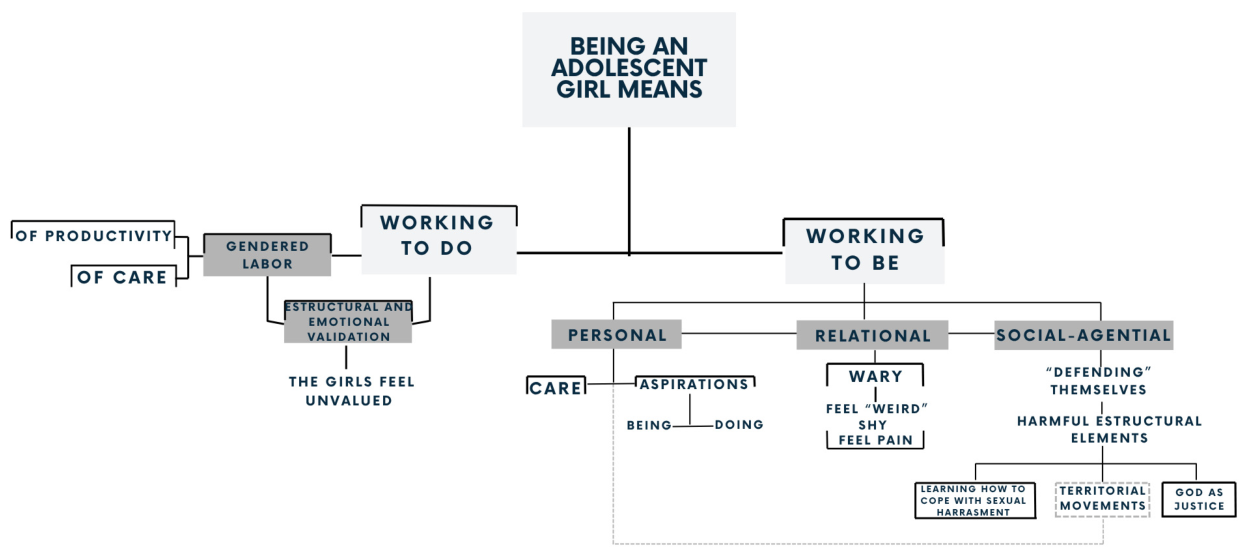
The central finding of this study is encapsulated in the participant-led formulation: “Being a woman is a lot of work” (Ser mujer es mucho trabajo). During a collective discussion, Clarita took a marker and wrote the phrase on the board without hesitation, an act met with immediate consensus and shared laughter from the other girls. This phrase echoed recurring references from previous conversations, including waking early for agricultural tasks, caring for younger siblings, managing household responsibilities, and navigating communal social expectations. Rather than describing their lives through the lens of childhood or adulthood, the participants consistently centered labor as the defining feature of their everyday experience. These articulations emerged into two primary themes: “Working to Do” and “Working to Be,” which are visually represented in the thematic framework below (Figure 1).
Figure 1.
Thematic framework of laboring subjectivity. Note: Solid lines indicate the primary thematic dimensions and their core constituent categories. Dashed lines represent overlapping conceptual boundaries, indicating that certain categories are non-mutually exclusive and can dynamically be in the other categories.
3.1. Working to Do
The first theme, “Working to Do,” captures a dual dynamic: the execution of gendered labor and the simultaneous experience of social devaluation that accompanies these communal expectations. This theme is structured across two primary categories. First, it encompasses the embodied responsibilities of productivity and care performed for the family, examining the tensions within the sphere of primary affective relations. Second, it analyzes how this continuous “doing” fails to yield proportional communal status, thereby addressing deficits in recognition within the sphere of social esteem.
To examine this first category of gendered labor, it is necessary to consider the normative framework articulated by the adult generation. Don Elias, a father in the community, stated that daughters “belong to the mom,” while sons “belong to the fathers” (Conversation with Don Elias, 28 February 2024). This logic dictates that fathers instruct their sons in male tasks, while mothers transmit the daily routines and communal expectations to their daughters. This structure establishes an intergenerational pattern of social reproduction that determines the division of labor and communal roles, a dynamic explicitly illustrated in the participants’ GLST maps.
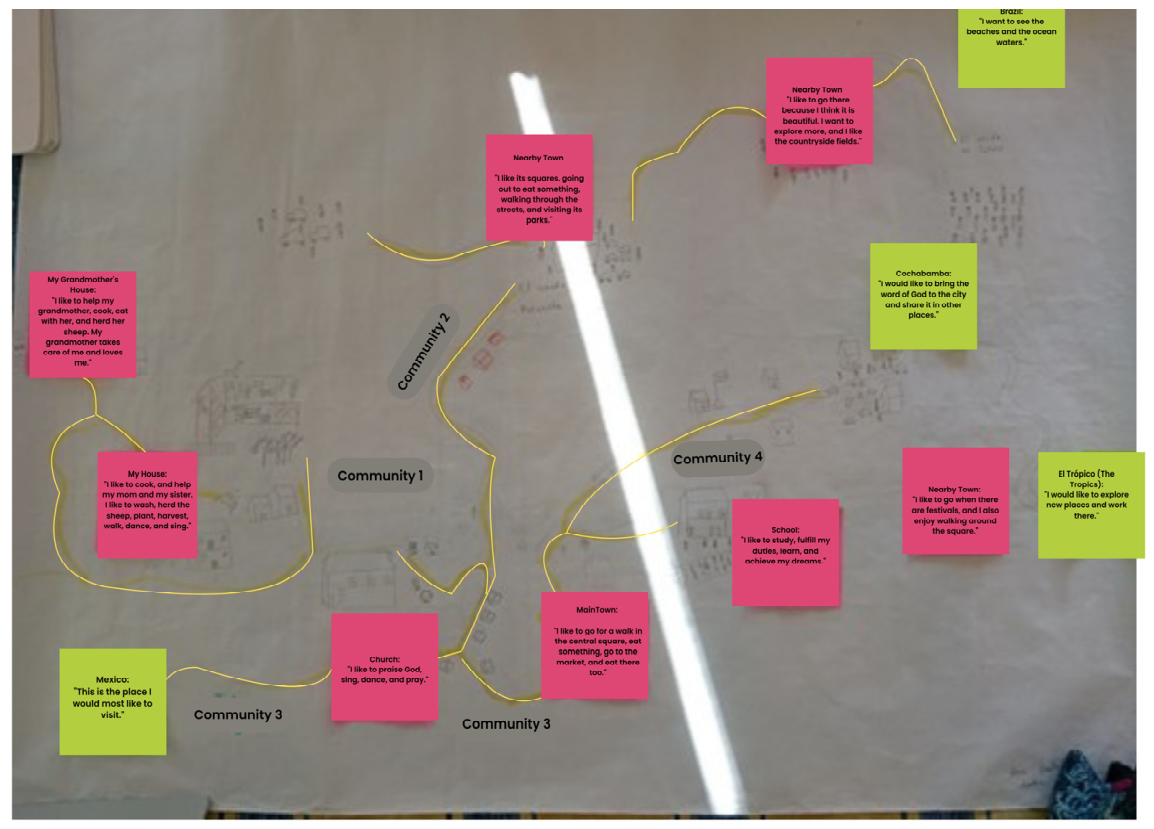
As illustrated in Anahi’s GLST map (Figure 2), the girls perceive their community as a network formed by kinship and historical migratory flows. Within this network, the home emerges as a primary pedagogical space where girls learn the roles and expectations imposed by the rural gender order. Anahi, for example, identifies her house as a site of affection where she helps her mother and sister with cooking, washing, and agricultural labor. This pattern reveals an intergenerational labor regime maintained through the female line, which encompasses two distinct categories: physical labor and care labor.
Figure 2.
Anahi’s geographical life-storytelling map1. Note: Original field data has been digitized for visual legibility, with specific geographic location names anonymized to protect participant confidentiality. Yellow lines represent daily walking routes and local pathways; icons represent households and community spaces.
On the one hand, physical labor supports the household economy through agricultural work, including cutting oats, digging potatoes, and harvesting, without direct financial compensation, as the participants navigate these tasks as an inherent familial obligation. On the other hand, care labor is also part of their gendered expectations. When discussing her daily life, Ilaria highlighted how this role translates into an asymmetric disciplinary burden placed on daughters:
Researcher: How do you get along with your parents?
Ilaria: Just fine, they understand me. Sometimes they just blame me for everything.
Researcher: Why?
Ilaria: My brothers do something, and [my parents] blame me.
Researcher: What do they say?
Ilaria: They just scolded me.
As Ilaria’s account demonstrates, their responsibilities include not only physical labor but also the affective duties of caring for and overseeing their siblings’ behavior. Within this rural context, emotional inclusion and familial love are structurally tethered to material and moral utility, showing how the relational dynamics of the family sphere are bound to these labor expectations. While the domestic space offers a baseline of primary affective recognition, as Anahí stated, this emotional validation is highly conditional, requiring the girls to simultaneously shoulder heavy economic burdens and asymmetrical moral expectations for their households to function.
“Mariana told me that she won’t be able to come to our Saturday meetings because she has to take care of her siblings and do laundry. She told me that her parents, or well, actually, her dad, doesn’t want her to come to the Saturday meetings very much” (Field notes, 28 February 2024). This was a current situation for them. They needed the girls to work on Saturdays so that the household would function, the parents could work, the animals would be fed, and the kids would be cared for. Thus, when girls did attend, they often brought their younger siblings, fostering a collective practice of care. “They all keep an eye on the baby. They give him food, they fix his small wool hat, they take care of him (Field notes, 2 December 2023). Caring and loving in the community is not just individual labor but an affective recognition of others so that the community can endure. However, there is a structural deficit that lies in the fact that the household relies on this emotional attentiveness to function, even when the girls have personal needs. Their labor enabled parents to continue working and younger siblings to be cared for as part of a communal social reproduction. Their responsibilities extended beyond physical tasks and included emotional attentiveness and constant availability.
Structural and Emotional Gendered Suffering
“Doing” things in the community also made them feel undervalued and misrecognized. This corresponds to the second category of structural and emotional validation. They described being recognized for working hard, yet simultaneously being compared unfavorably to boys.
Ilaria: I like to work. I would have liked to be a man.
Researcher: Why?
Ilaria: I don’t know, so that I wouldn’t suffer anymore.
Within the community, the girls expressed exclusion elements as part of their suffering as girls: machismo and sexual abuse. This systematic exposure to threat marks a distinct transition from a lack of communal esteem to a direct vulnerability within the sphere of rights, specifically regarding their bodily integrity and physical protection. These perceptions are formed within family interactions and in their communities.
Clara explained that she avoids dressing as a cholita, with traditional skirts and braids usually worn by Andean women, because men “check you out more” in that attire (Field notes, 30 March 2024).
“Then we saw a cholita with a phosphorescent orange skirt. I told her, ‘What a pretty pollera.’ [She replied] ‘Yes, isn’t it?’ [I asked] ‘How do you choose if you want to be a cholita? Why didn’t you choose?’ [She answered] ‘They check you out a lot when you are a cholita… just like that… they look at you a lot. Yes, they look at you a lot… but in my Senior year I will go out as a cholita” (Field notes, March 2024).
By choosing to dress as señoritas, the girls strategically attempt to minimize visibility and harassment, though they still face fear when walking home alone. The traditional indigenous attire brings a hyper-visibility characterized by an intrusive, predatory gaze (“they check you out a lot”). To protect their right to unharassed physical mobility, the girls employ an aesthetics of opacity, using Western clothes to blend into the town’s landscape and minimize vulnerability. Crucially, however, this defensive posture does not signify an absolute erasure of identity; the insistence on “going out as a cholita” during graduation highlights a resistance to permanent assimilation. The participant subverts the predatory implications of the everyday gaze by choosing to claim her cultural identity during a structured, communal ritual where her presence must be recognized through community prestige rather than sexualized utility.
This vulnerability is grounded in a reality of pervasive violence; in one focus group, all participants reported experiences of sexual abuse, often disclosing these events only to their mothers due to a fear of communal disbelief.
The girls stated that they eventually learned how to defend themselves against group and sexual abuse: “Now, since we’ve gotten older, they can’t do much; we have a little more strength.
3.2. Working to Be
Beyond communal obligations, the participants described significant efforts to construct their own identities. This subjective labor of “Working to Be” is categorized into three elements: personal, relational, and agentic. For these adolescent girls, “who they are” is deeply intertwined with their navigation of structural exclusions, their capacity for resistance, and their evolving self-perception, reflecting a deliberate struggle to claim the personal confidence, rights, and social value that the local order denies them.
Within personal labor, the first category of this element is care for the self, which is sustained through paid work. As detailed in Table 1, nearly all participants have engaged in geographical mobilizations, primarily to “El Trópico,” a region in Cochabamba known for coca cultivation. These journeys, typically lasting two weeks to a month, represent a significant shift from the “Working to Do” regime. In El Trópico, labor is converted into direct income, providing a sense of acknowledged value that is often absent in the unpaid domestic sphere of the home community.
Daniela highlighted this contrast, noting that while the community demands constant unpaid work, migration offers a space to “live well and be happy” “She told me that in Chapare [El Trópico] she earned 1300 Bs in a month. Each pound of coca she harvests costs 1 Bs. With that money, she bought her cell phone” (Field notes, October 2023). For these girls, earning money is a primary “integration strategy” that allows them to purchase smartphones, which serve as essential tools for managing their digital identities. “Clarita and Mariana were taking pictures of themselves, Ilaria also takes pictures with her hand on her face, making a peace sign… Mariana was putting filters… All the photos they take are with a filter app” (Field notes, March 2024). During one Saturday session, the girls spent considerable time comparing photographs, adjusting filters, and discussing which images were suitable to upload as WhatsApp statuses. What initially appeared to be playful interaction gradually revealed itself as a form of identity work, through which they actively negotiated how they wished to be seen by peers, relatives, and potential future partners. Through selfies, filters, and WhatsApp stories, they curate a self-image that transcends their roles as rural laborers. The use of music, from reggaeton to Sayas (Andean folk music), and the consumption of YouTube content further facilitate this process of self-recognition and emotional well-being. While digital practices such as smartphone use and social media engagement also contribute to identity construction, these remain materially dependent on the economic possibilities generated through labor.
The second category of their personal labor is oriented toward the future through their aspirations. On a subjective level, they do not merely want to work; they aspire to be recognized as good workers, to cultivate kindness, and to leave their past behind. Regarding their sense of being, they have dreams: “I want to be myself and stop comparing to others or to what others say about me” (Field notes, 27 July). This inner aspiration to be is mutually dependent on what they plan to do. During another conversation, Daniela explained that migration represented more than income generation. Reflecting on her future, she stated: “I want to see other places and learn things on my own. Here, everyone already knows you.” Her comment highlights how mobility was imagined not only as movement through space but also as an opportunity to redefine oneself beyond established community expectations.
On the other hand, they have dreams of what they will do when they grow older, such as traveling to Brazil to work as sewers, or to Argentina to sell fruit and vegetables, or to Cochabamba to study. Migration is central to how they envision their future; consequently, their future labor and geographical mobility (“doing”) are not merely economic strategies, but the very mechanisms that will enable them to construct an autonomous, recognized self (“being”).
Relational labor is characterized by a “wary” posture shaped by the community’s structural exclusions. The girls often struggle to articulate complex emotions, frequently using the term “weird” (raro) to describe feelings of sadness, anger, or fear. This affective ambiguity often prevents them from engaging in daily life with confidence.
Shyness and the physical act of covering their faces with masks or hands during social interactions serve as protective mechanisms against the community’s “social conservatism” and gossip. During several meetings, participants physically covered their faces when speaking about personal matters, often laughing before answering questions about relationships, aspirations, or experiences of harassment. The gesture repeatedly appeared across interactions and was frequently mirrored by other girls, suggesting a shared repertoire for navigating vulnerability in public settings. Laughter also serves a dual purpose: it is used both as a nervous coping mechanism and as a tool for mockery or resistance against those who have treated them poorly. As recorded in field notes from April 2024, laughter can be a form of agency, used to “mock” those who attempt to enforce reputational constraints. “I also laughed at her yesterday, I called her a brat (mocosa)” (ethnographic field notes, April 2024). Laughter is not merely an internal emotional escape, but a relational tool used to subvert local social surveillance actively.
The final dimension of this subjectivity is social-agential labor, observed in the girls’ daily resistance to violence and their long-term migratory aspirations. Agency is manifested in the “work of defending oneself,” where the girls share strategies for responding to harassment and physical threats. Maria and Clara emphasized the necessity of “screaming loud and running” to counter the threat of sexual violence (Focus group, February 2024). Daniela further contextualized this defensive awareness as an inevitable condition of growing up in the community: “Now, when we are older, they can’t do much; we have a little more strength. Some little girls walk without knowing it’s like this”.
Crucially, framing this self-defense purely as individual agency must not obscure the severe structural failure it represents; because the communal and legal order fails to guarantee their basic right to physical safety, the moral burden of protecting their bodily integrity is violently shifted onto the girls themselves. Daniela’s reflection highlights that the “strength” and self-defense tactics the girls develop are compulsory adaptations to threat rather than autonomous choices.
In parallel with physical resistance, the girls employ “spiritual resilience” by positioning God as the ultimate source of justice and love. In a community marked by misrecognition, God is perceived as an escape route and a source of comfort. Anahi noted that feeling God’s presence makes her “feel happy” even when circumstances are “bad” (Interview, Anahi, October 2023). References to prayer and divine protection also emerged during discussions about fear and uncertainty. When reflecting on difficult situations, several participants spontaneously invoked God as a source of strength, comfort, or guidance, particularly when other forms of support appeared unavailable. This spiritual orientation functions as an alternative relational anchor; when human networks fail to offer safety, the divine space operates as an absolute extension of the sphere of love, providing an unconditional validation of their worth that protects them from internalizing communal devaluation.
Ultimately, the transition from “Working to Do” to “Working to Be” represents the girls’ attempt to move from a state of invisible reproductive labor to one of symbolic and economic recognition. Whether through the direct wages of El Trópico, the curated selfies on a smartphone, or the aspirational migration to Brazil, these girls are engaged in a constant subjective struggle to claim a value that the local rural order systematically denies them.
4. Discussion
This article sought to understand, in collaboration with adolescent girls, the lived experience of adolescence within a rural community. The findings indicate that adolescence in this context is not primarily experienced as a transitional life stage, but as a formal incorporation into a rigorous labor regime [16]. The girls’ articulation that “Being a woman is a lot of work” dialectically exposes the material and intersubjective dimensions of this condition: first, that work organizes their everyday practices (“Working to Do”) and second, that their identity is a continuous process shaped through embodied activity, relational positioning, and the conflictual search for recognition (“Working to Be”) [26]. Following Ames [27], identity for rural girls entails negotiation and positions that require constant subjective effort to navigate social constraints. In this study, this is interpreted as a lack of recognition that interacts with the girls’ strategic responses to misrecognitions [28], most visibly manifested in their participation in circular migration.
For Honneth, identity formation is constructed through a dialogic process with others; in this case, this is seen in the “Working to Do” sphere which refers to the labor through which girls sustain family and community life [16,18]. This is a physical and embodied practice in which their houses and communities become a pedagogy of who they have to be, where they are recognized as women through “doing” productive and care work [18,29]. In James Fraser’s words [30], this could be understood as intersubjective recognition. As studies on rural labor and social reproduction have shown, women’s work frequently merges productive, reproductive, and affective spheres as part of how they are, not just what they “do” [2,12]. In this case, adolescent girls assume roles that closely resemble those of adult women, merging productive, reproductive, and affective labor, as Federici explains. While this performance fulfills a clear function within the community’s division of labor, which theoretically serves as the primary source of social esteem [15], in reality, this unremunerated labor compromises their spheres of love and rights, which we define as misrecognition.
Honneth’s recognition framework [17] is thus required to unpack the relational misrecognitions operating within this “Working to Do” sphere, capturing how a space defined by systemic domestic extraction (Federici) simultaneously destabilizes the girls’ intersubjective well-being. This intersection highlights the ch’ixi character of their laboring subjectivity, where the physical demands of reproductive work and the subjective pursuit of recognition coexist as a mottled, non-reconciled condition within the same domestic space.
Within the rural agrarian household, Honneth’s spheres of love and solidarity collapse into a single domain because the family functions simultaneously as an emotional and a production unit. Consequently, the girls’ social esteem, which conceptually belongs to the sphere of solidarity, is measured directly inside the primary affective unit through what Federici conceptualizes as affective labor. The girls feel loved by their mothers, but this validation is tethered to their performance within the household labor regime. Because their capacity for care is extracted to sustain the family economy, personal valuation becomes contingent on their work as sibling caretakers and physical laborers [31]. Rather than receiving emotional support or relief, this fatigue is normalized as a gendered obligation. The girls absorb the physical exhaustion required to sustain communal life [32], while the familial order defaults on recognizing their physical limits and well-being.
Yet this incorporation into communal labor does not translate into full social recognition within Honneth’s sphere of rights [17]. The girls are valued insofar as they fulfill expectations, but they remain exposed to machismo, harassment, and sexual violence. Within this “Working to Do” framework, the sphere of rights operates as a site of structural exclusion. The state’s protective apparatus is not entirely absent; several girls have actively initiated formal complaints with the Defensoría de la Niñez [Municipal Child Protection Office]. However, these institutions are geographically remote from their rural communities, and continuing the legal process sometimes requires the adolescents to travel to the city.
This institutional friction highlights a critical limit in regional recognition theory. James Fraser [30] argues that vulnerable subaltern populations in Latin America can leverage the sphere of rights to actively contest misrecognition. However, this framework assumes an adult capacity for political or legal mobilization. For Andean adolescent girls, the intersection of age, gender, and geographic isolation strips them of this authority. Their age does not shield them; instead, it positions them in a liminal space where they carry adult responsibilities without adult status or protection [7]. Consequently, while James Fraser [30] theorizes subaltern agency as an outward, institutional claim to formal state rights, the legal minority of these adolescent participants restricts such political visibility, meaning their resistance cannot manifest through formal structural channels but must instead be generated inwardly through subjective spaces of self-preservation. The intersection of age and gender structures a state of double misrecognition [33]: they are not treated as children deserving protection in their own households, nor fully recognized as adult women with social standing.
The intersection of age and gender thus structures their vulnerability [34]. Consequently, “Working to Do” sustains the physical community but fails to provide the girls with a sense of being rights-bearing, socially valued subjects. Because these three foundational spheres (love, rights, and solidarity) are systematically compromised, a critical departure from existing literature occurs. Fraser [30] posits that subaltern and indigenous populations in the Global South can actively claim recognition within these traditional intersubjective spheres and formal legal frameworks. For Andean adolescent girls, however, the structural violation of these external channels necessitates the “Working to Be” dimension, where they actively construct alternative pathways to achieve recognition. This can be understood as a ch’ixi condition in which both dimensions of labor coexist as part of their everyday experience: their gendered labor in their traditional rural space and their search for self-recognition in their “new ruralities” through circular migration. Ultimately, if “Working to Do” sustains communal life, “Working to Be” sustains the self.
This dimension encompasses emotional management, relational negotiation, aspiration, and strategies of visibility and protection. Crucially, “Working to Be” operates as a form of recognition by shifting from an external demand to an autonomous practice. Drawing on Fraser’s [30] in Fanon, when marginalized subjects face total subjection by an objectifying gaze, they must engage in the radical autonomy of self-recognition to overcome alienation. This dynamic mirrors wider gendered frameworks in the Global South, which emphasize the need to view subaltern actions not as unconstrained choices, but as adaptive strategies to heavily constrained circumstances [35]. The girls’ accounts of shyness, guardedness, laughter, and mutual support illustrate that this self-recognition is not automatic but requires effort. The girls invest subjective labor in managing their reputations and protecting their sense of worth [26].
“Working to Be” also involves projecting oneself into possible futures. Their references to studying, migrating, or working abroad resonate with the idea of possible selves [36] and migratory imaginaries [37]. These projections are grounded in the observed trajectories of their peers and elders, making aspiration itself a form of work where girls must imagine and justify futures that exceed local constraints.
Circular migration occupies a pivotal position at the intersection of these two dimensions. Economically, the “Working to Do” dimension contributes to household survival and allows for continued participation in rural life, aligning with Federici’s observations on reproductive labor [16]. In particular, the findings highlight how labor operates as a site of subject formation already during adolescence, prior to full incorporation into adult gendered roles. While Federici views this labor primarily as a site of exploitation and the “enclosure” of women’s bodies, for rural adolescent girls, labor is also an existential terrain materialized through migration, intensifying “Working to Be.” Mobility does not signify a clean rupture from communal constraints, but rather an expression of their ch’ixi spatial reality, where market-driven wage generation and traditional reproductive obligations are inhabited concurrently without fusing.
In El Trópico, girls earn direct income and temporarily reposition themselves outside the community’s immediate gaze, providing moments of economic and symbolic recognition [38]. Migration allows them to demonstrate capability and “prove,” both to others and to themselves, their worth [39]. Through mobility, they retain direct ownership over their own labor power. Therefore, this labor functions as their material currency to secure a state of being and command recognition within Honneth’s spheres. As Bastia suggests, migration can function as a response to gendered injustice, yet here it remains embedded in agricultural labor circuits and does not fully dismantle structural inequalities [32], a dynamic that mirrors wider scholarship in the Global South demonstrating how structural vulnerability and deep-seated scarcities shape and constrain women’s mobility and survival strategies [35].
Ultimately, “Working to Do” and “Working to Be” reveal that labor is not merely an economic activity these girls perform; it is the primary matrix through which their subjectivities are structured. While “Working to Do” extracts their physical and affective labor to sustain the material survival of the agrarian household and community, it systematically fails to provide them with the foundational spheres of recognition. Within this structural vacuum, the “Working to Be” dimension emerges as a reactive strategy to navigate a profound recognition gap. Adolescence for rural Andean girls, therefore, emerges not as a linear, transitional phase between childhood and adulthood, but as a fundamentally ch’ixi laboring condition, where the bodily compliance to communal extraction and the spatial pursuit of self-recognition coexist as an everyday reality. In other words, their contradictory roles as daughters, caretakers, students, and seasonal migrants coexist within a heterogeneous rural order, subjectivities that do not displace or fuse into one another, but are lived out concurrently.
By centering adolescent girls as active laboring subjects rather than peripheral dependents, this analysis demands a paradigm shift in youth and migration scholarship away from future-oriented developmental stages and toward present-tense conditions of subaltern mobility. Circular migration is not simply an economic adjustment strategy; it becomes a terrain where recognition, aspiration, and inequality are negotiated during adolescence itself. In this sense, rural adolescent migration is not premature adulthood, but constitutive of girlhood within gendered rural orders.
5. Conclusions
In conclusion, adolescence for rural Quechua girls is not a neutral developmental stage, but a laboring condition that fundamentally shapes their laboring subjectivity. This condition is defined by a ch’ixi reality where “Working to Do” and “Working to Be” exist in constant, dynamic interaction. Within the community, “Working to Do” encompasses not only productive agricultural tasks but also unremunerated affective labor that is naturalized as a form of cultural pedagogy. Through this structural arrangement, Honneth’s spheres of love, rights, and social esteem are systematically compromised, disrupting the role that labor should ideally play in positive identity formation. In response, the girls exercise their agency through “Working to Be,” utilizing migratory movements to El Trópico as an autonomous strategy to seek validation and reclaim the recognition denied to them within the household and community order.
These findings both resonate with and extend existing research on rural youth mobility in Bolivia and Latin America. Previous studies have largely interpreted adolescent migration as a livelihood strategy, a transition to adulthood, or a response to structural vulnerability. While the present study confirms the importance of these dynamics, it suggests that such interpretations remain incomplete. Migration emerged not only as an economic practice but also as a process through which girls seek recognition, autonomy, and self-construction. By foregrounding the subjective dimensions of labor and mobility, the study demonstrates that migration is simultaneously material and symbolic, shaping both livelihoods and identities.
By placing these dynamics within a global context, this study demonstrates that while the girls’ circular mobility mirrors gendered survival strategies under precarity in the Global South, their intersectional positioning (as underage, female, and rural minors who are treated as adults) complicates subaltern frameworks that assume an unproblematic capacity for formal legal or political mobilization.
As the initial phase of an ongoing longitudinal project, this study is necessarily limited by its focus on a single Quechua community and by its emphasis on one stage of the participants’ life trajectories. Future research will follow these adolescents over time to examine how laboring subjectivities evolve through educational transitions, migration trajectories, family formation, and entry into adulthood. Comparative research across different rural regions and indigenous communities would further clarify which dimensions of “Working to Do” and “Working to Be” are context-specific and which reflect broader patterns of rural girlhood across Latin America. Such research would contribute to a deeper understanding of how labor, mobility, and recognition interact across the life course.
The findings also carry important implications for policy and practice. Existing interventions often focus on poverty reduction, educational access, or migration management while overlooking the unpaid reproductive and affective labor that structures girls’ everyday lives. Policies aimed at improving adolescent well-being in rural contexts must therefore move beyond formal institutional responses and recognize girls as active social actors whose contributions sustain households and communities. Strengthening locally accessible mechanisms of protection, psychosocial support, and meaningful participation is essential if adolescent girls are to be recognized not only for what they do, but also for who they are.
Author Contributions
Methodology, C.J.-S. and G.L.; formal analysis, C.J.-S.; investigation, C.J.-S.; data curation, C.J.-S.; writing—original draft preparation, C.J.-S.; writing—review and editing, T.B. and G.L.; validation, T.B.; visualization, C.J.-S.; supervision, T.B. and G.L.; project administration, G.L. and C.J.-S.; funding acquisition, C.J.-S. All authors have read and agreed to the published version of the manuscript.
Funding
This research was funded by the VLIR-UOS (Vlaamse Interuniversitaire Raad) and the Universidad Católica Boliviana “San Pablo” (UCB), grant number BO2022IUC034A105. The APC was funded by the Vrije Universiteit Brussel (VUB) Open Access Fund.
Institutional Review Board Statement
Ethical review and approval were waived for this study because, at the time of data collection, the host institution in Bolivia did not have an established Institutional Review Board (IRB) or Ethics Committee for the Social Sciences. However, the study was conducted in strict accordance with the Declaration of Helsinki and international ethical standards for research with minors. The research followed a robust internal ethical protocol, including written parental consent and adolescent assent, and was supervised by the doctoral committee at Vrije Universiteit Brussel (VUB) and the Universidad Católica Boliviana "San Pablo" to ensure the protection and anonymity of all participants.
Informed Consent Statement
Written Informed consent and assent were obtained from all participants involved in the study.
Data Availability Statement
The data presented in this study are available on request from the corresponding author. The data are not publicly available due to privacy and ethical restrictions, as they involve sensitive ethnographic accounts from minor participants in a small rural community.
Acknowledgments
The authors would like to thank the adolescent girls of the community for their trust and active participation in this research. We also acknowledge the support of the District Education Office. During the preparation of this manuscript, the authors used Gemini (3 Flash) for the purposes of structural refining and academic tone adjustment. The authors have reviewed and edited the output and take full responsibility for the content of this publication.
Conflicts of Interest
The authors declare no conflicts of interest.
Abbreviations
The following abbreviations are used in this manuscript:
| CBPR | Community-Based Participatory Research |
| UCB | Universidad Católica Boliviana “San Pablo” |
| VUB | Vrije Universiteit Brussel |
| ENNA | National Survey of Children and Adolescents (Encuesta Nacional de Niñas, Niños y Adolescentes) |
Note
| 1 | Digital schematic overlay of Anahi’s hand-drawn geographical life-storytelling map. Original field data has been digitized for visual legibility, with specific geographic location names anonymized to protect participant confidentiality. Yellow lines represent daily walking routes and local pathways; icons represent households and community spaces. |
References
- UNICEF. Child Protection Thematic Report 2018: Bolivia; UNICEF: La Paz, Bolivia, 2018; Available online: https://open.unicef.org/sites/transparency/files/2020-06/Bolivia-TP5-2018.pdf (accessed on 3 June 2026).
- Casazola, F.L. El trabajo y la actividad laboral en Bolivia. Cuad. Investig. Económica Boliv. 2022, 5, 7–44. [Google Scholar]
- Fontana, L.B. Indigenous Peasant ‘Otherness’: Rural Identities and Political Processes in Bolivia. Bull. Lat. Am. Res. 2014, 33, 436–451. [Google Scholar] [CrossRef] [Scilit]
- Cusicanqui, S.R. Ch’ixinakax Utxiwa: A Reflection on the Practices and Discourses of Decolonization. South Atl. Q. 2012, 111, 95–109. [Google Scholar] [CrossRef] [Scilit]
- Instituto Nacional de Estadística Indicadores de Migración Interna Reciente para la Población de 5 a 17 Años de Edad. Available online: https://nimbus.ine.gob.bo/index.php/s/bJ2yZCsamXYbTfe (accessed on 30 March 2026).
- Daza, W.G.I. Jóvenes rurales: Exploraciones conceptuales y vivenciales en becarias/os universitarias/os. Millcayac-Rev. Digit. Cienc. Soc. 2020, 7, 223–248. [Google Scholar]
- Díaz, M. Las Migraciones, Movilizaciones y Desplazamientos Internos Durante la Niñez, la Infancia y la Adolescencia en Perú y Bolivia. 2020. Available online: http://repositorio.pucp.edu.pe/index/handle/123456789/172966 (accessed on 3 June 2026).
- Durán, N.A. Juventud rural y futuros posibles. Inclusión social, transiciones y expectativas de la juventud de Tiraque (Cochabamba). Rev. Con-Sci. Soc. 2024, 16, 9–24. [Google Scholar] [CrossRef] [Scilit]
- Santibañez, C.; Calle, I. Mujeres Adolescentes Afectadas Por La Migración En Bolivia: Hacia Políticas de Protección de Los Derechos de Hijos e Hijas de Migrantes. Rev. Umbr. Cs. Soc. 2011, 22, 21–40. [Google Scholar]
- Ramirez, A. Retorno y Ciudadanias Transnacionales, 1st ed.; Universidad Mayor de San Simón: Cochabamba, Bolivia, 2012; ISBN 978-99954-2-580-7. [Google Scholar]
- Camarero Rioja, L.A.; Oliva Serrano, J. Las trabajadoras invisibles de las áreas rurales: Un ejercicio estadístico de estimación. EMP 2004, 7, 159. [Google Scholar] [CrossRef] [Scilit]
- Mascheroni, P.; Alberti, A.; Ángulo, S. Edtado Del Arte Sobre Cuidados En Contextos de Ruralidad En América Latina y El Caribe; ONU Mujeres: Ciudad de Panamá, Panamá, 2023. Available online: https://lac.unwomen.org/es/digital-library/publications/2023/01/estado-del-arte-sobre-cuidados-en-contextos-de-ruralidad-en-america-latina-y-el-caribe (accessed on 3 June 2026).
- Calle Quispe, V.S.; Bascopé Guzmán, H. Dimensión psicosocial líquida en los flujos rurales urbanos: Miradas desde la adolescencia en Viacha—Bolivia. Rev. Estud. Reg. 2024, 1, 146–161. [Google Scholar] [CrossRef] [Scilit]
- Israel, B.; Eng, E.; Amy, S. Methods in Community-Based Participatory Research for Health; John Wiley & Sons: San Francisco, CA, USA, 2005; ISBN 13 978-0-7879-7562-3. [Google Scholar]
- Angella, M. Work, Recognition and Subjectivity: Relocating the Connection between Work and Social Pathologies. Eur. J. Soc. Theory 2016, 19, 340–354. [Google Scholar] [CrossRef] [Scilit]
- Federici, S. Revolution at Point Zero: Housework, Reproduction, and Feminist Struggle; Common Notions: Autonome-dia; Turnaround [distributor]; PM Press: Oakland, CA, USA; Brooklyn, NY, USA; London, UK, 2012; ISBN 978-1-60486-333-8. [Google Scholar]
- Honneth, A. The Struggle for Recognition: The Moral Grammar of Social Conflicts. In Studies in Contemporary German Social Thought, 1st ed.; MIT Press: Cambridge, MA, USA, 1996; ISBN 978-0-262-58147-9. [Google Scholar]
- Amaral, A.I. Identity, Work, and Mobility amongst Bolivian Market Vendors in El Alto and São Paulo. Doctoral Dissertation, University of Essex, Colchester, UK, 2018. [Google Scholar]
- Instituto Nacional de Estadística (INE). Indicadores de Migración Interna Reciente para la Población de 5 o Más Años de Edad, según Departamento, Provincia, Municipio o Territorio Indígena Originario Campesino (TIOC) y Sexo, Períodos 1996–2001, 2007–2012 y 2019–2024, Censos 2001, 2012 y 2024; INE: La Paz, Bolivia, 2024. Available online: https://www.ine.gob.bo/index.php/estadisticas-sociales/migracion-interna/ (accessed on 3 June 2026).
- Malterud, K.; Siersma, V.D.; Guassora, A.D. Sample Size in Qualitative Interview Studies: Guided by Information Power. Qual. Health Res. 2016, 26, 1753–1760. [Google Scholar] [CrossRef] [Scilit] [PubMed]
- Jerolmack, C.; Khan, S.R. (Eds.) Approaches to Ethnography: Analysis and Representation in Participant Observation; Oxford University Press: New York, NY, USA, 2018; ISBN 978-0-19-023604-5. [Google Scholar]
- Kusenbach, M. Street Phenomenology: The Go-Along as Ethnographic Research Tool. Ethnography 2003, 4, 455–485. [Google Scholar] [CrossRef] [Scilit]
- Barragán Giraldo, D.F. Cartografía social pedagógica: Entre teoría y metodología. Rev. Colomb. Educ. 2016, 1, 247–285. [Google Scholar] [CrossRef] [Scilit]
- Loots, G.; Fernandez-Cediel, M.C. A Geo-Narrative Perspective on Doing Research with Youth at Social Risk; University of Malta: Valletta, Malta, 2020; Available online: https://storage.googleapis.com/smooty-1220.appspot.com/uploads/4112/1601647944_ECQI2020abstractbookeditionMalta.pdf (accessed on 3 June 2026).
- LaRossa, R. Grounded Theory Methods and Qualitative Family Research. J. Marriage Fam. 2005, 67, 837–857. [Google Scholar] [CrossRef] [Scilit]
- Vignoles, V.L.; Schwartz, S.J.; Luyckx, K. Handbook of Identity Theory and Research; Schwartz, S.J., Luyckx, K., Vignoles, V.L., Eds.; Springer: New York, NY, USA, 2011; ISBN 978-1-4419-7987-2. [Google Scholar]
- Ames, P. Constructing New Identities? The Role of Gender and Education in Rural Girls’ Life Aspirations in Peru. Gend. Educ. 2013, 25, 267–283. [Google Scholar] [CrossRef] [Scilit]
- Alves, M.Z.; Dayrell, J.T. Transnacionalismo, juventude rural e a busca de reconhecimento. Educ. Pesqui. 2015, 41, 1455–1471. [Google Scholar] [CrossRef] [Scilit]
- Besen-Cassino, Y. The Cost of Being a Girl; Temple University Press: Philadelphia, PA, USA; Rome, Italy; Tokyo, Japan, 2018; ISBN 978-1-4399-1350-5. [Google Scholar]
- Fraser, J.A. Amazonian Struggles for Recognition. Trans. Inst. Br. Geog 2018, 43, 718–732. [Google Scholar] [CrossRef] [Scilit]
- Costa, A.P.M. Os Limites ao Reconhecimento de Adolescentes e seus Contextos Jurídicos Culturais—Uma Ilustração com o Caso Brasileiro (The Limitations on the Recognition of Adolescents and their Legal Cultural Contexts—An Ilustration of the Brazilian Case). Onati Socio-Leg. Ser. 2016, 6, 454–476. [Google Scholar]
- Bastia, T. Women’s Migration and the Crisis of Care: Grandmothers Caring for Grandchildren in Urban Bolivia. Gend. Dev. 2009, 17, 389–401. [Google Scholar] [CrossRef] [Scilit]
- Amer, A.; Obradovic, S. Recognising Recognition: Self-other Dynamics in Everyday Encounters and Experiences. J. Theory Soc. Behav. 2022, 52, 550–562. [Google Scholar] [CrossRef] [Scilit]
- Collins, P.H.; Da Silva, E.C.G.; Ergun, E.; Furseth, I.; Bond, K.D.; Martínez-Palacios, J. Intersectionality as Critical Social Theo-ry: Intersectionality as Critical Social Theory, Patricia Hill Collins, Duke University Press, 2019. Contemp. Political Theory 2021, 20, 690–725. [Google Scholar] [CrossRef] [Scilit]
- Khofi, L.; Manderson, L.; Moyer, E. Food Insecurity, Intimate Partner Violence, and Barriers to Sexual and Reproductive Health Care among Women in Lorentzville, South Africa. Soc. Sci. Med. 2025, 369, 117785. [Google Scholar] [CrossRef] [Scilit] [PubMed]
- Markus, H.; Nurius, P. Possible Selves. Am. Psychol. 1986, 41, 954–969. [Google Scholar] [CrossRef]
- Rossi, T. The Construction of the Imaginary and Migratory Culture among Bolivians in Argentina. Cult. Latinoam. 2022, 35, 114–144. [Google Scholar]
- Punch, S. Negotiating Migrant Identities: Young People in Bolivia and Argentina. Child. Geogr. 2007, 5, 95–112. [Google Scholar] [CrossRef] [Scilit]
- Harper, C.; Jones, N.; Marcus, R.; Bantebya, G.K.; Ghimire, A. Empowering Adolescent Girls in Developing Countries: Gender Justice and Norm Change; Routledge: London, UK, 2018; ISBN 978-1-315-18025-0. [Google Scholar]

Disclaimer/Publisher’s Note: The statements, opinions and data contained in all publications are solely those of the individual author(s) and contributor(s) and not of MDPI and/or the editor(s). MDPI and/or the editor(s) disclaim responsibility for any injury to people or property resulting from any ideas, methods, instructions or products referred to in the content. |
© 2026 by the authors. Licensee MDPI, Basel, Switzerland. This article is an open access article distributed under the terms and conditions of the Creative Commons Attribution (CC BY) license.