


Abstract
In recent decades, Early Childhood Education has consolidated its role as a decisive stage for socio-emotional, identity, and moral development. However, attachment pedagogy, identity construction, and character education have traditionally been addressed through fragmented theoretical frameworks. The main aim of this article is to propose and theoretically ground an original pedagogical integration of these three constructs from the perspective of the Ethics of Care, offering a relational integrative model for Early Childhood Education. Through a theoretical analysis drawing on attachment theory, identity development, and moral education philosophy, a dynamic and interdependent model is proposed in which secure attachment supports identity construction, identity structures character, and character, in turn, reinforces the quality of relational bonds. The findings show that character education cannot be reduced to normative instruction but rather emerges progressively from lived educational experiences of care, recognition, and shared responsibility. Finally, practical implications are derived for the classroom, the school as an institution, and teacher training, aimed at fostering character education grounded in relational bonds, identity development, and human flourishing from early childhood.
1. Introduction
In recent decades, Early Childhood Education has attracted increasing interest in understanding children’s holistic development from perspectives that go beyond strictly cognitive dimensions and incorporate affective, social, and moral aspects. However, this theoretical progress has often been articulated through partially fragmented conceptual frameworks, particularly with regard to attachment theory, identity construction, and character education. Although each of these approaches has generated substantial contributions, their parallel development has hindered the formulation of truly integrative pedagogical models.
Furthermore, child development in early childhood must be understood within multiple and interacting ecological contexts. From an ecological systems perspective, children’s socio-emotional, identity, and moral development are shaped not only by educational settings but also by family relationships and broader social environments [1]. Although the present study focuses primarily on Early Childhood Education settings, it recognizes the foundational role of the family in shaping early relational experiences and developmental trajectories.
Attachment theory has highlighted the central role of early affective bonds in shaping emotional security and children’s socio-relational development [2,3]. Subsequent research has extended this framework to educational contexts, emphasizing the importance of attachment relationships in the classroom for self-regulation, engagement in learning, and socio-emotional adjustment [4,5]. From this perspective, stable and sensitive relationships with reference figures not only foster exploration of the environment but also constitute a fundamental condition for the development of interpersonal trust and emotional regulation.
In turn, theories of identity development have emphasized the dynamic, narrative, and social nature of the self, highlighting that identity is constructed through interaction with others and within culturally situated contexts [6,7,8]. This perspective is also aligned with approaches that emphasize the educational dimension of identity construction as a contextual and relational process [9]. It has been further reinforced by contemporary contributions that stress the relational dimension of identity and its development within educational settings, underscoring the role of pedagogical practices in shaping the sense of self [10].
At the same time, character education has addressed the formation of moral dispositions, habits, and virtues oriented toward life in community, emphasizing the integration of cognition, emotion, and behavior [11,12,13]. Recent research has highlighted the need for contextualized and comprehensive approaches that move beyond models focused exclusively on the instruction of values, incorporating relational dimensions and situated practices [14,15].
Despite the robustness of these developments, several authors have pointed to the need to overcome their isolated treatment and to advance toward approaches that coherently integrate the affective, identity, and moral dimensions of human development [16,17]. In this context, the Ethics of Care has emerged as a particularly fruitful theoretical framework for rethinking education in terms of relationality, interdependence, and responsibility [18,19,20]. This approach shifts the focus away from an individualistic conception of development toward a relational understanding of the subject, in which care acquires both interpersonal and ethical-social significance.
In a similar vein, the literature on educational commons has emphasized the importance of understanding educational processes as collective practices sustained by dynamics of cooperation, shared responsibility, and mutual commitment [21,22]. From this perspective, care is configured not only as a dyadic relationship between teacher and child but also as a social practice that articulates educational communities and contributes to the construction of the common good.
However, despite the integrative potential of these approaches, there remains a limited theoretical articulation that systematically connects attachment theory, identity construction, and character education within the field of Early Childhood Education. Likewise, current frameworks of socio-emotional learning and character education, although moving toward more holistic perspectives, do not always explicitly incorporate the deep affective foundations of development or the structuring role of attachment relationships in educational contexts.
In response to this gap, the present article proposes an integrative pedagogical model that articulates attachment, identity, and character within a relational framework inspired by the Ethics of Care. This model is based on the premise that attachment constitutes a relational foundation that significantly shapes the quality, coherence, and stability of identity construction, which in turn acts as an intermediate structure for the configuration of character as a set of relatively stable moral dispositions.
The specific contribution of this work lies in the systematic articulation of these three dimensions within a single conceptual framework. Unlike approaches that address socio-emotional development or character education in terms of relatively decontextualized competencies, the present proposal situates attachment relationships as the structural foundation of personal and moral development. Furthermore, it expands the understanding of relationality by integrating not only the interpersonal dimension of care but also its ethical and social projection in terms of shared responsibility and the construction of the common good.
In this way, the article does not merely offer a synthesis of existing theoretical frameworks but proposes a pedagogical reinterpretation of child development from a relational and integrative perspective. This approach provides a foundation for educational practices oriented simultaneously toward affective security, identity construction, and moral formation, contributing to the advancement of relational approaches in Early Childhood Education.
In addition, the model extends this relational perspective toward the early development of ethical citizenship, emphasizing how experiences of care, recognition, empathy, and shared responsibility in Early Childhood Education may contribute to children’s first forms of democratic coexistence and orientation toward the common good.
Beyond its theoretical contribution, the model is also intended to provide pedagogical orientations for educational practice in Early Childhood Education, particularly regarding relational climate, identity support, and character development.
Given the theoretical nature of this study, the article adopts a conceptual and interpretive integration approach aimed at systematically articulating attachment theory, identity development, and character education within a relational framework inspired by the Ethics of Care. Rather than testing hypotheses empirically, the study seeks to develop a coherent pedagogical model through theoretical synthesis and critical analysis of relevant literature. The analysis is guided by the following questions: (1) How can attachment, identity, and character be conceptually integrated within Early Childhood Education? and (2) What pedagogical implications emerge from such integration for educational practice and the promotion of ethical citizenship?
2. The Ethics of Care as a Relational Foundation of Moral Development
2.1. The Ethics of Care as a Foundation of Character Development
The pedagogy of care validates the child’s personal identity through attentive and responsive relationships, thereby laying the foundations for the development of a solid moral and civic character, beyond approaches that reduce teaching to mere instruction. This connection is established insofar as the experience of being cared for acts as a catalyst for essential virtues required for ethical and communal life. In this regard, recent studies indicate that the Ethics of Care in education is particularly effective in connecting with students by linking learning to their lived experiences [23].
From a theoretical standpoint, the Ethics of Care, as formulated by Gilligan [24], is grounded in the recognition of human vulnerability and the inherently relational and interdependent nature of human beings. Care is understood as a fundamental human capacity, encompassing both self-care and care for others. In contrast to exclusively rational models of moral development, Gilligan questions the sufficiency of Kohlberg’s theory of justice [25], arguing that it fails to fully capture the complexity of moral development. While justice is primarily associated with rational principles, care is articulated through emotions, embodied experience, and relational contexts.
This relational understanding of moral development also resonates with broader European pedagogical and ethical traditions. Contemporary educational perspectives increasingly emphasize that educational processes are constituted through relationships that support not only learning but also subject formation and responsibility [16]. Likewise, ethical traditions inspired by Levinas’ understanding of responsibility toward the Other reinforce the idea that moral development emerges through lived relationships and recognition rather than through abstract principles alone [26].
From an integrative perspective, Corbella and Úcar [23] advocate for a complementary position between justice and care. They argue that both approaches should be articulated in a way that allows for a more comprehensive understanding of human action and professional practice. Such integration prevents both unjust treatment of others and the neglect of those in situations of need. However, educational relationships grounded in care, recognition, and responsiveness must avoid falling into paternalistic or overly permissive dynamics. Rather, the educational profession must assume its caring function while maintaining critical and ethical rigor. Their findings highlight that practices grounded in care have a direct and positive impact on individuals.
In a similar vein, Gozálvez and Jover [21] point out that, since the 1990s, moral education has undergone a “sentimental turn,” characterized by an overemphasis on affectivity at the expense of cognitive dimensions. In response, they argue for an integrated approach to moral education that combines affect and cognition within the realm of practical knowledge. Educational actions aimed at moral development must therefore reconcile the demands of justice with sensitivity to the concrete needs and interests of individuals within specific cultural contexts.
From an applied perspective, educational approaches grounded in the Ethics of Care emphasize teaching as a genuine practice of care, fostering learning environments in which students can experience joy in learning, achievement, and personal recognition [16,17,23].
Similarly, O’Toole and Reynolds [27] emphasize that teacher–student relationships are not merely a contextual factor in moral education but a determining element in themselves. Based on international evidence, they show that daily interactions grounded in trust, respect, and care are essential for the internalization of values and the formation of responsible citizens. Character education thus takes place both in explicit programs and in everyday relational practice, where teachers act as moral models. The quality of interpersonal relationships fosters empathy, cooperation, and commitment.
In this regard, Lickona [12] argues that education cannot be limited to the transmission of knowledge and skills but must aim to form morally responsible and respectful individuals. Educating character involves learning to think, feel, and act ethically, developing empathy, self-control, and sensitivity to harm. These values acquire meaning only when translated into concrete habits and responsibilities, whose practice contributes to reducing antisocial behavior and strengthening civic commitment [28].
2.2. Justice and Care in Moral Education
Gozálvez and Jover [21] propose overcoming the traditional dichotomy between justice and care in moral education by articulating both within a situated ethics of human rights. Rather than prioritizing abstract norms detached from concrete contexts, they advocate for a model that integrates universal principles with attention to the singularity of each individual, recognizing the affective and relational dimensions as constitutive of morality. This perspective is particularly relevant in Early Childhood Education, where identity is always constructed through interaction with others and within contexts of care.
The Ethics of Care, inspired by Gilligan, reinforces the idea that identity does not develop in isolation but within relationships that enable individuals to express their own voice and experience recognition.
This relational perspective becomes particularly relevant in Early Childhood Education, where current educational debates increasingly emphasize children’s emotional well-being, inclusive educational practices, and socio-emotional development as foundational dimensions of educational quality.
From this relational foundation, pedagogy must promote experiences that integrate empathy and justice, allowing children to learn to respect rights through sensitivity to the needs of others. In this sense, care cannot be understood as a mere emotional complement but as a structural axis that sustains the development of moral autonomy and democratic citizenship from early childhood.
However, this integration also poses important pedagogical challenges. There is a risk that care-based approaches may lead to paternalistic practices or excessive dependency if they are not properly balanced with the progressive development of autonomy and agency. Therefore, moral education from a relational perspective requires a careful balance between guidance and emancipation, avoiding both rigid normativity and affective overprotection.
Within this framework, the articulation between justice and care can be understood as a mediating element between the affective dimension of development—linked to attachment and recognition—and the consolidation of stable moral dispositions characteristic of character. Moral education in Early Childhood Education thus involves not only the transmission of norms or the expression of emotions, but the progressive construction of criteria for action that integrate sensitivity toward others with reference to shared principles.
2.3. Empathy as a Foundation of Character
The primary conceptual bridge between Ethics of Care and character education lies in the development of empathy and social awareness. In this study, empathy is understood not merely as an emotional response but as a multidimensional socio-emotional competence involving affective sensitivity, perspective-taking, and responsiveness toward others. As noted, Gilligan challenged models of moral development focused exclusively on abstract justice, arguing that moral judgment must also be grounded in care and concrete responsibility toward others.
In early childhood, teachers who embody an ethics of care play a key role in shaping children’s social awareness and behaviour. Through attentive and responsive interactions, educators help children recognize the needs and emotional states of others, thereby laying the foundation for social awareness—one of the core competencies within socio-emotional learning frameworks.
The reciprocity inherent in caring relationships fosters a progressive motivation in children to care for others. Research on secure attachment [29,30] indicates that consistent affective experiences in early childhood are associated with the development of prosocial behaviours—such as helping, sharing, and cooperating—in later stages, thus embodying the moral action described by Lickona [12]. This interpretation is also consistent with socio-emotional learning approaches, which highlight empathy and social awareness as competencies closely associated with prosocial behaviour, ethical participation, and interpersonal responsibility in educational settings [31].
Furthermore, emotions are not merely impulses but integral components of moral development and character formation [15]. From this perspective, emotional education in early childhood becomes a fundamental pillar in the construction of personal and social identity. Socio-emotional dispositions such as empathy, gratitude, and compassion act as motivational forces that orient behaviour toward the common good and support the internalization of values.
Consequently, character formation in Early Childhood Education requires the design of educational experiences that enable children to recognize, regulate, and express emotions in ethically meaningful ways. This process supports the development of an identity grounded in respect and responsibility. As Kristjánsson [15] argues, character development should not be reduced to purely behavioural or cognitive models but must integrate emotion, moral reasoning, and habituation.
3. Pedagogy of Care and Human Flourishing: A Relational Foundation for Identity in Early Childhood Education
Childhood constitutes a key stage for the construction of identity, understood as a dynamic process that emerges from the interaction between the child’s internal experience and social relationships [7]. In the context of Early Childhood Education, this process is articulated through self-discovery, recognition of others, exploration of the environment, and the progressive definition of one’s place in the world [29]. In this sense, identity is not a starting point but a relational and situated outcome.
This perspective becomes particularly relevant within contemporary Early Childhood Education, where increasing attention is being paid to children’s emotional well-being, inclusion, relational climate, and socio-emotional development. Current educational debates emphasize the need to create environments that not only promote academic readiness but also support belonging, emotional security, and healthy identity formation during the early years.
In the early years, identity is grounded in two closely related psycho-emotional dimensions linked to care: self-concept and self-esteem. Self-concept develops through the child’s progressive differentiation from others and the perception of their own abilities. Following Erikson’s stages of psychosocial development, the emergence of autonomy becomes a central driver of self-knowledge. The educator’s role is to provide an environment that fosters initiative, experimentation, and guided discovery, allowing the child to explore roles, abilities, and decisions. When the child succeeds in “doing by themselves,” they begin to construct an image of themselves as a competent subject.
Self-esteem, in turn, is initially shaped by the quality of affective relationships with primary caregivers and teachers. From the perspective of the Ethics of Care [19,32], the adult’s consistent, respectful, and responsive attitude conveys a sense of personal worth that becomes internalized as emotional security. The feeling of belonging thus becomes a necessary condition for the child to explore, make mistakes, and engage with the external world without fear of devaluation.
Identity in early childhood must also be understood from a holistic perspective, integrating bodily, emotional, social, and contextual dimensions. The emotional dimension manifests in the early recognition and regulation of internal states. The educator’s support in emotional literacy—naming, validating, and regulating emotions—enables the child to integrate affective experiences into their personal narrative, progressively strengthening self-awareness as a core component of socio-emotional development.
Contemporary literature on identity development further emphasizes that children construct a sense of self through repeated experiences of recognition, participation, and meaningful interaction with significant adults and peers. Educational contexts therefore play a decisive role in shaping both children’s self-perceptions and their sense of belonging within social communities [9,10].
The social and contextual dimension is constructed through relationships and mutual recognition. The school becomes the first formal social space beyond the family, where the child learns to negotiate their place, share norms, and recognize themselves as part of a group. Daily experiences of respect, cooperation, and diversity contribute to the formation of an identity that is open to others and oriented toward community life. Although schools become central relational spaces in early childhood, these experiences interact continuously with family relationships and broader social environments, reinforcing the ecological nature of identity development.
Consequently, the educational challenge at this stage is not limited to the transmission of knowledge but involves the creation of relational environments in which processes of self-discovery and social recognition can unfold in a safe, ethical, and reflective manner. This framework provides the foundation upon which pedagogical proposals aimed at character formation and civic commitment in early childhood can be developed.
4. Identity and Character as Foundations of Ethical Citizenship
The construction of identity in childhood is not an isolated process but is closely linked to the formation of character. While identity refers to the understanding that the child develops about themselves as a valuable and competent subject, character refers to the configuration of relatively stable moral dispositions that guide behaviour in relation to others.
From a pedagogical perspective, both processes develop interdependently. Identity provides the basis upon which the child can recognize themselves as a moral agent, while character represents the practical expression of that identity in social contexts. In this sense, a solid formation of character cannot occur without an identity shaped in contexts of recognition, nor can identity be fully developed without the progressive incorporation of ethical criteria that guide action.
In Early Childhood Education, this relationship becomes particularly evident. Experiences of care, recognition, and participation allow children to build a positive image of themselves while facilitating the internalization of norms, values, and forms of coexistence. Thus, the development of autonomy, responsibility, and empathy cannot be understood merely as the acquisition of skills but as processes intrinsically linked to the construction of the self in relation to others.
This interdependence between identity and character has been increasingly emphasized within character education literature, which highlights that moral dispositions are more likely to consolidate when children perceive themselves as competent, recognized, and socially connected subjects [12,15,32].
However, this articulation between identity and character also poses educational challenges. There is a risk of promoting forms of socialization that prioritize adaptation to norms without encouraging critical reflection, or, conversely, approaches that focus exclusively on self-expression while neglecting the ethical dimension of coexistence. Therefore, Early Childhood Education must balance the recognition of individuality with the formation of dispositions oriented toward the common good.
From this perspective, identity and character can be understood as the foundations of an ethical citizenship that begins to take shape from the earliest years of life. Participation in cooperative practices, respect for shared norms, and the experience of belonging to a community constitute the first forms of civic learning [33]. Consequently, Early Childhood Education not only prepares children for future learning but also contributes decisively to the formation of individuals capable of living together, participating, and assuming responsibilities in diverse social contexts.
In this regard, ethical citizenship in early childhood should not be interpreted in terms of formal civic participation, but rather as the gradual emergence of relational dispositions such as empathy, cooperation, responsibility, and concern for the common good through everyday experiences of coexistence.
5. Relational Framework: Attachment, Identity, Character and the Common Good
Child development within educational contexts requires an understanding that coherently integrates affective, identity, and moral dimensions. Traditionally, these dimensions have been addressed through separate theoretical frameworks, which, while allowing for in-depth analysis of each aspect, have also led to a certain degree of conceptual fragmentation. In this context, it becomes necessary to move toward approaches that articulate these dimensions within a relational understanding of development.
Attachment theory has highlighted the importance of early relationships as the foundation of emotional security and environmental exploration [2,3]. These relationships not only have implications for socio-emotional development but also shape fundamental dispositions that influence how the child relates to themselves, to others, and to the educational environment. In this sense, attachment can be understood as a condition of possibility for other developmental processes.
Theories of identity, for their part, emphasize the relational and narrative character of the self, highlighting that identity is constructed through processes of interaction, recognition, and shared meaning-making [6,7,8]. In educational contexts, this implies that relational experiences affect not only the child’s well-being but also the way they understand themselves and position themselves within the social world.
In relation to character education, the literature has emphasized the formation of moral dispositions, habits, and virtues that guide action in social contexts [11,12,13]. These dispositions do not emerge in isolation but are shaped through concrete educational practices in which norms, values, and relationships play a fundamental role. From this perspective, character can be understood as a situated and relational dimension of moral development.
The Ethics of Care provides a particularly suitable theoretical framework for integrating these dimensions by placing relationality, interdependence, and responsibility toward others at the center of educational reflection [17,20,24]. This approach allows education to be understood not merely as the transmission of knowledge or the development of competencies, but as a relational practice in which care constitutes a structural dimension.
Recent developments have emphasized the need to expand this perspective by incorporating the collective dimension of care. From approaches grounded in the concept of the common good in education, it has been argued that care should not be reduced to interpersonal relationships but must also be understood as a shared social practice oriented toward sustaining educational communities [22,34]. This perspective introduces elements such as co-responsibility, participation, and the construction of shared conditions that make the development of all members of the community possible.
In this way, care is understood both as a relationship and as a community practice in which affective, identity, and moral dimensions converge. This expanded relational framework provides the conceptual basis for the integrative pedagogical model proposed in this study. This relationship is represented synthetically in Figure 1.
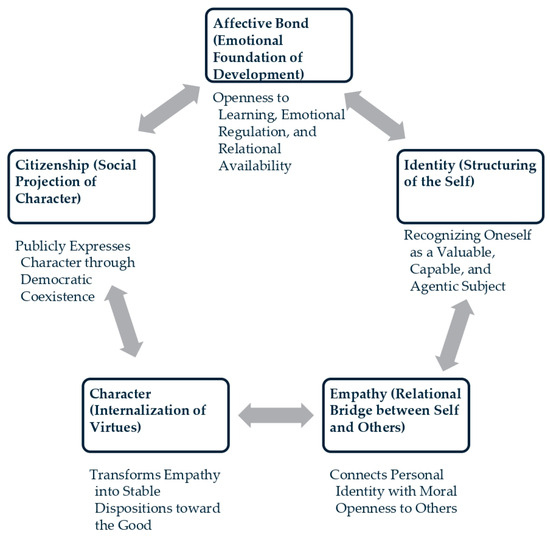
Figure 1.
Sequence of the Integrative Pedagogical Model. Note. Author’s own elaboration.
Although the sequence represented in the model reflects a developmental logic, the relationships among attachment, identity, empathy, and character should not be interpreted as strictly linear. Rather, these dimensions interact recursively and dynamically over time. For example, children’s empathic and prosocial responses may reinforce relational bonds with teachers and peers, thereby strengthening affective security and contributing to the ongoing development of identity and character.
As observed, the model reflects a dynamic and interdependent relationship among the different dimensions, in which attachment functions as a relational foundation, identity as a mediating process through which children interpret themselves and others, empathy as a relational bridge toward social awareness, and character as the consolidation of moral dispositions that orient action. Although the model presents a developmental sequence, these dimensions influence one another recursively, giving rise to continuous processes of relational and moral development.
6. Integrative Pedagogical Model: Attachment, Identity and Character
Building on the relational framework outlined above, this section presents an integrative pedagogical model that articulates the dimensions of attachment, identity, and character within the context of Early Childhood Education. The model is grounded in the understanding of child development as a relational process in which affective, identity, and moral dimensions operate in an interdependent manner.
In this study, the term attachment pedagogy is used as a conceptual proposal to describe an educational approach that places attachment relationships at the foundation of pedagogical practice. Although attachment theory has been extensively developed within the field of psychology [2,35], its systematic translation into education has been more limited and often implicit. As conceptualized here, attachment pedagogy refers not only to the promotion of secure affective bonds but also to the creation of educational contexts in which relational security functions as the basis for identity construction and character formation. In this sense, it is understood as a pedagogical framework that integrates care, recognition, and moral guidance within meaningful educational relationships. This use of the term is not intended to establish a closed category but rather to offer an analytical conceptual tool.
The proposed model is structured around interrelated dimensions of attachment, identity, empathy, and character, understood within a dynamic relational framework. First, attachment is understood as the relational foundation that enables the development of the other dimensions. In educational contexts, this implies considering the pedagogical relationship as a space in which emotional security is constructed, facilitating exploration, learning, and social interaction. The teacher’s role can thus be interpreted as that of a figure who contributes to generating contexts of trust, predictability, and recognition.
Second, identity is conceived as a relational and narrative process that develops on the basis of relational security. Rather than being understood as a stable trait, identity is seen as a dynamic construction in which the child interprets experiences, negotiates meanings, and develops an understanding of themselves in relation to others. Educational practices play a crucial role in this process, as they provide opportunities for recognition, participation, and expression.
Empathy operates as a mediating relational mechanism within the model. As children progressively develop a stable sense of self and emotional security, they become increasingly capable of recognizing the emotions, perspectives, and needs of others. In this sense, empathy acts as a bridge between identity construction and the formation of moral dispositions, facilitating openness toward cooperation, responsibility, and concern for the common good.
Third, character is understood as the configuration of moral dispositions that guide action in social contexts. These dispositions are not isolated traits but habits and orientations that develop through concrete practices and shared normative frameworks. Character formation is therefore closely linked to relational experiences and to the contexts in which expectations, norms, and forms of coexistence are established.
The central value of the model lies in the articulation of these three dimensions within a unified relational framework. Rather than operating in a strictly linear or hierarchical manner, attachment, identity, empathy, and character interact dynamically and recursively, forming a continuous process of development. Relational experiences shape identity and moral orientations, while children’s emerging dispositions and empathic responses may also reinforce attachment relationships and social participation.
7. Educational Practice Proposals Based on the Attachment–Identity–Character Model
The following proposals are not presented as isolated techniques, but as coherent practical expressions derived from a relational understanding of child development. Accordingly, they should be interpreted as pedagogical orientations grounded in the integrative model proposed in this study.
These pedagogical orientations should also be understood as context-sensitive and relationally situated practices that require adaptation to children’s developmental needs, family contexts, and the broader educational environment.
From this perspective, the Early Childhood classroom can be conceived as a space of emotional security, care, and validation of the self. In line with the pedagogy of care, the teacher plays a structuring role in generating conditions of pedagogical attachment through attentive presence, relational consistency, and affective responsiveness. Practices such as active listening and emotional validation, together with the establishment of a stable and predictable relational climate, contribute to a sense of safety that underpins both identity construction and character development.
On this relational foundation, educational practices can foster the development of self-awareness and self-concept as core dimensions of identity. Structured opportunities for dialogue, emotional expression, and narrative construction allow children to recognize, name, and make sense of their experiences. Similarly, the progressive assignment of responsibilities within the classroom supports the development of autonomy, self-efficacy, and self-regulation, reinforcing children’s perception of themselves as competent agents.
As identity consolidates, children progressively open themselves to others, enabling the emergence of empathy and social awareness. In this regard, structured cooperative activities and shared tasks oriented toward caring for the environment or supporting peers can facilitate the transition from egocentric perspectives to relational forms of identity. These experiences contribute to the understanding of interdependence and the recognition of others as subjects of care.
The repeated participation in practices of cooperation, responsibility, and shared decision-making supports the consolidation of moral dispositions such as respect, commitment, and responsibility. Pedagogical resources such as storytelling with moral content, guided reflective dialogue, and participation in the construction of shared norms enable the integration of affective, cognitive, and behavioural dimensions of moral development.
These practices acquire greater coherence and impact when embedded within a consistent institutional framework. This includes the integration of socio-emotional development and the Ethics of Care as transversal elements of the curriculum, the consideration of relational climate as an indicator of educational quality, and the active collaboration between school and families in the construction of shared educational environments.
Finally, the implementation of this model highlights the importance of teacher education in areas such as the Ethics of Care, identity development, and reflective observation of educational interactions. In particular, teachers’ capacity for emotional regulation, relational sensitivity, and critical reflection on their own practice plays a decisive role in shaping students’ socio-emotional development and character formation.
Beyond its implications for children’s development, the proposed model may also be interpreted as a reflective framework for Early Childhood Education teachers themselves. Teachers enter educational relationships carrying their own attachment-related experiences, professional identities, empathic dispositions, moral orientations, and civic understandings, all of which may influence how they function as a secure relational base for children. From this perspective, attachment, identity, empathy, character, and citizenship are not only dimensions relevant to children’s development but also factors that shape teachers’ relational positioning within educational settings. Consequently, the model may contribute to teacher education and professional development by fostering reflective awareness of relational practices, emotional responsiveness, and ethical responsibility in pedagogical interactions.
8. Discussion
8.1. Pedagogical Implications
The analysis developed in this study makes it possible to situate child development within an integrative perspective that overcomes the fragmented approaches that have dominated much of the pedagogical literature. Rather than isolating emotional development, identity construction, or moral formation into separate domains, the integration of attachment, identity, and character provides an operational pedagogical understanding of educational processes in early childhood.
The model aligns with contemporary perspectives that emphasize the relational nature of human development and supports the view that moral learning occurs not primarily through normative instruction but through sustained participation in meaningful relational practices. By positioning identity as a mediating element between care and justice, the model offers a framework that integrates sensitivity to others with adherence to shared ethical principles.
From this perspective, character education is not reduced to rule-following or behavioural conditioning but is rooted in lived experiences of meaning, recognition, and relational belonging. This contributes to moving beyond moralistic or purely programmatic approaches, situating character as an ethical expression of a relationally constructed identity.
Furthermore, the findings suggest that citizenship education should not be postponed to later educational stages. Rather, it begins in Early Childhood Education through experiences of care, cooperation, and shared responsibility, in which children learn that their personal identity is intrinsically connected to the well-being of others.
However, this study also presents limitations. Its theoretical nature requires empirical validation through research that examines the impact of the proposed model on children’s socio-emotional, identity, and moral development. Future studies could explore, through longitudinal designs and pedagogical interventions, the extent to which the quality of pedagogical attachment influences the consolidation of character dispositions and observable civic behaviours. Future research may also explore how teachers’ own attachment histories, relational dispositions, and professional identities influence the implementation of care-based pedagogical practices and their capacity to function as a secure base in Early Childhood Education settings. More specifically, future empirical research may operationalize key constructs of the model through multiple methodological approaches. Relational climate could be examined through classroom observation protocols and measures of classroom belonging; pedagogical attachment through teacher–child relationship scales; identity development through indicators of self-concept, recognition, and belonging; and moral dispositions through observations of empathy, prosocial behaviour, cooperation, and participation in shared practices.
8.2. Tensions and Limits of the Relational Approach
Despite its integrative potential, the relational approach proposed here entails certain tensions. One of the main risks is the possibility that an emphasis on care may lead to paternalistic practices in which the adult, under the pretext of promoting the child’s well-being, limits autonomy or imposes predefined developmental trajectories.
Another challenge concerns the risk of dependency if attachment-based pedagogy is not balanced with the progressive development of autonomy and agency.
Likewise, although the present model focuses primarily on Early Childhood Education settings, children’s relational experiences are also shaped by family and community contexts, which may either reinforce or challenge the relational dynamics promoted within educational environments.
While secure attachment provides a necessary foundation, educational practice must ensure that it does not result in overprotection.
Additionally, relational approaches must address the inherent power asymmetries present in educational relationships. Teacher–student interactions are shaped by institutional, cultural, and normative structures that influence both care practices and children’s opportunities for participation. Recognizing these asymmetries allows care to be understood not as a neutral or purely ethical act but as a situated practice requiring critical reflection.
These tensions do not invalidate the model but highlight the need for a balanced approach that integrates care, autonomy, and shared responsibility within educational contexts.
9. Conclusions: Care as an Ethical Catalyst for Citizenship
This study has shown that Early Childhood Education constitutes a privileged context for the integrated and relational development of attachment, identity, and character. Rather than independent processes, these three constructs operate as a dynamic and interdependent system in which experiences of care support identity formation and enable the early emergence of moral dispositions oriented toward coexistence and citizenship.
The proposed pedagogical integration provides a theoretical framework that understands child development as a unified, relational, and ethical process. Attachment is not limited to an early affective phenomenon but becomes a structuring pedagogical foundation upon which identity is built. Identity, in turn, acts as a mediating axis between the experience of being cared for and the progressive capacity to care for others, giving rise to character formation.
The incorporation of the Ethics of Care allows for a critical rethinking of reductionist approaches to moral education based solely on normative instruction. Character education emerges not as a prescriptive process but as a lived, situated experience embedded in everyday relationships.
The practical implications of this model highlight the importance of prioritizing relational bonds, identity narratives, empathy, cooperation, and shared responsibility as central axes of educational action in early childhood. Likewise, the importance of teacher education in relational competence, reflective observation, and emotional regulation is emphasized.
In this regard, citizenship in early childhood should be understood not as formal civic participation but as the gradual emergence of dispositions toward coexistence, responsibility, empathy, and commitment to the common good through everyday relational experiences.
Finally, this proposal opens new lines of research aimed at empirically exploring the relationship between relational quality, identity development, and character formation in real educational contexts. Advancing in this direction will contribute to an education that not only instructs but also ethically and pedagogically supports human flourishing from the earliest stages of life.
Funding
This work was funded by the Catholic University of Valencia.
Institutional Review Board Statement
Not applicable.
Informed Consent Statement
Not applicable.
Data Availability Statement
The original contributions presented in this study are included in the article. Further inquiries can be directed to the corresponding author.
Conflicts of Interest
The author declares no conflicts of interest.
References
- Bronfenbrenner, U. The Ecology of Human Development: Experiments by Nature and Design; Harvard University Press: Cambridge, MA, USA, 1979. [Google Scholar] [CrossRef]
- Ainsworth, M.D.S.; Blehar, M.C.; Waters, E.; Wall, S. Patterns of Attachment: A Psychological Study of the Strange Situation; Lawrence Erlbaum Associates: Hillsdale, MI, USA, 1978. [Google Scholar]
- Bowlby, J. Attachment and Loss: Vol. 1. Attachment; Basic Books: New York, NY, USA, 1969. [Google Scholar]
- Bergin, C.; Bergin, D. Attachment in the classroom. Educ. Psychol. Rev. 2009, 21, 141–170. [Google Scholar] [CrossRef]
- O’Toole, L.; Reynolds, K. The role of teacher–student relationships in moral and character education. J. Moral Educ. 2020, 49, 434–450. [Google Scholar]
- Bruner, J. Acts of Meaning; Harvard University Press: Cambridge, MA, USA, 1990. [Google Scholar]
- Erikson, E.H. Identity: Youth and Crisis; Norton: New York, NY, USA, 1968. [Google Scholar]
- McAdams, D.P. The psychology of life stories. Rev. Gen. Psychol. 2001, 5, 100–122. [Google Scholar] [CrossRef]
- Bernal-Guerrero, A. Educación e Identidad: Nuevos Desafíos; PPU: Barcelona, Spain, 2011. [Google Scholar]
- Hammack, P.L. Narrative and the cultural psychology of identity. Hum. Dev. 2008, 12, 222–247. [Google Scholar] [CrossRef]
- Berkowitz, M.W.; Bier, M.C. What works in 2character education: A research-driven guide for educators. J. Res. Character Educ. 2005, 3, 29–48. [Google Scholar]
- Lickona, T. Educating for Character: How Our Schools Can Teach Respect and Responsibility; Bantam Books: New York, NY, USA, 1991. [Google Scholar]
- Noddings, N. Caring: A Relational Approach to Ethics and Moral Education, 2nd ed.; University of California Press: Berkeley, CA, USA, 2013. [Google Scholar]
- Arthur, J.; Kristjánsson, K.; Walker, D.; Sanderse, W.; Jones, C.; Thoma, S.; Curren, R.; Roberts, P. A Habit of Service: The Factors that Sustain Service in Young People; University of Birmingham: Birmingham, UK, 2017. [Google Scholar]
- Kristjánsson, K. Virtuous Character for the Flourishing Life; Oxford University Press: Oxford, UK, 2020. [Google Scholar]
- Biesta, G. Risking. Ourselves in education: Qualification, socialization, and subjectification revisited. Educ. Theory 2020, 70, 89–104. [Google Scholar] [CrossRef]
- Noddings, N. Caring: A Feminine Approach to Ethics and Moral Education, 2nd ed.; University of California Press: Berkeley, CA, USA, 2003. [Google Scholar]
- Gilligan, C. In a Different Voice: Psychological Theory and Women’s Development; Harvard University Press: Cambridge, MA, USA, 1982. [Google Scholar]
- Kohlmeier, J.; Sætra, E.K. The ethics of care and citizenship education: A call for relational literacy. J. Soc. Sci. Educ. 2019, 18, 11–23. [Google Scholar] [CrossRef]
- Noddings, N. The Challenge to Care in Schools: An Alternative Approach to Education, 2nd ed.; Teachers College Press: New York, NY, USA, 2005. [Google Scholar]
- Gozálvez, V.; Jover, G. Articulación de la justicia y el cuidado en la educación moral: Del universalismo sustitutivo a una ética situada de los derechos humanos. Educ. XX1 2016, 19, 311–330. [Google Scholar] [CrossRef]
- Stake, R.E.; Visse, M. La educación como cuidado. Una cualidad que salva. Relieve 2023, 29. [Google Scholar] [CrossRef]
- Corbella, L.; Úcar, X. ¿Educar es cuidar? El cuidado educativo como práctica ética en la relación socioeducativa. Educ. Social. Rev. D’intervenció Socioeducativa 2024, 84, 39–55. [Google Scholar]
- Gilligan, C. La Ética del Cuidado; Cuadernos de la Fundació Víctor Grifols i Lucas: Barcelona, Spain, 2013; Volume 30, pp. 12–39. Available online: https://www.revistaseden.org/boletin/files/6964_etica_del_cuidado_2013.pdf (accessed on 14 May 2026).
- Kohlberg, L. Essays on Moral Development, Vol. 2: The Psychology of Moral Development; Harper & Row: New York, NY, USA, 1984. [Google Scholar]
- Levinas, E. Totality and Infinity: An Essay on Exteriority; Duquesne University Press: Pittsburgh, PA, USA, 1969. [Google Scholar]
- Nucci, L.P. Education in the Moral Domain; Cambridge University Press: Cambridge, UK, 2001. [Google Scholar]
- Bernal, A.; Naval, C. El florecimiento como fin de la educación del carácter. Rev. Española Pedagog. 2023, 81, 17–32. [Google Scholar] [CrossRef]
- Siegel, D.J. The Developing Mind: How Relationships and the Brain Interact to Shape Who We Are, 2nd ed.; Guilford Press: New York, NY, USA, 2012. [Google Scholar]
- Sroufe, L.A.; Egeland, B.; Carlson, E.A.; Collins, W.A. The Development of the Person: The Minnesota Study of Risk and Adaptation from Birth to Adulthood; Guilford Press: New York, NY, USA, 2005. [Google Scholar]
- Collaborative for Academic, Social, and Emotional Learning (CASEL). CASEL Framework for Systemic Social and Emotional Learning. 2020. Available online: https://casel.org/casel-sel-framework-11-2020/ (accessed on 14 May 2026).
- Naval, C.; Bernal, A.; Dabdoub, J.P. Educación del character. Cuad. Pedagog. 2021, 521, 131–136. [Google Scholar]
- Westheimer, J. What Kind of Citizen? Educating Our Children for the Common Good, 2nd ed.; Teachers College Press: New York, NY, USA, 2015. [Google Scholar]
- Hargreaves, A.; Shirley, D. The Fourth Way: The Inspiring Future for Educational Change; Corwin Press: Thousand Oaks, CA, USA, 2009. [Google Scholar]
- Bowlby, J. A Secure Base: Parent-Child Attachment and Healthy Human Development; Basic Books: New York, NY, USA, 1988. [Google Scholar]
Disclaimer/Publisher’s Note: The statements, opinions and data contained in all publications are solely those of the individual author(s) and contributor(s) and not of MDPI and/or the editor(s). MDPI and/or the editor(s) disclaim responsibility for any injury to people or property resulting from any ideas, methods, instructions or products referred to in the content. |
© 2026 by the author. Licensee MDPI, Basel, Switzerland. This article is an open access article distributed under the terms and conditions of the Creative Commons Attribution (CC BY) license.