


Abstract
The use of generative artificial intelligence (GenAI) in academic contexts has expanded rapidly in recent years, yet limited evidence exists regarding its prevalence across educational levels or its association with psychological and academic variables among adolescents and young adults. This exploratory study aimed to examine the prevalence of GenAI use for learning-related academic purposes among pre-university and university students, including gender differences, and to analyze its relationship with self-esteem, self-efficacy, academic confidence, and academic anxiety. The sample comprised 1043 participants aged 13 to 23 years (M = 16.16, SD = 2.42; 59.1% female) who completed self-report measures. Structural equation modeling was conducted controlling for gender, age, and Internet use. Overall, 95% of students reported using GenAI for academic purposes, with higher usage among university than pre-university students and among female than male students. GenAI use was significantly associated with higher academic anxiety, although the effect size was small, and no significant associations were observed with the remaining variables. These findings suggest that while GenAI use is widespread, its associations with psychological and academic variables appear to remain limited.
1. Introduction
Since the widespread emergence of Generative Artificial Intelligence (GenAI) in November 2022, tools such as ChatGPT, Gemini, and DeepSeek, among others, have sparked a revolution in the educational system due to their ability to generate high-quality content instantly [1,2,3]. GenAI offers a wide range of possibilities in academic contexts, such as providing immediate feedback, fostering creativity, solving of complex problems (e.g., mathematical exercises), quick access to information, support for language learning and instant translations, and opportunities for personalized learning [1,4,5]. These capabilities suggest substantial potential to enhance learning processes and academic performance. However, the widespread use of this technology also raises significant risks and concerns. Among the main challenges of GenAI in the academic field are the accuracy of the content generated by these tools, the potential for plagiarism, biases in data and outputs, and the potential consequences of intensive or uncritical use of AI-generated results [2,6]. Furthermore, the widespread use of GenAI among students may be associated with several psychological and academic variables, such as self-esteem, self-efficacy, academic confidence, and academic anxiety, which are relevant indicators of students’ academic functioning [7,8,9].
Despite growing public and academic interest, empirical evidence remains limited regarding how frequently GenAI is currently used for academic purposes, whether there are differences based on educational level (e.g., high school vs. university students) and gender, and how GenAI may be related to important psychological and academic variables (e.g., academic confidence and anxiety). Academic use of GenAI refers to students’ use of generative artificial intelligence tools to support learning-related academic activities, such as completing assignments, revising or improving written work, generating ideas for academic projects, and studying course topics [2,6]. We specifically investigate differences in usage frequency between pre-university and university students, as well as potential gender differences. Additionally, we explore how the frequency of GenAI use for academic purposes relates to key psychological variables that may affect learning and academic outcomes, namely: self-esteem, self-efficacy, academic confidence, and academic anxiety. These variables represent different dimensions of students’ self-perception and emotional experience. Self-esteem can be understood as a global evaluation of one’s personal worth [10], whereas self-efficacy refers to the perceived ability to carry out specific tasks [11]. Academic confidence, in turn, has been considered a contextualized manifestation of self-efficacy, focused on the demands of the educational environment [8]. Finally, academic anxiety reflects emotional distress in situations related to studying, and it may interfere with both motivation and performance [9,12,13]. The ultimate goal of this study is to provide empirical data on the scope of GenAI in educational settings and its potential psychological correlates, in order to inform educational policy and practice. The following sections review the theoretical and empirical rationale for this study.
1.1. Use of GenAI for Academic Tasks: Differences by Educational Level and Gender
Empirical evidence on the use of GenAI in academic settings is still relatively scarce, although existing studies suggest that its adoption has increased exponentially in recent years. Surveys across different countries suggest that between roughly half and more than 90% of university students report having used GenAI for academic purposes [14,15,16,17]. Evidence regarding gender differences is mixed, with some studies finding higher usage among men [16], while others report no significant gender differences [18]. Studies on the use of GenAI among adolescents and secondary school students have been fewer than among university students, but they have revealed varying adoption rates. For example, Zhu et al. [19] found that 70% of U.S. secondary students reported having used GenAI. Klarin et al. [20], in a study conducted in Sweden, observed that 14.8% of younger adolescents and 52.6% of older adolescents had used GenAI. These patterns did not differ significantly by gender. These differences in reported prevalence may reflect variations in the timing of data collection, given the rapid expansion of GenAI tools since late 2022, as well as differences in national educational policies, access to digital resources, and institutional norms regarding AI use. Developmental factors and differences in academic demands between younger and older students may also play a role in shaping adoption patterns.
However, to date, no studies have directly compared pre-university and university students regarding GenAI use. Thus, little is known about how GenAI adoption varies by educational level. Likewise, evidence on potential gender differences remains limited and inconsistent across studies [14,19].
1.2. Relationship Between GenAI Use and Self-Esteem, Self-Efficacy, Academic Confidence, and Academic Anxiety
While GenAI may support academic performance and motivation in certain contexts, it may also introduce new challenges and psychological demands [8,9]. For this reason, we chose to explore four psychological variables that are central to learning and academic success: self-esteem, self-efficacy, academic confidence, and academic anxiety. These variables were selected due to their well-established relevance in the teaching–learning process and their strong links to outcomes such as motivation, engagement, and academic achievement [12,21,22,23]. According to Social Cognitive Theory [24], learning and behavior are shaped through the reciprocal interaction between personal factors, environmental influences, and behavioral processes. Within this framework, technological tools such as GenAI can be conceptualized as new environmental resources that influence students’ beliefs, emotions, and academic behaviors.
Self-esteem refers to an individual’s overall sense of self-worth, encompassing feelings of personal value and confidence in one’s abilities [10]. It reflects a broad, global evaluation of the self and plays a role in how individuals interpret their potential and limitations. In contrast, self-efficacy is a more specific construct, defined as the belief in one’s ability to organize and carry out actions necessary to achieve specific goals [11]. Although related, these two constructs differ in scope: self-esteem captures a general sense of self-worth, while self-efficacy refers to perceived competence in specific situations [25]. For example, a student may feel generally positive about themselves (high self-esteem) but still lack confidence in their ability to complete a difficult math assignment (low self-efficacy).
Previous empirical evidence on the relationship between GenAI use and these psychological variables remains limited and somewhat inconsistent. In a recent mixed-methods study, Pavone [9] examined the connection between self-esteem and GenAI use among university students. Qualitative findings revealed that while some students felt demotivated or less confident, perceiving AI as a superior tool that minimized their personal input, others viewed AI as a helpful complement that supported rather than replaced their abilities. Quantitative results showed that higher self-esteem was linked to greater reliance on AI, but also to increased concern about automation and ethical issues related to its use. Interestingly, higher self-esteem also predicted better academic outcomes, more creative thinking, and greater enjoyment when using AI [9]. In a separate study conducted with the general adult population, Yao et al. [26] found that higher self-esteem was associated with a lower likelihood of problematic AI chatbot use, a behavior pattern characterized by compulsive or excessive engagement with GenAI [26]. Finally, Tufail et al. [27], in a study with university students, found that exposure to AI-generated content was significantly associated with lower levels of self-esteem.
Regarding self-efficacy, Falebita and Kok [28] found that technological self-efficacy was positively associated with greater use of artificial intelligence tools among university students, suggesting that students with higher self-efficacy were more likely to engage with AI technologies in their academic activities. Kim and Lee [7] found that self-efficacy in AI-based learning among professionals was positively associated with greater AI adoption in the organization. In a study conducted by Montag et al. [29] with students and individuals from the general population, it was found that higher levels of technology self-efficacy were linked to more positive acceptance of AI and lower levels of fear related to AI. In another study with university students, Jia and Tu [30] found that perceived AI capabilities significantly enhanced general self-efficacy. Overall, although the use of artificial intelligence appears to be positively associated with self-efficacy, existing studies including samples of adolescents remain scarce. Furthermore, little is known specifically about the relationship between the use of AI for academic tasks and the perception of self-efficacy.
Academic confidence has been conceptualized as a specific form of self-efficacy [31]. Academic confidence refers to students’ belief in their ability to perform well in academic tasks [32]. It plays a key role in shaping motivation, engagement, and academic outcomes [31]. The use of GenAI may be positively related to academic confidence, as these tools can offer support with planning, understanding, and completing complex assignments. In what is, to our knowledge, the only study to date that has specifically examined the relationship between GenAI use and academic confidence, Oubibi [8] found that, among postgraduate students, the use of GenAI tools significantly increased perceived academic confidence. The authors suggest that AI tools may assist with task completion in ways that reinforce students’ belief in their academic abilities. In contrast, Johnston et al. [15] found that students who had not used or even considered using GenAI tools for academic purposes reported higher confidence in academic writing compared to those who had used or considered using such tools. In addition, Silitubun [33] found that AI technology in education could improve students’ self-confidence.
Finally, academic anxiety refers to feelings of discomfort, fear, or worry specifically tied to academic activities [13]. It includes concerns like fear of underperforming compared to peers, difficulty managing academic responsibilities, or feeling overwhelmed in settings like classrooms or exams [12,34]. Academic anxiety may manifest as cognitive worry, emotional tension, or even physical symptoms, and it can negatively affect focus, motivation, and overall academic performance [35,36]. Abbas et al. [37] found that university students experiencing high academic workload and stress were more likely to use ChatGPT. Similarly, Pavone [9] reported a link between higher dependence on AI and greater academic anxiety among university students, including fear of failure in exams and anxiety related to automation (e.g., feeling anxious about working with an AI that seems more intelligent than oneself). According to the authors, the immediate feedback provided by chatbots allowed students to correct their mistakes right away, which helped lower anxiety levels. Gao [38] also found that the use of AI-enhanced learning applications significantly reduced test anxiety and negative academic emotions, while boosting positive academic emotions, in a sample of undergraduate students in China.
1.3. The Present Study
The present study aims to contribute to the growing body of empirical research on the use of GenAI and its associated psychological and academic variables. Given the rapid expansion of GenAI in educational contexts and the limited empirical evidence on its actual patterns of use, the present study seeks to provide descriptive data on the prevalence and frequency of academic GenAI engagement, as well as its associations with key psychological variables. The first objective of this study was to analyze the prevalence of GenAI use for academic tasks among pre-university students (secondary school students and high school students) in comparison with university students. In addition, we examined gender differences in the use of GenAI for academic purposes. The second objective was to examine associations between the use of GenAI and key psychological and academic variables, specifically self-esteem, self-efficacy, academic confidence, and academic anxiety, after controlling for important variables such as educational level, gender, and time spent using the Internet. These variables were selected as emotional and learning-related processes that may influence student performance and well-being. Due to the cross-sectional design, these associations were examined without assuming directional or causal relationships. Given the limited and inconsistent empirical evidence in this field, the present study adopts an exploratory approach, rather than aiming to confirm specific hypotheses.
2. Materials and Methods
2.1. Participants
The initial sample consisted of 1108 participants, comprising both pre-university (i.e., secondary education and high school) and university students, aged between 13 and 23 years, from ten educational institutions in central and northern Spain. Sixty-five participants were excluded from the analyses due to having more than half of the key variable data missing, resulting in a final sample of 1043 participants. The mean age of the final sample was 16.16 years (SD = 2.40). Regarding gender identity, 39.7% of participants self-identified as male, 59.1% as female, 0.4% identified with another gender, and 0.9% preferred not to disclose their gender. In terms of educational level, 72% were enrolled in pre-university education, while 28% were university students. The sample was collected across eight secondary schools and two universities. At the school level, the number of respondents per site ranged from 18 to 364 students. Across schools, the proportion of female students ranged between 33.3% and 62.1%. In the university sample, 25 students from the University of the Basque Country (88.0% female) and 263 students from the Autonomous University of Madrid participated (88.2% female). Participants were predominantly born in Spain (85.2%), followed by Latin America (11.1%), other European countries (1.6%), African countries (1.0%), Asian countries (0.7%), and North America (0.2%). Parental education was employed as a proxy for socioeconomic status (SES), as it is strongly associated with occupational opportunities and household income [39]. Mothers most frequently held a university degree (40.6%). Additionally, 22.6% had completed secondary education or high school, 19.1% a master’s/doctoral degree, 11.9% had vocational training, 4.4% had completed only primary education, and 1.3% had no formal education. For fathers, 33.7% held a university degree, 27.2% had completed secondary education or high school, 20.2% held a master’s or doctoral degree, 14.0% had vocational training, 3.0% had only primary education, and 1.9% had no formal education. This distribution indicates that the sample is predominantly composed of families from middle to upper-middle SES backgrounds, with a smaller proportion of participants coming from lower SES households. An independent samples t-test indicated that the mean level of parental education was lower among participants with missing data who were excluded from the analyses (M = 1.00, SD = 0.00) than among those who remained in the study (M = 1.28, SD = 0.45), t = −5.02, p < 0.001.
2.2. Measures
Sociodemographic Questionnaire. The study included a sociodemographic questionnaire consisting of multiple-choice questions designed to gather relevant background information from participants. Questions assessed participants’ gender and age, parental marital status (e.g., married), participants’ place of birth, and the educational level of both the father and mother. To assess daily internet usage patterns, participants were asked about the amount of time they spent on the internet during weekdays (Monday to Friday) and on weekends. The response options for both questions were: 1 h or less, 2 to 3 h, 3 to 4 h, 4 to 5 h, or more than 5 h per day.
Generative Artificial Intelligence Use. To assess the frequency with which students had used GenAI for academic activities, we developed a scale that included eleven potential uses of GenAI in educational contexts. The 11 items were designed to capture a broad range of academic GenAI applications, including assignment completion, writing revision and improvement, idea generation, studying and summarizing content, presentation preparation, conceptual clarification, mathematical problem solving, and translation tasks. The items assessing GenAI use were developed through a multi-step procedure. First, a review of the literature on common educational uses of generative artificial intelligence was conducted to identify a broad range of academic and higher-order learning applications. The preliminary instrument was then reviewed by several members of the research team, who evaluated the clarity, relevance, and coverage of the items, leading to minor wording adjustments. Finally, the questionnaire was piloted with two classes of pre-university students and two classes of university students, who provided feedback on item clarity and comprehension. Based on this feedback, minor revisions were made to ensure that the wording was clear and understandable for students at both educational levels. Sample items included: “To complete a school assignment,” “To improve the writing of something I had already written,” and “To study a topic.” Participants were asked to indicate: “How often have you used generative artificial intelligence for your schoolwork or academic activities in the past six months?” Responses were recorded on a 5-point scale: 0 (Never), 1 (Occasionally—less than once a month), 2 (Regularly—about once or twice a month), 3 (Frequently—about once a week), and 4 (Very frequently—several times a week or daily). An exploratory factor analysis was conducted using principal axis factoring as the extraction method. Bartlett’s test of sphericity yielded a chi-square value of 7684.00 (df = 55, p < 0.001), indicating that the data were suitable for factor analysis. Examination of the scree plot and eigenvalues greater than 1 supported a one-factor solution, which accounted for 55.6% of the total variance. All items had factor loadings greater than 0.57 on this single factor. A confirmatory factor analysis (CFA) was conducted to examine the measurement structure of the instrument. Given the ordinal nature of the response scales, the model was estimated using robust weighted least squares estimation (WLSMV). The results provided preliminary evidence of acceptable model fit (e.g., CFI = 0.946; TLI = 0.933; SRMR = 0.050). The internal consistency of the scale, as measured by Cronbach’s alpha, was 0.93 in the present study.
Self-Esteem. To assess self-esteem, the Rosenberg Self-Esteem Scale was administered [39]. This 10-item measure includes both positively framed statements (e.g., “On the whole, I am satisfied with myself”) and negatively worded items (e.g., “At times I think I am no good at all”), the latter of which were reverse-coded to ensure that higher total scores reflected greater self-esteem. Participants responded using a 6-point Likert scale from 1 (strongly disagree) to 6 (strongly agree). This scale has consistently demonstrated good validity and reliability in Spanish samples [40]. In the current study, internal consistency was Cronbach’s α = 0.73
Self-Efficacy. We used the short version of the New General Self-Efficacy Scale [41], which comprises 8 items (e.g., “I will be able to achieve most of the goals that I have set for myself”; “When facing difficult tasks, I am certain that I will accomplish them”). Responses were recorded on a 6-point Likert scale ranging from 1 (strongly disagree) to 6 (strongly agree). This instrument has shown satisfactory psychometric properties in previous research among Spanish samples [42]. In the current sample, internal consistency was Cronbach’s α = 0.93
Academic Confidence. To assess academic confidence, we included the subscales of Grades and Studying from the Spanish version of the Academic Behavioural Confidence (ABC) scale [32]. Students were asked: “How confident do you feel about the following academic tasks?” The scale included 10 items (e.g., “Studying on your own effectively,” “Writing in an appropriate academic style”). Responses were provided on a 5-point Likert scale ranging from 1 (not at all confident) to 5 (very confident). An exploratory factor analysis was conducted on the items using the principal axis factoring extraction method. Bartlett’s test of sphericity was significant, χ2(36) = 4405, p < 0.001, indicating that the data were suitable for factor analysis. The number of factors to retain was determined based on eigenvalues greater than 1 and inspection of the scree plot, which revealed a single-factor solution. This factor accounted for 48.6% of the total variance, with all items loading above 0.56. Therefore, the scale was used unidimensionally in subsequent analyses. The internal consistency of the scale was Cronbach’s α = 0.889
Academic Anxiety. Due to the lack of widely used and validated instruments in Spanish for assessing academic anxiety in both adolescents and university students, a questionnaire specifically designed to measure this construct was developed. To this end, we reviewed thematically related scales, e.g., [43]. As with the GenAI-use scale, the items were also administered in a preliminary pilot with groups of pre-university and university students to ensure that the wording was clear and that the items were properly understood. The instrument consists of seven items, including examples such as “I doubt my own ability to complete academic tasks” and “I feel tense or nervous before important exams or tests.” Participants responded using a 5-point Likert scale ranging from 1 (strongly disagree) to 5 (strongly agree). An exploratory factor analysis (EFA) was conducted using principal axis factoring as the extraction method. Bartlett’s test of sphericity was performed to assess the suitability of the data for factor analysis. The test yielded a chi-square value of 2285.00 (df = 21, p < 0.001), indicating that the data were suitable for factor analysis. Factors were retained based on eigenvalues greater than 1 and inspection of the scree plot. The analysis indicated a single-factor structure that accounted for 41.9% of the total variance. All items loaded on this factor with loadings above 0.49. Multi-group confirmatory factor analyses were conducted to test measurement invariance across educational levels (pre-university vs. university students). The configural model showed acceptable fit (CFI = 0.987, TLI = 0.980, SRMR = 0.061). Constraining factor loadings to equality across groups did not substantially reduce model fit (ΔCFI = 0.005), supporting metric invariance. A further model constraining thresholds also showed minimal change in fit (ΔCFI = 0.003), supporting scalar invariance. These results indicate that the scale operates equivalently across educational levels. The internal consistency of the scale, as measured by Cronbach’s alpha, was 0.89 in the present study. The full list of the seven items is provided in the Supplementary Material (Supplementary Material S1).
2.3. Design and Procedure
This study employed a cross-sectional exploratory design. The sample was collected between November 2024 and May 2025. Adolescent participants from pre-university studies were recruited through direct contact with the schools, where institutional permission was requested to conduct the evaluation with their students. Parental consent for minors was obtained by sending an informational letter detailing the study’s objectives and requesting signed consent forms. University students were invited to participate via faculty members from two universities in the country, who distributed the questionnaires to their students. All participants received an informed consent form that explained the purpose of the study, the confidentiality of their responses, the use of their personal data, and their rights as participants. Participation began only after individuals (or their parents, in the case of minors) read and agreed to these conditions. Confidentiality was guaranteed, and it was emphasized that individual responses would not be identifiable. To encourage honest and thoughtful responses, participants were informed that their involvement was entirely voluntary and that they could refuse to answer specific questions or withdraw from the study at any time without any negative consequences. Participants were also encouraged to seek clarification if they encountered difficulties during the completion of the questionnaire. The questionnaires were administered online via Qualtrics during regular class time. Data collection was supervised by a member of the research team to ensure standardized administration procedures. This study forms part of a broader research project on the use of the Internet among youth, which received approval from the Ethics Committee of Autonomous University of Madrid. All procedures conformed to the ethical principles established in the Declaration of Helsinki.
2.4. Statistical Analysis
First, we explored the frequencies with which adolescents had used GenAI for each academic task. Due to the very small cell sizes, participants who selected “another gender” or “prefer not to disclose” were excluded from the gender comparison analyses, which were therefore restricted to male and female participants. For the structural equation modeling analyses, listwise deletion was applied, retaining only cases with complete data on the variables included in the model (n = 931). Scores for all study variables were computed using the arithmetic mean of the corresponding items. Due to the violation of multivariate normality in the dataset (Mardia’s normalized coefficient = 6.73), robust estimation procedures were applied, including the Satorra–Bentler scaled chi-square and other robust fit indices. The software EQS 6.1 was used for the analyses [44]. To evaluate the overall model fit, several fit indices were examined, including the Comparative Fit Index (CFI), the Non-Normed Fit Index (NNFI), the Standardized Root Mean Square Residual (SRMR), and the Root Mean Square Error of Approximation (RMSEA). Values greater than 0.95 for the CFI and NNFI, and values below 0.06 for the SRMR and RMSEA, are generally considered to indicate excellent model fit [45].
3. Results
As shown in Table 1, the percentage of students who reported using GenAI for academic tasks frequently or very frequently—that is, approximately once a week or more—exceeds 40% for the majority of the tasks. When those who use it regularly, meaning about once or twice a month, are also included, the percentage rises above 50% for most of the academic tasks considered. The tasks with the highest reported usage are completing school assignments, with more than 65% of students using AI regularly or more often; seeking ideas or inspiration for academic work, which is used regularly or more by over 67% of participants; and clarifying concepts or topics covered in class, with at least 63% reporting regular or frequent use.
Table 1.
Frequency of GenAI use for academic purposes.
Table 2 presents the overall percentage of participants who have used GenAI for each academic task, as well as differences by gender and academic status. Overall, 95.4% of students reported having used AI at least once for an academic task. When examining gender differences, in 7 out of the 11 tasks analyzed, female students reported higher usage of AI compared to male students, while in the remaining tasks, no gender differences were observed. Regarding educational level, university students reported significantly higher use of AI in 8 out of the 11 tasks studied. In contrast, pre-university students reported higher use of AI for performing numerical calculations or solving mathematical problems, and for translating texts or reviewing translations. In total, 94.4% of pre-university students and 99.9% of university students have used GenAI for academic purposes (χ2 = 12.1; p < 0.001).
Table 2.
Overall percentage of AI use for academic tasks and differences by gender and educational level (pre-university and university studies).
To explore the relationship between GenAI use and self-esteem, self-efficacy, academic confidence, and academic anxiety, the bivariate Pearson correlations among the continuous study variables were first estimated (see Table 3). As shown, the frequency of GenAI use for academic purposes was negatively correlated with self-esteem (r = –0.079, p < 0.05) and positively correlated with academic anxiety (r = 0.157, p < 0.001). No significant correlations were found between AI use and either self-efficacy or academic confidence.
Table 3.
Bivariate Pearson correlations among the study variables.
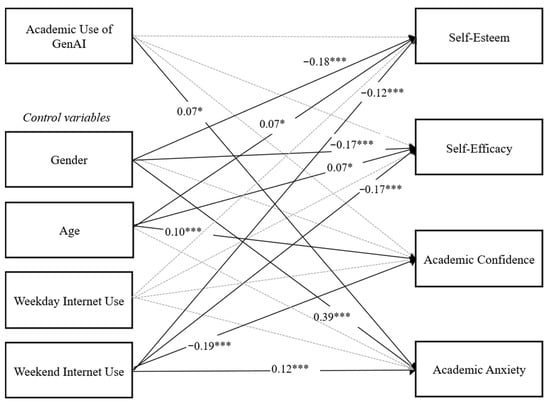
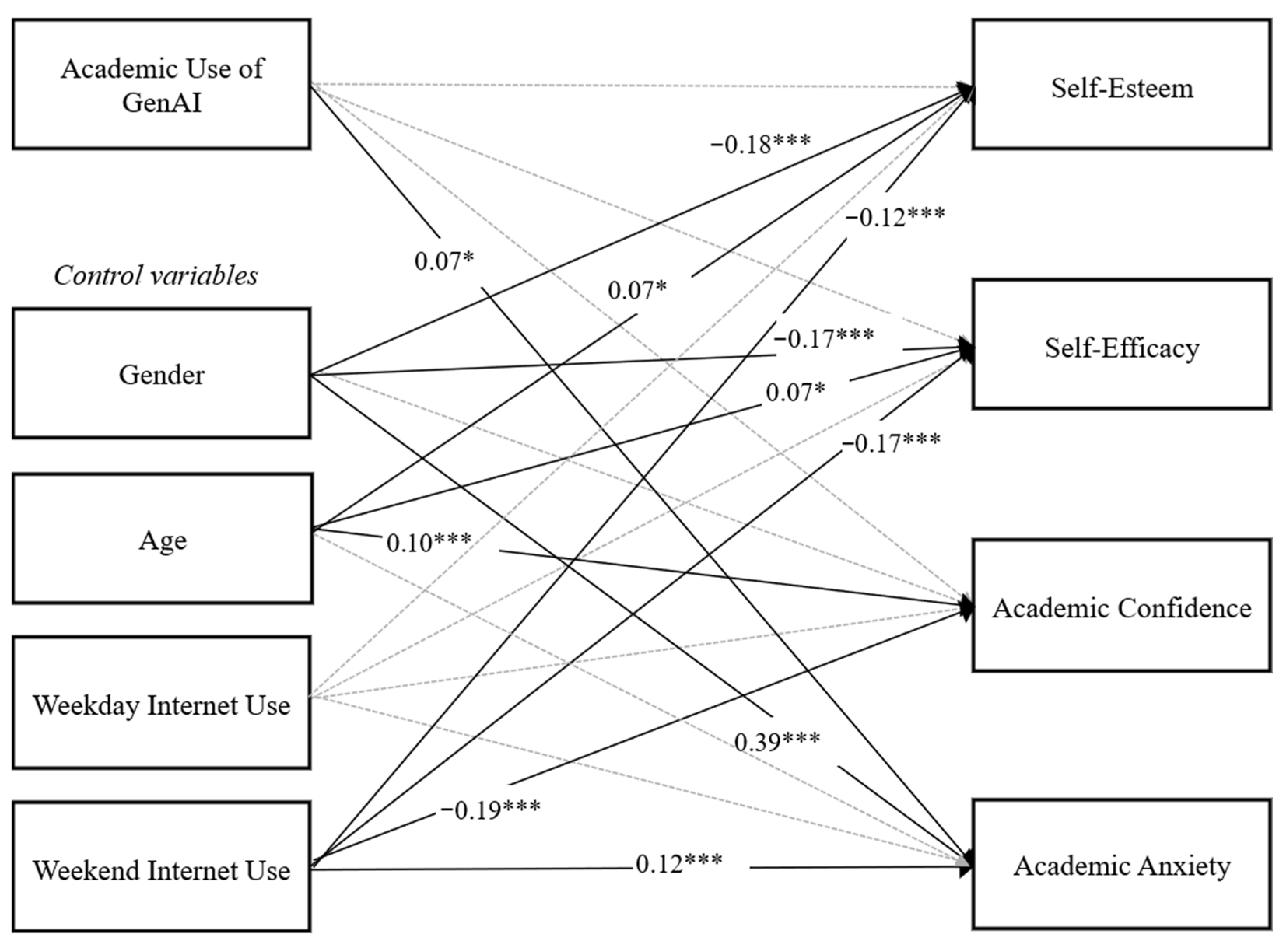
Next, we estimated a structural equation model (SEM) using observed variables, as shown in Figure 1. In the initial model, correlations among the dependent variables were allowed based on theoretical assumptions about their interrelationships. A full model including all direct paths was first estimated. However, this model showed poor fit (CFI = 0.43, NNFI = −1.00, RMSEA = 0.39, SRMR = 0.21) and several of the estimated relationships were not statistically significant (e.g., between GenAI use and self-esteem). Therefore, a more parsimonious model was estimated by removing all non-significant paths. The final model, displayed in Figure 1, retained only statistically significant relationships among the variables. In this model, academic use of GenAI was significantly associated only with academic anxiety, although the magnitude of this association was small (β = 0.07, p < 0.001). All other paths from AI use to self-esteem, self-efficacy, and academic confidence were non-significant. The final model demonstrated excellent fit to the data, as indicated by the following indices: Satorra–Bentler scaled χ2(9) = 13.68, p = 0.13; CFI = 0.998; NNFI = 0.991; SRMR = 0.020; and RMSEA = 0.024 (90% CI [0.000, 0.047]).
Figure 1.
Relationship between the use of GenAI and self-esteem, self-efficacy, academic confidence, and academic anxiety, controlling for gender, age, and time spent using the internet during weekdays and weekends. Note. SB χ2(9) = 13.68, p = 0.13; CFI = 0.998; NNFI = 0.991; SRMR = 0.020; RMSEA = 0.024 (90% CI [0.000, 0.047]). * p < 0.05, *** p < 0.001.
4. Discussion
This study set out to explore the ways in which GenAI is being used for academic purposes among adolescents and young adults, including both pre-university (i.e., secondary and high school) and university students, and to examine its associations with psychological and academic variables. The results indicate that GenAI has become widely integrated into academic life in just a few years since its introduction. In fact, its use now appears to be almost ubiquitous among students. Moreover, the findings suggest that gender (with higher usage among girls), academic level (higher among university students), and higher levels of academic anxiety were linked to more frequent use of GenAI. Although statistically significant, the effect size indicates that this relationship is modest and should not be interpreted as reflecting a substantial practical impact.
Overall, 95% of students across both levels reported having used GenAI for academic purposes—a high figure that points to the mainstream adoption of this technology. Only 5% of students in the sample had never used it. These results align with previous studies, both among university and pre-university students, showing widespread use of GenAI [16,17,19]. However, the percentages in the present study seem slightly higher than those in previous studies, likely because the use of this tool has increased exponentially in a short period of time. In this sense, it is likely that the frequency of use among students who already use GenAI will continue to rise in the coming years. The most common uses reported were writing assignments, getting ideas or inspiration, and producing academic texts, all of which had usage rates above 80%. Importantly, use was not only widespread but also frequent. In six of the eleven tasks examined, over 40% of students reported using GenAI at least once a week. This suggests that for a significant portion of students, GenAI is not just an occasional tool but has become a regular part of their academic routine.
One particularly notable result is the higher prevalence of GenAI use among females—97% compared to approximately 92% of males. These results do not support some previous findings regarding the higher use of GenAI chatbots among men than women [16]. However, our findings are consistent with prior research showing that girls tend to spend more time online, especially on social and communication platforms like social media [46]. Girls have also been found to be more susceptible to problematic internet use [47]. Given the language-based and interactive nature of GenAI tools, which resemble the communicative and social features of platforms where females are more engaged [46], it is plausible that these tools appeal more strongly to female students. Women also tend to assume more active communication roles through technology than men [48], which aligns closely with the user experience offered by GenAI. These patterns may help explain the higher levels of academic engagement with GenAI tools observed among female students.
The study also found that GenAI usage is more frequent among university students compared to their pre-university peers. Specifically, 99% of university students reported having used GenAI for academic tasks, while the figure among pre-university students was 94%. For most of the tasks included in the study—such as writing assignments, editing, or generating academic content—university students reported greater use. Only in two areas did pre-university students show higher usage: numerical problem solving (e.g., calculations or math exercises) and translating texts. There are a few possible explanations for this difference. This might reflect the different academic demands faced by each group. Pre-university students may be using GenAI for more structured, task-specific purposes, whereas university students may rely on it for broader and more complex academic activities. In addition, university-level studies typically involve longer, more demanding assignments, which may lead students to seek additional support. Finally, university students may feel more confident or autonomous in experimenting with new digital tools [17], which, in turn, could lead to more frequent use of GenAI for academic purposes compared to adolescents.
In relation to the association between the use of GenAI for academic purposes and key academic variables, some noteworthy findings also emerged. When examining bivariate correlations, the use of GenAI showed a significant association with both self-esteem and academic anxiety. However, once control variables such as gender, age, and Internet use were included, only the relationship between academic anxiety and GenAI use remained statistically significant.
The findings regarding the relationship between GenAI use and academic anxiety are consistent with several previous studies [9,37]. Several possible explanations may account for these results. In this regard, it is important to consider that the observed association may reflect potential reverse or reciprocal causal mechanisms. On the one hand, increased use of GenAI may contribute to increased feelings of anxiety and insecurity [9]. This could be due to concerns among students regarding the academic legitimacy and ethical implications of using AI tools, raising questions about authorship, grading, recognition, or the depth of learning achieved [16]. Such anticipatory concerns are characteristic of academic anxiety, which is commonly associated with stress, tension, and worry related to academic performance and achievement expectations [43]. In this sense, greater use of GenAI might lead to heightened concerns about academic integrity and learning outcomes. Conversely it is also plausible that students experiencing higher levels of academic anxiety may be more likely to turn to GenAI as a coping strategy [37]. This may involve using AI tools to complete tasks more efficiently, maximize achievement, or access additional information and learning resources. Therefore, a bidirectional, reciprocal relationship between GenAI use and academic anxiety should be further explored in future longitudinal studies. It is also important to note that the effect size between GenAI use and academic anxiety observed was small (r = 0.15), indicating that, as expected, academic anxiety is influenced by multiple other factors. These may include individual personality traits, contextual demands, or broader environmental conditions. Future research should examine the interaction between these factors and GenAI use to develop a more comprehensive understanding of the dynamics involved.
However, we did not find evidence of a significant association between GenAI use and self-esteem, self-efficacy, or academic confidence. Although, as noted earlier, self-esteem initially showed a significant bivariate correlation with GenAI use, this association disappeared after controlling for gender, age, and patterns of Internet use. These results diverge from several previous studies that have reported links between GenAI use and these variables [8,9,28]. Several possible explanations may account for these discrepancies. First, our study employed a more specific and comprehensive measure of GenAI use focused exclusively on academic tasks, unlike other studies that have assessed general or undifferentiated use of AI tools. This more focused scope may have limited associations with broader psychological constructs such as global self-esteem or general academic confidence. Furthermore, it is possible that self-evaluative constructs like self-esteem and self-efficacy are more stable and less reactive to the short-term or situational use of technological tools. While GenAI might support task completion or help reduce uncertainty in specific academic contexts, this may not be sufficient to produce noticeable changes in students’ general beliefs about their abilities or worth. Nevertheless, future research should continue to investigate this relationship, as it is likely that GenAI use will become even more widespread in the coming years. As students increasingly rely on AI not only for academic tasks but also for non-academic purposes, such as psychological support or decision-making, the potential impact on psychological variables and mental health may evolve and intensify over time.
Limitations and Future Directions
The findings of this study should be interpreted in light of several limitations, as is the case with all research. First, the data were collected through self-report measures provided by adolescents, which may have introduced biases related to recall accuracy and self-perception. Additionally, some of the self-report instruments used in this study were specifically developed for the purposes of this research. As a result, their validity and reliability across different contexts and populations have not yet been fully established. Future studies would benefit from the inclusion of more objective measures, such as actual usage logs from GenAI platforms, or third-party evaluations, for instance, teachers’ assessments of students’ academic confidence. Second, this study was conducted with a non-representative sample of adolescents and young adults. As such, caution should be exercised when generalizing the findings to other populations. Moreover, the initial SEM was specified as a fully saturated model based on theoretical considerations, including all hypothesized paths. Model refinement was subsequently conducted by removing non-significant paths in a data-driven manner to obtain a more parsimonious solution. We acknowledge that this approach is exploratory in nature and may increase the risk of overfitting; therefore, the final model should be interpreted with caution. Further research conducted in diverse cultural and educational contexts is needed to replicate and extend these results. Third, the study design was cross-sectional, with all variables assessed at a single point in time. Consequently, causal relationships between variables (such as between GenAI use for academic purposes and academic anxiety) cannot be inferred. Longitudinal studies are necessary to examine the temporal sequence of these associations and to explore potential reciprocal effects between GenAI use and psychological or academic variables. Fourth, while our study focused specifically on GenAI use for academic purposes, it did not account for students’ more general use of AI beyond academic tasks—such as use for entertainment, psychological support, or personal productivity. In addition, the study did not distinguish between supportive uses of GenAI (e.g., idea generation, studying, or editing texts) and potentially substitutive or non-legitimate uses (e.g., copying AI-generated content into academic work). Future research should adopt a broader perspective by evaluating both academic and non-academic AI usage, as well as distinguishing between different types of engagement. For example, copying and pasting AI-generated content into schoolwork may have very different implications than using AI to explore ideas and cross-check information with other sources. Such distinctions would allow for a more nuanced understanding of how different forms of AI use may influence students’ psychological and emotional outcomes. Finally, future studies should examine whether socioeconomic status may influence the relationships observed in the present study, given that factors associated with SES (such as access to digital resources, digital skills, and school characteristics) may act as potential confounding variables.
This study is one of the first to compare the use of GenAI between pre-university and university students, revealing that its use is already widespread. Virtually all students in the sample had used GenAI tools for academic purposes, and the frequency of use was notably high, with many reporting use more than once a week. Despite this rapid adoption, educational and regulatory policies remain a step behind, lacking clear and consistent guidelines on how these technologies should be used and integrated into academic learning. In the field of education, there is still limited knowledge about evidence-based recommendations that can help students integrate AI tools effectively and responsibly. This research also represents an initial exploratory attempt to examine the psychological and academic correlates of GenAI use. Based on our results, we cannot conclude that artificial intelligence currently has a consistent effect on the studied psychological or academic variables. Rather, its impact appears to be quite limited, and in most cases, statistically non-significant. However, although the observed effects were generally small, the findings suggest the potential for meaningful associations, particularly with academic anxiety. Given the growing presence of GenAI tools both inside and outside the classroom, the scientific community must remain attentive to the possible psychological and academic implications for young users, including potential risks such as bias, breaches of privacy, security gaps, and ethical concerns. Future research should also examine how AI use is related to other online risks, such as compulsive internet use, the creation of fake news, or potential victimization (e.g., through deepfake generation) [49,50].
5. Conclusions
This study is one of the first to compare the use of GenAI between pre-university and university students, revealing that its use is already widespread. Virtually all students in the sample had used GenAI tools for academic purposes, and the frequency of use was notably high, with many reporting use more than once a week. This rapid adoption highlights the potential need of developing clear institutional frameworks to guide the pedagogical integration of these technologies. However, any applied implications derived from these findings should be considered preliminary, as the present study did not directly assess educational policies and is based on cross-sectional self-report data. Although the present study did not directly assess regulatory policies, previous reports have emphasized the need for coherent guidelines to ensure responsible and effective implementation of AI tools in academic contexts [51]. However, in the field of education, there is still limited knowledge about evidence-based recommendations that can help students integrate AI tools effectively and responsibly. This research also represents an initial exploratory attempt to examine the psychological and academic correlates of GenAI use. Based on our results, we cannot conclude that artificial intelligence currently has a consistent effect on the studied psychological or academic variables. Rather, its impact appears to be quite limited and, in most cases, statistically non-significant. However, although the observed effects were generally small, the findings suggest the potential for meaningful associations, particularly with academic anxiety. Future studies should build upon these results using broader, more diverse samples and longitudinal designs that examine the temporal and reciprocal nature of these relationships over time. Given the growing presence of GenAI tools both inside and outside the classroom, the scientific community must remain attentive to the possible psychological and academic implications for young users, including potential risks such as bias, breaches of privacy, security gaps, and ethical concerns.
Supplementary Materials
The following supporting information can be downloaded at: https://www.mdpi.com/article/10.3390/soc16040107/s1, Supplementary Material S1: Academic Anxiety Scale Items.
Author Contributions
Conceptualization, M.G.-G. and E.M.-P.; methodology, M.G.-G. and E.M.-P.; formal analysis, M.G.-G.; investigation, M.G.-G. and E.M.-P.; resources, M.G.-G.; data curation, M.G.-G.; writing—original draft preparation, M.G.-G.; writing—review and editing, E.M.-P.; project administration, M.G.-G.; funding acquisition, M.G.-G. All authors have read and agreed to the published version of the manuscript.
Funding
This work was supported by the Spanish Ministry of Science and Innovation Grant [grant number PID2022-140195NB-I00]. The research funding sources were not involved in the project’s conduct or preparation of the present manuscript.
Institutional Review Board Statement
This study forms part of a broader research project on the use of the Internet among youth, which received approval from the Ethics Committee of Autonomous University of Madrid (approval code CEI-134-2826) on 3 November 2023. All procedures conformed to the ethical principles established in the Declaration of Helsinki.
Informed Consent Statement
Informed consent was obtained from all subjects involved in the study.
Data Availability Statement
The datasets presented in this article are not readily available because the data are part of an ongoing study. Requests to access the datasets should be directed to the corresponding author.
Conflicts of Interest
The authors declare no conflicts of interest.
References
- Chiu, T.K.F.; Xia, Q.; Zhou, X.; Chai, C.S.; Cheng, M. Systematic Literature Review on Opportunities, Challenges, and Future Research Recommendations of Artificial Intelligence in Education. Comput. Educ. Artif. Intell. 2023, 4, 100118. [Google Scholar] [CrossRef] [Scilit]
- Kamalov, F.; Santandreu Calonge, D.; Gurrib, I. New Era of Artificial Intelligence in Education: Towards a Sustainable Multifaceted Revolution. Sustainability 2023, 15, 12451. [Google Scholar] [CrossRef] [Scilit]
- Wang, S.; Wang, F.; Zhu, Z.; Wang, J.; Tran, T.; Du, Z. Artificial Intelligence in Education: A Systematic Literature Review. Expert Syst. Appl. 2024, 252, 124167. [Google Scholar] [CrossRef] [Scilit]
- Xiaoyu, W.; Zainuddin, Z.; Hai Leng, C. Generative Artificial Intelligence in Pedagogical Practices: A Systematic Review of Empirical Studies (2022–2024). Cogent Educ. 2025, 12, 2485499. [Google Scholar] [CrossRef] [Scilit]
- Zhan, Y.; Boud, D.; Dawson, P.; Yan, Z. Generative Artificial Intelligence as an Enabler of Student Feedback Engagement: A Framework. High. Educ. Res. Dev. 2025, 44, 1289–1304. [Google Scholar] [CrossRef] [Scilit]
- García-López, I.M.; Trujillo-Liñán, L. Ethical and Regulatory Challenges of Generative AI in Education: A Systematic Review. Front. Educ. 2025, 10, 1565938. [Google Scholar] [CrossRef] [Scilit] [PubMed]
- Kim, B.-J.; Lee, J. The Mental Health Implications of Artificial Intelligence Adoption: The Crucial Role of Self-Efficacy. Humanit. Soc. Sci. Commun. 2024, 11, 1561. [Google Scholar] [CrossRef] [Scilit]
- Oubibi, M. Generative Artificial Intelligence: Postgraduate Student’s Digital Adaptability, Engagement and Academic Confidence. J. Comput. Educ. 2025. [Google Scholar] [CrossRef] [Scilit]
- Pavone, G. Generative AI in the Learning Process: Threat or Tool? Understanding the Role of Self-Esteem and Academic Anxiety in Shaping Student Motivations. J. Mark. Educ. 2025, 02734753251346857. [Google Scholar] [CrossRef] [Scilit]
- Rosenberg, M. Rosenberg Self-Esteem Scale. J. Relig. Health 1965. [Google Scholar] [CrossRef] [Scilit]
- Bandura, A. Self-Efficacy Mechanism in Human Agency. Am. Psychol. 1982, 37, 122–147. [Google Scholar] [CrossRef]
- Cassady, J.C.; Pierson, E.E.; Starling, J.M. Predicting Student Depression with Measures of General and Academic Anxieties. Front. Educ. 2019, 4, 11. [Google Scholar] [CrossRef] [Scilit]
- Finch, W.H.; Cassady, J.C.; Helsper, C.A. Identification and Validation of Severity Standards for the Academic Anxiety Scale. Int. J. Test. 2024, 24, 145–168. [Google Scholar] [CrossRef] [Scilit]
- von Garrel, J.; Mayer, J. Artificial Intelligence in Studies—Use of ChatGPT and AI-Based Tools among Students in Germany. Humanit. Soc. Sci. Commun. 2023, 10, 799. [Google Scholar] [CrossRef] [Scilit]
- Johnston, H.; Wells, R.F.; Shanks, E.M.; Boey, T.; Parsons, B.N. Student Perspectives on the Use of Generative Artificial Intelligence Technologies in Higher Education. Int. J. Educ. Integr. 2024, 20, 2. [Google Scholar] [CrossRef] [Scilit]
- Møgelvang, A.; Bjelland, C.; Grassini, S.; Ludvigsen, K. Gender Differences in the Use of Generative Artificial Intelligence Chatbots in Higher Education: Characteristics and Consequences. Educ. Sci. 2024, 14, 1363. [Google Scholar] [CrossRef] [Scilit]
- Chaparro, E.; Arias, J.; Quispe, M. Uso de Inteligencia Artificial Generativa En Contextos Académicos: Percepción de Estudiantes Universitarios. Ing. Investig. 2025, 7, 1–13. [Google Scholar] [CrossRef] [Scilit]
- Xiao, L.; Pyng, H.S.; Ayub, A.F.M.; Zhu, Z.; Gao, J.; Qing, Z. University Students’ Usage of Generative Artificial Intelligence for Sustainability: A Cross-Sectional Survey from China. Sustainability 2025, 17, 3541. [Google Scholar] [CrossRef] [Scilit]
- Zhu, T.; Zhang, K.; Wang, W.Y. Embracing AI in Education: Understanding the Surge in Large Language Model Use by Secondary Students. arXiv 2024, arXiv:2411.18708. [Google Scholar] [CrossRef] [Scilit]
- Klarin, J.; Hoff, E.; Larsson, A.; Daukantaitė, D. Adolescents’ Use and Perceived Usefulness of Generative AI for Schoolwork: Exploring Their Relationships with Executive Functioning and Academic Achievement. Front. Artif. Intell. 2024, 7, 1415782. [Google Scholar] [CrossRef] [Scilit] [PubMed]
- Wu, H.; Guo, Y.; Yang, Y.; Zhao, L.; Guo, C. A Meta-Analysis of the Longitudinal Relationship Between Academic Self-Concept and Academic Achievement. Educ. Psychol. Rev. 2021, 33, 1749–1778. [Google Scholar] [CrossRef] [Scilit]
- Zheng, L.R.; Atherton, O.E.; Trzesniewski, K.; Robins, R.W. Are Self-Esteem and Academic Achievement Reciprocally Related? Findings from a Longitudinal Study of Mexican-Origin Youth. J. Pers. 2020, 88, 1058–1074. [Google Scholar] [CrossRef] [Scilit]
- Zysberg, L.; Schwabsky, N. School Climate, Academic Self-Efficacy and Student Achievement. Educ. Psychol. 2021, 41, 467–482. [Google Scholar] [CrossRef] [Scilit]
- Bandura, A. Social Foundations of Thought and Action: A Social Cognitive Theory; Prentice-Hall, Inc.: Hoboken, NJ, USA, 1986. [Google Scholar]
- Chen, G.; Gully, S.M.; Eden, D. General Self-Efficacy and Self-Esteem: Toward Theoretical and Empirical Distinction between Correlated Self-Evaluations. J. Organ. Behav. 2004, 25, 375–395. [Google Scholar] [CrossRef] [Scilit]
- Yao, R.; Qi, G.; Sheng, D.; Sun, H.; Zhang, J. Connecting Self-Esteem to Problematic AI Chatbot Use: The Multiple Mediating Roles of Positive and Negative Psychological States. Front. Psychol. 2025, 16, 1453072. [Google Scholar] [CrossRef] [Scilit]
- Tufail, R.; Shahwani, A.M.; Khan, W.; Badar, Y. Examining the Impact of AI-Generated Content on Self-Esteem and Body Image Through Social Comparison. Bull. Bus. Econ. BBE 2024, 13, 413–421. [Google Scholar] [CrossRef] [Scilit]
- Falebita, O.S.; Kok, P.J. Artificial Intelligence Tools Usage: A Structural Equation Modeling of Undergraduates’ Technological Readiness, Self-Efficacy and Attitudes. J. STEM Educ. Res. 2025, 8, 257–282. [Google Scholar] [CrossRef] [Scilit]
- Montag, C.; Kraus, J.; Baumann, M.; Rozgonjuk, D. The Propensity to Trust in Automated Technology Mediates the Links between Technology Self-Efficacy and Fear and Acceptance of Artificial Intelligence. Comput. Hum. Behav. Rep. 2023, 11, 100315. [Google Scholar] [CrossRef] [Scilit]
- Jia, X.-H.; Tu, J.-C. Towards a New Conceptual Model of AI-Enhanced Learning for College Students: The Roles of Artificial Intelligence Capabilities, General Self-Efficacy, Learning Motivation, and Critical Thinking Awareness. Systems 2024, 12, 74. [Google Scholar] [CrossRef] [Scilit]
- Sander, P. Current Developments in Measuring Academic Behavioural Confidence. Psychol. Teach. Rev. 2009, 15, 32–44. [Google Scholar] [CrossRef] [Scilit]
- Sander, P.; De La Fuente Arias, J.; Stevenson, K.; Jones, T. A Validation of the Academic Behavioural Confidence Scale with Spanish Psychology Students. Psychol. Learn. Teach. 2011, 10, 11–24. [Google Scholar] [CrossRef] [Scilit]
- Silitubun, E. The Relationship Between Student Self-Confidence, AI Support, and Academic Achievement: A Study in the Psychology of Motivation and Learning. Bull. Couns. Psychother. 2023, 5, 305–313. [Google Scholar] [CrossRef] [Scilit]
- Cassady, J.C. Anxiety in Schools: The Causes, Consequences, and Solutions for Academic Anxieties; Peter Lang: Lausanne, Switzerland, 2010; ISBN 978-1-4331-0633-0. [Google Scholar]
- Brumariu, L.E.; Waslin, S.M.; Gastelle, M.; Kochendorfer, L.B.; Kerns, K.A. Anxiety, Academic Achievement, and Academic Self-Concept: Meta-Analytic Syntheses of Their Relations across Developmental Periods. Dev. Psychopathol. 2023, 35, 1597–1613. [Google Scholar] [CrossRef] [Scilit]
- Commodari, E.; La Rosa, V.L. General Academic Anxiety and Math Anxiety in Primary School. The Impact of Math Anxiety on Calculation Skills. Acta Psychol. 2021, 220, 103413. [Google Scholar] [CrossRef] [Scilit]
- Abbas, M.; Jam, F.A.; Khan, T.I. Is It Harmful or Helpful? Examining the Causes and Consequences of Generative AI Usage among University Students. Int. J. Educ. Technol. High. Educ. 2024, 21, 10. [Google Scholar] [CrossRef] [Scilit]
- Gao, S. Can Artificial Intelligence Give a Hand to Open and Distributed Learning? A Probe into the State of Undergraduate Students’ Academic Emotions and Test Anxiety in Learning via ChatGPT. Int. Rev. Res. Open Distrib. Learn. 2024, 25, 199–218. [Google Scholar] [CrossRef] [Scilit]
- Rosenberg, M. Society and the Adolescent Self-Image; Princeton University Press: Princeton, NJ, USA, 1965; Volume 11. [Google Scholar]
- Martín-Albo, J.; Núñez, J.L.; Navarro, J.G.; Grijalvo, F. The Rosenberg Self-Esteem Scale: Translation and Validation in University Students. Span. J. Psychol. 2007, 10, 458–467. [Google Scholar] [CrossRef] [Scilit] [PubMed]
- Chen, G.; Gully, S.M.; Eden, D. Validation of a New General Self-Efficacy Scale. Organ. Res. Methods 2001, 4, 62–83. [Google Scholar] [CrossRef] [Scilit]
- Espada, J.P.; Gonzálvez, M.T.; Orgilés, M.; Carballo, J.; Piqueras, J. Validation of the General Self-Efficacy Scale with Spanish Adolescents. Electron. J. Res. Educ. Psychol. 2012, 10, 355–370. [Google Scholar] [CrossRef] [Scilit]
- Cassady, J.C.; Johnson, R.E. Cognitive Test Anxiety and Academic Performance. Contemp. Educ. Psychol. 2002, 27, 270–295. [Google Scholar] [CrossRef] [Scilit]
- Bentler, P.M.; Wu, E.J. EQS 6.1 for Windows; Multivariate Software INC: Encino, CA, USA, 2005. [Google Scholar]
- Byrne, B.M. Structural Equation Modeling with EQS: Basic Concepts, Applications, and Programming; Routledge: London, UK, 2013; ISBN 1-135-80960-7. [Google Scholar]
- Twenge, J.M.; Martin, G.N. Gender Differences in Associations between Digital Media Use and Psychological Well-Being: Evidence from Three Large Datasets. J. Adolesc. 2020, 79, 91–102. [Google Scholar] [CrossRef] [Scilit]
- Machimbarrena, J.M.; González-Cabrera, J.; Ortega-Barón, J.; Beranuy-Fargues, M.; Álvarez-Bardón, A.; Tejero, B. Profiles of Problematic Internet Use and Its Impact on Adolescents’ Health-Related Quality of Life. Int. J. Environ. Res. Public Health 2019, 16, 3877. [Google Scholar] [CrossRef] [Scilit]
- Zibin, A.; Al-Sabatin, Y.; Altakhaineh, A.R.M. Social Media’s Influence on Gendered Interpersonal Communication: Insights from Jordan. J. Media 2025, 6, 47. [Google Scholar] [CrossRef] [Scilit]
- Mateos Pérez, E.; Martínez Bacaicoa, J.; Wachs, S.; Gámez Guadix, M. Longitudinal Associations of Online Self-Harm with Online Victimization through Cyberbullying, Hate Speech, Online Grooming and Nonconsensual Sexting. J. Study Educ. Dev. Infanc. Aprendiz. 2025, 48, 663–687. [Google Scholar] [CrossRef] [Scilit]
- Gámez-Guadix, M.; Machimbarrena, J.M. Internet Risks and Challenges among Young Adults and Adolescents: An Overview and Research Prospects/Riesgos y Retos de Internet Entre Jóvenes y Adolescentes: Una Visión General y Perspectivas de Investigación. J. Study Educ. Dev. Infanc. Aprendiz. 2025, 48, 483–503. [Google Scholar] [CrossRef] [Scilit]
- Holmes, W.; Miao, F. UNESCO Guidance for Generative AI in Education and Research; UNESCO Publishing: Paris, France, 2023; ISBN 978-92-3-100612-8. [Google Scholar]

Disclaimer/Publisher’s Note: The statements, opinions and data contained in all publications are solely those of the individual author(s) and contributor(s) and not of MDPI and/or the editor(s). MDPI and/or the editor(s) disclaim responsibility for any injury to people or property resulting from any ideas, methods, instructions or products referred to in the content. |
© 2026 by the authors. Licensee MDPI, Basel, Switzerland. This article is an open access article distributed under the terms and conditions of the Creative Commons Attribution (CC BY) license.