
AI Ethics Bylaws for Academia: Teaching, Learning, and Assessment



Abstract
1. Introduction
Research Questions
- 1.
- Among faculty in STEM fields, what are the perceptions of faculty regarding key dimensions of AI Ethics Bylaws addressing TLAs?
- 2.
- Do perceived differences in the perceived importance of AI ethics principles like transparency, fairness, and human oversight vary between conditions of a high and low level of disciplinary presence?
- 3.
- Does the pilot study give preliminary evidence on the relevance and viability of the suggested AI governance model in the academic setting?
2. Materials and Methods
2.1. Major Use of AI in TLA

| Dimension | Typical University Practice | Proposed Taxonomy | Refs. |
|---|---|---|---|
| Classification logic | “Allowed vs. prohibited” criteria | Contribution rules for consistent categorization | [49,50] |
| Minor AI Use | Grammar or formatting assistance tools | Non-transformative aid; disclosure optional unless required | [51] |
| Major AI Use | Vague reference to “substantive” AI assistance | Meaningful input into ideas, structure, or analysis; mandatory disclosure | [41] |
| Disclosure requirements | To disclose AI use; no placement rules | Structured area (title page, acknowledgments, appendices) | [49] |
| Pedagogical sensitivity | Rules across disciplines | Discipline templates; draws on pilot studies | [32] |
| Governance integration | Enforcement by instructor; workflow alignment | Linked to university workflow: approval, audits, documentation, appeals | [52] |
| Our contributions | High-level guidance with operational detail with references | Role-based dependencies, disclosure taxonomy, approval criteria, workflows | Our work |
2.2. Minor Use of AI in TLA
2.3. Important Protocols for Use of AI in TLA
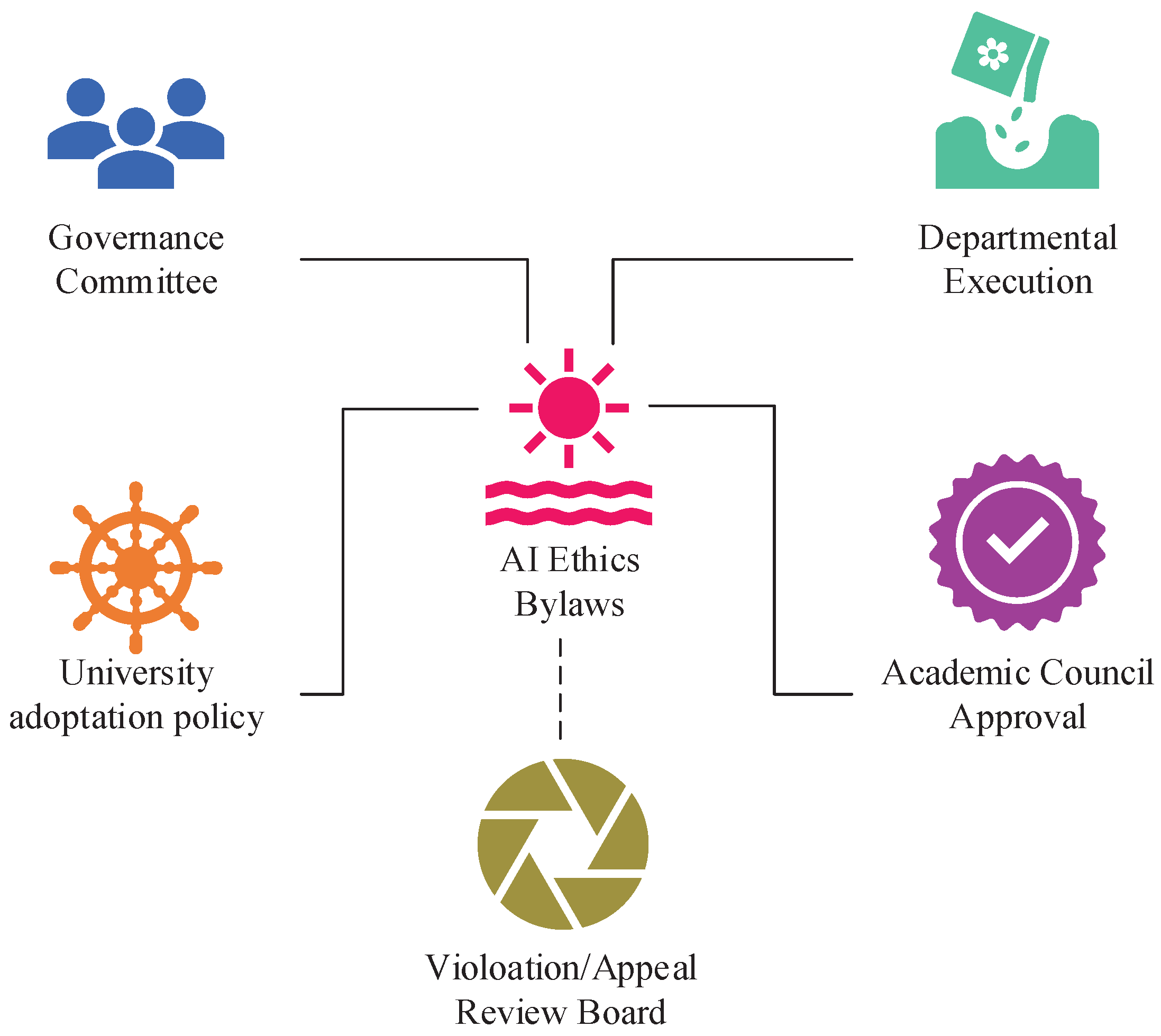
2.4. Governance Workflow Process
- 1.
- Draft bylaws from committee member, forward to departmental review, and then forward to university academic council final approval.
- 2.
- Publish the bylaws in the institutional repository and the course syllabus.
- 3.
- Conduct review and stakeholder consultation.
- 4.
- Investigate violations and collect documented evidence and apply academic integrity policies.
- 5.
- Provide an appeal mechanism and resolve conflicts through institutional authority.
2.5. Role of the Empirical Component
2.6. AI Ethics Bylaws for TLA
2.7. Sample Disclosure Statement for Students
2.8. Sample Disclosure Statement for Faculty Using AI Tools in Assessment
2.9. Sample Disclosure Statement for Researchers Using AI Tools
| Concerns | Observations | Existing Studies |
|---|---|---|
| Loss of privacy | 1. Leakage of personal information. 2. Increasing the surveillance culture. 3. Compromised consent. | Kobis and Mehner [33] Reiss [34] Adams et al. [35] |
| Bias and discrimination | 1. Gender discrimination. 2. Regional and ethnic discrimination. 3. Class discrimination. 4. Cultural discrimination. | Ghotbi and Ho [36] Ghotbi et el. [53] Matias and Zipitria [37] Masters [38] |
| Transparency issue | 1. Teachers’ vs. student relation for knowledge imparting and learning. 2. Potential risks of using AI models in the classroom. | Memarian and Doleck [54] Wang et al. [55] |
| Academic misconduct | Plagiarism and cheating issues. | Adams et al. [35] |
| Autonomy learning | Freedom of knowledge sharing the environment is limited. | Han et al. [31] |
| Evaluation Component | Description | Evidence Required |
|---|---|---|
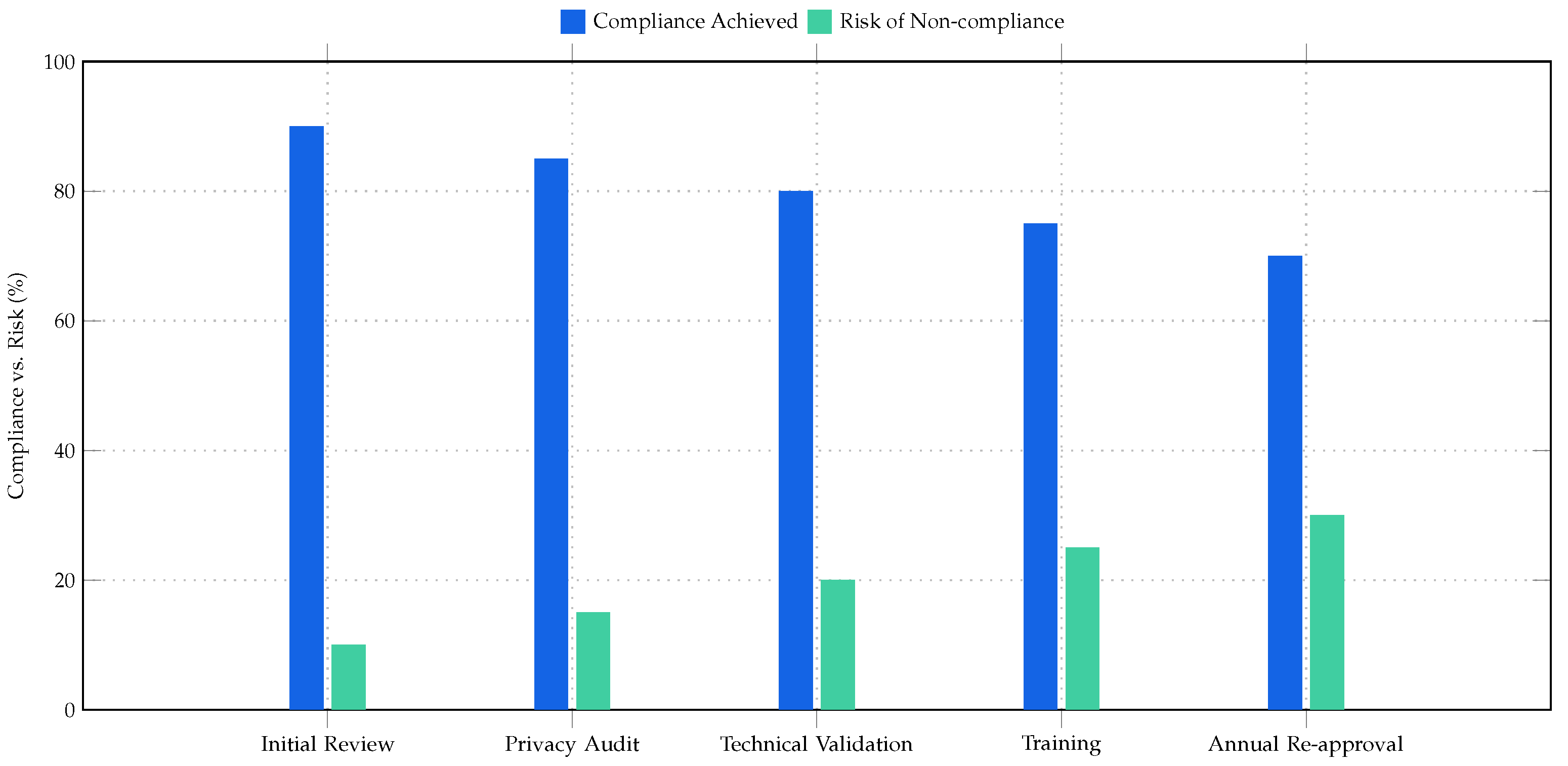
| Privacy Impact Assessment | Compliance with GDPR and local data laws | Formal PIA report |
| Data Handling and Retention | Policy for storage, encryption, and deletion | Vendor documentation |
| Model Limitations | Known biases, explainability constraints | Technical whitepaper |
| Training Requirements | User training for ethical and secure use | Training module outline |
| Re-approval Process | Annual review or upon major version change | Audit checklist |
| De-listing Criteria | Non-compliance or security breach | Incident report |
| Academic Task | Permitted AI Use | Required Disclosure | Prohibited Use |
|---|---|---|---|
| Closed-book Exam | None (except formatting) | N/A | Answer generation |
| Take-home Project | Grammar check | Scope of help | Full project |
| Thesis/Dissertation | Language, citation, formatting | Contribution details | Fabrication/ plagiarism |
| Programming Assignment | Syntax, debugging hints | Tool name, assistance | Code generation |
| Dimension | UNESCO AI Ethics [51] | OECD AI Principles [48] | Proposed Academic AI Ethics Bylaws |
|---|---|---|---|
| Scope | Global policy and societal impact | Economic growth and innovation | Institutional governance for teaching, learning, and assessment |
| Focus Area | Human rights, fairness, transparency | Responsible AI, accountability | Academic integrity, disclosure, assessment validity |
| Implementation Level | Macro-level national strategies | Policy guidelines for governments | Micro-level university bylaws and workflows |
| Operational Tools | Principles and recommendations | High-level policy statements | Disclosure templates, mapping tables, approval dossier (Table 3) |
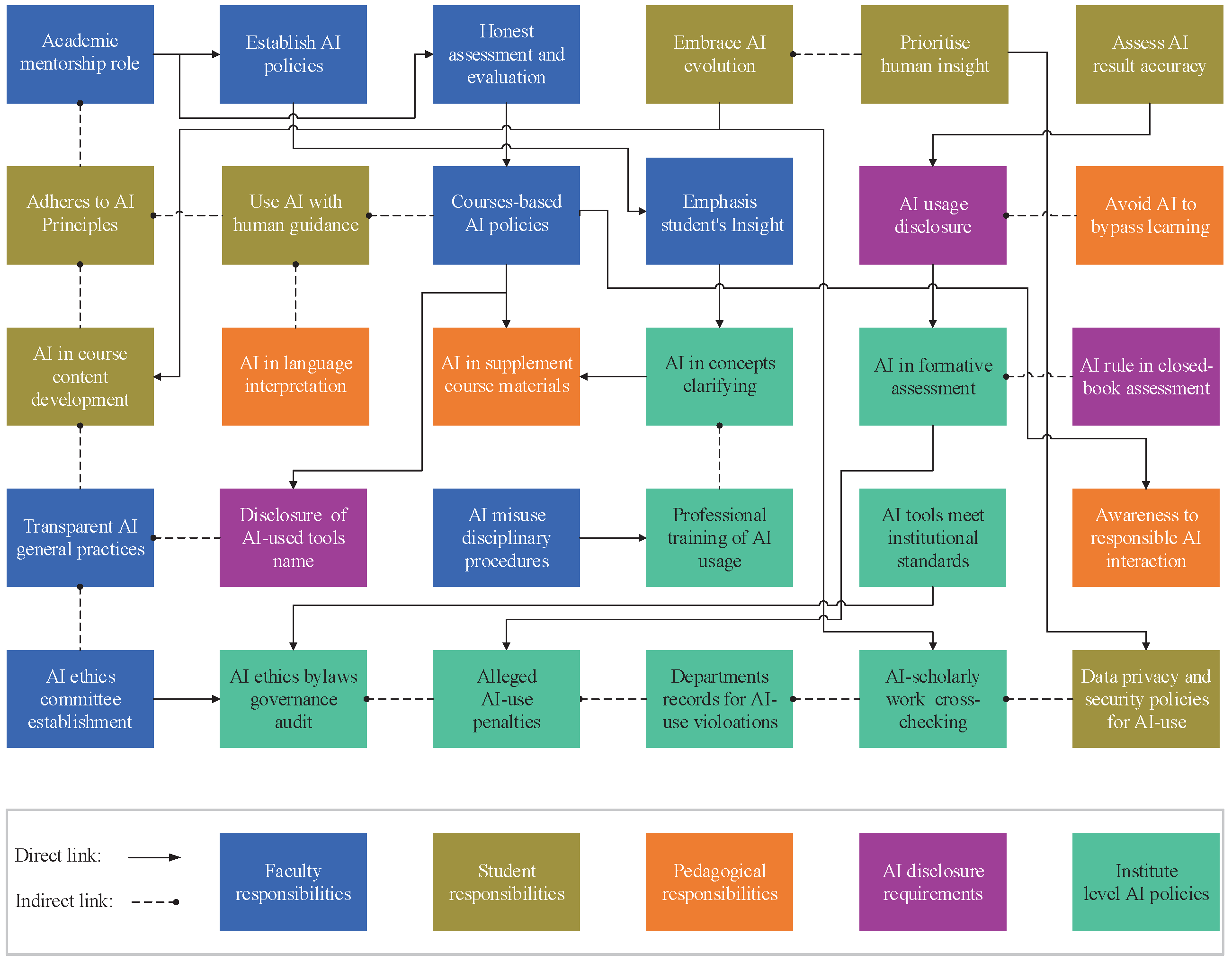
| Governance Mechanism | Ethical principles for AI systems | Risk-based regulatory approach | Role-based governance workflow (Figure 4) |
| Applied Examples | Not specified | Not specified | Illustrative bylaw clauses, academic task mapping (Table 4) |
3. AI Ethics Bylaw Roles with Dependencies
Data Privacy and Security
4. AI Ethics Bylaws’ Theoretical and Governance Foundations
4.1. Contributions of the Proposed Bylaws
4.2. AI Tool Evaluation and Approval
4.3. Academic Integrity and Misuse of AI
- 1.
- Submitting AI-generated work as original human work.
- 2.
- Fabricating sources, data, or citations using AI tools.
- 3.
- Using AI in assessments where its use is prohibited.
4.4. Comparison with International AI Ethics in Academia
4.5. Interpretive Status of the Taxonomy
5. Statistical Analysis
5.1. Descriptive Insights
5.2. Disciplinary Comparisons
- 1.
- Mathematics and Computing differ in the Learning dimension;
- 2.
- Computing and Engineering differ in the Assessment dimension;
- 3.
- Mathematics and Engineering remain similar across most dimensions.
Interpretive Insights
5.3. Limitations and Considerations
6. Conclusions
Author Contributions
Funding
Institutional Review Board Statement
Informed Consent Statement
Data Availability Statement
Acknowledgments
Conflicts of Interest
References
- Association for Computing Machinery. ACM Code of Ethics and Professional Conduct. 2018. Available online: https://www.codes-isss.org/ethics_subdomain/code-of-ethics/code-2018-update-project/ (accessed on 28 September 2025).
- Acemoglu, D.; Restrepo, P. The Race Between Machine and Man: Implications of Technology for Growth, Factor Shares, and Employment. Am. Econ. Rev. 2018, 108, 1488–1542. [Google Scholar] [CrossRef]
- Ng, A. What Artificial Intelligence Can and Can’t Do Right Now. Harvard Business Review, 9 November 2016. Available online: https://hbr.org/2016/11/what-artificial-intelligence-can-and-cant-do-right-now (accessed on 11 March 2026).
- European Commission. Ethics Guidelines for Trustworthy AI (Draft). 2019. Available online: https://digital-strategy.ec.europa.eu/en/library/ethics-guidelines-trustworthy-ai (accessed on 11 March 2026).
- Rafique, Z.; Bibi, N.; Muhammad, N. Quantum-Inspired Ant Colony Optimization for Task Scheduling in Edge Environment. In Proceedings of the 2025 International Conference on Frontiers of Information Technology (FIT), Islamabad, Pakistan, 15–16 December 2025; pp. 1–6. [Google Scholar] [CrossRef]
- Silver, D.; Schrittwieser, J.; Simonyan, K.; Antonoglou, I.; Huang, A.; Guez, A.; Hubert, T.; Baker, L.; Lai, M.; Bolton, A.; et al. Mastering the game of Go without human knowledge. Nature 2017, 550, 354–359. [Google Scholar] [CrossRef]
- State v. Loomis, 881 N.W.2d 749 (Wis. 2016). Justia U.U. Law, Supreme Court of Wisconsin Decision, 2016. 13 July 2016. Available online: https://law.justia.com/cases/wisconsin/supreme-court/2016/2015ap000157-cr.html (accessed on 11 March 2026).
- Feller, A.; Pierson, E.; Corbett-Davies, S.; Goel, S. A Computer Program Used for Bail and Sentencing Decisions Was Labeled Biased Against Blacks. It’s Actually Not That Clear. The Washington Post, 17 October 2016.
- IEEE Standards Association. Ethically Aligned Design, 2nd ed.; IEEE Standards Association: Piscataway, NJ, USA, 2018. [Google Scholar]
- Doshi-Velez, F.; Kortz, M.; Budish, R.; Bavitz, C.; Gershman, S.; O’Brien, D.; Scott, K.; Schieber, S.; Waldo, J.; Weinberger, D.; et al. Accountability of AI Under the Law: The Role of Explanation. arXiv 2017, arXiv:1711.01134. [Google Scholar] [CrossRef]
- AI Now Institute. AI Now Report; AI Now Institute: New York, NY, USA, 2017. [Google Scholar]
- Cath, C. Governing artificial intelligence: Ethical, legal and technical opportunities and challenges. Philos. Trans. R. Soc. A 2018, 376, 20180080. [Google Scholar] [CrossRef]
- Villani, C. For a Meaningful Artificial Intelligence: Towards a French and European Strategy. In Villani Report; Conseil National du Numérique: Paris, France, 2018. [Google Scholar]
- Bremner, P.; Dennis, L.A.; Fisher, M.; Winfield, A.F. On Proactive, Transparent, and Verifiable Ethical Reasoning for Robots. Proc. IEEE 2019, 107, 541–561. [Google Scholar] [CrossRef]
- Bashir, A.; Bibi, N.; Muhammad, N. Ransomware Detection using Machine Learning Approaches. In Proceedings of the 2025 International Conference on Frontiers of Information Technology (FIT), Islamabad, Pakistan, 15–16 December 2025; pp. 1–6. [Google Scholar] [CrossRef]
- Wilk, A. Cyber Security Education and Law. In Proceedings of the 2016 IEEE International Conference on Software Science, Technology and Engineering (SWSTE), Beer Sheva, Israel, 23–24 June 2016; pp. 58–62. [Google Scholar] [CrossRef]
- A Report in the Computing Curricula Series Joint Task Group on Computer Engineering Curricula Association for Computing Machinery (ACM), IEEE Computer Society 2016. 15 December 2016. Available online: https://www.acm.org/binaries/content/assets/education/ce2016-final-report.pdf (accessed on 11 March 2026).
- Bielefeldt, A.R.; Polmear, M.; Knight, D.; Swan, C.; Canney, N. Education of Electrical Engineering Students about Ethics and Societal Impacts in Courses and Co-curricular Activities. In Proceedings of the 2018 IEEE Frontiers in Education Conference (FIE), San Jose, CA, USA, 3–6 October 2018; pp. 1–5. Available online: https://ieeexplore.ieee.org/abstract/document/8658888 (accessed on 11 March 2026).
- Duncan, S.; Healey, J. (Eds.) The Ethics. In Trauma Reporting; Routledge: Abingdon, UK, 2019; pp. 186–198. ISBN 9781138482098. Available online: https://strathprints.strath.ac.uk/70023/ (accessed on 11 March 2026).
- Shalvi, S.; Gino, F.; Barkan, R.; Ayal, S. Self-Serving Justifications: Doing Wrong and Feeling Moral. Curr. Dir. Psychol. Sci. 2015, 24, 125–130. [Google Scholar] [CrossRef]
- World Economic Forum. World Economic Forum DATE: 14 Jan 2020 Emerging Technologies How Global Tech Companies Can Champion Ethical AI. Available online: https://www.weforum.org/stories/2020/01/tech-companies-ethics-responsible-ai-microsoft/ (accessed on 11 March 2026).
- Saltz, J.S.; Dewar, N.I.; Heckman, R. Key Concepts for a Data Science Ethics Curriculum. In Proceedings of the 49th ACM Technical Symposium on Computer Science Education (SIGCSE’18), New York, NY, USA, 21–24 February 2018; pp. 952–957. Available online: https://dl.acm.org/doi/abs/10.1145/3159450.3159483 (accessed on 11 March 2026).
- Zeide, E.; Nissenbaum, H. Learner Privacy in MOOCs and Virtual Education. Theory Res. Educ. 2018, 16, 280–307. Available online: https://journals.sagepub.com/doi/10.1177/1477878518815340 (accessed on 11 March 2026). [CrossRef]
- Quinn, M.J. Ethics for the Information Age, 7th ed.; Pearson: London, UK, 2017. [Google Scholar]
- Goldsmith, J.; Burton, E. Why Teaching Ethics to AI Practitioners Is Important. In Proceedings of the AAAI-17 Workshop on AI, Ethics, and Society; Association for the Advancement of Artificial Intelligence: Washington, DC, USA, 2017. [Google Scholar]
- Burton, E.; Goldsmith, J.; Koenig, S.; Kuipers, B.; Mattei, N.; Walsh, T. Ethical Considerations in Artificial Intelligence Courses. arXiv 2017, arXiv:1701.07769. [Google Scholar] [CrossRef]
- Lafollette, H. The Practice of Ethics; Blackwell Publishing: Oxford, UK, 2007. [Google Scholar]
- Fort, T.; Presser, S. The Legal Environment of Business; West Academic Publishing: Saint Paul, MN, USA, 2017. [Google Scholar]
- Zeng, Y.; Lu, E.; Huangfu, C. Linking Artificial Intelligence Principles. arXiv 2018, arXiv:1812.04814. [Google Scholar] [CrossRef]
- Wilk, A. Teaching AI, Ethics, Law and Policy. arXiv 2019, arXiv:1904.12470. [Google Scholar] [CrossRef]
- Han, B.; Nawaz, S.; Buchanan, G.; McKay, D. Ethical and Pedagogical Impacts of AI in Education. In Artificial Intelligence in Education (AIED); Lecture Notes in Computer Science; Springer: Berlin/Heidelberg, Germany, 2023; Volume 13916, pp. 667–673. [Google Scholar] [CrossRef]
- Borenstein, J.; Howard, A. Emerging Challenges in AI and the Need for Ethics Education. AI Soc. 2021, 1, 61–65. Available online: https://link.springer.com/article/10.1007/s43681-020-00002-7 (accessed on 11 March 2026). [CrossRef] [PubMed]
- Köbis, N.; Mehner, C. Ethical Questions Raised by AI-Supported Mentoring in Higher Education. Front. Artif. Intell. 2021, 4, 624050. [Google Scholar] [CrossRef]
- Reiss, M.J. The use of AI in education: Practicalities and ethical considerations. Lond. Rev. Educ. 2021, 19, 1–14. [Google Scholar] [CrossRef]
- Adams, C.; Pente, P.; Lemermeyer, G.; Rockwell, G. Ethical principles for artificial intelligence in K-12 education. Comput. Educ. Artif. Intell. 2023, 4, 100131. [Google Scholar] [CrossRef]
- Ghotbi, N.; Ho, M.T. Moral Awareness of College Students Regarding Artificial Intelligence. Asian Bioeth. Rev. 2021, 13, 421–433. [Google Scholar] [CrossRef]
- Matias, A.; Zipitria, I. Promoting Ethical Uses in Artificial Intelligence Applied to Education. In Augmented Intelligence and Intelligent Tutoring Systems; International Conference on Intelligent Tutoring Systems; Frasson, C., Mylonas, P., Troussas, C., Eds.; Springer: Berlin/Heidelberg, Germany, 2023; Volume 13891, pp. 604–615. [Google Scholar] [CrossRef]
- Masters, K. Ethical use of Artificial Intelligence in Health Professions Education: AMEE Guide No. 158. Med. Teach. 2023, 45, 574–584. [Google Scholar] [CrossRef]
- Anderson, J.; Rainie, L. The Future of Human Agency. Pew Research Center. 24 February 2023. Available online: https://www.pewresearch.org/internet/2023/02/24/the-future-of-human-agency/ (accessed on 11 March 2026).
- Herlinawati, H.; Marwa, M.; Ismail, N.; Junaidi, J.; Liza, L.O.; Situmorang, D.D.B. The Integration of 21st Century Skills in the Curriculum of Education. Heliyon 2024, 10, e35148. Available online: https://www.cell.com/heliyon/fulltext/S2405-8440(24)11179-6?uuid=uuid%3Abeb69b96-916f-44ef-aa85-d0092138f43a (accessed on 11 March 2026). [CrossRef]
- Chatila, R.; Havens, J.C. The IEEE Global Initiative on Ethics of Autonomous and Intelligent Systems. In Robotics and Well-Being; Springer: Cham, Switzerland, 2019; pp. 11–16. Available online: https://link.springer.com/chapter/10.1007/978-3-030-12524-0_2 (accessed on 11 March 2026).
- Matsiola, M.; Lappas, G.; Yannacopoulou, A. Generative AI in Education: Assessing Usability, Ethical Implications, and Communication Effectiveness. Societies 2024, 14, 267. [Google Scholar] [CrossRef]
- Field, A. Discovering Statistics Using IBM SPSS Statistics, 5th ed.; Sage Publications: Thousand Oaks, CA, USA, 2018. [Google Scholar]
- Cronbach, L.J. Coefficient alpha and the internal structure of tests. Psychometrika 1951, 16, 297–334. [Google Scholar] [CrossRef]
- Hsu, H. Multiple Comparisons: Theory and Methods; Chapman & Hall: London, UK, 1996. [Google Scholar]
- Cohen, J. Statistical Power Analysis for the Behavioral Sciences, 2nd ed.; Routledge: London, UK, 1988. [Google Scholar]
- Naqvi, S.R.; Akram, T.; Haider, S.A.; Khan, W.; Kamran, M.; Muhammad, N.; Nawaz Qadri, N. Learning outcomes and assessment methodology: Case study of an undergraduate engineering project. Int. J. Electr. Eng. Educ. 2019, 56, 140–162. [Google Scholar] [CrossRef]
- Nguyen, A.; Ngo, H.N.; Hong, Y.; Dang, B.; Nguyen, B.-P.T. Ethical Principles for Artificial Intelligence in Education. Educ. Inf. Technol. 2023, 28, 4221–4241. Available online: https://link.springer.com/article/10.1007/s10639-022-11316-w (accessed on 11 March 2026). [CrossRef]
- UNESCO. Recommendation on the Ethics of Artificial Intelligence; UNESCO: Paris, France, 2021; Available online: http://unesdoc.unesco.org/in/rest/annotationSVC/DownloadWatermarkedAttachment/attach_import_75c9fb6b-92a6-4982-b772-79f540c9fc39?_=381137eng.pdf&to=44&from=1 (accessed on 11 March 2026).
- OECD. OECD Principles on Artificial Intelligence; OECD: Paris, France, 2019; Available online: https://archive.epic.org/algorithmic-transparency/OECD-AI-Principles-flyer.pdf (accessed on 11 March 2026).
- UNESCO. Recommendation on the Ethics of Artificial Intelligence. Updated 2024. Global Normative Framework for Ethical AI. 2021. Available online: https://unesdoc.unesco.org/ark:/48223/pf0000381137 (accessed on 11 March 2026).
- Okulich-Kazarin, V.; Artyukhov, A. (Un)invited Assistant: AI as a Structural Element of the University Environment. Societies 2025, 15, 297. [Google Scholar] [CrossRef]
- Ghotbi, N.; Ho, M.T.; Mantello, P. Attitude of college students towards ethical issues of artificial intelligence in an international university in Japan. AI Soc. 2022, 37, 283–290. [Google Scholar] [CrossRef]
- Memarian, B.; Doleck, T. Fairness, Accountability, Transparency, and Ethics (FATE) in Artificial Intelligence (AI) and Higher Education: A Systematic Review. Computers and Education: Artificial Intelligence 2023, 5, 100152. Available online: https://www.sciencedirect.com/science/article/pii/S2666920X23000310 (accessed on 11 March 2026). [CrossRef]
- Wang, D.; Tao, Y.; Chen, G. Artificial Intelligence in Classroom Discourse: A Systematic Review of the Past Decade. Int. J. Educ. Res. 2024, 123, 102275. Available online: https://www.sciencedirect.com/science/article/pii/S0883035523001386 (accessed on 11 March 2026). [CrossRef]
- Cheong, B.C. Transparency and Accountability in AI Systems: Safeguarding Wellbeing in the Age of Algorithmic Decision-Making. Front. Hum. Dyn. 2024, 6, 1421273. Available online: https://www.frontiersin.org/journals/human-dynamics/articles/10.3389/fhumd.2024.1421273 (accessed on 11 March 2026). [CrossRef]
- Aror, T.A.; Mupa, M.N. Risk and compliance paper what role does Artificial Intelligence (AI) play in enhancing risk management practices in corporations. World J. Adv. Res. Rev. 2025, 27, 1072–1080. [Google Scholar] [CrossRef]
- Khogali, H.O.; Mekid, S. Perception and Ethical Challenges for the Future of AI as Encountered by Surveyed New Engineers. Societies 2024, 14, 271. [Google Scholar] [CrossRef]


| Discipline | Experience/Years | Gender (M/F) | Ethics Committee | Leadership Role |
|---|---|---|---|---|
| Mathematics | 12 | 6/4 | 4.2 | 70% |
| Computing | 10 | 7/3 | 8.1 | 80% |
| Engineering | 14 | 5/5 | 5.6 | 75% |
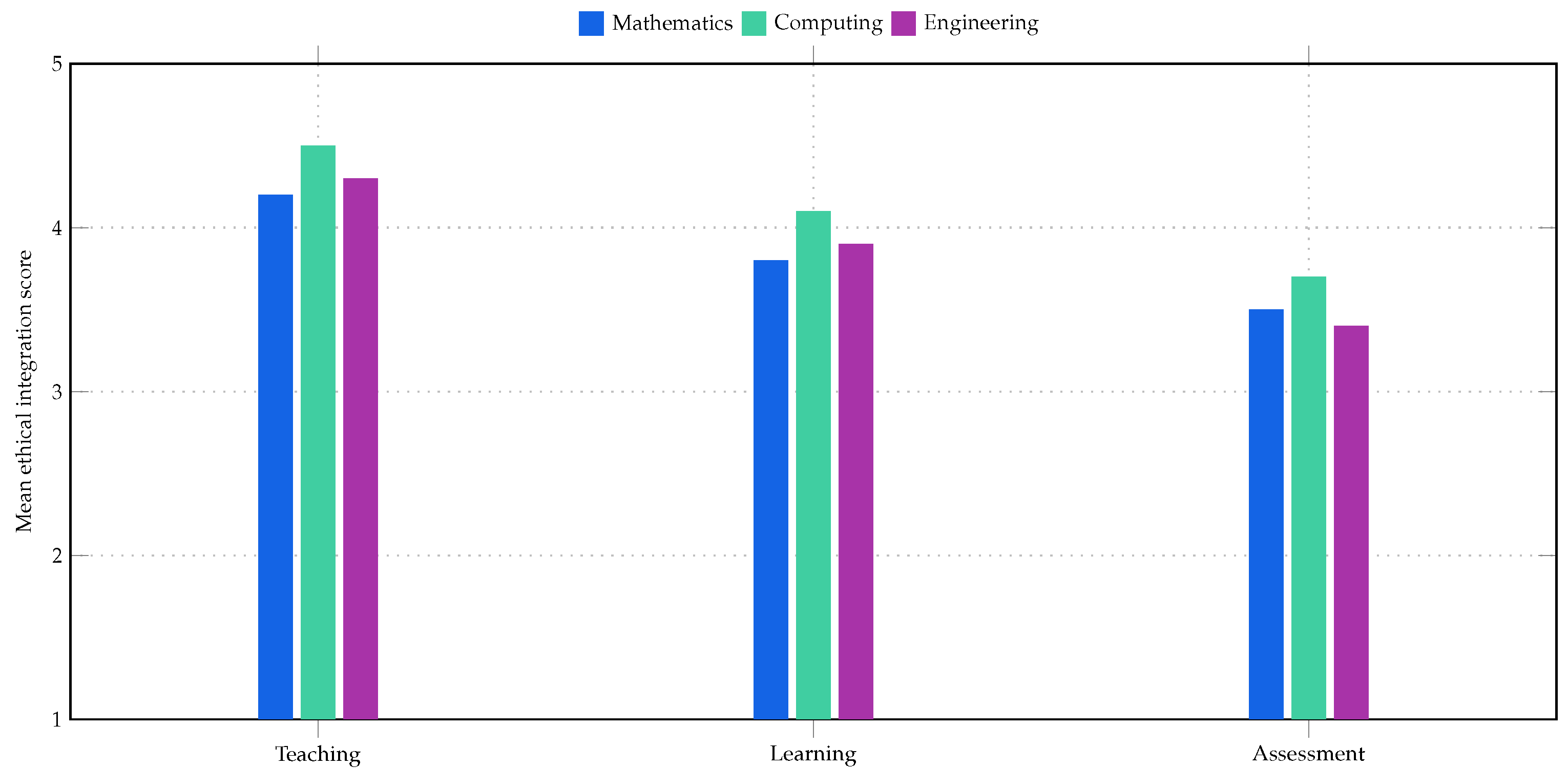
| Dimension | Discipline | Mean | SD | SEM | 95% CI | Cronbach’s |
|---|---|---|---|---|---|---|
| Teaching | Mathematics | 7.6 | 0.8 | 0.25 | [7.04, 8.16] | 0.86 |
| Computing | 7.9 | 0.6 | 0.19 | [7.47, 8.33] | ||
| Engineering | 7.7 | 0.7 | 0.22 | [7.20, 8.20] | ||
| Learning | Mathematics | 6.8 | 1.1 | 0.35 | [6.01, 7.59] | 0.89 |
| Computing | 7.2 | 0.9 | 0.28 | [6.56, 7.84] | ||
| Engineering | 7.0 | 1.0 | 0.32 | [6.27, 7.73] | ||
| Assessment | Mathematics | 6.3 | 1.2 | 0.38 | [5.44, 7.16] | 0.83 |
| Computing | 6.5 | 1.0 | 0.32 | [5.77, 7.23] | ||
| Engineering | 6.1 | 1.1 | 0.35 | [5.31, 6.89] |
| Dimension | F(2,27) | p-Value | Significance | Power | Required N * | |
|---|---|---|---|---|---|---|
| Teaching | 3.12 | 0.058 | Marginal | 0.188 | 0.56 | 18 |
| Learning | 4.90 | 0.015 | * | 0.266 | 0.74 | 12 |
| Assessment | 5.44 | 0.011 | * | 0.287 | 0.78 | 11 |
| Dimension | Shapiro–Wilk (p) | Levene’s Test (p) |
|---|---|---|
| Teaching | 0.13 | 0.23 |
| Learning | 0.10 | 0.22 |
| Assessment | 0.16 | 0.22 |
| Comparison | Mean Diff | SE | 95% CI | p-Value | Sig. |
|---|---|---|---|---|---|
| Teaching ( = 1.39, q = 3.51) | |||||
| Math vs. Computing | −0.30 | 0.167 | [−0.89, 0.29] | 0.071 | NS |
| Math vs. Engineering | −0.10 | 0.167 | [−0.69, 0.49] | 0.735 | NS |
| Computing vs. Engineering | 0.20 | 0.167 | [−0.39, 0.79] | 0.284 | NS |
| Learning ( = 1.57, q = 3.51) | |||||
| Math vs. Computing | −0.40 | 0.177 | [−1.02, 0.22] | 0.038 | * |
| Math vs. Engineering | −0.20 | 0.177 | [−0.82, 0.42] | 0.427 | NS |
| Computing vs. Engineering | 0.20 | 0.177 | [−0.42, 0.82] | 0.406 | NS |
| Assessment ( = 1.57, q = 3.51) | |||||
| Math vs. Computing | −0.20 | 0.177 | [−0.82, 0.42] | 0.543 | NS |
| Math vs. Engineering | 0.20 | 0.177 | [−0.42, 0.82] | 0.543 | NS |
| Computing vs. Engineering | 0.40 | 0.177 | [−0.22, 1.02] | 0.023 | * |
Disclaimer/Publisher’s Note: The statements, opinions and data contained in all publications are solely those of the individual author(s) and contributor(s) and not of MDPI and/or the editor(s). MDPI and/or the editor(s) disclaim responsibility for any injury to people or property resulting from any ideas, methods, instructions or products referred to in the content. |
© 2026 by the authors. Licensee MDPI, Basel, Switzerland. This article is an open access article distributed under the terms and conditions of the Creative Commons Attribution (CC BY) license.
Share and Cite
Almutairi, A.F.; Pils, J.; Muhammad, N.; Khan, S. AI Ethics Bylaws for Academia: Teaching, Learning, and Assessment. Societies 2026, 16, 106. https://doi.org/10.3390/soc16040106
Almutairi AF, Pils J, Muhammad N, Khan S. AI Ethics Bylaws for Academia: Teaching, Learning, and Assessment. Societies. 2026; 16(4):106. https://doi.org/10.3390/soc16040106
Chicago/Turabian StyleAlmutairi, Ali F., Jonathan Pils, Nazeer Muhammad, and Shafiullah Khan. 2026. "AI Ethics Bylaws for Academia: Teaching, Learning, and Assessment" Societies 16, no. 4: 106. https://doi.org/10.3390/soc16040106
APA StyleAlmutairi, A. F., Pils, J., Muhammad, N., & Khan, S. (2026). AI Ethics Bylaws for Academia: Teaching, Learning, and Assessment. Societies, 16(4), 106. https://doi.org/10.3390/soc16040106