


Abstract
This article presents a systematic, comparative, and reproducible mapping of the scientific literature examining how the term glocalization is mobilized in contemporary research. We analyze a corpus of 2200 articles (1990–September 2025) from Web of Science and Scopus and report in line with PRISMA 2020 and PRISMA-ScR (scoping). Methodologically, we combine PRISMA-ScR-aligned screening with the bibliometric and lexicometry mapping of metadata, complemented by the qualitative interpretation of a purposive subset of key texts to contextualize the mapped trajectories. Following normalization, we apply co-occurrence and correspondence analyses to identify lexical proximities and cross-disciplinary translation zones. We ask how glocalization is conceptualized, the contexts in which it is deployed, and whether classic theoretical frameworks retain their explanatory power. Findings show a gradual shift from a mainly conceptual to more operational register. Regional differences are marked yet organized around a core of governance, multilevel coordination, and collective practice. The disciplinary landscape shows continuity between techno-applied and reflexive approaches, supported by bridging disciplines (sociology, communication, education, health, sport) that translate a general grammar into research and intervention tools. We offer a cumulative methodological framework for tracing the scientific trajectory of glocalization. As a bridge concept between theory and action, glocalization provides an explanatory lens on transformations and resistances in early-twenty-first-century globalized society. We therefore position this study as a PRISMA-traceable corpus construction combined with bibliometric and lexicometry science mapping.
1. Introduction
1.1. Research Context
This article traces the scientific trajectory of glocalization in the scholarly literature since 1990. Fully engaging with the concept requires clarifying how it is used, the contexts in which it operates, and the ways in which its meanings vary. A systematic analysis is therefore warranted: in practice, glocalization no longer merely labels the nexus between the global and the local; it has become a working vocabulary for public policy, multilevel governance, markets, and cultures. Within academia, the term travels across sociology, anthropology, geography, and organization studies, yet it remains difficult to specify who uses it, under what conditions, and with which co-occurring terms. Even so, major approaches converge on several propositions: the global and the local are co-constructed [1]; cultural flows yield hybrid, re-semantized forms [2]; scales of action are reconfigured both upward and downward [3,4]; the expansion of capital coexists with local adjustments distinct from “grobalization” [5]; and top-down models are translated, reappropriated, and rewritten within organizations [6,7,8]. These are broad, transversal frameworks rather than sector-specific claims. What is still lacking, however, is a systematic and empirically grounded map of actual usage over time, regions, and disciplines, built on a homogeneous and comparable corpus. Such a cartography is therefore not epistemically neutral but shaped by the infrastructures on which it relies, including large citation databases and global classification schemes. On this basis, we offer a bibliometric cartography (science mapping of the literature) of such uses, making our choices explicit to provide a rigorous, transparent, and reproducible baseline for subsequent debates.
1.2. Research Questions and Contributions
The lexicometry review we propose does not aim to establish a single “date of birth” for the concept but rather to consider a progressive convergence of ideas and practices. The objective is to describe, in a transparent, rigorous, and reproducible manner, how the scientific community “speaks” about glocalization: specifically, who employs it, in which contexts, with which lexical companions, and how these uses evolve across situations. Our analysis proceeded in stages: first, a systematic examination of titles, abstracts, and keywords; then, the construction of a cartography of co-occurrences and semantic proximities; and, where metadata and abstracts were insufficient, targeted full-text checks to validate specific interpretations.
To guide this endeavor, we formulated the following research questions (RQ): RQ1: How has the volume, regional origin, and disciplinary distribution of glocalization-related publications evolved between 1990 and 2025? RQ2: What are the main lexical clusters and thematic trajectories that structure the use of “glocalization” in scientific articles over time? RQ3: How do territorial and disciplinary classifications shape the vocabularies through which glocalization is framed—for instance, analytical versus situated registers, or governance-oriented versus identity-oriented framings? RQ4: Which disciplines occupy bridging positions that connect conceptual and applied uses of glocalization and thereby mediate between different registers of scholarship?
This approach brings to light a lexical lineage and makes it possible to track potential semantic migrations, without imposing, from the Introduction onwards, any rigid chronologies or theoretical verdicts. It also allows us to confront classic frameworks with the empirical trajectories observed: if the co-constitution proposed by Roland Robertson remains the backbone, the analysis will confirm it; if, on the contrary, newer languages—those of indicators, governance, or organizational “translation”—come to reorder the whole, they will be documented.
The aim is to produce a systematic, comparable, and transparent cartography that can serve as a basis for more targeted deepening in different domains. The orientation is scoping in nature (without effect aggregation), with a selection and reporting protocol aligned with PRISMA-ScR [9].
2. Methodology
2.1. Sources, Search Strategy, and Eligibility
Following best practices for bibliometric analyses, we drew on two flagship databases—Web of Science Core Collection and Scopus. These databases are widely used because of their extensive multidisciplinary coverage and rigorous editorial selection criteria, which support the scientific quality of indexed sources and offer a structured, international view of scholarly output that is particularly suited to bibliographic and bibliometric analyses. To capture the pre-history and subsequent development of the concept, the time window begins before its formalization in the early 1990s, covering 1990–2025 (up to 30 September 2025). The last search was conducted on 21 October 2025, and results were limited to records published through 30 September 2025. Reporting follows PRISMA 2020 [10] and Kitchenham-inspired guidelines [11] for systematic literature reviews.
We queried both spellings—glocalisation and glocalization—using fully specified Boolean search strings. In WoS, the search targeted topic fields (Title, Abstract, Author Keywords, Keywords Plus) with the query TS = (glocalisation OR glocalization), limited to the period 1990–2025, document types of Articles OR Reviews, and Language = English; in Scopus, we searched TITLE-ABS-KEY (glocalisation OR glocalization) with filters doctype (article OR review), Pub year 1990–2025, and Language (English). This configuration extends beyond the title/abstract pair and detects the term wherever it appears in these fields [12,13].
Because the initial retrieval returned several thousand items, we applied explicit eligibility criteria. Hereafter, “I” denotes inclusion criteria and “E” denotes exclusion criteria. Records were included if they (I1) were peer-reviewed journal articles or reviews; (I2) were written in English; (I3) retained the query term in analyzable exported fields (title, abstract, and/or keywords), as a post-export quality-control step for subsequent lexicometry analyses; and (I4) fell within the study’s disciplinary scope, operationalized post-retrieval using Web of Science Research Areas (Refine Results panel) as the harmonized taxonomy (retained categories only, listed in Table A5). We did not restrict Research Areas at query time (All databases retrieval) to maximize recall; disciplinary delimitation was applied post-retrieval using this taxonomy. For cross-database comparability, Scopus Subject Areas (ASJC broad subject areas shown in the Scopus refine panel) were mapped post-retrieval to the same WoS Research Areas using the crosswalk reported in Table A4. We excluded (E1) residual non-research items due to occasional metadata misclassification as “article” or “review” (e.g., editorials or book reviews indexed as articles); (E2) records where the term appeared only in the reference list; (E3) inter-database duplicates; and (E4) records lacking an abstract.
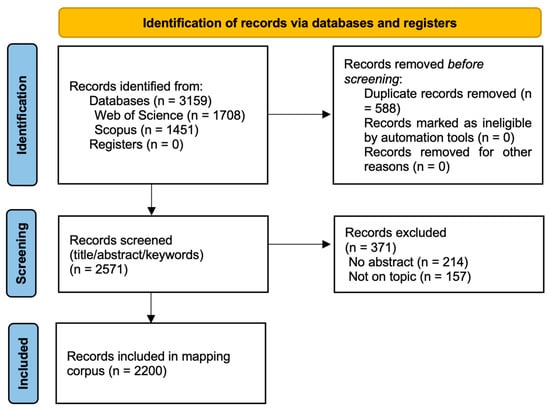
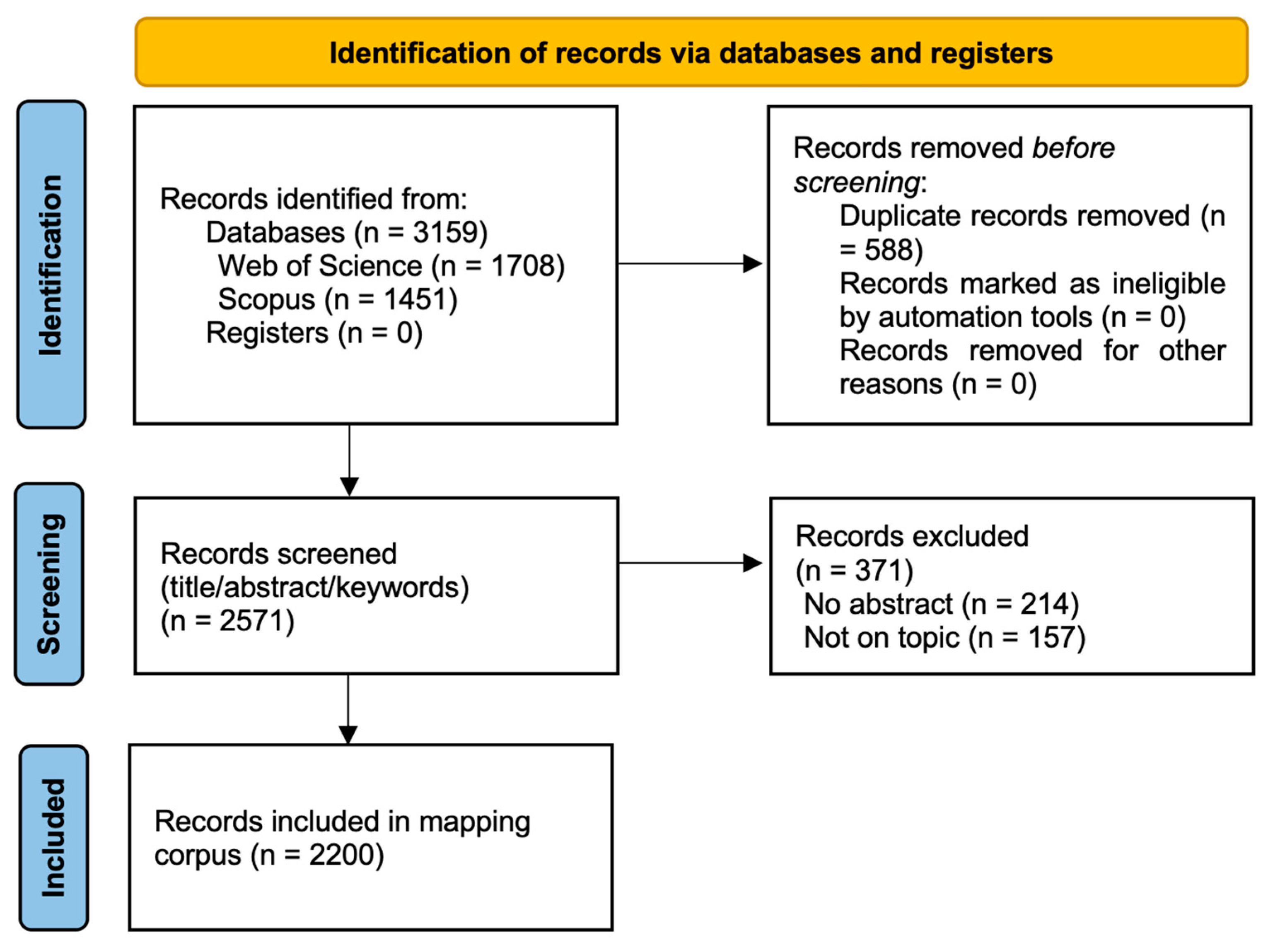
Screening was conducted in two stages. First, titles and abstracts were assessed against the inclusion/exclusion criteria. Second, full texts were consulted only when bibliographic metadata and abstracts were insufficient to resolve eligibility. This design aligns with this study’s aim of scoping and mapping a large corpus rather than conducting a full-text critical appraisal of every item. Eligibility decisions were thus governed by explicit, predefined criteria applied uniformly across the corpus, ensuring consistency and limiting interpretative subjectivity in the selection process. To document the screening consistency, a single reviewer performed an intra-rater blind re-screening on a random subset of 100 records after a short washout period (several days). Agreement on inclusion/exclusion decisions was 98%, and discrepancies were adjudicated and logged. The PRISMA 2020 [10] checklist is provided as Supplementary Material S1, and Supplementary Material S2 reports a de-identified quality-control audit subset (n = 100) documenting the calibration and adjudication process. PRISMA counts in Figure 1 were computed from the full master screening log (all screened records), whereas S2 documents the QC procedure and is not intended to map one-to-one onto PRISMA boxes.
Figure 1.
PRISMA 2020 flow diagram (adapted) of record selection.
We then structured the dataset with a geographic variable based on the United Nations regional classification (UN M49/UN Geoscheme) [14], adding a “Global” tag for trans-regional studies to maintain consistent area-level coding. We also introduced a disciplinary variable [13] from WoS “Subject Categories/Research Areas”. After deduplication, cleaning, and harmonizing metadata, January 1990–September 2025 yielded 2200 records, consistent with bibliometric and reporting good practices [15].
Analytically, we reconstructed the bibliographic itinerary of glocalization along three axes—time, discipline, and geography. To enhance coverage and robustness, we combined WoS and Scopus [15,16,17]; comparative studies show the two are complementary in journal, country, and language coverage, and their joint use limits single-source bias.
For text analytics, we used IRaMuTeQ [18] to run multivariate analyses combining two complementary correspondence analysis (CA/AFC) designs: (1) CA on forms (term–document matrix) to capture overall semantic dynamics; and (2) CA on types, treating years, disciplines, and territories as supplementary (illustrative) variables to compare characteristic lexical profiles.
Preprocessing—normalization, lemmatization, merging orthographic variants (glocalisation/glocalization), and removing stop-list terms—secured comparability across time, disciplines, and regions. Interpretation primarily relied on χ2 contributions and semantic coherence, with systematic returns to high-contribution abstract contexts. Where needed, we complemented CA with Reinert’s descending classification (ALCESTE family) and/or similarity network analysis to stabilize the resulting “lexical worlds”. The pipeline aligns with IRaMuTeQ standards and the factorial tradition in lexicometry, yielding a cumulative, contextualized, and methodologically robust account of the concept’s trajectory [19,20].
The choices made—databases, geographic categories, analytical tools, and parameters—are based on historically and politically situated infrastructures to produce academic knowledge. Web of Science and Scopus not only offer structured and comparable access to the international scientific literature but also reflect well-documented asymmetries in terms of languages, regions, and disciplinary traditions. Similarly, the territorial classification adopted (UN M49) is an operational compromise, rooted in a specific geopolitical history. Rather than naturalizing these frameworks, we make them explicit so that their structuring effects on the cartography produced can be discussed, criticized, and, where appropriate, supplemented by other perspectives.
Backward snowballing was not employed to expand the corpus, as this study aims to produce a reproducible mapping bounded to bibliographic databases; citation-based expansion may reduce replicability and introduce visibility bias. Instead, we validated the query against a small set of foundational seed publications to ensure adequate recall while keeping the final corpus strictly derived from database retrieval.
2.2. Encoding and Preprocessing
The metadata and texts, initially organized progressively in a spreadsheet-type matrix (Microsoft Excel), were restructured and encoded using a macro command in accordance with IRaMuTeQ conventions, enabling the transition from a tabular storage logic to an analyzable textual corpus logic.
The corpus is encoded in UTF-8 and formatted in accordance with the IRaMuTeQ template: each record comprises a metadata line (e.g., **** year = 1998 field = … territory = …) followed by the text. The structure and formatting rules (**** headers, variables, separators) comply with the software’s official documentation. Basic diagnostics (frequencies, contributions to χ2, cos2) and simple stability tests were conducted to support the factorial interpretation. These encoding and preprocessing steps inevitably involve analytical decisions (for example, concerning variable definition and text segmentation), which we therefore document explicitly so that their effects remain open to critical scrutiny rather than disappearing into an apparently neutral background.
2.3. Data Processing Workflow
This study does not aim to satisfy all the methodological criteria of a comprehensive systematic review focused on effect aggregation or risk-of-bias assessment. Instead, it adopts a bibliographic, bibliometric, and lexicometry approach designed to map the emergence, circulation, and structuring of a concept across time, disciplines, and geographical areas. From this perspective, the PRISMA 2020 framework was mobilized as a tool to ensure transparency and traceability in the corpus construction, rather than as a strict evaluative protocol.
Accordingly, the data processing workflow followed a transparent and structured procedure aligned with PRISMA 2020, adapted to the specific aims of a bibliographic and lexicometry analysis rather than a fully systematic review. The successive stages of the identification, deduplication, selection, and inclusion of records are explicitly documented to ensure the traceability and reproducibility of the corpus. PRISMA items not applicable to the present analytical design (e.g., risk-of-bias assessment or effect-size synthesis) were therefore considered not relevant.
Screening and inclusion were conducted at the title/abstract/keyword level for scoping and mapping purposes; full texts were not systematically retrieved or appraised by design. Therefore, full-text retrieval/eligibility boxes from the standard PRISMA 2020 template are omitted in this adapted diagram.
Following PRISMA’s sequence—identification, deduplication, selection, inclusion—the initial retrieval yielded 3159 records. After removing 588 duplicates, 2571 records were screened at the title/abstract/keyword level; 371 were excluded (214 without abstracts; 157 not on topic), leaving 2200 records included in the mapping corpus.
Software and parameters: We used bibliometrix (R 4.3.2; bibliometrix 4.2.1) for import, deduplication, and descriptive diagnostics; VOSviewer (1.6.20) for co-occurrence mapping on the merged, deduplicated file using the thesaurus described in Section 2.1; and IRaMuTeQ (0.7 alpha 2) for correspondence analysis and optional descending classification.
For co-occurrence networks, the minimum term frequency was set to ≥5 (sensitivity checks from ≥3 to ≥10). Normalization employed the “association strength” method, in line with standard guidance.
Semantic network clustering used the Louvain algorithm: Comparative runs with Leiden revealed no major structural differences. Visualization in VOSviewer relied on the default VOS layout (attraction = 2; repulsion = −1) with minimal manual tweaks to improve legibility and reduce node overlap. These parameter choices follow standard practice in science mapping, but we report them in detail because different settings can foreground different structures, and we consider it important that such analytical decisions remain visible and debatable.
3. Birth of the Concept and Antecedents
3.1. Historical Context
Well before the label “glocalization” appeared, several scholarly traditions had already framed its core problem. Macro-structural historical sociologist Immanuel Wallerstein’s reconstruction thus suggests that these world-scale tensions produced a sustained institutional preference for localism [21]. This relocates “locality” within the world-economy/world-system—not as a residual counterpoint to the global but as a mode of governmentality and identity shaped by global political–economic logics.
Anthropological and cultural approaches likewise stressed early on the entanglement of the global and the local by treating cultural flows as processes. Ulf Hannerz theorizes “creolization” as the emergence of new forms through movement, circulation, and temporal re-somatization; the issue is less homogenization than the local reworking of meaning. Hannerz ultimately contends that creolization has become a general condition shaping everyone [2]. This intuition acknowledges expanding global flows while affirming locally rooted creativity and underpins the later “heterogeneity-in-homogeneity” motif associated with glocalization.
In the sociology of religion and modernization theory, a “choice–construction” lens highlights local agency in steering trajectories within global processes. Analyzing religion and modernity in Japan, Robertson argues that societies retain significant latitude in choosing the directions of change and the forms of their global engagement [22]. The “global culture of modernization” thus functions as an orienting call to all societies, which, under identity and continuity constraints, select and construct their modes of participation, yielding differentiated “reality constructions”.
From the mid-1980s, “globalization” gained systematic usage and definition, opening—within a history-of-concepts perspective—the path to the later term “glocalization”. Peter Beyer is explicit that globalization is a very new word, but it refers to developments that, in many senses, have been going on for a very long time … the first sociologist to do so consistently was Roland Robertson [23,24]. This positions “globalization” as “a new name for old processes” and underscores Robertson’s formative role, paving the way for glocalization as an intrinsic facet of the global.
On the socio-cultural face of the “global condition”, Boli and Petrova characterize globalization as a universalizing project intended to encompass all actors [25]. These normative and organizational frames equip local actors with resources, justifications, and constraints, producing locally observable pathways of “absorption–transformation–reproduction”.
Finally, work on media and cultural industries shows that even amid accelerating transnational capital and communication flows, national and regional structures can reshape—and sometimes counter—globalizing forces. Straubhaar demonstrates that regional and national structures can at times offset or resist particular globalizing forces [26].
Taken together and situated within the history of terms, these strands—critiques of world-systems theory’s cultural deficit and complementary moves to place cultural processes alongside global structures [27]—helped elevate the theoretical status of the global–local nexus [28], establishing globalization as a central concept for depicting the “world as a single place” while keeping the local in view.
3.2. Key Authors and Theoretical Frameworks
Conceptually, Robertson [1,29,30] casts glocalization as the “particularization of the universal” and the “universalization of the particular.” The global is not an external “elsewhere” but is continually made through situated practices; the local, never “pure,” is co-constituted with the global. This view links cultural globalization to local invention and invites systematic comparison. In contrast, Swyngedouw [3,4] locates the “glocal” within the politics of scale and spatial rescaling, showing how nested and parallel multi-scalar orders reconfigure the geometry of power via urban networks and transterritorial governance. Ritzer [5,31] sets grobalization against glocalization: under capital expansion and industrialization, “local authenticity” is drawn into flexible homogenization, rendering the glocal an appearance—or façade—of the global system. Within organization studies, Drori, Höllerer, and Walgenbach [6,7,8] frame glocalization as a process of “theorisation/translation,” whereby global models and discourses are locally selected, sutured, and rewritten, producing loosely coupled institutional landscapes with incomplete diffusion and the co-presence of isomorphism and differentiation. Normatively, Beck [32,33] advances “cosmopolitisation”: bringing globalization into everyday life and institutions, unpacking global/local and inside/outside dualisms, while keeping North–South inequalities and exclusionary mechanisms in view. Roudometof [34,35,36] argues for glocalization’s analytical autonomy, using “refraction” to capture how global dynamics pass through local mediations of varying “density,” being absorbed, bent, or reconfigured into a plurality of observable glocal outcomes.
3.3. Critiques and Limits of Glocalization
The analytical mapping developed in the previous sections is therefore best understood as a situated, rather than neutral, representation of the corpus. The concept of glocalization, like the bibliographic infrastructures and analytical tools through which it is studied, is embedded in historically and politically situated regimes of knowledge production. It is therefore necessary to situate glocalization within the critical debates that have accompanied its diffusion and institutionalization.
Since its popularization in the 1990s, glocalization has also attracted sustained critique. A first line of argument concerns power and asymmetry: by foregrounding local adaptation and creativity, the concept may understate the structural constraints imposed by global capitalism, state projects, and corporate strategies. Ritzer’s distinction between “grobalization” and “glocalization” explicitly targets this risk, warning that a celebratory language of glocal flexibility can function as a façade behind which expansionary, top-down processes proceed largely unchecked. From a political-economic perspective, glocalization often fits comfortably with managerial discourses of flexibility, customization, and market segmentation and can therefore reinforce rather than challenge neoliberal logics.
A second cluster of debates arises from postcolonial and decolonial scholarship and from concerns about conceptual stretching. Postcolonial authors question celebrations of hybridity, creolization, and cultural mixing when these occlude the histories of conquest, dispossession, and racialized domination that created many global–local “contact zones”; approaches centered on coloniality insist that global–local interactions are shaped by historically entrenched power asymmetries and unequal epistemic authority that are not easily captured by apparently neutral terms such as “interpenetration” or “mutual adaptation”. At the same time, the semantic breadth of glocalization—applied to marketing, organizational change, religion, urban governance, leisure, everyday consumption—raises questions about whether the notion adds explanatory value beyond existing vocabularies, or whether it is often used descriptively and normatively, as a watchword for “adapting global models to local contexts” without asking who defines adaptation and whose interests are served. These criticisms do not invalidate glocalization as an analytical grammar, but they call for greater reflexivity about how, where, and by whom the term is mobilized. In other words, the analysis of glocalization must also deepen the study of the social practices of societies by analyzing the different actors who organize or experience this process.
Our bibliometric and lexicometry mapping engages with these debates by tracing how “glocalization” has moved over time from more conceptual formulations towards increasingly operational and governance-oriented vocabularies, a shift that we return to in the Discussion Secion. The regional lexical specificities identified in the corpus—particularly the emphasis on identity, resilience, and hybridity in Caribbean, Melanesian, or Australian scholarship—cannot be reduced to neutral descriptors or mere stylistic variations. These vocabularies emerge from historically situated contexts marked by colonial domination, dispossession, cultural disruption, and struggles for survival and recognition. From a postcolonial perspective, terms such as “identity” or “hybridity” are inseparable from power-laden histories of contact and violence, as highlighted by scholars of coloniality who caution against treating cultural mixing as a benign or symmetrical process (e.g., Quijano, 2024; Mignolo, 2002) [37,38].
While lexicometry analysis allows for the identification and comparison of such vocabularies at scale, it risks flattening their historical and political depth if detached from the conditions of their emergence. In this sense, the mapping proposed here should not be read as an explanation of why certain regions mobilize specific conceptual repertoires but as an empirical indication of where such repertoires are recurrently activated. Interpreting these patterns requires complementary theoretical lenses drawn from postcolonial studies and political economy, which remind us that glocalization may simultaneously function as a critical language of survival and a managerial idiom aligned with neoliberal flexibility, depending on the contexts and actors involved.
In this sense, the present study does not seek to resolve these debates normatively but to provide an empirical cartography of how glocalization is mobilized across contexts, as a critical concept, a descriptive category, or a depoliticized instrument of governance.
4. Overview of the Scholarly Output
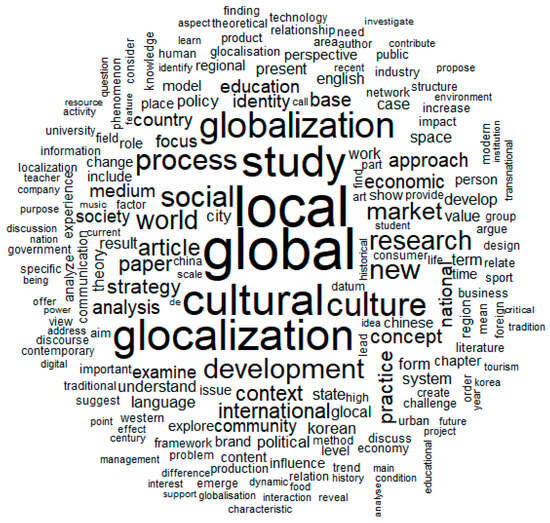
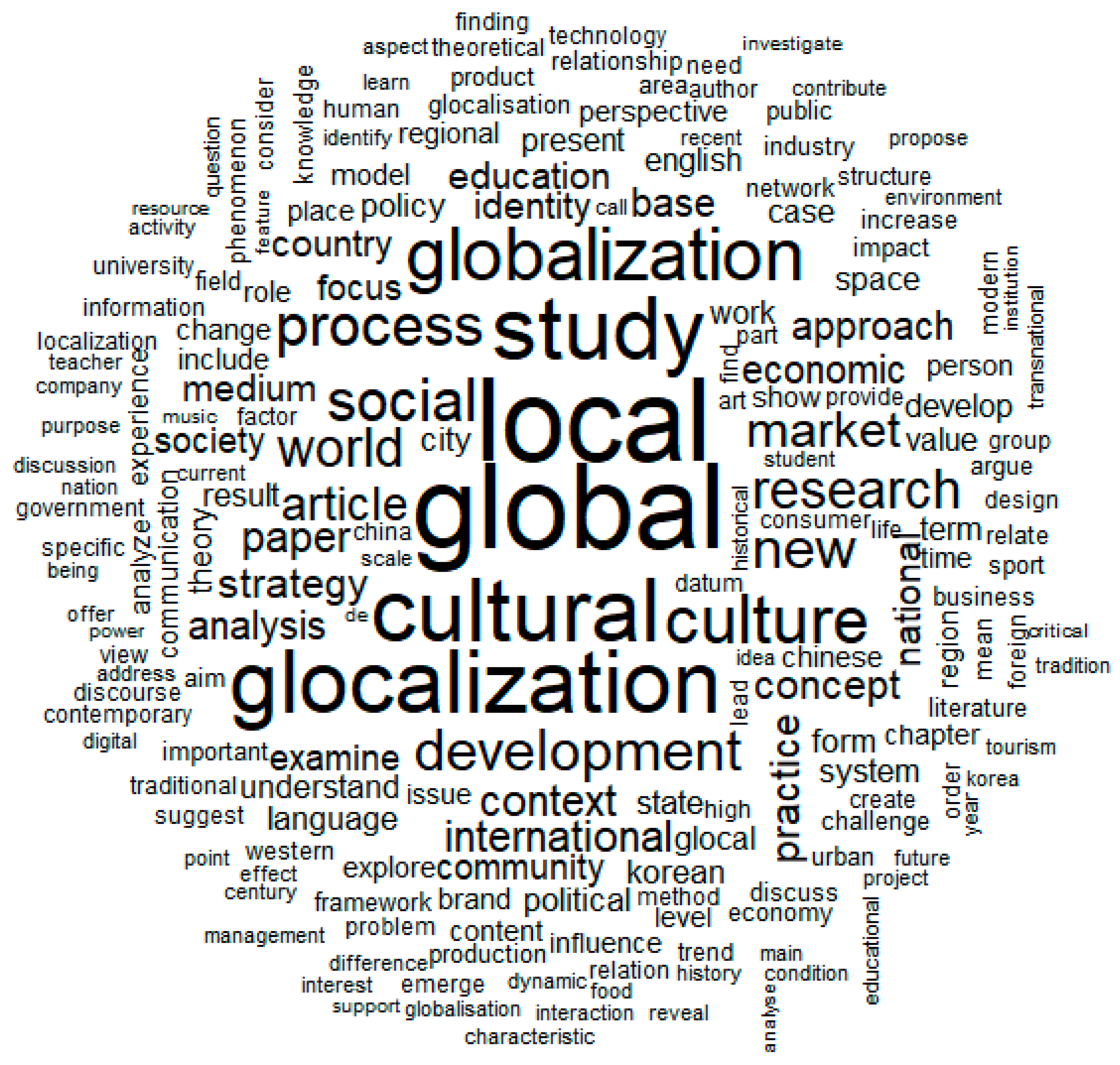
Based on 2200 records from WoS and Scopus, the word cloud sketches the field’s recurrent vocabulary. At its center sits the triad global/local/glocalization, encircled by study, process, research, development, context, market, governance, cultural/culture, globalization, identity, and community. Together, these terms locate the object at the interface of an analytical register (frameworks, processes, governance) and applied arenas (development, markets, public policy) while also signaling a pronounced socio-cultural dimension (cultural/culture, identity, community). The joint presence of globalization and glocalization suggests strong co-occurrence between general debates and their situated instantiations. Terms such as education, policy, and international—and, more marginally in certain periods, sport and tourism—indicate the chief domains of application.
Figure 2 serves a strictly exploratory and general descriptive purpose. It aims to reflect the overall lexical structure of the corpus, independently of the research questions formulated later. As such, the presence of certain terms or geographical references reflects only their relative frequency in the abstracts analyzed and not their analytical centrality in this study. The analysis itself is then based on more targeted processing (co-occurrences, thematic groupings, text segments) directly related to the research questions. Figure 2 is therefore not an interpretative result but an element of contextualization of the corpus, allowing its diversity and dominant lexical poles to be appreciated.
Figure 2.
Word cloud—dominant themes in abstracts (WoS, Scopus).
4.1. Annual Evolution
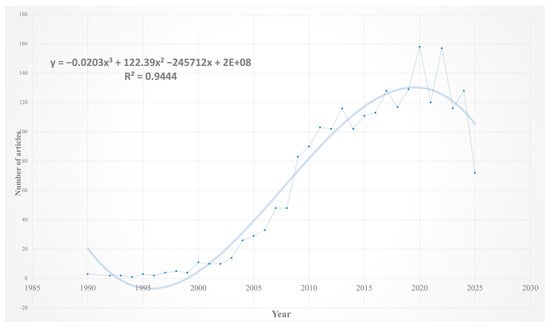
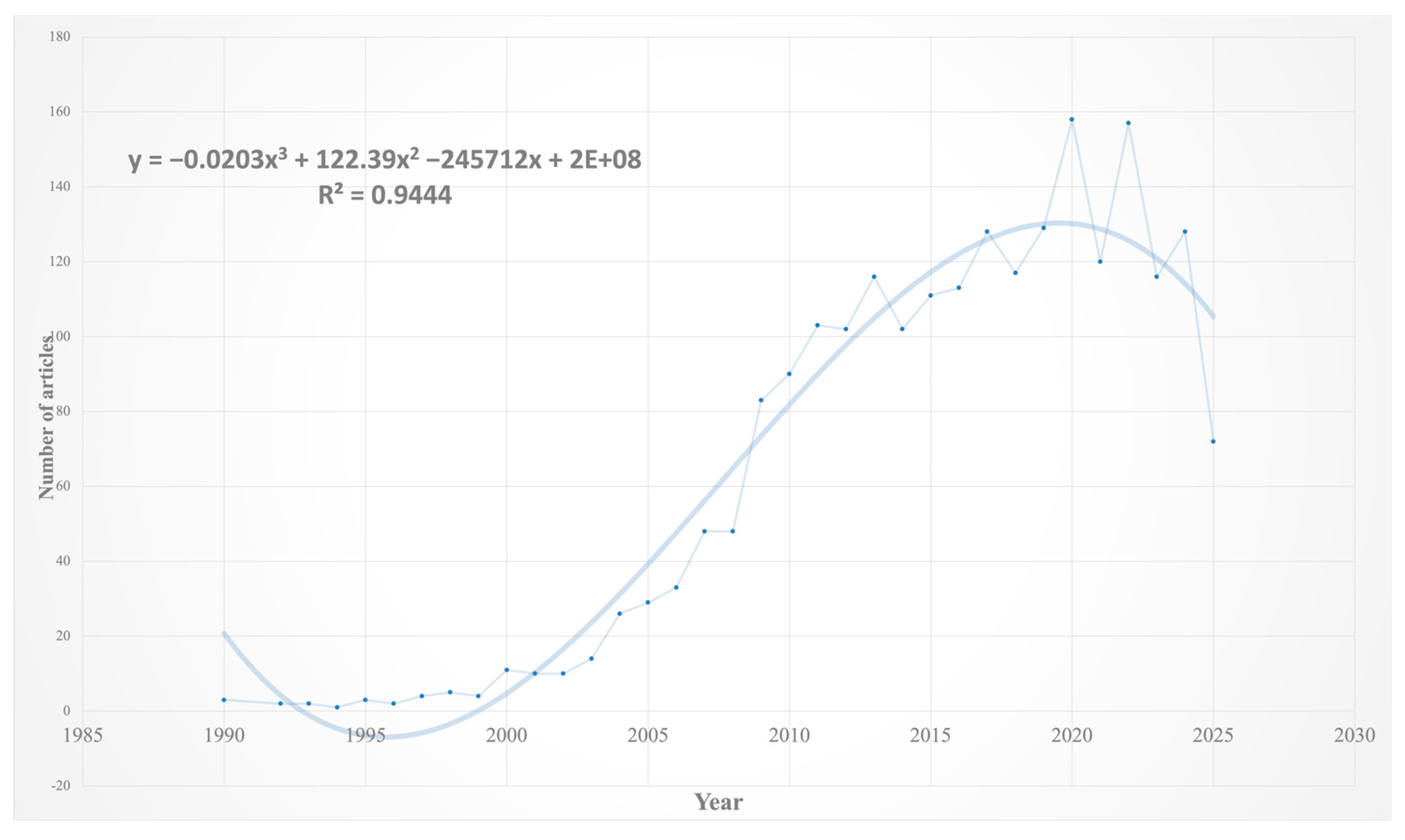
Building on the preceding synthesis of key authors’ claims about the global–local nexus, we first track diffusion over time by charting publications from 1990 to 2025 (see Figure 3). The trajectory is non-linear: low output through the 1990s, steady growth around 2000, a sharp acceleration from 2008 to 2016, and then a sustained plateau with a slight uptick between 2017 and 2021. A cubic polynomial fit (R2 ≈ 0.94) closely reflects this pattern—slow initial growth, subsequent acceleration, then stabilization. Fluctuations in 2022–2024 appear to stem chiefly from topical competition, editorial policies, and regional heterogeneity; the modest dip in 2025 is best read cautiously, given the truncated year (the series closed in September). Taken together, the series broadly aligns with the earlier “emergence → diffusion → maturation → differentiation” scenario. More broadly, the pattern signals a twenty-first century turn that probes the limits of globalization: across markets and media—and in accounts of civilizational contestation (or localized culture)—attention to the local becomes necessary to understand and anticipate the needs and transformations of world society.
Figure 3.
Years and numbers of articles. Note: Blue dots/line show the observed annual number of articles; the light-blue curve is a fitted trend line added to aid visual interpretation of the overall temporal pattern (equation and R2 indicate the fitted model and goodness of fit).
4.2. Analysis of Lexical Distribution and Clustering
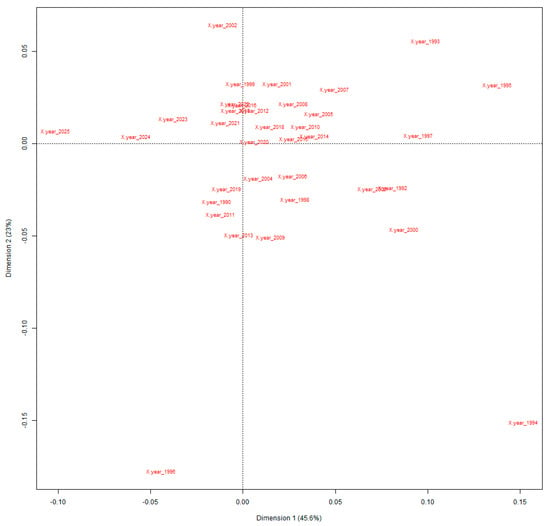
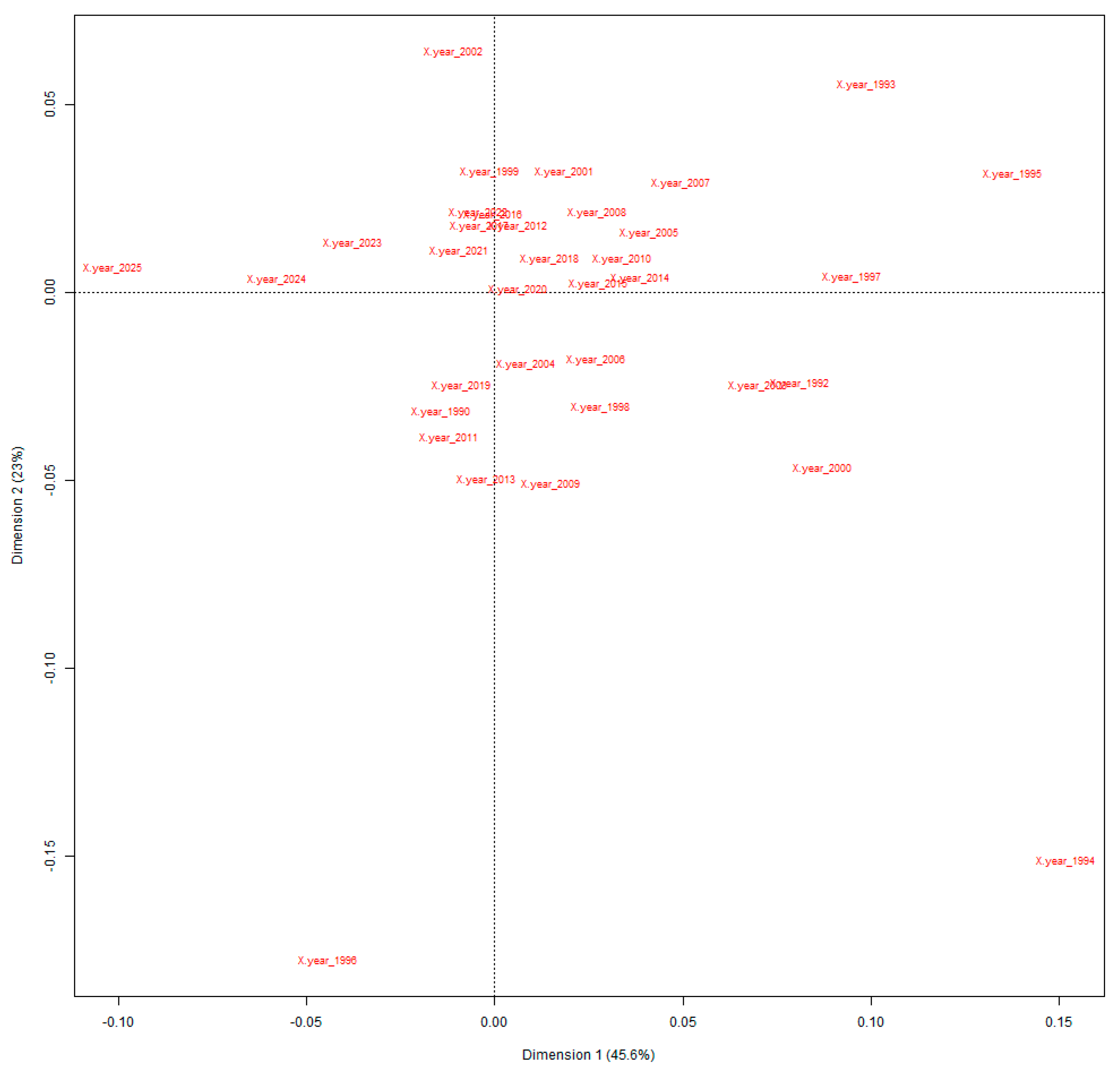
Using our database, we ran correspondence analyses to probe geographical and disciplinary dimensions, examine lexical distributions and clusters, and refine interpretation. Figure 4, Figure 5 and Figure 6 below correspond to graphical outputs generated automatically by Iramuteq software. The graphical parameters are largely predefined by the software, particularly regarding label size and internal resolution. However, they remain meaningful in that they provide an understanding of the lexical structure and thematic groupings of the analyzed corpus.
Figure 4.
AFC over the years (types)—the lexical temporality of glocalization, 1990–2025 (see Table A1 (Appendix A)).
In this types-based AFC, years are active modalities projected into a space defined by their characteristic forms. The first two axes capture the main structure (Dim1 ≈ 45.6%; Dim2 ≈ 22.2%; total ≈ 67.8%), allowing for a concise reading of temporal proximities and oppositions.
Axis 1 traces a diachronic gradient: 1992–2000 load positively with a conceptual lexicon tied to early usage (globalization, identity, culture), while 2022–2025 load negatively with more applied frames (sustainability, governance, territorialization). The contrast indicates a shift from theoretical–conceptual language to more operational usage. Axis 2 adds a secondary split between some early years (e.g., 1993, 1995, upper area) and mid-periods (2009, 2013, lower area), hinting at episodic discursive phases shaped by thematic or editorial contexts. The outlier position of 1996 (lower left) points to an atypical lexical profile, likely driven by a pioneering text and its subsequent uptake—most notably Robertson’s work.
Moderate dispersion and neighborhood clusters indicate continuity of vocabulary across periods, with periodic renewal rather than rupture. Overall, the map reveals a structured trajectory: a historical pole (1990–2000) dominated by conceptual framing; a diffusion/stabilization phase (2000s–2010s); and a contemporary pole (2020–2025) oriented toward interdisciplinary operationalization and finer-grained analyses of specific social objects or territories.
4.3. Geographical Evolution
We ran a forms-based AFC with territory as an illustrative variable (UN M49; Global included). Each point denotes a territorial modality (e.g., Western, Eastern, Caribbean, Australia) positioned by proximity in characteristic forms: close points share lexical repertoires; distant points reflect distinct semantic spaces. The first two dimensions explain a modest yet interpretable share of inertia (≈22% overall), as expected in lexicometry.
Along Dimension 1, more transversal/globalized spaces (e.g., Global, Western, some “South” aggregates) contrast with more regional/situated spaces (e.g., south-eastern, eastern subregions). The former skew toward analytical/systemic vocabulary; the latter emphasize territorial anchoring, identity, and local development. The tension articulates between glocalization framed as adaptation to a Western-shaped globalization and globalization read as a response to resistances and the necessary hybridizations of world society with local societies—especially in Asia and Africa.
Dimension 2 introduces a complementary split: cultural/historical repertoires (circulations, hybridizations) cluster above, while more operational registers (public policy, planning, sustainability) cluster below. The notion of social space is central for making sense of territorially differentiated glocalization.
Figure 5.
AFC of forms (territories)—geographical variation in vocabulary (see Table A2 (Appendix A)).
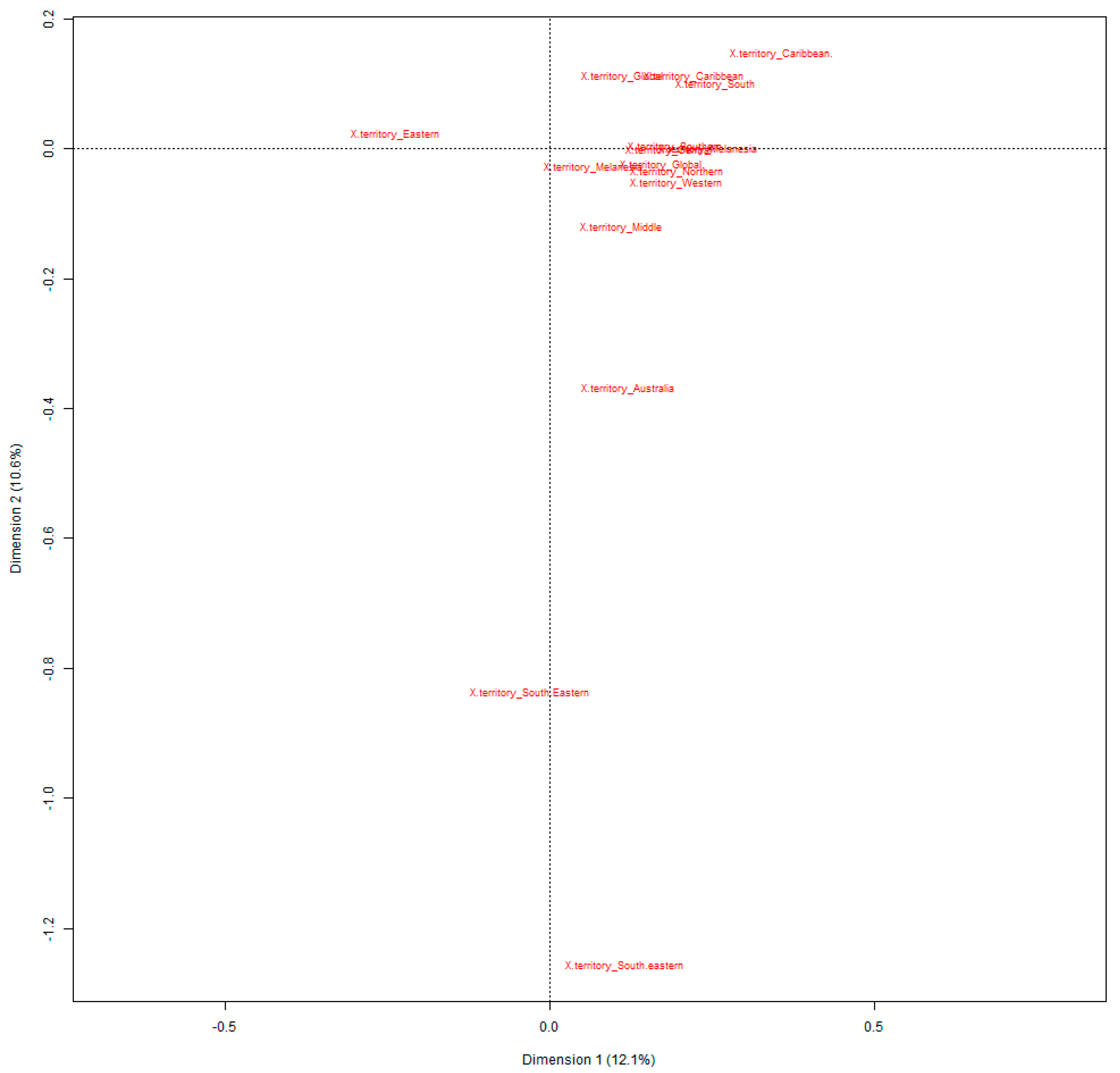
The overall picture is one of ordered heterogeneity: a systemic/global pole, a contextual/local pole, and a central zone where a shared vocabulary settles (multilevel governance, territory, practices). The map does not rank territories; it visualizes lexical nearness and distance, indicating that the glocalization lexicon recomposes itself with geographical context—bridging a general analytical category and situated, descriptive uses.
From a critical perspective, this configuration also speaks to the geopolitics of knowledge production. The “Global” pole, with its transversal, apparently universal lexicon of governance, policy, and sustainability, is largely anchored in Anglophone and Western academic centers, while regionally coded spaces are more often associated with identity, resilience, and hybridization. These risks reproduce a familiar center–periphery pattern in which some locations are authorized to theorize in abstract analytical terms, whereas others are positioned as sites of situated experience and case material. The outlying position of certain regions, such as south-eastern Asia, may thus reflect not only distinct empirical trajectories but also unequal visibility and recognition within global circuits of publication. In practice, much of this work is authored from Western academic centers and is concerned with understanding how diverse local populations respond to globalization. Post-colonial and geo-economic issues are both explanatory and amplifying factors in this focus of Western researchers on areas of analysis related to the development of new markets or to former colonies.
Figure 6.
AFC on types (disciplines)—integrated paragraph (see Table A3 (Appendix A)).
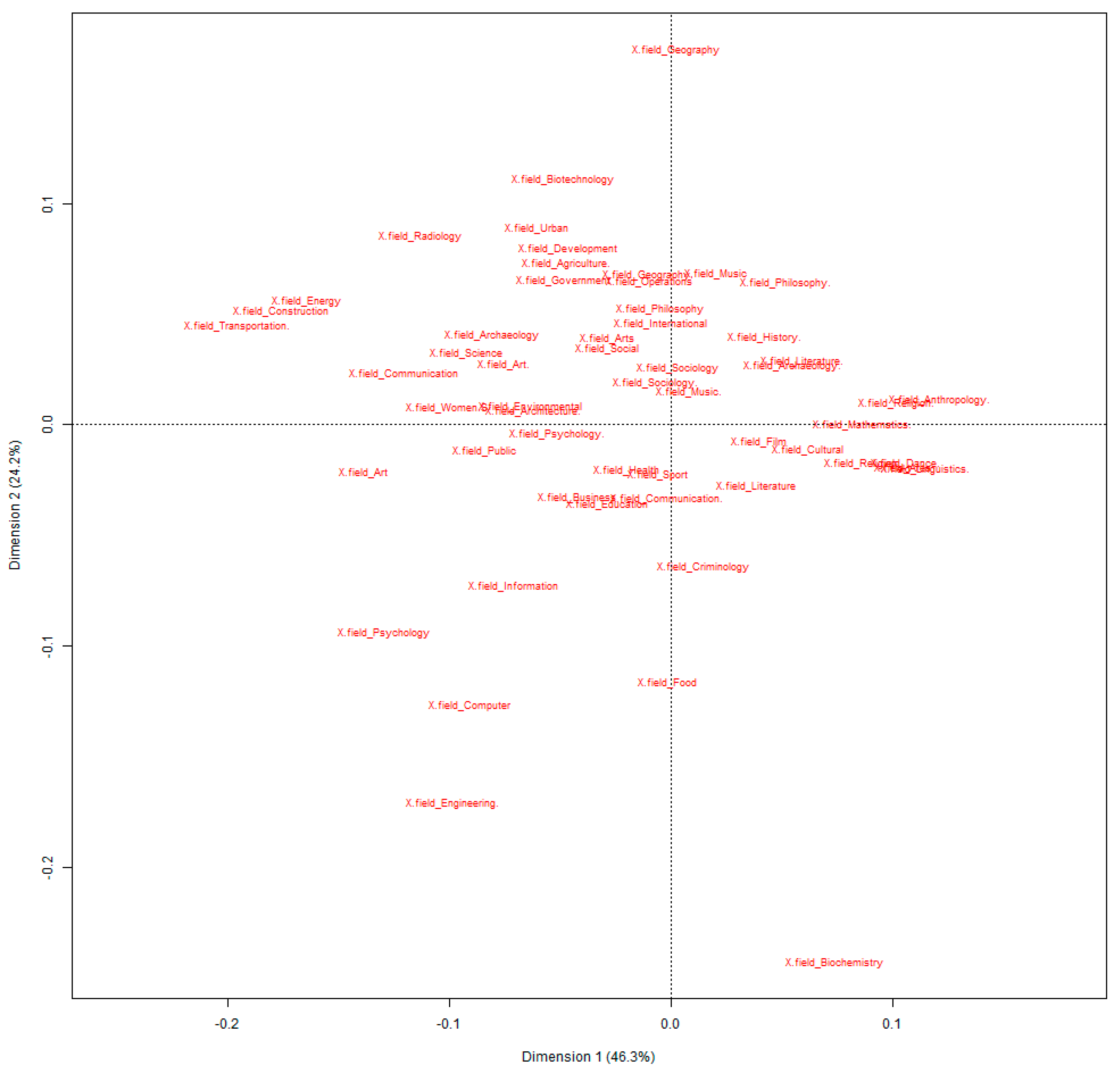
Rather than treating regional vocabularies as neutral descriptors, we read the territorial AFC as a map of how glocalization is unevenly theorized and appropriated within a stratified academic field.
4.4. Disciplinary Structuring
The map shows a clear disciplinary structure. On Dimension 1 (46.3%), a continuum runs from a technological/applied cluster (engineering, computer science, energy, construction/transport, problem-solving strands of psychology) to a more humanistic/conceptual cluster (philosophy, anthropology, linguistics, mathematics, cultural studies)—a shift from operational to theoretical/symbolic registers.
Dimension 2 (22.4%) adds a further split. Upper positions group domains tied to environments and systems (geography, agriculture, urban/development, ecology/biotechnologies, radiology); lower positions gather fields centered on social, behavioral, and informational dynamics (psychology, criminology, information/communication, education, sport/health).
Around the origin lies a transversal core—(sociology, communication, education, health, sport)—sharing a common vocabulary and mediating between poles. Peripheral modalities mark specialized repertoires: (biochemistry) in the lower-right quadrant; (engineering and computer science) at the far left; (philosophy, anthropology, mathematics) tending to the upper right.
Taken together, the configurations indicate that glocalization operates both as a shared analytical frame anchored by a central lexicon and as a category differentially appropriated by disciplines according to technical, conceptual, or systemic orientations. This disciplinary specialization is, we argue, crucial to glocalization’s future trajectory as a bridge concept: its development should unfold within specific domains and spaces to illuminate societal transformations.
The transversal core identified around sociology, communication, education, health, and sport can be understood considering work on boundary objects and trading zones in interdisciplinary research. These fields are simultaneously oriented towards applied problem solving and policy intervention and anchored in reflexive traditions that theorize institutions, identities, and practices. As such, they provide sites not only where abstract formulations of glocalization can be translated into operational tools, indicators, and intervention frameworks, but also where locally situated experiences feed back into more general vocabularies. Their mediating position in the disciplinary map is therefore not accidental: it reflects the role of these disciplines as relay points through which glocalization circulates between social conceptual debates and society’s analytical tools.
5. Discussion
The lexical analysis places the triad (global/local/glocalization) at the cloud’s center, ringed by (study, process, development, governance, market). This co-presence is no accident: from the outset, glocalization has been framed as a single movement in which homogeneity and heterogeneity advance together. The concept therefore serves both as a lens on the world and as a descriptive tool for concrete situations [1]. This duality also follows from cultural flows: elements “from elsewhere” are recomposed in place, generating local forms of the global—now a classic insight in work on modernity’s territories and creolization [2,39,40]. We therefore returned to full texts, selectively, to validate high-contribution lexical associations. Close readings of high-contribution articles from different regions and disciplines confirm this heterogeneity of uses: some mobilize glocalization as a critical lens on power-laden reconfigurations of space and scale, while others treat it as a largely technical label for multilevel implementation frameworks. The lexical core we map therefore condenses both the critical and operational lives of the concept, rather than resolving the tensions identified in the literature.
To make this more concrete, we briefly return to two high-contribution articles that occupy different positions in our maps. Pieterse’s classic essay on hybridization [41] treats glocalization primarily as a cultural logic of mixing and creolization, mobilized to move beyond simple binaries between homogenization and heterogenization. Glocal forms here stand for inventive reworkings of global cultural flows, with explicit attention to historically sedimented power relations. By contrast, Bulkeley and Betsill’s analysis of urban climate governance [42] invokes glocalization within a managerial vocabulary of multilevel governance, policy instruments, and the transfer of “best practices” between cities and international regimes. In our AFC space, the two texts cluster near different sets of keywords—“identity”, “culture”, and “hybridity” on one side, “governance”, “policy”, and “sustainability” on the other—illustrating how the same term bridges critical projects in globalization theory and pragmatic toolkits for governing cities, a tension that cannot be inferred from co-occurrence patterns alone.
Temporal evidence further reinforces the pattern. The annual series and chronological map show a ramp-up and then stable high output, coinciding with a vocabulary shift from conceptual (globalization, identity, culture) to more operational terms (sustainability, governance, territorialization). Two forces underpin this turn. First, the politics of scale: globalization does not erase place; it reconfigures levels of action upward and downward—captured by rescaling and the twin processes of glocalization [3,4,43]. Second, the institutionalization of transnational agendas—most prominently Agenda 2030—spreads a language of monitoring, indicators, and local implementation (United Nations, 2015) [44]. At their intersection, urban and multilevel networks turn glocalization into a working vocabulary of public problem solving, not merely a theoretical tag [42,45]. From a critical standpoint, this operational turn is ambivalent. On the one hand, it signals the concept’s institutional success and its capacity to inform concrete policies; on the other, it resonates with political–economic critiques that warn against the capture of glocalization by governance and managerial discourses, in which adaptation and flexibility are valued while underlying asymmetries of power risk are backgrounded.
Geographically, the two uses of the concept coexist and speak to one another. Global-coded abstracts draw on a more analytical, transversal lexicon, whereas in the Caribbean, Melanesia, or Australia, vocabulary is more situated—(identity, resilience, hybridization, local development). This reflects, on the one hand, flows and cultural mixing that “remake” the global locally, and on the other, cultural proximity, which weights language, history, and aesthetics in reception and action [2,26,39,41,46]. The outcome is articulation rather than rupture—indeed, hybridization: a systemic pole and a contextual pole linked by a shared core (governance, territory, community). Viewed through the lens of postcolonial critiques, however, this pattern also echoes a stratified academic world in which analytical registers are disproportionately authored from metropolitan centers, while regions marked by colonial and settler-colonial histories are more often associated with identity, resilience, and hybridization.
Disciplinarily, the main axis separates problem-solving domains (engineering, computer science, energy, construction/transport) from reflexive ones (philosophy, anthropology, linguistics, mathematics, cultural studies). Bridging disciplines (sociology, communication, education, health, sport) translate between them, borrowing general frames and converting them into languages of inquiry, evaluation, and policy while routing situated observations back into theory [8,47]. In terms of boundary objects and trading zones, these fields act as mediating spaces where glocalization can be simultaneously theorized and operationalized, turning it into a shared but differently inflected resource across communities of practice. This helps explain the long-standing cohabitation between grobalization (capital expansion and standardization) and glocalization (meaning making and local adjustment) in globalization scholarship [5,31]: the same concept circulates through disciplines that both stabilize managerial uses and keep critical, reflexive readings alive.
Together, the findings trace a coherent yet ambivalent trajectory. The lexical core (global/local/glocalization; research/process; governance/development) supplies common ground. Over time, this nucleus feeds a more actionable language without losing conceptual memory; spatially, it densifies in specific contexts; across disciplines, translation between theory and implementation is organized around an interdisciplinary center. Whether read as a grammar that rises above dualisms, an accommodation to institutional rescaling, or a form of cultural plasticity and translational capacity, this mix accounts for the concept’s vitality and its reach into urban studies, education, health, and sport [42,48,49]. At the same time, the shift towards governance-oriented vocabularies and managerial registers invites the question—raised by political–economy and postcolonial critiques—as to how far glocalization retains its capacity to make visible the power asymmetries, colonial histories, and structural constraints of glocal–local societies of the 21st century. In short, glocalization works as a bridge concept—general enough to connect, flexible enough to adapt, and sufficiently equipped to support analyses of societies organized through multilevel arrangements across diverse territories [1,50].
6. Limitations and Research Perspectives
This section consolidates four complementary aspects: (i) threats to validity, (ii) sources and scope of the review, (iii) limitations of the review, and (iv) lessons learned and research perspectives.
This study draws on a systematically retrieved, abstract-based corpus rather than an exhaustive corpus. The choice yields a structured dataset and comparability across sources, but it narrows theoretical and empirical nuance. We mitigated this by targeted returns to originals to contextualize terms and high-contribution associations. Given the study’s scoping-and-mapping aim, we did not conduct a record-by-record critical appraisal of full texts; instead, we relied on explicit eligibility rules, diagnostics, and targeted returns to originals when bibliographic metadata and abstracts were insufficient.
Analytically, a terms-by-documents setup and correspondence analysis (AFC) map robust lexical proximities; yet the first two axes do not capture all inertia. Interpretation should rest on χ2 contributions, cos2, and simple stability checks—not on visual impression alone [19,51].
Consistent with text-as-data guidance, we pair internal validation (diagnostics) with external validation (return to texts, downstream tasks) and acknowledge uncertainty from preprocessing (encoding, cleaning, lemmatization) [52,53,54]. Using both Web of Science and Scopus reduces single-source bias but cannot erase coverage differences by discipline, country, or language that may shape map structure [15,16,17]. Our query—WoS Topic and Scopus TITLE-ABS-KEY with (glocalisation OR glocalization)—covers Title/Abstract/Author Keywords (plus Keywords Plus in WoS) but remains term-dependent; related expressions (global–local, localizing the global) may be missed. Spatial coding follows the UN M49/UN geoscheme (with Global), aiding comparison while necessarily aggregating multi-scalar cases. With the window closing on 30 September 2025, positions for that year require caution due to an incomplete-year effect [15]. Two lessons follow: first, lexicometry maps should be read as diagnostic navigation devices rather than as self-sufficient representations. Second, robustness depends on combining internal checks (χ2 contributions, cos2, stability) with selective returns to texts and downstream validation.
These constraints—an abstract-based corpus, database coverage gaps, term dependence, and UN M49 normalization—notwithstanding, the findings still point toward a next phase: moving from semantic maps to the domains of action where glocalization takes concrete shape in interconnected, mediated configurations. Here, global frames are translated, measured, and fed back as indicators, standards, and best practices. This calls for meso-level work that traces paths from importation to translation and appropriation, combining the close reading of targeted full texts, mapping actor/expertise networks, and qualitative observation.
This agenda extends research on rescaling and multilevel governance and draws on policy mobilities and translation studies that track how models travel and mutate across sites [43,45,55,56]. Global agendas provide cumulative terrain: Agenda 2030 and the rise of Voluntary Local Reviews (VLRs) make visible the localization of sustainability, participation, and governance in evidence formats circulating across levels. In parallel, the indicator literature shows quantification as a technology of governance, easing the diffusion of standards while reshaping local practice [57]. The shift opens an analytical on-ramp to highly visible social worlds—events, cultural practices, niche markets—and to sectors such as commerce, leisure, health, tourism, and sport, which are well placed to test glocalization as an evidence cycle linking ideas, networks, and realizations, and to clarify the transformations induced by the co-presence of the global and the local within a single social space.
7. Conclusions
Our objective was straightforward: to analyze the scientific trajectory of the concept of glocalization—describing how glocalization is invoked in research, specifying the arenas in which this language unfolds, and assessing the resilience of classic frameworks. The approach remains verifiable: a corpus of comparable abstracts, identification of co-occurrences, and returns to source texts to check interpretation. This provides a transparent and replicable procedure for conducting a lexicometry review on glocalization.
The results point to a gradual shift in vocabulary from a largely theoretical register towards a more practical one. Terms such as globalization, identity, and culture remain present but now coexist with sustainability, governance, and territorialization. This is an expansion, not a replacement. As regional differences emerge, globally oriented texts favor a transversal, analytical language, whereas regionally grounded texts emphasize identity, hybridization, resilience, and local development. The two poles remain linked by a common core that combines governance, multilevel coordination, and community.
Disciplinarily, continuity appears between techno-applied domains and more reflexive fields. A bridging space occupies the middle zone: sociology, communication, education, health, and sport. These disciplines convert a general grammar into tools for inquiry and intervention and then feed observations from the field back into theory. Conceptually, the co-construction of the global and the local retains a structuring role. At the same time, languages of governance, indicators, and rescaling help reorder priorities. The classic framework is therefore not superseded; it is contextualized and enriched by uses oriented towards action and evaluation. However, the maturity phase in publications now invites a new analytic dynamic of glocalization within societies—more specific and more territorialized to address the challenges of adaptation and transformation in contemporary societies.
The contribution of this study is twofold. First, it proposes a systemic, comparable, and reproducible cartography of the term’s use across time, space, and disciplines. Second, it sets up a light and explicit work chain—normalization of abstracts, lexical mapping, verification of text—that opens robust entry points for targeted deepening. Admittedly, limits remain: the analysis relies on abstracts, depends on database coverage and query choices, and aggregates multi-scalar realities through geographic normalization. These limits call for finer evidence without invalidating the observed trends.
The logical next step is to move from the general map to meso-level enquiries. Full-text readings, analysis of actor networks, and brief observations form a pertinent trio. Comparative research and case study analysis across domains of action (education, health, sport, tourism, etc.) will finally make it possible to test the stability of the shared lexical core and to clarify the conditions under which glocalization functions as a common grammar or as a specialized tool. The concept thus appears general, flexible, and operational, able to connect, adapt, and guide multilevel social practices.
Supplementary Materials
The following supporting information can be downloaded at: https://www.mdpi.com/article/10.3390/soc16020043/s1, Supplementary Material S1: PRISMA 2020 Checklist Glocalization Review; Supplementary Material S2: Screening Audit Trail.
Author Contributions
All the authors contributed equally. Conceptualization, P.C. and A.W.; Methodology, Z.L., P.C. and D.C.-J.; Formal analysis, Z.L. and P.C.; Data curation, Z.L. and A.W.; Writing—original draft preparation, Z.L.; Writing—review and editing, A.W., P.C., and D.C.-J.; Visualization, Z.L. All authors have read and agreed to the published version of the manuscript.
Funding
This research received no external funding.
Institutional Review Board Statement
Not applicable.
Informed Consent Statement
Not applicable.
Data Availability Statement
The datasets analyzed in this study are derived from Web of Science and Scopus and are subject to database licensing restrictions; therefore, the raw exported records cannot be publicly shared. Derived data supporting the findings of this study, as well as the screening protocol and de-identified audit information, are available from the corresponding author and first author upon reasonable request.
Acknowledgments
URePSSS (ULR 7369) is a joint research unit involving Université de Lille, Université du Littoral Côte d’Opale and Université d’Artois.
Conflicts of Interest
The authors declare no conflict of interest.
Appendix A
Interpretive Reading of Figure AFC
Table A1.
Complementary interpretation of Figure 4: most structuring years and their positions on Dimensions 1 and 2.
This table provides an interpretive synthesis of the main temporal modalities displayed in Figure 4. The relative positions of the years are determined from their location on the first two factorial axes. Only years located at the extremes or contributing to the overall structuring of the factorial plane are reported to improve readability.
Table A2.
Complementary interpretation of Figure 5: territorial modalities structuring the CA map and their positions on Dimensions 1 and 2.
This table provides an interpretive synthesis of the territorial modalities displayed in Figure 5. The relative positions of the territories are determined from their location on the first two factorial axes. Only territories contributing to the global structuring of the factorial plane or presenting marked lexical specificities are reported to enhance readability.
Table A3.
Complementary interpretation of Figure 6: disciplinary modalities structuring the CA map and their positions on Dimensions 1 and 2.
This table provides an interpretive synthesis of the disciplinary modalities displayed in Figure 6. The relative positions of the disciplines are derived from their location on the first two factorial axes. Only disciplines contributing to the overall structuring of the factorial space or exhibiting marked lexical specificities are reported to enhance readability.
Taken together, the correspondence analyses highlight a coherent structuring of the corpus across temporal, territorial, and disciplinary dimensions. The temporal analysis reveals a progressive differentiation of discourses, with early years occupying peripheral positions and more recent periods contributing to the reconfiguration of the factorial space. This temporal evolution intersects with marked territorial contrasts, as certain geographical areas display strong lexical specificities, while others remain closer to the central discursive core. Finally, the disciplinary analysis shows a clear opposition between technically oriented fields, located at the margins of the factorial space, and humanities and social sciences, which tend to structure the central and positive areas of the plane. Considered jointly, these results suggest that the evolution of media discourse is not only time-dependent but also shaped by geographically situated perspectives and disciplinary frameworks, whose interactions contribute to the overall heterogeneity of the corpus.
Appendix B
Table A4.
Crosswalk from Scopus subject areas to harmonized Web of Science Research Areas.
Appendix B reports the crosswalk used to harmonize the Scopus subject labels to this study’s reference taxonomy (harmonized Web of Science Research Areas) for cross-database comparability.
Table A5.
Retained Web of Science Research Areas used for post-retrieval disciplinary delimitation (n = 62).
References
- Featherstone, M.; Lash, S.; Robertson, R. Glocalization: Time-Space and Homogeneity-Heterogeneity. In Global Modernities; SAGE: Thousand Oaks, CA, USA, 1995; ISBN 978-1-4462-2883-8. [Google Scholar]
- Hannerz, U. The World in Creolisation. Africa 1987, 57, 546–559. [Google Scholar] [CrossRef] [Scilit]
- Swyngedouw, E.; Cox, K. Neither Global Nor Local: ‘Glocalization’ and the Politics of Scale. In Spaces of Globalization: Reasserting the Power of the Local; Guilford Press: New York, NY, USA, 1997; pp. 137–166. [Google Scholar]
- Swyngedouw, E. Globalisation or ‘Glocalisation’? Networks, Territories and Rescaling. Camb. Rev. Int. Aff. 2004, 17, 25–48. [Google Scholar] [CrossRef] [Scilit]
- Ritzer, G. Rethinking Globalization: Glocalization/Grobalization and Something/Nothing. Sociol. Theory 2003, 21, 193–209. [Google Scholar] [CrossRef] [Scilit]
- Drori, G.S.; Höllerer, M.A.; Walgenbach, P. Global Themes and Local Variations in Organization and Management: Perspectives on Glocalization; Routledge: Abingdon-on-Thames, UK, 2013; ISBN 978-1-136-49398-0. [Google Scholar]
- Drori, G.S.; Höllerer, M.A.; Walgenbach, P. The Glocalization of Organization and Management: Issues, Dimensions, and Themes. In Global Themes and Local Variations in Organization and Management; Routledge: Abingdon-on-Thames, UK, 2013; ISBN 978-0-203-13948-6. [Google Scholar]
- Drori, G.S.; Höllerer, M.A.; Walgenbach, P. Unpacking the Glocalization of Organization: From Term, to Theory, to Analysis. Eur. J. Cult. Polit. Sociol. 2014, 1, 85–99. [Google Scholar] [CrossRef] [Scilit]
- Tricco, A.C.; Lillie, E.; Zarin, W.; O’Brien, K.K.; Colquhoun, H.; Levac, D.; Moher, D.; Peters, M.D.J.; Horsley, T.; Weeks, L.; et al. PRISMA Extension for Scoping Reviews (PRISMA-ScR): Checklist and Explanation. Ann. Intern. Med. 2018, 169, 467–473. [Google Scholar] [CrossRef] [Scilit]
- Page, M.J.; McKenzie, J.E.; Bossuyt, P.M.; Boutron, I.; Hoffmann, T.C.; Mulrow, C.D.; Shamseer, L.; Tetzlaff, J.M.; Akl, E.A.; Brennan, S.E.; et al. The PRISMA 2020 Statement: An Updated Guideline for Reporting Systematic Reviews. BMJ 2021, 372, n71. [Google Scholar] [CrossRef] [Scilit]
- Kitchenham, B.; Charters, S. Guidelines for Performing Systematic Literature Reviews in Software Engineering; EBSE Technical Report; Keele University: Newcastle, UK, 2007. [Google Scholar]
- Carrera-Rivera, A.; Ochoa, W.; Larrinaga, F.; Lasa, G. How-to Conduct a Systematic Literature Review: A Quick Guide for Computer Science Research. MethodsX 2022, 9, 101895. [Google Scholar] [CrossRef] [Scilit]
- Web of Science Core Collection Search Fields. Available online: https://webofscience.zendesk.com/hc/en-us/articles/26916258216209-Web-of-Science-Core-Collection-Search-Fields (accessed on 3 October 2025).
- UNSD—Methodology. Available online: https://unstats.un.org/unsd/methodology/m49/ (accessed on 5 October 2025).
- Donthu, N.; Kumar, S.; Mukherjee, D.; Pandey, N.; Lim, W.M. How to Conduct a Bibliometric Analysis: An Overview and Guidelines. J. Bus. Res. 2021, 133, 285–296. [Google Scholar] [CrossRef] [Scilit]
- Mongeon, P.; Paul-Hus, A. The Journal Coverage of Web of Science and Scopus: A Comparative Analysis. Scientometrics 2016, 106, 213–228. [Google Scholar] [CrossRef] [Scilit]
- Falagas, M.E.; Pitsouni, E.I.; Malietzis, G.A.; Pappas, G. Comparison of PubMed, Scopus, Web of Science, and Google Scholar: Strengths and Weaknesses. FASEB J. 2008, 22, 338–342. [Google Scholar] [CrossRef] [Scilit] [PubMed]
- Camargo, B.V.; Justo, A.M. IRAMUTEQ: Um software gratuito para análisede dados textuais. Temas Psicol. 2013, 21, 513–518. [Google Scholar] [CrossRef] [Scilit]
- Greenacre, M.J. Correspondence Analysis. WIREs Comput. Stat. 2010, 2, 613–619. [Google Scholar] [CrossRef] [Scilit]
- Caballero-Julia, D.; Campillo, P. Epistemological Considerations of Text Mining: Implications for Systematic Literature Review. Mathematics 2021, 9, 1865. [Google Scholar] [CrossRef] [Scilit]
- Wallerstein, I. The Modern World-System IV: Centrist Liberalism Triumphant, 1789–1914, 1st ed.; University of California Press: Oakland, CA, USA, 2011; ISBN 978-0-520-26760-2. [Google Scholar]
- Robertson, R. Globalization and Societal Modernization: A Note on Japan and Japanese Religion. Sociol. Anal. 1987, 47, 35–42. [Google Scholar] [CrossRef] [Scilit]
- Beyer, P. Globalization and Glocalisation. In The Sage Handbook of the Sociology of Religion; SAGE Publications Ltd.: London, UK, 2007. [Google Scholar]
- Beyer, P. Globalization/Glocalization: Developments in Theory and Application: Essays in Honour of Roland Robertson; Brill: Leiden, The Netherlands, 2021; ISBN 978-90-04-50036-5. [Google Scholar]
- Boli, J.; Petrova, V. Globalization Today. In The Blackwell Companion to Globalization; John Wiley & Sons, Ltd.: Hoboken, NJ, USA, 2007; pp. 103–124. ISBN 978-0-470-69193-9. [Google Scholar]
- Straubhaar, J.D. World Television: From Global to Local; SAGE: Thousand Oaks, CA, USA, 2007; ISBN 978-1-4522-3965-1. [Google Scholar]
- Robertson, R.; Lechner, F. Modernization, Globalization and the Problem of Culture in World-Systems Theory. Available online: https://journals-sagepub-com.ressources-electroniques.univ-lille.fr/doi/epdf/10.1177/0263276485002003009 (accessed on 10 September 2025).
- Robertson, R. Mapping the Global Condition: Globalization as the Central Concept. Theory Cult. Soc. 1990, 7, 15–30. [Google Scholar] [CrossRef] [Scilit]
- Robertson, R. Globalization: Social Theory and Global Culture, 1st ed.; SAGE Publications: London, UK, 1992; ISBN 978-0-8039-8187-4. [Google Scholar]
- Robertson, R. Europeanization as Glocalization. In European Glocalization in Global Context; Robertson, R., Ed.; Palgrave Macmillan UK: London, UK, 2014; pp. 6–34. ISBN 978-0-230-39080-5. [Google Scholar]
- Ritzer, G. The Globalization of Nothing; Pine Forge Press: Thousand Oaks, CA, USA, 2004; ISBN 978-0-7619-8806-9. [Google Scholar]
- Beck, U. The Cosmopolitan Perspective: Sociology of the Second Age of Modernity*. Br. J. Sociol. 2000, 51, 79–105. [Google Scholar] [CrossRef] [Scilit]
- Beck, U. The Cosmopolitan Society and Its Enemies. Theory Cult. Soc. 2002, 19, 17–44. [Google Scholar] [CrossRef] [Scilit]
- Roudometof, V. Mapping the Glocal Turn: Literature Streams, Scholarship Clusters and Debates. Glocalism J. Cult. Politics Innov. 2015. [Google Scholar] [CrossRef] [Scilit]
- Roudometof, V. Glocalization: A Critical Introduction; Routledge: London, UK, 2016; ISBN 978-1-315-85829-6. [Google Scholar]
- Roudometof, V. Theorizing Glocalization: Three Interpretations1. Eur. J. Soc. Theory 2016, 19, 391–408. [Google Scholar] [CrossRef] [Scilit]
- Quijano, A. Coloniality of Power, Eurocentrism, and Latin America; Duke University Press: Durham, NC, USA, 2024. [Google Scholar] [CrossRef] [Scilit]
- Mignolo, W.D. The Geopolitics of Knowledge and the Colonial Difference. South Atl. Q. 2002, 101, 57–96. [Google Scholar] [CrossRef] [Scilit]
- Appadurai, A. Modernity at Large: Cultural Dimensions of Globalization; University of Minnesota Press: Minneapolis, MN, USA, 1996; ISBN 978-1-4529-0006-3. [Google Scholar]
- Tomlinson, J. Globalization and Culture; University of Chicago Press: Chicago, IL, USA, 1999; ISBN 978-0-226-80767-6. [Google Scholar]
- Pieterse, J.N. Globalization as Hybridization. In Sociology of Globalization; Routledge: Abingdon-on-Thames, UK, 2013. [Google Scholar]
- Bulkeley, H.; Betsill, M. Rethinking Sustainable Cities: Multilevel Governance and the “Urban” Politics of Climate Change. Environ. Polit. 2005, 14, 42–63. [Google Scholar] [CrossRef] [Scilit]
- Brenner, N. Globalisation as Reterritorialisation: The Re-Scaling of Urban Governance in the European Union. Urban Stud. 1999, 36, 431–451. [Google Scholar] [CrossRef] [Scilit]
- United Nations. Transforming Our World: The 2030 Agenda for Sustainable Development: Draft Resolution Referred to the United Nations Summit for the Adoption of the Post-2015 Development Agenda by the General Assembly at Its 69th Session; United Nations: New York, NY, USA, 2015; 18p. [Google Scholar]
- Betsill, M.M.; Bulkeley, H. Cities and the Multilevel Governance of Global Climate Change. Glob. Gov. 2006, 12, 141–159. [Google Scholar] [CrossRef] [Scilit]
- Straubhaar, J. (Re)Asserting National Television And National Identity Against the Global, Regional, and Local Levels of World Television. In Media and Cultural Studies Keyworks; Greenwood Publishing Group, Inc.: Westport, CT, USA, 2002. [Google Scholar]
- Drori, G.S. Global and Comparative Studies of Organization and Management: Moving from ‘Sameness or Difference’ to ‘Glocalization and Orientation’. In A Research Agenda for Management and Organization Studies; Czarniawska, B., Ed.; Edward Elgar Publishing: Cheltenham, UK, 2016; pp. 96–106. [Google Scholar] [CrossRef] [Scilit]
- Giulianotti, R.; Robertson, R. The Globalization of Football: A Study in the Glocalization of the ‘Serious Life’. Br. J. Sociol. 2004, 55, 545–568. [Google Scholar] [CrossRef] [Scilit] [PubMed]
- Giulianotti, R.; Robertson, R. Forms of Glocalization: Globalization and the Migration Strategies of Scottish Football Fans in North America. Sociology 2007, 41, 133–152. [Google Scholar] [CrossRef] [Scilit]
- Featherstone, M. Global Culture: An Introduction. Theory Cult. Soc. 1990, 7, 1–14. [Google Scholar] [CrossRef] [Scilit]
- Sebastiani, F. Machine Learning in Automated Text Categorization. ACM Comput. Surv. 2002, 34, 1–47. [Google Scholar] [CrossRef] [Scilit]
- Grimmer, J.; Stewart, B.M. Text as Data: The Promise and Pitfalls of Automatic Content Analysis Methods for Political Texts. Polit. Anal. 2013, 21, 267–297. [Google Scholar] [CrossRef] [Scilit]
- Bernhard-Harrer, J.; Ashour, R.; Eberl, J.-M.; Tolochko, P.; Boomgaarden, H. Beyond Standardization: A Comprehensive Review of Topic Modeling Validation Methods for Computational Social Science Research. Polit. Sci. Res. Methods 2025, 1–19. [Google Scholar] [CrossRef] [Scilit]
- Boyd-Graber, J.; Hu, Y.; Mimno, D. Applications of Topic Models. Found. Trends® Inf. Retr. 2017, 11, 143–296. [Google Scholar] [CrossRef] [Scilit]
- Peck, J.; Theodore, N. Mobilizing Policy: Models, Methods, and Mutations. Geoforum 2010, 41, 169–174. [Google Scholar] [CrossRef] [Scilit]
- Czarniawska, B.; Joerges, B. Travels of Ideas. In Translating Organizational Change; Czarniawska, B., Sevón, G., Eds.; De Gruyter: Berlin, Germany, 1996; pp. 13–48. ISBN 978-3-11-087973-5. [Google Scholar]
- Davis, K.E.; Kingsbury, B.; Merry, S.E. Indicators as a Technology of Global Governance. Law Soc. Rev. 2012, 46, 71–104. [Google Scholar] [CrossRef] [Scilit]
Disclaimer/Publisher’s Note: The statements, opinions and data contained in all publications are solely those of the individual author(s) and contributor(s) and not of MDPI and/or the editor(s). MDPI and/or the editor(s) disclaim responsibility for any injury to people or property resulting from any ideas, methods, instructions or products referred to in the content. |
© 2026 by the authors. Licensee MDPI, Basel, Switzerland. This article is an open access article distributed under the terms and conditions of the Creative Commons Attribution (CC BY) license.