


Abstract
This study empirically validates the proposed Adaptive Generational Leadership (AGL) model, a multi-dimensional framework designed to address the unique leadership needs of Generation Z (Gen Z) employees. The model comprises seven dimensions: Growth, Engagement, Empathy, Leadership Fit, Navigability, Novelty, and Social Values. Using a quantitative, cross-sectional survey design, we collected a sample of 370 Gen Z employees across multiple industry sectors. Data were collected using a newly developed AGL scale and validated instruments. Partial Least Squares Structural Equation Modeling (PLS-SEM) with a bootstrapping procedure was applied to test the hypotheses. All five direct-effect hypotheses were supported, confirming that AGL dimensions are positively associated with work engagement, job satisfaction, organizational commitment, and psychological safety, while being negatively associated with turnover intention. The strongest association emerged with work engagement, followed by job satisfaction, psychological safety, and organizational commitment; AGL also showed a meaningful negative relationship with turnover intention. All six mediation hypotheses were also supported, indicating partial mediation through psychological safety, job satisfaction, and organizational commitment. The model explained substantial variance in work engagement and provided meaningful explanatory power for job satisfaction, organizational commitment, psychological safety, and turnover intention. This study provides the first comprehensive empirical validation of the AGL model. The findings extend Self-Determination Theory (SDT) and Social Exchange Theory (SET) by providing motivational and relational mechanisms underlying these associations. The validated AGL scale offers organizations a diagnostic tool for assessing leadership that can support Gen Z employees’ engagement and retention.
1. Introduction
1.1. The Changing Landscape of Work and Leadership
The contemporary workplace is undergoing a substantial transformation influenced by technological disruption, shifting demographic trends, and evolving expectations of employees. The primary driver behind the change is Generation Z (Gen Z)—people born between approximately 1997 and 2012—who are becoming a significant and growing proportion of the overall workforce [1]. The COVID-19 pandemic accelerated the widespread adoption of hybrid and remote work models, fundamentally reshaping the dynamics of leader-employee interactions and the nature of workplace experiences [2]. Virtual collaboration, digital communication technologies, and teams working across different geographical locations have become the order of the day. This generational shift is not only a matter of preference but also a psychological change in the relationship between employees and organizations. Generation Z employees approach workplaces with a mindset that questions traditional authority structures and traditional hierarchies of leadership, appreciating transparency and alignment between organizational practices and personal values [3]. They tend to reject traditional types of leadership in favor of organizations where they will be able to contribute meaningfully, learn continuously, and experience authentic connection with colleagues and leaders [3].
1.2. Theoretical Gaps in Existing Leadership Research
Existing leadership research has treated generational characteristics as peripheral rather than a central concern, resulting in a fragmented scholarly literature on generational differences in leadership. The various models of leadership theory such as transformational leadership, servant leadership, authentic leadership, inclusive leadership, and situational leadership used so far have been studied for earlier generations (before Gen Z) [4]. Traditional leadership theories have often addressed generational differences in a superficial and unsystematic manner, failing to provide insights into the understanding of generational responsiveness or clearly define any adaptation mechanisms. The literature typically acknowledges that “leaders should adapt to the situation” but fails to explain what adaptation means in practice and what leadership approach should be applied to address generational differences in organizations [5]. The present research has not sufficiently focused on intra-generational diversity within Generation Z, instead assuming uniformity, thus oversimplifying the leadership styles. This results in the limited applicability of existing leadership models in terms of the diversity of individual experiences, values, and expectations related to Gen Z [6]. Research has been applied only to a limited extent, with insufficient use of the technology aspect of leadership. Even though the relevance of technology in Gen Z’s work environment is significant, digital leadership competencies, virtual collaboration, and technology have been relegated to side issues of modern leadership effectiveness [7]. These gaps collectively suggest that, although generational responsiveness in leadership is accepted by scholars, the field lacks an integrated theoretical framework that captures Gen Z employees’ characteristics, needs, and expectations of leaders. This absence of the theoretical framework limits scholarly understanding of what generational responsiveness entails and presents a significant challenge to its implementation in organizations [8,9].
1.3. Research Objectives
Given the theoretical gaps identified above, this study addresses a complete leadership model grounded in empirical research and tailored to Generation Z workplace personnel.
Objective 1: To validate the psychometric properties of a newly developed scale to measure leadership in engaging Gen Z employees.
Objective 2: To test the direct relationships between the identified leadership dimensions and the outcomes that must be assessed for Gen Z employees (work engagement, job satisfaction, organizational commitment, psychological safety, and turnover intention) empirically.
Objective 3: To analyze the mediating effect of the leadership dimensions on the outcomes of Gen Z employees: psychological safety, job satisfaction, and organizational commitment.
Objective 4: To evaluate the predictive value and explanatory power of the proposed leadership framework to explain the differences in employee outcomes of Gen Z.
These objectives are based on the proposition that a systematic and empirically grounded approach is needed to understand how specific leadership behaviors affect Gen Z employees.
2. Literature Review
2.1. The Concept of Generational Responsiveness in Leadership
The preceding discussion of theoretical gaps has established that many leadership models have been relevant in the past. These models have contributed significantly to the development of leadership scholarships, especially with regard to previous generations. However, it is important to study research on Gen Z’s work-related values and leadership styles that might fit their needs before proposing a general leadership approach for Gen Z [10]. Gen Z, broadly defined as individuals born between 1997 and 2012, represents the newest and most digitally native cohort to enter the global workforce. Unlike preceding generations, Gen Z employees have grown up in an era of pervasive digitalization, social media presence, and accessibility to information, which has fundamentally shaped their values, communication preferences, and expectations of workplace relationships [11].
2.2. Core Characteristics of Gen Z Workforce
It is important to note that while generational cohort theory provides a useful lens for understanding shared formative experiences, substantial intra-generational diversity exists within Generation Z. Factors such as the character profile, stage in career path, background in education, financial status, cultural contexts, and specialization areas shape the expectations and behavior of Generation Z employees towards their leaders and their leadership style. Generation Z representatives working in collectivist cultures may have different attitudes towards their leaders in comparison with their peers from individualist societies [12]. In addition, entry-level and mid-career employees may have distinct approaches to leadership based on their attitudes to autonomy and structure. Organizational and industry contexts also matter for the evaluation of leadership by employees. This research, therefore, recognizes these issues and argues for the importance of generational responsiveness among other contextual factors determining the efficiency of leadership.
2.2.1. Digital Nativity
Generation Z is the first generation to witness the internet, social media, and mobile technology becoming an essential part of daily life from childhood onward. This technological upbringing has incredible impact on job expectations. Those belonging to Gen Z expect companies and their leaders to be tech-savvy, taking digital competence as a prerequisite rather than an ability to master [11,12].
2.2.2. Purpose-Driven Orientation
Generation Z workers are notably passionate about meaningful work. Compared to previous generations, they are less willing to separate personal values from professional life and expect their employers to uphold high standards of ethics, social responsibility, and commitment to making a difference in society. Consequently, they expect that their leaders will demonstrate moral behavior and be advocates of diversity and inclusion and ensure that organizational practices align with the values they espouse [13,14].
2.2.3. Preference for Authenticity
Gen Z employees value authentic relationships and place considerable importance on emotional intelligence in leadership. They appreciate leaders who truly care about the employees, listen to their problems, and respond with empathy and support. They do not value purely transactional or hierarchical relationships and expect leaders to act empathetically towards the employees. Their concern about mental health and well-being is very strong; they expect that leaders create psychologically safe conditions for them to express themselves [15].
2.2.4. Desire for Continuous Learning
Gen Z employees demonstrate strong career consciousness and a desire for continuous learning and skill acquisition. Since they were raised in a world characterized by fast technological advancement and a constantly changing economy, they learn to see adaptability as the essential condition of development [16]. Gen Z expect their managers to invest time in their personal progress and help them to develop new skills. Gen Z employees are satisfied with companies and managers who help them to grow and learn new things related to their profession [16].
2.2.5. Need for Flexibility and Autonomy
Generation Z employees value flexibility concerning the location, timing, and mode of work. Thereby, by opting for flexible work options over traditional work–life separation, they seek clarity in tasks to be performed, objectives to be achieved, and guidelines on how to perform work tasks [17]. Generation Z employees do not value excessive micromanagement and would prefer guidance rather than interference with the work accomplishment. Leaders who manage to achieve a balance between flexibility and structure are more likely to keep Generation Z employees engaged and motivated [18].
2.2.6. Commitment to Diversity, Equity, and Inclusion (DEI)
Generation Z has proven to be the most diverse generation, and they have displayed greater awareness of diversity, equity, and inclusivity issues than previous generations. Gen Z prioritize organizations and leaders who take real action when it comes to diversity, equity, and inclusion rather than anything that looks good on paper [19]. Leaders who foster inclusivity, provide equal opportunities, and build a workplace where different opinions are encouraged and respected are more likely to gain the loyalty and trust of their Generation Z workers [20].
2.2.7. Innovation and Novelty-Seeking
Gen Z employees are drawn to innovation, creativity, and novel experiences. Having grown up in an era of rapid technological change, they expect their leaders to embrace emerging technologies, encourage experimentation, and tolerate intelligent failure [21]. They are not satisfied with status quo approaches and seek workplaces that foster creative thinking, transformation, and continuous improvement. Leaders who champion innovation and provide opportunities for creative contribution are more likely to attract and retain Gen Z talent [22].
2.3. Conceptualization of Adaptive Generational Leadership (AGL)
The AGL framework draws on Self-Determination Theory (SDT) [23] and Social Exchange Theory (SET) [24] and is organized around seven empirically derived dimensions—Growth, Engagement, Empathy, Leadership Fit, Navigability, Novelty, and Social Values—that span three interconnected domains: Developmental (Growth, Navigability), Relational (Engagement, Empathy, Leadership Fit), and Contextual (Novelty, Social Values).
2.3.1. Growth Dimension
The Growth Dimension emphasizes the proactive role of leaders in the promotion of ongoing learning, skill development, and career advancement, meeting the needs of Generation Z. Growth leaders create an environment for improving skills and assisting in career paths [25]. Based on SDT, Growth enables personal mastery and achievement of the necessary skills that result in self-confidence and motivation [23]. According to SET, leaders who care about employees’ development demonstrate their willingness to support professional growth [24].
2.3.2. Engagement Dimension
The Engagement Dimension emphasizes how effective leaders create an environment for meaningful engagement, frequent feedback, and work driven by a sense of purpose. Leaders with an engagement-oriented style involve employees in the decision-making process, provide regular feedback on their work, and connect employees’ contributions to the purpose of the organization [26,27]. From the perspective of SDT, the Engagement dimension promotes competence through feedback that fosters mastery and establishes relatedness through collaboration at the workplace [28]. The theory of SET holds that leadership focused on engagement enables good exchanges at the workplace, thus leading to better employee engagement [29].
2.3.3. Empathy Dimension
The Empathy Dimension encompasses a leader’s ability to perceive and react to their followers’ feelings and motivations. A leader with the capacity for empathy will have an actual concern for the well-being of their employees [30]. The application of the SDT suggests that Empathy is crucial for the sake of relatedness since it creates emotional connection within a team [23]. Empathy also corresponds to the idea presented in the SET, which claims that empathetic leaders facilitate relations of cooperation, trust, reciprocity, and psychological safety between themselves and their followers [24].
2.3.4. Leadership Fit Dimension
The Leadership Fit Dimension reflects leaders’ adaptability to manage their style based on the differences found in individuals, the group dynamics in the team, and the needs of the situation, particularly in light of Gen Z’s preference for a personalized approach [31,32]. Leaders demonstrating good Leadership Fit adapt communication, feedback, and support depending on individual needs [32]. Based on SDT, Leadership Fit also addresses the need for autonomy by means of providing personalized support with respect to individual preferences [18]. According to SET, adaptive leadership fosters high-quality exchanges characterized by mutual recognition and respect.
2.3.5. Navigability Dimension
The Navigability Dimension describes a leader’s ability to offer clear guidance while ensuring autonomy, fulfilling Gen Z’s need for clarity in their work. Leaders focused on Navigability offer visions, expectations, and processes that aim to support autonomy at work. According to Self-Determination Theory, Navigability seeks to satisfy the need for autonomy by providing guidelines according to which the employees exercise their freedom. Social Exchange Theory suggests that leaders who guide their teams show that they want their employees to be successful [24,33].
2.3.6. Novelty Dimension
The Novelty Dimension indicates leaders’ readiness for innovations, high technology, and experimental methods. Such novelty-oriented leaders foster innovation, accept the use of novel technology, and advocate transformation [34]. According to Self-Determination Theory, Novelty meets the need for independence since it provides opportunities for innovation and creative work [35]. Social Exchange Theory implies that one’s readiness for innovations demonstrates their intention to invest in the growth and development of the organization and its employees, which will produce a reciprocal effect [34,36].
2.3.7. Social Values Dimension
The Social Values dimension looks to the extent to which leaders demonstrate their commitment to ethical principles, diversity, and social responsibility, reflecting the increasing interest Gen Z have in ethics and social meaning in organizations [37]. Leaders with a Social Values approach practice ethical behavior, champion inclusion, and make their practices consistent with social responsibility [38]. According to SDT, Social Values is meant to meet the need for meaning and purpose through linking work to broader social concerns, while SET argues that value-oriented exchanges create trust, belonging, and commitment [39].
3. Hypothesis Development and Conceptual Model
Building on the AGL framework and its seven dimensions, this section develops hypotheses that articulate the expected relationships between the AGL dimensions and key employee outcomes. The hypotheses are organized into direct effects (H1–H5) and mediating effects (H6–H11), with each hypothesis grounded in the theoretical foundations of SDT and SET.
3.1. AGL Dimensions and Work Engagement
Work engagement is a positive, fulfilling, work-related state of mind characterized by vigor, dedication, and absorption. Work-engaged employees are energetic, enthusiastic, and fully absorbed in their work, positively impacting organizational performance and individual well-being [9]. Leaders who exhibit all seven AGL competencies fulfill employees’ basic psychological needs for competence, relatedness, and autonomy. This psychological need for satisfaction helps to facilitate and ensure autonomous motivation, which results in greater engagement [40]. Thus, the following hypothesis is proposed:
H1.
The AGL dimensions (Growth, Engagement, Empathy, Leadership Fit, Navigability, Novelty, Social Values) collectively positively influence Gen Z work engagement.
3.2. AGL Dimensions and Turnover Intention
Turnover intention refers to employees’ conscious and deliberate willingness to leave their current organization. A major concern for organizations is employees’ intention to leave, as turnover intention can predict actual turnover and its associated costs [41].
Gen Z workers may have high turnover intentions, driven by their need for growth, flexibility, and a sense of being valued. Leaders who exhibit all seven AGL competencies can help minimize the likelihood of Gen Z intending to leave an organization under conditions that are of value to them [42]. Thus, the following hypothesis is proposed:
H2.
The AGL dimensions (Growth, Engagement, Empathy, Leadership Fit, Navigability, Novelty, Social Values) collectively negatively influence Gen Z turnover intention.
3.3. AGL Dimensions and Psychological Safety
Psychological safety is when employees feel they can voice their perspectives, take risks, and voice concerns without facing negative consequences. Psychological safety is grounded in Self-Determination Theory, which focuses on relatedness, and fosters a feeling of belonging and acceptance. Social Exchange Theory also implies that setting up a psychologically safe environment can promote trust and quality exchanges between leaders and employees [43].
Leaders who exhibit all seven AGL competencies, specifically empathy, leadership fit, and social values, foster psychologically safe workplaces that allow Gen Z employees to be valued, respected, and able to contribute meaningfully to the workplace without fear. Employees feel psychological safety when leaders are genuinely empathetic, responsive to individuals’ needs, and committed to inclusion and ethical values [44]. Thus, the following hypothesis is proposed:
H3.
The AGL dimensions (Growth, Engagement, Empathy, Leadership Fit, Navigability, Novelty, Social Values) collectively positively influence Gen Z psychological safety.
3.4. AGL Dimensions and Job Satisfaction
Job satisfaction is the satisfaction of competence needs through growth and meaningful work, autonomy, and relatedness. Job satisfaction is the evaluative judgment of one’s job in general, including satisfaction with the tasks, the supervisor, opportunities for advancement, and policies of the organization [45]. Leaders who exhibit all seven AGL competencies improve job satisfaction by providing positive work experiences in multiple dimensions. Thus, the following hypothesis is proposed:
H4.
The AGL dimensions (Growth, Engagement, Empathy, Leadership Fit, Navigability, Novelty, Social Values) collectively positively influence Gen Z job satisfaction.
3.5. AGL Dimensions and Organizational Commitment
Organizational commitment is a psychological identification with the organization’s objectives, a desire to put in effort for the organization, and a desire to stay in the organization. Leaders who exhibit all seven AGL competencies foster commitment by providing conditions that are valued by Gen Z employees [46]. Organizational commitment can develop through high-quality exchanges between employees and their leaders (based on Social Exchange Theory). Leader commitment to the AGL dimensions elicits reciprocal commitment from employees [24]. Thus, the following hypothesis is proposed:
H5.
The AGL dimensions (Growth, Engagement, Empathy, Leadership Fit, Navigability, Novelty, Social Values) collectively positively influence Gen Z organizational commitment.
3.6. Mediating Role of Psychological Safety
In addition to the direct effects, the relationship between the AGL dimensions and employee engagement has been mediated by three psychological mechanisms: psychological safety, job satisfaction, and organizational commitment.
3.7. Psychological Safety as Mediator
Psychological safety promotes work engagement by allowing employees to bring their whole selves to work without fear of judgment or reprisal [47]. Psychological safety can foster employee engagement when Gen Z feel safe to take risks, share ideas, and contribute to the organization. In addition, satisfied employees who feel psychologically safe in their work are not likely to have turnover intention [48]. The AGL dimensions, specifically Empathy, Leadership Fit, and Social Values, foster an environment that supports psychological safety, demonstrating that they treat people well, respect differences, and value inclusion. Thus, the following hypotheses are proposed:
H6.
Psychological safety mediates the positive relationship between AGL dimensions and Gen Z work engagement.
H7.
Psychological safety mediates the negative relationship between AGL dimensions and Gen Z turnover intention.
3.8. Mediating Role of Job Satisfaction
Job Satisfaction as Mediator
As per the concepts of social exchange theory, positive experiences lead to reciprocity-satisfied employees become more committed to the organization and less likely to leave the organization [49]. Employees in high job satisfaction conditions (growth opportunities, meaningful work, supportive supervision, autonomy, and value-aligned workplaces) tend to exert effort and energy into their work and are less likely to look for other jobs [50]. The AGL dimensions increase job satisfaction by providing positive job experience in several areas.
Thus, the following hypotheses are proposed:
H8.
Job satisfaction mediates the positive relationship between AGL dimensions and Gen Z work engagement.
H9.
Job satisfaction mediates the negative relationship between AGL dimensions and Gen Z turnover intention.
3.9. Mediating Role of Organizational Commitment
Organizational Commitment as Mediator
Committed staff are more involved and less likely to quit the organization. If employees of Generation Z become psychologically attached to the organization, they become more diligent in their work and less likely to quit, feeling their emotions are associated with the organization’s goals and wanting to stay [51]. The AGL dimensions illustrate how the organization invests in employee development, ethical behavior, and supportive relationships, which shows commitment [52].
Thus, the following hypotheses are proposed:
H10.
Organizational commitment mediates the positive relationship between AGL dimensions and Gen Z work engagement.
H11.
Organizational commitment mediates the negative relationship between AGL dimensions and Gen Z turnover intention.
3.10. Conceptual Model with Hypotheses
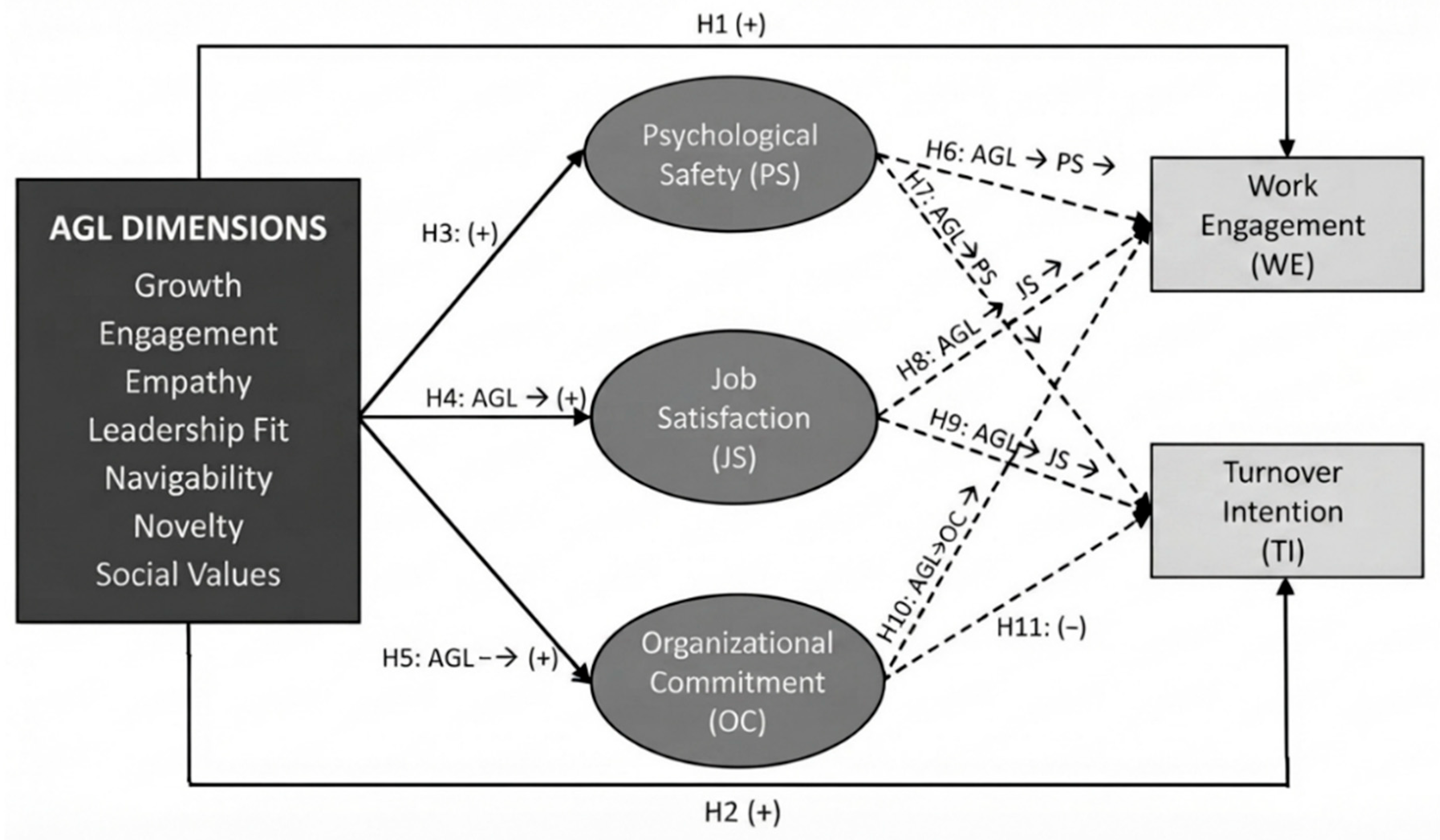
This section presents the integrated conceptual model that synthesizes all hypothesized relationships developed in the previous section. The model visually depicts the direct effects of the AGL dimensions on the dependent variables, as well as the indirect effects through the three mediating mechanisms (PS, JS, and OC). A comprehensive summary of all hypotheses is also provided.
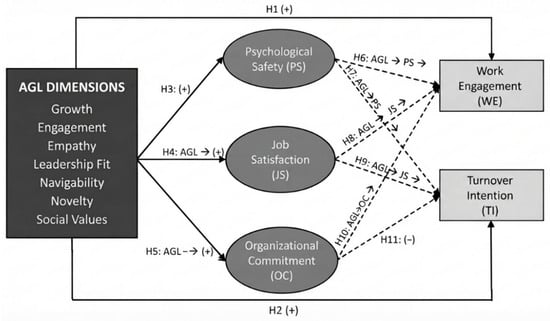
Based on the theoretical foundations and hypotheses developed above, Figure 1 presents the conceptual model with all hypothesized relationships clearly delineated.
Figure 1.
Conceptual Model with Hypothesized Relationships. Source: Developed by the authors Note: Independent Variable (AGL Dimensions): The AGL construct comprises seven dimensions: Growth (GR), Engagement (EN), Empathy (EM), Leadership Fit (LF), Navigability (NA), Novelty (NO), and Social Values (SVs). Mediating Variables: Psychological Safety (PS), Job Satisfaction (JS), and Organizational Commitment (OC). Dependent Variables: Work Engagement (WE) and Turnover Intention (TI).
The model hypothesizes direct effects of AGL dimensions on all mediating and dependent variables, and indirect effects through the three mediating variables (PS, JS, and OC). The summary of the hypotheses used in this manuscript is presented in Table 1.
Table 1.
Summary of Hypotheses.
4. Research Methodology
4.1. Research Design
The research design used a cross-sectional survey-based quantitative design [53]. This design has been used in the literature for generational leadership studies and allows data collection at a single point in time. Although causal inferences are limited, it is suitable for testing the hypothesized structural relationships.
4.2. Study Population and Sampling
The target population consists of workers in the age range (1997–2012), i.e., Generation Z [12]. A sample size of 370 was determined in line with the minimum population size for the Gen Z studies [54] and set to exceed the minimum population size for PLS-SEM [55,56]. A non-probability convenience sampling method with purposive sampling was used, including professional networks, targeted organizational outreach, and snowball sampling. The participants had to be born between 1997 and 2012, currently employed, have a minimum of six months of work experience, and be able to give informed consent. Given that data collection occurred in 2025, the effective age range of employed Gen Z respondents was approximately 18–28 years.
4.3. Data Collection Procedure
The instrument development process, expert review, pilot testing with 30 to 50 Gen Z employees, main data collection, and data cleaning were used to conduct the survey. Data were checked for missing values, with the average being less than 2% for each indicator. Data were missing completely at random, as confirmed by Little’s MCAR test [57]. All missing values were filled with the mean of the variables, as per the guidelines of PLS-SEM [55]. The following procedural remedies were used to minimize common method bias [58]: (a) respondent anonymity was ensured to reduce evaluation apprehension, (b) items measuring predictor variables and criterion variables were separated in the survey, (c) different types of scales were used for some variables; e.g., a frequency scale was used for the predictor variables, and an agreement scale was used for the criterion variables, (d) the survey was administered at two times, two weeks apart, with predictor variables measured at Time 1 and criterion variables at Time 2, (e) reverse-coded items were used to reduce acquiescence bias.
4.4. Research Instruments
The independent variable was conceptualized as a higher-order reflective-formative (2nd order) model in the PLS-SEM method [59]. Theoretically, this hierarchical specification is warranted because each of the seven dimensions is independent but covariant with the other dimensions to support an overall construct of leadership ability [60]. The nine-item Utrecht Work Engagement Scale [61] was used to measure work engagement. A six-item (six areas) Minnesota Satisfaction Questionnaire was employed as a measure of job satisfaction [62]. An adapted version of the Meyer and Allen Organizational Commitment Scale was used to assess organizational commitment [63]. Psychological safety was assessed with the validated seven-item scale (AGL Dimensions).
AGL Scale Development
The Adaptive Generational Leadership (AGL) scale was developed using recommended scale development guidelines [64]. The development process consisted of three stages:
Phase 1—Item Generation: Initial items were developed by conducting a comprehensive review of the literature on Gen Z workplace preferences and expectations, reviewing theory from Self-Determination Theory and Social Exchange Theory, and based on the findings of semi-structured interviews with 25 Gen Z employees and 10 HR professionals. This resulted in 42 initial items for the 7 dimensions.
Phase 2—Content Validity: This involved a panel of five content experts (three organizational academics and two HR professionals) rating each item based on its relevance, clarity, and comprehensiveness. The 35 items with a content validity index (CVI) of less than 0.80 were eliminated.
Phase 3—Psychometric Validation: Pilot testing was done with 50 Gen Z workers in Phase 3—Psychometric Validation. Exploratory factor analysis (EFA) using principal axis factoring and promax rotation yielded a seven-factor structure. Items loading to factors less than 0.50 and those with factor cross-loadings greater than 0.30 were dropped, leaving the final scale of 28 items.
There are four items for each dimension in the final AGL scale, comprising a total of 28 items across seven dimensions (7 dimensions × 4 items). The seven dimensions are Growth, Engagement, Empathy, Leadership Fit, Navigability, Novelty, and Social Values. All items were measured using a seven-point Likert scale, ranging from 1 = Strongly Disagree to 7 = Strongly Agree (see Appendix A).
4.5. Statistical Analysis
Descriptive statistics, exploratory factor analysis, reliability test, and Harman’s single factor test for common method bias were performed using SPSS (Version 24). The confirmatory factor analysis, the structural equation modeling, and the bootstrapping with 5000 resamples were performed using Smart-PLS [65]. The factor loadings and Cronbach’s Alpha, composite reliability, average variance extracted (AVE), Fornell–Larcker criterion, and the heterotrait–monotrait (HTMT) ratio were used to evaluate the measurement model [66,67,68,69,70]. The structural model was assessed using the coefficient of Determination (R2), Stone–Geisser’s Q-square predictive relevance value (Q2) [71], variance inflation factors (VIFs), and Cohen’s f2 effect sizes [72]. To determine the presence of common method bias, Harman’s test [73] procedural remedies (anonymity, multiple question formats), and correlations of >0.90 in the correlation matrix were conducted.
5. Results and Findings
5.1. Descriptive Statistics
5.1.1. Sample Characteristics
The demographic profile of the 370 respondents is presented in Table 2.
Table 2.
Demographic Profile of Respondents (N = 370).
5.1.2. Descriptive Statistics of Study Variables
The overall mean of AGL dimensions is 5.35 on a 7-point scale, which represents moderately high perceived competencies of leadership. Psychological safety has the highest mean score value (5.28), followed by organizational commitment (5.12) and job satisfaction (4.98) among the mediating variables. It is seen that, among the dependent variables, the mean score of work engagement is relatively high (5.31) and the mean of turnover intention is relatively low (3.24), indicating that the attitudes of employees working in the workplace are favorable. The skewness and kurtosis values are within acceptable limits and thus are normally distributed (Table 3).
Table 3.
Descriptive Statistics of Study Variables.
5.2. Measurement Model Assessment
5.2.1. Reliability Assessment
The reliability coefficients of all constructs are presented in Table 4. Cronbach’s Alpha values for all of the tests are above the suggested cutoff of 0.70 and range from 0.834 to 0.892, indicating that they have high internal consistency. There are a number of composite reliability values that range from 0.857 to 0.915, which is above the recommended value of 0.7. The reliability of constructs is also above 0.70 for all constructs.
Table 4.
Reliability Assessment of Constructs.
5.2.2. Convergent Validity Assessment
The factor loadings are all greater than 0.50 (range: 0.658–0.869), with most values (mostly >0.70), which signify good indicator reliability. Table 5 demonstrates the Average Variance Extracted (AVE) values for all the constructs are greater than 0.5 (range: 0.601–0.642), confirming adequate convergent validity [74,75].
Table 5.
Convergent Validity Assessment.
5.2.3. Discriminant Validity Assessment
As shown in Table 6, the square root of the AVE (shown on the diagonal, with the actual AVE in parentheses) for each construct exceeds all inter-construct correlations, satisfying the Fornell–Larcker criterion.
Table 6.
Fornell–Larcker Criterion for Discriminant Validity.
All HTMT values (Table 7) are below the 0.90 threshold, with all reported pairs falling below 0.75 (and the remaining pairs below 0.700), confirming that all constructs are empirically distinct.
Table 7.
Heterotrait–Monotrait Ratio (HTMT) Results.
5.2.4. Common Method Bias Assessment
A single factor explained 28.6% of the total variance, suggesting that common method bias is not a serious concern as per Harman’s single-factor test. There were no extremely high correlations (above 0.90) in the correlational matrix. To minimize risk of bias, procedural remedies were employed such as anonymity, different types of questions, and separating the independent and dependent variables.
5.3. Structural Model Evaluation
5.3.1. Model Fit Assessment
The model fit was evaluated with the standardized root mean square residual (SRMR) as the main fit index suggested for PLS-SEM. SRMR was 0.068, which is less than the conservative SRMR value of 0.08, and therefore it is considered an acceptable level of model fit [76]. Also, the normed fit index (NFI) was 0.892, very close to the recommended value of 0.90. The results of these indices indicate that the empirical relationships among the study variables are well represented by the structural model.
5.3.2. Hypothesis Testing Results
Table 8 shows the results of the hypothesis testing conducted in this study, which were carried out on the five proposed direct effect hypotheses.
Table 8.
Direct Effect Hypothesis Testing Results.
Bootstrapping with 5000 resamples was employed to assess the statistical significance of path coefficients. All five direct effect hypotheses were supported by the empirical data. For work engagement, the AGL dimensions showed a significant positive correlation (β = 0.498, p < 0.001), which is in support of H1. This finding shows that there is a significant connection between leaders who exhibit all of the AGL competencies and the work engagement of Gen Z employees. This relationship is noteworthy, as a path coefficient of 0.498 is a large effect size. The AGL dimensions had a significant negative association with turnover intention (AGL1: β = −0.215, p < 0.001), thus supporting H2. This is confirmation of the fact that the ones who feel their leaders have higher competencies in AGL are less likely to quit their organizations. The AGL dimensions showed a significant positive correlation with psychological safety (β = 0.312, p < 0.001), job satisfaction (β = 0.341, p < 0.001), and organizational commitment (β = 0.298, p < 0.001), respectively, to support H3, H4, and H5. The results are consistent with employees’ perception of psychologically safe work environments being linked to leaders with the AGL competencies and higher levels of overall job satisfaction and psychological attachment to the organization for employees who are Gen Z adults.
5.4. Mediation Analysis
Mediation analysis using bootstrapping (5000 resamples) examined the indirect effects of AGL dimensions on employee outcomes through psychological safety, job satisfaction, and organizational commitment. Table 9 presents the results, including direct, indirect, total effects, and variance accounted for (VAF) percentages.
Table 9.
Indirect Effect Mediation Analysis Results.
5.5. Predictive Relevance and Effect Sizes
The predictive relevance of all Q2 values (Table 10) exceeds zero, with the highest Q2 for work engagement (0.382), followed by job satisfaction (0.286), organizational commitment (0.256), psychological safety (0.218), and turnover intention (0.168). The size of the f2 values reflects the large effects for work engagement (f2 = 0.748), job satisfaction (f2 = 0.452), and organizational commitment (f2 = 0.401), and the medium effects for psychological safety (f2 = 0.321) and turnover intention (f2 = 0.225). The results validate the practical importance of the AGL dimensions in all outcomes, with a stronger impact in the case of positive outcomes (engagement, satisfaction, commitment) and a comparatively smaller, but still significant, effect in the case of turnover intention.
Table 10.
Predictive Relevance (Q2) and Effect Sizes (f2) for Endogenous Variables.
6. Discussion
6.1. Summary of Key Findings
This study empirically validated the proposed Adaptive Generational Leadership (AGL) model using statistical association research of seven dimensions. The strongest impact was found in work engagement (β = 0.498, p < 0.001) [9], followed by job satisfaction (β = 0.341, p < 0.001) [45], psychological safety (β = 0.312, p < 0.001) [47], organizational commitment (β = 0.298, p < 0.001) [51], and turnover intention (β = −0.215, p < 0.001) turnover intention [41]. Overall, the results indicate leaders exhibiting the full range of AGL capabilities are likely to have workplaces where Gen Z employees report higher levels of engagement, job satisfaction, and commitment, along with lower levels of [78]. The mediation findings further reveal that psychological safety [47], job satisfaction [45] and organizational commitment are important mediating factors through which the effects of AGL dimensions on employee outcomes are achieved [51]. Among the three psychological states, psychological safety has the largest mediation effect (VAF = 45.6%) [47] followed by job satisfaction (39.5%) [45] and organizational commitment (36.3%) [51]. This demonstrates that the effects of AGL dimensions on turnover intention occur, to a great extent, through improvements in psychological safety, job satisfaction, and organizational commitment [51]. Furthermore, the mediation effects due to the three psychological states are stronger for turnover intention than for work engagement, indicating that the indirect effects of AGL dimensions are most significant in terms of retention-related outcomes [79].
6.2. Implications of the Study
The findings offer actionable implications for engaging and retaining Gen Z talent. First, organizations should develop leaders across all seven AGL dimensions, as it is not enough for leaders to develop competencies only in one area. Training programs for leaders must develop competencies in all three groups falling within the AGL three dimensions [4]. Second, given the strong association with psychological safety (β = 0.312), organizations should prioritize developing psychologically safe environments. For this to be possible, leaders must implement true empathy, be responsive to individual needs, and show their commitment to inclusion as well as ethical principles through actions such as providing fair resources and implementing inclusive decision-making [47]. Third, job satisfaction’s mediating role accentuates the importance of addressing positive contextual factors. First, leaders must create opportunities for job growth, fulfilling work, supportive supervision, autonomy, and value congruence. Providing regular feedback and holding career discussions is a must. Organizations may engage in mentoring and skill development programs [49]. Fourth, the organizational commitment role in turnover reduction highlights aspects of psychological attachment. Leaders who establish development, ethical integrity, and supportive connections build reciprocal commitment. Hence, organizations should focus on emotional intelligence in leader selection and the psychological contract for retention [80].
Finally, the substantial variance explained in work engagement (42.8%) and turnover intention (18.4%) demonstrates that the AGL model can serve as a diagnostic tool. Organizations may use a validated AGL scale as a feedback mechanism.
6.3. Limitations and Future Research
This study has several limitations warranting acknowledgment. First, the cross-sectional design prevents us from making claims about causation. Therefore, further studies should adopt a longitudinal design to analyze the development of AGL and other variables in a dynamic way (e.g., how high-engagement employees contribute to AGL), as well as experimental designs (e.g., conducting leadership training before and after the intervention). Second, the use of procedural and statistical remedies for common method bias (Harman’s single-factor test: 28.6% variance explained; marker variable analysis) does not completely exclude the possibility of method variance, with the caveat that the data were self-reported from a single source. Despite the results of Harman’s test, which suggest that there is no serious common method bias, the Harman test is not very sensitive [73]. Future research could use multi-source designs (subordinates could rate their own leaders, and outcomes could be obtained from supervisors or objective records, such as actual turnover data or performance data) and designs using more than one measurement wave to demonstrate temporal precedence and test for reciprocal relationships. Within-person variation in perceptions of leadership and outcomes of employees can also be observed using experience sampling methods (ESMs). Third, a convenience sample of participants—mostly well-educated (91.9% holding at least a bachelor’s degree) and predominantly urban population—limits the generalization of the findings. The non-probability sampling approach means that inclusion probabilities were neither uniform nor known, potentially introducing selection bias. Future research should adopt a probability sampling method to ensure adequate representation of employees across educational levels, occupational categories, and labor market segments, and should consider demographic moderators and conduct cross-cultural research. Fourth, despite the fact that f2 values for work engagement (0.748) and job satisfaction (0.452) suggest strong effects, one should be cautious about interpreting the results because of the possibility of shared method variance. Fifth, VAF estimates in PLS-SEM may yield unreliable results owing to their susceptibility to model specification. VAF percentages should be perceived as merely indicative. It is recommended that future studies explore different mediation approaches (Monte Carlo confidence intervals and Bayesian estimation) for stronger evidence. Sixth, the narrow scope of Gen Z means it cannot be evaluated as a potential application of the AGL approach across generations. The theoretical underpinnings of AGL (SDT and SET) are not generational; however, it is not possible to make an empirical argument for the salience of the seven dimensions for Gen Z versus other generations. Comparative studies with different generational groups (Millennials, Generation X, Baby Boomers) are key to determining if AGL is a concept for a particular generation or a key best practice in leadership. Similar studies need to be conducted to compare AGL with other leadership constructs that have been previously validated in predicting employee outcomes across generations. Until empirical evidence is available, we place AGL as a possible framework for the effectiveness of Gen Z leadership and do not assume it is the exclusive explanation of Gen Z leadership. Seventh, the study did not make any attempt to analyze the impact of moderating variables. Therefore, future research ought to take account of the surrounding context (organizational culture, industry, team composition, type of working arrangement). For example, Novelty might be more important in high-tech industries, while Social Values can differ among organizations depending on their engagement in corporate social responsibility. Eighth, although this study examines the differences between generations, we recognize that individual-level factors (such as personality, career aspiration, personal values) and contextual factors (such as national culture, industry norms, organizational size) are likely to interact with generational membership to influence employee outcomes. Future studies should be more sophisticated and consider the relative contribution of generational versus individual and contextual factors.
7. Conclusions
Generation Z workers continue to influence changing dynamics in the labor market, and their digital skills, social awareness, and different expectations make it necessary for firms to adjust their leadership styles. The AGL model presents a framework that is based on theory and verified by practice on how leadership facets function in a workplace. According to the results of this study, proper leadership regarding Gen Z is not only about traditional leadership concepts. A number of competencies that are essential are as follows: growth facilitating, engagement building, empathy, flexibility, navigation clarity, innovation openness, and value. The implications of these findings are obvious. Companies that develop leaders who can use the principles of the AGL model will be able to attract, engage, and retain Generation Z workers. Companies that fail to change their leadership styles will risk losing the most valuable employees to their competitors. Future research should continue to refine and extend the model through cross-cultural, longitudinal, and comparative studies to further enhance our understanding of how leadership can effectively engage and inspire the next generation of employees. In addition, it would be informative to study how technology helps or restrains AGL competencies; how flexible work arrangements affect leadership effectiveness; and how digital leadership competencies may complement the AGL framework. The AGL model lays a solid basis for grasping and improving leadership competencies necessary for creating pleasant working conditions for Gen Z representatives and future generations alike.
Author Contributions
Conceptualization, M.S., F.U., M.B.H. and F.Z.J.; methodology, M.S., F.U., F.Z.J. and M.B.H.; software, M.S. and F.U.; validation, F.Z.J. and M.B.H.; formal analysis, M.S. and F.U.; investigation, F.U., F.Z.J. and M.B.H.; resources, F.Z.J. and M.B.H.; data curation, M.S. and M.B.H.; writing—original draft, M.S. and F.U.; writing—review and editing, M.S., F.U., F.Z.J. and M.B.H.; visualization, F.Z.J. and M.B.H.; project administration, M.S.; supervision, M.B.H.; funding acquisition, F.Z.J. All authors have read and agreed to the published version of the manuscript.
Funding
This research received no external funding.
Institutional Review Board Statement
Ethical review and approval were waived for this study by the Institutional Review Board of SVKM’s Narsee Monjee Institute of Management Studies (NMIMS), Deemed to be University, Mumbai, India, on 30 October 2026. The waiver was granted because the study was a non-interventional, quantitative, cross-sectional survey of 370 employed Generation Z respondents, supplemented by semi-structured interviews with 25 Generation Z employees and 10 HR professionals, expert review, and pilot testing. The study did not involve clinical interventions, medical procedures, or experimental manipulation. Participation was voluntary, informed consent was obtained from all participants, and respondent anonymity and confidentiality were maintained throughout data collection.
Informed Consent Statement
Informed consent was obtained from all subjects involved in the study.
Data Availability Statement
The data presented in this study is available on request from the corresponding author.
Acknowledgments
We sincerely thank the anonymous reviewers of this paper for their insightful and helpful recommendations.
Conflicts of Interest
The authors declare no conflicts of interest.
Appendix A
Table A1.
Adaptive Generational Leadership (AGL) Scale—Final Items and Psychometric Properties.
Notes:
- N = 370. All items were rated on a 7-point Likert scale (1 = Strongly Disagree to 7 = Strongly Agree).
- Standardized factor loadings are from the PLS-SEM measurement model (all loadings significant at p < 0.001).
- The AGL scale was conceptualized as a second-order reflective-formative construct, with the seven dimensions as first-order reflective constructs.
- Descriptive statistics are reported at the item level; dimension-level means are reported in Table 3.
References
- Widodo, D.S.; Maghfuriyah, A. Factors Affecting the Performance of Generation Z Workforce Employees: Analysis of Work Life Balance, Leadership Style and Organizational Culture. Dinasti Int. J. Econ. Finance Account. 2024, 5, 1489–1500. [Google Scholar] [CrossRef] [Scilit]
- Dharmawan, G.S.B.; Nurhayati, M.; Wd, H.S. The Influence of Transformational Leadership and Workload on the Performance of BMKG Technicians during the Covid-19 Pandemic: Comparison Between Generations X, Y, and Z. J. Dr. Manaj. (JDM) 2022, 5, 102. [Google Scholar] [CrossRef] [Scilit]
- Kimonyo, T. Influence of Strategic Leadership on Generation Z Employees: A Strategic Approach to Organizational Performance. Eur. J. Bus. Strateg. Manag. 2025, 10, 72–85. [Google Scholar] [CrossRef] [Scilit]
- Grotkamp, L.; Schaumann, J.M.; Riehm, P. Millennial leaders’ display of generational cohort stereotypes: A qualitative research approach. J. Leadersh. Organ. 2020, 2, 57–74. [Google Scholar] [CrossRef] [Scilit]
- Ke, Y.; Liu, L.; Gu, M. Paternalistic leadership and counterproductive work behavior: Mediating role of leader identification and moderating effect of traditionality in Chinese generation Z employees. Front. Psychol. 2024, 16, 1587525. [Google Scholar] [CrossRef] [Scilit] [PubMed]
- Tiikkaja, S.; Sandin, S.; Hultman, C.M.; Modin, B.; Malki, N.; Sparén, P. Psychiatric disorder and work life: A longitudinal study of intra-generational social mobility. Int. J. Soc. Psychiatry 2016, 62, 156–166. [Google Scholar] [CrossRef] [Scilit] [PubMed]
- Putri, M.M.; Emilisa, N.; Wijaya, R.; Adnan, M.T. Is There an Influence of Visionary Leadership, Digital Leadership, and Knowledge Sharing on the Emotional Intelligence of Generation Z Interns in DKI Jakarta? J. Manaj. Bisnis Eka Prasetya 2025, 11, 25–46. [Google Scholar] [CrossRef] [Scilit]
- Garai-Fodor, M.; Vasa, L.; Jäckel, K. Characteristics of segments according to the preference system for job selection, opportunities for effective incentives in each employee group. Decis. Mak. Appl. Manag. Eng. 2023, 6, 557–580. [Google Scholar] [CrossRef] [Scilit]
- Revuru, I.; Bandaru, K.K. Leadership Practices for Sustaining Work Engagement: A Gen-Z Perspective. Int. J. Organ. Leadersh. 2024, 13, 451–466. [Google Scholar] [CrossRef] [Scilit]
- Hill, C.; Rice, J.; Bell, R.L. What are the Best Leadership Styles for Managing Boomers, Generation X, Millennials, and Generation Z Who Work Remotely? J. Manag. Policy Pract. 2025, 26, 101–115. [Google Scholar] [CrossRef] [Scilit]
- Hidayat, D.; Tjandra, E.U.; Herawati, N. Gen Z Digital Leadership through Social Media. WIDYAKALA J. J. Pembang. JAYA Univ. 2023, 10, 62. [Google Scholar] [CrossRef] [Scilit]
- Yılmaz, B.; Dinler Kısaçtutan, E.; Gürün Karatepe, S. Digital natives of the labor market: Generation Z as future leaders and their perspectives on leadership. Front. Psychol. 2024, 15, 13789825. [Google Scholar] [CrossRef] [Scilit] [PubMed]
- Črešnar, R.; Nedelko, Z. Understanding future leaders: How are personal values of generations Y and Z tailored to leadership in industry 4.0? Sustainability 2020, 12, 4417. [Google Scholar] [CrossRef] [Scilit]
- Nie, Y.; Gu, Y.; Nurmagambetova, A.; Shahzadi, I.; Vasa, L. Integrating common prosperity into knowledge governance: A multilevel framework of justice, development and innovative work behaviour. J. Knowl. Manag. 2026, 1–20. [Google Scholar] [CrossRef] [Scilit]
- Sigaeva, N.; Arasli, H.; Ozdemir, E.; Atai, G.; Capkiner, E. In Search of Effective Gen Z Engagement in the Hospitality Industry: Revisiting Issues of Servant and Authentic Leadership. Sustainability 2022, 14, 13105. [Google Scholar] [CrossRef] [Scilit]
- Singh, S.; Singh, R.P.; Vishwakarma, S.S. Organizational Learning and Sustainability: A Review of Adaptive Strate-gies of Indian Firms to Engage Gen Z Employees. J. Inform. Educ. Res. 2025, 5, 4525–4537. [Google Scholar] [CrossRef] [Scilit]
- Liu, N.C.; Lin, Y.T. High-performance work systems, management team flexibility, employee flexibility and service-oriented organizational citizenship behaviors. Int. J. Hum. Resour. Manag. 2021, 32, 3912–3949. [Google Scholar] [CrossRef] [Scilit]
- De Clerck, T.; Haerens, L.; Devos, G.; Willem, A. A self-determination theory perspective on how autonomy-supportive and chaotic leadership relates to volunteers’ need-based experiences and turnover intentions: A variable-centered and person-centered approach. Nonprofit Manag. Leadersh. 2024, 34, 777–800. [Google Scholar] [CrossRef] [Scilit]
- Zhao, Q.; Zhang, J.; Sun, X.; Ma, J.; Wang, G. Green or Greenwashing? A novel deep learning method integrating multi-source data for ESG greenwashing detection. J. Clean. Prod. 2026, 555, 148147. [Google Scholar] [CrossRef] [Scilit]
- Cunningham, G.B. Overview of Diversity, Equity, and Inclusion. In Diversity, Equity, and Inclusion at Work; Routledge: London, UK, 2024; pp. 3–25. [Google Scholar] [CrossRef] [Scilit]
- Ivasciuc, I.-S.; Sequeira, A.S.; Brown, L.; Ispas, A.; Peyré, O. Digital Natives on the Move: Cross-Cultural Insights into Generation Z’s Travel Preferences. Sustainability 2025, 17, 6601. [Google Scholar] [CrossRef] [Scilit]
- Qingyang, L.; Yuxuan, X.; Sijia, C. Y-Generation Digital Natives’ Impulsive Buying Behavior. In Proceedings of the TIMES-iCON 2018—3rd Technology Innovation Management and Engineering Science International Conference, Bangkok, Thailand, 12–14 December 2018. [Google Scholar] [CrossRef] [Scilit]
- Tafvelin, S.; Stenling, A. A Self-Determination Theory Perspective on Transfer of Leadership Training: The Role of Leader Motivation. J. Leadersh. Organ. Stud. 2021, 28, 60–75. [Google Scholar] [CrossRef] [Scilit]
- Thrasher, G.; Dickson, M.; Biermeier-Hanson, B.; Najor-Durack, A. Social identity theory and leader–member exchange: Individual, dyadic and situational factors affecting the relationship between leader–member exchange and job performance. Organ. Manag. J. 2020, 17, 133–152. [Google Scholar] [CrossRef] [Scilit]
- Dwidienawati, D.; Ratnasari, E.D.; Nugraha, I.O.; Maharani, A.; Arsan, M.F. The Influence of Well-being, Empowering Leadership, and Career Development on Work Engagement in Generation Z in Indonesia. WSEAS Trans. Bus. Econ. 2025, 22, 32–47. [Google Scholar] [CrossRef] [Scilit]
- Hesmert, L.; Vogel, R. Following Your Ideal Leader: Implicit Public Leadership Theories, Leader—Member Exchange, and Work Engagement. Public Pers. Manag. 2024, 53, 548–571. [Google Scholar] [CrossRef] [Scilit]
- Raza, M.A.; Imran, M.; Rosak-Szyrocka, J.; Vasa, L.; Hadi, N.U. Organizational Change and Workplace Incivility: Mediated by Stress, Moderated by Emotional Exhaustion. Int. J. Environ. Res. Public Health 2023, 20, 2008. [Google Scholar] [CrossRef] [Scilit] [PubMed]
- Srivastava, S.; Gupta, P. Workplace spirituality as panacea for waning well-being during the pandemic crisis: A SDT perspective. J. Hosp. Tour. Manag. 2022, 50, 375–388. [Google Scholar] [CrossRef] [Scilit]
- Iddrisu, Z.; Awal, M.; Abdul-Karim, M.; Alidu, M. The nexus between effective communication practices and employee engagement: Integrating job demands-resources (JD-R) model and social exchange theory. SN Bus. Econ. 2026, 6, 133. [Google Scholar] [CrossRef] [Scilit]
- Hu, R.; Chen, C.-S.; Yang, C. The impact of employees’ perceived corporate social responsibility on employee sus-tainable performance: Exploring the moderating role of authentic leadership and empathy. Environ. Soc. Psychol. 2025, 10, 1–19. [Google Scholar] [CrossRef] [Scilit]
- Kucuk, B.A. Work Flow Experience in the Light of Leader-Member Exchange and Person-Job Fit Theories. Psychol. Rep. 2022, 125, 464–497. [Google Scholar] [CrossRef] [Scilit] [PubMed]
- Thompson, G.; Glasø, L. Situational leadership theory: A test from a leader-follower congruence approach. Leadersh. Organ. Dev. J. 2018, 39, 574–591. [Google Scholar] [CrossRef] [Scilit]
- Dick, D.T.; Henningsen, D.D. The Perception of Leaders: A Competitive Test of Social Exchange Theory and Equity Theory. Groupwork 2020, 28, 37–52. [Google Scholar] [CrossRef] [Scilit]
- Hu, C.; Cheng, W.; Lyu, J. Unlocking Innovation Novelty Through AI Adoption: The Impact of Leadership Team Diversity and Employee-Related Corporate Social Responsibility; Social Science Research Network (SSRN): Rochester, NY, USA, 2025. [Google Scholar] [CrossRef] [Scilit]
- Kim, S.; Kwon, H.; Shi, J. The moderating roles of multidimensional novelty-seeking behaviors on destination images and revisit intentions. Tour. Rev. Int. 2024, 28, 293–309. [Google Scholar] [CrossRef] [Scilit]
- Hossain, M.B.; Rahman, M.U.; Čater, T.; Vasa, L. Determinants of SMEs’ strategic entrepreneurial innovative digitalization: Examining the mediation role of human capital. Eur. J. Innov. Manag. 2025, 28, 2733–2760. [Google Scholar] [CrossRef] [Scilit]
- Nave, E.; Katz, H. The “Consistent Chameleon”: Values-Driven Leadership among Social and Business Leaders Doing Social Entrepreneurship. J. Values-Based Leadersh. 2024, 17, 12. [Google Scholar] [CrossRef] [Scilit]
- Fu, B.; Ahmad, N.; Lho, L.H.; Han, H. Triple-E effect: Corporate ethical responsibility, ethical values, and employee emotions in the healthcare sector. Soc. Behav. Personal. Int. J. 2023, 51, 1–14. [Google Scholar] [CrossRef] [Scilit]
- Reer, F.; Krämer, N.C. A self-determination theory-based laboratory experiment on social aspects of playing multiplayer first-person shooter games. Entertain. Comput. 2020, 34, 100353. [Google Scholar] [CrossRef] [Scilit]
- Perera, L.; Jayasena, C.; Hettiarachchi, N.; Siriwardana, D.; Wisenthige, K.; Wickramaarachchi, C. Fueling the future: Unveiling what drives gig worker motivation and engagement in Sri Lanka’s corporate landscape. Int. J. Sociol. Soc. Policy 2025, 45, 308–330. [Google Scholar] [CrossRef] [Scilit]
- Mac, Y.T.H.; Tran, C.T. Job Characteristics, Affective Commitment, and Turnover Intentions: A Dual-Theory Examination of Generation Z. Emerg. Sci. J. 2026, 10, 333–347. [Google Scholar] [CrossRef] [Scilit]
- Xiaofang, Z.; Yue, Z.; Yasin, S.M. Turnover intentions among gig workers: A job demands and resources perspective. Acta Psychol. 2026, 264, 10660. [Google Scholar] [CrossRef] [Scilit] [PubMed]
- Yu, J.; Hamid, R.A. Gig workers’ psychological contracts and turnover intention: A mediated path analysis of organizational identification and job satisfaction. Acta Psychol. 2024, 251, 104587. [Google Scholar] [CrossRef] [Scilit] [PubMed]
- Li, C.; Lin, C.-L.; Chin, T. How Does the Paradoxical Leadership of Cross-Border e-Commerce (CBEC) Gig Workers Influence Chinese Company Performance: The Role of Psychological Well-Being. Sustainability 2022, 14, 12307. [Google Scholar] [CrossRef] [Scilit]
- Lin, Q.; Sun, R.; Zhu, Q. Adaptive job recrafting of gig workers: Concept, measurement, and validation of its impact on job satisfaction. Acta Psychol. 2026, 262, 106034. [Google Scholar] [CrossRef] [Scilit] [PubMed]
- Tidhar, L. Management and leadership for generation z in an era of changing employee commitment. J. Public Adm. Finance Law 2023, 27, 462–469. [Google Scholar] [CrossRef] [Scilit]
- Meng, Q.; Liu, W.; Li, Z.; Chong, H.-Y.; Li, K. Mindful Leadership and Construction Workers’ Safety Citizenship Behavior: A Moderated Mediation Model of Team Psychological Safety, Participative Safety Self-Efficacy, and Leader–Member Exchange. J. Constr. Eng. Manag. 2026, 152, 04025244. [Google Scholar] [CrossRef] [Scilit]
- Dong, X.; Xing, L. Authentic leadership and employee psychological safety: The mediating role of leader-member exchange and the moderating effect of cultural collectivism. BMC Psychol. 2026, 14, 400. [Google Scholar] [CrossRef] [Scilit] [PubMed]
- Aldawod, A.; Al-Duhoki, A.A.A. Unpacking the Link: How Distributive and Interactional Justice Mediate the Relationship Between Leader–Member Exchange, Servant Leadership, and Job Satisfaction. Empl. Responsib. Rights J. 2026, 1–38. [Google Scholar] [CrossRef] [Scilit]
- Mittal, A.; Mishra, G.; Bishnoi, S. Workplace Spirituality and Job Satisfaction of Higher Education Teachers in India: Examining Occupational Stress as a Mediator. Bus. Perspect. Res. 2024, 12, 296–314. [Google Scholar] [CrossRef] [Scilit]
- Uddin, A.; Mahmood, M.; Fan, L. Why individual employee engagement matters for team performance? Team Perform. Manag. Int. J. 2019, 25, 47–68. [Google Scholar] [CrossRef] [Scilit]
- Oh, J.; Kim, D.H.; Kim, D. The Impact of Inclusive Leadership and Autocratic Leadership on Employees’ Job Satisfaction and Commitment in Sport Organizations: The Mediating Role of Organizational Trust and The Moderating Role of Sport Involvement. Sustainability 2023, 15, 3367. [Google Scholar] [CrossRef] [Scilit]
- Wang, X.; Loganathan, K. Performance Effects of Leadership Support Behavior in University Teachers’ Career Development in Shandong Province: A Cross-sectional Study Based on Social Exchange Theory. J. Chin. Hum. Resour. Manag. 2026, 17, 189–203. [Google Scholar] [CrossRef] [Scilit]
- Konietschke, F.; Schwab, K.; Pauly, M. Small sample sizes: A big data problem in high-dimensional data analysis. Stat. Methods Med. Res. 2021, 30, 687–701. [Google Scholar] [CrossRef] [Scilit] [PubMed]
- Hair, J.F.; Ringle, C.M.; Sarstedt, M. PLS-SEM: Indeed a silver bullet. J. Mark. Theory Pract. 2011, 19, 139–152. [Google Scholar] [CrossRef] [Scilit]
- Razi-Ur-Rahim, M.; Rabbani, M.R.; Uddin, F.; Shaikh, Z.H. Adoption of UPI among Indian users: Using extended meta-UTAUT model. Digit. Bus. 2024, 4, 100093. [Google Scholar] [CrossRef] [Scilit]
- Hayes, T.; Baraldi, A.N.; Coxe, S. Random forest analysis and lasso regression outperform traditional methods in identifying missing data auxiliary variables when the MAR mechanism is nonlinear (p.s. Stop using Little’s MCAR test). Behav. Res. Methods 2024, 56, 8608–8639. [Google Scholar] [CrossRef] [Scilit] [PubMed]
- Podsakoff, P.M.; MacKenzie, S.B.; Lee, J.Y.; Podsakoff, N.P. Common method biases in behavioral research: A critical review of the literature and recommended remedies. J. Appl. Psychol. 2003, 88, 879–903. [Google Scholar] [CrossRef] [Scilit] [PubMed]
- Zhu, L. Conceptualizing and measuring strategic authenticity? A reflective-formative second-order model. J. Bus. Res. 2025, 200, 115582. [Google Scholar] [CrossRef] [Scilit]
- Disse, I.K.; Becker-Özcamlica, H. The effects of employee behavior in sustainable service organizations. J. Serv. Mark. 2022, 36, 1095–1105. [Google Scholar] [CrossRef] [Scilit]
- Sidharta, I. Validation on Utrecht Work Engagement Scale: Multisample and Multi Sectors Analysis. Kontigensi J. Ilm. Manaj. 2018, 6, 49–58. [Google Scholar] [CrossRef] [Scilit]
- Hancer, M.; George, R.T. Job Satisfaction Of Restaurant Employees: An Empirical Investigation Using The Minnesota Satisfaction Questionnaire. J. Hosp. Tour. Res. 2003, 27, 85–100. [Google Scholar] [CrossRef] [Scilit]
- López, A.L.S.; Muñoz Fernández, G.A.; Astudillo, S.V. Confirmatory factor analysis of a scale of job satisfaction and organizational commitment among hotel service employees in Ecuador. Investig. Tur. 2022, 24, 68–84. [Google Scholar] [CrossRef] [Scilit]
- Galanis, P.; Katsiroumpa, A.; Vraka, I.; Siskou, O.; Konstantakopoulou, O.; Moisoglou, I.; Gallos, P.; Kaitelidou, D. The quiet quitting scale: Development and initial validation. AIMS Public Health 2023, 10, 828–848. [Google Scholar] [CrossRef] [Scilit] [PubMed]
- Hasim, M.A.; Mahbob, N.N. Perceived Influencer Credibility and Perceived Content Usefulness in Influencing Consumer Purchase Decisions: A Moderated Model Using SmartPLS. paperASIA 2025, 41, 232–244. [Google Scholar] [CrossRef] [Scilit]
- Ab Hamid, M.R.; Sami, W.; Mohmad Sidek, M.H. Discriminant Validity Assessment: Use of Fornell & Larcker criterion versus HTMT Criterion. J. Phys. Conf. Ser. 2017, 890, 012163. [Google Scholar] [CrossRef] [Scilit]
- Raza, M.W.; Rasheed, A.; Uddin, F. What affects the consumers’ green purchasing behaviour? A study from an emerging market. Int. J. Product. Qual. Manag. 2025, 45, 513–533. [Google Scholar] [CrossRef] [Scilit]
- Sahu, M.; Uddin, F.; Hossain, M.B. Exploring the psychological drivers of cryptocurrency investment biases: Evidence from Indian retail investors. Int. J. Financ. Stud. 2025, 13, 219. [Google Scholar] [CrossRef] [Scilit]
- Razi-Ur-Rahim, M.; Uddin, F.; Chauhan, J.; Faisal, K. GenAI in Indian higher education: Faculty at the crossroads of adoption. Asian Educ. Dev. Stud. 2026, 15, 41–72. [Google Scholar] [CrossRef] [Scilit]
- Razi-Ur-Rahim, M.; Uddin, F.; Rahim, S.; Hossain, B. Pioneering digital finance: Determinants of CBDC adoption in the era of FinTech and online payments. Qual. Quant. 2026, 60, 9771–9797. [Google Scholar] [CrossRef] [Scilit]
- Hossain, M.A.; Al Jamil, M.A.; Ahmed, S.S. Business Leadership and Consumer Relationship Management: Understanding Brand Loyalty Through Experience, Trust, and Psychological Ownership. Bus. Ethics Leadersh. 2026, 10, 269–291. [Google Scholar] [CrossRef] [Scilit]
- Selya, A.S.; Rose, J.S.; Dierker, L.C.; Hedeker, D.; Mermelstein, R.J. A Practical Guide to Calculating Cohen’s f2, a Measure of Local Effect Size, from PROC MIXED. Front. Psychol. 2012, 3, 111. [Google Scholar] [CrossRef] [Scilit] [PubMed]
- Aguirre-Urreta, M.I.; Hu, J. Detecting Common Method Bias. ACM SIGMIS Database Database Adv. Inf. Syst. 2019, 50, 45–70. [Google Scholar] [CrossRef] [Scilit]
- Sanyal, U.; Uddin, F.; Razi-Ur-Rahim, M.; Islam, A.; Kuriyodath, R.; Hossain, M.B. Behavioral Biases and Retail Investment Decisions in India: The Moderating Role of Financial Literacy and Financial Awareness. Analytics 2026, 5, 26. [Google Scholar] [CrossRef] [Scilit]
- Sahu, M.; Uddin, F.; Hossain, M.B. From credibility to advocacy: An SOR model of consumer engagement and authenticity in functional foods and beverages market. Thunderbird Int. Bus. Rev. 2025, 68, 759–777. [Google Scholar] [CrossRef] [Scilit]
- Hu, L.T.; Bentler, P.M. Cutoff criteria for fit indexes in covariance structure analysis: Conventional criteria versus new alternatives. Struct. Equ. Model. Multidiscip. J. 1999, 6, 1–55. [Google Scholar] [CrossRef] [Scilit]
- Nitzl, C.; Roldan, J.L.; Cepeda, G. Mediation analysis in partial least squares path modelling, Helping researchers discuss more sophisticated models. Ind. Manag. Data Syst. 2016, 116, 1849–1864. [Google Scholar] [CrossRef] [Scilit]
- Dawson, M.; Guchait, P.; Russen, M.; Wang, X.; Pasamehmetoglu, A. Hospitality organizational culture: Impact on employee’s job satisfaction, organizational citizenship behaviors, service recovery performance, and intention to leave. J. Hum. Resour. Hosp. Tour. 2023, 22, 460–488. [Google Scholar] [CrossRef] [Scilit]
- Paraiso, P. Factors Influencing Quiet Quitting and Employee Commitment in Casino Gaming Workplaces: Implications for Employee Retention Strategies. J. Interdiscip. Perspect. 2024, 2, 500–509. [Google Scholar] [CrossRef] [Scilit]
- Haider, R.; Rafique, M.; Mushtaq, F. Responsible Leadership and Project Sustainability Performance: Role of Project Commitment and Emotional Intelligence. Social Identity Theory Perspective. Sustain. Dev. 2026. Epub ahead of printing. [Google Scholar] [CrossRef] [Scilit]

Disclaimer/Publisher’s Note: The statements, opinions and data contained in all publications are solely those of the individual author(s) and contributor(s) and not of MDPI and/or the editor(s). MDPI and/or the editor(s) disclaim responsibility for any injury to people or property resulting from any ideas, methods, instructions or products referred to in the content. |
© 2026 by the authors. Licensee MDPI, Basel, Switzerland. This article is an open access article distributed under the terms and conditions of the Creative Commons Attribution (CC BY) license.