


Abstract
This study examined the relationships among university support, workplace experience, and career decision-making proficiency (CDMP) among Myanmar undergraduate students studying in Myanmar and Thailand. Survey data were collected from 300 students (52.7% female) enrolled at four universities in Myanmar and four in Thailand. Structural equation modeling (SEM) was used to test the proposed relationships. The primary model explained 51.4% of the variance in CDMP (R2 = 0.514). University support was positively associated with CDMP (β = 0.345, p < 0.001) and workplace experience, while workplace experience was positively associated with CDMP. The indirect association of university support with CDMP through workplace experience was significant (β = 0.346, p < 0.001), accounting for approximately 50.1% of the total association and indicating partial statistical mediation. The main structural relationships remained significant after adjustment for country of study and academic year level. These findings highlight the importance of integrating university-based career support with meaningful workplace learning opportunities to strengthen students’ career decision-making proficiency. Future research should examine whether these relationships hold across different educational and cultural contexts.
1. Introduction
Career decision-making is important in shaping individuals’ educational and occupational pathways [1]. It is a vital skill for aligning educational readiness and future employment outcomes. Students must have clear career orientations and make career choices by considering academic preparation, personal interests, workplace expectations, and future career goals [2]. The lack of career information and guidance may lead to a mismatch between education, career aspiration, and confidence in making well-thought-out career decisions [3,4,5].
Career decision-making proficiency (CDMP) refers to the ability to make informed career choices based on self-understanding, available information, and relevant experience [6]. In this study, university support concerns the academic and career-related assistance students receive from their university [7], whereas workplace experience refers to what students learn and the support they receive during a university-arranged internship [8]. CDMP represents the students’ capacity to use such information and experience in making career decisions [6]. Thus, the three constructs are treated as institutional support, experiential learning, and career decision-making, respectively. To improve university students’ career decision-making proficiency, institutions should provide guidance and access to career information to help students explore their career options and clarify their future career goals [9]. Experiential learning is one method that can help develop this aspect, as knowledge is constructed through practical experience [10,11]. Thus, higher education institutions (HEIs) should facilitate experiential learning opportunities to develop professional identity, motivation, and the psychological competencies required for informed career decision-making.
Previous studies have investigated university support and workplace experience as predictors of students’ career decision-making. Wang [12] studied internships as institutional support and professional identity, motivation, and career attitudes as outcomes, but the study did not consider the psychological implications of the career decision-making process. Khampirat [13] confirmed the importance of career adaptability among Thai undergraduates. However, the study focused mainly on the characteristics of adaptability, rather than on broader outcomes related to decision-making. Hastindra Na Ayudhaya et al. [14] stated that workplace experience enhances professional communication skills. They focused on the development of language skills rather than the influence of language on the students’ career decision-making proficiency. Likewise, Khampirat et al. [15] focused on the role of social competencies in workplace readiness, but they did not analyze the broader career development outcomes, such as career decision-making proficiency. These studies explore institutional support and learning experiences from different perspectives, but they pay limited attention to the psychological outcomes related to career decision-making.
Despite these contributions, little is known about how university support and workplace experience work together to shape career decision-making proficiency, particularly among Myanmar students in cross-border educational contexts. This gap is practically significant in Myanmar, where mismatches between education and labor-market skill requirements continue to challenge young people’s transition to employment, and where socioeconomic and educational disruptions have further complicated informed career decision-making among emerging adults [16]. These challenges may be particularly salient for Myanmar students studying abroad, who must navigate additional employment-related barriers in the host-country context [17]. As a result, it is challenging to identify effective educational strategies for enhancing students’ career decision-making proficiency through institutional support and experiential learning opportunities. To address this gap, the present study examines the structural relationships among university support, workplace experience, and career decision-making proficiency among Myanmar undergraduate students studying at universities in both Myanmar and Thailand. Drawing on Social Cognitive Career Theory (SCCT) [18], this study examines university support as a contextual factor, workplace experience as a learning experience, and career decision-making proficiency as the career outcome. This approach offers a better understanding of how contextual support and workplace experience are related to students’ career decision-making proficiency.
2. Literature Review
2.1. Social Cognitive Career Theory
This research is based on SCCT [18], which originates from Bandura’s social cognitive framework [19]. The theory highlights the interaction of cognitive processes, learning experiences, and contextual support in individuals’ career development. Although previous studies have indicated self-efficacy as an outcome [20], this study extends the application of SCCT by considering the quality of career decision-making as a broader comprehensive outcome. Within this framework, university support represents the institutional context surrounding students’ career development, workplace experience represents internship-based learning, and career decision-making proficiency represents students’ capacity to make career decisions.
2.2. Higher Education and Labor Market Context in Myanmar
Access to higher education has increased in Myanmar during the last decade [21]. Students mostly select majors based on factors including institutional reputation, perceived job security, social status, and family expectations [22]. Students’ career decisions are postponed until the final year of study or after graduation. Consequently, many students experience academic disengagement or are employed in unrelated fields [23]. The theory-based education system in Myanmar often does not equip graduates with the skills demanded by employers [24]. Thus, graduate employability has not improved at the same pace as the expansion of higher education, and unemployment and underemployment remain significant challenges. The labor market evidence also identifies an inadequately skilled workforce as a major obstacle for the business environment [25]. These conditions highlight the need to understand how university support and workplace experience may help Myanmar students develop stronger career decision-making proficiency.
2.3. Relationship Between University Support and Career Decision-Making Proficiency
University support includes activities such as career guidance and counseling [26], mentorship [27], academic advising [28], and industrial exposure [29]. Supportive university environments were strongly associated with enhanced confidence in professional decision-making [30]. Career services may facilitate students’ attainment of career decision-making skills [31]. This pattern of action and decision-making competence is related to students exploring career choices, reflecting on personal interests, and acquiring confidence to make informed career decisions.
2.4. Relationship Between University Support and Workplace Experience
University support and workplace experience enable students to access valuable learning opportunities that underpin career development [32]. Within higher education, university support serves as a key contextual factor that shapes the quality and accessibility of workplace experiences, thereby fostering students’ employability and career development [33]. Previous studies provide evidence that institutional support contributes to students’ workplace learning. Barton et al. [32] found that the quality of workplace experiences was influenced by the support and learning opportunities available to students during their placements. Luk and Chan [8] showed that academic preparation and supervisor support were important components of students’ internship experiences. Similarly, Jackson et al. [33] reported that university-supported employability activities enhanced students’ engagement in career-related and workplace learning.
2.5. Relationship Between Workplace Experience and Career Decision-Making Proficiency
Previous studies indicate that workplace experience contributes to students’ career development. Alharethi et al. [34] found that internship experience was associated with greater work readiness, while Wang [12] reported that internship participation supported the development of professional identity, motivation, and career attitudes. Luk and Chan [8] indicated that clear learning goals, academic and workplace support, and competency development contributed to meaningful internship experiences. A systematic review by Visser and Grosemans [35] similarly highlighted the role of internship experiences in helping students understand professional expectations and reflect on their future careers.
2.6. Hypothesis Development
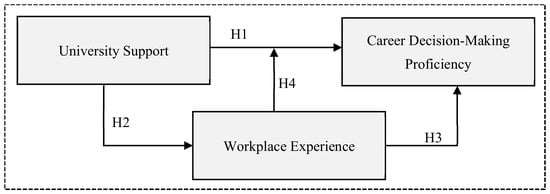
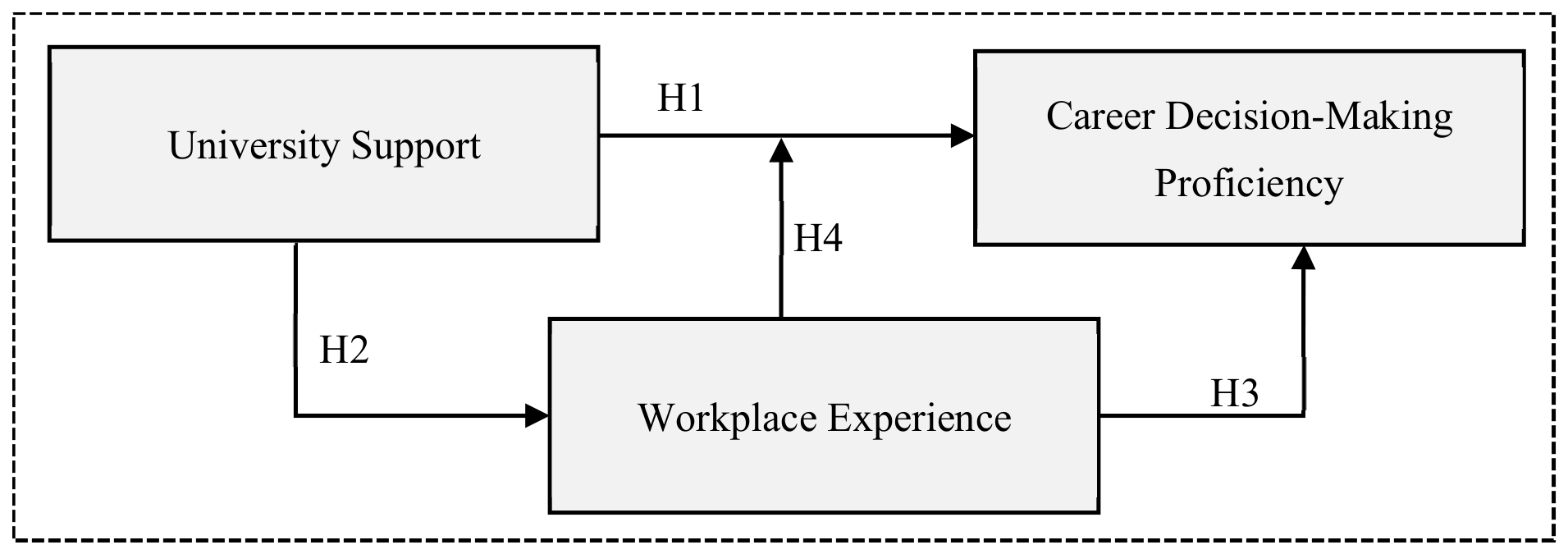
SCCT suggests that university support may influence students’ career development both directly and through their learning experiences. In this study, university support is viewed as a contextual factor, while workplace experience represents a learning experience. From an SCCT perspective, contextual support may shape career outcomes partly by influencing the learning experiences through which students develop career-related knowledge, confidence, and decision-making resources. Accordingly, university support is expected to contribute to CDMP not only directly, but also indirectly through workplace experience. This reasoning forms the basis for H4, which proposes that workplace experience mediates the relationship between university support and CDMP.
This study’s hypotheses are illustrated in Figure 1 and stated as follows.
Figure 1.
Conceptual framework.
H1.
University support is positively associated with career decision-making proficiency.
H2.
University support is positively associated with workplace experience.
H3.
Workplace experience is positively associated with career decision-making proficiency.
H4.
Workplace experience mediates the association between university support and career decision-making proficiency.
3. Method
3.1. Participants
The participants were 300 Myanmar undergraduate students enrolled at four universities in Myanmar (International Leadership University, Naypyitaw Technological University, Meiktila University of Economics, and Yadanabon University) and four universities in Thailand (Suranaree University of Technology, Khon Kaen University, Mahachulalongkornrajavidyalaya University, and Mahamakut Buddhist University). Of these, 151 (50.33%) were studying in Myanmar and 149 (49.67%) were studying in Thailand. The specific university attended by each participant was not recorded because this information could make some students easier to identify, especially at universities with only a small number of participants. For this reason, the number of participants from each university could not be reported. Instead, the sample was reported by country of study (Myanmar or Thailand). Country of study was also included as a covariate in the structural model to examine possible differences between the two study contexts. Participants were recruited using convenience sampling. Students who met the inclusion criteria and were available at the participating universities were invited to take part voluntarily. No random sampling procedure was used. Of the participants, 158 (52.67%) were female and 142 (47.33%) were male. They represented various disciplines, including health sciences (41.00%, n = 123), education (23.00%, n = 69), management (10.67%, n = 32), engineering (8.00%, n = 24), agriculture (6.33%, n = 19), information technology (5.67%, n = 17), social sciences (3.67%, n = 11), and physical sciences (1.67%, n = 5). Regarding academic year level, 68 (22.7%) were first-year, 64 (21.3%) were second-year, 70 (23.3%) were third-year, 81 (27.0%) were fourth-year, 3 (1.0%) were fifth-year, and 14 (4.67%) were sixth-year or above students. Most had less than two months of internship experience (70.00%, n = 210).
Participant characteristics, including gender, discipline, academic year level, and internship duration, are presented in Supplementary Table S1.
3.2. Data Collection
Data were collected from 15 May to 16 June 2025 using a self-report questionnaire distributed in paper-based and online (Google Form) formats. Due to logistical and time constraints, data collection in Myanmar was conducted exclusively through the online format, whereas both paper-based and online formats were used in Thailand. The inclusion criteria required participants to have at least one month of workplace experience. Permission letters were sent to the administrators and faculty members of the participating universities to request their cooperation with this study. Informed consent was obtained through a consent statement provided at the beginning of the questionnaire. Participants were required to read and agree to the statement before proceeding with the survey. Participation was anonymous and had no effect on students’ academic standing. Participants were free to withdraw at any time without consequence. In such cases, incomplete responses were excluded from the analysis.
3.3. Instrument
University Support: The University Support Questionnaire developed by Mahfud et al. [7] was used to assess students’ perceived university support. The scale consists of 12 items and is divided into 3 dimensions, namely perceived educational support (five items), perceived concept development support (four items), and perceived business development support (three items).
Workplace Experience: The Workplace Experience Questionnaire developed by Luk and Chan [8] was used to assess students’ workplace experience. This scale comprises 15 items with a four-dimensional structure, including (a) career goals (four items), (b) academic support (three items), (c) workplace support (three items), and (d) generic competencies (five items). In this study, workplace experience refers specifically to students’ experiences during a completed university-arranged internship and does not include part-time employment or other general work experience.
Career Decision-Making Proficiency: Students’ career decision-making proficiency was assessed using the Career Decision-Making Proficiency Scale developed by Khawaja et al. [6]. The scale consists of 30 items and comprises five domains, including (a) career autonomy (six items), (b) career maturity (five items), (c) career reiteration (three items), (d) career indecision (eleven items), and (e) career resoluteness (five items). The Career Indecision items retained their original wording but were reverse-scored prior to analysis (1 → 5, 2 → 4, 3 → 3, 4 → 2, and 5 → 1). Thus, higher reverse-scored values represent lower career indecision, consistent with the scoring direction of the other career decision-making proficiency dimensions.
All questionnaires were self-report measures and were rated on five-point Likert scales ranging from 1 (strongly disagree) to 5 (strongly agree) (Table 1). The original questionnaires were developed in English and were translated into Burmese using a back-translation technique by a bilingual Myanmar researcher. After the scales were translated back into English, the Burmese and English versions were compared to ensure that each item retained its original meaning. The accuracy and clarity of the Burmese translation were also reviewed and confirmed by two lecturers from a public university in Myanmar. The Burmese version of the scale was subsequently administered to 50 Myanmar undergraduate students to evaluate the appropriateness and face validity of each item before the main data collection. Full item wording for all dimensions is provided in Supplementary Table S2.
Table 1.
Constructs, subscales, and item content.
3.4. Data Analysis
Data were analyzed with SPSS 29.0 and Mplus 8.3. All items were rated on five-point Likert scales and were treated as continuous indicators in the CFA and SEM analyses, consistent with maximum likelihood (ML) estimation in Mplus. Descriptive statistics were used to summarize participant characteristics. To test the normality of the univariate distribution of the data, the skewness (SK) and kurtosis (KU) statistics were applied; multivariate normality was not separately tested. An absolute SK < 2 and KU < 7 were considered indicators of acceptable normality [36]. Pearson correlation coefficients (r) were employed to evaluate linear relationships between observed variables. Since the design is cross-sectional and all measures were self-reported, the path coefficients reported below describe the pattern of association among variables that is compatible with the hypothesized model, rather than establishing causal or temporal order among them.
Online questionnaires required responses to all items, and paper questionnaires were checked for completeness. No missing data were identified. Outliers were checked with standardized z-scores (±3.29 cutoff), and no cases exceeded this threshold. Since the dataset did not identify each student’s university, clustering at the university level could not be modeled. Country of study was therefore included as a covariate instead. Common method bias was assessed using Harman’s single-factor test. The first unrotated factor accounted for 41.9% of the total variance, which was below the 50% criterion. This suggests that no single factor dominated the responses, although common method bias cannot be completely ruled out [37].
Confirmatory factor analysis (CFA) was used to test the measurement model. Each of the three constructs (university support, workplace experience, and CDMP) was specified as a reflective second-order factor, with its first-order dimensions (three, four, and five dimensions, respectively) serving as indicators of the higher-order construct. Standardized second-order loadings were estimated to assess the relationships between the higher-order constructs and their first-order dimensions. Internal consistency reliability was evaluated using Cronbach’s alpha (α) and McDonald’s omega coefficients (ω). Values of 0.70 or higher were considered acceptable indicators of internal consistency reliability. Composite reliability (CR ≥ 0.70) and average variance extracted (AVE ≥ 0.50) were used to assess convergent validity [37]. Discriminant validity was assessed using the Fornell–Larcker criterion [38] and the heterotrait–monotrait ratio of correlations (HTMT) [39]. According to the Fornell–Larcker criterion, the square root of the AVE for each construct should exceed its correlations with the other constructs. HTMT values below 0.85 were considered evidence of adequate discriminant validity.
The indirect effect of university support on career decision-making proficiency through workplace experience was estimated in Mplus using the MODEL INDIRECT command, with statistical significance evaluated using the model-estimated indirect effect and its delta-method standard error. Bootstrapping was not used.
Model fit was evaluated using multiple indices, including χ2/df (<3), RMSEA (≤0.08), SRMR (≤0.08), CFI (≥0.90), and TLI (≥0.90). Structural paths were evaluated using standardized path coefficients (β), with significance set at p < 0.05. Coefficients of determination (R2) were reported to indicate the proportion of variance explained in the endogenous constructs. Given the subgroup sample sizes (Myanmar n = 151; Thailand n = 149) relative to the complexity of the higher-order model, comprising three second-order constructs, 12 first-order factors, and 57 observed indicators, country of study and academic year level were entered as covariates predicting university support, workplace experience, and CDMP, rather than tested through multi-group structural equation modeling (SEM).
Additionally, mean differences in university support, workplace experience, and CDMP were examined using independent-samples t tests and one-way ANOVA.
4. Results
4.1. Descriptive Statistics and Preliminary Analysis
As shown in Table 2, the mean scores (M) ranged from 3.06 to 3.57, with SD ranging from 0.68 to 0.98. The SK and KU values were within acceptable limits (|SK| < 2, |KU| < 7), indicating no substantial departure from univariate normality.
Table 2.
Descriptive statistics, internal consistency, and correlations among the subscales.
All constructs demonstrated good internal consistency, with Cronbach’s alpha coefficients (α) ranging from 0.87 to 0.96 and McDonald’s omega coefficients (ω) ranging from 0.87 to 0.96. The relatively high coefficients for some constructs (e.g., generic competencies, α = 0.96) may reflect strong intercorrelations among items measuring a narrowly defined construct. However, coefficients approaching or exceeding 0.95 may also suggest some similarity or redundancy among items and should therefore be interpreted with caution [37]. Nevertheless, all the constructs showed adequate convergent validity, as assessed by composite reliability (CR) and average variance extracted (AVE), and discriminant validity, as assessed by the Fornell–Larcker criterion and HTMT, providing additional evidence that the constructs remained empirically distinguishable. Most correlations (r) among the study variables were positive and statistically significant (p < 0.001), ranging from 0.206 to 0.855. The highest correlation was found between perceived concept development support and perceived business development support (r = 0.855), whereas the correlation between career indecision and career resoluteness was not statistically significant (r = 0.061).
4.2. Confirmatory Factor Analysis
The CFA results demonstrated acceptable fit for all the measurement models (see Table 3). For university support, the fit indices were: χ2(47) = 134.183, χ2/df = 2.855, CFI = 0.968, TLI = 0.956, RMSEA = 0.079, and SRMR = 0.033. For workplace experience: χ2(67) = 193.961, χ2/df = 2.895, CFI = 0.972, TLI = 0.957, RMSEA = 0.079, and SRMR = 0.032. For career decision-making proficiency: χ2(280) = 805.632, χ2/df = 2.877, CFI = 0.953, TLI = 0.928, RMSEA = 0.079, and SRMR = 0.071. All fit indices met the recommended thresholds (χ2/df < 3, CFI/TLI ≥ 0.90, RMSEA/SRMR ≤ 0.08), indicating that the hypothesized models were consistent with the observed data.
Table 3.
Fit indices for the three measurement models.
Composite reliability (CR) values ranged from 0.949 to 0.977, exceeding the recommended threshold of 0.70, and average variance extracted (AVE) values ranged from 0.610 to 0.669, exceeding the 0.50 criterion, supporting convergent validity [37].
Discriminant validity was established through two criteria. First, the square roots of the AVE (√AVE) for each construct (ranging from 0.781 to 0.818) were higher than the inter-construct correlations (ranging from 0.671 to 0.728) (Table 4), satisfying the Fornell–Larcker criterion [38]. Second, all HTMT values ranged from 0.69 to 0.73, below the conservative threshold of 0.85, supporting discriminant validity [39].
Table 4.
Latent construct correlations and discriminant validity based on the Fornell–Larcker criterion.
The Academic Support subscale (AS1–AS3) concerns departmental preparation for internships and support from the university academic supervisor. We acknowledge that this content may overlap with aspects of university support. AS1–AS3 were retained in the primary model to preserve the four-dimensional structure of the workplace experience measure described by Luk and Chan [8]. To examine whether the findings depended on this subscale, we conducted a robustness analysis excluding AS1–AS3. The main structural associations and the indirect association remained significant, as reported under “Robustness Analysis Excluding Academic Support” in Section 4.3.1.
Item-level standardized factor loadings, standard errors, and p-values for all indicators are reported in Supplementary Table S3.
4.3. Structural Equation Modeling
4.3.1. Primary SEM Without Covariates
The primary SEM without covariates showed a generally acceptable, though not uniformly satisfactory, model fit (χ2 = 2896.478, df = 1074, p < 0.001, χ2/df = 2.697, CFI = 0.924, RMSEA = 0.075, SRMR = 0.070), with the TLI (0.886) falling slightly below the recommended 0.90 threshold. Although most fit indices met the recommended criteria, the sub-threshold TLI indicates that the overall model fit should be interpreted with some caution [37,40]. The sample size (n = 300) exceeded the minimum of 200 commonly recommended for SEM [37]. However, given the complexity of the model and the large number of estimated parameters, the sample-to-parameter ratio was approximately 2:1, which was below the commonly recommended ratio of 5:1–10:1. Therefore, the parameter estimates should also be interpreted with appropriate caution.
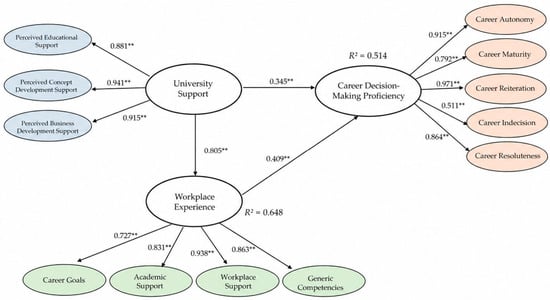
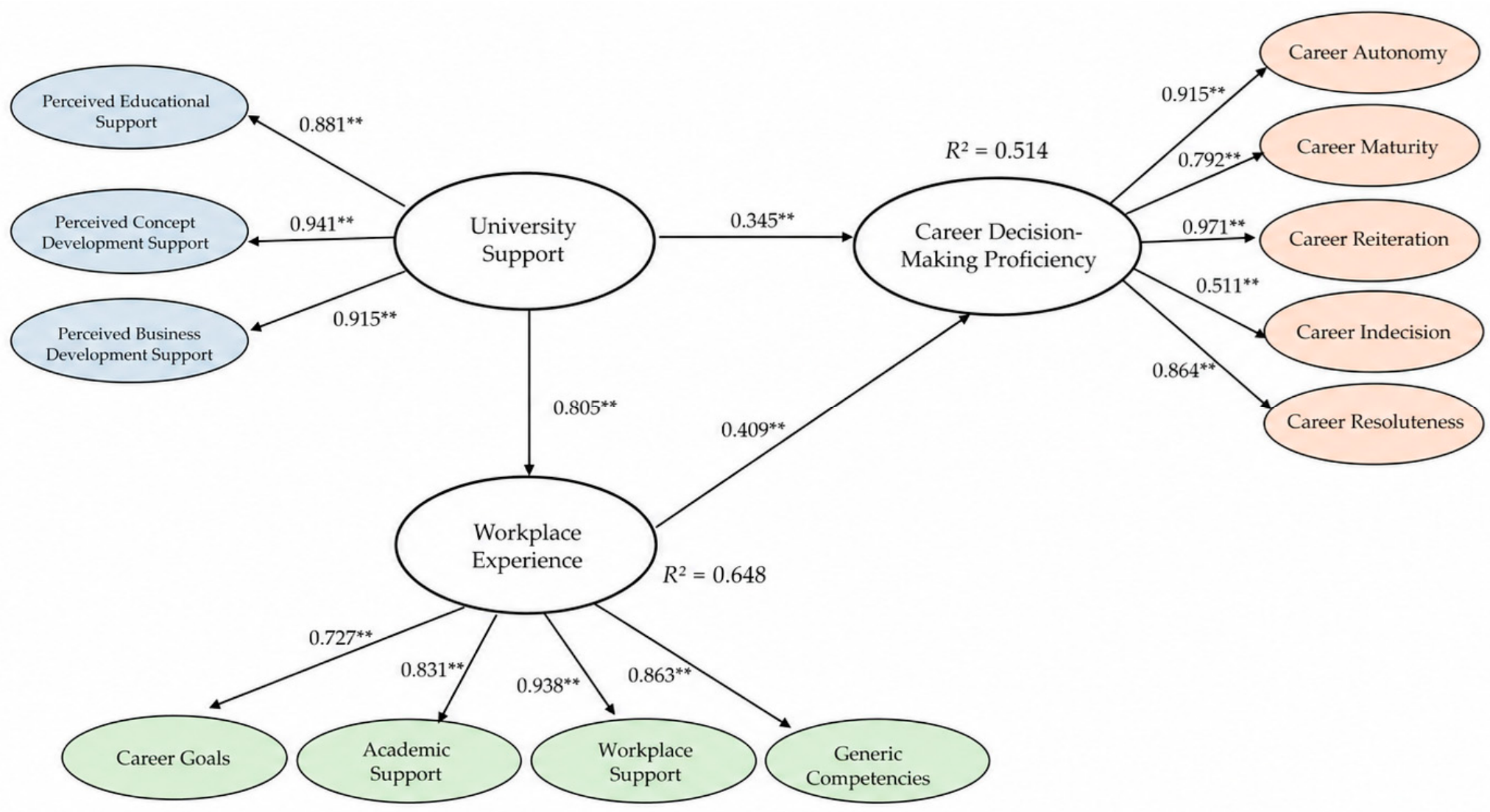
The model explained 64.8% of the variance in workplace experience (R2 = 0.648) and 51.4% of the variance in career decision-making proficiency (R2 = 0.514), indicating substantial explanatory power for both endogenous constructs. This means that university support and workplace experience together account for more than half of the variability in students’ career decision-making proficiency.
As shown in Table 5 and Figure 2, university support had a significant positive direct effect on career decision-making proficiency (β = 0.345, t = 4.839, p < 0.001), supporting H1. This means that students who felt more supported by their universities tended to be better able to make career-related decisions.
Table 5.
Structural paths and hypothesis testing: models with and without covariate adjustment.
Figure 2.
Primary SEM without covariates with standardized path coefficients. Note. The Figure emphasizes the main structural paths among the higher-order latent constructs and displays their first-order dimensions. Item-level indicators and their loadings are omitted for readability. Standardized second-order loadings are reported numerically in Table 6, while item-level measurement results are provided in Supplementary Table S3. Residual terms are omitted for clarity. ** p < 0.001.
University support also was significantly positively associated with workplace experience (β = 0.805, t = 31.076, p < 0.001), supporting H2. This means that students who received stronger support from their universities tended to report better workplace experiences.
Workplace experience was significantly positively associated with career decision-making proficiency (β = 0.409, t = 5.506, p < 0.001), supporting H3. This means that students who had more positive workplace experiences tended to make career decisions more effectively.
To examine the mediating role of workplace experience, the indirect effect of university support on CDMP through workplace experience was estimated in Mplus. The indirect effect was significant (β = 0.346, t = 5.523, p < 0.001), supporting H4. The total effect of university support on CDMP was 0.691, of which approximately 50.1% operated indirectly through workplace experience. The significant direct and indirect associations were consistent with partial statistical mediation within the specified model, although the cross-sectional design does not establish a causal mediation process.
Robustness Analysis Excluding Academic Support
We also re-estimated the model after removing the Academic Support subscale (AS1–AS3) from workplace experience. All three structural paths remained positive and significant: university support to workplace experience (β = 0.835), workplace experience to CDMP (β = 0.453), and university support to CDMP (β = 0.322), all p < 0.001. The indirect effect also remained significant (β = 0.378, p < 0.001, 95% CI [0.223, 0.534]). These results suggest that the indirect association did not depend on including academic support in the workplace experience measure.
4.3.2. SEM with Country and Year-Level Covariates
A second SEM was estimated with country of study and academic year level included as covariates. The adjusted model showed weaker fit than the primary SEM (χ2 = 4340.280, df = 1341, χ2/df = 3.24, p < 0.001, CFI = 0.876, TLI = 0.842, RMSEA = 0.086, SRMR = 0.079), so the results should be interpreted with some caution (Table 5).
After accounting for country and year level, all three main structural relationships remained significant: university support was positively related to CDMP (β = 0.297, p < 0.001) and workplace experience (β = 0.826, p < 0.001), while workplace experience was positively related to CDMP (β = 0.507, p < 0.001). The indirect effect of university support on CDMP through workplace experience also remained significant (β = 0.419, p < 0.001), accounting for approximately 58.5% of the total effect and indicating partial statistical mediation.
Country of study was significantly associated with university support (β = 0.140, p = 0.014), workplace experience (β = −0.209, p < 0.001), and CDMP (β = −0.136, p = 0.001). With Thailand coded as 0 and Myanmar as 1, students studying in Myanmar reported higher university support but lower workplace experience and CDMP. Academic year level was negatively associated with workplace experience (β = −0.145, p < 0.001), but not with university support or CDMP. Table 6 presents the standardized second-order factor loadings for the primary SEM without covariates.
Table 6.
Second-order measurement model for the primary SEM without covariates: standardized loadings of first-order dimensions on higher-order constructs.
4.4. Mean Differences by Gender, Country of Study, and Academic Year Level
Additional analyses were conducted to examine whether university support, workplace experience, and career decision-making proficiency (CDMP) differed across gender, country of study, and academic year level. As shown in Table 7, gender differences were found for workplace experience and CDMP. Male students reported higher workplace experience (M = 3.394, SD = 0.679) than female students (M = 3.228, SD = 0.557), t(273.41) = 2.31, p = 0.022, and higher CDMP (M = 3.385, SD = 0.621) than female students (M = 3.187, SD = 0.558), t(285.01) = 2.90, p = 0.004. The gender difference in university support was not statistically significant, p = 0.055.
Table 7.
Mean differences in university support, workplace experience, and CDMP by gender, country of study, and academic year level.
For country of study, students studying in Thailand reported slightly higher workplace experience (M = 3.379, SD = 0.656) than those studying in Myanmar (M = 3.235, SD = 0.581), t(292.67) = −2.01, p = 0.046. No significant country differences were found for university support or CDMP.
Academic year level was significantly associated with workplace experience, F(3, 296) = 9.77, p < 0.001, but not with university support, F(3, 296) = 1.64, p = 0.181, or CDMP, F(3, 296) = 1.51, p = 0.212. Post hoc comparisons showed that first-year and second-year students reported significantly higher workplace experience than students in the fourth year or above. These analyses are unadjusted group comparisons and are intended to complement the covariate-adjusted SEM results reported in Section 4.3.
5. Discussion
5.1. University Support and Career Decision-Making Proficiency (H1)
The results indicated that university support was significantly positively related to career decision-making proficiency, thus supporting H1. This finding is in line with the results of Yao et al. [41]. The researchers pointed out that career guidance and mentoring are among the important institutional support services that help students explore career options and make informed career decisions. Similarly, Alnajjar and Abou Hashish [42] found that career guidance and counseling programs helped students understand career opportunities, prepare for employment, and feel more ready to enter the job market. Okolie and Nwajiuba [43] have also demonstrated that career development activities in universities enhance students’ work readiness and self-confidence in career planning. Similarly, Sheu et al. [44] found that students felt better able to evaluate career options and make career choices when they were in positive learning environments.
From the perspective of SCCT, university support can be viewed as a form of contextual support that shapes students’ confidence, expectations, and career goals [18,45]. Universities can provide this support through academic advising, career counseling, mentoring, workplace preparation, and opportunities to explore different career paths [41,46]. When these resources are available, students may be better able to understand their interests and strengths, compare career options, and set clearer career goals [47,48]. In contrast, students who receive limited support may find it more difficult to access the information and guidance they need.
5.2. University Support and Workplace Experience (H2)
University support was significantly positively related to workplace experience, supporting H2. This finding suggests that students who receive stronger support from their universities are more likely to have better workplace learning experiences. It is consistent with Khan et al. [49], who found that internships and industry engagement activities help students gain direct contact with real workplace settings. Similarly, Ivanova and Alhrhasheh [50] reported that exposure to the workplace helps students connect classroom learning with practice, understand workplace expectations, and develop skills that improve their employability. Faculty supervision and institutional support can help students learn more effectively during work placements and strengthen their confidence and perceived employability [51]. Well-designed internships also allow students to apply academic knowledge, develop professional skills, and better understand workplace expectations [12]. This finding is also consistent with Sa-Nguanmanasak and Khampirat [52], who highlighted the important role of work-integrated learning in preparing students for professional careers. However, university support may not be the only reason for this. Wright and Mulvey [53] found that some students use family connections, not university support, to secure better internships. This suggests that access to workplace experience can also depend on personal resources outside the university.
5.3. Workplace Experience and Career Decision-Making Proficiency (H3)
Workplace experience was significantly positively related to career decision-making proficiency, supporting H3. This finding is consistent with Mathew et al. [54], who highlighted the importance of workplace exposure in helping students make career choices. Studies also found that students with greater work experience tended to show a more advanced career decision-making status [47,55]. Work placements can support career development by helping students understand occupations, test their career interests, and gain clearer views of their future career paths [56]. Pham et al. [48] found that combining work experience with career development learning can strengthen students’ confidence in making career decisions. Together, these findings suggest that workplace experience gives students practical information and personal insight that can help them make more informed career choices. In contrast, earlier findings from Zuo et al. [57] showed that internships related to a student’s major improved career outcomes, while unrelated internships did not always help and could even have a negative effect. This study did not separate workplace experience by its relevance to students’ majors, which is a direction for future research.
5.4. Mediating Role of Workplace Experience (H4)
The significant indirect association was consistent with partial statistical mediation between university support and career decision-making proficiency through workplace experience (β = 0.346, p < 0.001). This suggests that university support may strengthen students’ career decision-making not only through direct guidance and resources but also by helping them access and benefit from meaningful workplace learning opportunities. This pathway is consistent with SCCT, which proposes that contextual support can shape career outcomes through learning experiences [18]. Contrary to what has been reported by Dioquino et al. [58], who found that internship experience did not mediate the link between self-efficacy and career aspirations in another student sample, this study found a significant mediating role for workplace experience. This suggests that the mediating role of workplace experience may not generalize across all student populations.
The indirect relationship remained significant when country of study and academic year level were included as covariates, suggesting that it was not explained solely by these background factors.
Relatively strong relationships have also been reported in career-development research. Among Vietnamese university students, Pham et al. [48] reported correlations of up to 0.688, path coefficients above 0.60, and an R2 of 0.510 for career choice. A meta-analysis by Kleine et al. [47] also found a relatively strong association between career-related self-efficacy and career exploration (r = 0.52). Although these studies examined related rather than identical constructs, they suggest that moderate to strong associations can occur among closely connected career-development variables. In the present study, university support and workplace experience may be particularly closely related because workplace experience refers to university-arranged internships. Nevertheless, the magnitude of the associations should be interpreted cautiously because all measures were self-reported and collected at the same time.
5.5. Differences by Gender, Country of Study, and Academic Year Level
Male students reported higher workplace experience and CDMP than female students, whereas perceived university support did not differ significantly by gender. This suggests that gender differences in this sample were more evident in workplace learning and career development than in perceived institutional support. Similar studies have shown that gender can be related to students’ perceived employability and career readiness, although the pattern of these differences may vary across fields and contexts [59,60]. From an SCCT perspective, such differences may reflect the interaction of personal characteristics, learning experiences, and contextual supports or barriers [18,61]. However, these gender differences should be interpreted cautiously because they were based on unadjusted mean comparisons.
Country of study was also related to students’ experiences. In the unadjusted comparisons, students studying in Thailand reported slightly higher workplace experience than those studying in Myanmar, while university support and CDMP did not differ significantly. In the covariate-adjusted SEM, however, country of study was associated with all three constructs. This pattern is consistent with research showing that educational and cultural contexts can influence career decision self-efficacy, adaptability, and employability [62]. It also fits the SCCT view that career development is shaped by contextual conditions as well as individual resources. Nevertheless, these findings should not be interpreted as evidence that one national context is better than the other. Although mean-level differences were examined, this study did not use multi-group SEM to test whether the structural relationships differed between the two educational contexts.
Academic year level was mainly related to workplace experience. Second-year students reported the highest workplace experience, whereas students in the fourth year or above reported the lowest. First- and second-year students also reported significantly higher workplace experience than students in the fourth year or above. The covariate-adjusted SEM showed a similar negative association between year level and workplace experience. This pattern may reflect differences in the timing, type, or quality of workplace exposure across stages of study rather than a decline in the value of workplace learning. Previous studies similarly suggest that the quality and nature of field or internship experiences may matter more than exposure alone [63,64].
These findings suggest that workplace experience is particularly sensitive to students’ social and educational context. Since the subgroup analyses were supplementary and cross-sectional, they should be interpreted as contextual rather than causal evidence.
5.6. Implications
5.6.1. Theoretical Implications
This study contributes to the career development literature by examining university support, workplace experience, and CDMP within a single model. University support was associated with this outcome both directly and indirectly through workplace experience. These findings are broadly consistent with SCCT’s proposed sequence from contextual support to learning experiences to career outcomes, since workplace experience carried part of the relationship between university support and CDMP. This simplified pathway did not measure the self-efficacy and outcome-expectation mechanisms within the full sequence. Testing a broader outcome than the self-efficacy and career-choice variables usually studied extends the range of applications for SCCT, though a broader outcome variable alone does not constitute a substantial theoretical extension. Among CDMP’s five dimensions, career indecision showed a comparatively lower standardized loading (λ = 0.511, R2 = 0.261), indicating that it was less strongly represented by the higher-order CDMP construct than the other dimensions. One possible explanation is the use of negatively worded, reverse-scored items, which may introduce method-related response effects. The lower loading may also indicate that career indecision captures a somewhat distinct aspect of career decision-making proficiency. Accordingly, this dimension should be interpreted with caution, and future research should examine whether career indecision functions as a distinct facet or shows method effects associated with reverse-worded items.
Country of study was examined both as a covariate in the structural model and through mean comparisons between students studying in Myanmar and Thailand. The mean comparisons indicated a significant difference in workplace experience, but not in university support or CDMP. The main structural relationships also remained significant after adjustment for country of study. However, because multi-group SEM was not conducted, this study does not establish whether the structural relationships themselves differ between the two educational contexts.
5.6.2. Practical and Curriculum Implications
The findings offer useful implications for higher education practice and curriculum design. Career development learning should be embedded throughout the curriculum rather than provided only in the final year. This may include early career planning, pre-placement preparation, structured reflection during internships, and post-placement guidance to help students connect workplace learning with career decision-making [65,66].
Universities should also expand structured work-integrated learning opportunities, such as internships and industry projects. These experiences should include clear learning goals, academic and workplace support, regular feedback, and opportunities for competency development. Well-designed workplace learning can strengthen students’ work readiness, professional skills, and career clarity [12,67].
5.7. Limitations and Future Research
This study has four limitations. First, the sample was limited to Myanmar undergraduates, which may restrict the generalizability of the findings to other populations. Future research should extend the scope to include students from other ASEAN countries or broader regional contexts. Moreover, the reliance on convenience sampling may limit the representativeness of the sample, as participants were recruited from only eight universities. Future studies should employ probability sampling strategies to enhance generalizability. Second, the use of self-reported questionnaires may introduce response bias and may not fully capture the complexity of career decision-making processes. Future studies could incorporate qualitative methods, such as interviews or focus groups, to gain deeper insights into students’ cognitive and affective experiences. Third, this study relied solely on student perspectives and did not include input from mentors, supervisors, or faculty members. Incorporating multiple stakeholder perspectives in future research would provide a more comprehensive understanding of the career development process. Fourth, the cross-sectional design limits the ability to examine causal relationships. Future research could employ a longitudinal design to examine how the relationships among university support, workplace experience, and CDMP evolve over time.
6. Conclusions
This study found that university support was positively related to both workplace experience and career decision-making proficiency among Myanmar undergraduates studying in Myanmar and Thailand. Workplace experience was also positively related to career decision-making proficiency. University support and workplace experience jointly explained 51.4% of the variance in career decision-making proficiency. University support was also indirectly related to career decision-making proficiency through workplace experience. These relationships remained significant when country of study and academic year level were included in the model. The results suggest that career support from universities and meaningful workplace learning are both important for students’ career development. For Myanmar students studying either at home or in Thailand, closer links between university support and workplace learning may help them prepare for career decisions. As this was a cross-sectional study, the results show associations rather than causal relationships. Future studies could examine these relationships over time and in other educational settings.
Supplementary Materials
The following supporting information can be downloaded at: https://www.mdpi.com/article/10.3390/soc16110377/s1, Table S1: Participant characteristics of the study sample (N = 300); Table S2: Full item wording for all dimensions; Table S3: Item-level standardized factor loadings, standard errors (SE), and p-values for all indicators.
Author Contributions
Conceptualization, P.S.O. and B.K.; methodology, P.S.O. and B.K.; software, B.K.; validation, P.S.O., D.C. and B.K.; formal analysis, P.S.O., P.B. and B.K.; investigation, P.S.O. and P.B.; resources, P.S.O. and B.K.; data curation, P.S.O. and B.K.; writing—original draft preparation, P.S.O. and B.K.; writing—review and editing, B.K.; visualization, P.S.O., D.C. and B.K.; supervision, B.K.; project administration, P.S.O. and B.K.; funding acquisition, B.K. All authors have read and agreed to the published version of the manuscript.
Funding
This research was funded by (i) Suranaree University of Technology (SUT), (ii) Thailand Science Research and Innovation (TSRI), and (iii) National Science, Research and Innovation Fund (NSRF) grant number NRIIS215632 and 204202; and by National Research Council of Thailand (NRCT) and Suranaree University of Technology (SUT) grant number N42A660436.
Institutional Review Board Statement
Ethical approval for this study was obtained from the Ethics Committee of Suranaree University of Technology, Thailand under Application No. EC-68-45 (6 May 2025; COE no. 44/2568). This study was performed according to the ethical standards of the Declaration of Helsinki for involving human subjects. All participants provided informed consent before taking part in this study. They were informed about the purpose of the study, the use of the collected data, their right to withdraw at any time, and the measures taken to protect their anonymity and confidentiality.
Informed Consent Statement
Informed consent was obtained from all subjects involved in the study.
Data Availability Statement
The datasets used and analyzed in this study are available from the corresponding author upon reasonable request.
Conflicts of Interest
The authors declare no conflicts of interest.
References
- Paul, A.P.; Soh, C.K. Discernment-driven career decision-making model for tertiary students: A concept paper. Ind. High. Educ. 2026, 40, 621–634. [Google Scholar] [CrossRef] [Scilit]
- Markman, A.O.; Du, X. Career orientation of first-year students in STEM education: A Q methodology study. Int. J. Educ. Vocat. Guid. 2025, 25, 1173–1198. [Google Scholar] [CrossRef] [Scilit]
- Juma, A.A. Bridging skills gaps: Evaluating VET reskilling and curriculum reforms for enhancing graduate employability in Tanzania. Int. J. Train. Res. 2025, 1–14. [Google Scholar] [CrossRef] [Scilit]
- Khampirat, B. The relationship between paternal education, self-esteem, resilience, future orientation, and career aspirations. PLoS ONE 2020, 15, e0243283. [Google Scholar] [CrossRef] [Scilit] [PubMed]
- McKenzie, S.; Bennett, D. Understanding the career interests of Information Technology (IT) students: A focus on choice of major and career aspirations. Educ. Inf. Technol. 2022, 27, 12839–12853. [Google Scholar] [CrossRef] [Scilit]
- Khawaja, S.; Javed, R.; Qureshi, F.H. Development and validation of career decision making proficiency scale. J. Asian Sci. Res. 2024, 14, 317–330. [Google Scholar] [CrossRef] [Scilit]
- Mahfud, T.; Masek, A.; Suyitno, S.; Ihsani, A.N.N.; Fransisca, Y.; Pranoto, P.W.; Pranoto, A.; Hadi, S.; Susanto, A. The role of work-based learning in enhancing career adaptability: An empirical study from vocational students in Indonesian and Malaysian universities. Интеграция Образoвания 2024, 28, 436–453. [Google Scholar] [CrossRef] [Scilit]
- Luk, L.Y.Y.; Chan, C.K.Y. Adaptation and validation of the work experience questionnaire for investigating engineering students’ internship experience. J. Eng. Educ. 2020, 109, 801–820. [Google Scholar] [CrossRef] [Scilit]
- Zhang, Z.; Yu, X.; Liu, X. Do I decide my career? Linking career stress, career exploration, and future work self to career planning or indecision. Front. Psychol. 2022, 13, 997984. [Google Scholar] [CrossRef] [Scilit] [PubMed]
- Ferns, S.J.; Zegwaard, K.E.; Pretti, T.J.; Rowe, A.D. Defining and designing work-integrated learning curriculum. High. Educ. Res. Dev. 2025, 44, 371–385, Correction in High. Educ. Res. Dev. 2025, 44, II. https://doi.org/10.1080/07294360.2024.2444748. [Google Scholar] [CrossRef] [Scilit]
- Wibowo, A.H.; Mohamad, B.; Djatmika; Santosa, R. Designing and assessing experiential learning pedagogy for an intercultural communicative competence training module: A quasi-experimental study. Front. Educ. 2024, 9, 1470209. [Google Scholar] [CrossRef] [Scilit]
- Wang, F. The impact of internship experience on professional identity, motivation, and attitude among aviation service majors: A cross-sectional empirical study. Front. Psychol. 2025, 16, 1661068. [Google Scholar] [CrossRef] [Scilit] [PubMed]
- Khampirat, B. Psychometric characteristics of the career adapt-abilities scale in Thai undergraduate students: A multiple indicators multiple causes model. Front. Psychol. 2024, 15, 1338401. [Google Scholar] [CrossRef] [Scilit] [PubMed]
- Hastindra Na Ayudhaya, N.; Oo, P.S.; Em, S.; Iipinge, S.M.; Bamrungsin, P.; Chonsalasin, D.; Kunchai, J.; Rudzinska, I.; Khampirat, B. Developing and validating the WIL-EngDev scale: A measurement tool for assessing English language development in work-integrated learning contexts. Lang. Test. Asia 2026, 16, 18. [Google Scholar] [CrossRef] [Scilit]
- Khampirat, B.; Pusaboon, K.; Bamrungsin, P.; Chonsalasin, D. Development and validation of a questionnaire to measure social competencies for undergraduate students. J. Educ. Cult. Soc. 2025, 16, 535–553. [Google Scholar] [CrossRef] [Scilit]
- Lum, L.H.; Ing, M.J.S.; Menon, R. Career decision self-efficacy enhancement training for Myanmar emerging adults: A mixed method evaluation. Int. J. Educ. Manag. Stud. 2025, 15, 195–203. [Google Scholar]
- Heay, N.S.H.; Foster, H.; Hamra, W. Overcoming employment barriers: Strategies for enhancing the socio-economic integration of professional workers from Myanmar in Thailand. J. Adm. Sci. 2026, 23, 195–219. [Google Scholar] [CrossRef] [Scilit]
- Lent, R.W.; Brown, S.D.; Hackett, G. Toward a unifying social cognitive theory of career and academic interest, choice, and performance. J. Vocat. Behav. 1994, 45, 79–122. [Google Scholar] [CrossRef] [Scilit]
- Bandura, A. Social Foundations of Thought and Action: A Social Cognitive Theory; Prentice-Hall: Hoboken, NJ, USA, 1986. [Google Scholar]
- Wang, D.; Liu, X.; Deng, H. The perspectives of social cognitive career theory approach in current times. Front. Psychol. 2022, 13, 1023994. [Google Scholar] [CrossRef] [Scilit] [PubMed]
- Phyo, L.W. Understanding equity and access in the expansion of higher education in Myanmar. Camb. Educ. Res. e-J. 2024, 11, 310–331. [Google Scholar] [CrossRef]
- Kyu, N.; Ivan, N.W. The influence of parental pressure and perceived control on career exploration of young adults in Yangon. Myanmar Acad. Arts Sci. 2021, XIX, 219–233. [Google Scholar]
- United Nations Development Programme. Myanmar’s Youth “on Hold” as Education and Employment Crisis Deepens, Warns UNDP. 2025. Available online: https://www.undp.org/asia-pacific/press-releases/myanmars-youth-on-hold-education-and-employment-crisis-deepens-warns-undp (accessed on 19 June 2026).
- World Bank. Myanmar Economic Monitor: Coping with COVID-19. 2020. Available online: https://hdl.handle.net/10986/34936 (accessed on 19 June 2026).
- Roy, S.; Demarchi, G. A Growing Crisis: Work, Workers, and Wellbeing in Myanmar; World Bank: Washington, DC, USA, 2023. [Google Scholar]
- Keshf, Z.; Khanum, S. Career guidance and counseling needs in a developing country’s context: A qualitative study. SAGE Open 2021, 11, 21582440211040119. [Google Scholar] [CrossRef] [Scilit]
- Nabi, G.; Walmsley, A.; Mir, M.; Osman, S. The impact of mentoring in higher education on student career development: A systematic review and research agenda. Stud. High. Educ. 2025, 50, 739–755. [Google Scholar] [CrossRef] [Scilit]
- Picton, C.; Kahu, E.R. ‘I knew I had the support from them’: Understanding student support through a student engagement lens. High. Educ. Res. Dev. 2022, 41, 2034–2047. [Google Scholar] [CrossRef] [Scilit]
- Ali Adib, S.; Younes, H.M. From classroom to cleanroom: Evaluating industrial field visits as a pedagogical tool in parenteral pharmaceutical manufacturing and quality control education. Pharmacy 2026, 14, 62. [Google Scholar] [CrossRef] [Scilit] [PubMed]
- Soares, J.; Carvalho, C.; Silva, A.D. A systematic review on career interventions for university students: Framework, effectiveness, and outcomes. Aust. J. Career Dev. 2022, 31, 81–92. [Google Scholar] [CrossRef] [Scilit]
- Jemini Gashi, L.; Bërxulli, D.; Konjufca, J.; Cakolli, L. Effectiveness of career guidance workshops on the career self-efficacy, outcome expectations, and career goals of adolescents: An intervention study. Int. J. Adolesc. Youth 2023, 28, 2281421. [Google Scholar] [CrossRef] [Scilit]
- Barton, G.; Hartwig, K.; Le, A.H. International students’ perceptions of workplace experiences in Australian study programs: A large-scale survey. J. Stud. Int. Educ. 2019, 23, 248–264. [Google Scholar] [CrossRef] [Scilit]
- Jackson, D.; Lambert, C.; Sibson, R.; Bridgstock, R.; Tofa, M. Student employability-building activities: Participation and contribution to graduate outcomes. High. Educ. Res. Dev. 2024, 43, 1308–1324. [Google Scholar] [CrossRef] [Scilit]
- Alharethi, T.; Awan, M.I.; Saleem, M.S. Investigating the impact of internship experience on work readiness among hospitality program students: The moderating role of student mindfulness. Front. Educ. 2025, 10, 1497721. [Google Scholar] [CrossRef] [Scilit]
- Visser, S.; Grosemans, I. Understanding internship experiences from students’ perspectives: A systematic review. Educ. Train. 2026, 68, 824–845. [Google Scholar] [CrossRef] [Scilit]
- West, S.G.; Finch, J.F.; Curran, P.J. Structural equation models with nonnormal variables: Problems and remedies. In Structural Equation Modeling: Concepts, Issues, and Applications; Hoyle, R.H., Ed.; Sage: Thousand Oaks, CA, USA, 1995; pp. 56–75. [Google Scholar]
- Hair, J.F.; Black, W.C.; Babin, B.J.; Anderson, R.E. (Eds.) Multivariate Data Analysis, 8th ed.; Cengage Learning: Delhi, India, 2019. [Google Scholar]
- Fornell, C.; Larcker, D.F. Evaluating structural equation models with unobservable variables and measurement error. J. Mark. Res. 1981, 18, 39–50. [Google Scholar] [CrossRef] [Scilit]
- Henseler, J.; Ringle, C.M.; Sarstedt, M. A new criterion for assessing discriminant validity in variance-based structural equation modeling. J. Acad. Mark. Sci. 2015, 43, 115–135. [Google Scholar] [CrossRef] [Scilit]
- Marsh, H.W.; Hau, K.-T.; Wen, Z. In search of golden rules: Comment on hypothesis-testing approaches to setting cutoff values for fit indexes and dangers in overgeneralizing Hu and Bentler’s (1999) findings. Struct. Equ. Model. A Multidiscip. J. 2004, 11, 320–341. [Google Scholar] [CrossRef] [Scilit] [PubMed]
- Yao, X.; Tuntinakhongul, A.; Sumettikoon, P. Enhancing undergraduate employability and career adaptability through career planning education: The mediating role of career decision-making self-efficacy. Eurasian J. Educ. Res. 2024, 2024, 251–263. [Google Scholar] [CrossRef]
- Alnajjar, H.A.; Abou Hashish, E.A. Exploring the effectiveness of the Career Guidance and Counseling Program on the perceived readiness for the job market: A lived experience among nursing students. Front. Public Health 2024, 12, 1403730. [Google Scholar] [CrossRef] [Scilit] [PubMed]
- Okolie, U.C.; Nwajiuba, C.A. Career training with mentoring programs in higher education. Educ. Train. 2020, 62, 214–234. [Google Scholar] [CrossRef] [Scilit]
- Sheu, L.; Goglin, S.; Collins, S.; Cornett, P.; Clemons, S.; O’Sullivan, P.S. How do clinical electives during the clerkship year influence career exploration? A qualitative study. Teach. Learn. Med. 2022, 34, 187–197. [Google Scholar] [CrossRef] [Scilit] [PubMed]
- Lent, R.W.; Brown, S.D. Career decision making, fast and slow: Toward an integrative model of intervention for sustainable career choice. J. Vocat. Behav. 2020, 120, 103448. [Google Scholar] [CrossRef] [Scilit]
- David, S.A.; Mohebi, L. Implications of career guidance on career choices and professional development: Stakeholders’ perspectives from selected higher educational institutions in the UAE. Soc. Sci. Humanit. Open 2026, 13, 102594. [Google Scholar] [CrossRef] [Scilit]
- Kleine, A.-K.; Schmitt, A.; Wisse, B. Students’ career exploration: A meta-analysis. J. Vocat. Behav. 2021, 131, 103645. [Google Scholar] [CrossRef] [Scilit]
- Pham, M.; Lam, B.Q.; Tuan Ngoc Bui, A. Career exploration and its influence on the relationship between self-efficacy and career choice: The moderating role of social support. Heliyon 2024, 10, e31808. [Google Scholar] [CrossRef] [Scilit] [PubMed]
- Khan, I.M.; Edwards, E.; Ianicelli, B.M.; Ahmed, W.; Hardey, M.; Eremionkhale, G. University-industry collaboration for academic success and employability: A connectivist perspective. Stud. High. Educ. 2026, 51, 1843–1863. [Google Scholar] [CrossRef] [Scilit]
- Ivanova, G.; Alhrhasheh, R. Emotional intelligence and problem-solving correlations and impact on employability: A case study from the UAE. J. Cult. Values Educ. 2026, 9, 249–268. [Google Scholar] [CrossRef] [Scilit]
- Russ, E.; Lapkin, S.; Jonathan, K.; Toohey, K.; Wilson, D.; Shinners, L.; Buchan, J. A shared journey: Uncovering support needs and challenges of health student placement supervisors to improve placement experiences. High. Educ. Res. Dev. 2026, 1–16. [Google Scholar] [CrossRef] [Scilit]
- Sa-Nguanmanasak, T.; Khampirat, B. Comparing employability skills of technical and vocational education students of Thailand and Malaysia: A case study of international industrial work-integrated learning. J. Tech. Educ. Train. 2019, 11, 94–109. [Google Scholar] [CrossRef] [Scilit]
- Wright, E.; Mulvey, B. Internships and the graduate labour market: How upper-middle-class students ‘get ahead’. Br. J. Sociol. Educ. 2021, 42, 339–356. [Google Scholar] [CrossRef] [Scilit]
- Mathew, B.; Toscano, N.; Bird, M.; McDonald, S. Exploring the factors that influence nursing students’ choice of first job in the locality of their preregistration education programme. Nurs. Manag. 2025, 32, 12–18. [Google Scholar] [CrossRef] [Scilit] [PubMed]
- Tuononen, T.; Räisänen, M.; Hyytinen, H. Students’ work experience in relation to their career engagement and metacognitive awareness. High. Educ. Res. Dev. 2024, 43, 1399–1415. [Google Scholar] [CrossRef] [Scilit]
- Inceoglu, I.; Selenko, E.; McDowall, A.; Schlachter, S. (How) Do work placements work? Scrutinizing the quantitative evidence for a theory-driven future research agenda. J. Vocat. Behav. 2019, 110, 317–337. [Google Scholar] [CrossRef] [Scilit]
- Zuo, Y.; Weng, Q.; Xie, X. Are all internships equally beneficial? Toward a contingency model of internship efficacy. J. Career Dev. 2020, 47, 627–641. [Google Scholar] [CrossRef] [Scilit]
- Dioquino, J.; Manaig, A.B.; de Veyra, E.E.M.; Obida, S.; Manaois, J. Exploring the mediating role of internship experience to the self-efficacy and career aspirations of undergraduate students. J. Interdiscip. Perspect. 2024, 2, 287–292. [Google Scholar] [CrossRef] [Scilit]
- Ananthram, S.; Bawa, S.; Bennett, D.; Gill, C. Perceived employability and career readiness among STEM students: Does gender matter? High. Educ. Res. Dev. 2024, 43, 267–283. [Google Scholar] [CrossRef] [Scilit]
- Bennett, D.; Ananthram, S.; Lindsay, S.; Benati, K.; Jevons, C. Employability beliefs of business students by gender and year of study: Implications for higher education. Int. J. Manag. Educ. 2022, 20, 100654. [Google Scholar] [CrossRef] [Scilit]
- Özdemir, N.K.; Buyukcolpan, H. Testing a social cognitive model of career self-management with Turkish undergraduate students. Career Dev. Q. 2024, 72, 203–214. [Google Scholar] [CrossRef] [Scilit]
- Chai, D.S.; Park, S. Personal factors and career decision self-efficacy of postsecondary international students: The moderating role of cultural adjustment. Career Dev. Q. 2025, 73, 162–171. [Google Scholar] [CrossRef] [Scilit]
- Kim, S.J.; Moon, C. An analysis of the effects of field experiences on career decision-making and job-seeking activities of university student. J. Econ. Financ. Educ. 2024, 33, 111–133. [Google Scholar] [CrossRef] [Scilit]
- Wu, C.C.; Chen, H.F. Internship satisfaction among university students in Hong Kong during the COVID-19 pandemic: Does career decision self-efficacy mediate the relationship between internship satisfaction and career optimism? Asia Pac. Career Dev. J. 2024, 7, 34–51. [Google Scholar] [CrossRef] [Scilit]
- Khampirat, B.; McRae, N. Developing global standards framework and quality integrated models for cooperative and work-integrated education programs. Asia-Pac. J. Coop. Educ. 2016, 17, 349–362. [Google Scholar]
- Mitschelen, A.; Kauffeld, S. Workplace learning during organizational onboarding: Integrating formal, informal, and self-regulated workplace learning. Front. Organ. Psychol. 2025, 3, 1569098. [Google Scholar] [CrossRef] [Scilit]
- Dean, B.A. The employability agenda: Embedding work-integrated and career development learning in every degree. Change Mag. High. Learn. 2025, 57, 14–21. [Google Scholar] [CrossRef] [Scilit]

Disclaimer/Publisher’s Note: The statements, opinions and data contained in all publications are solely those of the individual author(s) and contributor(s) and not of MDPI and/or the editor(s). MDPI and/or the editor(s) disclaim responsibility for any injury to people or property resulting from any ideas, methods, instructions or products referred to in the content. |
© 2026 by the authors. Licensee MDPI, Basel, Switzerland. This article is an open access article distributed under the terms and conditions of the Creative Commons Attribution (CC BY) license.