Article

Data-Driven Multidimensional Performance Profiling in U10 Tennis Players

1
School of Doctoral Studies, Hungarian University of Sports Science, 1123 Budapest, Hungary
2
Department of Sport Games, Hungarian University of Sports Science, 1123 Budapest, Hungary
3
Eötvös Loránd University Faculty of Education and Psychology, Institute of Health Development and Sport Sciences, 1075 Budapest, Hungary
4
Department of Psychology and Sports Psychology, Hungarian University of Sports Science, 1123 Budapest, Hungary
5
Teacher Training Institute, Hungarian University of Sports Science, 1123 Budapest, Hungary
6
Institute of Health Promotion and Sport Sciences, Faculty of Education and Psychology, Eötvös Loránd University, 1053 Budapest, Hungary
*
Author to whom correspondence should be addressed.
Sports 2026, 14(9), 382; https://doi.org/10.3390/sports14090382

Submission received: 6 July 2026 / Revised: 21 August 2026 / Accepted: 24 August 2026 / Published: 1 September 2026

Abstract

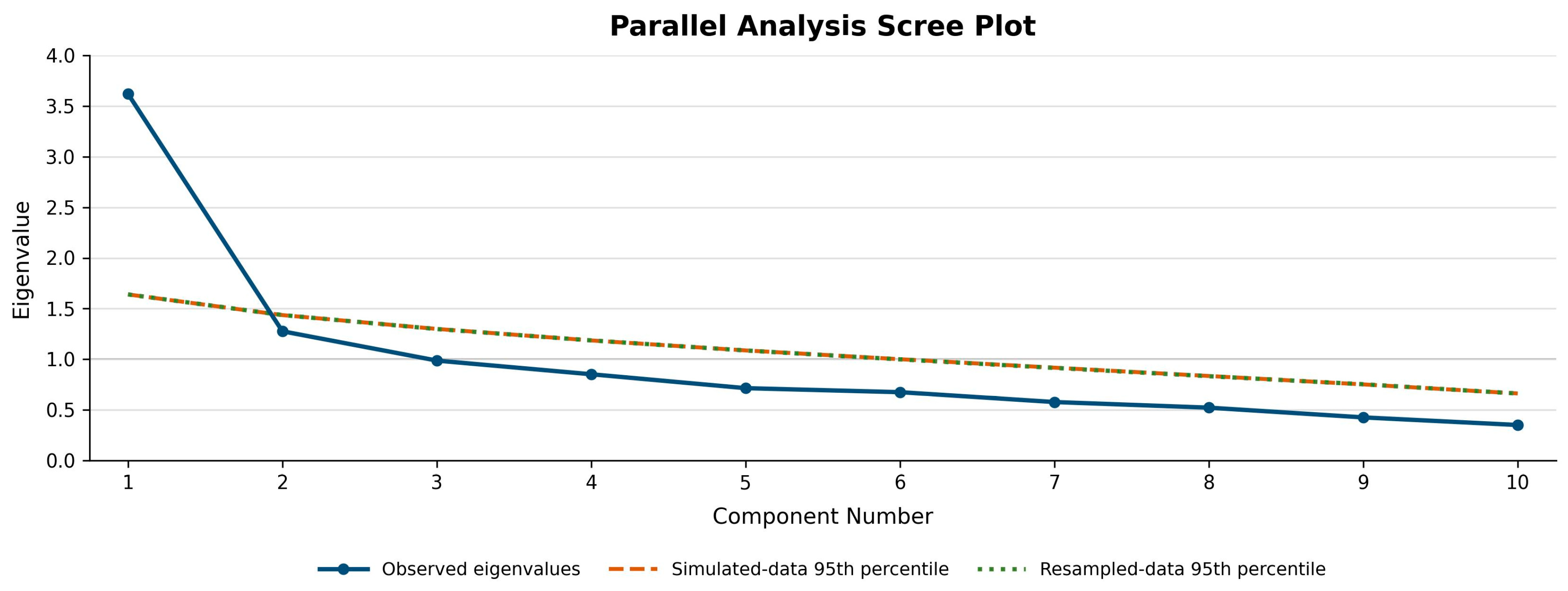
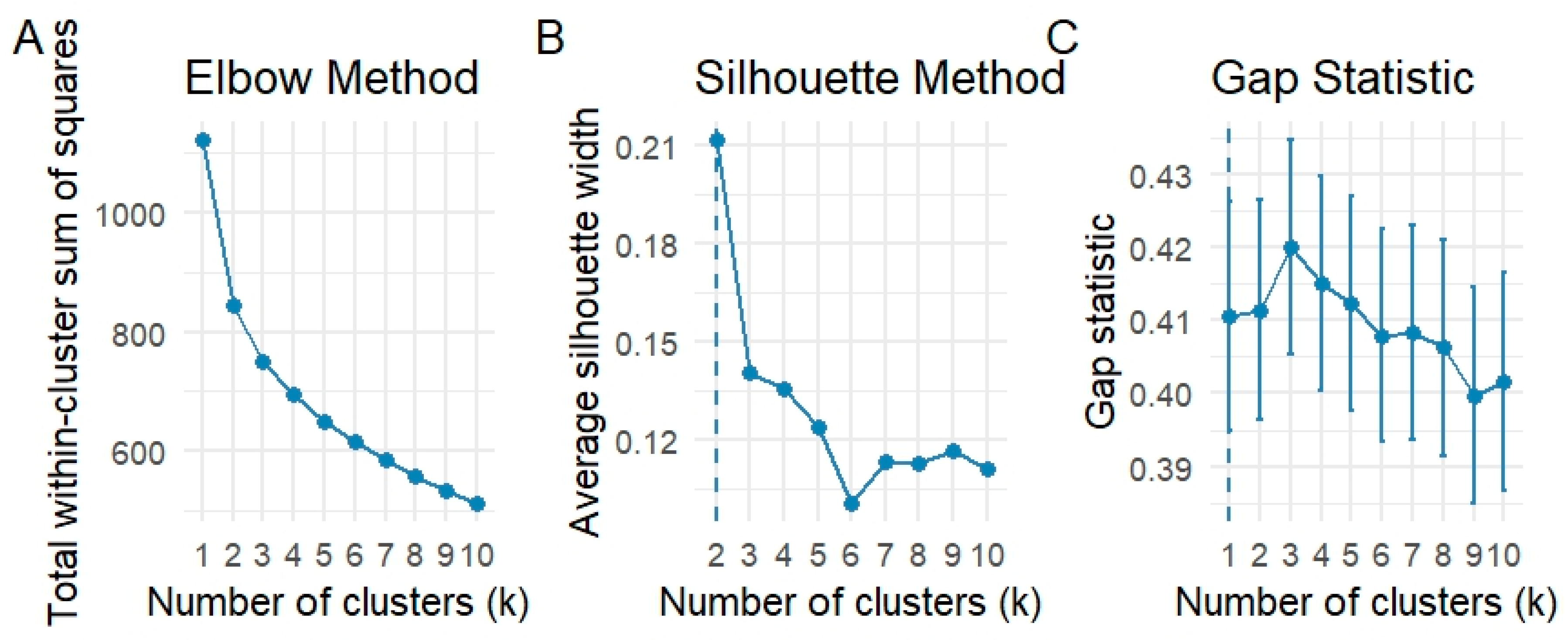
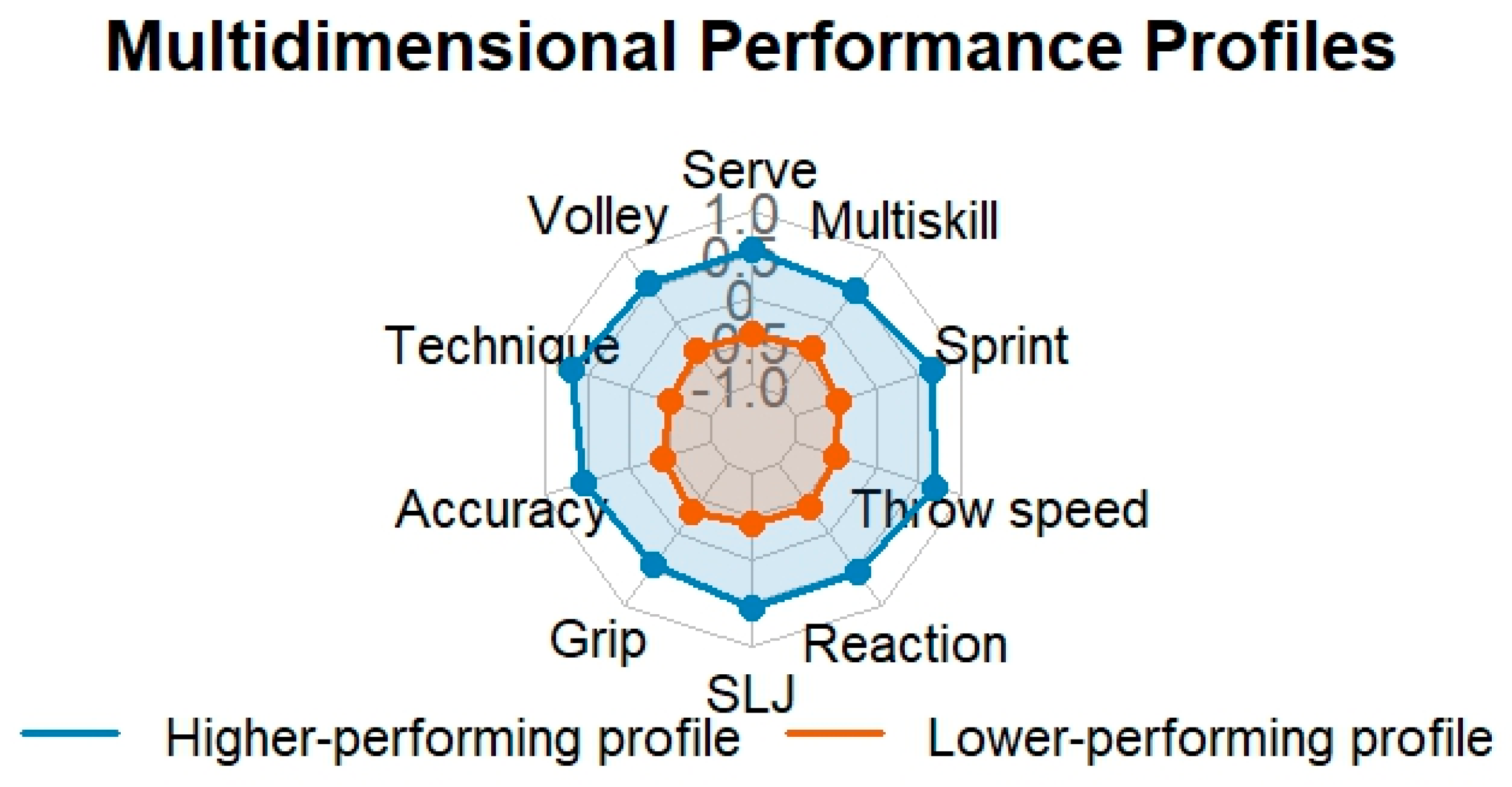
Objective: Talent identification in youth tennis remains challenging because current assessment approaches often evaluate physical, technical, and cognitive characteristics separately rather than within an integrated multidimensional framework. The present study aimed to identify multidimensional performance profiles in U10 tennis players by integrating technical, physical-motor, and reaction-based cognitive performance characteristics within a single analytical framework. Methods: A total of 113 players participating in the Hungarian Tennis Federation’s U10 Talent Identification Festival were assessed using a multidimensional performance battery. Following data cleaning, 113 participants were included in the analyses. Principal component analysis was used to examine the dimensional structure of the assessment battery, whereas k-means clustering was performed separately on the ten standardized performance variables. The optimal number of clusters was determined using complementary validation procedures, including the elbow method, average silhouette width, and gap statistic. Differences between the two performance profiles were examined using Welch’s t-tests with Hedges’ g effect sizes, while associations of profile membership with birth quarter and sex were assessed using chi-square analyses. An age-adjusted sensitivity analysis was additionally performed to evaluate the influence of chronological age on the clustering solution. Results: A two-cluster solution was retained, comprising a higher-performing profile (n = 48) and a lower-performing profile (n = 65). The higher-performing profile demonstrated better performance across all ten technical, physical-motor, and reaction-based measures, with the largest standardized differences observed for throwing speed (Hedges’ g = 1.43), technique (g = 1.42), and 15-m sprint performance (|g| = 1.38). Chronological age differed significantly between profiles, with participants in the higher-performing profile being older (9.41 vs. 8.80 years; Welch’s t(102.94) = 4.24, p < 0.001; Hedges’ g = 0.80). However, the two-cluster solution remained highly stable after age adjustment (bootstrap Jaccard coefficients = 0.937 and 0.946), with 85.0% correspondence in cluster membership. Neither birth quarter (χ2(3) = 0.28, p = 0.964) nor sex (χ2(1) = 3.19, p = 0.074) was significantly associated with profile membership. Conclusions: Multidimensional profiling identified two distinct performance profiles in U10 tennis players, primarily reflecting a broad gradient in current technical, physical-motor, and reaction-based performance. Although chronological age contributed to profile membership, the persistence of the cluster structure after age adjustment suggests that age did not fully account for the observed performance heterogeneity. These profiles should be interpreted as exploratory descriptions of current multidimensional performance rather than fixed talent categories or predictors of future development. In practice, multidimensional assessment may help coaches identify relative strengths and weaknesses across performance domains and support individualised player development; however, profile membership should not be used as a stand-alone criterion for talent selection or deselection. Longitudinal studies are needed to establish their developmental stability and predictive validity.
Keywords: talent identification; youth tennis; cluster analysis; principal component analysis; multidimensional profiling; physical performance talent identification; youth tennis; cluster analysis; principal component analysis; multidimensional profiling; physical performance