


Abstract
This study assessed the effectiveness of a position-specific and time-efficient warm-up injury prevention program for male football players. This season-long quasi-experimental study included 129 male amateur football players. A structured injury prevention program was incorporated into the warm-up routine during the preseason and competitive season. Prospectively collected injury data from the intervention season were compared with retrospectively collected injury data from the previous season and included injury incidence, the number of injured players, injury severity, and injury burden. The program included general exercises and position-specific modifications for defenders, midfielders, and attackers. Implementation of the program was associated with a 60% reduction in total injuries (p < 0.05) and a 60.3% reduction in total injured players The injury burden was significantly reduced (p < 0.05), as indicated by a reduced mean day lost per injury from 33.24 to 19.56 days. Although injury reductions were observed across all playing positions, between-position differences were not statistically significant. The type of injuries and their mechanisms were not significantly affected. These preliminary, associative findings suggest that a time-efficient, position-specific warm-up program may contribute to reduced injury occurrence in amateur football; however, given the quasi-experimental design, confirmation through randomized controlled trials is required.
1. Introduction
Football is one of the most widely practiced sports worldwide, with millions of registered players participating at both amateur and professional levels [1]. Despite its global popularity, football is associated with a substantial risk of injury, which negatively affects player availability, team performance, and long-term athlete health [2,3]. Lower-limb injuries, particularly those affecting the hamstrings, knee (including anterior cruciate ligament [ACL]), groin, and ankle, are consistently reported as the most prevalent in male football players across competitive levels [4]. These injuries often result in significant time loss and contribute disproportionately to overall injury burden [5].
A large body of evidence indicates that many football-related injuries are at least partially preventable [6]. In this direction, exercise-based injury prevention programs incorporating strength, neuromuscular control, balance, and plyometric components have been shown to reduce injury occurrence, particularly when compliance is high [7]. For instance, eccentric hamstring strengthening has been associated with substantial reductions in hamstring injuries [8], while neuromuscular and proprioceptive training programs have demonstrated effectiveness in reducing knee and ankle injuries [9]. Comprehensive warm-up programs, such as the FIFA 11+, have further shown that structured, multi-component interventions can reduce overall injury risk in football populations [10].
Despite this evidence, the widespread implementation of injury prevention programs in real-world settings remains limited. One of the most frequently reported barriers is time constraint, as coaches are often reluctant to allocate more than 10 to 15 min of training time to preventive exercises [11]. Additional barriers include lack of individualization and supervision, perceived complexity of programs, small sample sizes, low compliance with the program, its limited integration into regular training routines, and a failure to account for pre-existing injuries and implement systematic progression [12]. Hence, there is a need for injury prevention strategies that are evidence-based and time-efficient, while in parallel, practical, and easily integrated into standard warm-up routines. Moreover, recent studies further support the value of soccer-specific training interventions that are both practical and engaging. Game-representative training methods, including small-sided games and reactive agility exercises, have been shown to improve physical performance while enhancing player enjoyment and adherence, highlighting the importance of designing injury-prevention programs that are not only effective but also feasible and motivating within regular football training environments [13,14].
Another important yet underexplored consideration is the role of playing position in injury risk and prevention. In football, different playing positions are exposed to distinct physical and tactical demands, including variations in sprinting, acceleration, deceleration, changes in direction, and contact situations [15,16]. These differences are associated with position-specific injury patterns, with evidence suggesting that midfielders may be more prone to hamstring injuries [17], defenders to contact-related injuries [18], and attackers to high-speed and explosive actions [19]. While these positional differences are well documented, most existing injury prevention programs tend to adopt a “one-size-fits-all” approach, without tailoring exercises to the specific demands of each playing role. Moreover, as physical and tactical demands differ substantially among defenders, midfielders, and attackers, injury risk profiles may also differ, potentially warranting tailored preventive strategies.
To date, limited research has examined whether incorporating position-specific adaptations into a structured, time-efficient warm-up program can enhance injury prevention outcomes [9]. Furthermore, few studies have evaluated such interventions over an entire competitive season in amateur football players, where implementation challenges are often greatest but potential benefits are substantial [20]. To our knowledge, no previous study has evaluated a time-efficient, position-specific injury prevention program over a full competitive season in amateur male football players. Therefore, the present study aimed to evaluate the effectiveness of a position-specific, time-efficient (<15 min) warm-up injury prevention program, implemented twice weekly over a full competitive season, in reducing injury occurrence and injury burden in male amateur football players. We hypothesized that the program would significantly reduce injury occurrence, the number of injured players, and injury burden compared with the previous season.
2. Materials and Methods
2.1. Study Design
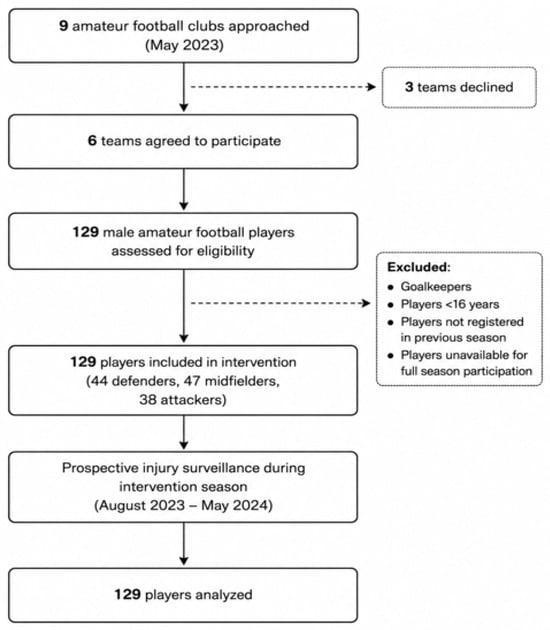
This study employed a quasi-experimental prospective before–after design comparing injury outcomes during a retrospective pre-intervention season and a prospective intervention season. In May 2023, coaches and team representatives from nine amateur football clubs in Greece were contacted and informed about the study procedures, as injury prevention programs recommended to commence at least six weeks prior to the start of the season followed by a maintenance program and be part of the warm-up routine [21]. Six teams agreed to participate, while three teams declined. In total, 129 male amateur football players participated in the study from August 2023 to May 2024. Inclusion criteria required players to (a) be registered members of their team during both the preseason and competitive season, (b) participate in team training at least three times per week, and (c) be available for official matches. Players who had not participated in the previous competitive season, goalkeepers, and players younger than 16 years of age were excluded.
The study sample consisted of 129 male football players (44 defenders, 47 midfielders, and 38 attackers), aged 16–32 years (mean 19.47 ± 3.49), with a height of 163–197 cm (mean 179.43 ± 6.94), body mass of 49.5–95 kg (mean 72.46 ± 8.87), training age of 5–28 years (mean = 12.9 ± 3.81), and a training frequency of 2 to 6 sessions per week (mean 4.61 ± 0.70). Participant recruitment and study inclusion are summarized in Figure 1, while the baseline characteristics of the study participants are presented in Table 1.
Figure 1.
Flow diagram of participant recruitment, eligibility assessment, inclusion, and analysis.
Table 1.
Baseline characteristics of the study participants.
During the first week of the preseason, each team received an on-field presentation of the injury prevention program. Written and visual instructional materials were provided to coaches, strength and conditioning staff, and players. Anthropometric data, playing experience, playing position, and injury history from the previous season were recorded at baseline. To ensure consistent implementation and high compliance, a research associate attended at least one training session per team each week. During each visit, the research associate monitored correct exercise execution, adherence to the prescribed program structure, and provided corrective feedback to players and coaching staff where necessary. Any deviations from the prescribed exercises, progressions, or session structure were noted and addressed at the subsequent visit. Injury data were systematically collected throughout the study period using a standardized surveillance protocol [22]. Previous research has shown that greater compliance with injury prevention programs is associated with larger reductions in injury risk [23]. The study design was approved by the Research Ethics Committee of the School of Physical Education and Sport Science at Thessaloniki (Approval number 151/2023). All participants were informed about the procedures approved by the ethics committee and in compliance with the Declaration of Helsinki and provided individual written informed consent; for participants under the age of 18, consent was obtained from their parents or legal guardians. Reporting of this study was informed by the TREND (Transparent Reporting of Evaluations with Nonrandomized Designs) statement for non-randomized intervention studies.
2.2. Data Collection and Injury Classification
Injury data from the season preceding the intervention were collected retrospectively, on a weekly basis. At baseline, the research associate conducted structured interviews with players and, where available, corroborated by coaches and team staff (strength and conditioning staff, and medical personnel, when available) prior to training sessions. To improve consistency of reporting, the same time-loss injury definition and injury classification criteria used during prospective surveillance were applied retrospectively. This approach minimized recall delay and improved reporting accuracy. Data collection focused on injury occurrence, anatomical location, injury mechanism, and time-loss duration. Injuries were defined as time-loss injuries, resulting in absence from training or match participation. Injury severity was classified as minimal (1–3 days), mild (4–7 days), moderate (8–21 days), or severe (>21 days), in accordance with established consensus guidelines [22]. Injuries resulting in no time loss were excluded due to inconsistent reporting reliability. No “career-ending” injuries were recorded during the study period. Injury data from the previous season to the intervention period was collected retrospectively at baseline via structured interviews. While this method has been shown to provide acceptable recall for injury occurrence and location, diagnostic accuracy may be reduced compared to prospective surveillance.
2.3. Intervention Program
The injury prevention program was designed to be time-efficient (≤15 min), equipment-free, and fully integrated into the regular team warm-up routine. It was performed twice per week throughout both the preseason and the competitive season. Throughout the intervention period, the program also involved systematic progression of the selected exercises at six-week intervals, along with position-specific modifications based on the participants’ playing roles. Progression involved increasing eccentric volume, shifting from bilateral to unilateral stability patterns, and accelerating the velocity of plyometric tasks. Finally, after the 12 weeks, the final level of the injury prevention program was established and then maintained without any modifications until the end of the study.
The injury prevention program was developed based on current scientific literature addressing the general and football-specific mechanisms of injury [24,25], relevant risk factors [26,27] and evidence-based prevention strategies [28,29] for hamstring, knee/ACL, adductor, and ankle sprain injuries. In addition, expert knowledge derived from highly experienced practitioners working at the highest level of football conditioning, as well as practical input from players, coaches, strength and conditioning coaches, and physiotherapists from professional football clubs [8], was incorporated into the program design. The primary outcome variables were total injuries, number of injured players, and injury burden. Secondary outcomes included injury severity, injury type, and injury mechanism. Positional analyses were conducted for defenders, midfielders, and attackers. The intervention consisted of a position-specific, progressive warm-up program performed twice weekly for the duration of the season. The structure of the program consisted of three distinct parts: Part A: General activation, strength, and neuromuscular control exercises performed by all players; Part B: Position-specific exercises targeting predominant injury risk profiles associated with defenders, midfielders, and attackers; Part C: An integrated football-specific drill including agility, change in direction, and high-speed running performed by all players. Detailed exercise descriptions and progressions are provided in Table 2.
Table 2.
Detailed description of exercises, progressions, and position-specific modifications for the three parts of intervention injury prevention program.
2.4. Statistical Analysis
Statistical analyses were performed using IBM SPSS Statistics (Version 29.0). Categorical variables, including injury occurrence, number of injured players, injury severity, injury type, and injury mechanism, were analysed using chi-square tests. Mean differences in days lost due to injury were assessed using independent sample t-tests. To complement null-hypothesis significance testing, effect sizes were calculated to quantify the practical magnitude of observed differences. Risk ratios (RR) were used to assess relative changes in injury occurrence between seasons. Although exposure-adjusted incidence rate ratios are preferable when player-hours are available, RR was selected because exposure data were not recorded. Cohen’s d was applied to evaluate standardized differences in mean days lost due to injury, while Cramer’s V was used to estimate effect size for categorical comparisons involving injury severity, injury type, and injury mechanism.
This combined approach was adopted to enhance interpretability and to account for the limited statistical power inherent in subgroup analyses. Effect sizes were interpreted according to established conventions [30,31]. Cohen’s d values below 0.20 were considered trivial, and Cohen’s d values of 0.20, 0.50, and 0.80 were considered small, moderate, and large, respectively, while Cramer’s V values of 0.10, 0.30, and 0.50 indicated small, moderate, and large effects. For RR, interpretation was based on the magnitude of relative risk reduction, in line with applied epidemiological practice and recommendations emphasizing practical significance beyond p-values [32]. Statistical significance was set at p < 0.05.
3. Results
3.1. Number of Injuries
Following the implementation of the position-specific warm-up injury prevention program, a substantial reduction in overall injuries was observed. The total number of recorded injuries decreased from 80 in the season prior to the intervention to 32 during the intervention season, corresponding to a 60% reduction (Table 2). This decrease was statistically significant (χ2 = 4.949, df = 1, p = 0.026) and was associated with a large practical effect RR = 0.40; relative risk reduction = 60%). When examined by playing position, injury reductions were observed across all positional groups. Defenders sustained 13 injuries during the intervention season compared to 20 in the previous season (35% reduction), midfielders sustained 12 injuries compared to 30 (60% reduction), and attackers sustained 7 injuries compared to 30 (76.7% reduction) (Table 3). Although these reductions did not reach statistical significance at the positional level, the magnitude of change was descriptively largest for attackers; this should be interpreted cautiously given the lack of statistical significance and the limited subgroup sample sizes.
Table 3.
Number of recorded injuries before and after the intervention.
3.2. Number of Injured Players
The number of injured players was also markedly reduced following the intervention. A total of 68 players sustained at least one injury in the season prior to the intervention, compared to 27 players during the intervention season, representing a 60.3% reduction. This corresponds to a large effect size (RR = 0.40). At the positional level, the number of injured defenders decreased from 18 to 11 (38.9% reduction), midfielders from 24 to 10 (58.3% reduction), and attackers from 26 to 6 (76.9% reduction) (Table 4). While these changes were not statistically significant, the direction and magnitude of the effects were consistent across positions. Table 4 presents the total number of injured athletes and the number of injured athletes by playing position.
Table 4.
Number of recorded injured players before and after the intervention.
3.3. Injuries by Playing Position
Across all positional subgroups, the implementation of the prevention program was accompanied by a clear downward trend in both total injury incidence and the absolute number of injured players.
3.3.1. Defenders
The number of injured defenders decreased from 18 to 11 following the intervention (38.9% reduction) (Table 4), although this change was not statistically significant (p = 0.723). However, injury severity among defenders was significantly reduced (p = 0.006) (Table 5b).
Table 5.
(a) Injury severity before and after the intervention. (b) Injury severity by playing position, before and after the intervention.
3.3.2. Midfielders
3.3.3. Attackers
3.4. Injury Burden and Severity
Injury burden, assessed through injury severity categories and time-loss days, was significantly reduced following the implementation of the injury prevention program (Table 5). The distribution of injury severity differed significantly between seasons (χ2 = 8.113, df = 3, p = 0.044), with a moderate effect size (Cramer’s V = 0.27). Severe injuries (>21 days absence) showed the largest relative reduction, decreasing from 27 cases before the intervention to 4 cases during the intervention season, representing an 85.2% reduction (Table 5a). This change reflects a large practical effect, reflecting a substantial reduction in high-burden injuries. Mean days lost per injury also decreased from 33.24 ± 50.18 days before the intervention to 19.56 ± 32.56 days after the intervention (mean difference = 13.68 days; 95% CI: −5.35 to 32.70) (Table 6). Although this reduction did not reach statistical significance (t = 1.424, df = 110, p = 0.157), the effect estimate indicated a small-to-moderate positive effect (Cohen’s d = 0.34; 95% CI: −0.07 to 0.75) [30,31]; however, the confidence interval crossed zero, indicating uncertainty regarding the precision and direction of the true effect. As no clinical threshold for meaningful change was predefined in this study, this finding should be interpreted descriptively rather than as evidence of a clinically relevant trend.
Table 6.
Injury burden before and after the intervention.
3.5. Injury Type and Mechanism
The distribution of injury types did not differ significantly between seasons (χ2 = 2.175, df = 4, p = 0.704), with a small effect size (Cramer’s V = 0.12). Hamstring strains were the most common specific injury in both the pre-intervention and intervention seasons, accounting for 18.8% of all injuries in each period (15 vs. 6 injuries). Ankle sprains decreased from 15 to 4 cases, while adductor strains decreased from 6 to 5 cases. Knee/ACL injuries decreased from 4 to 2 cases. Injuries classified as other injuries (e.g., contusions, muscle cramps, lacerations) declined from 40 to 15 cases. Despite these descriptive reductions, the overall distribution of injury types did not differ significantly between seasons (χ2 = 2.175, p = 0.704).
Finally, injury mechanisms demonstrated similar distributions before and after the intervention. Injuries occurring during changes in direction decreased from 15 to 4 cases, while injuries associated with kicking or passing decreased from 14 to 4 cases. Tackling- or stretching-related injuries were reduced from 10 to 1 case. Running-related injuries showed minimal change (9 vs. 8 cases), whereas overload or unknown mechanisms decreased from 12 to 8 cases. Although several mechanisms showed descriptive reductions, the overall distribution of injury mechanisms was not significantly different between seasons (χ2 = 7.032, p = 0.318).
4. Discussion
To our knowledge, this is among the first studies evaluating a position-specific, time-efficient (<15 min) football warm-up injury prevention intervention in male amateur football players. The main findings support the primary hypothesis, demonstrating a substantial reduction in overall injury occurrence, number of injured players, and injury burden following the implementation of the intervention, suggesting that a structured warm-up program lasting less than 15 min and incorporating position-specific adaptations may be associated with meaningful reductions in real-world football settings.
A key result of the present study was the approximately 60% reduction in total injuries and injured players during the intervention season. While this magnitude of change is statistically significant and practically substantial and consistent with previous literature on exercise-based injury prevention programs in football [33], it is important to emphasize that the quasi-experimental before–after design of the present study does not allow for causal attribution of this reduction to the intervention [34]. Direct comparisons with earlier studies, such as those evaluating general warm-up interventions [35], should also be made with caution due to differences in study design, populations, and outcome measures. The present findings are therefore best interpreted as preliminary associative evidence suggesting that a time-efficient, position-specific warm-up program may be associated with lower injury occurrence in amateur football, an observation that warrants confirmation through adequately powered randomized controlled trials.
In addition to reducing injury occurrence, the intervention was associated with a significant reduction in injury burden, as reflected by both severity distribution and mean days lost per injury. Notably, severe injuries (>21 days absence) were reduced, reflecting a shift toward less severe injury outcomes. From a performance and health perspective, this finding is particularly relevant, as injury burden is more strongly associated with player availability and team performance than injury occurrence alone [2]. One possible, though untested, explanation is that the intervention enhanced neuromuscular control, movement efficiency, or load tolerance [22]; since none of these variables were directly assessed, this remains entirely speculative.
The secondary hypothesis regarding positional differences was partially supported. Reductions in injury occurrence were observed across all positional groups, although the magnitude of change varied. This finding is consistent with the multifactorial nature of football injuries, which are influenced by a complex interaction of intrinsic and extrinsic factors [34]. Rather than targeting a single injury mechanism, the program may have contributed to improvements in general physical preparedness and resilience, thereby reducing susceptibility to a range of injury types. More specifically defenders demonstrated the smallest relative reduction (38.9%), as this playing position is related to more unpredictable contact-driven, collision-based injuries (tackling, aerial duels) [36]. Interestingly, ankle injuries were less frequent among defenders at baseline than would be expected based on previous reports in amateur football populations, which have generally identified defenders as being at elevated risk for ankle injuries [18,37]. Midfielders demonstrated a 58.3% reduction in injured players and a 33.3% reduction in hamstring injuries, consistent with evidence suggesting that midfielders may be particularly vulnerable to hamstring-related injuries due to their high running demands [14,17]. Attackers demonstrated the largest relative reduction (76.9%), accompanied by reductions in adductor strains, hamstring injuries, and ankle sprains, as well as no recorded ACL injuries during the intervention season. Attackers routinely execute unexpected high-speed cutting maneuvers and decelerations [19]. These descriptive trends should be regarded as preliminary and exploratory only. Because between-position differences were not statistically significant and subgroup sample sizes were limited, they should not be interpreted as evidence of differential program effectiveness across playing positions. Whether the position-specific exercise adaptations were differentially aligned with the movement demands [38] and injury profiles of each playing role [39] in a way that produced meaningful benefit cannot be determined from the present data and requires investigation in adequately powered future studies.
The position-specific structure of the program was designed to reflect differences in movement demands and injury profiles. The descriptive trends observed in the data are consistent with this rationale; however, given the absence of statistical significance in between-position comparisons and the small subgroup sample sizes, these trends should not be taken as confirmation of position-specific program effects.
This study has several important strengths. First, it demonstrates high ecological validity, as the intervention was fully integrated into the regular warm-up routine and implemented under real-world conditions in amateur football teams. Second, the program was time-efficient (<15 min), equipment-free, and easily scalable, directly addressing key barriers to implementation and enhancing its practical applicability. Third, the study introduced a novel position-specific approach, reflecting the differing physical demands of playing roles, and evaluated its effectiveness over an entire competitive season. In addition, the prospective injury surveillance during the intervention period, use of standardized injury definitions, and inclusion of effect size measures alongside statistical testing strengthen the interpretability and applied relevance of the findings.
4.1. Practical Implications
From a practical standpoint, the findings suggest that injury prevention strategies do not necessarily require extensive training time or specialized equipment to be effective. Position-specific adaptations incorporated into short warm-up routines may represent a feasible approach for amateur football environments, where limited resources and time constraints often reduce implementation of established prevention programs. Nevertheless, these findings should be considered preliminary until confirmed by adequately powered randomized controlled trials.
4.2. Limitations
This study has some limitations that should be acknowledged. First, this study employed a quasi-experimental before–after design without a concurrent control group, which limits causal inference and increases susceptibility to confounding factors such as seasonal variation, changes in training practices, or regression to the mean. Second, injury data from the pre-intervention season were collected retrospectively and therefore may be affected by recall bias and differences in reporting accuracy relative to the prospective surveillance applied during the intervention season. Although structured interviews and standardized injury definitions were used, retrospective self-reporting may underestimate minor injuries and reduce diagnostic precision. Consequently, comparisons between seasons should be interpreted cautiously and viewed as associative rather than causal. Third, exposure data (e.g., training and match hours) were not recorded, preventing the calculation of exposure-adjusted injury incidence (injuries per 1000 player-h). Thus, the observed reductions should be translated as changes in injury occurrence within this cohort rather than formal incidence-rate reductions. Fourth, although the presence of a research associate at weekly training sessions facilitated implementation monitoring and ensured a minimum level of program fidelity, compliance was not quantitatively assessed using validated measurement tools (e.g., session logs, attendance records, or exercise completion checklists). Consequently, the precise degree to which individual players and teams adhered to the prescribed program throughout the intervention season remains unknown. Finally, subgroup analyses by playing position were based on relatively small sample sizes, reducing statistical power to detect significant differences. Future randomized controlled trials should compare position-specific and non-position-specific prevention programs while accounting for exposure, compliance, training load, and previous injury history.
5. Conclusions
In conclusion, implementation of a position-specific, time-efficient warm-up program was associated with reduced injury occurrence and lower injury burden among male amateur football players over a competitive season. However, given the quasi-experimental before–after design without a concurrent control group, these findings are associative in nature and should not be interpreted as evidence of a causal program effect. Alternative explanations, including seasonal variation, regression to the mean, and uncontrolled confounders, cannot be excluded. Positional subgroup findings were exploratory and not statistically significant between groups. These observations suggest that short, easily implemented prevention strategies may be a feasible option in amateur football settings and provide a foundation for future randomized controlled trials to determine the independent contribution of position-specific programming to injury reduction.
Author Contributions
Conceptualization: D.V., T.M., N.S., I.T. and V.M.; methodology: D.V. and V.M.; validation: T.M.; formal analysis: V.M.; investigation: D.V.; resources: D.V. and V.M.; data curation: V.M.; writing—original draft preparation: D.V. and A.A.D.; writing—review and editing: A.A.D. and V.M.; supervision: V.M. and I.T.; project administration: V.M. All authors have read and agreed to the published version of the manuscript.
Funding
This research received no external funding.
Institutional Review Board Statement
The study was conducted in accordance with the Declaration of Helsinki and approved by the ethics committee of the School of Physical Education and Sport Science of the Aristotle University of Thessaloniki Ethics Committee (approval code: 151/2023; approval date: 28 June 2023).
Informed Consent Statement
Informed consent was obtained from all subjects involved in the study. For subjects under 18 years of age, informed consent was obtained from their legal guardians.
Data Availability Statement
Research data are available from the corresponding author upon reasonable request.
Acknowledgments
We would like to thank the coaches and players for their essential support and cooperation during data collection. During the preparation of this manuscript, the authors used Gemini (June 2026 version, version 3.5) for the purposes of reformatting the bibliography to the ACS style guide, reviewing manuscript draft structure, and refining academic clarity. The authors have reviewed and edited the output and take full responsibility for the content of this publication.
Conflicts of Interest
The authors declare no conflicts of interest.
References
- Leventer, L.; Eek, F.; Lames, M. Intra-Seasonal Variation of Injury Patterns Among German Bundesliga Football Players. J. Sci. Med. Sport 2019, 22, 661–666. [Google Scholar] [CrossRef] [Scilit]
- López-Valenciano, A.; Ruiz-Pérez, I.; Garcia-Gómez, A.; Vera-Garcia, F.J.; De Ste Croix, M.; Myer, G.D.; Ayala, F. Epidemiology of injuries in professional football: A systematic review and meta-analysis. Br. J. Sports Med. 2020, 54, 711–718. [Google Scholar] [CrossRef] [Scilit] [PubMed]
- Eliakim, E.; Morgulev, E.; Lidor, R.; Meckel, Y. Estimation of Injury Costs: Financial Damage of English Premier League Teams’ Underachievement Due to Injuries. BMJ Open Sport Exerc. Med. 2020, 6, e000675. [Google Scholar] [CrossRef] [Scilit] [PubMed]
- Gurau, T.V.; Gurau, G.; Musat, C.L.; Voinescu, D.C.; Anghel, L.; Onose, G.; Munteanu, C.; Onu, I.; Iordan, D.A. Epidemiology of Injuries in Professional and Amateur Football Men (Part II). J. Clin. Med. 2023, 12, 6293. [Google Scholar] [CrossRef] [Scilit] [PubMed]
- Ekstrand, J.; Krutsch, W.; Spreco, A.; van Zoest, W.; Roberts, C.; Meyer, T.; Bengtsson, H. Time Before Return to Play for the Most Common Injuries in Professional Football: A 16-Year Follow-Up of the UEFA Elite Club Injury Study. Br. J. Sports Med. 2020, 54, 421–426. [Google Scholar] [PubMed]
- Owoeye, O.B.A.; VanderWey, M.J.; Pike, I. Reducing Injuries in Soccer (Football): An Umbrella Review of Best Evidence Across the Epidemiological Framework for Prevention. Sports Med. Open 2020, 6, 46. [Google Scholar] [CrossRef] [Scilit] [PubMed]
- Beato, M.; Maroto-Izquierdo, S.; Turner, A.N.; Bishop, C. Implementing Strength Training Strategies for Injury Prevention in Soccer: Scientific Rationale and Methodological Recommendations. Int. J. Sports Physiol. Perform. 2021, 16, 456–461. [Google Scholar] [CrossRef] [Scilit] [PubMed]
- McCall, A.; Pruna, R.; Van der Horst, N.; Dupont, G.; Buchheit, M.; Coutts, A.J.; Impellizzeri, F.M.; Fanchini, M.; EFP-Group. Exercise-Based Strategies to Prevent Muscle Injury in Male Elite Footballers: An Expert-Led Delphi Survey of 21 Practitioners Belonging to 18 Teams from the Big-5 European Leagues. Sports Med. 2020, 50, 1667–1681. [Google Scholar] [CrossRef] [Scilit] [PubMed]
- Pérez-Gómez, J.; Adsuar, J.C.; Alcaraz, P.E.; Carlos-Vivas, J. Physical exercises for preventing injuries among adult male football players: A systematic review. J. Sport Health Sci. 2022, 11, 115–122. [Google Scholar] [CrossRef] [Scilit] [PubMed]
- Patel, P.; Shah, M. The Impact of the FIFA 11+ Injury Prevention Program on Injury Incidence in Football Athletes: A Systematic Review of Randomized Controlled Trials. Cureus 2025, 17, e100463. [Google Scholar] [PubMed]
- Minnig, M.C.; Hawkinson, L.; Root, H.J.; Driban, J.; DiStefano, L.J.; Callahan, L.; Ambrose, K.R.; Spang, J.T.; Golightly, Y.M. Barriers and facilitators to the adoption and implementation of evidence-based injury prevention training programmes: A narrative review. BMJ Open Sport Exerc. Med. B 2022, 8, e001374. [Google Scholar] [CrossRef] [Scilit] [PubMed]
- Soligard, T.; Nilstad, A.; Steffen, K.; Myklebust, G.; Holme, I.; Dvorak, J.; Bahr, R.; Andersen, T.E. Compliance with a Comprehensive Warm-Up Programme to Prevent Injuries in Youth Football. Br. J. Sports Med. 2010, 44, 787–793. [Google Scholar] [CrossRef] [Scilit] [PubMed]
- Rahmoune, M.A.; Selmi, O.; Bouali, S.; Bouassida, A.; Alexe, D.I.; Aldhahi, M.I.; Cojocaru, A.M.; Ştef, M.; Alexe, C.I. Effects of small-sided games and dribbling circuit training on physical and technical skills in youth soccer players. Sci. Rep. 2026, 16, 1731. [Google Scholar] [CrossRef] [Scilit] [PubMed]
- Doua, N.; Marzouki, H.; Selmi, O.; Cherni, B.; Djeddi, R.; Alexe, D.I.; Canli, U.; Wilk, M.; Bouhlel, E.; Sakizlian, E.R. Comparative effects of reactive and planned agility training on physical performance, internal load and enjoyment in youth soccer players. Sci. Rep. 2026, 16, 11302. [Google Scholar] [CrossRef] [Scilit] [PubMed]
- Della Villa, F.; Mandelbaum, B.R.; Lemak, L.J. The Effect of Playing Position on Injury Risk in Male Football Players: Systematic Review of the Literature and Risk Considerations for Each Playing Position. Am. J. Orthop. 2018, 47, ajo.2018.0092. [Google Scholar] [CrossRef] [Scilit] [PubMed]
- Thema, M.T.; Jacobs, S.; van den Berg, L.; Strauss, A.; Mahlangu, M.P. The role of playing position in soccer injury characteristics: Evidence from sub-elite athletes. Front. Sports Act. Living 2025, 7, 1542300. [Google Scholar] [CrossRef] [Scilit] [PubMed]
- Petersen, J.; Thorborg, K.; Nielsen, M.B.; Hölmich, P. Acute Hamstring Injuries in Danish Elite Football: A 12-Month Prospective Registration Study Among 374 Players. Scand. J. Med. Sci. Sports 2010, 20, 588–592. [Google Scholar] [CrossRef] [Scilit] [PubMed]
- My, G.; Farì, G.; Muscella, A.; Marsigliante, S. Evaluation of injury rates in soccer players before, during, and after the COVID-19 pandemic. BMC Sports Sci. Med. Rehabil. 2025, 17, 313. [Google Scholar] [CrossRef] [Scilit] [PubMed]
- Zeng, Y.; Ji, W.; Shi, Y.; Liu, W.; Ji, W. Sports Injuries in Elite Football Players: Classification, Prevention, and Treatment Strategies Update. Front. Sports Act. Living 2025, 7, 1643789. [Google Scholar] [CrossRef] [Scilit] [PubMed]
- Duda, H.; Rydzik, Ł.; Ambroży, T.; Ruzbarsky, P.; Kędra, A.; Wąsacz, W. The Impact of Rational Warm-Up on Physical Preparation and Injury Prevention in Young Footballers: A Longitudinal Study. J. Clin. Med. 2026, 15, 608. [Google Scholar] [CrossRef] [Scilit] [PubMed]
- Khan, M.A.; Al Sehemi, S.A.; Alahmadi, O.A. Injury Prevention Programs in Youth Football: A Narrative Review of the FIFA 11+ and FUNBALL Programs. Cureus 2025, 17, e82232. [Google Scholar] [CrossRef] [Scilit] [PubMed]
- Fuller, C.R.; Ekstrand, J.; Junge, A.; Andersen, T.E.; Bahr, R.; Dvorak, J.; Hägglund, M.; McCrory, P.; Meeuwisse, W.H. Consensus Statement on Injury Definitions and Data Collection Procedures in Studies of Football (Soccer) Injuries. Br. J. Sports Med. 2006, 40, 193–201. [Google Scholar] [CrossRef] [Scilit] [PubMed]
- Silvers-Granelli, H.J.; Bizzini, M.; Arundale, A.; Mandelbaum, B.R.; Snyder-Mackler, L. Higher Compliance to a Neuromuscular Injury Prevention Program Improves Overall Injury Rate in Male Football Players. Knee Surg. Sports Traumatol. Arthrosc. 2018, 26, 1975–1983. [Google Scholar] [CrossRef] [Scilit] [PubMed]
- Dupré, T.; Tryba, J.; Potthast, W. Muscle Activity of Cutting Manoeuvres and Football Inside Passing Suggests an Increased Groin Injury Risk During These Movements. Sci. Rep. 2021, 11, 7223. [Google Scholar] [CrossRef] [Scilit] [PubMed]
- Ekstrand, J.; Healy, J.; Waldén, M.; Lee, J.; English, B.; Hägglund, M. Hamstring Muscle Injuries in Professional Football: The Correlation of MRI Findings with Return to Play. Br. J. Sports Med. 2012, 46, 112–117. [Google Scholar] [CrossRef] [Scilit] [PubMed]
- Buckthorpe, M.; Wright, S.; Bruce-Low, S.; Nanni, G.; Sturdy, T.; Gross, S.; Bowen, L.; Styles, B.; Della Villa, S.; Davison, M.; et al. Recommendations for Hamstring Injury Prevention in Elite Football: Translating Research into Practice. Br. J. Sports Med. 2019, 53, 449–456. [Google Scholar] [CrossRef] [Scilit] [PubMed]
- Moreno-Pérez, V.; Soler, A.; Ansa, A.; López-Samanes, Á.; Madruga-Parera, M.; Beato, M.; Romero-Rodríguez, D. Acute and chronic effects of competition on ankle dorsiflexion ROM in professional football players. Eur. J. Sport Sci. 2020, 20, 51–60. [Google Scholar] [CrossRef] [Scilit] [PubMed]
- Krutsch, W.; Lehmann, J.; Jansen, P.; Angele, P.; Fellner, B.; Achenbach, L.; Krutsch, V.; Nerlich, M.; Alt, V.; Loose, O. Prevention of Severe Knee Injuries in Men’s Elite Football by Implementing Specific Training Modules. Knee Surg. Sports Traumatol. Arthrosc. 2020, 28, 519–527. [Google Scholar] [CrossRef] [Scilit] [PubMed]
- Mehl, J.; Diermeier, T.; Herbst, E.; Imhoff, A.B.; Stoffels, T.; Zantop, T.; Petersen, W.; Achtnich, A. Evidence-Based Concepts for Prevention of Knee and ACL Injuries: 2017 Guidelines of the Ligament Committee of the German Knee Society (DKG). Arch. Orthop. Trauma Surg. 2018, 138, 51–61. [Google Scholar] [CrossRef] [Scilit] [PubMed]
- Cohen, J. Statistical Power Analysis for the Behavioral Sciences; Routledge: New York, NY, USA, 2013. [Google Scholar]
- Hopkins, W.G.; Marshall, S.W.; Batterham, A.M.; Hanin, J. Progressive Statistics for Studies in Sports Medicine and Exercise Science. Med. Sci. Sports Exerc. 2009, 41, 3–13. [Google Scholar] [CrossRef] [Scilit] [PubMed]
- Sullivan, G.M.; Feinn, R. Using Effect Size—Or Why the P Value Is Not Enough. J. Grad. Med. Educ. 2012, 4, 279–282. [Google Scholar] [CrossRef] [Scilit] [PubMed]
- Lemes, I.R.; Pinto, R.Z.; Lage, V.N.; Roch, B.A.B.; Verhagen, E.; Bolling, C.; Aquino, C.F.; Fonseca, S.T.; Souza, T.R. Do Exercise-Based Prevention Programmes Reduce Non-Contact Musculoskeletal Injuries in Football (Soccer)? A Systematic Review and Meta-Analysis with 13,355 Athletes and More than 1 Million Exposure Hours. Br. J. Sports Med. 2021, 55, 1170–1178. [Google Scholar] [CrossRef] [Scilit] [PubMed]
- Thorborg, K.; Krommes, K.K.; Esteve, E.; Clausen, M.B.; Bartels, E.M.; Rathleff, M.S. Effect of Specific Exercise-Based Football Injury Prevention Programmes on the Overall Injury Rate in Football: A Systematic Review and Meta-Analysis of the FIFA 11 and 11+ Programmes. Br. J. Sports Med. 2017, 51, 562–571. [Google Scholar] [CrossRef] [Scilit] [PubMed]
- Mandorino, M.; Figueiredo, A.J.; Gjaka, M.; Tessitore, A. Injury Incidence and Risk Factors in Youth Soccer Players: A Systematic Literature Review. Part II: Intrinsic and Extrinsic Risk Factors. Biol. Sport 2023, 40, 27–49. [Google Scholar] [CrossRef] [Scilit] [PubMed]
- Peek, K.; Georgieva, J.; Wilson, B.; Massey, A.; Serner, A. Re-Thinking Head Injury Prevention in Football: The Role of Tactics and Technique. J. Sci. Med. Sport 2026, 29, 65–68. [Google Scholar] [CrossRef] [Scilit] [PubMed]
- Sghir, M.; Guedria, M.; Haj Salah, A.; Haddad, I.; Ben Fredj, M.; Kessomtini, W. Ankle and Foot Injuries Among Tunisian Male Amateur Football Players: A Cross-Sectional Study. Sci. Sports 2021, 36, 290–298. [Google Scholar] [CrossRef] [Scilit]
- Sarmento, H.; Martinho, V.D.; Gouveia, É.R.; Afonso, J.; Chmura, P.; Field, A.; Savedra, N.O.; Oliveira, R.; Praça, G.; Silva, R.; et al. The Influence of Playing Position on Physical, Physiological, and Technical Demands in Adult Male Soccer Matches: A Systematic Scoping Review with Evidence Gap Map. Sports Med. 2024, 54, 2841–2864. [Google Scholar] [CrossRef] [Scilit] [PubMed]
- Vassis, K.; Misiris, I.; Plakias, S.; Siouras, A.; Spanos, S.; Giamouridis, E.; Dimitriadis, Z.; Tsaopoulos, D.; Poulis, I.A. Injury Pattern According to Player Position in Male Amateur Football Players in Greece: A Retrospective Study. J. Clin. Med. 2025, 14, 6320. [Google Scholar] [CrossRef] [Scilit] [PubMed]

Disclaimer/Publisher’s Note: The statements, opinions and data contained in all publications are solely those of the individual author(s) and contributor(s) and not of MDPI and/or the editor(s). MDPI and/or the editor(s) disclaim responsibility for any injury to people or property resulting from any ideas, methods, instructions or products referred to in the content. |
© 2026 by the authors. Licensee MDPI, Basel, Switzerland. This article is an open access article distributed under the terms and conditions of the Creative Commons Attribution (CC BY) license.