


Abstract
Reactive strength is the ability to rapidly produce force during fast stretch-shortening cycle (SSC) actions and is quantified by the reactive strength index (RSI), commonly derived from a drop jump (DJ). Although resistance training is widely used to develop this quality, the most effective modality remains unclear. This systematic review and meta-analysis examined changes in DJ-derived RSI following resistance training in healthy adults, comparing plyometric, ballistic, strength and combined training. Web of Science, SPORTDiscus and PubMed were searched in January 2026 for structured resistance training interventions of at least four weeks reporting bilateral DJ-derived RSI under fast SSC conditions, yielding thirty eligible studies that provided 48 intervention arms. Interventions were classified by the mechanical characteristics of the individual lower-body exercises, with modalities assigned when at least 60% of exercises were drawn from that classification. A multilevel random-effects meta-analysis of pre–post standardised mean changes (Hedges g) showed a positive pooled change in DJ-derived RSI (g = 0.42, 95% CR2 CI 0.26 to 0.58, p < 0.001, PI −0.27 to 1.11, total I2 = 48.9%) following resistance training. Pooled changes were g = 0.59 for plyometric, 0.52 for combined, 0.41 for ballistic and 0.31 for strength training, with no evidence of differences between modalities (p = 0.583). Funnel asymmetry suggested small-study effects; trim-and-fill attenuated the pooled estimate to g = 0.27. Although no modality was clearly superior, the largest changes may reflect training that closely aligns with the mechanical and temporal demands of the reactive strength test.
1. Introduction
Reactive strength is a specific strength quality that represents an individual’s ability to rapidly produce concentric force following eccentric impact loading during short ground contact times (GCT; <250 ms) [1,2,3]. It is distinct from other strength domains and imposes a unique neuromuscular demand relying on fast stretch-shortening cycle (SSC) mechanisms [1]. Reactive strength is quantified using the reactive strength index (RSI), calculated by dividing jump height or flight time by GCT in a drop jump (DJ), rebound jump, or repeated hopping task [1,2,3,4]. RSI testing is typically performed on force platforms, contact mats or optical systems where participants are instructed to jump for maximal height with minimal ground contact time [1,2,3,4]. Among these methods, DJ-derived RSI appears most regularly in research and practice due to its validity and reliability, which is reflected in the larger evidence base that has accumulated from a longer history of use [1,2,3,4,5,6,7,8,9,10].
Assessing RSI allows for quantification of an athlete’s capacity to utilise fast SSC mechanics to rapidly produce force in short time constraints and is reflective of the neuromuscular demands observed in sprinting [11], run-up jumps [12] and change of direction [13]. Furthermore, a prior meta-analysis by Jarvis et al. [5] has shown significant associations between RSI and multiple measures of athletic performance, including endurance performance, sprint acceleration, max-velocity sprinting and change-of-direction speed. Notably, some findings indicate that RSI is significantly associated with running economy when other strength metrics (leg press concentric peak force, one-repetition maximum (1RM) squat strength and countermovement jump (CMJ) height) had no significant association [14]. Greater reactive strength can also differentiate between elite and recreational competitive levels [15] and faster and slower field sport athletes [16]. Given the importance to sports performance, training methods capable of improving reactive strength remain an important focus in the physical preparation of athletes.
Training modalities such as plyometric, ballistic, traditional strength and combined training are all proposed to enhance reactive strength [17]. Plyometric training is characterised by exercises performed with little to no external load that emphasise fast SSC function through overloading the stretch rate by minimising the duration of GCT or increasing landing forces [18,19,20,21,22]. Common examples include DJs, rebound jumps, bounds and hopping variations which are intentionally cued to maximise jump displacement and minimise GCT [19,20,21]. Plyometric exercises share the most mechanical specificity with reactive strength and likely improve RSI through neural [3,4,21,22,23,24,25] and tendon adaptations [3,4,26,27]. This appears to occur via neural feedforward adaptations that increase joint stiffness prior to ground impact [3,4,21,22,23,25] and reflexive contributions that increase the concentric force production following ground contact [3,4,21,22,24,25]. Feedforward adaptations increase muscular pre-activation and improve intermuscular coordination [3,4,21,22,23,25], while feedback mechanisms increase the reutilisation of elastic energy and improve reflexive contributions within the muscle–tendon unit [3,4,21,24,25]. Additionally, although individual study findings remain variable, meta-analytic evidence indicates that plyometric training elicits a moderate increase in tendon stiffness without corresponding changes in tendon cross-sectional area (CSA), suggesting that stiffness adaptations following plyometric training are driven predominantly by material rather than morphological changes [26,27]. The effect of plyometric training on reactive strength has also been published, with prior meta-analyses showing significant positive effects of plyometric interventions on RSI [28,29,30]. However, the prior meta-analyses were limited by their inclusion of heterogeneous and slow SSC outcomes (CMJ-derived RSI modified), and simplified classification of training interventions based on original author definitions rather than mechanistic categorisation [28,29,30].
Ballistic training involves slow SSC (>250 ms) movements performed with a broad range of external loads between 0–80% 1RM. Exercises such as CMJs, loaded jumps, throws and weightlifting derivatives are characteristic of ballistic training and require athletes to maximally accelerate load or their own mass into free space [19,31,32,33,34]. Such movements are typically progressed by manipulating external load while maintaining high concentric velocities to increase take-off acceleration and maximal power output [19,31,32,33,34,35]. Although ballistic training does not have the fast GCT constraints and therefore has less specificity to reactive strength compared to plyometric training, it may still contribute to RSI given the goal is to produce high velocities at take-off or release. Mechanistically, ballistic training elicits neuromuscular adaptations associated with rapid force production, including increased muscular activation [36,37,38,39,40], motor unit recruitment [36,37,38,39,40], motor unit firing frequency [36,37,38,39,40] and improved intermuscular coordination [36,37,39]. Collectively, these adaptations may also contribute to RSI development by increasing the capacity to rapidly produce force and subsequently jump height. Lastly, although isolated ballistic interventions have reported a positive effect on DJ performance [41,42], there is still ambiguity as no current meta-analysis has established a clear relationship between light or heavy ballistic interventions and reactive strength.
Strength training is characterised by movements such as squats, deadlifts and their variations performed with slow eccentric and concentric movement velocities with high external loads (60–100% 1RM), through full ranges of motion [17,19,32]. Strength training is progressed through increases in external load and mechanical tension [17,19,32,35], which promotes an array of structural and neural adaptations. Musculotendinous adaptations arise, including increased muscle CSA [43,44,45,46], fibre pennation angle [43,44,45,46] and increased tendon thickness and stiffness [24,47,48] alongside neural adaptations attributed to increased electromyography (EMG) activity which include increased motor unit recruitment [36,37,38,39,40,45,49,50], motor unit firing frequency [36,37,38,39,40,45,49,50] and synchronisation [36,37,38,39,45,49,50,51]. Consistent with this rationale, greater dynamic and isometric strength is associated with superior performance in fast SSC activities such as sprinting and plyometric exercises [11,52,53,54,55,56,57]. However, cross-sectional associations of maximal strength to plyometrics and sprinting performance cannot be interpreted as evidence that strength training directly improves DJ-derived RSI, as limited training intervention evidence currently supports this causation.
Combined training includes multiple resistance training modalities with varied elements of plyometric, ballistic and strength training implemented concurrently within a session or separately across a training period [58,59,60,61]. As RSI reflects the capacity to tolerate high eccentric forces and subsequently express them concentrically through fast SSCs [1,2,3,4], combining strength with plyometric and/or ballistic exercises may promote the concurrent development of complementary neuromuscular qualities, providing a broader basis for fast SSC adaptation than each of the training modalities in isolation [58,59,60,61,62,63]. Plyometric training is the most specific training stimulus to reactive strength and is likely to improve relevant neural adaptations [3,4,21,22,23,24], whereas ballistic and strength modalities lack the GCT constraints, but may contribute to concentric force production capacity through changes to muscle architecture [43,44,45,46], tendon adaptations [24,45,48] and muscle activation [36,37,38,39,45,49,50,51]. Consistent with this, interventions combining strength and plyometric or ballistic training have reported greater improvements in vertical jump performance [59,62,64,65], maximal dynamic strength [64,65] and vertical stiffness [64] than the modalities performed in isolation. However, distributing training volume and focus across multiple modalities likely dilutes the stimulus directed at any single quality relative to a dedicated single-modality program [58,60,61,66]. Although isolated studies have supported a combined versus isolated training approach effect on RSI [67], the evidence appears mixed, and it has never been synthesised in a pooled meta-analysis of resistance training interventions.
Collectively, available evidence suggests multiple modalities may have the ability to influence reactive strength through differing neuromuscular, biomechanical and structural adaptations. Therefore, the primary aim of this systematic review and meta-analysis is to assess how resistance training influences DJ-Derived RSI in healthy adults and to compare the effects of plyometric, ballistic, strength and combined training modalities. Additionally, this review aims to determine whether these adaptations vary based on population characteristics and intervention duration.
2. Materials and Methods
2.1. Search Strategy
The systematic review and meta-analysis was conducted in accordance with the Preferred Reporting Items for Systematic Reviews and Meta-Analyses (PRISMA) guidelines [68]. In January 2026, the databases Web of Science, SPORTDiscus and PubMed were searched using key phrases and search terms to identify eligible peer-reviewed English-language original research articles (Supplementary Material Table S1). The study protocol was registered with INPLASY (INPLASY202690035).
2.2. Selection Criteria
Search results were imported into EndNote (Version 21, Clarivate, PA, USA) for removal of duplicates and title and abstract screening. Title and abstract screening was completed independently by LG and LJ, followed by a full-text review by both authors of the remaining articles. Studies were deemed eligible if they (1) involved healthy/uninjured adults (≥18 years) (2) implemented a ≥4-week structured plyometric, ballistic, strength or combined training intervention (3) reported an outcome measure of bilateral RSI derived from a DJ (4) DJ testing protocol cued for maximal jump height and minimal contact time and/or GCT was reported as ≤250 ms. Studies were excluded if they only included unconventional training methods (e.g., vibration, electrical stimulation, eccentric, isometric, flywheel) or lacked sufficient quantitative data for inclusion in the meta-analysis (e.g., missing group-specific sample sizes, missing measures of central tendency and variability and/or reporting results in figures alone).
2.3. Data Extraction
Data extraction was performed using a standardised spreadsheet. Study characteristics included first author, year of publication, study design and sample size. Each study was assigned a unique study identifier, and each intervention arm a unique group identifier. Participant characteristics included population description, sex distribution and resistance training experience. Intervention characteristics included intervention duration, training frequency, included exercises and the presence and/or type of concurrent training. Outcome-specific information included the RSI calculation method, DJ height, verbal cueing and testing instrumentation. For the meta-analysis, group-specific sample sizes, pre- and post-intervention mean and standard deviation values for DJ-derived RSI were extracted. Studies with multiple eligible intervention arms were recorded as separate comparisons (intervention arms), each retaining its study identifier so that arms from the same study could be modelled as clustered. When multiple DJ heights were reported, data from the height producing the highest pre-intervention RSI were used. For studies reporting pre-, mid- and post-intervention testing, only pre- and post-intervention data were extracted for each intervention arm; control-group data were not extracted. Control-group data were not used, as only 13 of the 30 studies clearly reported a control condition and these varied in nature, so they could not provide a common comparator for the modality comparisons.
2.4. Intervention Reclassification
In order to reclassify interventions, each lower-body exercise within the specified program was first assigned to a modality based on its mechanical characteristics, namely external load and ground-contact demands. Plyometric exercises were defined by fast SSC movements with the intent of short ground contact times performed with little or no external load; ballistic exercises were movements performed with maximal intended velocity and projection without a rapid SSC or ground contact; and lastly, strength exercises were heavily loaded movements (≥60% 1RM) and were often performed at slower velocities. Interventions were classified as plyometric, ballistic or strength training based on a threshold of ≥60% of lower-body exercises being derived from that one modality; when no single modality predominated, interventions were labelled as combined training. A threshold above 50% ensured only one modality could be classified as predominant, and 60% was selected so that programmes with near-even splits were classified as combined training.
2.5. Study Quality Assessment
Study quality was assessed on a 10-factor scale developed by Brughelli [69] to evaluate methodological quality in strength and conditioning research, with each element scored as 2 (“yes”), 1 (“maybe”), or 0 (“no”). The scores for each of the factors were then summed to provide a total study quality assessment score ranging from 0 to 20.
2.6. Statistical Methods
Meta-analysis was conducted in R (Version 4.5.2) using the “metafor” and “clubSandwich” packages [70]. The effect size for each intervention arm was the standardised mean change in DJ-derived RSI from pre- to post-intervention, calculated as a Hedges-corrected standardised mean change using baseline-SD (raw-score) standardisation [71]: g = J x (M_post − M_pre)/SD_pre, where J is Hedges’ small-sample correction factor [72]. Positive values indicate higher RSI post-intervention. As the pre–post correlation required for the sampling variance was not available from all included studies, r = 0.50 was assumed for all arms. As studies differed in DJ protocols, testing devices, drop heights and RSI calculation methods, which can affect the scale and variability of change, a standardised mean change, which is independent of measurement units, was therefore used as the primary cross-study effect size. Control-group data were not extracted, so effect sizes represent within-group change rather than a controlled intervention effect.
Because 48 intervention arms were nested within 30 studies, a three-level random-effects model was fitted using restricted maximum likelihood, with random intercepts for study and for arm within study [73]. Sampling errors of different arms were assumed independent, as each arm comprised separate participants. Standard errors, 95% confidence intervals (CIs) and p-values used cluster-robust variance estimation (CR2) with studies as clusters and Satterthwaite degrees of freedom, which suits a modest number of clusters [74]. Prediction intervals (PIs) were calculated from the fitted model to indicate the likely range of true changes in a future setting [75]. Heterogeneity was assessed using Cochran’s Q and a multilevel I2 that partitions variability into between-study and within-study components [73].
Moderator analyses were specified a priori for modality, population and duration (≤6 or ≥7 weeks). Category-specific estimates were obtained from models without an intercept under a common heterogeneity structure, so category-specific PIs and I2 were not estimated. Differences between categories were tested with cluster-robust omnibus Wald tests (CR2 with the HTZ small-sample approximation). Additionally, duration was examined as a continuous, mean-centred moderator in an exploratory meta-regression (Supplementary material Text S5).
Robustness was examined by varying the assumed pre–post correlation (r = 0.30, 0.70, 0.90), imposing a correlation of 0.50 between the sampling errors of arms from the same study and omitting each study in turn.
Reporting bias was assessed at the study level, as conventional tests assume independent effects. Arms from each study were combined into one inverse-variance-weighted estimate (k = 30) and pooled using a random-effects model with the Knapp–Hartung adjustment. Funnel plot asymmetry was assessed visually and with Egger’s [76] and Begg’s [77] tests, and an exploratory trim-and-fill analysis was performed [78]. These were not applied within modality subgroups because of the small number of independent studies. Statistical significance was set at p < 0.05 (two-sided).
3. Results
3.1. Search Results
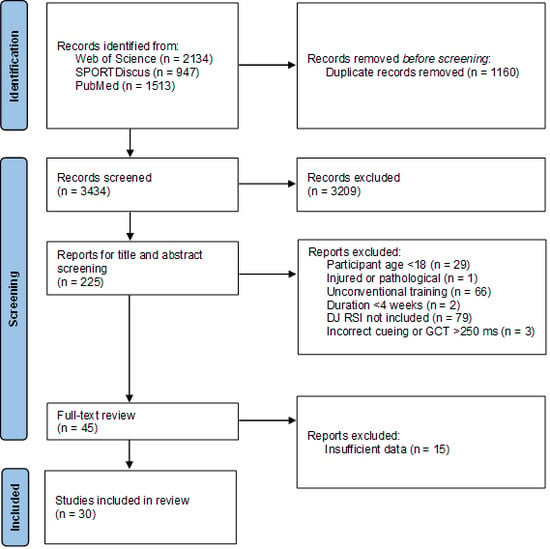
Following duplicate removal, 3434 articles remained. Title and abstract screening further reduced this to 225 articles for full-text evaluation. 30 studies met the inclusion criteria and had sufficient data that were retained for meta-analysis and systematic review, yielding 48 intervention arms. Figure 1 describes the PRISMA process applied to this review (when studies met multiple exclusion criteria, individual criteria were not double-counted and were counted in the order seen in Figure 1).
Figure 1.
PRISMA flow diagram describing the selection processes for eligible articles.
3.2. Study Characteristics
Of the 30 included studies, 18 recruited male-only, 5 female-only, and 7 mixed-sex samples. Twenty-three studies involved athletic populations and 7 involved non-athletic or recreationally trained participants. Following modality reclassification, the 48 intervention arms comprised 10 plyometric, 7 ballistic, 21 strength and 10 combined training interventions. A majority (n = 22) of the studies utilised one DJ testing height, with the remaining testing multiple heights or an ‘individualised’ drop height (n = 8). Lastly, force platforms (n = 13) and contact mats (n = 12) were the most frequently used testing devices, with the remainder coming from optical systems, timing systems, or video analysis. A summary of the study and intervention characteristics can be found in Table 1.
Table 1.
Summary of study and intervention characteristics.
3.3. Summary of Study Quality Assessment
Study quality assessment scores ranged from 10 to 20, with a mean (SD) of 17.5 (2.1). The most frequently unmet criteria were the inclusion of a control group and the assessment of similarity of groups at baseline. This likely reflects the practical difficulty of using intervention control groups in trained populations and inadequate scientific rigour to statistically assess baseline group comparability (Supplementary Material Table S2).
3.4. Overall Meta-Analysis
The analysis included a multilevel random-effects analysis of 48 intervention arm standardised mean changes nested within 30 studies. Effect sizes were Hedges-corrected standardised mean changes using baseline-SD (raw-score) standardisation, with positive values indicating higher DJ-derived RSI at post-intervention. The analysis indicated a positive mean pre–post change in DJ-derived RSI (Hedges g = 0.424, 95% CR2 CI 0.26 to 0.58, p < 0.001). As the available dataset contains intervention arm pre–post outcomes only, this result represents an observed within-group change and should not be interpreted as a controlled intervention versus control effect.
The prediction interval was wide and included no change (−0.27 to 1.11), indicating substantial variation in the expected effect in future settings. Residual heterogeneity was statistically significant (Q = 96.86, p < 0.001). In the multilevel decomposition, total I2 was 48.9%, comprising 29.3% between-study variation and 19.6% variation among effects within studies.
3.5. Sensitivity Analysis
The pooled standardised mean change was robust to the assumed pre–post correlation. Across values of r from 0.30 to 0.90, the estimated effect ranged only from g = 0.42 to 0.43 (Table 2). When a within-study sampling-error correlation of 0.50 was imposed among multiple effects from the same study, the pooled estimate was g = 0.41 (95% CI 0.24 to 0.57).
Table 2.
Sensitivity analyses for the pooled standardised mean change in DJ-derived RSI.
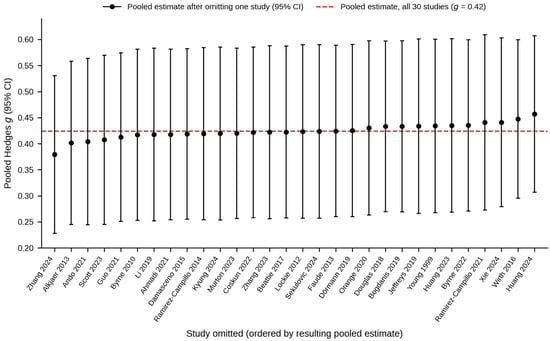
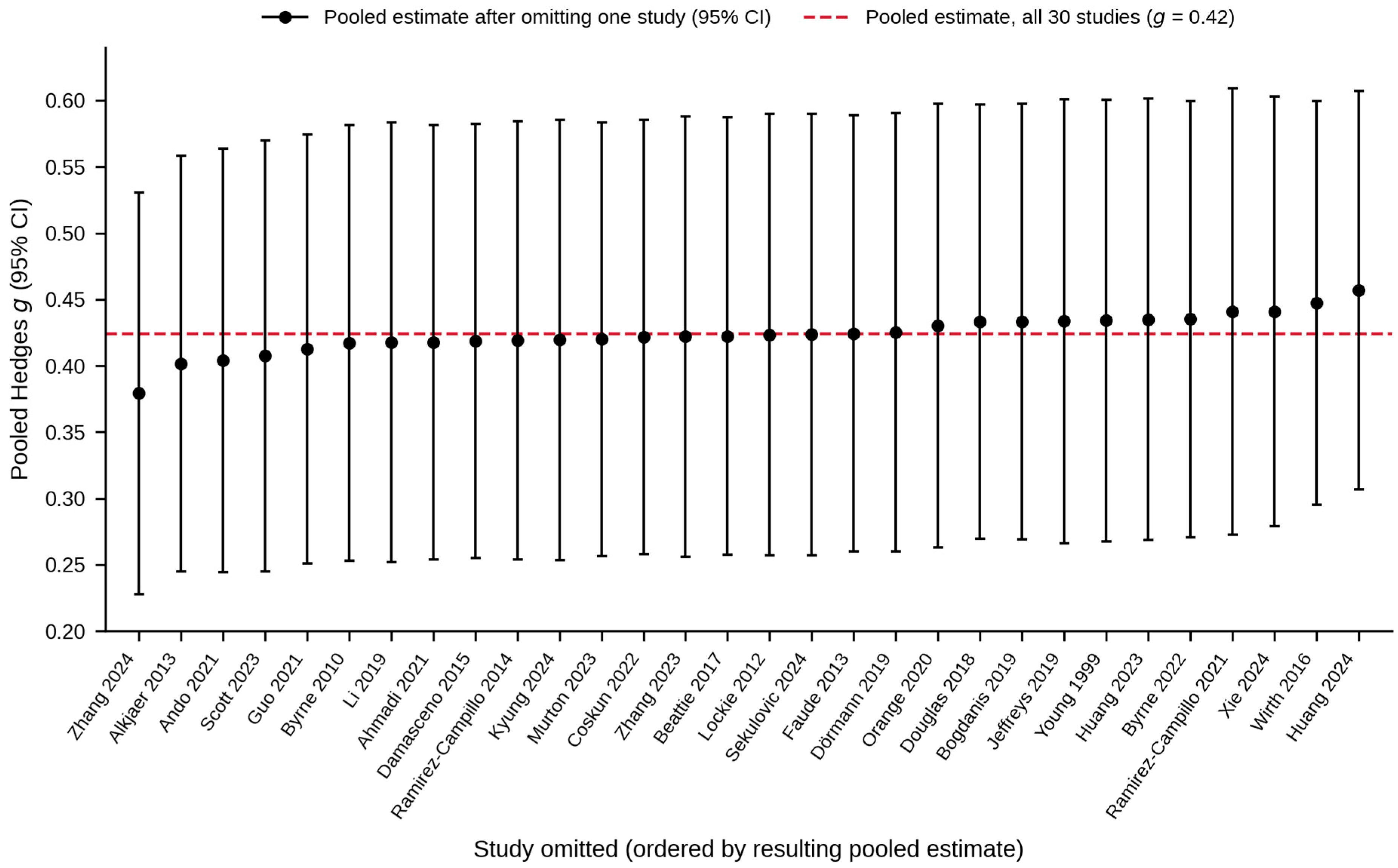
Leave-one-study-out analyses showed that the pooled estimate remained positive when each study cluster was excluded in turn (range g = 0.38 to 0.46; Figure 2). The lowest estimate followed exclusion of the three Zhang [105] effects (g = 0.38, 95% CI 0.23 to 0.53), whereas the highest followed exclusion of the two Huang [91] effects (g = 0.46, 95% CI 0.31 to 0.61). All leave-one-study-out confidence intervals excluded zero.
Figure 2.
Leave-one-study-out sensitivity analysis for the corrected pooled standardised mean change in DJ-derived RSI. Note. Each point and interval is the multilevel pooled Hedges standardised mean change after omitting one study cluster. Study clusters are ordered by the resulting pooled estimate.
3.6. Moderator Analysis
3.6.1. Intervention Modality
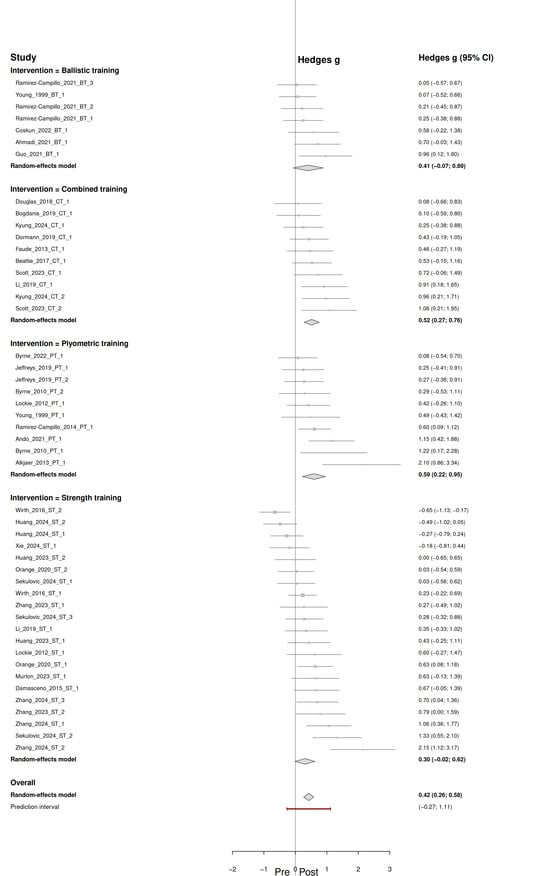
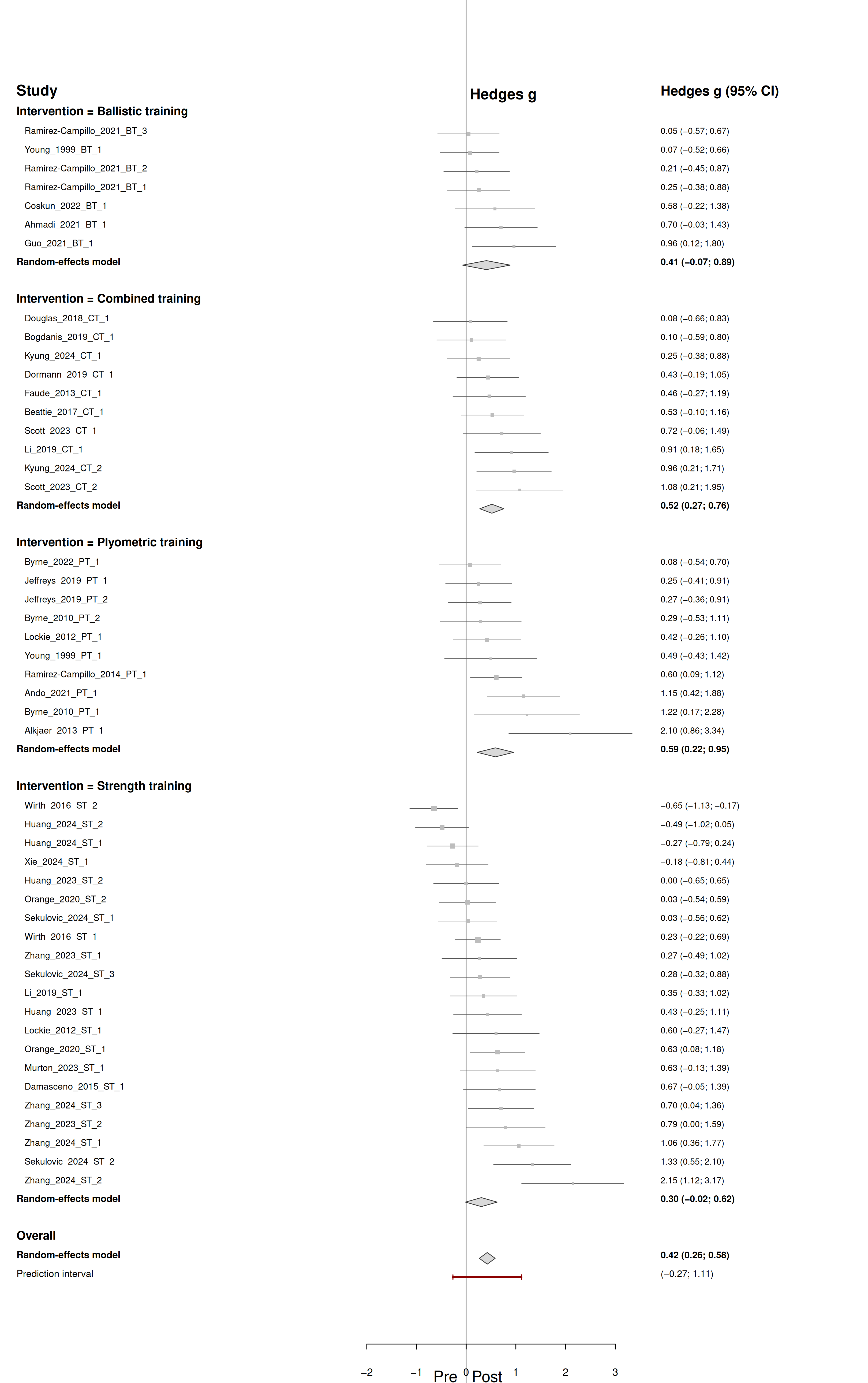
Under the four modality labels, standardised mean changes were positive for combined training (g = 0.52, 95% CI 0.27 to 0.76) and plyometric training (g = 0.59, 95% CI 0.22 to 0.95). Ballistic (g = 0.41, 95% CI −0.07 to 0.89) and strength training (g = 0.31, 95% CI −0.02 to 0.63) had confidence intervals that included zero (Table 3). Individual intervention effects and corrected subgroup summaries are shown in Figure 3. There was no evidence of a difference across the four modality classifications (cluster-robust omnibus HTZ F = 0.68, df = 3 and 10.99, p = 0.583). This non-significant test does not establish equivalence among modalities and does not test the robustness of the result to alternative classification thresholds.
Table 3.
Multilevel subgroup estimates.
Figure 3.
Forest plot of intervention arm Hedges g (95% CI) stratified by intervention arm modality, with subgroup estimates, the overall pooled estimate and the 95% PI.
3.6.2. Intervention Population
Both athletic and non-athletic populations showed positive pooled standardised mean changes. The estimated effect was g = 0.43 (95% CI 0.23 to 0.63) in athletes and g = 0.41 (95% CI 0.11 to 0.71) in non-athletes. There was no evidence of a difference between population groups (HTZ F = 0.01, df = 1 and 8.97, p = 0.919; Table 3). The individual-effect forest plot stratified by population is provided in Supplementary Figure S3.
3.6.3. Intervention Duration
The pooled standardised mean change was g = 0.47 (95% CI 0.30 to 0.64) for interventions lasting ≤6 weeks and g = 0.38 (95% CI 0.10 to 0.67) for those lasting ≥7 weeks. The categorical subgroup difference was not statistically significant (HTZ F = 0.30, df = 1 and 25.43, p = 0.588; Table 3). The individual-effect forest plot stratified by duration category (Supplementary Figure S4) alongside the duration meta-regression (Supplementary Text S5) is included in the Supplementary Materials File.
3.7. Reporting Bias and Small-Study Effects
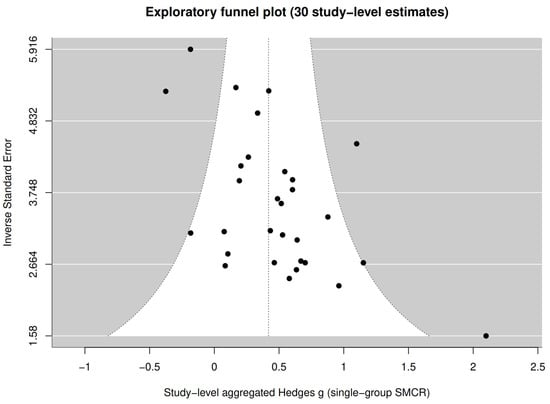
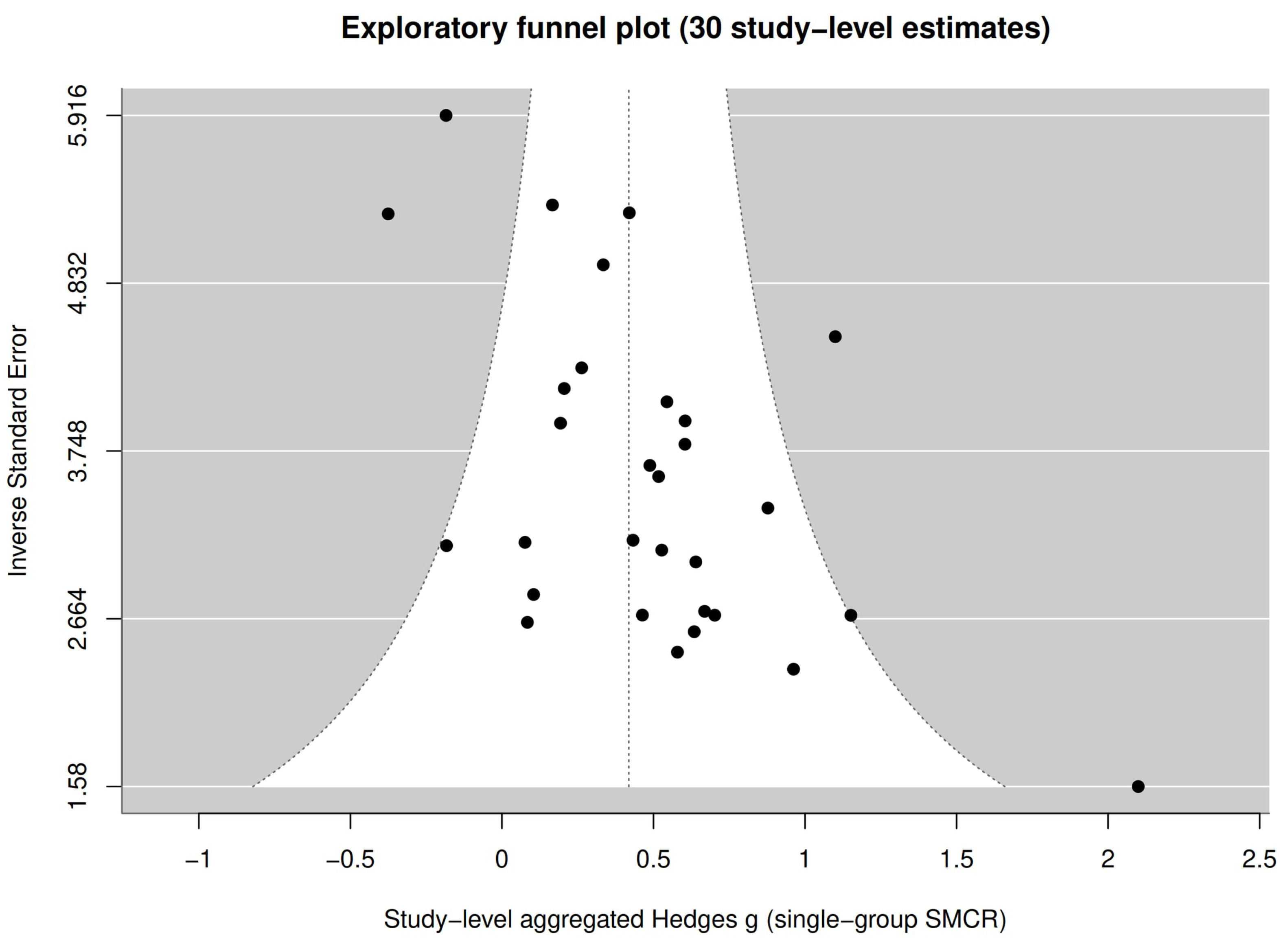
Reporting-bias analyses were conducted at the study level, rather than treating the 48 intervention effects as independent. Multiple effects were inverse-variance aggregated to one estimate per study, yielding 30 study-level standardised mean changes. The funnel plot was asymmetric (Figure 4). Egger’s regression test (z = 3.31, p = 0.0026) and Begg’s rank-correlation test (τ = 0.278, p = 0.031) were statistically significant (Table 4). In an exploratory trim-and-fill analysis, eight studies were imputed, and the pooled standardised mean change attenuated from g = 0.42 (95% CI 0.26 to 0.58) to g = 0.27 (95% CI 0.12 to 0.43).
Figure 4.
Funnel plot of the 30 study-level aggregated standardised mean changes.
Table 4.
Exploratory study-level reporting-bias and small-study-effect diagnostics.
These results are consistent with small-study effects or funnel asymmetry but do not demonstrate that publication bias is the cause. The findings should be interpreted cautiously because the underlying study effects were heterogeneous and the study-level aggregation is a sensitivity approach. Conventional asymmetry tests were not conducted within the small modality subgroups because the number of independent studies was insufficient for reliable inference.
4. Discussion
4.1. Summary of Findings
The primary aim of this research was to systematically review and meta-analyse existing literature to determine the change in DJ-derived RSI following resistance training and to compare plyometric, ballistic, strength and combined training modalities. A secondary aim was to determine whether these adaptations differed according to population characteristics and intervention duration. Across 30 studies contributing 48 intervention arms, DJ-derived RSI increased from pre- to post-intervention by a small-to-moderate, statistically significant amount (g = 0.42, 95% CI 0.26 to 0.58). However, the overall prediction interval spanned negative to positive values (−0.27 to 1.11), indicating substantial variability in the magnitude and direction of change observable in a future intervention. Additionally, as these estimates reflect uncontrolled pre–post changes, the effect cannot be attributed solely to the training interventions.
Plyometric training demonstrated the largest standardised mean change (g = 0.59), followed by combined (g = 0.52), ballistic (g = 0.41) and strength training (g = 0.31). Although confidence intervals excluded zero for plyometric and combined training, this was not true for ballistic and strength training interventions. However, there was no evidence of statistically significant difference between modalities (p = 0.583), nor that changes differed between athletes and non-athletes (p = 0.919), between shorter and longer interventions (p = 0.588), or with intervention duration examined continuously (p = 0.598).
4.2. Overall Change in DJ-Derived RSI
The overall findings suggest that while DJ-derived RSI typically improves following resistance training, the magnitude of change is modest, variable and smaller than the reported effect or change seen in other strength qualities such as maximal dynamic and fast dynamic (CMJ) strength. Two recent meta-analyses [107,108] reported significant improvements in maximal dynamic strength following resistance training (SMD = 0.77 & 0.98), while another reported large improvements in CMJ height (+9.9 cm, 95% CI: 6.7 to 13.5) with negligible heterogeneity (I2 = 0.0%) [109]. This may reflect that highly specific training might be necessary to develop reactive strength, as it is a unique expression of multiple underpinning mechanisms that have limited overlap with generalised resistance training [1,2,3,4].
Funnel plot asymmetry and significant study-level Egger and Begg tests indicate that smaller studies tended to report larger changes, and the trim-and-fill adjusted estimate (g = 0.27, 95% CI 0.12 to 0.43) was lower than the unadjusted study-level estimate (g = 0.42), indicating that the true change in DJ-derived RSI after resistance training may be smaller than the unadjusted estimate, and that little, no change or even a decrease cannot be excluded in an individual future setting. This is consistent with small-study effects but does not demonstrate publication bias, as asymmetry can also arise from heterogeneity or from systematic differences between smaller and larger studies, such as participant characteristics, intervention differences or testing procedures. Therefore, although the adjusted estimate remained positive, it should be interpreted cautiously given the meaningful heterogeneity.
4.3. Plyometric Training
Although not statistically different from the other modalities, plyometric training demonstrated the largest pooled change of the intervention types (g = 0.59, 95% CI 0.22 to 0.95), and included one of the highest individual intervention effects. This is consistent with previous literature [29] and aligns with the mechanical specificity of plyometric training for developing reactive strength. However, the wide confidence interval and the absence of a significant between-modality difference mean that plyometric training was not demonstrated to be statistically advantageous over the other modalities. Analysis of the individual interventions revealed that the largest plyometric training change in DJ-derived RSI [80] was observed in well-trained, national-level sprint and jump athletes who did not routinely perform DJs in training. This may have been influenced by the highly supervised nature of the intervention, whereby all DJs were overseen by the principal investigator, with the athletes receiving immediate, individualised feedback following each trial. In addition, analysis of the coefficient of variation (CV) for jump height, GCT, and RSI across the 4-week intervention indicated a learning effect, with performance variables plateauing after the second week of training. In contrast, another of the largest plyometric effects [81] was seen in an intervention that excluded participants if they were particularly well-trained in running, jumping or any form of training that could potentially impact the stiffness of their plantar flexor muscles. When comparing these studies, conflicting albeit valuable information can be inferred about the effect of plyometric training on DJ-derived RSI. Alkjaer et al. found that if athletes already possess the underpinning neuromuscular attributes that support fast SSC performance, a short-term intervention can significantly improve RSI testing outcomes [80], while Ando et al.’s results suggest that plyometric training can be a highly effective strategy for improving RSI in untrained individuals [81]. There may also be a relationship between plyometric training and RSI test specificity, as the two lowest effects were seen in interventions that trained plyometric exercises as part of a composite activity integrated into sprint training [84] or completed a high volume of less specific unilateral, hurdle, and multidirectional plyometrics [93]. Together, these findings suggest that the magnitude of plyometric training-induced improvements to RSI may depend on both participant training status and the degree of specificity between the plyometric intervention and the reactive strength assessment used to capture its effects.
4.4. Ballistic Training
Ballistic training had the second-lowest pooled change of intervention modalities (g = 0.41, 95% CI −0.07 to 0.89), with a confidence interval that included zero, and no individual intervention producing a particularly large effect. Notably, no included training interventions incorporated loaded ballistic exercises (weightlifting derivatives, loaded jumps, etc.), and interventions in the ballistic classification were primarily made up of training programs incorporating a range of slow SSC unloaded jumping variations that did not include GCT constraints or specifically instruct participants to jump for maximal height only. Importantly, previous reviews have classified jumping interventions of this nature as plyometric training [28,29,30]; however, as fast and slow SSC actions share limited commonality, this review restricted plyometrics to be defined by movements that explicitly target rapid GCTs and include fast SSC exercises. This difference is highlighted in an intervention that found a significant difference in RSI following an intervention comprising plyometric DJs (cued for minimal GCT and maximal jump height) against an intervention of ballistic DJs (cued for maximal height only) [104]. Additionally, upon further analysis of the ballistic interventions with the highest effect, all three incorporated a portion of training volume to fast SSC drop jumps [41,79] and/or hurdle jumps [79,90]. However, the interventions were still classified as ballistic training, as the overall volume of the lower-body training comprised ballistic or slow SSC jumping exercises. This highlights uncertainty that the observed RSI improvement may be attributable to the inclusion of plyometrics and fast SSC movements rather than the light ballistic exercises within the program. The interpretation of the pooled effect of ballistic training on RSI is also constrained by the limited number of studies and the predominance of interventions that include only low-load ballistic movements, highlighting a clear gap in the literature regarding heavier ballistic training approaches. Overall, these findings suggest that light ballistic training is associated with a small and imprecisely estimated change in RSI and, given the apparent contribution of fast SSC content within the highest-performing interventions, the true effect of ballistic training in isolation remains unclear.
4.5. Strength Training
Strength training had the smallest pooled change of the four modalities (g = 0.31, 95% CI −0.02 to 0.62), with a confidence interval that included zero, and was the only subgroup in which any interventions showed decreases in RSI following training. Individual effects ranged widely, indicating that strength training alone may improve or have a detrimental impact on DJ-derived RSI. This inconsistency may reflect the velocity-specific nature of strength adaptation, whereby traditional heavy-load strength training reliably increases maximal force-generating capacity [17,56] and transfers to slower SSC ballistic actions such as the countermovement or squat jump [19,35]. Consistent with this, the two interventions with the largest positive effects regulated exercise set volume using 20% power-loss [105] or 15% velocity-loss [101] thresholds, an approach associated with maintaining higher movement velocities throughout training [110,111]. Additionally, the intervention reporting the largest positive effect [105] measured low initial mean lower-body strength and RSI values, suggesting that the magnitude of improvement may be partially explained by participants starting with a poor initial reactive strength capacity and therefore a greater potential for adaptation. This aligns with previous literature that states that individuals with lower initial performance levels can benefit from a less specific stimulus [17] and typically exhibit larger improvements when compared to highly trained individuals [112]. Lastly, the intervention with the largest negative effect [102] used a leg-press-only protocol. As machine-based exercises utilise a fixed path that removes the postural and coordinative demands present in free-weight training, machine-based exercises may have limited capacity to transfer to fast dynamic tasks like the DJ [17,32]. Notably, within this same study, back squat training produced greater improvements in jump and speed-strength outcomes than the leg press training, directly implicating exercise selection rather than training modality, volume, or intensity [102]. Collectively, these findings indicate that while strength training may improve RSI, the change is small and inconsistent with the patterns observed in individual interventions, indicating that initial reactive strength performance, movement-velocity intent and exercise selection potentially contribute to the observed performance change.
4.6. Combined Training
Combined training had a statistically significant pooled change in RSI (g = 0.52, 95% CI 0.27 to 0.76), second only to plyometric training in magnitude, with all individual combined effects indicating positive change. Importantly, this does not show that combined training is superior or more consistent than other modalities, as modality differences were not statistically supported (p = 0.583) and subgroup-specific heterogeneity and prediction intervals were not estimated. One of the combined interventions producing the largest positive effects found a significant difference in RSI when comparing a combined approach of pairing heavy resistance exercises with biomechanically similar plyometric exercises (back squats paired with drop jumps) to a traditional heavy resistance training program [67]. This suggests that the inclusion of fast SSC plyometrics alongside strength training supports reactive strength adaptations over strength training alone. However, the overall effect of this intervention was still lower than what was seen in the highest-performing plyometric-only interventions and may suggest that the shared training volume across modalities meant that the stimulus directed at specific qualities was likely diluted. Additionally, the two lowest effects [83,88] were seen in interventions that incorporated a very small proportion of the training to plyometric exercises, potentially elucidating that a minimum effective dose of the stimulus was not closely aligned to fast SSC movements. Together, these findings suggest that the magnitude of change following combined training may depend on how much of the shared training volume and focus is directed toward fast SSC actions rather than on the mere inclusion of a plyometric component.
4.7. Population
Subgroup analyses revealed no significant difference in DJ-derived RSI change between athletes (g = 0.43, 95% CI 0.23 to 0.63) and non-athletes (g = 0.41, 95% CI 0.11 to 0.71; p = 0.919). However, the absence of a difference should be interpreted cautiously, as it may partly reflect substantial overlap in baseline RSI across studies rather than a genuine lack of population-dependent effect. As athlete status in the included studies was determined by author-assigned descriptions of population (e.g., trained, athlete, etc.) rather than standardised objective performance thresholds, it likely reflects a broader limitation across sport science literature in which such terms are applied inconsistently and without a common classification framework [113]. Consequently, the ‘athlete’ and ‘non-athlete’ subgroups may not have meaningfully discerned greater reactive strength or athletic capacity. This is reiterated as several studies with participants classified as ‘athletes’ reported baseline RSI values comparable to or lower than those of ‘non-athlete’ populations. Taken together, these findings suggest that the population subgroup comparison likely lacked the classification precision needed to distinguish greater initial capacity or to detect a true population-dependent effect on RSI trainability.
4.8. Duration
Analysis of intervention duration revealed no significant difference in RSI adaptations between shorter (≤6 weeks; g = 0.47, 95% CI 0.30 to 0.64) or longer (≥7 weeks; g = 0.38, 95% CI 0.09 to 0.67) programmes (p = 0.588), and no association in the exploratory meta-regression of duration in weeks (slope = 0.0028 g per week, 95% CI −0.032 to 0.038, p = 0.598; Supplementary Material Text S5). As with the population subgroup analysis, this absence of a difference should be interpreted cautiously rather than taken as evidence that intervention length has no bearing on RSI adaptation. As duration in weeks is a coarse proxy for total training dose, it does not fully capture session frequency, total training volume, or the progression of intensity within a training intervention. This limitation is compounded by the fact that the duration subgroups in this review were pooled across all four training modalities, meaning any modality-specific duration effect could have been diluted or obscured once collapsed into a single cross-modality comparison. This may partly explain why the present findings diverge from prior modality-specific meta-analytic evidence [29], which has reported greater RSI improvements following plyometric-only interventions of >7 weeks compared with ≤7 weeks. It is also plausible that a ceiling effect contributes to the null result, as neuromuscular and coordinative adaptations underpinning early RSI improvements can plateau within the first few weeks of training exposure [80]. Finally, the ability to detect duration-related changes in the present analysis is constrained by the limited variability in intervention length, as 44 of the 48 included interventions were conducted over a narrow 4- to 8-week period. These findings suggest that the duration subgroup comparison likely lacked the granularity to capture the true dose–response relationship between training exposure and RSI adaptation rather than indicating that program length is unimportant to reactive strength development.
4.9. Practical Application and Future Directions
Collectively, these findings offer several considerations for practitioners programming resistance training to develop reactive strength. Given the modest average change and wide prediction intervals, practitioners should expect incremental rather than consistently large improvements in DJ-derived RSI as a response to resistance training. As such, these are practical interpretations of the data rather than definitive conclusions established by the meta-analysis. When improving reactive strength is a primary training target, plyometric training had the largest point estimate; however, modalities were not statistically distinguishable. Therefore, the use of plyometric training is better supported by the mechanical specificity to reactive strength and fast SSC actions than by a demonstrated superiority, with the potential benefits likely mediated by the athlete’s underlying neuromuscular qualities and the similarity of training to the chosen test. Ballistic and strength training may also be associated with improvements, and although their confidence intervals included zero, the individual interventions with the largest changes tended to include fast SSC plyometric movements or velocity-based load regulation to encourage fast movement intent. Strength training may also be of greater value in athletes with low initial reactive strength capacity, where a less specific stimulus can still yield meaningful adaptations.
Finally, combined training had a pooled change comparable to plyometric training and often had the greatest effect in interventions where the plyometric component represented a meaningful proportion of total training volume and focus.
Future research should aim to explore the effect of distinct resistance training modalities in an isolated and internally controlled trial. Additionally, alongside the implementation of contrasting training-modality comparisons, studies should aim to include concurrent neuromuscular and architectural measures to help clarify potential mechanisms underpinning the observed effect.
4.10. Limitations
Three primary limitations should be considered when interpreting these findings. First, the pooled estimates represent uncontrolled within-group pre–post changes and cannot be interpreted as direct causal effects of the interventions. Given the skill-dependent nature of the DJ, change over this period may also reflect learning effects or a response to extraneous stimuli such as concurrent sport-specific, sprint or endurance training. Second, classifying interventions and populations into discrete categories required simplification of complex training programmes and participant differences. As such, classifying a multiple-modality intervention arm into a singular category based on ≥60% dominance of that training type may have potentially obscured meaningful between-group differences. Additionally, as there is no established methodology for training classification and alternative thresholds of classification were not tested in the present analysis, the findings should be interpreted as exploratory rather than distinctive comparisons of training strategies. Finally, the authors recognise the meaningful heterogeneity as it likely reflects differences in the intervention’s participant characteristics (age, sex, training status, sport background), training and testing methodologies. These sources of heterogeneity observed across the analyses indicate substantial variability and limit the precision of pooled estimates.
5. Conclusions
The results of this systematic review and meta-analysis demonstrate that DJ-derived RSI modestly improves following resistance training, with no statistically significant difference found when comparing intervention modalities. Although plyometric training was associated with the largest pooled change, considerable variability in results was seen across all training modalities. While a key outcome of this investigation was the lack of clear subgroup differences, larger changes in individual intervention arms suggest that highly task-specific plyometric strategies may elicit the greatest improvements in RSI, highlighting the importance of aligning training stimuli with the mechanical and temporal demands of the chosen reactive strength test.
Supplementary Materials
The following supporting information can be downloaded at: https://www.mdpi.com/article/10.3390/sports14110524/s1, Table S1: Database search terms and keywords; Table S2: Summary of study quality assessment; Figure S3: Forest plot of intervention arm Hedges g (95% CI) stratified by intervention population, with subgroup estimates, the overall pooled estimate and the 95% prediction interval; Figure S4: Forest plot of intervention arm Hedges g (95% CI) stratified by intervention duration, with subgroup estimates, the overall pooled estimate and the 95% prediction interval, Supplementary Material Text S5: Exploratory continuous meta-regression of intervention duration.
Author Contributions
Conceptualization, L.P.J., S.W.T., C.J.D. and L.W.G.; methodology, L.P.J., L.W.G. and M.H.; formal analysis, L.W.G. and M.H.; writing-original draft preparation, L.W.G.; writing—L.W.G., C.J.D., S.W.T., M.H. and L.P.J.; review and editing—L.W.G., C.J.D., S.W.T., M.H. and L.P.J. All authors have read and agreed to the published version of the manuscript.
Funding
This research received no external funding.
Institutional Review Board Statement
Not applicable.
Informed Consent Statement
Not applicable.
Data Availability Statement
Extracted study and intervention data are available upon request to the corresponding author. The following link provides the R code to run the analysis: https://github.com/m2huynh/LukeG_Study/blob/main/Code (accessed on 26 October 2026).
Conflicts of Interest
The authors declare no conflicts of interest.
References
- James, L.P.; Talpey, S.W.; Young, W.B.; Geneau, M.C.; Newton, R.U.; Gastin, P.B. Strength Classification and Diagnosis: Not All Strength Is Created Equal. Strength Cond. J. 2023, 45, 333–341. [Google Scholar] [CrossRef] [Scilit]
- Young, W.B. Laboratory strength assessment of athletes. New Stud. Athl. 1995, 10, 89. [Google Scholar]
- Xu, J.; Turner, A.; Jordan, M.J.; Comyns, T.M.; Chavda, S.; Bishop, C. A Narrative Review of Rebound Jumping and Fast Stretch-Shortening Cycle Mechanics. Strength Cond. J. 2025, 47, 302–316. [Google Scholar] [CrossRef] [Scilit]
- Turner, A.N.; Jeffreys, I. The Stretch-Shortening Cycle: Proposed Mechanisms and Methods for Enhancement. Strength Cond. J. 2010, 32, 87–99. [Google Scholar] [CrossRef] [Scilit]
- Jarvis, P.; Turner, A.; Read, P.; Bishop, C. Reactive Strength Index and its Associations with Measures of Physical and Sports Performance: A Systematic Review with Meta-Analysis. Sports Med. 2022, 52, 301–330. [Google Scholar] [CrossRef] [Scilit] [PubMed]
- Lloyd, R.S.; Oliver, J.L.; Hughes, M.G.; Williams, C.A. Reliability and validity of field-based measures of leg stiffness and reactive strength index in youths. J. Sports Sci. 2009, 27, 1565–1573. [Google Scholar] [CrossRef] [Scilit] [PubMed]
- Flanagan, E.P.; Ebben, W.P.; Jensen, R.L. Reliability of the reactive strength index and time to stabilization during depth jumps. J. Strength Cond. Res. 2008, 22, 1677–1682. [Google Scholar] [CrossRef] [Scilit] [PubMed]
- Feldmann, C.R.; Weiss, L.W.; Ferreira, L.C.; Schilling, B.K.; Hammond, K.G. Reactive Strength Index and Ground Contact Time: Reliability, Precision, and Association with Drop Vertical Jump Displacement. J. Strength Cond. Res. 2011, 25, S1. [Google Scholar] [CrossRef] [Scilit]
- Byrne, D.J.; Browne, D.T.; Byrne, P.J.; Richardson, N. Interday Reliability of the Reactive Strength Index and Optimal Drop Height. J. Strength Cond. Res. 2017, 31, 721–726. [Google Scholar] [CrossRef] [Scilit] [PubMed]
- Markwick, W.J.; Bird, S.P.; Tufano, J.J.; Seitz, L.B.; Haff, G.G. The intraday reliability of the Reactive Strength Index calculated from a drop jump in professional men’s basketball. Int. J. Sports Physiol. Perform. 2015, 10, 482–488. [Google Scholar] [CrossRef] [Scilit] [PubMed]
- Young, W.B.; McLean, B.; Ardagna, J. Relationship between strength qualities and sprinting performance. J. Sports Med. Phys. Fit. 1995, 35, 13–19. [Google Scholar]
- Young, W.B.; Wilson, G.J.; Byrne, C. Relationship between strength qualties and performance in standing and run-up vertical jumps. J. Sports Med. Phys. Fit. 1999, 39, 285. [Google Scholar]
- Young, W.B.; Miller, I.R.; Talpey, S.W. Physical qualities predict change-of-direction speed but not defensive agility in Australian rules football. J. Strength Cond. Res. 2015, 29, 206–212. [Google Scholar] [CrossRef] [Scilit] [PubMed]
- Li, F.; Newton, R.U.; Shi, Y.; Sutton, D.; Ding, H. Correlation of Eccentric Strength, Reactive Strength, and Leg Stiffness With Running Economy in Well-Trained Distance Runners. J. Strength Cond. Res. 2021, 35, 1491–1499. [Google Scholar] [CrossRef] [Scilit] [PubMed]
- Moeskops, S.; Pedley, J.S.; Oliver, J.L.; Lloyd, R.S. The Influence of Competitive Level on Stretch-Shortening Cycle Function in Young Female Gymnasts. Sports 2022, 10, 107. [Google Scholar] [CrossRef] [Scilit] [PubMed]
- Lockie, R.G.; Murphy, A.J.; Knight, T.J.; Janse de Jonge, X.A. Factors that differentiate acceleration ability in field sport athletes. J. Strength Cond. Res. 2011, 25, 2704–2714. [Google Scholar] [CrossRef] [Scilit] [PubMed]
- Suchomel, T.J.; Nimphius, S.; Bellon, C.R.; Stone, M.H. The Importance of Muscular Strength: Training Considerations. Sports Med. 2018, 48, 765–785. [Google Scholar] [CrossRef] [Scilit] [PubMed]
- Chu, D.A.; Myer, G.D. Anatomy and Physiology of Plyometrics. In Plyometrics; Human Kinetics: Champaign, IL, USA, 2013; pp. 13–26. [Google Scholar]
- Cormie, P.; McGuigan, M.R.; Newton, R.U. Developing maximal neuromuscular power: Part 2—Training considerations for improving maximal power production. Sports Med. 2011, 41, 125–146. [Google Scholar] [CrossRef] [Scilit] [PubMed]
- de Villarreal, E.S.; Kellis, E.; Kraemer, W.J.; Izquierdo, M. Determining variables of plyometric training for improving vertical jump height performance: A meta-analysis. J. Strength Cond. Res. 2009, 23, 495–506. [Google Scholar] [CrossRef] [Scilit] [PubMed]
- Sole, C.J. Plyometric training. In Advanced Strength and Conditioning: An Evidence-Based Approach; Taylor & Francis Group: Milton, UK, 2017; pp. 315–333. [Google Scholar]
- Markovic, G.; Mikulic, P. Neuro-musculoskeletal and performance adaptations to lower-extremity plyometric training. Sports Med. 2010, 40, 859–895. [Google Scholar] [CrossRef] [Scilit] [PubMed]
- Chimera, N.J.; Swanik, K.A.; Swanik, C.B.; Straub, S.J. Effects of Plyometric Training on Muscle-Activation Strategies and Performance in Female Athletes. J. Athl. Train. 2004, 39, 24–31. [Google Scholar] [PubMed]
- Kubo, K.; Morimoto, M.; Komuro, T.; Yata, H.; Tsunoda, N.; Kanehisa, H.; Fukunaga, T. Effects of plyometric and weight training on muscle-tendon complex and jump performance. Med. Sci. Sports Exerc. 2007, 39, 1801–1810. [Google Scholar] [CrossRef] [Scilit] [PubMed]
- Taube, W.; Leukel, C.; Gollhofer, A. How neurons make us jump: The neural control of stretch-shortening cycle movements. Exerc. Sport Sci. Rev. 2012, 40, 106–115. [Google Scholar] [CrossRef] [Scilit] [PubMed]
- Kubo, K.; Ikebukuro, T.; Yata, H. Effects of plyometric training on muscle-tendon mechanical properties and behavior of fascicles during jumping. Physiol. Rep. 2021, 9, e15073. [Google Scholar] [CrossRef] [Scilit] [PubMed]
- Ramírez-delaCruz, M.; Bravo-Sánchez, A.; Esteban-García, P.; Jiménez, F.; Abián-Vicén, J. Effects of Plyometric Training on Lower Body Muscle Architecture, Tendon Structure, Stiffness and Physical Performance: A Systematic Review and Meta-analysis. Sports Med. Open 2022, 8, 40. [Google Scholar] [CrossRef] [Scilit] [PubMed]
- Ramirez-Campillo, R.; Sortwell, A.; Moran, J.; Afonso, J.; Clemente, F.M.; Lloyd, R.S.; Oliver, J.L.; Pedley, J.; Granacher, U. Plyometric-Jump Training Effects on Physical Fitness and Sport-Specific Performance According to Maturity: A Systematic Review with Meta-analysis. Sports Med. Open 2023, 9, 23. [Google Scholar] [CrossRef] [Scilit] [PubMed]
- Ramirez-Campillo, R.; Thapa, R.K.; Afonso, J.; Perez-Castilla, A.; Bishop, C.; Byrne, P.J.; Granacher, U. Effects of Plyometric Jump Training on the Reactive Strength Index in Healthy Individuals Across the Lifespan: A Systematic Review with Meta-analysis. Sports Med. 2023, 53, 1029–1053. [Google Scholar] [CrossRef] [Scilit] [PubMed]
- Rebelo, A.; Pereira, J.R.; Martinho, D.V.; Duarte, J.P.; Coelho, E.S.M.J.; Valente-Dos-Santos, J. How to Improve the Reactive Strength Index among Male Athletes? A Systematic Review with Meta-Analysis. Healthcare 2022, 10, 593. [Google Scholar] [CrossRef] [Scilit] [PubMed]
- Cronin, J.; McNair, P.J.; Marshall, R.N. Developing explosive power: A comparison of technique and training. J. Sci. Med. Sport 2001, 4, 59–70. [Google Scholar] [CrossRef] [Scilit] [PubMed]
- Suchomel, T.J.; Comfort, P. Developing muscular strength and power. In Advanced Strength and Conditioning: An Evidence-Based Approach; Taylor & Francis Group: Milton, UK, 2017; pp. 40–65. [Google Scholar]
- Suchomel, T.J.; Comfort, P.; Stone, M.H. Weightlifting pulling derivatives: Rationale for implementation and application. Sports Med. 2015, 45, 823–839. [Google Scholar] [CrossRef] [Scilit] [PubMed]
- Wilson, G.J.; Newton, R.U.; Murphy, A.J.; Humphries, B.J. The optimal training load for the development of dynamic athletic performance. Med. Sci. Sports Exerc. 1993, 25, 1279–1286. [Google Scholar] [CrossRef] [Scilit]
- Cormie, P.; McGuigan, M.R.; Newton, R.U. Adaptations in athletic performance after ballistic power versus strength training. Med. Sci. Sports Exerc. 2010, 42, 1582–1598. [Google Scholar] [CrossRef] [Scilit] [PubMed]
- Cormie, P.; McGuigan, M.R.; Newton, R.U. Influence of strength on magnitude and mechanisms of adaptation to power training. Med. Sci. Sports Exerc. 2010, 42, 1566–1581. [Google Scholar] [CrossRef] [Scilit] [PubMed]
- Cormie, P.; McGuigan, M.R.; Newton, R.U. Developing maximal neuromuscular power: Part 1—Biological basis of maximal power production. Sports Med. 2011, 41, 17–38. [Google Scholar] [CrossRef] [Scilit] [PubMed]
- Häkkinen, K.; Komi, P.V. Effect of explosive type strength training on electromyographic and force production characteristics of leg extensor muscles during concentric and various stretch-shortening cycle exercises. Scand. J. Sports Sci. 1985, 2, 65–76. [Google Scholar]
- Sale, D.G. Neural adaptation to resistance training. Med. Sci. Sports Exerc. 1988, 20, S135–S145. [Google Scholar] [CrossRef] [Scilit] [PubMed]
- Van Cutsem, M.; Duchateau, J.; Hainaut, K. Changes in single motor unit behaviour contribute to the increase in contraction speed after dynamic training in humans. J. Physiol. 1998, 513, 295–305. [Google Scholar] [CrossRef] [Scilit] [PubMed]
- Coskun, B.; Aras, D.; Akalan, C.; Kocak, S.; Hamlin, M.J. Plyometric Training in Normobaric Hypoxia improves Jump Performance. Int. J. Sports Med. 2022, 43, 519–525. [Google Scholar] [CrossRef] [Scilit] [PubMed]
- Newton, R.U.; Kraemer, W.J.; Hakkinen, K. Effects of ballistic training on preseason preparation of elite volleyball players. Med. Sci. Sports Exerc. 1999, 31, 323–330. [Google Scholar] [CrossRef] [Scilit] [PubMed]
- Aagaard, P.; Andersen, J.L.; Dyhre-Poulsen, P.; Leffers, A.M.; Wagner, A.; Magnusson, S.P.; Halkjaer-Kristensen, J.; Simonsen, E.B. A mechanism for increased contractile strength of human pennate muscle in response to strength training: Changes in muscle architecture. J. Physiol. 2001, 534, 613–623. [Google Scholar] [CrossRef] [Scilit] [PubMed]
- Blazevich, A.J.; Gill, N.D.; Bronks, R.; Newton, R.U. Training-specific muscle architecture adaptation after 5-wk training in athletes. Med. Sci. Sports Exerc. 2003, 35, 2013–2022. [Google Scholar] [CrossRef] [Scilit] [PubMed]
- Folland, J.P.; Williams, A.G. The adaptations to strength training: Morphological and neurological contributions to increased strength. Sports Med. 2007, 37, 145–168. [Google Scholar] [CrossRef] [Scilit] [PubMed]
- Kawakami, Y.; Abe, T.; Kuno, S.Y.; Fukunaga, T. Training-induced changes in muscle architecture and specific tension. Eur. J. Appl. Physiol. Occup. Physiol. 1995, 72, 37–43. [Google Scholar] [CrossRef] [Scilit] [PubMed]
- Kubo, K.; Kanehisa, H.; Fukunaga, T. Effects of resistance and stretching training programmes on the viscoelastic properties of human tendon structures in vivo. J. Physiol. 2002, 538, 219–226. [Google Scholar] [CrossRef] [Scilit] [PubMed]
- Reeves, N.D.; Maganaris, C.N.; Narici, M.V. Effect of strength training on human patella tendon mechanical properties of older individuals. J. Physiol. 2003, 548, 971–981. [Google Scholar] [CrossRef] [PubMed]
- Del Vecchio, A.; Casolo, A.; Negro, F.; Scorcelletti, M.; Bazzucchi, I.; Enoka, R.; Felici, F.; Farina, D. The increase in muscle force after 4 weeks of strength training is mediated by adaptations in motor unit recruitment and rate coding. J. Physiol. 2019, 597, 1873–1887. [Google Scholar] [CrossRef] [Scilit] [PubMed]
- Gabriel, D.A.; Kamen, G.; Frost, G. Neural adaptations to resistive exercise: Mechanisms and recommendations for training practices. Sports Med. 2006, 36, 133–149. [Google Scholar] [CrossRef] [Scilit] [PubMed]
- Semmler, J.G. Motor unit synchronization and neuromuscular performance. Exerc. Sport Sci. Rev. 2002, 30, 8–14. [Google Scholar] [CrossRef] [Scilit] [PubMed]
- Barr, M.J.; Nolte, V.W. The importance of maximal leg strength for female athletes when performing drop jumps. J. Strength Cond. Res. 2014, 28, 373–380. [Google Scholar] [CrossRef] [Scilit] [PubMed]
- Beattie, K.; Carson, B.P.; Lyons, M.; Kenny, I.C. The Relationship Between Maximal Strength and Reactive Strength. Int. J. Sports Physiol. Perform. 2017, 12, 548–553. [Google Scholar] [CrossRef] [Scilit] [PubMed]
- Comfort, P.; Stewart, A.; Bloom, L.; Clarkson, B. Relationships between strength, sprint, and jump performance in well-trained youth soccer players. J. Strength Cond. Res. 2014, 28, 173–177. [Google Scholar] [CrossRef] [Scilit] [PubMed]
- Dymond, C.; Flanagan, E.P.; Turner, A.P. The relationship between maximal strength and plyometric ability in rugby players. In Proceedings of the 29th International Conference on Biomechanics in Sports (ISBS), Porto, Portugal, 27 June–1 July 2011; pp. 77–80. [Google Scholar]
- Suchomel, T.J.; Nimphius, S.; Stone, M.H. The Importance of Muscular Strength in Athletic Performance. Sports Med. 2016, 46, 1419–1449. [Google Scholar] [CrossRef] [Scilit] [PubMed]
- Wisloff, U.; Castagna, C.; Helgerud, J.; Jones, R.; Hoff, J. Strong correlation of maximal squat strength with sprint performance and vertical jump height in elite soccer players. Br. J. Sports Med. 2004, 38, 285–288. [Google Scholar] [CrossRef] [Scilit] [PubMed]
- Newton, R.U.; Kraemer, W.J. Developing Explosive Muscular Power: Implications for a Mixed Methods Training Strategy. Strength Cond. J. 1994, 16, 20–31. [Google Scholar] [CrossRef] [Scilit]
- Harris, G.R.; Stone, M.H.; O’Bryant, H.S.; Proulx, C.M.; Johnson, R.L. Short-Term Performance Effects of High Power, High Force, or Combined Weight-Training Methods. J. Strength Cond. Res. 2000, 14, 14–20. [Google Scholar] [CrossRef] [Scilit]
- Bauer, T.; Thayer, R.E.; Baras, G. Comparison of Training Modalities for Power Development in the Lower Extremity. J. Strength Cond. Res. 1990, 4, 115–121. [Google Scholar] [CrossRef] [Scilit]
- Hartmann, H.; Wirth, K.; Keiner, M.; Mickel, C.; Sander, A.; Szilvas, E. Short-term Periodization Models: Effects on Strength and Speed-strength Performance. Sports Med. 2015, 45, 1373–1386. [Google Scholar] [CrossRef] [Scilit] [PubMed]
- Cormie, P.; McCaulley, G.O.; McBride, J.M. Power versus strength-power jump squat training: Influence on the load-power relationship. Med. Sci. Sports Exerc. 2007, 39, 996–1003. [Google Scholar] [CrossRef] [Scilit] [PubMed]
- Adams, K.; OʼShea, J.P.; OʼShea, K.L.; Climstein, M. The Effect of Six Weeks of Squat, Plyometric and Squat-Plyometric Training on Power Production. J. Strength Cond. Res. 1992, 6, 36–41. [Google Scholar] [CrossRef] [Scilit]
- Xu, Z.; Sun, J.; Gu, J.; Yu, L. Effects of 8 weeks of combined strength and plyometric training on lower limb vertical stiffness and jump performance in elite long jump athletes. Front. Physiol. 2025, 16, 1692254. [Google Scholar] [CrossRef] [Scilit] [PubMed]
- Fatouros, I.G.; Jamurtas, A.Z.; Leontsini, D.; Taxildaris, K.; Aggelousis, N.; Kostopoulos, N.; Buckenmeyer, P. Evaluation of Plyometric Exercise Training, Weight Training, and Their Combination on Vertical Jumping Performance and Leg Strength. J. Strength Cond. Res. 2000, 14, 470–476. [Google Scholar] [CrossRef] [Scilit]
- Issurin, V.B. New horizons for the methodology and physiology of training periodization. Sports Med. 2010, 40, 189–206. [Google Scholar] [CrossRef] [Scilit] [PubMed]
- Li, F.; Wang, R.; Newton, R.U.; Sutton, D.; Shi, Y.; Ding, H. Effects of complex training versus heavy resistance training on neuromuscular adaptation, running economy and 5-km performance in well-trained distance runners. PeerJ 2019, 7, e6787. [Google Scholar] [CrossRef] [Scilit] [PubMed]
- Page, M.J.; McKenzie, J.E.; Bossuyt, P.M.; Boutron, I.; Hoffmann, T.C.; Mulrow, C.D.; Shamseer, L.; Tetzlaff, J.M.; Akl, E.A.; Brennan, S.E.; et al. The PRISMA 2020 statement: An updated guideline for reporting systematic reviews. BMJ 2021, 372, n71. [Google Scholar] [CrossRef] [Scilit] [PubMed]
- Brughelli, M.; Cronin, J.; Levin, G.; Chaouachi, A. Understanding change of direction ability in sport: A review of resistance training studies. Sports Med. 2008, 38, 1045–1063. [Google Scholar] [CrossRef] [Scilit] [PubMed]
- Viechtbauer, W. Conducting Meta-Analyses in R with the metafor Package. J. Stat. Softw. 2010, 36, 1–48. [Google Scholar] [CrossRef] [Scilit]
- Morris, S.B. Estimating Effect Sizes From Pretest-Posttest-Control Group Designs. Organ. Res. Methods 2008, 11, 364–386. [Google Scholar] [CrossRef] [Scilit]
- Hedges, L.V. Distribution Theory for Glass’s Estimator of Effect size and Related Estimators. J. Educ. Stat. 1981, 6, 107–128. [Google Scholar] [CrossRef] [Scilit]
- Cheung, M.W. Modeling dependent effect sizes with three-level meta-analyses: A structural equation modeling approach. Psychol. Methods 2014, 19, 211–229. [Google Scholar] [CrossRef] [Scilit] [PubMed]
- Pustejovsky, J.E.; Tipton, E. Small-Sample Methods for Cluster-Robust Variance Estimation and Hypothesis Testing in Fixed Effects Models. J. Bus. Econ. Stat. 2018, 36, 672–683. [Google Scholar] [CrossRef] [Scilit]
- IntHout, J.; Ioannidis, J.P.; Rovers, M.M.; Goeman, J.J. Plea for routinely presenting prediction intervals in meta-analysis. BMJ Open 2016, 6, e010247. [Google Scholar] [CrossRef] [Scilit] [PubMed]
- Egger, M.; Davey Smith, G.; Schneider, M.; Minder, C. Bias in meta-analysis detected by a simple, graphical test. BMJ 1997, 315, 629–634. [Google Scholar] [CrossRef] [Scilit] [PubMed]
- Begg, C.B.; Mazumdar, M. Operating characteristics of a rank correlation test for publication bias. Biometrics 1994, 50, 1088–1101. [Google Scholar] [CrossRef] [Scilit]
- Duval, S.; Tweedie, R. Trim and fill: A simple funnel-plot-based method of testing and adjusting for publication bias in meta-analysis. Biometrics 2000, 56, 455–463. [Google Scholar] [CrossRef] [Scilit] [PubMed]
- Ahmadi, M.; Nobari, H.; Ramirez-Campillo, R.; Pérez-Gómez, J.; Ribeiro, A.L.A.; Martínez-Rodríguez, A. Effects of Plyometric Jump Training in Sand or Rigid Surface on Jump-Related Biomechanical Variables and Physical Fitness in Female Volleyball Players. Int. J. Environ. Res. Public Health 2021, 18, 13093. [Google Scholar] [CrossRef] [Scilit] [PubMed]
- Alkjaer, T.; Meyland, J.; Raffalt, P.C.; Lundbye-Jensen, J.; Simonsen, E.B. Neuromuscular adaptations to 4 weeks of intensive drop jump training in well-trained athletes. Physiol. Rep. 2013, 1, e00099. [Google Scholar] [CrossRef] [Scilit] [PubMed]
- Ando, R.; Sato, S.; Hirata, N.; Tanimoto, H.; Imaizumi, N.; Suzuki, Y.; Hirata, K.; Akagi, R. Relationship Between Drop Jump Training-Induced Changes in Passive Plantar Flexor Stiffness and Explosive Performance. Front. Physiol. 2021, 12, 777268. [Google Scholar] [CrossRef] [Scilit] [PubMed]
- Beattie, K.; Carson, B.P.; Lyons, M.; Rossiter, A.; Kenny, I.C. The Effect of Strength Training on Performance Indicators in Distance Runners. J. Strength Cond. Res. 2017, 31, 9–23. [Google Scholar] [CrossRef] [Scilit] [PubMed]
- Bogdanis, G.C.; Tsoukos, A.; Kaloheri, O.; Terzis, G.; Veligekas, P.; Brown, L.E. Comparison Between Unilateral and Bilateral Plyometric Training on Single- and Double-Leg Jumping Performance and Strength. J. Strength Cond. Res. 2019, 33, 633–640. [Google Scholar] [CrossRef] [Scilit] [PubMed]
- Byrne, P.J.; Moody, J.A.; Cooper, S.-M.; Farrell, E.; Kinsella, S. Short-Term Effects of “Composite” Training on Strength, Jump, and Sprint Performance in Hurling Players. J. Strength Cond. Res. 2022, 36, 2253–2261. [Google Scholar] [CrossRef] [Scilit] [PubMed]
- Byrne, P.J.; Moran, K.; Rankin, P.; Kinsella, S. A Comparison of Methods Used to Identify ‘Optimal’ Drop Height for Early Phase Adaptations in Depth Jump Training. J. Strength Cond. Res. 2010, 24, 2050–2055. [Google Scholar] [CrossRef] [Scilit] [PubMed]
- Damasceno, M.; Lima-Silva, A.; Pasqua, L.; Tricoli, V.; Duarte, M.; Bishop, D.; Bertuzzi, R. Effects of resistance training on neuromuscular characteristics and pacing during 10-km running time trial. Eur. J. Appl. Physiol. 2015, 115, 1513–1522. [Google Scholar] [CrossRef] [Scilit] [PubMed]
- Dörmann, U.; Wirtz, N.; Micke, F.; Morat, M.; Kleinöder, H.; Donath, L. The Effects of Superimposed Whole-Body Electromyostimulation During Short-Term Strength Training on Physical Fitness in Physically Active Females: A Randomized Controlled Trial. Front. Physiol. 2019, 10, 728. [Google Scholar] [CrossRef] [Scilit] [PubMed]
- Douglas, J.; Pearson, S.; Ross, A.; McGuigan, M. Effects of Accentuated Eccentric Loading on Muscle Properties, Strength, Power, and Speed in Resistance-Trained Rugby Players. J. Strength Cond. Res. 2018, 32, 2750–2761. [Google Scholar] [CrossRef] [Scilit] [PubMed]
- Faude, O.; Roth, R.; Di Giovine, D.; Zahner, L.; Donath, L. Combined strength and power training in high-level amateur football during the competitive season: A randomised-controlled trial. J. Sports Sci. 2013, 31, 1460–1467. [Google Scholar] [CrossRef] [Scilit] [PubMed]
- Guo, Z.; Huang, Y.; Zhou, Z.; Leng, B.; Gong, W.; Cui, Y.; Bao, D. The Effect of 6-Week Combined Balance and Plyometric Training on Change of Direction Performance of Elite Badminton Players. Front. Psychol. 2021, 12, 684964. [Google Scholar] [CrossRef] [Scilit] [PubMed]
- Huang, Z.; Dai, J.; Chen, L.; Yang, L.; Gong, M.; Li, D.; Sun, J. Effects of Progressive and Velocity-Based Autoregulatory Resistance Training on Lower-Limb Movement Ability in Taekwondo Athletes. Sports Health 2025, 17, 545–555. [Google Scholar] [CrossRef] [Scilit] [PubMed]
- Huang, Z.; Ji, H.; Chen, L.; Zhang, M.; He, J.; Zhang, W.; Chen, X.; Sun, J.; Song, J.; Li, D. Comparing autoregulatory progressive resistance exercise and velocity-based resistance training on jump performance in college badminton athletes. PeerJ 2023, 11, e15877. [Google Scholar] [CrossRef] [Scilit] [PubMed]
- Jeffreys, M.A.; De Ste Croix, M.B.A.; Lloyd, R.S.; Oliver, J.L.; Hughes, J.D. The Effect of Varying Plyometric Volume on Stretch-Shortening Cycle Capability in Collegiate Male Rugby Players. J. Strength Cond. Res. 2019, 33, 139–145. [Google Scholar] [CrossRef] [Scilit] [PubMed]
- Kyung, L.H.; Park, H.Y. Effects of complex training on muscle stiffness, half squat 1-RM, agility, and jump performance in healthy males. J. Mens Health 2024, 20, 79–88. [Google Scholar] [CrossRef] [Scilit]
- Lockie, R.G.; Murphy, A.J.; Schultz, A.B.; Knight, T.J.; de Jonge, X. The Effects of Different Speed Training Protocols on Sprint Acceleration Kinematics and Muscle Strength and Power in Field Sport Athletes. J. Strength Cond. Res. 2012, 26, 1539–1550. [Google Scholar] [CrossRef] [Scilit] [PubMed]
- Murton, J.; Eager, R.; Drury, B. Comparison of flywheel versus traditional resistance training in elite academy male Rugby union players. Res. Sports Med. 2023, 31, 214–227. [Google Scholar] [CrossRef] [Scilit] [PubMed]
- Orange, S.T.; Metcalfe, J.W.; Robinson, A.; Applegarth, M.J.; Liefeith, A. Effects of In-Season Velocity- Versus Percentage-Based Training in Academy Rugby League Players. Int. J. Sports Physiol. Perform. 2020, 15, 554–561. [Google Scholar] [CrossRef] [Scilit] [PubMed]
- Ramírez-Campillo, R.; Alvarez, C.; Henríquez-Olguín, C.; Baez, E.B.; Martínez, C.; Andrade, D.C.; Izquierdo, M. Effects of Plyometric Training on Endurance and Explosive Strength Performance in Competitive Middle- and Long-Distance Runners. J. Strength Cond. Res. 2014, 28, 97–104. [Google Scholar] [CrossRef] [Scilit] [PubMed]
- Ramirez-Campillo, R.; Moran, J.; Drury, B.; Williams, M.; Keogh, J.W.; Chaabene, H.; Granacher, U. Effects of Equal Volume But Different Plyometric Jump Training Intensities on Components of Physical Fitness in Physically Active Young Males. J. Strength Cond. Res. 2021, 35, 1916–1923. [Google Scholar] [CrossRef] [Scilit] [PubMed]
- Scott, D.J.; Ditroilo, M.; Orange, S.T.; Marshall, P. The Effect of Complex Training on Physical Performance in Rugby League Players. Int. J. Sports Physiol. Perform. 2023, 18, 240–247. [Google Scholar] [CrossRef] [Scilit] [PubMed]
- Sekulovic, V.; Jezdimirovic-Stojanovic, T.; Andric, N.; Elizondo-Donado, A.; Martin, D.; Mikic, M.; Stojanovic, M.D.M. Effects of In-Season Velocity-Based vs. Traditional Resistance Training in Elite Youth Male Soccer Players. Appl. Sci. 2024, 14, 9192. [Google Scholar] [CrossRef] [Scilit]
- Wirth, K.; Hartmann, H.; Sander, A.; Mickel, C.; Szilvas, E.; Keiner, M. The Impact of Back Squat and Leg-Press Exercises on Maximal Strength and Speed-Strength Parameters. J. Strength Cond. Res. 2016, 30, 1205–1212. [Google Scholar] [CrossRef] [Scilit] [PubMed]
- Xie, L.; Qu, W.H.; Dai, J.; Xu, J.M.; Zhang, W.F.; Sun, J.; Song, W.F.; Li, D.Y. The impact of flywheel resistance squat training on lower limb strength in female college basketball players. Front. Physiol. 2024, 15, 1491957. [Google Scholar] [CrossRef] [Scilit] [PubMed]
- Young, W.B.; Wilson, G.J.; Byrne, C. A comparison of drop jump training methods: Effects on leg extensor strength qualities and jumping performance. Int. J. Sports Med. 1999, 20, 295–303. [Google Scholar] [CrossRef] [Scilit] [PubMed]
- Zhang, M.Y.; Chen, L.X.; Dai, J.; Yang, Q.; Huang, Z.J.; He, J.X.; Ji, H.S.; Sun, J.; Li, D.Y. Application of a New Monitoring Variable: Effects of Power Loss During Squat Training on Strength Gains and Sports Performance. J. Strength Cond. Res. 2024, 38, 656–670. [Google Scholar] [CrossRef] [Scilit] [PubMed]
- Zhang, M.Y.; Liang, X.Y.; Huang, W.F.; Ding, S.C.; Li, G.X.; Zhang, W.; Li, C.; Zhou, Y.F.; Sun, J.; Li, D.Y. The effects of velocity-based versus percentage-based resistance training on athletic performances in sport-collegiate female basketball players. Front. Physiol. 2023, 13, 992655. [Google Scholar] [CrossRef] [Scilit] [PubMed]
- Rong, W.; Geok, S.K.; Samsudin, S.; Zhao, Y.; Ma, H.; Zhang, X. Effects of strength training on neuromuscular adaptations in the development of maximal strength: A systematic review and meta-analysis. Sci. Rep. 2025, 15, 19315. [Google Scholar] [CrossRef] [Scilit] [PubMed]
- Saeterbakken, A.H.; Stien, N.; Paulsen, G.; Behm, D.G.; Andersen, V.; Solstad, T.E.J.; Prieske, O. Task Specificity of Dynamic Resistance Training and Its Transferability to Non-trained Isometric Muscle Strength: A Systematic Review with Meta-analysis. Sports Med. 2025, 55, 1651–1676. [Google Scholar] [CrossRef] [Scilit] [PubMed]
- Ma, S.; Xu, Y.; Xu, S. Effects of Physical Training Programs on Healthy Athletes’ Vertical Jump Height: A Systematic Review With Meta-Analysis. J. Sports Sci. Med. 2025, 24, 236–257. [Google Scholar] [CrossRef] [Scilit] [PubMed]
- Weakley, J.; Mann, B.; Banyard, H.; McLaren, S.; Scott, T.; Garcia-Ramos, A. Velocity-Based Training: From Theory to Application. Strength Cond. J. 2021, 43, 31–49. [Google Scholar] [CrossRef] [Scilit]
- Włodarczyk, M.; Adamus, P.; Zieliński, J.; Kantanista, A. Effects of Velocity-Based Training on Strength and Power in Elite Athletes-A Systematic Review. Int. J. Environ. Res. Public Health 2021, 18, 5257. [Google Scholar] [CrossRef] [Scilit] [PubMed]
- Rhea, M.R.; Alvar, B.A.; Burkett, L.N.; Ball, S.D. A meta-analysis to determine the dose response for strength development. Med. Sci. Sports Exerc. 2003, 35, 456–464. [Google Scholar] [CrossRef] [Scilit] [PubMed]
- McKay, A.K.A.; Stellingwerff, T.; Smith, E.S.; Martin, D.T.; Mujika, I.; Goosey-Tolfrey, V.L.; Sheppard, J.; Burke, L.M. Defining Training and Performance Caliber: A Participant Classification Framework. Int. J. Sports Physiol. Perform. 2022, 17, 317–331. [Google Scholar] [CrossRef] [Scilit] [PubMed]

Disclaimer/Publisher’s Note: The statements, opinions and data contained in all publications are solely those of the individual author(s) and contributor(s) and not of MDPI and/or the editor(s). MDPI and/or the editor(s) disclaim responsibility for any injury to people or property resulting from any ideas, methods, instructions or products referred to in the content. |
© 2026 by the authors. Licensee MDPI, Basel, Switzerland. This article is an open access article distributed under the terms and conditions of the Creative Commons Attribution (CC BY) license.