


Abstract
This cross-sectional study explored the perceived challenges and needs of a convenience sample of European elite athletes regarding multilevel support services (dual career, mental health, and career retirement). Athletes recruited through the networks of the EU-funded “PORTAL” project partners in five European countries completed a 50-item semi-structured electronic questionnaire. Information relative to career path, career challenges and needs, and the perceived relevance, availability, satisfaction, frequency of provision, and possible digital implementation of 12 potential career support services were considered for analysis. Respondents (n = 136; 46% female; 44% retired; 75% Olympic/World) highlighted difficulties during their athletic and dual career paths, with limited formal recognition from sport (41%) and academic/vocational environments (43%), and inadequate preparation for retirement (48%). For retirement preparation, career transitions and mental health support services were considered crucial (5 pts/6), although the perceived effectiveness of currently available services was low (3 pts/6). Among the 12 evaluated services, workshops, career development/networking, financial planning, and mental health counselling were rated as the most relevant (4 pts/5). Most services (10/12) were reported as available by fewer than half of respondents (range: 20–44%), with a generally perceived low satisfaction (range: 2.5–3.2 pts/5). Positive perceptions emerged for possible digital implementation of all 12 services (range: 3.8–4.2 pts/5), with a service-dependent preferred frequency of provision varying from weekly to occasional. Considering the importance of multidimensional support systems for addressing practical, psychological, and emotional retirement-related challenges, although descriptive of the present sample and not generalizable to all European elite athletes, these end-user-informed findings may guide the development and implementation of a digital platform supporting athletes throughout their dual-career and retirement pathways and life beyond sport.
1. Introduction
The transition out of elite sport represents one of the most demanding and challenging phases of an athletic career, requiring athletes to renegotiate their psychological, social, vocational, and financial trajectories, often after years of full dedication to athletic performance [1,2,3]. This challenge is increasingly framed within a broader sustainability and good-governance perspective in sport, whereby sporting systems are expected to protect athletes’ rights and wellbeing not only during, but also beyond, their competitive careers [4,5]. Hence, ensuring athletes a fair and supported exit from competitive sport is not merely a matter of individual coping, but a structural responsibility shared by sport organizations, educational institutions, and policy makers operating across different national contexts [6,7]. From this standpoint, dual-career pathways (e.g., combining elite sport with education or vocational training) emerged as a crucial aspect facilitating sustainable athletic careers and elite athletes’ career transition out of sport, by equipping them with the educational, professional, and identity resources necessary to prepare for life after sport before retirement actually occurs [3,8].
Retirement from elite sport is far from being a single event. Rather, it unfolds as a long-term, multifaceted process involving identity reconstruction, skill transfer, reintegration into society, and entry into a stable labour market. Its success depends heavily on advance preparation, particularly through the dual-career experiences accumulated during the sporting career, as well as on effective coping strategies [9,10,11]. When inadequately supported, this process can lead to unemployment, financial hardship, social isolation, and heightened vulnerability to mental health problems, risks that are further amplified by sudden or involuntary career endings such as those caused by injury or deselection [12,13,14]. Recognizing these vulnerabilities, the International Olympic Committee, through its Consensus Statement on Mental Health in Elite Athletes [15] and subsequent Mental Health Action Plan [16], highlighted the need to integrate mental health care into sport organizations, including normalized help-seeking, early screening, and continuous access to psychological services across the athletic career [17,18,19,20]. Furthermore, policy and scientific guidance have progressively positioned dual career as a key tool to facilitate athletes’ transitions and retirement [3,21,22].
A consistent body of evidence indicates that multi-stakeholder, multidimensional approaches are required to place athlete welfare at the centre of sustainable sport development. As protective factors against adverse transitions, structured retirement planning, dual-career (e.g., combining elite sport with education or vocational training), and timely access to career counselling and mental health services were consistently reported [9,23,24,25,26,27,28,29]. In particular, dual-career engagement fosters identities beyond sport and strengthens the social and professional networks that ease reintegration after retirement, while confidential and culturally sensitive mental health services help counter the stigma that still discourages help-seeking among elite athletes [30,31]. Therefore, sport organizations are increasingly urged to offer comprehensive and holistic transition support as both an athlete-rights issue and a matter of organizational responsibility [32,33].
This responsibility has been reinforced at the European policy level. The European Parliament [34] recently stressed the need to protect athletes’ fundamental rights, including fair working conditions, and to reframe retirement as a stage of empowerment rather than disadvantage. Furthermore, programs such as the IOC’s Athlete365 Career+ illustrate how education, mentorship, and transition services can be scaled across contexts [35]. However, actual support implementation remains uneven, as national assistance models continue to vary substantially and limited resources constrain consistency across countries [9,33,35,36]. Digital innovation is increasingly regarded as a scalable, cost-effective avenue to bridge these gaps, allowing online platforms and mobile applications to integrate career guidance, dual-career counselling, financial and health literacy, mentoring, and peer-support networks within a single, borderless resource [37,38,39]. In this context, the Erasmus+-funded PORTAL project was recently financed in direct response to this need, with the aim of developing and launching an online platform (e.g., including digital resources and a network of Real-Life Transition Officers) to support elite athletes, particularly those with fewer opportunities, throughout their transition to post-sport life [40].
Translating this ambition into the actual development of a multi-dimensional, holistic support platform genuinely tailored to offer key mental-health and career transition services requires more than a single source of evidence. Notably, the development and implementation of the PORTAL platform have been grounded in an iterative, multi-source evidence-generation process, in which scientific knowledge, organizational practice, and the lived experience of athletes are deliberately triangulated [41] to inform platform design (Figure 1). Specifically:
Figure 1.
An iterative, triangulated research journey toward the development of the Project PORTAL’s digital platform. The evidence base combines the scientific literature [42,43], organizational practice [33], and athletes’ voices (i.e., the present study), which are integrated to inform the evidence-based, end-user-informed implementation of the PORTAL digital platform and its network of Real-Life Transition Officers.
- The first phase of this process deeply examined the scientific evidence base on career transitions and mental health support in elite sport, combining a systematic literature review [42] with a complementary integrative umbrella review of the review-level, conceptual, and position-statement literature [43]. Together, these two manuscripts mapped the key determinants, protective factors, and persistent implementation gaps reported in the international literature, while also proposing a first harmonized framework of intervention domains potentially suited to digital delivery.
- Evidence alone cannot capture how these recommendations translate, or fail to translate, into everyday organizational practice. Therefore, the second phase of this process turned to the institutional perspective, surveying major European sport organizations, predominantly National Olympic Committees (NOCs), on the policies, programs, and practices in place to sustain elite athletes’ career transitions, mental health, and career retirement [33]. The study showed that service provision remains fragmented, frequently restricted to medallists, and constrained by limited funding and the absence of formal regulatory frameworks, revealing a persistent gap between evidence-based recommendations and institutionalized practice [33]. However, this institutional perspective captured only one side of the picture, as it did not include the direct voice of athletes, who are the ultimate intended beneficiaries of the platform.
- The third and necessary piece of this triangulation encompasses elite athletes’ perceived challenges and needs, representing a key aspect in developing sound and sustainable support services. Hence, by directly surveying active and retired European elite athletes, the present study aimed to explore the potential end-users’ perspectives and complement scientific evidence and organizational practice, allowing the three sources of evidence to be compared and integrated through triangulation (Figure 1).
This triangulated design is not merely a methodological sequence but a deliberate epistemological choice [41] to link research-based knowledge on the main stakeholders involved in elite athletes’ mental health and career assistance to the development of innovative digital solutions, sustainable in the long term. In fact, to structure a sound, user-friendly, cross-national, and sustainable online platform, there is a need to bridge the gap between literature-based recommendations, evidence regarding main support practices at the sports organization level, and elite athletes’ actual perceived challenges, needs, and attributed value to different career assistance services. This iterative and multi-level research and implementation process is key to avoiding misalignment between the scientific evidence, the real perceived priorities of intended platform end-users, and actual implementation within innovative digital support solutions.
Therefore, the present study has been conceived as the third missing pillar towards the development of innovative and evidence-based digital solutions for the support of elite athletes’ mental health and career transition under the PORTAL project. In this respect, evidence-based knowledge [42,43], eminence-based information [33], and the athletes’ voices were considered the key foundation to develop a sustainable and cross-national online platform. Within this framework, the present study intended to complete the triangulation by directly investigating the perspective of European elite athletes regarding support services in place for their career transitions and mental health needs. Specifically, the aim of the present study was four-fold: (a) to explore European elite athletes’ sport and dual career pathways, and prior experience of career transition-related support; (b) to narratively integrate their emerged perceptions with evidence- and eminence-based main findings derived from previous research carried out under the PORTAL project [33,42,43], through a summary joint display; (c) to assess how a set of selected career and mental health support services are perceived in terms of relevance, availability, satisfaction, and possible implementation within an online platform across national contexts; and (d) to identify gaps between athletes’ expressed needs and existing provision that may inform the further, evidence-based development and implementation of the PORTAL mental health and career transition support platform.
2. Materials and Methods
2.1. Study Design
The present study was supported by the European ERASMUS+ Sport Lump Sum Grant “SupPorting OlympiAns Transitioning to Real Life in concern in their mental health—PORTAL” project (101184857-ERASMUS-SPORT-2024-SCP). Furthermore, the Institutional Review Board of the University of Rome “Foro Italico” (CAR 284/2026) ensured that ethical standards were respected in relation to qualitative excellence and scientific rigor [44,45]. The PORTAL project consortium included partners of different typologies, such as academic institutions, National Olympic Committees (NOCs), and innovation/education organizations from Italy, France, Romania, North Macedonia, and Croatia (e.g., “San Raffaele” Open University of Rome, Institut National du Sport de l’Expertise et de la Performance (INSEP), the Romanian Olympic and Sports Committee, the Macedonian Olympic Committee, the Croatian Olympic Committee, Stichting European Network for Innovation and Knowledge, and Sport Innovation Hub).
Within the broader PORTAL project research framework, the present study represented the survey phase aimed at collecting eminence-based information from potential end-users of the online platform regarding their perceived challenges and needs in relation to career transitions, mental health, and support services. This phase was developed in continuity with previous project-related research activities [33,42,43]. Specifically, two preparatory phases informed the present study. First, the mapping of policies, programmes, and practices related to career transitions, mental health, and support services for elite athletes across European sporting contexts, as evidenced by our study on European major sport organizations [33], contributed to the identification of a set of services whose availability and potential implementation gaps could have had an impact on European elite athletes’ career pathways and perceptions. Second, contemporary scientific evidence and recommendations derived from a systematic [42] and an integrative umbrella literature review [43] provided an updated overview of relevant intervention areas, major support services categories, and possible online implementation opportunities that should be verified in relation to elite athletes’ actual perceived priorities. This body of information was used to:
- Define main research priorities of the present study, in relation to the assessment of European elite athletes’ perceptions and opinions on relevant multi-dimensional career assistance services;
- Develop a suitable, tailored research instrument to investigate these aspects in our target community (e.g., European elite athletes representing both genders and practicing different sports disciplines).
2.2. Questionnaire Development and Structure
To collect relevant information on elite athletes’ perceived challenges and needs concerning their dual career pathways, career transitions, mental health, and support services, a semi-structured electronic questionnaire was used. Notably, the tool consisted of both closed- and open-ended items to allow the simultaneous capture of standardized indicators and richer, context-dependent insights that reflect athletes’ lived experiences, emerging concerns, and nuanced interpretations of their support ecosystems. In particular, closed-ended items (e.g., Likert-type, dichotomous, and multiple-choice questions) were intended to obtain standardized, quantifiable, and directly comparable responses across respondents, whereas open-ended questions served to capture contextualized explanations, nuances, and organizational complexities that cannot be reduced to predefined categories, thereby enabling a balance between quantitative information and interpretive depth and generating richer insights that strengthen both the analytic validity and the ecological relevance of the data. Notably, according to previous studies [46,47,48], in a semi-structured survey, open-ended items stimulate reflection and the free expression of perceptions and opinions on the proposed thematic fields without constraining respondents to pre-defined response choices. More specifically, closed-ended items were used to obtain structured and comparable quantitative information on athletes’ profiles, support experiences, and service evaluations, whereas open-ended items were included to deepen the interpretation of the quantitative findings. Accordingly, to achieve a contextualized understanding of elite athletes’ perceptions in this area, both quantitative and qualitative analyses were conducted [49,50].
Notably, to address elite athletes’ perceived challenges and needs concerning career transitions, mental health, and support services, no specific and valid semi-structured tool is available. Therefore, the semi-structured questionnaire administered in the present study was developed, refined, and finalized through a telematic focus group. In particular, all PORTAL project partners from Italy, France, Romania, North Macedonia and Croatia were involved, following recommendations for focus group-based qualitative inquiry and collaborative instrument refinement [50,51]. This procedure mirrored the consensus-based approach adopted in the previous survey of European sport organizations conducted within the PORTAL project [33], thereby ensuring methodological consistency across the project outputs. In particular:
- A preliminary version of the instrument was developed by the PORTAL project’s academic partner (e.g., the Italian “San Raffaele” Open University of Rome) and subsequently discussed among all project partners. In this first stage, a pool of items (e.g., including closed-ended and open-ended items) was formulated, aligned to the research core objectives.
- In the second stage, consortium partners were involved in the refinement process through distance communication strategies (e.g., email, web calls) to (a) discuss the scope and relevance of the proposed content and structural organization of the semi-structured questionnaire; (b) identify any questions that may require rewording and/or further development; (c) achieve agreement on the overall organisation of the semi-structured questionnaire including the thematic sections, item typology (e.g., open and closed-ended), clarity of wording, and grouping of items; and (d) establish clear procedures for administering the questionnaire and collecting, extracting, and analysing data, while minimising potential preconceptions and/or influences on participants’ views.
- At the end of this process, the refined version of the tool was processed through a structured consortium agreement (see Section 2.5 Data Analysis) on items’ content relevance within each thematic section. Based on this consensus procedure, further final revisions were performed, resulting in the final English draft version of the tailored semi-structured questionnaire.
- In considering the cross-national nature of the present study, data collection was conceived in project partners’ national languages. Therefore, the final English draft was back-translated into Croatian, French, Italian, North Macedonian, and Romanian (see Section 2.3 Translation into national languages) before further methodological stages;
- Then, a piloting phase was performed through both internal testing within the project’s research team [52] and a preliminary administration to a small sample (n = 2) of elite athletes from all project partner countries [50]. This phase was deemed crucial to ensure that the clarity, interpretability, and practical usability of the tool were satisfied, and that items were understood as intended, reflecting athletes’ lived experiences and perceptions. Collected feedback was used to proceed to the final revisions of the tool.
- Finally, after the piloting phase, the semi-structured questionnaire was deemed appropriate for administration in the current study. The final English version is presented in the Supplementary Materials S1.
Notably, in the present study, the tailored semi-structured questionnaire developed for data collection was conceived as a needs-assessment instrument to explore elite athletes’ perceived challenges, needs, and perceptions across distinct, content-driven thematic domains, rather than as a psychometric scale designed to measure an underlying latent construct through a set of interrelated items. In fact, psychometric instruments are developed to quantify latent constructs or behavioural tendencies. Conversely, in the present study, the semi-structured questionnaire was intentionally designed as a tailored, mixed-format tool to elicit athletes’ perceptions, priorities, and lived experiences regarding career and mental health support (e.g., availability of services, challenges, needs, problems, concerns, and expected services usage). Therefore, according to the exploratory, end-user driven aims of the present study, the applied methodological focus was on content relevance, ecological validity, and cross-national comprehensibility rather than on formal psychometric validation procedures (e.g., construct modelling, reliability testing) [53]. Overall, the iterative, multi-source development procedures (i.e., grounding items generation in systematic and umbrella review [42,43], organizational mapping [33], and structured consortium consensus) were aligned to recommended best practices [53] for the development of new semi-structured tools. In particular, content validity was established through expert/stakeholder consensus on the relevance and representativeness of items in relation to thematic domains and content areas under investigation rather than through post hoc statistical validation alone [53]. Each tool section was designed to encompass both closed-ended items (e.g., Likert-type scale; dichotomous and multiple-choice questions) and open-ended questions (Supplementary Materials S1) to ensure standardized, comparable measurement across respondents, and to capture contextualized explanations, nuances, and organizational complexities that cannot be reduced to predefined categories, respectively. Two different Likert-type response formats were used. Items concerning importance, relevance, effectiveness, and satisfaction in the sections on career path, transition challenges and needs, and platform expectations were rated on a 6-point scale (1–6), whereas the evaluation of the 12 selected services was rated on a 5-point scale (1–5). Because the target respondents comprised both active and retired elite athletes, the questionnaire was designed to allow retrospective responses. Hence, the final version of the semi-structured questionnaire used in the present study included six main thematic sections to collect relevant information regarding:
- i.
- participants’ demographics and sport profile (e.g., age, gender, sports discipline, sporting experience/Palmares);
- ii.
- career path and dual-career experiences;
- iii.
- transition challenges and needs (e.g., perceived challenges and needs, and previous experience of support services in relation to career transition and mental health);
- iv.
- evaluation of 12 selected career assistance and transition services (Figure 2), namely: (1) in-house mental health counselling; (2) in-house healthy lifestyle and nutrition counselling; (3) access to external mental health and nutrition professionals; (4) mental health and healthy lifestyle/nutrition awareness training; (5) educational workshops; (6) living and moving support; (7) career development and networking; (8) financial planning and management support; (9) legal or contractual assistance; (10) social support services; (11) individual coaching sessions; and (12) mentorship from retired athletes. Particularly, each service was evaluated by respondents in relation to perceived relevance, availability, satisfaction, preferred frequency of provision, and opinions regarding possible/necessary digital implementation. The selection of these 12 services resulted from a structured, multi-source process. First, the systematic and umbrella literature reviews conducted within the PORTAL project [42,43] identified the intervention domains most consistently associated with sustainable career transitions and mental health support. Second, the study on major European sport organizations [33] mapped the services most frequently provided across European contexts, together with the principal gaps in current provision. Third, these candidate services were discussed, refined and prioritized during the consortium focus group, ensuring that the final set reflected both the available scientific evidence and the practical relevance recognized by project partners. This procedure ensured continuity across the project’s outputs, aligning the services investigated in the present study with those identified in the previous PORTAL published studies.Figure 2. Graphical representation of the 12 selected support services.
- v.
- expectations regarding the PORTAL digital platform;
- vi.
- the role of the Real-Life Career Transition Officer.
2.3. Translation into National Languages
In the present study, the electronic semi-structured questionnaire administration was conducted in the project partners’ national languages (e.g., Croatian, French, Italian, North Macedonian, and Romanian). Therefore, the English version of the tool was translated into multiple national languages following established principles for cross-cultural adaptation [54,55,56], linguistic accuracy, conceptual equivalence, and cultural appropriateness [57]. Before translation, relevant aspects of the questionnaire content (e.g., terminology, context, and intended meaning) were discussed within the project’s consortium to agree on equivalence in meaning with respect to the present study’s objectives. Then, the translation from English to each target language was performed by a bilingual translator, preferably a target language native speaker. Subsequently, the translated version was reviewed by a second translator and subject-matter expert to identify potential issues and improve conceptual equivalence rather than literal correspondence. Further translation accuracy procedures were also applied within project partner countries, where feasible. Specifically, to ensure consistency and preservation of meaning between versions, a third translator, who had not seen the original English version, independently translated the text back into English. Furthermore, the pre-final translated version was also pre-tested with a small sample of elite athletes representative of the target population, allowing the identification of possible misunderstandings or culturally sensitive wording. This structured translation and adaptation process was aimed at minimizing linguistic bias and enhancing the cross-cultural comparability of the questionnaire by ensuring semantic, idiomatic, experiential, and conceptual equivalence between the original and translated versions [54,55,57,58].
2.4. Participants and Data Collection
Participants were recruited in person or through electronic communication (e.g., email) and invited to consent to participation in the study. They received information about the study’s purpose and primary research objective, the scope of the PORTAL project, and what completing the semi-structured questionnaire would involve. They were also informed that participation was voluntary, their responses would remain confidential, and all collected data would be handled anonymously. Furthermore, participants were assured that there were no correct or incorrect answers and that they could withdraw from the questionnaire at any time, for any reason, without consequences.
Written informed consent was secured from all participants before the questionnaire was administered. Participants completed the questionnaire anonymously, and their responses were stored electronically for subsequent data analysis. Questionnaire administration was conducted electronically between April and May 2025.
Eligibility criteria for potential respondents were (i) being an active or retired elite athlete, with no restriction concerning sports disciplines; (ii) being aged ≥18 years; (iii) having competed in organized sport for at least 5 years at the highest competition level in their sport at national or international levels; (iv) being or having been involved in sports practice for at least 10 h per week. Accordingly, two respondents who were 17 years old at the time of questionnaire completion and eight respondents who selected the response category “less than 5 years” of competition at the highest level were included, as they reached 18 years of age and five years of competition at the highest level, respectively, within the same calendar year. Potential respondents were identified through project partners’ networks, including sport federations, sport clubs, academic institutions, and national records of elite athletes. Therefore, recruitment followed a non-probability, convenience-based sampling strategy, relying on the reach and engagement of each partner’s national network. As a result, the number of respondents varied substantially across countries, and findings should not be interpreted as statistically representative of the national or European populations of elite athletes [59].
2.5. Data Analysis
The present study adopted a mixed-method approach to data analysis. Both quantitative and qualitative analyses were applied to provide a comprehensive overview of the collected data, ensuring rigor and richness of the main findings. Quantitative analyses were conducted using STATA statistical software version 19.5 (StataCorp LLC, College Station, TX, USA), whereas open-ended responses were analyzed separately through a qualitative thematic analysis [49,50].
Descriptive statistics were initially computed for all variables. Continuous variables are reported as means ± standard deviations (SD), while categorical variables are expressed as absolute frequencies and percentages (%). In addition, 95% confidence intervals (95%CIs) were calculated for the service-level evaluations and platform expectations, using the t distribution of means and the Wilson score method for proportions. Sex (male and female), sport type (Individual and Team sport), and career phase (active, in retirement, and retired) were considered grouping variables in the inferential analyses. Given the markedly uneven country-specific sample sizes, country-level data are reported only descriptively and were not included as a grouping variable in inferential comparisons. Regarding the applied inferential statistical approach, selected analyses reflected item typologies. For categorical questionnaire items (e.g., multiple choices), Pearson’s chi-square tests (p ≤ 0.05) were applied to verify differences between groups. For scale items, although Likert-type items are ordinal by nature, individual item scores were treated as continuous. This approach is supported by extensive methodological evidence [60] that parametric tests such as ANOVA remain robust to violations of interval-scale assumptions, particularly for scales with five or more response categories and adequate sample size. Therefore, for these item scores, normality and homogeneity of variance were checked (p > 0.05) to select the proper (parametric or not parametric) analysis. In case the normality and homogeneity of variance were met, between-group differences were examined using one-way analysis of variance (ANOVA), followed by Bonferroni-adjusted post hoc tests where appropriate. For non-normally distributed variables, the Mann–Whitney U test was used to compare two groups, whereas the Kruskal–Wallis test was applied to comparisons involving more than two groups (p ≤ 0.05). Furthermore, sensitivity analyses were also systematically performed for every scale-based comparison reported as statistically significant under the parametric approach and are reported alongside the corresponding ANOVA results. For significant ANOVA results, partial eta squared (ηp2) was computed for effect sizes (ES). Interpretation was in line with Cohen’s guidelines (0.01 ≤ ηp2 < 0.06 a small effect, 0.06 ≤ ηp2 < 0.14 a medium effect, and ηp2 ≥ 0.14 a large effect) [61].
For sections including multiple items referring to the same domain, the internal consistency of the 12 individual item scores (here intended as a descriptive indicator of the homogeneity of the 12 individual item scores) was first assessed using Cronbach’s α coefficient, with acceptability threshold set at α ≥ 0.70 [62]. Specifically, section-level mean scores were calculated for the relevance, satisfaction, and possible implementation sections and used to summarize participants’ responses for bivariate comparisons by sex, sport type, and career phase. Notably, for the satisfaction section, participants were instructed to select “can’t tell” when they had no experience with a given service. Therefore, these responses were treated as non-evaluable and excluded from score calculation. Accordingly, service-level means were calculated on evaluable responses, and the section-level satisfaction score of each participant was calculated as the mean of their evaluable items. Athletes who selected “can’t tell” for all 12 services (n = 22) were not included in the bivariate comparisons of satisfaction (n = 114). Additionally, count variables were computed for the number of services reported as available (possible answers “Yes” or “No”), for the preferred platform interaction modalities and frequency (i.e., frequency of online-platform use, preferred interaction modality, and preferred engagement format with the Real-Life Transition Officer), and for Real Life Transition Officer’s preferred qualities. Missing data were limited and were treated as missing values. They were not replaced with estimated values, and all analyses were conducted on the available responses.
In addition to the descriptive and bivariate analyses, mixed-effects models (p ≤ 0.05) were performed for the repeated service-level ratings across the 12 proposed support-service domains, with ratings nested within respondents and a random intercept for each respondent. Linear mixed-effects models were used for relevance, satisfaction, and possible implementation scores, whereas a mixed-effects logistic model was used for service availability (coded as 1 = available and 0 = not available). Service domain, sex, sport type, and career phase were included as categorical fixed effects, the latter to account for the heterogeneity of needs and experiences across active, in retirement, and retired athletes. Reference categories were in-house mental health counselling for service domain, female for sex, individual sport for sport type, and active athletes for career phase. Models were estimated by maximum likelihood. Only main effects were retained in the final models, as the interactions between service domain and sex, sport type, and career phase did not improve model fit (likelihood-ratio tests, all p ≥ 0.139). The overall effect of each predictor was tested with a joint Wald test. To control for multiplicity, the contrasts between each service domain and the reference domain were interpreted only when the overall effect of service domain was significant, and the corresponding p-values were adjusted using the Holm method within each model. Intraclass correlation coefficients (ICCs) were also calculated to quantify within-participant clustering, using the latent-scale residual variance (π2/3) for the logistic method. Complete model estimates are reported in Supplementary Materials S2 (Table S8). Given the number of bivariate comparisons, these were regarded as exploratory, and their interpretation was based on effect sizes and on the consistency between parametric and non-parametric tests.
Additionally, responses to the eleven open-ended items underwent qualitative thematic analysis, comprising familiarization with the data, initial coding, development of themes, their review and refinement, and final interpretation [49,50]. Coding followed a hybrid deductive-inductive approach, consistent with established qualitative methods in sport and exercise research [50]. Initial deductive categories mirrored the structure of the questionnaire sections, with each of the eleven open-ended items embedded within a specific thematic area (e.g., career information (n = 2), transition challenges and needs (n = 1), evaluation of career transition services relative to relevance, availability, satisfaction, possible implementation, and frequency of provision (n = 5), platform expectations (n = 2), and the Transition Officer role (n = 1)). This process was intended to provide an initial analytic anchor for coding process, consistent with the thematic coding logic adopted in previous PORTAL studies [42,43]. These section-specific categories were treated as a starting scaffold rather than a fixed scheme, with meaning units extracted from responses and grouped inductively according to conceptual similarity and recurrence, allowing cross-cutting content to converge into higher-order themes. First, responses were read in depth within each partner country and translated into English by bilingual members of each partner institution, who were familiar with both the study objectives and the questionnaire content. To support conceptual equivalence across languages, a random subset of translated responses was cross-checked by the first author (F.D.R.) against an independent translation of the original-language responses obtained through web-based automated translation tools (i.e., Google Translate, Google LLC, Mountain View, CA, USA). Consistent with previous methodological work on cross-cultural qualitative research, automated translation was used as an auxiliary verification tool rather than as a substitute for human translation [63,64]. In addition, during the coding process, translated excerpts perceived as ambiguous or unclear in meaning were referred back to the partner of the country of origin for clarification before being coded. As translation preceded coding, this step represented a potential source of interpretative bias, since nuances of the original wording may not be fully preserved across languages. To reduce the risk of potential coding bias, and consistent with framework-based approaches to the management and organization of qualitative data [65,66], two authors (F.D.R. and C.R.) independently reviewed the translated material through multiple readings and performed an initial coding of meaning units using a structured Microsoft Excel template (Microsoft Corporation, Redmond, WA, USA, version 16.114.3). In particular, responses were grouped into preliminary thematic clusters based on similarities in content and meaning. In case of disagreement between the two coders, a third author (F.G.) was consulted to reach a final consensus [65,66]. Although no statistical coefficient of intercoder agreement (e.g., Choen’s κ) was calculated, consistent with recommended practice in qualitative research [67], the systematic process of independent coding, comparison, and third-author arbitration was intended to ensure analytic rigor and reduce interpretative bias [68]. These clusters were then discussed and refined through a focus group [51] during a project meeting to reach shared interpretation and thematic agreement across all consortium partners. To complement the qualitative synthesis, the frequency of occurrence of each final thematic cluster was also calculated and reported as absolute frequencies and percentages (n, %).
Finally, to integrate the present findings with those of the previous PORTAL studies, a summary joint display was developed [69]. For each of the 12 selected services, the matrix aligned the main evidence emerging from the systematic and integrative umbrella reviews [42,43], the provision reported by European sport organizations [33], and the evaluations provided by elite athletes in the present study (i.e., relevance, availability, and platform preferences). Two authors (F.D.R. and F.G.) independently classified the correspondence among sources as convergence with provision gap, partial convergence, divergence, or limited evidence across sources, and disagreements were resolved through discussion. This integration was interpretative and descriptive, and was not intended as a formal statistical comparison among sources.
3. Results
3.1. General Findings
A total of 136 athletes (n = 62 female and n = 74 male, mean age: 32.6 ± 12.1 years, range: 17–66 years) from Croatia, France, Italy, North Macedonia, and Romania were included. Notably, as described in Section 2.4, two participants were aged <18 years at the time of questionnaire administration but turned 18 within the same calendar year and were therefore retained in the analysis. The sample was mainly composed of athletes competing in individual sports (55.9%) at the highest competitive levels, with most participants having competed at the Olympic or Paralympic (41.2%) or world (33.8%) level. Participants were predominantly either retired (44.1%) or active (42.6%), with a smaller group currently going through the retirement transition (13.2%); more than one-third had competed for over 15 years (36.0%). In terms of education, a bachelor’s degree (33.1%) was the most frequently reported level, followed in equal proportion by high-school diplomas and master’s degrees (30.9% each). Country-specific demographic information and distributions are presented in Table 1.
Table 1.
Demographic Characteristics of the samples participating in the questionnaire of the study.
Country-level sample sizes were markedly uneven, ranging from n = 11 in France and North Macedonia to n = 54 in Romania, reflecting the convenience-based recruitment strategy across partner networks rather than a proportionally stratified national representation. Accordingly, country-level data are reported for descriptive purposes only and should be interpreted as trends within the present sample rather than as representative nation profiles.
3.2. Findings Regarding the Career Path of Participants
Most respondents reported combining sport with education or training and identified themselves as dual-career athletes (69.1%). However, formal recognition of dual-career status was far less common, being reported by only 41.2% of respondents in the sport context and 43.4% in the academic/vocational contexts. University education was the most frequently reported educational pathway (77.9%).
Responses to the scale-based items (1–6 pts.) showed a moderate-to-high (4.5 ± 1.3 pts.) perceived effectiveness in managing time across multiple domains (e.g., balancing sport with academic/vocational duties), a high (5.4 ± 0.9 pts.) perceived relevance of academic education as facilitator for successful career transitions, a moderate (4.6 ± 1.3 pts.) satisfaction with the educational pathway followed during the sporting career, and a high perceived importance of both mental health support (5.4 ± 1.0 pts.) and digital support tools (5.1 ± 1.2 pts.) during the dual-career phase of an elite athlete. Most categorical dual-career variables did not differ according to sex, sport type, or career phase. However, females assigned greater importance to mental health support during the dual-career phase than males (F(1,134) = 8.67, p = 0.004, ηp2 = 0.061, Mann–Whitney U: p = 0.002) and rated digital support tools as more relevant (F(1,134) = 14.62, p < 0.001, ηp2 = 0.098, Mann–Whitney U: p < 0.001), whereas individual-sport athletes reported greater time-management effectiveness than team-sport athletes (F(1,134) = 6.35, p = 0.013, ηp2 = 0.045, Mann–Whitney U: p = 0.013). At the descriptive level, the scale-based dual-career variables showed different patterns across country subsamples, with the highest perceived time-management effectiveness reported in North Macedonia (5.1 ± 1.0 pts.), the highest relevance of education for transition in North Macedonia and Romania (5.6 ± 0.7 and 5.6 ± 0.8 pts., respectively), and the highest relevance of digital support tools in France (5.5 ± 0.9 pts.), North Macedonia (5.4 ± 0.9 pts.), and Romania (5.3 ± 1.0 pts.), whereas Croatian athletes generally reported the lowest values for most of these dimensions. Taken together, these findings underline the central role of dual-career experiences in athletes’ preparation for the post-sport transition. Although most participants engaged in a dual career and rated education, mental health support, and digital tools as highly valuable resources, the limited formal recognition of dual-career status, in both the sporting and the academic contexts, points to a persistent gap between athletes’ lived experiences and the institutional acknowledgement of their dual commitments. Table 2A,B summarize the dual-career profile of the participants.
Table 2.
(A) Dual-career profile of the participants by country. (B) Scale items results (Mean ± SD) regarding the participants’ dual career profile.
3.3. Transition Challenges and Needs Perceived by Participants
Almost half of the participants (47.8%) reported having received or receiving no career transition support, whereas the remaining respondents reported receiving either a few or multiple services. Among the services received, workshops specifically focused on life after elite sport were rarely provided, being reported by only 16.2% of respondents.
The most frequently identified challenges concerned career development and job search (55.9%), financial planning and stability (51.5%), emotional adjustment (e.g., loss of athletic identity, 44.9%), and the development of new skills (42.6%), whereas rebuilding social networks was less frequently reported (20.6%). Emotional adjustment was reported more frequently by female than by male athletes (58.1% vs. 33.8%). At the descriptive level, the frequency of some challenge domains differed across country subsamples. Career development and job search were most frequently reported in Romania (72.2%), North Macedonia (63.6%), and Croatia (57.1%), and least in Italy (28.0%) and France (27.3%), whereas financial planning and stability were most prominent in Croatia (71.4%) and Romania (53.7%).
On the 6-point Likert scale, career transition support services (5.34 ± 0.96 pts.) and mental health support services (5.10 ± 1.15 pts.) were both rated as highly important, whereas the perceived effectiveness of currently available services was substantially lower (2.93 ± 1.50 pts.). Females attributed greater importance to mental health support than males (F(1,134) = 11.27, p = 0.001, ηp2 = 0.078, Mann–Whitney U: p < 0.001). At the descriptive level, mean importance attributed to mental health support ranged from 4.69 pts. in Croatia to 5.45 pts. in France. In addition, ratings of career-related mobility, intended as the importance attributed to relocating and being willing to move for education, training, or employment opportunities during the transition, differed according to sex (F(1,134) = 5.27, p = 0.023, ηp2 = 0.038) and sport type (F(1,134) = 5.91, p = 0.016, ηp2 = 0.042, Mann–Whitney U: p = 0.013), with higher scores reported by female and individual-sport athletes. However, gender differences in career-related mobility did not reach statistical significance under the non-parametric sensitivity analysis (Mann–Whitney U: p = 0.096) and should be interpreted with caution. Similarly, descriptive country-level ratings of career-related mobility ranged from 4.14 pts. in Croatia to 5.36 pts. in France, whereas perceived service effectiveness was lowest in Italy (2.24 ± 1.11 pts.) and Romania (2.74 ± 1.44 pts.) and highest in France (3.64 ± 1.37 pts.), North Macedonia (3.45 ± 2.10 pts.), and Croatia (3.34 ± 1.37 pts.). Full results are presented in Table 3, with the complete data disaggregated by sex, sport type, career phase, and country reported in Supplementary Materials S2 (Tables S1 and S2).
Table 3.
Transition challenges and support needs perceived by the participants.
3.4. Participants’ Evaluation of the 12 Selected Support Services: Relevance, Availability, Satisfaction, Frequency of Provision, and Possible Implementation Through Digital Solutions
The evaluation of the 12 service domains in relation to the perceived relevance, availability, satisfaction, possible implementation, and preferred frequency of provision is summarized in Table 4, while the full disaggregated values by career phase and country are reported in Supplementary Materials S2 (Tables S3–S5). Ratings of the 12 items within each of the relevance, satisfaction, and possible implementation sections showed high homogeneity (Cronbach’s α = 0.966 for relevance, 0.979 for satisfaction, and 0.956 for possible implementation), consistent with the substantial within-participant clustering indicated by the ICCs of the mixed-effects models (ICC = 0.678–0.781), suggesting that respondents rated the 12 service domains in an internally coherent manner rather than that item redundancy inflated the coefficient.
Table 4.
Evaluation (mean ± SD [95%CI]) of the 12 selected services, ordered by descending perceived relevance.
Overall, relevance scores indicated that participants considered the 12 proposed services moderately to highly relevant for promoting mental health and successful career transitions in elite sport. In particular, educational workshops, career development and networking, financial planning and management support, and in-house mental health counselling received the highest ratings (ranging from 3.80 to 3.85 pts. on the 5-point Likert scale). By contrast, individual coaching, social support services, and mentorship from retired athletes were among the lowest-rated domains (ranging from 3.47 to 3.57 pts.).
The exploratory mixed-effects model indicated that perceived relevance differed across the service domains (χ2(11) = 54.73, p < 0.001). Compared with in-house mental health counselling, social support services (b = −0.27, 95%CI −0.43 to −0.10, p = 0.015), individual coaching (b = −0.33, 95%CI −0.50 to −0.17, p < 0.001), and mentorship from retired athletes (b = −0.24, 95%CI −0.40 to −0.07, p = 0.044) received significantly lower relevance ratings, whereas the remaining domains, including living and moving support (p = 0.066), and legal assistance (p = 0.194) did not differ significantly. None of the grouping variables had a significant overall effect on relevance, with no differences according to sex (p = 0.249), sport type (p = 0.932), or career phase (p = 0.355). This null pattern was consistent with non-parametric sensitivity analyses (all p > 0.10). At the descriptive level, mean relevance scores ranged from 2.97 pts. in the French subsample to 3.91 pts. in the Romanian subsample, with intermediate values in the Italian (3.61 pts.), Croatian (3.64 pts.), and North Macedonian (3.86 pts.). The ICC was 0.698, indicating substantial within-participant clustering across service-level relevance ratings.
Availability scores were markedly lower than perceived relevance. In-house mental health counselling (55.9%) and in-house healthy lifestyle and nutrition counselling (53.7%) were the most frequently available services, whereas several practical and transition-oriented services, including financial planning (19.9%) and social support (19.9%), were among the least available. The mean number of available services differed according to career phase (F(2,133) = 7.76, p = 0.001, ηp2 = 0.104, Kruskal–Wallis: p = 0.001), with active and in-retirement athletes reporting greater availability than retired athletes. In the mixed-effects logistic model, all service domains except in-house healthy lifestyle and nutrition counselling were less likely to be reported as available than in-house mental health counselling (odds ratios ranging from 0.07 to 0.43, p ≤ 0.017), and retired athletes were less likely than active athletes to report services as available (odds ratio = 0.22, 95%CI 0.10–0.50, p < 0.001). The ICC on the latent scale was 0.536.
Satisfaction (rated on the 5-point Likert scale), calculated only among participants able to provide an evaluative response (n = 114), was moderate overall and differed according to career phase (F(2,111) = 5.25, p = 0.007, ηp2 = 0.086, Kruskal–Wallis: p = 0.006), with lower satisfaction observed among retired athletes (2.60 ± 1.34 pts.) than among active (3.37 ± 1.32 pts.) and in-retirement (3.55 ± 1.31 pts.) athletes. In the mixed-effects model (1035 evaluable ratings from 114 respondents), satisfaction was significantly lower than for in-house mental health counselling across several domains, including educational workshops, career development and networking, financial planning, living and moving support, legal assistance, and social support services (all p < 0.01), and was lower among retired athletes than active athletes (b = −0.79, 95%CI −1.31 to −0.27, p = 0.003). At the descriptive level, mean participant-level satisfaction was lowest among Italian athletes (2.25 ± 1.21 pts.), who reported lower satisfaction than Croatian (3.48 ± 1.13 pts.) and Romanian (3.30 ± 1.43 pts.) athletes. In addition, the lower satisfaction observed in team-sport athletes did not reach statistical significance (p = 0.087). The ICC was 0.781, indicating marked within-participant clustering across service-level satisfaction ratings.
Possible implementation scores were generally high across all domains (means ranging from 3.81 to 4.22 on the 1–5 scale), indicating broad support for including these services in the planned PORTAL platform. No significant effects emerged for sex, sport type, or career phase, consistent with non-parametric sensitivity analyses (all p > 0.35). Notably, at the descriptive level, mean implementation scores were highest in Romania (4.27 ± 0.83 pts.) and Croatia (4.10 ± 0.80 pts.) and lowest in North Macedonia (3.28 ± 1.27 pts.) subsamples. In the mixed-effects model, living and moving support, legal assistance, social support services, individual coaching, and mentorship from retired athletes received significantly lower implementation ratings than in-house mental health counselling (all p ≤ 0.001), whereas no significant effects emerged for sex, sport type, or career phase. The ICC was 0.678, again supporting the relevance of accounting for participant-level clustering.
Finally, the preferred frequency of provision varied across services: in-house mental health counselling was the only service for which weekly provision was most often preferred (48.5%), whereas a monthly frequency was favoured for the other mental-health- and education-related services (e.g., in-house healthy-lifestyle counselling, external professionals, awareness training, and financial planning; 40–43%), and an occasional or on-demand frequency was preferred for the more practical, transition-specific services such as legal assistance, living and moving support, social support, and mentorship (40–51%).
3.5. Platform Expectations
As shown in Table 5, the most frequently selected desired platform features were in-house mental health counselling (75.0%), career development and networking (59.6%), financial planning and management support (55.9%), and educational workshops (47.8%), indicating a clear preference for integrating mental health, practical transition support, and career-oriented resources within the platform.
Table 5.
Expectations regarding the online support platform.
Disaggregated values are reported in Supplementary Materials S2 (Table S6). Expected platform use was predominantly weekly, followed by monthly use. Frequency of use differed according to sex (p = 0.004) and career phase (p = 0.025). Female and currently active athletes more often reported weekly or daily use, whereas male and retired athletes showed a preference for more dispersed, occasional patterns of expected use. No differences emerged in relation to sport type, and weekly use was the most frequently expected pattern in all country subsamples (Supplementary Materials S2, Table S6). Mobile accessibility was rated as highly important (5.46 ± 0.85 pts. on the 6-point Likert scale), with females assigning greater importance than males (F(1,134) = 6.42, p = 0.013, ηp2 = 0.046, Mann–Whitney U: p = 0.016). At the descriptive level, the highest importance was attributed by Romanian (5.74 ± 0.64 pts.) and Italian (5.56 ± 0.64 pts.) athletes and the lowest by Croatian athletes (4.97 ± 1.06 pts.).
3.6. Role of the Real-Life Career Transition Officer
Regarding the expected and desired profile of the Real-Life Career Transition Officer, the most cited qualities were a deep understanding of athlete life (81.6%), emotional and mental health support-related expertise (61.0%), advocacy for athlete rights and opportunities (60.3%), and career development and networking skills (54.4%).
Monthly (31.6%) and on-demand (29.4%) contact were the most frequently selected interaction frequencies, followed by weekly (23.5%) and occasional (15.4%) interaction. These preferences differed according to sex (p = 0.005) and sport type (p = 0.047), but not according to career phase: female athletes more often preferred regular, scheduled contact (monthly or weekly), whereas male athletes leaned towards on-demand interaction. Regarding mode of engagement, a mixed format combining one-to-one sessions, online communication, and group discussions was preferred by most participants (51.5%), followed by one-to-one sessions only (31.6%). At the descriptive level, the mixed format was mostly preferred in Italy (64%) and Romania (61%), whereas North Macedonian athletes most commonly preferred one-to-one sessions (55%). Preferences regarding the Transition Officer are reported in Table 6, with values disaggregated by subgroup in Supplementary Materials S2 (Table S7).
Table 6.
Preferences regarding the role of the Real-Life Career Transition Officer.
3.7. Thematic Analysis of Open-Ended Responses
Regarding the thematic content analysis conducted on the open-ended responses, after exclusion of empty or non-informative comments, 130 of 136 participants (95.6%) contributed to the qualitative synthesis. Response rates for the individual open-ended items varied considerably, ranging from approximately 4% for optional free-text comment fields to 88% for the main open-ended questions. Following initial coding of meaning units, responses were grouped into broader macro-themes based on conceptual similarity and recurrent content patterns, in line with the thematic coding logic adopted in previous PORTAL studies [42,43]. The most recurrent theme concerned the need for practical career-transition support identified in 63 participants (48.5%). Responses in this cluster referred mainly to job-search assistance, career planning, employability, educational or vocational guidance, and the need to better understand opportunities outside sport.
A second major theme concerned accessible and continuous mental health support, reported by 41 participants (31.5%), and included references to emotional adjustment, anxiety, identity-related difficulties, and the importance of confidential psychological support during both the athletic career and retirement transition.
A third theme concerned expectations for a trustworthy, interactive, and easy-to-access digital platform, identified by 40 participants (30.8%), with respondents emphasizing accessibility across time and place, mobile usability, structured and updated information, and the possibility of interactive communication rather than passive content only.
Participants also emphasized the importance of individualized, flexible, and athlete-centred support (n = 29, 22.3%), stating that services should be adapted to personal needs, sport demands, and career phase. In addition, 20 participants (15.4%) highlighted the value of peer exchange, mentoring, and trusted relationships, particularly through contact with former athletes or a stable reference person able to guide the transition process.
Finally, 17 participants (13.1%) referred to financial, legal, and organizational guidance, including financial literacy, contractual advice, and practical support with post-sport life organization. For example, one participant emphasized the need for:
“Concrete support in planning the future beyond sport, not only emotionally but also professionally”,
whereas another respondent highlighted the importance of:
“A platform that is easy to access, reliable, and able to connect athletes with the right people at the right time”.
Overall, the qualitative findings reinforced the quantitative results by showing that athletes not only perceived transition support as relevant but also expected it to be accessible, personalized, and integrated across psychological, educational, career-related, and practical domains. Table 7 summarizes the six main themes identified.
Table 7.
Main themes identified in the open-ended responses.
3.8. Integration with Previous PORTAL Findings
The integration of the present findings with those of previous PORTAL studies is summarized in the joint display reported in Table 8. For scientific evidence, the table reports frequency of occurrence (%) relative to the research focus of the 117 primary studies included in the systematic review [42], and of the corresponding intervention domain among the 52 manuscripts included in the integrative umbrella review [43]. For organizational service provision, reported percentages refer to the share of each service by surveyed European sport organizations [33]. Then, regarding the perspectives of elite athletes as end-users, the table shows relevance mean scores (Likert-type scale 1–5 pts.), resulting rank, availability (%) and desired platform implementation (%) of the selected 12 services rated by the 136 respondents in the present study.
Table 8.
Summary joint display integrating scientific evidence, organizational provision, and athletes’ evaluations for the 12 selected support services, ordered by descending perceived relevance.
For each service, based on the level of alignment of the three sources of information, a correspondence judgment was formulated as follows:
- -
- Convergence with provision gap: service supported by the literature and rated among the most relevant by athletes, but rarely provided and available;
- -
- Partial convergence: service supported by the literature and relevant for athletes, with intermediate provision and availability;
- -
- Divergence: service emphasized in the literature but attributed lower relevance by athletes;
- -
- Limited evidence across sources: service marginally addressed in the literature, rarely reported by organizations, and attributed lower relevance by athletes.
Convergence with a marked provision gap emerged for educational workshops, career development and networking, and financial planning, which were recommended in the literature [42,43], and rated among the three most relevant services by elite athletes, but were available to approximately one in five respondents, and only 35% of the surveyed sports organizations reported currently providing career transition services [33]. Partial convergence emerged for the four mental health and healthy lifestyle services, which were supported by the literature and showed higher organizational provision and availability. Divergence emerged for social support services and mentorship from retired athletes, which were emphasized in the literature but ranked among the last relevant services by respondents. Finally, legal assistance, living and moving support, and individual coaching showed limited evidence across sources.
4. Discussion
This study examined European elite athletes’ perceived challenges, needs, and expectations concerning career transitions, dual career pathways, mental health, and support services. Particular attention was paid to the relevance and availability of selected services, athletes’ satisfaction with existing provision, their preferred frequency of provision, and opportunities for implementation through digital solutions. Overall, the findings suggest that athletes considered career transitions and mental health support highly relevant. However, they reported limited experience with structured initiatives, low perceived availability of several essential services, and only moderate satisfaction with the support currently available. Furthermore, across both quantitative and qualitative findings, mental health services, career development, financial assistance, and individualized support solutions emerged as central priorities.
These findings are broadly consistent with the international literature in this field, consistently showing that elite athletes attribute high value to career transitions and mental-health support yet frequently encounter fragmented, under-resourced, or hard-to-access provision [1,9,29,33,42,43]. The recurring gap between the high relevance elite athletes attributed to these services and their limited availability reflects a structural gap that sustainable, long-term, and cross-national support systems are expected to address [33,35]. In this framework, a deeper understanding of elite athletes’ perceptions regarding the relevance, availability, and implementation expectations is a necessary precondition for promoting an adequate, evidence-based, sustainable, and continuous development of multi-dimensional support systems. Hence, the present findings should be considered not as a final outcome, but as end-user perceptions and preferences that may inform the development of scalable, digitally enabled support infrastructures (e.g., the PORTAL platform), grounded in elite athletes’ expressed priorities and relevant to long-term, cross-national policy implementation.
A first relevant finding concerns the elite athletes’ career path and dual-career profile. Most participants identified themselves as dual-career athletes, reporting a combination of sport with education and/or vocational training during their career. However, the formal recognition of their dual-career status was substantially low in both sport and academic/vocational contexts. This pattern echoes recent evidence on dual-career elite athletes, frequently lacking adequate support to combine their sport and academic/ employment demands and being poorly recognized and inconsistently safeguarded at the institutional level [8,36,70,71]. This gap suggests that engagement in a dual-career pathway does not necessarily correspond to structured institutional recognition [3,72]. Such a pattern is consistent with the previous literature showing that, despite the policy attention devoted to dual career development in Europe [21,73], implementation remains uneven and elite athletes often navigate these pathways with limited formal support or inconsistent institutional backing [1,8,9,10,37]. The present findings are also aligned with the conclusions of our systematic and integrative umbrella reviews, which identified dual-career engagement, anticipatory planning, and educational flexibility as important protective factors for smoother transitions, while also highlighting persistent disparities in accessibility and practical implementation across countries and sport systems [42,43].
The greater importance attributed by female elite athletes to mental health support during the dual career phase and to the availability of digital support tools emerged in the present study deserves particular attention. Although the present study was not specifically designed to address the mechanisms underlying these gender differences in elite athletes’ perceptions regarding career services, findings may reflect a stronger perceived need for structured psychosocial support and accessible resources among female elite athletes. More broadly, female athletes continue to face well-documented inequalities in visibility, resources, funding, and institutional recognition within elite sport, often having to work harder to obtain comparable opportunities and acknowledgement [8,70,74,75,76,77]. These structural conditions may plausibly translate into a stronger perceived need for dedicated psychosocial and practical support, as well as for digitally accessible resources, among female elite athletes [71,78]. Consistently, research on elite female footballers [70] has shown that women pursuing a dual career face additional obstacles compared with their male counterparts, such as the limited recognition of their athlete status, fewer dedicated support services, and the persistent gender pay gap, which may push female athletes to invest more heavily in education and plausibly heighten their perceived need for structured psychosocial and career-transition support. Finally, gender differences in athletic career trajectories may also be influenced by the importance assigned to particular sports within national contexts, potentially shaping athletes’ motivations for relocation and/or transnational migration. Female elite athletes reportedly face a greater need to support themselves financially than their male counterparts, often requiring them to combine their sporting careers with additional paid work [72,79,80]. Similarly, the higher perceived time-management effectiveness reported by individual-sport athletes suggests that dual-career demands may be experienced differently across sport contexts [1,81], showing that athlete development and transitions are shaped by sport-specific and contextual factors. These findings reinforce the idea that elite athletes’ needs and perceptions are not homogeneous, but rather shaped by both personal and contextual characteristics. In this regard, our previous integrative umbrella review [43] also emphasized that sustainable athlete career pathways should be conceptualized as intertwined, lifespan processes influenced by mental-health vulnerabilities, dual-career engagement, identity dynamics, and contextual conditions, thus supporting the need for differentiated and flexible support systems rather than single-level interventions [1,81,82,83].
A second major finding concerns the clear mismatch between high importance attributed to support services and the relatively limited support participants received throughout their career. Almost half of the respondents reported receiving no career transitions support, as well as limited learning opportunities (e.g., workshops specifically focused on life after elite sport). This is consistent with previous evidence [9,11,12,42,43,84], which highlighted substantial gaps in reaching psychological support services, in effectively planning their career transitions, and in managing their dual-career, despite the recognized importance of these dimensions for sustainable post-sport development. Notably, in the present study, the most frequently reported challenges concerned career development and job search, financial planning and stability, emotional adjustment, and new skills development [1,2,3]. In this regard, the present results are consistent with the view that athletic retirement is not only a psychological adjustment, but a broader process involving identity, employability, financial security, and everyday life organization [9,11,12].
The present findings should also be contextualized in relation to evidence on European major sport organizations’ policies and practices in relation to elite athletes’ multidimensional support [33]. In particular, European major sport organizations showed that mental health and career transition services remain fragmented, variably structured, and often dependent on national resources and organizational priorities [33]. However, organizational efforts towards mental health support implementation and provision showed an encouraging trend, with several sport bodies reporting ongoing actions to meet elite athletes’ mental health and literacy needs. Nonetheless, important gaps are still present, with some countries lacking structured services or relying on partial initiatives only. Similarly, career transition services were reported as currently available only in a minority of countries, with several others still in development or entirely lacking such provision. Moreover, even where and/or when services are offered, accessibility is mainly directed to medallists and top-profile athletes, thereby raising concerns about equitable access and long-term support throughout the athletic pathway [9,33,35,36]. In this regard, the perceptions of participants in the present study mirror the challenges and gaps identified at the organization level. In particular, the study of Guidotti and colleagues [33] reported that France accounted among the most structured contexts, with dedicated departments for career transitions support and articulated mental health services provision, whereas Croatia and Romania were characterized by more informal or still-developing arrangements. Notably, Italy showed important gaps in the provision of structured mental health support, whereas North Macedonia occupied an intermediate position, with selected services already in place but not yet reflecting a fully comprehensive and institutionalized system [33]. Although these organizational differences offer a useful interpretative context, the country-related trends observed in the present study were descriptive and derived from small and uneven convenience subsamples. Therefore, they cannot be attributed to differences in national support systems, and any correspondence with the organizational findings should be regarded as a hypothesis for future research rather than as evidence of country effects [35,36].
In the present study, high ratings were observed for both career transitions support services and mental health support services, suggesting that elite athletes do not perceive these domains as secondary or optional, but rather as central components of a sustainable athletic pathway. This interpretation is consistent with the previous literature in this field, which emphasized the crucial role of mental health assistance, dual-career planning, proactive identity negotiation, and integrated multidimensional guidance [15,37,42]. Furthermore, the present findings reinforce the need to acknowledge the importance of screening, education, literacy, support systems, identity-career development resources, and coordinated policy frameworks to sustain elite athletes’ career journeys, which call for sound and sustainable interventions [1,43]. Furthermore, the high relevance participants attributed to educational workshops, career development and networking, financial planning and management support, and in-house mental health counselling amplifies the need to substantially establish such services, also in light of the markedly lower perceived availability. This gap represents a major outcome of the current study, suggesting that elite athletes are not merely expressing abstract preferences but are specifically indicating concrete service gaps and priorities for sound, sustainable and long-term career support strategies and implementation. Notably, in-house mental health and healthy lifestyle and nutrition counselling were rated among the most available services, whereas several practical and career transition-oriented services (e.g., financial planning and social support) were less frequently available. Mild satisfaction emerged, when evaluable, with even lower ratings among retired athletes, suggesting that support may have been insufficient, poorly timed, or not adequately aligned with actual needs, especially in the past years. This interpretation is consistent with the previous literature, showing that support provision was slowly developed in many national and sport contexts, mostly reactive rather than preventive, and that many elite athletes often transition to the retirement stage of their career without adequate preparation, assistance, and guidance [11,12,13]. Accordingly, previous findings showed that many sport organizations still rely on temporary initiatives, underdeveloped services, or informal arrangements rather than stable, integrated systems [33].
The service-level analyses further reinforce this point. Across the 12 selected service domains, relevance was generally moderate to high, accompanied by positive scores for possible digital implementation, suggesting that elite athletes clearly perceived these services as desirable components of a future digital support platform [85,86]. The mixed-effects models added an important layer of interpretation, showing that elite athletes’ evaluations were not random, but clustered meaningfully within participants. In other words, respondents tended to show internally coherent patterns across multiple ratings, supporting the robustness of the observed service hierarchies. Importantly, the 12 selected services should be regarded as one of the core outcomes of the present study, because they provide a structured and practice-oriented map of elite athletes’ priorities in relation to career transition and mental health support. In particular, the prominence of educational workshops, career development and networking, financial planning and management support, and in-house mental health counselling indicate that elite athletes do not simply ask for generic support, but for integrated resources able to address psychological wellbeing, employability, planning for life beyond sport, and practical transition-related challenges. At the same time, the lower availability and only moderate satisfaction observed across several domains show that these priorities are still only partially translated into accessible and well-structured services [33,42,43]. Thus, the evidence-based 12-service framework proposed in this study represents a particularly relevant outcome of the study, because it helps identify not only what elite athletes perceive as most needed but also which support components they consider most urgent to be strengthened and most suitable to be offered through sustainable digital solutions. The lower ratings assigned to domains such as living and moving support, legal assistance, social support services, individual coaching, and mentorship from retired athletes should not necessarily be interpreted as a lack of interest. Rather, they may indicate a hierarchy of perceived urgency, with mental health, educational, and career-development resources seen as more foundational. Importantly, the qualitative findings suggest that mentoring, peer exchange, and individualized support remain highly valued when framed as part of integrated pathways rather than isolated interventions [1,42].
Another key contribution of the present study concerns elite athletes’ expectations in relation to a support digital platform. The most frequently selected desired features focused on in-house mental health counselling, career development and networking, financial planning and management support, and educational workshops. This pattern closely matches the priorities identified in the previous literature, which highlighted the need for integrated, multidimensional guidance through digitally enabled support systems capable of combining screening, literacy, self-management, identity-career development, and coordinated support structures [15,37,42,43]. Hence, the present findings not only support previously emerged trends and priorities but also add the potential end-users’ perspectives on the relevance and possible implementation of key mental health, dual career, and career transitions support services to be considered for the design and development of tailored digital solutions for elite athletes. Furthermore, the frequency of expected platform interaction and the high importance attributed to mobile accessibility further suggest that elite athletes do not view digital support as a passive archive of information, but rather as something that should be usable regularly, flexibly, and in a low-threshold manner. This interpretation is reinforced by the thematic analysis, which identified the expectation of a trustworthy, interactive, and easy-to-access digital platform as one of the most recurrent themes. Therefore, a support digital platform should not simply “contain” services, but should be designed to function as an accessible and credible support ecosystem, able to bridge the gap between evidence-based recommendations, fragmented service provision, and elite athletes’ real needs. This is particularly relevant when considering that scalable, cross-national, and digitally enabled resources are still lacking despite the growing evidence base in this field [15,37,42,43].
The findings regarding the Real-Life Career Transition Officer are equally informative. Participants most frequently valued a deep understanding of athlete life, emotional and mental health expertise, advocacy, and career development/networking skills. This suggests that this professional figure is expected to function not only as an information provider, but as a relational and multidimensional figure able to understand elite athletes’ specific contexts and accompany them across different phases and needs [1,37,83]. The preference for monthly or on-demand interaction, together with the popularity of mixed engagement formats, further indicates that flexibility is an essential component of effective support. The qualitative findings supported the importance of trusted relationships, mentoring, and peer exchange, highlighting that the human component of support remains central even within a digitally mediated system. In this sense, the present findings support the idea that the platform to be developed under the PORTAL project should be conceived as a hybrid model in which digital accessibility and human guidance are complementary rather than alternative dimensions of support [1,37,43].
Career phase represented a further source of heterogeneity that deserves consideration. Although the perceived relevance and possible digital implementation of the 12 services did not differ across career phases, retired athletes reported lower availability of and satisfaction with support services than active and in-retirement athletes, whereas weekly or daily use of the platform was expected by a larger proportion of active athletes. These stage-specific patterns suggest that the priorities attributed to support services are shared across the athletic lifecycle, whereas access to and quality of support may be more favourable for athletes currently competing or approaching retirement. This pattern may reflect the recent development of support provision in several national contexts [33]. Alternatively, retired athletes may evaluate past provision more critically, in light of the challenges experienced after leaving sport. For the PORTAL platform, these findings indicate that core services content may be shared across career phases, whereas delivery modalities and engagement frequency should be adapted to the specific stage of the athletic career [1,2].
Descriptive variation across country subsamples was observed for several outcomes, including previous support experiences, selected challenge domains, service evaluations, mobile accessibility, and preferred interaction modalities. However, due to the marked imbalance in country sample sizes and the convenience-based recruitment, these differences were not tested inferentially and should be regarded as non-generalizable trends within the present sample rather than as representative national profile. Nonetheless, the organizational evidence [33] and the wider literature in this field [42,83] indicate that national sport systems differ substantially in governance, funding, service formalization, and the degree to which support is embedded across the athletic lifecycle [33,42,83]. Furthermore, findings support the need for a shared European framework that guarantees minimum standards of elite athlete support, while allowing sufficient flexibility to adapt services to national, cultural, organizational and individual realities. For the PORTAL platform, this should be translated into its architecture, to be both standardized and adaptable, ensuring common evidence-based core content while remaining responsive to country-specific needs and support cultures [83].
The joint display reported in Table 8 shows that the services most valued by elite athletes, namely educational workshops, career development and networking, and financial planning, are the same services recommended in the literature but provided by a minority of sports organizations [33,42,43]. Notably, career support was the focus of only 7.7% of the primary studies included in the systematic literature review [42], suggesting that the gap concerns not only service provision but also the available empirical evidence. Conversely, the divergence observed for social support services and mentorship from retired athletes which were emphasized in the literature but attributed lower relevance by athletes, may indicate that these components are perceived as valuable when embedded within integrated pathways rather than as stand-alone services, as suggested by the open-ended responses.
Taken together, the present quantitative and qualitative findings strengthen the rationale underlying the PORTAL project initiative. Respondent elite athletes clearly expressed the need for a not episodic, fragmented, or limited support before and after their sport career retirement, but rather continuous, multidimensional, and accessible across the athletic pathway. Mental health support, dual-career development, career planning, employability, financial guidance, and individualized orientation emerged as recurrent priorities across sections [1,3,9,11,37,84]. The convergence between closed-ended and open-ended responses is a major strength of the study, showing that elite athletes’ needs are not only statistically visible but also narratively consistent. Even more importantly, when interpreted alongside the other research carried out under the PORTAL project, these findings indicate that the main needs identified by elite athletes appear to be well grounded in the evidence base, although only partially reflected in existing national practices. In this sense, the present study extends previous work by connecting evidence, implementation, and end-user experience within a single interpretative framework [33,42,43].
Some limitations should be acknowledged for the current study. First, although the tailored semi-structured questionnaire was developed through an iterative, multi-source, and consensus-based process grounded in scientific evidence [33,42,43] supporting its content validity, formal psychometric validation of the instrument was not envisioned. In this regard, it should be considered that the instrument was developed as a needs-assessment and data-collection tool to capture participants’ perceptions, opinions, and lived experiences (e.g., encompassing largely independent, content-driven domains) rather than as a psychometric scale intended to assess underlying latent constructs. Therefore, standard psychometric validation procedures were considered not applicable in this study. Future research should further examine athletes’ motivations and attitudes toward the use of career transitions and mental health support services, which may provide valuable insight to inform the ongoing adjustment and refinement of these services. Second, the study was based on self-reported questionnaire data, which may have been influenced by recall bias, subjective interpretation, and personal experience. Third, the sample was recruited through a non-probability, convenience-based strategy relying on the project’s partner networks, and may not fully represent European elite athletes and sport systems. Fourth, country-specific sample sizes were markedly uneven. Consequently, both country-specific and overall findings should be interpreted as descriptive of the present sample rather than as generalizable estimates for the broader population of European elite athletes. Future cross-national studies should consider a stratified sampling design ensuring proportional representation of each country a priori or, where reliable national registers of elite athletes are available, the application of post-stratification weighting techniques, to allow legitimate cross-country comparisons while mitigating the risk of sampling bias. Fifth, the inclusion of active, in retirement, and retired athletes enriched the perspective of the study but also increased heterogeneity, as some responses were prospective and/or based on ongoing processes, while others were retrospective. Although career phase was accounted for as a fixed effect in the mixed-effects models and as a grouping variable in bivariate analyses, the small size of the in-retirement subgroup (n = 18) did not allow separate subgroup analyses. Similarly, competition level was not modelled, given the unbalanced distribution of respondents across categories, and future studies with larger and more balanced samples should examine whether support needs differ according to competition level. Sixth, the qualitative analysis was conducted as a thematic content analysis of open-ended responses and should be interpreted as descriptive and exploratory rather than as an in-depth qualitative inquiry. Moreover, open-ended responses were translated into English prior to coding. Although translations were cross-checked against web-based automated translation tools (i.e., Google Translate) on a random subset of responses and ambiguous excerpts were clarified with the partners of the countries of origin, some linguistic and cultural nuances present in the original languages may not have been fully captured, representing a further potential source of interpretive bias. In addition, the study assessed athletes’ perceptions of the relevance and possible digital implementation of support services, and not the effectiveness, usability, or actual uptake of digitally delivered interventions, which should be evaluated in future implementation studies of the PORTAL platform. Finally, the mixed-effects models were performed as complementary analyses and should be interpreted accordingly.
Despite these limitations, the study presents several strengths. It involved elite athletes from multiple European countries, adopted a mixed-methods perspective, and combined descriptive, inferential, multilevel, and thematic analyses to examine a topic of growing relevance in sport policy and athlete welfare research. Most importantly, it provides end-user perceptions and preferences that may inform the development and implementation of a digital support ecosystem for athletes transitioning beyond elite sport. The three-level convergence between review-level evidence and recommendations [42,43], organizational mapping [33], and elite athletes’ perceived challenges and needs explored in the present study might represent the scientific framework to develop adequate, end-user-driven, scalable, cross-national, multidimensional, digital solutions to address the important gaps in elite athlete support provision. In particular, systematic and integrative umbrella reviews identified mental health support, dual-career pathways, proactive career planning, practical guidance, and digitally enabled support as key components of sustainable transition systems [42,43]. Then, the survey conducted at the European sport organizational level reported that implementation remains uneven and often underdeveloped across national contexts [33]. Finally, the present study investigating elite athletes’ perceptions on career transitions and mental health services’ needs and expected provision yielded findings consistent with previously emerged trends, with several domains perceived as highly relevant, yet insufficiently available or only moderately satisfactory when provided/accessible. Therefore, the present findings do not simply suggest that certain services are desirable but also show that the priorities established in the literature are only partially translated into structured practice, and that athletes clearly perceive this gap [1,15]. In this regard, the study offers an empirical bridge between the evidence synthesized in the previous PORTAL reviews, the organizational realities identified in the survey of sport organizations, and the actual perceptions of athletes, thus providing a particularly solid basis for the next stages of platform development [33,42,43].
5. Conclusions
The present study provides evidence, from a convenience sample of European elite athletes across five countries, that dual career, career transitions, and mental health support are perceived as highly relevant, while still reporting limited availability and only moderate satisfaction with existing services. Across both quantitative and qualitative findings, mental health support, career development, financial guidance, and individualized assistance emerged as consistent priorities. The results indicate that support should not be confined to the final stage of retirement but rather conceived as a continuous and multidimensional process that begins with the dual-career pathways pursued during active competition years and extends well beyond the end of the sporting career. In this regard, elite athletes expressed clear expectations for support systems that are practical, accessible, personalized, and able to integrate psychological, educational, vocational, financial, and relational dimensions. The findings also indicate that athletes are favourable towards digital solutions to address current service gaps, particularly if designed as trustworthy, interactive, and mobile-accessible environments, although the effectiveness, usability, and actual uptake of such solutions remain to be evaluated. At the same time, elite athletes emphasized the importance of the human dimension of support, particularly through empathetic and competent Transition Officers able to provide guidance across different needs and career phases. Importantly, when interpreted together with the previous PORTAL review studies [42,43] and the survey of European major sport organizations [33], the present findings suggest that the main needs identified by athletes appear to be well grounded in the available evidence base but remain only partially translated into structured and accessible services across national contexts. In this sense, the study highlights not only what athletes need but also the gap that still exists between evidence, policy, implementation, and lived experience. These findings have direct implications for the further development of the PORTAL platform. Specifically, they support the inclusion of integrated resources for mental health, career planning, employability, financial literacy, mentoring, and personalized career transition support, alongside flexible opportunities for interaction and referral. Although country-level findings were descriptive and non-generalizable, the variation observed across country subsamples is consistent with the view that European-level support initiatives may benefit from combining common standards with sufficient flexibility to accommodate national and organizational specificities. Overall, the present findings are consistent with the view that supporting athletes’ transition beyond elite sport is not only a matter of individual wellbeing but also of social sustainability, athlete rights, and responsible sport governance [33,35,42]. Future research should continue to examine how these support systems can be implemented, evaluated, and adapted across sporting contexts while maintaining the active involvement of elite athletes in the design and implementation of sustainable dual-career and transition pathways, tailored to their real needs.
Supplementary Materials
The following supporting information can be downloaded at https://www.mdpi.com/article/10.3390/sports14110491/s1. Supplementary Materials S1: The questionnaire administered in the present study; Supplementary Materials S2: Supplemental Tables. Supplementary Table S1. Perceived transition challenges by subgroup (% reporting each challenge). Supplementary Table S2. Importance and perceived effectiveness by subgroup (mean ± SD, scale 1–6 pts.). Supplementary Table S3. Service availability (% reporting the service as available) by career phase and country. Supplementary Table S4. Service satisfaction (mean ± SD, scale 1–5 pts., excluding “can’t tell”) by career phase and country. Supplementary Table S5. Possible digital implementation of services (mean ± SD, scale 1–5 pts.) by career phase and country. Supplementary Table S6. Platform-use frequency and mobile-accessibility importance (scale 1–6 pts.) by subgroup. Supplementary Table S7. Preferences regarding the Real-Life Career Transition Officer by subgroup. Supplementary Table S8. Complete estimates of the mixed-effects models for the service-level ratings.
Author Contributions
Conceptualization, F.D.R., C.R., S.C., S.D., M.D., L.C., E.P. and F.G.; methodology, F.D.R., C.R. and F.G.; software, F.D.R. and F.G.; validation, F.D.R. and F.G.; formal analysis, F.D.R., C.R., S.D., and F.G.; investigation, F.D.R. and F.G.; resources, F.G.; data curation, F.D.R., C.R., S.D., and F.G.; writing—original draft preparation, F.D.R., C.R., S.C., S.D., M.D., L.C., E.P. and F.G.; writing—review and editing, F.D.R., C.R., S.C., S.D., M.D., L.C., E.P. and F.G.; visualization, F.D.R. and F.G.; supervision, F.G.; project administration, F.G.; funding acquisition, F.G. All authors have read and agreed to the published version of the manuscript.
Funding
This research was funded by the Erasmus+ Sport Lump Sum Grant “SupPorting OlympiAns Transitioning to Real Life in concern in their mental health–PORTAL” project, Project number: 101184857-ERASMUS-SPORT-2024-SCP. Views and opinions expressed are however those of the author(s) only and do not necessarily reflect those of the European Union or the European Education and Culture Executive Agency (EACEA). Neither the European Union nor EACEA can be held responsible for them.
Institutional Review Board Statement
The study was conducted in accordance with the Declaration of Helsinki and approved by the Institutional Review Board of “Foro Italico” (CAR 284/2026 and date of approval 14 May 2026).
Informed Consent Statement
Informed consent was obtained from all subjects involved in the study.
Data Availability Statement
Data are available in a publicly accessible repository. The original data presented in the study are openly available at https://github.com/FraDiRocco/Dataset.git (accessed on 29 October 2026).
Acknowledgments
The authors want to acknowledge all the project’s partners participating in the Erasmus+ Sport Lump Sum Grant “SupPorting OlympiAns Transitioning to Real Life in concern in their mental health—PORTAL” project: Institut National du Sport de l’Expertise et de la Performance (Insep), Romanian Olympic and Sports Committee, Macedonian Olympic Committee, Croatian Olympic Committee, Stichting European Network for Innovation and Knowledge, Sport Innovation Hub.
Conflicts of Interest
The authors declare no conflicts of interest. The funder had no role in the design of the study; in the collection, analyses, or interpretation of the data; in the writing of the manuscript; or in the decision to publish the results.
References
- Stambulova, N.B.; Ryba, T.V.; Henriksen, K. Career Development and Transitions of Athletes: The International Society of Sport Psychology Position Stand Revisited. Int. J. Sport Exerc. Psychol. 2021, 19, 524–550. [Google Scholar] [CrossRef] [Scilit]
- Stambulova, N.; Henriksen, K. Career Transitions in Sport: Bridging Holistic Developmental and Ecological Approaches. Psychol. Sport Exerc. 2025, 80, 102900. [Google Scholar] [CrossRef] [Scilit] [PubMed]
- Capranica, L.; Guidotti, F. Research for CULT Committee—Qualifications/Dual Careers in Sports; European Parliament: Brussels, Belgium, 2016.
- Council of Europe. Revised European Sports Charter—Enlarged Partial Agreement on Sport; Council of Europe: Strasbourg, France, 2021.
- Council of Europe. Sustainability in and Through Sport; Council of Europe: Strasbourg, France, 2024.
- Kihl, L.A. Sport Integrity Systems: A Recommended System for Promoting and Safeguarding Sport Integrity. In Good Governance in Sport; Routledge: London, UK, 2021. [Google Scholar]
- Corkery, K.; Schoenberg, G. Towards “Good” Good Governance Policies in Sport: Lessons from Australia. In Good Governance in Sport; Routledge: London, UK, 2021. [Google Scholar]
- Guidotti, F.; Conte, D.; Bertocchi, L.; Doupona, M.; Capranica, L. Dual Career in European-Funded Projects: A Critical Analysis and Review. Rev. Bras. Ciênc. Esporte 2023, 45, e20230057. [Google Scholar] [CrossRef] [Scilit]
- Kuettel, A.; Larsen, C.H. Risk and Protective Factors for Mental Health in Elite Athletes: A Scoping Review. Int. Rev. Sport Exerc. Psychol. 2020, 13, 231–265. [Google Scholar] [CrossRef] [Scilit]
- López-Carril, S.; Alguacil, M.; Anagnostopoulos, C. LinkedIn in Sport Management Education: Developing the Students’ Professional Profile Boosting the Teaching-Learning Process. Int. J. Manag. Educ. 2022, 20, 100611. [Google Scholar] [CrossRef] [Scilit]
- Voorheis, P.; Silver, M.; Consonni, J. Adaptation to Life after Sport for Retired Athletes: A Scoping Review of Existing Reviews and Programs. PLoS ONE 2023, 18, e0291683. [Google Scholar] [CrossRef] [Scilit] [PubMed]
- Knights, S.; Sherry, E.; Ruddock-Hudson, M. Investigating Elite End-of-Athletic-Career Transition: A Systematic Review. J. Appl. Sport Psychol. 2016, 28, 291–308. [Google Scholar] [CrossRef] [Scilit]
- Park, S.; Lavallee, D.; Tod, D. Athletes’ Career Transition out of Sport: A Systematic Review. Int. Rev. Sport Exerc. Psychol. 2013, 6, 22–53. [Google Scholar] [CrossRef] [Scilit]
- Oblinger-Peters, V.; Henriksen, K.; Ronkainen, N.J. Searching for Meaning and Purpose in Elite Sport: A Narrative Review of Sport Psychology Literature with Theoretical Insights from Psychology. Psychol. Sport Exerc. 2025, 76, 102725. [Google Scholar] [CrossRef] [Scilit] [PubMed]
- Reardon, C.L.; Hainline, B.; Aron, C.M.; Baron, D.; Baum, A.L.; Bindra, A.; Budgett, R.; Campriani, N.; Castaldelli-Maia, J.M.; Currie, A.; et al. Mental Health in Elite Athletes: International Olympic Committee Consensus Statement (2019). Br. J. Sports Med. 2019, 53, 667–699. [Google Scholar] [CrossRef] [Scilit] [PubMed]
- International Olympic Committee. Mental Health Action Plan 2023; International Olympic Committee: Lausanne, Switzerland, 2025. [Google Scholar]
- Schinke, R.J.; Stambulova, N.B.; Si, G.; Moore, Z. International Society of Sport Psychology Position Stand: Athletes’ Mental Health, Performance, and Development. Int. J. Sport Exerc. Psychol. 2018, 16, 622–639. [Google Scholar] [CrossRef] [Scilit]
- Moesch, K.; Kenttä, G.; Kleinert, J.; Quignon-Fleuret, C.; Cecil, S.; Bertollo, M. FEPSAC Position Statement: Mental Health Disorders in Elite Athletes and Models of Service Provision. Psychol. Sport Exerc. 2018, 38, 61–71. [Google Scholar] [CrossRef] [Scilit]
- Van Slingerland, K.J.; Durand-Bush, N.; Bradley, L.; Goldfield, G.; Archambault, R.; Smith, D. Canadian Centre for Mental Health and Sport (CCMHS) Position Statement: Principles of Mental Health in Competitive and High-Performance Sport. Clin. J. Sport Med. 2019, 29, 173–180. [Google Scholar] [CrossRef] [Scilit] [PubMed]
- Schinke, R.J.; Henriksen, K.; Moore, Z.E.; Stambulova, N.; Bartley, J.; Cosh, S.; Wagstaff, C.R.D.; Quartiroli, A.; Wylleman, P.; Maher, C.A. International Society of Sport Psychology Position Stand: Elite Athlete Mental Health Revisited. Int. J. Sport Exerc. Psychol. 2024, 22, 775–801. [Google Scholar] [CrossRef] [Scilit]
- European Commission. EU Guidelines on Dual Careers of Athletes—Recommended Policy Actions in Support of Dual Careers in High-Performance Sport; Publications Office of the European Union: Luxembourg, 2013.
- Stambulova, N.; Wylleman, P.; Torregrossa, M.; Erpič, S.C.; Vitali, F.; de Brandt, K.; Khomutova, A.; Ruffault, A.; Ramis, Y. FEPSAC Position Statement: Athletes’ Dual Careers in the European Context. Psychol. Sport Exerc. 2024, 71, 102572. [Google Scholar] [CrossRef] [Scilit] [PubMed]
- Barriopedro, M.; López De Subijana, C.; Muniesa, C.; Ramos, J.; Guidotti, F.; Lupo, C. Retirement Difficulties in Spanish Athletes: The Importance of the Career Path. Sport Exerc. Perform. Psychol. 2019, 8, 387–400. [Google Scholar] [CrossRef] [Scilit]
- Brewer, B.W.; Caldwell, C.M.; Petitpas, A.J.; Van Raalte, J.L.; Pans, M.; Cornelius, A.E. Development and Preliminary Validation of a Sport-Specific Self-Report Measure of Identity Foreclosure. J. Clin. Sport Psychol. 2020, 15, 105–120. [Google Scholar] [CrossRef] [Scilit]
- Mingione, M.; Mattia, G.; Podnar, K.; Capranica, L. Can I Be a Sportsperson and a Worker? Analytics on Athlete and Coach Dual Careers. J. Mark. Anal. 2024, 13, 467–482. [Google Scholar] [CrossRef] [Scilit]
- Fusco, A.; MacDonncha, C.; Capranica, L.; Barat, C.; Bichi, A.; Blondel, L.; Daniel, R.; Doupona, M.; Figueiredo, A.J.; Keldorf, O. Dual Career in the Workplace: Co-Creation of a Conceptual Framework by Employers and Employee-Sportspersons Incorporating Corporate Social Responsibility and Brand Alignment. Front. Psychol. 2024, 15, 1432850. [Google Scholar] [CrossRef] [Scilit] [PubMed]
- Cosh, S.M.; McNeil, D.G.; Jeffreys, A.; Clark, L.; Tully, P.J. Athlete Mental Health Help-Seeking: A Systematic Review and Meta-Analysis of Rates, Barriers and Facilitators. Psychol. Sport Exerc. 2024, 71, 102586. [Google Scholar] [CrossRef] [Scilit] [PubMed]
- Hong, H.J.; Fraser, I. ‘My Sport Won’t Pay the Bills Forever’: High-Performance Athletes’ Need for Financial Literacy and Self-Management. J. Risk Financ. Manag. 2021, 14, 324. [Google Scholar] [CrossRef] [Scilit]
- Guidotti, F.; Demarie, S.; Ciaccioni, S.; Capranica, L. Relevant Sport Management Knowledge, Competencies, and Skills: An Umbrella Review. Sustainability 2023, 15, 9515. [Google Scholar] [CrossRef] [Scilit]
- Moolman, J.; Shuttleworth, C.C. Qualitatively Pre-Testing a Tailored Financial Literacy Measurement Instrument for Professional Athletes. J. Risk Financ. Manag. 2025, 18, 317. [Google Scholar] [CrossRef] [Scilit]
- de Oliveira Camilo, J.A.; Almeida, J.C.S.; Galán, C.H. Suicide in the Context of Elite Sport: A Meta-Ethnographic Synthesis. Retos 2024, 54, 633–641. [Google Scholar] [CrossRef] [Scilit]
- Fleischman, D.; Mulcahy, R.; English, P.; Kirby, K.; Stevenson, T.; Sotiriadou, P. Athlete Career Transitions: A Systematic Review and Future Directions for Sport Management Research. Eur. Sport Manag. Q. 2025, 25, 768–792. [Google Scholar] [CrossRef] [Scilit]
- Guidotti, F.; Di Rocco, F.; Romagnoli, C.; Ciaccioni, S.; Demarie, S.; Capranica, L.; Padua, E. Sustainability of Top-Performance Athletes’ Mental Health and Career Retirement Support Services: European Major Sports Organizations’ Perspective. Front. Sports Act. Living 2026, 8, 1722556. [Google Scholar] [CrossRef] [Scilit] [PubMed]
- European Parliament Document Summary|Legislative Observatory. Available online: https://oeil.europarl.europa.eu/oeil/en/document-summary?id=1850734 (accessed on 24 August 2026).
- Hong, H.J.; Minikin, B. An International Analysis of Career Assistance Programmes for High-Performance Athletes. Int. J. Sport Policy Polit. 2023, 15, 705–724. [Google Scholar] [CrossRef] [Scilit]
- Izzicupo, P.; Serafini, S.; Prestanti, I.; Fusco, A.; Abalasei, B.-A.; Alonso del Hierro, T.; Çalışkan, B.; Di Baldassarre, A.; Ege, H.; Figueiredo, A.J.; et al. A Study on the Implementation of Dual Career at European Higher Education Institutions: The Student-Athletes’ and Experts’ Views. Front. Sports Act. Living 2025, 7, 1507951. [Google Scholar] [CrossRef] [Scilit] [PubMed]
- Henriksen, K.; Schinke, R.; Moesch, K.; McCann, S.; Parham, W.D.; Larsen, C.H.; Terry, P. Consensus Statement on Improving the Mental Health of High Performance Athletes. Int. J. Sport Exerc. Psychol. 2019, 18, 553–560. [Google Scholar] [CrossRef] [Scilit]
- Torregrosa, M.; Ramis, Y.; Pallarés, S.; Azócar, F.; Selva, C. Olympic Athletes Back to Retirement: A Qualitative Longitudinal Study. Psychol. Sport Exerc. 2015, 21, 50–56. [Google Scholar] [CrossRef] [Scilit]
- European Commission. Communication on a European Skills Agenda for Sustainable Competitiveness, Social Fairness and Resilience; European Commission: Brussels, Belgium, 2020. [Google Scholar]
- PORTAL Project. Supporting Olympians Transitioning to Real Life in Concern of Their Mental Health (PORTAL). Available online: https://www.olyportal.eu/ (accessed on 24 August 2026).
- Carter, N.; Bryant-Lukosius, D.; DiCenso, A.; Blythe, J.; Neville, A.J. The Use of Triangulation in Qualitative Research. Oncol. Nurs. Forum 2014, 41, 545–547. [Google Scholar] [CrossRef] [Scilit] [PubMed]
- Di Rocco, F.; Romagnoli, C.; Ciaccioni, S.; Capranica, L.; Padua, E.; Guidotti, F. Sustainable Career Transitions and Mental Health Support in Elite Sport: A Systematic Review of Evidence and Practices. Sports 2025, 13, 438. [Google Scholar] [CrossRef] [Scilit] [PubMed]
- Di Rocco, F.; Romagnoli, C.; Ciaccioni, S.; Demarie, S.; Doupona, M.; Capranica, L.; Padua, E.; Guidotti, F. Mental Health and Career Transitions in Elite Sport: An Integrative Umbrella Review of Evidence and Practices Toward Digital Service Provision. Sports 2026, 14, 251. [Google Scholar] [CrossRef] [Scilit] [PubMed]
- Tracy, S.J. Qualitative Quality: Eight “Big-Tent” Criteria for Excellent Qualitative Research. Qual. Inq. 2010, 16, 837–851. [Google Scholar] [CrossRef] [Scilit]
- Smith, B.; McGannon, K.R. Developing Rigor in Qualitative Research: Problems and Opportunities within Sport and Exercise Psychology. Int. Rev. Sport Exerc. Psychol. 2018, 11, 101–121. [Google Scholar] [CrossRef] [Scilit]
- Ferrario, B.; Stantcheva, S. Eliciting People’s First-Order Concerns: Text Analysis of Open-Ended Survey Questions. AEA Pap. Proc. 2022, 112, 163–169. [Google Scholar] [CrossRef] [Scilit]
- Callegaro, M.; Manfreda, K.L.; Vehovar, V. Web Survey Methodology; SAGE Publications Ltd.: London, UK, 2015. [Google Scholar]
- Fusco, A.; Capranica, L.; Palumbo, F.; Mosci, G.; Ciaccioni, S.; Doupona, M.; Cortis, C.; Guidotti, F. Dual Career Experiences of Elite Coaches Enrolled at University Level. PLoS ONE 2023, 18, e0283009. [Google Scholar] [CrossRef] [Scilit] [PubMed]
- Braun, V.; Clarke, V. Using Thematic Analysis in Psychology. Qual. Res. Psychol. 2006, 3, 77–101. [Google Scholar] [CrossRef] [Scilit]
- Sparkes, A.C.; Smith, B. Qualitative Research Methods in Sport, Exercise and Health: From Process to Product; Routledge: London, UK, 2013. [Google Scholar]
- Krueger, R.A.; Casey, M.A. Focus Groups: A Practical Guide for Applied Research, 5th ed.; SAGE Publications: Thousand Oaks, CA, USA, 2015; ISBN 978-1-4833-6524-4. [Google Scholar]
- Chenail, R.J. Interviewing the Investigator: Strategies for Addressing Instrumentation and Researcher Bias Concerns in Qualitative Research. Qual. Rep. 2011, 16, 255–262. [Google Scholar] [CrossRef] [Scilit]
- Boateng, G.O.; Neilands, T.B.; Frongillo, E.A.; Melgar-Quiñonez, H.R.; Young, S.L. Best Practices for Developing and Validating Scales for Health, Social, and Behavioral Research: A Primer. Front. Public Health 2018, 6, 149. [Google Scholar] [CrossRef] [Scilit] [PubMed]
- Sousa, V.D.; Rojjanasrirat, W. Translation, Adaptation and Validation of Instruments or Scales for Use in Cross-Cultural Health Care Research: A Clear and User-Friendly Guideline. J. Eval. Clin. Pract. 2011, 17, 268–274. [Google Scholar] [CrossRef] [Scilit] [PubMed]
- Wild, D.; Grove, A.; Martin, M.; Eremenco, S.; McElroy, S.; Verjee-Lorenz, A.; Erikson, P. Principles of Good Practice for the Translation and Cultural Adaptation Process for Patient-Reported Outcomes (PRO) Measures: Report of the ISPOR Task Force for Translation and Cultural Adaptation. Value Health 2005, 8, 94–104. [Google Scholar] [CrossRef] [Scilit] [PubMed]
- Gjersing, L.; Caplehorn, J.R.M.; Clausen, T. Cross-Cultural Adaptation of Research Instruments: Language, Setting, Time and Statistical Considerations. BMC Med. Res. Methodol. 2010, 10, 13. [Google Scholar] [CrossRef] [Scilit] [PubMed]
- Beaton, D.E.; Bombardier, C.; Guillemin, F.; Ferraz, M.B. Guidelines for the Process of Cross-Cultural Adaptation of Self-Report Measures. Spine 2000, 25, 3186–3191. [Google Scholar] [CrossRef] [Scilit] [PubMed]
- Tsang, S.; Royse, C.F.; Terkawi, A.S. Guidelines for Developing, Translating, and Validating a Questionnaire in Perioperative and Pain Medicine. Saudi J. Anaesth. 2017, 11, S80–S89. [Google Scholar] [CrossRef] [Scilit] [PubMed]
- Etikan, I.; Musa, S.A.; Alkassim, R.S. Comparison of Convenience Sampling and Purposive Sampling. Am. J. Theor. Appl. Stat. 2015, 5, 1–4. [Google Scholar] [CrossRef] [Scilit]
- Norman, G. Likert Scales, Levels of Measurement and the “Laws” of Statistics. Adv. Health Sci. Educ. 2010, 15, 625–632. [Google Scholar] [CrossRef] [Scilit] [PubMed]
- Cohen, J. Statistical Power Analysis for the Behavioral Sciences, 2nd ed.; Erlbaum: Hillsdale, NJ, USA, 1988. [Google Scholar]
- Tavakol, M.; Dennick, R. Making Sense of Cronbach’s Alpha. Int. J. Med. Educ. 2011, 2, 53–55. [Google Scholar] [CrossRef] [Scilit] [PubMed]
- de Jesús-Espinosa, T.; Solís-Báez, S.; Valencia-Molina, C.P.; Triana Orrego, J.C.; Benítez Duque, J.; Phillips, J.C.; Schnall, R.; Cuca, Y.P.; Chen, W.-T.; Shaibu, S.; et al. Translating Open-Ended Questions in Cross-Cultural Qualitative Research: A Comprehensive Framework. J. Transcult. Nurs. 2024, 35, 399–407. [Google Scholar] [CrossRef] [Scilit] [PubMed]
- Balk, E.M.; Chung, M.; Chen, M.L.; Chang, L.K.W.; Trikalinos, T.A. Data Extraction from Machine-Translated versus Original Language Randomized Trial Reports: A Comparative Study. Syst. Rev. 2013, 2, 97. [Google Scholar] [CrossRef] [Scilit] [PubMed]
- Gale, N.K.; Heath, G.; Cameron, E.; Rashid, S.; Redwood, S. Using the Framework Method for the Analysis of Qualitative Data in Multi-Disciplinary Health Research. BMC Med. Res. Methodol. 2013, 13, 117. [Google Scholar] [CrossRef] [Scilit] [PubMed]
- Miles, M.B.; Huberman, A.M. Qualitative Data Analysis: A Methods Sourcebook; SAGE Publications: Thousand Oaks, CA, USA, 2018. [Google Scholar]
- O’Connor, C.; Joffe, H. Intercoder Reliability in Qualitative Research: Debates and Practical Guidelines. Int. J. Qual. Methods 2020, 19, 1609406919899220. [Google Scholar] [CrossRef] [Scilit]
- Nowell, L.S.; Norris, J.M.; White, D.E.; Moules, N.J. Thematic Analysis: Striving to Meet the Trustworthiness Criteria. Int. J. Qual. Methods 2017, 16, 1609406917733847. [Google Scholar] [CrossRef] [Scilit]
- Fetters, M.D.; Curry, L.A.; Creswell, J.W. Achieving Integration in Mixed Methods Designs-Principles and Practices. Health Serv. Res. 2013, 48, 2134–2156. [Google Scholar] [CrossRef] [Scilit] [PubMed]
- Guidotti, F.; Ciaccioni, S.; Demarie, S.; Colombo, P.; López De Subijana, C.; Padua, E.; Capranica, L. Women Elite Italian Football Players’ Perceptions on Gender Equality and Dual Career Opportunities. Front. Sports Act. Living 2025, 7, 1508147. [Google Scholar] [CrossRef] [Scilit] [PubMed]
- Ryba, T.V.; Ronkainen, N.J.; Douglas, K.; Aunola, K. Implications of the Identity Position for Dual Career Construction: Gendering the Pathways to (Dis)Continuation. Psychol. Sport Exerc. 2021, 53, 101844. [Google Scholar] [CrossRef] [Scilit]
- Stambulova, N.B.; Wylleman, P. Psychology of Athletes’ Dual Careers: A State-of-the-Art Critical Review of the European Discourse. Psychol. Sport Exerc. 2019, 42, 74–88. [Google Scholar] [CrossRef] [Scilit]
- Directorate-General for Education, Youth, Sport and Culture. Annual Activity Report 2013—Education and Culture. Available online: https://commission.europa.eu/publications/annual-activity-report-2013-education-and-culture_en (accessed on 24 August 2026).
- International Olympic Committee (IOC). IOC Gender Equality Review Project: 25 Recommendations; International Olympic Committee: Lausanne, Switzerland, 2018. [Google Scholar]
- International Olympic Committee. Gender Equality & Inclusion Report 2021: Actions, Insights and Progress from Tokyo 2020; International Olympic Committee: Lausanne, Switzerland, 2021. [Google Scholar]
- Directorate-General for Education, Youth, Sport and Culture. Towards More Gender Equality in Sport: Recommendations and Action Plan from the High Level Group on Gender Equality in Sport; European Commission: Brussels, Belgium, 2022. [Google Scholar]
- European Institute for Gender Equality. Gender in Sport; Publications Office: Luxembourg, 2017. [Google Scholar]
- Chroni, S.; Dieffenbach, K.; Pettersen, S. An Exploration of Recruitment of Elite Athletes to Coaching Within Federations. Int. Sport Coach. J. 2021, 8, 315–327. [Google Scholar] [CrossRef] [Scilit]
- Bon, M.; Doupona, M.; Wilson-Gahan, S.; Capranica, L.; Guidotti, F. Transnational Migration and Dual Career of Slovenian and Swiss Elite Female Handball Players—A Longitudinal Analysis. Sports 2022, 10, 137. [Google Scholar] [CrossRef] [Scilit] [PubMed]
- Fuchs, P.X.; Doupona, M.; Varga, K.; Bon, M.; Cortis, C.; Fusco, A.; Castellani, L.; Niemisalo, N.; Hannola, H.; Giron, P. Multi-National Perceptions on Challenges, Opportunities, and Support Structures for Dual Career Migrations in European Student-Athletes. PLoS ONE 2021, 16, e0253333. [Google Scholar] [CrossRef] [Scilit] [PubMed]
- Stambulova, N.; Wylleman, P. Special Issue: Dual Career Development and Transitions. Psychol. Sport Exerc. 2015, 21, 1–134. [Google Scholar] [CrossRef] [Scilit]
- Wylleman, P.; Lavallee, D. A Developmental Perspective on Transitions Faced by Athletes. In Developmental Sport and Exercise Psychology: A Lifespan Perspective; Fitness Information Technology: Morgantown, WV, USA, 2004; pp. 507–527. [Google Scholar]
- Ryba, T.V.; Stambulova, N.B. The Turn Towards a Culturally Informed Approach to Career Research and Assistance in Sport Psychology. In Athletes’ Careers Across Cultures; Routledge/Taylor & Francis Group: London, UK, 2013; pp. 1–16. [Google Scholar]
- Waud, D.; Weese, W.J. Does High-Performance Sport Have an Obligation to Help Former Athletes with Their Career and Life Transition? Athens J. Sports 2023, 10, 39–56. [Google Scholar] [CrossRef] [Scilit]
- Granja, C.; Janssen, W.; Johansen, M.A. Factors Determining the Success and Failure of eHealth Interventions: Systematic Review of the Literature. J. Med. Internet Res. 2018, 20, e10235. [Google Scholar] [CrossRef] [Scilit] [PubMed]
- Henriksen, K.; Schinke, R.; McCann, S.; Durand-Bush, N.; Moesch, K.; Parham, W.D.; Larsen, C.H.; Cogan, K.; Donaldson, A.; Poczwardowski, A. Athlete Mental Health in the Olympic/Paralympic Quadrennium: A Multi-Societal Consensus Statement. Int. J. Sport Exerc. Psychol. 2020, 18, 391–408. [Google Scholar] [CrossRef] [Scilit]
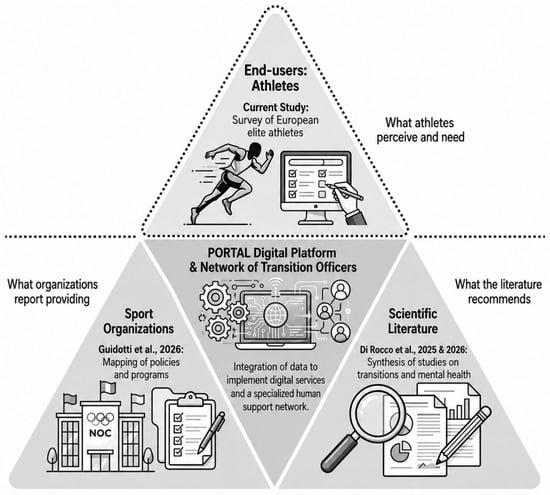
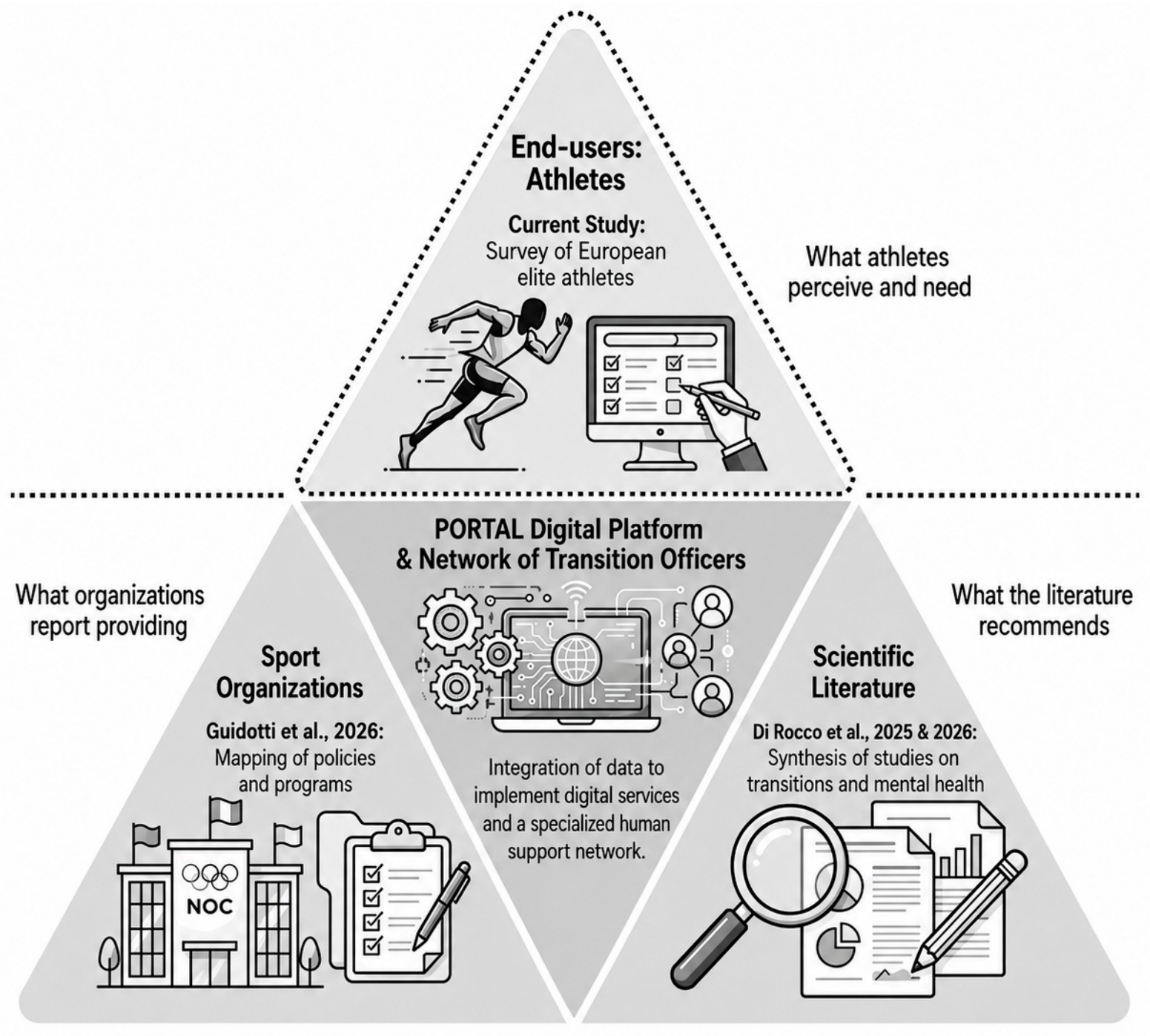
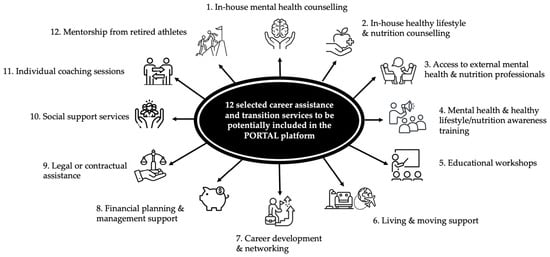
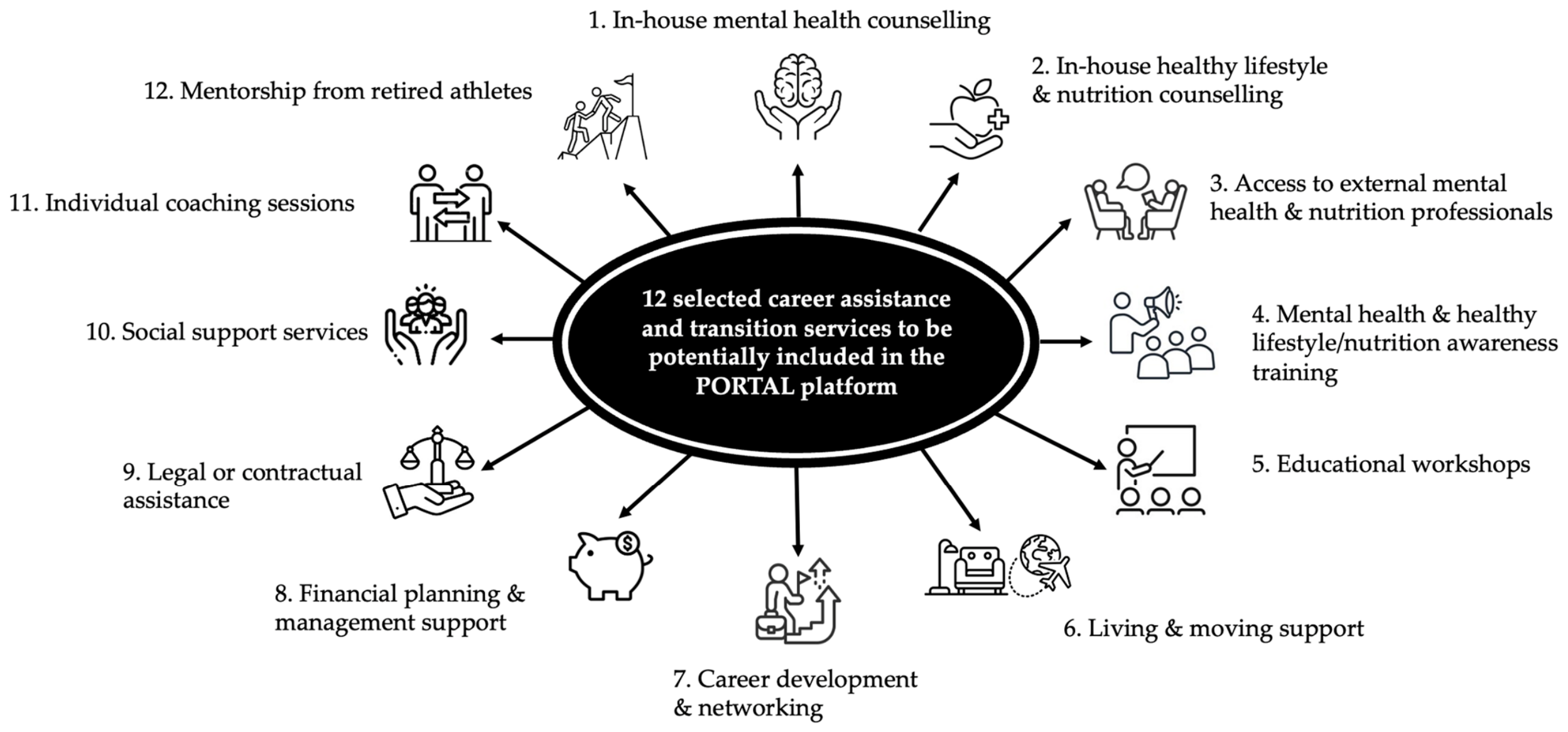

Disclaimer/Publisher’s Note: The statements, opinions and data contained in all publications are solely those of the individual author(s) and contributor(s) and not of MDPI and/or the editor(s). MDPI and/or the editor(s) disclaim responsibility for any injury to people or property resulting from any ideas, methods, instructions or products referred to in the content. |
© 2026 by the authors. Licensee MDPI, Basel, Switzerland. This article is an open access article distributed under the terms and conditions of the Creative Commons Attribution (CC BY) license.