


Abstract
Background: Visual attention is fundamental to basketball performance, yet how binocular gaze behaviour and oculomotor control vary across age-based competitive categories and between sexes remains unclear. Objectives: This study aimed to investigate differences in binocular gaze behaviour, oculomotor control, and visual allocation strategies across basketball competitive categories and between sexes. Methods: In this cross-sectional study, 120 basketball players aged 11–28 years from four competitive categories performed a sport-specific task involving directional changes followed by a free throw. A head-mounted binocular eye tracker recorded fixation, saccadic, vergence, and gaze allocation metrics during the dynamic approach and final aiming phases. Results: In males, fixation duration differed significantly across competitive categories (p < 0.001), whereas in females, fixation and saccade counts differed across categories (p < 0.001). Male players showed higher fixation and saccade counts in Junior and Senior categories, while females exhibited more fixations during final aiming. Strong positive interocular correlations were observed for saccadic length and angular velocity (ρ > 0.86, p < 0.001), and players in Junior and Senior categories showed more stable fixation patterns. Conclusions: Differences in gaze organization, interocular agreement, and visual allocation patterns were associated with competitive category. Sex differences were observed within individual categories; however, these exploratory sex-stratified analyses do not establish that category-related patterns differ between sexes.
1. Introduction
Anticipation and accurate decision-making are essential for performance in team sports and are closely linked to visual search processes, which enable athletes to efficiently extract and process information in complex, high-speed environments [1]. Basketball, as a dynamic sport, in which opposing teams continuously share and penetrate the same playing space while attacking and defending, requires continuous analysis of rapidly changing visual information, where visual attention plays a central role in shooting performance [1,2]. Fixations, defined as the stabilization of gaze on a target or area of interest, together with saccadic eye movements, defined as rapid ballistic shifts of gaze between fixation locations, are key components of visual search and have been strongly associated with shooting accuracy and attentional control [3,4]. Previous research suggests that basketball players develop efficient oculomotor strategies characterized by enhanced saccadic control, temporal consistency, and spatial precision, reflecting improved predictive processing of dynamic visual stimuli [5,6].
Visual attention is fundamental for information detection and the development of optimal motor responses during shooting [2,6,7,8]. Its efficiency has been shown to vary with task demands and competitive categories, with more experienced players demonstrating faster responses and more selective gaze behavior than less skilled athletes [1,9]. In this context, expert players have been reported to exhibit more efficient gaze patterns, including fewer fixations, longer fixation durations on task-relevant areas, and extended Quiet Eye (QE) periods [10]. QE, defined as the final fixation on a relevant target prior to movement execution, reflects the temporal and spatial coordination between gaze and motor output and is widely considered a key indicator of visuomotor control [11,12]. Consistent evidence links QE characteristics with superior performance across sports, with longer QE durations associated with improved shooting accuracy, movement organization, and attentional stability [11,12,13,14]. This effect has been explained by the inhibition hypothesis, which suggests that experts require longer QE durations to suppress competing motor solutions during execution [15], while also supporting fine motor control and decision-making processes in high-speed contexts [16,17].
Basketball shooting performance depends on efficient visuomotor control and precise gaze allocation throughout the execution of the shot. Three-point shooting, performed from 6.75 m according to FIBA regulations, represents one of the most demanding shooting situations and has become a critical determinant of basketball performance [2,14]. Skilled players typically fixate on the rim throughout the shooting action, enabling accurate execution even when visual conditions are suboptimal, as the target location has already been encoded prior to ball release [14,18]. Findings regarding gaze behaviour remain inconsistent. While some studies report that expert athletes perform fewer but longer fixations on relevant areas [1,19,20], others suggest that they may exhibit more frequent but shorter fixations [1], highlighting the need for further investigation. However, despite the recognized importance of visual attention and QE behaviour, little is known about how interocular agreement and gaze allocation strategies differ across competitive basketball categories or whether these differences vary between sexes in a sport-specific task.
Therefore, the aim of this study was to investigate gaze behaviour, interocular agreement, and QE patterns across basketball competitive categories using a head-mounted binocular eye-tracking system, while also examining potential sex-related differences in visuomotor strategies. We hypothesized that differences across competitive categories would be associated with more efficient gaze organization, longer QE periods, higher interocular agreement, and more stable visual allocation patterns, and that sex differences would be observed within individual categories. As the competitive categories also differ in age, playing experience, and biological maturation, observed differences cannot be attributed to expertise alone. Sex-stratified analyses are exploratory, and no formal sex/category interaction is tested.
2. Materials and Methods
This cross-sectional observational study was conducted in accordance with the tenets of the Declaration of Helsinki and received ethical approval from the Research Ethics Committee of the Community of Aragon (CEICA, reference PI24/483). Written informed consent was obtained from all participants prior to inclusion in the study. For minors, consent was additionally obtained from legal guardians. Data were anonymized using coded identifiers, and only aggregated results were reported.
2.1. Sample Size Estimation and Justification
A total of 126 basketball players (11–28 years) were recruited from competitive federated clubs in Zaragoza (Spain) representing the typical developmental structure of Spanish basketball categories. Six participants were excluded before analysis because complete eye-tracking recordings could not be obtained or because the recordings did not provide sufficient quality for reliable gaze analysis. Consequently, the final sample consisted of 120 participants. All participants trained in shared facilities, which also served as the testing environment, ensuring consistent conditions.
Prior to participation, all players underwent a comprehensive optometric assessment with their best distance correction. Inclusion criteria were continuous federated basketball practice for at least three consecutive years, with regular training (minimum two sessions per week) and official competition, monocular best-corrected visual acuity (BCVA) ≥ 0.8 in each eye, and absence of strabismus, binocular vision disorders, or ocular/systemic conditions affecting visual function. Participants wore their habitual optical correction during testing. The examination included refraction, binocular, accommodative, and oculomotor assessments. Players with visual suppression or values outside age-normative ranges were excluded to ensure that observed differences reflected category-related visuomotor strategies rather than pre-existing binocular dysfunction.
An optometric assessment was conducted with the 126 recruited participants prior to the controlled eye-tracking exercise, using each athlete’s habitual optical correction when required to ensure that the visual performance measured reflected their real training conditions. All examinations took place in an adjacent room adapted by the research team to ensure optimal conditions for accurate visual measurements. The room had no windows, which ensured constant illumination and stable environmental conditions regardless of the time of day. These evaluations were always completed immediately before the controlled task.
All measurements were performed by the same examiner to ensure consistency across the dataset using a standardized Early Treatment Diabetic Retinopathy Study (ETDRS) chart at 4 m under 100% contrast. The visual examination included the assessment of monocular BCVA, accommodative amplitude (AA), binocular accommodative facility (BAF) at distance, vergence facility (VF) at distance, and the near point of convergence (NPC). AA was obtained monocularly using the Donders push-up technique, with age-expected values calculated following Hofstetter’s formula (AA = 18.5 − 0.3 × age). BAF was evaluated by counting cycles of alternating lenses (0.00 D/−2.00 D) completed in one minute. VF was assessed through alternating base-in/base-out prism trials (3∆ BI/12∆ BO). NPC was measured using a non-illuminated target. Strabismus was ruled out using standard cover and alternating cover tests, and oculomotor behaviour (saccades, pursuits, and associated head movements) was quantified using the Northeastern State University College of Optometry (NSUCO) protocol [21,22].
After applying all inclusion and exclusion criteria, 120 participants were retained for the final analysis. These athletes were then grouped by sex (female and male) into four age-based Spanish competitive categories: the Infantil category (28 participants), Cadete (44 participants), Junior (22 participants), and Senior (26 participants). All optometric data and associated clinical measures were systematically logged and organized into a unified database using Microsoft Excel 365 (Microsoft Corporation, Redmond, WA, USA).
2.2. Instrumentation
Oculomotor data were collected using the same instrumentation and procedures as those described in our previous study [23]. Gaze behavior was recorded in an ecological sport-specific setting using a head-mounted system (Neon Eye Tracker, Pupil Labs, Berlin, Germany) that integrates binocular infrared eye cameras, a forward-facing scene camera, and inertial sensors. Data acquisition, synchronization, and preprocessing were performed within the manufacturer’s software environment (Pupil Cloud v8.0, Berlin, Germany), enabling the extraction of fixation, saccadic, and pupil diameter metrics. Gaze-scene mapping, head-motion compensation, and continuous automatic calibration followed the validated protocol detailed in the referenced study, ensuring methodological consistency without duplicating technical descriptions.
2.3. Procedure
The study was conducted under real training conditions to maximize ecological validity. Following optometric screening, participants performed a standardized basketball-specific drill while wearing an eye-tracking system, enabling the recording of oculomotor behaviour during natural movement. Data collection took place during evening training sessions in November 2025 at an indoor regulation court (28 m × 15 m) in Zaragoza, Spain, under consistent lighting conditions. The task replicated typical perceptual-motor demands of gameplay. Players ran a zig-zag pattern around five cones (2.5 m apart) from mid-court and, upon completion, executed a free throw from the free-throw line (4.60 m). Participants were instructed to complete the drill at a game-like pace while maintaining continuous ball control, without prioritizing either maximum speed or deliberate slowing. No instructions regarding gaze behaviour or fixation strategy were provided, allowing visual search behaviour to emerge naturally throughout the task. The free throw was selected to provide a standardized shooting action immediately following the locomotor phase, enabling consistent identification of the QE interval across all participants while balancing ecological validity and experimental control.
All trials were supervised by the same examiner (AGS) to ensure consistency. Scene-camera recordings were reviewed to confirm correct task execution, pacing, and positioning across participants.
2.4. Data Processing and Event Coding
The recorded sessions were uploaded to Pupil Cloud, where each visual trial was manually segmented into successive task-related phases. In this protocol, the timestamps were labelled “Cone 5”, “Cone 4”, “Cone 3”, “Cone 2”, “Cone 1”, “Shot”, “Shot 2” and “Shot End”. The label “Cone 5” marked the beginning of the action, and the subsequent markers corresponded to each point of interest (the series of cones) that the player passed before reaching the free-throw line. All manual event tagging was conducted by the same trained researcher (AGS), and each event was defined as the temporal interval bounded by these eight markers.
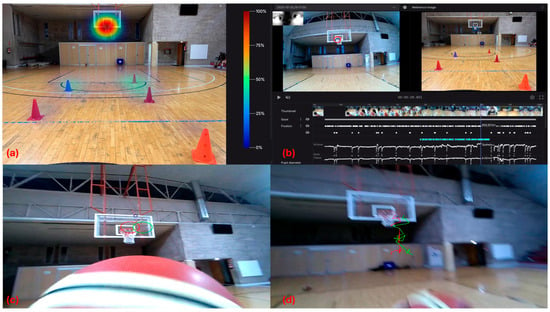
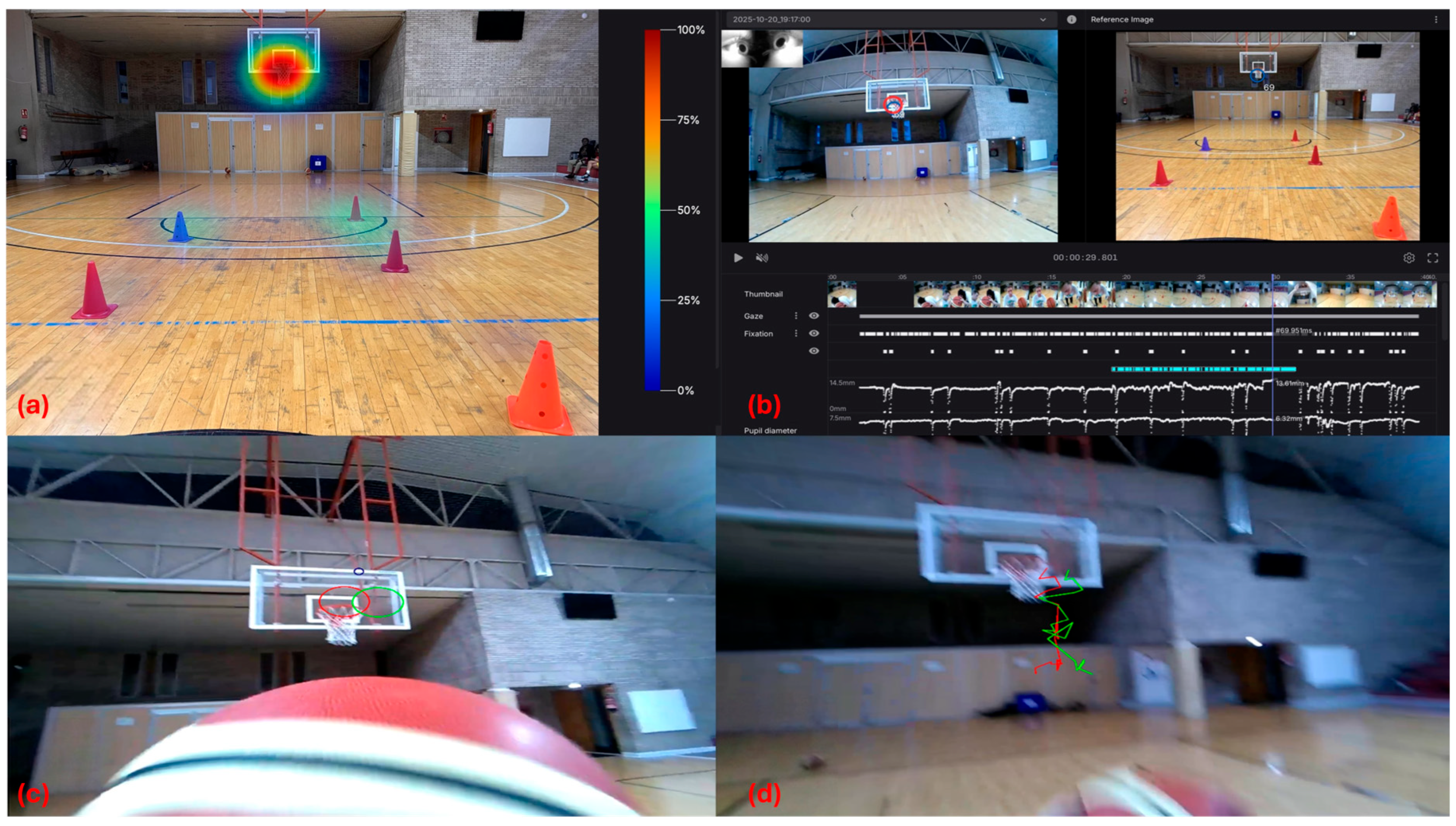
To enable spatial analysis of gaze behaviour, the Reference Image Mapper module was used to generate a three-dimensional reconstruction of the visual scene. Gaze samples were projected onto a static reference image captured during the drill, allowing precise localization of fixation points within the environment. The same reference image, containing the predefined Areas of Interest (AOIs), was used for all participants, as all recordings were acquired under identical conditions on the same basketball court. Gaze data were automatically mapped onto the reference image using the Pupil Labs surface-tracking algorithm and subsequently visually inspected and manually corrected when necessary, by the same researcher to ensure accurate AOI assignment. Aggregated gaze data were visualized using heat maps to identify areas of recurrent visual attention across trials (Figure 1). Additionally, heat maps were computed specifically for the QE interval, defined as the period extending from the onset of the final task-relevant fixation directed towards the basket (“Shot”) until ball release (“Shot 2”). The marker “Shot End”, corresponding to the instant when the ball contacted the basket, was used exclusively to delimit the end of the trial and was not included in the QE interval. Task-relevant fixations were identified within the predefined AOI, which included the rim, net, backboard, inner target square, and basket structure. Fixation events were automatically detected using the Pupil Labs event-classification algorithm, and no additional fixation-duration threshold beyond the software was imposed. Brief interruptions caused by blinks or saccades were handled through the software’s automatic event classification. The onset of the QE interval was subsequently verified by manually reviewing the synchronized scene videos to identify the final fixation immediately preceding ball release.
Figure 1.
(a) Gaze heat map illustrating the spatial distribution of fixations recorded during the controlled basketball task, with warmer colors indicating regions of higher fixation density in the Pupil Cloud platform. (b) Example of the Reference Image Mapper environment in the Pupil Cloud platform, showing gaze data aligned to a reference image of the basket. (c) Representation of fixation events, with monocular fixations displayed separately for the left eye (red) and right eye (green), and the binocular mean fixation indicated in blue, with ETrackerParsePC 1.0. (d) Saccadic trajectories plotted for each eye during task execution, depicting the direction and magnitude of gaze shifts, with ETrackerParsePC 1.0.
Eye-movement events were automatically detected through the Pupil Labs fixation-detection algorithm integrated into the Neon system. This method is an enhanced variant of the classic I-VT approach, incorporating optic-flow-based corrections and an adaptive velocity threshold that compensates for head and scene motion. In Neon, saccades are defined as rapid gaze shifts exceeding the adaptive threshold (base 750 px/s, gain 0.8), lasting a minimum of 10 ms with an amplitude of at least 1°, whereas fixations are identified as stable gaze periods of at least 70 ms [24,25]. All automatically detected events were subsequently processed with ETrackerParsePC 1.0 and visually verified via velocity–time plots to ensure classification accuracy [26,27,28]. Only recordings providing complete gaze recordings of sufficient quality for the predefined analyses were included in the final dataset. Recordings with incomplete acquisition or unreliable gaze mapping were excluded before statistical analysis according to the predefined exclusion criteria. The proprietary Pupil Labs processing software automatically performs gaze mapping and event detection. However, quantitative mapping-quality indices, confidence scores, tracking-loss percentages, and valid-sample proportions are not available for independent export and therefore could not be included in the present study.
To enable eye-specific processing, a custom software tool developed at the University of Zaragoza, ETrackerParsePC 1.0 (Zaragoza, Spain), was used to separate, identify, and classify the data associated with each eye. The software automatically recognized predefined track segments and exported quantitative oculometric metrics into Excel files. These included saccade number (n), duration (ms), longitudinal velocity (mm/s), and length (mm); fixation duration (ms); and pupil diameter (mm). The algorithm also ensured a consistent distinction between fixation and saccades in each event (Figure 1).
2.5. Statistical Analysis
Descriptive statistics, inferential analyses, and graphical representations were performed using custom Python scripts executed in Google Colab (Google LLC; Python version 3.12.13), based on the consolidated Excel dataset.
As variables did not meet the assumption of normality according to the Shapiro–Wilk test, comparisons between female and male players within each competitive category (Infantil, Cadete, Junior, and Senior) were performed using the Mann–Whitney U test for independent samples, with statistical significance set at p < 0.05. Subsequently, analyses were performed separately for each sex using the Kruskal–Wallis test to compare the four competitive categories. Following a significant Kruskal–Wallis test, pairwise comparisons between categories were interpreted using a Bonferroni-adjusted significance threshold of p < 0.0083, corresponding to the six possible category contrasts. The relationships between right-eye (RE) and left-eye (LE) parameters were examined using Spearman’s rank-order correlation coefficient (ρ), with statistical significance set at p < 0.05.
No significant differences were found in sex distribution across categories (Fisher-Freeman-Halton exact test, p = 0.426), indicating a similar female-to-male ratio across the competitive categories.
Given the large number of optometric and oculomotor outcomes, subgroup comparisons, and correlations tested, all comparisons not protected by the Bonferroni-adjusted threshold (p < 0.0083) are labelled as exploratory throughout the manuscript. No formal false discovery rate correction was applied across the full family of outcomes; therefore, all uncorrected p-values < 0.05 are reported as descriptive observations only and are not interpreted as established effects. These findings are identified with the qualifier ‘exploratory, uncorrected’ and are discussed with appropriately cautious language.
Detailed test statistics, effect sizes, and 95% confidence intervals for between-sex and between-age-category comparisons are provided in the Supplementary Material (Tables S1–S6).
3. Results
3.1. Sample Overview
A total of 120 participants were included, numbering 78 females (F) and 42 males (M), distributed across Infantil (19F/9M), Cadete (31F/13M), Junior (11F/11M), and Senior (17F/9M) categories. All analyses were conducted separately by sex. Demographic and baseline optometric data are presented in Table 1, Tables S1 and S2.
Table 1.
Participant characteristics and visual function outcomes across basketball age categories (Infantil, Cadete, Junior, and Senior) in the female (F) and male (M) samples. Data are presented as mean ± standard deviation (SD) for age, playing experience, and all visual function variables. Between-sex comparisons (F vs. M) were performed using the Mann–Whitney U test within each competitive category, with statistical significance set at p < 0.05 (uncorrected; exploratory). Comparisons across categories within each sex were conducted using the Kruskal–Wallis test, and a Bonferroni-adjusted significance threshold was applied for multiple comparisons across categories (p < 0.0083); statistically significant differences are marked with asterisks.
Age differed between sexes in Cadete, Junior, and Senior (all p ≤ 0.005, uncorrected; exploratory), but not in Infantil. Playing experience showed sex differences in Cadete and Junior (p < 0.001), with no differences in Infantil or Senior. Within-sex comparisons across categories were significant for both age and experience (p < 0.001, uncorrected; exploratory).
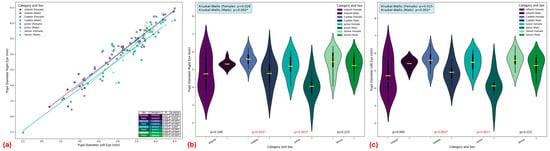
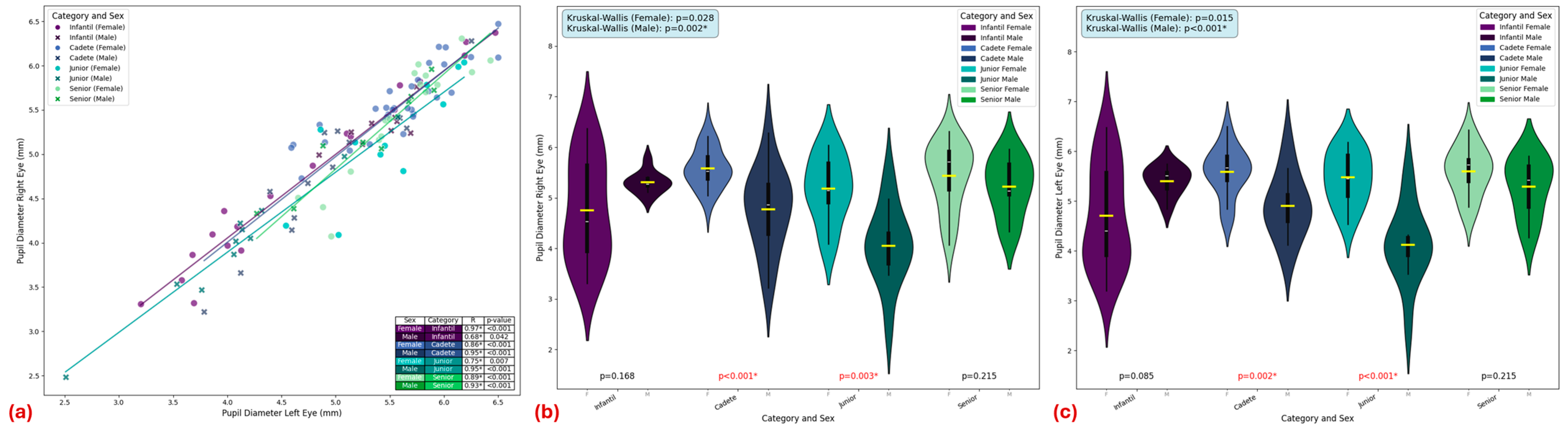
BCVA remained within normal ranges, with no sex differences across categories. AA decreased with age, with sex differences observed in Infantil and Senior (p < 0.05, uncorrected; exploratory). Nominal between-sex differences were observed for BAF in the Junior category (p = 0.039, uncorrected; exploratory) and for NPC in the Infantil category (p = 0.040, uncorrected; exploratory). VF showed a nominal between-sex difference in Senior players (p = 0.010, uncorrected; exploratory), although lower values were observed in Senior males. A strong interocular correlation in pupil diameter was observed across all groups (ρ > 0.68, p < 0.05; Figure 2a). Pupil diameter showed significant differences across categories in males (p ≤ 0.002), whereas the differences observed in females did not reach the Bonferroni-adjusted threshold (p ≤ 0.028, uncorrected; exploratory), generally increasing with category level in females, while males showed smaller values in Cadete (Figure 2b,c). Between-sex differences were present in Cadete and Junior (p < 0.05, uncorrected; exploratory).
Figure 2.
Pupil diameter distribution and interocular relationship across basketball competitive categories (Infantil, Cadete, Junior, and Senior) and sex (female, F; male, M). (a) Scatterplot of the correlation between left eye and right eye pupil diameters in mm. Each point represents an individual observation, with colors indicating category and marker shapes distinguishing sex. Regression lines are provided for each subgroup. The inset table details the Spearman correlation analysis, showing the correlation coefficient (ρ) and the significance level (p-value) for each group. (b,c) Violin plots representing the distribution of pupil diameter for the right eye and left eye in mm, respectively, segmented by category and sex. Internal boxplots indicate the interquartile range, while yellow bars represent group means. p-values at the bottom indicate comparisons between sexes using the Mann–Whitney U test (significance set at p < 0.05, uncorrected; exploratory). The upper insets display Kruskal–Wallis test results for comparisons across categories within each sex; for these multi-group comparisons, a Bonferroni correction was applied, with statistical significance defined as p < 0.0083. Asterisks indicate significant differences.
3.2. Fixations and Saccades
3.2.1. Cones Phase
When restricting the analysis to the cone phase corresponding to the zig-zag movement between cone 5 and cone 1 immediately prior to shot execution, visual behaviour revealed category- and sex-dependent patterns in both fixation and saccadic metrics (Table 2 and Tables S3 and S4).
Table 2.
Summary of fixation and saccadic eye movement metrics recorded during both the cone (zig-zag) phase between cone 5 and cone 1 immediately prior to shot execution, and the quiet eye (QE) phase, defined as the final task-relevant fixation on the basket AOI preceding ball release (interval from the ‘Shot’ marker to the ‘Shot 2’ marker). Descriptive data are presented separately for female and male participants across competitive categories (Infantil, Cadete, Junior, and Senior). Fixation variables include duration (ms) and number (n). Saccadic variables (cone phase only) include duration (ms), number (n), length for the right (RE) and left eye (LE) (mm), and angular velocity (deg/s) for both eyes. Data are reported as mean (standard deviation) [minimum/maximum]. Shot success is reported as the number of successful shots/total shots (n), followed by the success proportion (successful shots/total attempts) and its corresponding standard deviation.
Fixation Behaviour During the Cone Phase
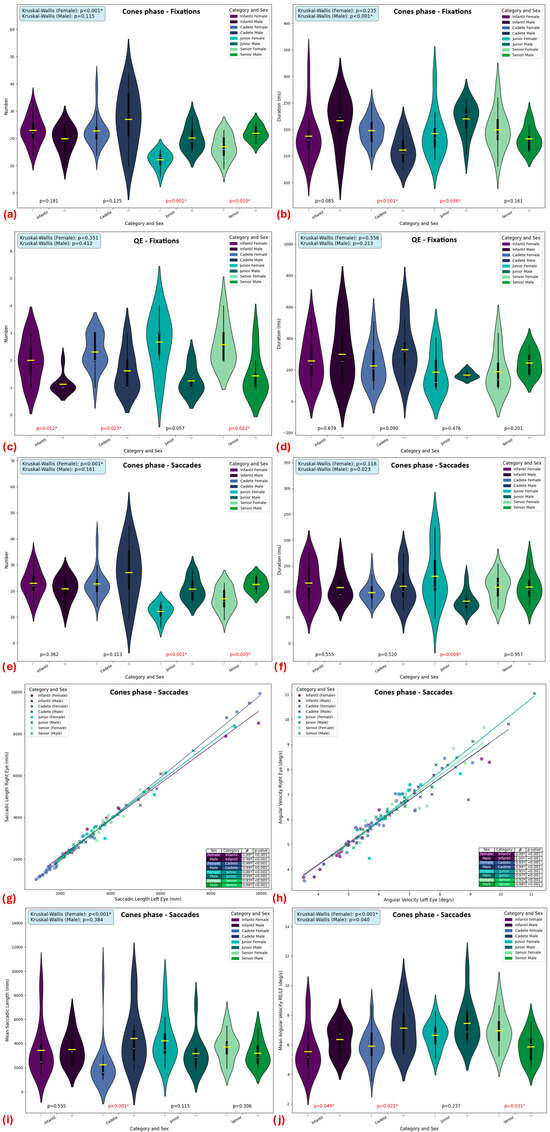
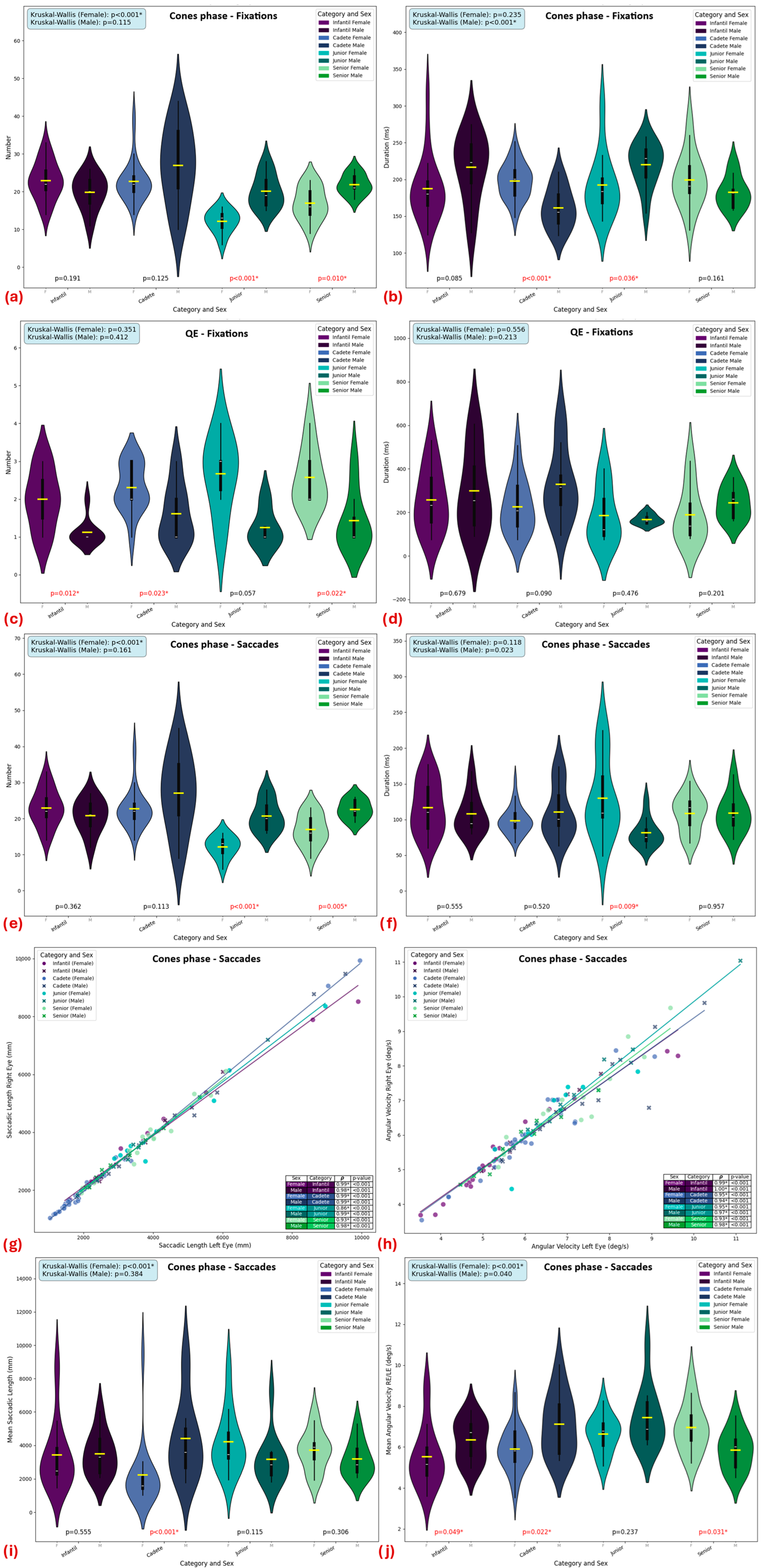
Fixation count (Figure 3a) showed significant differences across categories in female players (p < 0.001), with higher values in Infantil (22.95 ± 5.08) and Cadete (22.71 ± 5.50), and lower values in Senior (16.94 ± 4.35) and Junior (12.18 ± 3.03). In males, no significant differences were found (p = 0.115), although counts were highest in Cadete (27.00 ± 10.42), followed by Senior (21.89 ± 2.67), Junior (20.09 ± 4.44), and Infantil (19.89 ± 4.62). Between-sex comparisons (Figure 3a) showed higher counts in males in Junior (p < 0.001, uncorrected; exploratory) and Senior (p = 0.010, uncorrected; exploratory), with no differences in Infantil (p = 0.191) or Cadete (p = 0.125).
Figure 3.
Violin plots and scatterplots illustrating fixation and saccadic eye movement metrics across basketball competitive categories (Infantil, Cadete, Junior, and Senior) and sex (female, F; male, M). Panels (a,b) show fixation count and fixation duration during the cone (zig-zag) phase between cone 5 and cone 1 immediately prior to shot execution; panels (c,d) show fixation count and duration during the quiet eye (QE) phase, defined as the final task-relevant fixation on the basket AOI preceding ball release. Panels (e,f) display violin plots of saccade count and duration (ms) during the cone phase. Panels (g,h) present scatterplots of the interocular relationship between left eye (LE) and right eye (RE) for saccadic length (mm) and angular velocity (deg/s), respectively. Panels (i,j) show violin plots of mean saccade length (mm) and angular velocity (deg/s) for both eyes. Each violin represents the distribution of individual observations within each category and sex. Internal boxplots indicate the interquartile range and median, while yellow horizontal bars represent group means. In scatterplots, each point represents an individual observation, with colors indicating category and marker shapes distinguishing sex; regression lines are shown for each subgroup. Inset tables report Spearman correlation coefficients (ρ) and significance levels (p < 0.05). p-values at the bottom of violin plots indicate between-sex comparisons (Mann–Whitney U test; p < 0.05, uncorrected; exploratory). Upper insets display Kruskal–Wallis test results for comparisons across categories within each sex; Bonferroni-adjusted significance was set at p < 0.0083. Asterisks indicate statistically significant differences.
Fixation duration (Figure 3b) showed no significant differences across categories in female players (p = 0.235), ranging from 187.47 ± 45.04 ms in Infantil to 199.42 ± 37.52 ms in Senior, with Cadete (197.70 ± 24.39 ms) and Junior (192.36 ± 44.31 ms) showing similar values. In males, significant differences were observed (p < 0.001), with longer durations in Junior (232.04 ± 52.02 ms) and shorter values in Cadete (174.58 ± 43.86 ms) and Senior (182.46 ± 21.98 ms). Between-sex comparisons (Figure 3b) revealed longer durations in females in Cadete (p < 0.001, uncorrected; exploratory) and higher values in males in Junior (p = 0.036, uncorrected; exploratory), with no differences in Infantil (p = 0.085) or Senior (p = 0.161).
Saccadic Behaviour During the Cone Phase
Saccadic metrics during the cone phase (Figure 3e–j) showed significant differences across categories in female players (p < 0.001; Figure 3e) with higher saccade counts in Infantil (22.95 ± 5.08) and Cadete (22.71 ± 5.50) and lower values in Senior (16.94 ± 4.35) and Junior (12.18 ± 3.03). In males, no significant differences were found (p = 0.161), although counts were highest in Cadete (27.08 ± 10.78), followed by Senior (22.56 ± 2.70), Junior (20.73 ± 4.34), and Infantil players (20.78 ± 4.63). In between-sex comparisons, (Figure 3e) males showed higher counts in Junior (p < 0.001, uncorrected; exploratory) and Senior (p = 0.005, uncorrected; exploratory) than female players.
Mean saccade duration (Figure 3f) showed no significant differences across categories in females (p = 0.118), with values ranging from 98.47 ± 19.09 ms in Cadete to 129.85 ± 55.19 ms in Junior. In males, although statistical differences were observed (p = 0.023), these did not meet the adjusted threshold, with shorter durations in Junior (81.53 ± 19.35 ms) compared to Cadete (110.36 ± 36.70 ms). Between-sex comparisons (Figure 3f) revealed the longest durations in females within Junior (p < 0.009, uncorrected; exploratory).
Interocular relationships for saccadic displacement and angular velocity (Figure 3g,h) demonstrated strong positive associations across all categories and sexes, confirmed by very high Spearman correlations (ρ > 0.93; p < 0.001 in all cases), indicating high interocular agreement in saccadic metrics.
Saccade length and angular velocity distributions (Figure 3i,j) showed between-sex differences in Cadete (p < 0.001, uncorrected; exploratory), with higher amplitudes in males (RE: 4337.94 ± 2399.23 mm; LE: 4476.93 ± 2382.63 mm) compared to females (RE: 2231.38 ± 2021.83 mm; LE: 2247.24 ± 2020.37 mm). Across categories, saccade length differed significantly in females (p < 0.001) but not in males (p = 0.384). Angular velocity also differed between sexes in Infantil (p = 0.049, uncorrected; exploratory), Cadete (p = 0.022, uncorrected; exploratory), and Senior (p = 0.031, uncorrected; exploratory), generally higher in males. However, across categories, only females showed significant variation (p < 0.001), whereas males did not reach the adjusted threshold (p = 0.040).
The cone phase revealed sex- and category-dependent visual patterns, with greater variability across competitive levels in females, while males showed more homogeneous oculomotor behavior across categories.
3.2.2. Quiet Eye
When the analysis was restricted to the QE phase, defined as the final task-relevant fixation on the basket AOI preceding ball release (the interval from the ‘Shot’ marker to the ‘Shot 2’ marker), visual behaviour was characterized almost exclusively by fixation events, as saccadic activity was minimal or absent in many trials. Consequently, the analysis focused on fixation stability and temporal characteristics (Table 3 and Tables S5 and S6).
Table 3.
Summary of fixation eye movement metrics recorded during the quiet eye (QE) phase, defined as the final task-relevant fixation on the basket AOI preceding ball release (interval from the ‘Shot’ marker to the ‘Shot 2’ marker). Descriptive data are presented separately for female and male participants across competitive categories (Infantil, Cadete, Junior, and Senior). Fixation variables include duration (ms), number of (n), and horizontal (DPx) and vertical (DPy) displacement of the binocular vergence axis expressed in prismatic diopters (Δ). Data are reported as mean (standard deviation) [minimum/maximum]. Shot success is reported as the number of successful shots/total shots (n), followed by the success proportion (successful shots/total attempts) and its corresponding SD.
Fixation Behaviour During QE Phase
During the QE phase, fixation count (Figure 3c) did not differ across categories in female (p = 0.351) or male players (p = 0.412). Female players consistently showed higher values (Infantil: 2.00 ± 0.77; Cadete: 2.31 ± 0.63; Junior: 2.67 ± 1.03; Senior: 2.57 ± 0.79) compared to males (Infantil: 1.13 ± 0.35; Cadete: 1.62 ± 0.77; Junior: 1.25 ± 0.50; Senior: 1.43 ± 0.79). Mann–Whitney comparisons (Figure 3c) indicated higher counts in females in Infantil (p = 0.012, uncorrected; exploratory), Cadete (p = 0.023, uncorrected; exploratory), and Senior (p = 0.022, uncorrected; exploratory), with no differences in Junior (p = 0.057).
For fixation duration (Figure 3d), no significant differences were found across categories in females (p = 0.556) or males (p = 0.213). Female values decreased from Infantil (257.44 ± 146.38 ms) to Cadete (226.12 ± 124.55 ms), Junior (184.93 ± 133.66 ms), and Senior (189.17 ± 131.94 ms). In males, longer durations were observed in Infantil (298.81 ± 192.06 ms) and Cadete (329.14 ± 168.43 ms), with lower values in Junior (167.75 ± 23.39 ms) and intermediate values in Senior (243.86 ± 76.71 ms). Mann–Whitney tests (Figure 3d) showed no between-sex differences in any category (Infantil p = 0.679; Cadete p = 0.090; Junior p = 0.476; Senior p = 0.201).
Vergence Behaviour During QE Phase
Binocular fixation stability during the QE phase was assessed using horizontal (DPx) and vertical (DPy) vergence displacement, expressed in prismatic diopters (Δ). DPx reflects horizontal eye separation relative to a 4.5 m reference distance (free-throw distance), while DPy represents vertical alignment between visual axes. Positive DPx indicates convergence and negative values divergence; DPy indicates vertical offset between fixation points.
DPx values were negative across all categories, indicating slight horizontal divergence. In females, values ranged from −24.09 ± 17.74 Δ (Infantil) to −16.42 ± 8.66 Δ (Senior), with Cadete (−20.66 ± 11.67 Δ) and Junior (−14.91 ± 8.43 Δ) intermediate. Males showed lower divergence overall, from −15.59 ± 11.64 Δ (Infantil) and −11.95 ± 16.04 Δ (Cadete) to −7.13 ± 0.85 Δ (Junior) and −2.54 ± 3.96 Δ (Senior). A significant sex difference was found in Senior (p = 0.021, uncorrected; exploratory), while no differences appeared in Infantil (p = 0.395), Cadete (p = 0.135), or Junior (p = 0.114). No significant differences across categories were found within females (p = 0.687) or males (p = 0.122) (Table 3), indicating a slight divergence in the visual axes relative to the orthophoric reference (0 Δ at 4.5 m), consistent with the low vergence demand associated with fixation on a distant target such as the basketball rim.
DPy remained close to zero in all groups, indicating stable vertical binocular alignment during QE. In females, values ranged from 0.32 ± 0.93 Δ (Junior) to 0.88 ± 0.68 Δ (Infantil), with Cadete (0.68 ± 0.56 Δ) and Senior (0.80 ± 0.48 Δ) intermediate. Males showed similar values, from 0.60 ± 0.63 Δ (Infantil) and 0.99 ± 0.41 Δ (Cadete) to 0.98 ± 0.15 Δ (Junior) and 0.93 ± 0.17 Δ (Senior). A significant sex difference was observed in Cadete (p = 0.038, uncorrected; exploratory), while no differences were found in Infantil (p = 0.708), Junior (p = 0.133), or Senior (p = 0.174). No category effects were detected within females (p = 0.339) or males (p = 0.132) (Table 3).
3.3. Heat Maps and Areas of Interest (AOIs), Gaze Distribution Across Categories
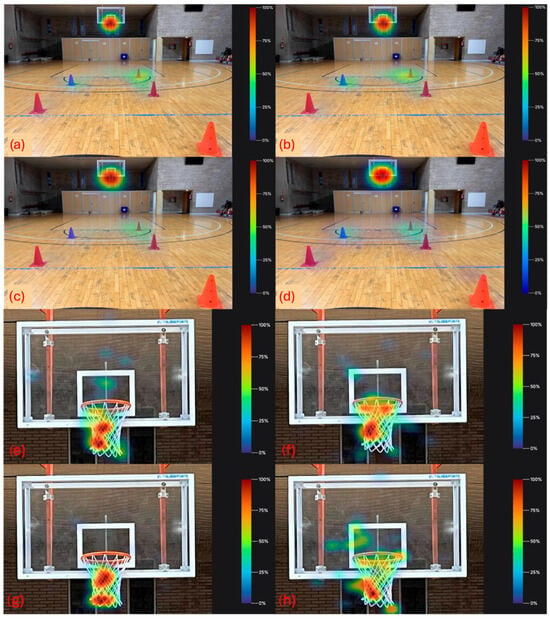
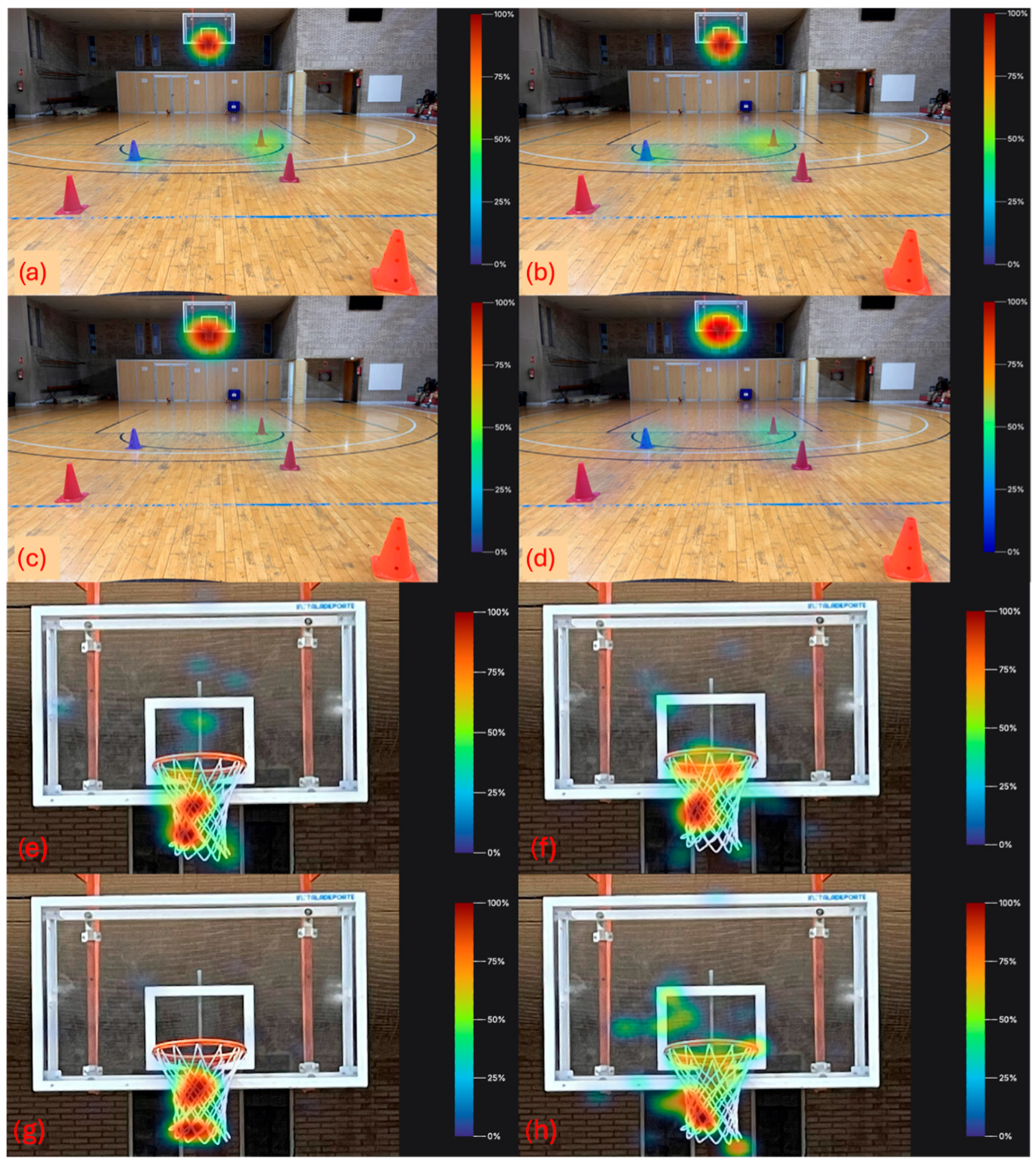
Gaze heat maps revealed clear category-dependent differences in the spatial distribution of visual attention during both task execution and the QE phase (Figure 4a–d). Across all groups, fixation density was primarily concentrated on the basket, indicating a common visual anchor. However, Infantil players showed a widely distributed gaze pattern, allocating attention not only to the basket but also to multiple areas along the movement path, reflecting a less selective visual exploration. Cadete players displayed a more consolidated pattern, with increased focus on the basket and reduced peripheral dispersion. In contrast, Junior players exhibited a highly centralized fixation cluster over the basket, while Senior players showed a similarly focused pattern with slightly greater spatial spread, suggesting stable yet flexible visual control.
Figure 4.
Heat maps illustrating the aggregated spatial distribution of gaze across competitive categories (females and males together) during the controlled basketball task and the Quiet Eye (QE) phase. Panels (a) Infantil, (b) Cadete, (c) Junior, and (d) Senior show gaze distribution during execution of the controlled basketball exercise, whereas panels (e) Infantil, (f) Cadete, (g) Junior, and (h) Senior show gaze distribution on the basket during the QE phase. Color intensity represents the relative fixation density accumulated across trials.
During the QE phase, differences across categories were observed in the spatial distribution of gaze toward the rim–net interface (Figure 4e–h). Infantil players maintained a relatively diffuse pattern extending to the backboard, whereas Cadete players showed a more defined concentration around the hoop with some residual dispersion. Junior and Senior players demonstrated tightly clustered fixations almost exclusively on the optimal scoring region, indicating more stable and task-focused QE behavior.
Shot success outcomes provided contextual support for these gaze patterns (Table 3). In female players, successful shots were 5/19 in Infantil (0.26 ± 0.44), 5/31 in Cadete (0.16 ± 0.37), 3/11 in Junior (0.27 ± 0.45), and 7/17 in Senior (0.41 ± 0.49). In male players, successful shots were 1/9 in Infantil (0.11 ± 0.31), 3/13 in Cadete (0.23 ± 0.42), 8/11 in Junior (0.73 ± 0.45), and 2/9 in Senior (0.22 ± 0.42). Although the present study was not designed to test performance predictors, these outcomes provide contextual information for interpreting the observed gaze strategies.
AOI analysis further quantified these differences in gaze allocation within the basket. Junior players concentrated a greater proportion of fixation time on the inner scoring region (1.46 s), compared with Infantil (0.69 s), Cadete (0.88 s), and Senior players (0.69 s), reflecting more sustained engagement with the optimal target. In contrast, Infantil and Cadete players distributed fixation time more evenly across multiple regions, including the backboard (Infantil: 0.94 s; Cadete: 1.02 s), compared with Junior (0.63 s) and Senior players (0.58 s), indicating a broader and less centralized gaze strategy. Senior players showed shorter overall fixation durations across AOIs despite high visual coverage (>85%), suggesting a more economical allocation of visual attention.
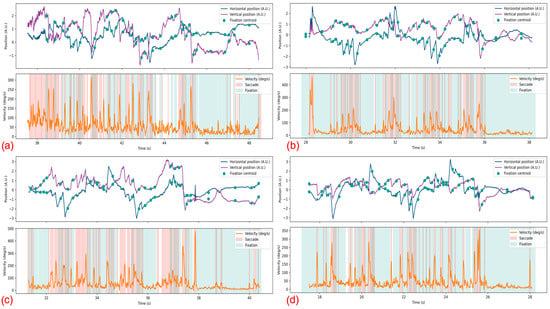
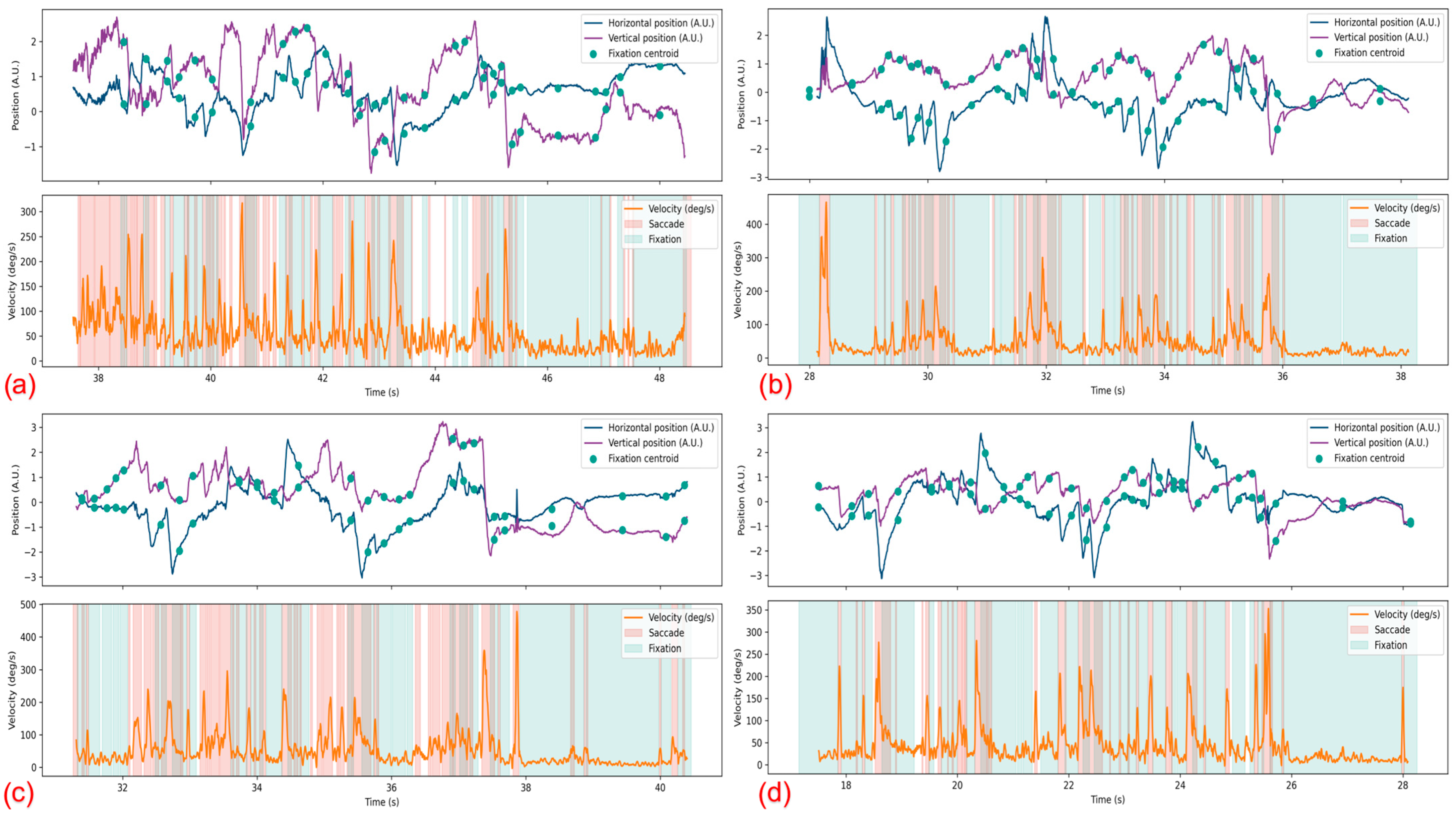
Analysis of representative gaze-position and velocity traces for one participant from each competitive category further supported the event classification procedure (Figure 5). The recordings corresponded to the interval from Cone 5, the initial cone of the zig-zag sequence, to Shot End, defined as the instant at which the ball contacted the rim. Across all categories, gaze traces showed a consistent alternation between periods of relative gaze stability and rapid positional shifts in both horizontal and vertical components. The corresponding velocity profiles exhibited distinct high-amplitude peaks temporally aligned with saccadic events, whereas fixation periods appeared as sustained low-velocity segments, descriptively supporting the accuracy of the automated classification. Notably, the final phase preceding shot release was characterized by a longer and more stable fixation, visible as an extended low-velocity segment coinciding with shot execution. The spontaneous presence of this terminal fixation is descriptively consistent with the QE phenomenon and was observed across all categories, despite the absence of explicit instructions to adopt a QE strategy. These descriptive observations from representative traces do not, by themselves, confirm the ecological validity of the QE construct or its functional role; such interpretations should be based on the quantitative vergence and AOI results reported above.
Figure 5.
Gaze position and velocity recordings obtained using the raw data provided by Pupil Labs Neon eye-tracking system. The top panel illustrates horizontal and vertical gaze coordinates (arbitrary units, A.U.) sampled at 200 Hz over the QE phase for one representative participant from each competitive category: (a) Infantil; (b) Cadete; (c) Junior; and (d) Senior. The bottom panel displays the associated gaze velocity trace expressed in deg/s. Shaded color segments represent events automatically detected by the NeonNet algorithm, with fixations shown in green and saccades in red. The sharp high-velocity transients characteristic of saccades, together with the comparatively stable low-velocity periods corresponding to fixations, illustrate the automated event classification.
Overall, these results indicate differences across competitive categories in the spatial distribution of gaze, with Junior and Senior players demonstrating more selective visual allocation toward task-relevant scoring regions compared with Infantil and Cadete players.
4. Discussion
The present study provides novel insights into how oculomotor behaviour, interocular gaze consistency, and visual allocation strategies differ across basketball competitive categories during a controlled locomotor-shooting task. By integrating full-task, phase-specific (zig-zag and QE), and exploratory sex-stratified analyses, our findings show that visual behaviour does not change uniformly with competitive category but rather reflects phase-dependent differences and notable intra-category variability [7,16,19,20]. While fixation duration remained relatively stable, horizontal vergence alignment, saccadic efficiency, and spatial gaze allocation were associated with visuomotor patterns compatible with more efficient visuomotor behaviour across competitive categories. Importantly, exploratory sex-stratified analyses revealed differences in visuomotor strategies, with male players showing more homogeneous patterns across categories and female players exhibiting greater variability, particularly during the dynamic cone phase. However, because no formal sex/category interaction was tested, these findings should be interpreted as exploratory and do not establish that category-related patterns differ between sexes, since these competitive categories also differ simultaneously in chronological age, accumulated playing experience, and biological maturation. Therefore, the observed differences should not be interpreted as reflecting expertise alone, but rather the combined influence of sport-specific practice, together with developmental and maturational processes affecting perceptual, cognitive, and oculomotor functions. Accordingly, references throughout this discussion to higher competitive categories should be interpreted within this broader developmental framework rather than as evidence of expertise alone.
Across the full execution of the task, fixation duration and number showed substantial overlap between categories, suggesting that the temporal structure of gaze anchoring is relatively preserved across developmental stages. In contrast, horizontal vergence displacement differed across categories, with values closer to the orthophoric reference in Senior, being descriptively consistent with more efficient binocular alignment and motor fusion control [5,26,27], which has been linked to enhanced sport performance [22]. Vertical vergence remained stable across groups, suggesting that horizontal coordination may be more sensitive to differences associated with competitive level. These results are consistent with the possibility that differences across competitive categories are better reflected in fine oculomotor adjustments than in gross fixation metrics.
During the dynamic cone phase, clearer sex-related differences emerged. Female players showed significant variability across categories in fixation and saccadic metrics, whereas male players maintained more stable behaviour. The reduced fixation and saccade counts observed in Junior females may reflect differences in visual sampling patterns across competitive categories, rather than reduced exploration. In parallel, saccadic behaviour revealed category-related modulation, with Junior players demonstrating shorter saccade durations and higher velocities, consistent with more efficient visual scanning and anticipatory control mechanisms [24,25,28]. Some between-sex comparisons showed differences in fixation and saccade counts or durations within individual competitive categories. However, because these comparisons were not adjusted across the full set of outcomes, they should be considered exploratory and should not be interpreted as evidence of systematically different visual exploration or attentional allocation between sexes.
Heat maps provided qualitative visualizations of gaze distribution during task execution, whereas the AOI analyses provided the quantitative evidence used for statistical interpretation. Qualitatively, younger players appeared to display more dispersed gaze distributions, whereas Junior and Senior players showed more centralized fixation around the basket. These visualizations are intended to illustrate the observed gaze behaviour and should not be interpreted as independent evidence of category-related progression or visual-search efficiency [1,3,9]. AOI data indicated greater fixation time on optimal scoring regions in the higher competitive categories, along with earlier gaze anchoring to these areas, consistent with previous reports in basketball shooting performance [2,4,8,10,18].
The QE phase provided additional information on gaze behaviour during the final aiming phase of the shot. Although QE duration did not significantly differ across categories, spatial and temporal characteristics of gaze behaviour varied. Female players exhibited a higher number of fixation events, whereas male players relied on fewer fixations during the final aiming phase, consistent with different gaze stabilization patterns. These findings align with the idea that QE effectiveness may depend more on the quality and stability of gaze allocation than on duration alone [7,15]. Furthermore, players from the higher competitive categories demonstrated more spatially constrained fixation and vergence values closer to the orthophoric reference during QE, findings that are descriptively consistent with the proposed role of QE as a mechanism for attentional regulation and motor parameterization under performance constraints [11,12,13,29], although the present study did not directly assess attentional processes and these descriptive observations do not confirm the functional role of QE. Recent evidence suggests that spatial attention and oculomotor control are supported by partially overlapping neural networks that dynamically interact during visually guided behavior rather than functioning as independent systems [30]. Therefore, the gaze patterns observed in the present study may reflect the integrated operation of attentional selection and eye movement planning during sport-specific visuomotor performance.
Exploratory sex-stratified analyses further complemented these interpretations. Male players generally exhibited more consistent vergence stability and saccadic efficiency across the analyzed competitive categories, whereas female players exhibited greater intra-group variability, particularly in the Junior category. This variability may reflect transitional phases in visuomotor strategy development or differences in cognitive load management during visual search [9], rather than inferior performance. However, these differences are unlikely to be explained by sex alone and may also reflect the combined influence of anthropometric characteristics, biological maturation, accumulated playing experience, and training exposure across the competitive categories. These observations illustrate the potential value of sex-stratified analyses when describing gaze behaviour across competitive categories. However, more studies specifically designed to evaluate sex competitive category interactions are required to determine whether these apparent differences represent statistically distinct trajectories between sexes. Additionally, subtle differences in vergence behaviour during QE suggest slightly more stable binocular alignment in male players at higher competitive levels, although overall vergence stability appeared largely preserved once basic binocular control is established.
Despite the observed differences in spatial allocation and saccadic behaviour, fixation duration remained relatively constant across categories. This reinforces the idea that the differences observed across competitive categories in basketball are more closely related to optimizing when and where gaze is deployed rather than simply increasing fixation duration. Accordingly, variables such as fixation count, vergence alignment, saccadic efficiency, and AOI targeting may represent more sensitive markers of visuomotor behaviour. Although several statistically significant or nominally significant differences were identified, some were numerically small and arose from unadjusted subgroup comparisons. These findings should therefore be interpreted as exploratory variations in visuomotor behaviour rather than as definitive evidence of clinically or practically meaningful differences in basketball performance. Interpretation should focus on the overall pattern of results rather than on isolated p-values close to the conventional significance threshold.
Several limitations should be acknowledged. Although the task was performed in sport-specific conditions, it remained a standardized basketball-specific protocol and did not include defensive pressure or other game-contextual interactions, factors known to influence visual search and QE behaviour. Furthermore, the ecological nature of the protocol inevitably reduced experimental control, and individual factors such as movement speed, fatigue, motivation, and execution strategy may have varied among participants despite the standardized instructions. These factors should therefore be considered when interpreting the present findings. Moreover, although shot success was recorded for descriptive purposes, no formal analysis was performed to examine its association with gaze behaviour. Therefore, the present findings cannot determine whether the observed visuomotor differences translate into improved shooting performance. While wearable eye tracking enhances ecological validity, event classification remains methodologically sensitive despite recent advances in automated detection algorithms [24,25,28]. Additionally, subgroup sample sizes may have increased variability. Six of the 126 recruited participants were excluded before analysis due to incomplete or unreliable eye-tracking recordings. As these participants could not be formally compared with the analysed sample, potential selection bias cannot be ruled out. Another limitation is that the competitive categories combine age, playing experience, and biological maturation, making it difficult to isolate the specific contribution of expertise. Furthermore, because no formal sex/competitive category interaction was evaluated, differences observed between the male and female subgroup analyses should be interpreted as exploratory rather than confirmatory. Future studies including adequately powered interaction models are needed to establish whether competitive category influences gaze behaviour differently according to sex, and they should include direct measures of maturation and training history to disentangle these factors. Although Bonferroni correction was applied to pairwise category comparisons following significant Kruskal–Wallis tests, no additional multiplicity correction was applied across the multiple oculomotor outcomes, between-sex subgroup comparisons, or correlation analyses. Therefore, the large number of statistical tests increases the risk of Type I error, and findings not specifically adjusted for multiple testing should be considered exploratory. These results require confirmation in future hypothesis-driven studies with predefined primary outcomes and appropriate multiplicity-control procedures. Additionally, the proprietary processing pipeline does not provide exportable mapping-quality indicators, tracking-loss percentages, or valid-sample proportions, preventing independent reporting of these quality metrics. Future research should incorporate more representative game scenarios, including defensive interactions and contextual constraints, and integrate performance, kinematic, and psychological measures to further elucidate the functional significance of gaze behaviour. Finally, although heat maps and representative gaze traces facilitate visualization of gaze behaviour, the interpretation of the present findings is based primarily on the quantitative vergence and AOI analyses rather than on these descriptive visualizations.
In summary, differences across competitive categories were associated with vergence values closer to the orthophoric reference, greater saccadic efficiency during dynamic phases, and more spatially constrained gaze allocation during QE. While fixation duration remained relatively stable, qualitative and phase-specific aspects of gaze behaviour differentiated competitive categories. Crucially, exploratory sex-stratified analyses described observed differences in visual behaviour within male and female players, supporting the need for tailored sport vision approaches within athlete development programs [22].
5. Conclusions
The present findings indicate that visuomotor behaviour during basketball shot preparation differed across competitive categories, particularly in vergence alignment, saccadic organization during the dynamic approach phase, and spatial gaze allocation during the QE. While fixation duration remained relatively stable across competitive categories, qualitative aspects of gaze behaviour differenced across categories. Exploratory sex-stratified analyses revealed different gaze behaviour patterns within male and female players. However, because no formal sex/category interaction was performed, these observations should be interpreted cautiously and should not be considered evidence of distinct sex-specific developmental trajectories. Together, these results highlight the relevance of gaze control as one component of perceptual-motor behaviour in basketball and underscore the importance of considering sex when examining visual behaviour in sport contexts, while acknowledging the exploratory nature of these comparisons. Future research should examine how these visual characteristics operate under competitive constraints and should include formal sex/category interaction analyses to determine whether category-related patterns truly differ between sexes.
Supplementary Materials
The following supporting information can be downloaded at https://www.mdpi.com/article/10.3390/sports14110485/s1, Tables S1–S6: Detailed statistical results for between-sex and between-age-category comparisons, including Mann–Whitney U and Kruskal–Wallis H test statistics, effect-size estimates, and 95% confidence intervals where available. Table S1: Mann–Whitney U test statistics and effect sizes for between-sex comparisons within each basketball age category for participant characteristics and visual function; Table S2: Kruskal–Wallis H test statistics and effect sizes for between-age-category comparisons stratified by sex for participant characteristics and visual function; Table S3: Mann–Whitney U test statistics and effect sizes for between-sex comparisons within each basketball age category during the cones phase; Table S4: Kruskal–Wallis H test statistics and effect sizes for between-age-category comparisons stratified by sex during the cones phase; Table S5: Mann–Whitney U test statistics and effect sizes for between-sex comparisons within each basketball age category during the quiet eye phase; Table S6: Kruskal–Wallis H test statistics and effect sizes for between-age-category comparisons stratified by sex during the quiet eye phase.
Author Contributions
Conceptualization, A.S.-C. and E.O.-H.; methodology, A.G.-S., A.S.-C., X.Z. and E.O.-H.; software, A.G.-S., A.S.-C., X.Z. and E.O.-H.; validation, A.S.-C. and E.O.-H.; formal analysis, A.G.-S., A.S.-C. and E.O.-H.; investigation, A.G.-S., A.S.-C., X.Z. and E.O.-H.; resources, A.S.-C. and E.O.-H.; data curation, A.G.-S., A.S.-C., X.Z. and E.O.-H.; writing—original draft preparation, A.G.-S., A.S.-C., X.Z. and E.O.-H.; writing—review and editing, A.S.-C. and E.O.-H.; visualization, A.S.-C. and E.O.-H.; supervision, A.S.-C. and E.O.-H.; project administration, A.S.-C. and E.O.-H. All authors have read and agreed to the published version of the manuscript.
Funding
This research received no external funding.
Institutional Review Board Statement
The study was conducted in accordance with the Declaration of Helsinki and approved by the Research Ethics Committee of the Community of Aragon (CEICA with reference: PI24/483); 4 December 2024.
Informed Consent Statement
Informed consent was obtained from all subjects involved in the study. For minors, consent was additionally obtained from legal guardians.
Data Availability Statement
The data presented in this study are available upon request from the corresponding author. The data are not publicly available due to privacy and ethical restrictions.
Acknowledgments
The authors would like to thank Old School Basket Zaragoza, Stadium Casablanca, C.D. Reino de Aragón, and Club Baloncesto Imperial Zaragoza for their support, facilities, and collaboration during data collection. Artificial intelligence (AI) tools, including large language models, were used to support the preparation of this manuscript. Specifically, AI-assisted writing tools (e.g., ChatGPT-6 by OpenAI) were employed to refine academic language, improve structural coherence, and align the manuscript with conventional research reporting standards. All scientific content, data interpretation, and final editing were carried out and verified by the authors to ensure the accuracy, originality, and integrity of the work.
Conflicts of Interest
The authors declare no conflicts of interest.
Abbreviations
The following abbreviations are used in this manuscript:
| I-VT | Velocity-Threshold Identification |
| BO | Base-Out (prism) |
| BI | Base-In (prism) |
| AOI | Area of Interest |
| QE | Quiet Eye |
| DPx | Horizontal Vergence Displacement |
| DPy | Vertical Vergence Displacement |
| SD | Standard deviation |
| AA | Accommodative amplitude |
| PD | Pupil diameter |
| NPC | Near point of convergence |
| VF | Vergence facility |
| BAF | Binocular accommodative facility |
| logMAR | logarithm of the minimum angle of resolution |
| BCVA | best-corrected visual acuity |
| D | Diopters |
| cpm | Cycles per minute |
| cm | centimeters |
| mm | millimeters |
| s | seconds |
| deg | degrees |
| nF | Number of females |
| nM | Number of males |
| RE | Right Eye |
| LE | Left Eye |
References
- Jin, P.; Ge, Z.; Fan, T. Research on Visual Search Behaviors of Basketball Players at Different Levels of Sports Expertise. Sci. Rep. 2023, 13, 1406. [Google Scholar] [CrossRef] [Scilit] [PubMed]
- Piras, A. The Timing of Vision in Basketball Three-Point Shots. Front. Psychol. 2024, 15, 1458363. [Google Scholar] [CrossRef] [Scilit] [PubMed]
- Marques, R.; Martins, F.; Mendes, R.; E Silva, M.C.; Dias, G. The Use of Eye Tracking Glasses in Basketball Shooting: A Systematic Review. J. Phys. Educ. Sport 2018, 18, 175–183. [Google Scholar] [CrossRef]
- Marques, R.C.A.; Mendes, R.S.M.; Martins, F.M.L.; Gomes, R.M.M.; Coelho-E-Silva, M.J.; Dias, G.N.F. Gaze behaviour in basketball jump shot: Differences between expert and non-expert athletes. S. Afr. J. Res. Sport Phys. Educ. Recreat. 2021, 2021, 85–95. [Google Scholar]
- Tatara, S.; Toda, H.; Maeda, F.; Ito, A.; Handa, T. Comparison of the Saccadic Eye Movement Ability of Female Professional Basketball Players and Non-Athletes. Appl. Sci. 2024, 14, 1108. [Google Scholar] [CrossRef] [Scilit]
- Zhao, C.; Li, S.; Liu, N. Study on Eye Movement Characteristics of Basketball Players during Free Throws under Different Intensities. Res. Sq. 2023. [Google Scholar] [CrossRef] [Scilit] [PubMed]
- Sirnik, M.; Erčulj, F.; Rošker, J. Research of Visual Attention in Basketball Shooting: A Systematic Review with Meta-Analysis. Int. J. Sports Sci. Coach. 2022, 17, 1195–1210. [Google Scholar] [CrossRef] [Scilit]
- Zhao, C.; Liu, N.; Li, S.; Zhao, X. Investigation of Eye Movement Characteristics during Free Throws at Varying Intensities among Basketball Players and Its Correlation with Free Throw Percentage. PLoS ONE 2024, 19, e0299938. [Google Scholar] [CrossRef] [Scilit] [PubMed]
- Nian, Q.; Lu, W.; Xu, Y. Effects of Object Working Memory Load on Visual Search in Basketball Players: An Eye Movement Study. BMC Psychol. 2023, 11, 446. [Google Scholar] [CrossRef] [Scilit] [PubMed]
- Marques, R.; Martins, F.; Gomes, R.; Martinho, D.V.; Mendes, R.; Moore, S.A.; Coelho-E-silva, M.J.; Dias, G. Visual Information in Basketball Jump-Shots: Differences between Youth and Adult Athletes. J. Hum. Kinet. 2023, 89, 65–75. [Google Scholar] [CrossRef] [Scilit] [PubMed]
- Vine, S.J.; Wilson, M.R. The Influence of Quiet Eye Training and Pressure on Attention and Visuo-Motor Control. Acta Psychol. 2011, 136, 340–346. [Google Scholar] [CrossRef] [Scilit] [PubMed]
- Lebeau, J.C.; Liu, S.; Sáenz-Moncaleano, C.; Sanduvete-Chaves, S.; Chacón-Moscoso, S.; Becker, B.J.; Tenenbaum, G. Quiet Eye and Performance in Sport: A Meta-Analysis. J. Sport Exerc. Psychol. 2016, 38, 441–457. [Google Scholar] [CrossRef] [Scilit] [PubMed]
- Vine, S.J.; Moore, L.J.; Wilson, M.R. Quiet Eye Training: The Acquisition, Refinement and Resilient Performance of Targeting Skills. Eur. J. Sport Sci. 2014, 14, S235–S242. [Google Scholar] [CrossRef] [Scilit] [PubMed]
- Moeinirad, S.; Abdoli, B.; Farsi, A.; Ahmadi, N. Training Visual Attention Improves Basketball Three-Point Shot Performance under Pressure. Sport Sci. Health 2022, 18, 853–861. [Google Scholar] [CrossRef] [Scilit]
- Klostermann, A. Especial Skill vs. Quiet Eye Duration in Basketball Free Throw: Evidence for the Inhibition of Competing Task Solutions. Eur. J. Sport Sci. 2019, 19, 964–971. [Google Scholar] [CrossRef] [Scilit] [PubMed]
- Hüttermann, S.; Noël, B.; Memmert, D. Eye Tracking in High-Performance Sports: Evaluation of Its Application in Expert Athletes. Int. J. Comput. Sci. Sport 2018, 17, 182–203. [Google Scholar] [CrossRef] [Scilit]
- Vincze, A.; Iliescu, D.; Jurchiș, R. Quiet Eye Supports Winner Shots in a Simulated Table Tennis Competition. Scand. J. Med. Sci. Sports 2023, 33, 631–640. [Google Scholar] [CrossRef] [Scilit] [PubMed]
- Zhao, C.; Li, S.; Zhao, X. Empirical Study on Visual Attention Characteristics of Basketball Players of Different Levels during Free-Throw Shooting. PeerJ 2023, 11, e16607. [Google Scholar] [CrossRef] [Scilit] [PubMed]
- Kredel, R.; Vater, C.; Klostermann, A.; Hossner, E.J. Eye-Tracking Technology and the Dynamics of Natural Gaze Behavior in Sports: A Systematic Review of 40 Years of Research. Front. Psychol. 2017, 8, 1845. [Google Scholar] [CrossRef] [Scilit] [PubMed]
- Kredel, R.; Hernandez, J.; Hossner, E.J.; Zahno, S. Eye-Tracking Technology and the Dynamics of Natural Gaze Behavior in Sports: An Update 2016–2022. Front. Psychol. 2023, 14, 1130051. [Google Scholar] [CrossRef] [Scilit] [PubMed]
- Scheiman, M.; Wick, B. Clinical Management of Binocular Vision: Heterophoric, Accommodative, and Eye Movement Disorders; Wolters Kluwer Health: Philadelphia, PA, USA, 2008. [Google Scholar]
- Erickson, G.B. Sports Vision: Vision Care for the Enhancement of Sports Performance; Elsevier Health Sciences: Amsterdam, The Netherlands, 2020. [Google Scholar]
- Guiseris-Santaflorentina, A.; Sanchez-Cano, A.; Orduna-Hospital, E. Wearable Eye-Tracking of Visuomotor Strategies in Table Tennis Players of Diverse Expertise and Cognitive Function in a Naturalistic Environment. Hum. Mov. Sci. 2026, 105, 103448. [Google Scholar] [CrossRef] [Scilit] [PubMed]
- Hessels, R.S.; Niehorster, D.C.; Nyström, M.; Andersson, R.; Hooge, I.T.C. Is the Eye-Movement Field Confused about Fixations and Saccades? A Survey among 124 Researchers. R. Soc. Open Sci. 2018, 5, 180502. [Google Scholar] [CrossRef] [Scilit] [PubMed]
- Drews, M.; Dierkes, K. Strategies for Enhancing Automatic Fixation Detection in Head-Mounted Eye Tracking. Behav. Res. Methods 2024, 56, 6276–6298. [Google Scholar] [CrossRef] [Scilit] [PubMed]
- Stuart, S.; Parrington, L.; Martini, D.; Popa, B.; Fino, P.C.; King, L.A. Validation of a Velocity-Based Algorithm to Quantify Saccades during Walking and Turning in Mild Traumatic Brain Injury and Healthy Controls. Physiol. Meas. 2019, 40, 044006. [Google Scholar] [CrossRef] [Scilit] [PubMed]
- Schweitzer, R.; Rolfs, M. Definition, Modeling, and Detection of Saccades in the Face of Post-Saccadic Oscillations. In Neuromethods; Humana Press Inc.: Totowa, NJ, USA, 2022; Volume 183, pp. 69–95. [Google Scholar]
- van der Lans, R.; Wedel, M.; Pieters, R. Defining Eye-Fixation Sequences across Individuals and Tasks: The Binocular-Individual Threshold (BIT) Algorithm. Behav. Res. Methods 2011, 43, 239–257. [Google Scholar] [CrossRef] [Scilit] [PubMed]
- Giancamilli, F.; Galli, F.; Chirico, A.; Fegatelli, D.; Mallia, L.; Palombi, T.; Lucidi, F. High-Pressure Game Conditions Affect Quiet Eye Depending on the Player’s Expertise: Evidence from the Basketball Three-Point Shot. Brain Sci. 2022, 12, 286. [Google Scholar] [CrossRef] [Scilit] [PubMed]
- Di Bello, F.; Ceccarelli, F.; Messinger, A.; Genovesio, A. Endogenous and Exogenous Attentional Interplay through Mixed Prefrontal Cortex Resources. Curr. Biol. 2025, 35, 3825–3838.e3. [Google Scholar] [CrossRef] [Scilit] [PubMed]

Disclaimer/Publisher’s Note: The statements, opinions and data contained in all publications are solely those of the individual author(s) and contributor(s) and not of MDPI and/or the editor(s). MDPI and/or the editor(s) disclaim responsibility for any injury to people or property resulting from any ideas, methods, instructions or products referred to in the content. |
© 2026 by the authors. Licensee MDPI, Basel, Switzerland. This article is an open access article distributed under the terms and conditions of the Creative Commons Attribution (CC BY) license.