


Abstract
Selecting an appropriate training stimulus is important for developing strength and power. This study compared real-time quantitative feedback (RF), verbal encouragement (VE), and no external stimulus (WS) during an 8-week squat-training program, with football training (FOO) as a comparison condition. Forty male university students completed the study (n = 10 per group). The RF, VE, and WS groups completed the same Smith machine squat program, whereas the FOO group completed football training. Smith machine squat one-repetition maximum (1RM) and maximal concentric power at 20, 30, and 40 kg were assessed before and after the intervention. Squat 1RM increased significantly over time across the sample, but the time × group interaction was not statistically significant, indicating no statistically significant differences in changes among the four groups. For maximal concentric power, significant time × group interactions were observed at 20 and 30 kg. At 20 kg, the real-time feedback group improved significantly more than the football group, while at 30 kg, the without-stimulus group improved significantly more than the football group. At 40 kg, the time × group interaction was not significant, although average power differed among groups. These findings indicate that changes in maximal concentric power varied according to the absolute load tested. However, the results did not demonstrate consistent superiority of real-time quantitative feedback or verbal encouragement over resistance training without external stimulation.
1. Introduction
This section reviews the existing literature on the effects of real-time quantitative feedback and verbal encouragement on physical performance, with particular emphasis on maximal strength and power during resistance exercise. It first outlines the potential effects of real-time quantitative feedback, followed by evidence concerning verbal encouragement and factors that may influence its effectiveness. The section then considers the current evidence on the chronic effects of these external stimuli, identifies the research gap concerning squat training, and presents the aims and hypotheses of the present study.
Enhancing physical performance is a primary objective of strength and conditioning coaches and practitioners. Appropriate motivation, together with effective training strategies and coaching stimuli, can influence athletes’ effort and performance outcomes [1]. Among the external stimuli commonly used during sport and resistance training, feedback represents an important component of the coaching process. Feedback can provide information about an individual’s performance and facilitate the regulation and refinement of movement [2,3]. By providing information about the relationship between an individual’s actions and the resulting movement outcome, feedback may facilitate motor learning, increase attention, and improve movement execution [3,4]. In addition, perceived positive feedback has been associated with greater perceptions of competence and intrinsic motivation, suggesting that feedback may influence both psychological and performance-related responses during physical activity [1,4]. Zhou et al. [5] reported that, although feedback generally supports motor-skill learning in physical education, the evidence comparing visual and verbal feedback was limited.
Two commonly used external stimuli during resistance training are real-time quantitative feedback (RF) and verbal encouragement (VE) [3,6]. RF provides objective and immediate information about performance variables such as movement velocity, force, and power. The development of velocity-monitoring technologies has enabled coaches and practitioners to provide immediate information about performance during individual repetitions and sets, potentially facilitating training-load prescription, monitoring changes in performance, and regulating training effort [3,7]. The provision of immediate performance feedback may also increase motivation, competitiveness, and perceived effort during resistance exercise [3,7]. Indeed, a systematic review and meta-analysis reported that feedback enhanced acute resistance-training performance, with barbell velocity increasing by approximately 8.4% compared with conditions without feedback [3]. The same review also indicated that feedback provided chronically during resistance training may contribute to greater improvements in strength, speed, and power-related adaptations, the available evidence remains limited and heterogeneous [3]. More recent experimental research has also demonstrated that real-time visual feedback can increase maximal force production and reliability during strength testing [8].
Despite these promising findings, the effects of RF may depend on the type of feedback provided, the exercise performed, and whether the stimulus is applied acutely or repeatedly throughout a training program [3]. Acute improvements in performance during an individual training session do not necessarily indicate that the same stimulus will produce superior long-term adaptations [3]. Therefore, although RF appears capable of enhancing performance during individual resistance-training sessions, further research is needed to determine whether its repeated application provides an advantage for the development of maximal strength and power compared with other commonly used external stimuli.
Verbal encouragement represents a different type of external performance stimulus. Whereas RF provides objective information about movement performance, VE provides an auditory and social stimulus intended to increase effort and motivation during demanding physical tasks. VE is widely used by coaches, teachers, and practitioners during physical performance testing and training and has been conceptualized as a form of social influence intended to support performers by mobilizing available resources [9]. However, the magnitude and consistency of its effects appear to vary according to the characteristics of the task, the individual, and the manner in which encouragement is delivered [9,10].
The existing evidence regarding the effects of VE on strength-related performance is mixed. Several studies have reported beneficial effects of VE during resistance exercise and strength testing. Belkhiria et al. [11] reported greater maximal isometric handgrip force and electromyographic activation during verbal encouragement compared with control conditions. Weakley et al. [6] found that VE influenced barbell velocity during the back squat, while Concon et al. [12] reported greater repetition velocity under VE compared with a control condition during squat and bench-press exercise in highly trained powerlifters. In addition, Romdhani et al. [13] reported that VE improved 1RM performance during squat, deadlift, and bench-press testing, with peer-delivered VE producing greater performance than coach-delivered VE under their experimental conditions. These findings suggest that VE can enhance performance during resistance exercise, although the magnitude of the effect may depend on the specific performance outcome and experimental context. A study by Aydın and Kasap [14] found that the content and emotional valence of motivational verbal phrases also influenced maximal force production during an isoinertial squat exercise.
Conversely, other studies have failed to demonstrate a significant effect of VE on strength performance. Campenella et al. [15] found that visual feedback and combined visual feedback and VE increased quadriceps and hamstring torque compared with VE alone, indicating that VE alone did not provide the same performance benefit. Similarly, Lee et al. [16] found no significant effect of VE on quadriceps strength during repeated knee-extension exercise, although VE helped maintain central activation. Pacholek and Zemková [17] also reported that performance feedback, rather than VE alone, produced the clearest improvement in bench-press maximal concentric power, although VE improved performance in other fitness tests such as the vertical jump. Collectively, these findings indicate that the presence of VE alone does not consistently enhance strength performance and that its effectiveness may depend on the characteristics of the task, participant, and intervention.
One important methodological issue is therefore how VE is operationalized. Previous research has identified considerable uncertainty regarding the optimal content, timing, and frequency of verbal encouragement during maximal exercise testing [10]. More recent research has further emphasized that naturalistic VE may differ substantially from the highly standardized encouragement protocols commonly used in experimental studies [9]. The source of encouragement may also influence its effectiveness. For example, peer-delivered VE produced greater performance benefits than coach-delivered VE in a CrossFit-specific 1RM testing protocol [13]. Furthermore, the sex of the person providing VE may influence performance responses under some conditions [18]. Consequently, factors such as the source of encouragement, wording, timing, frequency, vocal intensity, personalization, and degree of standardization may contribute to differences between studies [9,10]. Thus, the effectiveness of VE may depend not simply on whether encouragement is provided, but on how, when, and by whom it is delivered and on the demands of the performance task.
The broader informational and social context in which resistance exercise is performed may also influence performance. Previous research indicates that providing performance information can increase motivation, competitiveness, perceived effort, and acute resistance-training performance [3,7]. Similarly, VE can influence performance through social and motivational mechanisms [9]. Comparing different external stimuli under controlled training conditions may therefore provide practically relevant information for strength and conditioning practitioners seeking to optimize training performance and long-term adaptations.
Although the acute effects of real-time quantitative feedback (RF) and verbal encouragement (VE) have received increasing research attention, evidence regarding their effects on chronic adaptations to resistance training remains limited and heterogeneous [3]. Previous research has directly compared RF, VE, and training without external stimulation (WS) during an 8-week bench-press intervention, providing preliminary evidence that the type of external stimulus may influence strength and power adaptations [19]. However, it remains unclear whether these findings generalize to other resistance exercises, particularly lower-body multi-joint exercises such as the squat. Although previous studies have investigated the acute effects of RF and VE on squat performance [6,12], evidence directly comparing their effects on long-term squat-related strength and power adaptations remains limited. This gap warrants further investigation into whether these external stimuli provide additional benefits beyond those achieved through resistance training alone.
Therefore, the primary aim of the present study was to compare the effects of RF, VE, and WS on maximal strength and maximal concentric power during an 8-week squat-training program. Specifically, changes in one-repetition maximum (1RM) and maximal concentric power at absolute loads of 20, 30, and 40 kg were examined. A football-training group was included as an active comparison condition to provide a reference for changes associated with a different training modality.
It was hypothesized that all three resistance-training groups would demonstrate greater improvements in 1RM and maximal concentric power than the football-training group. Furthermore, it was hypothesized that the RF and VE groups would demonstrate greater improvements in these outcomes than the WS group. These hypotheses were based on previous evidence suggesting that immediate performance feedback and verbal encouragement may provide additional informational and motivational stimuli during resistance exercise. The study was intended to clarify whether these potential benefits extend to strength and power adaptations following a structured squat-training intervention.
2. Materials and Methods
This section describes the study design, participant recruitment and allocation, intervention protocols, outcome measures, and statistical analyses used to address the research objectives.
2.1. Participants
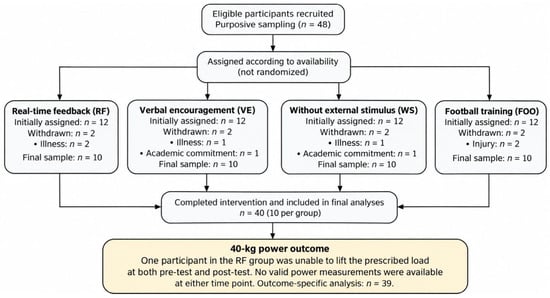
This study employed a four-group, parallel-group, nonrandomized intervention design to investigate the effects of different forms of feedback during resistance training on motor performance. The dependent variables were maximal strength and maximal concentric power, while the independent variable was the type of feedback provided during training, including real-time quantitative feedback and verbal encouragement. An a priori sample size calculation was performed using G*Power (Version 3.1.9.7, Heinrich Heine University Düsseldorf, Düsseldorf, Germany). Based on a repeated-measures ANOVA (within–between interaction), assuming a medium effect size (f = 0.25), an alpha level of 0.05, a statistical power of 0.80, four groups, and two measurement time points, the required sample size was estimated to be 48 participants. Accordingly, 48 male students from Prince Sultan University volunteered to participate in the study. Participants were recruited using purposive sampling based on predefined inclusion criteria: male sex, age between 18 and 25 years, good general health, absence of musculoskeletal injuries, willingness to complete the 8-week training program, a minimum of two months of gym-based resistance training experience, and less than two years of progressive resistance training experience. Participants were instructed to refrain from taking dietary supplements and from performing any lower-limb resistance training outside the study protocol throughout the intervention. In total, 48 participants were assigned to the four groups, with 12 participants per group. During the intervention, eight participants withdrew from the study. In the FOO group, two participants withdrew because of injury. In the VE group, one participant withdrew because of illness and one because of academic commitments. Two RF participants withdrew because of illness; one participant in the WS group withdrew because of illness and one because of academic commitments (Figure 1). Consequently, 40 participants completed the intervention and all testing sessions (age: 20.7 ± 2.2 years; body mass: 80.8 ± 20.1 kg; height: 174.9 ± 6.7 cm; BMI: 26.3 ± 6.0 kg/m2) and were included in the final analyses. However, one participant in the real-time quantitative feedback (RF) group was unable to lift the prescribed load during both the pre-test and post-test. Consequently, no valid power measurements were available for this participant at 40 kg. No values were imputed, and the participant was excluded from the 40 kg analysis, resulting in a sample of 39 participants for this outcome. The participant’s available data for other outcomes were retained in the corresponding analyses. Before baseline testing, all participants received standardized information regarding the study procedures, training protocol, and potential risks associated with participation and provided written informed consent. To minimize expectancy bias, participants were blinded to the specific aims and hypotheses of the study and were informed only that the study examined the effects of resistance training on physical performance. However, due to the nature of the intervention, participants were aware of the type of feedback they received during the training sessions. Maximal strength and maximal concentric power were assessed before and after the 8-week resistance training program.
Figure 1.
Participant flow diagram.
2.2. Instruments
Prior to the baseline assessment, participants performed three familiarization trials of the Smith machine squat using a 20 kg barbell to ensure proper technique and minimize potential learning effects. Following baseline testing, participants were assigned to one of four groups according to their availability: (1) real-time quantitative feedback (RF), (2) verbal encouragement (VE), (3) without external stimulation (WS), and (4) football training (FOO). Each group included 10 participants in the final analysis. The RF, VE, and WS groups completed the same resistance training program, differing only in the type of feedback provided. The FOO group participated in football training twice weekly for eight weeks. Each training session consisted of a 10 min standardized warm-up followed by a 30-min 5 vs. 5 small-sided game performed on a 30 × 15 m pitch with handball goals. All groups underwent identical pre- and post-intervention assessments before and after the 8-week training period. Participants in the RF group received verbal real-time quantitative feedback on concentric power output after each repetition using the FITROdyne Premium system (FITRONIC, Bratislava, Slovak Republic). The performance data were displayed on a monitor visible to the participant and simultaneously communicated verbally by the investigator. Participants in the VE group received standardized verbal encouragement consisting of the single command “Go!”, delivered loudly by the investigator immediately before each repetition and the concentric phase of each movement. Participants in the WS group performed the resistance training protocol without any external feedback or verbal encouragement. All testing sessions, training interventions, and outcome assessments were conducted by the same investigator to ensure standardized experimental procedures. The intervention lasted 8 weeks, with two training sessions per week, resulting in a total of 16 supervised training sessions. Attendance was monitored throughout the intervention. Participants who missed more than two training sessions were withdrawn from the study.
2.3. Procedures
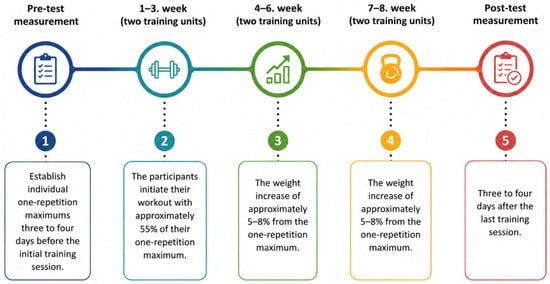
Students completed individualized training programs based on their pre-test one-repetition maximum (1RM) in the Smith machine squat (Figure 2). Each training session began with a standardized warm-up consisting of 5 min of treadmill walking or running at an individually selected speed, followed by dynamic stretching targeting the lower limbs, hips, and trunk, and five bodyweight squats. This warm-up protocol was performed before every training session. Following the warm-up, participants performed Smith machine squats using loads corresponding to approximately 55–70% of their pre-intervention 1RM. The resistance-training protocol consisted of two sets of 4–6 repetitions, with the number of repetitions in each set determined by participants’ subjective perceptions of their readiness to produce maximal power. Participants performed six repetitions when they felt capable of completing the upper end of the prescribed range or stopped at four repetitions when they perceived sufficient fatigue or a reduced capacity to continue. Training loads were individualized according to each participant’s pre-intervention squat 1RM. Initial loads corresponded to approximately 55% of baseline 1RM, progressing to approximately 70% over the intervention period. Loads were adjusted approximately every three weeks, with intended increases of 5–8%. However, actual increments varied according to the available weight plates (1.25, 2.5, 5, 10, 15, and 20 kg). Each participant received an individualized load-progression plan before the start of the training program, and the loads used throughout the intervention were recorded. The same prescribed repetition range and load-progression schedule were applied to the real-time quantitative feedback, verbal encouragement, and no-external-stimulus groups. Rest intervals between sets ranged from 3 to 6 min. Participants were instructed to perform each concentric phase with maximal intended velocity. Before each repetition, they sat on a 40-cm bench with the barbell positioned across the upper back and maintained a knee angle of approximately 90° for 3 s before initiating the concentric phase of the Smith machine squat. All participants had at least 48 h of recovery between consecutive training sessions. The prescribed parameters were informed by general resistance-training principles described by the American College of Sports Medicine [20], although the exact combination of sets, repetitions, and progression used in this study was specific to the present intervention.
Figure 2.
Training program.
The study adhered to ethical standards for human experimentation as outlined in the 1964 Helsinki Declaration and its subsequent amendments. Approval for the project was obtained from the Prince Sultan University Institutional Review Board (PSU IRB-2022-02-0104).
2.4. Data Collection and Processing
Participants were instructed to refrain from vigorous physical activity for at least 48 h before both the pre- and post-intervention assessments and were instructed to maintain their usual dietary intake but to avoid food and caffeine for 2 h before testing. On each testing day, participants completed the same standardized warm-up performed before every training session, consisting of 5 min of treadmill walking or running at an individually selected speed, followed by dynamic stretching of the lower limbs, hips, and trunk, and five bodyweight squats. After the warm-up, participants completed a testing battery to assess maximal concentric power and maximal strength. Maximal strength was assessed by determining the one-repetition maximum (1RM) during the Smith machine squat. The Smith machine was used to standardize the bar path and minimize movement variability between participants. In addition, squat depth was standardized by requiring participants to briefly sit on a 40-cm bench, corresponding to approximately 90° of knee flexion, before initiating the concentric phase of each repetition. Standardizing squat technique and depth has been shown to provide good to excellent reliability for velocity- and power-related variables during Smith machine squats (ICC = 0.79–0.95; CV < 10%) [21]. The squat was selected because it is one of the most commonly used exercises for developing lower-body strength.
Throughout testing, the same investigator acted as both examiner and spotter. Before each attempt, the participant’s body position and bar placement were checked to ensure correct technique. Participants positioned the barbell across the upper back (high-bar position), adopted a shoulder-width stance with the feet pointing forward, and sat briefly on the 40-cm bench while maintaining approximately 90° of knee flexion and full foot contact with the floor. After a pause of approximately 2–3 s, participants performed the concentric phase by standing up with maximal intended velocity until full knee and hip extension. Only the concentric phase was analyzed. Each repetition was considered successful only if the participant maintained the prescribed technique throughout the movement, including consistent foot contact with the floor, stable knee alignment, an upright trunk, and full extension of the hips and knees at the end of the lift. Any deviation from these criteria, including lifting the heels, altering the starting position, excessive trunk flexion, or failure to reach full extension, resulted in an unsuccessful attempt [22]. For safety, the spotter remained directly behind the participant throughout testing and intervened only when an attempt could not be completed safely, without touching the barbell during successful lifts [23]. Participants first performed the test with a 20 kg load. The external load was subsequently increased in 10 kg increments after each successful repetition until the participant reached their 1RM. If an attempt was unsuccessful, one additional attempt was permitted with the load reduced by 5 kg to improve the accuracy of 1RM determination. Peak concentric power was recorded during every successful repetition from the initial 20 kg load through the final successful 1RM attempt [24]. To contextualize the absolute loads used during the intervention, the relative intensity of the 20, 30, and 40 kg loads was calculated as a percentage of baseline squat one-repetition maximum (1RM) for each intervention group. Relative intensity was calculated by dividing each absolute load by the group mean baseline 1RM and multiplying by 100. These values were used descriptively to contextualize the loading conditions across groups.
Maximal concentric power was assessed at fixed external loads of 20, 30, and 40 kg at pre-test and post-test. These absolute loads provided standardized external loading conditions across participants and measurement occasions. However, because participants differed in body mass and baseline squat 1RM, the loads represented different relative intensities across individuals. Mechanical variables were measured using the FITROdyne Premium system (FITRONIC, Bratislava, Slovakia), a linear position transducer designed for strength assessment and real-time performance feedback. The device consists of a sensor unit connected to the barbell via a retractable cable and records bar displacement and velocity during each repetition. Based on bar displacement, time, and the external load, the system calculates velocity, force, power, and work, providing immediate feedback after every lift [25]. The FITROdyne system has demonstrated good reliability and validity for measuring biomechanical variables during resistance exercises, including squat jumps and biceps curls [26], bench press performed on a stable bench and Swiss ball [27], and Smith machine and free-weight deadlift-to-high-pull exercises [28]. To minimize measurement error, all assessments were conducted in the same laboratory by the same investigator, using identical equipment, at the same time of day, and under standardized environmental conditions.
2.5. Statistical Analysis
Data are presented as mean ± standard deviation (SD). Normality was assessed using the Shapiro–Wilk test. Baseline characteristics were compared among the four groups using one-way analysis of variance (ANOVA). The effects of the intervention on squat one-repetition maximum (1RM) and maximal concentric power at external loads of 20, 30, and 40 kg were examined separately using 2 × 4 mixed-design ANOVAs, with time (pre-test vs. post-test) as the within-subject factor and group (real-time quantitative feedback, verbal encouragement, without external stimulation, and football) as the between-subject factor. The time × group interaction was used to assess whether changes over time differed among groups. When the interaction was statistically significant, between-group comparisons of changes were examined using Bonferroni-adjusted pairwise comparisons of estimated marginal means. When the interaction was not statistically significant, but the main effect of group was significant, Bonferroni-adjusted pairwise comparisons were used to examine differences in average outcome values between groups. Within-group pre-to-post changes were examined as secondary analyses using paired-samples t-tests when the distribution of the paired differences was sufficiently consistent with the normality assumption. The Wilcoxon signed-rank test was used when this assumption was not met. Effect sizes were calculated using Cohen’s d for paired-samples t-tests and (r = Z/\sqrt{N}) for Wilcoxon signed-rank tests, where N denotes the number of observations used in calculating the effect size. Cohen’s d values of 0.20, 0.50, and 0.80 were interpreted as small, medium, and large effects, respectively. For Wilcoxon signed-rank tests, r values of 0.10, 0.30, and 0.50 were interpreted as small, medium, and large effects, respectively [29]. Partial eta squared (partial η2) was reported as the effect-size measure for ANOVA. A single primary outcome was not formally prespecified in the study analysis plan. Therefore, the analyses are interpreted as exploratory, and the possibility of an increased Type I error rate due to multiple testing cannot be excluded. Bonferroni adjustment was applied to the specified post hoc comparisons but did not control for multiplicity across all outcomes and analyses.
For each outcome, analyses were conducted using participants with complete measurements required for the respective analysis. Accordingly, the sample size could vary across outcomes depending on data availability. One participant in the real-time quantitative feedback (RF) group was unable to lift the prescribed 40-kg load during both the pre-test and post-test. Consequently, no valid power measurements were available for this participant at either time point. No values were imputed, and this participant was excluded from the 40-kg power analysis, resulting in a sample of 39 participants for this outcome. The participant’s available data for all other outcomes were retained in the corresponding analyses.
All statistical tests were two-sided, with statistical significance set at p < 0.05. Analyses were performed using IBM SPSS Statistics (Version 27; IBM Corp., Armonk, NY, USA).
3. Results
This section presents the study findings, beginning with participant characteristics, followed by the main outcomes and comparisons between the intervention groups.
3.1. Participant Characteristics
The baseline characteristics are reported in Table 1. No statistically significant between-group differences were observed in age, height, body mass, or BMI (all p > 0.05).
Table 1.
Characteristics of the participants (mean ± SD and n).
3.2. One-Repetition Maximum
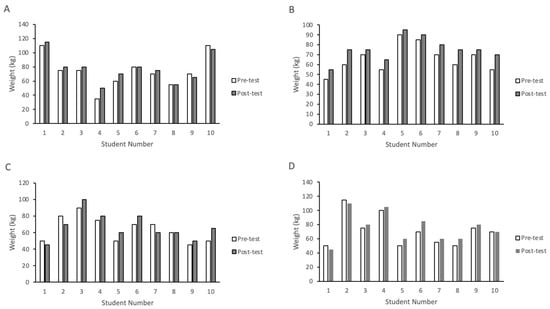
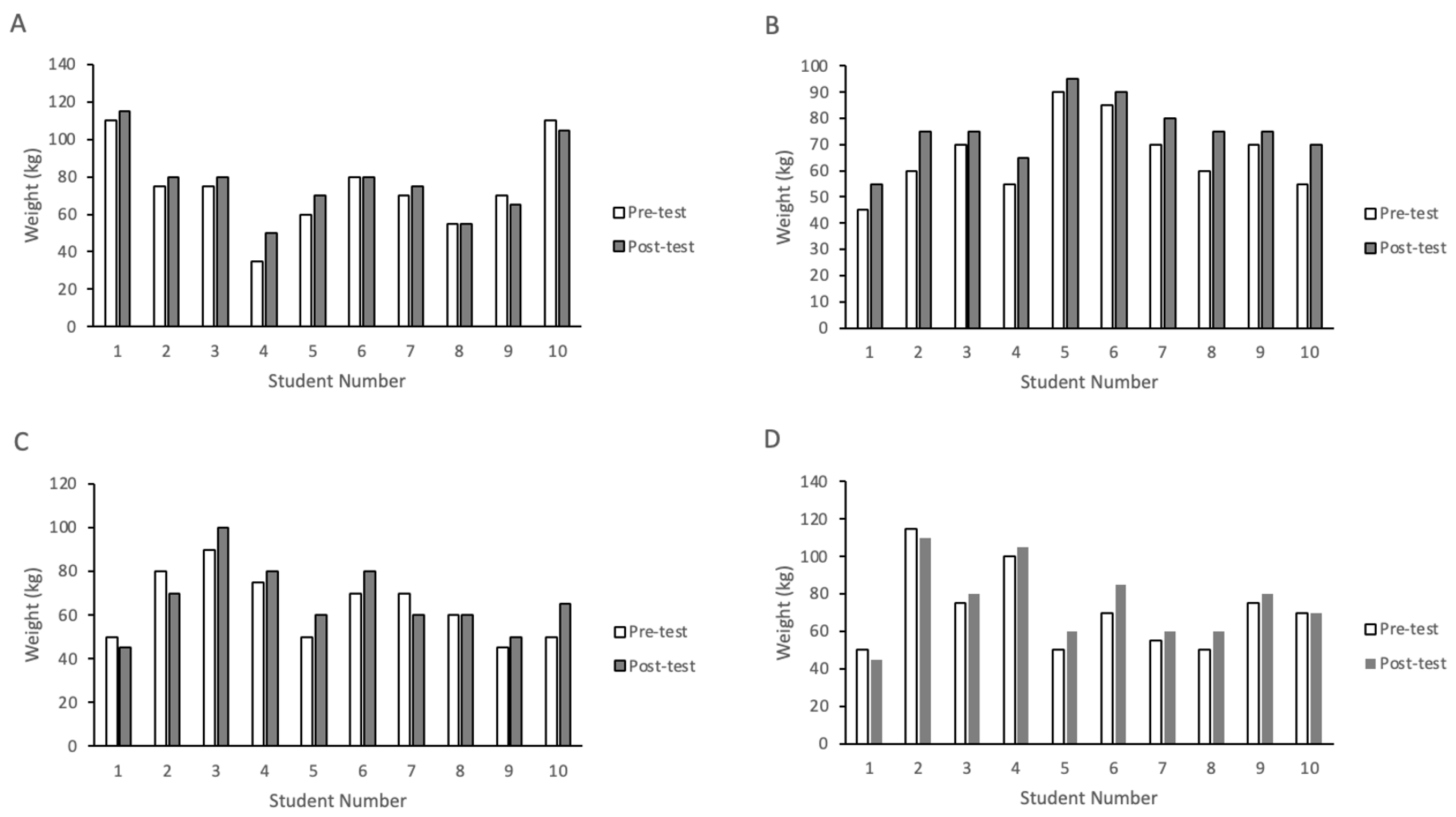
A significant main effect of time was observed for squat one-repetition maximum (1RM), F(1, 36) = 23.53, p < 0.001, partial η2 = 0.395, indicating an overall increase in 1RM from pre-test to post-test. The main effect of group was not significant, F(3, 36) = 0.60, p = 0.623, partial η2 = 0.047, and the time × group interaction was also not significant, F(3, 36) = 1.99, p = 0.133, partial η2 = 0.142. Thus, the analysis did not provide statistically significant evidence that changes in 1RM differed among the four groups. In secondary within-group analyses, a significant improvement was observed in the verbal-encouragement group (t(9) = 6.86, p < 0.001, d = 2.17), whereas changes in the real-time feedback, without-stimulus, and football groups did not reach statistical significance. These within-group findings should not be interpreted as evidence of between-group differences. Descriptive statistics are presented in Table 2. Figure 3A–D illustrate the individual changes (pre-post measurement) in one-repetition maximum within each group.
Table 2.
One-Repetition Maximum in the Smith Machine Squat. Data are presented as mean ± SD.
Figure 3.
Individual pre- to post-intervention changes in Smith machine squat one-repetition maximum (1RM) in the (A) real-time quantitative feedback, (B) verbal encouragement, (C) without external stimulation, and (D) football group.
To provide context for the absolute loading conditions, the relative intensities of the 20, 30, and 40 kg loads were calculated using the mean baseline squat 1RM values for each intervention group (Table 3).
Table 3.
Relative intensities of absolute squat loads based on baseline one-repetition maximum (1RM) values across intervention groups. Data are presented as mean ± SD.
3.3. Maximal Concentric Power at 20 kg
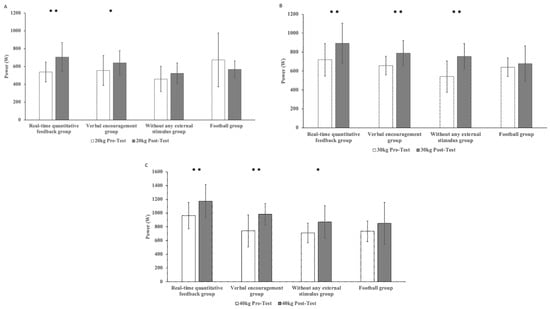
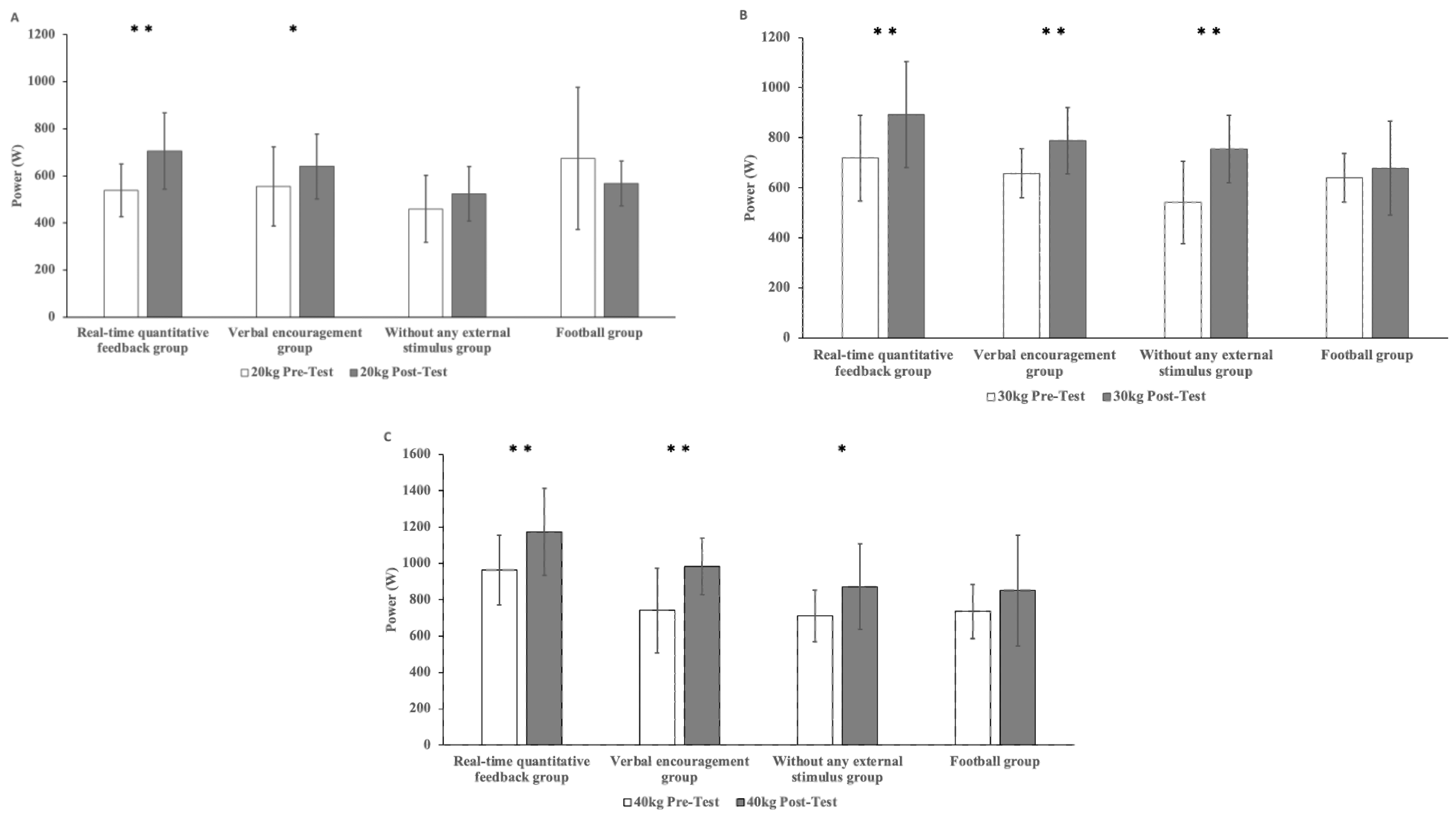
During the Smith machine squat performed with a 20-kg load (Figure 4A), a significant time × group interaction was observed (F(3, 36) = 4.53), (p = 0.009), partial (η2 = 0.274), indicating that changes in maximal concentric power differed among the groups. The main effects of time, (F(1, 36) = 3.73), (p = 0.061), partial (η2 = 0.094), and group, (F(3, 36) = 1.92), (p = 0.144), partial (η2 = 0.138), were not statistically significant. Bonferroni-adjusted pairwise comparisons of changes showed that the real-time quantitative feedback group improved significantly more than the football group (mean difference = 273.4 W, 95% CI 60.3 to 486.5 W (p = 0.006)). No other between-group differences in change were statistically significant (all (p > 0.05)). In secondary within-group analyses, maximal concentric power increased significantly in the real-time quantitative feedback group (Wilcoxon signed-rank test (W = 0), (p = 0.002), (r = 0.89)) and the verbal-encouragement group ((t(9) = 2.56), (p = 0.031), (d = 0.81)). Changes in the without-external-stimulation group ((t(9) = 1.75), (p = 0.115), (d = 0.55)) and the football group ((t(9) = −1.17), (p = 0.273), (d = −0.37)) were not statistically significant. These within-group findings should not be interpreted as evidence of differences between groups.
Figure 4.
Mean (± SD) maximal concentric power during the Smith machine squat at (A) a 20 kg load, (B) a 30 kg load, and (C) a 40 kg load before and after the 8-week intervention. Asterisks indicate statistically significant within-group differences between pre-test and post-test (* p ≤ 0.05; ** p ≤ 0.01).
3.4. Maximal Concentric Power at 30 kg
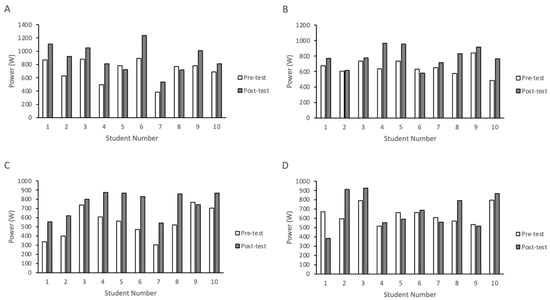
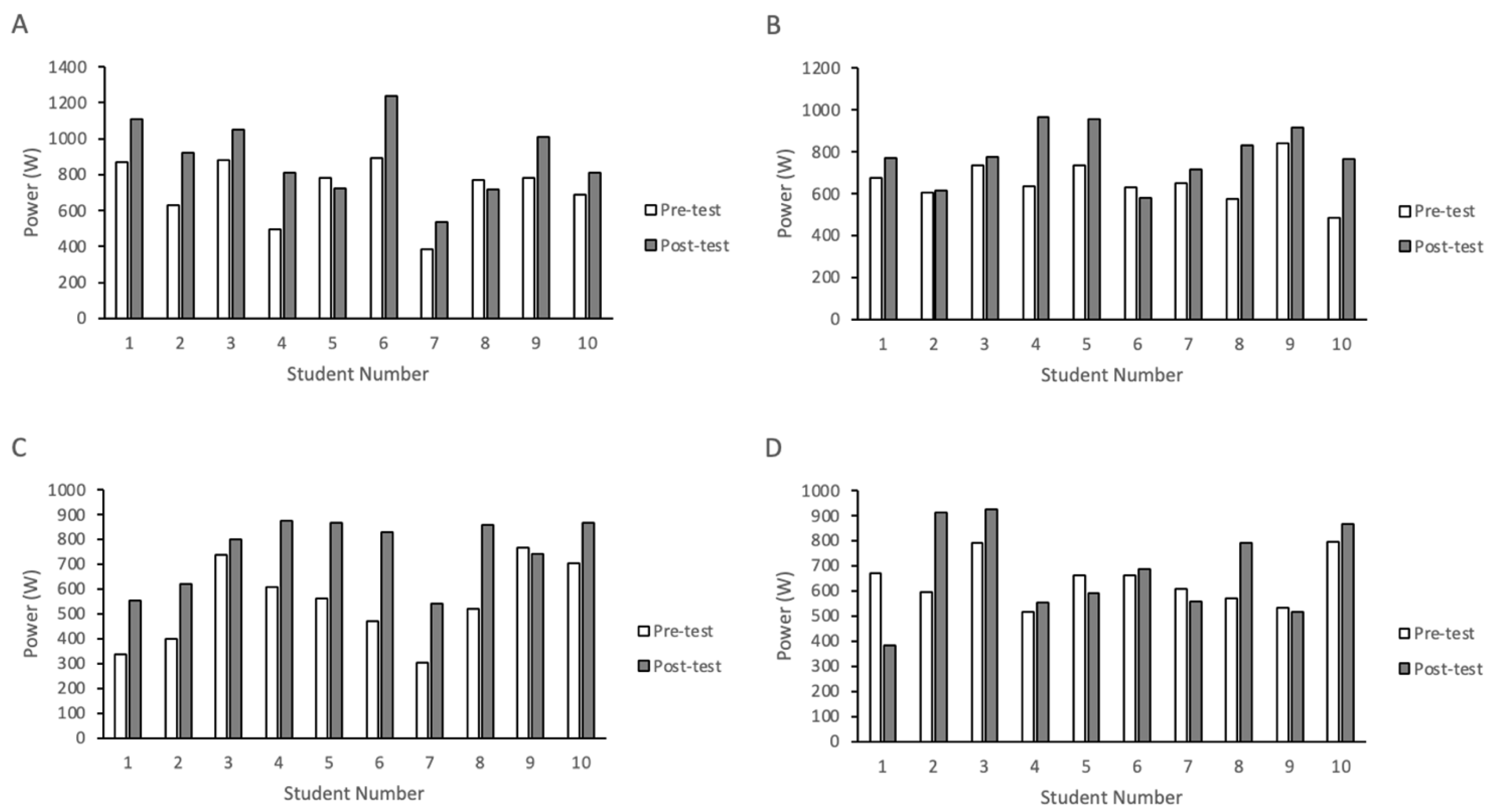
A significant main effect of time (pre-test vs. post-test) was observed for maximal concentric power during the Smith machine squat performed with a 30 kg load (Figure 4B), F(1, 36) = 39.40, p < 0.001, partial η2 = 0.523, indicating greater power output at post-test than at pre-test. The main effect of group was not statistically significant, F(3, 36) = 2.76, p = 0.056, partial η2 = 0.187. However, a significant time × group interaction was observed, F(3, 36) = 2.92, p = 0.047, partial η2 = 0.196, indicating that the magnitude of improvement differed among the intervention groups. Follow-up paired-samples t-tests demonstrated significant improvements in the Real-Time Feedback group (t(9) = 3.91, p = 0.004, d = 1.24), Verbal Encouragement group (t(9) = 3.23, p = 0.010, d = 1.02), and Without Stimulus group (t(9) = 5.59, p < 0.001, d = 1.77). No significant change was observed in the Football group (t(9) = 0.71, p = 0.495, d = 0.22). Bonferroni-adjusted pairwise comparisons of change scores revealed that the Without Stimulus group demonstrated a significantly greater improvement than the Football group (mean difference = 176.7 W, 95% CI 1.48 to 351.92 W, p = 0.047). No other pairwise comparisons were statistically significant (all p > 0.05). Figure 5A–D illustrate the individual changes (pre-post measurement) in maximal concentric power within each group at the 30 kg external load.
Figure 5.
Individual changes in maximal concentric power during the Smith machine squat with a 30-kg load before and after the 8-week intervention in the (A) Real-Time Feedback, (B) Verbal Encouragement, (C) Without Stimulus, and (D) Football group.
3.5. Maximal Concentric Power at 40 kg
A significant main effect of time (pre-test vs. post-test) was observed for maximal concentric power during the Smith machine squat performed with a 40 kg load (Figure 4C), F(1, 35) = 31.85, p < 0.001, partial η2 = 0.476, indicating an overall increase in maximal concentric power following the intervention. A significant main effect of group was also observed, F(3, 35) = 4.54, p = 0.009, partial η2 = 0.280, indicating differences in average power output among the intervention groups. However, the time × group interaction was not significant, F(3, 35) = 0.74, p = 0.536, partial η2 = 0.060, suggesting that the magnitude of improvement over time was comparable across groups. Follow-up paired-samples t-tests demonstrated significant improvements in the Real-Time Feedback group (t(8) = 5.33, p < 0.001, d = 1.78), Verbal Encouragement group (t(9) = 3.41, p = 0.008, d = 1.08), and Without Stimulus group (t(9) = 2.63, p = 0.027, d = 0.83), whereas no significant improvement was observed in the Football group (t(9) = 1.53, p = 0.161, d = 0.48). Pairwise comparisons for the main effect of group indicated that average maximal concentric power across pre-test and post-test was significantly higher in the RF group than in the WS group (mean difference = 278.4 W, 95% CI 37.3 to 519.5 W, p = 0.016) and the Football group (mean difference = 276.4 W, 95% CI 35.3 to 517.5 W, p = 0.017). No other pairwise comparisons were statistically significant (all p > 0.05).
4. Discussion
This section discusses the main findings in relation to the existing literature on maximal strength and power development and the use of external stimuli during resistance training. It also considers the practical implications of the findings and addresses the study’s limitations and directions for future research.
The primary purpose of this study was to compare the effects of real-time quantitative feedback, verbal encouragement, and resistance training without external stimulation on maximal strength and power during an 8-week squat-training program, with a football-training group serving as an active comparison condition. Squat one-repetition maximum (1RM) increased significantly over the intervention period; however, the time × group interaction was not statistically significant. Thus, the results do not provide evidence that improvements in maximal strength differed among the four groups. Although the verbal-encouragement group demonstrated a significant within-group increase in 1RM, this finding does not establish that verbal encouragement was more effective than the other training conditions.
The findings for maximal concentric power varied according to the absolute external load. At 20 kg, a significant time × group interaction was observed, and the real-time quantitative feedback group improved significantly more than the football group. However, the improvement in the real-time feedback group did not differ significantly from that in the resistance-training group without external stimulation. At 30 kg, a significant time × group interaction was also observed, with the group without external stimulation demonstrating a significantly greater improvement than the football group. At 40 kg, the time × group interaction was not statistically significant, indicating no statistically significant differences in changes in power among the groups. Although average power differed between some groups at this load, these main-effect comparisons do not establish differences in improvement over time. Therefore, the hypotheses concerning maximal concentric power received only partial and load-specific support.
The football group represented an active comparison condition involving a different training modality rather than a non-exercise control. Consequently, differences between the resistance-training and football groups should be interpreted as differences between training conditions and not as evidence of an additional benefit of feedback or verbal encouragement. Taken together, the results did not support the hypothesis that the resistance-training groups would demonstrate greater improvements in squat 1RM than the football-training group.
Overall, the results suggest that squat 1RM improved across the sample, while differences in maximal concentric power changes varied across the absolute loads tested. These findings should be interpreted cautiously given the absence of a significant interaction for 1RM, the inconsistent pattern of power outcomes, and the exploratory nature of the analyses.
4.1. Maximal Strength
The significant increase in 1RM across the intervention indicates that participants improved their maximal squat strength over the 8-week experimental period. However, the absence of a significant time × group interaction indicates that the magnitude of change did not differ statistically among the RF, VE, WS, and Football groups. Therefore, the present findings do not support the hypothesis that RF or VE would produce significantly greater improvements in maximal strength than the other conditions. Although the VE group demonstrated a statistically significant within-group increase in 1RM, this finding should be interpreted as evidence of improvement within the VE condition rather than evidence of superiority over the other interventions. Nevertheless, the magnitude of improvement observed in the VE group may be practically relevant.
The present findings differ to some extent from previous research demonstrating beneficial effects of external performance feedback on maximal strength. Weakley et al. [7] reported possibly to likely greater improvements in 3RM back-squat strength following a 4-week resistance-training intervention with immediate objective feedback compared with a no-feedback condition. Similarly, Vanderka et al. [30] reported a 7% improvement in 3RM half-squat strength following 6 weeks of jump-squat training with real-time visual power feedback, compared with a 3% improvement in the no-feedback group, which did not reach statistical significance. More recently, Pacholek [19] reported significant improvements in 1RM bench-press strength following an 8-week resistance-training intervention in both the RF (+9.76%) and VE (+11.51%) groups, whereas the Without Stimulus group improved by only 3.75% and did not reach statistical significance. In the present study, the VE group demonstrated a 14.4% improvement in squat 1RM, which was comparable in magnitude to the 11.51% improvement in bench-press 1RM reported by Pacholek [19]. However, unlike Pacholek [19], the present study did not demonstrate a significant time × group interaction for 1RM. These differences may indicate that the effects of external performance stimuli on maximal strength are influenced by factors such as the exercise performed, biomechanical and loading characteristics, training protocol, and feedback modality.
One possible explanation for the absence of significant between-group differences in 1RM is that all resistance-training groups performed the same structured and progressive squat-training program, with the external stimulus representing the primary experimental difference between conditions. The underlying resistance-training stimulus may therefore have been sufficient to induce improvements in maximal strength across the intervention, limiting the additional contribution that RF or VE could make to the observed adaptation. Thus, the present findings suggest that the progressive resistance-training stimulus may have been more influential for overall improvements in maximal strength than the specific external stimulus used during training.
The Football group demonstrated a 4.5 kg increase in squat 1RM, corresponding to a 5.96% improvement and a moderate-to-large within-group effect size (d = 0.70), although this change did not reach statistical significance. Previous studies have demonstrated substantial improvements in maximal squat strength when structured resistance training is incorporated into the training programs of football players. Helgerud et al. [31] reported a 51.7% increase in half-squat 1RM following 8 weeks of twice-weekly maximal-strength training, while Styles et al. [32] observed a 19.1% increase in back-squat 1RM following 6 weeks of twice-weekly in-season strength training. In contrast, the Football group in the present study demonstrated a considerably smaller numerical increase in squat 1RM (+5.96%), which did not reach statistical significance. Nevertheless, the numerical improvement observed in the Football group may reflect the neuromuscular demands of football, which include repeated accelerations, decelerations, changes of direction, jumping, and other high-force lower-body actions. In addition, repeated exposure to the squat 1RM testing procedure may have contributed to improved technical execution, familiarity, and confidence during the post-test. These factors may partly explain the numerical increase in squat strength despite the absence of structured resistance training. Taken together, the present findings, considered alongside previous research, suggest that incorporating structured resistance training alongside football training may be a potentially useful approach to improving maximal squat strength. However, the present study did not directly investigate the combined effects of these training modalities.
4.2. Power Adaptation
The effects of the interventions were more evident for maximal concentric power than for maximal strength, although the magnitude and pattern of these effects varied across external loads. This load-dependent response is important because it suggests that the potential contribution of external stimuli may not be uniform across the force–velocity spectrum.
At the 20-kg load, no significant main effect of time or group was observed; however, the RF group demonstrated a significant improvement with a very large effect size, while the VE group also demonstrated a significant improvement with a large effect size. Importantly, pairwise comparisons of change scores showed that the RF group improved significantly more than the Football group, whereas no other between-group comparisons were statistically significant. The particularly favorable response to RF at 20 kg may be related to the nature of the feedback provided. Participants in the RF group received immediate information about concentric power after every repetition, allowing them to observe their performance and potentially adjust their effort on subsequent repetitions. Unlike VE, which primarily provides a motivational stimulus, RF provides objective information about the actual movement outcome. Participants could therefore attempt to maximize each repetition based on immediate knowledge of their performance. This may have been particularly advantageous at a relatively light external load. The present finding is consistent with previous research demonstrating beneficial effects of real-time performance feedback on acute resistance-training performance. Weakley et al. [3], in a systematic review and meta-analysis, reported that feedback can increase acute resistance-training performance, including barbell velocity. Similarly, previous studies have demonstrated that providing immediate performance information can increase movement velocity and training performance [33,34,35]. The present results extend this literature by suggesting that repeated exposure to RF during an 8-week training program may contribute to improvements in power at a relatively light squat load.
The significant improvement observed in the VE group at 20 kg also suggests that a motivational stimulus may facilitate the development of explosive performance when participants are instructed to perform each repetition with maximal intended velocity. The large effect size observed in the VE group further supports the potential practical value of verbal encouragement. This finding is consistent with previous research demonstrating that external stimuli can positively influence physical performance. Pacholek [19] demonstrated that verbal encouragement during an 8-week bench-press training program was associated with significant improvements in strength and power. Similarly, Concon et al. [12] reported that both real-time visual feedback and verbal encouragement increased repetition velocity during the bench press in trained powerlifters compared with a control condition. However, the effect of VE may depend strongly on how the encouragement is delivered. Previous research has shown that the source, content, timing, frequency, and personalization of encouragement may influence its effects [9,10]. In the present study, VE was intentionally standardized to a single command, “Go!”, delivered loudly immediately before and during each repetition. This approach minimized variability in the intervention and ensured that all participants received the same verbal stimulus. However, it also represents a relatively simple form of VE compared with the dynamic, individualized encouragement typically provided by strength and conditioning coaches. Previous studies have reported both positive and null effects of VE on strength performance [13,15,16,17]. Therefore, although the present VE group demonstrated significant improvements in strength and power at selected outcomes, the absence of consistent between-group superiority suggests that the additional effect of standardized VE may be relatively small or dependent on the broader training context.
At 30 kg, the RF, VE, and WS groups all demonstrated significant improvements, with large-to-very-large within-group effect sizes, whereas the Football group did not significantly improve. The Without Stimulus group improved significantly more than the Football group. No significant differences in change were observed between RF and VE, RF and WS, or VE and WS. Therefore, although the significant interaction indicates that the pattern of change differed among groups, the post hoc results do not provide evidence that RF or VE was superior to resistance training without external stimulation at this load. The improvement observed in the Without Stimulus group at 30 kg is particularly relevant. Participants in this condition followed the same individualized and progressive resistance-training program as the RF and VE groups and were instructed to perform the concentric phase with maximal intended velocity. Thus, the observed improvement suggests that substantial gains in power may occur without additional external feedback or verbal encouragement when resistance training is performed using a structured, progressive program with maximal intended concentric velocity. The lack of significant differences between the Without Stimulus group and either RF or VE further suggests that the underlying resistance-training stimulus was sufficient to promote power development at this load.
Similarly, significant within-group improvements were observed in the RF, VE, and WS groups at 40 kg. However, the nonsignificant time × group interaction indicates that the analysis did not identify statistically significant differences in changes among the four groups. Therefore, the findings do not establish that external feedback or verbal encouragement provided an additional benefit at this load. This finding differs somewhat from Pacholek [19], who reported significant improvement at a higher load in the RF group following an 8-week bench-press training program. In the present study, significant improvements were observed across all three resistance-training conditions. Differences between studies may reflect the exercise performed, participant characteristics, training prescription, loading strategy, or the specific characteristics of the feedback intervention.
The substantial improvements observed in the Without Stimulus group at 30 and 40 kg are particularly noteworthy because they demonstrate that external feedback is not necessarily required to develop power under the present training conditions. Participants in this group were instructed to perform each concentric phase with maximal intended velocity and followed the same individualized, progressive resistance-training program as the RF and VE groups. The importance of maximal movement intent is supported by González-Badillo et al. [36], who demonstrated that bench-press training performed with maximal intended velocity induced greater improvements in performance than training performed at deliberately slower velocities. Similarly, Pareja-Blanco et al. [37] reported superior neuromuscular adaptations when training was performed with maximal concentric velocity. The effectiveness of the without external stimulation condition may therefore be explained by the structured nature of the training environment. Clear instructions, individualized training loads, and a consistent training protocol may have been sufficient to maintain a high level of effort throughout the intervention. Participants’ motivation to execute each repetition with maximal effort may therefore have remained sufficiently high without additional external stimulation. This may help explain why the WS group improved to a similar extent as the groups receiving additional stimuli. External feedback may provide greater benefits when participants have difficulty maintaining motivation or accurately regulating their effort, whereas participants who are already able and willing to perform each repetition with maximal intent may have less opportunity for additional improvement.
An important distinction when interpreting these findings is the difference between acute performance effects and chronic training adaptations. Studies by Pérez-Castilla et al. [38] and Jiménez-Alonso et al. [39] have suggested that immediate or repetition-by-repetition feedback can enhance acute power and velocity performance during resistance exercise. Similarly, Concon et al. [12] found that real-time visual feedback and verbal encouragement increased repetition velocity during the bench press. These acute benefits may be practically important because repeatedly performing training repetitions at higher velocities could theoretically contribute to greater long-term adaptations. The present findings did not demonstrate consistent superiority of the external stimuli over the control condition in terms of chronic adaptations. However, because acute performance responses were not directly assessed in the present study, the relationship between acute performance effects and subsequent chronic adaptations cannot be determined from these findings. The systematic review and meta-analysis by Weakley et al. [3] demonstrated clear acute benefits of augmented feedback during resistance training but highlighted that evidence regarding its chronic effects remains comparatively limited. Although available longitudinal studies generally suggest that feedback may enhance long-term adaptations, further research is needed to establish the magnitude and consistency of these effects across different populations and training conditions. The relatively small number of available studies, together with limitations in sample sizes and outcome measures, further highlights the need for more robust longitudinal research.
4.3. Practical Implications
The findings have several practical implications for strength and conditioning practitioners. First, the results support the importance of progressive resistance training as a strategy for improving squat strength and power. Squat 1RM increased significantly over the intervention period, although changes did not differ significantly among the four groups. Therefore, external feedback should not be considered a prerequisite for improving maximal strength.
Second, real-time quantitative feedback may be a feasible adjunct to resistance training when monitoring power performance and providing immediate information about exercise execution. Although the real-time feedback group improved significantly more than the football group in power at 20 kg, this difference was not statistically significant when compared with resistance training without external stimulation. Consequently, the present findings do not establish that real-time quantitative feedback provides an additional benefit for improving power beyond resistance training alone.
Third, verbal encouragement is an inexpensive and readily available coaching strategy that can be incorporated into resistance-training sessions without additional technological equipment. However, the significant within-group improvement in 1RM observed in the verbal-encouragement group does not establish that verbal encouragement produces greater adaptations than the other resistance-training conditions. Practitioners may use verbal encouragement as part of their coaching approach, but its additional effects on maximal strength and power remain uncertain.
Finally, the differences observed between resistance-training and football groups at specific external loads should be interpreted as comparisons between different training modalities rather than as evidence of an additional benefit of feedback or verbal encouragement. Overall, real-time quantitative feedback and verbal encouragement may be considered optional adjuncts to resistance training, but the present findings do not demonstrate their consistent superiority over otherwise similar resistance training without external stimulation.
4.4. Limitations and Future Directions
Several limitations should be considered when interpreting the findings. First, the sample consisted exclusively of young male university students with previous resistance-training experience. Therefore, the findings may not be generalizable to females, older adults, highly trained strength athletes, or other populations. Future studies should recruit larger and more diverse samples to examine whether responses to real-time quantitative feedback and verbal encouragement vary according to sex, age, and training status.
Second, participants were assigned to groups according to their availability rather than through random allocation. This approach may have introduced selection bias and reduced the comparability of the groups. Although no statistically significant between-group differences were observed in the measured baseline characteristics, this does not exclude the possibility of other unmeasured differences. In addition, eight participants withdrew during the intervention, leaving 40 participants in the final analyses compared with the 48 participants required by the a priori sample size calculation. The resulting reduction in sample size may have limited the statistical power to detect between-group differences. Future studies should use randomized allocation where feasible, recruit sufficient participants to account for anticipated attrition, and prespecify the primary outcome and analysis plan.
Third, the intervention lasted eight weeks and included two supervised sessions per week. Although improvements were observed in several strength and power outcomes, the relatively short intervention may have limited the ability to detect differences in longer-term adaptations. Furthermore, the prescribed training protocol allowed four to six repetitions per set according to participants’ subjective readiness, and the exact number of repetitions completed during each session was not systematically recorded. Consequently, actual training volume could not be reconstructed. Future research should systematically record repetitions, training volume, and load progression and consider longer interventions to investigate whether different external stimuli influence adaptations over time.
Fourth, the VE intervention was highly standardized and consisted of the verbal command “Go!” delivered by the investigator. Although this approach provided a consistent encouragement protocol, it may not represent the range of verbal encouragement strategies used in practical coaching settings. Moreover, the same investigator delivered the interventions, supervised training, and conducted outcome assessments, meaning that assessor blinding was not possible. The groups also differed in the nature and amount of investigator–participant interaction: the RF group received quantitative feedback, the VE group received verbal encouragement, and the WS group received no comparable external stimulus. Therefore, the possible influence of assessor-related bias and differences in attention or interaction cannot be excluded. Future studies should consider blinded outcome assessment where feasible and compare different forms, sources, and delivery strategies of verbal encouragement while controlling investigator–participant interaction as far as possible.
Fifth, maximal concentric power was assessed at fixed absolute loads of 20, 30, and 40 kg. Although this approach enabled comparisons at standardized external loads, the same absolute load represented different relative intensities among participants because of differences in baseline strength and body mass. In addition, one participant in the RF group could not lift 40 kg during either assessment and was excluded from that load-specific analysis, resulting in 39 participants for the 40-kg outcome. Future studies should consider assessing power at individualized relative loads based on baseline 1RM and reporting power relative to body mass alongside absolute power. A wider range of individualized loading conditions may also help clarify whether the effects of external stimuli depend on relative exercise intensity.
Finally, a primary outcome was not formally prespecified in the analysis plan, and multiple outcomes and comparisons were examined. Although Bonferroni adjustment was applied to the specified post hoc comparisons, multiplicity was not controlled across all analyses. Therefore, the findings, particularly those involving borderline statistically significant results, should be interpreted as exploratory and require confirmation. Future studies should prespecify primary and secondary outcomes, define the statistical analysis plan in advance, and apply an appropriate strategy for controlling multiplicity.
Overall, further research using larger randomized samples, longer interventions, more comprehensive training-dose monitoring, and prespecified statistical analyses is needed to establish whether RF and VE provide meaningful additional benefits beyond resistance training without external stimulation. Studies should also investigate whether individualized feedback strategies, different feedback frequencies, or combinations of quantitative feedback and verbal encouragement produce consistent benefits across different loads, exercises, and athletic populations.
5. Conclusions
The findings indicate that squat 1RM and maximal concentric power generally increased over the intervention period. However, changes in squat 1RM did not differ significantly among the four groups. For maximal concentric power, significant time × group interactions were observed at 20 and 30 kg, with significant between-group differences in change limited to comparisons involving the football group. At 40 kg, the interaction was not statistically significant. Overall, the findings do not demonstrate consistent superiority of real-time quantitative feedback or verbal encouragement over resistance training without external stimulation. Although previous research has reported acute benefits of external stimuli, acute responses were not assessed in the present study; therefore, the relationship between acute performance effects and long-term adaptations cannot be determined from these findings. The observed differences in power changes varied across the absolute loads tested. Practitioners may therefore use feedback and verbal encouragement as optional coaching strategies, while recognizing that their additional benefits for long-term strength and power development remain uncertain.
Funding
This research was funded by Prince Sultan University through the Research and Initiatives Center (SEED-CHS-2022-99).
Institutional Review Board Statement
The study was conducted in accordance with the Declaration of Helsinki and approved by the Prince Sultan University Institutional Review Board (PSU IRB-2022-02-0104; date 20 April 2022).
Informed Consent Statement
Informed Consent Statement: Informed consent was obtained from all participants involved in the study.
Data Availability Statement
The data presented in this study are available from the corresponding author upon reasonable request. The data are not publicly available due to privacy restrictions.
Acknowledgments
The author would like to recognize the efforts made by Prince Sultan University in funding the research with either fees, incentives, or seed grants.
Conflicts of Interest
The author declares no conflicts of interest. The funder had no role in the design of the study; in the collection, analyses, or interpretation of data; in the writing of the manuscript; or in the decision to publish the results.
References
- Mouratidis, A.; Vansteenkiste, M.; Lens, W.; Sideridis, G. The motivating role of positive feedback in sport and physical education: Evidence for a motivational model. J. Sport Exerc. Psychol. 2008, 30, 240–268. [Google Scholar] [CrossRef] [Scilit]
- Kangalgil, M.; Özgül, F. Use of feedback in physical education and sports lessons from student point of view. Univers. J. Educ. Res. 2018, 6, 1235–1242. [Google Scholar] [CrossRef] [Scilit]
- Weakley, J.; Cowley, N.; Schoenfeld, B.J.; Read, D.B.; Timmins, R.G.; García-Ramos, A.; McGuckian, T.B. The effect of feedback on resistance training performance and adaptations: A systematic review and meta-analysis. Sports Med. 2023, 53, 1789–1803. [Google Scholar] [CrossRef] [Scilit]
- Koka, A.; Hein, V. Perceptions of teachers’ feedback and learning environment as predictors of intrinsic motivation in physical education. Psychol. Sport Exerc. 2003, 4, 333–346. [Google Scholar] [CrossRef] [Scilit]
- Zhou, Y.; Shao, W.D.; Wang, L. Effects of feedback on students’ motor skill learning in physical education: A systematic review. Int. J. Environ. Res. Public Health 2021, 18, 6281. [Google Scholar] [CrossRef] [Scilit]
- Weakley, J.; Wilson, K.; Till, K.; Banyard, H.; Dyson, J.; Phibbs, P.; Read, D.; Jones, B. Show me, tell me, encourage me: The effect of different forms of feedback on resistance training performance. J. Strength Cond. Res. 2020, 34, 3157–3163. [Google Scholar] [CrossRef] [Scilit]
- Weakley, J.J.S.; Wilson, K.M.; Till, K.; Read, D.B.; Darrall-Jones, J.; Roe, G.A.B.; Phibbs, P.J.; Jones, B. Visual feedback attenuates mean concentric barbell velocity loss and improves motivation, competitiveness, and perceived workload in male adolescent athletes. J. Strength Cond. Res. 2019, 33, 2420–2425. [Google Scholar] [CrossRef] [Scilit]
- Stien, N.; Saeterbakken, A.H.; Andersen, V.; Solstad, T.E.J. The impact of real-time visual feedback on maximal force output and reliability during isometric mid-thigh pull testing in resistance-trained men. Eur. J. Sport Sci. 2025, 25, e70000. [Google Scholar] [CrossRef] [Scilit]
- Meurs, E.; Nieto, M.; Strauss, B.; Harenberg, S. Naturalistic verbal and non-verbal encouragement in athletic performance assessments: A mixed-methods study. J. Sports Sci. 2026, 44, 1113–1126. [Google Scholar] [CrossRef] [Scilit]
- Midgley, A.W.; Marchant, D.C.; Levy, A.R. A call to action towards an evidence-based approach to using verbal encouragement during maximal exercise testing. Clin. Physiol. Funct. Imaging 2018, 38, 547–553. [Google Scholar] [CrossRef] [Scilit]
- Belkhiria, C.; De Marco, G.; Driss, T. Effects of verbal encouragement on force and electromyographic activations during exercise. J. Sports Med. Phys. Fit. 2018, 58, 750–757. [Google Scholar] [CrossRef] [Scilit]
- Concon, V.; Kobal, R.; Carvalho, L.; Crivoi do Carmo, E.; Coimbra, D.; Barroso, R. The effect of real-time visual feedback and verbal encouragement on repetition velocity of squat, bench press and deadlift exercises in competitive powerlifters. Int. J. Sports Sci. Coach. 2025, 20, 275–280. [Google Scholar] [CrossRef] [Scilit]
- Romdhani, A.; Sahli, F.; Trabelsi, O.; Rebhi, M.; Ghouili, H.; Sahli, H.; Salem, A.; Trabelsi, K.; Jahrami, H.; Ammar, A.; et al. Peer verbal encouragement is more effective than coach encouragement in enhancing CrossFit-specific 1-RM strength, functional endurance, and psychophysiological assessment performance. Sports 2024, 12, 64. [Google Scholar] [CrossRef] [Scilit]
- Aydın, G.R.; Kasap, M. The effects of motivational verbal phrases on isoinertial force production and sustained force output: A comparison of positive and negative conditions. Front. Psychol. 2026, 17, 1852572. [Google Scholar] [CrossRef] [Scilit]
- Campenella, B.; Mattacola, C.G.; Kimura, I.F. Effect of visual feedback and verbal encouragement on concentric quadriceps and hamstrings peak torque of males and females. Isokinet. Exerc. Sci. 2000, 8, 1–6. [Google Scholar] [CrossRef] [Scilit]
- Lee, H.; Shin, J.; Kim, D.; Park, J. Effect of verbal encouragement on quadriceps and knee joint function during three sets of knee extension exercise. Isokinet. Exerc. Sci. 2021, 29, 155–162. [Google Scholar] [CrossRef] [Scilit]
- Pacholek, M.; Zemková, E. Effects of verbal encouragement and performance feedback on physical fitness in young adults. Sustainability 2022, 14, 1753. [Google Scholar] [CrossRef] [Scilit]
- Romdhani, A.; Trabelsi, O.; Selmi, O.; Guelmami, N.; Weiss, K.; Rosemann, T.; Zghibi, M.; Knechtle, B. Verbal encouragement during strength and endurance assessments: The gender of the encourager can matter. Acta Psychol. 2025, 255, 104919. [Google Scholar] [CrossRef] [Scilit]
- Pacholek, M. The influence of real-time quantitative feedback and verbal encouragement on adults’ performance in maximal and explosive strength and power in bench press exercise. Front. Physiol. 2024, 15, 1329432. [Google Scholar] [CrossRef] [Scilit]
- Ratamess, N.A.; Alvar, B.A.; Evetoch, T.K.; Housh, T.J.; Kibler, W.B.; Kraemer, W.J.; Triplett, T.; Ratamess, N.; Alvar, B.; Evetoch, T.K.; et al. American College of Sports Medicine position stand. Progression models in resistance training for healthy adults. Med. Sci. Sports Exerc. 2009, 41, 687–708. [Google Scholar] [CrossRef] [Scilit]
- Pérez-Castilla, A.; Janicijevic, D.; Akyildiz, Z.; Senturk, D.; García-Ramos, A. Assessment of back-squat performance at submaximal loads: Is the reliability affected by the variable, exercise technique, or repetition criterion? Int. J. Environ. Res. Public Health 2021, 18, 4626. [Google Scholar] [CrossRef] [Scilit]
- van den Tillaar, R.; Kristiansen, E.L.; Larsen, S. Is the occurrence of the sticking region in maximum Smith machine squats the result of diminishing potentiation and co-contraction of the prime movers among recreationally resistance-trained males? Int. J. Environ. Res. Public Health 2021, 18, 1366. [Google Scholar] [CrossRef] [Scilit]
- Wilk, M.; Golas, A.; Zmijewski, P.; Krzysztofik, M.; Filip, A.; Del Coso, J.; Tufano, J.J. The effects of the movement tempo on the one-repetition maximum bench press results. J. Hum. Kinet. 2020, 72, 151–159. [Google Scholar] [CrossRef] [Scilit]
- Pacholek, M.; Zemková, E. Effect of two strength training models on muscle power and strength in elite women’s football players. Sports 2020, 8, 42. [Google Scholar] [CrossRef] [Scilit]
- FITRONIC. FITROdyne Premium: User Manual and Technical Documentation; FITRONIC: Bratislava, Slovakia, 2017. [Google Scholar]
- Jennings, C.L.; Viljoen, W.; Durandt, J.; Lambert, M.I. The reliability of the FitroDyne as a measure of muscle power. J. Strength. Cond. Res. 2005, 19, 859–863. [Google Scholar] [CrossRef] [Scilit]
- Zemková, E.; Jeleň, M.; Kováčiková, Z.; Ollé, G.; Vilman, T.; Hamar, D. Reliability and methodological issues of power assessment during chest presses on unstable surface with different weights. J. Sports Med. Phys. Fit. 2015, 55, 922–930. [Google Scholar]
- Zemková, E.; Cepková, A.; Uvaček, M.; Hamar, D. A new method to assess the power performance during a lifting task in young adults. Measurement 2016, 91, 460–467. [Google Scholar] [CrossRef] [Scilit]
- McLeod, S.A. What Does Effect Size Tell You? Simply Psychology. 10 July 2019. Available online: https://www.simplypsychology.org/effect-size.html (accessed on 6 August 2026).
- Vanderka, M.; Bezák, A.; Longová, K.; Krčmár, M.; Walker, S. Use of visual feedback during jump-squat training aids improvement in sport-specific tests in athletes. J. Strength Cond. Res. 2020, 34, 2250–2257. [Google Scholar] [CrossRef] [Scilit]
- Helgerud, J.; Rodas, G.; Kemi, O.J.; Hoff, J. Strength and endurance in elite football players. Int. J. Sports Med. 2011, 32, 677–682. [Google Scholar] [CrossRef] [Scilit]
- Styles, W.J.; Matthews, M.J.; Comfort, P. Effects of strength training on squat and sprint performance in soccer players. J. Strength Cond. Res. 2016, 30, 1534–1539. [Google Scholar] [CrossRef] [Scilit]
- Argus, C.K.; Gill, N.D.; Keogh, J.W.L.; Hopkins, W.G. Acute effects of verbal feedback on upper-body performance in elite athletes. J. Strength Cond. Res. 2011, 25, 3282–3287. [Google Scholar] [CrossRef] [Scilit]
- Randell, A.D.; Cronin, J.B.; Keogh, J.W.L.; Gill, N.D.; Pedersen, M.C. Effect of instantaneous performance feedback during 6 weeks of velocity-based resistance training on sport-specific performance tests. J. Strength Cond. Res. 2011, 25, 87–93. [Google Scholar] [CrossRef] [Scilit]
- Wilson, K.M.; Helton, W.S.; de Joux, N.R.; Head, J.R.; Weakley, J.J. Real-time quantitative performance feedback during strength exercise improves motivation, competitiveness, mood, and performance. Proc. Hum. Factors Ergon. Soc. Annu. Meet. 2017, 61, 1546–1550. [Google Scholar] [CrossRef] [Scilit]
- González-Badillo, J.J.; Rodríguez-Rosell, D.; Sánchez-Medina, L.; Gorostiaga, E.M.; Pareja-Blanco, F. Maximal intended velocity training induces greater gains in bench press performance than deliberately slower half-velocity training. Eur. J. Sport Sci. 2014, 14, 772–781. [Google Scholar] [CrossRef] [Scilit]
- Pareja-Blanco, F.; Rodríguez-Rosell, D.; Sánchez-Medina, L.; Gorostiaga, E.M.; González-Badillo, J.J. Effect of movement velocity during resistance training on neuromuscular performance. Int. J. Sports Med. 2014, 35, 916–924. [Google Scholar] [CrossRef] [Scilit]
- Pérez-Castilla, A.; Jiménez-Alonso, A.; Cepero, M.; Miras-Moreno, S.; Rojas, F.J.; García-Ramos, A. Velocity performance feedback during ballistic training: Which is the optimal frequency of feedback administration? Mot. Control 2020, 25, 19–32. [Google Scholar] [CrossRef] [Scilit]
- Jiménez-Alonso, A.; García-Ramos, A.; Cepero, M.; Miras-Moreno, S.; Rojas, F.J.; Pérez-Castilla, A. Effect of augmented feedback on velocity performance during strength-oriented and power-oriented resistance training sessions. J. Strength Cond. Res. 2022, 36, 1511–1517. [Google Scholar] [CrossRef] [Scilit]

Disclaimer/Publisher’s Note: The statements, opinions and data contained in all publications are solely those of the individual author(s) and contributor(s) and not of MDPI and/or the editor(s). MDPI and/or the editor(s) disclaim responsibility for any injury to people or property resulting from any ideas, methods, instructions or products referred to in the content. |
© 2026 by the author. Licensee MDPI, Basel, Switzerland. This article is an open access article distributed under the terms and conditions of the Creative Commons Attribution (CC BY) license.