


Simple Summary
Aedes mosquito surveillance is used to guide integrated vector management for arbovirus disease control. Although the Biogents Sentinel (BGS) trap is considered the standard trap for monitoring Aedes aegypti, its relatively high cost and reliance on a battery powered fan limit large-scale use in resource-constrained settings. This study evaluated the performance of lower-cost, oviposition-based traps relative to the standard BGS trap. This included the Biogents Gravid Aedes Trap (BG-GAT), a locally produced modified Gravid Aedes Trap (MoGAT) applied at different densities, either one or four together, and a modified Ovillanta trap. Oviposition traps were yeast-baited and the Ovillanta was modified to capture adult mosquitoes by incorporating internal adhesive surfaces. The modified Ovillanta with yeast captured adult female Ae. aegypti numbers similar to the standard BGS trap and outperformed all other gravid traps. These findings suggest that the modified Ovillanta is a promising candidate oviposition trap for further evaluation.
Abstract
Aedes aegypti surveillance is essential for guiding arbovirus control strategies. The BG-Sentinel (BGS) trap is a widely used reference trap for monitoring adult Ae. aegypti, but its cost and need for electricity limit its use in resource-constrained settings. This study evaluated locally made, low-cost oviposition-based traps relative to the BGS trap. The Ovillanta trap was modified with internal adhesive surfaces to capture adult mosquitoes. Six trap types were evaluated at six outdoor locations, including (1) Ovillanta with yeast (2) Ovillanta with only water, (3) BG-Gravid Aedes Trap (BG-GAT) with yeast, (4) one modified GAT (1MoGAT) with yeast, (5) four modified GATs (4MoGAT) with yeast, and (6) a standard BGS trap with BG-Lure. Traps were deployed for three consecutive 24 h sampling periods before rotation. This process was repeated four times resulting in a total of 72 experimental days. The primary outcome was total number of captured female Ae. aegypti. The yeast-baited modified Ovillanta captured more Ae. aegypti than the other oviposition-based traps (n = 468), with catches comparable to the BGS trap (n = 497; IRR = 1.03, 95% CI: 0.76–1.41; p = 0.859). Removing yeast from the Ovillanta reduced captures by 31% (n = 321; IRR = 0.69, 95% CI: 0.51–0.95; p = 0.023). The BG-GAT (n = 95), 4MoGAT (n = 35), and 1MoGAT (n = 31) captured significantly fewer Ae. aegypti than the yeast-baited modified Ovillanta (all p < 0.0001). Around 95% of captured mosquitoes were unfed across all trap types. These findings suggest that the yeast-baited modified Ovillanta may provide a low-cost alternative for adult female Ae. aegypti surveillance, but further evaluation across diverse ecological and operational settings is needed.
1. Introduction
Arbovirus diseases remain a major global public health challenge. Dengue is one of the fastest expanding vector-borne diseases in tropical and subtropical regions [1,2,3], with reported global cases having increased sharply more than five-fold over the past fifty years [3,4]. This expansion is associated with the spread of competent vectors, particularly Aedes aegypti [5], driven by factors such as unplanned urbanization, climate change [1,2], increasing human mobility [6], and increasing intercontinental trade [7]. Genetic evidence suggests that competent Ae. aegypti populations were reintroduced into Africa from the Americas and Asia [8], and human mobility may contribute to wider circulation of virus genotypes [9].
In sub-Saharan Africa, dengue transmission increased by more than 400% between 1990 and 2019 [10]. The African continent is estimated to have a dengue burden similar to Latin America, although only a tiny proportion of cases are reported [11]. The number of cases in sub-Saharan Africa is likely to further increase due to massive urban population growth. Therefore, there is a need for effective vector surveillance and control strategies.
Integrated vector management is the primary approach for dengue prevention [1,2,7]. Vector surveillance is a necessary component of this approach [12,13] because it supports proactive Aedes control and targeted deployment of interventions [14]. Reliable mosquito sampling tools are essential for identifying local vector species, understanding their ecology, and monitoring the impact of control programs [15]. Despite the rapid spread of dengue in Africa, systematic vector surveillance remains limited [3,16]. Several studies have evaluated the performance of traps for sampling Ae. aegypti mosquitoes [17,18,19,20]. However, evidence on the local performance of Aedes surveillance traps in Tanzania remains scarce, despite the country experiencing recurrent dengue outbreaks where all four dengue virus serotypes co-circulate [21,22,23]. Identifying affordable and locally adaptable surveillance tools is therefore critical for strengthening vector monitoring.
Various Aedes mosquito sampling techniques have been developed [15,24,25,26]. Among the most widely used methods is the BG-Sentinel (BGS) [7,27]. It is a fan-powered device that uses chemical lures to attract host-seeking mosquitoes and is widely considered the gold-standard method for sampling Aedes populations [7,27]. However, the BGS trap is relatively expensive and requires electricity or batteries for operation, limiting its large-scale use in resource-constrained settings [19].
Other potentially more cost-effective trapping methods are lethal ovitraps (gravid traps), including the Gravid Aedes Trap (GAT) [25,28], Autocidal Gravid Ovitrap (AGO) [17], and Ovillanta trap [29]. Gravid traps target gravid mosquitoes, female mosquitoes that have already taken a blood meal and developed mature eggs (gravid) and are seeking suitable habitats to lay their eggs (oviposition) [30]. These traps operate as passive devices that exploit the attraction of mosquitoes to water and organic infusions that mimic breeding habitats [18,31]. Mosquitoes entering these traps are typically retained on adhesive surfaces or insecticide-treated materials inside the trap chamber [15]. The Ovillanta trap [29,32,33] is made of used vehicle tires, and is designed to attract mosquitoes to lay their eggs. The resulting eggs and larvae can then be collected and identified to species for surveillance, or the contents of the Ovillanta trap can be dumped or used with larvicide to reduce mosquito densities [34]. Such traps apply a “lure-and-kill” strategy that can reduce adult mosquito populations if they are deployed at high density, while also providing surveillance data [19,21]. Aedes mosquitoes also exhibit “skip oviposition”, a behavior in which females distribute a single batch of eggs across multiple larval habitats to enhance the probability of egg survival [35]. This behavior makes the mosquitoes more vulnerable to lethal ovitraps.
In this study, two locally constructed gravid traps were evaluated alongside the commercially available BGS [27] and BG-GAT [28,36]. The first was a modified Gravid Aedes Trap (MoGAT), with the internal chamber lined with insecticide-treated netting as a killing agent [24]. The second was a modified Ovillanta trap, which incorporated an adhesive surface mounted on a rectangular board and inserted on both sides of the upper and lower tires to retain adult mosquitoes entering to rest or lay eggs. In addition, the Ovillanta was tested with and without yeast to evaluate whether yeast enhanced trap catches.
This study aimed to evaluate the performance of low-cost, locally developed Aedes surveillance traps under field conditions in Bagamoyo, Tanzania and to identify more scalable and affordable surveillance tools for routine Ae. aegypti monitoring in resource-limited settings.
2. Materials and Methods
2.1. Study Area
Bagamoyo is a tropical coastal area located at 6°25′59.9988″ S latitude and 38°54′0.0072″ E longitude [37], approximately 65 km north of Dar es Salaam, the country’s economic hub. Bagamoyo experiences a bimodal climate with two rainy seasons, heavy rains from March to May and short rains from November to December, with occasional rainfall throughout the year, amounting to approximately 1200 to 2100 mm annually. Temperatures range between 22 °C and 33 °C, with an average relative humidity of 73% [38]. The area is characterized by unplanned settlements, poor sanitation and inadequate water storage, all of which create favorable conditions for larval development of Aedes mosquitoes. The study was conducted outdoors within the grounds of a hotel in Bagamoyo Town, selected for its accessibility and the abundance of Aedes larval habitats. The hotel was chosen as the study site because it provided a controlled environment with conditions conducive to the survival and proliferation of Ae. aegypti.
2.2. Experimental Design and Procedure
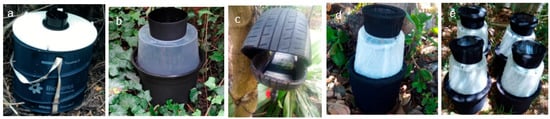
An experimental field study was conducted between October and December 2025 over 72 days. Traps were deployed at six fixed outdoor locations within the hotel grounds, approximately 15 m apart and positioned in shaded areas [24]. Six trapping methods were evaluated: (1) BGS with BG-Lure, (2) BG-GAT with yeast, (3) modified Ovillanta trap with yeast, (4) modified Ovillanta trap with water, (5) single modified Gravid Aedes Trap (1MoGAT) with yeast, and (6) four-unit modified GAT (4MoGAT) with yeast (Figure 1). Each trap configuration was rotated through all six locations to minimize confounding by site and sampling day. At each of the six locations, the traps were deployed for three consecutive 24 h sampling periods before being rotated to a new location (6 locations × 3 days = 18 days for one experimental round). The rotation was repeated four times throughout the study, resulting in a total of 72 experimental days (18 days × 4 rounds). All traps operated continuously for 24 h intervals and were serviced daily at 10:00 h [24]. Captured mosquitoes were collected into paper cups, labeled by trap, location and date, and transported to the Ifakara Health Institute (IHI) laboratory at the Kingani facility in Bagamoyo for morphological identification [39].
Figure 1.
Aedes monitoring tools: (a) Biogents Sentinel (BGS) trap (standard trap), (b) Biogent Gravid Aedes Trap (BG-GAT), (c) modified Ovillanta trap, (d) single-unit modified Aedes Gravid Trap (1MoGAT), and (e) four-unit modified Gravid Aedes Trap (4MoGAT).
2.3. Traps and Attractant Development
2.3.1. Biogents Sentinel (BGS) Trap
The BGS trap (Biogent GmbH, Regensburg, Germany) is shown in Figure 1a. As described by Krockel et al., 2006 [36], the BGS trap targets host-seeking mosquitoes through a funnel-shaped intake connected to a 12 V fan that generates downward airflow, pulling mosquitoes into a collection bag [6]. During field deployment, the trap was baited with BG-lure (Biogent AG, Regensburg, Germany), a synthetic blend of lactic acid, caproic acid, and ammonia mimicking human odor [20,36]. The lure was placed inside the BGS trap and used throughout the 72-day experimental period, remaining within the manufacturer’s recommendation [27].
2.3.2. Biogents Gravid Aedes Trap (BG-GAT)
The BG-GAT [40] was used as a commercially available gravid trap comparator (Figure 1b). The BG-GAT comprises five main components: (1) a matte-finished black bucket base that contains the lure; (2) a translucent chamber formed by an inverted translucent plastic container fitted securely into the base; (3) a 1 mm black nylon mesh barrier, positioned between the chamber and the base; (4) a black funnel entry point positioned at the top of the translucent chamber; and (5) a BG-GAT sticky card. The sticky card was replaced daily, and captured mosquitoes were recovered from the removed sticky cards for identification.
2.3.3. Modified Ovillanta
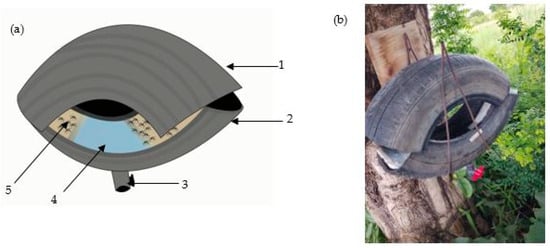
The Ovillanta previously described by Ulibarri et al. (2017), and Umar et al. (2020) [29,41] consists of two 50 cm sections of discarded vehicle tires arranged in a “mouth-like” configuration as shown in Figure 1c. The unit consists of two tire sections: a base for the attractant solution, fitted with a drainage tap to facilitate the weekly replacement of the lure, and an upper section protecting the interior from rain and debris.
For this study, the modified Ovillanta trap was adapted by incorporating an industrial adhesive surface (FICS Flyroll) to capture adult mosquitoes. Two rectangular fiberboard frames were first constructed to fit in both sides of the Ovillanta base. The adhesive sheets were cut with a 1 mm overhang to eliminate non-adhesive landing surfaces, mounted onto each fiberboard with the sticky side facing outward, and secured with tape. Each completed unit was handled as a single piece and inserted into both openings of the trap base. Adult mosquitoes entering for resting or oviposition were captured upon contact with adhesive surface. After 24 h, the frames were collected, and then the captured mosquitoes were removed from adhesive surface using forceps, placed in labeled paper cups, and transported to the laboratory.
Because no larvicide was used, any larvae that emerged were controlled by filtering the infusion solution weekly through a clean white lightweight cotton cloth. After filtration, the solution was returned to the trap. During the first sampling round (18 days), all collected larvae were reared to adulthood for species identification, and all emerging adults were identified as Ae. aegypti. In subsequent sampling rounds, larvae collected during filtration were buried in the ground (Figure 2b) [29].
Figure 2.
Modified Ovillanta trap: (a) schematic diagram for a modified Ovillanta; (1) 50 cm piece of tire used as trap cover; (2) 50 cm piece of tire used as trap base; (3) the water tap connected to the drainage pipe; (4) the disclosed trap infusion (yeast or water); and (5) the adhesive surface mounted on a fiberboard in both side of trap and (b) modified Ovillanta in the field setting.
2.3.4. Modified Gravid Aedes Trap (MoGAT)
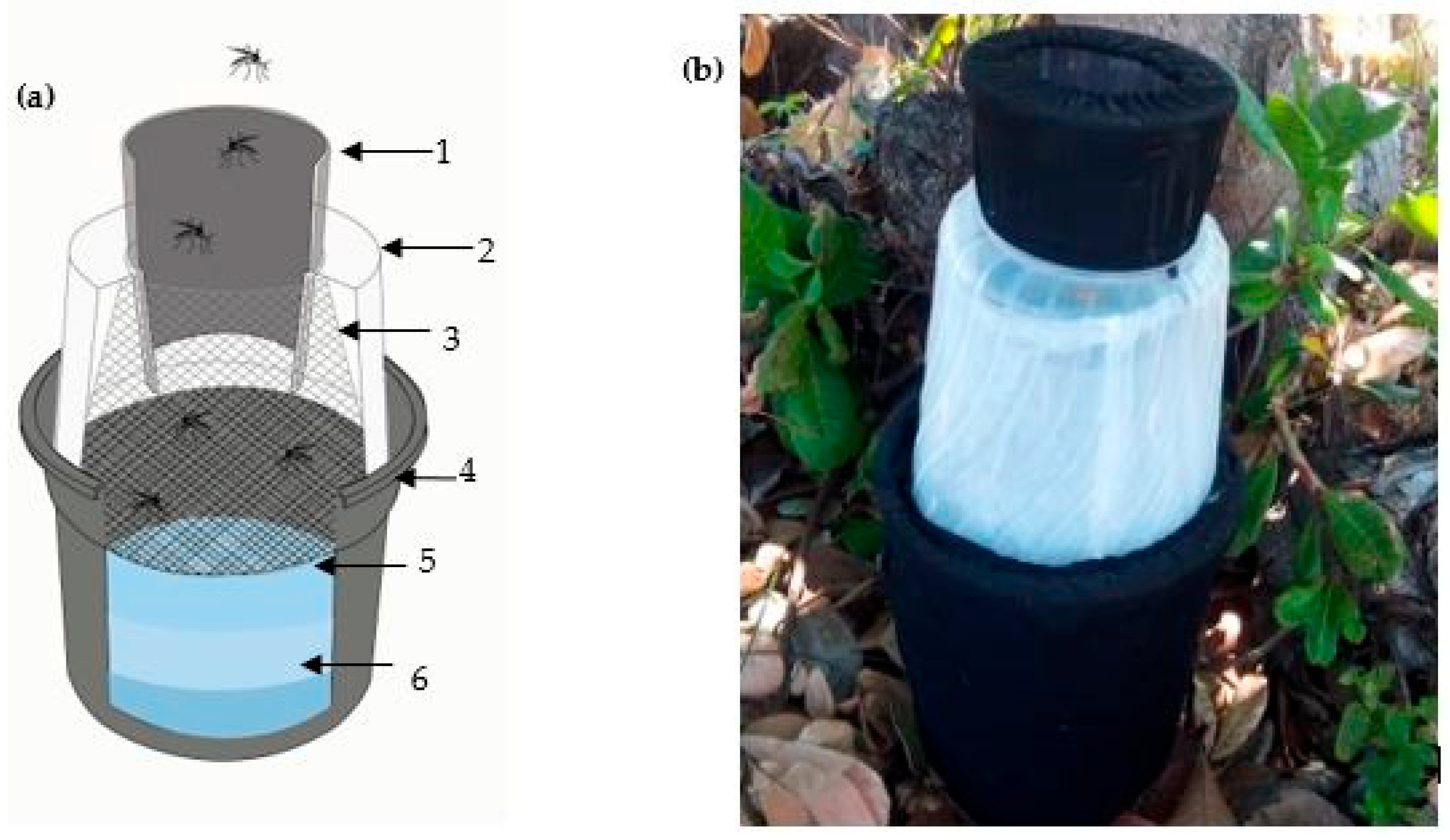
The MoGAT was constructed as previously described by Machange et al. 2024 [24] (Figure 1d). The trap consists of six components, (1) a three-liter (L) bucket with its base removed, covered in black cloth, and used as the mosquito entry point, (2) an inverted translucent ten-liter (L) bucket lined with (3) bifenthrin-treated net manufactured by VKA Polymers Ltd., (4) a sixteen-liter (L) bucket serving as the base, covered with black cloth and containing the lure, with drainage holes positioned above the three-liter level to prevent overfilling, (5) a layer of black mosquito mesh (1 mm) placed between the translucent bucket and the base to block mosquito access to the infusion, and (6) a trap infusion (Figure 3).
Figure 3.
Modified Gravid Aedes Trap (MoGAT). (a) Modified GAT schematic diagram: (1) bucket of 3 L; (2) translucent 10 L bucket; (3) insecticide-treated net; (4) 16 L bucket; (5) 1 mm screen mesh; and (6) trap infusion. (b) Modified GAT in the field setting.
For this study, one modified GAT (1MoGAT) referred to the deployment of a single-unit modified GAT at a sampling location, whereas 4MoGAT referred to the deployment of four identical modified GATs positioned together at one location, with mosquitoes captured by all four traps combined and treated as a single experimental unit (Figure 1e). Both configurations were evaluated to determine whether increasing the number of modified GATs at a sampling point improved mosquito trap capture compared with a single trap deployment.
2.3.5. Lure Preparation
To increase the attractiveness of gravid traps (BG-GAT, 1MoGAT, 4MoGAT, and Ovillanta) for mosquitoes, an infusion producing fermentation-derived volatiles was prepared by dissolving 22 g of dry baker’s yeast in 12 L of tap water. The solution was prepared as described by Machange et al. (2024); briefly, it was placed in a sealed container and away from direct sunlight for three days with manual agitation performed once daily with no additional substrate [24,42]. For field deployment, 2 L of the fermented attractant was added to each oviposition (Ovillanta and BG-GAT), and 3 L to each MoGAT trap, while control Ovillanta traps contained 2 L of water only; the lure was replaced every 14 days. The volume used and replacement interval followed Ulibarri et al. 2016 [29], and Machange et al. 2024 [24]; different replacement intervals were not experimentally compared in this study.
2.4. Data Management and Statistical Analysis
All data were collected into paper forms, double-entered into Microsoft Excel spreadsheet version 16, and cross-checked for duplicate entries and discrepancies before being imported into STATA/MP 18.0 (Stata Statistical Software: Release 18. College Station, TX, USA: Statacorp, LLC.) for analysis [43]. Any duplicate or inconsistent records were verified against the original field forms and corrected. Descriptive statistics were performed to estimate the geometric mean with 95% confidence intervals (CI) of female Ae. aegypti species for each trap in the field.
Mixed-effect negative binomial regressions were performed to compare the number of mosquitoes captured between the traps. Due to the low numbers of gravid and blood-fed individuals, analyzing separate physiological stages was unfeasible; therefore, the model focused on total female mosquitoes. Trap type and sampling points were included in the model as fixed effects while experimental day was included as a random effect to account for daily heterogeneity in mosquito densities.
Bland–Altman plots were used to evaluate agreement in female Ae. aegypti catches between the BGS and the modified Ovillanta with yeast infusion, as these were the two highest performing traps for capturing adult female Ae. aegypti. The mean difference and 95% limits of agreement were calculated for each comparison. Density-dependent effects were assessed by examining the relationship between the differences in paired trap catches and their corresponding mean catches, with significant trends indicating density-dependent bias.
3. Results
A total of 5051 mosquitoes were collected over 72 sampling nights; of these, 61.7% (n = 3115) were Culex quinquefasciatus and 38.2% (n = 1936) were Ae. aegypti. The majority of Cx. quinquefasciatus were captured by the BGS, which accounted for 88% of the female Culex collected, whereas the other trap types contributed substantially fewer individuals, (Figure S1). Of the Ae. aegypti captured, 74.6% (1447/1936) were female and 95% of the females (1368/1447) were unfed. The physiological status of the captured mosquitoes is summarized in Table S1. Subsequent analyses were restricted to total female Ae. aegypti only.
The BGS captured the highest number of female Ae. aegypti, representing 34.4% of total catch, followed by yeast-baited Ovillanta 32.3% and water-only Ovillanta 22.2%. The remaining oviposition traps captured substantially lower proportions of mosquitoes (BG-GAT 6.6%, 1MoGAT 2.1% and 4MoGAT 2.4%, (Table 1)).
Table 1.
Geometric mean catches and incidence rate ratios (IRRs) of female Aedes aegypti captured by yeast-baited modified Ovillanta relative to other trap types in Bagamoyo, Tanzania, during the 72-night study period (October–December 2025).
The yeast-baited Ovillanta captured a similar number of female Ae. aegypti compared to BGS traps (IRR = 1.03, [95%CI: 0.76–1.40], p = 0.859), while capturing significantly more mosquitoes than the other gravid traps (all p < 0.0001) (Table 1). Without yeast infusion, Ovillanta catches decreased by 31% (IRR =0.69, [95% CI: 0.51–0.95], p = 0.023).
The commercial BGS captured significantly more mosquitoes than Ovillanta with water (IRR = 0.67, [95% CI: 0.49, 0.92], p = 0.013), and differences were not significant compared with Ovillanta with yeast (IRR = 0.97, [95%CI: 0.71, 1.32], p = 0.859 (Table 2)).
Table 2.
Geometric mean catches and incidence rate ratio (IRR) of female Aedes aegypti mosquitoes captured by Biogents Sentinel (BGS) trap relative to other trap types in Bagamoyo, Tanzania, during the 72-night study period (October–December 2025).
The commercial BG-GAT captured more mosquitoes (n = 95) than the 1MoGAT (n = 31, IRR = 0.37, [95%CI: 0.22–0.60], p < 0.0001) and 4MoGAT (n = 35, IRR = 0.32, [95%CI: 0.20–0.53], p < 0.0001), (Table 3).
Table 3.
Geometric mean catches and incidence rate ratio (IRR) of female Aedes aegypti mosquitoes captured by Biogents Gravid Aedes Trap (BG_GAT) with yeast relative to other trap types in Bagamoyo, Tanzania, during the 72-night study period (October–December 2025).
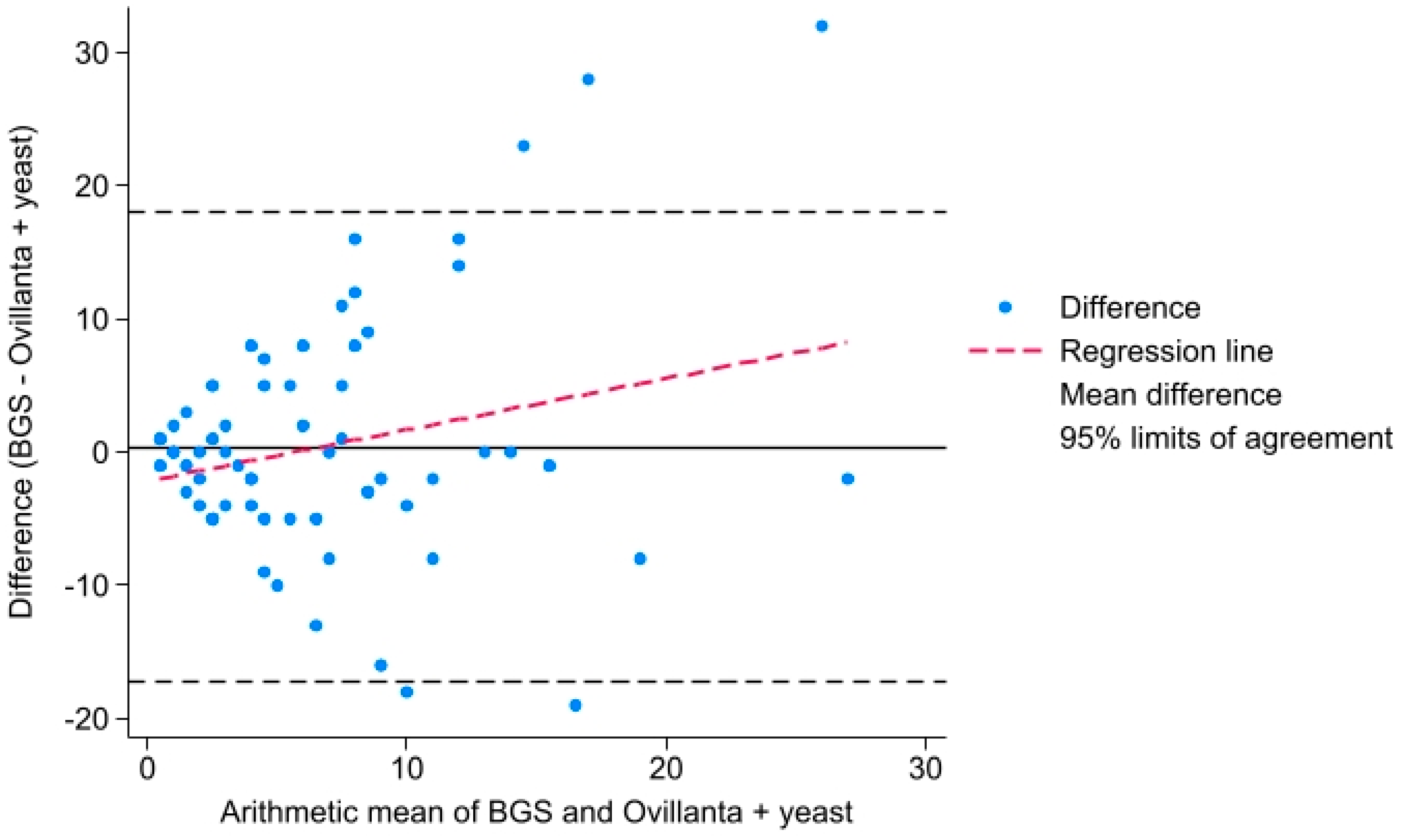
The Bland–Altman analysis showed limited agreement between BGS and Ovillanta with yeast infusion, with a mean difference of 0.40 mosquitoes, but the limits of agreement were wide, from −17.29 to 17.29, indicating substantial daily variability in mosquito capture between the trap types (Figure 4). The positive regression slope indicated density-dependent bias. These findings indicate that although the yeast-baited modified Ovillanta and BGS traps produced similar total catches, they may not be directly interchangeable for estimating daily mosquito abundance, and further evaluation is warranted.
Figure 4.
Bland−Altman plot assessing agreement and density-dependent bias between the Biogents Sentinel trap and Ovillanta with yeast infusion for capturing adult female Aedes aegypti mosquitoes under field conditions. The solid horizontal line represents the mean difference (bias), dashed lines indicate the 95% limits of agreement, and the fitted regression line indicates the density-dependent relationship between the two trapping methods.
4. Discussion
Effective surveillance of Aedes aegypti is essential for guiding dengue prevention and control efforts, particularly in resource-limited settings where sustainable monitoring tools are needed [44]. In this study, the trapping performance of the modified Ovillanta, with and without yeast, was compared with several trapping methods, including 1MoGAT, 4MoGAT, BG-GAT, and the widely used reference trap (BGS trap), using a Latin square design that controlled for spatial and temporal variation [45]. The yeast-baited modified Ovillanta captured a similar total number of female Ae. aegypti to the BGS trap and substantially more than the BG-GAT and modified GAT designs. However, wide limits of agreement between the BGS and modified Ovillanta indicate that similar total catches do not necessarily imply that the traps are interchangeable for estimating daily vector density. The variation may reflect differences in trapping mechanisms, behavioral targets, and attractants. Therefore, the BGS and Ovillanta comparison represents a combined trap–lure effect rather than trap design alone.
The Ovillanta was originally developed as an oviposition device to collect Aedes eggs and thereby reduce subsequent mosquito generations [29,32,33]. Previous studies have shown that this trap effectively attracts gravid Ae. aegypti mosquitoes; however, because it was primarily designed to collect eggs, it provides a limited capacity for monitoring adult mosquito populations and detecting arboviruses [41]. In this study, the Ovillanta was modified to capture adult mosquitoes by incorporating internal adhesive surfaces [19,28], enabling direct capture of adult Ae. aegypti. The commercial BG-GAT similarly used a BG-GAT adhesive surface, while the MoGAT was equipped with a bifenthrin-treated net for adult mosquito retention.
4.1. The Influence of Trap Design of Mosquito Capture
The superior performance of modified Ovillanta trap is likely explained by the combined influence of visual and olfactory cues. Because the water-filled Ovillanta captured a significantly high number of mosquitoes compared to other ovitraps baited with yeast (BG-GAT and modified GATs), its relatively higher mosquito capture is partially attributed to the trap design [33]. Tires are preferred habitats for Ae. aegypti [46], due to water retention, shade, organic matter, and visual cues (black color) [19]. In addition, the adhesive sticky cards installed inside the trap effectively retain mosquitoes upon contact, thereby reducing escape probability [19,28,47].
When compared with unbaited (water-filled) Ovillanta, yeast-baited Ovillanta captured a substantially higher number of Ae. aegypti. Water acts as a lure by providing oviposition signals for gravid females [48]. However, the addition of yeast significantly enhances oviposition attraction in Aedes mosquitoes by acting as a nutrient-associated cue [42], leading to significantly higher trap attractiveness than water alone [49]. These differences in attraction mechanisms and mosquito behavior may also explain the wide limits of agreement observed when comparing the modified Ovillanta with a host-seeking trap (BGS).
Lower mosquito captures in the BG-GAT compared with the BGS trap are consistent with previous studies [1,7,17,20,24,28]. The BGS employs a fan-driven airflow to actively draw mosquitoes into a collection bag [27], whereas the BG-GAT relies on passive entry without mechanical suction. The BGS traps can attract and draw in mosquitoes from distances of several meters under field conditions [50]. Its performance is likely attributed to the combination of synthetic human-odor lures, comprising a blend of lactic acid, caproic acid, and ammonia [27]. These volatile compounds create active plumes that, combined with the trap suction, actively draw mosquitoes into the trap [31,42]. This pattern is consistent with reports from West Africa [51], Cameroon [52], and Ghana [53,54].
Comparative studies indicate that the performance of different trap types varies across ecological contexts [22], likely reflecting variations in mosquito ecology [55]. For instance, in Brazil, GATs captured fewer adult mosquitoes overall but a higher proportion of gravid individuals compared to BGS traps [17], whereas in Guinea, gravid traps collected similar numbers of gravid mosquitoes but fewer unfed Aedes than BGS traps [56]. These findings underscore the importance of evaluating trap performance within specific contexts, taking into account ecological suitability in addition to operational feasibility and cost-effectiveness.
4.2. Operational Limitations of the Modified Ovillanta
Although the Ovillanta trap caught more Aedes than other gravid traps, environmental factors such as heavy rainfall combined with high winds occasionally reduced trap capture by moisture-logging the adhesive surfaces. This was similarly observed in the BG-GAT, highlighting the need for weather-resistant adhesive materials in future field optimizations.
Larvae were occasionally detected in the infusion in Ovillanta traps. Upon rearing them to adulthood, all adult mosquitoes (n = 763) were confirmed as Ae. aegypti mosquitoes, indicating that some gravid females successfully oviposited without contacting the internal adhesive surfaces. This suggests that if traps are left unattended, they may become potential larval habitats for Ae. aegypti. The potential use of long-lasting larvicides, such as spinosad, Bti, or pyriproxyfen, could be explored in future studies to prevent potential larval development when traps are left unattended [34,57], thereby strengthening the trap’s utility for both integrated surveillance and vector control [57].
4.3. Performance of BG-GAT and Other GAT Variants
The superior performance of BG-GAT observed compared to modified GAT may be attributed to its specific trap design. The BG-GAT uses an adhesive sticky board, which retains mosquitoes immediately upon contact. The modified GAT used bifenthrin-treated net as a killing agent [24], which requires sufficient contact time for a lethal exposure. Further work to explore low-cost adhesives or other alternatives to optimize the locally produced GAT is warranted.
Since Aedes are skip ovipositors [58], it was hypothesized that increasing the number of traps may increase the radius of attraction and increase the capture rate [19]. Interestingly, increasing the number of modified GATs from one to four did not yield higher capture rates; instead, this study found that the mosquitoes were observed resting in the sheltered gaps between the traps. A similar study conducted in this setting compared BGS and 4MoGAT, stationed at different locations (1MoGAT per location), and suggested that more replicates of GAT at multiple locations and pooling data [24] is a more effective approach than stationing four traps at one location, agreeing with findings from Puerto Rico [19].
4.4. Study Limitations
This study had several limitations. Firstly, it was conducted at a single commercial site in Bagamoyo over one sampling period, and the findings may not be generalizable to other ecological, seasonal, or community settings. Therefore, multi-site and multi-season studies are needed to determine whether the observed differences in trap performance remain consistent under different environmental conditions. Secondly, gravid traps have the advantage of capturing females that have already taken a blood meal and are therefore more likely to carry arboviruses, such as dengue [28,40]. Consequently, these traps can also contribute to arbovirus surveillance through xenomonitoring, which is the screening of field-collected vectors for pathogens to provide indirect evidence of pathogen circulation in the host population [12,13]. Very few blood-fed and gravid Ae. aegypti were captured and virus detection was not conducted. Therefore, evaluating whether these traps are suitable for xenomonitoring requires testing of all captured female Ae. aegypti, regardless of their blood meal status, and warrants further investigation. Thirdly, the rainfall and wind occasionally affected adhesive surfaces, indicating that trap performance may vary under different weather conditions and that design modifications involving more weather-resistant materials may be needed. In addition, the presence of predators (ants) within BG-GATs, likely entering through the overflow outlet, may have contributed to mosquito loss. These observations highlight the importance of appropriate trap allocation and placement to minimize ants’ interference and other environmental factors that may influence mosquito retention and trap performance. Fourthly, larvae were detected in some Ovillanta traps, showing that traps could become productive larval habitats if not inspected and serviced regularly. The study was an early phase efficacy study and more data are needed in additional settings to confirm the findings before evaluating community acceptability, operational feasibility at scale, cost-effectiveness and dengue virus detection in captured mosquitoes.
Although this study focused on Ae. aegypti, Culex quinquefasciatus accounted for a substantial proportion of mosquitoes collected. The predominance of female Culex in the BGS compared with the other trap types suggests that the BGS is a potential tool for the surveillance of Culex and other medically important mosquito species.
Based on the findings of this study, and other studies all showing positive results [29,32,33], Ovillanta provides a practical and efficient tool for monitoring dengue vectors, offering key operational benefits such as durability, low cost (<10 $USD—designed from locally available recycled materials) and no reliance on electricity [29]. Taken together, these findings support further evaluation of the modified Ovillanta as a low-cost, electricity-free tool for adult female Ae. aegypti surveillance.
5. Conclusions
The yeast-baited modified Ovillanta captured a similar number of female Ae. aegypti as the BGS trap and substantially higher numbers than the other oviposition-based traps. Yeast substantially improved the Ovillanta’s performance. The commercial BG-GAT outperformed locally modified GATs, and increasing the number of Mo-GAT from one to four in a single location did not improve catches. These findings support further evaluation of the yeast-baited modified Ovillanta across additional ecological, seasonal and operational settings to determine whether it can provide a practical, low-cost tool for routine adult female Ae. aegypti surveillance.
Supplementary Materials
The following supporting information can be downloaded at https://doi.org/10.5281/zenodo.22179236, Table S1: Geometric means and incidence rate ratios (IRRs) of physiological stages of female Aedes aegypti mosquitoes captured at multiple sampling points within a hotel in Bagamoyo, Tanzania, during the 72-night study period (October–December 2025), Figure S1: Number of female Culex mosquitoes captured at multiple sampling points within a hotel in Bagamoyo, Tanzania, during the 72-night study period (October–December 2025).
Author Contributions
S.A.S., J.J.M., J.M. and S.J.M. conceptualized and designed the experiments. S.A.S. and J.J.M. collected the data. J.B.M. performed image capturing and designing, S.A.S., J.J.M., J.K.S., A.G.L., F.S.C.T. and O.G.O. performed data analysis. S.A.S., J.J.M. and S.J.M. drafted the manuscript. S.A.S., E.G.K., F.S.C.T., O.G.O., S.J.M., J.J.M. and J.K.S. reviewed and contributed to the final draft. All authors have read and agreed to the published version of the manuscript.
Funding
This study was supported by VCPTU and the IHI Training and Capacity Building Department.
Institutional Review Board Statement
Written informed consent was obtained from hotel owners for permission to conduct the study on their premises. Ethical approval was granted by the Institutional Review Board of the Ifakara Health Institute (IHI/IRB/No: 44-2025).
Informed Consent Statement
Permission to publish was granted by the Tanzania National Institute for Medical Research Ref: BD.242/437/01C/243.
Data Availability Statement
All data generated or analyzed during this study are included in this published article and will be available upon request.
Acknowledgments
We would like to thank the Vector Control Product Testing Unit (VCPTU) and the Training Department of the Ifakara Health Institute for supporting this research. We also extend our gratitude to the hotel owners who granted permission to conduct this study on their premises.
Conflicts of Interest
The authors declare no conflicts of interest.
Abbreviations
The following abbreviations are used in this manuscript:
| BG-GAT | Biogent Gravid Aedes Trap |
| BGS | Biogents Sentinel Trap |
| CHIKV | Chikungunya Virus |
| DENV | Dengue Virus |
| ITN | Insecticide-Treated Nets |
| Mo-GAT | Locally Modified Gravid Aedes Trap |
| Mo-Ovillanta | Locally Modified Ovillanta |
| WHO | World Health Organization |
| 1MoGAT | Single-Unit Modified Gravid Aedes Trap |
| 4MoGAT | Four-Unit Modified Gravid Aedes Trap |
References
- Gubler, D.J. Dengue, Urbanization and Globalization: The Unholy Trinity of the 21st Century. Trop. Med. Health 2011, 39, S3–S11. [Google Scholar] [CrossRef] [Scilit] [PubMed]
- Messina, J.P.; Brady, O.J.; Golding, N.; Kraemer, M.U.G.; Wint, G.R.W.; Ray, S.E.; Pigott, D.M.; Shearer, F.M.; Johnson, K.; Earl, L.; et al. The current and future global distribution and population at risk of dengue. Nat. Microbiol. 2019, 4, 1508–1515. [Google Scholar] [CrossRef] [Scilit] [PubMed]
- Mwanyika, G.O.; Moir, M.; Musa, A.O.; Poongavanan, J.; Dor, G.; Wilkinson, E.; Baxter, C.; De Oliveira, T.; Tegally, H. A decade of dengue disease burden in Africa (2013–2023): A systematic review. Travel Med. Infect. Dis. 2025, 67, 102897. [Google Scholar] [CrossRef] [Scilit] [PubMed]
- Black, I.V.; WHO. Dengue-Global Situation, Disease Outbreak News, December 2023. Available online: https://www.who.int/emergencies/disease-outbreak-news/item/2023-DON498 (accessed on 21 January 2026).
- Fernando, H.S.D.; Hapugoda, M.; Perera, R.; Black Iv, W.C.; De Silva, B.G.D.N.K. Mitochondrial metabolic genes provide phylogeographic relationships of global collections of Aedes aegypti (Diptera: Culicidae). PLoS ONE 2020, 15, e0235430. [Google Scholar] [CrossRef] [Scilit] [PubMed]
- Dos Santos, T.P.; Cruz, O.G.; Da Silva, K.A.B.; De Castro, M.G.; De Brito, A.F.; Maspero, R.C.; De Alcântra, R.; Dos Santos, F.B.; Honorio, N.A.; Lourenço-de-Oliveira, R. Dengue serotype circulation in natural populations of Aedes aegypti. Acta Trop. 2017, 176, 140–143. [Google Scholar] [CrossRef] [Scilit] [PubMed]
- Kröckel, U.; Rose, A.; Eiras, Á.E.; Geier, M. A new tools for surveillance of adult yellow fever mosquitoes: Comparison of trap catches within human landing rates in an evivironment. J. Am. Mosq. Control. Assoc. 2006, 22, 229–238. [Google Scholar] [CrossRef] [Scilit]
- Cosme, L.V.; Gloria-Soria, A.; Caccone, A.; Powell, J.R.; Martins, A.J. Evolution of kdr haplotypes in worldwide populations of Aedes aegypti: Independent origins of the F1534C kdr mutation. PLoS Negl. Trop. Dis. 2020, 14, e0008219. [Google Scholar] [CrossRef] [Scilit] [PubMed]
- Buchwald, A.G.; Hayden, M.H.; Dadzie, S.K.; Paull, S.H.; Carlton, E.J. Aedes-borne disease outbreaks in West Africa: A call for enhanced surveillance. Acta Trop. 2020, 209, 105468. [Google Scholar] [CrossRef] [Scilit] [PubMed]
- Du, M.; Jing, W.; Liu, M.; Liu, J. The Global Trends and Regional Differences in Incidence of Dengue Infection from 1990 to 2019: An Analysis from the Global Burden of Disease Study 2019. Infect. Dis. Ther. 2021, 10, 1625–1643. [Google Scholar] [CrossRef] [Scilit] [PubMed]
- Bhatt, S.; Gething, P.W.; Brady, O.J.; Messina, J.P.; Farlow, A.W.; Moyes, C.L.; Drake, J.M.; Brownstein, J.S.; Hoen, A.G.; Sankoh, O.; et al. The global distribution and burden of dengue. Nature 2013, 496, 504–507. [Google Scholar] [CrossRef] [Scilit] [PubMed]
- Mustafa, U.; Kreppel, K.S.; Sauli, E. Dengue virus transmission during non-outbreak period in Dar Es Salaam, Tanzania: A cross-sectional survey. BMC Infect. Dis. 2024, 24, 1219. [Google Scholar] [CrossRef] [Scilit] [PubMed]
- Tenywa, F.S.C.; Hälg, S.; Makame, H.; Moore, J.; Dogan, O.; Mapipi, H.I.; Machange, J.J.; Lilolime, N.S.; Hofer, L.M.; Batao, L.D.; et al. DENV-2 Circulation and Host Preference Among Highly Anthropophilic, Outdoor-Biting Aedes aegypti in Dar es Salaam, Tanzania. Viruses 2025, 17, 818. [Google Scholar] [CrossRef] [Scilit] [PubMed]
- Roiz, D.; Wilson, A.L.; Scott, T.W.; Fonseca, D.M.; Jourdain, F.; Müller, P.; Velayudhan, R.; Corbel, V. Integrated Aedes management for the control of Aedes-borne diseases. PLoS Negl. Trop. Dis. 2018, 12, e0006845. [Google Scholar] [CrossRef] [Scilit] [PubMed]
- Heringer, L.; Johnson, B.J.; Fikrig, K.; Oliveira, B.A.; Silva, R.D.; Townsend, M.; Barrera, R.; Eiras, Á.E.; Ritchie, S.A. Evaluation of Alternative Killing Agents for Aedes aegypti (Diptera: Culicidae) in the Gravid Aedes Trap (GAT). J. Med. Entomol. 2016, 53, 873–879. [Google Scholar] [CrossRef] [Scilit] [PubMed]
- Mboera, L.E.G.; Mweya, C.N.; Rumisha, S.F.; Tungu, P.K.; Stanley, G.; Makange, M.R.; Misinzo, G.; De Nardo, P.; Vairo, F.; Oriyo, N.M. The Risk of Dengue Virus Transmission in Dar es Salaam, Tanzania during an Epidemic Period of 2014. PLoS Negl. Trop. Dis. 2016, 10, e0004313. [Google Scholar] [CrossRef] [Scilit] [PubMed]
- Cilek, J.E.; Knapp, J.A.; Richardson, A.G. Comparative Efficiency of Biogents Gravid Aedes Trap, Cdc Autocidal Gravid Ovitrap, and CDC Gravid Trap in Northeastern Florida. J. Am. Mosq. Control Assoc. 2017, 33, 103–107. [Google Scholar] [CrossRef] [Scilit] [PubMed]
- Bazin, M.; Williams, C.R. Mosquito traps for urban surveillance: Collection efficacy and potential for use by citizen scientists. J. Vector Ecol. 2018, 43, 98–103. [Google Scholar] [CrossRef] [Scilit] [PubMed]
- Barrera, R.; Amador, M.; Clark, G.G. Ecological Factors Influencing Aedes aegypti (Diptera: Culicidae) Productivity in Artificial Containers in Salinas, Puerto Rico. J. Med. Entomol. 2006, 43, 484–492. [Google Scholar] [CrossRef] [Scilit]
- Degener, C.M.; Eiras, Á.E.; Ázara, T.M.F.; Roque, R.A.; Rösner, S.; Codeço, C.T.; Nobre, A.A.; Rocha, E.S.O.; Kroon, E.G.; Ohly, J.J.; et al. Evaluation of the Effectiveness of Mass Trapping with BG-Sentinel Traps for Dengue Vector Control: A Cluster Randomized Controlled Trial in Manaus, Brazil. J. Med. Entomol. 2014, 51, 408–420. [Google Scholar] [CrossRef] [Scilit] [PubMed]
- Johnson, B.; Ritchie, S.; Fonseca, D. The State of the Art of Lethal Oviposition Trap-Based Mass Interventions for Arboviral Control. Insects 2017, 8, 5. [Google Scholar] [CrossRef] [Scilit] [PubMed]
- Gorsich, E.E.; Beechler, B.R.; Van Bodegom, P.M.; Govender, D.; Guarido, M.M.; Venter, M.; Schrama, M. A comparative assessment of adult mosquito trapping methods to estimate spatial patterns of abundance and community composition in southern Africa. Parasit. Vectors 2019, 12, 462. [Google Scholar] [CrossRef] [Scilit] [PubMed]
- Achee, N.L.; Grieco, J.P.; Vatandoost, H.; Seixas, G.; Pinto, J.; Ching-NG, L.; Martins, A.J.; Juntarajumnong, W.; Corbel, V.; Gouagna, C.; et al. Alternative strategies for mosquito-borne arbovirus control. PLoS Negl. Trop. Dis. 2019, 13, e0006822. [Google Scholar] [CrossRef] [Scilit] [PubMed]
- Machange, J.J.; Maasayi, M.S.; Mundi, J.; Moore, J.; Muganga, J.B.; Odufuwa, O.G.; Moore, S.J.; Tenywa, F.C. Comparison of the Trapping Efficacy of Locally Modified Gravid Aedes Trap and Autocidal Gravid Ovitrap for the Monitoring and Surveillance of Aedes aegypti Mosquitoes in Tanzania. Insects 2024, 15, 401. [Google Scholar] [CrossRef] [Scilit] [PubMed]
- Johnson, B.J.; Hurst, T.; Quoc, H.L.; Unlu, I.; Freebairn, C.; Faraji, A.; Ritchie, S.A. Field Comparisons of the Gravid Aedes Trap (GAT) and BG-Sentinel Trap for Monitoring Aedes albopictus (Diptera: Culicidae) Populations and Notes on Indoor GAT Collections in Vietnam. J. Med. Entomol. 2016, 54, 340–348. [Google Scholar] [CrossRef] [Scilit] [PubMed]
- Maasayi, M.S.; Machange, J.J.; Kamande, D.S.; Kibondo, U.A.; Odufuwa, O.G.; Moore, S.J.; Tambwe, M.M. The MTego trap: A potential tool for monitoring malaria and arbovirus vectors. Parasit. Vectors 2023, 16, 212. [Google Scholar] [CrossRef] [Scilit] [PubMed]
- Maciel-de-Freitas, R.; Eiras, Á.E.; Lourenço-de-Oliveira, R. Field evaluation of effectiveness of the BG-Sentinel, a new trap for capturing adult Aedes aegypti (Diptera: Culicidae). Mem. Inst. Oswaldo Cruz 2006, 101, 321–325. [Google Scholar] [CrossRef] [Scilit] [PubMed]
- Ritchie, S.A.; Buhagiar, T.S.; Townsend, M.; Hoffmann, A.; Van Den Hurk, A.F.; McMahon, J.L.; Eiras, A.E. Field Validation of the Gravid Aedes Trap (GAT) for Collection of Aedes aegypti (Diptera: Culicidae). J. Med. Entomol. 2014, 51, 210–219. [Google Scholar] [CrossRef] [Scilit] [PubMed]
- Ulibarri, G.; Betanzos, A.; Betanzos, M.; Rojas, J.J. Preliminary results on the control of Aedes spp. in a remote Guatemalan community vulnerable to dengue, chikungunya and Zika virus: Community participation and use of low-cost ecological ovillantas for mosquito control. F1000Research 2017, 5, 598. [Google Scholar] [CrossRef] [Scilit] [PubMed]
- Reiter, P. Oviposition, Dispersal, and Survival in Aedes aegypti: Implications for the Efficacy of Control Strategies. Vector-Borne Zoonotic Dis. 2007, 7, 261–273. [Google Scholar] [CrossRef] [Scilit] [PubMed]
- Steiger, D.B.M.; Ritchie, S.A.; Laurance, S.G.W. Overcoming the Challenges of Mosquito (Diptera: Culicidae) Sampling in Remote Localities: A Comparison of CO2 Attractants on Mosquito Communities in Three Tropical Forest Habitats. J. Med. Entomol. 2014, 51, 39–45. [Google Scholar] [CrossRef] [Scilit] [PubMed]
- Suresh, A.; Nagarajan, S.A.; Mathew, J.; Poyilthazham, A.K.; Thankachy, S.; Saini, P.; Thiruvengadam, K.; Narendran, P.K.; Kumar, A. Field evaluation of the efficacy of ovillanta ovitrap towards Aedes spp. control in a dengue endemic area of Kerala, India. Parasite Epidemiol. Control 2026, 34, e00516. [Google Scholar] [CrossRef] [Scilit] [PubMed]
- Waddle, E.G.; Biddle, B.; Parker, A.T. Assessment of ovillanta tire traps for mosquito surveillance in the midwestern united states. J. Am. Mosq. Control Assoc. 2026, 42, 136–142. [Google Scholar] [CrossRef] [Scilit] [PubMed]
- Garza-Almanza, V.; Ulíbarri, G.; Sanchez-Yañez, J.M. Efficacy of 2 Commercial Formulations of Bacillus thuringiensis H-14 in Larvae of Anopheles albimanus W and Aedes aegypti L (Diptera: Culicidae). Preprints 2020. [Google Scholar] [CrossRef] [Scilit]
- Day, J.F. Mosquito Oviposition Behavior and Vector Control. Insects 2016, 7, 65. [Google Scholar] [CrossRef] [Scilit] [PubMed]
- Eiras, A.E.; Costa, L.H.; Batista-Pereira, L.G.; Paixão, K.S.; Batista, E.P.A. Semi-field assessment of the Gravid Aedes Trap (GAT) with the aim of controlling Aedes (Stegomyia) aegypti populations. PLoS ONE 2021, 16, e0250893. [Google Scholar] [CrossRef] [Scilit] [PubMed]
- Salim, N.; Knopp, S.; Lweno, O.; Abdul, U.; Mohamed, A.; Schindler, T.; Rothen, J.; Masimba, J.; Kwaba, D.; Mohammed, A.S.; et al. Distribution and Risk Factors for Plasmodium and Helminth Co-infections: A Cross-Sectional Survey among Children in Bagamoyo District, Coastal Region of Tanzania. PLoS Negl. Trop. Dis. 2015, 9, e0003660. [Google Scholar] [CrossRef] [Scilit] [PubMed]
- Mbuba, E.; Odufuwa, O.G.; Tenywa, F.C.; Philipo, R.; Tambwe, M.M.; Swai, J.K.; Moore, J.D.; Moore, S.J. Single blinded semi-field evaluation of MAÏA® topical repellent ointment compared to unformulated 20% DEET against Anopheles gambiae, Anopheles arabiensis and Aedes aegypti in Tanzania. Malar. J. 2021, 20, 12. [Google Scholar] [CrossRef] [Scilit] [PubMed]
- Rueda, L.M. Pictorial keys for the identification of mosquitoes (Diptera: Culicidae) associated with Dengue Virus Transmission. Zootaxa 2004, 589, 1–60. [Google Scholar] [CrossRef] [Scilit]
- Eiras, A.E.; Buhagiar, T.S.; Ritchie, S.A. Development of the Gravid Aedes Trap for the Capture of Adult Female Container-Exploiting Mosquitoes (Diptera: Culicidae). J. Med. Entomol. 2014, 51, 200–209. [Google Scholar] [CrossRef] [Scilit] [PubMed]
- Umar, A.B.; Dankaka, A.H.; Shah, M.M. Control of filariasis vector using Ovillanta in Gwale local Government area of Kano State, Nigeria. J. Ecobiotechnology 2020, 12, 14–16. [Google Scholar] [CrossRef] [Scilit]
- Lester, D.; Winter, N.; Stewart, A.T.; Feng, R.S.; Nandram, N.; Mohammed, A.; Duman-Scheel, M.; Romero-Severson, E.; Severson, D.W. Field trials reveal the complexities of deploying and evaluating the impacts of yeast-baited ovitraps on Aedes mosquito densities in Trinidad, West Indies. Sci. Rep. 2022, 12, 4047. [Google Scholar] [CrossRef] [Scilit] [PubMed]
- Statacorp LLC. StataCorp Stata Statistical Software; Statacorp LLC: College Station, TX, USA, 2019. [Google Scholar]
- WHO. Global Strategic, Preparedness, Readness and Response Plan for Dengue and Other Aedes-Borne Arboviruses. 2024. Available online: https://cdn.who.int/media/docs/default-source/ntds/dengue/global-sprp-for-dengue-and-other-aedes-borne-arboviruses.pdf?utm_source=chatgpt.com (accessed on 17 February 2026).
- Montgomery, D.C. Design Experiment. 2019. Available online: https://online.stat.psu.edu/stat503/lesson/4/4.3?utm_source=chatgpt.com (accessed on 13 December 2025).
- Harris, C.; Kihonda, J.; Lwetoijera, D.; Dongus, S.; Devine, G.; Majambere, S. A simple and efficient tool for trapping gravid Anopheles at breeding sites. Parasit. Vectors 2011, 4, 125. [Google Scholar] [CrossRef] [Scilit] [PubMed]
- Okal, M.N.; Francis, B.; Herrera-Varela, M.; Fillinger, U.; Lindsay, S.W. Water vapour is a pre-oviposition attractant for the malaria vector Anopheles gambiae sensu stricto. Malar. J. 2013, 12, 365. [Google Scholar] [CrossRef] [Scilit] [PubMed]
- Hapairai, L.K.; Mysore, K.; James, L.D.; Scheel, N.D.; Realey, J.S.; Sun, L.; Gerber, L.E.; Feng, R.S.; Romero-Severson, E.; Mohammed, A.; et al. Evaluation of large volume yeast interfering RNA lure-and-kill ovitraps for attraction and control of Aedes mosquitoes. Med. Vet. Entomol. 2021, 35, 361–370. [Google Scholar] [CrossRef] [Scilit] [PubMed]
- Ball, T.S.; Ritchie, S.R. Evaluation of BG-Sentinel Trap Trapping Efficacy for Aedes aegypti (Diptera: Culicidae) in a Visually Competitive Environment. J. Med. Entomol. 2010, 47, 657–663. [Google Scholar] [CrossRef] [Scilit]
- Brouazin, R.; Claudel, I.; Lancelot, R.; Dupuy, G.; Gouagna, L.-C.; Dupraz, M.; Baldet, T.; Bouyer, J. Optimization of oviposition trap settings to monitor populations of Aedes mosquitoes, vectors of arboviruses in La Reunion. Sci. Rep. 2022, 12, 18450. [Google Scholar] [CrossRef] [Scilit] [PubMed]
- Djiappi-Tchamen, B.; Nana-Ndjangwo, M.S.; Nchoutpouen, E.; Makoudjou, I.; Ngangue-Siewe, I.N.; Talipouo, A.; Mayi, M.P.A.; Awono-Ambene, P.; Wondji, C.; Tchuinkam, T.; et al. Aedes Mosquito Surveillance Using Ovitraps, Sweep Nets, and Biogent Traps in the City of Yaoundé, Cameroon. Insects 2022, 13, 793. [Google Scholar] [CrossRef] [Scilit] [PubMed]
- Akyea-Bobi, N.E.; Akorli, J.; Opoku, M.; Akporh, S.S.; Amlalo, G.K.; Osei, J.H.N.; Frempong, K.K.; Pi-Bansa, S.; Boakye, H.A.; Abudu, M.; et al. Entomological risk assessment for transmission of arboviral diseases by Aedes mosquitoes in a domestic and forest site in Accra, Ghana. PLoS ONE 2023, 18, e0295390. [Google Scholar] [CrossRef] [Scilit] [PubMed]
- Thornton, J.H.; Batengana, B.M.; Eiras, A.E.; Irish, S.R. Evaluation of collection methods for Culex quinquefasciatus, Aedes aegypti, and Aedes simpsoni in northeastern Tanzania. J. Vector Ecol. 2016, 41, 265–270. [Google Scholar] [CrossRef] [Scilit] [PubMed]
- Egid, B.R.; Coulibaly, M.; Dadzie, S.K.; Kamgang, B.; McCall, P.J.; Sedda, L.; Toe, K.H.; Wilson, A.L. Review of the ecology and behaviour of Aedes aegypti and Aedes albopictus in Western Africa and implications for vector control. Curr. Res. Parasitol. Vector-Borne Dis. 2022, 2, 100074. [Google Scholar] [CrossRef] [Scilit] [PubMed]
- Cansado-Utrilla, C.; Jeffries, C.L.; Kristan, M.; Brugman, V.A.; Heard, P.; Camara, G.; Sylla, M.; Beavogui, A.H.; Messenger, L.A.; Irish, S.R.; et al. An assessment of adult mosquito collection techniques for studying species abundance and diversity in Maferinyah, Guinea. Parasit. Vectors 2020, 13, 150. [Google Scholar] [CrossRef] [Scilit] [PubMed]
- Santos, V.S.V.; Limongi, J.E.; Pereira, B.B. Association of low concentrations of pyriproxyfen and spinosad as an environment-friendly strategy to rationalize Aedes aegypti control programs. Chemosphere 2020, 247, 125795. [Google Scholar] [CrossRef] [Scilit] [PubMed]
- Colton, Y.M.; Chadee, D.D.; Severson, D.W. Natural skip oviposition of the mosquito Aedes aegypti indicated by codominant genetic markers. Med. Vet. Entomol. 2003, 17, 195–204. [Google Scholar] [CrossRef] [Scilit] [PubMed]
- Barrera, R.; Amador, M.; Acevedo, V.; Caban, B.; Felix, G.; Mackay, A.J. Use of the CDC Autocidal Gravid Ovitrap to Control and Prevent Outbreaks of Aedes aegypti (Diptera: Culicidae). J. Med. Entomol. 2014, 51, 145–154. [Google Scholar] [CrossRef] [Scilit] [PubMed]

Disclaimer/Publisher’s Note: The statements, opinions and data contained in all publications are solely those of the individual author(s) and contributor(s) and not of MDPI and/or the editor(s). MDPI and/or the editor(s) disclaim responsibility for any injury to people or property resulting from any ideas, methods, instructions or products referred to in the content. |
© 2026 by the authors. Licensee MDPI, Basel, Switzerland. This article is an open access article distributed under the terms and conditions of the Creative Commons Attribution (CC BY) license.