
Role of Host Volatiles in Regulating the Rhythmic Host Alternation in the Mulberry Longhorn Beetle, Apriona germari


Co-Innovation Center for the Sustainable Forestry in Southern China, Nanjing Forestry University, Nanjing 210037, China
*
Author to whom correspondence should be addressed.
Insects 2026, 17(5), 448; https://doi.org/10.3390/insects17050448
Submission received: 25 February 2026
/
Revised: 30 March 2026
/
Accepted: 23 April 2026
/
Published: 24 April 2026
(This article belongs to the Special Issue Biocontrol and Behavioral Approaches to Manage Invasive Insects—2nd Edition)
Simple Summary
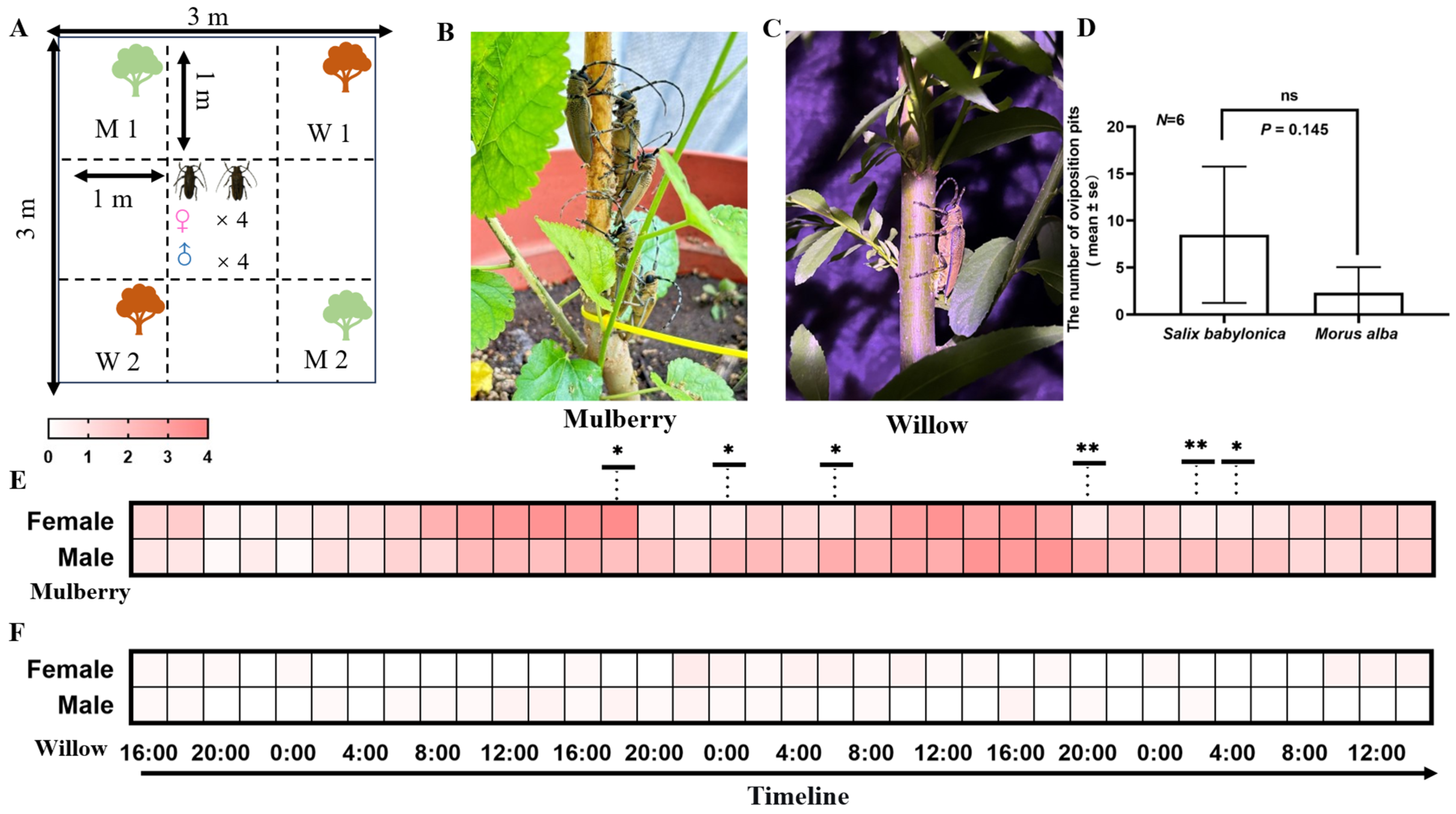
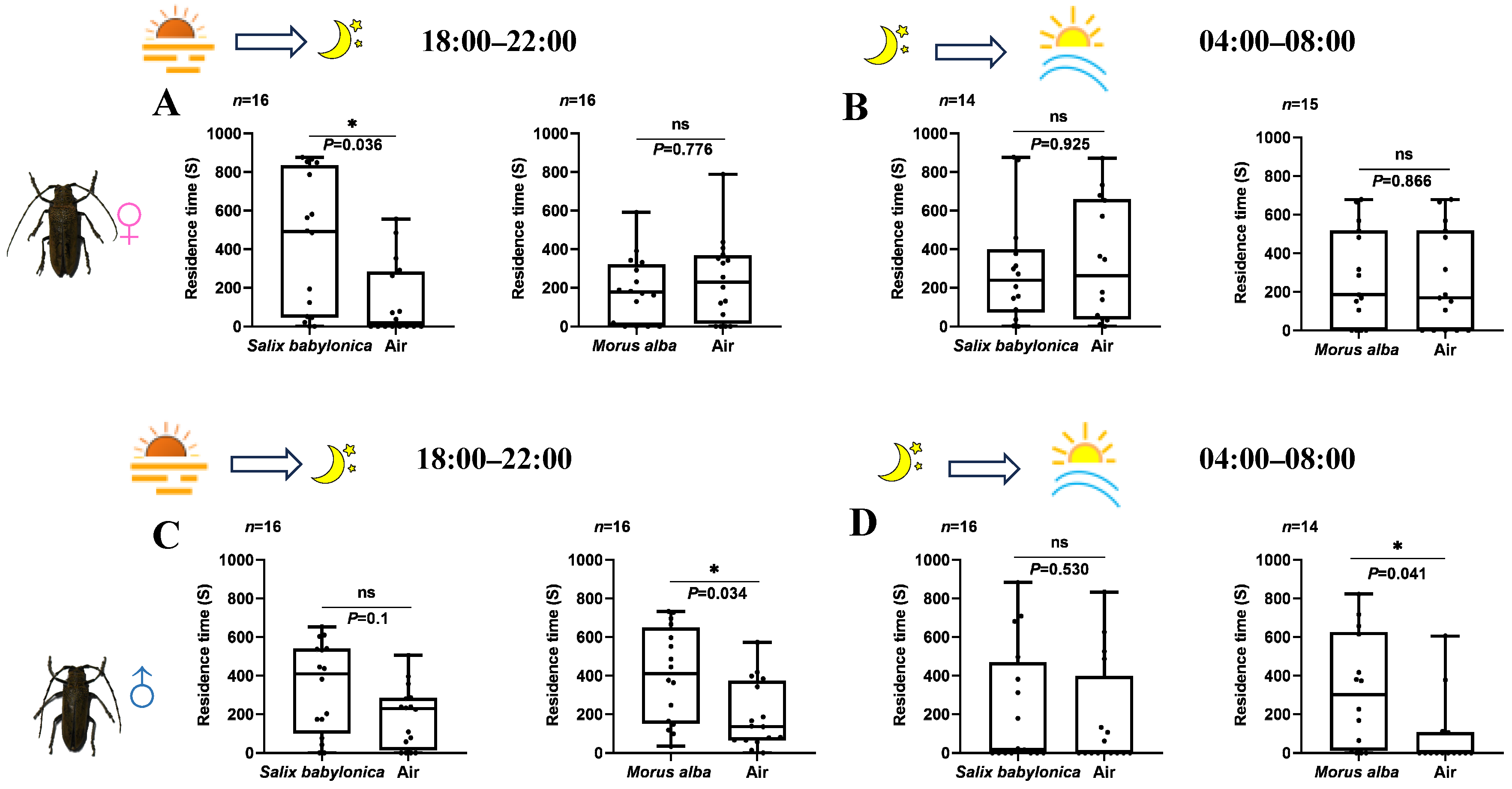
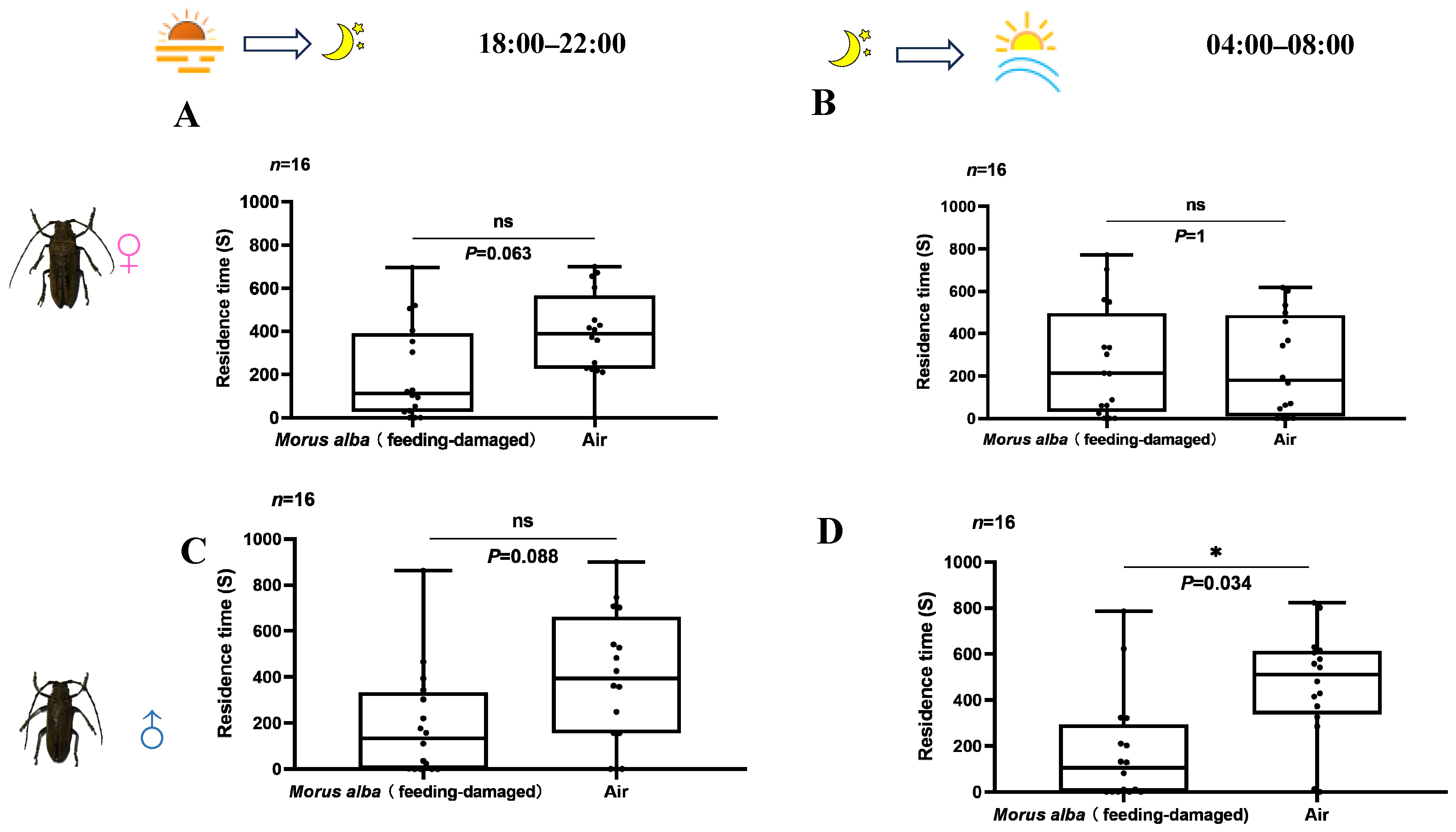
The mulberry longhorn beetle, Apriona germari, is a destructive wood-boring pest that causes significant economic and ecological damage to multiple hardwood species across its extensive distribution range. Adults of this species exhibit a distinct diel rhythm of host alternation, aggregating on feeding hosts (Morus alba) during daytime and dispersing to oviposition hosts (Salix babylonica) at night. However, the regulatory mechanisms underlying this rhythmic behavior remain poorly understood. In this study, we investigated the role of host volatile organic compounds (VOCs) in mediating this behavioral rhythm through cage experiments and two-choice olfactory bioassays. Our results demonstrate that male A. germari are consistently attracted to VOCs from undamaged mulberry throughout both dawn and dusk periods, whereas females exhibit significant attraction exclusively to willow VOCs at dusk, coinciding with their dispersal for oviposition. Notably, VOCs from feeding-damaged mulberry exhibited repellent effects, particularly toward males at dawn. These findings suggest that the rhythmic host alternation in A. germari is partially mediated by differential behavioral responses to host volatiles, with putative male-produced aggregation pheromones potentially contributing to the dawn reassembly on feeding hosts. This research advances our understanding of host alternation mechanisms in Cerambycidae and provides a theoretical foundation for developing semiochemical-based management strategies against this economically important pest.
Abstract
Host alternation is a common behavioral strategy among many herbivorous insects. The mulberry longhorn beetle, Apriona germari is a destructive wood-boring pest. The adults exhibit rhythmic host alternation between feeding and oviposition hosts. However, the temporal rhythm and regulatory mechanisms underlying this behavior remain unclear. In the present study, by observing the dynamics of the numbers of A. germari on mulberry (Morus alba, feeding host) and willow (Salix babylonica, oviposition host) trees in a cage, we first found that both females and males began to aggregate on mulberry trees at dawn. Following 18:00 at dusk, the number of females on mulberry declined sharply, whereas the number of males decreased slightly, with a greater proportion of males staying on mulberry. To investigate the role of host volatiles in regulating the host alternation in A. germari, we then carried out two-choice olfactory assays to test whether the behavioral responses of A. germari to the host volatiles from mulberry and willow twigs differed between 04:00 and 08:00 (dawn, aggregated on mulberry) and 18:00 to 22:00 (dusk, dispersed from mulberry). Males were consistently attracted to the volatiles from healthy mulberry at both dawn and dusk, but not to those from willow. Females showed no attraction to the volatiles from either of two hosts at dawn; however, at dusk, they were significantly attracted to willow volatiles. Furthermore, volatiles from feeding-damaged mulberry trees were repellent to both sexes, particularly to males at dawn. These results indicate that the rhythmic host alternation in A. germari is partly mediated by host volatiles and an unidentified male-produced pheromone may be present in this species. Our findings can deepen the understanding of the host alternation in longhorn beetles, and offer a theoretical foundation for developing semiochemical-based, eco-friendly strategies for controlling this pest.