Mapping Conservation Biological Control and IPM Research (2000–2025): A Bibliometric Analysis of Natural Enemies and Habitat Management
 ,
,  ,
,  ,
,  , , ,
, , ,
Simple Summary
Abstract
1. Introduction
2. Materials and Methods
2.1. Data Collection
2.2. Bibliometric Analysis Software
2.3. Analysis Indicators
3. Results
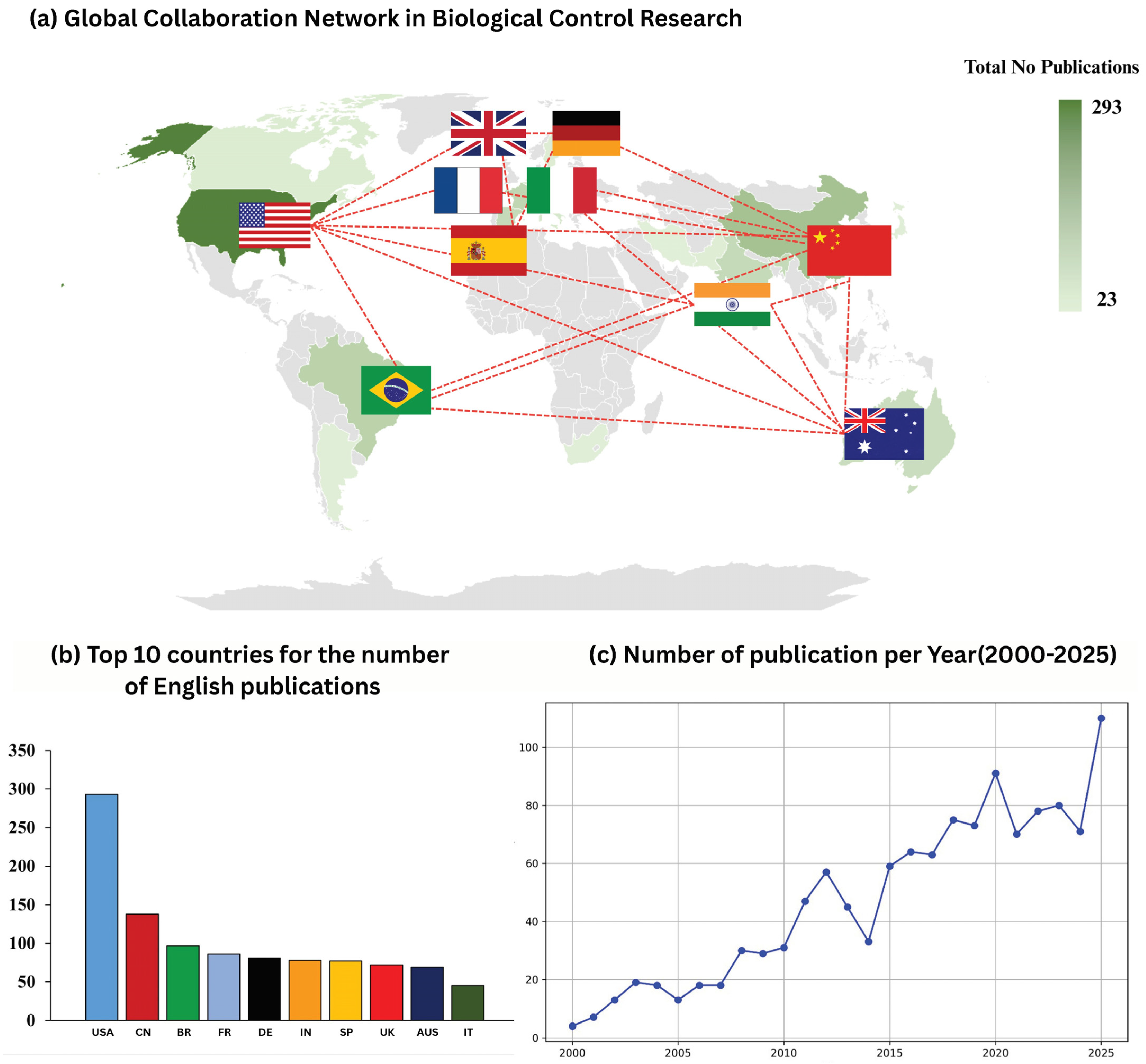
3.1. Publication Output Analysis
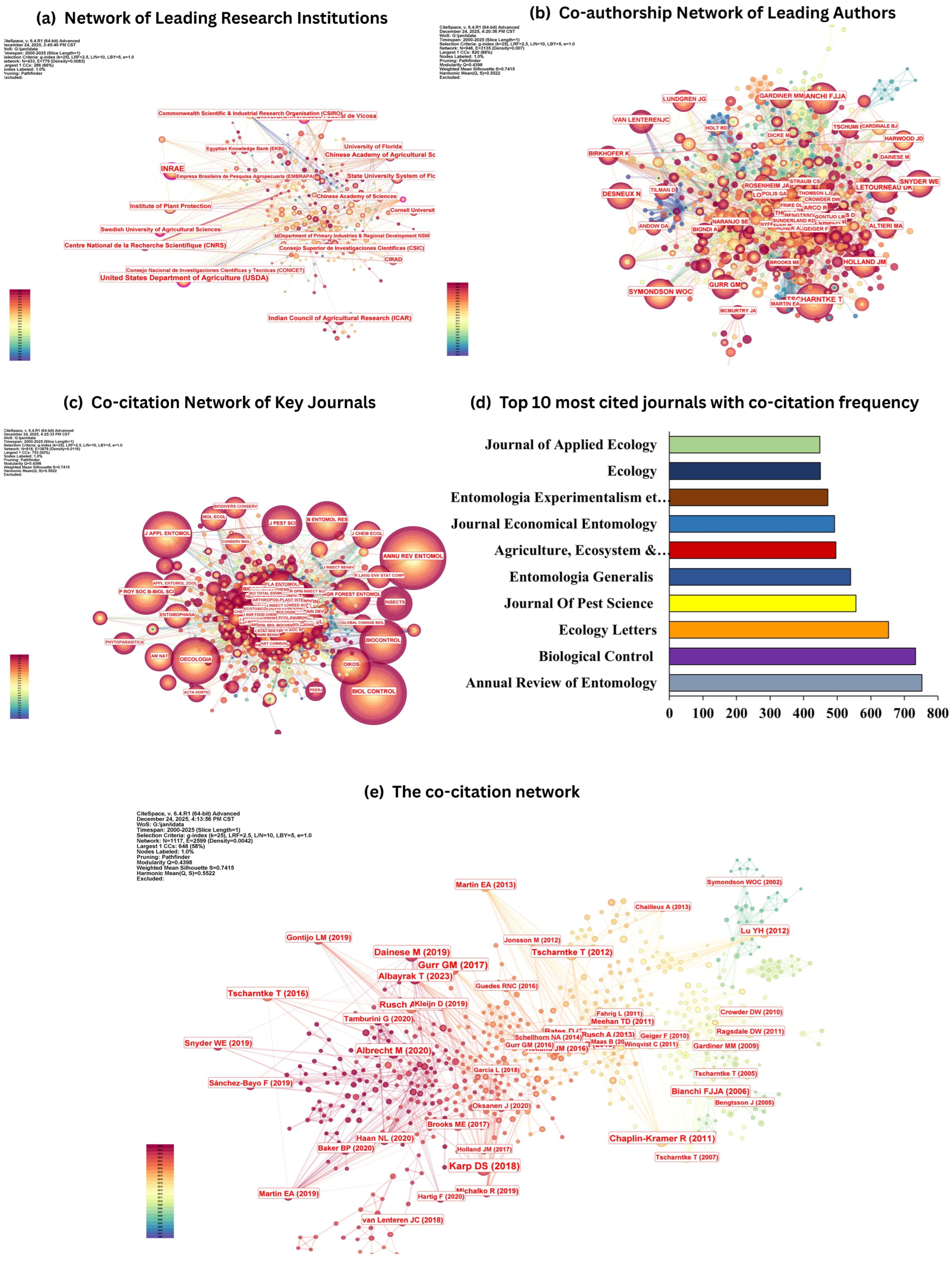
3.2. Central Authors and Collaborators
3.3. Analysis of Research Countries
3.4. Analysis of Research Institutions
3.5. Key Journals in Biological Control Research
3.6. Analysis of Cited References
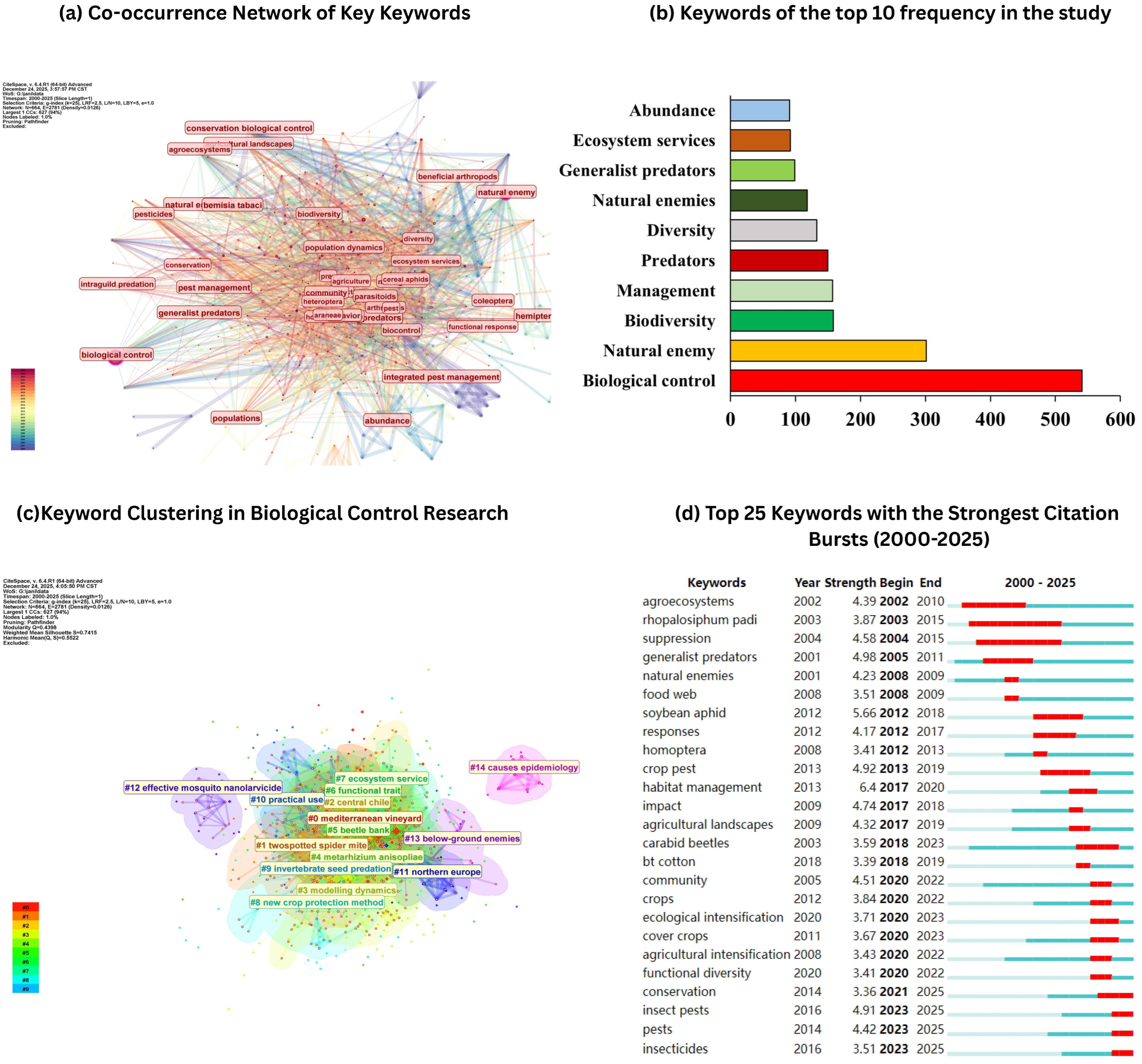
3.7. Analysis of Top Keywords and Keyword Clustering Analysis
4. Discussion
4.1. Sustainability and Ecological Pest Control: Changes in Research Trends
4.2. Illustrative Success Stories in Classical and Augmentative Biological Control
4.3. The IPM and the Role of Habitat Management
4.4. Research Gaps and Future Directions
5. Conclusions
Author Contributions
Funding
Data Availability Statement
Acknowledgments
Conflicts of Interest
Abbreviations
| IPM | Integrated Pest Management |
| WoS | Web of Science |
| WoSCC | Web of Science Core Collection |
| TS | Topic Search (WoS Search Field Tag Used In The Query) |
| PGPR | Plant Growth-Promoting Rhizobacteria |
| LLR | Log-Likelihood Ratio (Used For Naming Keyword Clusters) |
| JCR | Journal Citation Reports |
| APC | Article Processing Charge |
| R | R statistical software |
References
- Shoaib, M.; Sadeghi-Niaraki, A.; Ali, F.; Hussain, I.; Khalid, S. Leveraging deep learning for plant disease and pest detection: A comprehensive review and future directions. Front. Plant Sci. 2025, 16, 1538163. [Google Scholar] [CrossRef] [Scilit] [PubMed]
- Zhou, W.; Arcot, Y.; Medina, R.F.; Bernal, J.; Cisneros-Zevallos, L.; Akbulut, M.E. Integrated pest management: An update on the sustainability approach to crop protection. ACS Omega 2024, 9, 41130–41147. [Google Scholar] [CrossRef] [Scilit] [PubMed]
- Khan, B.A.; Nadeem, M.A.; Nawaz, H.; Amin, M.M.; Abbasi, G.H.; Nadeem, M.; Ali, M.; Ameen, M.; Javaid, M.M.; Maqbool, R. Pesticides: Impacts on agriculture productivity, environment, and management strategies. In Emerging Contaminants and Plants: Interactions, Adaptations and Remediation Technologies; Springer: Berlin/Heidelberg, Germany, 2023; pp. 109–134. [Google Scholar]
- Deguine, J.-P.; Aubertot, J.-N.; Bellon, S.; Côte, F.; Lauri, P.-E.; Lescourret, F.; Ratnadass, A.; Scopel, E.; Andrieu, N.; Bàrberi, P. Agroecological crop protection for sustainable agriculture. Adv. Agron. 2023, 178, 1–59. [Google Scholar]
- Möhring, N.; Ba, M.N.; Braga, A.R.C.; Gaba, S.; Gagic, V.; Kudsk, P.; Larsen, A.; Mesnage, R.; Niggli, U.; Qaim, M. Expected effects of a global transformation of agricultural pest management. Nat. Commun. 2025, 16, 10901. [Google Scholar] [CrossRef] [Scilit]
- Omran, E.-S.E.; Negm, A. Impacts of pesticides on soil and water resources in Algeria. In Water Resources in Algeria—Part I: Assessment of Surface and Groundwater Resources; Springer: Berlin/Heidelberg, Germany, 2020; pp. 69–91. [Google Scholar]
- Bagayou, A.; Hamdache, A.; Diane, Y.; Ezziyyani, M. Health and ecological risks associated with pesticides in the groundwater of the Loukkos area (Larache, Morocco). Environ. Sci. Pollut. Res. 2025, 32, 1–16. [Google Scholar] [CrossRef] [Scilit]
- Acharya, L.K.; Paramaguru, P.K.; Tripathi, K.; Bhoi, T.K.; Seth, P.; Birah, A. Pesticide contamination in groundwater: Processes, risks, and mitigation strategies. Discov. Agric. 2025, 3, 152. [Google Scholar] [CrossRef] [Scilit]
- Hashimi, M.H.; Hashimi, R.; Ryan, Q. Toxic effects of pesticides on humans, plants, animals, pollinators and beneficial organisms. Asian Plant Res. J. 2020, 5, 37–47. [Google Scholar] [CrossRef] [Scilit]
- Pandya, I.Y. Pesticides and their applications in agriculture. Asian J. Appl. Sci. Technol. 2018, 2, 894–900. [Google Scholar]
- Meira, D.D.; Kohls, V.N.D.G.; Casotti, M.C.; Louro, L.S.; Santana, G.M.; Louro, T.E.S.; da Silva, A.M.A.; Altoé, L.S.C.; Trabach, R.R.; Groisman, S. Laying the groundwork: Exploring pesticide exposure and genetic factors in south-eastern Brazilian farmers. Curr. Res. Toxicol. 2025, 8, 100215. [Google Scholar] [CrossRef] [Scilit]
- Singla, P. Plant synthetic biology: A paradigm shift targeting stress mitigation, reduction of ecological footprints and sustainable transformation in agriculture. In Plant Stress Biology: Strategies and Trends; Springer: Berlin/Heidelberg, Germany, 2021; pp. 435–489. [Google Scholar]
- Tiwari, A.K. IPM essentials: Combining biology, ecology, and agriculture for sustainable pest control. J. Adv. Biol. Biotechnol. 2024, 27, 39–47. [Google Scholar] [CrossRef] [Scilit]
- Tooker, J.F.; O’Neal, M.E.; Rodriguez-Saona, C. Balancing disturbance and conservation in agroecosystems to improve biological control. Annu. Rev. Entomol. 2020, 65, 81–100. [Google Scholar] [CrossRef] [Scilit] [PubMed]
- Deguine, J.-P.; Aubertot, J.-N.; Flor, R.J.; Lescourret, F.; Wyckhuys, K.A.; Ratnadass, A. Integrated pest management: Good intentions, hard realities. A review. Agron. Sustain. Dev. 2021, 41, 38. [Google Scholar] [CrossRef] [Scilit]
- Hyder, M.; Ullah, F.; Hussain, M.; Ghafar, M.A.; Ul Haq, I.; Bukero, A.; Akhtar, M.R.; Lodhi, A.M.; Ahmed, Z.; Ali, F. Assessing the decline of ladybird populations: A comprehensive analysis of multifactorial threats and evidence-based conservation strategies. Entomol. Gen. 2025, 45, 3682. [Google Scholar] [CrossRef] [Scilit]
- Cock, M.; Day, R.; Hinz, H.L.; Pollard, K.; Thomas, S.; Williams, F.; Witt, A.; Shaw, R. The impacts of some classical biological control successes. CABI Rev. 2016, 11, 1–58. [Google Scholar] [CrossRef] [Scilit]
- Baker, B.P.; Green, T.A.; Loker, A.J. Biological control and integrated pest management in organic and conventional systems. Biol. Control 2020, 140, 104095. [Google Scholar] [CrossRef] [Scilit]
- Galli, M.; Feldmann, F.; Vogler, U.K.; Kogel, K.-H. Can biocontrol be the game-changer in integrated pest management? A review of definitions, methods and strategies. J. Plant Dis. Prot. 2024, 131, 265–291. [Google Scholar] [CrossRef] [Scilit]
- Ambethgar, A.S.; Rameshkumar, A.; Krishna, K.R.; Sundaresan, S. Biological control of pests in major tropical vegetable crops: A review. Agric. Rev. 2025, 46, 515–530. [Google Scholar] [CrossRef] [Scilit]
- Hyder, M.; Li, Y.; Raza, M.F.; Zhang, M.; Chen, J.; Mao, J.; Bukero, A.; Zhang, L. Enhancing Coccinella beetle biological pest control via a floral approach in cucumber greenhouse. Life 2023, 13, 2080. [Google Scholar] [CrossRef] [Scilit]
- Varone, L.; Benda, N.; Guala, M.E.; Martínez, J.J.; Bruzzone, O.A. Reproductive biology and rearing improvements of Apanteles opuntiarum, potential biocontrol agent of the Argentine cactus moth, Cactoblastis cactorum. Insects 2024, 15, 604. [Google Scholar] [CrossRef] [Scilit]
- Sivinski, J. Augmentative biological control: Research and methods to help make it work. CABI Rev. 2014, 9, 1–11. [Google Scholar] [CrossRef] [Scilit]
- Deans, C.; Krischik, V. The current state and future potential of microbial control of scarab pests. Appl. Sci. 2023, 13, 766. [Google Scholar] [CrossRef] [Scilit]
- Hyder, M.; Ul Haq, I.; Younas, M.; Ghafar, M.A.; Akhtar, M.R.; Ahmed, Z.; Bukero, A.; Hou, Y. Floral resource integration: Enhancing biocontrol of Tuta absoluta within sustainable IPM frameworks. Plants 2025, 14, 319. [Google Scholar] [CrossRef] [Scilit] [PubMed]
- Karamaouna, F.; Jaques, J.A.; Kati, V. Practices to conserve pollinators and natural enemies in agro-ecosystems. Insects 2021, 12, 31. [Google Scholar] [CrossRef] [Scilit] [PubMed]
- Hatt, S.; Francis, F.; Xu, Q.; Wang, S.; Osawa, N. Perennial flowering strips for conservation biological control of insect pests: From picking and mixing flowers to tailored functional diversity. In Integrative Biological Control: Ecostacking for Enhanced Ecosystem Services; Springer: Berlin/Heidelberg, Germany, 2020; pp. 57–71. [Google Scholar]
- Zaviezo, T.; Muñoz, A.E. Conservation biological control of arthropod pests using native plants. Curr. Opin. Insect Sci. 2023, 56, 101022. [Google Scholar] [CrossRef] [Scilit] [PubMed]
- Lu, Z.X.; Zhu, P.Y.; Gurr, G.M.; Zheng, X.S.; Read, D.M.; Heong, K.L.; Yang, Y.J.; Xu, H.X. Mechanisms for flowering plants to benefit arthropod natural enemies of insect pests: Prospects for enhanced use in agriculture. Insect Sci. 2014, 21, 1–12. [Google Scholar] [CrossRef] [Scilit]
- Rega, C.; Bartual, A.M.; Bocci, G.; Sutter, L.; Albrecht, M.; Moonen, A.-C.; Jeanneret, P.; van der Werf, W.; Pfister, S.C.; Holland, J.M. A pan-European model of landscape potential to support natural pest control services. Ecol. Indic. 2018, 90, 653–664. [Google Scholar] [CrossRef] [Scilit]
- Holland, J.M.; Bianchi, F.J.; Entling, M.H.; Moonen, A.C.; Smith, B.M.; Jeanneret, P. Structure, function and management of semi-natural habitats for conservation biological control: A review of European studies. Pest Manag. Sci. 2016, 72, 1638–1651. [Google Scholar] [CrossRef] [Scilit]
- Tscharntke, T.; Bommarco, R.; Clough, Y.; Crist, T.O.; Kleijn, D.; Rand, T.A.; Tylianakis, J.M.; van Nouhuys, S.; Vidal, S. Conservation biological control and enemy diversity on a landscape scale. Biol. Control 2007, 43, 294–309. [Google Scholar] [CrossRef] [Scilit]
- Snyder, W.E. Give predators a complement: Conserving natural enemy biodiversity to improve biocontrol. Biol. Control 2019, 135, 73–82. [Google Scholar] [CrossRef] [Scilit]
- Cortez-Madrigal, H.; Gutiérrez-Cárdenas, O.G. Enhancing biological control: Conservation of alternative hosts of natural enemies. Egypt. J. Biol. Pest Control 2023, 33, 25. [Google Scholar] [CrossRef] [Scilit]
- Géneau, C.E.; Wäckers, F.L.; Luka, H.; Daniel, C.; Balmer, O. Selective flowers to enhance biological control of cabbage pests by parasitoids. Basic Appl. Ecol. 2012, 13, 85–93. [Google Scholar] [CrossRef] [Scilit]
- Nechols, J.R. The potential impact of climate change on non-target risks from imported generalist natural enemies and on biological control. BioControl 2021, 66, 37–44. [Google Scholar] [CrossRef] [Scilit]
- Sloggett, J.J. Aphidophagous ladybirds (Coleoptera: Coccinellidae) and climate change: A review. Insect Conserv. Divers. 2021, 14, 709–722. [Google Scholar] [CrossRef] [Scilit]
- Musa, N.N.; Mohammed, M.A.; Yaakop, S. Survival of predatory ladybirds (Coleoptera: Coccinellidae): Interplay of behavior, agricultural practices and symbiotic relationships. Egypt. J. Biol. Pest Control 2026, 36, 9. [Google Scholar] [CrossRef] [Scilit]
- Yang, L.; Liu, B.; Zhang, Q.; Zeng, Y.; Pan, Y.; Li, M.; Lu, Y. Landscape structure alters the abundance and species composition of early-season aphid populations in wheat fields. Agric. Ecosyst. Environ. 2019, 269, 167–173. [Google Scholar] [CrossRef] [Scilit]
- Zhang, X.; Dong, Z.; Wu, Q.; Gagic, V.; Tomanovic, Z.; Zalucki, M.P.; Lu, Z. Landscape structure and composition affect aphid biological control in alfalfa fields, but regional differences prevail. Entomol. Gen. 2024, 44, 535–544. [Google Scholar] [CrossRef] [Scilit]
- Kabenomuhangi, R. Regenerative agriculture and soil health: Enhancing biodiversity through sustainable farming practices. Int. J. Res. Publ. Rev. 2024, 5, 3203–3215. [Google Scholar] [CrossRef] [Scilit]
- Diyaolu, C.O.; Folarin, I.O. The role of biodiversity in agricultural resilience: Protecting ecosystem services for sustainable food production. Int. J. Res. Publ. Rev. 2024, 5, 1560–1573. [Google Scholar] [CrossRef] [Scilit]
- Marrone, P.G. Increasing the use of biological pesticides in integrated pest management programs. Front. Insect Sci. 2025, 5, 1552361. [Google Scholar] [CrossRef] [Scilit]
- Jha, S.K.; Monobrullah, M.; Krishna, B. Recent advancements in biological control for sustainable pest management. Trop. Agric. 2025, 102, 596–608. [Google Scholar]
- Thilagam, P.; Sharanappa, C.H.; Roy, S.; Deb, L.; Padhan, S.; Srividhya, S.; Awadhiya, P. A review on advances in biocontrol techniques for managing insect pests in sustainable agriculture. Int. J. Environ. Clim. Change 2023, 13, 2114–2125. [Google Scholar] [CrossRef] [Scilit]
- Ali, M.A.; Abdellah, I.M.; Eletmany, M.R. Towards sustainable management of insect pests: Protecting food security through ecological intensification. Int. J. Chem. Biochem. Sci. 2023, 24, 386–394. [Google Scholar]
- Angon, P.B.; Mondal, S.; Jahan, I.; Datto, M.; Antu, U.B.; Ayshi, F.J.; Islam, M.S. Integrated pest management (IPM) in agriculture and its role in maintaining ecological balance and biodiversity. Adv. Agric. 2023, 2023, 5546373. [Google Scholar] [CrossRef] [Scilit]
- Landis, D.A.; Wratten, S.D.; Gurr, G.M. Habitat management to conserve natural enemies of arthropod pests in agriculture. Annu. Rev. Entomol. 2000, 45, 175–201. [Google Scholar] [CrossRef] [Scilit] [PubMed]
- Desneux, N.; Han, P.; Mansour, R.; Arnó, J.; Brévault, T.; Campos, M.R.; Chailleux, A.; Guedes, R.N.; Karimi, J.; Konan, K.A.J. Integrated pest management of Tuta absoluta: Practical implementations across different world regions. J. Pest Sci. 2022, 95, 17–39. [Google Scholar] [CrossRef] [Scilit]
- Chaplin-Kramer, R.; O’Rourke, M.E.; Blitzer, E.J.; Kremen, C. A meta-analysis of crop pest and natural enemy response to landscape complexity. Ecol. Lett. 2011, 14, 922–932. [Google Scholar] [CrossRef] [Scilit]
- Gurr, G.M.; Wratten, S.D.; Landis, D.A.; You, M. Habitat management to suppress pest populations: Progress and prospects. Annu. Rev. Entomol. 2017, 62, 91–109. [Google Scholar] [CrossRef] [Scilit]
- Albrecht, M.; Kleijn, D.; Williams, N.M.; Tschumi, M.; Blaauw, B.R.; Bommarco, R.; Campbell, A.J.; Dainese, M.; Drummond, F.A.; Entling, M.H. The effectiveness of flower strips and hedgerows on pest control, pollination services and crop yield: A quantitative synthesis. Ecol. Lett. 2020, 23, 1488–1498. [Google Scholar] [CrossRef] [Scilit]
- Karp, D.S.; Chaplin-Kramer, R.; Meehan, T.D.; Martin, E.A.; DeClerck, F.; Grab, H.; Gratton, C.; Hunt, L.; Larsen, A.E.; Martínez-Salinas, A. Crop pests and predators exhibit inconsistent responses to surrounding landscape composition. Proc. Natl. Acad. Sci. USA 2018, 115, E7863–E7870. [Google Scholar] [CrossRef] [Scilit]
- Rusch, A.; Chaplin-Kramer, R.; Gardiner, M.M.; Hawro, V.; Holland, J.; Landis, D.; Thies, C.; Tscharntke, T.; Weisser, W.W.; Winqvist, C. Agricultural landscape simplification reduces natural pest control: A quantitative synthesis. Agric. Ecosyst. Environ. 2016, 221, 198–204. [Google Scholar] [CrossRef] [Scilit]
- Tscharntke, T.; Karp, D.S.; Chaplin-Kramer, R.; Batáry, P.; DeClerck, F.; Gratton, C.; Hunt, L.; Ives, A.; Jonsson, M.; Larsen, A. When natural habitat fails to enhance biological pest control—Five hypotheses. Biol. Conserv. 2016, 204, 449–458. [Google Scholar] [CrossRef] [Scilit]
- Fiedler, A.K.; Landis, D.A.; Wratten, S.D. Maximizing ecosystem services from conservation biological control: The role of habitat management. Biol. Control 2008, 45, 254–271. [Google Scholar] [CrossRef] [Scilit]
- Desneux, N.; Wajnberg, E.; Wyckhuys, K.A.; Burgio, G.; Arpaia, S.; Narváez-Vasquez, C.A.; González-Cabrera, J.; Catalán Ruescas, D.; Tabone, E.; Frandon, J. Biological invasion of European tomato crops by Tuta absoluta: Ecology, geographic expansion and prospects for biological control. J. Pest Sci. 2010, 83, 197–215. [Google Scholar] [CrossRef] [Scilit]
- Gurr, G.M.; Perović, D.J.; Le Mottee, K. Pests, predators and parasitoids. In Routledge Handbook of Agricultural Biodiversity; Routledge: Oxfordshire, UK, 2017; pp. 99–111. [Google Scholar]
- Dainese, M.; Martin, E.A.; Aizen, M.A.; Albrecht, M.; Bartomeus, I.; Bommarco, R.; Carvalheiro, L.G.; Chaplin-Kramer, R.; Gagic, V.; Garibaldi, L.A. A global synthesis reveals biodiversity-mediated benefits for crop production. Sci. Adv. 2019, 5, eaax0121. [Google Scholar] [CrossRef] [Scilit] [PubMed]
- Marino, P.C.; Landis, D.A. Parasitoid community structure: Implications for biological control in agricultural landscapes. In Interchanges of Insects between Agricultural and Surrounding Landscapes; Springer: Berlin/Heidelberg, Germany, 2000; pp. 183–193. [Google Scholar]
- Cohen, A.L.; Crowder, D.W. The impacts of spatial and temporal complexity across landscapes on biological control: A review. Curr. Opin. Insect Sci. 2017, 20, 13–18. [Google Scholar] [CrossRef] [Scilit]
- O’Rourke, M.E.; Rienzo-Stack, K.; Power, A.G. A multi-scale, landscape approach to predicting insect populations in agroecosystems. Ecol. Appl. 2011, 21, 1782–1791. [Google Scholar] [CrossRef] [Scilit]
- Martin, E.A.; Reineking, B.; Seo, B.; Steffan-Dewenter, I. Natural enemy interactions constrain pest control in complex agricultural landscapes. Proc. Natl. Acad. Sci. USA 2013, 110, 5534–5539. [Google Scholar] [CrossRef] [Scilit]
- Sponagel, C.; Klinnert, A.; Catarino, R.; Beber, C.L.; Baldoni, E.; Barbosa, A.-L.; Witte, F.; Bahrs, E.; Fellmann, T. Capturing the effects of flower strips on natural pest control in agronomic land use models. Agric. Syst. 2025, 222, 104176. [Google Scholar] [CrossRef] [Scilit]
- Klinnert, A.; Barbosa, A.L.; Catarino, R.; Fellmann, T.; Baldoni, E.; Beber, C.; Hristov, J.; Paracchini, M.L.; Rega, C.; Weiss, F. Landscape features support natural pest control and farm income when pesticide application is reduced. Nat. Commun. 2024, 15, 5384. [Google Scholar] [CrossRef] [Scilit]
- Kondo, T.; Manzano, M.R.; Cotes, A.M. Biological control in Colombia. In Biological Control in Latin America and the Caribbean: Its Rich History and Bright Future; CABI: Oxfordshire, UK, 2020; pp. 124–161. [Google Scholar]
- Calatayud, P.-A.; Le Ru, B.P.; Van den Berg, J.; Schulthess, F. Ecology of the African maize stalk borer, Busseola fusca (Lepidoptera: Noctuidae) with special reference to insect-plant interactions. Insects 2014, 5, 539–563. [Google Scholar] [CrossRef] [Scilit]
- Masry, S.H.; El-Wakeil, N. Egg parasitoid production and their role in controlling insect pests. In Cottage Industry of Biocontrol Agents and Their Applications: Practical Aspects to Deal Biologically with Pests and Stresses Facing Strategic Crops; Springer: Berlin/Heidelberg, Germany, 2019; pp. 3–47. [Google Scholar]
- Dannon, H.F.; Dannon, A.E.; Douro-Kpindou, O.K.; Zinsou, A.V.; Houndete, A.T.; Toffa-Mehinto, J.; Elegbede, I.M.; Olou, B.D.; Tamò, M. Toward the efficient use of Beauveria bassiana in integrated cotton insect pest management. J. Cotton Res. 2020, 3, 24. [Google Scholar] [CrossRef] [Scilit]
- Liu, L.; Liu, S.; Meng, Q.; Chen, B.; Zhang, J.; Zhang, X.; Lin, Z.; Zou, Z. Evaluating Beauveria bassiana strains for insect pest control and endophytic colonization in wheat. Insects 2025, 16, 287. [Google Scholar] [CrossRef] [Scilit]
- Brewer, M.J.; Goodell, P.B. Approaches and incentives to implement integrated pest management that addresses regional and environmental issues. Annu. Rev. Entomol. 2012, 57, 41–59. [Google Scholar] [CrossRef] [Scilit]



| Rank | Total Published Paper | Author | Centrality |
|---|---|---|---|
| 1 | 13 | Desneux, Nicolas | 0.01 |
| 2 | 7 | Birkhofer, Klaus | 0.01 |
| 3 | 7 | Tscharntke, Teja | 0 |
| 4 | 6 | Gurr, Geoff M | 0.01 |
| 5 | 6 | Lu, Yanhui | 0 |
| 6 | 6 | Zanuncio, Jose Cola | 0 |
| 7 | 5 | Benelli, Giovanni | 0 |
| 8 | 5 | Landis, Douglas A | 0 |
| 9 | 5 | Albrecht, Matthias | 0 |
| 10 | 5 | Traugott, Michael | 0.01 |
| Rank | Total Published Papers | Institutes | Centrality |
|---|---|---|---|
| 1 | 65 | INRAE | 0.14 |
| 2 | 52 | United States Department of Agriculture (USDA) | 0.17 |
| 3 | 35 | University of California System | 0.11 |
| 4 | 33 | Chinese Academy of Agricultural Sciences | 0.06 |
| 5 | 32 | Indian Council of Agricultural Research (ICAR) | 0.06 |
| 6 | 29 | Centre National de la Recherche Scientifique (CNRS) | 0.08 |
| 7 | 28 | Universidade Federal de Viçosa. | 0.01 |
| 8 | 25 | Institute of Plant Protection | 0.04 |
| 9 | 25 | State University System of Florida | 0.03 |
| 10 | 22 | University of Florida | 0.02 |
| Rank | Title | Author | Journal | Citation |
|---|---|---|---|---|
| 1 | “Habitat management to conserve natural enemies of arthropod pests in agriculture” | Landis [48] | Annual Review of Entomology | 4297 |
| 2 | “Biological invasion of European tomato crops by Tuta absoluta: ecology, geographic expansion and prospects for biological control” | N. Desneux [49] | Journal of Pest Science | 1574 |
| 3 | “Conservation biological control and enemy diversity on a landscape scale” | Tscharntke [32] | Biological Control | 1018 |
| 4 | “A meta-analysis of crop pest and natural enemy response to landscape complexity” | Chaplin [50] | Ecology Letters | 1302 |
| 5 | “Habitat management to suppress pest populations: progress and prospects” | G.M Gurr [51]. | Annual Review of Entomology | 808 |
| 6 | “The effectiveness of flower strips and hedgerows on pest control, pollination services and crop yield: a quantitative synthesis” | Albrecht [52] | Ecology Letters | 757 |
| 7 | “Crop pests and predators exhibit inconsistent responses to surrounding landscape composition” | Karp D. [53] | PNAS | 738 |
| 8 | “Agricultural landscape simplification reduces natural pest control: A quantitative synthesis” | Rusch A.R [54] | Agr. Ecosyst. Environ. | 707 |
| 9 | “When natural habitat fails to enhance biological pest control–Five hypotheses” | Tscharntke [55] | Biological Control | 694 |
| 10 | “Maximizing ecosystem services from conservation biological control: the role of habitat management” | Fiedler [56] | Biological Control | 614 |
Disclaimer/Publisher’s Note: The statements, opinions and data contained in all publications are solely those of the individual author(s) and contributor(s) and not of MDPI and/or the editor(s). MDPI and/or the editor(s) disclaim responsibility for any injury to people or property resulting from any ideas, methods, instructions or products referred to in the content. |
© 2026 by the authors. Licensee MDPI, Basel, Switzerland. This article is an open access article distributed under the terms and conditions of the Creative Commons Attribution (CC BY) license.
Share and Cite
Hyder, M.; Ullah, F.; Basit, A.; Haq, I.U.; Mustapha, T.; Nisa, Z.U.; Cai, X.; Liu, H.; Hou, Y. Mapping Conservation Biological Control and IPM Research (2000–2025): A Bibliometric Analysis of Natural Enemies and Habitat Management. Insects 2026, 17, 447. https://doi.org/10.3390/insects17050447
Hyder M, Ullah F, Basit A, Haq IU, Mustapha T, Nisa ZU, Cai X, Liu H, Hou Y. Mapping Conservation Biological Control and IPM Research (2000–2025): A Bibliometric Analysis of Natural Enemies and Habitat Management. Insects. 2026; 17(5):447. https://doi.org/10.3390/insects17050447
Chicago/Turabian StyleHyder, Moazam, Farman Ullah, Abdul Basit, Inzamam Ul Haq, Tijjani Mustapha, Zaib Un Nisa, Xiangyun Cai, Huiping Liu, and Youming Hou. 2026. "Mapping Conservation Biological Control and IPM Research (2000–2025): A Bibliometric Analysis of Natural Enemies and Habitat Management" Insects 17, no. 5: 447. https://doi.org/10.3390/insects17050447
APA StyleHyder, M., Ullah, F., Basit, A., Haq, I. U., Mustapha, T., Nisa, Z. U., Cai, X., Liu, H., & Hou, Y. (2026). Mapping Conservation Biological Control and IPM Research (2000–2025): A Bibliometric Analysis of Natural Enemies and Habitat Management. Insects, 17(5), 447. https://doi.org/10.3390/insects17050447