


Simple Summary
Plutella xylostella poses a significant global threat to cruciferous crops such as cabbage and broccoli. Managing the pest has become increasingly difficult due to its resistance to conventional insecticides. This study identifies PxvATPaseE, an essential gene for larval survival and development in P. xylostella. Utilizing RNA interference (RNAi), we successfully reduced the mRNA level of PxvATPaseE, resulting in high larval mortality and severe developmental impairment. Furthermore, we employed computational virtual screening to identify natural compounds capable of inhibiting PxvATPaseE. These findings validate PxvATPaseE as a promising target for developing eco-friendly pest management methods against P. xylostella.
Abstract
The diamondback moth (Plutella xylostella) is a devastating global pest of cruciferous crops. This study explores the potential of targeting the vacuolar ATPase subunit E (PxvATPaseE) for its control. We demonstrate that PxvATPaseE is essential for larval development, showing high expression levels in the midgut. RNA interference (RNAi)-mediated silencing of PxvATPaseE resulted in severe growth retardation and dose-dependent mortality, with higher dsRNA doses inducing more sustained effects. Furthermore, computational virtual screening of natural compound libraries identified a high-affinity binder of PxvATPaseE, such as periplocoside D. Our results demonstrate that PxvATPaseE is a promising molecular target for controlling P. xylostella, supporting a dual-strategy approach combining RNAi and targeted chemical inhibition for future pest management solutions.
1. Introduction
The diamondback moth, Plutella xylostella, is a significant lepidopteran pest of cruciferous crops, causing major global damage, with annual economic losses estimated at US$4–5 billion [1,2]. The rapid evolution of insecticide resistance has rendered chemical control increasingly challenging. Field control still relies primarily on chemical insecticides, such as chlorantraniliprole and chlorpyrifos [2,3]. Consequently, identifying effective alternatives for managing P. xylostella is urgent.
RNA interference (RNAi) is a cellular process that employs double-stranded RNA (dsRNA) to suppress gene expression in a precise, sequence-specific manner, offering substantial promise for pest management [4,5,6,7,8]. Recent studies have indicated that vATPases provide a strategic entry point for RNAi-based pest management. RNAi targeting V-ATPase subunits consistently induces lethal phenotypes, and advances in dsRNA design, nanoparticle carriers, and plant-based, microbial, or spray-based delivery systems have expanded the practical application, highlighting insect ATPases as both fundamental drivers of biological processes and promising molecular targets [9,10].
The potential of RNAi has been widely demonstrated across various insect orders, including coleopterans such as Tribolium castaneum [11], Leptinotarsa decemlineata [6,12], and Henosepilachna vigintioctopunctata [13,14,15,16], in thysanopteran Frankliniella occidentalis [17], in hemipterans Apolygus lucorum [18] and Nilaparvata lugens [19], and in lepidopterans Manduca sexta [20] and Helicoverpa armigera [21]. Recent evidence demonstrates that RNAi targeting PxPiwi [22] or PxTH [23] in P. xylostella impairs larval development, suggesting the feasibility of RNAi-based management for this pest.
The vacuolar-type H+-ATPase (vATPase) is an evolutionarily conserved, multi-subunit complex in eukaryotes that hydrolyzes adenosine triphosphate (ATP) to pump protons across membranes, thereby regulating various cellular and extracellular biological processes [24,25,26]. Structurally, the V-ATPase comprises two main subcomplexes: the V1 complex, containing eight subunits (A–H) responsible for ATP hydrolysis, and the V0 complex, which facilitates transmembrane proton movement [27,28,29,30,31]. In Tuta absoluta, feeding on tomato leaves treated with dsTavATPaseA resulted in substantial larval mortality and pupation failure [32]. Both injection of dsRNA and ingestion of bacterially expressed dsRNA significantly downregulated expression of vATPaseA in Hyphantria cunea, causing high larval mortality and pupal malformation [33]. Studies on Bemisia tabaci have suggested that RNAi targeting different vATPase subunits may elicit distinct phenotypic effects, with silencing efficacy exhibiting biotype-specific variation [34]. In the coleopteran Plagiodera versicolora, ingestion of dsRNA targeting vATPaseA and vATPaseE severely suppressed development from the first to third instar and impaired adult mating or oviposition [35].
Previous studies have highlighted RNAi of the V-ATPase E subunit (vATPaseE) as a promising approach for insect pest control. For example, knockdown of vATPaseE causes high mortality in hemipterans like A. lucorum [18] and Acyrthosiphon pisum [20]; in coleopterans such as T. castaneum [11], L. decemlineata [36], H. vigintioctopunctata [14,26], and Diabrotica virgifera virgifera [37]; and in the lepidopteran M. sexta [18] and the dipteran Drosophila melanogaster [20]. Furthermore, expression of vATPaseE dsRNA in transgenic sugarcane leads to significant mortality in Sphenophorus levis [38]. These findings suggest that targeting PxvATPaseE via RNAi could be an effective strategy for controlling P. xylostella.
Advances in computational capabilities have greatly facilitated the screening of target protein inhibitors from large compound libraries [39,40,41]. For instance, Gryniukova et al. preselected 434 compounds for sirtuin-1 inhibition from a library of 2.6 million compounds using virtual screening [39], and Chafer-Dolz et al. discovered novel inhibitors of acetylcholinesterase through virtual screening [41]. These findings confirm that virtual screening can efficiently identify candidate inhibitors for target proteins from extensive databases.
In this study, we selected PxvATPaseE as a target gene to investigate the effects of RNAi on P. xylostella. Our approach involved (i) identifying and conducting a phylogenetic analysis of PxvATPaseE; (ii) characterizing its expression profiles across various developmental stages and tissues; (iii) quantifying the impact of in vitro-synthesized dsRNA on PxvATPaseE expression; (iv) evaluating the effects of two doses of dsPxvATPaseE on larval weight, survival, pupation, and adult emergence; and (v) using virtual screening to identify potential small-molecule inhibitors of PxvATPaseE from a library of 15,216 natural compounds.
2. Materials and Methods
2.1. Insect Rearing
P. xylostella larvae were collected from Brassica napus in Haidong City, Qinghai Province, China. They were maintained on fresh Brassica leaves under controlled conditions: 26 ± 1 °C, a 16:8 h (light:dark) photoperiod, and 60 ± 5% relative humidity. Adults were provided with a 10% honey solution.
2.2. Molecular Cloning and Phylogenetic Analysis
The sequence of PxvATPaseE was obtained from the genome and transcriptome data of P. xylostella [42,43]. The accuracy was confirmed by polymerase chain reaction (PCR) using the primers listed in Table S1. The cDNA sequence was downloaded from NCBI (GenBank accession number: AB189032.1). Phylogenetic analysis of PxvATPaseE was conducted using MEGA-5 software (https://sourceforge.net/projects/mega5/, accessed on 18 April 2025) and the neighbor-joining method, with 1000 bootstrap replications.
2.3. Synthesis of dsRNA
We designed and synthesized dsRNA targeting PxvATPaseE (dsVAE) and a control targeting the green fluorescent protein gene (dsGFP). cDNA fragments for both targets were PCR-amplified using specific primers flanked by T7 promoter sequences (Table S1 and Figure S1). dsRNA was synthesized by in vitro transcription using the T7 RiboMAX™ Express RNAi System (Promega, Madison, WI, USA) following the manufacturer’s protocol. The transcription reaction, containing 1 μg DNA template, 10 μL of RiboMAX™ Express T7 2× Buffer (Promega, Madison, WI, USA), and 2 μL of T7 Enzyme Mix (Promega, Madison, WI, USA), was incubated at 37 °C for 2–6 h, heat-inactivated at 70 °C for 10 min, and then slowly cooled to room temperature to facilitate dsRNA formation. The product was treated with DNase I and RNase A to remove template DNA and single-stranded RNA, respectively, and then purified using a gel extraction kit (Omega, Norcross, GA, USA). The dsRNA concentration was determined by measuring absorbance at 260 nm with a Nanodrop 1000 spectrophotometer, and its integrity was confirmed by agarose gel electrophoresis. Purified dsRNA was aliquoted and stored at −80 °C until use.
2.4. dsRNA Injection and Sample Collection
Microinjection of dsRNA was performed as previously described [44,45,46]. Newly molted fourth-instar larvae were selected for injection. Borosilicate glass capillaries were prepared using a PC-10 puller (Narishige, Tokyo, Japan). Using the microinjection system (World Precision Instruments, Sarasota, FL, USA), a volume of 0.2 μL containing either 800 ng or 1200 ng of dsRNA (total dose, as per reference [47]) was delivered into the larval hemolymph. Larvae injected with dsGFP served as the negative control. For each dsRNA treatment, six experimental replicates were performed, with each replicate consisting of eight injected larvae. Following microinjection, the larvae were individually placed in plastic boxes and supplied with fresh rapeseed leaves. To evaluate RNAi efficiency, three replicates per group were collected at 2 and 3 days post-injection for qRT-PCR analysis. The remaining three replicates were observed for three weeks to monitor phenotypic defects, larval weight change, survival, pupation, and adult emergence rates.
2.5. RNA Extraction and Quantitative Real-Time PCR (qRT-PCR)
To analyze temporal and tissue-specific expression patterns as well as treatment effects, RNA was isolated from the collected samples. Specifically, total RNA was extracted from treated larvae (eight individuals pooled per sample) using the Total RNA Extraction Reagent (YiFeiXue Tech, Nanjing, China), with three independent biological replicates prepared for each condition. Quantitative real-time PCR (qRT-PCR) was performed following a previously established method [48] to quantify transcript levels. RPL32 was used as the reference gene for normalization. Each biological replicate was assayed in three technical replicates. Relative mRNA expression was calculated using the 2−ΔΔCT method.
2.6. Virtual Screening for PxvATPaseE Inhibitors
The three-dimensional structure of the PxvATPaseE protein was predicted using AlphaFold 3 [49], an artificial intelligence-based modeling tool. A comprehensive compound library was constructed by integrating multiple chemical databases. A total of 15,216 natural compounds were obtained after preprocessing, which included conversion from 2D to 3D structures, addition of hydrogen atoms, assignment of Gasteiger charges, energy minimization, and application of the MMFF94 force field.
Hierarchical virtual screening was then performed using the molecular docking program AutoDock Vina (version 1.2.5) [50], a standard physics-based docking tool. First, high-throughput virtual screening (HTVS) was conducted. Compounds prone to computational errors due to unreasonable bonds, heavy atoms, excessive cavities, or high torsional degrees of freedom were removed, resulting in valid docking scores for 14,468 compounds. The top 10% of compounds ranked by “Max Affinity” from the HTVS were selected for the second round of virtual screening. Subsequently, the top 5% of compounds from this screening round (based on “Max Affinity”) were subjected to a final refined screening step to obtain the ultimate “Max Affinity” rankings. The modeled structure of PxvATPaseE was based on docking by AutoDock Vina. The structural data were processed using the PyMOL software (version 2.5.5). This work was performed in collaboration with Hefei Kejing Biotechnology Co., Ltd. (Hefei, China).
2.7. Statistical Analysis
Statistical analyses were conducted using SPSS (version 29.0.2.0) for Windows (Chicago, IL, USA). Mean differences (±SE) were analyzed by one-way ANOVA with the Tukey–Kramer post hoc test. Survival curves were analyzed with the log-rank test (Mantel–Cox; 95% CI) in GraphPad Prism (version 8.0).
3. Results
3.1. Identification and Phylogenetic Analysis of PxvATPaseE
The putative full-length PxvATPaseE was confirmed in P. xylostella by mining the transcriptome data (Figure S1). The PxvATPaseE consisted of a 681 bp complete open reading frame, encoding 226 amino acid residues (Figure S1). The calculated molecular weight and isoelectric point of PxvATPaseE were 26.13 kDa and 7.78, respectively, as determined by the Compute pI/MW tool (https://web.expasy.org/compute_pi/, accessed on 18 April 2025).
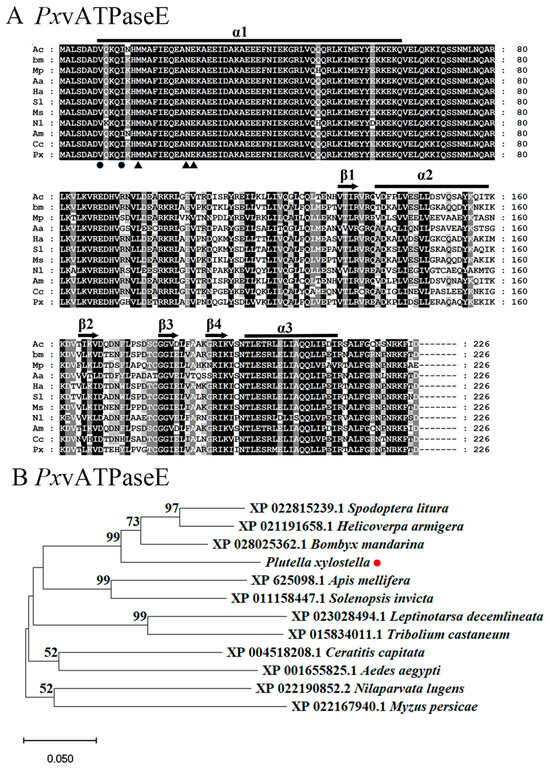
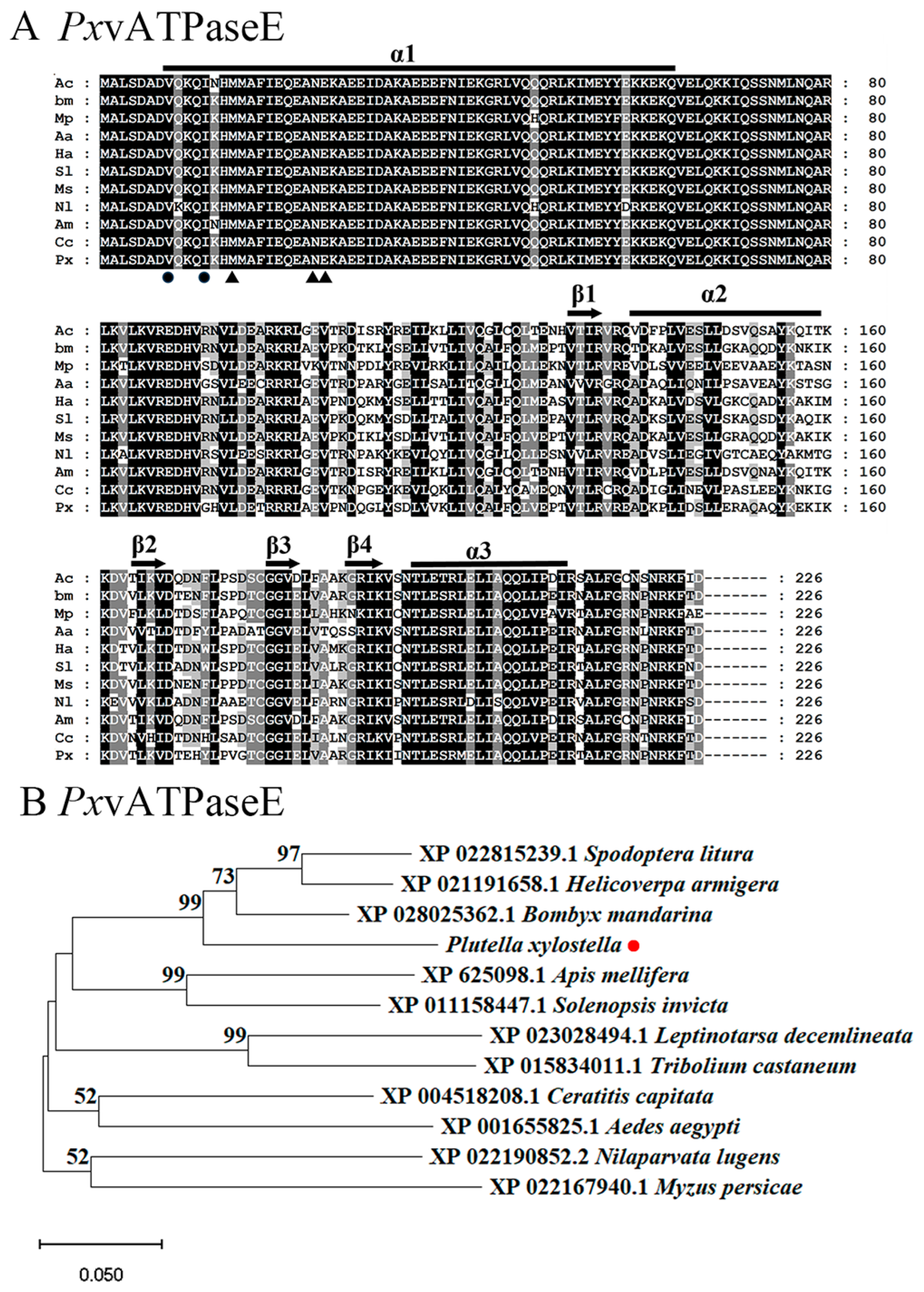
A sequence alignment revealed that vATPaseE proteins in different insects were highly conserved. The vATPaseE protein consisted of four β-strands (S131-I134, K164-V167, G179-E182, and G188-K191) and two α-helices (E139-L159 and T195-I211). The sheets and helices were connected by flexible loop regions in the following order: β1:α2:β2:β3:β4:α3 (Figure 1A).
Figure 1.
Sequence alignment and phylogenetic analysis of V-ATPase subunit E from P. xylostella. (A) Multiple sequence alignment of vATPaseE proteins from Apis cerana (Ac), Bombyx mandarina (Bm), Myzus persicae (Mp), Aedes aegypti (Aa), Helicoverpa armigera (Ha), Spodoptera litura (Sl), Manduca sexta (Ms), Nilaparvata lugens (Nl), Apis mellifera (Am), Ceratitis capitata (Cc), and Plutella xylostella (Px). The background shading intensity is proportional to sequence similarity (light to dark). Gaps are introduced for optimal alignment. Predicted secondary structure elements (α-helices and β-sheets) of subunit E, arranged in order α1:β1:α2:β2:β3:β4:α3, are indicated above the alignment (lines for α-helices; arrows for β-sheets). Triangles and circles mark amino acid residues critical for interaction with subunits G and C, respectively. (B) Phylogenetic tree of vATPaseE proteins from four lepidopteran (Spodoptera litura, Helicoverpa armigera, Plutella xylostella, and Bombyx mandarina), two hymenopteran (Apis mellifera and Solenopsis invicta), two dipteran (Aedes aegypti and Ceratitis capitata), two hemipteran (Nilaparvata lugens and Myzus persicae), and two coleopteran (Leptinotarsa decemlineata and Tribolium castaneum) species. The tree was constructed using the neighbor-joining method based on full-length protein sequence alignments. Bootstrap support values from 1000 replicates are shown at nodes (>50%).
To elucidate the evolutionary relationships of vATPaseE-like proteins, a phylogenetic tree was constructed using sequences from 12 species (Figure 1B). The analysis included species from five insect orders: Lepidoptera (P. xylostella, Bombyx mandarina, H. armigera, and Spodoptera litura), Hymenoptera (Apis mellifera and Solenopsis invicta), Diptera (Aedes aegypti and Ceratitis capitata), Hemiptera (N. lugens and Myzus persicae), and Coleoptera (T. castaneum and L. decemlineata). The resulting unrooted tree demonstrated that vATPaseE-like proteins from species within the same order clustered together. Accordingly, vATPaseE from P. xylostella was clearly grouped within the lepidopteran clade (Figure 1B).
3.2. Expression Profiles of PxvATPaseE
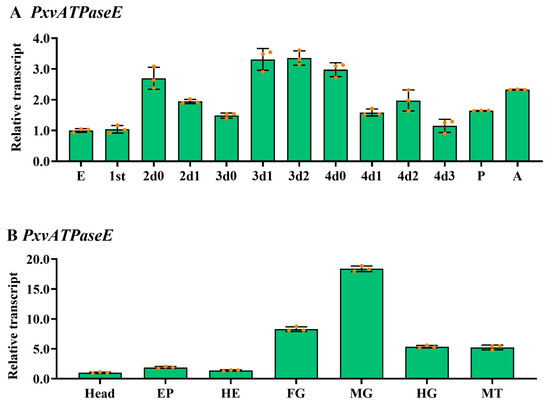
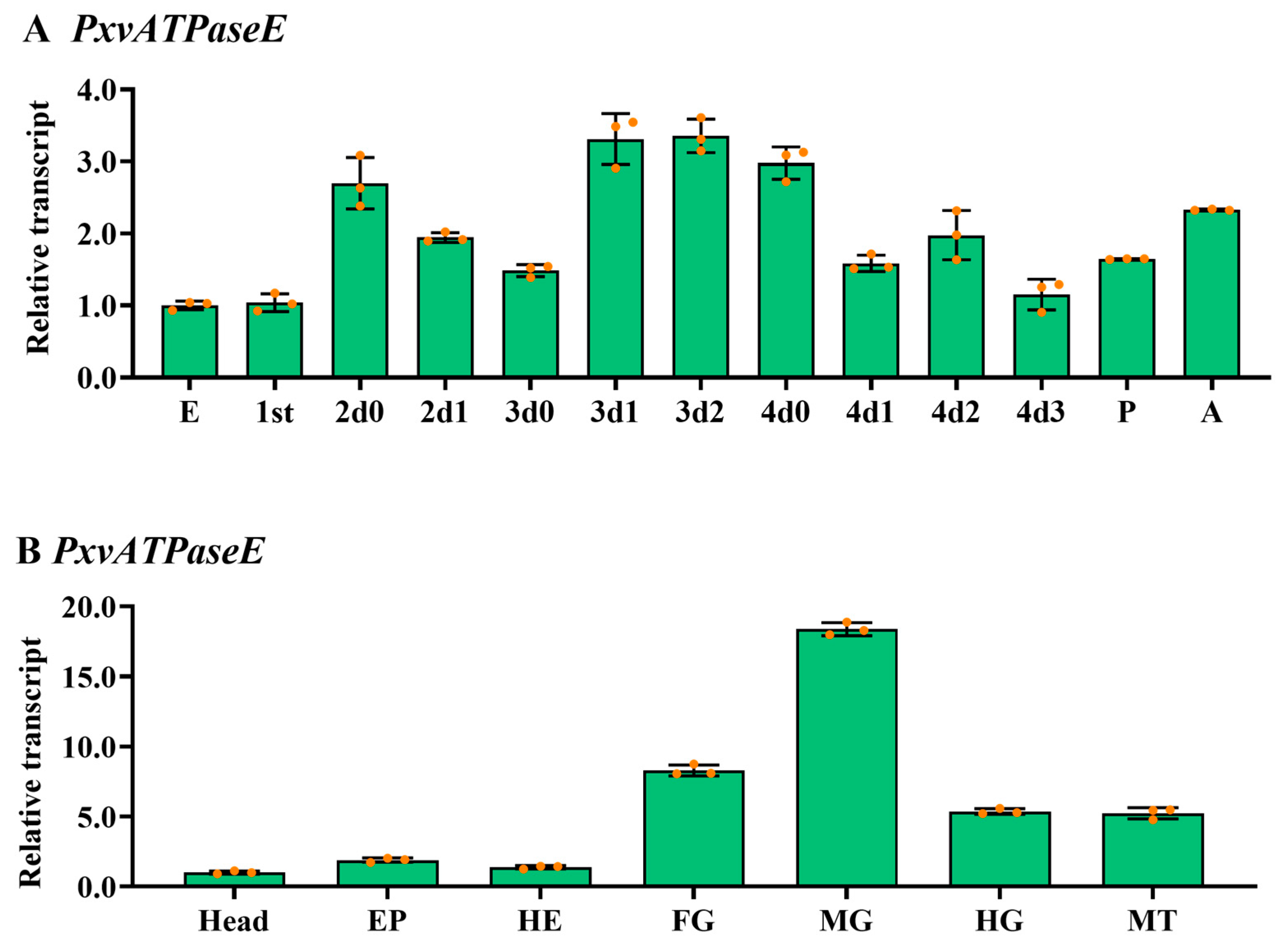
The temporal expression pattern of PxvATPaseE was examined by qRT-PCR. Transcripts were detectable across all developmental stages from embryo to adult. Expression peaked on day 2 of the third-instar larval stage, while the lowest level was observed at the egg stage. A consistent expression pattern was noted throughout larval development: mRNA levels increased during each ecdysis period and decreased during the subsequent feeding stage (Figure 2A). Spatial expression profiling was performed in multiple tissues of fourth-instar larvae, including the head, foregut, midgut, hindgut, hemolymph, Malpighian tubules, and epidermis. PxvATPaseE expression was highest in the midgut and foregut, moderate in the hindgut and Malpighian tubules, and low in the head, hemolymph, and epidermis (Figure 2B).
Figure 2.
Temporal and spatial expression profiles of PxvATPaseE in P. xylostella. (A) Temporal expression. Complementary DNA templates were prepared from eggs; larvae of the first (0–1 day post-hatching), second, third, and fourth instars (day 0 indicates newly molted individuals); newly ecdysed pupae; and newly emerged adults. (B) Tissue-specific expression. Templates were derived from the head, foregut (FG), midgut (MG), hindgut (HG), hemolymph (HE), Malpighian tubules (MT), and epidermis (EP) of day-4 fourth-instar larvae. Expression levels were calculated using the 2−ΔΔCT method, normalized to the lowest level (set as 1) observed in eggs and head tissues. Data are presented as means ± standard errors (SEs).
3.3. RNAi of PxvATPaseE in Fourth-Instar P. xylostella Larvae (800 ng Dose)
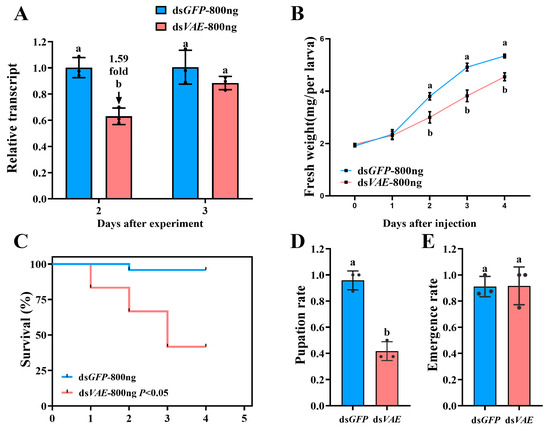
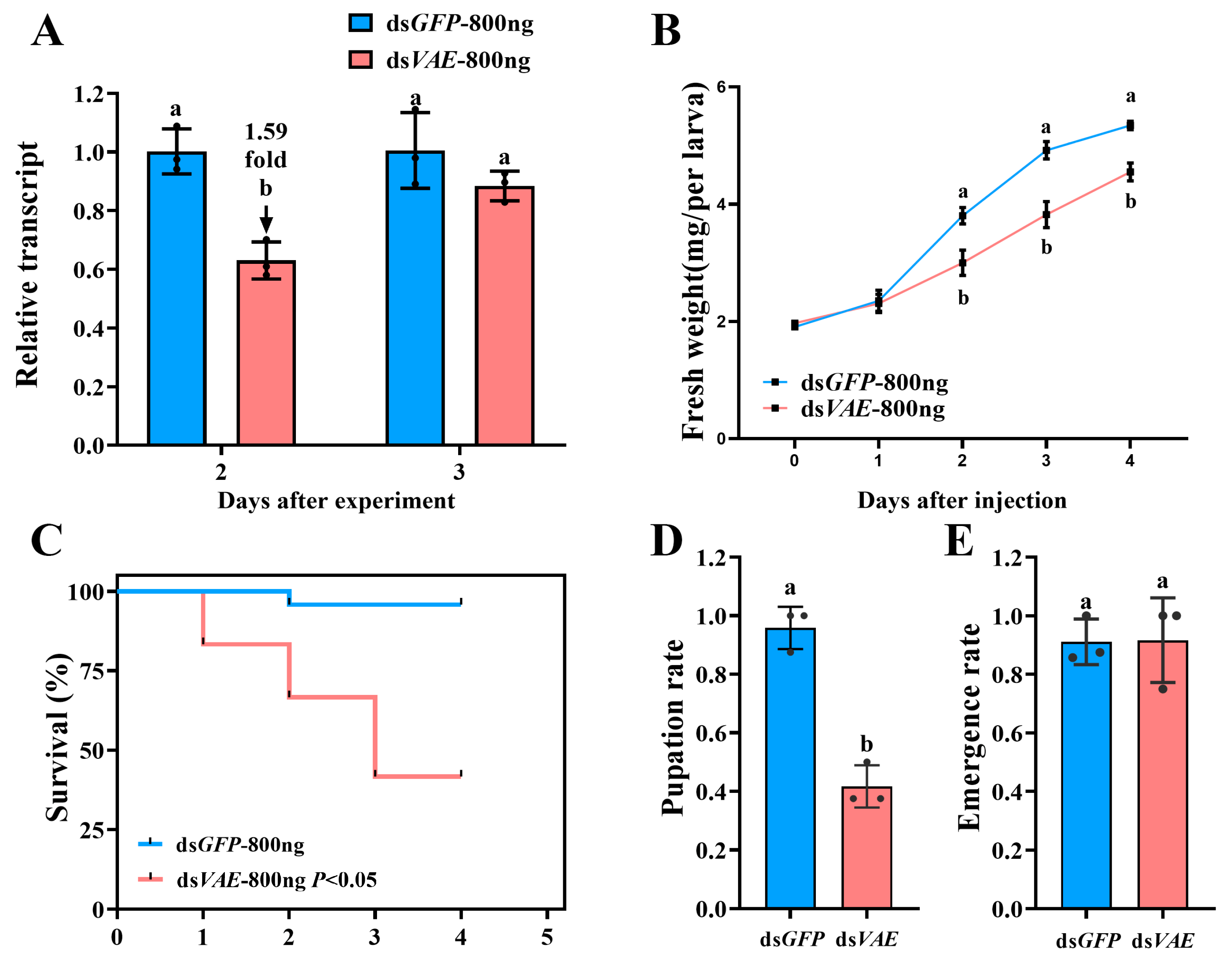
To evaluate the effects of RNAi targeting PxvATPaseE in P. xylostella, we silenced the gene via dsRNA injection. Delivery of 800 ng of dsVAE into newly molted fourth-instar larvae significantly reduced PxvATPaseE mRNA levels by approximately 1.59-fold at day 2 post-injection, although no significant reduction was observed at day 3 (Figure 3A).
Figure 3.
Effects of PxvATPaseE silencing in fourth-instar larvae of P. xylostella. Newly molted fourth-instar larvae were injected with 0.2 µL of a solution containing 800 ng of dsVAE; dsGFP-injected larvae served as a negative control. After injection, the larvae were reared on fresh rape leaves. (A) Relative PxvATPaseE expression levels at 48 and 72 h post-injection, normalized to dsGFP control (set as 1). (B–E) Larval fresh weight (B), survival rate (C), pupation rate (D), and adult emergence rate (E) were monitored over a 5-day period. Data are presented as means ± SEs. Different letters indicate statistically significant differences (p < 0.05).
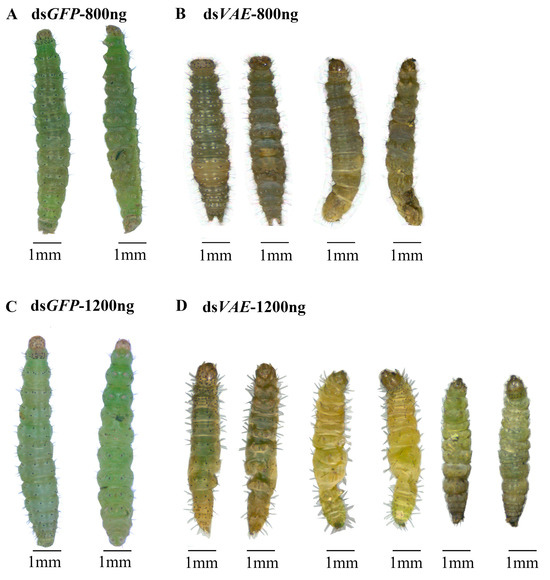
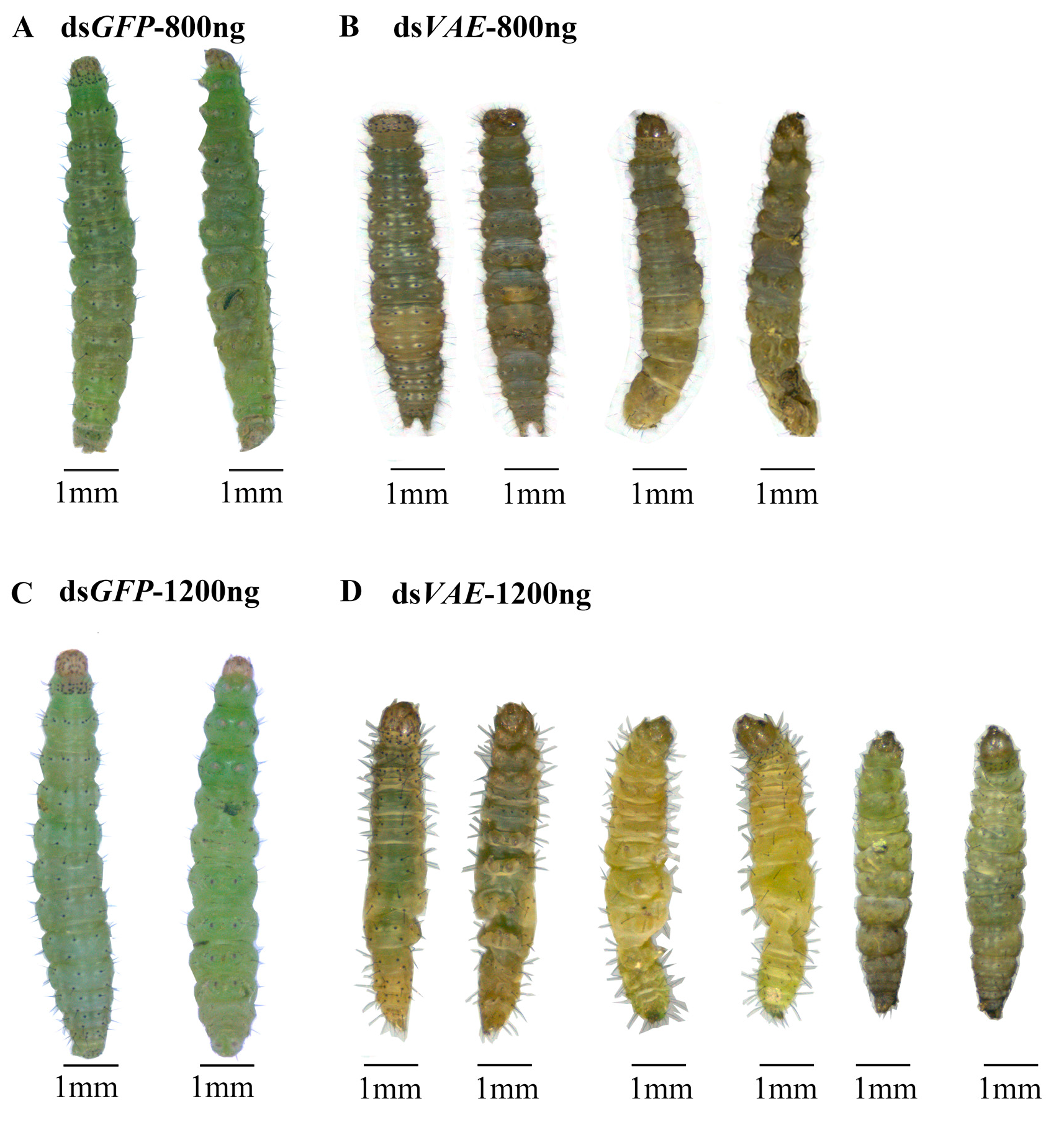
Knockdown of PxvATPaseE markedly suppressed larval development, resulting in fresh weight reductions of 19.9%, 22.2%, and 14.8% at days 2, 3, and 4, respectively, compared with dsGFP-injected controls (Figure 3B). Furthermore, PxvATPaseE silencing caused substantial larval mortality, reaching 16.7%, 33.3%, and 58.3% at days 2, 3, and 4 after treatment, respectively (Figure 3C). Of the surviving larvae, 41.7% proceeded to pupation (Figure 3D), while no significant difference in adult emergence rate was detected between dsVAE- and dsGFP-treated groups (Figure 3E). Notably, dsVAE-treated larvae exhibited malformed and smaller bodies, followed by gradual dehydration, darkening, and eventual death (Figure 4A vs. Figure 4B).
Figure 4.
Phenotypic consequences of PxvATPaseE knockdown in P. xylostella fourth-instar larvae. Larvae were injected with dsVAE (800 ng or 1200 ng) or an equivalent amount of dsGFP (control) and reared on rape leaves. Developmental progression was monitored at 24 h intervals. Representative phenotypes of dsVAE-treated and control larvae were documented on day 3 post-injection.
3.4. Enhanced Effects of a Higher dsVAE Dose (1200 ng)
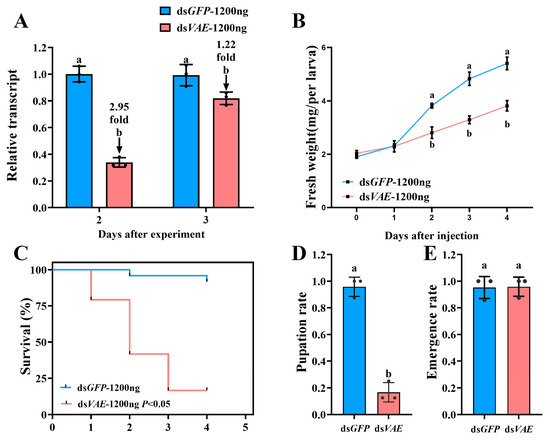
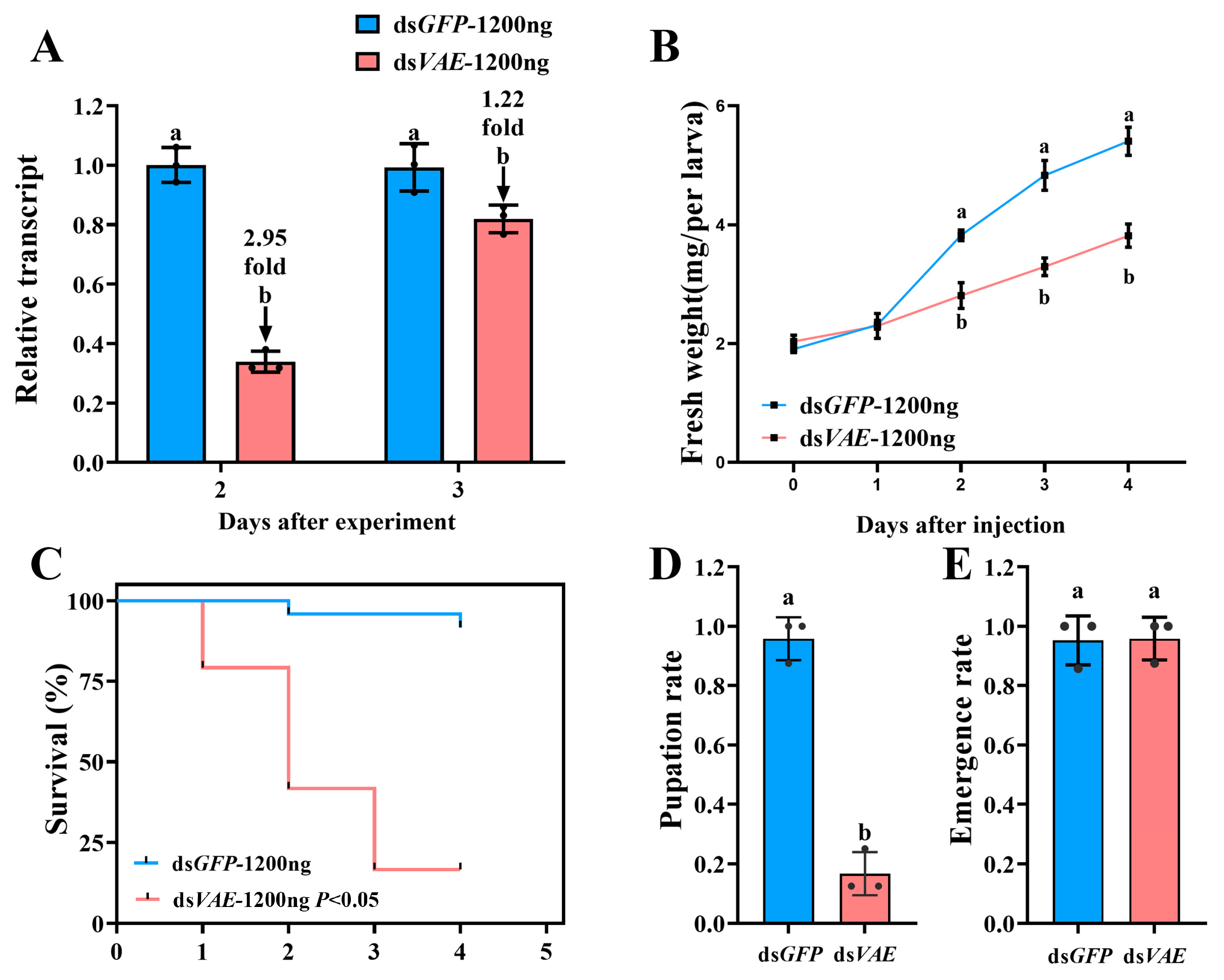
At a higher dose of 1200 ng of dsVAE, RNAi efficacy was enhanced, with a longer duration of action. PxvATPaseE mRNA levels were reduced by approximately 2.95-fold at day 2 and 1.22-fold at day 3 (Figure 5A). Larval growth inhibition was more pronounced, with fresh weight reductions of 26.5%, 31.8%, and 29.4% on days 2, 3, and 4, respectively (Figure 5B). Mortality rates increased dose-dependently, reaching 20.8%, 58.3%, and 83.3% at the same time points (Figure 5C), and only 16.7% of larvae successfully pupated (Figure 5D). As with the lower dose, the adult emergence rate did not differ significantly from the control group (Figure 5E). Phenotypic defects were more severe: many larvae failed to molt into pupae, and 83.3% of stunted larvae exhibited progressive withering, desiccation, and darkening before death (Figure 4C,D).
Figure 5.
Effects of PxvATPaseE knockdown in P. xylostella fourth-instar larvae (1200 ng of dsRNA dose). Newly molted fourth-instar larvae were injected with 0.2 µL of a solution containing 1200 ng of dsVAE; dsGFP-injected larvae served as a negative control. (A) Relative PxvATPaseE expression levels. (B) Larval survival rate. (C) Larval mortality rate. (D) Pupation rate. (E) Adult emergence rate. Data are presented as means ± SEs. Different letters indicate statistically significant differences (p < 0.05).
3.5. Virtual Screening Identifies Periplocoside D as an Effective Binder of PxvATPaseE
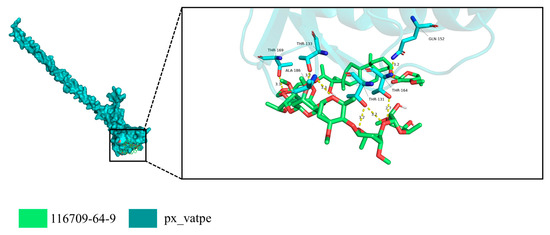
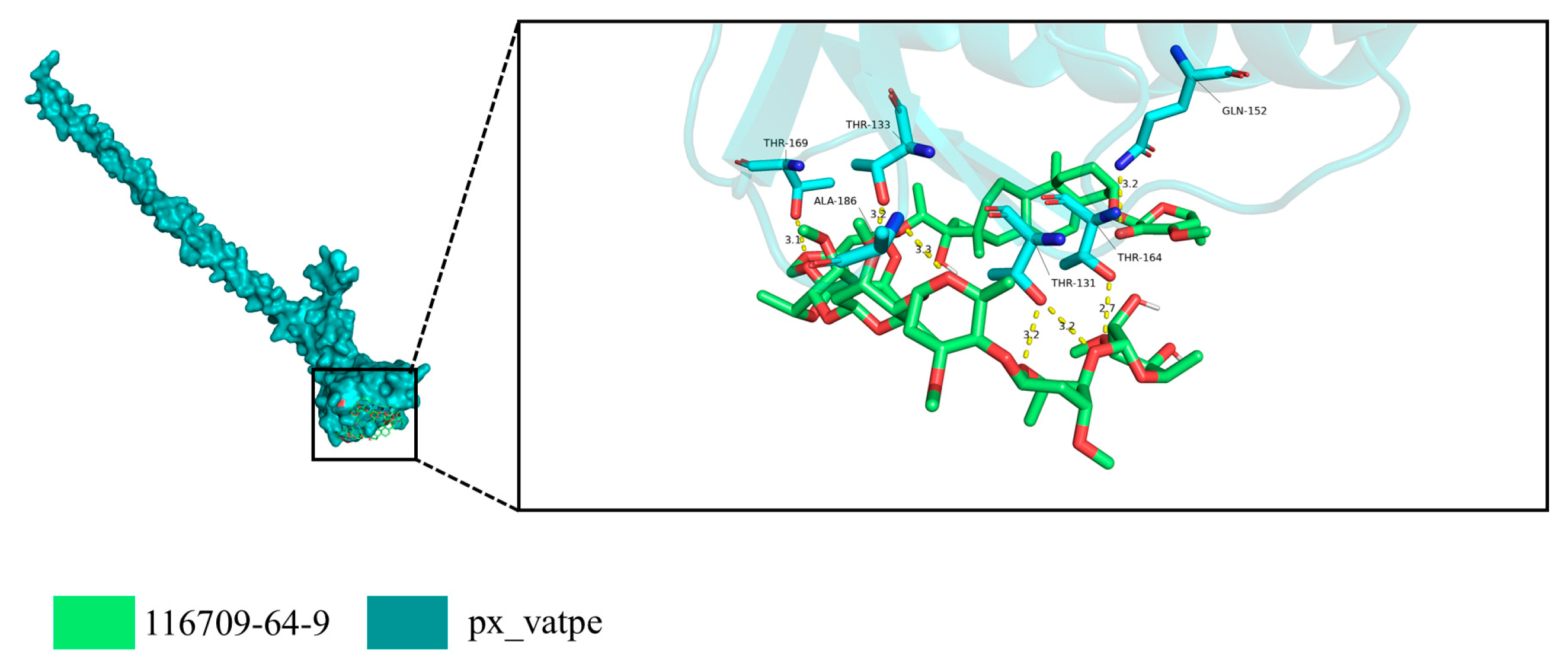
We performed virtual screening of a multi-library collection of 15,216 natural compounds using AutoDock Vina to identify high-affinity binders for the bait protein PxvATPaseE. The top 34 compounds with the highest predicted binding affinities are listed in Table 1. Notably, previous studies showed periplocoside D (116709-64-9) was lethal to P. xylostella, with an LC50 of 1310 μg/mL [51]. Our docking analysis revealed that periplocoside D might bind to PxvATPaseE, indicating its potential inhibitory effect on P. xylostella via targeting PxvATPaseE, thus qualifying it as a candidate compound. Finally, competitive binding within the same protein-binding pocket and their interactions with key surrounding amino acid residues were analyzed (Figure 6). Overall, Figure 6 demonstrates that both molecules compete for the same pocket and form similar interaction networks, where hydrogen bonds mediated by multiple threonine and glutamine residues constitute the primary binding force. Variations in the orientation of terminal substituents could modulate binding strength and molecular selectivity.
Table 1.
Compound name.
Figure 6.
Predicted binding mode of periplocoside D in the V-ATPase subunit E pocket. The overall structure of PxvATPaseE is shown in cyan, with the binding pocket location indicated by a black box (left panel). An enlarged view of the pocket (right panel) shows the overlay of periplocoside D (compound 116709-64-9, green) within the same site. The two molecules share high structural overlap, suggesting similar binding modes. Key interacting residues (e.g., THR-131, THR-133, THR-164, THR-169, GLN-152, and ALA-186) form multiple hydrogen bonds or polar contacts with the ligand, as indicated by yellow dashed lines (bond distances: 2.7–3.4 Å, within the conventional hydrogen-bond distance range).
4. Discussion
In this study, we identified and characterized the V-ATPase subunit E gene (PxvATPaseE) in P. xylostella. Functional analysis via RNA interference (RNAi) demonstrated that silencing PxvATPaseE severely impaired larval survival and development. Furthermore, by combining computational virtual screening, we identified a series of natural compounds capable of binding to PxvATPaseE and simulated the interaction mechanism of periplocoside D with this target, thereby proposing a novel strategy for screening potential insecticidal compounds.
4.1. RNAi-Based Pest Control: Feasibility and Target Selection
RNAi has emerged as a potent and species-specific strategy for next-generation pest management [4,7,52,53,54]. Its application progresses along two primary pathways: the development of exogenous RNAi biopesticides [10] and the creation of transgenic crops expressing RNAi constructs. The latter approach has successfully controlled pests including A. lucorum [18], L. decemlineata [55], Adelphocoris suturalis [56], Sitobion avenae [57], and M. persicae [58]. Furthermore, integrating RNAi with conventional tactics synergistically overcomes pest resistance and enhances control efficacy. For example, co-expressing hpPXCHS1 with the Bt protein in oilseed rape potentiates Bt toxicity [1], while silencing the immune-related gene Pxdorsal increases P. xylostella larval susceptibility to Bt through cuticular melanization [59]. Collectively, these advancements underscore the viability and promise of RNAi-based crop protection strategies. The success of RNAi hinges on selecting essential target genes whose disruption induces lethal or sublethal phenotypes. Effective targets are often associated with fundamental physiological pathways, including core cellular functions (e.g., vacuolar ATPase [60]), energy metabolism, and critical signaling networks governing ecdysis [11,61,62,63,64,65,66]. The demonstrated efficacy against genes such as PxPiwi and PxTH in P. xylostella confirms this approach’s technical feasibility [22,23]. Our work extends this principle by systematically evaluating PxvATPaseE, a gene encoding the core component of an evolutionarily conserved proton pump, as a novel target.
4.2. PxvATPaseE as a Potential Target Gene for Controlling P. xylostella Larvae
Our comprehensive analysis provides strong evidence that PxvATPaseE is a high-value candidate gene for RNAi-mediated control of P. xylostella. This conclusion is supported by multiple lines of evidence.
First, the evolutionary conservation of vATPaseE (Figure 1) suggests its non-redundant, essential role in cellular physiology across insects [26,28,67]. This conservation often translates to robust and predictable RNAi outcomes across species.
Second, the spatiotemporal expression profile of PxvATPaseE aligns with its putative function and vulnerability. Its peak expression during the third instar (Figure 2) coincides with a period of rapid growth and high metabolic demand. Most notably, its abundant transcription in the midgut (Figure 2) underscores a critical role in gut function, specifically in nutrient absorption and ion homeostasis as documented in other insects [34,68,69]. Disrupting a gene highly active in a vital tissue like the midgut provides a rational explanation for the severe growth inhibition and mortality observed post-RNAi.
Third, our functional validation yielded unequivocal results. RNAi-mediated knockdown of PxvATPaseE caused dose-dependent larval mortality, significant growth retardation, and failed pupation (Figure 3 and Figure 5). The phenotypic progression—body malformation, wilting, and darkening—is consistent with systemic physiological collapse, primarily driven by disruption of cellular pH homeostasis and V-ATPase-dependent energy metabolism. The efficacy of targeting vATPaseE is well-established; high mortality has been reported following its silencing in pests like A. lucorum, L. decemlineata, and H. vigintioctopunctata [18,24,26]. Our findings confirm that P. xylostella is equally susceptible to this approach. The clear dose–response relationship, where 1200 ng of dsRNA induced stronger and more prolonged gene suppression along with higher mortality relative to 800 ng (Figure 3 and Figure 5), highlights the importance of optimizing delivery parameters for practical application. This dose-dependent efficacy aligns with core principles of RNAi in insects [5,70] and is observed across diverse species [71,72,73].
Although RNAi was originally considered highly specific, off-target effects remain a concern. Therefore, rigorous validation is essential to ensure that dsRNA design minimizes potential impacts on non-target organisms, crops, or mammals. Moreover, silencing genes involved in regulatory functions or various metabolic pathways, such as transcription factors or signaling molecules, may lead to unintended effects in the host. Thus, multi-level off-target evaluation is critical. First, dsRNA should exclusively target the intended mRNA without affecting endogenous genes. Second, off-target risks must be evaluated in phylogenetically related insects, particularly beneficial species. Selecting appropriate target genes through screening is a suitable approach to ensure that non-pest insects are not harmed.
In this study, we employed the online tool DSRNA-Engineer (https://www.dsrna-engineer.cn, accessed on 18 April 2025) to predict the number and positions of on-target and off-target sites for the PxvATPaseE gene fragment during RNAi [74]. The blue curve represents on-target sites, while the red curve indicates off-target sites (Figure S2). Predictions were performed primarily for arthropod species with predatory relationships or evolutionary similarity to the target organism, aiming to identify potential off-target regions in non-target organisms. We deliberately selected regions with low probability of off-target effects as templates for dsRNA synthesis, thereby minimizing such effects.
Currently, off-target prediction relies on bioinformatics approaches using existing gene sequence databases. Therefore, developing comprehensive whole-genome and transcriptome databases for non-pest insect species is essential to predict possible off-target effects [75].
4.3. Nanomaterial-Assisted Efficient Delivery of dsRNA for Pest Management
Several factors influence RNAi efficiency, with dsRNA stability being a critical determinant. Once dsRNA enters the insect body, the exposed dsRNA is susceptible to degradation by nucleases present in the saliva, hemolymph, and gut, which partially reduces RNAi efficiency in certain insect species. In lepidopteran insects specifically, nucleases termed RNAi efficiency-related nucleases (REases) have been identified [76]. Additionally, studies have shown that insect hemolymph and gut fluids contain double-stranded ribonucleases (dsRNases), considered major factors limiting RNAi efficiency in oral delivery due to their impact on dsRNA stability in body fluids [77,78]. Encapsulating dsRNA with protective nanomaterials can effectively preserve its integrity, and reducing dsRNase activity helps minimize dsRNA degradation within cells, thereby enhancing RNAi efficiency. This represents a novel delivery strategy for RNAi-based applications. These nanocarrier complexes facilitate cellular uptake of dsRNA due to their high transduction efficiency and low cytotoxicity, while reducing degradation risks by nucleases under environmental conditions such as temperature fluctuations and medium changes [79].
The most extensively studied nanocarriers include chitosan, liposomes, star-shaped cationic polymers (SPcs), layered double hydroxides (LDHs), and guanidinylated polymers (GNPs). RNAi efficiency in lepidopteran insects is relatively low. A study reported the development of a chitosan-mediated oral dsRNA delivery method in silkworm larvae for the first time, which successfully induced significant knockdown of various immune gene transcripts. Prior RNAi studies in the lepidopteran model insect Bombyx mori were primarily conducted via injection. This advancement facilitates the application of RNAi for pest control in lepidopteran species [80]. Spray-Induced and Nanocarrier-Delivered Gene Silencing (SI-NDGS) technology, utilizing star-shaped polymer (SPc) nanoparticles, was employed to evaluate the control efficacy of different vATPase subunits in Sogatella furcifera. This approach successfully reduced target mRNA levels and vATPase enzyme activity while assessing the environmental safety of nanoparticle-encapsulated dsRNA [81]. In Earias vittella, three different nanoparticle-encapsulated dsRNA complexes significantly knocked down multiple genes, including vATPase [82]. For controlling the pest H. armigera, ionotropically synthesized cationic chitosan nanoparticles (CNPs) demonstrated high dsRNA loading efficiency and effectively protected dsRNA from degradation by gut nucleases and pH fluctuations in the insect gut [83]. Lipoplexes exhibited excellent protection of dsRNA and siRNA against heat, UV radiation, and RNase degradation, effectively suppressing gene expression, impairing larval development, and causing high mortality in early instar larvae [84]. Loading dsRNA targeting the vATPaseA gene onto layered double hydroxide (LDH) enhanced its environmental stability, leading to mortality in Holotrichia parallela larvae and disrupting their cuticle and midgut structure [85].
4.4. Virtual Screening Identifies a Putative PxvATPaseE Inhibitor
Beyond genetic suppression, we explored the potential for chemical inhibition of PxvATPaseE. The V-ATPase complex is a validated target for insecticide development [86], as demonstrated by the activity of vanillin derivatives against Mythimna separata [74] and isoxazoline compounds against P. xylostella [87]. Building on this, we employed structure-based virtual screening to identify specific inhibitors of the vATPaseE subunit. The application of computational virtual screening significantly accelerates the mining of large chemical libraries by prioritizing candidates for experimental validation [39,40,41]. Our screen of over 15,000 natural compounds identified periplocoside D among the top hits (Table 1). This finding is particularly significant in light of prior evidence: periplocoside D is known to be lethal to P. xylostella [51]. Previous studies have identified six periplocosides from Periploca sepium Bunge. Among these, compounds PSD (periplocoside D) and PSF (periplocoside F) exhibited insecticidal activity against M. separata and P. xylostella, with 48 h median lethal dose (LD50) values of 12.17 and 13.95 μg per larva [88]. Notably, its structural analog, periplocoside P, has been shown to inhibit V-ATPase activity in the midgut of another lepidopteran, M. separata [89].
Our molecular docking analysis (Figure 6) provides a mechanistic hypothesis for these observations. The model suggests that periplocoside D can occupy the binding pocket of PxvATPaseE, forming a stable interaction network primarily through hydrogen bonds with conserved threonine and glutamine residues. Based on these results, we predict that periplocoside D acts as a natural insecticide, whose toxicity may be mediated by binding to PxvATPaseE. This work, thus, shifts the narrative for periplocoside D from a compound with known toxicity to one with a proposed molecular target, providing a theoretical foundation for the rational design of novel V-ATPase E-targeted insecticides.
5. Conclusions
In conclusion, we have identified and validated the V-ATPase subunit E gene as a potent RNAi target for controlling P. xylostella, with silencing causing severe developmental defects and mortality. Furthermore, by employing computational virtual screening, we predicted that periplocoside D may bind to the PxvATPaseE protein, thereby linking its insecticidal activity to a specific molecular mechanism. These findings present a dual-pronged strategy—genetic (RNAi) and chemical (small-molecule inhibition)—targeting the same essential protein, thereby contributing valuable insights and tools for the development of targeted management strategies against this globally significant pest.:
Supplementary Materials
The following supporting information can be downloaded at: https://www.mdpi.com/article/10.3390/insects17040439/s1, Table S1: A list of primers used for RT-PCR of the genes; Figure S1: A display of nucleic acid sequences of PxvATPaseE from Plutella xylostella; Figure S2: On-target/off-target prediction and high-risk off-target regions of dsvATPaseE.
Author Contributions
Experiments were designed by X.Y. (Xuetao Yu), J.L., J.X., L.L., G.W., X.Y. (Xiaohong Yan), and C.S. Figures were designed and created by X.Y. (Xuetao Yu), J.L., J.X., L.L., G.W., X.Y. (Xiaohong Yan), and C.S. Statistical analyses were implemented by X.Y. (Xuetao Yu), J.L., J.X., L.L., P.D., L.Z., K.Y., X.W., Y.W., A.B., G.W., X.Y. (Xiaohong Yan), and C.S. All authors have read and agreed to the published version of the manuscript.
Funding
This research was supported by the National Key Research and Development Program of China (2024YFD1400800), the National Natural Science Foundation of China (32502498), the Hubei Provincial Natural Science Foundation (2024AFB325), the Wuhan Natural Science Foundation Exploratory Program project (2024040801020312), and the Innovation Project of the Chinese Academy of Agricultural Sciences (No. 2060302-049-091).
Data Availability Statement
The original contributions presented in this study are included in this article/Supplementary Materials. Further inquiries can be directed to the corresponding authors.
Conflicts of Interest
The authors declare no conflicts of interest.
References
- Deng, P.; Peng, Y.; Sheng, Z.; Li, W.; Liu, Y. RNAi silencing CHS1 gene shortens the mortality time of Plutella xylostella feeding Bt-transgenic Brassica napus. Pest Manag. Sci. 2024, 80, 2610–2618. [Google Scholar] [CrossRef] [Scilit]
- Shehzad, M.; Bodlah, I.; Siddiqui, J.A.; Bodlah, M.A.; Fareen, A.G.E.; Islam, W. Recent insights into pesticide resistance mechanisms in Plutella xylostella and possible management strategies. Environ. Sci. Pollut. Res. 2023, 30, 95296–95311. [Google Scholar] [CrossRef] [Scilit] [PubMed]
- Wang, M.; Zhu, B.; Zhang, L.; Xiao, Y.; Liang, P.; Wu, K. Influence of seasonal migration on evolution of insecticide resistance in Plutella xylostella. Insect Sci. 2022, 29, 496–504. [Google Scholar] [CrossRef] [Scilit]
- Liu, S.; Jaouannet, M.; Dempsey, D.A.; Imani, J.; Coustau, C.; Kogel, K.H. RNA-based technologies for insect control in plant production. Biotechnol. Adv. 2020, 39, 107463. [Google Scholar] [CrossRef] [Scilit]
- Zhu, K.Y.; Palli, S.R. Mechanisms, applications, and challenges of insect RNA interference. Annu. Rev. Entomol. 2020, 65, 293–311. [Google Scholar] [CrossRef] [Scilit] [PubMed]
- Shen, C.H.; Jin, L.; Fu, K.Y.; Guo, W.C.; Li, G.Q. RNA interference targeting Ras GTPase gene Ran causes larval and adult lethality in Leptinotarsa decemlineata. Pest Manag. Sci. 2022, 78, 3849–3858. [Google Scholar] [CrossRef] [Scilit] [PubMed]
- Yan, S.; Ren, B.; Zeng, B.; Shen, J. Improving RNAi efficiency for pest control in crop species. Biotechniques 2020, 68, 283–290. [Google Scholar] [CrossRef] [Scilit]
- Christiaens, O.; Whyard, S.; Vélez, A.M.; Smagghe, G. Double-stranded RNA technology to control insect pests: Current status and challenges. Front. Plant Sci. 2020, 11, 451. [Google Scholar] [CrossRef] [Scilit]
- Amiri, A.; Bandani, A.R. Molecular biology of insect ATPases: From physiology to pest management. Pest Manag. Sci. 2026. epub ahead of print. [Google Scholar] [CrossRef] [Scilit]
- Li, Z.; Liu, Y.; Liang, Y.; Pan, T.; Liu, J. RNA interference-based pesticides: Mechanism, application, and commercialization in sustainable pest management. Pestic. Biochem. Physiol. 2026, 219, 107034. [Google Scholar] [CrossRef] [Scilit]
- Cao, M.; Gatehouse, J.A.; Fitches, E.C. A systematic study of RNAi effects and dsRNA stability in Tribolium castaneum and Acyrthosiphon pisum, following injection and ingestion of analogous dsRNAs. Int. J. Mol. Sci. 2018, 19, 1079. [Google Scholar] [CrossRef] [Scilit] [PubMed]
- Zhang, J.; Khan, S.A.; Hasse, C.; Ruf, S.; Heckel, D.G.; Bock, R. Full crop protection from an insect pest by expression of long double-stranded RNAs in plastids. Science 2015, 347, 991–994. [Google Scholar] [CrossRef] [Scilit]
- Wu, J.J.; Mu, L.L.; Kang, W.N.; Ze, L.J.; Shen, C.H.; Jin, L.; Anjum, A.A.; Li, G.Q. RNA interference targeting ecdysone receptor blocks the larval-pupal transition in Henosepilachna vigintioctopunctata. Insect Sci. 2021, 28, 419–429. [Google Scholar] [CrossRef] [Scilit]
- Guo, W.; Guo, M.; Yang, C.; Liu, Z.; Chen, S.; Lü, J.; Qiu, B.; Zhang, Y.; Zhou, X.; Pan, H. RNA interference-mediated silencing of vATPase subunits A and E affect survival and development of the 28-spotted ladybeetle, Henosepilachna vigintioctopunctata. Insect Sci. 2021, 28, 1664–1676. [Google Scholar] [CrossRef] [Scilit]
- Lü, J.; Guo, W.; Chen, S.; Guo, M.; Qiu, B.; Yang, C.; Zhang, Y.; Pan, H. Double-stranded RNAs targeting HvRPS18 and HvRPL13 reveal potential targets for pest management of the 28-spotted ladybeetle, Henosepilachna vigintioctopunctata. Pest Manag. Sci. 2020, 76, 2663–2673. [Google Scholar] [CrossRef] [Scilit]
- Jiang, L.H.; Mu, L.L.; Jin, L.; Anjum, A.A.; Li, G.Q. Silencing uridine diphosphate N-acetylglucosamine pyrophosphorylase gene impairs larval development in Henosepilachna vigintioctopunctata. Pest Manag. Sci. 2022, 78, 3894–3902. [Google Scholar] [CrossRef] [Scilit] [PubMed]
- Wu, M.; Dong, Y.; Zhang, Q.; Li, S.; Chang, L.; Loiacono, F.V.; Ruf, S.; Zhang, J.; Bock, R. Efficient control of western flower thrips by plastid-mediated RNA interference. Proc. Natl. Acad. Sci. USA 2022, 119, e2120081119. [Google Scholar] [CrossRef] [Scilit]
- Liu, F.; Yang, B.; Zhang, A.; Ding, D.; Wang, G. Plant-mediated RNAi for controlling Apolygus lucorum. Front. Plant Sci. 2019, 10, 64. [Google Scholar] [CrossRef] [Scilit]
- Yang, Q.; De Schutter, K.; Chen, P.; Van Damme, E.J.M.; Smagghe, G. RNAi of the N-glycosylation-related genes confirms their importance in insect development and α-1,6-fucosyltransferase plays a role in the ecdysis event for the hemimetabolous pest insect Nilaparvata lugens. Insect Sci. 2022, 29, 91–99. [Google Scholar] [CrossRef] [Scilit]
- Whyard, S.; Singh, A.D.; Wong, S. Ingested double-stranded RNAs can act as species-specific insecticides. Insect Biochem. Mol. Biol. 2009, 39, 824–832. [Google Scholar] [CrossRef] [Scilit] [PubMed]
- Vatanparast, M.; Kazzazi, M.; Sajjadian, S.M.; Park, Y. Knockdown of Helicoverpa armigera protease genes affects its growth and mortality via RNA interference. Arch. Insect Biochem. Physiol. 2021, 108, e21840. [Google Scholar] [CrossRef] [Scilit]
- Liu, D.; Asad, M.; Liao, J.; Chen, J.; Li, J.; Chu, X.; Pang, S.; Tariq, M.; Abbas, A.N.; Yang, G. The potential role of the Piwi gene in the development and reproduction of Plutella xylostella. Int. J. Mol. Sci. 2023, 24, 12321. [Google Scholar] [CrossRef] [Scilit]
- Hou, Q.L.; Zhang, H.Q.; Zhu, J.N.; Chen, E.H. Tyrosine hydroxylase is required for the larval-pupal transformation and immunity of Plutella xylostella: Potential for pest management. J. Agric. Food Chem. 2024, 72, 27818–27829. [Google Scholar] [CrossRef] [Scilit] [PubMed]
- Zeng, J.; Mu, L.L.; Jin, L.; Ali Anjum, A.; Li, G.Q. RNAi of vacuolar-type H+-ATPase genes causes growth delay and molting defect in Henosepilachna vigintioctopunctata. Bull. Entomol. Res. 2021, 111, 705–714. [Google Scholar] [CrossRef] [Scilit] [PubMed]
- Zeng, J.; Kang, W.N.; Jin, L.; Anjum, A.A.; Li, G.Q. Knockdown of Vacuolar ATPase Subunit G Gene affects larval survival and impaired pupation and adult emergence in Henosepilachna vigintioctopunctata. Insects 2021, 12, 935. [Google Scholar] [CrossRef] [Scilit] [PubMed]
- Zeng, J.; Kang, W.N.; Jin, L.; Anjum, A.A.; Li, G.Q. Vacuolar ATPase subunit F is critical for larval survival in Henosepilachna vigintioctopunctata. Insect Mol. Biol. 2022, 31, 177–189. [Google Scholar] [CrossRef] [Scilit]
- McGuire, C.; Stransky, L.; Cotter, K.; Forgac, M. Regulation of V-ATPase activity. Front. Biosci.-Landmark 2017, 22, 609–622. [Google Scholar]
- Song, Q.; Meng, B.; Xu, H.; Mao, Z. The emerging roles of vacuolar-type ATPase-dependent Lysosomal acidification in neurodegenerative diseases. Transl. Neurodegener. 2020, 9, 17. [Google Scholar] [CrossRef] [Scilit]
- Abbas, Y.M.; Wu, D.; Bueler, S.A.; Robinson, C.V.; Rubinstein, J.L. Structure of V-ATPase from the mammalian brain. Science 2020, 367, 1240–1246. [Google Scholar] [CrossRef] [Scilit]
- Mazhab-Jafari, M.T.; Rohou, A.; Schmidt, C.; Bueler, S.A.; Benlekbir, S.; Robinson, C.V.; Rubinstein, J.L. Atomic model for the membrane-embedded VO motor of a eukaryotic V-ATPase. Nature 2016, 539, 118–122. [Google Scholar] [CrossRef] [Scilit]
- Roh, S.H.; Stam, N.J.; Hryc, C.F.; Couoh-Cardel, S.; Pintilie, G.; Chiu, W.; Wilkens, S. The 3.5-Å CryoEM structure of nanodisc-reconstituted yeast vacuolar ATPase Vo proton channel. Mol. Cell 2018, 69, 993–1004.e3. [Google Scholar] [CrossRef] [Scilit] [PubMed]
- Rahmani, S.; Bandani, A.R. A gene silencing of V-ATPase subunit A interferes with survival and development of the tomato leafminer, Tuta absoluta. Arch. Insect Biochem. Physiol. 2021, 106, e21753. [Google Scholar] [CrossRef] [Scilit] [PubMed]
- Zhang, X.; Fan, Z.; Zhang, R.; Kong, X.; Liu, F.; Fang, J.; Zhang, S.; Zhang, Z. Bacteria-mediated RNAi for managing fall webworm, Hyphantria cunea: Screening target genes and analyzing lethal effect. Pest Manag. Sci. 2023, 79, 1566–1577. [Google Scholar] [CrossRef] [Scilit]
- Jaryani, F.S.; Rahmani, S.; Golnaraghi, A. Targeting vacuolar ATPase in tobacco whitefly, Bemisia tabaci (Gennadius): Insights and implications for integrated whitefly management strategies. J. Biosci. 2025, 50, 88. [Google Scholar] [CrossRef] [Scilit]
- Li, Y.; Ze, L.J.; Liu, F.J.; Liao, W.; Lu, M.; Liu, X.L. RNA interference of vATPase subunits A and E affects survival of larvae and adults in Plagiodera versicolora (Coleoptera: Chrysomelidae). Pestic. Biochem. Physiol. 2022, 188, 105275. [Google Scholar] [CrossRef] [Scilit] [PubMed]
- Fu, K.Y.; Guo, W.C.; Lü, F.G.; Liu, X.P.; Li, G.Q. Response of the vacuolar ATPase subunit E to RNA interference and four chemical pesticides in Leptinotarsa decemlineata (Say). Pestic. Biochem. Physiol. 2014, 114, 16–23. [Google Scholar] [CrossRef] [Scilit]
- Rangasamy, M.; Siegfried, B.D. Validation of RNA interference in western corn rootworm Diabrotica virgifera virgifera LeConte (Coleoptera: Chrysomelidae) adults. Pest Manag. Sci. 2012, 68, 587–591. [Google Scholar] [CrossRef] [Scilit]
- Mohan, C.; Shibao, P.Y.T.; de Paula, F.F.P.; Toyama, D.; Vieira, M.A.S.; Figueira, A.; Scotton, D.; Soares-Costa, A.; Henrique-Silva, F. hRNAi-mediated knock-down of Sphenophorus levis V-ATPase E in transgenic sugarcane (Saccharum spp interspecific hybrid) affects the insect growth and survival. Plant Cell Rep. 2021, 40, 507–516. [Google Scholar] [CrossRef] [Scilit]
- Gryniukova, A.; Kaiser, F.; Myziuk, I.; Alieksieieva, D.; Leberecht, C.; Heym, P.P.; Tarkhanova, O.O.; Moroz, Y.S.; Borysko, P.; Haupt, V.J. AI-powered virtual screening of large compound libraries leads to the discovery of novel inhibitors of Sirtuin-1. J. Med. Chem. 2023, 66, 10241–10251. [Google Scholar] [CrossRef] [Scilit]
- Ji, P.; Bao, Y.; Zhou, H.; Pei, Y.; Song, W.; Ou, K.; Qiao, Z.; Si, J.; Zhong, Z.; Xu, X.; et al. Blocking the isoflavone chemoreceptor in Phytophthora sojae to prevent disease. Sci. Adv. 2025, 11, eadt0925. [Google Scholar] [CrossRef] [Scilit]
- Chafer-Dolz, B.; Cecilia, J.M.; Imbernón, B.; Núñez-Delicado, E.; Casaña-Giner, V.; Cerón-Carrasco, J.P. Discovery of novel acetylcholinesterase inhibitors through AI-powered structure prediction and high-performance computing-enhanced virtual screening. RSC Adv. 2025, 15, 4262–4273. [Google Scholar] [CrossRef] [Scilit]
- Xie, C.; Xiong, L.; Ye, M.; Shen, L.; Li, J.; Zhang, Z.; You, M.; You, S. Genome-wide analysis of V-ATPase genes in Plutella xylostella (L.) and the potential role of PxVHA-G1 in resistance to Bacillus thuringiensis Cry1Ac toxin. Int. J. Biol. Macromol. 2022, 194, 74–83. [Google Scholar] [CrossRef] [Scilit] [PubMed]
- Niu, R.C.; Meng, F.X.; Zeng, Q.H.; Wang, Y.J.; Liu, T.X.; Chu, D.; Zhang, S.Z. Comprehensive transcriptomic analyses of silk-associated genes and functional characterization of key silk fibroins in Plutella xylostella. Int. J. Mol. Sci. 2025, 26, 2842. [Google Scholar] [CrossRef] [Scilit] [PubMed]
- Ze, L.J.; Xu, P.; Kang, W.N.; Wu, J.J.; Jin, L.; Anjum, A.A.; Li, G.Q. Disruption of kynurenine pathway reveals physiological importance of tryptophan catabolism in Henosepilachna vigintioctopunctata. Amino Acids 2021, 53, 1091–1104. [Google Scholar] [CrossRef] [Scilit]
- Xu, P.; Ze, L.J.; Kang, W.N.; Wu, J.J.; Jin, L.; Anjum, A.A.; Li, G.Q. Functional divergence of white genes in Henosepilachna vigintioctopunctata revealed by RNA interference. Insect Mol. Biol. 2020, 29, 466–476. [Google Scholar] [CrossRef] [Scilit]
- Huvenne, H.; Smagghe, G. Mechanisms of dsRNA uptake in insects and potential of RNAi for pest control: A review. J. Insect Physiol. 2010, 56, 227–235. [Google Scholar] [CrossRef] [Scilit] [PubMed]
- Hameed, M.S.; Wang, Z.; Vasseur, L.; Yang, G. Molecular Characterization and the Function of Argonaute3 in RNAi Pathway of Plutella xylostella. Int. J. Mol. Sci. 2018, 19, 1249. [Google Scholar] [CrossRef] [Scilit]
- Bustin, S.A.; Benes, V.; Garson, J.A.; Hellemans, J.; Huggett, J.; Kubista, M.; Mueller, R.; Nolan, T.; Pfaffl, M.W.; Shipley, G.L.; et al. The MIQE guidelines: Minimum information for publication of quantitative real-time PCR experiments. Clin. Chem. 2009, 55, 611–622. [Google Scholar] [CrossRef] [Scilit]
- Abramson, J.; Adler, J.; Dunger, J.; Evans, R.; Green, T.; Pritzel, A.; Ronneberger, O.; Willmore, L.; Ballard, A.J.; Bambrick, J.; et al. Accurate structure prediction of biomolecular interactions with AlphaFold 3. Nature 2024, 630, 493–500. [Google Scholar] [CrossRef] [Scilit]
- Trott, O.; Olson, A.J. AutoDock Vina: Improving the speed and accuracy of docking with a new scoring function, efficient optimization, and multithreading. J. Comput. Chem. 2010, 31, 455–461. [Google Scholar] [CrossRef] [Scilit]
- Li, Y.K.; Lv, B.; Hu, Z.N.; Wu, W.J. Research advances in the insecticidal plant Periploca sepium. Chin. J. Pestic. Sci. 2019, 21, 709–717. [Google Scholar]
- Baum, J.A.; Bogaert, T.; Clinton, W.; Heck, G.R.; Feldmann, P.; Ilagan, O.; Johnson, S.; Plaetinck, G.; Munyikwa, T.; Pleau, M.; et al. Control of coleopteran insect pests through RNA interference. Nat. Biotechnol. 2007, 25, 1322–1326. [Google Scholar] [CrossRef] [Scilit]
- Mao, Y.B.; Cai, W.J.; Wang, J.W.; Hong, G.J.; Tao, X.Y.; Wang, L.J.; Huang, Y.P.; Chen, X.Y. Silencing a cotton bollworm P450 monooxygenase gene by plant-mediated RNAi impairs larval tolerance of gossypol. Nat. Biotechnol. 2007, 25, 1307–1313. [Google Scholar] [CrossRef] [Scilit]
- Wytinck, N.; Manchur, C.L.; Li, V.H.; Whyard, S.; Belmonte, M.F. dsRNA uptake in plant pests and pathogens: Insights into RNAi-based insect and fungal control technology. Plants 2020, 9, 1780. [Google Scholar] [CrossRef] [Scilit] [PubMed]
- Spit, J.; Philips, A.; Wynant, N.; Santos, D.; Plaetinck, G.; Vanden Broeck, J. Knockdown of nuclease activity in the gut enhances RNAi efficiency in the Colorado potato beetle, Leptinotarsa decemlineata, but not in the desert locust, Schistocerca gregaria. Insect Biochem. Mol. Biol. 2017, 81, 103–116. [Google Scholar] [CrossRef] [Scilit] [PubMed]
- Luo, J.; Liang, S.; Li, J.; Xu, Z.; Li, L.; Zhu, B.; Li, Z.; Lei, C.; Lindsey, K.; Chen, L.; et al. A transgenic strategy for controlling plant bugs (Adelphocoris suturalis) through expression of double-stranded RNA homologous to fatty acyl-coenzyme A reductase in cotton. New Phytol. 2017, 215, 1173–1185. [Google Scholar] [CrossRef] [Scilit]
- Xu, L.; Duan, X.; Lv, Y.; Zhang, X.; Nie, Z.; Xie, C.; Ni, Z.; Liang, R. Silencing of an aphid carboxylesterase gene by use of plant-mediated RNAi impairs Sitobion avenae tolerance of Phoxim insecticides. Transgenic Res. 2014, 23, 389–396. [Google Scholar] [CrossRef] [Scilit]
- Mao, J.; Zeng, F. Plant-mediated RNAi of a gap gene-enhanced tobacco tolerance against the Myzus persicae. Transgenic Res. 2014, 23, 145–152. [Google Scholar] [CrossRef] [Scilit]
- Sun, Y.; Wen, H.; Xue, W.; Xia, X. PxDorsal Regulates the Expression of Antimicrobial Peptides and Affects the Bt Susceptibility of Plutella xylostella. Insects 2025, 16, 163. [Google Scholar] [CrossRef] [Scilit] [PubMed]
- Gunning, P.W.; Ghoshdastider, U.; Whitaker, S.; Popp, D.; Robinson, R.C. The evolution of compositionally and functionally distinct actin filaments. J. Cell Sci. 2015, 128, 2009–2019. [Google Scholar] [CrossRef] [Scilit]
- San Miguel, K.; Scott, J.G. The next generation of insecticides: dsRNA is stable as a foliar-applied insecticide. Pest Manag. Sci. 2016, 72, 801–809. [Google Scholar] [CrossRef] [Scilit]
- Christiaens, O.; Iga, M.; Velarde, R.A.; Rougé, P.; Smagghe, G. Halloween genes and nuclear receptors in ecdysteroid biosynthesis and signalling in the pea aphid. Insect Mol. Biol. 2010, 19, 187–200. [Google Scholar] [CrossRef] [Scilit]
- Park, M.H. The post-translational synthesis of a polyamine-derived amino acid, hypusine, in the eukaryotic translation initiation factor 5A (eIF5A). J. Biochem. 2006, 139, 161–169. [Google Scholar] [CrossRef] [Scilit]
- Xu, Q.Y.; Deng, P.; Zhang, Q.; Li, A.; Fu, K.Y.; Guo, W.C.; Li, G.Q. Ecdysone receptor isoforms play distinct roles in larval-pupal-adult transition in Leptinotarsa decemlineata. Insect Sci. 2020, 27, 487–499. [Google Scholar] [CrossRef] [Scilit]
- Abe, M.; Saito, M.; Tsukahara, A.; Shiokawa, S.; Ueno, K.; Shimamura, H.; Nagano, M.; Toshima, J.Y.; Toshima, J. Functional complementation reveals that 9 of the 13 human V-ATPase subunits can functionally substitute for their yeast orthologs. J. Biol. Chem. 2019, 294, 8273–8285. [Google Scholar] [CrossRef] [Scilit]
- Wieczorek, H.; Beyenbach, K.W.; Huss, M.; Vitavska, O. Vacuolar-type proton pumps in insect epithelia. J. Exp. Biol. 2009, 212, 1611–1619. [Google Scholar] [CrossRef] [Scilit]
- List, F.; Tarone, A.M.; Zhu-Salzman, K.; Vargo, E.L. RNA meets toxicology: Efficacy indicators from the experimental design of RNAi studies for insect pest management. Pest Manag. Sci. 2022, 78, 3215–3225. [Google Scholar] [CrossRef] [Scilit] [PubMed]
- Lü, J.; Guo, M.; Chen, S.; Noland, J.E.; Guo, W.; Sang, W.; Qi, Y.; Qiu, B.; Zhang, Y.; Yang, C.; et al. Double-stranded RNA targeting vATPase B reveals a potential target for pest management of Henosepilachna vigintioctopunctata. Pestic. Biochem. Physiol. 2020, 165, 104555. [Google Scholar] [CrossRef] [Scilit] [PubMed]
- Mohammed, A.M.A.; Diab, M.R.; Abdelsattar, M.; Khalil, S.M.S. Characterization and RNAi-mediated knockdown of Chitin Synthase A in the potato tuber moth, Phthorimaea operculella. Sci. Rep. 2017, 7, 9502. [Google Scholar] [CrossRef] [Scilit] [PubMed]
- Alshukri, B.; Astarita, F.; Al-Esawy, M.; El Halim, H.; Pennacchio, F.; Gatehouse, A.M.R.; Edwards, M.G. Targeting the potassium ion channel genes SK and SH as a novel approach for control of insect pests: Efficacy and biosafety. Pest Manag. Sci. 2019, 75, 2505–2516. [Google Scholar] [CrossRef] [Scilit]
- Dong, Y.Q.; Wang, Z.Y.; Jing, T.Z. Functional characterization of ASTC (allatostatin C) and ASTCC (allatostatin double C) in Clostera anastomosis (Lepidoptera: Notodontidae). Gene 2017, 598, 1–8. [Google Scholar] [CrossRef] [Scilit]
- Yang, S.; Zou, Z.; Xin, T.; Cai, S.; Wang, X.; Zhang, H.; Zhong, L.; Xia, B. Knockdown of hexokinase in Diaphorina citri Kuwayama (Hemiptera: Liviidae) by RNAi inhibits chitin synthesis and leads to abnormal phenotypes. Pest Manag. Sci. 2022, 78, 4303–4313. [Google Scholar] [CrossRef] [Scilit]
- Yu, X.; Luo, J.; Lu, L.; Zhu, L.; Wang, S.; Yang, K.; Wan, X.; Wu, Y.; Akmal, B.; Wu, G.; et al. RNAi of vATPasea Affects Survival and Larval-Pupal Development in Plutella xylostella. Insects 2025, 16, 1054. [Google Scholar] [CrossRef] [Scilit]
- Chen, Y.; Shi, Y.; Wang, Z.; An, X.; Wei, S.; Andronis, C.; Vontas, J.; Wang, J.J.; Niu, J. dsRNAEngineer: A web-based tool of comprehensive dsRNA design for pest control. Trends Biotechnol. 2025, 43, 969–983. [Google Scholar] [CrossRef] [Scilit]
- Mangrauthia, S.K.; Singh, P.; Praveen, S. Genomics of helper component proteinase reveals effective strategy for papaya ringspot virus resistance. Mol. Biotechnol. 2010, 44, 22–29. [Google Scholar] [CrossRef] [Scilit]
- Guan, R.B.; Li, H.C.; Fan, Y.J.; Hu, S.R.; Christiaens, O.; Smagghe, G.; Miao, X.X. A nuclease specific to lepidopteran insects suppresses RNAi. J. Biol. Chem. 2018, 293, 6011–6021. [Google Scholar] [CrossRef] [Scilit] [PubMed]
- Shukla, J.N.; Kalsi, M.; Sethi, A.; Narva, K.E.; Fishilevich, E.; Singh, S.; Mogilicherla, K.; Palli, S.R. Reduced stability and intracellular transport of dsRNA contribute to poor RNAi response in lepidopteran insects. RNA Biol. 2016, 13, 656–669. [Google Scholar] [CrossRef] [Scilit] [PubMed]
- Wang, K.; Peng, Y.; Pu, J.; Fu, W.; Wang, J.; Han, Z. Variation in RNAi efficacy among insect species is attributable to dsRNA degradation in vivo. Insect Biochem. Mol. Biol. 2016, 77, 1–9. [Google Scholar] [CrossRef] [Scilit]
- Liu, J.; He, Q.; Lin, X.; Smagghe, G. Recent progress in nanoparticle-mediated RNA interference in insects: Unveiling new frontiers in pest control. J. Insect Physiol. 2025, 167, 104884. [Google Scholar] [CrossRef] [Scilit] [PubMed]
- Liu, J.; Yang, Y.; Yang, Q.; Lin, X.; Liu, Y.; Li, Z.; Swevers, L. Successful oral RNA interference efficiency in the silkworm Bombyx mori through nanoparticle-shielded dsRNA delivery. J. Insect Physiol. 2025, 161, 104749. [Google Scholar] [CrossRef] [Scilit]
- Ma, Y.F.; Zhao, Y.Q.; Zhou, Y.Y.; Feng, H.Y.; Gong, L.L.; Zhang, M.Q.; Hull, J.J.; Dewer, Y.; Roy, A.; Smagghe, G.; et al. Nanoparticle-delivered RNAi-based pesticide target screening for the rice pest white-backed planthopper and risk assessment for a natural predator. Sci. Total Environ. 2024, 926, 171286. [Google Scholar] [CrossRef] [Scilit]
- Sandal, S.; Singh, S.; Bansal, G.; Kaur, R.; Mogilicherla, K.; Pandher, S.; Roy, A.; Kaur, G.; Rathore, P.; Kalia, A. Nanoparticle-Shielded dsRNA Delivery for Enhancing RNAi Efficiency in Cotton Spotted Bollworm Earias vittella (Lepidoptera: Nolidae). Int. J. Mol. Sci. 2023, 24, 9161. [Google Scholar] [CrossRef] [Scilit]
- Kolge, H.; Kadam, K.; Ghormade, V. Chitosan nanocarriers mediated dsRNA delivery in gene silencing for Helicoverpa armigera biocontrol. Pestic. Biochem. Physiol. 2023, 189, 105292. [Google Scholar] [PubMed]
- Lu, Y.H.; Liu, Y.; Lin, Y.C.; Su, Y.J.; Henry, D.; Lacarriere, V.; Haller, S.; Lin, Y.H.; Chiang, P.C.; Hsu, C.I.; et al. Lipoplex-based RNA delivery system enhances RNAi efficiency for targeted Pest control in Spodoptera litura. Int. J. Biol. Macromol. 2025, 319, 145091. [Google Scholar] [CrossRef] [Scilit] [PubMed]
- Jiang, L.; Wang, Q.; Kang, Z.H.; Wen, J.X.; Yang, Y.B.; Lu, X.J.; Guo, W.; Zhao, D. Novel Environmentally Friendly RNAi Biopesticides: Targeting V-ATPase in Holotrichia parallela Larvae Using Layered Double Hydroxide Nanocomplexes. J. Agric. Food Chem. 2024, 72, 11381–11391. [Google Scholar] [CrossRef] [Scilit] [PubMed]
- Lv, B.; Zhang, X.; Wang, Y.; Wu, W.; Li, D.; Hu, Z. Discovery of the Chlorinated and Ammoniated Derivatives of Vanillin as Potential Insecticidal Candidates Targeting V-ATPase: Structure-Based Virtual Screening, Synthesis, and Bioassay. J. Agric. Food Chem. 2024, 72, 20872–20881. [Google Scholar]
- Jiang, B.; Xu, T.; Li, Y.; He, D.; Wang, J.; Ying, W.; Feng, D.; Wu, W.; Shi, J.; Ren, H.; et al. Identification of Isoxazoline Compounds as Potential Insecticidal Agents through High-Throughput Screening and 3D-QSAR Analysis. J. Agric. Food Chem. 2025, 73, 24653–24661. [Google Scholar] [PubMed]
- Li, T.; Zhang, J.; Ma, S.; Gao, L.; Chen, C.; Ji, Z.; Hu, Z.; Shi, B.; Wu, W. Identification and mechanism of insecticidal periplocosides from the root bark of Periploca sepium Bunge. Pest Manag. Sci. 2021, 77, 1925–1935. [Google Scholar]
- Wang, Y.; Qi, Z.; Qi, M.; Hu, Z.; Wu, W. Effects of Periplocoside P from Periploca sepium on the Midgut Transmembrane Potential of Mythimna separata Larvae. Sci. Rep. 2016, 6, 36982. [Google Scholar] [CrossRef] [Scilit]

Disclaimer/Publisher’s Note: The statements, opinions and data contained in all publications are solely those of the individual author(s) and contributor(s) and not of MDPI and/or the editor(s). MDPI and/or the editor(s) disclaim responsibility for any injury to people or property resulting from any ideas, methods, instructions or products referred to in the content. |
© 2026 by the authors. Licensee MDPI, Basel, Switzerland. This article is an open access article distributed under the terms and conditions of the Creative Commons Attribution (CC BY) license.