Effects of Selenite and Selenate on the Growth, Nutrient Composition, Selenium Species, and In Vitro Digestibility of Mealworm Tenebrio molitor

 ,
,  ,
,
Simple Summary
Abstract
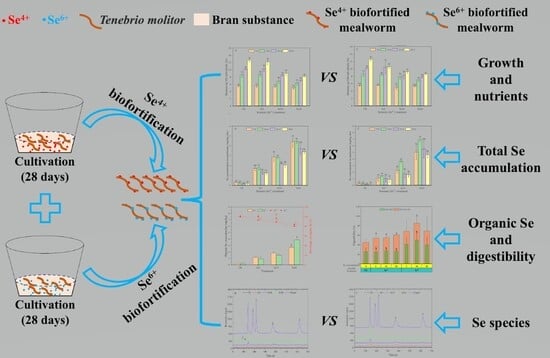
1. Introduction
2. Materials and Methods
2.1. Yellow Mealworm and Test Substance
2.2. Experiment Process
2.3. Detection of Total and Organic Se Concentrations
2.4. Nutrient Components and Elements Analysis
2.4.1. Crude Protein
2.4.2. Crude Fat
2.4.3. Crude Polysaccharide
2.4.4. Mineral Elements
2.5. In Vitro Digestibility and Se Species Evaluation
2.6. Statistical Analysis
3. Results
3.1. Biomass of Mealworm
3.2. Total Se Concentration and BAFSe
3.3. Nutrient Analysis
3.4. Organic Se Concentration
3.5. Digestibility and Species of Mealworm-Derived Se
4. Discussion
4.1. Effects of Inorganic Se on Mealworm Growth
4.2. Se Accumulation Analysis in Mealworms
4.3. Effects of Se Addition on Nutrient Components
4.4. Se Species and Bioaccessibility in Mealworm
5. Conclusions
Supplementary Materials
Author Contributions
Funding
Data Availability Statement
Acknowledgments
Conflicts of Interest
References
- Rayman, M.P. Selenium and human health. Lancet 2012, 379, 1256–1268. [Google Scholar] [CrossRef] [Scilit]
- Ullah, H.; Liu, G.; Yousaf, B.; Ali, M.U.; Abbas, Q.; Munir, M.A.M.; Mian, M.M. Developmental selenium exposure and health risk in daily foodstuffs: A systematic review and meta-analysis. Ecotoxicol. Environ. Saf. 2018, 149, 291–306. [Google Scholar] [CrossRef] [Scilit]
- Combs, G.F., Jr. Selenium in global food systems. Brit. J. Nutr. 2001, 85, 517–547. [Google Scholar] [CrossRef] [Scilit] [PubMed]
- Tolu, J.; Bouchet, S.; Helfenstein, J.; Hausheer, O.; Chékifi, S.; Frossard, E.; Federica Tamburini, F.; Chadwick, O.A.; Winkel, L.H. Understanding soil selenium accumulation and bioavailability through size resolved and elemental characterization of soil extracts. Nat. Commun. 2022, 13, 6974. [Google Scholar] [CrossRef] [Scilit]
- Rayman, M.P.; Infante, H.G.; Sargent, M. Food-chain selenium and human health: Spotlight on speciation. Brit. J. Nutr. 2008, 100, 238–253. [Google Scholar] [CrossRef] [Scilit] [PubMed]
- Li, H.; Liu, H.; Tang, X.; Deng, Z.; Li, H. From Soil to Table: A comprehensive review of selenium-fortified foods. Compr. Rev. Food Sci. Food Saf. 2025, 24, e70250. [Google Scholar] [CrossRef] [Scilit] [PubMed]
- Hou, X.; Wang, Z.; Peng, M. Selenium compounds and their bioactivities: Molecular mechanisms and prospects for functional food and therapeutic applications. Plants 2025, 14, 2622. [Google Scholar] [CrossRef] [Scilit]
- Farooq, M.R.; Zhang, Z.; Yuan, L.; Liu, X.; Li, M.; Song, J.; Wang, Z.; Yin, X. Characterization of selenium speciation in Se-enriched crops: Crop selection approach. J. Agric. Food Chem. 2024, 72, 3388–3396. [Google Scholar] [CrossRef] [Scilit]
- Tangjaidee, P.; Swedlund, P.; Xiang, J.; Yin, H.; Quek, S.Y. Selenium-enriched plant foods: Selenium accumulation, speciation, and health functionality. Front. Nutr. 2022, 9, 962312. [Google Scholar] [CrossRef] [Scilit]
- Lange, K.W.; Nakamura, Y. Edible insects as future food: Chances and challenges. J. Future Foods 2021, 1, 38–46. [Google Scholar] [CrossRef] [Scilit]
- Huis, A.V.; Itterbeeck, J.V.; Klunder, H.; Mertens, E.; Halloran, A.; Muir, G.; Vantomme, P. Edible Insects: Future Prospects for Food and Feed Security; Food and Agriculture Organization of the United Nations: Rome, Italy, 2013. [Google Scholar]
- Selaledi, L.; Mbajiorgu, C.A.; Mabelebele, M. The use of yellow mealworm (T. molitor) as alternative source of protein in poultry diets: A review. Trop. Anim. Health Prod. 2020, 52, 7–16. [Google Scholar] [CrossRef] [Scilit] [PubMed]
- Li, L.; Zhao, Z.; Liu, H. Feasibility of feeding yellow mealworm (Tenebrio molitor L.) in bioregenerative life support systems as a source of animal protein for humans. Acta Astronaut. 2013, 92, 103–109. [Google Scholar] [CrossRef] [Scilit]
- Kröncke, N.; Benning, R. Influence of dietary protein content on the nutritional composition of mealworm larvae (Tenebrio molitor L.). Insects 2023, 14, 261. [Google Scholar] [CrossRef] [Scilit]
- Rumbos, C.I.; Rumbos, C.I.; Karapanagiotidis, I.T.; Mente, E.; Psofakis, P.; Athanassiou, C.G. Evaluation of various commodities for the development of the yellow mealworm, Tenebrio molitor. Sci. Rep. 2020, 10, 11224. [Google Scholar] [CrossRef] [Scilit] [PubMed]
- Dreyer, M.; Hörtenhuber, S.; Zollitsch, W.; Jäger, H.; Schaden, L.M.; Gronauer, A.; Kral, I. Environmental life cycle assessment of yellow mealworm (Tenebrio molitor) production for human consumption in Austria—A comparison of mealworm and broiler as protein source. Int. J. Life Cycle Ass. 2021, 26, 2232–2247. [Google Scholar] [CrossRef] [Scilit]
- Belluco, S.; Losasso, C.; Maggioletti, M.; Alonzi, C.C.; Paoletti, M.G.; Ricci, A. Edible insects in a food safety and nutritional perspective: A critical review. Compr. Rev. Food Sci. Food Saf. 2013, 12, 296–313. [Google Scholar] [CrossRef] [Scilit]
- Testa, M.; Stillo, M.; Maffei, G.; Andriolo, V.; Gardois, P.; Zotti, C.M. Ugly but tasty: A systematic review of possible human and animal health risks related to entomophagy. Crit. Rev. Food Sci. Nutr. 2017, 57, 3747–3759. [Google Scholar] [CrossRef] [Scilit]
- Barre, A.; Pichereaux, C.; Velazquez, E.; Maudouit, A.; Simplicien, M.; Garnier, L.; Bienvenu, F.; Bienvenu, J.; Burlet-Schiltz, O.; Auriol, C.; et al. Insights into the allergenic potential of the edible yellow mealworm (Tenebrio molitor). Foods 2019, 8, 515. [Google Scholar] [CrossRef] [Scilit]
- Van Huis, A. Edible insects are the future? Proc. Nutr. Soc. 2016, 75, 294–305. [Google Scholar] [CrossRef] [Scilit]
- Ferrari, L.; Cattaneo, D.M.; Abbate, R.; Manoni, M.; Ottoboni, M.; Luciano, A.; Von Holst, C.; Pinotti, L. Advances in selenium supplementation: From selenium-enriched yeast to potential selenium-enriched insects, and selenium nanoparticles. Anim. Nutr. 2023, 14, 193–203. [Google Scholar] [CrossRef] [Scilit] [PubMed]
- Li, Y.; Chen, H.; Zhang, Y.; Cao, S.; Wang, H.; Lu, Z.; Wu, X. Sodium selenite enhanced the selenium content in black soldier fly. Sci. Rep. 2025, 15, 1112. [Google Scholar] [CrossRef] [Scilit]
- Peng, R.J.; Zheng, C.; Yang, Z.B.; Xu, X.X.; Wong, M.H.; Man, Y.B.; Cheng, Z. Selenium toxicity and bioaccumulation in selenium-enriched fly (Chrysomya megacephala) maggots. Environ. Geochem. Health 2023, 45, 4493–4503. [Google Scholar] [CrossRef] [Scilit]
- Yue, S.Z.; Zhang, H.Q.; Zhen, H.Y.; Lin, Z.Q.; Qiao, Y.H. Selenium accumulation, speciation and bioaccessibility in selenium-enriched earthworm (Eisenia fetida). Microchem. J. 2019, 145, 1–8. [Google Scholar] [CrossRef] [Scilit]
- Dong, Z.; Lin, Y.; Wu, H.; Zhang, M. Selenium accumulation in protein fractions of Tenebrio molitor larvae and the antioxidant and immunoregulatory activity of protein hydrolysates. Food Chem. 2021, 334, 127475. [Google Scholar] [CrossRef] [Scilit] [PubMed]
- Wahengbam, E.D.; Supriya, K.; Erla, S.; Thokchom, S. Use of edible insects and their role for providing nutritional security. In Traditional Foods: The Reinvented Superfoods; Springer: Berlin/Heidelberg, Germany, 2024; pp. 369–389. [Google Scholar]
- GBW10051; Certified Reference Matherials for the Chemical Composition of Biological Sample (Pork Liver). Institute of Geophysical and Geochemical Exploration: Langfang, China, 2025.
- Sangthong, S.; Pintathong, P.; Pongsua, P.; Jirarat, A.; Chaiwut, P. Polysaccharides from Volvariella volvacea mushroom: Extraction, biological activities and cosmetic efficacy. J. Fungi 2022, 8, 572. [Google Scholar] [CrossRef] [Scilit]
- Li, C.; Yu, W.; Wu, P.; Chen, X.D. Current in vitro digestion systems for understanding food digestion in human upper gastrointestinal tract. Trends Food Sci. Technol. 2020, 96, 114–126. [Google Scholar] [CrossRef] [Scilit]
- Kupsco, A.; Schlenk, D. Mechanisms of selenomethionine developmental toxicity and the impacts of combined hypersaline conditions on Japanese medaka (Oryzias latipes). Environ. Sci. Technol. 2014, 48, 7062–7068. [Google Scholar] [CrossRef] [Scilit] [PubMed]
- Yue, S.; Huang, C.D.; Wang, R.P.; Qiao, Y.H. Selenium toxicity, bioaccumulation, and distribution in earthworms (Eisenia fetida) exposed to different substrates. Ecotoxicol. Environ. Saf. 2021, 217, 112250. [Google Scholar] [CrossRef] [Scilit]
- Li, W.H.; Hsu, F.L.; Liu, J.T.; Liao, V.H.C. The ameliorative and toxic effects of selenite on Caenorhabditis elegans. Food Chem. Toxicol. 2011, 49, 812–819. [Google Scholar] [CrossRef] [Scilit] [PubMed]
- Xu, Q.; Shao, X.; Shi, Y.; Qian, L.; Zhou, X.; Qin, W.; Zhang, M. Is selenium beneficial or detrimental to earthworm? Growth and metabolism responses of Eisenia Fetida to Na2SeO3 exposure. Sci. Total Environ. 2022, 807, 150770. [Google Scholar] [CrossRef] [Scilit]
- Yao, L.; Du, Q.; Yao, H.; Chen, X.; Zhang, Z.; Xu, S. Roles of oxidative stress and endoplasmic reticulum stress in selenium deficiency-induced apoptosis in chicken liver. Biometals 2015, 28, 255–265. [Google Scholar] [CrossRef] [Scilit]
- Boehler, C.J.; Raines, A.M.; Sunde, R.A. Toxic-selenium and low-selenium transcriptomes in Caenorhabditis elegans: Toxic selenium up-regulates oxidoreductase and down-regulates cuticle-associated genes. PLoS ONE 2014, 9, e101408. [Google Scholar] [CrossRef] [Scilit] [PubMed]
- Gupta, M.; Gupta, S. An overview of selenium uptake, metabolism, and toxicity in plants. Front. Plant Sci. 2016, 7, 2074. [Google Scholar] [CrossRef] [Scilit]
- Wang, C.; Liang, G.; Chai, L.; Wang, H. Effects of copper on growth, metamorphosis and endocrine disruption of Bufo gargarizans larvae. Aquat. Toxicol. 2016, 170, 24–30. [Google Scholar] [CrossRef] [Scilit] [PubMed]
- Somogyi, Z.; Kiss, I.; Kádár, I.; Bakonyi, G. Toxicity of selenate and selenite to the potworm Enchytraeus albidus (Annelida: Enchytraeidae): A laboratory test. Ecotoxicology 2007, 16, 379–384. [Google Scholar] [CrossRef] [Scilit]
- Romero, I.; De Francisco, P.; Gutiérrez, J.C.; Martín-González, A. Selenium cytotoxicity in Tetrahymena thermophila: New clues about its biological effects and cellular resistance mechanisms. Sci. Total Environ. 2019, 671, 850–865. [Google Scholar] [CrossRef] [Scilit]
- Somogyi, Z.; Kádár, I.; Kiss, I.; Juríková, T.; Szekeres, L.; Balla, Š.; Nagy, P.; Bakonyi, G. Comparative toxicity of the selenate and selenite to the potworm Enchytraeus albidus (Annelida: Enchytraeidae) under laboratory conditions. Eur. J. Soil Biol. 2012, 50, 159–164. [Google Scholar] [CrossRef] [Scilit]
- Xiao, K.; Song, M.; Liu, J.; Chen, H.; Li, D.; Wang, K. Differences in the bioaccumulation of selenium by two earthworm species (Pheretima guillemi and Eisenia fetida). Chemosphere 2018, 202, 560–566. [Google Scholar] [CrossRef] [Scilit]
- Zaltauskaite, J.; Sodiene, I. Effects of cadmium and lead on the life-cycle parameters of juvenile earthworm Eisenia fetida. Ecotoxicol. Environ. Saf. 2014, 103, 9–16. [Google Scholar] [CrossRef] [Scilit]
- Wang, X.; Gong, B.; He, E.; Peijnenburg, W.J.; Qiu, H. Subcellular localization and compartment-specific toxicokinetics of cadmium, arsenic, and zinc in brandling worm Eisenia fetida. Chemosphere 2022, 308, 136482. [Google Scholar] [CrossRef] [Scilit] [PubMed]
- Yue, S.Z.; Wang, R.P.; Huang, C.D.; Qiao, Y.H.; Shen, Z.Q.; Wei, Y.W.; Li, Z. Toxicokinetics of selenate in earthworm sub-tissues and potential bio-accessibility assessment of earthworm-derived selenium. Ecotoxicol. Environ. Saf. 2024, 281, 116643. [Google Scholar] [CrossRef] [Scilit]
- Timmermans, K.R.; Walker, P.A. The fate of trace metals during the metamorphosis of chironomids (diptera, chironomidae). Environ. Pollut. 1989, 62, 73–85. [Google Scholar] [CrossRef] [Scilit]
- Hill, D.; Cresswell, T.; Bennett, W.; Lanctôt, C. Fate and sublethal effects of metals during amphibian metamorphosis: A systematic review. Crit. Rev. Environ. Sci. Tec. 2021, 52, 4266–4283. [Google Scholar] [CrossRef] [Scilit]
- Kraus, J.M.; Walters, D.M.; Wesner, J.S.; Stricker, C.A.; Schmidt, T.S.; Zuellig, R.E. Metamorphosis alters contaminants and chemical tracers in insects: Implications for food webs. Environ. Sci. Technol. 2014, 48, 10957–10965. [Google Scholar] [CrossRef] [Scilit]
- Simon, E.; Baranyai, E.; Braun, M.; Fábián, I.; Tóthmérész, B. Elemental concentration in mealworm beetle (Tenebrio molitor L.) during metamorphosis. Biol. Trace Elem. Res. 2013, 154, 81–87. [Google Scholar] [CrossRef] [Scilit] [PubMed]
- Heyes, A.; Rowe, C.L.; Conrad, P. Differential patterns of accumulation and retention of dietary trace elements associated with coal ash during larval development and metamorphosis of an amphibian. Arch. Environ. Contam. Toxicol. 2014, 66, 78–85. [Google Scholar] [CrossRef] [Scilit] [PubMed]
- Gan, X.; Huang, J.C.; Zhang, M.; Zhou, C.; He, S.; Zhou, W. Remediation of selenium-contaminated soil through combined use of earthworm Eisenia fetida and organic materials. J. Hazard. Mater. 2021, 405, 124212. [Google Scholar] [CrossRef] [Scilit] [PubMed]
- Azhar-u-ddin; Huang, J.C.; Gan, X.; He, S.; Zhou, W. Interactive effects of earthworm Eisenia fetida and bean plant Phaseolus vulgaris L on the fate of soil selenium. Environ. Pollut. 2020, 260, 114048. [Google Scholar] [CrossRef] [Scilit]
- Ečimović, S.; Velki, M.; Vuković, R.; Čamagajevac, I.Š.; Petek, A.; Bošnjaković, R.; Grgić, M.; Engelmann, P.; Bodó, K.; Filipović-Marijić, V.; et al. Acute toxicity of selenate and selenite and their impacts on oxidative status, efflux pump activity, cellular and genetic parameters in earthworm Eisenia andrei. Chemosphere 2018, 212, 307–318. [Google Scholar] [CrossRef] [Scilit]
- Lanctot, C.M.; Cresswell, T.; Lombi, E.; Bennett, W.W. Synchrotron-based imaging reveals the fate of selenium in striped marsh frog tadpoles. Environ. Sci. Technol. 2021, 55, 11848–11858. [Google Scholar] [CrossRef] [Scilit]
- Lanctot, C.M.; Melvin, S.D.; Cresswell, T. Selenium speciation influences bioaccumulation in Limnodynastes peronii tadpoles. Aquat. Toxicol. 2017, 187, 1–8. [Google Scholar] [CrossRef] [Scilit]
- Ma, S.; Zeng, X.; Chen, H.; Geng, S.; Zhang, Q. The differences in bioaccumulation and effects between Se(IV) and Se(VI) in the topmouth gudgeon Pseudorasbora parva. Sci. Rep. 2018, 8, 13860. [Google Scholar] [CrossRef] [Scilit]
- Suzuki, K.T.; Ogra, Y. Metabolic pathway for selenium in the body: Speciation by HPLC-ICP MS with enriched Se. Food Addit. Contam. 2002, 19, 974–983. [Google Scholar] [CrossRef] [Scilit]
- Bampidis, V.; Azimonti, G.; Bastos, M.D.L.; Christensen, H.; Dusemund, B.; Durjava, M.; Kouba, M.; López-Alonso, M.; Lópezpuente, S.; Marcon, F. Safety and efficacy of a feed additive consisting of inactivated selenised yeast (Saccharomyces cerevisiae CCTCC M 2022402) for all animal species (Phytobiotics Futterzusatzstoffe Gmbh). EFSA J. 2024, 22, e8627. [Google Scholar] [CrossRef] [Scilit]
- Yu, Q.R.; Fu, Z.Q.; Huang, M.X.; Xu, C.; Wang, X.D.; Qin, J.G.; Chen, L.Q.; Han, F.L.; Li, E.C. Growth, physiological, biochemical, and molecular responses of Pacific white shrimp Litopenaeus vannamei fed different levels of dietary selenium. Aquaculture 2021, 535, 736393. [Google Scholar] [CrossRef] [Scilit]
- Zhao, Z.; Barcus, M.; Kim, J.; Lum, K.L.; Mills, C.; Lei, X.G. High Dietary selenium intake alters lipid metabolism and protein synthesis in liver and muscle of pigs. J. Nutr. 2016, 146, 1625–1633. [Google Scholar] [CrossRef] [Scilit] [PubMed]
- Zoroddu, M.A.; Aaseth, J.; Crisponi, G.; Medici, S.; Peana, M.; Nurchi, V.M. The essential metals for humans: A brief overview. J. Inorg. Biochem. 2019, 195, 120–129. [Google Scholar] [CrossRef] [Scilit]
- Ferrari, L.; Sele, V.; Silva, M.; Bonilauri, P.; De Filippo, F.; Selmin, F.; Ørnsrud, R.; Pinotti, L.; Ottoboni, M. Biofortification of selenium in black soldier fly (Hermetia illucens) prepupae reared on seaweed or selenium enriched substrates. J. Insects Food Feed 2022, 8, 887–899. [Google Scholar] [CrossRef] [Scilit]
- Schiavon, M.; Nardi, S.; Dalla Vecchia, F.; Ertani, A. Selenium biofortification in the 21st century: Status and challenges for healthy human nutrition. Plant Soil 2020, 453, 245–270. [Google Scholar] [CrossRef] [Scilit]
- Fairweather-Tait, S.J.; Collings, R.; Hurst, R. Selenium bioavailability: Current knowledge and future research requirements. Am. J. Clin. Nutr. 2010, 91, 1484S–1491S. [Google Scholar] [CrossRef] [Scilit] [PubMed]
- Reich, H.J.; Hondal, R.J. Why nature chose selenium. ACS Chem. Biol. 2016, 11, 821–841. [Google Scholar] [CrossRef] [Scilit] [PubMed]
- Xu, M.; Zhu, S.; Li, Y.; Xu, S.; Shi, G.; Ding, Z. Effect of selenium on mushroom growth and metabolism: A review. Trends Food Sci. Technol. 2021, 118, 328–340. [Google Scholar] [CrossRef] [Scilit]



| Se Treatment | Components (%) | Elements (mg/kg) | |||||||
|---|---|---|---|---|---|---|---|---|---|
| Crude Protein | Crude Fat | Crude Polysaccharide | Mg | Zn | Fe | Cu | Mn | ||
| CK | 47.85 ± 0.79 c | 36.05 ± 2.08 a | 9.12 ± 1.99 c | 2369.10 ± 303.23 b | 113.10 ± 3.04 ab | 59.95 ± 1.36 d | 16.77 ± 1.84 a | 11.89 ± 1.90 ab | |
| Se4+ | Se5 | 48.89 ± 1.03 c | 30.64 ± 3.40 ab | 16.64 ± 1.53 a | 2595.60 ± 300.11 ab | 113.82 ± 4.45 ab | 66.55 ± 5.82 bcd | 14.62 ± 3.36 abc | 11.65 ± 0.99 ab |
| Se10 | 52.58 ± 1.62 b | 20.62 ± 4.96 cd | 15.98 ± 2.16 a | 2980.96 ± 390.44 a | 109.13 ± 10.24 b | 66.93 ± 1.02 bc | 14.42 ± 2.26 abc | 10.41 ± 1.09 b | |
| Se20 | 56.10 ± 1.10 a | 16.95 ± 4.89 d | 16.81 ± 1.00 a | 3031.49 ± 347.93 a | 124.33 ± 3.46 a | 72.96 ± 4.58 ab | 12.35 ± 1.26 bc | 9.55 ± 0.32 b | |
| Se6+ | Se5 | 47.48 ± 1.19 c | 34.15 ± 4.13 ab | 12.05 ± 1.72 bc | 2550.19 ± 113.70 ab | 110.41 ± 2.13 b | 64.56 ± 3.73 cd | 14.75 ± 1.29 abc | 11.92 ± 2.03 ab |
| Se10 | 47.96 ± 0.97 c | 27.21 ± 5.88 bc | 14.02 ± 2.35 ab | 2794.64 ± 182.18 ab | 118.49 ± 5.54 ab | 69.56 ± 4.30 bc | 16.12 ± 1.89 ab | 13.53 ± 1.22 a | |
| Se20 | 51.85 ± 1.06 b | 14.71 ± 1.86 d | 13.66 ± 1.20 ab | 2631.80 ± 159.81 ab | 114.26 ± 11.47 ab | 77.33 ± 1.20 a | 10.93 ± 2.39 c | 13.39 ± 0.84 a | |
| Se Treatment | Se Species in SSF-SGF-SIF Digests | ||||||||||||
|---|---|---|---|---|---|---|---|---|---|---|---|---|---|
| SeCys2 | MeSeCys | Se4+ | SeMet | Se6+ | U | ||||||||
| Content (mg/kg) | Proportion (%) | Content (mg/kg) | Proportion (%) | Content (mg/kg) | Proportion (%) | Content (mg/kg) | Proportion (%) | Content (mg/kg) | Proportion (%) | Content (mg/kg) | Proportion (%) | ||
| CK | 0 | 0 | 0 | 0 | 0 | 0 | 0 | 0 | 0 | 0 | 0 | 0 | |
| Se4+ | Se5 | 1.06 ± 0.19 | 97.42 | 0 | 0 | 0 | 0 | 0.028 ± 0.0053 | 2.58 | 0 | 0 | 0 | 0 |
| Se10 | 1.79 ± 0.24 | 96.71 | 0 | 0 | 0 | 0 | 0.061 ± 0.012 | 3.29 | 0 | 0 | 0 | 0 | |
| Se20 | 3.19 ± 0.55 | 94.14 | 0 | 0 | 0 | 0 | 0.17 ± 0.026 | 5.03 | 0 | 0 | 0.028 ± 0.0096 | 0.83 | |
| Se6+ | Se5 | 0.53 ± 0.12 | 94.68 | 0 | 0 | 0 | 0 | 0.028 ± 0.0037 | 5.07 | 0.0014 ± 0.0006 | 0.25 | 0 | 0 |
| Se10 | 1.23 ± 0.29 | 92.68 | 0 | 0 | 0 | 0 | 0.096 ± 0.010 | 7.19 | 0.0017 ± 0.0010 | 0.13 | 0 | 0 | |
| Se20 | 2.34 ± 0.22 | 93.83 | 0 | 0 | 0 | 0 | 0.14 ± 0.028 | 5.42 | 0.019 ± 0.009 | 0.75 | 0 | 0 | |
Disclaimer/Publisher’s Note: The statements, opinions and data contained in all publications are solely those of the individual author(s) and contributor(s) and not of MDPI and/or the editor(s). MDPI and/or the editor(s) disclaim responsibility for any injury to people or property resulting from any ideas, methods, instructions or products referred to in the content. |
© 2026 by the authors. Licensee MDPI, Basel, Switzerland. This article is an open access article distributed under the terms and conditions of the Creative Commons Attribution (CC BY) license.
Share and Cite
Yue, S.; Jiang, S.; Zhang, S.; Wang, C.; Zhang, W.; Li, T.; Wang, R.; Li, H.; Zhao, X.; Li, H.; et al. Effects of Selenite and Selenate on the Growth, Nutrient Composition, Selenium Species, and In Vitro Digestibility of Mealworm Tenebrio molitor. Insects 2026, 17, 177. https://doi.org/10.3390/insects17020177
Yue S, Jiang S, Zhang S, Wang C, Zhang W, Li T, Wang R, Li H, Zhao X, Li H, et al. Effects of Selenite and Selenate on the Growth, Nutrient Composition, Selenium Species, and In Vitro Digestibility of Mealworm Tenebrio molitor. Insects. 2026; 17(2):177. https://doi.org/10.3390/insects17020177
Chicago/Turabian StyleYue, Shizhong, Shan Jiang, Shuwen Zhang, Chengjie Wang, Wenqi Zhang, Tianran Li, Ruiping Wang, Huaitao Li, Xingtang Zhao, Huaishen Li, and et al. 2026. "Effects of Selenite and Selenate on the Growth, Nutrient Composition, Selenium Species, and In Vitro Digestibility of Mealworm Tenebrio molitor" Insects 17, no. 2: 177. https://doi.org/10.3390/insects17020177
APA StyleYue, S., Jiang, S., Zhang, S., Wang, C., Zhang, W., Li, T., Wang, R., Li, H., Zhao, X., Li, H., & Yu, J. (2026). Effects of Selenite and Selenate on the Growth, Nutrient Composition, Selenium Species, and In Vitro Digestibility of Mealworm Tenebrio molitor. Insects, 17(2), 177. https://doi.org/10.3390/insects17020177