


Simple Summary
The Oriental fruit moth (OFM) is a major pest that damages fruit trees worldwide. Farmers face great challenges in its management because its population dynamics depend on the changing traits of host fruits, such as firmness and sugar content. In this study, we aimed to examine how OFM survival and reproduction vary across fruit developmental stages over the growing season and to explore which pear fruit physicochemical traits may be associated with OFM performance. We evaluated three widely cultivated pear varieties across five fruit growth stages. Surprisingly, all young fruits collected 60 days after full bloom caused 100% larval mortality, whereas fruits from other developmental stages permitted partial larval survival. Pear varieties significantly influenced larval survival in the three later stages, while adult fecundity did not differ significantly among larval host treatments. Based on statistical models, OFM performance was positively associated with total phenols content but negatively associated with fruit firmness. At 90 days after full bloom, Yuluxiang pear exhibited earlier seasonal suitability for OFM than Xuehua or Su pears. Collectively, these findings facilitate the development of targeted, eco-friendly pest management strategies for pear orchards across China.
Abstract
The Oriental fruit moth, Grapholita molesta (Busck), is a globally important fruit tree pest. Seasonal variation in the physical characteristics and chemical components of host plants affect the OFM performance and population dynamics. Previously, we discovered that pear varieties influence the fitness of OFM. However, the underlying mechanisms remain largely unclear. In this study, we evaluated the effects of three common pear varieties, namely Yuluxiang, Su, and Xuehua pears, on the performance of OFM. Surprisingly, larvae suffered 100% mortality on fruits of all three pear varieties collected 60 days after full bloom (DAFB) but successfully developed on fruits collected 30, 90, 120, and 150 DAFB. The larval survival rates were significantly different among the three pear varieties for fruits collected 90, 120, and 150 DAFB. The fecundity of adults derived from larvae reared on different pear cultivars did not differ significantly. Across cultivars and developmental stages, R0 and larval survival were both positively associated with total phenols content and negatively associated with fruit hardness. This study suggested that, at 90 DAFB, Yuluxiang pear showed earlier seasonal suitability for OFM and might contribute to the availability of suitable pear hosts during midseason. This study will support integrated pest management strategies against OFM in China’s pear orchards.
1. Introduction
The Oriental fruit moth (OFM), Grapholita molesta (Busck) (Lepidoptera: Tortricidae), is a key pest of stone and pome fruits (mostly species of Prunus, Malus, or Pyrus in the Rosaceae) [1]. The stone fruits, e.g., peach (Prunus persica) and nectarine (Prunus persica var. nectarina), serve as primary hosts, while the pome fruits, e.g., apple (Malus domestica) and pear (Pyrus communis), are considered secondary hosts [2,3,4,5,6]. Over the course of the growing season, multiple generations of OFM larvae first infest the new shoots of peach in the early season and then the fruits of wild and cultivated peach, apple, or pear later in the growing season [7,8]. A shift from peach to pear occurs at the fruit ripening stage and it is driven by differences in host suitability at the species level within a specific phenological stage [9,10].
Host suitability for insect performance depends on adequate survival and development across all immature (egg, larva, pupa) and adult stages [11,12]. Although host species effects are stronger than varietal effects within a species [13], cultivar-level traits can affect larval survival and emergence rates of mature larvae from fruits, especially among different fruit phenological periods [4,5,14,15]. Because the physical characteristics and chemical components of host plants vary among different plant phenological periods [16,17], these characteristics and components can affect the performance of herbivorous insects on different developmental stages of the same host plant [18]. Previous studies have shown that the phenology of host plants can influence the dynamics of pest populations, such as larval survival of Cydia pomonella (L.) [16,17,19] and OFM [10], the survival or fitness of Choristoneura rosaceana (Harris) [20], Choristoneura fumiferana (Clemens) [21], and OFM [9]. Although pears are considered secondary hosts of OFM, severe outbreaks do occur in pear orchards [22,23]. However, few studies have compared the developmental rates and population dynamics of OFM life stages reared on pear fruits across different phenological periods [4]. Most importantly, our previous report showed that the ranking of host suitability for OFM was peach and nectarine > Yuluxiang pear > other pear varieties and apple [13]. Whether the phenology of pear fruits (at the varietal level) influences the performance of OFM and results in differences in OFM population densities among pear orchards across the growing season remained unknown at the start of this study.
We conducted a comprehensive investigation into the suitability of three widely cultivated pear varieties (Pyrus spp.) in northern China—‘Yuluxiang’, ‘Su’, and ‘Xuehua’—as host plants for OFM. Specifically, we aimed to (1) quantify the field infestation rates of three pear varieties by OFM across the growing season; (2) evaluate the development, survival, and reproduction of OFM on these pear varieties at different phenological stages under laboratory conditions; and (3) explore associations between pear fruit physicochemical traits and measured OFM performance variables through regression analysis. Collectively, our results should provide a scientific basis for the timely and efficient control of OFM in commercial orchards.
2. Materials and Methods
2.1. Plant Materials
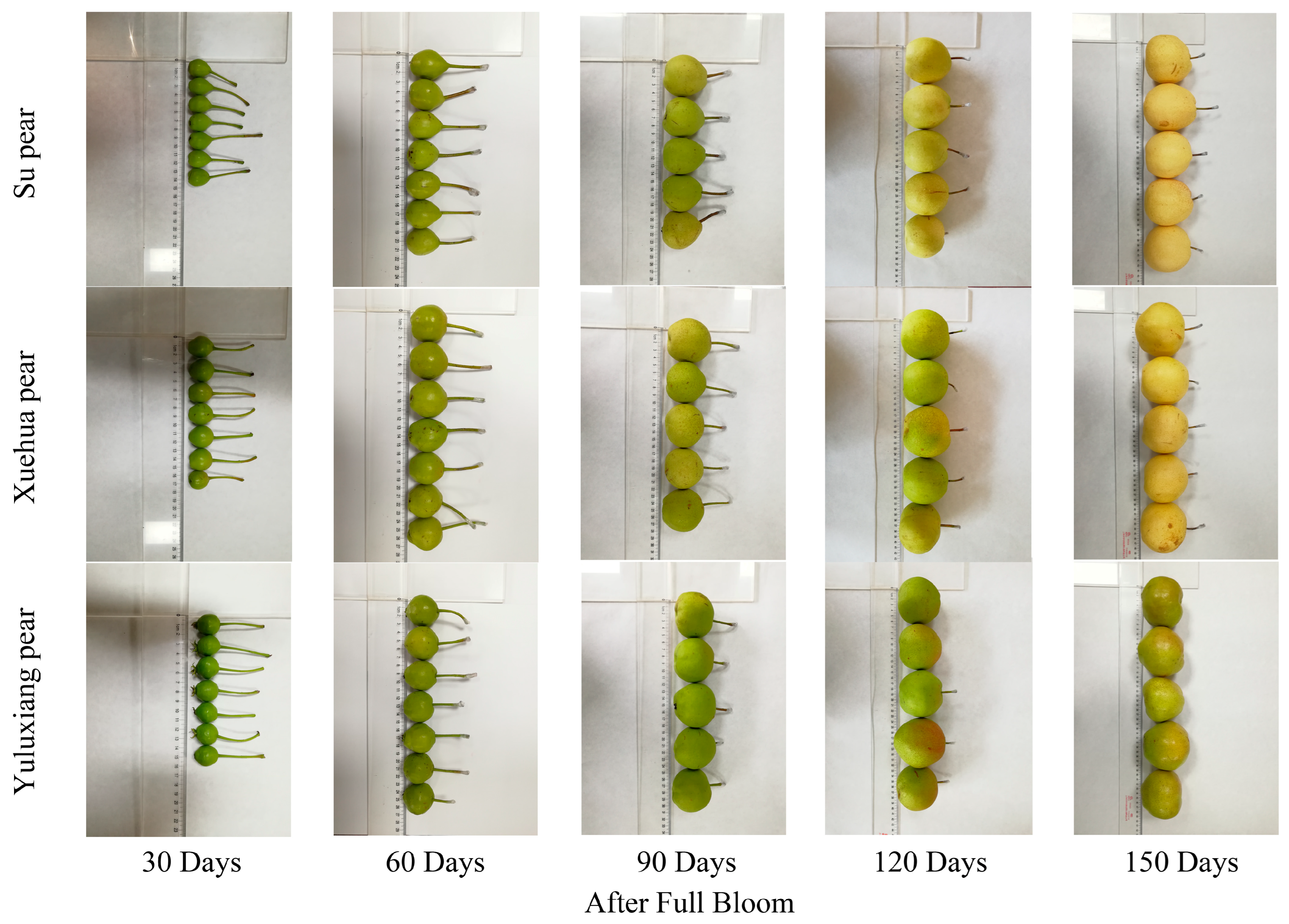
All plant materials used in our experiments were collected from pear orchards in Xiguan Village, Qi County (37°35′ N, 112°33′ E; 800 m above sea level), Shanxi Province, China. The pear orchard covered an area of approximately 8 hectares. No chemical control was applied during the entire growing period of the fruit trees, with only routine farming operations carried out. Pear trees of the three tested varieties—Yuluxiang pear, Su pear, and Xuehua pear—were 19, 25, and 25 years old, respectively. The collection dates of plant materials were determined based on the previous records of OFM occurrence for each generation in the area. Intact pear fruits were collected 30 (16 May), 60 (17 June), 90 (19 July), 120 (21 August), 150 (17 September) DAFB in 2020. The intact pears used in the experiment were repeatedly examined to confirm that there were no signs of insects, disease, or mechanical damage. The growth, development, weight, and diameter of the plant materials are presented in Table A1, Table A2 and Figure A1. All fruits were collected the day before the start of the experiments. Fruits were then rinsed with 75% alcohol to minimize mold growth and air-dried for 24 h. Subsequently, fruits were either used immediately or sealed in valve bags and stored at 4 °C until used.
2.2. Test Insects
The test insects were obtained from the Biosafety and Biocontrol Research Base of College of Plant Protection, Shanxi Agricultural University. The OFM individuals in the colony were originally collected from the peach orchards of Xishandi Village, Taigu District, Jinzhong City, Shanxi Province, China (37°21′~37°56′ N, 112°47′~113°04′ E; 805 m above sea level). The moths were reared according to the protocol [15]. The test insects were reared in an artificial climate chamber (model PRX-450C; Ningbo Haishu Saifu Experimental Instrument Factory, Ningbo, China) at 26 ± 0.8 °C, 70–80% RH, and a photoperiod of 15L:9D. The OFM colony used in this study had been maintained under these conditions for more than 80 generations. To periodically introduce field-derived individuals, larvae were collected annually from the same peach orchard where the colony was originally established. At each annual supplementation, field-collected larvae accounted for approximately 30% of the combined breeding population and were pooled with the laboratory colony for reproduction. The offspring produced from this mixed population were subsequently maintained as the laboratory colony and used for experimentation. Thus, the approximately 30% proportion referred to the field-collected individuals introduced into the breeding population at each annual supplementation, rather than a fixed proportion maintained in the experimental generation.
2.3. Field Trials on Fruit Infestation Levels
The fruit infestation rates in the test orchard for Su, Xuehua, and Yuluxiang pears were determined on 16 May (30 DAFB), 17 June (60 DAFB), 19 July (90 DAFB), 21 August (120 DAFB), and 17 September (150 DAFB) in 2020. Trials were conducted in an 8 ha commercial orchard in Xiguan Village, Qi County, Jinzhong City, Shanxi Province, China (37°35′ N, 112°33′ E; 800 m above sea level). A five-point sampling method was used to ensure spatial coverage within each study site. At each of the five sampling points, one tree of each cultivar (Su, Xuehua, and Yuluxiang) was randomly selected. Different trees were randomly selected at each sampling date, and the five sampling points were used only to distribute sampling spatially and were not treated as spatial blocks in the statistical analysis. From each selected tree, three fruits were collected from each of the four cardinal directions (east, west, south, and north) and from the center of the canopy, yielding 15 fruits per tree. The 15 fruits collected from each tree were treated as subsamples, whereas each tree was considered an independent biological replicate. Thus, five independent tree-level replicates were obtained for each cultivar at each sampling date (n = 5), corresponding to a total of 75 fruits per cultivar. For each tree, fruit infestation was recorded as the numbers of infested and uninfested fruits among the 15 sampled fruits.
2.4. Life-Table Study
Field-collected pears were placed in covered transparent plastic containers (upper diameter 15.0 cm, lower diameter 10.8 cm, height 8.0 cm, volume 1000 mL) that had been disinfected with 75% alcohol. A hundred holes were made in the container cover using a #0 insect pin for aeration. For each pear variety, the diameters of the tested fruits varied with season (Table A2). Each small pear fruit (<5 cm) collected 30 and 60 DAFB was inoculated with 1 egg, each medium pear fruit (5–7 cm) collected 90 DAFB was inoculated with 3 eggs, and each large pear fruit (>7 cm) collected 120 and 150 DAFB was inoculated with 5 eggs [9]. The total number of inoculated eggs was no less than 60 per treatment. Eggs laid on the waxed papers in the colony were collected within 12 h of their deposition, and the egg paper pieces were attached to the fruit surface. All the containers were maintained in a climate chamber under the same conditions as the colony. Egg hatch in each plastic box was observed and recorded daily at 8:00 a.m. and the egg hatch rate and egg developmental time were recorded. The number of mature larvae exiting from fruits was counted daily, and the developmental durations of larvae were recorded. Each mature larva was transferred individually into a glass test tube (1.5 cm in diameter and 8 cm in height) for pupation. Larvae were examined daily until pupation. After pupation, the pupae were removed from the tubes and their cocoons. The pupae were sexed and checked daily for adult emergence. Each pupa was weighed 48 h after larval pupation.
A newly emerged male and female adult, from the same pear variety collected at the same fruit developmental stage, were paired and transferred into transparent cylindrical plastic containers (15 cm in diameter and 20 cm in height). The bottoms of the containers were covered with plastic wrap that was punctured 100 times with a #0 insect pin for aeration. The number of moth pairs tested for each host fruit depended on the survival rate from the previous stage within each treatment. Moths were fed with 10% honey solution soaked in a cotton wick. The number of eggs laid per female was recorded daily at 8:00 a.m. and each egg was marked with a marker pen on the outside wall of the container until both the female and male adults died. Data from unmated females (indicated by the absence of a spermatophore upon dissection) were excluded from analysis. All containers were held in a climate-controlled chamber under the same conditions as the rearing colony.
2.5. Evaluation of Physicochemical Traits in Pear Fruits
The physicochemical traits of three pear varieties were measured at 30, 60, 90, 120 and 150 DAFB. The total sugars content and reducing sugars content were determined by the 3,5-dinitrosalicylic acid colorimetry method [24]. The protein content was determined by the Kjeldahl nitrogen method [25]. The vitamin C content was determined by the 2,6-dichloroindophenol titration method [26]. The total phenols content was determined by the Folin–Ciocalteu method [27]. The tannin content was determined by the Folin–Denis method [28]. The moisture content was determined by the decompression drying method [29]. Hardness and chewiness were measured using a TMS-PRO texture analyzer (Food Technology Corporation, Sterling, VA, USA) (Parameter settings: probe diameter = 6 mm; extrusion distance = 5 mm; detection speed = 60 mm/min; initiation force = 0.5 N; force sensing element range = 1000 N; the interval between two times = 3 s). For each treatment, all measurements were performed with four to six independent biological replicates.
2.6. Statistical Analysis
Life-table analysis was carried out according to age-stage, two-sex life-table theory and method [30,31]. All data from different developmental stages (for survival rate, developmental period, sex ratio, and fecundity of OFM reared on Yuluxiang, Xuehua, or Su pears with different levels of maturity) were analyzed using the computer program TWOSEX-MSChart [32]. The 60-DAFB treatment was not included in this analysis because all OFM larvae died on these fruits. Means of survival rate, developmental period, fecundity, sex ratio (Nm/Nf), and population parameters were calculated from the original data, whereas their standard errors were estimated using the bootstrap method with 100,000 bootstrap replicates. A paired bootstrap test (B = 100,000) was used to compare the differences among treatments using TWOSEX-MSChart based on 95% confidence interval [33,34,35]. The life-table parameters, with the 60-DAFB treatment excluded, are calculated as follows:
According to Chi and Liu, m is the number of life stages; sxj is the age-stage specific survival rate (the rate of individuals surviving to age x and stage j); and fx4 is the female age-stage specific fecundity (adult is the fourth life stage) [31]. The intrinsic rate of increase (r) is estimated using the iterative bisection method and the Lotka–Euler formula with age starting from zero as follows:
where lx is the age-specific survival rate (i.e., the probability that a newly laid egg will survive to age x) and mx is the age-specific fecundity (i.e., the mean fecundity of individuals at age x) [31].
In the age-stage, two-sex life-table analysis performed using TWOSEX-MSChart, individual insects were treated as observational units, and bootstrap resampling was conducted at the individual-insect level rather than the fruit level. Individual life-history records were resampled independently with replacement. However, the original dataset did not retain information linking individual insects to their respective host fruits. Consequently, the bootstrap procedure did not preserve the potential clustering of insects developing within the same fruit, and within-fruit dependence could not be explicitly accounted for in the statistical analyses.
Fruit infestation was treated as binomial response data, with the numbers of infested and uninfested fruits recorded for each tree. To evaluate the effects of pear cultivar and fruit developmental stage on fruit infestation, a generalized linear model (GLM) with a binomial error distribution and a logit link function was fitted. Cultivar, developmental stage (DAFB), and their interaction were included as fixed effects. The assumption of binomial dispersion was evaluated using the Pearson chi-square statistic divided by the residual degrees of freedom, and no substantial overdispersion was detected (dispersion parameter = 0.769). Therefore, the standard binomial GLM was retained for subsequent analyses. The significance of main effects and their interaction was assessed using likelihood-ratio chi-square tests. When the interaction effect was significant, simple-effects analyses were conducted to compare cultivars within each developmental stage. Pairwise comparisons among cultivars were performed using estimated marginal means on the response (probability) scale, with Tukey adjustment for multiple comparisons. Statistical significance was set at p < 0.05.
For the analysis of pupal weight and pear fruit physicochemical traits, all data were square-root transformed to stabilize their variances before analysis. The normality of the residuals was tested using the Shapiro–Wilk test [36]. Pupal weight was analyzed using one-way ANOVA. Post hoc comparisons were performed with Tukey’s multiple range test or Games–Howell test, depending on whether the treatment and control variances were equal (Shapiro–Wilk test, p > 0.05) or unequal (Shapiro–Wilk test, p < 0.05) [37,38]. Fruit physicochemical traits were analyzed using two-way analysis of variance (ANOVA), with cultivar and fruit developmental stage (DAFB) treated as fixed factors. The nine physicochemical traits were analyzed separately as response variables. The main effects of cultivar and DAFB, as well as their interaction (cultivar × DAFB), were tested for each trait. When a significant cultivar × DAFB interaction was detected, simple effects analyses were performed, followed by Tukey’s post hoc multiple-comparison test to compare cultivars within each DAFB stage, thereby characterizing how cultivar effects varied across fruit developmental stages.
Hierarchical cluster analysis was performed on the measured fruit physicochemical traits of the three pear varieties at different developmental stages using Ward’s method with squared Euclidean distance. Prior to clustering, all physicochemical variables were standardized to a range of 0–1.
To assess the relationships between the fitness of G. molesta and measured fruit physicochemical traits, we built models of net reproductive rate and larval survival rate against pear physicochemical traits. For net reproductive rate, multicollinearity among the nine initial trait variables was first assessed using the variance inflation factor (VIF). A stepwise elimination procedure was applied, in which variables with VIF ≥ 5 were iteratively removed until all retained variables had VIF values below 5. Multiple linear regression (MLR) models were then constructed using the retained variables. Subsequently, bidirectional stepwise model selection based on the Akaike information criterion (AIC) was performed to identify the most parsimonious model. Model diagnostics and stability were further assessed using the Shapiro–Wilk test for residual normality, the Breusch–Pagan test for homoscedasticity, and the Durbin–Watson test for residual independence. Potentially influential observations were examined using Cook’s distance. Predictive stability was evaluated using leave-one-out cross-validation (LOOCV), with prediction error quantified by the root mean squared error (RMSE), while coefficient robustness was assessed using 1000 bootstrap resamples to calculate bias-corrected and accelerated (BCa) 95% confidence intervals. For larval survival, predictors with VIF ≥ 5 were sequentially removed, followed by AIC-based stepwise selection using a binomial GLM with a logit link. Due to overdispersion, the final model was refitted using a quasibinomial distribution. Model stability was evaluated using LOOCV, with RMSE calculated between observed survival proportions and predicted survival probabilities. Coefficient robustness was assessed using 1000 bootstrap resamples to calculate BCa 95% confidence intervals. Potentially influential observations were examined using Cook’s distance, while residual diagnostics included the Shapiro–Wilk test of Pearson residuals and the Durbin–Watson test for residual independence. Analyses were performed using SPSS 19.0 (IBM, Armonk, NY, USA) and R version 4.5.2 (R Foundation for Statistical Computing, Vienna, Austria).
3. Results
3.1. Effect of Pear Variety on Fruit Infestation Rate
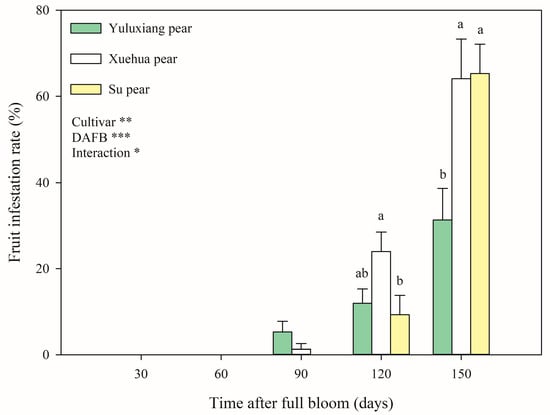
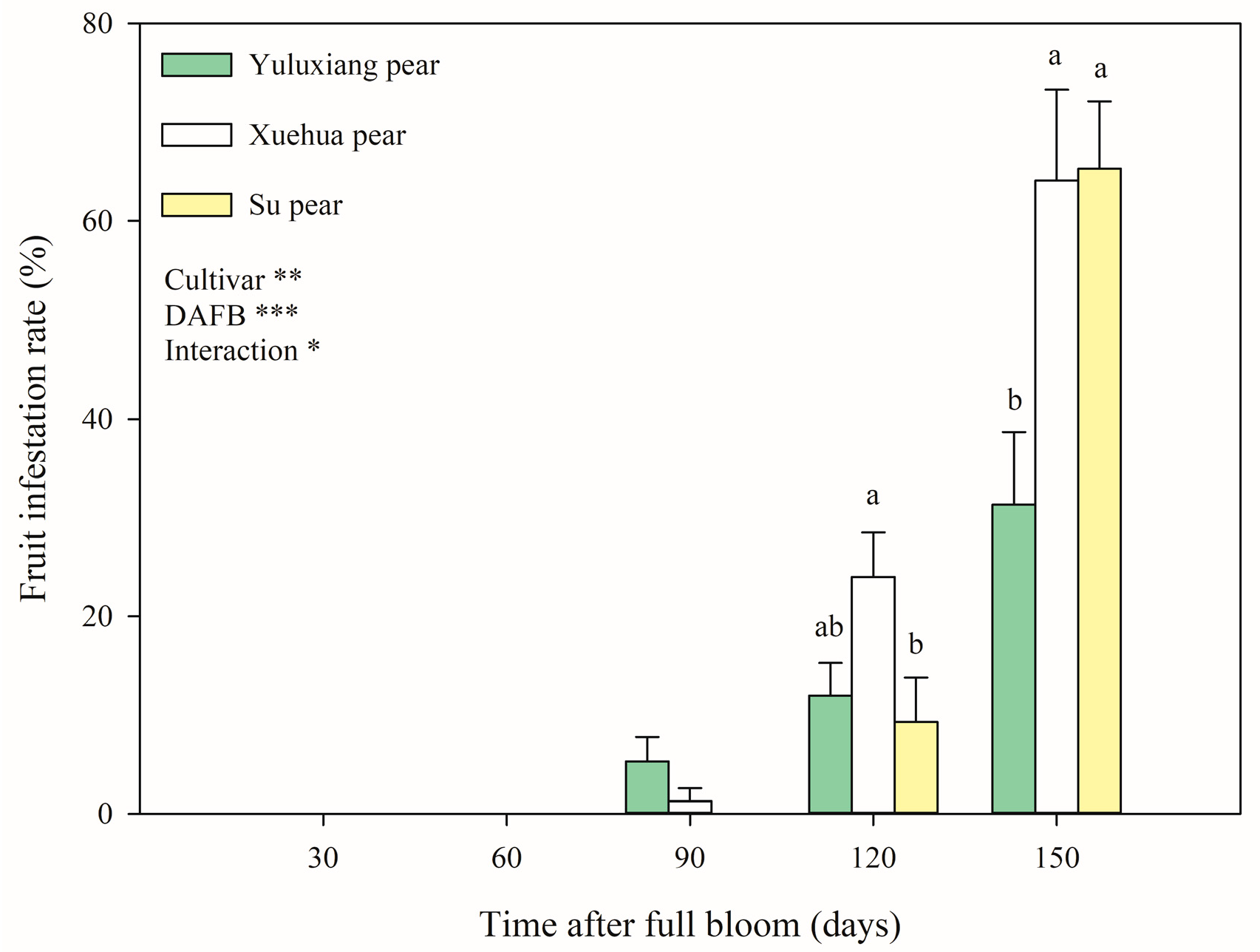
In the field, fruit infestation by OFM was investigated in all three pear cultivars. In general, infestation increased as the fruits developed. Likelihood-ratio tests showed significant effects of cultivar (χ2 = 11.626, df = 2, p = 0.003) and developmental stage (χ2 = 372.693, df = 4, p < 0.001), as well as a significant cultivar × DAFB interaction (χ2 = 19.098, df = 8, p = 0.014). Given the significant interaction, simple-effects analyses were conducted to compare cultivars within each developmental stage. At 30 and 60 DAFB, no fruit infestation was observed in any cultivar. At 90 DAFB, infestation did not differ significantly among cultivars (χ2 = 1.596, df = 2, p = 0.450). At 120 DAFB, a significant cultivar effect was detected (χ2 = 6.780, df = 2, p = 0.034), with Xuehua pears showing a significantly higher infestation rate than Su pears (p = 0.044). At 150 DAFB, cultivar differences were highly significant (χ2 = 20.106, df = 2, p < 0.001), with Yuluxiang pears showing significantly lower infestation rates than both Su and Xuehua pears (both p < 0.001), whereas Su and Xuehua pears did not differ significantly (p = 0.984). At each assessment time point, the cultivar exhibiting the highest fruit infestation rate varied among the tested cultivars. Yuluxiang, Xuehua, and Su pears showed the highest infestation rates among cultivars at 90, 120, and 150 DAFB, respectively (Figure 1).
Figure 1.
Fruit infestation by Grapholita molesta in three pear cultivars (Yuluxiang, Xuehua, and Su) at different fruit developmental stages (days after full bloom, DAFB). Bars show the observed mean infestation rates ± SE, whereas statistical inference was based on a binomial generalized linear model with a logit link function. Different lowercase letters indicate significant differences among cultivars within the same developmental stage based on pairwise contrasts of estimated marginal means (EMMs), with Tukey adjustment for multiple comparisons (p < 0.05). ns, not significant; *, p < 0.05; **, p < 0.01; ***, p < 0.001.
3.2. Fitness of OFM Fed on Three Pear Varieties During Different Fruit Maturation Periods
3.2.1. Fitness of OFM Fed on Pears 30 Days After Full Bloom
We found that the larval stage (p = 0.0408) and male longevity (p = 0.0255) of OFM fed on Su and Yuluxiang pears were significantly different from each other. Both the larval developmental period and male longevity were the shortest for OFM fed on Yuluxiang pears, being 14.3 days and 46.8 days, respectively (Table 1).
Table 1.
Life-table parameters of Grapholita molesta reared on three pear varieties.
3.2.2. Fitness of OFM Fed on Pears 60 Days After Full Bloom
In fruits at this stage, all OFM larvae died and could not survive on any of the three pear varieties.
3.2.3. Fitness of OFM Fed on Pears 90 Days After Full Bloom
For the developmental duration of stages, there were significant differences in the pre-oviposition period of OFM fed on Xuehua vs. Yuluxiang pears (p = 0.0095) and Xuehua vs. Su pears (p < 0.05). Among pear varieties, the pre-oviposition period of OFM fed on Xuehua pears was the longest (3.0 days), while moths reared on Su pears had the shortest pre-oviposition period (1.0 days) (Table 1).
Survival rates of OFM larvae fed on Yuluxiang vs. Xuehua pears (p = 0.0018) and Yuluxiang vs. Su pears (p = 0.0031) were significantly different. The pre-adult survival rates of OFM reared on Yuluxiang vs. Xuehua pears (p = 0.0035) and Yuluxiang vs. Su pears (p = 0.0129) were also significantly different. Larval survival rate and pre-adult survival rate were the highest (11.8% and 10.0%) for insects fed on Yuluxiang pears (Table 1).
The population parameters of OFM in different treatments differed as follows: the finite rate of increase (λ = 1.0748 d−1), intrinsic rate of increase (r = 0.0722 d−1) and net reproductive rate (R0 = 13.2) of OFM fed on Yuluxiang pears were significantly higher than those fed on Xuehua pears (λ = 1.0302 d−1, p = 0.0248; r = 0.0298 d−1, p = 0.0251; R0 = 2.7, p = 0.0285) or Su pears (λ = 1.0283 d−1, p = 0.0251; r = 0.0279 d−1, p = 0.0268; R0 = 2.6, p = 0.0277) (Table 1). The intrinsic rate of increase of OFM fed on Yuluxiang pears was about 2.5 times higher than that on Xuehua and Su pears.
3.2.4. Fitness of OFM Fed on Pears 120 Days After Full Bloom
There were significant differences in the adult longevity (p = 0.041) and total life longevity (p = 0.0473) of OFM fed on Su vs. Xuehua pears. The total pre-oviposition period was significantly different between Su and Yuluxiang pears (p = 0.0068). Adult longevity, total life longevity, and total pre-oviposition period of OFM were all the greatest on Su pears (23.4, 52.5, and 34.2 days, respectively). These parameters had the lowest values when OFM was fed on either Xuehua or Yuluxiang pears. Stage survival rates varied significantly for larval survival (p = 0.0108) and pupal survival (p = 0.0221) for Su vs. Xuehua pears (Table 1).
The rank order of pupal weight, female pupal weight, and male pupal weight of OFM fed on three pear varieties was Xuehua pear > Su pear > Yuluxiang pear. There were significant differences in pupal weight (F2,15 = 7.475, p = 0.006) and male pupal weight (F2,15 = 3.846, p = 0.045) among the three pear varieties. For the life-table population parameters, there were no significant differences among pear varieties for λ, r, or R0. However, the rank order of r was Yuluxiang > Xuehua > Su (Table 1).
3.2.5. Fitness of OFM Fed on Pears 150 Days After Full Bloom
Larval developmental duration of OFM was significantly different when fed on Yuluxiang vs. Xuehua pears (p = 0.0196). Larval duration was the greatest on Yuluxiang pears (18.3 days), while durations for larvae fed on Xuehua and Su pears were both shorter and not significantly different (p = 0.5806) from each other (Table 1). On the whole, the developmental duration of each stage of OFM fed on Yuluxiang pears were all longer than that on Su or Xuehua pears (Table A3).
Larval survival rate differed significantly between larvae fed on Su and Xuehua pears (p = 0.0002), between Su and Yuluxiang pears (p < 0.001), or between Xuehua and Yuluxiang pears (p = 0.0418). Similarly, there were significant differences in pre-adult survival between OFM fed on Su and Xuehua pears (p = 0.0041), for Su vs. Yuluxiang pears (p < 0.001), and for Xuehua vs. Yuluxiang pears (p = 0.0103). Both larval survival rate and pre-adult survival rate were the greatest when fed on Su pears (36.8%, 27.9%, respectively), followed by Xuehua pears (21.1%, 17.1%, respectively), and then Yuluxiang pears (13.9%, 9.2%, respectively) (Table 1).
The population parameters of OFM fed on Su pears were the highest (λ = 1.0775 d−1, r = 0.0746 d−1, R0 = 17.2), followed by Xuehua pears (λ = 1.0634 d−1, r = 0.0614 d−1, R0 = 10.8), and then Yuluxiang pears (λ = 1.0523 d−1, r = 0.0510 d−1, R0 = 7.5). There were significant differences in λ (p = 0.0304), r (p = 0.0317), and R0 (p = 0.0262) of OFM fed on Su vs. Yuluxiang pears (Table 1).
3.3. Fruit Characters of Three Pear Varieties During Different Fruit Maturation Periods
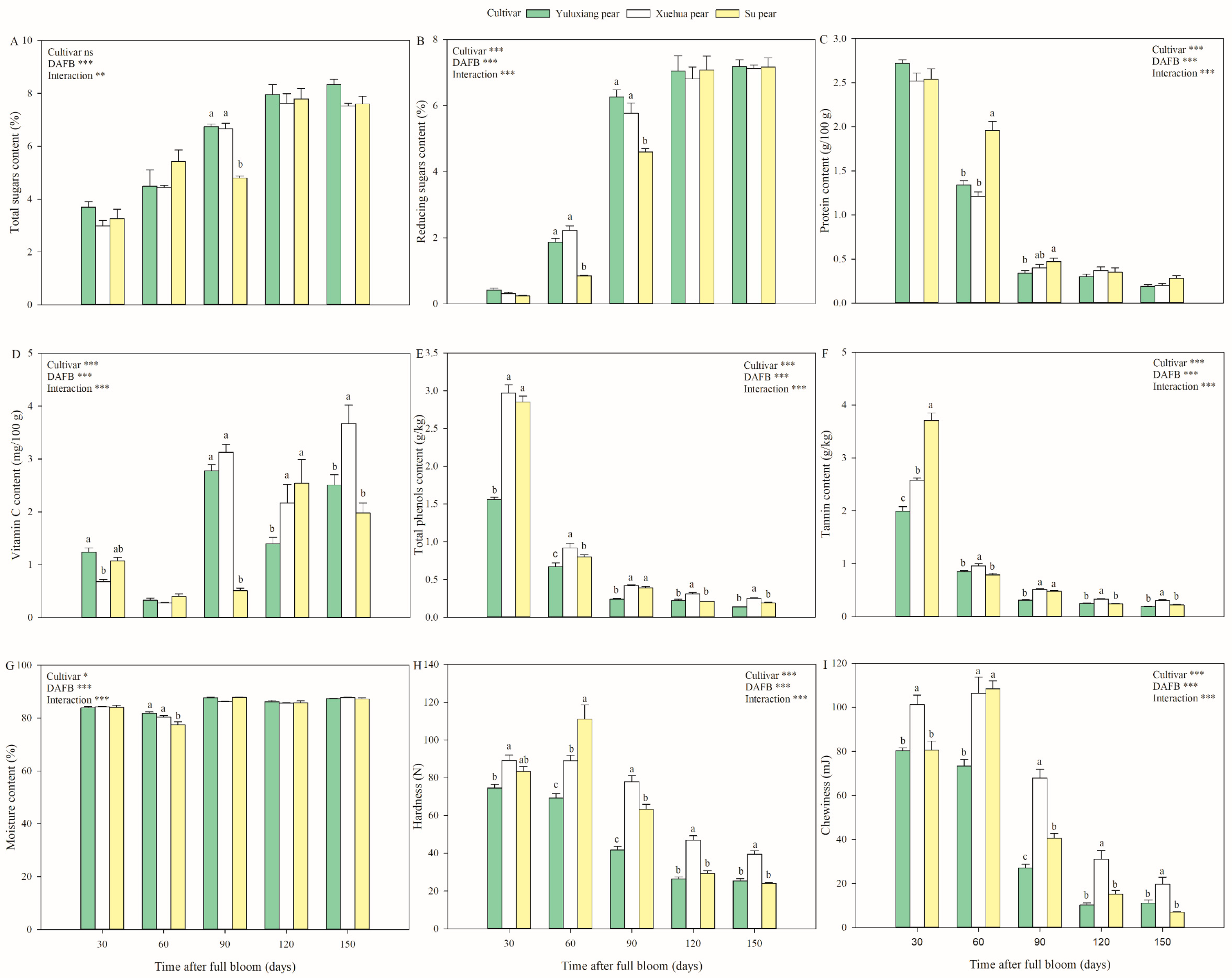
Overall, a two-way ANOVA was conducted to evaluate the effects of cultivar, fruit developmental stage (DAFB), and their interaction on fruit physicochemical traits. Fruit developmental stage (DAFB) significantly affected all nine physicochemical traits (all p < 0.001) (Table A4). Cultivar significantly affected reducing sugars content, protein content, vitamin C content, total phenols content, tannin content, moisture content, hardness, and chewiness (all p < 0.05) (Table A4), whereas total sugars content was not significantly affected (F2,63 = 0.678, p = 0.511). Significant cultivar × DAFB interactions were detected for all nine traits (all p < 0.01) (Table A4), indicating that the effects of cultivar depended on fruit developmental stage. To further characterize these interactions and their relationship with the stage-dependent performance of OFM, simple effects analyses were subsequently conducted among cultivars within each DAFB stage.
3.3.1. Fruit Characters 30 Days After Full Bloom
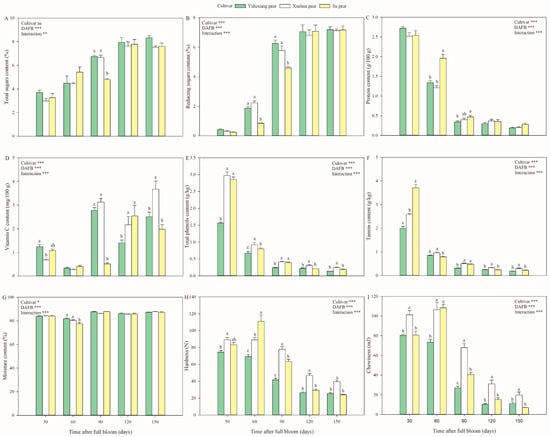
For young fruits (30 DAFB), there were significant differences among varieties in vitamin C content (F2,57 = 3.815; p = 0.028) (Figure 2D), total phenols content (F2,56 = 183.806; p < 0.001) (Figure 2E), tannin content (F2,57 = 222.975; p < 0.001) (Figure 2F), hardness (F2,59 = 5.892; p = 0.005) (Figure 2H), and chewiness (F2,58 = 7.707; p = 0.001) (Figure 2I). For Yuluxiang pears, vitamin C content was the highest (1.24 ± 0.08 mg/100 g), while total phenols, tannin, hardness, and chewiness were the lowest, their values being 1.56 ± 0.03 g/kg, 1.99 ± 0.09 g/kg, 74.52 ± 2.01 N, and 80.28 ± 1.32 mJ, respectively. For Xuehua pears, vitamin C was the lowest (0.68 ± 0.04 mg/100 g), while total phenols, hardness, and chewiness were the highest, their values being 2.97 ± 0.11 g/kg, 89.06 ± 2.90 N, and 101.21 ± 4.39 mJ, respectively. However, the tannin content of Su pears was the highest (3.71 ± 0.14 g/kg).
Figure 2.
Physicochemical traits of Yuluxiang, Xuehua, and Su pears at different fruit developmental stages (DAFB). Panels (A–I) show total sugars, reducing sugars, protein, vitamin C, total phenols, tannin, moisture, hardness, and chewiness, respectively. Data are presented as means ± SE. Two-way ANOVA was used to test the main effects of cultivar and DAFB and their interaction (cultivar × DAFB). Significance levels are indicated as follows: ns, p ≥ 0.05; *, p < 0.05; **, p < 0.01; and ***, p < 0.001. Simple-effects analyses were performed when a significant cultivar × DAFB interaction was detected. Different lowercase letters indicate significant differences among cultivars within the same DAFB stage based on Tukey’s post hoc multiple-comparison test (p < 0.05).
3.3.2. Fruit Characters 60 Days After Full Bloom
For fruits at 60 DAFB, reducing sugars (F2,63 = 38.356; p < 0.001) (Figure 2B), protein (F2,59 = 30.862; p < 0.001) (Figure 2C), total phenols (F2,56 = 15.837; p < 0.001) (Figure 2E), tannin (F2,57 = 8.965; p < 0.001) (Figure 2F), moisture (F2,54 = 17.715; p < 0.001) (Figure 2G), hardness (F2,59 = 43.497; p < 0.001) (Figure 2H) and chewiness (F2,58 = 20.293; p < 0.001) (Figure 2I) of three pear varieties were all significantly different. The values for reducing sugars, total phenols, and tannin were all the highest (2.22 ± 0.14%, 0.92 ± 0.06 g/kg, and 0.96 ± 0.04 g/kg, respectively) in Xuehua pears. Among the three pear varieties, protein level was the lowest in Xuehua pears (1.21 ± 0.05 g/100 g). The protein, hardness, and chewiness values of Su pears were the highest (1.96 ± 0.10 g/100 g, 111.04 ± 7.56 N, and 108.42 ± 3.60 mJ, respectively). The reducing sugars, tannin, and moisture values were all the lowest in Su pears (0.85 ± 0.02%, 0.79 ± 0.03 g/kg, and 77.42 ± 1.17%, respectively). Moisture content was the highest in Yuluxiang pears (81.77 ± 0.56%). In addition, total phenols, hardness, and chewiness were all the lowest in Yuluxiang pears (0.67 ± 0.05 g/kg, 69.21 ± 2.46 N, and 73.39 ± 2.94 mJ, respectively).
3.3.3. Fruit Characters 90 Days After Full Bloom
Total sugars (F2,63 = 7.917; p < 0.001) (Figure 2A), reducing sugars (F2,63 = 9.869; p < 0.001) (Figure 2B), protein (F2,59 = 3.412; p = 0.040) (Figure 2C), vitamin C (F2,57 = 58.094; p < 0.001) (Figure 2D), total phenols (F2,56 = 24.977; p < 0.001) (Figure 2E), tannin (F2,57 = 31.339; p < 0.001) (Figure 2F), hardness (F2,59 = 51.625; p < 0.001) (Figure 2H), and chewiness (F2,58 = 45.646; p < 0.001) (Figure 2I) all differed significantly among the three pear varieties. The values for total sugars and reducing sugars of Yuluxiang pears were the highest (6.74 ± 0.10% and 6.26 ± 0.22%, respectively), while total phenols, tannin, hardness, and chewiness were all the lowest in Yuluxiang pears (0.24 ± 0.01 g/kg, 0.31 ± 0.01 g/kg, 41.70 ± 2.04 N, and 27.12 ± 1.69 mJ, respectively). The vitamin C, total phenols, tannin, hardness, and chewiness values were all the highest in Xuehua pears (3.13 ± 0.15 mg/100 g, 0.42 ± 0.01 g/kg, 0.51 ± 0.02 g/kg, 77.90 ± 3.21 N, and 67.94 ± 3.87 mJ, respectively). For Su pears, total sugars, reducing sugars, and vitamin C levels were all the lowest among pear varieties, being 4.80 ± 0.08%, 4.60 ± 0.10%, and 0.51 ± 0.05 mg/100 g, respectively.
3.3.4. Fruit Characters 120 Days After Full Bloom
Significant differences were found among pear varieties for vitamin C (F2,57 = 7.758; p = 0.001) (Figure 2D), total phenols (F2,56 = 10.726; p < 0.001) (Figure 2E), tannin (F2,57 = 8.379; p < 0.001) (Figure 2F), hardness (F2,59 = 30.233; p < 0.001) (Figure 2H), and chewiness (F2,58 = 28.272; p < 0.001) (Figure 2I). Xuehua pears showed the highest total phenols, tannin, hardness, and chewiness values (0.31 ± 0.02 g/kg, 0.33 ± 0.01 g/kg, 46.93 ± 2.34 N, and 31.09 ± 3.95 mJ, respectively). Su pears showed the lowest levels of total phenols and tannin (0.21 ± 0.00 g/kg and 0.24 ± 0.01 g/kg, respectively). The lowest values for hardness and chewiness were found in Yuluxiang pears (26.46 ± 1.05 N and 10.26 ± 0.91 mJ, respectively).
3.3.5. Fruit Characters 150 Days After Full Bloom
Vitamin C (F2,57 = 13.002; p < 0.001) (Figure 2D), total phenols (F2,56 = 11.555; p < 0.001) (Figure 2E), tannin (F2,57 = 12.217; p < 0.001) (Figure 2F), as well as hardness (F2,59 = 20.704; p < 0.001) (Figure 2H), and chewiness (F2,58 = 13.714; p < 0.001) (Figure 2I) all varied significantly among the three pear varieties. Vitamin C, total phenols, tannin, hardness, and chewiness values were all highest in Xuehua pears (3.67 ± 0.35 mg/100 g, 0.25 ± 0.01 g/kg, 0.30 ± 0.02 g/kg, 39.50 ± 1.90 N, and 19.73 ± 3.17 mJ, respectively). Conversely, the vitamin C content, hardness, and chewiness values were all lowest in Su pears (1.98 ± 0.19 mg/100 g, 24.08 ± 0.53 N, 6.96 ± 0.29 mJ, respectively). Total phenols and tannin were the lowest in Yuluxiang pears (0.14 ± 0.00 g/kg and 0.19 ± 0.01 g/kg, respectively).
3.4. Effects of Pear Physicochemical Traits on OFM Fitness
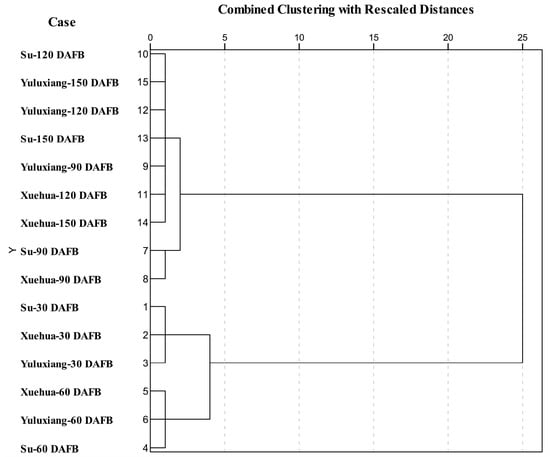
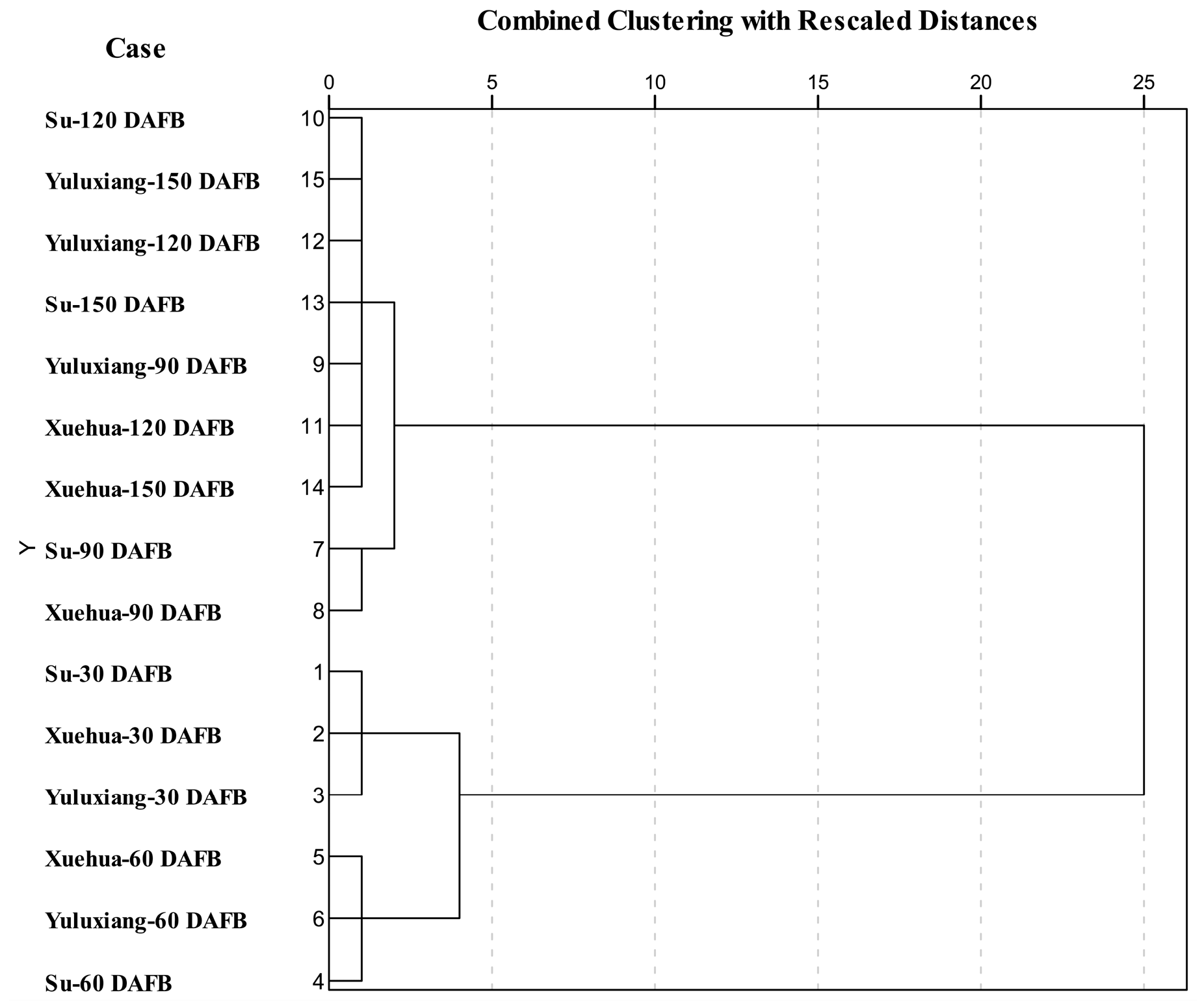
The relationship between OFM fitness and measured fruit physicochemical traits, including moisture, total sugars, protein, hardness, etc., in three pear varieties collected 30, 60, 90, 120, and 150 DAFB was assessed using a cluster pedigree diagram of pear physicochemical traits. Based on the structure of the dendrogram, a cut-off at a rescaled distance of approximately 2 was used to separate the samples into four major clusters (Figure 3), as follows. (1) The first category included Su, Xuehua, and Yuluxiang pears collected 60 DAFB. These pears had low moisture and total sugars, medium protein and total phenols, and high hardness. (2) The second category included Su, Xuehua, and Yuluxiang pears collected 30 DAFB. These pears had low total sugars, medium moisture, and high protein, total phenols, and hardness. (3) The third category included Su and Xuehua pears collected 90 DAFB. These pears had low protein and total phenols, low or medium total sugars, medium hardness, and high water content. (4) The fourth category included Yuluxiang pears collected 90 DAFB and Su, Xuehua, and Yuluxiang pears collected 120 or 150 DAFB. These pears had low protein, total phenols, and hardness, high moisture and total sugars. Based on the overall patterns of the intrinsic rate of increase and larval survival rate, the fitness of OFM fed on pear fruits could be broadly grouped into four categories. OFM could not survive on pear fruits of the first category. In contrast, OFM exhibited high fitness feeding on fruits from categories two and four, whereas fitness was low for category three. These findings showed that the physicochemical traits of pear fruits were closely related to the fitness of OFM.
Figure 3.
Cluster dendrogram of three pear varieties (Yuluxiang, Xuehua, and Su pears) at different maturity stages, based on the measured fruit physicochemical traits.
The relationships between the net reproductive rate (R0) of OFM and pear fruit traits were analyzed using multiple linear regression. The final model retained total phenols content (g/kg) and fruit hardness (N) as significant predictors: = 21.804 + 9.191 × total phenols content − 0.296 × hardness (F2,12 =14.17, p < 0.001, adjusted R2 = 0.653), where represents the estimated net reproductive rate. Both predictor variables were entered into the model on their original measurement scales without transformation or standardization. Total phenols content showed a significant positive association with R0 (p < 0.001), whereas fruit hardness showed a significant negative association with R0 (p < 0.001). Together, these two traits accounted for 65.3% of the variation in R0.
A generalized linear model with a quasibinomial error distribution and logit link function was used to analyze the relationship between fruit traits and OFM larval survival. After screening for multicollinearity and variable selection, total phenols content (g/kg) and fruit hardness (N) were retained in the final model. The fitted model was logit () = 0.320 + 1.221 × total phenols content − 0.058 × hardness, where represented the estimated probability of larval survival. Both predictor variables were entered into the model on their original measurement scales without transformation or standardization. The final model yielded a deviance-based pseudo-R2 of 0.720. Total phenols content was positively associated with larval survival (F1,12 = 12.150, p = 0.0045), whereas fruit hardness was negatively associated with larval survival (F1,12 = 30.699, p < 0.001). In this observational dataset, larval survival covaried positively with total phenols content and negatively with fruit hardness across the cultivars and developmental stages examined.
4. Discussion
In this study, we collected pear fruits at different phenological stages and evaluated life-table parameters (developmental duration, survival rate and fecundity) of the OFM reared on three pear varieties under laboratory conditions. The larvae failed to survive in pear fruits at 60 DAFB, but successfully developed in fruits at 30, 90, 120 and 150 DAFB. All three pear varieties collected 60 DAFB were lethal to OFM larvae; however, the underlying mechanisms remain unresolved and may be associated with high fruit hardness, medium total phenols, and other potential factors.
Total phenols, tannin, fruit hardness, and chewiness are typically fruit traits that generally inhibit larval feeding, whereas high levels of moisture, vitamin C, protein, reducing sugars, and total sugars usually stimulate insect feeding [39,40]. Total phenols and tannin are important secondary metabolites in plants that play crucial roles in plant chemical defense. These chemicals can inhibit enzyme activity or cause protein tanning. After ingestion by insects, these compounds inhibit the digestion and utilization of proteins, thereby negatively affecting insect feeding behavior, growth and development. In our study, we found that the contents of total phenols and tannin in pear fruits were higher at 30 and 60 DAFB than at 90, 120 and 150 DAFB (Figure 2E,F). However, the OFM larvae could successfully colonize and develop within high-phenol and high-tannin young fruits collected 30 DAFB. Regression analysis showed that, within the measured concentration range, total phenols content in pear fruits was positively associated with both the larval survival rate and net reproductive rate of OFM. These findings suggest that relatively high levels of phenolic compounds and tannins in young pear fruits do not prevent OFM larval colonization and development. Relevant studies have documented the cytochrome P450-mediated counter-defense response of fruit borers to quercetin [40]. In addition, host plant diets shape the gut bacterial communities of G. molesta, which in turn contribute substantially to host adaptation [41]. Further laboratory trials are recommended to assess how phenols and tannins affect the development of OFM larvae, which may help clarify these conflicting results.
Fruit hardness and chewiness are physical characteristics of host tissues that may influence insect penetration and feeding. In our study, the hardness and chewiness of pear fruits collected at 30 and 60 DAFB were generally higher than those collected at 90, 120, and 150 DAFB (Figure 2H,I). Across the pear cultivars and fruit developmental stages examined, regression analysis showed that fruit hardness was negatively associated with both the larval survival rate and the net reproductive rate of OFM. However, this association does not establish a causal relationship. Notably, Xuehua pears at 30 DAFB had higher hardness and chewiness than Yuluxiang pears at 60 DAFB, yet OFM larvae survived in the former, whereas complete larval mortality occurred in the latter (Table 1). This contrast indicates that hardness and chewiness alone cannot adequately explain the complete larval mortality observed at 60 DAFB. The underlying mechanisms remain unresolved and may involve fruit tissue structure, water content, nutritional composition, and other unmeasured chemical or structural factors that warrant further investigation. Previous studies reported that stone cell content in pear fruits peaked at approximately seven weeks after full bloom and then gradually declined [42]. The time point of 60 DAFB was basically consistent with the stage of maximum stone cell accumulation in pear fruits. This index was positively correlated with fruit hardness [43]. However, stone cell content was not measured in the present study. Therefore, the potential involvement of stone cells in the complete OFM larval mortality observed at 60 DAFB remains an untested hypothesis that warrants further investigation.
Sugars and proteins are major nutritional components of host plants and are generally considered important for insect growth and development. Soluble sugars mainly serve as energy sources, whereas proteins provide amino acids for tissue construction and reproduction. Water is likewise a major component of host plant tissues and is generally considered important for insect feeding, development, and survival. At 60 DAFB, fruit moisture content was the lowest among the five developmental stages examined, total sugars content was relatively low compared with later stages, and protein content was intermediate. These characteristics may be associated with the absence of larval survival at this stage, possibly reflecting less favorable nutritional and moisture conditions for OFM larvae. Similarly, foliage with higher moisture content from its host plants has been reported to be more favorable for the growth and reproduction of the moth Trabala vishnou gigantina Yang [44]. However, total sugars, protein, and moisture were not retained in the final regression models following multicollinearity screening and model selection. Therefore, their potential contributions to the mortality observed at 60 DAFB cannot be independently established from the present data.
The availability of host plants is also a significant factor determining the population dynamics of herbivorous insects. The physical characteristics and chemical components of host plants vary with their phenological stages, and this variation affects the performance of herbivorous insects, including developmental duration, survival rate, and fecundity [39,45,46]. In our study, total phenols content and hardness of pear fruits were important traits associated with the development, survival, and reproduction of OFM. These findings suggest that variation in fruit physicochemical characteristics may be associated with differences in OFM performance across pear cultivars and developmental stages. However, because multiple fruit traits change concurrently during fruit maturation, the observed relationships cannot distinguish the contributions of individual traits from other maturation-related changes. Therefore, these results should be interpreted as exploratory associations rather than evidence that particular fruit traits independently determine OFM performance. Further experiments are needed to clarify their respective contributions and the underlying mechanisms.
Life-table parameters integrate multiple factors affecting insect development, survival and fecundity, and are commonly used to assess the population growth potential of insects under specific conditions. In our study, we found that the finite rates of increase of OFM fed on the three pear varieties at 30, 90, 120, and 150 DAFB were all >1, indicating that all three pear varieties’ fruits could support OFM population growth. OFM fitness on Yuluxiang pears collected 30, 90, and 120 DAFB was higher than that on fruits collected 150 DAFB. For Su and Xuehua pears, OFM fitness on fruits collected 30, 120, and 150 DAFB was higher than that on those collected 90 DAFB. Among the three pear cultivars evaluated at 90 DAFB, OFM showed higher survival and greater population-growth potential on Yuluxiang pears under the no-choice conditions tested. However, larval survival of OFM on Yuluxiang pears declined at 150 DAFB. Similarly, C. pomonella larvae were less likely to complete their development during the late growth stage of pear fruits. This phenomenon has been attributed to the overripeness of pear fruits, which subsequently leads to their rapid liquefaction and rot [17].
In our field study, the fruit infestation rate of the three pear varieties gradually increased with fruit ripening. For the three pear varieties tested, the fruit infestation rate was 0% in young fruits at 30 and 60 DAFB. At 90 DAFB, Yuluxiang pears showed the highest infestation rate (5.3%). At 120 DAFB, Xuehua pears exhibited the highest infestation rate (24.0%). At 150 DAFB, Su pears had the highest infestation rate (65.3%). In general, OFM larvae bore into the shoots and fruits of various host plants, where they feed and cause significant damage. Most orchards in northern China are mixed-cropping systems consisting of pear, peach, apple, apricot, and plum trees. Confronted with such complex and variable field conditions, adult OFM can select from a shifting variety of potential hosts. During different growth periods of fruit trees, female OFM selectively oviposit on hosts with high suitability to ensure the growth, development, and reproduction of the next generation population. Generally, in our study area, peach trees blossom from March to April, followed by the emergence of new shoots in May. During this period, the larvae of OFM mainly damage the young shoots of peach trees. From June to July, as peach fruits mature, the larvae shift to feeding on peach fruits. From August to September, all peach fruits in the field are harvested, while pears and apples are entering their ripening stage, so the larvae subsequently shift to infesting pears and apples [9,47]. In our field study, a small number of peach and plum trees were planted around the orchards where the three pear varieties were grown. Therefore, the infestation rates of Yuluxiang, Xuehua, and Su pears were relatively low at 30, 60, and 90 DAFB (i.e., from May to July) under field conditions. However, OFM exhibited high fitness on the three pear varieties collected 30 DAFB in our laboratory life-table trials. This is because OFM prefer peach, which serves as the most favorable host for their growth and development under field conditions. But in our life-table experiment, OFM were reared under no-choice conditions using pear fruits collected 30 DAFB as the host. In our field study, OFM first infested Yuluxiang pears at 90 DAFB (July), while heavy infestation on Xuehua and Su pears did not occur until 120 DAFB (August). Su pears sustained the severest damage upon reaching maturity at 150 DAFB (September). The infestation rate was positively correlated with fruit maturity for all three pear varieties. The mid-maturing variety, Yuluxiang pear, ripens in late August. The late-maturing varieties, Xuehua and Su pears, ripen in mid-September and late September, respectively, in Qi County (Jinzhong City, Shanxi Province, China). Mature host plants are often more favorable for herbivorous insects, as they offer more nutrients, fewer toxic secondary metabolites, and generally more favorable physical characteristics. As pear fruits develop, pears become more susceptible to infestation by OFM, enabling more larvae to complete development [9,10]. Similarly, the survival of C. pomonella larvae is also affected by fruit maturity [17].
Understanding the relationship between the life-history parameters of an insect and the developmental periods of its host plants can improve the accuracy of population dynamics forecasting and contribute to the practical implementation of integrated pest management programs. At 60 DAFB, fruits of the three pear varieties showed reduced suitability for OFM larval development under laboratory conditions. This finding may provide insights useful for refining OFM management timing. However, field validation incorporating adult activity, oviposition, and subsequent OFM generations is required before translating these findings into management recommendations. In the life-table experiments, OFM exhibited relatively favorable life-history performance on pear fruits collected at 30 (mid-May), 120 (mid-August), and 150 (mid-September) DAFB under no-choice conditions. These findings suggest that fruit developmental stage may be relevant to OFM performance and could help identify periods warranting further field investigation and monitoring. However, the optimal timing and intensity of control measures require validation under field conditions. At 90 DAFB, Yuluxiang pears showed higher suitability for OFM than Xuehua and Su pears. This finding suggests that particular attention could be given to monitoring OFM occurrence in Yuluxiang pears around 90 DAFB. Differences in the timing of host suitability among pear cultivars indicate that different pear varieties may provide distinct windows of suitability for OFM during fruit development. Yuluxiang pears showed earlier seasonal suitability for OFM at 90 and 120 DAFB, whereas Xuehua and Su pears became suitable later in the season, at 120 and 150 DAFB. These differences suggest that cultivar-specific patterns of fruit susceptibility may influence the temporal availability of suitable hosts during the growing season. However, the effects of cultivar composition and orchard planting patterns on OFM population dynamics, host use, and dispersal require further field investigation.
One limitation of this study arises from the inoculation of multiple eggs per fruit at 90, 120, and 150 DAFB, particularly at the latter two stages. This approach may have allowed multiple larvae to develop within the same fruit, raising concerns about both potential within-fruit competition and statistical non-independence. First, competition among larvae for limited resources may have influenced larval survival, developmental time, pupal weight, and subsequent adult fecundity, potentially affecting the estimated life-table parameters. Second, insects developing within the same fruit may have exhibited correlated responses due to their shared environment. However, because fruit identity was not retained in the original dataset, individual insect records were resampled independently in the life-table bootstrap analyses, and within-fruit dependence could not be explicitly accounted for. Consequently, a sensitivity analysis accounting for clustering by fruit could not be performed. The resulting bootstrap standard errors, confidence intervals, and associated significance tests may not fully reflect within-fruit dependence, potentially leading to an overestimation of the precision of the results, although the direction and magnitude of any distortion cannot be determined from the available data. Therefore, statistical inferences based on these analyses should be interpreted with caution. Another potential limitation is the long-term laboratory maintenance of the OFM colony. Although field-collected larvae were introduced annually, laboratory adaptation over more than 80 generations may have influenced host-use performance. This possibility should be considered when extrapolating the present results to natural populations. A further limitation concerns the trait regression analyses, which were based on only 15 cultivar-by-developmental-stage observations. Although VIF screening was performed to reduce multicollinearity, the small sample size and strong correlations among fruit traits may increase the risk of overfitting and instability in model selection. Furthermore, because these traits also covaried with fruit developmental stage, the observed associations should be interpreted cautiously and should not be taken as evidence of causal effects attributable to individual fruit traits. Future research should investigate the mechanisms underlying the lethality observed in OFM larvae fed on pear fruits at 60 DAFB. Elucidating the lethal effects of these fruits, as well as the influence of different pear varieties on OFM, will open new avenues for integrated pest management strategies aimed at controlling this notorious global pest.
5. Conclusions
In summary, this study evaluated the life-table parameters of the OFM reared on fruits of three pear varieties collected 30, 60, 90, 120, and 150 DAFB. Our results revealed that pear fruits at different phenological stages primarily affected the larval survival rate of OFM. Pear fruits collected 60 DAFB were lethal to OFM larvae under laboratory conditions. At this stage, pear fruits exhibited relatively high firmness, medium protein and total phenols contents, and relatively low total sugars content and moisture. However, the factors responsible for complete larval mortality remain unresolved. By contrast, fruits collected 30, 90, 120, and 150 DAFB supported the population growth of OFM. Notably, Yuluxiang pear showed suitability for OFM at 90 DAFB, earlier than Xuehua or Su pears. This study will provide a theoretical and practical basis for integrated pest management strategies targeting OFM in pear orchards across China.
Supplementary Materials
The following supporting information can be downloaded at: https://www.mdpi.com/article/10.3390/insects17111209/s1. Dataset S1: Raw life-table data of OFM reared on Su pear fruits at 30 DAFB; Dataset S2: Raw life-table data of OFM reared on Xuehua pear fruits at 30 DAFB; Dataset S3: Raw life-table data of OFM reared on Yuluxiang pear fruits at 30 DAFB; Dataset S4: Raw life-table data of OFM reared on Su pear fruits at 60 DAFB; Dataset S5: Raw life-table data of OFM reared on Xuehua pear fruits at 60 DAFB; Dataset S6: Raw life-table data of OFM reared on Yuluxiang pear fruits at 60 DAFB; Dataset S7: Raw life-table data of OFM reared on Su pear fruits at 90 DAFB; Dataset S8: Raw life-table data of OFM reared on Xuehua pear fruits at 90 DAFB; Dataset S9: Raw life-table data of OFM reared on Yuluxiang pear fruits at 90 DAFB; Dataset S10: Raw life-table data of OFM reared on Su pear fruits at 120 DAFB; Dataset S11: Raw life-table data of OFM reared on Xuehua pear fruits at 120 DAFB; Dataset S12: Raw life-table data of OFM reared on Yuluxiang pear fruits at 120 DAFB; Dataset S13: Raw life-table data of OFM reared on Su pear fruits at 150 DAFB; Dataset S14: Raw life-table data of OFM reared on Xuehua pear fruits at 150 DAFB; Dataset S15: Raw life-table data of OFM reared on Yuluxiang pear fruits at 150 DAFB; Dataset S16: Life-table parameter analysis of OFM reared on fruits of three pear cultivars (Su, Xuehua, and Yuluxiang) at 30 DAFB; Dataset S17: Life-table parameter analysis of OFM reared on fruits of three pear cultivars (Su, Xuehua, and Yuluxiang) at 90 DAFB; Dataset S18: Life-table parameter analysis of OFM reared on fruits of three pear cultivars (Su, Xuehua, and Yuluxiang) at 120 DAFB; Dataset S19: Life-table parameter analysis of OFM reared on fruits of three pear cultivars (Su, Xuehua, and Yuluxiang) at 150 DAFB; Dataset S20: Effect of pear variety on fruit infestation rate; Dataset S21: Fruit characters of three pear varieties during different fruit maturation periods; Dataset S22: Data used for hierarchical cluster analysis of pear fruit physicochemical traits; Dataset S23: Regression analysis of net reproductive rate in relation to pear fruit physicochemical traits; Dataset S24: Regression analysis of larval survival rate in relation to pear fruit physicochemical traits.
Author Contributions
R.M. conceived the experiment and designed the study. Y.G., N.M., X.Z., X.L. and H.X. conducted the experiments and collected the data. Y.G. and T.T. performed the statistical analyses and drafted the manuscript. All authors discussed the results and revised the manuscript. All authors have read and agreed to the published version of the manuscript.
Funding
This research was funded by the Special Fund for Science and Technology Innovation Teams of Shanxi Province (202304051001006), the earmarked fund for National Key R&D Program of China (2023YFD1401400), Key R&D Program of Shanxi Province (202302140601011), and the Earmarked Fund for CARS (CARS-28).
Informed Consent Statement
All the authors reviewed and approved the final manuscript and consented to its publication.
Data Availability Statement
The original contributions presented in this study are included in the article or Supplementary Materials.
Conflicts of Interest
The authors declare no conflicts of interest.
Abbreviations
The following abbreviations are used in this manuscript:
| OFM | Oriental Fruit Moth |
| DAFB | Days After Full Bloom |
Appendix A
Table A1.
Introduction of pear varieties.
Table A2.
Determination of weight and diameter of pear fruits with different maturity.
Table A3.
Life-table parameters of Grapholita molesta reared on three different pear varieties collected at various times.
Table A4.
Two-way ANOVA of the effects of cultivar, DAFB, and their interaction on fruit physicochemical traits.
Figure A1.
Comparative study of fruits from three pear varieties at different maturity stages.
References
- Cardé, R.T.; Minks, A.K. Control of moth pests by mating disruption: Successes and constraints. Annu. Rev. Entomol. 1995, 40, 559–585. [Google Scholar] [CrossRef]
- Il’ichev, A.L.; Williams, D.G.; Milner, A.D. Mating disruption barriers in pome fruit for improved control of oriental fruit moth Grapholita molesta Busck (Lepidoptera: Tortricidae) in stone fruit under mating disruption. J. Appl. Entomol. 2004, 128, 126–132. [Google Scholar] [CrossRef] [Scilit]
- Kovanci, O.B.; Schal, C.; Walgenbach, J.F.; Kennedy, G.G. Comparison of mating disruption with pesticides for management of oriental fruit moth (Lepidoptera: Tortricidae) in North Carolina apple orchards. J. Econ. Entomol. 2005, 98, 1248–1258. [Google Scholar] [CrossRef] [Scilit]
- Myers, C.T.; Hull, L.A.; Krawczyk, G. Seasonal and cultivar-associated variation in oviposition preference of oriental fruit moth (Lepidoptera: Tortricidae) adults and feeding behavior of neonate larvae in apples. J. Econ. Entomol. 2006, 99, 349–358. [Google Scholar] [CrossRef]
- Myers, C.T.; Hull, L.A.; Krawczyk, G. Comparative survival rates of oriental fruit moth (Lepidoptera: Tortricidae) larvae on shoots and fruit of apple and peach. J. Econ. Entomol. 2006, 99, 1299–1309. [Google Scholar] [CrossRef]
- Myers, C.T.; Hull, L.A.; Krawczyk, G. Effects of orchard host plants (apple and peach) on development of oriental fruit moth (Lepidoptera: Tortricidae). J. Econ. Entomol. 2007, 100, 421–430. [Google Scholar] [CrossRef]
- Lu, P.F.; Huang, L.Q.; Wang, C.Z. Semiochemicals used in chemical communication in the oriental fruit moth, Grapholitha molesta Busck (Lepidoptera:Tortricidae). Acta Entomol. Sin. 2010, 53, 1390–1403. [Google Scholar]
- Kong, W.N.; Wang, Y.; Liu, Z.F.; Guo, Y.F.; Zhao, F.; Fan, R.J. The effect of different hosts on the oviposition preferences of Grapholita molesta (Busck) (Lepidoptera: Tortricoidea). Chin. J. Appl. Entomol. 2018, 55, 104–111. [Google Scholar]
- Du, J.; Li, G.W.; Xu, X.L.; Wu, J.X. Development and fecundity performance of oriental fruit moth (Lepidoptera: Tortricidae) reared on shoots and fruits of peach and pear in different seasons. Environ. Entomol. 2015, 44, 1522–1530. [Google Scholar] [CrossRef] [Scilit]
- Yu, Q.; Du, E.Q.; Feng, Y.T.; Guo, X.J.; Zhang, R.X.; Hao, C. Effects of fruit species and developmental stage on the larval boring rate and pupal weight of Grapholitha molesta (Lepidoptera: Tortricidae). Acta Entomol. Sin. 2019, 62, 1297–1304. [Google Scholar] [CrossRef]
- Scriber, J.M.; Slansky, F. The nutritional ecology of immature insects. Annu. Rev. Entomol. 1981, 26, 183–211. [Google Scholar] [CrossRef] [Scilit]
- Thompson, J.N. Evolutionary ecology of the relationship between oviposition preference and performance of offspring in phytophagous insects. Entomol. Exp. Appl. 1988, 47, 3–14. [Google Scholar] [CrossRef] [Scilit]
- Kong, W.N.; Wang, Y.; Guo, Y.F.; Chai, X.H.; Li, J.; Ma, R.Y. Importance of preovipositional period of an oligophagous moth in predicting host suitability. J. Econ. Entomol. 2020, 113, 222–229. [Google Scholar] [CrossRef] [Scilit]
- Gong, Q.T.; Wu, H.B.; Zhang, K.P.; Li, S.H.; Zhang, X.P.; Sun, R.H. Dynamics of the emergence of Grapholitha molesta (Busck) larvae from fruit under laboratory conditions. Chin. J. Appl. Entomol. 2013, 50, 1519–1523. [Google Scholar]
- Wang, Y.; Kong, W.N.; Zhao, L.L.; Xiang, H.M.; Zhang, L.J.; Li, J.; Ridsdill-Smith, J.; Ma, R.Y. Methods to measure performance of Grapholitha molesta on apples of five varieties. Entomol. Exp. Appl. 2018, 166, 162–170. [Google Scholar] [CrossRef] [Scilit]
- Bezemer, T.M.; Mills, N.J. Walnut development affects chemical composition and codling moth performance. Agric. For. Entomol. 2001, 3, 191–199. [Google Scholar] [CrossRef] [Scilit]
- Van Steenwyk, R.A.; Fouche, C.F.; Collier, T.R. Seasonal susceptibility of ‘Bartlett’ pears to codling moth (Lepidoptera: Tortricidae) infestation and notes on diapause induction. J. Econ. Entomol. 2004, 97, 976–980. [Google Scholar] [CrossRef]
- Awmack, C.S.; Leather, S.R. Host plant quality and fecundity in herbivorous insects. Annu. Rev. Entomol. 2002, 47, 817–844. [Google Scholar] [CrossRef] [Scilit]
- Riedl, H.; Blomerfield, T.L.; Giliomee, J.H. A century of codling moth control in South Africa: II. current and future status of codling moth management. J. South. Afr. Soc. Hortic. Sci. 1998, 8, 32–54. [Google Scholar]
- Onstad, D.W.; Reissig, W.H.; Shoemaker, C.A. Influence of apple cultivar, tree phenology, and leaf quality on the development and mortality of Choristoneura rosaceana (Lepidoptera: Tortricidae). Can. Entomol. 1986, 118, 123–132. [Google Scholar] [CrossRef] [Scilit]
- Lawrence, R.K.; Mattson, W.J.; Haack, R.A. White spruce and the spruce budworm: Defining the phenological window of susceptibility. Can. Entomol. 1997, 129, 291–318. [Google Scholar] [CrossRef] [Scilit]
- Zhu, W.Y.; Zhang, Y.; Li, T. Occurrence regularity of Grapholitha molesta adults in Yuncheng area and control effect of sex pheromone traps. Chin. Agric. Sci. Bull. 2019, 35, 154–158. [Google Scholar]
- Zhu, W.Y.; Zhang, Y.; Li, T. Investigation on occurrence regularity and mating disruption effect of Grapholitha molesta adults in pear orchards of Yuncheng City. J. Shanxi Agric. Sci. 2020, 48, 1298–1300. [Google Scholar] [CrossRef]
- Que, Z.Q.; Yi, W.Q.; Chen, J.P.; Wu, J.A. Determination of reducing sugar and total sugar in sweet potato. J. Yichun Coll. 2016, 38, 85–88. [Google Scholar]
- GB 5009.5-2016; National Food Safety Standard: Determination of Protein in Food. China Standards Press: Beijing, China, 2016.
- GB 5009.86-2016; National Food Safety Standard: Determination of Ascorbic Acid in Food. China Standards Press: Beijing, China, 2016.
- Li, J.; Nie, J.Y.; Li, H.F.; Xu, G.F.; Wang, X.D.; Wu, Y.L.; Wang, Z.X. On determination conditions for total polyphenols in fruits and its derived products by Folin- phenol methods. J. Fruit. Sci. 2008, 25, 126–131. [Google Scholar] [CrossRef]
- Li, J.; Nie, J.Y.; Li, H.F.; Meng, G.; Han, Y.J. Determination of tannins in apple fruit using the Folin-Denis method. China Fruits 2006, 57–59. [Google Scholar] [CrossRef]
- GB 5009.3-2016; National Food Safety Standard: Determination of Moisture in Food. China Standards Press: Beijing, China, 2016.
- Chi, H. Life-table analysis incorporating both sexes and variable development rates among individuals. Environ. Entomol. 1988, 17, 26–34. [Google Scholar] [CrossRef] [Scilit]
- Chi, H.; Liu, H. Two new methods for the study of insect population ecology. Bull. Inst. Zool. Acad. Sin. 1985, 24, 225–240. [Google Scholar]
- TWOSEX-MSChart: A Computer Program for Age Stage, Two-Sex Life Table Analysis. Available online: https://lifetablechi.com/software/ (accessed on 9 November 2026).
- Chang, C.; Huang, C.Y.; Dai, S.M.; Atlihan, R.; Chi, H. Genetically engineered ricin suppresses Bactrocera dorsalis (Diptera: Tephritidae) based on demographic analysis of group-reared life table. J. Econ. Entomol. 2016, 109, 987–992. [Google Scholar] [CrossRef] [Scilit]
- Akköprü, E.P.; Atlihan, R.; Okut, H.; Chi, H. Demographic assessment of plant cultivar resistance to insect pests: A case study of the dusky-veined walnut aphid (Hemiptera: Callaphididae) on five walnut cultivars. J. Econ. Entomol. 2015, 108, 378–387. [Google Scholar] [CrossRef] [Scilit]
- Efron, B.; Tibshirani, R.J. An Introduction to the Bootstrap; Chapman & Hall: New York, NY, USA, 1993. [Google Scholar]
- Snedecor, G.W.; Cochran, W.G. Statistical Methods; Iowa State University Press: Ames, IA, USA, 1967. [Google Scholar]
- Hochberg, Y.; Tamhane, A.C. Multiple Comparison Procedures; John Wiley & Sons: New York, NY, USA, 1987. [Google Scholar]
- Games, P.A.; Howell, J.F. Pairwise multiple comparison procedures with unequal N’s and/or variances: A Monte Carlo study. J. Educ. Behav. Stat. 1976, 1, 113–125. [Google Scholar] [CrossRef] [Scilit]
- Sarker, S.; Woo, Y.H.; Lim, U.T. Developmental stages of peach, plum, and apple fruit influence development and fecundity of Grapholita molesta (Lepidoptera: Tortricidae). Sci. Rep. 2021, 11, 2105. [Google Scholar] [CrossRef] [Scilit]
- Zhang, S.P.; Bai, B.; Chen, G.M.; Wang, Y.Q.; Hu, C.; Liu, X.F.; Gao, P.; Li, Y.T.; Fu, N.X.; Yang, X.Q. Secondary metabolites in host pears defense against two fruit borers and cytochrome-P450-mediated counter-defense. iScience 2024, 27, 109518. [Google Scholar] [CrossRef] [Scilit]
- Yuan, X.Q.; Zhang, X.; Liu, X.Y.; Dong, Y.L.; Yan, Z.Z.; Lv, D.B.; Wang, P.; Li, Y.P. Comparison of gut bacterial communities of Grapholita molesta (Lepidoptera: Tortricidae) reared on different host plants. Int. J. Mol. Sci. 2021, 22, 6843. [Google Scholar] [CrossRef] [Scilit]
- Nie, J.Q.; Cai, Y.P.; Zhang, S.H.; Lin, Y.; Xu, Y.L.; Zhang, J.Y. The anatomic study on relationship of stone cells and parenchyma cells during fruit development of Pyrus bretschneideri. Acta Hortic. Sin. 2009, 36, 1209–1214. [Google Scholar]
- Liu, Y.; Lu, X.Y.; Huang, X.D.; Yang, Y.Q.; Yue, Y.; Tang, J. Study on correlation among stone cell content, PAL activity and fruit hardness. Xinjiang Agric. Sci. 2011, 48, 1597–1601. [Google Scholar]
- Wen, D.M.; Liu, Y.H.; Ren, L.L.; Lu, P.F.; Luo, Y.Q. The effect of host plant species on the development of Trabala vishnou gigantina Yang (Lepidoptera: Lasiocampidae). Chin. J. Appl. Entomol. 2016, 53, 157–163. [Google Scholar]
- Yang, X.F.; Fan, F.; Ma, C.S.; Wang, C.; Wei, G.S. Effect of host plants on the development, survivorship and reproduction of Grapholita molesta (Lepidoptera: Tortricidae) under laboratory conditions. Austral Entomol. 2016, 55, 433–438. [Google Scholar] [CrossRef] [Scilit]
- Wang, Y.; Li, J.; Chai, X.H.; Guo, Y.F.; Hu, X.F.; Kong, W.N.; Ma, R.Y. Differences in the link between female moth oviposition and larval fitness in Grapholita molesta (Lepidoptera: Tortricidae) over seasonal variation of host fruit species. Int. J. Pest Manag. 2025, 71, 159–169. [Google Scholar] [CrossRef] [Scilit]
- Piñero, J.C.; Dorn, S. Response of female oriental fruit moth to volatiles from apple and peach trees at three phenological stages. Entomol. Exp. Appl. 2009, 131, 67–74. [Google Scholar] [CrossRef] [Scilit]

Disclaimer/Publisher’s Note: The statements, opinions and data contained in all publications are solely those of the individual author(s) and contributor(s) and not of MDPI and/or the editor(s). MDPI and/or the editor(s) disclaim responsibility for any injury to people or property resulting from any ideas, methods, instructions or products referred to in the content. |
© 2026 by the authors. Licensee MDPI, Basel, Switzerland. This article is an open access article distributed under the terms and conditions of the Creative Commons Attribution (CC BY) license.