


Simple Summary
Pygmy grasshoppers of the Tetrigidae family remain poorly documented in South America, making it difficult to understand their diversity and distribution. In this study, we describe two new species and one new genus discovered in the Ecuadorian Amazon. The new species have distinctive horn-like structures on their heads, which give them the appearance of tiny unicorns. Further, we clarify the definition of the group (subtribe Miriatrina) that encompasses all of the South American pygmy unicorns. Lastly, we update the list of pygmy grasshoppers known from Ecuador. The updated list includes 54 species in 23 genera, with several species recorded in the country for the first time. These findings improve knowledge of Ecuador’s rich but still incompletely documented insect life and provide a useful basis for future research and biodiversity conservation.
Abstract
Pygmy unicorns are pygmy grasshoppers that have their vertex or frons projected forward, forming a horn-like structure. The group is especially diverse in South America, where we report the discovery of one new genus and two new species. A new monotypic genus, Waoranion gen. nov. (Metrodorini: Miriatrina), has been named to honor the Waorani people, who are indigenous to the type locality of the only known species, Waoranion weki gen. et sp. nov. This winged genus is characterized by a prolonged vertex and frons with a wavy frontal costa. Besides the type locality, an observation of a member of this genus, photographed in Nangaritza canyon—which may not be conspecific with the described species—was posted on iNaturalist. One new species belonging to the genus Miriatra Bolívar, 1906 has been discovered, M. michellae sp. nov., similar to already described species but easily distinguished by the shape of the vertex and paranota. This is the fifth known species of Miriatra and the first from Ecuador. The composition of the subtribe Miriatrina has been revised so that it includes only winged species with a highly developed horn. Finally, a checklist of Tetrigidae of Ecuador is presented, which now counts 54 species and 23 genera within four subfamilies (Batrachideinae, Lophotettiginae, Metrodorinae, and Tetriginae).
Keywords:
pygmy grasshoppers; checklist; Ecuador; Metrodorini; Miriatrina; Waorani people; South America 1. Introduction
A pygmy unicorn is a pygmy grasshopper with an elongated horn between the eyes [1,2,3]. All pygmy unicorns of South America belong to Metrodorinae, a subfamily of Tetrigidae (Insecta: Orthoptera: Caelifera) that still lacks a clear definition [4,5]. In its current form, which encapsulates more than 400 species and more than 70 genera present on most continents [5], the subfamily is undoubtedly polyphyletic [4,6,7]. The genus Metrodora Bolívar, 1887 [8] and its relatives, comprising the nominotypical tribe Metrodorini Bolívar, 1887 [9], are constrained to the Neotropical region, and the other members of Metrodorinae should be reviewed in comparison to these taxa [9].
Recently, there have been efforts to define Metrodorini and provide a starting point for future research [9,10,11]. The tribe is currently composed of three subtribes—(1) Metrodorina Bolívar, 1887 [10], (2) Mucrotettigina Cadena-Castañeda & Silva, 2019 [12], and (3) Miriatrina Cadena-Castañeda & Cardona, 2015 [13]. The latter subtribe comprises four genera with a prominent horn formed by a projected vertex [10]—(1) Brazitettix Silva, 2024 [3], (2) Grantiatra Cadena-Castañeda & Tavares, 2025 [10], (3) Miriatra Bolívar, 1906 [14], and (4) Rehniatra Cadena-Castañeda & Tavares, 2025 [10]—but there are some apparent differences between these genera that warrant a reexamination of the type material. Following the discovery of two new horned pygmy grasshopper species from the Ecuadorian Amazon, one of which represents a new genus, here, we describe these taxa and revise the subtribe Miriatrina to which they belong.
2. Materials and Methods
2.1. Specimen Collection, Permits, and Depository
The specimens examined in this study originate from material collected with all necessary permits by canopy fogging conducted by Terry Erwin (Smithsonian Institution) in 2006 within Yasuní National Park, Amazonia [15]. All specimens were subsequently deposited in INABIO (Instituto Nacional de Biodiversidad). This standardized method provides sampling of arboreal arthropod communities in Amazonia [16,17,18].
2.2. Taxonomy, Terminology, Nomenclature, and Photography
Taxonomy follows the Orthoptera Species File, OSF [5], and the recent revision of Metrodorinae [11]. Morphological terminology follows refs. [19,20]. Type specimens of all relevant taxa were examined either in person or through high-resolution photographs [5,10]. Nomenclature is in accordance with the International Code of Zoological Nomenclature [21]. A Zeiss Stemi 2000-C microscope (Carl Zeiss Microscopy GmbH, Jena, Germany) and a Canon G10 camera (Canon Inc., Tokyo, Japan) were used for the examination of genitalia. Photographs of entire animals were captured using a Nikon D3300 camera (Nikon Corporation, Tokyo, Japan) with a Nikkor 105 mm macro lens.
2.3. Measurements
Measurements follow refs. [19,20]. The following measurements were made and are labeled in the text as indicated: body length, measured from the tip of fastigium to the caudal tip of pronotum—BL; vertex width between the eyes, in dorsal view—VW; eye width, in dorsal view—EW; pronotum length, in lateral or dorsal view—PL; pronotum lobe width in the widest part, in dorsal view—PLW; pronotum height from the lower part of the lateral lobe to the highest part of the pronotum, in lateral view—PH; tegmen length, in lateral view—TL; tegmen width, in lateral view—TW; ala length, in lateral view—AL; fore femur length, in lateral view—FFL; fore femur width, in lateral view—FFW; mid femur length, in lateral view—MFL; mid femur width, in lateral view—MFW; hind femur length, in lateral view—HFL; hind femur width, in lateral view—HFW; first hind tarsal segment (basal) length, in lateral view—FTL; third hind tarsal segment (apical) length (without claws), in lateral view—TTL; ovipositor length, in lateral view—OVL. The measurements were made using ImageJ 1.53t software [22], after calibration with millimeter paper.
2.4. Compilation of the Checklist of Ecuadorian Species
The checklist of pygmy grasshoppers from Ecuador was compiled from the literature [23,24,25,26,27,28,29,30,31,32,33,34], specimens from Orthoptera Species File not published elsewhere [5], and more than 1400 iNaturalist observations (of which only 127 are research grade) [35]. All species names from the old literature records have been revised in accordance with the currently accepted taxonomy.
3. Results
3.1. Taxonomy
- Family Tetrigidae Rambur, 1838 [36]
- Subfamily Metrodorinae Bolívar, 1887 [8]
- Tribe Metrodorini Bolívar, 1887 [8]
- Subtribe Miriatrina Cadena-Castañeda & Cardona, 2015 [13]
Type genus. Miriatra Bolívar, 1906 [14]
Diagnosis (revised from [10]). Macropronotal (pronotum extending beyond the body) and fully winged. The medial carina extends in front of the vertex, forming a horn. The anterior and middle femora expanded. First and third segments of hind tarsus approximately equal in length. Differs from Metrodorina and Mucrotettigina by wing development (Miriatrina fully winged, the other two subtribes wingless) and horn development (horn in Miriatrina composed of extended medial carina and fastigium, horn in the other two subtribes formed by an extended medial carina only).
Composition. Three genera—(1) Brazitettix Silva, 2024 [3], (2) Miriatra Bolívar, 1906 [14], and (3) Waoranion gen. nov., described here.
Distribution. Bolivia, Brazil, Colombia, Ecuador, Guyana, and Peru, i.e., South America north of Chile, Argentina, Paraguay, and Uruguay. No records from Venezuela, Suriname, and French Guiana [5].
Note. The diagnosis of the subtribe Miriatrina as defined in [10] is insufficient, since it claims that the carinae of the vertex are conspicuously projected, and the wings are well-developed. This diagnosis does not apply to Rehniatra Cadena-Castañeda & Tavares, 2025 [10] and Grantiatra Cadena-Castañeda & Tavares, 2025 [10] and thus cannot separate Miriatrina from Metrodorina. These two genera are much more similar to the members of Metrodorina than to the members of Miriatrina (see Section 4). Thus, we hereby transfer Rehniatra and Grantiatra to the subtribe Metrodorina. Miriatrina now includes only winged species with a highly developed horn.
3.1.1. Genus Miriatra Bolívar, 1906 [14]
Mitraria Bolívar, 1887: [8,14,24,28,37,38,39], homonymous with Mitraria Rafinesque, 1815 [40] (Mollusca) and Mitraria Müller, 1851 [41].
Miriatra Bolívar, 1906: [1,9,10,13,14,28,38,39,42,43,44,45,46,47];
Mitritettix Hancock, 1907: [24,28,38,48], unnecessary replacement name for Mitraria.
Type species. Mitraria producta Bolívar, 1887 (=Miriatra producta), by subsequent designation of the type species of the genus Mitraria Bolívar, 1887 [8] by Rehn [37]. The type locality of M. producta is Peru: Loreto: Alto Amazonas.
Description. Macropronotal and fully winged. Antennal grooves below ventral margin of eyes. Frontal costa bifurcation approximately at dorsal third of eye height. Vertex projected forwards, formed from an extended fastigium, from which, an elongated medial carina extends further; edges of medial carina jagged, i.e., formed by many small undulations. Two low crests formed by median carina in its anterior half, sometimes highly reduced as in M. producta. Fore and mid femora expanded, with undulated margins. First and third segment of hind tarsus approximately equal in length.
Diagnosis. The most reliable difference between Miriatrina genera is the shape of the projected vertex. In Miriatra, the edges of the extended and flattened medial carina are jagged. In Brazitettix, the edges are smooth, while in Waoranion gen. nov., these edges are jagged, but the frontal costa extends from the ventral margin of the vertex and forms a massive wavy crest.
Composition. Five species—(1) M. arawaka Rehn, 1939 [42], (2) M. boliviana Günther, 1939 [28], (3) M. chalazombra Günther, 1939 [28], (4) M. producta (Bolívar, 1887) [8], and (5) M. michellae sp. nov., described here.
Distribution. South America—Guyana (M. arawaka), Brazil (M. chalazombra), Ecuador (M. michellae sp. nov.), Bolivia (M. boliviana), and Peru (M. producta). There are very few published records of each species; so, they are supposedly rare and/or restricted to a small geographical area.
- Species Miriatra michellae Kasalo, Campos & Skejo sp. nov.
- urn:lsid:zoobank.org:act:6F50B8A7-B72C-41EA-A09C-6A1B92FDB815
- Vernacular name. Ecuadorian Pygmy Unicorn
Type series. 1♂ holotype: Ecuador, Orellana, vía Pompeya Sur km 39, Parque Nacional Yasuní (00°39′26″ N, 76°27′11″ W), 221 m asl., 2006. leg. T. Erwin (INABIO), MECN-FC-2113; 3♀♀ paratypes with the same data as the holotype (Figure 1) (INABIO), MECN-FC-2112, MECN-FC-2114, MECN-FC-2136.
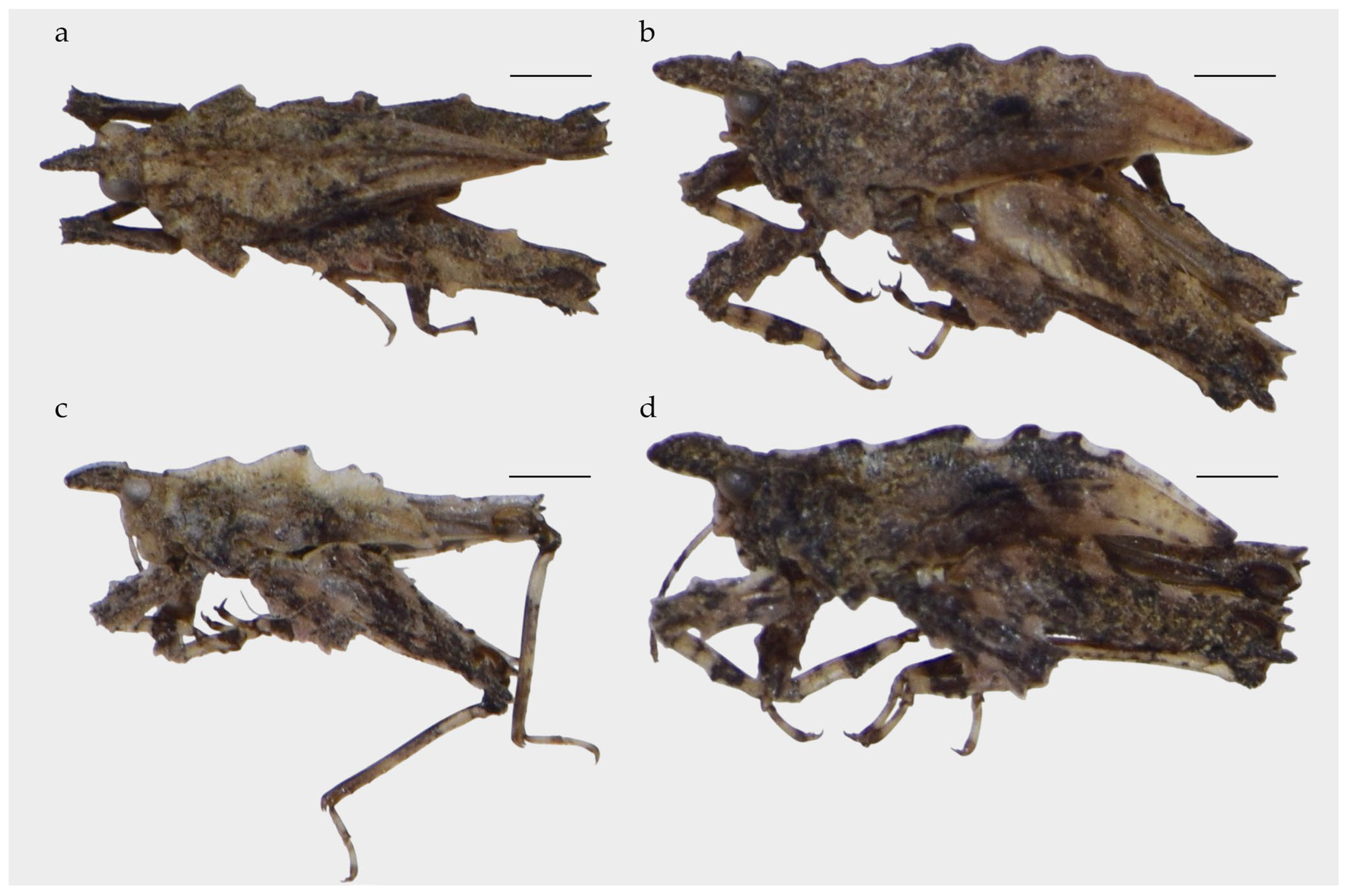
Additional material. Four nymphs, same data as the holotype (Figure 3) (INABIO).
Figure 1.
Type series of Miriatra michellae sp. nov. (a) ♀PT lateral view; (b) ♀PT dorsal view; (c) ♀PT dorsal view; (d) ♂HT dorsal view; (e) ♂HT lateral view; (f) ♀PT lateral view; (g) ♀PT lateral view; (h) ♀PT head and pronotum in lateral view; (i) ♂HT abdomen tip in lateral view; (j) ♂HT frontal view; (k) ♀PT frontal view; (l) ♀PT frontal view. Photo Felipe Campos. HT—holotype, PT—paratype.
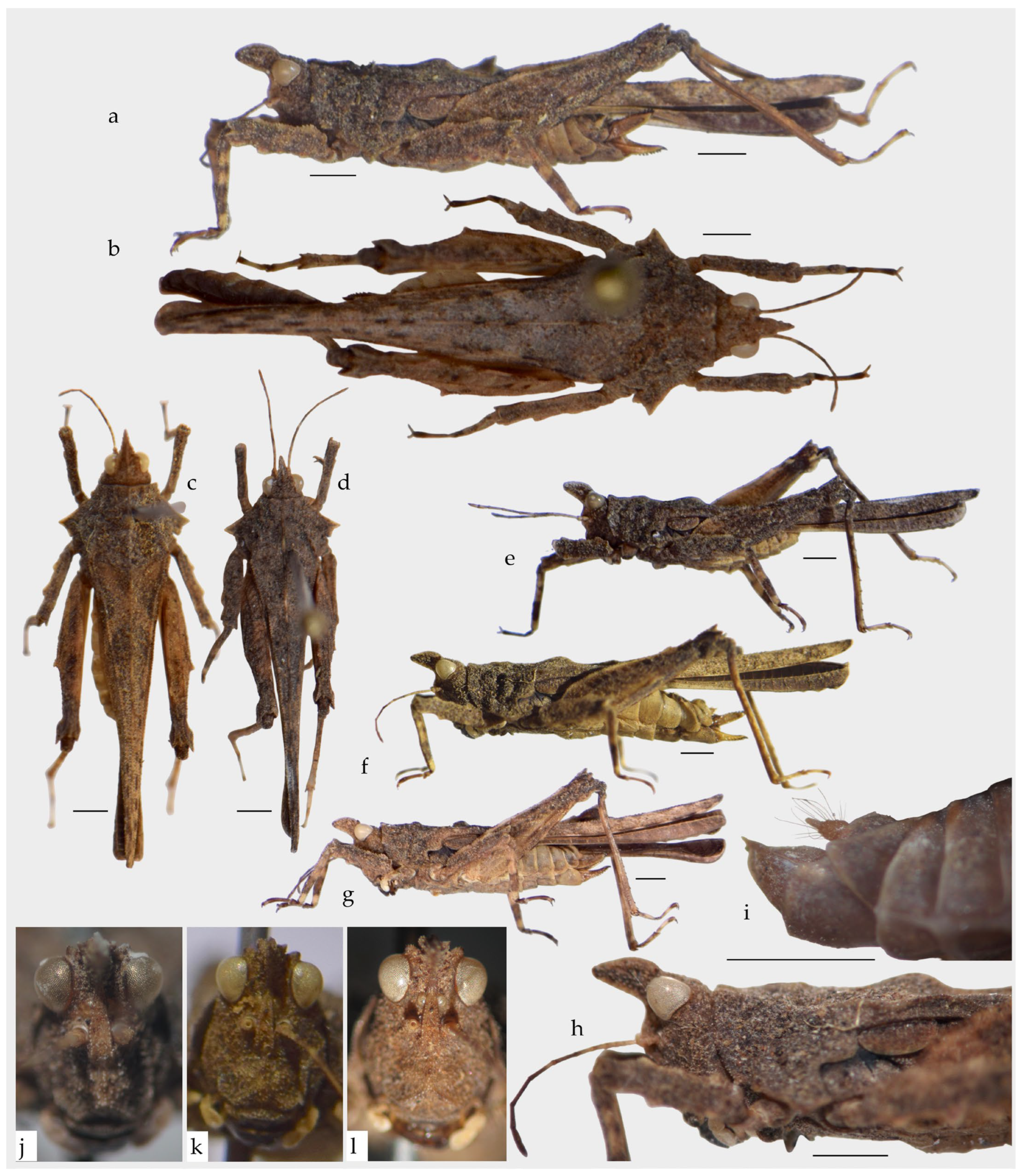
Figure 2.
Drawings of Miriatra michellae sp. nov. (A) Specimen in dorsal view; (B) dorsal view with the pronotum removed; (C) head in lateral view; (D) male terminalia; (E) female terminalia; (F) ventral view; (G) nymph; (H) pronotum in lateral view; (I) specimen in lateral view. Drawings by Michelle Rosas Ayala.
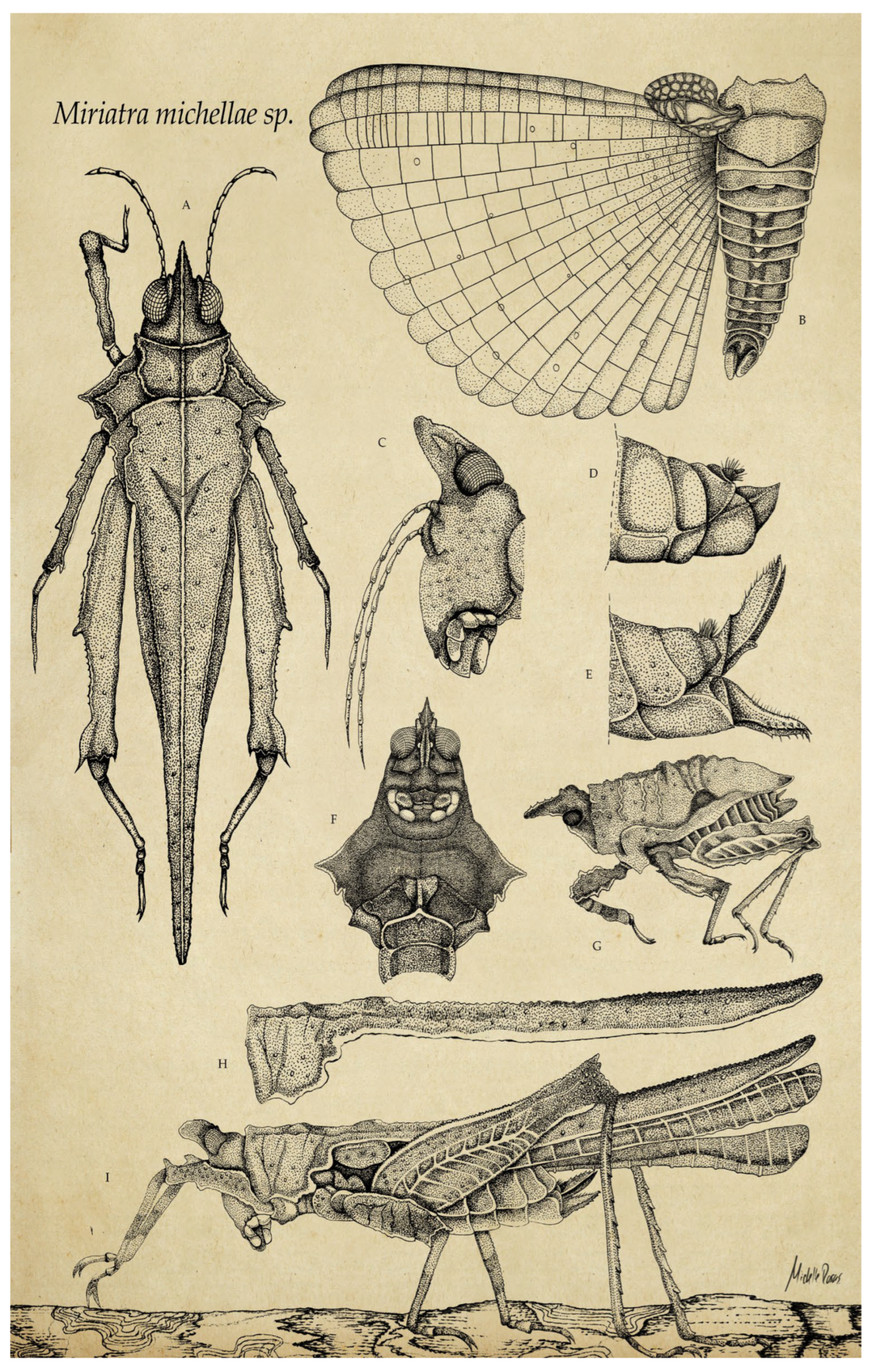
Etymology. The specific epithet is a feminine noun in the genitive. The species is named after Michelle Rosas Ayala, who provided detailed drawings of the two species described in this paper.
Type locality. Ecuadorian Amazon: Yasuní National Park.
Diagnosis. Miriatra michellae sp. nov. is most similar to M. producta in the shape of vertex but differs by elevated medial carina (low in M. producta), lateral lobes with an outer tooth (rectangular lateral lobes in M. producta), and a taller hind crest (very low in M. producta). Miriatra michellae sp. nov. differs from M. arawaka by the triangular vertex protrusion (narrow in M. arawaka) and toothed lateral lobes (rectangular in M. arawaka). Miriatra michellae sp. nov. differs from M. boliviana by the triangular vertex protrusion (long and narrow in M. boliviana) and taller hind crest than in M. boliviana. Miriatra michellae sp. nov. differs from M. chalazombra by the triangular vertex protrusion (narrow in M. chalazombra), by toothed lateral lobes (rectangular in M. chalazombra) and by lower crests than in M. chalazombra.
General characteristics
Size relatively large; females larger than males. Macropronotal and winged species with a conspicuous horn. Relatively robust in shoulders, but general appearance elongated. Body surfaces roughly granulated.
Head
In frontal view (Figure 1j–l): eyes ovoid; vertex elevated above the upper eye margins, with miter-shaped elevation in the middle; lateral carinae of vertex elevated into triangular horns; vertex 1.3–1.4 times wider than a compound eye; top margin of the antennal groove below the ventral margin of eye for one whole groove diameter length; frontal costa bifurcation at around upper third of eye height; frontal costa long, most of it placed on the elongated horn; paired ocelli placed between the lower margins of the compound eyes; scutellum as wide as an antennal groove or slightly wider; facial carinae divergent after the bifurcation, then almost parallel. In dorsal view (Figure 1b–d): eyes bean-shaped; vertex from 1.6 (males) to 2.2 times (females) wider than a compound eye; transverse carinae of the vertex situated approximately at the anterior margin of eyes, and anterior to them projected fastigium with compressed and projected medial carina, forming a triangular and serrated horn; horn with finely serrated margins; lateral and transverse carinae forming U-shape; occipital area wide as half of a compound eye length. In lateral view (Figure 1h): fastigium elevated above the vertex as a blunt laterally expanded horn; vertex level with pronotum; horn anterior to the eye about 1.3 times longer than a compound eye; occipital area narrow; facial carinae weakly projected forwards. Antennae long and filiform, composed of 15 antennomeres.
Pronotum
In dorsal view (Figure 1b–d): anterior margin truncated, straight; prozonal carinae parallel, a little rounded outwards in the middle, a bit shorter than an eye; median carina continuous throughout length of pronotum; interhumeral carinae absent; shoulders widened, angle between external lateral and humeroapical carina obtuse; pronotum exceeding hind femora for more than half of their length; lateral lobes strongly projected outwards, rectangular with a slightly indrawn middle part and the anterior edge forming a short spine. In lateral view (Figure 1a,e–g): median carina forming a lower elevation above the lateral lobes and a taller rounded one above tegmina and, behind it, a shallow depression; infrascapular area as wide as half of tegmen height, with parallel margins; tegminal sinus rectangular; ventral sinus acute with rounded angle, deeper than tegminal one.
Wings (Figure 1a,e–h)
Tegmina oval, typical size for Tetrigidae. Alae long but not reaching pronotal apex.
Legs (Figure 1a,e–h)
Anterior femora expanded; dorsal margin forming three elevations across its length, with the middle one being lower than other two; ventral margin forming two larger elevations in distal half. Middle femora expanded; dorsal margin forming two elevations, one in the middle, one in distal quarter; ventral margin forming elevations throughout its length. First tarsal segment of anterior and middle legs relatively short, with all three pulvilli visible. Hind femora robust (3.6–4.2 times as long as wide); genicular tooth small but sharp, antegenicular tooth blunt and barely perceptible. First segment of hind tarsus with three angular pulvilli (apices blunt and without teeth), distal one longer than proximal two. First and third tarsal segments approximately equal in length.
Nymphs (Figure 3)
Nymphs have short pronotum, wide infrascapular area, and no visible wings. The fastigial horn in nymphs appears larger in comparison to the head than it is in adults. Nymphs have a high and wavy median carina of pronotum, which becomes less wavy with each molt. Anterior two undulations seem to be homologous with the adults’ humps. All femora are more robust in nymphs and more elongated in adults. Fore and mid femora bear sharp horns, which become reduced in adults. Characteristic of all Tetrigidae nymphs, these nymphs also lack an antegenicular notch.
Figure 3.
Miriatra michellae sp. nov. nymphs. (a) Dorsal view; (b–d) lateral view. (a,c) show young nymphs, while (b,d) represent last instar nymphs. Scale bar 1 mm.
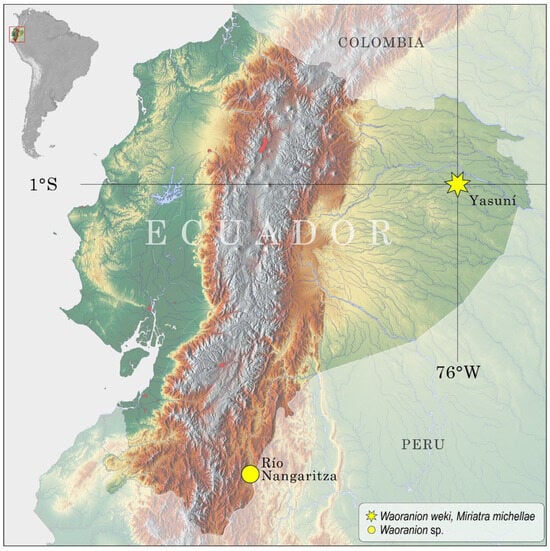
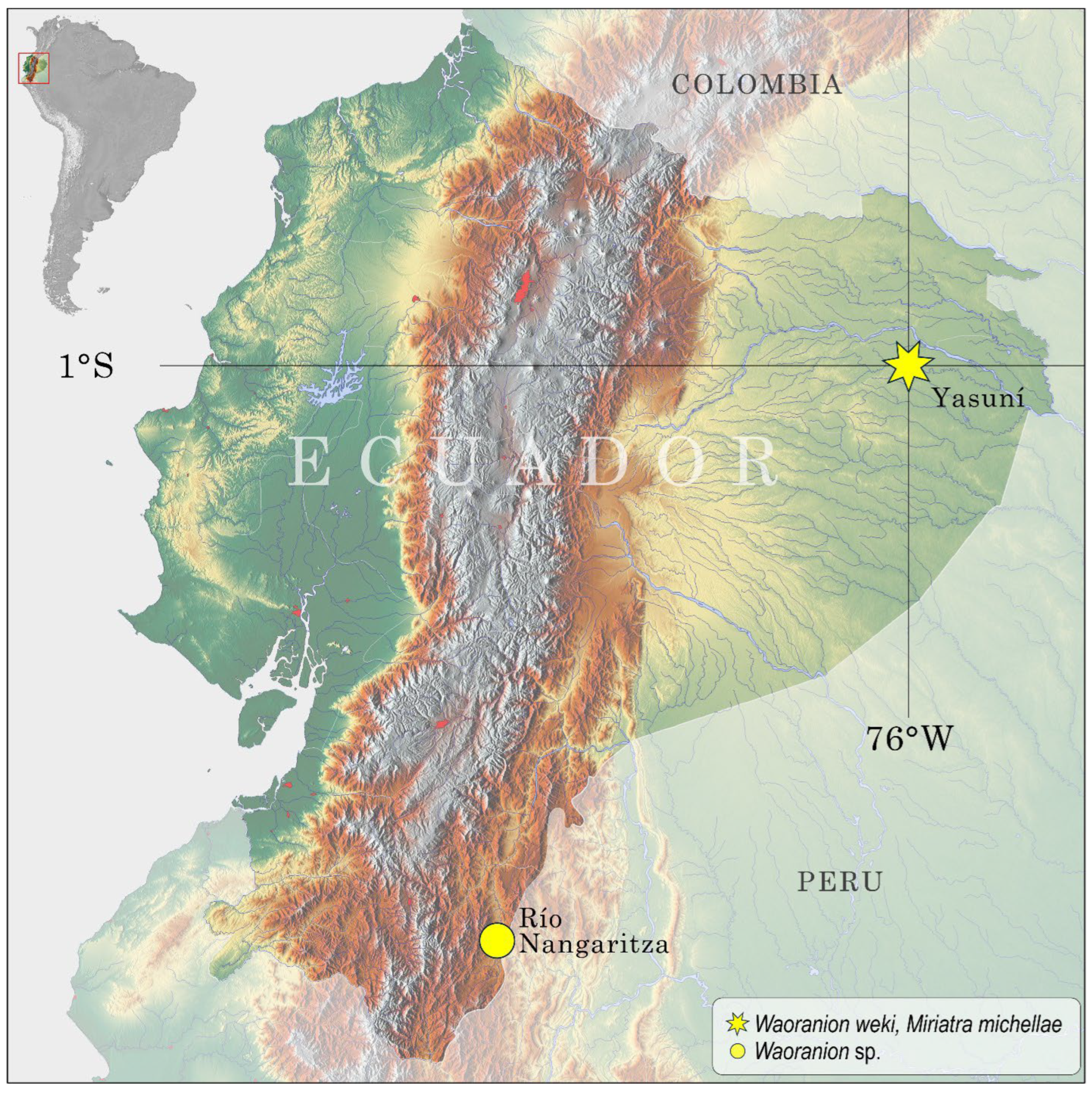
Distribution. Known only from the type locality, Yasuní National Park in Ecuador (Figure 4). This is the first record of the genus Miriatra from Ecuador [5,30].
Figure 4.
Geographical position of the type locality of Waoranion weki gen. et sp. nov. and Miriatra michellae sp. nov. (Yasuní National Park in Ecuador)—yellow star, and geographical location of Waoranion sp. observation (ID 310969617)—yellow circle. Image source: Topographic map of Ecuador, Wikimedia Commons, author OldBee, CCA-SA 4.0.
Measurements. See Table 1.
Table 1.
Measurements of Miriatra michellae sp. nov. and Waoranion weki gen. et sp. nov. Abbreviations are given in Section 2. HT—holotype, PT—paratype. Measurements are given in millimeters.
3.1.2. Genus Waoranion Kasalo, Campos & Skejo gen. nov.
urn:lsid:zoobank.org:act:ED9D5E3C-5B91-4F3F-832C-22180531CA1E
Vernacular name. Waorani Pygmy Unicorns
Type species. Waoranion weki sp. nov., by original designation and by monotypy.
Etymology. Named after the Waorani people from the Amazonian Region of Ecuador, who have for a long time been threatened by the oil industry and illegal logging. Waoranion is a nominative case noun of neuter gender.
Diagnosis. Waoranion gen. nov. is winged and has a long pronotum (macropronotal state). Pronotum and legs are similar in shape to other winged Metrodorini members, such as Miriatra and Brazitettix, but the combination of character states that make up its horn is unique among the known Tetrigidae. A massive saber-shaped horn of Waoranion gen. nov. is a projected vertex composed of the tip of the fastigium and the frontal costa. The horn is projected before the eyes for more than three eye lengths and has strongly undulated frontal costa, medial carina, and lateral carinae of the vertex.
Description. Currently inseparable from the type species description (see below).
Composition. Monotypic at the moment, including only W. weki sp. nov.
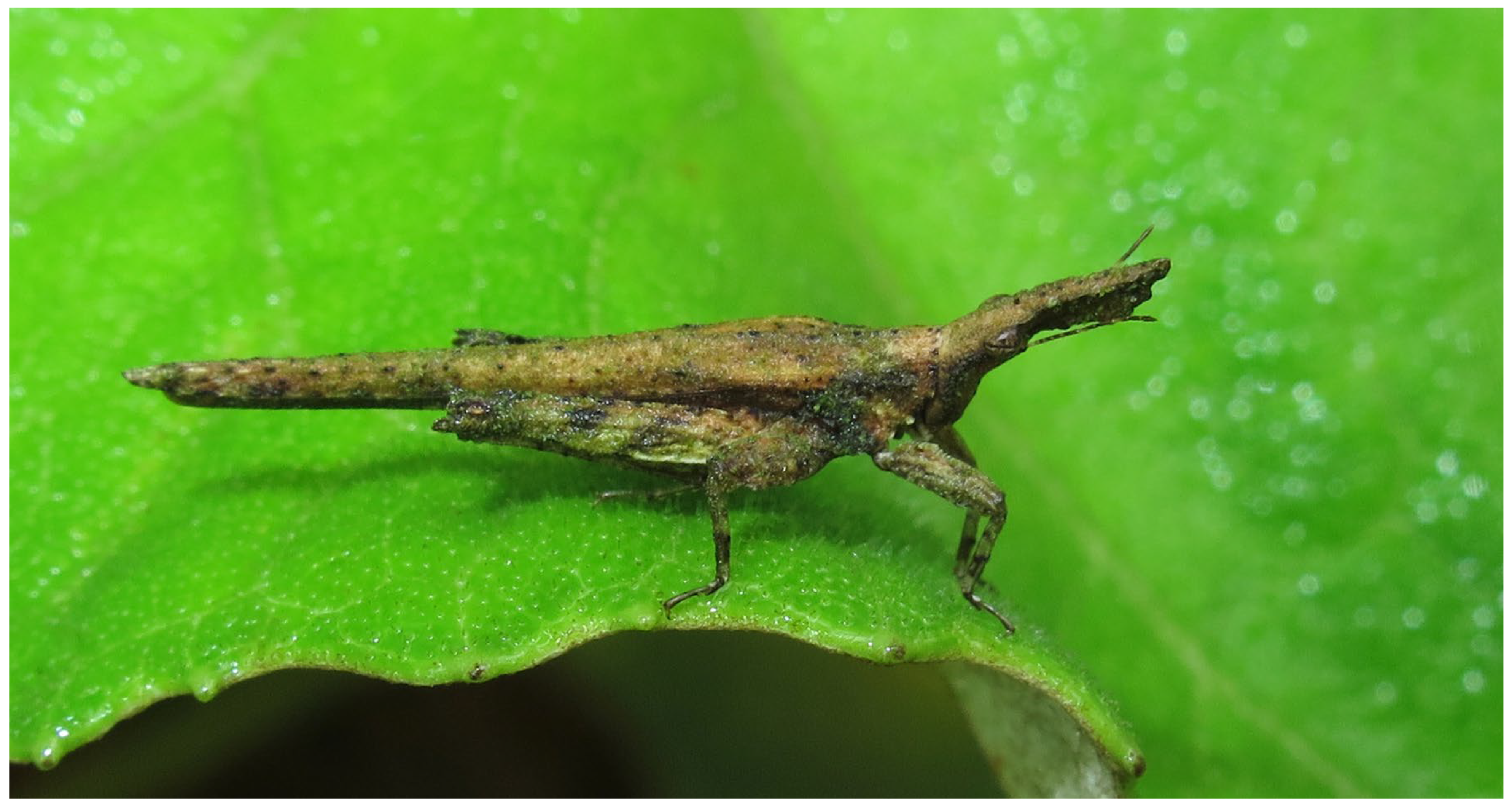
Distribution. Amazonian region of Ecuador, known from Yasuní National Park (W. weki gen. et sp. nov.) in northeastern Ecuador, and from Río Nangaritza canyon, Zamora (W. sp.) in southernmost Ecuador (Figure 4 and Figure 5). These two localities are around 480 km apart.
Figure 5.
The only photograph of a living Waoranion sp. From Río Nangaritza canyon (4.26429S, 78.64489W), Zamora Chinchipe, Ecuador, photographed on 24 November 2024, by Karen Nichols, uploaded to iNaturalist (observation ID 310969617), and reproduced with permission.
Species Waoranion weki Kasalo, Campos & Skejo sp. nov.
urn:lsid:zoobank.org:act:14C8C834-2987-4F38-B01E-2D6C632A0991
Vernacular name. Tear of the Waorani
Type series. 1 ♀ holotype Ecuador, Orellana, vía Pompeya Sur km 39, Parque Nacional Yasuní (00°39′26″ N, 76°27′11″ W), 221 m asl., 2006. leg. T. Erwin (Figure 6), MECN-FC-2122; 2 paratypes (1♀, 1♂) (INABIO), ♂ MECN-FC-2123, ♀ MECN-FC-2124.
Additional material. Four nymphs, same data as holotype (INABIO).
Etymology. The specific epithet is a noun in apposition. The word “weki”, meaning “tear”, is derived from the Waorani language and is meant to symbolize the suffering of the Waorani people. The word was chosen in consultation with the Waorani, conducted by FCY.
Type locality. Ecuadorian Amazon: Yasuní National Park.
Diagnosis. Top margin of antennal groove at level of ventral margin of eyes. Frontal costa highly modified, forming expanded, wavy, and thin feather-like structure at ventral side of fastigium. Hind femora distinctly slender.
General characteristics
Size relatively large; females larger than males. Arboreal and corticolous (bark-dwelling) cryptically colored pygmy grasshopper. Winged macropronotal species with a large horn and slender and long body. Body surfaces finely granulated.
Head
In frontal view: eyes ovoid and small; vertex strongly elevated above the upper eye margins for more than four eye heights, shaped as a sword with crenato-sinuate edges (=lateral carinae of the vertex); without visible horns on the vertex; vertex around 1.5 times wider than the eye; top margin of the antennal groove just below the level of the ventral eye margin; frontal costa highly modified, long and wavy, projected significantly above the eyes; frontal costa bifurcation seems to be between the lower third of the compound eyes, but its position is difficult to discern due to its modification; paired ocelli small and placed between the eyes; facial carinae divergent after the bifurcation, forming a wide scutellum that is as wide as a huge antennal scapus; between the antennal grooves, facial carinae form a shallow concavity. In dorsal view: eyes semicircular; surface of vertex finely tuberculated; vertex between the eyes around 2.5 times wider than an eye; transverse carinae of the vertex projected a little in front of eyes, discernable by rectangular carinae with rounded edges, which surpass the anterior margin of the eyes for half an eye length; medial carina evident; fastigium, medial carina of vertex and lateral carina of vertex highly projected anteriorly, forming a long laterally expanded and serrated (crenato-sinuate) horn; anterior margin of fastigium triangularly pointed; occipital area elongated, about 1.3 times as long as an eye. In lateral view: fastigium and frontal costa highly modified and elevated above the vertex into a horn that is more than one eye height; lateral carinae of the vertex finely serrated; frontal costa strongly compressed, with sinuate ventral margin; horn widest in its mid part; vertex slightly above the level of pronotum; horn before the eye more than 3.5 times longer than an eye; occipital area wide, eyes not touching pronotum; facial carinae slightly projected forwards. Antennae long and filiform.
Pronotum
In dorsal view: whole pronotal surface finely serrated and covered in tubercles; anterior margin of pronotum truncated, straight, and tuberculated; prozonal carinae parallel, difficult to see due to pronotum tuberculation, around 1.5 times longer than an eye; median carina continuous from the anterior margin to the posterior tip and tuberculated; interhumeral carinae absent; shoulders slender, with the angle between the external lateral and humeroapical carinae wide and blunt; pronotum exceeding hind knees almost for whole length of a hind femur; lateral lobes directed downwards and slightly sidewards, without spikes. In lateral view: pronotum disc almost flat, with median carina not elevated; infrascapular area relatively wide, almost as wide as the tegmen height, with parallel margins; median carina and lateral carinae finely serrated; tegminal sinus shallow; ventral sinus deep and rounded; tip of the lateral lobe triangular.
Wings
Tegmina small and oval. Alae reaching pronotal apex but not exceeding it (macropronotal state).
Legs
Anterior femora expanded; dorsal margin forming a serrated elevation in proximal half; ventral margin forming a tooth at the beginning of the distal third. Middle femora expanded; dorsal margin weakly undulated; ventral margin lobated, forming one small tooth in the proximal half and two small teeth in the distal half. First tarsal segment of anterior and middle legs elongated, with all three pulvilli clearly visible. Hind femora distinctly slender, around five times longer than wide; dorsal and ventral margins of the hind femora finely serrated; antegenicular tooth small and barely recognizable; antegenicular notch deep and evident; genicular tooth elongated and sharp. First segment of hind tarsus with three large and rounded pulvilli; distance between proximal and mid pulvilli larger than the distance between mid and distal pulvilli. First and third tarsal segments approximately equal in length.
Figure 6.
Type series of Waoranion weki gen. et sp. nov. and depictions of morphological details. (a) ♀HT lateral view; (b) ♀HT dorsal view; (c) ♀PT lateral view; (d) ♀PT dorsal view; (e) ♂PT lateral view; (f) ♂NT mid femur; (g) ♂NT head, lateral view; (h) ♂NT head, dorsal view; (i) ♂NT head, frontal view; (j) ♂NT palpi; (k) ♂NT hind tarsus. Photo Felipe Campos. HT—holotype, PT—paratype, NT—non-type. Scale bar 1mm.
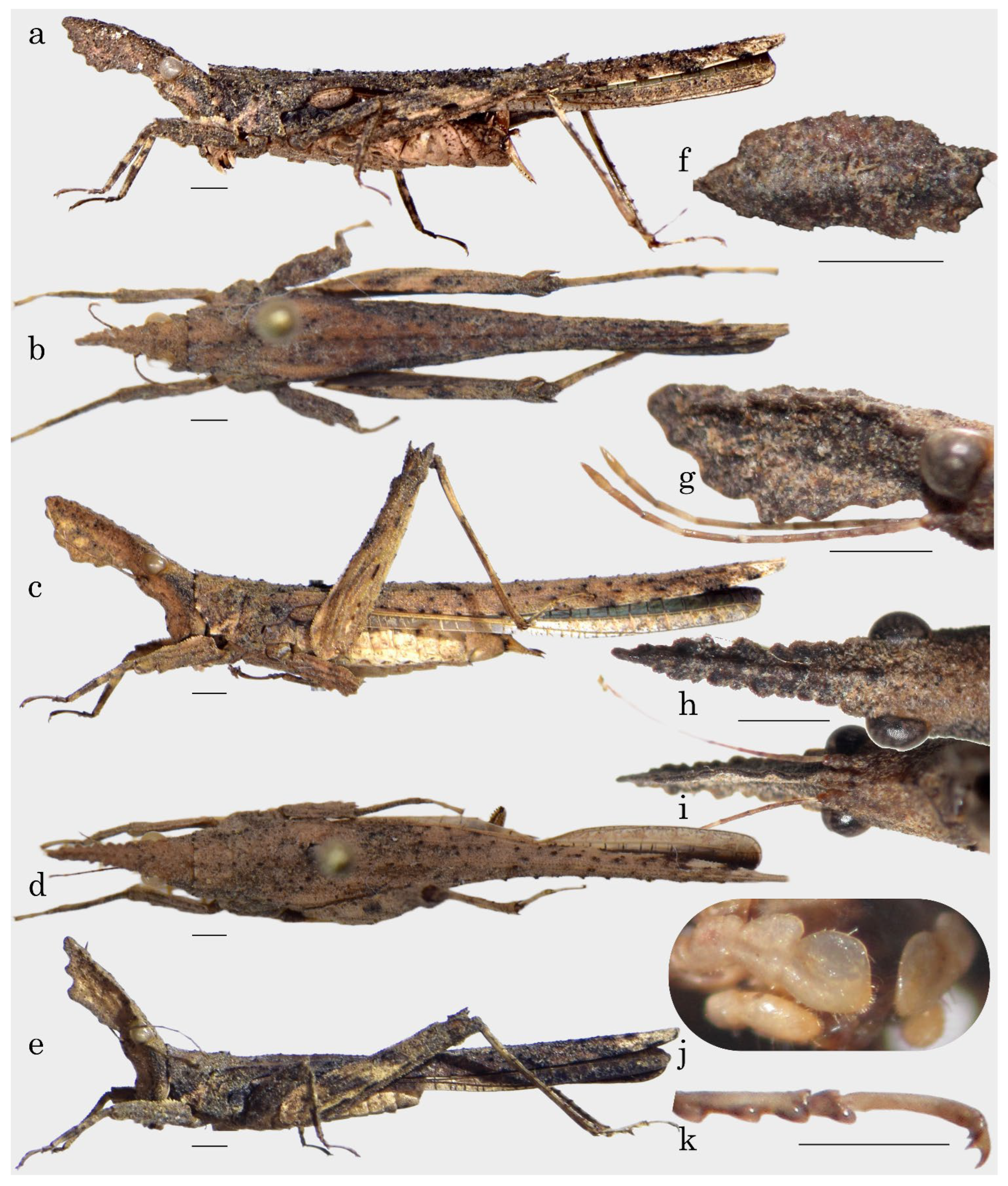
Figure 7.
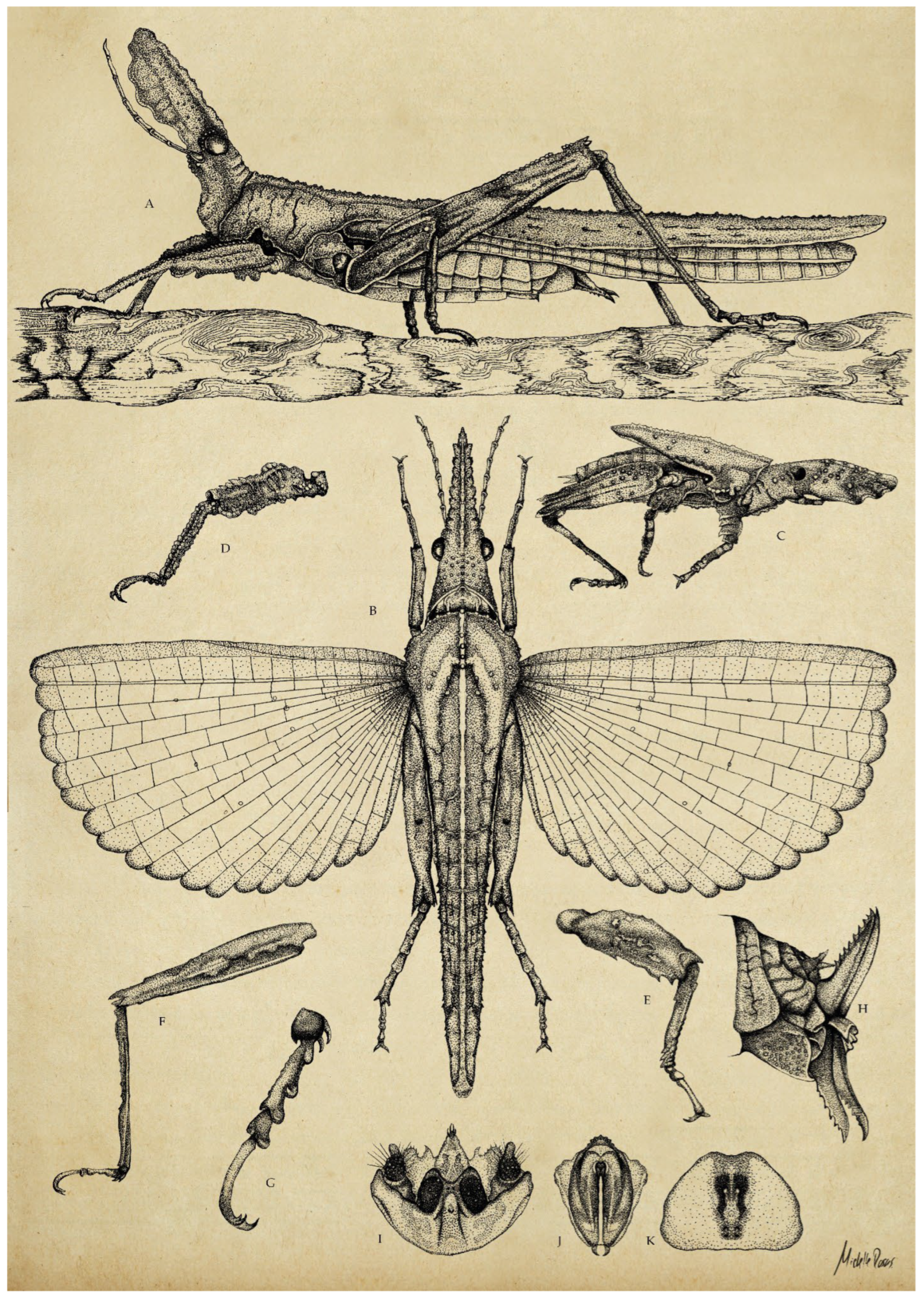
Drawings of Waoranion weki gen. et sp. nov. (A) Specimen in lateral view; (B) specimen in dorsal view; (C) nymph; (D) anterior leg; (E) middle leg; (F) hind leg; (G) hind tarsus, (H) female terminalia; (I–K) terminalia details. Drawings by Michelle Rosas Ayala.
Nymphs (Figure 8)
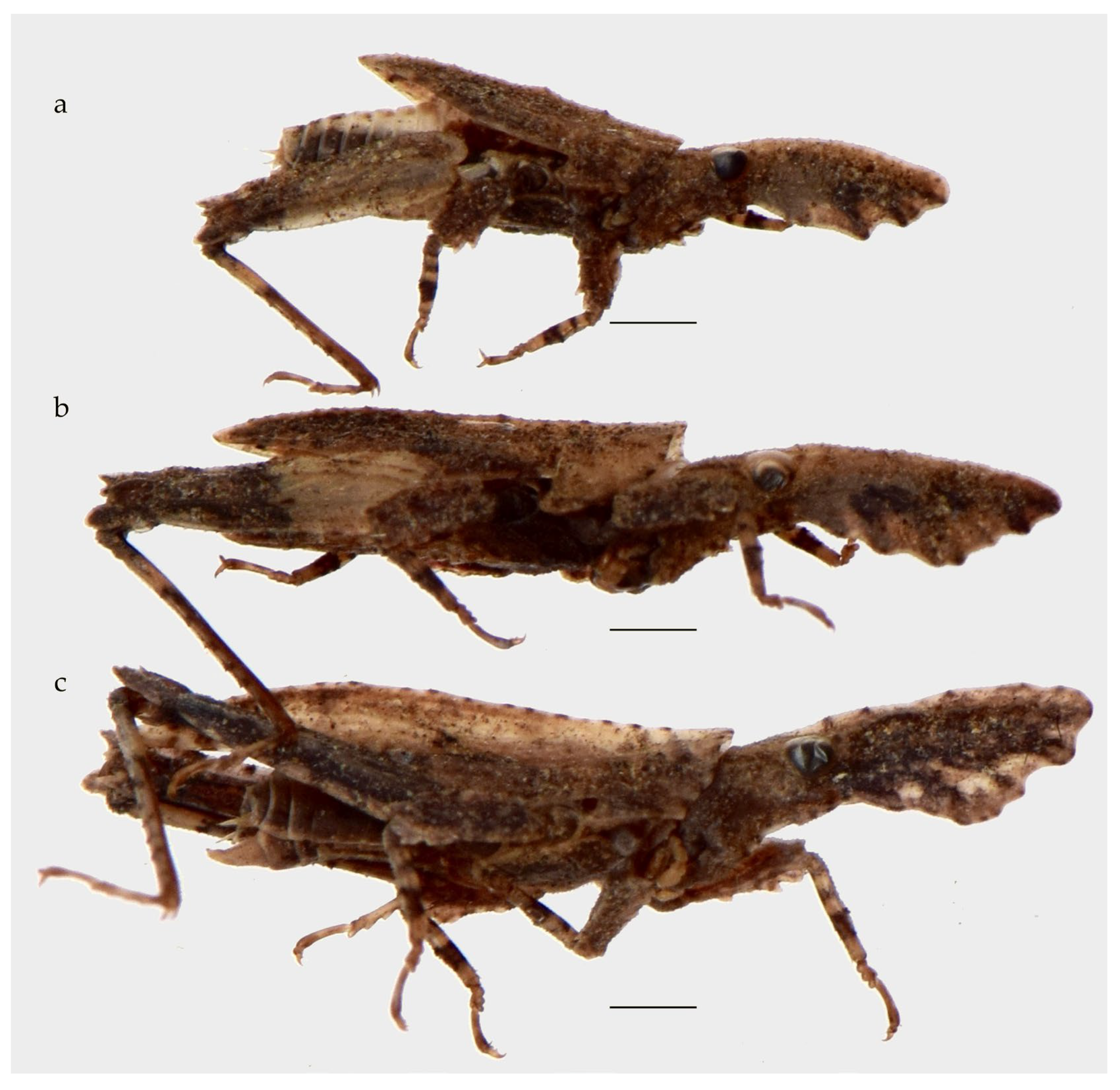
Nymphs similar to adults, except for the smaller size; lack of wings; shorter and smoother pronotum (not fully elongated); and more robust fore and mid femora. Fastigial horn already appears in very young nymphs and becomes longer, wider, directed more upwards, and more tuberculated with each molt.
Distribution. Known only from the type locality, Yasuní NP in Ecuador (Figure 4).
Measurements. See Table 1.
Figure 8.
Nymphs of Waoranion weki gen. et sp. nov. already have a highly specialized horn. It is notable that the horn becomes larger with each molt. (a) Young nymph, (b) pre-last instar nymph, (c) last instar nymph.
3.2. Checklist of Ecuadorian Tetrigidae
Altogether, 54 species (one represented by two subspecies) have been reported from Ecuador (Table 2). Taxonomically, these species are assigned to 23 genera, four tribes, and four subfamilies. The most diverse genera are Otumba Morse, 1900 [49] with six species; followed by Scaria Bolívar, 1887 [8] with five species; and Lophotettix Hancock, 1909 [25] and Crimisus Bolívar, 1887, with four species each.
Among the subfamilies, the most diverse is Metrodorinae with nine genera and 19 species, followed by Tetriginae with seven genera and 16 species (one represented by two subspecies), Batrachideinae with five genera and 13 species, and Lophotettiginae with two genera and six species.
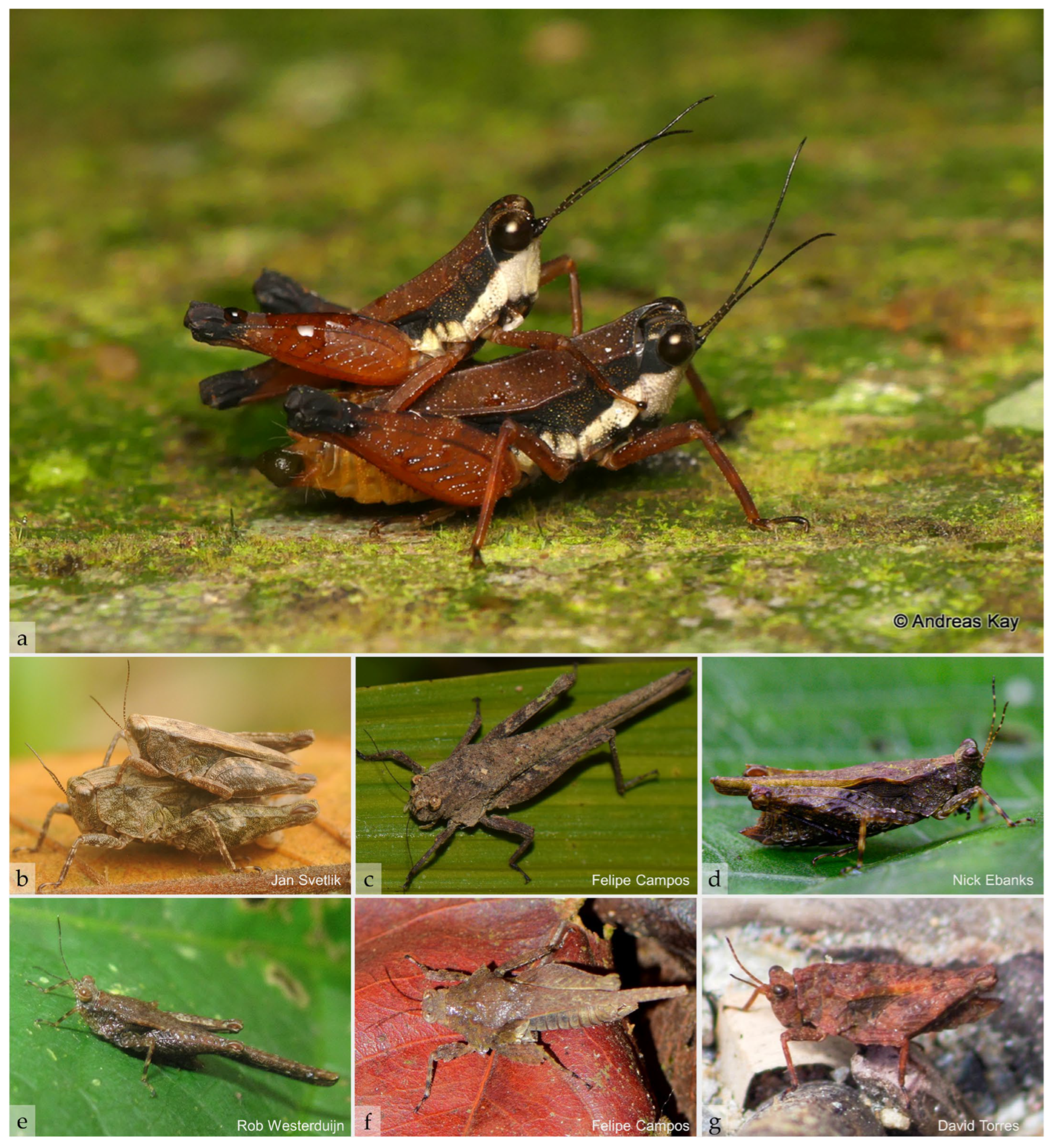
Species with records only from iNaturalist (one also from Flickr) and no otherwise published records can be regarded as the first faunistic records of these taxa from Ecuador (Figure 9). There are eight taxa fitting this criterion, and these are as follows:
New records: NE of Playayacu (0.377 S, 76.631 W) 15.VII.2009. Obs. David Torres (iNaturalist ID 24707146); Tena (0.994 S, 77.816 W) 28.IV.2019. Obs. Esnaider Guanga (iNaturalist ID 23645430); Tena (0.994 S, 77.814 W) 29.IV.2019. Obs. Anghe Reinoso (iNaturalist ID 24135798); Tena (0.975 S, 77.814 W) 29.IV.2019. Obs. Lucy Lu (iNaturalist ID 24141592); Tarapoa (0.121 S, 76.355 W) 20.IX.2021. Obs. Tatiana Chuncho (iNaturalist ID 95503361); Caño La Hormiga, Laguna Grande (0.011 S, 76.186 W) 16.VII.2022. Obs. Felipe Campos (iNaturalist ID 139706558).
Notes: The Ecuadorian Amazon is populated by the nominal subspecies, P. i. insolitus Rehn 1916 [50], also known from Peru, Brazil, Suriname [51], French Guiana [52], and Bolivia [53]. These are the westernmost known records of P. i. insolitus.
New records: Ecuadorian Amazon 19.IV.2017. Obs. Andreas Kay (Flickr, available at https://www.flickr.com/photos/andreaskay/38806686824 (accessed on 5 October 2025)); Tena: Parque Amazónico “La Isla” (0.993 S, 77.816 W) 28.IV.2019. Obs. Maythe Jarrin (iNaturalist ID 24050348); Tena (0.994 S, 77.819 W) 27.IV.2019. Obs. Damarys Daniela Tacuri (iNaturalist ID 23687144); Tena (0.996 S, 77.814 W) 26.IV.2019. Obs. Alex Marabunta (iNaturalist ID 23246289); N of Shell and Puyo (1.484 S, 78.041 W) 14.XI.2021. Obs. Mirka Andrade (iNaturalist ID 102861974).
Notes: Until now known only from the type locality in Peru—Cusco, Marcapata (13.5928 S, 70.9772 W), which is more than 1500 km from the closest Ecuadorian locality. These are the first records since 1956 [29].
New records: Putumayo, Cuya Beno Fauna Production Reserve (0.033 S, 76.320 W) 2.II.2019. Obs. Jan Svetlik (iNaturalist ID 37045589); S of Puyo 950 m a.s.l. (1.618 S, 77.840 W) 27.VII.2021. Obs. Eerika Schulz (iNaturalist ID 101776299).
Notes: Known from Peru (type locality eastern slopes of the Andes), Brazil, and Paraguay [5].
New records: Buenaventura, close to Moromoro river (3.654 S, 79.738 W) 4.IX.2021. Obs. David Díaz (iNaturalist ID 94892331); Reserva Las Tangaras (0.082 S, −78.769 W) 28.III.2021. Obs. Nick Ebanks (iNaturalist ID 87003502); Mindo: Sendero del Río (0.026 S, 78.759 W) 3.X.2020. Obs. David Díaz (iNaturalist IDs 80841662, 80841672); San Carlos (0.052 S, 78.762 W) 8.VII.2020. Obs. Gabriela Guerra (iNaturalist ID 52600750).
Notes: Described from Costa Rica and reported from Nicaragua [55], this is the first record of this species from the South American mainland. As we cannot determine whether these specimens represent a new species visually similar to O. scapularis, we use ‘cf.’ pending more detailed comparisons.
New record: Río Tiputini basin, Yasuní National Park (0.838 S, 75.581 W) 24.VIII.2019. Obs. F. Campos (iNaturalist ID 31760836).
Notes: Relatively widespread in South America—French Guiana [56], Colombia, Suriname, Guyana and Brazil [5,10,24,48].
Figure 9.
New Tetrigidae species in the Ecuadorian fauna. (a) Rehnidium necopinum, photo Andreas Kay, CC BY-NC-SA 2.0 license; (b) Tettigidea cuspidata, photo Jan Svetlik, CC-BY-NC; (c) Paurotarsus i. insolitus, photo Felipe Campos; (d) Otumba cf. scapularis, photo Nick Ebanks, CC-BY-NC license; (e) Stenodorsus extenuatus, photo Rob Westerduijn, CC-BY-NC; (f) Eomorphopus granulatus, photo Felipe Campos; (g) Paratettix freygessnerii, photo David Torres, CC-BY-NC license.
New records: Mera (1.467 S, 78.104 W) 19.III.2014. Obs. Rob Westerduijn (iNaturalist ID 75414437); Santa Clara (1.246 S, 77.881 W) 17.III.2014. Obs. Rob Westerduijn (iNaturalist ID 75293828); Yasuní National Park (0.638 S, 76.150 W) 2.XI.2013. Obs. iNaturalist user “catta” (iNaturalist ID 4131031).
Notes: Hitherto known only from Peru [53,57].
New records: SE of San Carlos (0.081 S, 78.740 W) 27.VIII.2020. Obs. Rudy Gelis (iNaturalist ID 57955283); Around Río Papallacta (0.383 S, 78.071 W) 17.I.2021. Obs. David Torres (iNaturalist ID 68293329); Around Quebrada Catana stream (4.272 S, 80.357 W) 12.VII.2021. Obs. Rudy Gelis (iNaturalist ID 88449617).
Notes: This overlooked species can be difficult to identify reliably. Until now known from California (USA), Cuba, Belize, El Salvador, and Nicaragua [5,55]. This is the first record of P. freygessnerii in the South American mainland.
(8) Waoranion sp. (Figure 5)
New record: Zamora Chinchipe: Río Nangaritza canyon (4.26429 S, 78.64489 W) 24.XI.2024. Obs. Karen Nichols (iNaturalist ID 310969617).
Notes: Most probably not the same species as W. weki gen. et sp. nov. Horn shape is different, and the locality is far away from the type locality of W. weki gen. et sp. nov.
Table 2.
A simple checklist of the Ecuadorian pygmy grasshoppers. For each species observed in Ecuador, the source of the occurrence records is provided.
Identification of three species remains ambiguous (Lophotettix cf. brevicristatus, L. cf. zumbadoi, and Otumba cf. scapularis), and two more species have not been identified to species level and most probably represent undescribed taxa (Waoranion sp., Plesiotettix sp.).
4. Discussion
4.1. Taxonomy of the Subtribe Miriatrina
In this study, we defined Miriatrina as a subtribe that contains genera in which the horn develops mostly from the medial carina, with a very slight impact of the fastigium elongation. The projected medial carina is also common across Metrodorina, although to a much smaller extent [5]. These two subtribes appear to be related not only due to the distinct morphology of medial carina projections but also due to the general facial morphology and the elevations of the median carina of the pronotum, which are placed in similar positions. Grantiatra and Rehniatra did not fit this pattern; so, we revised their taxonomic positions.
We moved Grantiatra and Rehniatra to Metrodorina, because in these genera, the medial carina of the vertex is just barely projected and is not at all laterally expanded, just like in many members of Metrodorina [5]. Rehniatra is peculiar in the sense that its lateral carinae of the vertex do not form C- or U-shapes like in most other Metrodorina but instead follow the shape of the wide and rounded vertex and connect to the barely projected medial carina. A similar shape can be observed only in Metrodora tani (Cadena-Castañeda & Tavares, 2025) [10] and to some extent in Metrodora parisae (Cadena-Castañeda & Tavares, 2025) [10], which in turn looks like Grantiatra douglasi Cadena-Castañeda & Tavares, 2025 [10] with a wide vertex. It is clear that Metrodorina will have to be revised in the near future.
Among the true Miriatrina, Waoranion gen. nov. is most similar to Brazitettix due to the shape of the horn in dorsal view, which is much less sharply serrated than in Miriatra. The median carina is also lower in these two genera than in Miriatra. The frontal costa of Waoranion gen. nov., however, is highly distinctive.
In the context of non-Metrodorina, Brazitettix has been noted as similar to Dravidacris Bhaskar & Kasalo, 2022 [2] and Rostella Hancock, 1913 [3,26]. While both genera are horned, the carinae of the vertex in Dravidacris are nearly completely reduced, which is in stark contrast with all of the Miriatrina genera, in which U-shaped carinae of the vertex are observable, even if highly modified. As noted earlier, there are multiple genera around the world with similar horn-like structures [2], but it is difficult to ascertain the relationships between them. For example, based on the morphology of the horn, Pseudomitraria Hancock, 1907 [24] appears somewhat similar to Brazitettix, but it could just as easily be attributed to Criotettiginae Kevan, 1966 [65,66] together with Rostella [66]. Future research should focus on obtaining molecular data on these taxa, since morphological data alone will not be able to provide the full picture of tetrigid evolution. In any case, South American Miriatra and Indian Indomiriatra Tinkham, 1939 [39], as well as Ecuadorian Waoranion gen. nov. and Indian Dravidacris, represent striking examples of morphological similarity that may reflect convergent evolution.
4.2. Diversity of Ecuadorian Tetrigidae
Altogether, 36 species in 17 genera were reported from Ecuador in the last checklist [30], and here, we report 54 species in 23 genera. Aside from new faunistic records of seven species (Table 2) found on iNaturalist [35] and two new species (Waoranion weki gen. et sp. nov. and Miriatra michellae sp. nov.), the increase in the species number in the last 18 years was also due to the taxonomic revision of Lophotettiginae, Batrachideinae, and Metrodorinae [9,33,67]. For some species, such as Rehnidium necopinum, new iNaturalist records [35] represent the first records in 70 years. Taxa that still lack a confident identification, i.e., Lophotettix cf. brevicristatus, Otumba cf. scapularis, Plesiotettix sp., and Waoranion sp. likely represent new species. Taking into account the high Ecuadorian biodiversity [68,69], the need for more thorough research on this group of insects in Ecuador is apparent. Some of the identification issues, such as Otumba cf. scapularis, need to be solved by means of molecular methods, which represent a good tool in discovering cryptic taxa [70].
The results from Yasuní National Park—one of the places with the highest biodiversity in the world [71]—clearly demonstrate that, despite the increase in research activities, pygmy grasshoppers of Ecuador remain poorly explored. Yasuní is situated in northeastern Ecuador and in the eastern Amazon basin. It covers an area larger than 10,200 km2, mostly covered in dense rainforest and rich in microhabitats because of the many canyons, creeks, streams, hills, and mountains. The discovery of a genus and two species new to science, together with several first national records, indicate that even well-studied conservation areas still harbor undescribed diversity. The continuous description of new species from various groups in Yasuní National Park [72,73,74,75,76] highlights its significance as one of the world’s biodiversity hotspots. This highlights the need for intensified taxonomic and faunistic research on Ecuadorian pygmy grasshoppers.
Author Contributions
All authors (N.K., F.C.Y. and J.S.) contributed equally to all parts of this study: conceptualization, methodology, validation, formal analysis, investigation, resources, data curation, writing—original draft preparation, writing—review and editing, visualization. All authors have read and agreed to the published version of the manuscript.
Funding
This research was funded by the Faculty of Science, University of Zagreb, with institutional support funds granted to J.S.
Data Availability Statement
All the data are presented in the study. For more information, please contact the authors of the study.
Acknowledgments
We are grateful to Michelle Rosas Ayala for the beautiful and accurate drawings, to Sebastian Ćato for the help with checklist compilation, to Karen Nichols for permission to use the photograph of Waoranion in its natural habitat, and to Tomislav Domazet-Lošo, Damjan Franjević, and Karolina Pipinić for discussion, proofreading, comments, and suggestions. We are grateful to all photographers who upload their observations of pygmy grasshoppers to iNaturalist.
Conflicts of Interest
The authors declare no conflicts of interest.
Abbreviations
The following abbreviations are used in this manuscript:
| HT | Holotype |
| INABIO | Instituto Nacional de Biodiversidad |
| OSF | Orthoptera Species File |
| PT | Paratype |
| PTs | Paratypes |
References
- Silva, D.S.M.; Skejo, J.; Pereira, M.R.; De Domenico, F.C.; Sperber, C.F. Comments on the recent changes in taxonomy of pygmy unicorns, with description of a new species of Metopomystrum from Brazil (Insecta, Tetrigidae, Cleostratini, Miriatrini). ZooKeys 2017, 702, 1–18. [Google Scholar] [CrossRef] [Scilit] [PubMed]
- Bhaskar, D.; Sankararaman, H.; Kasalo, N. Dravidacris annamalaica gen. et sp. nov., a new pygmy unicorn grasshopper (Orthoptera: Tetrigidae) from South India. Zootaxa 2022, 5196, 420–432. [Google Scholar] [CrossRef] [Scilit] [PubMed]
- Silva, D.S.M.; Pereira, M.R. A new genus of horn-like tetrigids (Orthoptera: Caelifera: Tetrigidae) from South America. Insecta Mundi 2024, 1072, 1–15. [Google Scholar]
- Pavon-Gozalo, P.; Manzanilla, J.; García-París, M. Taxonomy and morphological characterization of Allotettix simoni (Bolívar, 1890) and implications for the systematics of Metrodorinae (Orthoptera: Tetrigidae). Zool. J. Linn. Soc. 2012, 164, 52–70. [Google Scholar] [CrossRef] [Scilit]
- Cigliano, M.M.; Braun, H.; Eades, D.C.; Otte, D. Orthoptera Species File, Version 5.0/5.0. Available online: http://Orthoptera.SpeciesFile.org (accessed on 20 September 2026).
- Luo, J.; Zhang, R.; Deng, W. First mitogenomic characterization of Macromotettixoides (Orthoptera, Tetrigidae), with the descriptions of two new species. ZooKeys 2024, 1195, 95–120. [Google Scholar] [CrossRef] [Scilit] [PubMed]
- Li, Y.; Leng, S.; He, J.; Deng, W.; Guan, D. Mitochondrial phylogenomics of pygmy grasshoppers (Orthoptera, Tetrigidae, Metrodorinae): Descriptions of a new genus, two new species, and new synonyms from China. ZooKeys 2025, 1236, 249–281. [Google Scholar] [CrossRef] [Scilit] [PubMed]
- Bolívar, I. Essai sur les Acridiens de la tribu des Tettigidae. Ann. Soc. Entomol. Belg. 1887, 31, 175–313. [Google Scholar]
- Kasalo, N.; Yong, S.; Rebrina, F.; Skejo, J. Definition of the tribe Metrodorini (Orthoptera: Tetrigidae) with notes on biogeography and evolution of Metrodorinae and Cladonotinae. Acta Entomol. Musei Natl. Pragae 2023, 63, 187–193. [Google Scholar] [CrossRef] [Scilit]
- Cadena-Castañeda, O.J.; Quintana-Arias, R.F.; Infante, I.C.; Silva, D.S.M.; Tavares, G.C. Studies on pygmy grasshoppers: On the current Metrodorinae sensu lato classification (Orthoptera: Tetrigidae) with emphasis on American and Malagasy taxa. Zootaxa 2025, 5597, 1–265. [Google Scholar] [CrossRef] [Scilit] [PubMed]
- Kasalo, N.; Devriese, H.; Desutter-Grandcolas, L.; Hugel, S.; Husemann, M.; Storozhenko, S.Y.; Heads, S.W.; Thomas, M.J.; Doucet, G.; Itrac-Bruneau, R.; et al. Towards improved taxonomic standards in Orthoptera: Critical examination of Cadena-Castañeda et al. (2025b) and proposed synonymies. Contrib. Entomol. 2026, 76, 161–177. [Google Scholar] [CrossRef] [Scilit]
- Silva, D.S.M.; Cadena-Castañeda, O.J.; Pereira, M.R.; De Domenico, F.C.; Sperber, C.F. New tribes, overview and checklist of Neotropical Cladonotinae (Orthoptera: Caelifera: Tetrigidae). Insecta Mundi 2019, 723, 1–38. [Google Scholar]
- Cadena-Castañeda, O.J.; Cardona-Granda, J.M. Introducción a los Saltamontes de Colombia (Orthoptera: Caelifera: Acrididea: Acridomorpha, Tetrigoidea & Tridactyloidea); Lulu Press: Raleigh, NC, USA, 2015; 534p. [Google Scholar]
- Bolívar, I. Rectificaciones y observaciones ortopterológicas. Bol. R. Soc. Esp. Hist. Nat. 1906, 6, 384–393. [Google Scholar]
- Erwin, T.L.; Pimienta, M.C. Monitoreo Biológico Yasuní. Vol. 6. Insectos Arbóreos; Ecuambiente Consulting Group: Quito, Ecuador, 2018. [Google Scholar]
- Erwin, T.L.; Pimienta, M.C.; Murillo, O.E.; Aschero, V. Mapping patterns of β-diversity for beetles across the western Amazon Basin: A preliminary case for improving inventory methods and conservation strategies. Proc. Calif. Acad. Sci. 2005, 56, 72–85. [Google Scholar]
- Rice, M.E. Terry L. Erwin: She had a black eye and in her arm she held a skunk. Am. Entomol. 2015, 61, 9–15. [Google Scholar] [CrossRef] [Scilit]
- Servat, G.P. Terry L. Erwin and the race to document biodiversity (1940–2020). ZooKeys 2021, 1044, 3–22. [Google Scholar] [CrossRef] [Scilit] [PubMed]
- Tumbrinck, J. Taxonomic revision of the Cladonotinae (Orthoptera: Tetrigidae) from the islands of South-East Asia and from Australia, with general remarks to the classification and morphology of the Tetrigidae and descriptions of new genera and species from New Guinea and New Caledonia. In Biodiversity, Biogeography and Nature Conservation in Wallacea and New Guinea; Telnov, D., Ed.; Entomological Society of Latvia: Riga, Latvia, 2014; Volume 2, pp. 345–396. [Google Scholar]
- Kasalo, N.; Skejo, J. The smallest Australian Tetrigidae (Orthoptera): Taxonomic revision of Peraxelpa Sjöstedt, 1932 with the descriptions of three new genera and eleven new species. Ann. Soc. Entomol. Fr. 2024, 60, 515–546. [Google Scholar] [CrossRef] [Scilit]
- International Commission on Zoological Nomenclature. International Code of Zoological Nomenclature, 4th ed.; The International Trust for Zoological Nomenclature: London, UK, 1999; 306p. [Google Scholar]
- Schneider, C.A.; Rasband, W.S.; Eliceiri, K.W. NIH Image to ImageJ: 25 years of image analysis. Nat. Methods 2012, 9, 671–675. [Google Scholar] [CrossRef] [Scilit] [PubMed]
- Giglio-Tos, E. Viaggio del Dr. Enrico Festa nella Republica dell’Ecuador et regioni vicine. VI. Ortotteri. Boll. Mus. Zool. Anat. Comp. R. Univ. Torino 1898, 13, 1–108. [Google Scholar] [CrossRef] [Scilit]
- Hancock, J.L. Orthoptera Fam. Acridiidae. Subfam. Tetriginae. In Genera Insectorum; Wytsman, P., Ed.; V. Verteneuil & L. Desmet: Bruxelles, Belgium, 1907; Volume 48, pp. 1–79. [Google Scholar]
- Hancock, J.L. XIX. Further studies of the Tetriginaæ (Orthoptera) in the Oxford University Museum. Trans. Entomol. Soc. Lond. 1909, 56, 387–426. [Google Scholar] [CrossRef] [Scilit]
- Hancock, J.L. Studies of Tetriginae (Acrydinae) from Sarawak Museum, Borneo. Sarawak Mus. J. 1913, 1, 39–54. [Google Scholar]
- Hebard, M. Studies in the Dermaptera and Orthoptera of Ecuador. Proc. Acad. Nat. Sci. Phila. 1924, 76, 109–248. [Google Scholar]
- Günther, K. Revision der Acrydiinae (Orthoptera), III. Sectio Amorphopi (Metrodorae Bol. 1887, aut.). Abh. Ber. Staatl. Mus. Tierkd. Völkerkd. Dresd. 1939, 20, 16–335. [Google Scholar]
- Grant, H.J., Jr. The taxonomy of Batrachidea, Puiggaria, Lophoscirtus, Eutettigidea and Rehnidium n. gen. (Orthoptera: Acridoidea, Tetrigidae). Trans. Am. Entomol. Soc. 1956, 82, 67–108. [Google Scholar]
- Buzzetti, F.M.; Devriese, H. Tetrigidae from Ecuador (Orthoptera: Caelifera: Tetrigoidea). Atti Accad. Roveretana Agiati B 2007, 7, 41–54. [Google Scholar]
- Buzzetti, F.M.; Carotti, G. Annotated list of the Caelifera of Ecuador (Insecta: Orthoptera). In Biodiversity of South America, I (Memoirs on Biodiversity 1); Giachino, P.M., Ed.; World Biodiversity Association Onlus: Verona, Italy, 2008; pp. 39–66. [Google Scholar]
- Pavlović, M.; Božičević, L. Flickr kao Znanstvena Baza: Upotreba Mrežnog Servisa za Pohranu Slika u Istraživanju Biogeografije i Taksonomije Trnovratki (Orthoptera: Tetrigidae); Rector’s Award Paper; Faculty of Science, University of Zagreb: Zagreb, Croatia, 2019. [Google Scholar]
- Kasalo, N.; Bertner, P.; de Rueda, J.A.G.; Skejo, J. The true nature of the genus Lophotettix Hancock, 1909 (Orthoptera: Tetrigidae): A brief taxonomic revision. Ann. Zool. 2022, 72, 223–234. [Google Scholar] [CrossRef] [Scilit]
- Kasalo, N.; Husemann, M.; van de Kamp, T.; Skejo, J. Description of Phelene reinschmidti from Ecuador with notes on the subfamily Lophotettiginae (Orthoptera, Tetrigidae). Evol. Syst. 2024, 8, 119–125. [Google Scholar] [CrossRef] [Scilit]
- iNaturalist. Occurrence Dataset: Tetrigidae of Ecuador. Available online: https://inaturalist.org/observations?place_id=7512&subview=map&taxon_id=57657 (accessed on 5 October 2025).
- Rambur, P. Orthoptères. In Faune Entomologique de l’Andalousie; Bertrand: Paris, France, 1838; Volume 2, pp. 12–94. [Google Scholar]
- Rehn, J.A.G. Studies in the orthopterous subfamilies Acrydiinae (Tettiginae), Eumastacinae and Proscopinae. Proc. Acad. Nat. Sci. Phila. 1904, 56, 658–683. [Google Scholar]
- Kirby, W.F. A Synonymic Catalogue of Orthoptera (Orthoptera Saltatoria, Locustidae vel Acridiidae); British Museum (Natural History): London, UK, 1910; Volume 3, 674p. [Google Scholar]
- Tinkham, E.R. Revision of the genera Rhopalotettix Hancock, Rostella Hancock and allied and similar genera (Orthoptera, Acridiae, Acrydiinae). Lingnan Sci. J. 1939, 18, 329–339, 463–474. [Google Scholar]
- Rafinesque, C.S. Analyse de la Nature ou Tableau de L’univers et des Corps Organisés; Aux Dépens de L’auteur: Palermo, Italy, 1815; 224p. [Google Scholar]
- Müller, J. Über die Jugendzustände einiger Seethiere. Ber. K. Preuss. Akad. Wiss. Berl. 1851, 468–474. [Google Scholar]
- Rehn, J.A.G. A new grouse-locust of the genus Miriatra from British Guiana (Orthoptera: Acrididae, Acrydiinae). Not. Naturae 1939, 25, 1–6. [Google Scholar]
- Liang, G.-Q.; Zheng, Z.-M. A new genus and a new species of Tetrigidae from Mt. Nankun of Guangdong province. Acta Entomol. Sin. 1985, 28, 83–84. [Google Scholar]
- Paris, M. Catálogo de tipos de ortopteroides (Insecta) de Ignacio Bolívar, I: Blattaria, Mantodea, Phasmoptera y Orthoptera (Stenopelmatoidea, Rhaphidophoroidea, Tettigonioidea, Grylloidea, Tetrigoidea). Eos Rev. Esp. Entomol. 1994, 69, 143–264. [Google Scholar]
- Yin, X.-C.; Shi, J.; Yin, Z. Synonymic Catalogue of Grasshoppers and Their Allies of the World (Orthoptera: Caelifera); China Forestry Publishing House: Beijing, China, 1996; 1266p. [Google Scholar]
- Otte, D. Orthoptera Species File 6. Tetrigoidea and Tridactyloidea (Orthoptera: Caelifera) and Addenda to OSF Vols. 1–5; The Orthopterists’ Society and The Academy of Natural Sciences of Philadelphia: Philadelphia, PA, USA, 1997; 261p. [Google Scholar]
- Storozhenko, S.Y. Review of the pygmy grasshoppers of the tribe Cleostratini (Orthoptera: Tetrigidae). Far East. Entomol. 2016, 326, 1–44. [Google Scholar]
- Bruner, L. South American Tetrigidae. Ann. Carnegie Mus. 1910, 7, 89–143. [Google Scholar] [CrossRef] [Scilit]
- Morse, A.P. The Acrididae. Subfamily Tettiginae. In Biologia Centrali-Americana. Insecta. Orthoptera; Bruner, L., Morse, A.P., Shelford, R., Eds.; R.H. Porter: London, UK, 1900; Volume 2, pp. 3–19. [Google Scholar]
- Rehn, J.A.G. The Stanford expedition to Brazil. 1911, Dermaptera and Orthoptera I. Trans. Am. Entomol. Soc. 1916, 42, 215–308. [Google Scholar]
- Grant, H.J., Jr. Notes on the Neotropical Tetrigid genus Paurotarsus Hancock, including the description of two new subspecies (Orthoptera: Acridoidea). Not. Naturae 1955, 275, 1–14. [Google Scholar]
- Itrac-Bruneau, R.; Doucet, G. Apport des collections du Muséum national d’Histoire naturelle et de Didier Morin à la connaissance des Batrachideinae et Lophotettiginae (Orthoptera, Tetrigidae) de Guyane. Zoosystema 2023, 45, 601–634. [Google Scholar] [CrossRef] [Scilit]
- iNaturalist. Occurrence Dataset: Tetrigidae of South America. Available online: https://www.inaturalist.org/observations?place_id=97389&subview=map&taxon_id=57657 (accessed on 5 October 2025).
- Scudder, S.H. Notes on Orthoptera from northern Peru, collected by Professor James Orton. Proc. Boston Soc. Nat. Hist. 1875, 17, 257–282. [Google Scholar]
- Kasalo, N.; Naskrecki, P.; Rebrina, F.; Skejo, J. Central American Tetrigidae Rambur, 1838 (Orthoptera): A preliminary catalogue. Zoosystema 2023, 45, 177–212. [Google Scholar] [CrossRef] [Scilit]
- Itrac-Bruneau, R.; Doucet, G. Contribution à la connaissance des Tetrigidae (Orthoptera) de Guyane. Zoosystema 2022, 44, 405–421. [Google Scholar] [CrossRef] [Scilit]
- Hancock, J.L. Description of new genera and species of the orthopterous tribe Tettigidae. Entomol. News 1906, 17, 86–91. [Google Scholar]
- Latreille, P.A.; Le Peletier de Saint-Fargeau, A.L.M.; Serville, J.G.A.; Guérin-Méneville, F.E. Encyclopédie Méthodique, ou par Ordre de Matières. Histoire Naturelle. Entomologie, ou Histoire Naturelle des Crustacés, des Arachnides et des Insectes; Agasse: Paris, France, 1825; Volume 10, 832p. [Google Scholar]
- Walker, F. Catalogue of the Specimens of Dermaptera Saltatoria in the Collection of the British Museum; British Museum: London, UK, 1871; Volume 5, pp. 811–850. [Google Scholar]
- De Geer, C. Mémoires Pour Servir à L’histoire des Insectes; Pierre Hesselberg: Stockholm, Sweden, 1773; Volume 3, 696p. [Google Scholar]
- Barranco, P. Ortópteros de la Reserva Biológica Alberto Manuel Brenes (Costa Rica) II. Orthoptera: Caelifera. Bol. Soc. Entomol. Aragon. 2010, 47, 21–32. [Google Scholar]
- Serville, J.G.A. Histoire Naturelle des Insectes. Orthoptères; Librairie Encyclopédique de Roret: Paris, France, 1838; pp. 1–776. [Google Scholar]
- Brunner von Wattenwyl, C. Die von ihrer Königl. Hoheit Prinzessin Therese von Bayern auf einer Reise in Südamerika gesammelten Insekten. II. Orthopteren. Berl. Entomol. Z. 1900, 45, 253–268. [Google Scholar]
- Saussure, H. De. Orthoptera nova americana (Diagnoses praeliminares). II. Rev. Mag. Zool. 1861, 2, 126–130, 156–164, 313–324, 397–402. [Google Scholar]
- Kevan, D.K.M.E. Some Orthoptera-Caelifera from the Philippine, Bismarck and Solomon Islands, with a few interesting records from New Guinea and the Moluccas. Entomol. Medd. 1966, 34, 375–420. [Google Scholar]
- Subedi, M.; Kasalo, N.; Skejo, J. Definition of the pygmy grasshopper subfamily Criotettiginae (Orthoptera: Tetrigidae) with a preliminary catalogue of genera. Zool. Anz. 2025, 318, 133–151. [Google Scholar] [CrossRef] [Scilit]
- Silva, D.S.M.; Cadena-Castañeda, O.J.; Pereira, M.R. Batrachideinae (Orthoptera: Caelifera: Tetrigidae): An overview of the most diverse tetrigids of the Neotropical region. Zootaxa 2021, 4946, 1–84. [Google Scholar] [CrossRef] [Scilit] [PubMed]
- Myers, N.; Mittermeier, R.A.; Mittermeier, C.G.; da Fonseca, G.A.B.; Kent, J. Biodiversity hotspots for conservation priorities. Nature 2000, 403, 853–858. [Google Scholar] [CrossRef] [Scilit] [PubMed]
- Mestanza-Ramón, C.; Henkanaththegedara, S.M.; Vásconez Duchicela, P.; Vargas Tierras, Y.B.; Sánchez Capa, M.; Constante Mejía, D.; Jimenez Gutierrez, M.; Charco Guamán, M.; Mestanza Ramón, P. In-situ and ex-situ biodiversity conservation in Ecuador: A review of policies, actions and challenges. Diversity 2020, 12, 315. [Google Scholar] [CrossRef] [Scilit]
- Tan, M.K.; Storozhenko, S.Y.; Hwang, W.S.; Meier, R. Integrative taxonomy reveals two sympatric species of the genus Eucriotettix Hebard, 1930 (Orthoptera: Tetrigidae). Zootaxa 2017, 4268, 377–394. [Google Scholar] [CrossRef] [Scilit] [PubMed]
- Bass, M.S.; Finer, M.; Jenkins, C.N.; Kreft, H.; Cisneros-Heredia, D.F.; McCracken, S.F.; Pitman, N.C.A.; English, P.H.; Swing, K.; Villa, G.; et al. Global conservation significance of Ecuador’s Yasuní National Park. PLoS ONE 2010, 5, e8767. [Google Scholar] [CrossRef] [Scilit] [PubMed]
- Ghia Quezada, T.A. Nueva especie de Tortopus Needham & Murphy (Ephemeroptera: Polymitarcyidae) en la provincia de Orellana, Ecuador: New species of Tortopus Needham & Murphy (Ephemeroptera: Polymitarcyidae) in the province of Orellana, Ecuador. Acta Zool. Lilloana 2022, 66, 149–159. [Google Scholar] [CrossRef] [Scilit]
- Peñaherrera-R., P.; Cisneros-Heredia, D.F. A new species of spider of the genus Sadala Simon, 1880 (Araneae, Sparassidae) from the Yasuni Biosphere Reserve, Amazonian lowlands of Ecuador. Ecol. Evol. 2023, 13, 1–6. [Google Scholar] [CrossRef] [Scilit] [PubMed]
- Toapanta-Alban, C.E.; Ordoñez, M.E.; Barnes, C.W.; Blanchette, R.A. Taxonomy of the major rhizomorphic species of the “Melanopus group” within Polyporaceae in Yasuní National Park, Ecuador. PLoS ONE 2021, 16, e0254567. [Google Scholar] [CrossRef] [Scilit] [PubMed]
- Escobar-Camacho, D.; Valdiviezo-Rivera, J.; Carrillo-Moreno, C.; Argüello, P.; Swing, K. Exceptional concentration of fish diversity in Yasuní National Park, Ecuador (Napo River Basin). Biodivers. Data J. 2025, 13, e136476. [Google Scholar] [CrossRef] [Scilit] [PubMed]
- Tapuy-Avilés, Y.; Díaz-Guevara, D.R.; Caterino, M.S. First record of Bibrax Fletcher, 1927 (Coleoptera, Staphylinidae, Pselaphinae) from Ecuador, with descriptions of twelve new species. ZooKeys 2025, 1250, 105–133. [Google Scholar] [CrossRef] [Scilit] [PubMed]

Disclaimer/Publisher’s Note: The statements, opinions and data contained in all publications are solely those of the individual author(s) and contributor(s) and not of MDPI and/or the editor(s). MDPI and/or the editor(s) disclaim responsibility for any injury to people or property resulting from any ideas, methods, instructions or products referred to in the content. |
© 2026 by the authors. Licensee MDPI, Basel, Switzerland. This article is an open access article distributed under the terms and conditions of the Creative Commons Attribution (CC BY) license.