


Simple Summary
Mosquitoes spread diseases that affect millions of people worldwide. New genetic and biological control strategies offer promising approaches to reducing mosquito populations and disease transmission. These include sterile insect techniques, CRISPR-based systems such as pgSIT and gene drives, and Wolbachia-based methods. Their success can depend on local genetic variation, mosquito movement, mating, and population structure. In this review, we explain how population genetic surveys, field measurements, experiments, and modeling can guide the design of these technologies, the selection of release locations and strategies, and the evaluation of their effectiveness. We emphasize that different approaches require different evidence and that genomic data alone cannot predict field performance. By connecting genetic information with practical decisions and monitoring, this review provides a framework for developing more effective and responsible mosquito control programs.
Abstract
Population genomics can improve the design, deployment, and monitoring of genetic mosquito control strategies by revealing how genetic variation, population structure, and movement influence intervention outcomes. Here, we present a decision-oriented framework for integrating population-genetic information into conventional sterile insect technique (SIT), female-specific release of insects carrying a dominant lethal (fsRIDL), CRISPR-based precision-guided SIT (pgSIT), homing gene drives, and Wolbachia-based population suppression and modification strategies. Although these approaches differ in their mechanisms and intended outcomes, their effectiveness can be influenced by population connectivity, immigration, and local ecological conditions. Additional constraints are intervention-specific, including functional resistance alleles that can compromise homing gene drives, mating competitiveness and sex-sorting requirements for incompatible insect technique (IIT), and reproductive compatibility, maternal transmission, and pathogen-blocking efficacy for Wolbachia population modification. We describe how population-genomic surveys, functional assays, movement measurements, contained experiments, and spatial modeling can guide target selection, release-stock preparation, deployment planning, and surveillance. Importantly, we distinguish demonstrated field outcomes, including mosquito suppression and reductions in dengue incidence following Wolbachia-based interventions, from gene-drive outcomes that remain limited to laboratory and contained studies. We emphasize that genomic data alone cannot establish biological compatibility, predict field efficacy, or demonstrate epidemiological benefit. Instead, population-genetic measurements should inform locally parameterized models, predefined performance endpoints, and testable decision criteria evaluated against independent observations. Integrating population genomics with intervention-specific validation and prospective monitoring provides a practical framework for translating genetic mosquito control technologies toward responsible field deployment.
1. Introduction
Mosquito-borne pathogens, including those responsible for malaria, dengue, Zika, chikungunya, and yellow fever, remain a major global public-health burden, particularly where vector control is central to disease prevention [1,2,3,4]. Insecticide-treated nets, indoor residual spraying, ultra-low-volume adulticide and larvicide applications [5], and source reduction have reduced transmission in many settings, but their effectiveness can be constrained by insecticide resistance, operational challenges, urbanization, and environmental change [6,7]. Integrated vector management (IVM) provides a framework for selecting and coordinating control methods according to local vector ecology, epidemiological evidence, and operational resources [8]. Complementary genetic and symbiont-based approaches include conventional sterile insect technique (SIT) [9,10], Female-Specific Release of Insects carrying a Dominant Lethal (fsRIDL) [11,12], CRISPR/Cas9-based precision-guided SIT (pgSIT) [13,14,15,16,17,18], CRISPR-based homing gene drives [19,20], Wolbachia-based incompatible insect technique (IIT) for population suppression [21,22,23,24], and Wolbachia population modification for pathogen blocking [25].
These approaches can be broadly categorized according to their intended population-level outcomes. Population suppression strategies aim to reduce mosquito abundance or reproductive capacity, thereby decreasing vector populations. In contrast, population modification (also referred to as population replacement) strategies aim to alter the genetic or biological characteristics of mosquito populations, such as reducing their ability to transmit pathogens, without necessarily reducing mosquito abundance. Conventional SIT, fsRIDL, pgSIT, and Wolbachia-based IIT are primarily population suppression strategies, whereas Wolbachia-mediated pathogen blocking is a population modification strategy. Importantly, homing-based gene drives can be engineered for either population suppression, through reduced survival or fertility, or population modification, through the spread of traits that impair pathogen transmission. Wild mosquito populations vary in target sequences [26], resistance phenotypes, population structure [27,28], and connectivity. Such variation can alter intervention outcomes even when a system performs well in the laboratory. Target-site polymorphisms may reduce CRISPR/Cas9 cleavage [29,30], population connectivity can influence spread, confinement, or immigration [31,32], and DNA repair coupled with selection can favor functional escape genotypes [30,33]. Laboratory colonies may capture only a fraction of this diversity [34], underscoring the need to evaluate candidate interventions in the context of genetically and geographically representative populations.
Previous reviews have examined genetic biocontrol technologies and resistance evolution [13,33,35,36,37,38,39], while Schmidt et al. (2021) provided a broader synthesis of how population genomics can inform mosquito invasions, insecticide resistance, and rear-and-release programs [40]. However, less attention has been given to how population-genetic information can be translated into actionable decisions across different genetic control strategies. Here, we address this gap by providing an intervention-specific, decision-oriented framework linking population-genetic measurements to the design, deployment, and monitoring of genetic and symbiont-based mosquito control. Specifically, we make three contributions. First, we distinguish the biological requirements, population-genetic dependencies, and potential failure modes of self-limiting suppression approaches (SIT, fsRIDL, pgSIT, and IIT), gene drives, and Wolbachia-based population modification. Second, we connect population-genetic and ecological measurements to intervention-specific decisions, including molecular target selection, release-stock preparation, geographic coverage, and surveillance. For Wolbachia-based approaches, infection dynamics, reproductive compatibility, and release-stock genetic background introduce additional considerations [31,40,41]. Third, we propose a prospective validation framework in which locally measured parameters inform testable forecasts, predefined performance endpoints, and operational decision triggers that can be evaluated against independent observations. Importantly, we distinguish what can be inferred from population-genomic surveys from what requires functional assays, contained experiments, mathematical models, field trials, or epidemiological evaluation. Rather than treating population genomics as a stand-alone predictor of intervention success, we provide a practical framework for translating genetic information into actionable design, deployment, and monitoring decisions, with explicit recognition of the limitations of each evidence type (Figure 1; Table 1).
Figure 1.
Population genetics-informed design, deployment, and monitoring of genetic mosquito control strategies. Population-genetic measurements guide intervention-specific decisions across population suppression approaches (SIT, fsRIDL, pgSIT, Wolbachia-based IIT, and suppression gene drives) and population modification approaches (Wolbachia-mediated pathogen blocking and modification gene drives). Gene drives, including homing-based systems, can be engineered for either population suppression or population modification depending on their molecular architecture and intended outcome. Target-site haplotypes, population connectivity, and demographic characteristics inform genetic design, release strategies, and surveillance planning. Field surveys, functional assays, contained experiments, and mathematical models provide complementary but distinct sources of evidence. Genetic and entomological monitoring evaluates observed outcomes against predefined predictions and informs subsequent refinement of intervention strategies. The feedback arrow from “Monitor and Adapt” to “Design and Test” emphasizes the iterative nature of the framework, whereby surveillance outcomes can inform adjustments to intervention design, deployment strategies, and subsequent monitoring. Arrows represent conceptual relationships and decision pathways rather than experimentally demonstrated efficacy or validated predictions of field performance.
Scope and Approach of This Narrative Review
This article is a narrative review synthesizing published research on the application of population genetics and genomics to genetic and symbiont-based mosquito control. The interventions examined were selected to represent distinct mechanisms of action, inheritance patterns, and population-level dynamics, including self-limiting suppression strategies, homing and threshold-dependent gene drives, and Wolbachia-based population modification. These differences provide a basis for comparing how population-genetic information informs intervention design, deployment, and monitoring.
The review draws on representative population-genomic surveys, functional and mechanistic studies, laboratory and contained population experiments, mathematical models, and field evaluations. Studies were considered particularly relevant when they identified intervention-specific biological constraints, provided experimental or field evidence of performance, or demonstrated how population-genetic measurements could inform operational decisions. This is a narrative rather than a systematic review or meta-analysis; consequently, the literature discussed is illustrative rather than exhaustive, and no pooled estimates of intervention effectiveness are presented. The objective is to synthesize the available evidence into a framework identifying the measurements, uncertainties, and validation steps needed to support intervention-specific decisions.
2. Standing Genetic Variation: Hidden Constraints on Targeting
Standing genetic variation can constrain target sequence selection used for a control before release. Wild mosquito populations harbor geographically heterogeneous target-site diversity [26,42,43,44], and even a single nucleotide change within a guide RNA binding site or adjacent motif can reduce CRISPR/Cas9 cleavage [26,45,46]. Resistant haplotypes may therefore predate an intervention and go undetected when constructs are designed and optimized in genetically narrow laboratory colonies [34,47,48]. Sequence variation alone, however, does not establish resistance. Whether a variant constitutes functional resistance depends on its position, guide-specific effects on cleavage, consequences for target-gene function, and associated fitness costs. In homing drives, alleles that reduce cleavage while preserving target-gene function can be favored by repeated cleavage and selection [30,49,50], whereas variants that disrupt an essential gene may carry substantial fitness costs. Reduced cleavage can impair drive conversion or HDR in homing systems, illustrating how evolutionary constraints and molecular design jointly influence the performance and durability of CRISPR-based mosquito biocontrol strategies [35]. By contrast, pgSIT releases sterile males whose intended phenotype is generated before release and does not depend on continued cleavage or inheritance in the wild population; target site integrity in the wild population is therefore not a determinant of field efficacy. Conventional irradiation-based SIT likewise has no CRISPR target in the released population; its principal constraints instead include male competitiveness, release ratio, and immigration [51,52].
For CRISPR-based interventions, particularly homing gene drives, design should begin with geographically and seasonally representative surveys of candidate target sites coupled with functional testing. Where feasible, these systems should favor conserved, functionally constrained loci and may incorporate multiple guide RNAs to reduce dependence on a single cleavage site [14,15,16,17,18,26,42,53,54]. Comparative genomics and functional annotation can identify candidate loci that are conserved across wild populations, but sequence conservation is only the first step: field-derived haplotypes should subsequently be evaluated for cleavage, repair outcomes, gene function, phenotype, and fitness in relevant genetic backgrounds [14,15,16,17,18,26,42,45]. Cell-type-resolved transcriptomic resources, including the Ae. aegypti Mosquito Cell Atlas, can complement comparative genomic analyses by identifying tissue- and cell-specific expression patterns that inform candidate target prioritization and subsequent functional validation [55]. These considerations are particularly relevant to homing gene drives, where target-site variation and resistance evolution can directly influence drive performance. In contrast, pgSIT generates the intended sterile phenotype before release, so wild-population target-site variation does not constitute the same field resistance mechanism. Other approaches, including conventional SIT and Wolbachia-based interventions, require different genetic and ecological assessments, such as release-stock compatibility, mating competitiveness, and population connectivity. Laboratory and semi-field experiments can further reveal mating or performance costs that sequence data alone cannot detect [47,48,56].
Sampling depth and statistical power are equally important when interpreting apparent target conservation. Under ideal independent sampling, the probability of detecting at least one copy of a variant present at frequency p among n sampled alleles is [57]. Thus, a variant present at 1% frequency has approximately a 63% probability of being observed among 100 sampled alleles and a 95% probability among 300. In practice, relatedness among samples, uneven geographic coverage, seasonality, sequencing depth, and assay error can further reduce detection probability. Surveys should therefore report the numbers of mosquitoes, alleles, and sites sampled; sampling dates and geographic coverage; quality-control criteria; and the variant frequencies they were adequately powered to detect. Failure to observe a variant in a single colony, locality, or season should not be interpreted as evidence of invariance. These measurements can guide target selection and define the initial genetic conditions for an intervention, while population movement determines whether locally observed variation remains localized or becomes a regional constraint (Box 1).
Box 1. Population-genetic measurements and their limits.
Genomic surveys can estimate target-site haplotype frequencies and quantify the statistical power to detect rare variants [57]. The fixation index (FST) describes genetic differentiation among sampled populations, reflecting the combined effects of demographic history, genetic drift, migration, and selection rather than contemporary movement alone. Estimates of effective population size (Ne) help characterize the potential influence of genetic drift but should not be interpreted as census population size or direct measures of dispersal. Ancestry and admixture analyses can identify evidence consistent with population mixing, although such patterns do not necessarily establish ongoing gene flow. All these inferences depend on sampling scale, season, marker choice, and analytical assumptions, particularly in recently invaded or insecticide-exposed populations [27,32,40].
The appropriate genomic approach should be selected according to the biological question. Genome-wide markers can resolve ancestry, population structure, and close-kin relationships; guide RNA target selection requires high-quality sequence information spanning the target site and adjacent protospacer-adjacent motif (PAM), where applicable; and identifying copy-number variants or inversions requires sequencing approaches and reference assemblies capable of resolving structural variation [40]. Reduced-representation datasets generated using different protocols may share relatively few markers [58], limiting comparisons across sites or studies [40]. Importantly, failure to detect a variant does not establish its absence from other locations, seasons, or unsampled populations. Similarly, evidence of admixture alone does not demonstrate contemporary fertile hybridization or viable introgression of an engineered construct.
Defining connectivity at the spatial scale relevant to releases therefore requires complementary evidence from direct measurements of mosquito movement, mating, and temporal population dynamics [40,59,60,61,62,63,64]. Likewise, candidate variants predicted to reduce CRISPR cleavage should not be classified as functionally resistant based on sequence information alone; cleavage susceptibility, target-gene function, and associated fitness effects require experimental evaluation. Population-genetic measurements are therefore most useful for identifying where and what to sample, informing intervention design, and prioritizing functional validation, rather than serving as stand-alone evidence for defining release boundaries.
3. Gene Flow and Spatial Population Structure
Standing genetic variation establishes local initial conditions, whereas movement determines how broadly that variation is shared among populations. Anopheles and Aedes populations can exhibit fine-scale genetic differentiation over relatively short distances, allowing target-site, resistance, and modifier-allele frequencies to differ even among neighboring populations [59,60,61,62]. Within the An. gambiae species complex, hybridization between An. gambiae sensu stricto (s.s) and An. coluzzii has been documented, although reproductive barriers and variation in hybrid fitness can limit the persistence of introgression [65]. Nevertheless, adaptive introgression has facilitated the transfer of insecticide-resistance alleles between these species, with subsequent selection contributing to changes in resistance-associated haplotype frequencies and local population composition in West Africa [66,67,68]. Notably, the spread of resistance-associated alleles coincided with the expansion of insecticide-treated bednet use, consistent with insecticide-mediated selection favoring advantageous introgressed variants [66]. In urban Ae. aegypti, fine-scale neighborhood structure can coexist with movement or human-assisted transport between otherwise differentiated populations [60,61,62,64]. Population-genomic analyses of Ae. albopictus across remote Pacific islands further illustrate the importance of characterizing geographic population structure when evaluating the design and deployment of genetic biocontrol interventions [69]. Release boundaries inferred solely from local population structure may therefore overlook transport-linked introductions [70,71], and sampling and surveillance should include plausible source populations and transport corridors where such movement is relevant. Importantly, none of these patterns provides a universal estimate of dispersal. Surveys should span relevant habitat nodes and seasons, distinguish contemporary adult movement from longer-term introgression, and characterize connectivity among populations relevant to release and surveillance planning. Figure 2 illustrates how species composition, local movement, and transport-linked connectivity can define different sampling and release questions in Anopheles and Aedes.
Figure 2.
Conceptual population structure and connectivity in Anopheles and Aedes. (A) Species composition varies among sites within the An. gambiae complex, with blue representing An. gambiae, orange representing An. coluzzii, and purple representing An. arabiensis. (B) Urban populations of Ae. aegypti (green) may exhibit connectivity among neighborhoods through local dispersal and human-assisted transport. Solid dark arrows indicate hypothetical mosquito dispersal pathways between sites, whereas red dotted ar-rows indicate additional potential movement pathways that may be less direct or involve human-assisted transport. Importantly, mosquito dispersal does not necessarily imply gene flow, which requires successful reproduction and transmission of alleles between populations. Interspecific introgression additionally re-quires hybridization and the persistence of genetic material across species boundaries through subsequent generations. These distinctions are particularly relevant within the An. gambiae complex, where species may occur sympatrically but exhibit varying degrees of reproductive isolation, although introgression has been documented between An. gambiae and An. coluzzii [62,63,64,65]. Thus, all arrows represent hypothetical movement pathways rather than demonstrated interpopulation gene flow or interspecific introgression. All dots and arrows are schematic and do not represent measured species frequencies, dispersal rates, or genetic exchange. Local sampling and complementary genetic and ecological measurements are required to estab-lish actual connectivity [59,60,61,62,63,64].
Spatial structure can influence both intervention performance and deployment strategy. Target polymorphisms, genetic background, or expression context in field populations may differ from those in laboratory strains, while dispersal can spread a self-sustaining drive, introduce resistant alleles, or replenish populations undergoing self-limiting suppression [10,30,51,52,72,73,74,75]. Close-kin mark-recapture methods recovered dispersal and barrier parameters in simulated Ae. aegypti populations [76], while behavioral-state simulations demonstrate how resource-seeking behavior can generate spatially heterogeneous movement [77]. These results illustrate approaches for characterizing movement rather than providing transferable field dispersal estimates. Consistent with this need for local measurement, a field study of Ae. aegypti in a Malaysian apartment complex found that close-kin pairs were concentrated within the same or adjacent buildings, demonstrating fine-scale spatial structure relevant to release planning [40,78].
The consequences of connectivity also depend on intervention architecture. In continuous habitat, homing drives may spread as spatial waves, whereas in fragmented habitat, source–sink dynamics and asymmetric movement can produce heterogeneous establishment or local fade-out [72,79,80,81]. Threshold-dependent systems may fail to establish when local introduction frequencies remain below the required threshold [82,83,84]. Split-drive components occupy separate loci, limiting sustained propagation, although predicted confinement remains dependent on local demography and movement [83,85,86,87]. Highly connected populations may therefore require broader release and surveillance coverage, whereas more isolated populations may permit more localized strategies. Surveillance for resistance should likewise include populations connected to release sites by relevant migration pathways. For IIT, immigration can replenish fertile females following suppression [21,22,23]; for Wolbachia population modification, dispersal and local infection frequencies influence establishment and subsequent spatial spread [25,31,40]. Genomic data can identify candidate connections among populations, but release-scale connectivity, reproductive compatibility, and maternal transmission require direct measurement such as mark-release and recapture.
4. Resistance Evolution
Resistance is an expected evolutionary response to strong selection, but its origin, trajectory, and consequences depend on both the intervention architecture and the population in which it operates. In CRISPR/Cas9 gene drive systems, escape alleles can arise from standing target-site variation, de novo mutation, or repair following cleavage [26,30,42,45,88]. Error-prone non-homologous end joining (NHEJ) can generate insertions or deletions that disrupt guide recognition or the adjacent motif, whereas HDR can copy the drive; the relative frequency of these outcomes depends on nuclease expression and repair context [30,89,90,91,92,93]. Large populations also provide greater mutational opportunity, allowing initially rare functional escape alleles to become relevant under sustained selection [30]. Variants that reduce or prevent cleavage while preserving target gene function and fitness are particularly important because they can increase under drive-mediated selection. Their trajectories depend on selection strength, dominance, and fitness costs: dominant or partially dominant alleles are exposed to selection in heterozygotes, whereas recessive alleles may remain phenotypically masked until homozygous. Genetic drift becomes increasingly important when alleles are rare or suppression reduces population size, while migration can introduce or reseed resistance across connected populations.
Controlled studies demonstrate that resistance outcomes are system-specific rather than governed by a universal time to failure. Resistance reduced drive performance in some cage experiments and models [92,93,94,95,96,97], whereas a doublesex-targeting suppression drive eliminated age-structured cage populations without selecting detectable functional resistance [98]. However, subsequent work by Morianou et al. [99] demonstrated that even this highly optimized suppression drive can generate functional resistance alleles and encounter naturally occurring target-site variants that partially reduce drive activity. By combining surveys of standing and drive-induced doublesex variation with functional testing, population-genetic modeling, target redesign, and laboratory validation of multiplexed drives, the authors showed that rare resistant alleles could compromise the long-term effectiveness of single-target suppression drives at natural population sizes, despite their successful performance in laboratory cage experiments. Similarly, a resistant allele accumulated in one of several two-year An. gambiae population-modification cage replicates [100]. Together, these studies illustrate why sequence variation must be linked to functional evidence before an allele is classified as resistant and why predicted robustness at natural population scales requires prospective validation.
Resistance mechanisms also differ fundamentally among intervention architectures. Irradiation-based SIT has no CRISPR target and no sustained inheritance, although male competitiveness, immigration, and the need for repeated releases remain important determinants of suppression [10,51,52]. Similarly, pgSIT releases sterile males whose phenotype is generated before release and does not depend on continued cleavage or inheritance in the wild population. For homing gene drives, resistance alleles can be distinguished by their functional consequences: R1 alleles are cleavage-resistant variants that preserve target-gene function; R2 alleles are cleavage-resistant variants that disrupt target-gene function; and R3 alleles retain target-gene function but exhibit partial resistance to cleavage and drive conversion, as recently characterized by Morianou et al. [99]. These R1–R3 resistance classes describe target-site resistance in homing gene drives and do not directly apply to SIT, fsRIDL, pgSIT, or Wolbachia-based approaches. Confinable drive architectures require system-specific assessment of target variation, repair outcomes, and persistence [101,102]. Across propagating or partially propagating systems, selection intensity, release strategy, migration, mutation supply, and demography jointly determine whether resistance emerges and persists.
For homing drives, several design strategies can reduce the number of viable evolutionary escape routes. Multiplexing guide RNAs and targeting conserved, functionally constrained sequences can reduce the probability that a single functional variant prevents cleavage and compromises drive performance [53,54,99,103]. Cleave-and-rescue (ClvR) [104] and homing-based rescue architectures, including the home-and-rescue (HomeR) system [105], can couple organismal viability to the engineered construct by targeting an essential gene while providing a recoded rescue, thereby reducing the selective advantage of nonfunctional resistant alleles. Germline-restricted or appropriately timed nuclease activity aims to favor HDR over NHEJ, while haplolethal targets and reduced maternal carryover provide additional strategies [94,95,106,107,108,109]. The effectiveness of each approach must nevertheless be established experimentally for the specific construct and genetic background. Monitoring should distinguish reductions in construct frequency caused by functional resistance from those attributable to immigration, fitness costs, genetic drift, or other demographic processes. Longitudinal measurements of construct and target-site allele frequencies should be combined with functional assays, population-genetic analyses, and estimates of population connectivity to identify the most likely causes of observed changes. Declining construct frequency alone should not be interpreted as evidence of evolved resistance. No drive architecture should be assumed to be resistance-proof.
Insecticide resistance provides a useful parallel for genomic surveillance, rather than a mechanistic model of CRISPR gene-drive escape. As reviewed by Schmidt et al. [35], insecticide resistance can involve interacting target-site alleles, metabolic gene copy-number changes, structural variants, or adaptive alleles introduced from other populations. A single diagnostic marker may therefore fail to capture the relevant resistance phenotype or distinguish locally evolved resistance from immigration. For example, recent genomic surveillance of the voltage-gated sodium channel gene in Ae. aegypti populations in Florida identified two previously unreported mutations and four additional mutations detected for the first time in the state [110]. Some of these variants occurred at relatively high frequencies (>18% resistant allele frequency in certain counties), highlighting the potential for resistance-associated genetic variation to remain undetected by conventional surveillance approaches. These findings underscore the importance of comprehensive genomic surveillance alongside functional validation. Geographic variation in pyrethroid resistance among Ae. aegypti and Ae. albopictus populations across the Hawaiian Islands further emphasizes the need for geographically representative surveillance and locally informed vector-control decisions [111]. Pre- and postintervention genomic sampling should be paired with insecticide bioassays and, where appropriate, functional assays, while ancestry and linked haplotype analyses can help distinguish introduction from local emergence. These measurements can inform insecticide-resistance management and co-deployment decisions. By contrast, resistance to homing gene drives requires architecture-specific evidence linking target-site variation to cleavage, inheritance, target-gene function, and fitness.
5. Wolbachia-Based Control: IIT and Population Modification
5.1. Incompatible Insect Technique
Wolbachia-based IIT is a self-limiting population suppression strategy in which males carrying a Wolbachia strain that is incompatible with the local female population are repeatedly released. Matings between released males and incompatible females produce nonviable embryos through cytoplasmic incompatibility (CI), and the released infection is not intended to spread through the target population. Suppression therefore depends on sustained releases of competitive males and can be offset by immigration of fertile females [23,112]. A critical operational risk is the inadvertent release of fertile Wolbachia-infected females, which can establish the released strain in the field, generate compatible offspring, and compromise subsequent IIT suppression. This risk was highlighted during IIT field trials in Singapore, where unintended establishment of the released wAlbB strain was reported and was considered consistent with the accidental release of a small number of infected females [113]. Supporting semi-field experiments in Ae. albopictus demonstrated that contamination with as little as 2% fertile Wolbachia-infected females can weaken suppression by increasing infection frequencies and restoring reproductive compatibility [114]. Strain-specific crossing tests, male mating competitiveness, stringent sex-sorting accuracy [115], and surveillance for inadvertently released infected females are therefore central design and quality-control requirements. Genetic sex-separation systems exploiting sex-specific alternative splicing in Ae. aegypti may help improve male-only production [116], while characterization of naturally occurring Wolbachia infections in Hawaiian Ae. albopictus populations highlights the importance of evaluating local infection backgrounds and reproductive compatibility [117]. In combined IIT-SIT approaches, low-dose irradiation of residual females can reduce the risk of Wolbachia establishment, although the effects of irradiation and mass rearing on male quality and competitiveness still require measurement [22,23]. Field studies demonstrate suppression across several deployment settings. Standalone IIT suppressed Ae. albopictus at a subtropical field site [21], while combined IIT-SIT suppressed Ae. albopictus in Guangzhou [23] and reduced Ae. aegypti abundance and dengue risk in a cluster-randomized trial in Singapore [22].
5.2. Wolbachia Population Modification
Wolbachia population modification involves releasing infected females and males so that a maternally transmitted, pathogen-blocking infection can increase in frequency and persist in the target population. CI can provide infected females with a reproductive advantage, but establishment and subsequent spatial spread depend on local infection frequency, maternal transmission fidelity, mosquito fitness, insecticide exposure, temperature, and movement [31,40,41]. Genomic surveys can characterize host ancestry, population structure, dispersal barriers, and genetic similarity between release strains and local populations, including the distribution of insecticide-resistance alleles. However, key intervention phenotypes require direct measurement, including infection prevalence, CI, maternal transmission, pathogen blocking, and mosquito fitness.
In a cluster-randomized trial in Yogyakarta, Indonesia, releases of wMel-infected Ae. aegypti reduced symptomatic, virologically confirmed dengue, with an estimated protective efficacy of 77.1% [25]. This demonstrates epidemiological efficacy in the tested setting but should not be assumed to predict equivalent outcomes across other Wolbachia strains, mosquito genetic backgrounds, or deployment environments. Temperature can affect Wolbachia density and maternal transmission in Ae. aegypti, with responses differing among strains [118]. Field observations in Cairns also documented temporary declines in wMel infection frequency and density following a heatwave, followed by recovery [119]. Beyond establishment, important uncertainties include the long-term stability of CI, maternal transmission, and pathogen blocking, as well as potential evolutionary changes in mosquito–Wolbachia–pathogen interactions. Persistent infection therefore should not be equated with permanently maintained pathogen-blocking efficacy or epidemiological protection.
Unlike population suppression, Wolbachia population modification is intended to maintain self-sustaining populations of Ae. aegypti with reduced vector competence rather than eliminate the vector. This distinction has important public-health implications because Ae. aegypti can transmit multiple pathogens, including dengue, Zika, chikungunya, and yellow fever viruses, and Wolbachia-mediated blocking may vary among pathogens and environmental conditions. Moreover, evolutionary changes in circulating pathogens, Wolbachia strains, or their mosquito hosts could weaken pathogen blocking over time, potentially restoring vector competence despite continued Wolbachia infection. Consequently, maintaining vector populations with reduced competence does not necessarily eliminate the broader risks of disease transmission, whereas effective population suppression may reduce transmission opportunities for multiple pathogens simultaneously. Long-term evaluation should therefore consider not only infection prevalence and pathogen blocking but also mosquito abundance, vectorial capacity, insecticide-resistance profiles, and epidemiological outcomes. Because established Wolbachia strains cannot readily be modified after release, declining or context-dependent efficacy may require complementary vector-control measures, modified deployment strategies, or alternative interventions. Transparent reporting, independent evaluation, and continued genomic, entomological, and epidemiological surveillance are therefore important for assessing long-term performance and informing adaptive management.
These differences in mechanism define distinct checkpoints for Wolbachia-based interventions. IIT requires evidence of incompatible matings, competitive released males, and reliable exclusion of fertile infected females during repeated releases; population modification instead requires evidence that Wolbachia establishes and persists, maintains effective maternal transmission and pathogen blocking, and produces sustained epidemiological benefit. Host population genomics can guide sampling, identify potential barriers to spread, inform release-strain selection, and support longitudinal monitoring, but these operational and epidemiological endpoints cannot be inferred from genomic data alone. Table 1 links each intervention architecture to the measurements and decision triggers that should be evaluated locally.
6. Integrating Population Genomics into System Design
Population genomics is most useful for system design when a measured pattern can be linked to a specific design or deployment decision. A locally common low-cleavage haplotype, for example, can motivate target redesign, whereas evidence of population connectivity can alter release geography or surveillance coverage [87]. Repair-outcome and machine learning models can help prioritize variants for experimental testing [120,121,122,123,124,125], but predictions generated in another species or genetic background should not be interpreted as field resistance probabilities. The relevant measurements also depend on intervention architecture. For IIT, compatibility and sex-sorting performance require direct testing [21,22,23]. For Wolbachia population modification, infection frequency, maternal transmission, and pathogen blocking require direct measurement [25,31,41]. For homing drives, candidate resistance variants likewise require functional testing of cleavage, inheritance, target-gene function, and fitness before they can be classified as escape alleles. Figure 3 illustrates a framework distinguishing three classes of target-site resistance that may limit homing gene-drive performance: R1 alleles that prevent cleavage while retaining target-gene function; R2 alleles that prevent cleavage while impairing target-gene function; and R3 alleles that retain target-gene function but exhibit partial resistance to cleavage and drive conversion, as characterized by Morianou et al. [99]. Unlike R1 and R2, which exhibit complete cleavage resistance, R3 alleles remain partially susceptible to cleavage and may permit continued, but reduced, drive conversion. These distinctions are important because different resistance mechanisms can influence drive inheritance, fitness, and evolutionary dynamics without necessarily determining a specific population-level outcome. Figure 3B illustrates three hypothetical outcomes for population-suppression drives: population recovery following an initial decline, partial suppression maintained at an intermediate abundance, and sustained suppression. Figure 3C illustrates three possible outcomes for population-replacement drives: sustained pathogen blocking, loss of drive persistence or effector coverage, and the emergence of effector resistance despite continued drive persistence. These trajectories are illustrative rather than predictions associated with specific R1, R2, or R3 alleles, and their realization depends on drive architecture, resistance evolution, fitness effects, population dynamics, and, for population-replacement strategies, the persistence and effectiveness of pathogen-blocking effectors. These target-site resistance mechanisms are relevant to homing-drive systems and should not be generalized to self-limiting or Wolbachia-based approaches. Each design or deployment decision should therefore be linked to a locally defined measurement and decision trigger, with measurement uncertainty propagated into setting-specific simulations [126].
Figure 3.
Mechanisms limiting homing gene-drive performance and illustrative consequences for population suppression and replacement. (A) Allelic mechanisms limiting homing gene-drive performance. Three classes of target-site resistance are distinguished based on their effects on cleavage and target-gene function, drawing on the Ag(QFS)1 Anopheles gambiae example [98] and the resistance characterization by Morianou et al. [99]. R1 (functional resistance) alleles prevent cleavage while retaining target-gene function and may increase under drive-mediated selection, potentially displacing the drive. R2 (nonfunctional resistance) alleles prevent cleavage but impair target-gene function, potentially reducing fertility or viability and imposing fitness costs that constrain their spread. R3 (partial functional resistance) alleles retain target-gene function but exhibit reduced or partial cleavage, allowing some nonhomologous end joining (NHEJ) and homology-directed repair (HDR) while reducing overall conversion to the drive allele. These alleles may therefore partially reduce biased inheritance and compromise suppression. Importantly, resistance class describes allele properties rather than a predetermined population outcome. (B) Potential outcomes for population-suppression drives. Hypothetical trajectories illustrate three possible outcomes: population recovery (orange solid line), in which suppression is initially achieved but subsequently lost; partial suppression (green dashed line), in which mosquito abundance declines and stabilizes at an intermediate level; and sustained suppression (blue dotted line), in which mosquito abundance remains strongly reduced. (C) Potential outcomes for population-replacement drives. Hypothetical trajectories illustrate sustained pathogen blocking (blue solid line), in which relative pathogen transmission potential remains low; loss of drive persistence or effector coverage (orange dashed line), in which transmission potential initially declines but subsequently increases; and effector resistance despite continued drive persistence (magenta dotted line), in which pathogen transmission potential partially rebounds even though the drive remains present. Gray dashed horizontal lines indicate reference values of 1, representing mosquito abundance without suppression (B) or pathogen transmission potential without blocking (C). All trajectories are schematic and illustrate conditional outcomes rather than experimentally observed results or predictions derived from parameterized population-genetic or epidemiological models. Actual outcomes depend on drive architecture, resistance allele frequencies, dominance, fitness effects, population structure, and environmental conditions. Reductions in mosquito abundance do not necessarily produce proportional reductions in pathogen transmission, which also depends on mosquito survival, biting behavior, vector competence, pathogen prevalence, and ecological and epidemiological conditions. All quantities are normalized to their respective reference values. The R1–R3 classification describes target-site resistance in homing gene drives and should not be generalized to SIT, fsRIDL, pgSIT, or Wolbachia-based interventions.
An operational pipeline for a candidate An. gambiae homing-drive guide, for example, could begin by estimating target site and surrounding haplotype frequencies from geographically representative genomes [26,42]. Common local variants could then be tested for cleavage, repair outcomes, target gene function, and fitness. A spatial model could integrate these measurements with dispersal, seasonality, release size, and density dependence to evaluate establishment and resistance trajectories across plausible parameter ranges [72,81]. A common low-cleavage, function-preserving haplotype could trigger selection of a different guide or addition of another target, whereas uncertainty dominated by dispersal would instead prioritize movement measurements and refinement of release and surveillance boundaries. Independent cage populations could then test prespecified predictions before field evaluation. This workflow is an illustrative synthesis of separate evidence streams rather than a validated forecast for any particular site.
For self-limiting suppression, the decision framework is different. In Ae. aegypti, repeated sampling across neighborhoods and transport corridors [60,61,62,64] could identify population connections through which immigration may replenish a suppressed population. Direct measurements of movement, wild population abundance, and mating performance could then inform release coverage and sterile-to-wild male ratios [10,51,52]. Poor male competitiveness would direct attention toward rearing and release quality, whereas substantial transport-linked immigration could indicate the need for broader geographic coverage. For pgSIT, because the sterile phenotype is generated before release and is not propagated through the wild population, target site variation is not a field resistance mechanism; target and editing performance instead need to be validated during construct development and production. An IIT program would focus on compatibility, reliable female exclusion, and male performance [21,22,23], whereas Wolbachia population modification would track infection frequency, maternal transmission, host-background fitness, and pathogen blocking [25,31,41]. These examples illustrate how population genetic measurements can be translated into architecture-specific decisions; they are proposed workflows rather than field results for the example populations.
Defining Quantitative Decision Triggers
Decision triggers should be defined prospectively using locally measured parameters, uncertainty estimates, and intervention-specific models rather than universal thresholds. For self-limiting suppression strategies such as SIT, fsRIDL, and pgSIT, population connectivity, immigration, and male mating competitiveness can substantially influence the effectiveness of repeated releases [10,51,52]. Immigration may be considered operationally high when the estimated influx of fertile mosquitoes exceeds the level compatible with a prespecified suppression target under the planned release schedule. For example, if local surveillance and modeling indicate that immigration of 100 fertile females per week would prevent the desired reduction in vector abundance, an observed influx approaching or exceeding this value could trigger expansion of the release area or coordination with neighboring control programs. This hypothetical value illustrates how a locally derived decision threshold might be established rather than a universally applicable criterion.
Similarly, weak male performance can be defined relative to the mating competitiveness assumed during release planning. For example, if a suppression program assumes a relative male mating competitiveness of 0.5 but subsequent field or semi-field measurements indicate a value of 0.2, the discrepancy could trigger reassessment of rearing conditions, release density, or release frequency [10,51,52]. For Wolbachia-based population modification, infection frequency should be evaluated relative to locally modeled establishment thresholds and expected temporal trajectories, accounting for maternal transmission, fitness effects, reproductive compatibility, and population connectivity [25,31,32,41]. Infection frequencies falling below a prespecified model-based range could trigger additional monitoring, investigation of potential biological or environmental constraints, or modification of release coverage.
For homing gene drives, target-site variation, repair outcomes, and the fitness of resistance alleles can influence inheritance and population-level dynamics [26,42,45]. Detection of functionally validated resistance alleles at frequencies exceeding the upper bound of a prespecified model forecast could therefore trigger reassessment of predicted drive performance or target suitability, although sequence variation alone is insufficient to establish functional resistance [95,96,97,98,99,100]. Across all approaches, operational decision criteria should specify the measurement method, sampling interval, uncertainty range, and corresponding action. The numerical examples presented here are hypothetical and intended to illustrate the translation of population-genetic and ecological measurements into actionable criteria, rather than empirically validated operational thresholds. Table 1 summarizes these architecture-specific measurements, evidence limitations, and illustrative decision triggers.
Table 1.
Evidence-to-decision map for genetic and symbiont-based mosquito control strategies. The table summarizes intervention-specific measurements, supporting evidence and references, evidence limitations, and illustrative decision triggers. Intervention-specific requirements are distinguished from spatial planning considerations, which apply across all approaches. Decision triggers are illustrative examples rather than universally validated operational thresholds. Quantitative criteria should be defined prospectively using locally relevant population-genetic, ecological, and experimental data and evaluated with intervention-specific models. Evidence from laboratory experiments, contained population studies, mathematical models, and field evaluations should be distinguished, as findings from one intervention or setting may not directly predict outcomes in another. Abbreviations: SIT, sterile insect technique; fsRIDL, female-specific release of insects carrying a dominant lethal; pgSIT, precision-guided sterile insect technique; IIT, incompatible insect technique; CI; FST, fixation index.
7. From Design to Deployment: Population-Based Implementation
Evidence-based deployment can be organized into three linked stages: preparation of the release strain, planning of release coverage, and evaluation of outcomes over time [40]. Release strain preparation should assess species and mating compatibility, laboratory adaptation, male or carrier fitness, and the genetic compatibility between release stocks and local populations. In a Brazilian Wolbachia population modification program, low pyrethroid resistance in the initial Ae. aegypti release stock likely contributed to failure to establish in the field after releases ceased; a subsequent release of backcrossed stock had better success in establishment due to higher insecticide resistance and higher genetic similarity to the local Ae. aegypti population [40,41]. This sequence supports evaluating release strain background and local adaptation, but it does not isolate their causal effects or establish equivalent requirements for SIT, pgSIT, or gene drives. IIT preparation additionally requires strain-specific compatibility crosses and stringent sex separation, with irradiation as a safeguard [21,22,23], whereas Wolbachia population modification stocks require validated maternal transmission and sustained pathogen blocking [25].
Release planning should incorporate local vector abundance, mating structure, seasonality, species composition, and population connectivity [59,60,61,62,63,129], because these factors can influence spatial spread, population replenishment, and resistance dynamics [30,86,130]. SIT and pgSIT require sufficient releases of competitive sterile males across the intended release area, with repeated releases generally required for sustained suppression and limiting the effect of immigration potentially replenishing the target population [10,51,52]. Density-dependent larval dynamics can further complicate predictions from release ratios to subsequent adult abundance [131]. IIT similarly requires repeated releases of incompatible males together with reliable sex separation and compatibility testing [21,22,23]. Threshold-dependent drives require site-specific introduction frequencies sufficient for establishment [83,84], whereas Wolbachia population modification depends on local infection frequencies and connectivity among populations [25,31,40]. Spatial models can compare alternative release coverage across population hubs and movement corridors [64,72,81,87], but feasible deployment is also constrained by rearing capacity, sex separation, mating performance, costs, and delivery logistics [132,133].
Evaluation should use prespecified sampling before, during, and after release to distinguish intervention persistence, population replenishment, and genetic change [40]. Primary endpoints and comparators should be defined in advance and matched to the intervention architecture. For gene drives, construct frequency and functionally validated resistant haplotypes are relevant genetic outcomes. IIT evaluation should include egg hatch, wild female abundance, and surveillance for unintended establishment of the released infection, whereas Wolbachia population modification requires measurements of infection frequency, maternal transmission, and pathogen blocking. Female abundance, fertility, and vector competence provide entomological outcomes, while effects on disease incidence require appropriately designed epidemiological studies [22,25,134,135,136]. Importantly, the target of a 50% reduction in clinical malaria incidence described in Mondal et al. is a modeled outcome rather than an observed field result [137].
Monitoring plans should prespecify sampling locations and intervals, assays, expected ranges of outcomes, and decision rules [134,135,136]. For gene drives, an unexpected decline in construct frequency should trigger evaluation of immigration, fitness costs, construct integrity, and functionally relevant target site resistance before release strategy or construct design is changed. For self-limiting sterile male approaches such as SIT and pgSIT, declining suppression should instead prompt evaluation of release coverage, immigration, sterile male abundance, mating competitiveness, and production quality rather than target site resistance. IIT surveillance should additionally detect infected females in the field [21,22,23], while Wolbachia population modification surveillance should track infection frequency and investigate maternal transmission, fitness, loss of pathogen blocking, or other causes of unexpected decline [25,31,41].
Deployment also requires governance and evaluation beyond the genetic system itself. Local partners, public health authorities, regulators, and affected communities should establish expected benefits, geographic boundaries, data sharing practices, and criteria for pausing or modifying deployment [134,138]. Importantly, the ability to discontinue an intervention should not be equated with the reversibility of its consequences. The self-limiting nature of pgSIT provides an operational stopping point because sustained suppression ordinarily depends on continued releases; however, discontinuing releases does not necessarily restore previous population abundances or ecological conditions. In contrast, an established spreading gene drive may continue propagating after releases cease, making persistence, geographic spread, and long-term monitoring essential considerations for deployment planning. Combining genetic or Wolbachia-based interventions with insecticides or habitat management may provide complementary control, but the effectiveness and durability of each combination require direct evaluation [139,140]. Insecticide exposure can reshape population genetic structure [141], while Wolbachia can alter reproductive compatibility and spatial patterns [31,142], making ecological context important when interventions are co-deployed. Engineered gene drives additionally require phased testing and independent risk assessment before progressively less contained evaluation [134,138].
8. Limitations and Uncertainty in Deployment Decisions
Several limitations should be considered when translating population-genetic information into mosquito control strategies. First, genomic surveys provide incomplete representations of natural populations because sampling is often geographically restricted, temporally limited, and insufficiently powered to detect rare variants. Second, population-genetic differentiation and inferred connectivity do not necessarily reflect contemporary mosquito dispersal, mating patterns, or immigration rates relevant to operational release programs. Third, laboratory and contained experiments may not adequately capture the environmental variability, ecological interactions, and demographic processes that influence intervention performance in the field. These limitations are particularly important when extrapolating results across mosquito species, genetic backgrounds, or geographic settings.
Uncertainty should therefore be explicitly incorporated into deployment decisions rather than treated as a secondary consideration. Estimates of target-site variation, population abundance, dispersal, mating competitiveness, resistance evolution, and other intervention-specific parameters should be accompanied by uncertainty ranges and propagated through appropriate population-genetic, ecological, and spatial models. Sensitivity analyses should identify which uncertain parameters most strongly influence predicted outcomes, while alternative plausible scenarios should be evaluated to determine the robustness of proposed release strategies. Where uncertainty substantially affects predicted efficacy, persistence, or spatial spread, additional measurements and contained validation should be prioritized before progression to field evaluation. Operational decisions should rely on predefined performance criteria, independent validation, and adaptive monitoring, with explicit provisions for reassessment, modification, or suspension when observed outcomes fall outside predicted ranges. Importantly, genomic and entomological predictions alone cannot establish epidemiological benefit, which requires separate evaluation.
9. Future Directions and Conclusions
Future studies should determine how well locally measured target haplotypes, Wolbachia infection dynamics, movement, mating, and demography predict intervention outcomes beyond laboratory settings. Population genomic resources remain uneven across mosquito species and geographic regions, and many identified variants lack experimentally measured effects on cleavage, repair, fitness, or resistance [143,144]. Multi-region genomic surveys should therefore be coupled with architecture-specific functional measurements, including cleavage and repair assays for sequence-targeted systems; compatibility testing for IIT; maternal transmission and pathogen-blocking assays for Wolbachia population modification; and direct measurements of movement, mating, and fitness where these parameters influence deployment. Single-cell atlases may improve tissue- and cell-type-specific target annotation [145], while repair-outcome and machine-learning models can help prioritize variants for experimental testing [120,121,122,123,124,125]. Neither, however, substitutes for functional validation in the relevant mosquito genetic background. Reporting should include negative and mixed outcomes, parameter uncertainty, and explicit limits on extrapolation across populations and sites.
A central priority is to test whether prespecified measurements and decision triggers remain informative across independent populations and deployment settings. Studies should document where forecasts succeed or fail, identify the biological or operational factors underlying discrepancies, and update models before applying release strategies to new settings. Field evidence should likewise be interpreted within the intervention and context in which it was generated. The Yogyakarta Wolbachia population modification trial [25] and the Singapore IIT-SIT trial [22], for example, provide evidence for their respective interventions in the tested settings rather than interchangeable estimates of efficacy.
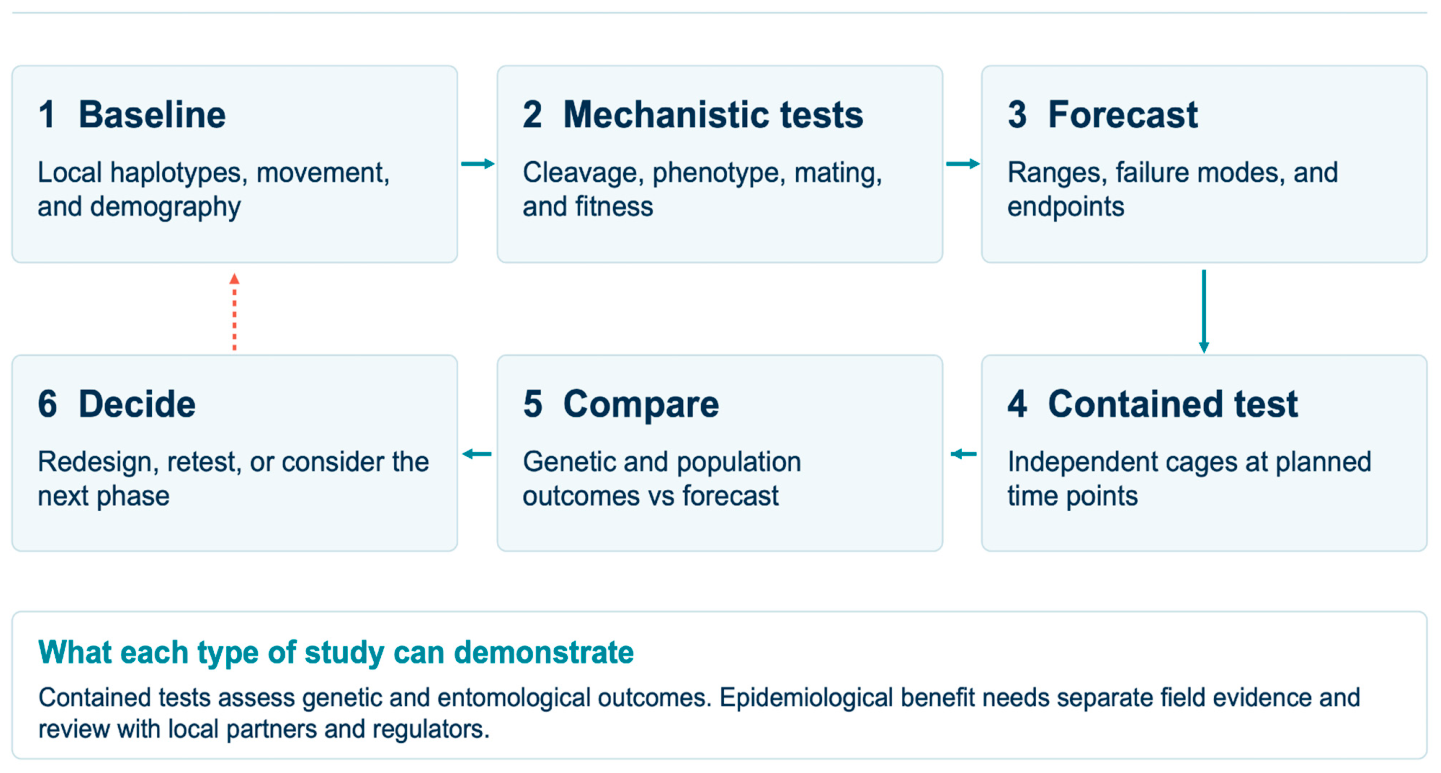
Population genomics is therefore most valuable not as a stand-alone predictor of intervention success, but as part of an iterative measurement-to-decision framework that connects local genetic variation and population structure to architecture-specific functional tests, models, deployment choices, and prospective validation. Combined with community engagement and independent risk assessment, this cycle provides a testable pathway from system design to deployment and subsequent refinement (Figure 4). The framework proceeds from local baseline measurements and mechanistic testing to prespecified forecasts, independent contained evaluation, comparison of observed outcomes with predictions, and evidence-based redesign or progression.
Figure 4.
Prospective validation framework for population-informed mosquito control. Local population-genetic, movement, and demographic measurements, together with functional assays, inform prospective predictions, predefined performance endpoints, and potential failure modes before experimental testing. Independent contained evaluations compare observed genetic and entomological outcomes with model predictions, while discrepancies prompt refinement of intervention designs, assumptions, or additional data collection. Demonstrating reductions in pathogen transmission or disease incidence requires separate epidemiological evidence and cannot be inferred solely from genetic or entomological outcomes. Progression toward field evaluation and deployment additionally requires appropriate risk assessment, regulatory review, and meaningful engagement with affected communities [134,135,136,138]. Solid teal arrows indicate the sequential progression through the six stages of the prospective validation framework, from baseline measurements and mechanistic testing to forecasting, contained evaluation, comparison of observed and predicted outcomes, and decision-making. The dashed red arrow connecting Step 6 (Decide) back to Step 1 (Baseline) represents an iterative feedback loop, whereby discrepancies between observed and predicted outcomes can prompt additional data collection, refinement of model assumptions, redesign of the intervention, and subsequent re-evaluation. Arrows represent conceptual decision pathways rather than experimentally validated relationships or demonstrated intervention efficacy.
Author Contributions
All authors contributed to the study’s conceptualization and to drafting, reviewing, and editing the manuscript. All authors have read and agreed to the published version of the manuscript.
Funding
This work was supported in part by National Institutes of Health awards RO1AI175152, RO1AI148300, R21AI196522, and R01AI190001 to O.S.A., R35GM156217 to Y. L., and R01AI189916 to J.M.M. J.M.M. was also supported by funds from the Gates Foundation (INV-078535). E.H. also received support from AI007384 (HOPE T32 Training Grant).
Data Availability Statement
Conflicts of Interest
O.S.A. is a founder of Agragene, Inc., Synvect, Inc., and Cloak Biotechnologies with equity interest. The terms of this arrangement have been reviewed and approved by the University of California at San Diego, in accordance with its conflict of interest policies. All other authors declare no competing interests.
References
- Fu, G. Epidemiological patterns of mosquito-borne diseases globally. J. Mosq. Res. 2024, 14, 111–123. [Google Scholar] [CrossRef] [Scilit]
- Penhollow, T.M.; Torres, L.; Ferreira, M.H.; Cassol, M.; de Fraga, B.F.; Bello, J.Z.; de Almeida, S.T. Impact of mosquito-borne diseases on global public health. Int. Phys. Med. Rehabil. J. 2021, 6, 19–20. [Google Scholar] [CrossRef] [Scilit]
- Bhatt, S.; Gething, P.W.; Brady, O.J.; Messina, J.P.; Farlow, A.W.; Moyes, C.L.; Drake, J.M.; Brownstein, J.S.; Hoen, A.G.; Sankoh, O.; et al. The global distribution and burden of dengue. Nature 2013, 496, 504–507. [Google Scholar] [CrossRef] [Scilit] [PubMed]
- World Health Organization. World Malaria Report 2025, Addressing the Threat of Antimalarial Drug Resistance; World Health Organization: Geneva, Switzerland, 2025. [Google Scholar]
- Kondapaneni, R.; Malcolm, A.N.; Vazquez, B.M.; Zeng, E.; Chen, T.-Y.; Kosinski, K.J.; Romero-Weaver, A.L.; Giordano, B.V.; Allen, B.; Riles, M.T.; et al. Mosquito control priorities in Florida-survey results from Florida mosquito control districts. Pathogens 2021, 10, 947. [Google Scholar] [CrossRef] [Scilit] [PubMed]
- Hemingway, J.; Shretta, R.; Wells, T.N.C.; Bell, D.; Djimdé, A.A.; Achee, N.; Qi, G. Tools and strategies for malaria control and elimination: What do we need to achieve a grand convergence in malaria? PLoS Biol. 2016, 14, e1002380. [Google Scholar] [CrossRef] [Scilit] [PubMed]
- Kumar, G.; Baharia, R.; Singh, K.; Gupta, S.K.; Joy, S.; Sharma, A.; Rahi, M. Addressing challenges in vector control: A review of current strategies and the imperative for novel tools in India’s combat against vector-borne diseases. BMJ Public Health 2024, 2, e000342. [Google Scholar] [CrossRef] [Scilit] [PubMed]
- Beier, J.C.; Keating, J.; Githure, J.I.; Macdonald, M.B.; Impoinvil, D.E.; Novak, R.J. Integrated vector management for malaria control. Malar. J. 2008, 7, S4. [Google Scholar] [CrossRef] [Scilit] [PubMed]
- Knipling, E.F. Possibilities of insect control or eradication through the use of sexually sterile Males1. J. Econ. Entomol. 1955, 48, 459–462. [Google Scholar] [CrossRef] [Scilit]
- Dyck, V.A.; Hendrichs, J.; Robinson, A.S. Sterile Insect Technique: Principles and Practice in Area-Wide Integrated Pest Management; Springer: New York, NY, USA, 2005. [Google Scholar]
- Labbé, G.M.; Scaife, S.; Morgan, S.A.; Curtis, Z.H.; Alphey, L. Female-specific flightless (fsRIDL) phenotype for control of Aedes albopictus. PLoS Negl. Trop. Dis. 2012, 6, e1724. [Google Scholar] [CrossRef] [Scilit] [PubMed]
- Spinner, S.A.M.; Barnes, Z.H.; Puinean, A.M.; Gray, P.; Dafa’alla, T.; Phillips, C.E.; de Souza, C.N.; Frazon, T.F.; Ercit, K.; Collado, A.; et al. New self-sexing Aedes aegypti strain eliminates barriers to scalable and sustainable vector control for governments and communities in dengue-prone environments. Front. Bioeng. Biotechnol. 2022, 10, 975786. [Google Scholar] [CrossRef] [Scilit] [PubMed]
- Smidler, A.L.; Akbari, O.S. CRISPR technologies for the control and study of malaria-transmitting anopheline mosquitoes. Parasites Vectors 2025, 18, 252. [Google Scholar] [CrossRef] [Scilit] [PubMed]
- Kandul, N.P.; Liu, J.; Sanchez, C.H.M.; Wu, S.L.; Marshall, J.M.; Akbari, O.S. Transforming insect population control with precision guided sterile males with demonstration in flies. Nat. Commun. 2019, 10, 84. [Google Scholar] [CrossRef] [Scilit] [PubMed]
- Li, M.; Yang, T.; Bui, M.; Gamez, S.; Wise, T.; Kandul, N.P.; Liu, J.; Alcantara, L.; Lee, H.; Edula, J.R.; et al. Suppressing mosquito populations with precision guided sterile males. Nat. Commun. 2021, 12, 5374. [Google Scholar] [CrossRef] [Scilit] [PubMed]
- Apte, R.A.; Smidler, A.L.; Pai, J.J.; Chow, M.L.; Chen, S.; Mondal, A.; C., H.M.S.; Antoshechkin, I.; Marshall, J.M.; Akbari, O.S. Eliminating malaria vectors with precision-guided sterile males. Proc. Natl. Acad. Sci. USA 2024, 121, e2312456121. [Google Scholar] [CrossRef] [Scilit] [PubMed]
- Li, M.; Kandul, N.P.; Sun, R.; Yang, T.; Benetta, E.D.; Brogan, D.J.; Antoshechkin, I.; C, H.M.S.; Zhan, Y.; A DeBeaubien, N.; et al. Targeting sex determination to suppress mosquito populations. eLife 2024, 12, RP90199. [Google Scholar] [CrossRef] [PubMed]
- Kandul, N.P.; Liu, J.; Buchman, A.; Shriner, I.C.; Corder, R.M.; Warsinger-Pepe, N.; Yang, T.; Yadav, A.K.; Scott, M.J.; Marshall, J.M.; et al. Precision guided sterile males suppress populations of an invasive crop pest. GEN Biotechnol. 2022, 1, 372–385. [Google Scholar] [CrossRef] [Scilit]
- Esvelt, K.M.; Smidler, A.L.; Catteruccia, F.; Church, G.M. Concerning RNA-guided gene drives for the alteration of wild populations. eLife 2014, 3, e03401. [Google Scholar] [CrossRef] [Scilit] [PubMed]
- Champer, J.; Buchman, A.; Akbari, O.S. Cheating evolution: Engineering gene drives to manipulate the fate of wild populations. Nat. Rev. Genet. 2016, 17, 146–159. [Google Scholar] [CrossRef] [Scilit] [PubMed]
- Zeng, Q.; She, L.; Yuan, H.; Luo, Y.; Wang, R.; Mao, W.; Wang, W.; She, Y.; Wang, C.; Shi, M.; et al. A standalone incompatible insect technique enables mosquito suppression in the urban subtropics. Commun. Biol. 2022, 5, 1419. [Google Scholar] [CrossRef] [Scilit] [PubMed]
- Lim, J.T.; Chong, C.-S.; Chang, C.-C.; Mailepessov, D.; Dickens, B.; Lai, Y.L.; Deng, L.; Lee, C.; Tan, L.Y.; Chain, G.; et al. Dengue suppression by male Wolbachia-infected mosquitoes. N. Engl. J. Med. 2026, 394, 1175–1183. [Google Scholar] [CrossRef] [Scilit] [PubMed]
- Zheng, X.; Zhang, D.; Li, Y.; Yang, C.; Wu, Y.; Liang, X.; Liang, Y.; Pan, X.; Hu, L.; Sun, Q.; et al. Incompatible and sterile insect techniques combined eliminate mosquitoes. Nature 2019, 572, 56–61. [Google Scholar] [CrossRef] [Scilit] [PubMed]
- Bansal, S.; Lim, J.T.; Chong, C.-S.; Dickens, B.; Ng, Y.; Deng, L.; Lee, C.; Tan, L.Y.; Kakani, E.G.; Yoong, Y.; et al. Effectiveness of Wolbachia-mediated sterility coupled with sterile insect technique to suppress adult Aedes aegypti populations in Singapore: A synthetic control study. Lancet Planet. Health 2024, 8, e617–e628. [Google Scholar] [CrossRef] [Scilit] [PubMed]
- Utarini, A.; Indriani, C.; Ahmad, R.A.; Tantowijoyo, W.; Arguni, E.; Ansari, M.R.; Supriyati, E.; Wardana, D.S.; Meitika, Y.; Ernesia, I.; et al. Efficacy of Wolbachia-infected mosquito deployments for the control of dengue. N. Engl. J. Med. 2021, 384, 2177–2186. [Google Scholar] [CrossRef] [Scilit] [PubMed]
- Collier, T.C.; Lee, Y.; Mathias, D.K.; López Del Amo, V. CRISPR-Cas9 and Cas12a target site richness reflects genomic diversity in natural populations of Anopheles gambiae and Aedes aegypti mosquitoes. BMC Genom. 2024, 25, 700. [Google Scholar] [CrossRef] [Scilit] [PubMed]
- Schmidt, H.; Lee, Y.; Collier, T.C.; Hanemaaijer, M.J.; Kirstein, O.D.; Ouledi, A.; Muleba, M.; Norris, D.E.; Slatkin, M.; Cornel, A.J.; et al. Transcontinental dispersal of Anopheles gambiae occurred from West African origin via serial founder events. Commun. Biol. 2019, 2, 473. [Google Scholar] [CrossRef] [Scilit] [PubMed]
- Campos, M.; Hanemaaijer, M.; Gripkey, H.; Collier, T.C.; Lee, Y.; Cornel, A.J.; Pinto, J.; Ayala, D.; Rompão, H.; Lanzaro, G.C. The origin of island populations of the African malaria mosquito, Anopheles coluzzii. Commun. Biol. 2021, 4, 630. [Google Scholar] [CrossRef] [Scilit] [PubMed]
- Zentner, G.E.; Wade, M.J. The promise and peril of CRISPR gene drives: Genetic variation and inbreeding may impede the propagation of gene drives based on the CRISPR genome editing technology. Bioessays 2017, 39, 1700109. [Google Scholar] [CrossRef] [Scilit] [PubMed]
- Unckless, R.L.; Clark, A.G.; Messer, P.W. Evolution of resistance against CRISPR/Cas9 gene drive. Genetics 2017, 205, 827–841. [Google Scholar] [CrossRef] [Scilit] [PubMed]
- Schmidt, T.L.; Filipović, I.; Hoffmann, A.A.; Rašić, G. Fine-scale landscape genomics helps explain the slow spatial spread of Wolbachia through the Aedes aegypti population in Cairns, Australia. Heredity 2018, 120, 386–395. [Google Scholar] [CrossRef] [Scilit] [PubMed]
- Beeton, N.J.; Wilkins, A.; Ickowicz, A.; Hayes, K.R.; Hosack, G.R. Spatial modelling for population replacement of mosquito vectors at continental scale. PLoS Comput. Biol. 2022, 18, e1009526. [Google Scholar] [CrossRef] [Scilit] [PubMed]
- Gomulkiewicz, R.; Thies, M.L.; Bull, J.J. Evading resistance to gene drives. Genetics 2021, 217, iyaa040. [Google Scholar] [CrossRef] [Scilit] [PubMed]
- Gloria-Soria, A.; Soghigian, J.; Kellner, D.; Powell, J.R. Genetic diversity of laboratory strains and implications for research: The case of Aedes aegypti. PLoS Negl. Trop. Dis. 2019, 13, e0007930. [Google Scholar] [CrossRef] [Scilit] [PubMed]
- Hill, E.; Raban, R.; Akbari, O.S. Evolutionary constraints and design principles in CRISPR-based mosquito biocontrol. In Advances in Insect Physiology; Elsevier: Amsterdam, The Netherlands, 2026; pp. 361–386. [Google Scholar] [CrossRef] [Scilit]
- Raban, R.; Akbari, O.S. CRISPR-based control strategies in mosquitoes. In Comprehensive Molecular Insect Science; Elsevier: Amsterdam, The Netherlands, 2026; pp. 118–134. [Google Scholar] [CrossRef] [Scilit]
- Raban, R.; Marshall, J.M.; Hay, B.A.; Akbari, O.S. Manipulating the destiny of wild populations using CRISPR. Annu. Rev. Genet. 2023, 57, 361–390. [Google Scholar] [CrossRef] [Scilit] [PubMed]
- Alphey, L. Genetic control of mosquitoes. Annu. Rev. Entomol. 2014, 59, 205–224. [Google Scholar] [CrossRef] [Scilit] [PubMed]
- Raban, R.; James, A.A.; Akbari, O.S. Advances in CRISPR gene drives for mosquito population control. Curr. Opin. Microbiol. 2026, 90, 102712. [Google Scholar] [CrossRef] [Scilit] [PubMed]
- Schmidt, T.L.; Endersby-Harshman, N.M.; Hoffmann, A.A. Improving mosquito control strategies with population genomics. Trends Parasitol. 2021, 37, 907–921. [Google Scholar] [CrossRef] [Scilit] [PubMed]
- Garcia Gde, A.; Sylvestre, G.; Aguiar, R.; da Costa, G.B.; Martins, A.J.; Lima, J.B.P.; Petersen, M.T.; Lourenço-De-Oliveira, R.; Shadbolt, M.F.; Rašić, G.; et al. Matching the genetics of released and local Aedes aegypti populations is critical to assure Wolbachia invasion. PLoS Negl. Trop. Dis. 2019, 13, e0007023. [Google Scholar] [CrossRef] [Scilit] [PubMed]
- Schmidt, H.; Collier, T.C.; Hanemaaijer, M.J.; Houston, P.D.; Lee, Y.; Lanzaro, G.C. Abundance of conserved CRISPR-Cas9 target sites within the highly polymorphic genomes of Anopheles and Aedes mosquitoes. Nat. Commun. 2020, 11, 1425. [Google Scholar] [CrossRef] [Scilit] [PubMed]
- Weeraratne, T.C.; Surendran, S.N.; Walton, C.; Karunaratne, S.H.P.P. Genetic diversity and population structure of malaria vector mosquitoes Anopheles subpictus, Anopheles peditaeniatus, and Anopheles vagus in five districts of Sri Lanka. Malar. J. 2018, 17, 271. [Google Scholar] [CrossRef] [Scilit] [PubMed]
- Ahebwa, A.; Hii, J.; Neoh, K.-B.; Chareonviriyaphap, T. Aedes aegypti and Aedes albopictus (Diptera: Culicidae) ecology, biology, behaviour, and implications on arbovirus transmission in Thailand: Review. One Health 2023, 16, 100555. [Google Scholar] [CrossRef] [Scilit] [PubMed]
- Pescod, P.; Bevivino, G.; Anthousi, A.; Shelton, R.; Shepherd, J.; Lombardo, F.; Nolan, T. Measuring the impact of genetic heterogeneity and chromosomal inversions on the efficacy of CRISPR-Cas9 gene drives in different strains of Anopheles gambiae. CRISPR J. 2023, 6, 419–429. [Google Scholar] [CrossRef] [Scilit] [PubMed]
- Pescod, P.; Bevivino, G.; Anthousi, A.; Shepherd, J.; Shelton, R.; Lombardo, F.; Nolan, T. Homing gene drives can transfer rapidly between Anopheles gambiae strains with minimal carryover of flanking sequences. Nat. Commun. 2024, 15, 6846. [Google Scholar] [CrossRef] [Scilit] [PubMed]
- Facchinelli, L.; Valerio, L.; Ramsey, J.M.; Gould, F.; Walsh, R.K.; Bond, G.; Robert, M.A.; Lloyd, A.L.; James, A.A.; Alphey, L.; et al. Field cage studies and progressive evaluation of genetically-engineered mosquitoes. PLoS Negl. Trop. Dis. 2013, 7, e2001. [Google Scholar] [CrossRef] [Scilit] [PubMed]
- Aldersley, A.; Pongsiri, A.; Bunmee, K.; Kijchalao, U.; Chittham, W.; Fansiri, T.; Pathawong, N.; Qureshi, A.; Harrington, L.C.; Ponlawat, A.; et al. Too “sexy” for the field? Paired measures of laboratory and semi-field performance highlight variability in the apparent mating fitness of Aedes aegypti transgenic strains. Parasites Vectors 2019, 12, 357. [Google Scholar] [CrossRef] [Scilit] [PubMed]
- Drury, D.W.; Dapper, A.L.; Siniard, D.J.; Zentner, G.E.; Wade, M.J. CRISPR/Cas9 gene drives in genetically variable and nonrandomly mating wild populations. Sci. Adv. 2017, 3, e1601910. [Google Scholar] [CrossRef] [Scilit] [PubMed]
- Burt, A. Site-specific selfish genes as tools for the control and genetic engineering of natural populations. Proc. Biol. Sci. 2003, 270, 921–928. [Google Scholar] [CrossRef] [Scilit] [PubMed]
- Alphey, L.; Benedict, M.; Bellini, R.; Clark, G.G.; Dame, D.A.; Service, M.W.; Dobson, S.L. Sterile-insect methods for control of mosquito-borne diseases: An analysis. Vector Borne Zoonotic Dis. 2010, 10, 295–311. [Google Scholar] [CrossRef] [Scilit] [PubMed]
- Bourtzis, K.; Vreysen, M.J.B. Sterile insect technique (SIT) and its applications. Insects 2021, 12, 638. [Google Scholar] [CrossRef] [Scilit] [PubMed]
- Anderson, M.A.E.; Gonzalez, E.; Edgington, M.P.; Ang, J.X.D.; Purusothaman, D.-K.; Shackleford, L.; Nevard, K.; Verkuijl, S.A.N.; Harvey-Samuel, T.; Leftwich, P.T.; et al. A multiplexed, confinable CRISPR/Cas9 gene drive can propagate in caged Aedes aegypti populations. Nat. Commun. 2024, 15, 729. [Google Scholar] [CrossRef] [Scilit] [PubMed]
- Larrosa-Godall, M.; Shackleford, L.; Edgington, M.P.; Leftwich, P.T.; Luk, J.C.Y.; Southworth, J.; Rosell, S.; Creasey, J.T.; Aked, J.M.; Nevard, K.; et al. Integrating multiplexing into confineable gene drives effectively overrides resistance in Anopheles stephensi. Nat. Commun. 2026, 17, 6844. [Google Scholar] [CrossRef] [Scilit] [PubMed]
- Goldman, O.V.; DeFoe, A.E.; Qi, Y.; Jiao, Y.; Weng, S.-C.; Wick, B.; Houri-Zeevi, L.; Lakhiani, P.; Morita, T.; Razzauti, J.; et al. A single-nucleus transcriptomic atlas of the adult Aedes aegypti mosquito. Cell 2025, 188, 7267–7290.e26. [Google Scholar] [CrossRef] [Scilit] [PubMed]
- Lacroix, R.; McKemey, A.R.; Raduan, N.; Kwee Wee, L.; Hong Ming, W.; Guat Ney, T.; AA, S.R.; Salman, S.; Subramaniam, S.; Nordin, O.; et al. Open field release of genetically engineered sterile male Aedes aegypti in Malaysia. PLoS ONE 2012, 7, e42771. [Google Scholar] [CrossRef] [Scilit] [PubMed]
- Hale, M.L.; Burg, T.M.; Steeves, T.E. Sampling for microsatellite-based population genetic studies: 25 to 30 individuals per population is enough to accurately estimate allele frequencies. PLoS ONE 2012, 7, e45170. [Google Scholar] [CrossRef] [Scilit] [PubMed]
- Lee, Y.; Schmidt, H.; Collier, T.C.; Conner, W.R.; Hanemaaijer, M.J.; Slatkin, M.; Marshall, J.M.; Chiu, J.C.; Smartt, C.T.; Lanzaro, G.C.; et al. Genome-wide divergence among invasive populations of Aedes aegypti in California. BMC Genom. 2019, 20, 204. [Google Scholar] [CrossRef] [Scilit] [PubMed]
- Taylor, C.; Touré, Y.T.; Carnahan, J.; Norris, D.E.; Dolo, G.; Traoré, S.F.; E Edillo, F.; Lanzaro, G.C. Gene flow among populations of the malaria vector, Anopheles gambiae, in Mali, West Africa. Genetics 2001, 157, 743–750. [Google Scholar] [CrossRef] [Scilit] [PubMed]
- Sumitha, M.K.; Kalimuthu, M.; Kumar, M.S.; Paramasivan, R.; Kumar, N.P.; Sunish, I.P.; Balaji, T.; Sarma, D.K.; Kumar, D.; Suman, D.S.; et al. Genetic differentiation among Aedes aegypti populations from different eco-geographical zones of India. PLoS Negl. Trop. Dis. 2023, 17, e0011486. [Google Scholar] [CrossRef] [Scilit] [PubMed]
- Hlaing, T.; Tun-Lin, W.; Somboon, P.; Socheat, D.; Setha, T.; Min, S.; Thaung, S.; Anyaele, O.; De Silva, B.; Chang, M.S.; et al. Spatial genetic structure of Aedes aegypti mosquitoes in mainland Southeast Asia: Genetic structure of Aedes aegypti. Evol. Appl. 2010, 3, 319–339. [Google Scholar] [CrossRef] [Scilit] [PubMed]
- Failloux, A.-B.; Vazeille, M.; Rodhain, F. Geographic genetic variation in populations of the dengue virus vector Aedes aegypti. J. Mol. Evol. 2002, 55, 653–663. [Google Scholar] [CrossRef] [Scilit] [PubMed]
- Besansky, N.J.; Lehmann, T.; Fahey, G.T.; Fontenille, D.; Braack, L.E.; Hawley, W.A. Patterns of mitochondrial variation within and between African malaria vectors, Anopheles gambiae and An. arabiensis, suggest extensive gene flow. Genetics 1997, 147, 1817–1828. [Google Scholar] [CrossRef] [Scilit] [PubMed]
- Hemme, R.R.; Thomas, C.L.; Chadee, D.D.; Severson, D.W. Influence of urban landscapes on population dynamics in a short-distance migrant mosquito: Evidence for the dengue vector Aedes aegypti. PLoS Negl. Trop. Dis. 2010, 4, e634. [Google Scholar] [CrossRef] [Scilit] [PubMed]
- Lee, Y.; Marsden, C.D.; Norris, L.C.; Collier, T.C.; Main, B.J.; Fofana, A.; Cornel, A.J.; Lanzaro, G.C. Spatiotemporal dynamics of gene flow and hybrid fitness between the M and S forms of the malaria mosquito, Anopheles gambiae. Proc. Natl. Acad. Sci. USA 2013, 110, 19854–19859. [Google Scholar] [CrossRef] [Scilit] [PubMed]
- Norris, L.C.; Main, B.J.; Lee, Y.; Collier, T.C.; Fofana, A.; Cornel, A.J.; Lanzaro, G.C. Adaptive introgression in an African malaria mosquito coincident with the increased usage of insecticide-treated bed nets. Proc. Natl. Acad. Sci. USA 2015, 112, 815–820. [Google Scholar] [CrossRef] [Scilit] [PubMed]
- Main, B.J.; Lee, Y.; Collier, T.C.; Norris, L.C.; Brisco, K.; Fofana, A.; Cornel, A.J.; Lanzaro, G.C. Complex genome evolution in Anopheles coluzzii associated with increased insecticide usage in Mali. Mol. Ecol. 2015, 24, 5145–5157. [Google Scholar] [CrossRef] [Scilit] [PubMed]
- Hanemaaijer, M.J.; Collier, T.C.; Chang, A.; Shott, C.C.; Houston, P.D.; Schmidt, H.; Main, B.J.; Cornel, A.J.; Lee, Y.; Lanzaro, G.C. The fate of genes that cross species boundaries after a major hybridization event in a natural mosquito population. Mol. Ecol. 2018, 27, 4978–4990. [Google Scholar] [CrossRef] [Scilit] [PubMed]
- Seok, S.; Vorsino, A.E.; Collier, T.C.; Hapairai, L.K.; Jacobsen, C.M.; Hasty, J.M.; Romero-Weaver, A.L.; Buckner, E.A.; LaPointe, D.A.; Leong, M.K.H.; et al. Population genomics of Aedes albopictus across remote Pacific islands for genetic biocontrol considerations. PLoS Negl. Trop. Dis. 2025, 19, e0013414. [Google Scholar] [CrossRef] [Scilit] [PubMed]
- Willoughby, J.R.; McKenzie, B.A.; Ahn, J.; Steury, T.D.; Lepzcyk, C.A.; Zohdy, S. Assessing and managing the risk of Aedes mosquito introductions via the global maritime trade network. PLoS Negl. Trop. Dis. 2024, 18, e0012110. [Google Scholar] [CrossRef] [Scilit] [PubMed]
- Ahn, J.; Sinka, M.; Irish, S.; Zohdy, S. Modeling marine cargo traffic to identify countries in Africa with greatest risk of invasion by Anopheles stephensi. Sci. Rep. 2023, 13, 876. [Google Scholar] [CrossRef] [Scilit] [PubMed]
- Eckhoff, P.A.; Wenger, E.A.; Godfray, H.C.J.; Burt, A. Impact of mosquito gene drive on malaria elimination in a computational model with explicit spatial and temporal dynamics. Proc. Natl. Acad. Sci. USA 2017, 114, E255–E264. [Google Scholar] [CrossRef] [Scilit] [PubMed]
- Noble, C.; Adlam, B.; Church, G.M.; Esvelt, K.M.; Nowak, M.A. Current CRISPR gene drive systems are likely to be highly invasive in wild populations. eLife 2018, 7, e33423. [Google Scholar] [CrossRef] [Scilit] [PubMed]
- Champer, J.; Wen, Z.; Luthra, A.; Reeves, R.; Chung, J.; Liu, C.; Lee, Y.L.; Liu, J.; Yang, E.; Messer, P.W.; et al. CRISPR gene drive efficiency and resistance rate is highly heritable with no common genetic loci of large effect. Genetics 2019, 212, 333–341. [Google Scholar] [CrossRef] [Scilit] [PubMed]
- Ickowicz, A.; Foster, S.D.; Hosack, G.R.; Hayes, K.R. Predicting the spread and persistence of genetically modified dominant sterile male mosquitoes. Parasites Vectors 2021, 14, 480. [Google Scholar] [CrossRef] [Scilit] [PubMed]
- Marshall, J.M.; Yang, S.; Bennett, J.B.; Filipović, I.; Rašić, G. Spatial close-kin mark-recapture methods to estimate dispersal parameters and barrier strength for mosquitoes. PLoS Comput. Biol. 2025, 21, e1013713. [Google Scholar] [CrossRef] [Scilit] [PubMed]
- Sánchez, C.H.M.; Wu, S.L.; Henry, J.M.; Guerra, C.A.; Galick, D.S.; Garcia, G.A.; Marshall, J.M.; Smith, D.L. Mosquito dispersal in context. PLoS Complex Syst. 2026, 3, e0000108. [Google Scholar] [CrossRef] [Scilit]
- Jasper, M.; Schmidt, T.L.; Ahmad, N.W.; Sinkins, S.P.; Hoffmann, A.A. A genomic approach to inferring kinship reveals limited intergenerational dispersal in the yellow fever mosquito. Mol. Ecol. Resour. 2019, 19, 1254–1264. [Google Scholar] [CrossRef] [Scilit] [PubMed]
- Barton, N.H.; Turelli, M. Spatial waves of advance with bistable dynamics: Cytoplasmic and genetic analogues of Allee effects. Am. Nat. 2011, 178, E48-75. [Google Scholar] [CrossRef] [Scilit] [PubMed]
- Hanski, I. Metapopulation dynamics. Nature 1998, 396, 41–49. [Google Scholar] [CrossRef] [Scilit]
- Wu, S.L.; Bennett, J.B.; Sánchez, C.H.M.; Dolgert, A.J.; León, T.M.; Marshall, J.M. MGDrivE 2: A simulation framework for gene drive systems incorporating seasonality and epidemiological dynamics. PLoS Comput. Biol. 2021, 17, e1009030. [Google Scholar] [CrossRef] [Scilit] [PubMed]
- Champer, J.; Zhao, J.; Champer, S.E.; Liu, J.; Messer, P.W. Population dynamics of underdominance gene drive systems in continuous space. ACS Synth. Biol. 2020, 9, 779–792. [Google Scholar] [CrossRef] [Scilit] [PubMed]
- Sánchez, C.H.M.; Bennett, J.B.; Wu, S.L.; Rašić, G.; Akbari, O.S.; Marshall, J.M. Modeling confinement and reversibility of threshold-dependent gene drive systems in spatially-explicit Aedes aegypti populations. BMC Biol. 2020, 18, 50. [Google Scholar] [CrossRef] [Scilit] [PubMed]
- Kim, I.K.; Messer, P.W. Predicting the invasiveness of threshold-dependent gene drives. bioRxiv 2025. [Google Scholar] [CrossRef] [Scilit] [PubMed]
- Li, M.; Yang, T.; Kandul, N.P.; Bui, M.; Gamez, S.; Raban, R.; Bennett, J.; C, H.M.S.; Lanzaro, G.C.; Schmidt, H.; et al. Development of a confinable gene drive system in the human disease vector Aedes aegypti. eLife 2020, 9, e51701. [Google Scholar] [CrossRef] [Scilit] [PubMed]
- Marshall, J.M.; Hay, B.A. Confinement of gene drive systems to local populations: A comparative analysis. J. Theor. Biol. 2012, 294, 153–171. [Google Scholar] [CrossRef] [Scilit] [PubMed]
- North, A.; Burt, A.; Godfray, H.C.J. Modelling the spatial spread of a homing endonuclease gene in a mosquito population. J. Appl. Ecol. 2013, 50, 1216–1225. [Google Scholar] [CrossRef] [Scilit] [PubMed]
- Price, T.A.R.; Windbichler, N.; Unckless, R.L.; Sutter, A.; Runge, J.-N.; Ross, P.A.; Pomiankowski, A.; Nuckolls, N.L.; Montchamp-Moreau, C.; Mideo, N.; et al. Resistance to natural and synthetic gene drive systems. J. Evol. Biol. 2020, 33, 1345–1360. [Google Scholar] [CrossRef] [Scilit] [PubMed]
- Romanowski, J.S.; Myles, K.M.; Adelman, Z.N. Microhomology-mediated end joining is the predominant form of DNA repair in the mosquito Aedes aegypti with implications for gene editing, gene drive, and transgene removal. Nucleic Acids Res. 2026, 54, gkaf1532. [Google Scholar] [CrossRef] [Scilit] [PubMed]
- Hou, S.; Chen, J.; Feng, R.; Xu, X.; Liang, N.; Champer, J. A homing rescue gene drive with multiplexed gRNAs reaches high frequency in cage populations but generates functional resistance. J. Genet. Genom. 2024, 51, 836–843. [Google Scholar] [CrossRef] [Scilit] [PubMed]
- Khatri, B.S.; Burt, A. A theory of resistance to multiplexed gene drive demonstrates the significant role of weakly deleterious natural genetic variation. Proc. Natl. Acad. Sci. USA 2022, 119, e2200567119. [Google Scholar] [CrossRef] [Scilit] [PubMed]
- Hammond, A.; Galizi, R.; Kyrou, K.; Simoni, A.; Siniscalchi, C.; Katsanos, D.; Gribble, M.; Baker, D.; Marois, E.; Russell, S.; et al. A CRISPR-Cas9 gene drive system targeting female reproduction in the malaria mosquito vector Anopheles gambiae. Nat. Biotechnol. 2016, 34, 78–83. [Google Scholar] [CrossRef] [Scilit] [PubMed]
- Oberhofer, G.; Ivy, T.; Hay, B.A. Behavior of homing endonuclease gene drives targeting genes required for viability or female fertility with multiplexed guide RNAs. Proc. Natl. Acad. Sci. USA 2018, 115, E9343–E9352. [Google Scholar] [CrossRef] [Scilit] [PubMed]
- Hammond, A.M.; Kyrou, K.; Bruttini, M.; North, A.; Galizi, R.; Karlsson, X.; Kranjc, N.; Carpi, F.M.; D’Aurizio, R.; Crisanti, A.; et al. The creation and selection of mutations resistant to a gene drive over multiple generations in the malaria mosquito. PLoS Genet. 2017, 13, e1007039. [Google Scholar] [CrossRef] [Scilit] [PubMed]
- Gantz, V.M.; Jasinskiene, N.; Tatarenkova, O.; Fazekas, A.; Macias, V.M.; Bier, E.; James, A.A. Highly efficient Cas9-mediated gene drive for population modification of the malaria vector mosquito Anopheles stephensi. Proc. Natl. Acad. Sci. USA 2015, 112, E6736–E6743. [Google Scholar] [CrossRef] [Scilit] [PubMed]
- Champer, J.; Reeves, R.; Oh, S.Y.; Liu, C.; Liu, J.; Clark, A.G.; Messer, P.W. Novel CRISPR/Cas9 gene drive constructs reveal insights into mechanisms of resistance allele formation and drive efficiency in genetically diverse populations. PLoS Genet. 2017, 13, e1006796. [Google Scholar] [CrossRef] [Scilit] [PubMed]
- Carrami, E.M.; Eckermann, K.N.; Ahmed, H.M.M.; Sánchez, C.H.M.; Dippel, S.; Marshall, J.M.; A Wimmer, E. Consequences of resistance evolution in a Cas9-based sex conversion-suppression gene drive for insect pest management. Proc. Natl. Acad. Sci. USA 2018, 115, 6189–6194. [Google Scholar] [CrossRef] [Scilit] [PubMed]
- Hammond, A.; Pollegioni, P.; Persampieri, T.; North, A.; Minuz, R.; Trusso, A.; Bucci, A.; Kyrou, K.; Morianou, I.; Simoni, A.; et al. Gene-drive suppression of mosquito populations in large cages as a bridge between lab and field. Nat. Commun. 2021, 12, 4589. [Google Scholar] [CrossRef] [Scilit] [PubMed]
- Morianou, I.; Phillimore, L.; Khatri, B.S.; Marston, L.; Gribble, M.; Burt, A.; Bernardini, F.; Hammond, A.M.; Nolan, T.; Crisanti, A. Engineering resilient gene drives for sustainable malaria control by predicting, testing and overcoming target site resistance in Anopheles gambiae. PLoS Biol. 2026, 24, e3003879. [Google Scholar] [CrossRef] [Scilit] [PubMed]
- Carballar-Lejarazú, R.; Dong, Y.; Pham, T.B.; Tushar, T.; Stillinger, D.; Nguyen, D.N.; Winokur, L.; Tavadia, M.; Tao, M.; Dimopoulos, G.; et al. Long-term stability and performance of Cas9/guide RNA-based gene drives in anopheline mosquitoes. Proc. Natl. Acad. Sci. USA 2026, 123, e2605739123. [Google Scholar] [CrossRef] [Scilit] [PubMed]
- Champer, J.; Lee, E.; Yang, E.; Liu, C.; Clark, A.G.; Messer, P.W. A toxin-antidote CRISPR gene drive system for regional population modification. Nat. Commun. 2020, 11, 1082. [Google Scholar] [CrossRef] [Scilit] [PubMed]
- Faber, N.R.; McFarlane, G.R.; Gaynor, R.C.; Pocrnic, I.; Whitelaw, C.B.A.; Gorjanc, G. Novel combination of CRISPR-based gene drives eliminates resistance and localises spread. Sci. Rep. 2021, 11, 3719. [Google Scholar] [CrossRef] [Scilit] [PubMed]
- Marshall, J.M.; Buchman, A.; Sánchez, C.H.M.; Akbari, O.S. Overcoming evolved resistance to population-suppressing homing-based gene drives. Sci. Rep. 2017, 7, 3776. [Google Scholar] [CrossRef] [Scilit] [PubMed]
- Oberhofer, G.; Ivy, T.; Hay, B.A. Cleave and Rescue, a novel selfish genetic element and general strategy for gene drive. Proc. Natl. Acad. Sci. USA 2019, 116, 6250–6259. [Google Scholar] [CrossRef] [Scilit] [PubMed]
- Kandul, N.P.; Liu, J.; Bennett, J.B.; Marshall, J.M.; Akbari, O.S. A confinable home-and-rescue gene drive for population modification. eLife 2021, 10, e65939. [Google Scholar] [CrossRef] [Scilit] [PubMed]
- Finney, M.; Romanowski, J.; Adelman, Z.N. Strategies to improve homology-based repair outcomes following CRISPR-based gene editing in mosquitoes: Lessons in how to keep any repair disruptions local. Virol. J. 2022, 19, 128. [Google Scholar] [CrossRef] [Scilit] [PubMed]
- Champer, J.; Yang, E.; Lee, E.; Liu, J.; Clark, A.G.; Messer, P.W. A CRISPR homing gene drive targeting a haplolethal gene removes resistance alleles and successfully spreads through a cage population. Proc. Natl. Acad. Sci. USA 2020, 117, 24377–24383. [Google Scholar] [CrossRef] [Scilit] [PubMed]
- Zhu, J.; Chen, J.; Liu, Y.; Xu, X.; Champer, J. Population suppression with dominant female-lethal alleles is boosted by homing gene drive. BMC Biol. 2024, 22, 201. [Google Scholar] [CrossRef] [Scilit] [PubMed]
- Carballar-Lejarazú, R.; Tushar, T.; Pham, T.B.; James, A.A. Cas9-mediated maternal effect and derived resistance alleles in a gene-drive strain of the African malaria vector mosquito, Anopheles gambiae. Genetics 2022, 221, iyac055. [Google Scholar] [CrossRef] [Scilit] [PubMed]
- Kosinski, K.; Lee, Y.; Romero-Weaver, A.; Chen, T.-Y.; Collier, T.; Wang, X.; Mathias, D.; Buckner, E. Two novel single nucleotide polymorphisms in the voltage-gated sodium channel gene identified in Aedes aegypti mosquitoes from Florida. J. Fla. Mosq. Control Assoc. 2022, 69. [Google Scholar] [CrossRef] [Scilit]
- Seok, S.; McCollum, M.T.; Jacobsen, C.M.; Akbari, O.S.; Mathias, D.K.; Lee, Y. Pyrethroid insecticide resistance of Aedes albopictus and Aedes aegypti (Diptera: Culicidae) across the Hawaiian Islands. Parasites Vectors 2025, 19, 17. [Google Scholar] [CrossRef] [Scilit] [PubMed]
- Zhang, D.; Zheng, X.; Xi, Z.; Bourtzis, K.; Gilles, J.R.L. Combining the sterile insect technique with the incompatible insect technique: I-impact of Wolbachia infection on the fitness of triple- and double-infected strains of Aedes albopictus. PLoS ONE 2015, 10, e0121126. [Google Scholar] [CrossRef] [Scilit] [PubMed]
- The Project Wolbachia—Singapore Consortium; Ching, N.L. Wolbachia-mediated sterility suppresses Aedes aegypti populations in the urban tropics. medRxiv 2021. [Google Scholar] [CrossRef] [Scilit]
- Lombardi, G.; Lampazzi, E.; Calvitti, M. Incompatible insect technique: Insights on potential outcomes of releasing contaminant females: A proof of concept under semi-field conditions. Pest Manag. Sci. 2024, 80, 5342–5352. [Google Scholar] [CrossRef] [Scilit] [PubMed]
- Lutrat, C.; Giesbrecht, D.; Marois, E.; Whyard, S.; Baldet, T.; Bouyer, J. Sex sorting for pest control: It’s raining men! Trends Parasitol. 2019, 35, 649–662. [Google Scholar] [CrossRef] [Scilit] [PubMed]
- Weng, S.-C.; Antoshechkin, I.; Marois, E.; Akbari, O.S. Efficient sex separation by exploiting differential alternative splicing of a dominant marker in Aedes aegypti. PLoS Genet. 2023, 19, e1011065. [Google Scholar] [CrossRef] [Scilit] [PubMed]
- Seok, S.; Salama, L.; Vorsino, A.E.; Leong, M.K.H.; Haines, W.P.; Jacobsen, C.M.; Akbari, O.S.; Caragata, E.P.; Lee, Y. Native Wolbachia infection dynamics across Aedes albopictus (Diptera: Culicidae) populations in Hawai’i. Parasites Vectors 2026, 19, 438. [Google Scholar] [CrossRef] [Scilit] [PubMed]
- Ross, P.A.; Wiwatanaratanabutr, I.; Axford, J.K.; White, V.L.; Endersby-Harshman, N.M.; Hoffmann, A.A. Wolbachia Infections in Aedes aegypti Differ Markedly in Their Response to Cyclical Heat Stress. PLoS Pathog. 2017, 13, e1006006. [Google Scholar] [CrossRef] [Scilit] [PubMed]
- Ross, P.A.; Axford, J.K.; Yang, Q.; Staunton, K.M.; Ritchie, S.A.; Richardson, K.M.; A Hoffmann, A. Heatwaves cause fluctuations in wMel Wolbachia densities and frequencies in Aedes aegypti. PLoS Negl. Trop. Dis. 2020, 14, e0007958. [Google Scholar] [CrossRef] [Scilit] [PubMed]
- Allen, F.; Crepaldi, L.; Alsinet, C.; Strong, A.J.; Kleshchevnikov, V.; De Angeli, P.; Páleníková, P.; Khodak, A.; Kiselev, V.; Kosicki, M.; et al. Predicting the mutations generated by repair of Cas9-induced double-strand breaks. Nat. Biotechnol. 2018, 37, 64–72. [Google Scholar] [CrossRef] [Scilit] [PubMed]
- Shen, M.W.; Arbab, M.; Hsu, J.Y.; Worstell, D.; Culbertson, S.J.; Krabbe, O.; Cassa, C.A.; Liu, D.R.; Gifford, D.K.; Sherwood, R.I. Predictable and precise template-free CRISPR editing of pathogenic variants. Nature 2018, 563, 646–651. [Google Scholar] [CrossRef] [Scilit] [PubMed]
- Chen, W.; McKenna, A.; Schreiber, J.; Haeussler, M.; Yin, Y.; Agarwal, V.; Noble, W.S.; Shendure, J. Massively parallel profiling and predictive modeling of the outcomes of CRISPR/Cas9-mediated double-strand break repair. Nucleic Acids Res. 2019, 47, 7989–8003. [Google Scholar] [CrossRef] [Scilit] [PubMed]
- Xiang, X.; Corsi, G.I.; Anthon, C.; Qu, K.; Pan, X.; Liang, X.; Han, P.; Dong, Z.; Liu, L.; Zhong, J.; et al. Enhancing CRISPR-Cas9 gRNA efficiency prediction by data integration and deep learning. Nat. Commun. 2021, 12, 3238. [Google Scholar] [CrossRef] [Scilit] [PubMed]
- Liu, X.; Wang, S.; Ai, D. Predicting CRISPR/Cas9 repair outcomes by attention-based deep learning framework. Cells 2022, 11, 1847. [Google Scholar] [CrossRef] [Scilit] [PubMed]
- Kim, M.-G.; Go, M.-J.; Kang, S.-H.; Jeong, S.-H.; Lim, K. Revolutionizing CRISPR technology with artificial intelligence. Exp. Mol. Med. 2025, 57, 1419–1431. [Google Scholar] [CrossRef] [Scilit] [PubMed]
- Rašić, G.; Marshall, J.M. Integrating mosquito genomics into simulation modeling: Opportunities for better-informed biocontrol. Curr. Opin. Insect Sci. 2026, 73, 101456. [Google Scholar] [CrossRef] [Scilit] [PubMed]
- Gendron, W.A.C.; Smidler, A.L.; Li, M.; Wise, T.; Sánchez, C.H.M.; Bennett, J.B.; Raban, R.; Marshall, J.M.; Akbari, O.S. Split suppression gene drives reveal a design tradeoff between inheritance and reproductive load in Aedes aegypti. bioRxiv 2026. [Google Scholar] [CrossRef] [Scilit] [PubMed]
- Verkuijl, S.A.N.; Gonzalez, E.; Li, M.; Ang, J.X.D.; Kandul, N.P.; Anderson, M.A.E.; Akbari, O.S.; Bonsall, M.B.; Alphey, L. A CRISPR endonuclease gene drive reveals distinct mechanisms of inheritance bias. Nat. Commun. 2022, 13, 7145. [Google Scholar] [CrossRef] [Scilit] [PubMed]
- Dhole, S.; Lloyd, A.L.; Gould, F. Gene drive dynamics in natural populations: The importance of density dependence, space, and sex. Annu. Rev. Ecol. Evol. Syst. 2020, 51, 505–531. [Google Scholar] [CrossRef] [Scilit] [PubMed]
- Dhole, S.; Lloyd, A.L.; Gould, F. Tethered homing gene drives: A new design for spatially restricted population replacement and suppression. Evol. Appl. 2019, 12, 1688–1702. [Google Scholar] [CrossRef] [Scilit] [PubMed]
- Legros, M.; Lloyd, A.L.; Huang, Y.; Gould, F. Density-dependent intraspecific competition in the larval stage of Aedes aegypti (Diptera: Culicidae): Revisiting the current paradigm. J. Med. Entomol. 2009, 46, 409–419. [Google Scholar] [CrossRef] [Scilit] [PubMed]
- Gendron, W.A.C.; Raban, R.; Mondal, A.; MSánchez, C.H.; Smidler, A.L.; Zilberman, D.; Ilboudo, P.G.C.; D’aLessandro, U.; Marshall, J.M.; Akbari, O.S. Evaluating the cost of malaria elimination by Anopheles gambiae precision guided SIT in the Upper River region, The Gambia. PLoS Glob. Public Health 2025, 5, e0004903. [Google Scholar] [CrossRef] [Scilit] [PubMed]
- Gendron, W.A.C.; Raban, R.; Mondal, A.; Sánchez, C.H.M.; Zilberman, D.; Ilboudo, P.G.C.; D’aLessandro, U.; Marshall, J.M.; Akbari, O.S. Estimated cost and operational structure of pgSIT malaria vector control programs in selected West African countries. Sci. Afr. 2025, 29, e02888. [Google Scholar] [CrossRef] [Scilit] [PubMed]
- James, S.; Collins, F.H.; Welkhoff, P.A.; Emerson, C.; Godfray, H.C.J.; Gottlieb, M.; Greenwood, B.; Lindsay, S.W.; Mbogo, C.M.; Okumu, F.O.; et al. Pathway to deployment of gene drive mosquitoes as a potential biocontrol tool for elimination of malaria in sub-Saharan Africa: Recommendations of a scientific working group. Am. J. Trop. Med. Hyg. 2018, 98, 1–49. [Google Scholar] [CrossRef] [Scilit] [PubMed]
- Okumu, F.O.; Finda, M.; Odero, J.O.; Aboagye-Antwi, F.; Adeogun, A.; Atta-Obeng, C.; Baldini, F.; Bouyer, J.; Burkot, T.R.; Churcher, T.S.; et al. Adapting Africa’s vector surveillance systems to monitor gene-drive mosquitoes in malaria control. Trends Parasitol. 2026, 42, 463–493. [Google Scholar] [CrossRef] [Scilit]
- Rašić, G.; Lobo, N.F.; Jeffrey Gutiérrez, E.H.; Sánchez, C.H.M.; Marshall, J.M. Monitoring needs for gene drive mosquito projects: Lessons from vector control field trials and invasive species. Front. Genet. 2021, 12, 780327. [Google Scholar] [CrossRef] [Scilit] [PubMed]
- Mondal, A.; Sánchez, C.H.M.; Marshall, J.M. A model-informed target product profile for population modification gene drives for malaria control. PLoS Glob. Public Health 2025, 5, e0005026. [Google Scholar] [CrossRef] [Scilit] [PubMed]
- Devos, Y.; Mumford, J.D.; Bonsall, M.B.; Glandorf, D.C.M.; Quemada, H.D. Risk management recommendations for environmental releases of gene drive modified insects. Biotechnol. Adv. 2022, 54, 107807. [Google Scholar] [CrossRef] [Scilit] [PubMed]
- Abbasi, E. Innovative approaches to vector control: Integrating genomic, biological, and chemical strategies. Ann. Med. Surg. 2025, 87, 5003–5011. [Google Scholar] [CrossRef] [Scilit] [PubMed]
- Tourapi, C.; Tsioutis, C. Circular Policy: A new approach to vector and vector-borne diseases’ management in line with the global vector control response (2017–2030). Trop. Med. Infect. Dis. 2022, 7, 125. [Google Scholar] [CrossRef] [Scilit] [PubMed]
- Hancock, P.A.; Hendriks, C.J.M.; Tangena, J.-A.; Gibson, H.; Hemingway, J.; Coleman, M.; Gething, P.W.; Cameron, E.; Bhatt, S.; Moyes, C.L. Mapping trends in insecticide resistance phenotypes in African malaria vectors. PLoS Biol. 2020, 18, e3000633. [Google Scholar] [CrossRef] [Scilit] [PubMed]
- O’Neill, S.L.; Ryan, P.A.; Turley, A.P.; Wilson, G.; Retzki, K.; Iturbe-Ormaetxe, I.; Dong, Y.; Kenny, N.; Paton, C.J.; Ritchie, S.A.; et al. Scaled deployment of Wolbachia to protect the community from dengue and other Aedes transmitted arboviruses. Gates Open Res. 2019, 2, 36. [Google Scholar] [CrossRef] [Scilit]
- Ruzzante, L.; Reijnders, M.J.; Waterhouse, R.M. Of genes and genomes: Mosquito evolution and diversity. Trends Parasitol. 2019, 35, 32–51. [Google Scholar] [CrossRef] [Scilit]
- Neafsey, D.E.; Taylor, A.R.; MacInnis, B.L. Advances and opportunities in malaria population genomics. Nat. Rev. Genet. 2021, 22, 502–517. [Google Scholar] [CrossRef] [Scilit] [PubMed]
- Nayyar, N.; Arya, S.K.; Harrison, D.A.; Palli, S.R. Recent advances and applications of single-cell sequencing in insects. Curr. Opin. Insect Sci. 2026, 73, 101455. [Google Scholar] [CrossRef] [Scilit] [PubMed]
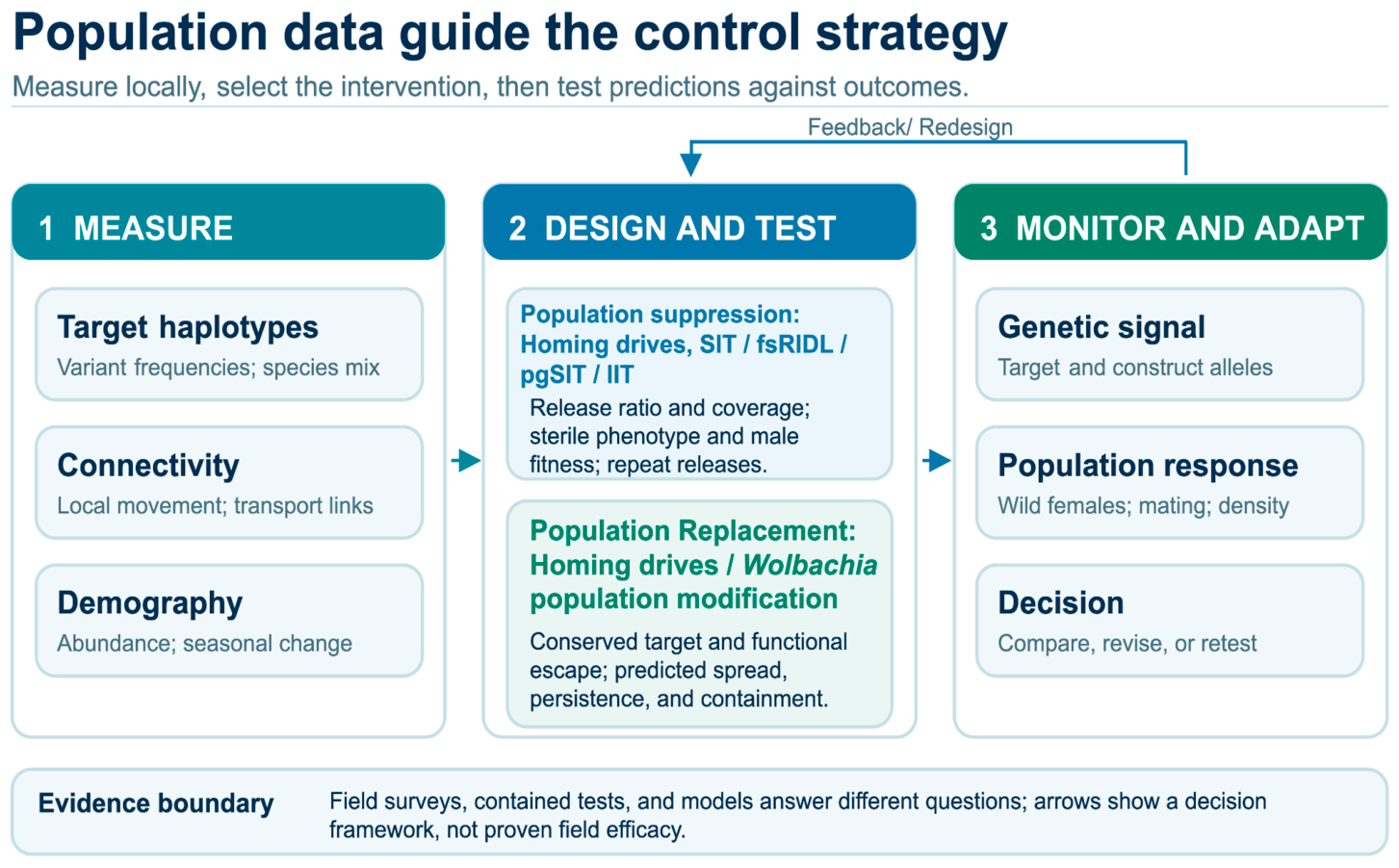
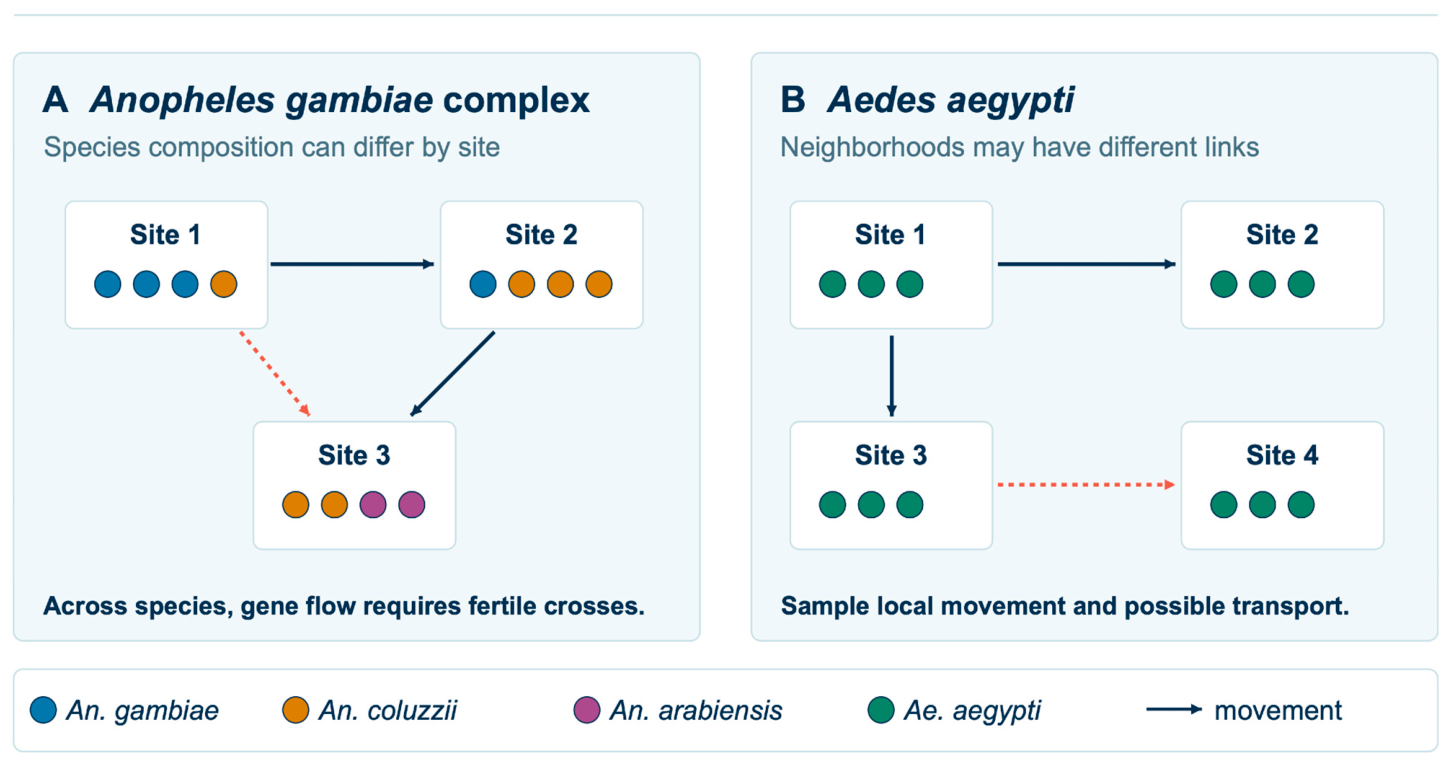
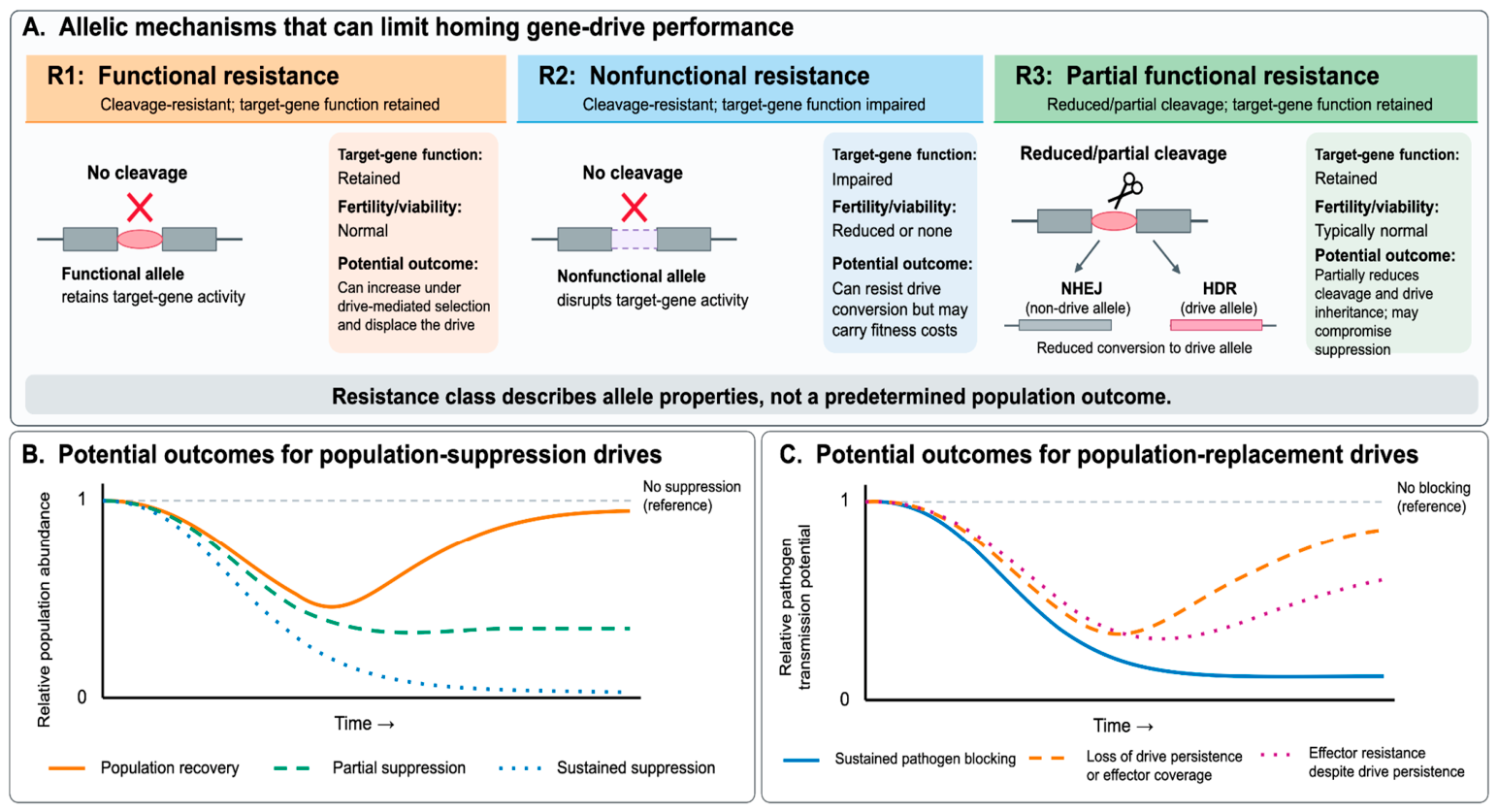
Disclaimer/Publisher’s Note: The statements, opinions and data contained in all publications are solely those of the individual author(s) and contributor(s) and not of MDPI and/or the editor(s). MDPI and/or the editor(s) disclaim responsibility for any injury to people or property resulting from any ideas, methods, instructions or products referred to in the content. |
© 2026 by the authors. Licensee MDPI, Basel, Switzerland. This article is an open access article distributed under the terms and conditions of the Creative Commons Attribution (CC BY) license.