


Simple Summary
Yellow mealworm, Tenebrio molitor Linnaeus, 1758, is increasingly farmed as a source of protein for food and feed, and the cost and quality of its feed largely determine whether production is profitable and sustainable. In this study, mealworm colonies were kept for 65 days on 23 different feeds: 15 single feed materials (agricultural by-products, cereal grains and processed cereal products), including wheat bran as the standard feed, and eight specially prepared mixtures with different amounts of protein and energy. At the end of the trial, all adults, larvae and pupae were counted to measure population growth. Brewer’s yeast produced the largest populations, although the difference from wheat bran was not statistically significant. Populations on rapeseed cake, sunflower meal, soybean meal and wheat grain did not differ significantly from those on wheat bran, although larvae on wheat grain tended to be smaller. Some protein-rich by-products, such as dried distillers grains, flaxseed cake and brewer’s spent grain, gave the smallest populations, showing that a high protein content alone does not make a good feed. A few pupae were found, but only on some of the prepared mixtures. These findings can help yellow mealworm (T. molitor) producers choose locally available feeds and show that feed should be judged by both the number and the size of larvae produced.
Abstract
Feed composition drives the viability of yellow mealworm (Tenebrio molitor Linnaeus, 1758) mass rearing, yet broad comparisons of feed materials remain scarce. In this research, the population growth of T. molitor was evaluated on 23 diets in a 65-day bioassay starting with 25 adults per replicate. The diets comprised 15 individual feed materials, including wheat bran as the control, and eight formulated diets with systematically varied protein and energy levels. At the end of the assay, all adults, larvae and pupae were counted, and population growth was expressed as the total number of individuals. Feed material significantly affected all population parameters (p ≤ 0.01), with the instantaneous rate of population increase (ri) ranging from 0.0314 on dried distillers grains with solubles (DDGS) to 0.0603 on brewer’s yeast. Compared with the control (wheat bran), DDGS, flaxseed cake, brewer’s spent grain, barley flakes, oat flakes and breadcrumbs significantly reduced the expected population size. Brewer’s yeast, the highest-protein material (50.37%), produced the largest population, but it did not differ significantly from the control. A few pupae were recorded, but only on five of eight formulated mixtures. Because DDGS and flaxseed cake were also among the highest-protein materials, protein content alone did not predict population growth. Brewer’s yeast, rapeseed cake and sunflower meal did not differ significantly from wheat bran in either population size or larval biomass.
1. Introduction
As the world’s population keeps growing, the pressure on conventional protein supply has intensified, and mass insect production has drawn renewed scientific attention as a complementary route to conventional livestock [1,2,3]. For Tenebrio molitor Linnaeus, 1758 (Coleoptera: Tenebrionidae), this interest has been reinforced by the approval of its dried larvae as a novel food for human consumption [4,5] and by parallel EU feed-use authorisations for aquafeed, poultry and pig diets [6,7]. Because the environmental footprint of the rearing chain is driven mainly by how the feed itself is produced [8], an efficient, well-optimised diet is central to the economic and environmental viability of the sector [9]. Tenebrio molitor has historically been managed primarily as a cereal storage pest, feeding on flour, bran and related amylaceous commodities [10]. Interest in the species has since shifted markedly toward its value as a protein source, driven by its favourable nutrient composition [11]. Raw larvae typically contain approximately 45–46% protein on a dry-matter basis and retain essential amino acids across life stages, and this nutritional profile, together with ease of breeding, has supported the industrial use of T. molitor as a feed ingredient [12,13].
Accordingly, T. molitor has attracted interest for partially replacing soybean meal and fishmeal in poultry and aquaculture feeds and for novel protein-rich food formulations [14,15,16]. Diet composition is therefore central to rearing efficiency and end-product viability. Larvae can develop on wheat bran alone, but this substrate is nutritionally incomplete: supplementing it with protein and carbohydrate sources has repeatedly improved growth and colony-level output [10,11,17,18], and both the amount and the balance of dietary protein and energy (carbohydrate) are known to regulate growth, survival and reproduction in this species [19,20,21].
Building on this principle, applied research has screened both formulated diets with systematically varied protein-to-carbohydrate ratios and alternative agro-industrial by-products as substrates for T. molitor rearing, motivated by the cost and limited availability of wheat bran at an industrial scale. Studies evaluating agricultural and agro-industrial by-products as rearing substrates, including those of Errico et al. [22], Langston et al. [23], Morales-Ramos et al. [24] and Serra et al. [25], show that feed identity strongly influences survival, development, biomass accumulation and reproduction, with effects varying considerably across ingredients even when protein content is held constant. Manipulating the proportion of insect meal against a wheat-bran base likewise alters these traits at the population level [26]. However, existing studies generally evaluate either isolated by-products or a small number of formulated diets, and rarely compare a broad range of by-products together with formulated diets of systematically varied protein and energy levels within a single, standardised framework. Moreover, most feeding trials, including our previous study of the same formulated mixtures [27], start from larvae and measure larval growth, whereas population-level assays that start from adults integrate adult survival, oviposition and early larval development into a single measure.
Beyond their nutritional profile, by-products of the cereal, oilseed, brewing and sugar industries are also attractive from a circular-economy perspective, since converting such low-value residues into insect feed lowers the environmental burden of mass rearing without competing with existing human food or livestock feed uses [8]. To compare such by-products with commonly used cereal-based materials, 14 feed materials were selected for evaluation in addition to the wheat bran control. They included agro-industrial by-products, cereal grains and processed cereal products commonly available in the region and covered a broad range of protein, fibre and energy content. Because the nutritional composition of such materials is often variable and imprecisely characterised, eight formulated diets with precisely defined protein and energy levels were included in the same trial. This allowed the effects of defined protein and energy levels to be compared with those of the individual materials under a controlled nutritional standard.
Considering the background presented above, the present study investigated the population growth of T. molitor across 23 diets, comprising 15 individual feed materials and eight formulated diets with systematically varied protein and energy levels. It was hypothesised that (i) feed materials with a high crude protein content would support higher population growth than low-protein, fibre-rich materials, and (ii) formulated diets in which the protein and/or energy level was raised above that of wheat bran would support significantly higher survival, biomass accumulation and reproductive output than the wheat bran control. The present study therefore aimed to identify feed materials most favourable to larval growth, survival and reproductive performance under controlled rearing conditions, and to establish whether their performance could be explained by their protein and energy content, thereby generating results directly applicable to feed selection and formulation in industrial-scale T. molitor mass rearing.
2. Materials and Methods
2.1. Insect Rearing
Adults used for the bioassay were taken from a stock population of T. molitor maintained at the Laboratory of Entomology, Faculty of Agriculture, University of Novi Sad. In the stock colony, 7-day-old adults were placed for one week on a substrate of wheat bran (95%) and brewer’s yeast (5%) in rearing trays (10 cm × 50 cm × 60 cm) in a climate chamber at 26 °C and 60% relative humidity (RH) to mate and oviposit, and were then removed; the trays were kept in the chamber until the eggs hatched. Larvae received fresh carrot slices three times per week as a moisture source, and the tray contents were sifted and renewed with fresh substrate at 30 and 60 days after adult removal. One full rearing cycle lasted 90 days.
2.2. Preparation of Experimental Diets
Population growth of T. molitor was assessed on 15 individual feed materials: wheat bran (used as the control), dried distillers grains with solubles (DDGS), oats, barley flakes, sunflower meal, oat flakes, breadcrumbs, wheat whole grain, rapeseed cake, silage, brewer’s yeast, flaxseed cake, soybean meal, brewer’s spent grain, and barley whole grain. Every feed that, in its natural state, has big particles was ground in a laboratory mill (A11 basic, IKA-Werke GmbH & Co. KG, Staufen, Germany) in order to support optimal growth of yellow mealworm. Therefore, oats and wheat (whole grain) and flakes were first ground. For all of the above diets prior to the experimental procedure, the substrates were sieved using perforated plate sieves (ø 200 mm, 2.5 mm apertures; Retsch GmbH, Haan, Germany). To standardise the particle size, only leftovers after sieving were used for rearing. The chemical composition of all feed materials is given in Table 1. Before the experiment, corn silage and brewer’s spent grain, with initial moisture contents of 70.43% and 80.65%, respectively (Table 1), were dried in a universal laboratory drying oven (U series, Memmert GmbH + Co. KG, Schwabach, Germany) at 65 °C for 48 h until a stable moisture content was reached, which reduced their moisture content to 10.43% and 10.65%, respectively, comparable to that of the other dry feed materials. For the latter two feedstuffs, which were additionally dried, the analysis was done after the drying procedure. Dry matter, crude protein (Kjeldahl; N × 6.25), crude fat (petroleum ether extract) and ash (600 °C) contents were determined according to AOAC Official Methods 934.01, 2001.11, 991.36 and 942.05, respectively, as described in [27], while crude fibre content was determined on the ANKOM DELTA fibre analyser (ANKOM Technology, Macedon, NY, USA) by applying the method provided by the manufacturer [28]. In addition to these single-ingredient treatments, 8 formulated diets combining wheat bran, soybean meal, corn and sugar beet pulp in defined proportions of protein and energy were also included in the trial, giving 23 feed treatments in total. Protein level was raised through the inclusion of soybean meal, and energy level through the inclusion of corn. Where a lower energy level was required, sugar beet pulp replaced part of the corn to dilute the energy content, since its digestible energy is markedly lower than that of corn and T. molitor larvae make limited direct use of it as an energy source [27]. Adjusting the proportions of these components produced 3 protein levels (low, medium, high) fully crossed with 3 energy levels (low, medium, high). The lowest-protein, lowest-energy combination corresponded to pure wheat bran (already listed as the control in Table 1), and the remaining 8 combinations are referred to hereafter as Mixture 1 to Mixture 8, with their formulation and chemical composition given in Table 2. The eight mixtures were the same as those used in our previous study [27], where their formulation and chemical composition were described in detail; as in that study, the mixtures were formulated on the basis of the calculated contributions of their individual ingredients, and their proximate chemical composition was determined analytically.
Table 1.
Proximate chemical composition of the tested feed materials (%; moisture on an as-fed basis, all other parameters on a dry-matter basis).
Table 2.
Ingredient and analysed proximate chemical composition of the 8 formulated mixture diets (adapted from [27]; %; moisture on an as-fed basis, all other parameters on a dry-matter basis).
2.3. Experimental Design
A laboratory bioassay adapted from Rigopoulou et al. [26] was used to track yellow mealworm population growth across 23 diets: 15 individual feed materials, including the wheat bran control, and 8 formulated mixture diets. Four replicates were set up for each diet. Each replicate comprised 50 g of diet and 25 unsexed adults of T. molitor (7–10 days old), randomly selected from the stock colony. The measured diets and adults were placed in 1.65 L plastic containers, which were held in a climate chamber at 26 °C and 55% RH (450SC, witeg Labortechnik GmbH, Wertheim, Germany) in continuous darkness for 65 days. In order to maintain equal growth, the containers were rotated in the climate chamber every seven days. The rotation was done following the 180° movement. The 65-day endpoint was selected a priori to match the population-growth protocol of Rigopoulou et al. [26] under the same temperature and relative humidity, thereby permitting direct comparison of final population size and the instantaneous rate of increase. This duration also approximately corresponds to the shortest reported larval developmental period of T. molitor on favourable diets at a comparable temperature (61–63 days [2]), providing sufficient time to detect diet-related differences in F1 population growth and allowing the fastest-developing individuals to begin pupation. The substrate was supplied once, at the start of the assay, and was not replenished, and three carrot pieces (not weighed) were provided per container three times per week to meet moisture requirements. After 65 days, the contents of each container were sieved through a 1 mm mesh sieve, through which only frass and fine substrate particles passed. All adults, larvae and pupae retained on the sieve were separated from the remaining substrate by hand and counted individually, without subsampling. The main measure of population growth was the total number of individuals, which consisted predominantly of the larval offspring of the parental adults. In addition, the numbers of live and dead adults, the number and total mass of larvae and the number of pupae were recorded, and mean individual larval mass was calculated for each replicate as total larval mass divided by the number of larvae. Following this counting and measuring, the frass was additionally checked under 40× magnification (SMZ-171, Motic China Group Co., Ltd., Xiamen, China) to check if any small-sized larvae passed through the sieve mesh. The instantaneous population growth rate (ri) was calculated according to Stark and Banks [29] using the following equation:
where N0 represents the initial number of adult individuals (25 individuals), Nf represents the total number of individuals recorded at the end of the experiment, calculated as the sum of live adults, dead adults, live larvae and live pupae, and ΔT represents the duration of the experimental period (65 days) in this study. Because no adults of the F1 generation emerged within the assay, all adults counted (live and dead) were the 25 parental adults, so that Nf equals 25 plus the number of live larvae and pupae.
2.4. Statistical Analysis
Data were analysed using a completely randomised design, with each treatment replicated 4 times. Diet/feed material was analysed as a single 23-level treatment factor, since the aim was to compare population performance across all available feed options rather than decompose the mixtures’ factorial structure. Owing to the small number of replicates per treatment (n = 4), a non-parametric approach was adopted. The effect of treatment on larval and adult performance parameters was assessed using the Kruskal–Wallis test, followed by Dunn’s post hoc test with Benjamini–Hochberg correction at p ≤ 0.05; treatments sharing the same letter were considered not significantly different. Because live and dead adults always summed to 25, and ri is a monotonic function of the total number of individuals, the tests for these two pairs of variables are not independent. For the total number of individuals, and therefore ri, a negative binomial generalised linear model was used as the primary analysis, as it is more powerful than the Kruskal–Wallis test for count data; the overall treatment effect was tested with a likelihood-ratio test, using the control diet as the reference category, and the resulting pairwise comparisons to the control were likewise adjusted for multiple testing using the Benjamini–Hochberg correction. Overdispersion was assessed by comparing the ratio of the Pearson χ2 statistic to the residual degrees of freedom for Poisson and negative binomial models. All statistical analyses were performed using Statistica software (version 14; TIBCO Software Inc., Palo Alto, CA, USA).
3. Results
The results showed that T. molitor was able to grow and reproduce on all evaluated diets, although clear differences among treatments were observed (Table 3).
Table 3.
Population parameters (mean ± standard error, SE) of Tenebrio molitor reared on the control diet, individual feed materials and formulated mixtures after 65 days.
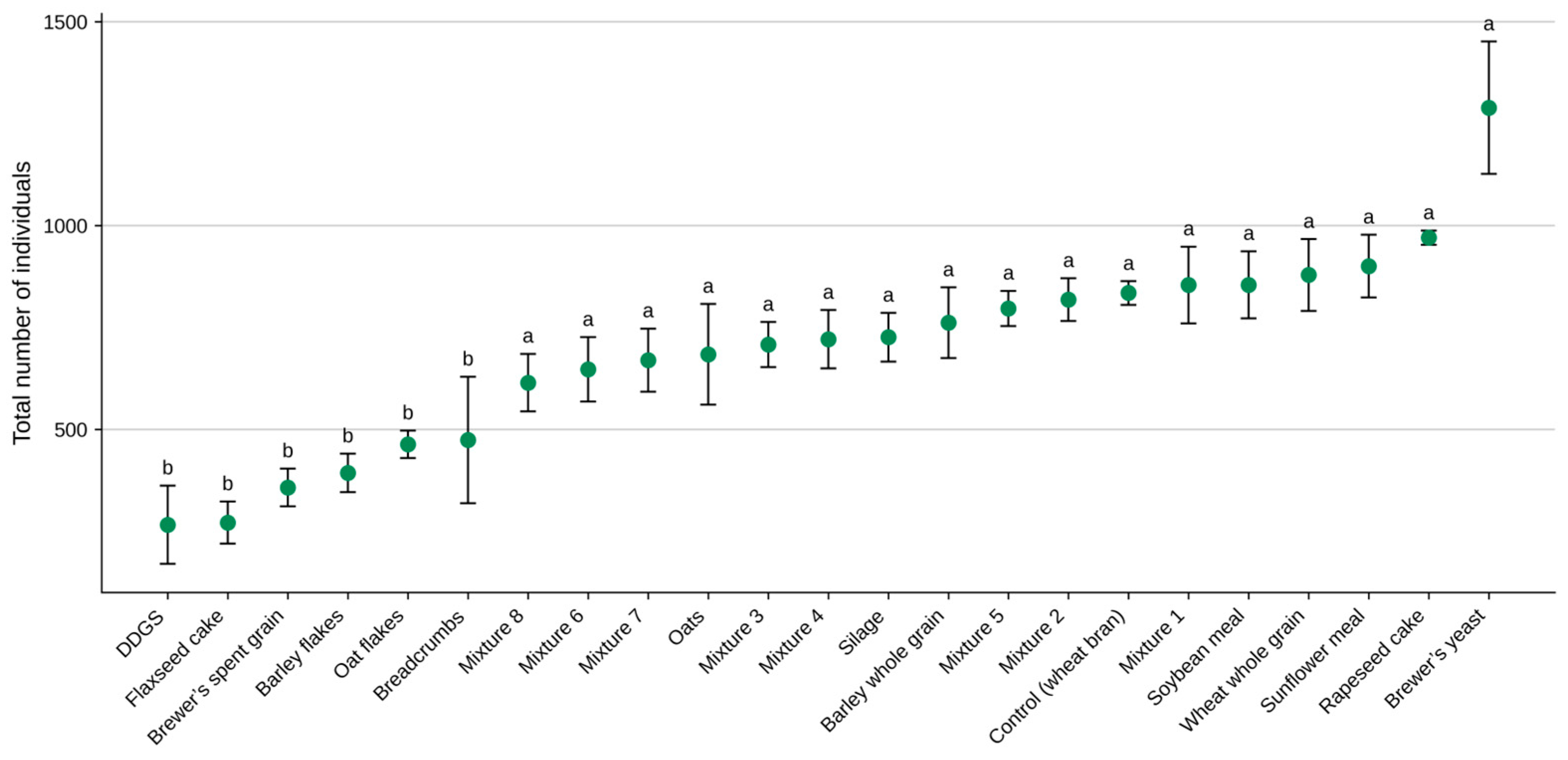
Population growth was most severely restricted on DDGS (266.00 ± 95.70 individuals per container, i.e., adults, larvae and pupae combined; ri = 0.0314) and flaxseed cake (271.25 ± 51.50; ri = 0.0359), followed by brewer’s spent grain, barley flakes, oat flakes and breadcrumbs (357.25–473.75 individuals; ri = 0.0380–0.0448). Seven of the eight formulated mixtures, together with oats, silage and barley whole grain, produced intermediate population sizes (614.50–818.25 individuals; ri = 0.0490–0.0536) that did not differ significantly from the control (wheat bran; 834.50 ± 29.04 individuals; ri = 0.0539). Population size on Mixture 1, soybean meal, wheat whole grain, sunflower meal and rapeseed cake was numerically higher than on the control (854.00–970.25 individuals; ri = 0.0540–0.0563), but these differences were not significant. The largest population was recorded on brewer’s yeast (1289.00 ± 162.40 individuals; ri = 0.0603 ± 0.0020), but it did not differ significantly from the control after correction for multiple comparisons (Table 4).
Table 4.
Negative binomial regression results for the effect of feed material/treatment on the total number of individuals.
Overall, population growth was significantly affected by treatment for all measured parameters (p ≤ 0.01 in all cases; Kruskal–Wallis test), and the negative binomial regression confirmed a highly significant overall effect of treatment on the total number of individuals (likelihood-ratio χ2 = 83.58, df = 22, p < 0.0001; Table 4). The data were strongly overdispersed relative to a Poisson model (Pearson χ2/df = 42.7), whereas the negative binomial model fitted adequately (Pearson χ2/df = 0.89; dispersion parameter θ = 10.85 ± 1.66). Relative to the control, DDGS, flaxseed cake, brewer’s spent grain, breadcrumbs, oat flakes and barley flakes were associated with significantly reduced expected population sizes (Exp(β) = 0.32–0.57, p ≤ 0.009), whereas brewer’s yeast was associated with a nominally higher expected value (Exp(β) = 1.55, p = 0.044), although this did not remain significant after Benjamini–Hochberg correction for the 22 comparisons to the control (adjusted p = 0.138).
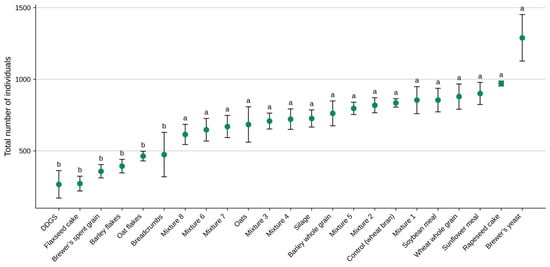
The observed total population sizes, together with the significance groupings from the Benjamini–Hochberg-corrected pairwise comparisons to the control in the negative binomial regression, are presented in Figure 1. DDGS, flaxseed cake, brewer’s spent grain, barley flakes, oat flakes and breadcrumbs clustered at the lower end of the range and brewer’s yeast clustered at the upper end, while all other treatments, including the control and the formulated mixtures, occupied intermediate positions.
Figure 1.
Observed total population size of Tenebrio molitor (mean ± standard error, SE; n = 4) across the 23 feed treatments after 65 days. Letters show the results of the Benjamini–Hochberg-corrected pairwise comparisons to the control in the negative binomial regression: treatments marked b had a significantly lower expected population size than the control (p ≤ 0.05), whereas treatments marked a did not differ significantly from it. Treatments are ordered by increasing population size. DDGS, dried distillers grains with solubles.
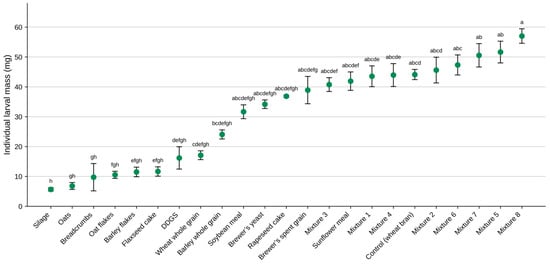
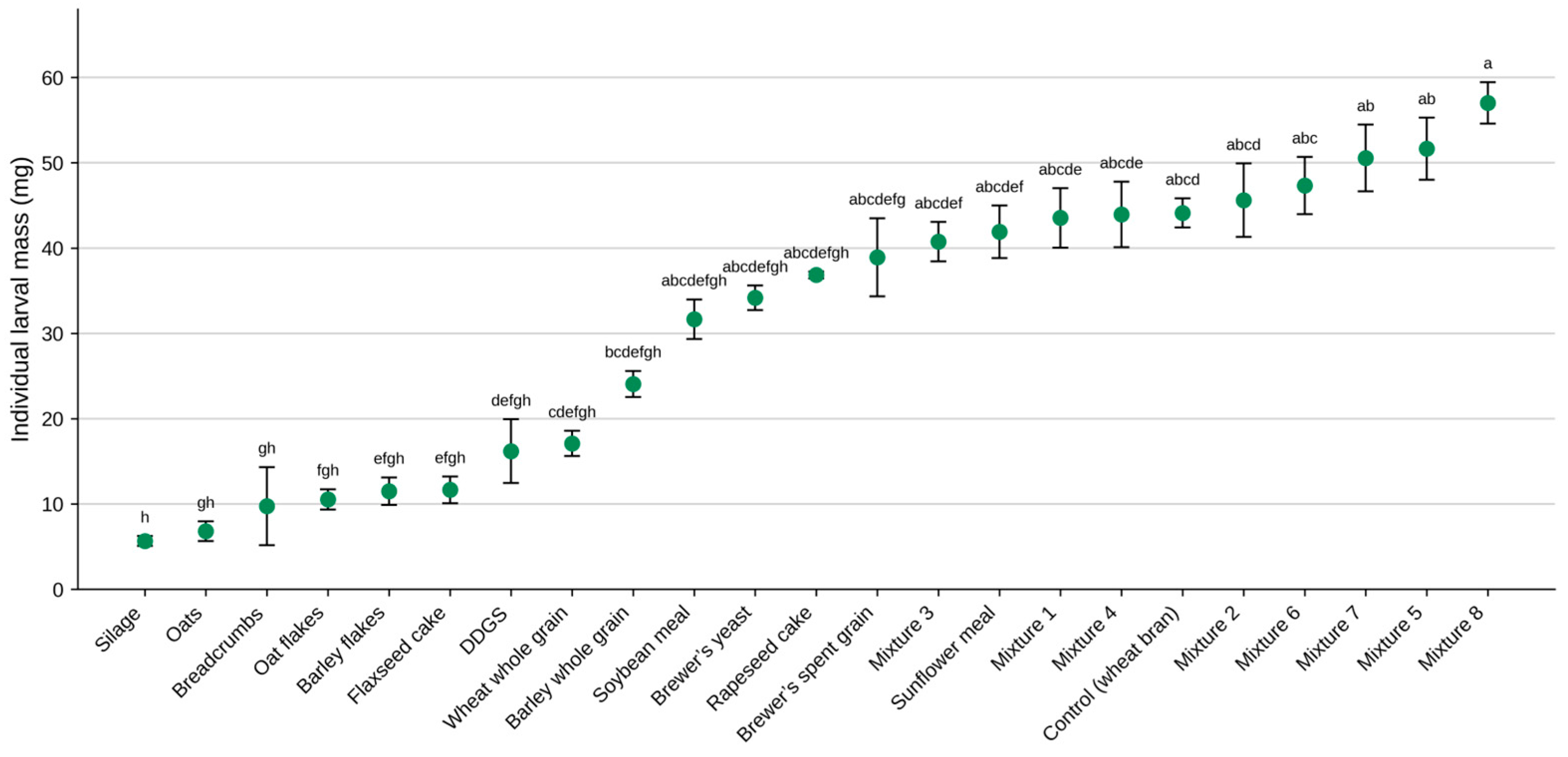
Adult survival and larval mass also differed significantly among treatments (Kruskal–Wallis test; χ2 = 63.17 and 84.55, respectively, df = 22, p < 0.001; Table 3). By day 65, the number of dead adults ranged from 2.75 ± 0.75 on Mixture 3 to 14.75 ± 2.78 on DDGS, and adult mortality on DDGS, oats and flaxseed cake was significantly higher than that on the control. Total larval mass per container ranged from 2.31 ± 0.71 g on breadcrumbs to 42.90 ± 4.92 g on brewer’s yeast; it was numerically highest (34.84–42.90 g) on brewer’s yeast, Mixture 5, sunflower meal, the control, Mixture 2, Mixture 1 and rapeseed cake, and significantly lower than on the control (below 5 g) on DDGS, oats, oat flakes, breadcrumbs, barley flakes, silage and flaxseed cake. Pupae were recorded only on Mixtures 2, 5, 6, 7 and 8 (0.25–5.25 per container; χ2 = 45.11, df = 22, p = 0.003), and only Mixture 8 differed significantly from the treatments without pupae. Mean individual larval mass also differed significantly among treatments (χ2 = 81.00, df = 22, p < 0.001), ranging from 5.66 ± 0.57 mg on silage to 57.01 ± 2.43 mg on Mixture 8; it was significantly lower than on the control (44.12 ± 1.70 mg) on flaxseed cake, barley flakes, oat flakes, breadcrumbs, oats and silage, whereas none of the treatments had significantly heavier larvae than the control (Table 3; Figure 2).
Figure 2.
Mean individual larval mass of Tenebrio molitor (mean ± SE; n = 4) across the 23 feed treatments after 65 days. Values followed by different letters differ significantly (Kruskal–Wallis test followed by Dunn’s post hoc test with Benjamini–Hochberg correction, p ≤ 0.05). Treatments are ordered by increasing larval mass. DDGS, dried distillers grains with solubles.
4. Discussion
Feed material significantly affected all measured population parameters of T. molitor, with ri ranging almost two-fold, from 0.0314 on DDGS to 0.0603 on brewer’s yeast. Protein content alone did not separate the best- from the worst-performing materials: the six highest-protein materials (brewer’s yeast, 50.37%; soybean meal, 49.98%; flaxseed cake, 39.09%; sunflower meal, 35.45%; rapeseed cake, 34.39%; DDGS, 33.09%; Table 1) included both the treatment with the highest ri (brewer’s yeast) and the one with the lowest (DDGS), as well as flaxseed cake, which had the second-smallest population, while brewer’s spent grain (29.77% protein) had the third-smallest. Hypothesis (i) was therefore not supported. This agrees with Rumbos et al. [10], in whose study soya meal, the highest-protein legume substrate (42.4%), produced one of the lowest individual larval dry weights (0.6 mg) and corn gluten (72.7% protein) produced no progeny at all, and with Kröncke and Benning [30], who found that higher dietary protein content was negatively correlated with individual larval weight (R2 = 0.572). The present results extend this conclusion from larval growth to population-level output.
Population growth on the wheat bran control was high relative to the most directly comparable data set. Under the same assay duration, temperature and relative humidity (65 days, 26 °C, 55% RH), Rigopoulou et al. [26] recorded a 14.6-fold increase on wheat bran (292.1 individuals from 20 adults in 10 g of substrate), compared with a 33.4-fold increase here (834.50 individuals from 25 adults in 50 g). The larger amount of substrate per adult (2.0 vs. 0.5 g) may have contributed to this difference, although colony origin, moisture source (potato vs. carrot) and adult age (7–10 days here vs. <1 month in [26]) also differed.
DDGS, flaxseed cake and brewer’s spent grain, which produced the three smallest populations, were all fed here as sole substrates, whereas each has performed better elsewhere when combined with a complementary base. Montalbán et al. [31] reported that several agro-industrial by-products worked well in blended diets but limited larval productivity and digestibility at 100% inclusion. Similarly, DDGS combined with wheat bran supported larval survival above 90% [32], and flaxseed cake at 30% inclusion gave a feed conversion ratio statistically indistinguishable from that on wheat bran [33], whereas wet brewer’s grains improved larval growth by 3.5% when used as a supplement to wheat bran [17]. Antinutritional compounds may also contribute, as suggested for thistle cake, which, relative to hemp cake, significantly extended larval duration by over 40% (142.7 vs. 101.0 days) and was associated with numerically higher larval mortality (21.6% vs. 9.5%) when fed as the sole substrate [25]. Antinutritional factors were not measured here, however, and rapeseed cake, which typically also contains such compounds, supported one of the largest populations, so this explanation requires direct testing. For brewer’s spent grain, the developmental stage also appears to matter: in larvae of about 46 mg fed for 28 days, complete replacement of wheat bran by brewery waste increased daily weight gain (0.87 vs. 0.77 mg per larva per day) [34], suggesting that in the present assay, which starts from adults, oviposition and early larval development rather than the growth of older larvae limited population increase on this material.
Differences in adult survival also contributed to the ranking of feed materials. Adult mortality on DDGS, oats and flaxseed cake was significantly higher than that on the control (Table 3). Because the reproductive output of T. molitor is concentrated in the first weeks of adult life, peaking in beetles 2–3 weeks old [35] and being generally highest in females aged 13–29 days [36], substrates that shorten adult survival or depress adult condition during this period can be expected to reduce progeny production, which is consistent with the small populations on DDGS and flaxseed cake. Adult mortality alone does not explain the ranking, however, since oats sustained an intermediate population size (684.00 individuals) despite comparable adult losses.
The flaked cereals performed less well than the corresponding whole grains relative to the control: oat flakes and barley flakes produced significantly smaller populations than wheat bran in the negative binomial model, whereas oats and barley whole grain did not (Table 4), although the direct differences between whole and flaked forms in the number of larvae were not significant in the non-parametric comparisons (Table 3). This pattern is not readily explained by the available literature: Rumbos et al. [10] found numerically more surviving larvae on millet flakes than on millet grains, but significantly heavier larvae on grains, and Naser El Deen et al. [37] reported that smaller feed particles generally improved larval growth, which would, if anything, favour the processed forms. Processing-related changes that were not characterised here, such as heat treatment during flaking, may therefore be involved, and the effect of physical form deserves separate study.
Population size and larval biomass were not always aligned. Wheat whole grain (878.75 individuals) and barley whole grain (761.50 individuals) did not differ from the control in population size, yet produced numerically less larval mass (14.29 and 17.56 g vs. 35.57 g on wheat bran), although these differences were not statistically significant (Table 3), and silage and oats supported intermediate population sizes but only 3.97 and 4.73 g of larvae. In contrast, brewer’s yeast (42.90 g), sunflower meal (36.00 g) and rapeseed cake (34.84 g) combined numerically high numbers with high larval mass, and the formulated mixtures combined intermediate to high numbers with intermediate to high larval mass (27.47–39.37 g). Expressed per larva, mean individual larval mass ranged from 5.66 mg on silage to 57.01 mg on Mixture 8 (Table 3). This agrees with Plonquet et al. [38], who found that unbalanced substrates containing 80% wheat or barley grain supported slower larval growth than wheat bran (3.05 and 3.17 vs. 3.54 mg per day), whereas balanced substrates based on the same cereals matched the wheat bran control. Because all containers received the same single, non-replenished amount of substrate, individual larval mass may also partly reflect the amount of food available per larva: in some of the better-performing treatments, larger populations consisted of smaller larvae (e.g., 584.25 larvae of 57.01 mg on Mixture 8 vs. 1264.00 larvae of 34.17 mg on brewer’s yeast). For production purposes, ri should therefore be interpreted together with larval biomass.
Brewer’s yeast produced the numerically highest ri (0.0603) and the largest final population, followed by rapeseed cake, sunflower meal and wheat whole grain; however, none of these treatments differed significantly from the control, and the advantage of brewer’s yeast did not remain significant after correction for multiple comparisons (adjusted p = 0.138). This agrees with a 12-week trial by Kim et al. [39], in which incorporating brewer’s yeast into wheat bran at 30–50% inclusion significantly improved weight gain relative to wheat bran alone, with numerically higher larval survival; the present results indicate that brewer’s yeast used as the sole substrate can sustain population growth that does not differ significantly from that on wheat bran, with individual larvae that were numerically, but not significantly, smaller (34.17 vs. 44.12 mg; Table 3).
Within the formulated mixtures, which followed the design of Vukadinović et al. [27], mean individual larval mass averaged 51.4 mg on the high-protein mixtures (Mixtures 2, 5 and 8), 46.0 mg on the medium-protein mixtures (Mixtures 1, 4 and 7) and 44.0 mg on the low-protein mixtures (Mixtures 3 and 6), and the largest larvae of all treatments were recorded on Mixtures 8 and 5 (57.01 and 51.64 mg), although these differences were not statistically significant (Table 3). This is consistent with Vukadinović et al. [27], who found on the same nine formulations that larval weight gain was significantly affected by dietary protein but not by energy level, ranging from 0.57 g/day per tray on pure wheat bran to 0.71 g/day per tray on the high-protein, medium-energy diet, which also gave the lowest feed conversion ratio (1.89). Hypothesis (ii) was not supported, however, as none of the formulated mixtures differed significantly from the control in population size, adult survival or total larval mass (Table 3 and Table 4); the only exception was a small but significantly higher number of pupae on Mixture 8.
Pupation did not follow the same ranking as ri: a few pupae were recorded only on Mixtures 2, 5, 6, 7 and 8, and only Mixture 8 differed significantly from the treatments without pupae (Table 3). These five mixtures were, however, the five treatments with the highest mean individual larval mass (45.61–57.01 mg vs. 44.12 mg on wheat bran and 34.17 mg on brewer’s yeast), although none of them differed significantly from the control, suggesting that pupation within the 65-day window occurred where larvae had grown largest rather than where populations were largest. As larval numbers on these mixtures were also somewhat lower than on the control, lower density may have contributed, although the evidence on density and pupation in T. molitor is conflicting: Weaver and McFarlane [40] found no effect of density on time to pupation, whereas Choi et al. [41] reported faster larva-to-pupa transformation at higher densities. Lifespan and reproductive output of adult T. molitor also respond to dietary protein-to-carbohydrate balance [20,42], but carbohydrate content was not determined here, so this observation should be regarded as preliminary.
Several limitations of the present study should be acknowledged. The bioassay was run for a single 65-day period, following the protocol of Rigopoulou et al. [26]; this duration was chosen because, at a comparable temperature (26 ± 1 °C), larvae on favourable diets have been reported to complete larval development in as little as 61–63 days [2]. Because the assay started from adults, however, the offspring had less than 65 days for egg and larval development, so only the fastest-developing individuals could reach the pupal stage. Adults were 7–10 days old at the start of the assay, and because the reproductive output of T. molitor is strongly age-dependent [35,36], even this range may have contributed to variation among replicates; moreover, each treatment was replicated only four times, which limits statistical power. Each material was tested only as a sole substrate, which was supplied once and not replenished, so food may have become limiting in the largest populations towards the end of the assay; in addition, larval density at the end of the assay differed widely among treatments (treatment means of 241–1264 larvae per container), so density-dependent effects on growth and development [40,41,43] cannot be separated from dietary effects. In addition, because larvae were recovered by sieving and the sieved fraction was not inspected, the smallest early instars may have been under-recorded, and their detection may have differed between fine substrates, which passed through the sieve, and coarse materials such as oats and flakes, from which larvae had to be separated by hand.
Further limitations relate to the insects and the moisture source. The parental adults originated from a colony reared on wheat bran with 5% brewer’s yeast; an influence of this previous dietary experience on the response to brewer’s yeast cannot be excluded, although it would not explain the good performance of rapeseed cake and sunflower meal, which were not part of the colony diet. The carrot pieces supplied as a moisture source were not weighed; as carrot also provides sugars, it may have been a non-negligible additional food source on nutritionally poor substrates. Finally, although adults of both sexes were present, the sex ratio was not determined and may have varied among replicates, and sex could not be included as a factor in the analysis. The chemical composition of the larvae was not analysed, although it is central to their value as a protein source. Future studies should follow populations over a full generation, determine larval composition and test the lowest-performing materials at graded inclusion levels in a wheat-bran base.
5. Conclusions
These results have practical relevance for T. molitor mass rearing based on regionally available feed materials. Population growth on brewer’s yeast, rapeseed cake, sunflower meal, soybean meal and wheat whole grain did not differ significantly from that on wheat bran, and brewer’s yeast, sunflower meal and rapeseed cake also did not differ from wheat bran in larval biomass. These materials can therefore be considered candidate alternatives to wheat bran, although, with four replicates per treatment, the absence of significant differences does not demonstrate equivalence. DDGS, flaxseed cake and brewer’s spent grain produced the smallest populations as sole substrates despite their relatively high protein content; given their better performance in blended diets reported elsewhere, their value at partial inclusion levels deserves testing rather than outright exclusion. The formulated mixtures did not differ significantly from wheat bran in population size, and the few pupae recorded within the 65-day window were found only on these mixtures, a preliminary observation that warrants longer-term study. Given that the environmental and economic viability of insect mass rearing is driven largely by feed cost and availability [8,9], these findings offer a practical basis for pre-selecting regional feed materials for further evaluation, with ri interpreted together with larval biomass.
Author Contributions
Conceptualisation, T.K.; methodology, N.L., M.P.H. and M.P.; validation, V.P.; formal analysis, M.P.; investigation, V.P., N.L., M.P.H., M.V. and A.P.; writing—original draft preparation, T.K., M.P.H., M.V., A.P. and M.P.; visualisation, T.K. All authors have read and agreed to the published version of the manuscript.
Funding
This research was supported by the Ministry of Science, Technological Development and Innovation of the Republic of Serbia (Contract No. 451-03-34/2026-03/200117). The work of M.P. was additionally funded through the project “InsectFarm—the Future of Food and Soil,” supported by the Provincial Secretariat for Higher Education and Scientific Research (Contract No. 00395198 2025 09418 003 000 000 001). The work of M.V. and M.P.H. was supported by the Provincial Secretariat for Higher Education and Scientific Research of the Autonomous Province of Vojvodina, Project No. 003858644 2025 09418 003 000 000 001 04 004. The work of A.P. and N.L. was additionally funded by the Science Fund of the Republic of Serbia under Grant No. 7284 (Pro-Sustain Project).
Data Availability Statement
The raw data supporting the conclusions of this article will be made available by the authors on request.
Acknowledgments
The authors used Claude (Sonnet 5 and Opus 5.5; Anthropic, San Francisco, CA, USA) for English language editing. The authors take full responsibility for the content of this publication.
Conflicts of Interest
The authors declare no conflicts of interest.
References
- van Huis, A.; Van Itterbeeck, J.; Klunder, H.; Mertens, E.; Halloran, A.; Muir, G.; Vantomme, P. Edible Insects: Future Prospects for Food and Feed Security; FAO Forestry Paper 171; FAO: Rome, Italy, 2013. [Google Scholar]
- Mahmoud, M.A.; Abotaleb, A.O.; Zinhoum, R.A. Evaluation of various diets for improved growth, reproductive and nutritional value of the yellow mealworm, Tenebrio molitor L. Sci. Rep. 2025, 15, 15656. [Google Scholar] [CrossRef] [Scilit]
- Ribeiro, N.; Abelho, M.; Costa, R. A review of the scientific literature for optimal conditions for mass rearing Tenebrio molitor (Coleoptera: Tenebrionidae). J. Entomol. Sci. 2018, 53, 434–454. [Google Scholar] [CrossRef] [Scilit]
- EFSA Panel on Nutrition, Novel Foods and Food Allergens (NDA); Turck, D.; Castenmiller, J.; De Henauw, S.; Hirsch-Ernst, K.I.; Kearney, J.; Maciuk, A.; Mangelsdorf, I.; McArdle, H.J.; Naska, A.; et al. Safety of dried yellow mealworm (Tenebrio molitor larva) as a novel food pursuant to Regulation (EU) 2015/2283. EFSA J. 2021, 19, e06343. [Google Scholar] [CrossRef] [Scilit]
- European Commission. Commission Implementing Regulation (EU) 2021/882 of 1 June 2021 authorising the placing on the market of dried Tenebrio molitor larva as a novel food under Regulation (EU) 2015/2283 of the European Parliament and of the Council, and amending Commission Implementing Regulation (EU) 2017/2470. Off. J. Eur. Union 2021, L194, 16–21. Available online: https://eur-lex.europa.eu/eli/reg_impl/2021/882/oj (accessed on 8 August 2026).
- European Commission. Commission Regulation (EU) 2017/893 of 24 May 2017 amending Annexes I and IV to Regulation (EC) No 999/2001 of the European Parliament and of the Council and Annexes X, XIV and XV to Commission Regulation (EU) No 142/2011 as regards the provisions on processed animal protein. Off. J. Eur. Union 2017, L138, 92–116. Available online: https://eur-lex.europa.eu/eli/reg/2017/893/oj (accessed on 8 August 2026).
- European Commission. Commission Regulation (EU) 2021/1372 of 17 August 2021 amending Annex IV to Regulation (EC) No 999/2001 of the European Parliament and of the Council as regards the prohibition to feed non-ruminant farmed animals, other than fur animals, with protein derived from animals. Off. J. Eur. Union 2021, L295, 1–17. Available online: https://eur-lex.europa.eu/eli/reg/2021/1372/oj (accessed on 8 August 2026).
- Fernández-Ríos, A.; Laso, J.; Aldaco, R.; Margallo, M. Environmental evaluation of yellow mealworm larvae products: Analysis of modeling choices and nutritional impact-adjusted comparison. ACS Omega 2026, 11, 8963–8975. [Google Scholar] [CrossRef] [Scilit]
- Lienhard, A.; Rehorska, R.; Pöllinger-Zierler, B.; Mayer, C.; Grasser, M.; Berner, S. Future proteins: Sustainable diets for Tenebrio molitor rearing composed of food by-products. Foods 2023, 12, 4092. [Google Scholar] [CrossRef] [Scilit]
- Rumbos, C.I.; Karapanagiotidis, I.T.; Mente, E.; Psofakis, P.; Athanassiou, C.G. Evaluation of various commodities for the development of the yellow mealworm, Tenebrio molitor. Sci. Rep. 2020, 10, 11224. [Google Scholar] [CrossRef] [Scilit]
- Adamaki-Sotiraki, C.; Rumbos, C.I.; Athanassiou, C.G. From a stored-product pest to a promising protein source: A U-turn of human perspective for the yellow mealworm Tenebrio molitor. J. Pest Sci. 2025, 98, 113–129. [Google Scholar] [CrossRef] [Scilit]
- Costa, S.; Pedro, S.; Lourenço, H.; Batista, I.; Teixeira, B.; Bandarra, N.M.; Murta, D.; Nunes, R.; Pires, C. Evaluation of Tenebrio molitor larvae as an alternative food source. NFS J. 2020, 21, 57–64. [Google Scholar] [CrossRef] [Scilit]
- Ravzanaadii, N.; Kim, S.-H.; Choi, W.H.; Hong, S.-J.; Kim, N.J. Nutritional value of mealworm, Tenebrio molitor as food source. Int. J. Ind. Entomol. 2012, 25, 93–98. [Google Scholar] [CrossRef] [Scilit]
- Kotsou, K.; Chatzimitakos, T.; Athanasiadis, V.; Bozinou, E.; Athanassiou, C.G.; Lalas, S.I. Innovative applications of Tenebrio molitor larvae in food product development: A comprehensive review. Foods 2023, 12, 4223. [Google Scholar] [CrossRef] [Scilit]
- Selaledi, L.; Mbajiorgu, C.A.; Mabelebele, M. The use of yellow mealworm (T. molitor) as alternative source of protein in poultry diets: A review. Trop. Anim. Health Prod. 2020, 52, 7–16. [Google Scholar] [CrossRef] [Scilit]
- Verheyen, G.R.; Goossens, S.; Van Miert, S. Protein extraction from mealworm (Tenebrio molitor): Effects of euthanasia and drying on yield and composition. Foods 2026, 15, 585. [Google Scholar] [CrossRef] [Scilit]
- Fasce, B.; Ródenas, L.; López, M.; Moya, V.; Pascual, J.; Cambra-López, M. Nutritive value of wheat bran diets supplemented with fresh carrots and wet brewers’ grains in yellow mealworm. J. Insect Sci. 2022, 22, 7. [Google Scholar] [CrossRef] [Scilit]
- Vrontaki, M.; Adamaki-Sotiraki, C.; Rumbos, C.I.; Anastasiadis, A.; Athanassiou, C.G. Valorization of local agricultural by-products as nutritional substrates for Tenebrio molitor larvae: A sustainable approach to alternative protein production. Environ. Sci. Pollut. Res. 2024, 31, 35760–35768. [Google Scholar] [CrossRef] [Scilit]
- Rho, M.S.; Lee, K.P. Geometric analysis of nutrient balancing in the mealworm beetle, Tenebrio molitor L. (Coleoptera: Tenebrionidae). J. Insect Physiol. 2014, 71, 37–45. [Google Scholar] [CrossRef] [Scilit]
- Rho, M.S.; Lee, K.P. Balanced intake of protein and carbohydrate maximizes lifetime reproductive success in the mealworm beetle, Tenebrio molitor (Coleoptera: Tenebrionidae). J. Insect Physiol. 2016, 91–92, 93–99. [Google Scholar] [CrossRef] [Scilit]
- Simpson, S.J.; Raubenheimer, D. The Nature of Nutrition: A Unifying Framework from Animal Adaptation to Human Obesity; Princeton University Press: Princeton, NJ, USA, 2012. [Google Scholar] [CrossRef] [Scilit]
- Errico, S.; Moliterni, S.; Dimatteo, S.; Rimauro, J.; Fedele, N.; Sabatino, A.; Casella, P.; Iannaccone, M.; Molino, A. Evaluation of agricultural by-products as sustainable feed sources for Tenebrio molitor larvae rearing. Chem. Eng. Trans. 2026, 124, 265–270. [Google Scholar] [CrossRef]
- Langston, K.; Selaledi, L.; Yusuf, A. Evaluation of alternative substrates for rearing the yellow mealworm Tenebrio molitor (L.). Int. J. Trop. Insect Sci. 2023, 43, 1523–1530. [Google Scholar] [CrossRef] [Scilit]
- Morales-Ramos, J.A.; Rojas, M.G.; Kelstrup, H.C.; Emery, V. Self-selection of agricultural by-products and food ingredients by Tenebrio molitor (Coleoptera: Tenebrionidae) and impact on food utilization and nutrient intake. Insects 2020, 11, 827. [Google Scholar] [CrossRef] [Scilit]
- Serra, G.; Corrias, F.; Casula, M.; Fadda, M.L.; Arrizza, S.; Milia, M.; Arru, N.; Angioni, A. Growth performances and nutritional values of Tenebrio molitor larvae: Influence of different agro-industrial by-product diets. Foods 2026, 15, 393. [Google Scholar] [CrossRef] [Scilit]
- Rigopoulou, M.; Rumbos, C.I.; Athanassiou, C.G. Population growth of three stored product beetle species on Alphitobius diaperinus (Coleoptera: Tenebrionidae) meals. J. Econ. Entomol. 2023, 116, 621–627. [Google Scholar] [CrossRef] [Scilit]
- Vukadinović, M.; Ivković, M.; Beuković, D.; Petrović, M.; Polovinski Horvatović, M.; Laćarac, N.; Krstović, S.; Jajić, I. The impact of energy and protein levels on yellow mealworm growth and chemical composition. Insects 2026, 17, 221. [Google Scholar] [CrossRef] [Scilit]
- ANKOM Technology. Crude Fiber Analysis in Feeds—Filter Bag Technique (AOCS Ba 6a-05). Available online: https://www.ankom.com/sites/default/files/2024-02/Crude_Fiber_Abstract.pdf (accessed on 25 September 2026).
- Stark, J.D.; Banks, J.E. Population-level effects of pesticides and other toxicants on arthropods. Annu. Rev. Entomol. 2003, 48, 505–519. [Google Scholar] [CrossRef] [Scilit]
- Kröncke, N.; Benning, R. Influence of dietary protein content on the nutritional composition of mealworm larvae (Tenebrio molitor L.). Insects 2023, 14, 261. [Google Scholar] [CrossRef] [Scilit]
- Montalbán, A.; Martínez-Miró, S.; Schiavone, A.; Madrid, J.; Hernández, F. Growth performance, diet digestibility, and chemical composition of mealworm (Tenebrio molitor L.) fed agricultural by-products. Insects 2023, 14, 824. [Google Scholar] [CrossRef] [Scilit]
- Akaichi, A.; Fazel Dehkordi, N.; Lingens, J.B.; Rath, A.; Lohkamp, F.; Abd El-Wahab, A.; Ahmed, M.F.E.; Grabowski, N.T.; ur Rehman, K.; Plötz, M.; et al. Sustainable rearing of Tenebrio molitor larvae using peatland biomass. Insects 2026, 17, 436. [Google Scholar] [CrossRef] [Scilit]
- Bordiean, A.; Krzyzaniak, M.; Aljewicz, M.; Stolarski, M.J. Influence of different diets on growth and nutritional composition of yellow mealworm. Foods 2022, 11, 3075. [Google Scholar] [CrossRef] [Scilit]
- Pelizari, A.; Paulo, G.N.S.; Borille, R.; Emanuelli, T.; Monteiro, C.S.; Lazzari, R.; Ghedini, C.P. The use of brewery waste as substrate on the lipid content and profile of the larvae Tenebrio molitor. Trop. Anim. Health Prod. 2026, 58, 365. [Google Scholar] [CrossRef] [Scilit]
- Morales-Ramos, J.A.; Rojas, M.G.; Kay, S.; Shapiro-Ilan, D.I.; Tedders, W.L. Impact of adult weight, density, and age on reproduction of Tenebrio molitor (Coleoptera: Tenebrionidae). J. Entomol. Sci. 2012, 47, 208–220. [Google Scholar] [CrossRef] [Scilit]
- Berggreen, I.E.; Offenberg, J.; Calis, M.; Heckmann, L.-H. Impact of density, reproduction period and age on fecundity of the yellow mealworm Tenebrio molitor (Coleoptera: Tenebrionidae). J. Insects Food Feed 2018, 4, 43–50. [Google Scholar] [CrossRef] [Scilit]
- Naser El Deen, S.; Spranghers, T.; Baldacchino, F.; Deruytter, D. The effects of the particle size of four different feeds on the larval growth of Tenebrio molitor (Coleoptera: Tenebrionidae). Eur. J. Entomol. 2022, 119, 242–249. [Google Scholar] [CrossRef] [Scilit]
- Plonquet, D.; Fondevila, G.; Fondevila, M. Rearing mealworm larvae with wheat, barley or maize grains as main source of nutrients in unbalanced or balanced substrates. Animal 2025, 19, 101384. [Google Scholar] [CrossRef] [Scilit]
- Kim, S.; Park, I.; Park, H.; Lee, H.S.; Song, J.-H. Growth performance of the edible mealworm species, Tenebrio molitor (Coleoptera: Tenebrionidae) on diets composed of brewer’s yeast. Int. J. Ind. Entomol. Biomater. 2019, 39, 54–59. [Google Scholar] [CrossRef]
- Weaver, D.K.; McFarlane, J.E. The effect of larval density on growth and development of Tenebrio molitor. J. Insect Physiol. 1990, 36, 531–536. [Google Scholar] [CrossRef] [Scilit]
- Choi, D.Y.; Yun, J.Y.; Kim, S.Y.; Lee, G.E.; Batarse, K.; Kim, S.; Kim, D.S. Effect of population density on development time of Tenebrio molitor. J. Bio-Environ. Control 2024, 33, 139–147. [Google Scholar] [CrossRef] [Scilit]
- Rho, M.S.; Lee, K.P. Macronutrient balance dictates lifespan and reproduction in a beetle, Tenebrio molitor. J. Exp. Biol. 2025, 228, jeb250281. [Google Scholar] [CrossRef] [Scilit]
- Zaelor, J.; Kitthawee, S. Growth response to population density in larval stage of darkling beetles (Coleoptera; Tenebrionidae) Tenebrio molitor and Zophobas atratus. Agric. Nat. Resour. 2018, 52, 603–606. [Google Scholar] [CrossRef] [Scilit]

Disclaimer/Publisher’s Note: The statements, opinions and data contained in all publications are solely those of the individual author(s) and contributor(s) and not of MDPI and/or the editor(s). MDPI and/or the editor(s) disclaim responsibility for any injury to people or property resulting from any ideas, methods, instructions or products referred to in the content. |
© 2026 by the authors. Licensee MDPI, Basel, Switzerland. This article is an open access article distributed under the terms and conditions of the Creative Commons Attribution (CC BY) license.