


Simple Summary
A description of the new aphid species Aphis tanaceticola sp. nov., living on Tanacetum parthenium (L.) Sch.Bip. in Ankara Province, Türkiye, and on Tanacetum sp. (Asteraceae: Anthemideae) in Mazandaran Province, Iran, is presented. The information about intraspecific variations between short-haired Iranian and long-haired Turkish populations of this species and an identification key for Anthemideae-feeding Aphis spp. with sclerotic abdominal dorsum anterior to siphunculi are provided.
Abstract
The new aphid species Aphis tanaceticola sp. nov., living on Tanacetum parthenium (L.) Sch.Bip. in Ankara Province, Türkiye, and on Tanacetum sp. (Asteraceae: Anthemideae) in Mazandaran Province, Iran, is described and illustrated based on the fundatrix, normal and alatiform apterous and alate viviparous females, and intraspecific variations between short-haired Iranian and long-haired Turkish populations are discussed. Differential diagnoses to morphologically similar species and to the Anthemideae-feeding Aphis spp. are given. An identification key for Anthemideae-feeding Aphis spp. with sclerotic abdominal dorsum anterior to siphunculi is provided.
1. Introduction
At present, 690 aphid species have been recorded from Türkiye [1,2,3] and 580 species from Iran [4,5,6,7,8].
Aphis Linnaeus, 1758, is the largest aphid genus in the tribe Aphidini Latreille, 1802, comprising seven subgenera, 799 species, and 46 subspecies, most of which occur in the Northern Hemisphere [9,10]. Species of the genus exhibit combinations of the following characteristics: apterous viviparous females lack secondary rhinaria on antennal segment III; the ratio of the processus terminalis to the basal part of the last antennal segment is 1.2–4.5; the ultimate rostral segments are mostly rather blunt, oblong-triangular; the siphunculi are subcylindrical; the cauda is finger-shaped or subtriangular; and the abdominal dorsum is reticulated. In addition, aphids of this genus are small to medium-sized, and their body colour varies from pale to black [11,12,13]. To date, 109 species of Aphis have been recorded from Türkiye [1,2,3], whereas 77 species have been recorded from Iran [7].
During an examination of aphid slides with Aphis species sampled on Tanacetum spp. in Türkiye and Iran in 1966 and 1977 respectively, a new aphid species was recognized. The aim of this study was to describe the new Tanacetum-feeding Aphis species from Türkiye and Iran and to document some intraspecific variations between the Iranian and Turkish populations.
2. Materials and Methods
Slides with undescribed Aphis sp. sampled on Tanacetum parthenium (L.) Sch.Bip. in Türkiye and Tanacetum sp. in Iran (Asteraceae), borrowed from the Muséum national d’Histoire naturelle, Paris, France (MNHN), were investigated. Measurements of the morphological characters of slide-mounted specimens were performed according to Blackman and Eastop [14] using an Olympus CX43 light microscope and photographed using an Olympus DP23 camera (Olympus Corporation, Tokyo, Japan) with cellSens software v 4.3. The measurements of the specimens are given in millimetres. The current valid names of aphid species are taken from Favret [10]. The names of host plant species were given according to the World Flora Online [15].
The following abbreviations are used in the text, tables and figure captions: ABD TERG: abdominal tergite; al.: alate viviparous female; alat.: alatiform apterae; ANT: antenna; ANT I, ANT II, ANT III, ANT IV, ANT V, ANT VI b: antennal segments I, II, III, IV, and V, and the base of antennal segment VI respectively; ANT III BD: basal diameter of antennal segment III; apt.: apterous viviparous female; BL: length of body along the midline, including cauda; BW: width of body in the widest part of abdomen; F.: fundatrix; HFEM: hind femur; HTIB: hind tibia; HT I, HT II: first and second segment of hind tarsus respectively; L: length; MSL: maximal setal length; MTu: marginal tubercle; PSL: posterior setae length; PT: processus terminalis; sec. rhin.: secondary rhinaria; SIPH: siphunculus; suture: trochantro-femoral suture; troch.: trochanter; URS: ultimate rostral segments IV and V together; W: width.
Depositories of material: IZISU—Institute of Zoology, Ilia State University, Tbilisi, Republic of Georgia; MNHN—Muséum national d’Histoire naturelle, Paris, France.
3. Results
- Aphis Linnaeus, 1758
- Aphis tanaceticola sp. nov.
- urn:lsid:zoobank.org:act:B389D0B1-EFC6-4AE0-9819-FA408E7BE485
- Description
- Fundatrix (n = 1)
Colour in life: unknown. Pigmentation on slide: ANT I, II, V brown, ANT III pale with pale brown apices, basal halves of ANT IV pale brown, with brown apical halves; head, clypeus, rostral III segment, URS, coxae, trochanters, and tarsi brown, femora of front legs completely pale brown, while ca. 1/5 of basal part pale and remaining 4/5 brown in middle and hind femora; tibiae with brown small basal portion, pale middle part and brown apices; prothorax and mesothorax with brown transverse bands; ABD TERG II–IV with brown marginal sclerites; fragmented or completed presiphuncular and completed postsiphuncular sclerites brown; ABD TERG VI with brown-coloured, small, several scleroites in spinopleural position; transverse bands on ABD TERG VII–VIII brown; stigmal plates, SIPH, cauda, subgenital and anal plates brown (Figure 1a).
Figure 1.
Aphis tanaceticola sp. nov. habitus: (a) fundatrix, (b) apterous viviparous female, (c) alate viviparous female.
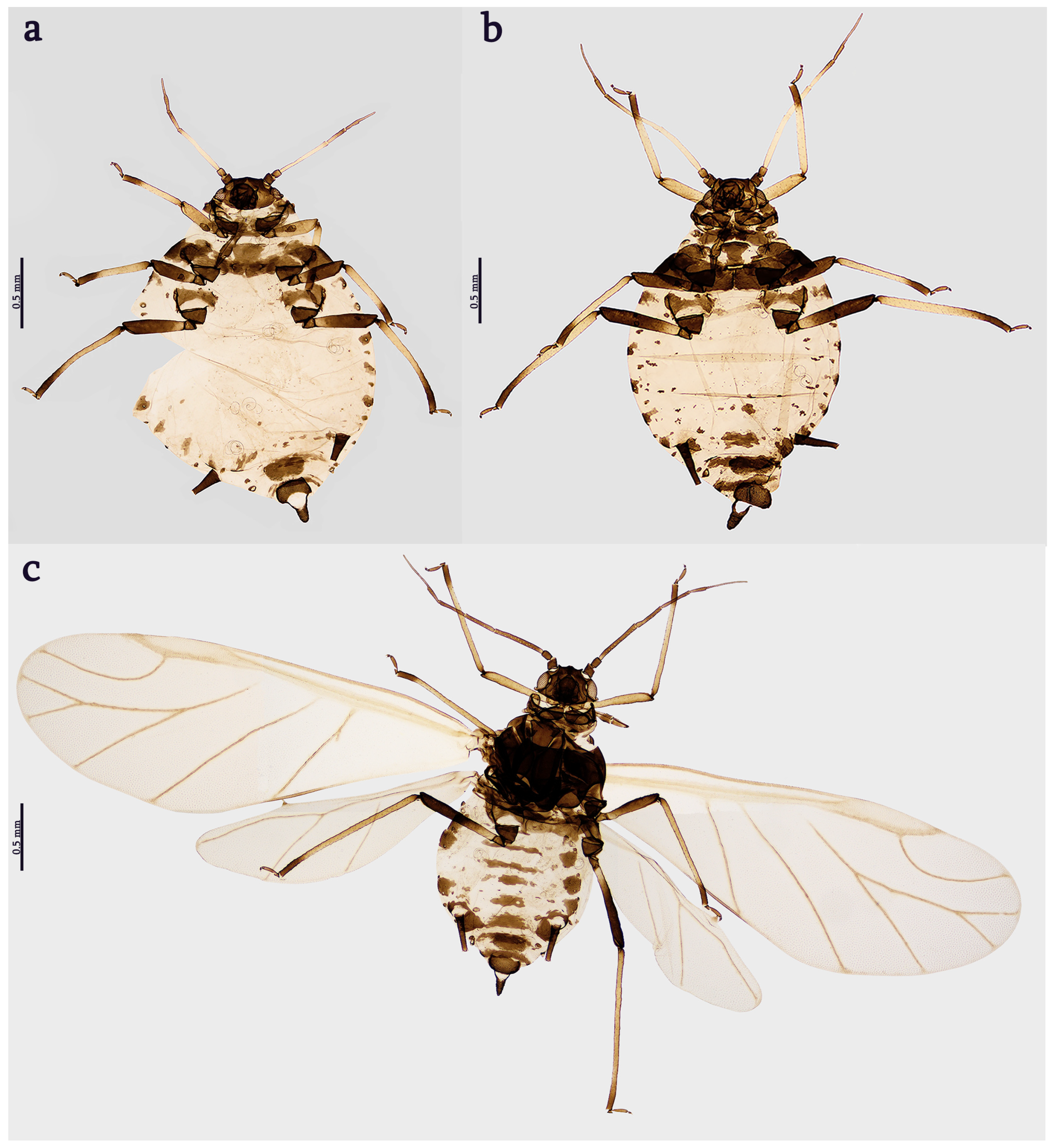
Morphological characters: Body widely oval (Figure 1a). Frons w-shaped with rounded medial frontal tubercle. Medial frontal tubercle higher than ANT tubercles (Figure 1a). ANT 5-segmented (Figure 1a). ANT 0.40 × BL and 1.96 × Head W respectively. ANT I–II smooth, ANT III–VI imbricated. Antennal chaetotaxy: ANT I with 5, ANT II with 2, ANT III with 2, ANT IV with 2, ANT V b with 2, PT with 0 setae, apart from 4 apical and subapical setae. Setae on ANT III pointed, straight or curved. MSL on ANT III 0.80 × ANT III BD. Sec. rhin. absent on ANT III–IV. PT 1.21 × ANT V b, 0.83 × ANT IV, 0.34 × ANT III and 0.29 × Head W respectively. ANT V b 0.28 × ANT III, ANT V 1.52 × ANT IV, ANT V 0.62 × ANT III, ANT IV 0.41 × ANT III. MSL on frons and occipital area 0.96 and 0.88 × ANT III BD respectively. Reticulation pattern of cuticle distinct on thorax and abdominal dorsum. Rostrum short, reaches to middle coxae (Figure 1a). Rostrum L 0.20 × BL. URS elongated triangular with 2 long, fine and pointed accessory setae (Figure 1a). URS L 1.85 × URS W, 1.20 × HT II L and 1.11 × ANT V b respectively. PSL on middle and hind troch. is 0.80 and 0.68 × diameter of trochantro-femoral suture respectively. HFEM 0.20 × BL and 0.96 × Head W respectively. Dorsal and ventral setae on hind femur are long and pointed. Length of longest dorsal and ventral setae on hind femur 0.67 and 0.63 × diameter of hind trochantro-femoral suture respectively. HTIB 0.35 × BL and 1.71 × Head W respectively. Dorsal and ventral setae on hind tibia are long and pointed. Length of longest dorsal and ventral setae on hind tibia 1.43 and 1.03 × middle diameter of hind tibia respectively. First tarsal chaetotaxy: 3:3:? (setae on first tarsal segment of both hind legs are broken). HT II distinctly imbricated. HT II L 3.68 × HT II W. Two small mamariform MTu present on metathorax. Mamariform or dome-shaped MTu present on ABD TERG I and VII, and 3 MTu present on ABD TERG II–IV, while MTu absent on ABD TERG V–VI. MTu on ABD TERG I bigger than MTu on ABD TERG II–IV. Length of marginal seta on ABD TERG I 0.44 × basal diameter of MTu on ABD TERG I. Basal diameter of MTu on ABD TERG VII 1.84 × ANT III BD. All ventral setae on abdomen are long and pointed and longer than dorsal pointed or slightly blunt setae. MSL on ABD TERG III and ABD TERG VIII 0.8 and 1.12 × ANT III BD respectively. SIPH tapering, imbricated with small flange (Figure 1a). SIPH L 3.03 × SIPH middle W, 1.98 × SIPH basal W, 0.09× BL, 2.06 × HT II L, 1.13 × Cauda L and 10.6 × MSL on margin of ABD TERG I–III respectively. Subgenital plate oval, with 3 setae on the discal part and 14 setae on the hind margin and with spinulose imbrications. ABD TERG VIII with 2 setae. Cauda finger-shaped and carrying 10 curved setae and numerous strong dark spinules. Cauda L 0.98 × Cauda basal W, 0.08 × BL, 0.39 × Head W, 0.47 × ANT III, 1.51 × URS L, 1.20 × HT II L respectively (Figure 1a). Metric features are presented in Table 1.
Table 1.
Metric characteristics of Aphis tanaceticola sp. nov. Measurements are given in millimetres. Bold numbers indicate differences in length and ratios between two morphs.
- Apterous viviparous female (n = 7)
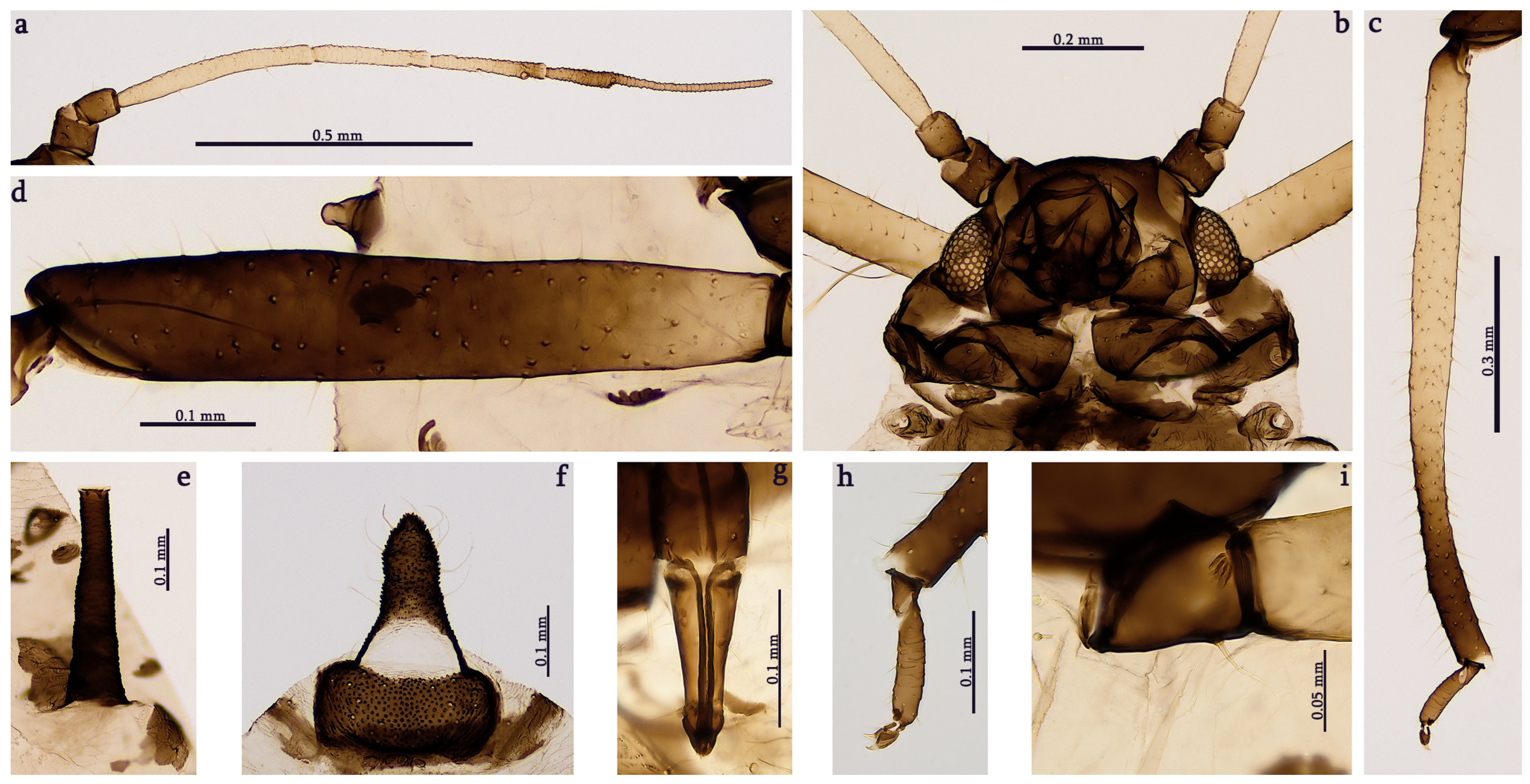
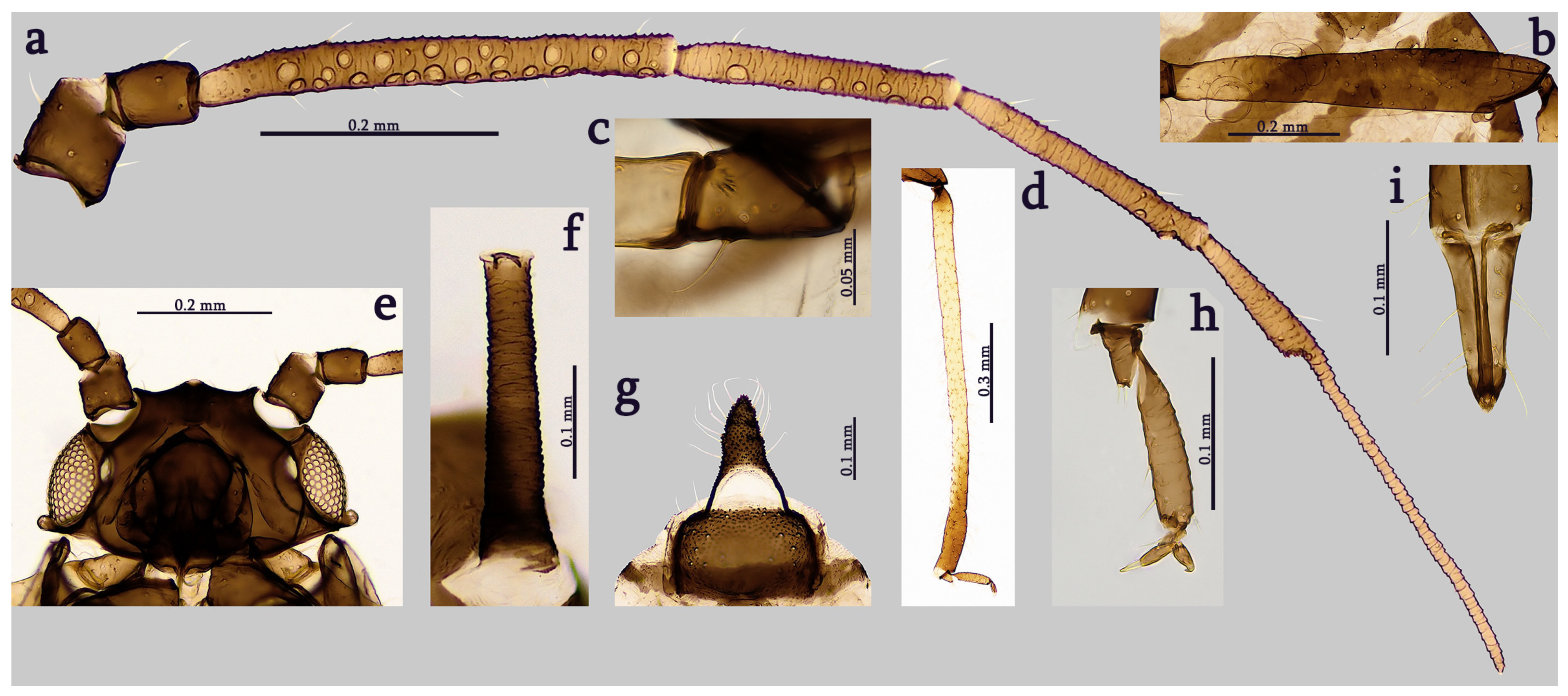
Colour in life: unknown. Pigmentation on slide: ANT I, II, VI brown, ANT III completely pale or pale with slightly dusky apices, ANT IV pale with dusky apices; ANT V basal halves pale brown, with brown apical halves; head, clypeus, rostral III segment, URS, coxae, trochanters, and tarsi brown, femora of front legs pale brown with darker apical halves, while ca. 1/5 of basal part pale and remaining ca. 4/5 brown in middle and hind femora; tibiae with brown small basal portion, pale middle part and brown apices; prothorax and mesothorax with brown transverse bands, metathorax with marginal sclerites and fragmented spinal sclerites; among ABD TERG I–VII intersegmental muscle sclerites; ABD TERG II–IV with marginal sclerites; presiphuncular and postsiphuncular sclerites present; small spinal sclerites or scleroites consisting of 1–6 pigmented reticulated cells present/absent on ABD TERG I–IV, while always present on ABD TERG V; ABD TERG VI with single or two spinal sclerites; transverse bands on ABD TERG VII–VIII brown; stigmal plates, SIPH, cauda, subgenital and anal plates brown (Figure 1b and Figure 3a–i).
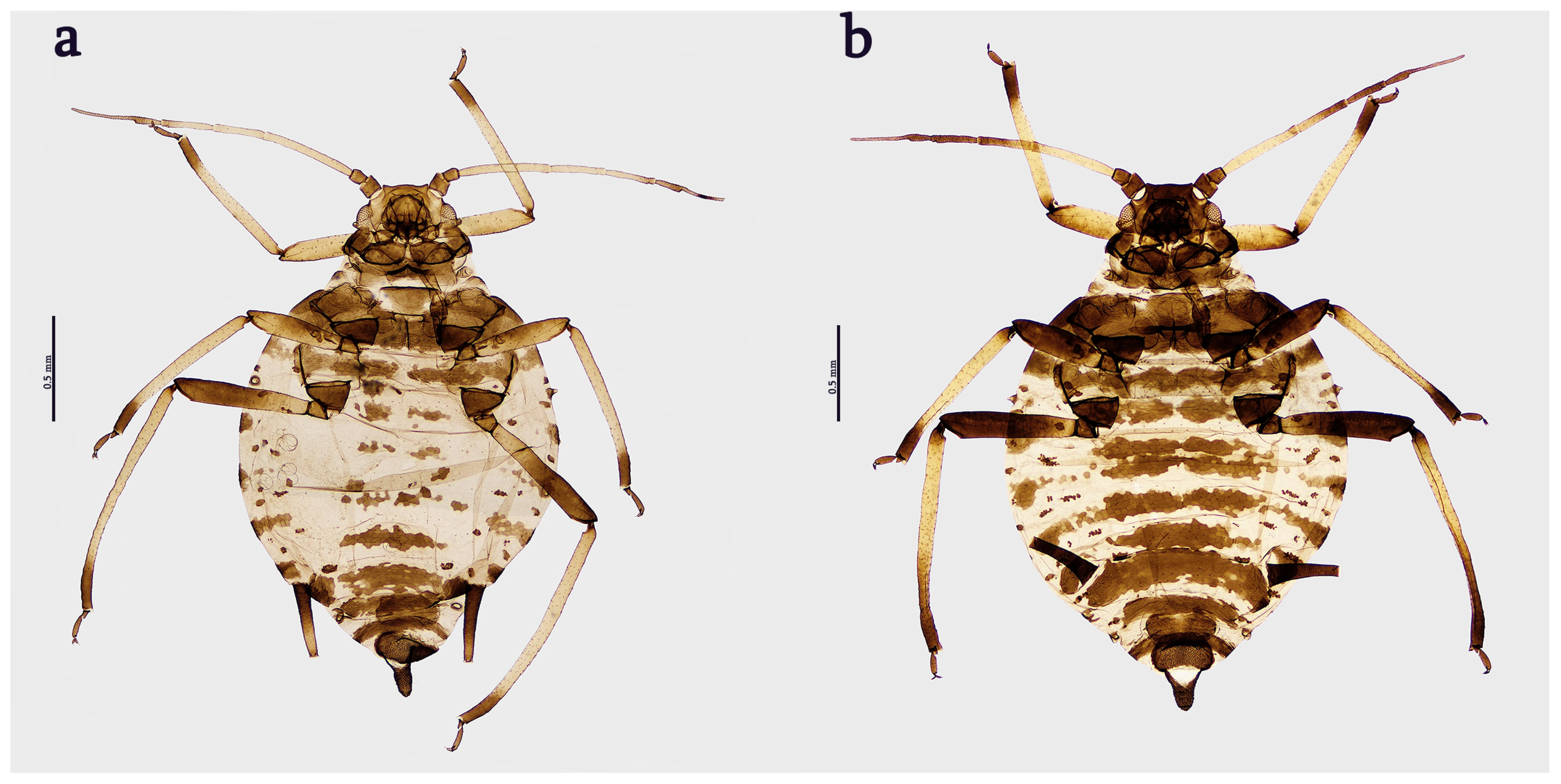
Figure 2.
Aphis tanaceticola sp. nov. habitus of alatiform apterous viviparous female: (a) from Iran and (b) from Türkiye.
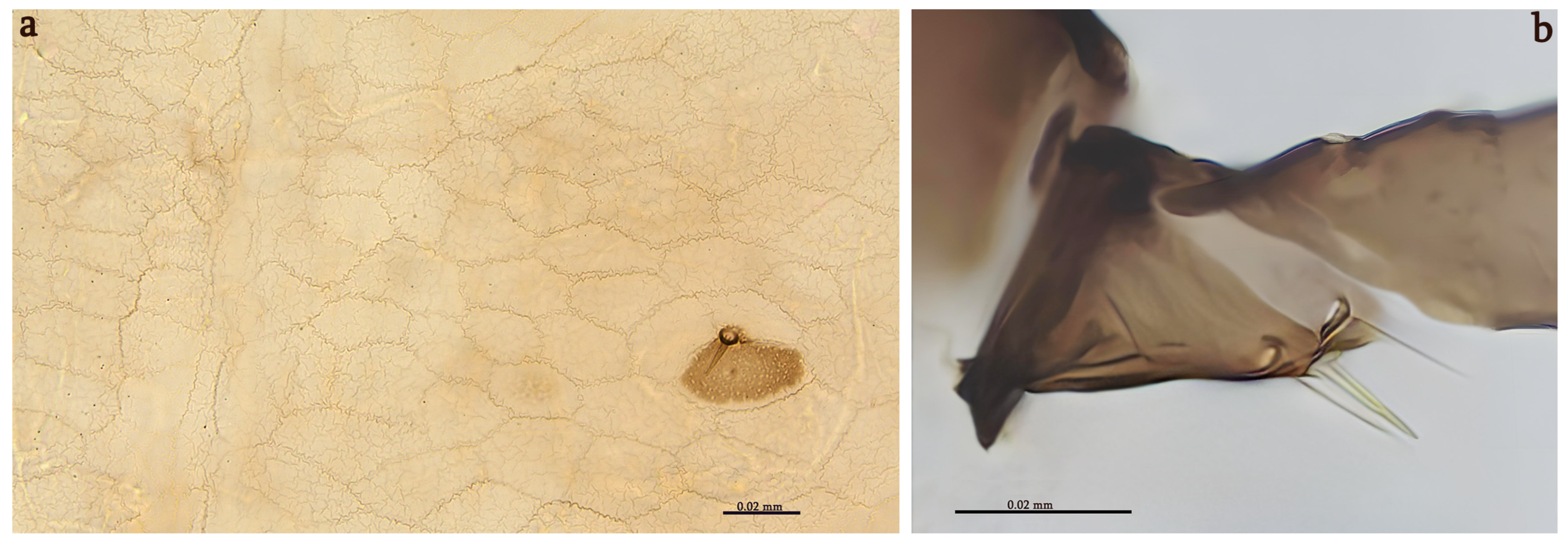
Morphological characters: Body oval (Figure 1b). BW 0.59–0.75 × BL. Frons w-shaped with rounded medial frontal tubercle (Figure 1b and Figure 3b). Medial frontal tubercle equals to ANT tubercles or slightly higher than ANT tubercles. ANT 6-segmented (Figure 1b and Figure 3a). ANT 0.56–0.65 × BL and 2.81–3.13 × Head W respectively. ANT I–II smooth, ANT III–VI imbricated (Figure 3a). Antennal chaetotaxy: ANT I with 5, ANT II with 3–4, ANT III with 8–14, ANT IV with 4–9, ANT V with 5–8, ANT VI b with 3, PT with 1–2 setae apart from the 4 apical and subapical ones. Setae on ANT III pointed, straight or curved. MSL on ANT III 0.82–1.07 × ANT III BD. Sec. rhin. absent on ANT III–V. PT 1.87–2.23 × ANT VI b, 1.07–1.37 × ANT V, 0.94–1.37 × ANT IV, 0.62–0.79 × ANT III and 0.55–0.61 × Head W respectively. ANT VI b 0.30–0.35 × ANT III, ANT VI 0.94–1.14 × ANT III, ANT V 0.49–0.65 × ANT III, ANT IV 0.56–0.67 × ANT III. ANT IV 0.92–1.23 × ANT V. MSL on frons and occipital area 0.86–1.22 and 0.71–1.07 × ANT III BD. Reticulation pattern of cuticle distinct on thorax and abdominal dorsum (Figure 4a). Rostrum short, reaching or passing to middle coxae (Figure 1b). Rostrum L 0.19–0.28 × BL. URS elongated triangular with 2–4 long, fine and pointed accessory setae (Figure 3g). URS L 1.88–2.22 × URS W, 1.12–1.20 × HT II L and 0.97–1.13 × ANT VI b respectively. PSL on middle and hind troch. is 0.84–1.19 and 0.75–1.11 × diameter of trochantro-femoral suture respectively (Figure 3i). HFEM 0.24–0.27 × BL and 1.21–1.32 × Head W respectively (Figure 1b and Figure 3d). Dorsal and ventral setae on hind femur are long and pointed. Length of longest dorsal and ventral setae on hind femur 0.75–1.13 and 0.84–1.05 × diameter of hind trochantro-femoral suture respectively. HTIB 0.40–0.47 × BL and 1.99–2.22 × Head W respectively (Figure 1b and Figure 3c). Dorsal and ventral setae on hind tibia are long and pointed. Length of longest dorsal and ventral setae on hind tibia 0.81–1.26 and 0.79–1.21 × middle diameter of hind tibia respectively. First tarsal chaetotaxy: 3:3:3 (Figure 4b). HT II distinctly imbricated (Figure 3h). HT II L 4.16–4.85 × HT II W. Mamariform or dome-shaped MTu present on ABD TERG I and VII, and 1–4 MTu present on ABD TERG II–IV, while MTu absent on ABD TERG V–VI. MTu on ABD TERG I bigger than MTu on ABD TERG II–IV. Length of marginal seta on ABD TERG I 0.35–0.59 × basal diameter of MTu on ABD TERG I. Basal diameter of MTu on ABD TERG VII 0.85–1.97 × ANT III BD. Pleural and spinal setae on ABD TERG I–V shorter, slightly blunt or rarely pointed, while marginal setae close to MTu are longer and pointed. Marginal MSL on ABD TERG III 1.17–1.79 × spinal MSL (0.017–0.023 mm) on ABD TERG III. Marginal setae number per side of ABD TERG I–VII: I with 1 seta, II with 3–5 setae, III with 2–4 setae, IV with 2–3 setae, V with 2–3 setae, VI with 0–3 setae and VII with 0–2 setae. All ventral setae on abdomen are long and pointed and longer than dorsal setae. MSL on ABD TERG III 0.70–1.00 × MSL on ABD TERG VIII. MSL on ABD TERG III and ABD TERG VIII 0.71–1.03 and 0.76–1.37 × ANT III BD respectively. SIPH tapering, imbricated with small flange (Figure 1b and Figure 3e). SIPH L 5.21–6.33 × SIPH middle W, 3.17–3.78 × SIPH basal W, 0.13–0.15 × BL, 2.39–2.80 × HT II L, 1.31–1.59 × Cauda L and 10.18–17.94 × MSL on margin of ABD TERG I–III respectively. Subgenital plate oval, with 3–8 setae on the discal part and 12–22 setae on the hind margin and with spinulose imbrications. ABD TERG VIII with 2–6 setae. Cauda finger-shaped and carrying 12–16 curved setae and numerous strong dark spinules. Cauda L 1.02–1.29 × Cauda basal W, 0.09–0.10 × BL, 0.42–0.49 × Head W, 0.50–0.61 × ANT III,1.44–1.62 × URS L, 1.65–1.85 × HT II L respectively (Figure 1b and Figure 3f). Metric features are presented in Table 1.
- Alatiform apterous viviparous female (n = 16)
Colour in life: unknown. Pigmentation on slide: ANT I, II, V, VI brown, ANT III completely pale or pale with brown apices or pale with apical brown halves, ANT IV with pale basal halves and brown apical halves or completely pale or rarely completely brown; ANT V rarely pale with brown apices; head, clypeus, rostral III segment, URS, coxae, trochanters, and tarsi brown, femora of front legs pale brown with darker apical halves, while ca. 1/5 of basal part pale and remaining ca. 4/5 brown in middle and hind femora; tibiae with brown small basal portion, pale middle part and brown apices; prothorax, mesothorax and metathorax with brown transverse bands; among ABD TERG I–VII intersegmental muscle sclerites; ABD TERG II–IV with marginal sclerites; presiphuncular sclerites present; different sized fragmented or single spinopleural or/and spinal sclerites or scleroites present on ABD TERG I–V, sometimes spinopleural sclerites merged to marginal sclerites on ABD TERG IV and transverse bands present on ABD TERG II–III; transverse bands on ABD TERG VI–VIII brown; stigmal plates, SIPH, cauda, subgenital and anal plates brown (Figure 2a,b).
Morphological characters: Body oval (Figure 2a,b). BW 0.63–0.78 × BL. Frons w-shaped with rounded medial frontal tubercle (Figure 2a,b). Medial frontal tubercle slightly lower than ANT tubercles. ANT 6-segmented (Figure 2a,b). ANT 0.58–0.70 × BL and 2.66–3.12 × Head W respectively. ANT I–II smooth, ANT III–VI imbricated. Antennal chaetotaxy: ANT I with 4–5, ANT II with 3–5, ANT III with 8–15, ANT IV with 4–11, ANT V with 4–11, ANT VI b with 3–5, PT with 1–3 setae apart from the 4 apical and subapical ones. Setae on ANT III pointed, straight or curved. MSL on ANT III 0.79–1.53 × ANT III BD. Different sized round sec. rhin. present on ANT III–IV: ANT III with 1–19, ANT IV with 0–9. PT 1.94–2.71 × ANT VI b, 1.19–1.49 × ANT V, 0.90–1.45 × ANT IV, 0.62–0.86 × ANT III and 0.52–0.68 × Head W respectively. ANT VI b 0.27–0.35 × ANT III, ANT VI 0.91–1.21 × ANT III, ANT V 0.47–0.69 × ANT III, ANT IV 0.52–0.79 × ANT III. ANT IV 0.96–1.40 × ANT V. MSL on frons and occipital area 0.76–1.68 and 0.67–1.68 × ANT III BD. Reticulation pattern of cuticle distinct on thorax and abdominal dorsum (Figure 2a,b). Rostrum short, reaching to middle coxae (Figure 2a,b). Rostrum L 0.20–0.27 × BL. URS elongated triangular with 2 long, fine and pointed accessory setae (Figure 2a,b). URS L 1.63–2.31 × URS W, 1.10–1.35 × HT II L and 1.06–1.37 × ANT VI b respectively. PSL on middle and hind troch. is 0.80–1.31 and 0.79–1.12 × diameter of trochantro-femoral suture respectively. HFEM 0.27–0.34 × BL and 1.27–1.41 × Head W respectively. Dorsal and ventral setae on hind femur are long and pointed. Length of longest dorsal and ventral setae on hind femur 0.85–1.12 and 0.85–1.23 × diameter of hind trochantro-femoral suture respectively. HTIB 0.46–0.57 × BL and 2.14–2.48 × Head W respectively. Dorsal and ventral setae on hind tibia are long and pointed. Length of longest dorsal and ventral setae on hind tibia 0.94–1.33 and 0.76–1.16 × middle diameter of hind tibia respectively. First tarsal chaetotaxy: 3:3:3. HT II distinctly imbricated (Figure 2a,b). HT II L 3.31–5.24 × HT II W. Mamariform or dome-shaped MTu present on ABD TERG I and VII, and 0–4 MTu present on ABD TERG II–IV, while MTu absent on ABD TERG V–VI. MTu on ABD TERG I bigger than MTu on ABD TERG II–IV. Length of marginal seta on ABD TERG I 037–1.07 × basal diameter of MTu on ABD TERG I. Basal diameter of MTu on ABD TERG VII 1.31–2.05 × ANT III BD. Pleural and spinal setae on ABD TERG I–V short, pointed or slightly blunt, while marginal setae close to MTu on ABD TERG I–V are long and pointed. All ventral setae on abdomen are long and pointed and longer than dorsal setae. MSL on ABD TERG III and ABD TERG VIII 0.68–1.84 and 0.94–2.36 × ANT III BD respectively. SIPH tapering, imbricated with small or marked flange (Figure 2a,b). SIPH L 4.53–6.22 × SIPH middle W, 2.75–4.36 × SIPH basal W, 0.13–0.17 × BL, 2.61–2.97 × HT II L, 1.32–1.71 × Cauda L and 4.84–15.44 × MSL on margin of ABD TERG I–III respectively. Subgenital plate oval, with 3–6 setae on the discal part and 14–18 setae on the hind margin and with spinulose imbrications. ABD TERG VIII with 2–5 setae. Cauda finger-shaped and carrying 11–15 curved setae and numerous strong dark spinules. Cauda L 1.00–1.25 × Cauda basal W, 0.09–0.11 × BL, 0.40–0.48 × Head W, 0.47–0.62 × ANT III,1.42–1.67 × URS L, 1.70–2.25 × HT II L respectively (Figure 2a,b). Measurements and ratios are available in Table 1 and Table 2.
Table 2.
Intraspecific morphological variations in Iranian and Turkish populations of Aphis tanaceticola sp. nov. Measurements are given in millimetres. Bolded numbers indicate differences in length and ratios within each morph.
Figure 3.
Aphis tanaceticola sp. nov. detailed morphological characters of apterous viviparous female: (a) ANT, (b) head and prothorax, (c) HTIB and HT I–II, (d) HFEM, (e) SIPH, (f) cauda, anal plate and ABD TERG VIII, (g) URS, (h) apical part of HTIB and HT I–II, (i) hind troch.
- Note: Turkish specimens (n = 12) have relatively darker body dorsum pigmentation than Iranian specimens (n = 4). Furthermore, between two populations, the number of sec. rhin. on ANT III is different: 2–19 (mean 12) in the Turkish population and 1–7 (mean 4) in the Iranian population. Alatiform apterous viviparous females should be distinguished from normal apterous viviparous females easily based on the abdominal dorsum pigmentation in front of SIPH (intensive in alatiform females vs. less distinct in normal females) and the presence/absence of sec. rhin. on ANT III (always present in alatiform females vs. always absent in normal females).
- Alate viviparous female (n = 5)
Colour in life: unknown. Pigmentation on slide: ANT I, II, IV–VI, ANT III brown with a small basal pale portion; head, clypeus, rostral III segment, URS, thorax, coxae, trochanters, and tarsi brown; femora of front legs completely pale brown with darker apices, while ca. 1/5 of basal part pale and remaining 4/5 dark brown in middle and hind femora; tibiae with brown small basal portion, pale middle part and brown apices; among ABD TERG I–VII intersegmental muscle sclerites; ABD TERG II–IV with brown marginal sclerites; merged and completed presiphuncular and postsiphuncular sclerites brown; ABD TERG I–IV with single or fragmented or spinopleural sclerites; ABD TERG I sometimes with single spinal sclerite; ABD TERG V with single wide spinal sclerite; ABD TERG VI with a single brown coloured, wide spinopleural sclerite separated or merged with presiphuncular sclerites; transverse bands on ABD TERG VII–VIII brown; stigmal plates, SIPH, cauda, subgenital and anal plates brown (Figure 1c and Figure 5a–i).
Morphological characters: Body oval (Figure 1c). BW 0.43–0.53 × BL. ANT 6-segmented (Figure 1c and Figure 5a). ANT 0.61–0.66 × BL and 3.07–3.18 × Head W respectively. ANT I–II smooth, ANT III–VI imbricated (Figure 5a,e). Antennal chaetotaxy: ANT I with 5, ANT II with 4–5, ANT III with 9–10, ANT IV with 5–9, ANT V with 6–9, ANT VI b with 3, PT with 2–3 setae apart from the 4 apical and subapical ones. Setae on ANT III pointed, straight or curved. MSL on ANT III 0.80–1.11 × ANT III BD. Different sized round and oval sec. rhin. present on ANT III–V: ANT III with 23–30, ANT IV with 3–9, ANT V with 0–1. PT 2.31–2.53 × ANT VI b, 1.29–1.41 × ANT V, 1.21–1.37 × ANT IV, 0.74–0.87 × ANT III and 0.68–0.71 × Head W respectively. ANT VI b 0.31–0.38 × ANT III, ANT VI 1.05–1.25 × ANT III, ANT V 0.55–0.64 × ANT III, ANT IV 0.59–0.72 × ANT III. ANT IV 1.02–1.13 × ANT V. MSL on frons and occipital area 0.59–1.12 and 0.50–1.15 × ANT III BD. Rostrum L 0.21–0.26 × BL. URS elongated triangular with 2–3 long, fine and pointed accessory setae (Figure 1c and Figure 5i). URS L 1.81–2.53 × URS W, 1.09–1.17 × HT II L and 1.01–1.13 × ANT VI b respectively. Wing venation normal. Media of for-wing with two forks (Figure 1c). PSL on middle and hind troch. is 0.93–1.36 and 0.79–0.97 × diameter of trochantro-femoral suture respectively (Figure 5c). HFEM 0.28–0.29 × BL and 1.38–1.44 × Head W respectively (Figure 1c and Figure 5b). Dorsal and ventral setae on hind femur are long and pointed. Lengths of longest dorsal and ventral setae on hind femur are 1.14–1.30 and 1.07–1.28 × diameter of hind trochantro-femoral suture respectively. HTIB 0.49–0.54 × BL and 2.46–2.69 × Head W respectively (Figure 1c and Figure 5d). Dorsal and ventral setae on hind tibia are long and pointed. Length of longest dorsal and ventral setae on hind tibia 1.37–1.67 and 1.28–1.59 × middle diameter of hind tibia respectively. First tarsal chaetotaxy: 3:3:3. HT II distinctly imbricated (Figure 5h). HT II L 4.06–5.50 × HT II W. Mamariform or dome-shaped MTu present on ABD TERG I and VII, and 0–5 MTu present on ABD TERG II–IV, while MTu absent on ABD TERG V–VI. MTu on ABD TERG I bigger than MTu on ABD TERG II–IV. Length of marginal seta on ABD TERG I 0.47–1.32 × basal diameter of MTu on ABD TERG I. Basal diameter of MTu on ABD TERG VII 1.09–1.63 × ANT III BD. MSL on ABD TERG III and ABD TERG VIII 0.81–1.94 and 0.94–2.00 × ANT III BD respectively. SIPH tapering, imbricated with small or marked flange (Figure 1c and Figure 5f). SIPH L 4.81–7.23 × SIPH middle W, 2.91–3.85 × SIPH basal W, 0.11–0.14 × BL, 2.06–2.36 × HT II L, 1.36–1.58 × Cauda L and 4.15–10.37 × MSL on margin of ABD TERG I–III respectively. Subgenital plate oval, with 2–11 setae on the discal part and 10–18 setae on the hind margin and with spinulose imbrications. ABD TERG VIII with 2–4 setae. Cauda finger-shaped and carrying 12–17 curved setae and numerous strong dark spinules. Cauda L 1.04–1.29 × Cauda basal W, 0.08–0.09 × BL, 0.41–0.45 × Head W, 0.45–0.52 × ANT III, 1.26–1.43 × URS L, 1.47–1.62 × HT II L respectively (Figure 1c and Figure 5g). Measurements and ratios are available in Table 1 and Table 2.
Type material. Holotype. Apt., IRAN, Mazandaran Province, Güvercinkaya region, central district of Chalus county, Chalus (on slide written as “Tchalus”), 30 m alt., 09.05.1977, on slide as Pyrethrum sp. (=Tanacetum sp.), Latge leg., slide code: EH26315 (i4156), the specimen N 17 encircled by marker with arrow on it and with paratypes N 16, 18 and 19, MNHN. Paratypes. Total of 1 fundatrix, the same data as for holotype, mentioned as “Fx” by marker and is on the same slide with 1 alatiform apterous viviparous female N 14, and 2 apt. N 13 and 15, slide code: EH26316 (i4156), MNHN; 2 apt. N 13 and 15 on the same slide with fundatrix and 1 alatiform apterous viviparous female N 14, Latge leg., slide code: EH26316 (i4156), MNHN; 3 apt. N 16, 18 and 19 on the same slide with holotype, MNHN; 1 apt. N 20 with 3 alatiform apterous viviparous females N 21–23, the same data as for holotype, slide code: EH26317 (i4156), IZISU; 2 al., TÜRKIYE, Ankara Province, Çubuk district, Karagöl, 1500 m alt., 09.VI.1966, on slide as “Chrysanthemum Tanacetum”, N. Tuatay leg., slide code: EH26314 (011910), N 1 and 2, with 2 alatiform apterous viviparous females N 11 and 12, IZISU; 2 al. N 3 and 4, the same data as for holotype, slide code: EH26319 (i4156), MNHN; 1 al. N 5, the same data as for holotype, slide code: EH26318 (i4156), MNHN. Additional material: 2 alatiform apterous viviparous females, TÜRKIYE, Ankara Province, Çubuk district, Karagöl, 1500 m alt., 09.VI.1966, on slide as Chrysanthemum parthenifolium (=Tanacetum parthenium), G. Remaudière leg., slide code: EH26309 (03541), N 1 and 2, MNHN; 2 alatiform apterous viviparous females, the same data as previous slide from Türkiye, slide code: EH26312 (03541), N 3 and 4, MNHN; 2 alatiform apterous viviparous females, the same data as previous slide from Türkiye, slide code: EH26311 (03541), N 5 and 6, MNHN; 2 alatiform apterous viviparous females, the same data as previous slide from Türkiye, slide code: EH26310 (03541), N 7 and 8, MNHN; 2 alatiform apterous viviparous females, the same data as previous slide from Türkiye, slide code: EH26313 (03541), N 9 and 10, MNHN; 2 alatiform apterous viviparous females, the same data as previous slide from Türkiye with host plant on slide as “Chrysanthemum Tanacetum”, N. Tuatay leg., slide code: EH26314 (011910), N 11 and 12, IZISU; 1 alatiform apterous viviparous female N 14, with 2 apt. N 13 and 15 and 1 fundatrix, the same data as for holotype, slide code: EH26316 (i4156), MNHN; 3 alatiform apterous viviparous females N 21–23 with 1 apt. N 20 with the same data as for holotype, slide code: EH26317 (i4156), IZISU.
Note: From Türkiye, N. Tuatay and G. Remaudière sampled aphids on the same day 09.VI.1966 and on the slides of Remaudière the host plant was written as “Chrysanthemum parthenifolium”, while on the single slide of Tuatay the host plant was written as “Chrysanthemum Tanacetum”. If we consider that we have the same species sampled on the same day from the same locality in Türkiye, it seems that the host plant for G. Remaudière‘s sampled aphids was determined on the species level later, and we think that for Tuatay’s single slide with two alate viviparous and two alatiform apterous viviparous females the host plant is the same—Tanacetum parthenium.
Figure 4.
Aphis tanaceticola sp. nov. detailed morphological characters of apterous viviparous female: (a) reticulation pattern of cuticle on abdominal dorsum and (b) first tarsal segment with setae.
Intraspecific variation. Distinct differences in the ratios and chaetotaxy are not detected between normal apterous viviparous and alatiform apterous viviparous females in spite of the fact that setae on ANT III, on the posterior side of the hind troch., on HTIB dorsally, and in the marginal position of ABD TERG I are shorter in normal apterous viviparous females than in alatiform apterous viviparous females from Türkiye and Iran (Table 1). In addition, differences were detected in the length of HFEM and HTIB in two populations of the above-mentioned morphs (Table 1). Fundatrix, normal and alatiform apterous viviparous females and alate viviparous females sampled on 9 May 1977 in Chalus, Iran, are short-haired, while Turkish normal and alatiform viviparous females and alate viviparous females sampled in Karagöl, Türkiye, on 9 June 1966 are long-haired (Table 2). Based on other morphological characteristics, it is clear that from Iran and Türkiye we have a single Tanacetum-feeding species, because all diagnostic characters are overlapping within Iranian and Turkish populations of alatiform apterous viviparous females and alate viviparous females except for setal length and ratios with setae (Table 2). We should consider differences in the setal length between the Iranian and Turkish populations as an effect of the difference in temperature and/or humidity or microclimate in general on the development of aphids, which should be different in the humid Chalus coastal plain at 30 m alt. in May and in the mountainous, relatively arid Karagöl at 1500 m alt. in June. Furthermore, the distance between Karagöl and Chalus is ca. 1660 km, and the difference in the setal length between the Iranian and Turkish populations may be considered a geographical variation as well.
Diagnosis and taxonomical comments. At present, four species from the genus Aphis—A. craccivora Koch, 1854, A. fabae Scopoli, 1763, A. gossypii Glover, 1877 and A. spiraecola Patch, 1914—are known on the genus Tanacetum Linnaeus, 1753 (Family Asteraceae: tribe Anthemideae) [9,16]. Until now, the following 28 species from the genus Aphis, belonging to three subgenera—Aphis Linnaeus, 1758 (19 species), Toxoptera Koch, 1856 (1 species) and Zyxaphis Knowlton, 1947 (8 species)—have been reported on the tribe Anthemideae (Asteraceae): A. artemisiphaga Holman, 1987; A. artemisiphila Holman, 1987; A. asclepiadis Fitch, 1851; A. aurantii Boyer de Fonscolombe, 1841; A. canae Williams, 1911; A. chrysothamnicola (Gillette & Palmer, 1929); A. coronopifoliae Bartholomew, 1932; A. craccivora Koch, 1854; A. fabae Scopoli, 1763; A. filifoliae (Gillette & Palmer, 1928); A. globosa Pashtshenko, 1992; A. gossypii Glover, 1877; A. hermistonii Wilson, 1915; A. hiltoni Essig, 1922; A. infrequens Knowlton, 1929; A. kurosawai Takahashi, 1921; A. lhasartemisiae Zhang, 1981; A. lindae Danielsson, 1986; A. matricariae Barjadze & Özdemir, 2014; A. minutissima (Gillette & Palmer, 1928); A. nasturtii Kaltenbach, 1843; A. neoartemisiphila Pashtshenko 1992; A. oregonensis Wilson, 1915; A. reticulata Wilson, 1915; A. solanella Theobald, 1914; A. spiraecola Patch, 1914; A. triglochinis Theobald, 1926; and A. utahensis (Knowlton, 1947) [9,16].
Figure 5.
Aphis tanaceticola sp. nov. Detailed morphological characters of alate viviparous female: (a) ANT, (b) HFEM, (c) hind troch., (d) HTIB and HT I–II, (e) head and prothorax, (f) SIPH, (g) cauda, anal plate and ABD TERG VIII, (h) apical part of HTIB and HT I–II, and (i) URS.
From the above listed aphids, the following 12 species—Aphis canae, A. chrysothamnicola, A. coronopifoliae, A. filifoliae, A. hermistonii, A. hiltoni, A. infrequens, A. lindae, A. minutissima, A. oregonensis, A. reticulata and A. utahensis—as Nearctic ones except for A. asclepiadis, are not compared to the new species [9].
Apterous viviparous females of the Nearctic polyphagous aphid species A. asclepiadis, known on Achillea micrantha Willd. (Anthemideae: Asteraceae), should be easily distinguished from those of the new species by (1) sclerotization of ANT II–III: ANT II pale or dusky, concolorous with basal half of ANT III in A. asclepiadis, while ANT II dark, contrasting with ANT III in the new species and (2) sclerotization of abdominal dorsum anterior to SIPH: without dark markings except for dark intersegmental muscle sclerites in A. asclepiadis, while marginal sclerites on ABD TERG II–IV, presiphuncular sclerites always present and small spinal scleroites present/absent on ABD TERG I–V in the new species [9].
From the remaining 15 Palaearctic species of the genus Aphis living on the tribe Anthemideae host plants (Asteraceae), only 5 species have sclerotic abdominal dorsum anterior to SIPH in apterous viviparous females. They are Aphis craccivora, A. fabae, A. globosa, A. matricariae and A. solanella. The new species differs from all the above-mentioned Aphis species by the first tarsal formula, which is 3:3:3 in the new species (Figure 4b), while it is always 3:3:2 in A. craccivora, A. fabae, A. globosa, A. matricariae and A. solanella.
Apterous viviparous females of the new species are distinguished from those of A. craccivora by (1) pigmentation of abdominal dorsum anterior to SIPH: without an extensive solid black sclerite in the new species, while extensive solid black sclerite is present in A. craccivora; (2) MSL on ANT III/ANT III BD ratio: 0.82–1.07 in the new species, while it is 0.20–0.80 in A. craccivora; and (3) number of setae on cauda: 12–16 setae in the new species, while there are 4–9 in A. craccivora [11,12,13].
Apterous viviparous females of the new species look like those of A. fabae and A. solanella by sclerotization of body and appendages, but apart from the (1) first tarsal chaetotaxy they are distinguished from each other by (2) ANT III/PT ratio: 1.27–1.61 in the new species, while it is 0.65–1.30 in A. fabae and A. solanella, and (3) marginal setal length on ABD TERG I/diameter of MTu on ABD TERG I ratio: 0.35–0.59, while it is at least 0.60 in A. fabae and A. solanella [9]. Apterous viviparous females of the new species in the Aphis fabae group are morphologically close to short-haired A. solanella by the SIPH L/MSL on ABD TERG I–III ratio: 10.2–17.9 in the new species, while it is 5.4–17.0 in A. solanella [9].
There are the following differences between fundatrices of the new species and the Aphis fabae species group: (1) sclerotization of abdominal dorsum anterior to SIPH: marginal sclerites present on ABD TERG II–IV in the new species, while marginal sclerites are absent in the Aphis fabae species group; (2) marginal seta length on ABD TERG I/height of MTu on ABD TERG I ratio: 0.54 in the new species, while it is ca. 1.10 in Aphis fabae species group; and (3) number of setae on cauda: 10 in the new species, while there are 12–15 in the Aphis fabae species group [12]; personal observation.
Polyphagous species from the Aphis fabae species group—A. fabae and A. solanella—have fundatrices on trees and shrubs—Euonymus europaeus L. (Celastraceae), Philadelphus coronarius L. (Hydrangeaceae) and Viburnum opulus L. (Viburnaceae)—and never produce them (fundatrices) on the secondary herbaceous plants and in some parts of the world including the Middle East; A. solanella lives anholocyclically, while fundatrix of the new species was detected on an herbaceous plant—Tanacetum—in May in Iran (Middle East) [9,17].
Apterous viviparous females of the new species are distinguished from those of A. globosa by (1) number of antennal segments: six in the new species, while there are five in A. globosa; (2) MSL on ANT III/ANT III BD ratio: 0.82–1.07 in the new species, while it is 0.50–0.60 in A. globosa; and (3) URS L/HT II L ratio: 1.12–1.20 in the new species, while it is 1.50–1.70 in A. globosa [18].
Apterous viviparous females of the new species are distinguished from those of A. matricariae by (1) URS L/HT II L ratio: 1.12–1.20 in the new species, while it is 0.84–0.87 in A. matricariae; (2) MSL on ANT III/ANT III BD ratio: 0.82–1.07 in the new species, while it is 0.61–0.71 in A. matricariae; and (3) SIPH L/Cauda L ratio: 1.31–1.59 in the new species, while it is 0.65–0.80 in A. matricariae [19].
Other differences between the above-mentioned pigmented Aphis species, living on host plants belonging to the plant tribe Anthemideae (Family Asteraceae), are given in the identification key.
Etymology. The new species name “tanaceticola” is an adjective in feminine grammatical gender derived from the generic name of the host plant “Tanacetum” and the Latin suffix “cola” (inhabitant).
Host Plant and Biology. This new species feeds on Tanacetum parthenium (L.) Sch.Bip. in Türkiye and Tanacetum sp. in Iran (Asteraceae). There is no data about the feeding preference of the aphid species on the host plants. We conclude that Aphis tanaceticola sp. nov. is monoecious holocyclic, because the fundatrix of this species occurred on Tanacetum sp. on 9 May 1977 in Iran. Its sexual morphs and ant attendance are unknown. In spring, fundatrix, normal and alatiform viviparous females and alate viviparous females were sampled in Chalus, Mazandaran Province on 9 May 1977, while only alatiform apterous viviparous females and alate viviparous females were sampled in Karagöl, Ankara Province on 9 June, 1966. Absence of normal apterous viviparous females and presence of alatiform apterous viviparous females exclusively in June in Turkish population could be explained by a dramatic change in crowding of aphids on the host plant, nutrition quality of the host plant, or local temperature.
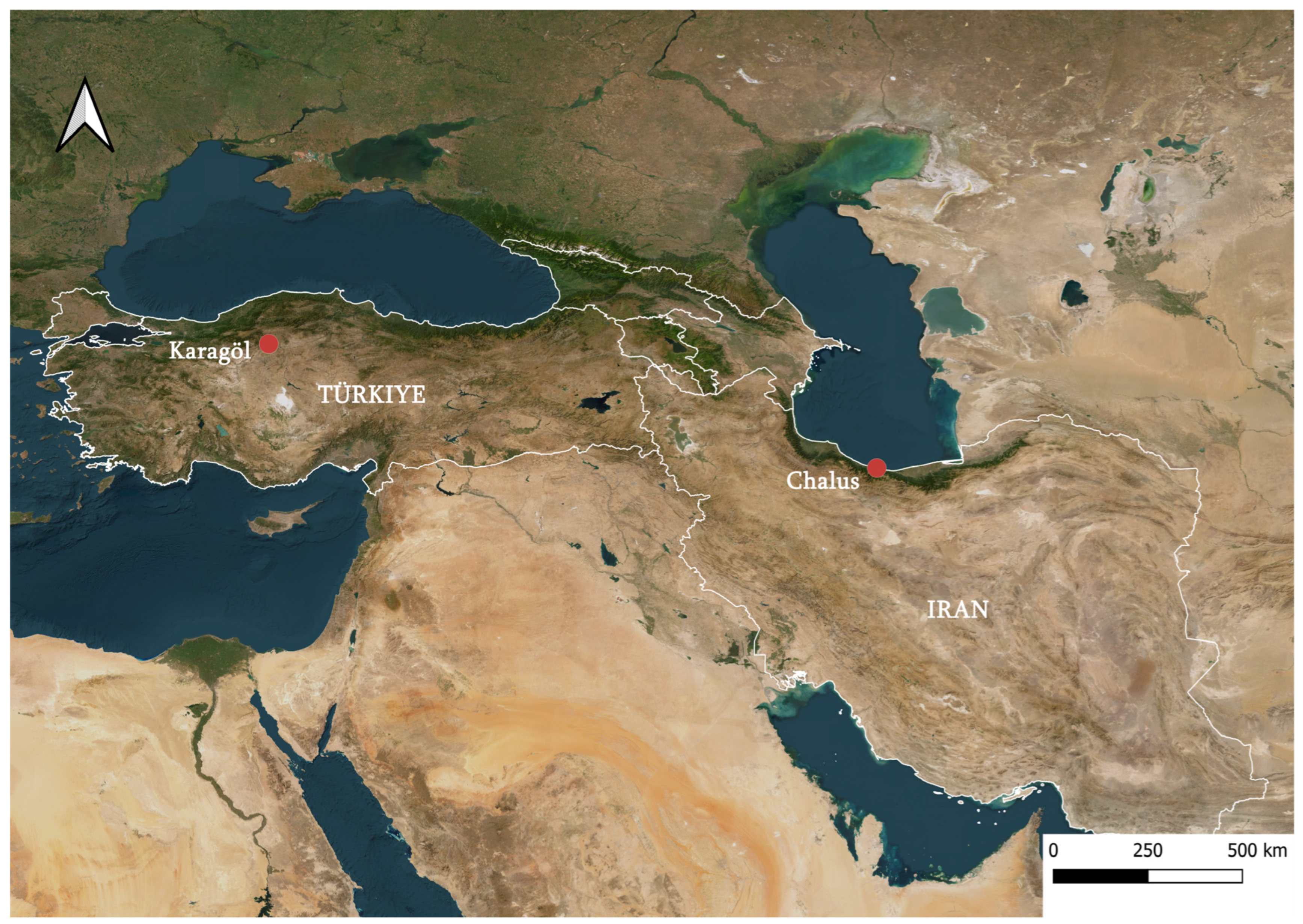
Distribution. It is known only in two localities: in Chalus at 30 m alt. (Mazandaran Province, Iran) and in Karagöl at 1500 m alt. (Ankara Province, Türkiye) (Figure 6). The new aphid species should be distributed widely considering wide distribution of its host plant—Tanacetum parthenium. This plant is found in Eurasia, Africa, Australia, and North and South America [15]. Due to fact that apterous viviparous females of the new species look like those of A. fabae and A. solanella by the sclerotization of body and appendages, the new species could be cryptic if taxonomists for species determination did/do not check tarsal chaetotaxy in apterae very carefully.
Identification key for Anthemideae-feeding Aphis spp. with sclerotic abdominal dorsum anterior to siphunculi
- 1.
- Sclerotic patch presents on the abdominal dorsum anterior to SIPH … 2
- -
- Sclerotic patch absents on the abdominal dorsum anterior to SIPH … 3
- 2.
- URS L 1.50–1.70 × HT II L. Cauda triangular … A. globosa Pashtshenko
- -
- URS L 0.90–1.20 × HT II L. Cauda finger-shaped … A. craccivora Koch
- 3.
- MSL on ANT III 0.61–0.71 × ANT III BD. Cauda with 7–8 setae … A. matricariae Barjadze & Özdemir
- -
- MSL on ANT III 0.70–3.40 × ANT III BD. Cauda with 11–27 setae … 4
- 4.
- ANT III 1.27–1.61 × PT. First tarsal chaetotaxy: 3:3:3 (Figure 4b) … A. tanaceticola sp. nov.
- -
- ANT III 0.65–1.30 × PT. First tarsal chaetotaxy: 3:3:2 … 5
- 5.
- SIPH L 2.4–5.4 × MSL on ABD TERG I–III … A. fabae Scopoli
- -
- SIPH L 5.4–17.0 × MSL on ABD TERG I–III … A. solanella Theobald
Figure 6.
Map showing the sampling sites of Aphis tanaceticola sp. nov. in Türkiye and Iran.
4. Discussion
The specimens examined in the species description were sampled on Tanacetum paartenium in Türkiye in 1966 and Tanacetum sp. in Iran in 1977, and the combination of diagnostic morphological characters does not correspond to any of the previously described Aphis species associated with Tanacetum or other plants from the tribe Anthemideae (Asteraceae). The new species is particularly noteworthy because its apterous viviparous females superficially resemble the strongly sclerotized species from the Aphis fabae group. Careful examination of the first tarsal chaetotaxy, ratios of ANT III/PT, marginal setal length on ABD TERG I/diameter of MTu on ABD TERG I, SIPH L/MSL on ABD TERG I–III and other diagnostic characters in normal apterous viviparous females is therefore essential for its reliable identification.
The first tarsal chaetotaxy appears to be the most stable and useful diagnostic character separating A. tanaceticola sp. nov. from the other Palaearctic Anthemideae-feeding Aphis species with a sclerotized abdominal dorsum. In the new species, the first tarsal formula is consistently 3:3:3, whereas A. craccivora, A. fabae, A. globosa, A. matricariae and A. solanella have 3:3:2. This distinction is especially important because several external features of A. tanaceticola sp. nov., including the darkly sclerotized body and appendages, can lead to identification of the new species as A. fabae or A. solanella erroneously. Thus, the first tarsal chaetotaxy should consequently be checked carefully whenever strongly pigmented Aphis specimens are collected on Anthemideae host plants.
The combination of other morphological characters further supports the distinctness of A. tanaceticola sp. nov. compared with A. craccivora, the new species lacks the extensive solid black abdominal sclerite characteristic of the latter and has longer setae on antennal segment III and a greater number of caudal setae. It easily differs from A. globosa in having six rather than five antennal segments in apterous viviparae. Aphis matricariae differs from the new species in several proportional characters, particularly in the ratios of URS L/HT II L, MSL on ANT III/ANT III BD and SIPH L/Cauda L. Its comparison with A. fabae and A. solanella is relatively difficult, owing to the overall similarity in body sclerotization, lengths and ratios of the diagnostic morphological characters and chaetotaxy. In addition to the first tarsal formula, the new species differs from these two taxa in the following ratios: ANT III/PT and marginal setal length on ABD TERG I/diameter of MTu on ABD TERG I. Taken together, these characters provide a consistent morphological basis for recognizing A. tanaceticola sp. nov. as a separate species.
An interesting feature of A. tanaceticola sp. nov. is the considerable variation in body setal length in alatiform apterous viviparous females and alate viviparous females between the Iranian and Turkish populations. The specimens from Chalus, Iran, are consistently shorter-haired, whereas those from Karagöl, Türkiye, have substantially longer setae on the antennae, head, legs and abdominal tergites. Importantly, however, the differences are largely quantitative and concern mainly setal length and ratios involving setae. Some important diagnostic characters (such as URS L/HT II L, URS L/ANT VI b, PT/Ant VI b, SIPH L/Cauda L; first tarsal chaetotaxy, number of accessory setae on URS; number of setae on ABD TERG VIII, subgenital plate and cauda; and sclerotization of body) overlap between the two populations. We therefore interpret the observed differences as intraspecific variations rather than evidence of the presence of two separate taxa.
The geographical separation of the two populations provides one possible explanation for this variation. The Iranian specimens were collected in Chalus at approximately 30 m elevation in May, whereas the Turkish specimens were collected at Karagöl at approximately 1500 m elevation in June. These localities are separated by approximately 1660 km and differ considerably in altitude and climatic conditions (lowland and humid in Iran vs. mountainous and arid in Türkiye). Differences in temperature, humidity and local microclimate may influence aphid development and consequently the expression of morphological characters such as body setal length. Geographical differentiation may also contribute to the observed pattern. Nevertheless, because the available material consists of specimens from only one locality in each country and was collected in different seasons and environmental conditions, the relative contribution of environmental and geographical effects cannot be evaluated. Additional populations from intermediate localities and, ideally, specimens reared under controlled conditions would be required to test these hypotheses.
Due to the influence of different temperatures even in one season—in Summer—apterous viviparous females of Aphis dardanelliensis Kök & Barjadze, 2025, sampled in June 2023 and in July 2024 had different siphunculi length/cauda length ratio (1.62–1.71 in 2023, and 0.90–1.21 in 2024). Other differences were not detected in morphology between these aphids [3]. In addition, seasonal differences were detected in apterous viviparous females of Aphis vallei Hille Ris Lambers & Stroyan, 1959, with spinal sclerites or some spinopleural sclerites on abdominal tergites I–VI [13,20], and the longest setae on antennal segment III are at least 0.9 × ANT III BD in summer populations [9], but in November nine apterous viviparous specimens with a small fainted single sclerite on the spinal position on abdominal tergites II–IV, II–V, III–IV, or IV–V and often on abdominal tergite VI and the longest setae on antennal segment III 0.65–0.89 × ANT III BD ratio were found on Euphorbia in Türkiye. Seasonal variations were so distinct that beginner taxonomist should consider summer and late autumn populations as different species [personal observation].
It is easy to detect geographic variation in the widely distributed aphid species belonging to the genus Aphis. For example, differences in the setal length were detected in different populations of Aphis polii Barjadze, Blackman & Özdemir, 2015. This species was described based on 143 apterous viviparous females from 17 localities from France to Iran. The longest cephalic frontal setae were 0.018–0.034 mm in specimens from Ukraine and Lebanon, and 0.009–0.023 mm in those from other localities, with only the sample from Iran (0.014–0.023 mm) spanning the two size ranges. No other distinct differences were found in these populations and differences in length of setae were considered as possible geographical variation [21]. Furthermore, apterae of Aphis passeriniana (del Guercio, 1900) from Türkiye had ratio of length of siphunculi/length of cauda of 0.84–1.60, while the remaining distributional area showed a different ratio—1.38–2.23—with a small overlapping range with the ratio from Türkiye [22]. The difference in the above-mentioned ratio was considered as geographical variation caused by the influence of local climate [22].
The variation observed among the morphs is also informative for interpreting the diagnostic value of individual characters. Despite the fact that alatiform apterous females have longer setae than normal apterous females of the new species, the ratios with setal characters overlapped considerably. This suggests that setal length should be used cautiously as a primary diagnostic feature.
The discovery of a fundatrix on Tanacetum in Iran provides the first indication that A. tanaceticola sp. nov. is holocyclic and monoecious. However, this conclusion should be regarded as provisional because only a single fundatrix is available and the sexual generation has not been observed yet. Future field observations are needed to determine whether sexuales of this taxon occur on Tanacetum.
The host association of A. tanaceticola sp. nov. is another aspect requiring further investigation. The species was sampled on Tanacetum parthenium in Türkiye and on an unidentified Tanacetum species in Iran. Because the Iranian host was not identified to the species level, it remains unclear whether the species is restricted to T. parthenium or utilizes several Tanacetum species. Maybe this is a monophagous aphid species restricted to the genus Tanacetum. The broad geographical distribution of T. parthenium in the world suggests that additional populations of the aphid may occur outside the two localities currently known. Intensive sampling of Tanacetum, especially in Türkiye, Iran and neighbouring areas of the Palaearctic, is therefore likely to provide important information on the host range and actual distribution of the new species.
The possibility that A. tanaceticola sp. nov. has previously been overlooked should also be considered. Its strongly pigmented apterous viviparous females resemble the same morph of A. fabae and A. solanella, and specimens may consequently have been assigned to one of these species if the first tarsal chaetotaxy was not examined carefully. Re-examination of strongly sclerotized Aphis specimens sampled on Tanacetum and other Anthemideae plants deposited in the different collections may therefore reveal additional records of A. tanaceticola sp. nov.
The identification key presented here is intended to facilitate recognition of the new species among the currently known Anthemideae-feeding Aphis species with distinct abdominal sclerotization. Molecular data were not available for the present study; therefore, future molecular analyses incorporating A. tanaceticola sp. nov. and morphologically similar taxa, particularly A. craccivora, A. fabae, A. globosa, A. matricariae and A. solanella, would provide an independent test of the species boundaries inferred from morphology.
5. Conclusions
Aphis tanaceticola sp. nov. represents a distinct Palaearctic Aphis species associated with Tanacetum in the Middle East. The marked difference in setal length between the Iranian and Turkish populations of the new species appears to represent intraspecific geographical and/or environmentally influenced variation, whereas the other diagnostic characters remain consistent. Further sampling of new Tanacetum-feeding species to find additional apterous and alate viviparous females and to detect sexual generation (males and ovipara females), combined with molecular studies (e.g., DNA barcoding) and observations of the complete life cycle, will be important for clarifying the host specificity, biology, distribution, and evolutionary relationships of this newly described species with its other congeners.
Author Contributions
Conceptualization, I.Ö. and S.B.; methodology, I.Ö., N.K. and S.B.; validation, I.Ö. and S.B.; formal analysis, N.K. and S.B.; investigation, I.Ö., N.K. and S.B.; resources, N.K.; data curation, I.Ö. and S.B.; writing—original draft preparation, S.B.; writing—review and editing, I.Ö., N.K. and S.B.; visualization, N.K. and S.B.; supervision, I.Ö.; project administration, S.B.; funding acquisition, S.B. All authors have read and agreed to the published version of the manuscript.
Funding
The third author’s research was supported by the projects “Investigation of the Georgian aphids (Hemiptera: Aphidoidea) using modern approaches” (SRSFG—FR-21-1509) funded by the Shota Rustaveli National Science Foundation of Georgia and “The investigation of Palaearctic aphids (Hemiptera: Aphidoidea) deposited in the different leading museums of the world” in the frame of the 2221—Fellowships for Visiting Scientists and Scientists on Sabbatical Leave program of the TÜBİTAK. In addition, research was supported by the local funds of Kocaeli University, Türkiye (BAP, FBA-2023-3437). Financial support for the publication of this article was provided by the Emergency Research Support Project of Kocaeli University, Türkiye, in the frame of the project “The description of new species for the world within the Palearctic aphid fauna (Hemiptera: Aphidoidea), found in Türkiye and Iran (5534)”.
Data Availability Statement
All data generated or analyzed during this study are included in this published article.
Acknowledgments
We would like to express our gratitude to Andy Jensen (California Academy of Sciences, San Francisco, USA) for the editing of the text grammatically and scientifically and the anonymous reviewers for critical reading of the manuscript and their invaluable comments on it. Furthermore, we would like to thank Colin Favret (University of Montreal, Canada) for providing publications during manuscript preparation. We are grateful to Mariam Gogshelidze (Ilia State University, Tbilisi, Georgia) for preparing the map and Adeline Soulier and Laurent Fauvre (Muséum national d’Histoire naturelle, Paris; MNHM) for providing help to the second author during their work in the aphid collection deposited at the MNHM.
Conflicts of Interest
The authors declare no conflicts of interest.
References
- Görür, G.; Şenol, Ö.; Akyıldırım Beğen, H.; Akyürek, B. Turkish Aphid. 2026. Available online: https://www.turkishaphid.com/ (accessed on 3 August 2026).
- Kök, Ş.; Özdemir, I. Annotated Systematic Checklist of the Aphids (Hemiptera: Aphidomorpha) of Turkey. Zootaxa 2021, 4925, 1–74. [Google Scholar] [CrossRef] [Scilit]
- Kök, Ş.; Barjadze, S. A new species of Aphis Linnaeus, 1758 (Hemiptera: Aphididae) from north western Türkiye. Zootaxa 2025, 5729, 489–497. [Google Scholar] [CrossRef] [Scilit]
- Momeni Shahraki, F.M.; Minaei, K.; Barjadze, S. Checklist of Iranian Aphids (Hemiptera: Stenorrhyncha: Aphidomorpha). J. Insect Biodivers. Syst. 2019, 5, 269–300. [Google Scholar] [CrossRef] [Scilit]
- Barjadze, S.; Özdemir, I.; Ebrahimi, E. Two species of Brachyunguis (Hemiptera: Aphididae) new to Iran, and a key to the Iranian species of this genus. Zootaxa 2022, 5183, 49–57. [Google Scholar] [CrossRef] [Scilit]
- Barjadze, S.; Kök, Ş.; Kadyrbekov, R. A new aphid species of Brachyunguis Das, 1918 (Hemiptera: Aphididae) from Iran. Zool. Middle East 2026, 72, 18–26. [Google Scholar] [CrossRef] [Scilit]
- Mehrparvar, M. Aphids of Iran: Their host plants and distribution. Zootaxa 2024, 5516, 1–129. [Google Scholar] [CrossRef] [Scilit]
- Mehrparvar, M. Additions to the aphid (Hemiptera, Aphididae) fauna of Iran: Three new records and their taxonomic significance. J. Insect Biodivers. Syst. 2026, 12, 203–212. [Google Scholar]
- Favret, C.; Aphid Taxon Community (Eds.) Blackman & Eastop’s Aphids on the World’s Plants, Version 2.0. Available online: https://aphidsonworldsplants.info/ (accessed on 7 August 2026).
- Favret, C. Aphid Species File. Available online: http://Aphid.SpeciesFile.org (accessed on 7 August 2026).
- Stroyan, H.L.G. Aphids—Pterocomatinae and Aphidinae (Aphidini). Homoptera, Aphididae. In Handbooks for the Identification of British Insects; Dramrite Printers Limited: London, UK, 1984; 232p, Volume 2, Part 6. [Google Scholar]
- Heie, O.E. The Aphidoidea of Fennoscandia and Denmark III. Pterocommatinae and Aphidinae, Aphidini. Fauna Entomol. Scand. 1986, 17, 1–314. [Google Scholar]
- Nieto Nafría, J.M.; Mier Durante, M.P.; García Prieto, F.; Pérez Hidalgo, N. Genus Aphis Linnaeus, 1758. In Hemiptera, Aphididae III. Fauna Iberica 28; Tercedor, J., Ros, X., Noguera, J., Sierra, A., Mayol, E., Marino, J., González, J., Eds.; Museo National de Ciencias Naturales: Madrid, Spain, 2005; pp. 30–173. [Google Scholar]
- Blackman, R.L.; Eastop, V.F. Aphids on the World’s Herbaceous Plants and Shrubs; John Wiley & Sons: London, UK, 2006; 1439p. [Google Scholar]
- WFO. World Flora Online. 2026. Available online: http://www.worldfloraonline.org (accessed on 3 August 2026).
- Holman, J. Host Plant Catalog of Aphids. Palaearctic Region; Springer: Dordrecht, The Netherlands, 2009; 1216p. [Google Scholar]
- Blackman, R.L.; Eastop, V.F. Aphids on the World’s Crops: An Identification and Information Guide; John Wiley & Sons: Chichester, UK, 2000; 466p. [Google Scholar]
- Pashtshenko, N.F. Aphids of the genus Aphis (Homoptera, Aphidinea, Aphididae) living on plants of the family Asteraceae in the Far East of Russia. Zool. Zh. 1992, 71, 32–51. (In Russian) [Google Scholar]
- Barjadze, S.; Özdemir, I.; Blackman, R. Two new species of Aphidini Latreille, 1802 (Hemiptera: Aphididae) from Turkey. Zootaxa 2014, 3873, 187–194. [Google Scholar] [CrossRef] [Scilit]
- Hille Ris Lambers, D.; Stroyan, H.L.G. Two new species and a new subspecies of aphid from Italy (Homopt., Aphididae). Mem. Soc. Entomol. Ital. 1959, 38, 84–94. [Google Scholar]
- Barjadze, S.; Blackman, R.; Özdemir, I. New species of the genus Aphis Linnaeus, 1758 (Hemiptera: Aphididae) on Teucrium polium L. (Lamiaceae). Zootaxa 2015, 4057, 248–256. [Google Scholar] [CrossRef] [Scilit]
- Barjadze, S. First record of Aphis passeriniana (Del Guercio) (Hemiptera: Aphididae) in the Asia Minor peninsula. Ann. Agrar. Sci. 2017, 15, 431–433. [Google Scholar] [CrossRef] [Scilit]

Disclaimer/Publisher’s Note: The statements, opinions and data contained in all publications are solely those of the individual author(s) and contributor(s) and not of MDPI and/or the editor(s). MDPI and/or the editor(s) disclaim responsibility for any injury to people or property resulting from any ideas, methods, instructions or products referred to in the content. |
© 2026 by the authors. Licensee MDPI, Basel, Switzerland. This article is an open access article distributed under the terms and conditions of the Creative Commons Attribution (CC BY) license.