


Simple Summary
Predatory bugs of the genus Geocoris are valuable natural enemies that feed on agricultural pests such as thrips, aphids, whiteflies, mites, leafhoppers, leaf beetles, and plant bugs. This study examined how temperature affects the development, survival, and reproduction of Geocoris xishaensis—a species recently recorded in Hainan, China. We reared the bugs on embryo-inactivated eggs of Corcyra cephalonica at six constant temperatures ranging from 16 to 36 °C. The bugs could not complete their life cycle at 16 and 20 °C. Between 24 and 36 °C, they developed faster as temperature increased. The estimated number of annual generations of G. xishaensis in Hainan ranges from 7.3 to 8.45. Among the temperatures tested, 32 °C gave the best overall performance and the fastest population growth of G. xishaensis, followed by 28 °C; both can be recommended as rearing temperatures, with 32 °C being preferable for rapid mass production.
Abstract
Temperature is a critical determinant of development and reproduction in predatory bugs of the genus Geocoris. Here, we examined thermal effects on life-history traits of Geocoris xishaensis Zhou, Cai & Gao (Hemiptera: Geocoridae), a species recently described from Hainan, China. Individuals were reared on embryo-inactivated eggs of Corcyra cephalonica (Stainton) (Lepidoptera: Pyralidae) at six constant temperatures (16, 20, 24, 28, 32, and 36 °C), and developmental duration, survival, and fecundity were recorded. Age-stage, two-sex life tables were constructed, and 60-day population dynamics were projected. Geocoris xishaensis failed to complete a whole generation at 16 °C and 20 °C. Between 24 °C and 36 °C, developmental duration of each stage decreased with increasing temperature. Female fecundity was highest at 32 °C (241.12 eggs) and 28 °C (184.00 eggs). For the total generation period (including the adult preoviposition period), the lower developmental threshold was estimated to be 17.35 °C, with a corresponding thermal constant of 376.42 degree-days. The estimated number of annual generations of G. xishaensis in Hainan ranges from 7.3 to 8.45. The intrinsic rate of increase (r) and finite rate of increase (λ) both peaked at 32 °C, reaching 0.0961 day−1 and 1.1008 day−1, respectively. Sixty-day population projections revealed increasing trends at 28–36 °C. These results indicate that, of the temperatures tested, 32 °C gave the best overall performance, followed by 28 °C; both can therefore be recommended as suitable temperatures for mass rearing.
1. Introduction
Geocoris spp. (Hemiptera: Geocoridae), commonly known as big-eyed bugs, are important predatory natural enemies widely distributed across agricultural ecosystems [1,2,3,4]. Characterized by their polyphagous nature, they prey on a diverse range of agricultural pests, including thrips, aphids, whiteflies, mites, leafhoppers, leaf beetles, and plant bugs, as well as the immature stages of lepidopterans [5,6,7,8,9,10,11]. According to current records, the genus Geocoris comprises 148 described species [12], which are widely distributed across tropical, subtropical, and warm temperate regions worldwide.
Temperature is a key environmental factor influencing insect survival and population establishment. Numerous studies have demonstrated that it significantly affects the development, reproduction and population growth of Geocoris species, with the extent of thermal adaptation varying considerably among species. Previous studies have investigated the development of G. varius (Uhler) and G. proteus Distant across a temperature range of 20–36 °C and found that the developmental thresholds for both eggs and nymphs were higher in G. proteus than in G. varius [13]. In addition, G. proteus exhibited greater tolerance to high temperatures at both the egg and nymphal stages [13]. At the intraspecific level, temperature similarly affects developmental performance: G. lubra Kirkaldy develops faster and exhibits higher nymphal survival at 27 °C than at 25 °C [14]. The big-eyed bug G. xishaensis, first recorded in Hainan, China, in 2021, exhibits strong predatory capacity against a range of pest species, including Tetranychus cinnabarinus (Boisduval), Aphis craccivora Koch, Scirtothrips dorsalis Hood, Megalurothrips usitatus (Bagnall), Frankliniella intonsa (Trybom), Haptonchus luteolus (Erichson), and Cicadellidae sp. [5,15,16]. However, the thermal adaptability of G. xishaensis remains poorly understood, which hinders the development and utilization of this predatory bug as a biological control agent. This study investigated the developmental duration, survival, and fecundity of G. xishaensis under different temperature regimes, constructed age-stage two-sex life tables for each treatment, and analyzed the corresponding population parameters. These findings are intended to provide fundamental data and theoretical support for the indoor large-scale rearing and field utilization of this species.
2. Materials and Methods
2.1. Insect Rearing
The population of G. xishaensis was collected from the mango orchard of Hainan Fruits Island Agriculture Development Co., Ltd., Tianya District, Sanya City, Hainan, China, and maintained under laboratory conditions at a temperature of 26 ± 1 °C, relative humidity (RH) of 75% ± 5%, and a photoperiod of 14:10 (L:D). The first-instar nymphs to adults of G. xishaensis were reared on embryo-inactivated eggs of Corcyra cephalonica, which were purchased from Guangzhou Yuefeng Biological Control Technology Co., Ltd., Guangzhou, China. All individuals used in the experiments were obtained from a laboratory colony that had been reared continuously for at least five generations to ensure acclimation to laboratory conditions.
2.2. Life Table Study
Adults of G. xishaensis that had emerged within 24 h were collected from the same rearing batch and paired at a 1:1 female:male ratio. Pairs were placed in gauze cages (30 × 30 × 30 cm, L × W × H; mesh aperture 0.180 mm) at approximately 50 pairs per cage and kept under the conditions described in Section 2.1. On day 7 after pairing, four black cloth strips (10 × 5 cm; mesh aperture 0.125 mm) were provided in each cage as oviposition substrates and removed 24 h later; the eggs collected were used to establish life table cohorts at each test temperature. All experiments were conducted in constant-temperature incubators (model MGC-100BP-2L; Shanghai Yiheng Scientific Instrument Co., Ltd., Shanghai, China). Six constant-temperature treatments were set: 16, 20, 24, 28, 32 and 36 °C (±1 °C), at 75 ± 5% RH and a 14:10 h (L:D) photoperiod. For each temperature, 150 newly laid eggs were collected and randomly allocated into five Petri dishes (9 cm in diameter), with 30 eggs per dish. A filter paper moistened with 2.5 mL of sterile water was placed at the bottom of each dish. Dishes were sealed with Parafilm® and uniformly punctured with a No. 0 insect pin (10–12 holes per dish), allowing controlled ventilation while preventing nymph escape. Egg hatching was examined every 12 h, and the number of newly emerged nymphs was recorded. Subsequently, each first-instar nymph was individually transferred to a new Petri dish (6 cm in diameter), with one nymph per dish. Each dish was replenished daily with 100 embryo-inactivated C. cephalonica eggs and a cotton ball saturated with 10% (w/v) honey-water solution as dietary provisions. Nymphal development was assessed every 12 h, with concurrent recording of molting events, mortality, and the number of nymphs reaching adult stage. After adult emergence of G. xishaensis subjected to different temperature treatments, the numbers of female and male adults from each treatment group were counted separately. To compensate for accidental mortality from handling and to ensure sufficient adults for 1:1 pairing at each temperature, an additional 60 eggs were set aside as a backup for each temperature treatment. These eggs were reared to adulthood under the same conditions as the main experimental cohort.
For the determination of fecundity and longevity of G. xishaensis across temperature treatments, male and female adults were paired at a 1:1 ratio within 36 h of emergence. Each pair was placed in a separate flat-bottomed glass tube (5.0 cm diameter × 11.5 cm height) provisioned with 100 embryo-inactivated C. cephalonica eggs and a cotton wick saturated with 10% (w/v) honey solution. The tubes were then sealed with black cloth for ventilation, which also served as an oviposition substrate for G. xishaensis. Daily observations were made to record adult survival; during each observation, the black cloth and food supply were replaced. Oviposition dates and daily fecundity of each female were recorded until all individuals had died. To maintain consistent 1:1 pairings across treatments—which varied in emergence success and adult longevity—backup cohorts reared at each temperature were available for supplementation. When adults of either sex were unavailable at pairing initiation, or when one member of a pair died prematurely, a developmentally synchronized adult of the missing sex was immediately selected from the backup cohort to complete or restore the pair. Fecundity and longevity data from these supplementary adults were excluded from all statistical analyses.
2.3. Life Table Data Analysis
The parameters of the age-stage, two-sex life table were estimated using the bootstrap technique (with 100,000 resamples) within the TWOSEX-MSChart software (Version v6) [17,18,19,20]. Key demographic traits and population parameters were also calculated using this program [19]. Differences in life table parameters among temperature treatments were evaluated using the paired bootstrap test [21,22]. Differences at a probability level of p < 0.05 were considered significant. SigmaPlot 16 (Systat Software, Inc., San Jose, CA, USA) was used to plot curves for different parameters. The detailed calculation processes for all parameters are as follows:
In the age-stage, two-sex life table, the age-specific survival rate (lx: the probability that a newly laid egg survives to age x) and age-specific fecundity (mx: the mean fecundity of individuals at age x) are calculated as:
where Sxj is the probability that a newly laid egg will survive to age x and stage j, fxj is the mean fecundity of females at age x and stage j, and m is the last stage of the study cohort.
The net reproductive rate (R0) represents the total number of offspring that an individual can produce over its lifetime, and it is calculated as follows:
The intrinsic rate of increase (r) is the population growth rate under a stable age-stage distribution and given conditions (i.e., laboratory conditions with unlimited food), and it is calculated as follows:
The finite rate of increase (λ) represents the average daily growth rate of a population when it reaches a stable age distribution, and it is calculated as follows:
λ = er
The mean generation time (T) is defined as the length of time that a population requires to increase to R0-fold of its size at the stable age-stage distribution, and it is calculated as follows:
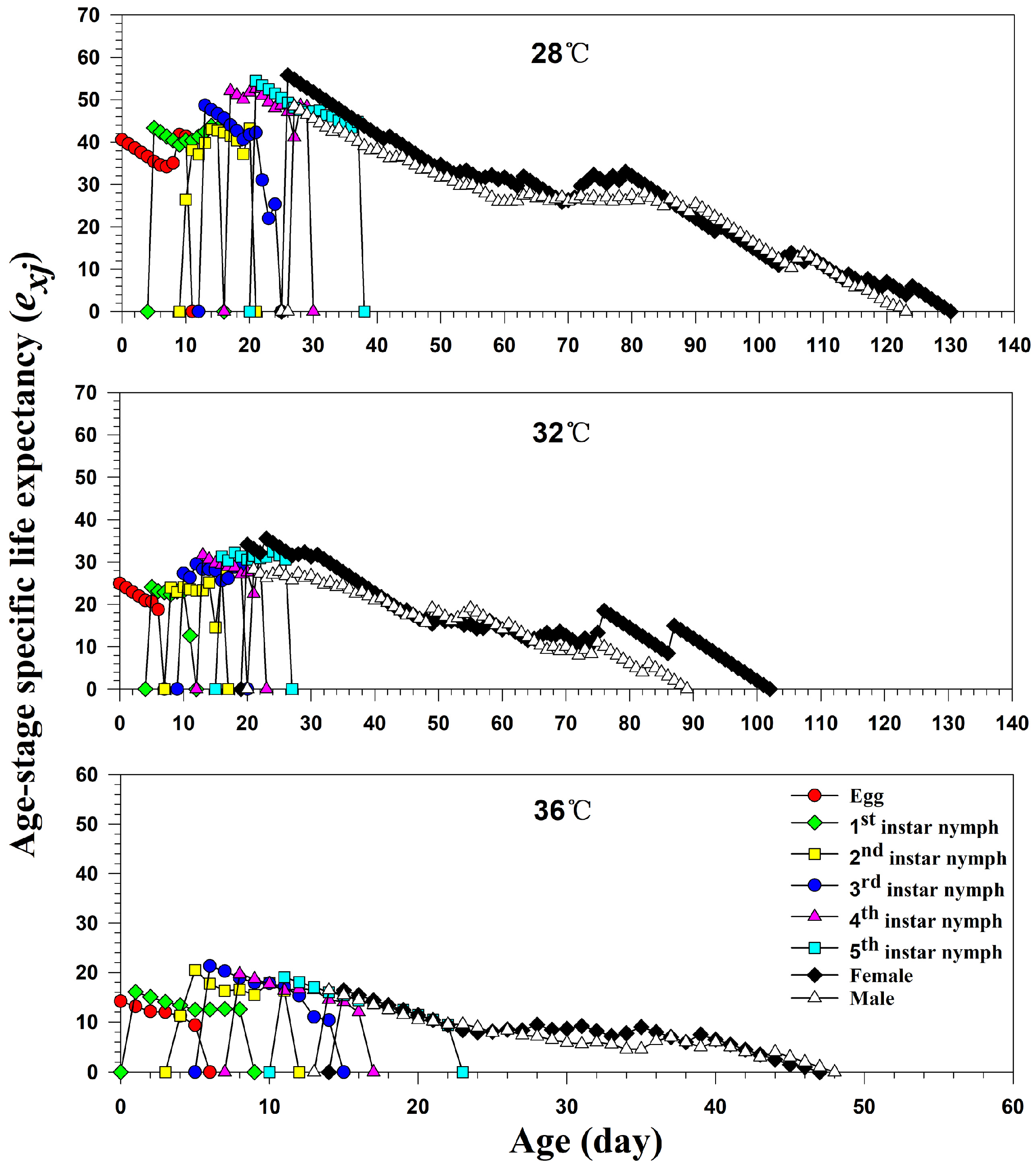
The age-stage specific life expectancy (exj) represents the expected survival time of an individual at age x and stage j, and it is calculated as follows [23]:
where is the probability that an individual of age x and stage j will survive to age i and stage y.
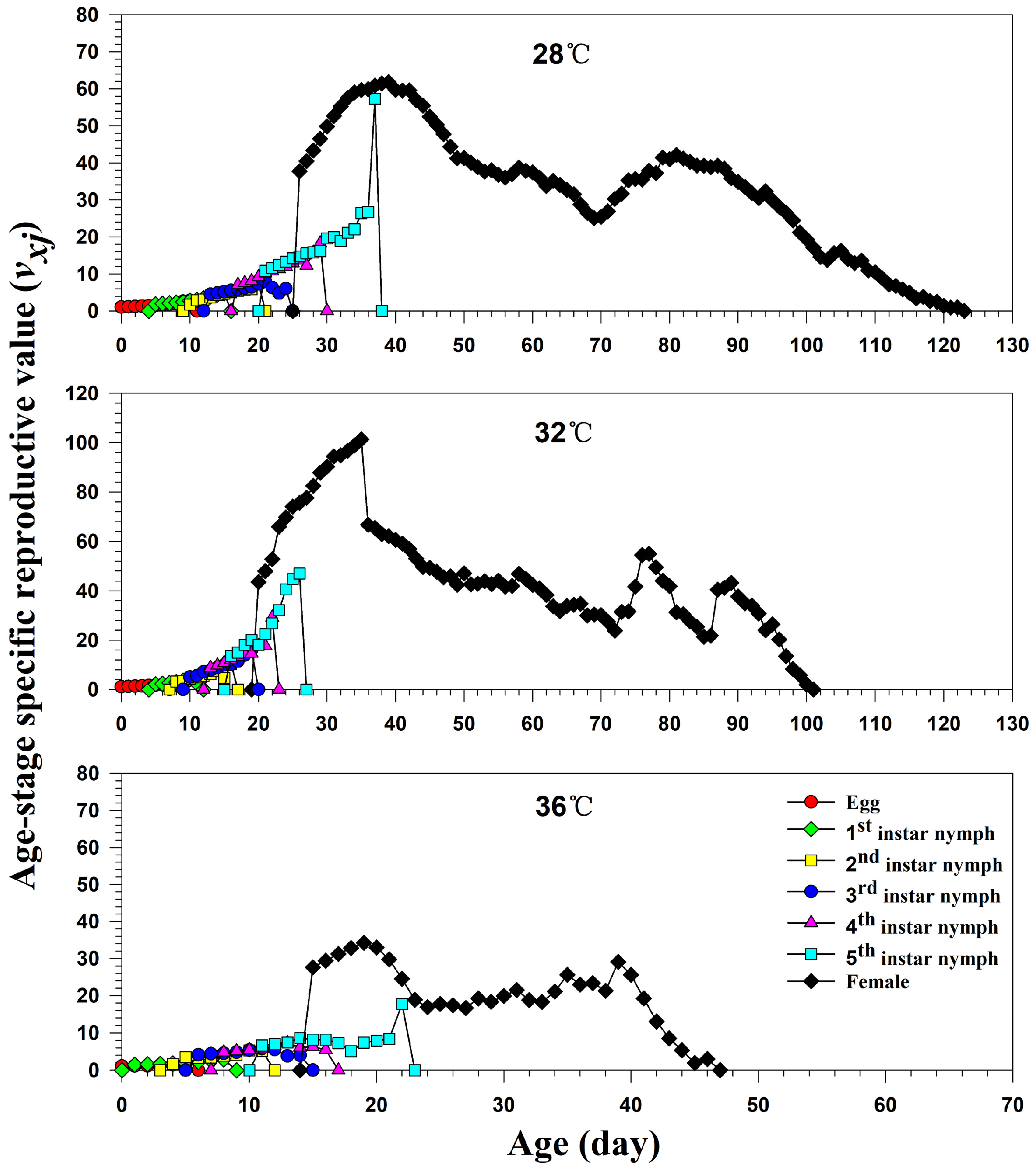
The age-stage specific reproductive value (vxj) is defined as the contribution of individuals at age x and stage j to the future population, and it is calculated as follows [24,25,26]:
The population dynamics of G. xishaensis over a 60-day period were predicted from life table parameters using the TIMING-MSChart program (Version v1) [27]. All projections were initiated with a cohort of 10 eggs, assuming unlimited food resources and no additional mortality beyond the age-stage-specific survival rates derived from the life table.
Based on the developmental duration of G. xishaensis at different temperatures, the lower developmental threshold (C) and the thermal constant (K, in degree-day) were estimated by linear regression using the least squares method [28,29]. The formulas are given below:
where V is the developmental rate, T is the experimental temperature, and n is the number of temperature treatments.
Based on the law of total effective temperature, the annual number of generations (N) and the timing of adult emergence of G. xishaensis can be predicted for a given geographic location using the following equation [30]:
where Ti is the daily mean temperature on day i at each of the five locations (Sanya, Dongfang, Qiongzhong, Haikou and Wenchang, Hainan, China), t is the lower developmental threshold for one generation, and K1 is the thermal constant required to complete a generation. Temperature data for the five study regions in 2025 were obtained from www.tianqi24.com, and daily mean temperature was calculated as the mean of the daily maximum and minimum temperatures (Table S1).
3. Results
3.1. Effect of Temperature on the Growth, Development and Reproduction of G. xishaensis
Because the number of individuals surviving to the later stages at 24 °C was too small, pairwise bootstrap comparisons of developmental parameters were restricted to 28, 32 and 36 °C. Eggs of G. xishaensis failed to hatch at 16 °C. At 20 °C, 52.67% of eggs hatched, but no nymph reached the second instar (Table 1). Between 24 and 36 °C, G. xishaensis completed the full life cycle (Table 1), and the duration of the egg stage, of each of the five nymphal instars, and of the preadult period decreased as temperature increased. Survival from egg to adult was also lowest at 24 °C (6.67%) and highest at 28 °C (40.67%).
Table 1.
Developmental duration of Geocoris xishaensis at different temperatures.
Within the temperature range of 24 °C to 36 °C, the durations of adult preoviposition period (APOP) and total preoviposition period (TPOP) of G. xishaensis decreased with rising temperature (Table 2). Although G. xishaensis completed generation development at 24 °C, its TPOP survival rate was only 2%. Between 28 and 36 °C, the TPOP is shortest at 36 °C (20.00 days; 28 °C vs. 36 °C: p < 0.0001; 32 °C vs. 36 °C: p < 0.0001) and longest at 28 °C (34.85 days; 28 °C vs. 32 °C: p < 0.0001). The longevity of adult females decreased with increasing temperature, from 50.63 days at 28 °C to 14.00 days at 36 °C; adult males showed the same pattern, from 44.18 to 12.77 days. The oviposition duration at 28 and 32 °C was significantly longer than that at 36 °C (28 °C vs. 36 °C: p < 0.0001; 32 °C vs. 36 °C: p < 0.0001). Fecundity per female was highest at 32 °C (241.12 eggs) and 28 °C (184.00 eggs), and lowest at 36 °C (47.67 eggs); however, no significant difference was observed between 32 °C and 28 °C (p = 0.1946).
Table 2.
Adult longevity and fecundity of G. xishaensis at different temperatures.
The lower developmental temperature thresholds and thermal constants estimated for each developmental stage of G. xishaensis are presented in Table 3. For the total generation period (including the adult preoviposition period), the lower developmental threshold was estimated to be 17.35 °C, with a corresponding thermal constant of 376.42 degree-days. Based on the lower developmental threshold of 17.35 °C for G. xishaensis and the daily mean temperatures of five locations in Hainan, China (Sanya, Dongfang, Qiongzhong, Haikou, and Wenchang), the annual effective accumulated thermal units were estimated at 3180.36, 3141.42, 2749.12, 3052.28, and 3078.76 degree-days, respectively. Dividing these values by the generation thermal constant of 376.42 degree-days yielded an estimated 8.45, 8.35, 7.30, 8.11, and 8.18 generations per year for the five locations, respectively.
Table 3.
Lower developmental threshold and thermal constant of G. xishaensis.
3.2. Effect of Temperature on the Age-Stage Specific Survival Rate of G. xishaensis
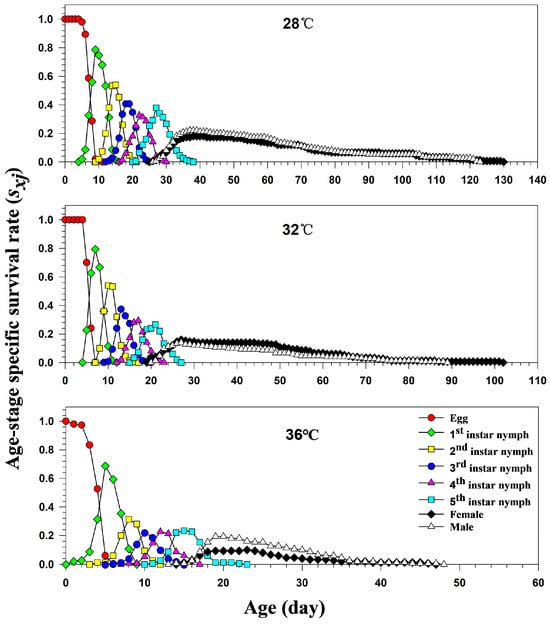
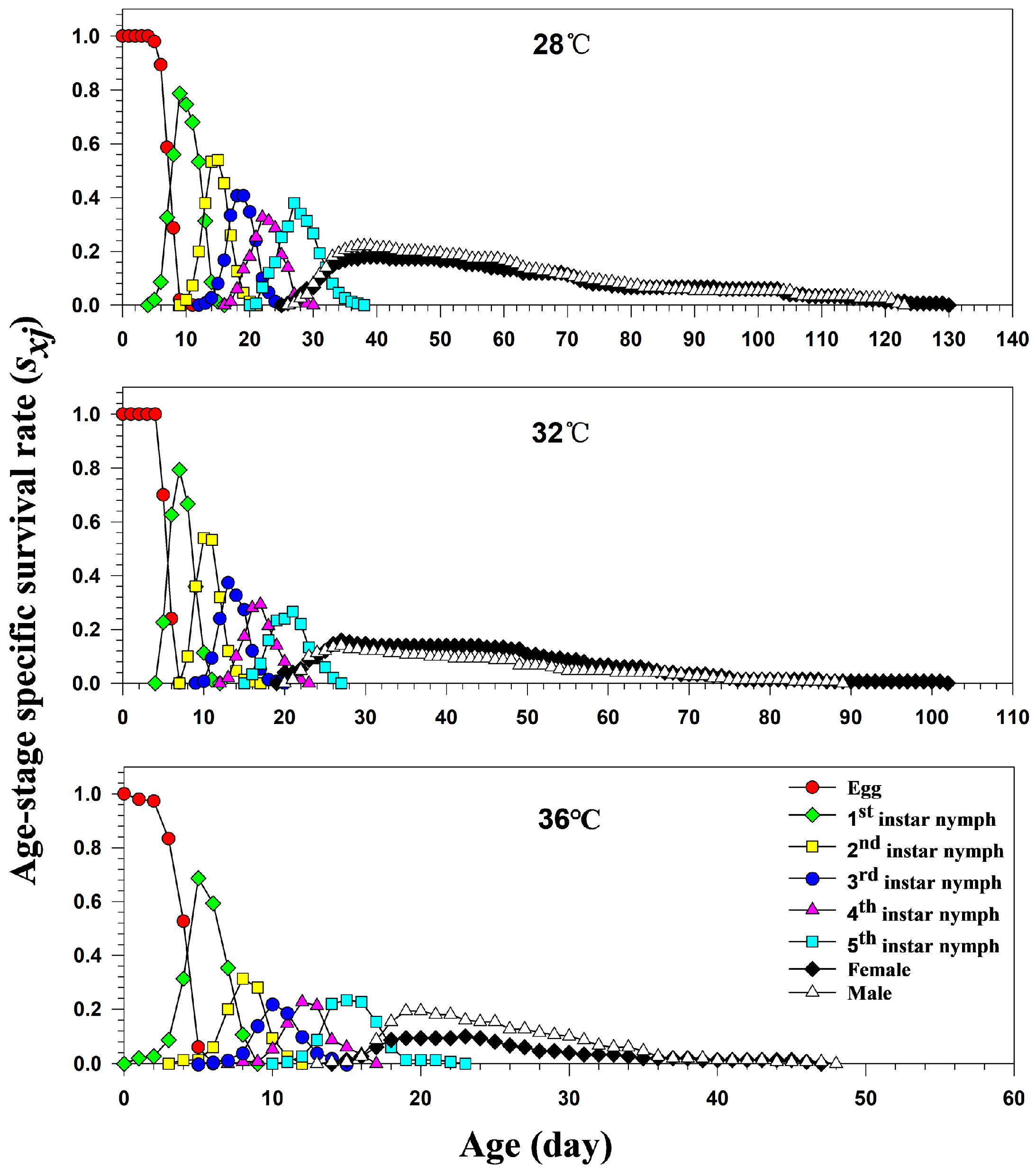
Given that G. xishaensis failed to complete a full generation at 16 and 20 °C, and that only three females survived to reproductive maturity at 24 °C, data from these three temperatures were excluded from subsequent curve fitting and demographic parameter analyses. This was done to ensure the robustness and comparability of life table parameter estimates across treatments. The age-stage specific survival rate (Sxj) curves overlapped across temperature treatments (Figure 1), indicating variable developmental rates among different stages of G. xishaensis and the coexistence of multiple stages at the same period. The curves also revealed a relatively rapid decline in survival during the nymphal stages of G. xishaensis. Additionally, as temperature increased, the developmental duration from egg to the fifth nymphal instar decreased progressively, indicating that higher temperatures accelerated the overall development of G. xishaensis.
Figure 1.
Age-stage specific survival rate (Sxj) of Geocoris xishaensis at different temperatures.
3.3. Effect of Temperature on the Age-Specific Survival Rate, Age-Stage Specific Fecundity, Age-Specific Fecundity, Age-Specific Net Maternity of G. xishaensis
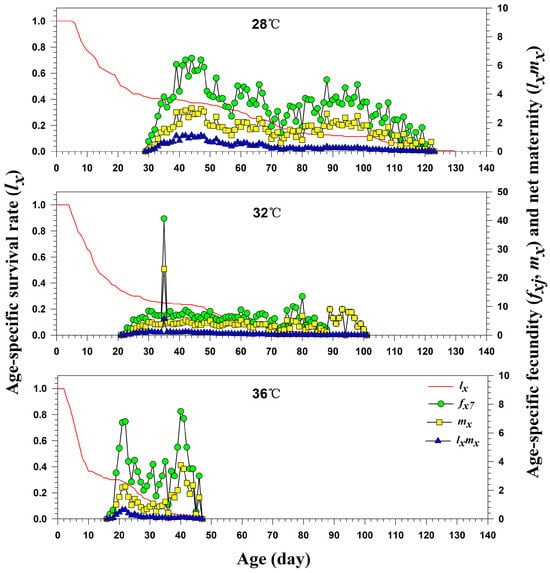
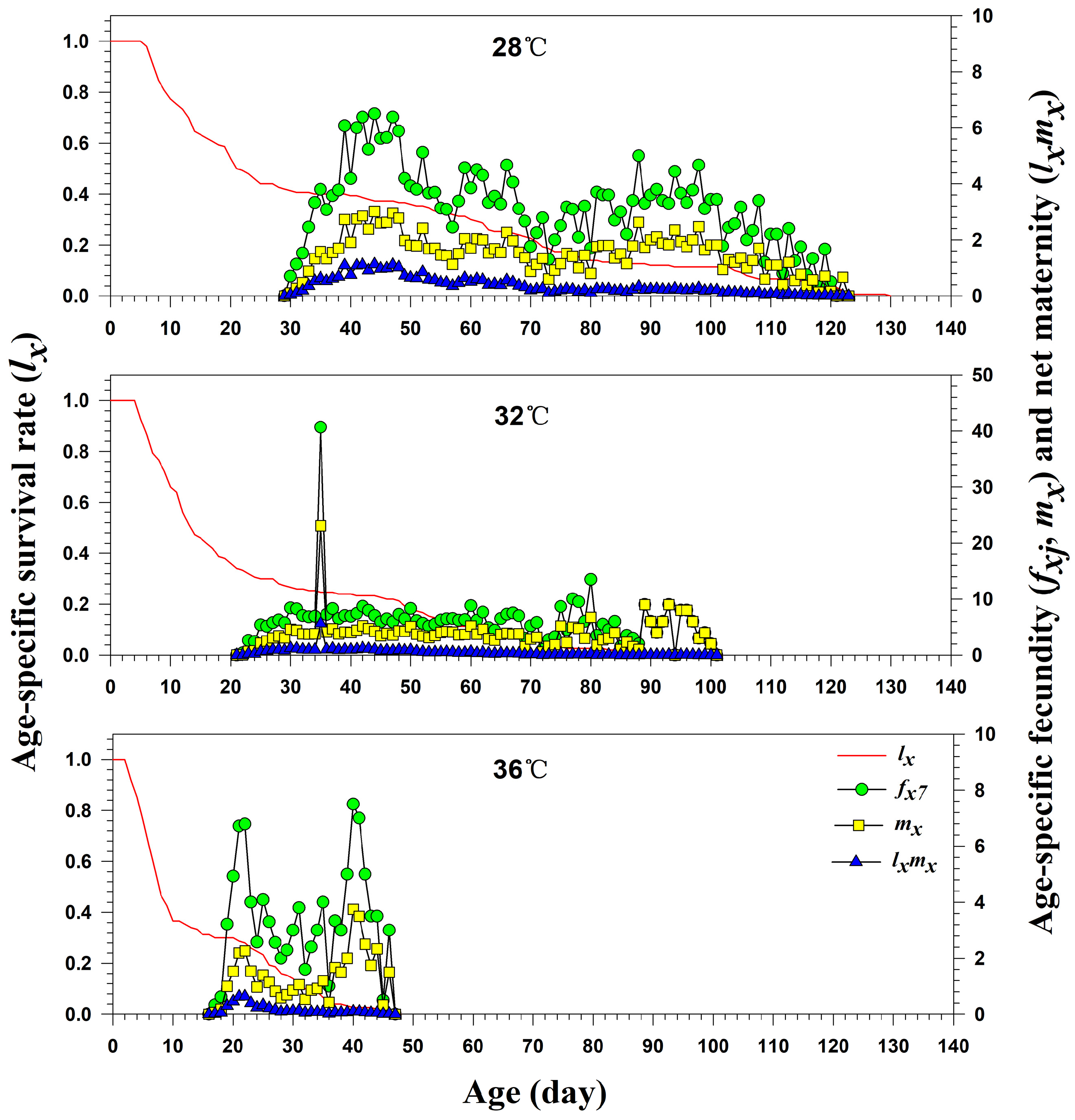
Age-specific survival rate (lx) across the three temperature treatments (Figure 2) showed that survival of G. xishaensis was relatively high during the egg stage at all temperatures, but declined sharply during the nymphal period. The longest population survival duration (129 days) was observed at 28 °C, followed by 32 °C (101 days) and 36 °C (47 days). The curves for age-specific fecundity (mx), age-stage specific fecundity (fx7), and age-specific net maternity (lxmx) exhibited similar fluctuating patterns, characterized by successive rises and declines (Figure 2). At 28 °C, fx7, mx, and lxmx all peaked on day 44, with maximum values of 6.50, 3.02, and 1.13 eggs day−1, respectively. At 32 °C, all three parameters peaked on day 35, at 40.67 (contributed by 21 females), 23.08, and 5.69 eggs day−1, respectively. At 36 °C, fx7 and mx both peaked on day 40 (7.50 and 3.75 eggs day−1, respectively), whereas lxmx peaked earlier on day 22 at 0.63 eggs day−1.
Figure 2.
Age-specific survival rate (lx), age-stage specific fecundity (fxj), age-specific fecundity (mx), age-specific net maternity (lxmx) of G. xishaensis at different temperatures. Note: The y-axis scale of the 32 °C panel differs from those of the 28 and 36 °C panels in order to accommodate the exceptionally high peak in age-specific fecundity (fx = 40.67 eggs day−1).
3.4. Effect of Temperature on the Age-Stage Specific Life Expectancy and Age-Stage Specific Reproductive Value of G. xishaensis
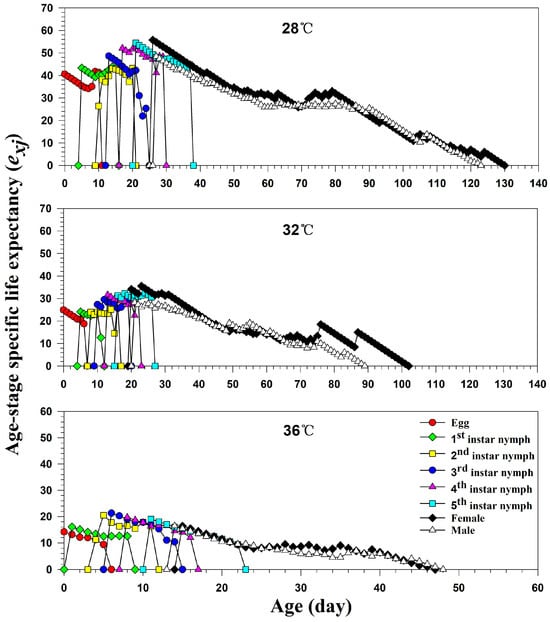
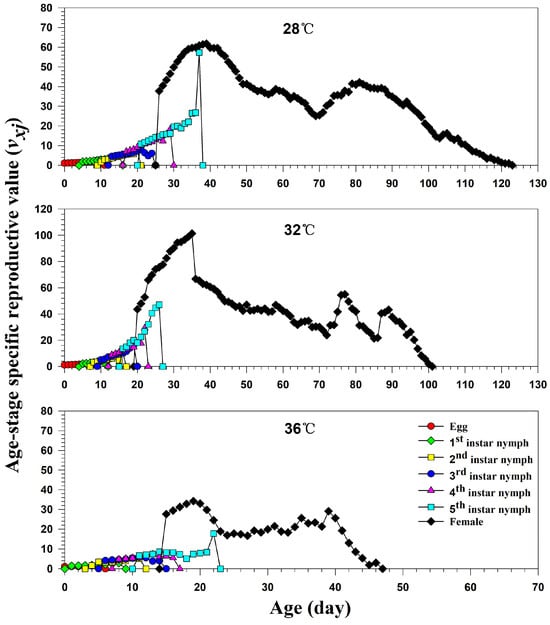
Age-stage specific life expectancy (exj) of G. xishaensis declined progressively with age across the three temperatures tested. Notably, the exj curves showed that all stages of G. xishaensis had the longest life expectancy at 28 °C (Figure 3). The vxj curves showed that after females began oviposition, reproductive value increased sharply to a peak and then declined progressively (Figure 4). After females began oviposition, reproductive value rose sharply, peaked, and then declined progressively. The highest peak reproductive value was observed at 32 °C, reaching 101.29, while the lowest was at 36 °C, with a value of 34.20.
Figure 3.
Age-stage specific life expectancy (exj) of G. xishaensis at different temperatures.
Figure 4.
Age-stage specific reproductive value (vxj) of G. xishaensis at different temperatures.
3.5. Life Table Parameters of G. xishaensis at Different Temperatures
The intrinsic rate of increase (r) and finite rate of increase (λ) of G. xishaensis both peaked at 32 °C, with values of 0.0961 days−1 and 1.1008 days−1, respectively (Table 4). The net reproductive rate (R0) was highest at 28 °C and 32 °C. Mean generation time (T) decreased with increasing temperature.
Table 4.
Population life table parameters of G. xishaensis at different temperatures.
3.6. Population Projection of G. xishaensis at Different Temperatures
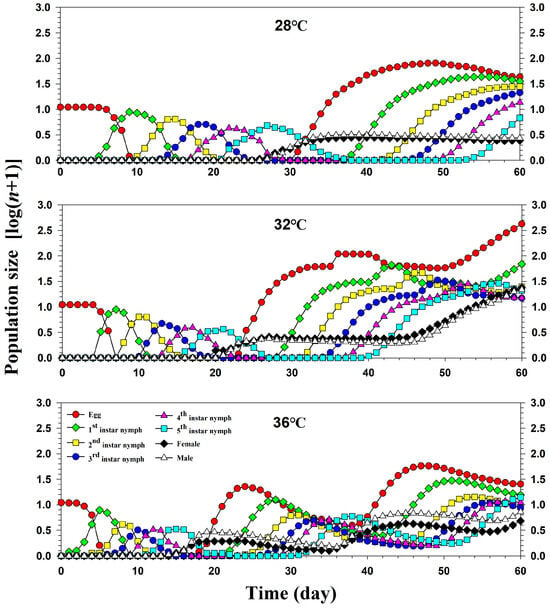
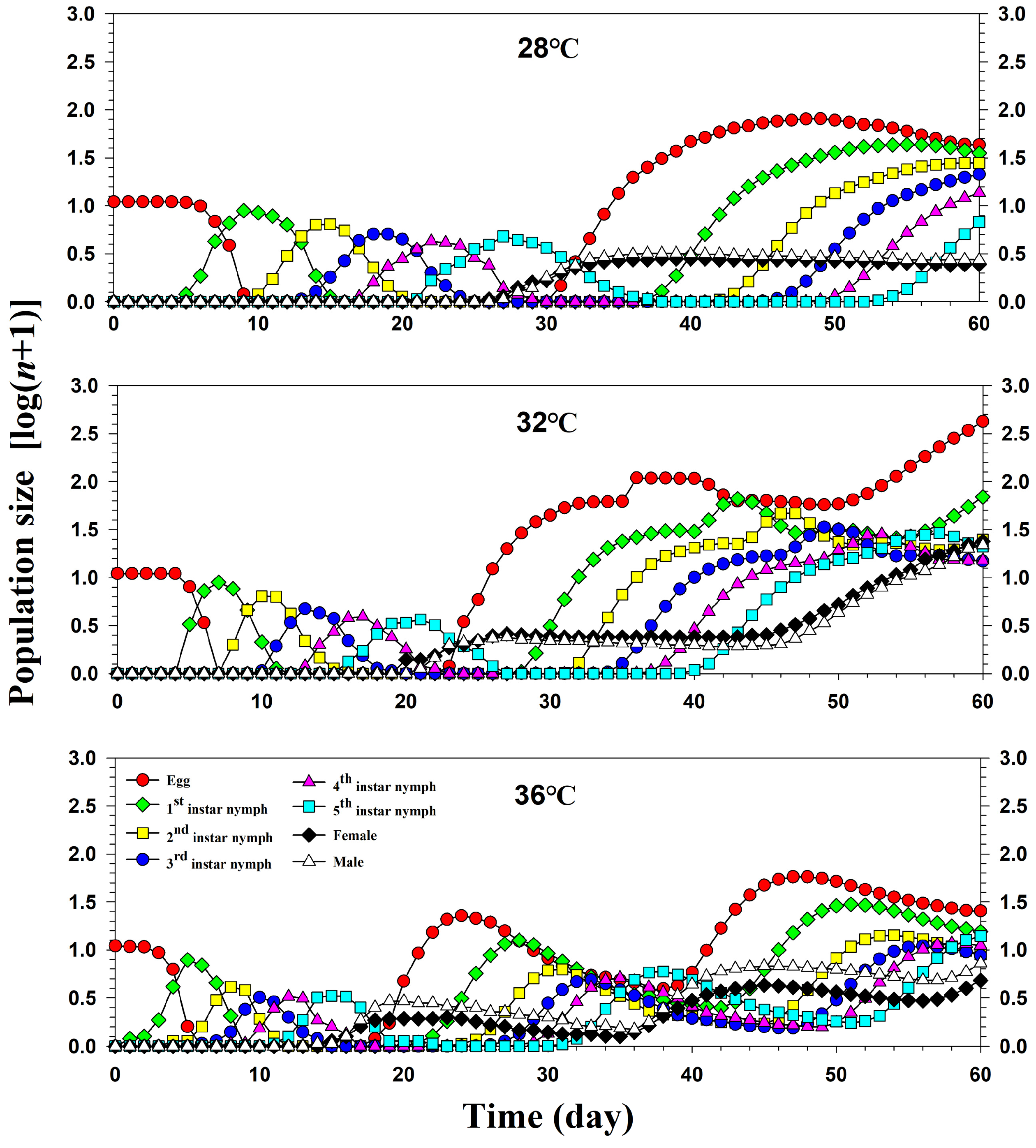
Simulation of the population growth dynamics of G. xishaensis over a 60-day period revealed that population size increased at all tested temperatures (Figure 5). The largest population growth was observed at 32 °C.
Figure 5.
Population projections of G. xishaensis over a 60-d period at different temperatures.
4. Discussion
Knowledge of the optimal temperatures for the development and survival of biological control agents is essential for their efficient mass-rearing and field release in augmentative biological control programs [31]. Numerous studies have demonstrated that developmental temperature requirements vary considerably among Geocoris species. For example, the optimal temperature range for development is 24–30 °C for G. varius, 26–33 °C for G. proteus, and 24.5–30 °C for G. punctipes [13,31]. In the current study, r was highest at 32 °C and did not differ significantly between 28 and 36 °C, whereas the developmental period was shortest at 36 °C; the temperature supporting the fastest population growth thus did not coincide with that supporting the fastest development, indicating that r cannot be predicted from developmental rate alone. Because r is jointly determined by T and R0 (r = lnR0/T); as temperature increased, both R0 and T declined, but they acted on r in opposite directions, the former lowering r and the latter raising it. The two, however, did not decline in the same manner: survival decreased progressively and significantly, being 40.67%, 32% and 30% at 28, 32 and 36 °C, respectively (28 > 32 > 36); fecundity did not differ between 28 and 32 °C and declined significantly only at 36 °C; whereas T decreased monotonically throughout and was shortest at 36 °C. Combining the effects of survival and fecundity, R0 did not differ between 28 and 32 °C, and both were significantly higher than at 36 °C. The decline in R0 at the high-temperature end, superimposed on the continuous shortening of T, produced a peak in r at 32 °C rather than a monotonic trend: at 36 °C, T was shortest, but survival and fecundity were both at their lowest, and the reduction in R0 offset the gain from the shorter T, so that r was comparable to that at 28 °C but did not exceed that at 32 °C; R0 was comparable at 28 and 32 °C, but T was longer at 28 °C, so r was lower there; 32 °C therefore combined a reproductive output comparable to that at 28 °C with a shorter generation time, so that both components were near their optima and r was maximal. Although r was similar at 28 and 36 °C, the two temperatures achieved it through opposite routes: the former compensated for a longer generation time with higher survival and reproductive output, whereas the latter compensated for the combined losses in survival and reproduction with the fastest development, reflecting a temperature-dependent trade-off between developmental rate and reproductive output. Because r did not differ between the two, their relative performance must be assessed using secondary criteria: taking r as the primary criterion and R0 and fecundity as secondary criteria, the three temperatures ranked 32 °C > 28 °C > 36 °C. Although 36 °C still permits completion of the life cycle, reproduction is clearly constrained, indicating that this temperature, while within the range permitting survival, approaches the upper thermal limit for reproduction; near 36 °C, population growth of G. xishaensis is limited by reproduction rather than by developmental rate.
In this study, the lower developmental threshold for generation development of G. xishaensis was estimated at 17.35 °C by linear regression. However, at a constant 20 °C, eggs hatched successfully but individuals failed to complete a full generation. This discrepancy may be explained by two factors. First, the lower developmental threshold is a theoretical value derived by extrapolating the linear relationship between developmental rate and temperature within the optimal temperature range; it represents the temperature intercept at which the developmental rate equals zero, which is not equivalent to the minimum temperature required to complete an entire generation. Second, the threshold was estimated under constant-temperature conditions, whereas in nature, fluctuating daily temperatures can produce different developmental outcomes even at the same mean temperature. A constant 20 °C represents continuous exposure to moderately low temperatures, whereas diurnal temperature fluctuations in the field may promote development through high-temperature compensation. Thus, the inability to complete a generation at a constant 20 °C does not necessarily imply the same outcome under field conditions with a daily mean of 20 °C; this hypothesis requires further validation using fluctuating temperature experiments.
In the present study, survival differed among stages and the effect of temperature varied with stage. The first instar was the only stage whose survival declined gradually with temperature (88.43%, 84.43% and 61.95% at 28, 32 and 36 °C, a range of 26.5 percentage points), whereas stage-specific survival in the remaining instars varied by less than 16 percentage points and did not change consistently in either direction. At 36 °C, egg survival remained high (75.33%, compared with 80.67% and 81.33% at 28 and 32 °C), so the sharp drop in first-instar survival indicates that the greater part of the mortality at high temperature occurred after hatching rather than during the egg stage. Survival of the third and fifth instars was, by contrast, highest at 36 °C (94.64% and 95.74%), and that of the fourth instar differed little among temperatures (84.38–92.86%). Consequently, although first-instar survival at 36 °C was 22.5 percentage points below that at 32 °C (61.95% vs. 84.43%), survival to adulthood was nearly identical at the two temperatures (30.0% vs. 32.0%), the deficit being offset by higher survival from the third instar onwards. This pattern of a sharp early decline followed by above-average survival in later instars is consistent both with strong selection during the first instar and with the greater thermal tolerance of the larger, thicker-skinned later instars. The only exception was the second instar at 32 °C (72.82%), the single stage at which 32 °C ranked neither first nor second, although this did not prevent 32 °C from supporting the highest r. The range in stage-specific survival was much wider at 36 °C (33.8 percentage points) than at 28 °C (15.2), indicating that mortality at high temperature was concentrated in the first instar rather than distributed across development.
Beyond temperature, factors such as prey (or diet), host plant and photoperiod also influence the development and reproduction of Geocoris species, and some of these factors exhibit interactive effects [14,32,33,34,35,36]. For instance, the developmental duration of G. lubra under a 10:14 (L:D) photoperiod was significantly longer than under 12:12 and 14:10 photoperiods, although none of the three photoperiod treatments significantly affected survival rate [14]. Regarding diet, the developmental time of G. varius fed on two artificial diets (based on pork liver and ground pork) was significantly longer than that of individuals fed on Ephestia kuehniella eggs [33]. Jayanth et al. examined the performance of Geocoris ochropterus fed on the cotton aphid Aphis gossypii Glover reared on two host plants—cotton (Gossypium hirsutum L.) and roselle (Hibiscus sabdariffa L.)—and found that individuals on the aphid–cotton combination exhibited a shorter developmental period, higher survival rate, longer female longevity, and greater fecundity [34]. The present study focused on temperature as the sole factor. Future work should incorporate photoperiod, prey and host plant to comprehensively evaluate the development, reproduction, and predation behavior of G. xishaensis, thereby providing a stronger basis for its practical application.
The results of this study demonstrate that temperature is a key factor influencing the development and reproduction of G. xishaensis. Among the temperatures tested, 32 °C gave the best overall performance and the fastest population growth of G. xishaensis, followed by 28 °C; both can be recommended as rearing temperatures, with 32 °C being preferable for rapid mass production. It should be noted that the 4 °C interval used in this study limits the resolution of the thermal response, and the true optimum may lie between the temperatures tested. Future work should therefore include additional temperatures between 28 and 32 °C and between 32 and 36 °C, so as to define the optimal temperature range for mass rearing.
Supplementary Materials
The following supporting information can be downloaded at: https://www.mdpi.com/article/10.3390/insects17111142/s1, Table S1: Daily mean temperature in five regions of Hainan Province, 2025.
Author Contributions
Conceptualization, L.L. and D.H.; Formal analysis, L.L., D.H., Y.G. and W.S.; Investigation, Y.G., C.L. and H.Q.; Methodology, L.L. and Y.G.; Writing, L.L., Y.G. and Y.F.; Supervision, D.H., L.L. and J.Z.; Resources, L.L. All authors have read and agreed to the published version of the manuscript.
Funding
This study was supported by the Central Public-interest Scientific Institution Basal Research Fund (1630042022007) and Hainan Province Science and Technology Special Fund (ZDYF2024XDNY250, ZDYF2022XDNY239).
Data Availability Statement
The original contributions presented in this study are included in the article/Supplementary Materials. Further inquiries can be directed to the corresponding authors.
Conflicts of Interest
The authors declare no conflicts of interest.
References
- Brailovsky, H. A review of the Geocoridae of Mexico (Hemiptera: Heteroptera: Lygaeoidea), with descriptions of four new species, new distributional records, and a key to the known subfamilies, tribes, genera and species. Zootaxa 2016, 4173, 401–448. [Google Scholar] [CrossRef] [Scilit] [PubMed]
- Solhjouy-Fard, S.; Sarafrazi, A. Patterns of niche overlapping and richness among Geocoris species (Hemiptera: Geocoridae) in Iran. Biocontrol Sci. Technol. 2016, 26, 1197–1211. [Google Scholar] [CrossRef] [Scilit]
- Sweet, M.H. Economic importance of predation by big-eyed bugs (Geocoridae). In Heteroptera of Economic Importance; Schaefer, C.W., Panizzi, A.R., Eds.; CRC Press: Boca Raton, FL, USA, 2000; pp. 713–724. [Google Scholar]
- Davis, D.L. Population Dynamics of Four Species of Geocoris in the Peanut Agroecosystem. PhD Thesis, Texas A&M University, College Station, TX, USA, 1981. [Google Scholar]
- Li, S.K.; Yue, W.M.; Lin, J.X.; Li, Q.S.; Fu, Z.S.; Lin, M.Z.; Kong, X.Y.; Zhang, Y.J.; Xie, W. Predatory function of Geocoris ochropterus and Geocoris xishaensis. Chin. J. Appl. Entomol. 2022, 59, 318–325. [Google Scholar] [CrossRef]
- Bueno, V.H.P.; Silva, D.B.; Calixto, A.M.; Montes, F.C.; van Lenteren, J.C. Geocoris punctipes nymphs and adults easily prey on leaf-mining larvae of Tuta absoluta on tomato. Bull. Insectol. 2016, 69, 271–276. [Google Scholar]
- Rondon, S.I.; Cantliffe, D.J.; Price, J.F. The feeding behavior of the bigeyed bug, minute pirate bug, and pink spotted lady beetle relative to main strawberry pests. Environ. Entomol. 2004, 33, 1014–1019. [Google Scholar] [CrossRef] [Scilit]
- Tong, Y.J.; Lu, Y.H.; Wu, K.M. Predation of Geocoris pallidipennis on Adelphocoris lineolatus. Chin. J. Appl. Entomol. 2011, 48, 136–140. [Google Scholar]
- Torres, J.B.; Silva-Torres, C.S.A.; Ruberson, J.R. Effect of two prey types on life-history characteristics and predation rate of Geocoris floridanus (Heteroptera: Geocoridae). Environ. Entomol. 2004, 33, 964–974. [Google Scholar] [CrossRef] [Scilit]
- Varshney, R.; Budhlakoti, N. Predatory potential of Geocoris ochropterus (Hemiptera: Geocoridae) against Thrips parvispinus (Thysanoptera: Thripidae): Insights from functional response studies. Int. J. Trop. Insect Sci. 2026, 46, 1807–1812. [Google Scholar] [CrossRef] [Scilit]
- Varshney, R.; Budhlakoti, N.; Ballal, C.R. Functional response of Geocoris ochropterus Fieber (Hemiptera: Geocoridae) to different egg densities of Helicoverpa armigera (Hubner) (Lepidoptera: Noctuidae). Phytoparasitica 2018, 46, 451–458. [Google Scholar] [CrossRef] [Scilit]
- Dellapé, P.M.; Thomas, J.H. Lygaeoidea Species File. Available online: https://lygaeoidea.speciesfile.org/otus/917311/overview (accessed on 16 October 2026).
- Oida, H.; Kadono, F. Development of Geocoris varius and G. proteus (Hemiptera: Geocoridae) provided with Ephestia kuehniella (Lepidoptera: Pyralidae) eggs. Appl. Entomol. Zool. 2012, 47, 365–372. [Google Scholar] [CrossRef] [Scilit]
- Mansfield, S.; Scholz, B.; Armitage, S.; Johnson, M.-L. Effects of diet, temperature and photoperiod on development and survival of the bigeyed bug, Geocoris lubra. BioControl 2007, 52, 63–74. [Google Scholar] [CrossRef] [Scilit]
- Gan, Y.; Fu, Y.; Han, D.; Wang, J.; Liang, C.; Sun, R.; Li, L. Observations of morphological and biological characteristics of Geocoris xishaensis (Hemiptera: Geocoridae). Acta Entomol. Sin. 2024, 67, 674–682. [Google Scholar] [CrossRef]
- Zhou, Y.; Cai, B.; Gao, C. A new species of Geocoris Fallén (Hemiptera: Heteroptera: Geocoridae) from Hainan Province, China. Entomotaxonomia 2021, 43, 1–6. [Google Scholar] [CrossRef]
- Efron, B.; Tibshirani, R.J. An Introduction to the Bootstrap; Chapman & Hall: New York, NY, USA, 1993. [Google Scholar]
- Huang, Y.B.; Chi, H. Life tables of Bactrocera cucurbitae (Diptera: Tephritidae): With an invalidation of the jackknife technique. J. Appl. Entomol. 2013, 137, 327–339. [Google Scholar] [CrossRef] [Scilit]
- Chi, H. TWOSEX-MSChart: A Computer Program for the Age-Stage, Two-Sex Life Table Analysis; Zenodo: Geneva, Switzerland, 2026. [Google Scholar] [CrossRef]
- Chi, H. Life-table analysis incorporating both sexes and variable development rates among individuals. Environ. Entomol. 1988, 17, 26–34. [Google Scholar] [CrossRef] [Scilit]
- Ebrahimi, M.; Sahragard, A.; Talaei-Hassanloui, R.; Kavousi, A.; Chi, H. The life table and parasitism rate of Diadegma insulare (Hymenoptera: Ichneumonidae) reared on larvae of Plutella xylostella (Lepidoptera: Plutellidae), with special reference to the variable sex ratio of the offspring and comparison of jackknife and bootstrap techniques. Ann. Entomol. Soc. Am. 2013, 106, 279–287. [Google Scholar] [CrossRef] [Scilit]
- Wei, M.F.; Chi, H.; Guo, Y.F.; Li, X.W.; Zhao, L.L.; Ma, R.Y. Demography of Cacopsylla chinensis (Hemiptera: Psyllidae) reared on four cultivars of Pyrus bretschneideri (Rosales: Rosaceae) and P. communis Pears with estimations of confidence intervals of specific life table statistics. J. Econ. Entomol. 2020, 113, 2343–2353. [Google Scholar] [CrossRef] [Scilit] [PubMed]
- Chi, H.; Su, H.Y. Age-stage, two-sex life tables of Aphidius gifuensis (Ashmead) (Hymenoptera: Braconidae) and its host Myzus persicae (Sulzer) (Homoptera: Aphididae) with mathematical proof of the relationship between female fecundity and the net reproductive rate. Environ. Entomol. 2006, 35, 10–21. [Google Scholar] [CrossRef] [Scilit]
- Kavousi, A.; Chi, H.; Talebi, K.; Bandani, A.; Ashouri, A.; Naveh, V.H. Demographic traits of Tetranychus urticae (Acari: Tetranychidae) on leaf discs and whole leaves. J. Econ. Entomol. 2009, 102, 595–601. [Google Scholar] [CrossRef] [Scilit] [PubMed]
- Huang, Y.B.; Chi, H. The age-stage, two-sex life table with an offspring sex ratio dependent on female age. J. Agric. For. 2011, 60, 337–345. [Google Scholar] [CrossRef]
- Tuan, S.; Lee, C.; Chi, H. Population and damage projection of Spodoptera litura (F.) on peanuts (Arachis hypogaea L.) under different conditions using the age-stage, two-sex life table. Pest Manag. Sci. 2014, 70, 805–813. [Google Scholar] [CrossRef] [Scilit] [PubMed]
- Chi, H. TIMING-MSChart: A Computer Program for the Population Projection Based on Age-Stage, Two-Sex Life Table; Zenodo: Geneva, Switzerland, 2026. [Google Scholar] [CrossRef]
- Li, D.M.; Wang, M.M. A study on the rapid estimation method for the developmental threshold temperature and effective accumulated temperature. Insect Knowl. 1986, 4, 184–187. [Google Scholar]
- Campbell, A.; Frazer, B.D.; Gilbert, N.; Gutierrez, A.P.; Mackauer, M. Temperature requirements of some aphids and their parasites. J. Appl. Ecol. 1974, 11, 431–438. [Google Scholar] [CrossRef] [Scilit]
- Damos, P.; Savopoulou-Soultani, M. Temperature-driven models for insect development and vital thermal requirements. Psyche 2012, 2012, 123405. [Google Scholar] [CrossRef] [Scilit]
- Calixto, A.M.; Bueno, V.H.P.; Montes, F.C.; van Lenteren, J.C. Development and thermal requirements of the Nearctic predator Geocoris punctipes (Hemiptera: Geocoridae) reared at constant and alternating temperatures and fed on Anagasta kuehniella (Lepidoptera: Pyralidae) eggs. Eur. J. Entomol. 2014, 111, 521–528. [Google Scholar] [CrossRef] [Scilit]
- Chau, N.N.B.; Anh, N.Q.P.; Nhu, L.T.T.; Kieu, N.T.P.; Quoc, N.B. Ant and silkworm pupae as convenient diets for the development and reproduction of big-eyed bug Geocoris ochropterus (Hemiptera: Geocoridae). J. Asia-Pac. Entomol. 2021, 24, 131–134. [Google Scholar] [CrossRef] [Scilit]
- Igarashi, K.; Nomura, M. Development and reproduction of Geocoris varius (Hemiptera: Geocoridae) on two types of artificial diet. Appl. Entomol. Zool. 2013, 48, 403–407. [Google Scholar] [CrossRef] [Scilit]
- Jayanth, B.V.; Shashikala, M.; Rajareddy, G.; Udaykumar, E.; Saw, G.; Paul, B. Host plant-mediated trophic dynamics influence life table parameters and predation of Geocoris ochropterus Fieber in a tritrophic system. Crop Prot. 2025, 193, 107186. [Google Scholar] [CrossRef] [Scilit]
- Nhu, L.T.T.; Quoc, N.B.; Chau, N.N.B. Effect of the combination floral and diet resources on development of big-eyed Bug Geocoris ochropterus (Fieber) (Hemiptera: Geocoridae) at different temperature. J. Appl. Entomol. 2025, 149, 1121–1128. [Google Scholar] [CrossRef] [Scilit]
- Saito, N.; Shimoda, T.; Goto, C.; Nomura, M.; Yano, E. Effects of plants on the foraging behavior of polyphagous natural enemies, Piocoris varius (Uhler) and Geocoris proteus Distant (Hemiptera: Lygaeidae). Jpn. J. Appl. Entomol. Zool. 2005, 49, 231–236. [Google Scholar] [CrossRef] [Scilit][Green Version]

Disclaimer/Publisher’s Note: The statements, opinions and data contained in all publications are solely those of the individual author(s) and contributor(s) and not of MDPI and/or the editor(s). MDPI and/or the editor(s) disclaim responsibility for any injury to people or property resulting from any ideas, methods, instructions or products referred to in the content. |
© 2026 by the authors. Licensee MDPI, Basel, Switzerland. This article is an open access article distributed under the terms and conditions of the Creative Commons Attribution (CC BY) license.