


Simple Summary
Phyllotreta striolata is a destructive pest that feeds on many Brassicaceae plants, causing substantial yield losses. Gene ncm is responsible for processing precursor mRNA into mature mRNA, which plays an important role in physiological process in insects. Silencing Psncm via microinjection or oral delivery of dsRNA led to high adult mortality and feeding refusal from day 3. Transcriptome analysis revealed 875 differentially expressed genes, mainly enriched in metabolism and organism systems, while metabolomics also suggested significant alterations in multiple metabolic pathways. These findings suggest that Psncm plays a vital role in P. striolata survival and highlight its potential as a target for developing RNA-based biopesticides for sustainable pest management, although field delivery, dsRNA stability, non-target safety, and resistance risk remain to be evaluated.
Abstract
The striped flea beetle, Phyllotreta striolata, is one of the most destructive pests in Brassicaceae plants worldwide. RNA interference (RNAi) has been proven to be a promising alternative strategy for pest control, especially for P. striolata, since its larvae feed on roots and the adults feed on leaves. Gene ncm is critical for insect physiological process, as it is responsible for processing precursor mRNA into mature mRNA. In this study, we cloned and characterized the ncm gene (Psncm) from P. striolata. Additionally, we found silencing Psncm either by microinjection or oral delivery led to the high mortality of P. striolata adults. Moreover, the onset of feeding refusal was observed on day 3 in Psncm-silenced P. striolata. Finally, a total of 875 differentially expressed genes were identified in dsPsncm-injection treatment, among which 322 were upregulated and 553 were downregulated. Additionally, these genes were mainly clustered in “metabolism” and “organism systems” pathways. Consistent with the transcriptome analysis, metabolomics analysis revealed that silencing of Psncm was associated with significant alterations in multiple metabolic pathways. These results suggest that Psncm is a potential candidate for RNAi-based pest management, although further functional validation, field delivery, dsRNA stability, non-target safety, and resistance risk assessment are needed.
1. Introduction
Phyllotreta striolata (Fabricius), a destructive pest, damages many kinds of cruciferous vegetables, including broccoli, cabbage and mustard greens [1,2]. Adults cause direct damage by feeding on host plant leaves while the larvae feed on the roots, resulting in substantial yield losses. Since first documented in 1865 [3], P. striolata has become widely distributed across multiple continents, including Europe, Asia, North America, and South Africa. In China, the expansion of cruciferous vegetable planting areas, coupled with increasing crop damage, has made this pest become a significant threat. Currently, the application of chemical pesticides remains the predominant control strategy due to their cost-effectiveness and rapid efficacy [4]. However, the long-term and extensive use of conventional pesticides has not only led to the development of pest resistance, but also has caused environmental degradation and poses risks to human and animal health.
RNA interference (RNAi), first discovered by Fire et al. (1998) in Caenorhabditis elegans, refers to the phenomenon in which double-stranded RNA (dsRNA) efficiently and specifically degrades mRNA, leading to the inhibition of gene expression [5]. RNAi has been used widely to identify the gene function, and numerous studies have shown that silencing of certain genes disrupts normal physiological processes or even causes death in insects. For instance, HvvATPase B, HvSar1 and HvSec23 were essential for the survival of Henosepilachna vigintioctopunctata, injection of the corresponding dsRNA exhibited high gene silencing efficiency and resulted in high mortality of larvae and adults [6,7]. Even at low dsRNA concentrations (50 ng/μL), HvBurs-α and HvBurs-β achieved over 94–95% silencing efficiency in H. vigintioctopunctata and led to severe developmental defects and wing malformations [8]. In Helicoverpa armigera, silencing of HaNRX via either feeding or injection significantly impaired larval growth and development [9]. In Sogatella furcifera, knockdown of SfAkt delayed ovarian development in adult females, resulting in a reduction in egg-laying rate by over 90% [10]. Importantly, RNAi-based biopesticides have recently been commercialized, marking a significant milestone in pest management. In December 2023, the U.S. Environmental Protection Agency approved Ledprona, the world’s first sprayable RNAi-based biopesticide, for controlling Leptinotarsa decemlineata. This breakthrough, together with the subsequent registration of additional RNAi products, has led RNAi-based pesticides to be increasingly regarded as the “third pesticide revolution”, following the eras of conventional chemical pesticides and the first generation of biopesticides [11]. With a large number of reported studies, RNAi has been proven to be a promising alternative strategy for pest management. However, studies on RNAi in P. striolata remain limited because of the lack of genome and transcriptome annotation.
Nucampholin (ncm) is a key component of the second-step spliceosome complex involved in processing precursor mRNA into mature mRNA [12]. For instance, ncm activity has been shown to be closely associated with ribosomal protein function, jointly affecting protein synthesis efficiency in Drosophila melanogaster [12,13]. Another key function of ncm is to coordinate exon junction complex (EJC) assembly and facilitate the binding of the core EJC protein eIF4A3 to the spliceosome, thereby preventing eIF4A3 from non-specifically interacting with other RNAs. The deposition of the EJC is critical for subsequent quality control mechanisms, such as nonsense-mediated mRNA decay (NMD) [13,14]. To perform these functions, ncm has evolved specialized domains. The middle domain of eukaryotic initiation factor 4G (MIF4G), which shares sequence similarity with eukaryotic translation initiation factor 4G (eIF4G), enables interaction with eukaryotic translation initiation factor A3 (eIF4A3) by mimicking the eIF4G-eIF4A binding mode during translation initiation [1]. The protein also contains a MA3 family domain (domain present in death-associated protein 5 [DAP-5], eIF4G, and MA3 family proteins); however, the precise role of this domain in RNA splicing and EJC assembly remains to be elucidated. In C. elegans, loss of the ncm homolog let-858 causes embryonic lethality [15]. In D. melanogaster, loss of or reduction in ncm disrupts organ growth, resulting in smaller adult size [16]. In Musca domestica, the ncm paralog Mdm4 acts as a key sex-determination switch by regulating the splicing of transformer and doublesex [17]. Moreover, RNAi-mediated knockdown of ncm has been shown to cause high mortality in several coleopteran pests, including T. castaneum, Diabrotica virgifera and Meligethes aeneus, and hpRNA-expressing plants targeting ncm exhibited low root damage [18]. These findings indicate that ncm is not only essential for insect survival but also amenable to RNAi-based silencing. Thus, we examined the effect of silencing of ncm in P. striolata to evaluate the potential of dsPsncm for controlling P. striolata. Additionally, transcriptomic and metabolomics analyses were performed to explore the alterations in transcripts and metabolites induced by knockdown of ncm.
2. Materials and Methods
2.1. Insect Collection and Rearing
The adult P. striolata were collected from the field in Hangzhou, Zhejiang, China and then reared in the laboratory with Brassica juncea cv. Bau-Sin plants. The insects are maintained at 25 °C ± 1 °C and 75% ± 10% relative humidity (RH), with a photoperiod of 12:12 (light:dark).
2.2. RNA Isolation, cDNA Synthesis, Psncm Cloning and Phylogenetic Analysis
Total RNA was extracted from adult P. striolata using TRIzol reagent (Takara, Tokyo, Japan) according to manufacturer’s instructions. Subsequently, 2 μg of total RNA was used for first-strand cDNA synthesis for gene cloning with the SuperScript III First-Strand Synthesis System (Invitrogen, Carlsbad, CA, USA), following the manufacturer’s protocol. Specific primers of Psncm were designed based on the nucleotide sequence of the P. striolata transcriptome (Table 1). PCR amplification was performed using Phusion® High-Fidelity DNA Polymerase (New England BioLabs, Ipswich, MA, USA) under the following thermal cycling conditions: 98 °C for 30 s, 35 cycles of 98 °C for 30 s, 55 °C for 20 s and 72 °C for 3 min. The resulting PCR product was cloned into the pEASY-Blunt Zero cloning vector (Transgen BioTech, Beijing, China) and confirmed by sequencing. The amino acid domain of Psncm was analyzed by SMART online tool. The ncm amino acid sequences from 24 insect species were downloaded from NCBI database (https://www.ncbi.nlm.nih.gov/) (accessed on 8 July 2026). Multiple sequence alignment was performed using MAFFT v.7. The tree was visualized and color coded using iTOL (https://itol.embl.de) (accessed on 10 July 2026).
Table 1.
The primers used in this study.
2.3. Preparation of dsRNA
The dsRNA primers for Psncm, flanked with T7-promoter sequences at the 5′ ends, were designed using Primer 5.0 software (Table 1). The negative control EGFP (enhanced green fluorescent protein, GenBank accession no. U87974) was amplified from the plasmid, pBmEGFPN1, which was kindly provided by Prof. Naiming Zhou from Zhejiang University. The primers of dsEGFP were referred to Peng et al. [19]. The dsRNA was synthesized using the TranscriptAidTM T7 High-Yield Transcription Kit (Ambion, Austin, TX, USA). The off-target effect analysis indicated that this dsRNA exhibited a low risk of off-target effects (Table S1).
2.4. Administration of dsRNA by Microinjection
Adults aged 4–5 days with 1:1 sex ratio were anesthetized with CO2, followed by microinjection with 50 ng dsRNA into the hemocoel on the dorsal side of the abdominal by Nanoject II TM injector (Drummond Scientific Company, Broomall, PA, USA). The relative mRNA expression levels of Psncm were determined by RT-qPCR. Subsequently, 10, 20, 50 and 75 ng of dsPsncm were separately injected into P. striolata adults to examine the mortality rate. An amount of 200 ng of dsEGFP was served as a high-dose negative control. For comparison, each beetle was injected with 50 nL of dsRNA solution at different concentrations, corresponding to different doses. After injection, adults were maintained in 150 mL plastic triangular flasks with sponge plugs, and leaves of Brassica juncea cv. Bau-Sin were provided as a food source. The mortality was recorded every two days. For each dsRNA dose, three independent biological replicates were performed, with 20 adults per replicate. Each experiment was repeated at least three times.
2.5. Administration of dsRNA by Oral Delivery
The synthesized dsRNA was uniformly sprayed onto both sides of 4 cm × 3 cm leaves of Brassica juncea cv. BauSin plants at two-day intervals. After air-drying, the treated leaves were provided as a food source for P. striolata adults. The concentrations of dsPsncm were 500 ng/cm2 and 1000 ng/cm2. Leaves sprayed with 1000 ng/cm2 dsEGFP were used as control. Three independent biological replicates were conducted for 15~20 adults per concentration. The mortality was recorded every two days.
2.6. Reverse Transcriptase Real-Time Quantitative PCR (RT-qPCR) Analysis
RT-qPCR was used to analyze the expression pattern of Psncm in different tissues, including head, gut, leg, and remaining body parts of P. striolata adult, while RNAi efficiency was assessed using whole beetles. RT-qPCR was performed on QuantStudio3 Real-Time PCR System (Applied Biosystems, Foster City, CA, USA) using the TB Green® PerfectStart Green qPCR SuperMix kit (TransGen, Beijing, China) and gene-specific primers (Table 1). The RT-qPCR was conducted following manufacturer’s protocol. The housekeeping gene ACT1 was used as the internal reference [20]. Relative mRNA levels were normalized to reference gene with the 2−∆∆Ct method. Three biologically independent replicates and three technical replicates were conducted to examine the expression level of Psncm.
2.7. Transcriptome Analysis After Silencing of Psncm
The method was identical with our previous study [21]. Fifteen adult P. striolata injected with 100 ng dsEGFP or dsPsncm were separately rapidly frozen in liquid nitrogen. Three biological replicates were performed for each treatment. Total RNA was extracted following the manufacture’s procedure, and the quality and quantity of extracted RNA were examined before Illumina sequencing. cDNA library construction, sequencing and transcriptomic data analysis were performed by Majorbio Bio-Pharm technology Co., Ltd. (Shanghai, China). Clean Reads were assembled by Trinity software v2.11.0 to obtain transcripts for subsequent analysis. High-quality sequences were assembled based on the de Bruijn graph (DBG) algorithm. For each gene, the longest transcript was selected as a unigene and annotated by NR (NCBI non-redundant protein sequences), GO (Gene Ontology), KEGG (Kyoto Encyclopedia of Genes and Genome), eggNOG (evolutionary genealogy of genes: Non-supervised Orthologous Groups), Swiss-Prot and Pfam. To quantify transcript expression, RSEM was used to align clean reads of each sample to the reference transcript sequence. The number of reads mapped to each sample was counted, and the FPKM (fragments per kilobase of transcript per million mapped reads) of each gene was calculated. Differential expression analysis was conducted using the DESeq package.
2.8. Metabolome Analysis After Silencing of Psncm
The dsRNA injected beetle samples were used for metabolomics analysis at Majorbio Biotechnology Co., Ltd. (Shanghai, China). A cold tissue grinder with methanol/water (4:1, v/v) solution was used to homogenize the samples. The homogenate was sonicated for 30 min and stood for 30 min at −20 °C, then centrifuged at 13,000× g for 15 min at 4 °C. The supernatant was stored at −80 °C. A quality control sample (QC) was prepared by mixing equal volumes of all biological samples, and were injected every five samples to monitor analytical system stability. Metabolomic profiling was performed on a UHPLC-Q Exactive system (Thermo Fisher Scientific, Waltham, MA, USA) equipped with an ACQUITY HSS T3 column (100 mm × 2.1 mm i.d., 1.8 μm; Waters, Milford, MA, USA). Chromatographic separation employed an elution with solvent A (water–acetonitrile (2:98, v/v) containing 0.1% formic acid) and solvent B (0.1% formic acid in acetonitrile) at 40 °C. The flow rate was 0.40 mL/min, and the injection volume was 5 μL. Mass spectra were obtained in positive and negative ESI modes across the m/z range 70–1050. The conditions of mass spectrometry were sheath gas flow rate: 40; Aux gas flow rate: 10; Capillary temperature: 400 °C; ion-spray voltage floating at −2800 V in negative mode and 3500 V in positive mode. The metabolites were identified by searching the self-compiled Majorbio Database (MJDB), HMDB (http://www.hmdb.ca/) (accessed on 15 October 2025), and Metlin (https://metlin.scripps.edu/) through Majorbio online analysis platform. The differential metabolites among treatment and control groups were mapped into biochemical pathways through metabolic enrichment and pathway analysis based on KEGG database (https://www.genome.jp/kegg/) (accessed on 15 October 2025).
3. Results
3.1. Cloning and Phylogenetic Analyses of Psncm
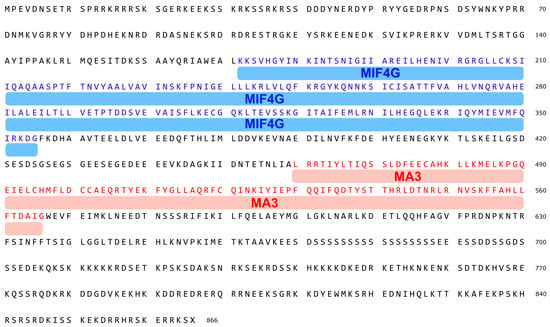
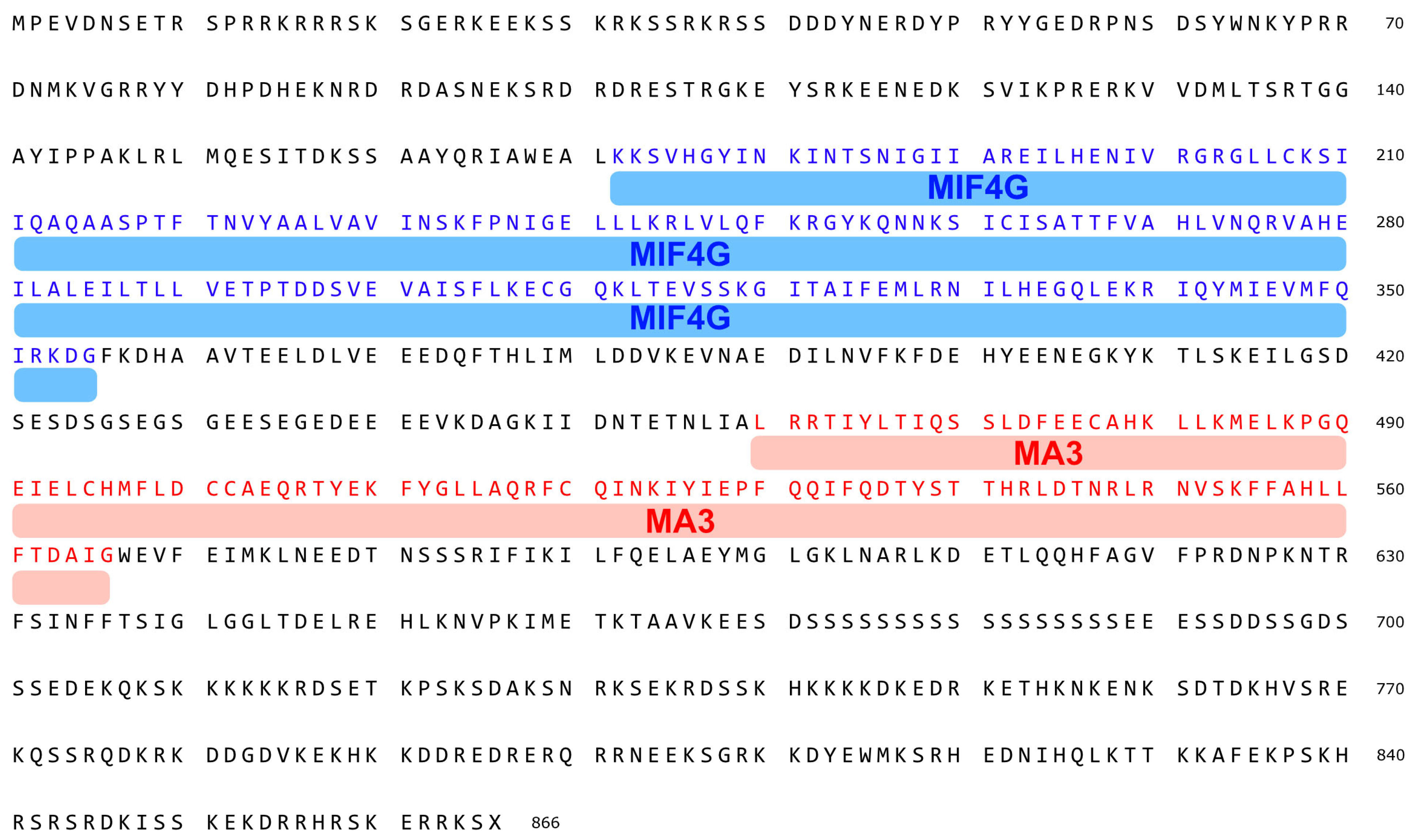
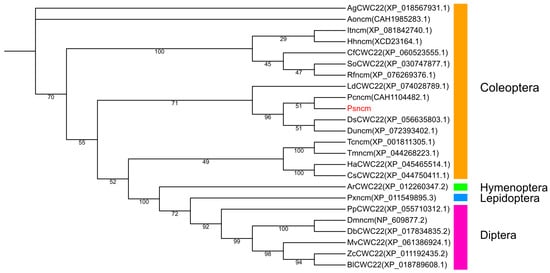
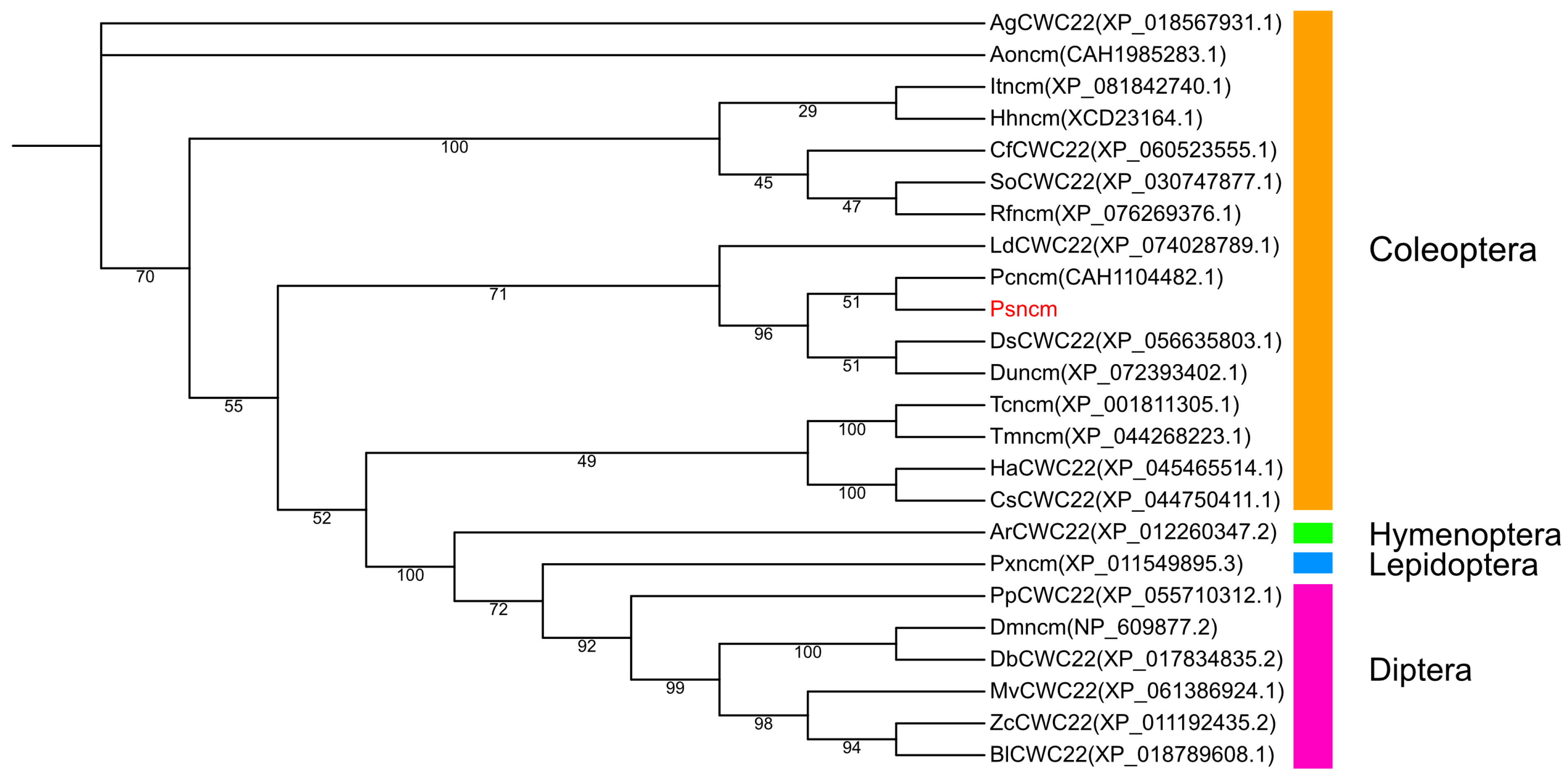
By searching GenBank and the transcriptome data library of P. striolata, we obtained the predicated Psncm sequence. Subsequently, we cloned and analyzed the Psncm gene from P. striolata. The Psncm gene, consisting of 2598 bp, encodes an 866-amino acid protein. Two critical domains, MIF4G (middle domain of eukaryotic initiation factor 4G) and MA3 (a domain present in death-associated protein 5 [DAP-5], eIF4G, and MA3 family proteins), were identified in the Psncm protein (Figure 1). Both domains mediate essential protein–protein interactions and play critical roles in translational regulation. The Psncm showed high sequence similarity to the ncm (CWC22) homologs of Psylliodes chrysocephalus, Diorhabda sublineata and Diabrotica undecimpunctata (Figure 2).
Figure 1.
Sequence and domain analysis of Psncm in P. striolata. The conserved domains were predicted using the SMART online tool based on the amino acid sequence of Psncm (866 aa). The schematic diagram shows the positions of the MIF4G (middle domain of eukaryotic initiation factor 4G) and MA3 domains.
Figure 2.
Phylogenetic tree of ncm ortholog sequence from 24 insect species. Coleoptera: Ag, Anoplophora glabripennis; Ao, Acanthoscelides obtectus; It, Ips typographus; Hh, Hypothenemus hampei; Cf. Cylas formicarius; So, Sitophilus oryzae; Rf, Rhynchophorus ferrugineus; Ld, Leptinotarsa decemlineata; Pc, Psylliodes chrysocephala; Ps, Phyllotreta striolata; Ds, Diorhabda sublineata; Du, Diabrotica undecimpunctata; Tc, Tribolium castaneum; Tm, Tribolium madens; Ha, Harmonia axyridis; Cs, Coccinella septempunctata; Hymenoptera: Ar, Athalia rosae; Lepidoptera: Px, Plutella xylostella; Dietera: Pp, Phlebotomus papatasi; Dm, Drosophila melanogaster; Db, Drosophila busckii; Mv, Musca vetustissima; Zc, Zeugodacus cucurbitae; Bl, Bactrocera latifrons.
3.2. Silencing Effect of Psncm in P. striolata Adults Through Microinjection
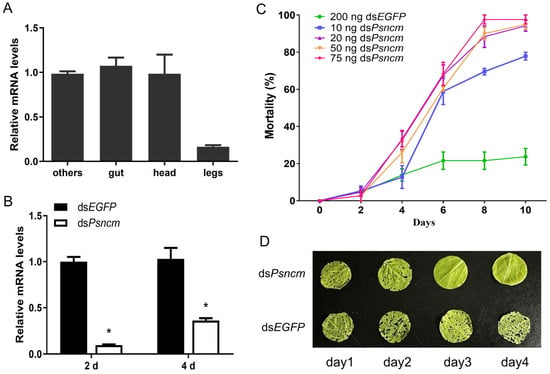
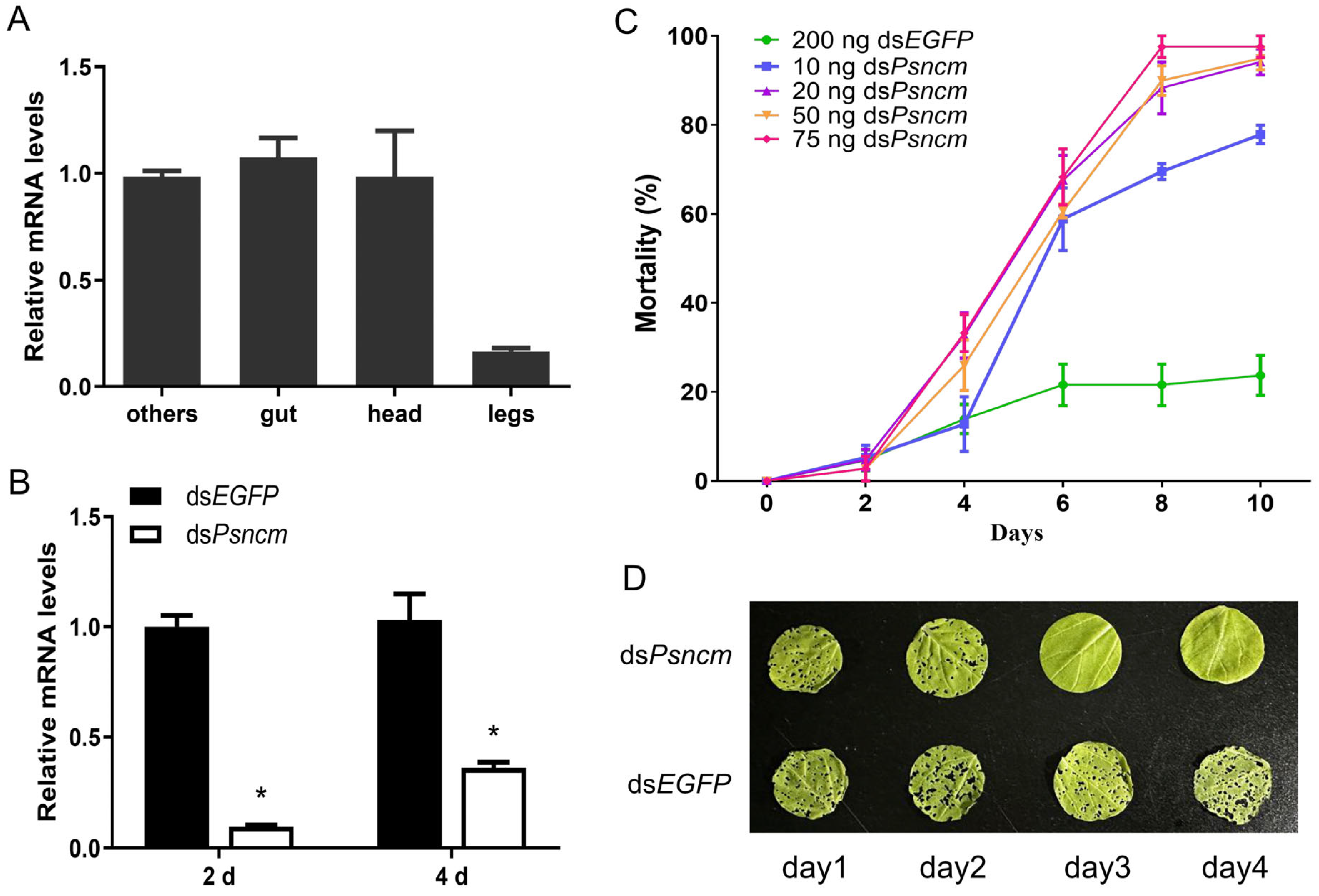
We used RT-qPCR to examine the expression pattern of Psncm in different tissues of P. striolata adults. The results showed that Psncm had low expression in the leg, and was highly expressed in other tissues, including head, gut and other body parts except leg and gut (Figure 3A). Then, RNAi was conducted in P. striolata adults through microinjection of dsPsncm to evaluate the role of Psncm in P. striolata. An amount of 50 ng of dsEGFP and 50 ng of dsPsncm were separately injected into P. striolata adults to examine the gene silencing effect of Psncm. Psncm was effectively silenced, and its mRNA level decreased significantly on days 2 and 4 (Figure 3B). Next, various concentrations of dsPsncm (10 ng, 20 ng, 50 ng, and 75 ng) were individually injected into the adult beetles to determine the mortality rate induced by silencing Psncm. The mortality rate was relatively low two days after injection; however, it increased significantly on day 4 and reached approximately 60% on day 6. By day 8, the mortality rates associated with the 20, 50 and 75 ng doses of dsPsncm all exceeded 80% (Figure 3C). The results demonstrated that Psncm silencing led to a significant mortality in a dose-dependent manner (Figure S1A). In addition, the onset of feeding refusal was observed on day 3 in Psncm-silenced P. striolata (Figure 3D).
Figure 3.
Effects of silencing Psncm on P. striolata adults by injection. (A) Relative mRNA levels of Psncm in different tissues of P. striolata. (B) Relative mRNA levels of Psncm in 2-day and 4-day beetles after injection of 50 ng dsEGFP or dsPsncm. Data are plotted as mean ± SE (n = 3 biological replicates). Statistical analysis was evaluated using Student’s t-test (* p < 0.05). (C) Percentage mortality of beetles following dsPsncm injection. Data are plotted as mean ± SE (n = 3 biological replicates, 20 adults per replicate). (D) The representative pictures of leaves fed by P. striolata adults after injection of 20 ng dsEGFP or dsPsncm.
3.3. Silencing Effect of Psncm in P. striolata Adults Through Oral Administration
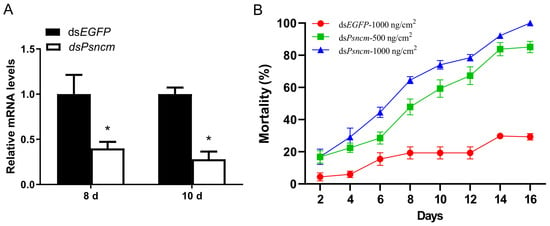
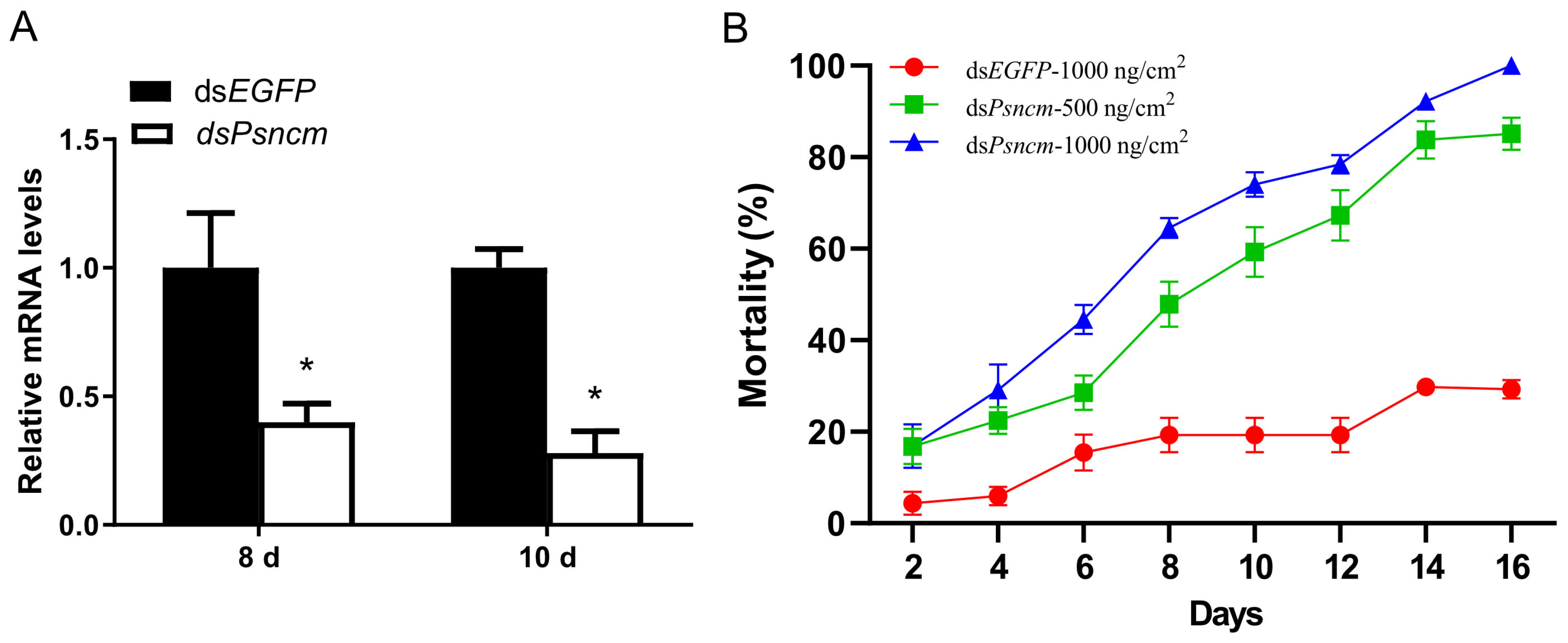
To confirm whether feeding dsPsncm exerts a silencing effect comparable to that of microinjection, we conducted a feeding experiment on P. striolata. The results showed that the mRNA level of Psncm in P. striolata fed with 1000 ng dsPsncm decreased significantly on day 8 and day 10, with 1000 ng dsEGFP serving as the negative control (Figure 4A). The mortality rates of beetles fed with 500 ng/cm2 or 1000 ng/cm2 dsPsncm exceeded 60% on day 12 and day 8, respectively, and both exceed 80% on day 14. Moreover, the survival rate of the 1000 ng/cm2 dsPsncm group was significantly lower than that of the 500 ng/cm2 group, exhibiting a dose-dependent manner of mortality effect (Figure 4B and Figure S1B).
Figure 4.
Effects of silencing Psncm on P. striolata adults by dsRNA oral delivery. (A) Relative mRNA levels of Psncm in 8-day and 10-day beetles after treatment with 1000 ng dsEGFP or dsPsncm. Data are plotted as mean ± SE (n = 3 biological replicates). Statistical analysis was evaluated using Student’s t-test (* p < 0.05). (B) The percentage mortality of beetles after dsPsncm feeding. Data are plotted as mean ± SE (n = 3 biological replicates, 15–20 adults per replicate).
3.4. Comparative Transcriptome Analysis Induced by Silencing of ncm
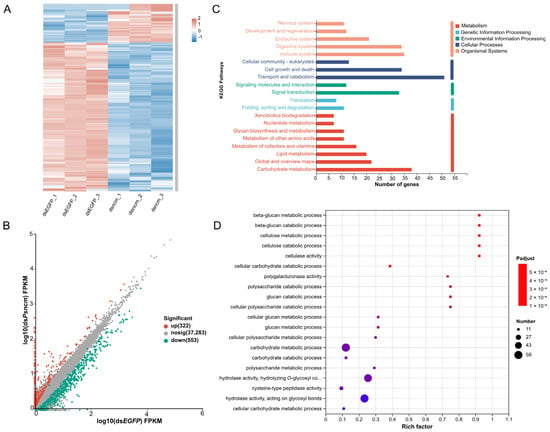
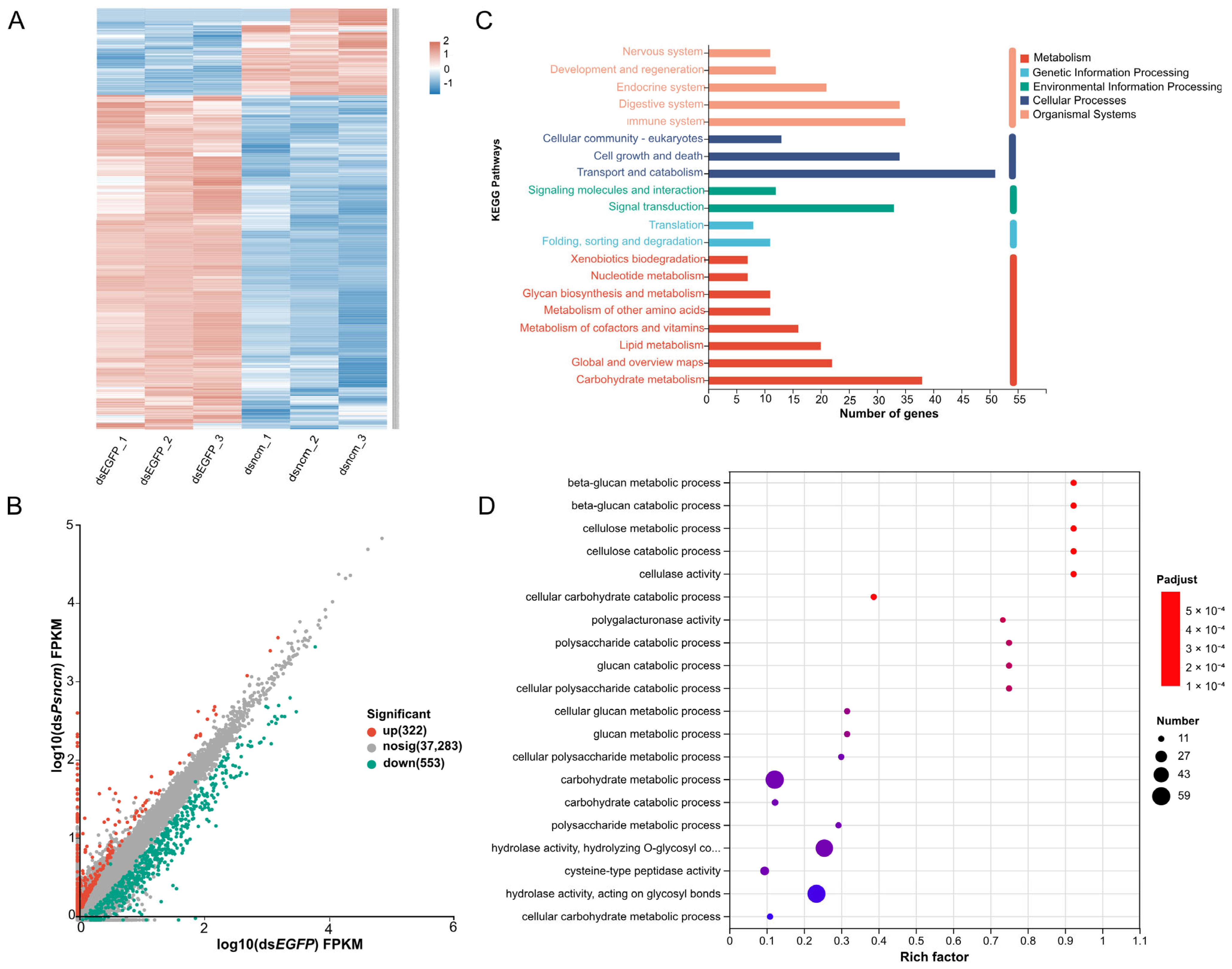
To explore the transcription effects of Psncm, we analyzed the transcriptome of adult P. striolata after injecting with 75 ng dsEGFP or dsPsncm. The cDNA libraries of P. striolata were constructed from scratch. In total, 38,158 unigenes were screened from 58,337 transcripts and compared with proteins in the NCBI NR protein database (E value < 1 × 10⁻⁵) by using the BLASTX algorithm (Figure 5A). Differential expression analysis (|log2 fold change| ≥ 1, p-value < 0.05) showed that a total of 875 significantly expressed genes in dsncm-injection treatment, among which 322 were upregulated and 553 were downregulated (Figure 5B). KEGG pathway analysis indicated that “metabolism” and “organism systems” were the most significantly enriched pathways among these dyregulated genes (Figure 5C). Gene Ontology (GO) enrichment analysis further revealed that differential expressed genes were significantly overrepresented in “carbohydrate metabolic process” and “hydrolase activity”, consistent with the results of KEGG pathway analysis (Figure 5D).
Figure 5.
The transcriptomes of ncm-silenced P. striolata. (A) Hierarchical clustering analysis of the transcriptomic data. The significant differences in the transcriptional levels between dsEGFP-injected groups and dsncm-injected groups. (B) The volcano map of transcriptome sequencing results. The abscissa is log10(dsEGFP) FPKM, and the ordinate is log10(dsncm) FPKM. Orange dots indicate upregulated genes in this group, cyan dots indicate downregulated genes, and gray dots indicate non-significantly differentially expressed genes. (C) KEGG pathway enrichment analysis with the highest score and lowest p-value for the enrichment score. (D) Bubble diagram of GO enrichment result. The dot size represents the proportion of genes, which is positively associated with the proportion of corresponding enrichment items. The change in color from red to blue represents a change in p-value from low to high.
3.5. Comparative Metabolome Analysis Induced by Silencing of ncm
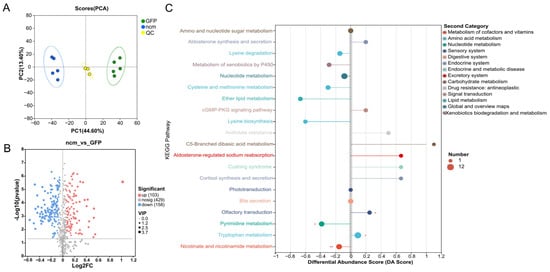
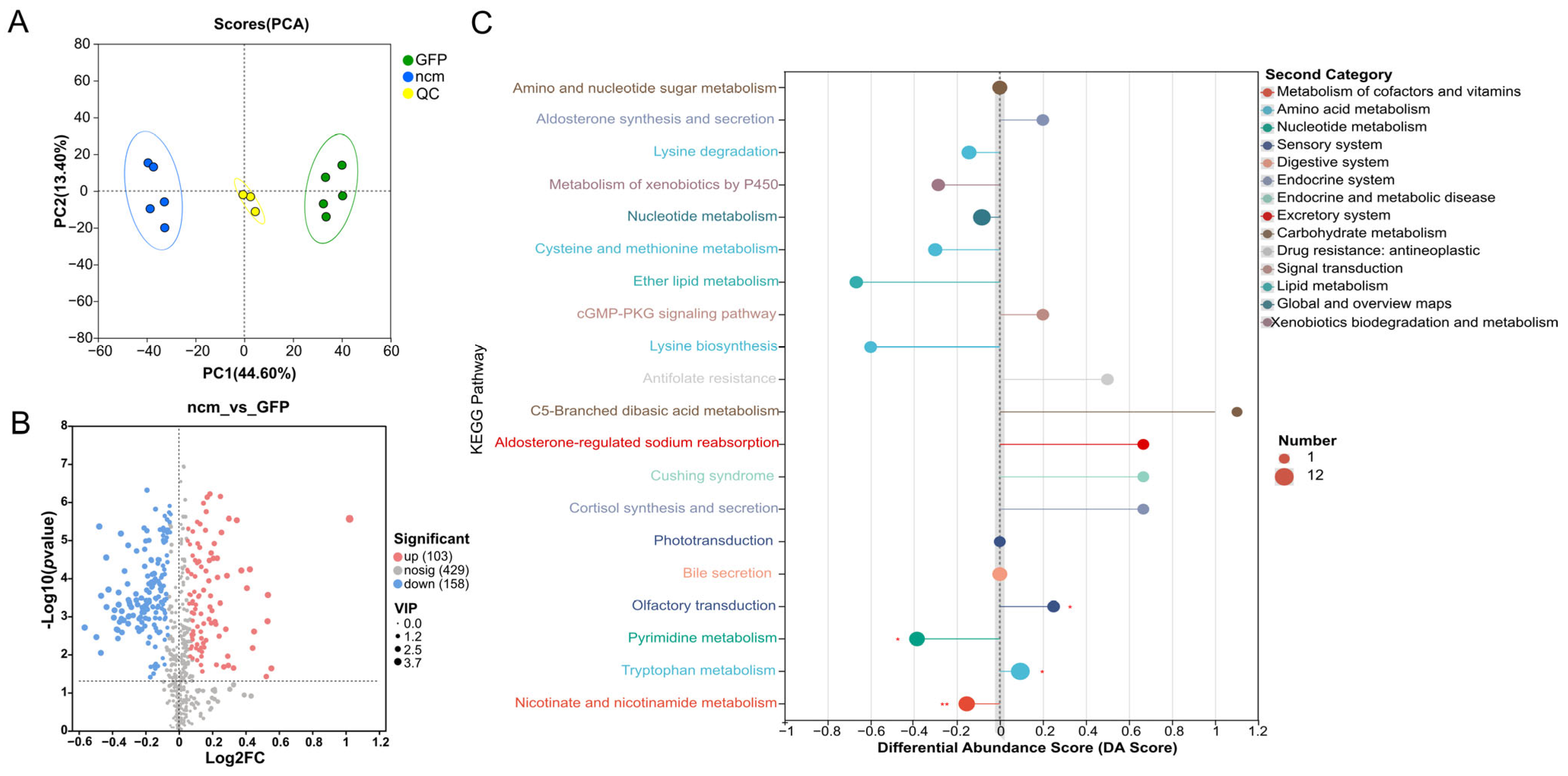
The untargeted metabolomics analysis equipped with ultra-high performance liquid chromatography-tandem mass spectrometry (UPLC-MS/MS) was used to investigate the metabolic profile of P. striolata induced by RNAi-mediated silencing of Psncm. According to principal component analysis (PCA), although the dsPsncm treatment group showed higher intra-sample dispersion, the results showed a clear separation between the control and Psncm-knockdown groups, indicating substantial metabolic alterations induced by Psncm silencing (Figure 6A). A total of 261 differential metabolites were identified by searching MS/MS spectral library based on the criteria of |log2FC| ≥ 1, variable importance in projection (VIP) > 1.0, and adjusted p-value < 0.05. Among these, 103 metabolites were significantly upregulated, while 158 were downregulated in the Psncm silencing group compared to controls (Figure 6B). All differential metabolites were assigned to annotation level B(i) (Schymanski Level 2a). The KEGG pathway enrichment analysis revealed that silencing of Psncm significantly altered multiple metabolic pathways. Notably, the nicotinate and nicotinamide metabolism and pyrimidine metabolism were strongly downregulated, whereas olfactory transduction and tryptophan metabolism were upregulated (Figure 6C).
Figure 6.
Metabolome of ncm-silenced P. striolata. (A) PCA analysis of different treatment groups. (B) The volcano map of metabolome sequencing results. Orange dots indicate upregulated metabolites in this group, cyan dots indicate downregulated metabolites, and gray dots indicate non-significantly differentially expressed metabolites. (C) KEGG pathway enrichment analysis of differential metabolites. Bubble size indicates the number of differential metabolites contained in the pathway and color indicates the secondary classification of the pathway.
4. Discussion
As an efficient and environmentally friendly biological method, RNAi is a promising tool for pest control. A previous study showed that feeding P. striolata with dspsJHBP-like and dspsaaNAT-like led to effective gene silencing and mortality; notably, RNAi also induced morphological changes in gut tissue cells at a concentration of 1000 ng/μL [22]. However, research on RNAi of P. striolata still faces challenges since lack of target genes and insufficient silencing efficiency. In this study, we found that both injecting and feeding dsPsncm caused high mortality in P. striolata, strengthening the evidence for the development and application of RNAi in pest management.
Previous studies have applied RNAi in flea beetles, mainly focusing on important pests such as P. striolata and Psylliodes chrysocephala. In P. striolata, silencing of Psγ-COPI and PsArf1COPI significantly increased the mortality [23]. Feeding P. striolata with RNA microspheres (RMS) synthesized via rolling-circle transcription (RCT) technology that targeted PsRCN and PsrRNA significantly increased mortality and reduced adult activity [24]. When mixed in equal proportions and added to the dsRNA stabilizer MLG01, dsPsRpt3 and dsPsCoatβ achieve excellent control effects against the P. striolata in the field [25]. In P. chrysocesphala, silencing of genes targeting proteasome subunits such as Prosβ1 and Prosβ5 caused significant mortality and reduced leaf damage [26]. Furthermore, studies have identified the microRNA (miRNA) pathway as the core mechanism regulating the summer diapause (hibernation) of P. chrysocesphala. Interfering with the key genes, such as Dicer-1 and Drosha, disrupts the diapause state, leading to changes in the metabolism, activity, and heat tolerance [27]. RNAi can also induce feeding resistance behavior in coleopterans. Silencing of PsOr1 disrupted the odor recognition ability of P. striolata, leading to significant changes in feeding and oviposition selectivity. The pests lost their preference for Brassica juncea and exhibited abnormal feeding behavior [28]. In another study, injecting 200–1000 ng of dsHvpnrc into third-instar larvae of H. vigintioctopunctata did not cause obvious mortality, but the resulting adults consumed no potato foliage [29].
Previous studies reported that knockdown of ncm caused high levels of mortality both by injection and feeding in T. castaneum, Diabrotica virgifera and Meligethes aeneus, moreover, low root damage was observed in the hpRNA expressing plants targeting ncm [18]. Here, we found silencing of Psncm not only leads to a significant mortality but also induces feeding refusal, providing a new strategy for biological pest control. However, the oral delivery experiment in this study did not quantify dsRNA stability on leaf surfaces, the actual amount of dsRNA ingested by insects, or leaf consumption. Reduced feeding activity itself may contribute to mortality, and therefore the relative contributions of direct RNAi effects and starvation-related effects cannot be fully separated in the present study. Future studies should measure dsRNA persistence on leaf surfaces, quantify dsRNA uptake, and monitor feeding behavior to distinguish these effects. A limitation of the injection experiment is that the 200 ng dsEGFP treatment was a high-dose negative control rather than a perfectly dose-matched control, and no injection buffer control was included. Although the much higher mortality in the 10 ng dsPsncm group than in the 200 ng dsEGFP group argues against a simple dsRNA dose-driven nonspecific effect, sequence-, batch-, or formulation-specific nonspecific effects cannot be fully excluded. Future studies should include a full dsEGFP dose gradient and an injection buffer control to separate target-specific RNAi effects from nonspecific dsRNA effects.
Compared to Lepidoptera and Hymenoptera, RNAi is more efficient and systematic in coleopterans. Possible reasons include the following. Firstly, the midgut environment of coleopteran larvae is acidic [30], which enhances dsRNA stability. In contrast, in other insects such as Lepidoptera, the intestinal environment is alkaline and contains highly active dsRNases, making dsRNA prone to degradation [31]. Secondly, in coleopterans including L. decemlineata [32] and T. castaneum [33], both sid-1-like channel protein and receptor-mediated endocytosis are involved in dsRNA uptakes [32,33,34]. However, in some insects, such as D. melanogaster, sid-1-like genes are absent; therefore, dsRNA uptake depends solely on receptor-mediated endocytosis, which results in limited systematic transfer capacity. Furthermore, while both invertebrates and plants contain RNA-dependent RNA polymerase (RdRP), an enzyme absent in insects, researchers hypothesize that an equivalent signal amplification or systemic transmission mechanism may exist in coleopterans. This mechanism could enable dsRNA to be transmitted and maintained between cells and even across tissues, thereby establishing systemic RNAi [35]. However, the precise mechanism responsible for this phenomenon has not yet been ultimately determined. Nevertheless, the variable oral RNAi efficiency observed in Coleoptera is largely attributed to the activity of double-stranded ribonucleases (dsRNases). A recent review comparing RNAi efficiency among insect orders classified Lepidoptera as having low RNAi efficiency, Coleoptera as exhibiting robust environmental RNAi, and Orthoptera as showing efficient systemic RNAi [36]. In Coleoptera, dsRNases in midgut weaken the RNAi effect triggered by feeding, and knockdown of dsRNase activity can enhance RNAi potency [37]. For instance, four dsRNase genes have been identified in T. castaneum, and TcdsRNase1 is the major nuclease degrading dsRNA; silencing TcdsRNase1 improved both injection and ingestion RNAi efficiency [19]. Similarly, in L. decemlineata, although dsRNases are present in the gut, the species remains highly sensitive to oral RNAi, suggesting that dsRNase activity levels alone cannot fully explain species-specific differences in RNAi sensitivity [37]. These findings highlight that dsRNA stability in the insect gut is a key determinant of oral RNAi efficacy and should be considered when developing RNAi-based pest control strategies. In our study, the oral delivery of dsPsncm caused significant mortality in P. striolata, suggesting that the gut environment of this species may be relatively permissive to dsRNA. However, we did not assess the degree of dsRNA degradation within the P. striolata, and future studies should evaluate whether dsRNase-mediated degradation limits RNAi efficacy in this species.
As described previously, ncm is known to play a critical role in spliceosome assembly and mRNA maturation [12]. Knockdown of ncm may disrupt the overall splicing process of the precursor mRNA, resulting in intron retention and exon skipping, and by preventing eIF4A3 from transporting to the spliceosome, it impairs the assembly of the exon junction complex (EJC). Since the EJC protein is associated with nonsense-mediated mRNA degradation (NMD) and translation efficiency, the absence of ncm may impair mRNA quality control and protein synthesis, ultimately leading to cellular dysfunction and even cell death [13,14]. In our study, transcriptomic analysis revealed that loss of ncm function was accompanied by widespread changes in gene expression, with most differentially expressed genes clustered in “metabolism” and “organism systems” pathways. Metabolomic analysis further showed that silencing of ncm potentially perturbed multiple core metabolic pathways, especially nucleotide and amino acid metabolism. Integrative correlation analysis suggested that the changes in differential metabolites were highly consistent with the regulatory directions of differentially expressed genes in specific metabolic pathways, suggesting that the phenotypic effects caused by silencing of ncm might be partially due to the coordinated disorder of these metabolic pathways. The feeding refusal observed after Psncm silencing might also be related to the impaired processing of neuropeptide or receptor mRNAs, as the signaling pathways of neuropeptide F (NPF) and short neuropeptide F (sNPF) are key mechanisms regulating insect feeding behavior [38]. However, the transcriptomic and metabolomic analyses only reveal correlations between molecular changes and mortality, and cannot establish causality; the observed changes may represent downstream stress responses to impaired physiological conditions rather than direct causes of death. Future functional validation studies like RT-qPCR, splicing analysis and targeted silencing experiments of neuropeptide-related genes are needed to test the above hypothesis.
Although Psncm silencing caused high mortality under laboratory conditions, several practical constraints must be considered before dsPsncm can be developed as an RNAi-based biopesticide. First, dsRNA stability is a major challenge for field application. Foliar dsRNA can be degraded by UV radiation, rainfall, microbial nucleases, and plant surface nucleases, thereby reducing effective exposure and RNAi efficacy [39]. Second, delivery efficiency varies with insect species, developmental stage, feeding behavior, and formulation [40]. In the present study, dsRNA was applied directly to leaf surfaces, but we did not quantify its persistence, the amount ingested by beetles, or the contribution of reduced feeding to mortality. Third, because ncm is highly conserved among insects, non-target effects on beneficial insects, pollinators, and natural enemies cannot be excluded [41]. Before field application, sequence similarity analyses and non-target organism bioassays should be performed to evaluate the safety of Psncm-derived dsRNA. Fourth, repeated and large-scale application of dsRNA may select for reduced RNAi sensitivity or resistance, as has been reported for other pest control agents [42]. Therefore, resistance monitoring and integrated pest management strategies should be considered. Finally, our experiments were performed under controlled laboratory conditions; field trials are required to evaluate the efficacy, persistence, and ecological safety of Psncm-based RNAi products.
5. Conclusions
In conclusion, here, we cloned and characterized the full length of ncm gene in P. striolata. We found knockdown of Psncm by microinjection caused the high mortality of P. striolata adults and via oral delivery was also associated with high mortality, although the contribution of reduced feeding to mortality cannot be excluded. Based on transcriptome and metabolomics analysis, the lethality was associated with significant alterations in multiple metabolic pathways induced by silencing of ncm, although whether these changes are causal or downstream consequences requires further investigation. Our results suggest that Psncm is a promising candidate target for RNAi-based control of P. striolata. However, its practical application still requires further studies on field delivery systems, dsRNA stability, non-target safety, resistance risk, and long-term ecological impacts.
Supplementary Materials
The following supporting information can be downloaded at: https://www.mdpi.com/article/10.3390/insects17111128/s1, Figure S1: Kaplan-Meier survival curves of different treatment groups in injection (A) and oral administration (B); Table S1: Off-target effect analysis of dsPsncm against non-target species.
Author Contributions
Conceptualization, M.C. and G.Z.; methodology, J.Q. and D.C.; software, H.R. and J.Q.; investigation, K.C., D.C., H.R. and J.Q.; validation, J.Q. and J.Y.; writing—original draft preparation, K.C., D.C. and M.C.; writing—review and editing, K.C. and M.C.; visualization, K.C., H.R. and J.Q.; supervision, Y.G. and G.Z.; funding acquisition, M.C. and H.W. All authors have read and agreed to the published version of the manuscript.
Funding
This research was funded by a joint-project between Zhejiang A&F University and a local company (grant no. 2022330101001710) and the Joint Funds of the National Natural Science Foundation of China (No. U2243229).
Data Availability Statement
The data presented in this study are available upon request from the corresponding authors.
Conflicts of Interest
The authors declare no conflicts of interest.
References
- Knodel, J.J. Flea Beetles (Phyllotreta spp.) and Their Management; CAB International: Oxfordshire, UK, 2017; pp. 1–12. [Google Scholar] [CrossRef] [Scilit]
- Yan, X.; Han, R.; Moens, M.; Chen, S.; De Clercq, P. Field evaluation of entomopathogenic nematodes for biological control of striped flea beetle, Phyllotreta striolata (Coleoptera: Chrysomelidae). BioControl 2012, 58, 247–256. [Google Scholar] [CrossRef] [Scilit]
- Rousseau, M.; LeSage, L. Earliest North American occurrence of Phyllotreta striolata (Coleoptera: Chrysomelidae) from Québec, Canada. Can. Entomol. 2015, 148, 476–478. [Google Scholar] [CrossRef] [Scilit]
- Tengfei, X.; Nanda, S.; Fengliang, J.; Qingsheng, L.; Xia, F. Control efficiency and mechanism of spinetoram seed-pelleting against the striped flea beetle Phyllotreta striolata. Sci. Rep. 2022, 12, 9524. [Google Scholar] [CrossRef] [Scilit]
- Fire, A.; Xu, S.Q.; Montgomery, M.K.; Kostas, S.A.; Driver, S.E.; Mello, C.C. Potent and specific genetic interference by double-stranded RNA in Caenorhabditis elegans. Nature 1998, 391, 806–811. [Google Scholar] [CrossRef] [Scilit]
- Lu, J.; Guo, M.; Chen, S.; Noland, J.E.; Guo, W.; Sang, W.; Qi, Y.; Qiu, B.; Zhang, Y.; Yang, C.; et al. Double-stranded RNA targeting vATPase B reveals a potential target for pest management of Henosepilachna vigintioctopunctata. Pestic. Biochem. Physiol. 2020, 165, 104555. [Google Scholar] [CrossRef] [Scilit]
- Guo, M.; Nanda, S.; Yang, C.; Li, Z.; Liu, J.; Gao, R.; Zhang, Y.; Zhou, X.; Pan, H. Oral RNAi assays in Henosepilachna vigintioctopunctata suggest HvSec23 and HvSar1 as promising molecular targets for pest control. Entomol. Gen. 2023, 43, 147–155. [Google Scholar] [CrossRef] [Scilit]
- Lei, Q.; Lin, A.; Wei, J.; Du, M.; Song, Q.; Zhang, Y.; Liu, X.; An, S. RNAi bioassays targeting bursicon reveal potential targets for pest control of Henosepilachna vigintioctopunctata. Pestic. Biochem. Physiol. 2025, 214, 106583. [Google Scholar] [CrossRef] [Scilit]
- Han, R.; Chu, D.; Hao, Z.; Li, H.; Miao, X.; An, S.; Guan, R. Research on HaNRX, a potential RNAi target gene in Helicoverpa armigera. Pestic. Biochem. Physiol. 2026, 218, 106936. [Google Scholar] [CrossRef] [Scilit]
- Guo, B.; Wang, Y.; Zhang, J.; Ding, W.; He, H.; Gao, Q.; Gao, H.; Li, Y.; Qiu, L. Silencing the serine/threonine kinase Akt gene disrupts reproductive physiology in Sogatella furcifera and confers RNAi-mediated insect resistance in rice. Pest Manag. Sci. 2025, 81, 7962–7970. [Google Scholar] [CrossRef] [Scilit]
- Li, Z.; Liu, Y.; Liang, Y.; Pan, T.; Liu, J. RNA interference-based pesticides: Mechanism, application, and commercialization in sustainable pest management. Pestic. Biochem. Physiol. 2026, 219, 107034. [Google Scholar] [CrossRef] [Scilit]
- Bansal, P.; Madlung, J.; Schaaf, K.; Macek, B.; Bono, F. An Interaction Network of RNA-Binding Proteins Involved in Drosophila Oogenesis. Mol. Cell. Proteom. 2020, 19, 1485–1502. [Google Scholar] [CrossRef] [Scilit]
- Ryu, I.; Won, Y.S.; Ha, H.; Kim, E.; Park, Y.; Kim, M.K.; Kwon, D.H.; Choe, J.; Song, H.K.; Jung, H.; et al. eIF4A3 Phosphorylation by CDKs Affects NMD during the Cell Cycle. Cell Rep. 2019, 26, 2126–2139.e9. [Google Scholar] [CrossRef] [Scilit]
- Steckelberg, A.L.; Altmueller, J.; Dieterich, C.; Gehring, N.H. CWC22-dependent pre-mRNA splicing and eIF4A3 binding enables global deposition of exon junction complexes. Nucleic Acids Res. 2015, 43, 4687–4700. [Google Scholar] [CrossRef] [Scilit]
- William, G.K.; Xu, S.; Mary, K.M.; Andrew, F. Distinct requirements for somatic and germline expression of a generally expressed Caenorhabditis elegans gene. Genetics 1997, 146, 227–238. [Google Scholar] [CrossRef] [Scilit]
- Coelho, C.M.; Kolevski, B.; Walker, C.D.; Lavagi, I.; Shaw, T.; Ebert, A.; Leevers, S.J.; Marygold, S.J. A genetic screen for dominant modifiers of a small-wing phenotype in Drosophila melanogaster identifies proteins involved in splicing and translation. Genetics 2005, 171, 597–614. [Google Scholar] [CrossRef] [Scilit]
- Sharma, A.; Svenia, D.H.; Wu, Y.; Kohlbrenner, T.; Morilla, I.; Brunner, C.; Wimmer, E.A.; Zande, L.; Robinson, M.D.; Beukeboom, L.W.; et al. Male sex in houseflies is determined by Mdmd, a paralog of the generic splice factor gene CWC22. Science 2017, 356, 642–645. [Google Scholar] [CrossRef] [Scilit]
- Knorr, E.; Fishilevich, E.; Tenbusch, L.; Frey, M.L.F.; Rangasamy, M.; Billion, A.; Worden, S.E.; Gandra, P.; Arora, K.; Lo, W.; et al. Gene silencing in Tribolium castaneum as a tool for the targeted identification of candidate RNAi targets in crop pests. Sci. Rep. 2018, 8, 2061. [Google Scholar] [CrossRef] [Scilit]
- Peng, Y.; Wang, K.; Chen, J.; Wang, J.; Zhang, H.; Ze, L.; Zhu, G.; Zhao, C.; Xiao, H.; Han, Z. Identification of a double-stranded RNA-degrading nuclease influencing both ingestion and injection RNA interference efficiency in the red flour beetle Tribolium castaneum. Insect Biochem. Mol. Biol. 2020, 125, 103440. [Google Scholar] [CrossRef] [Scilit]
- Wu, Z.; Bin, S.; He, H.; Wang, Z.; Li, M.; Lin, J. Differential Expression Analysis of Chemoreception Genes in the Striped Flea Beetle Phyllotreta striolata Using a Transcriptomic Approach. PLoS ONE 2016, 11, e0153067. [Google Scholar] [CrossRef] [Scilit]
- Chen, D.; Yan, R.; Xu, Z.; Qian, J.; Yu, Y.; Zhu, S.; Wu, H.; Zhu, G.; Chen, M. Silencing of dre4 Contributes to Mortality of Phyllotreta striolata. Insects 2022, 13, 1072. [Google Scholar] [CrossRef] [Scilit]
- Xu, D.D.; Xing, Q.J.; Liu, F.Q.; Jiang, Y.X.; Wang, Z.Z.; Liu, Y.N.; Wang, X.X.; Cao, H.H.; Liu, T.X.; Zhang, Y. Screened potential dsRNA targets in the digestive system of adult flea beetle Phyllotreta striolata: psJHBP-like and psaaNAT-like for enhancing RNAi pest control. Pest Manag. Sci. 2025, 81, 4579–4589. [Google Scholar] [CrossRef] [Scilit]
- Guo, M.; Gao, R.; Nanda, S.; Li, Y.; Guo, C.; Zhou, X.; Zhang, Y.; Yang, C.; Pan, H. RNAi assays in the striped flea beetle (Phyllotreta striolata) suggest Psgamma-COPI and PsArf1COPI as potential molecular targets for pest control. Pestic. Biochem. Physiol. 2023, 193, 105428. [Google Scholar] [CrossRef] [Scilit]
- Kong, L.; Xu, J.; Shen, W.; Zhang, S.; Xu, Z.; Zhu, K.Y. Development and evaluation of RNA microsphere-based RNAi approaches for managing the striped flea beetle (Phyllotreta striolata), a globally destructive pest of Cruciferae crops. Pest Manag. Sci. 2025, 81, 1529–1538. [Google Scholar] [CrossRef] [Scilit]
- Xu, S.; Zhang, X.; Wang, Y.; Han, R.; Miao, X.; Li, H.; Guan, R. Targets selection and field evaluation of an RNA biopesticide to control Phyllotreta striolata. Pestic. Biochem. Physiol. 2025, 209, 106330. [Google Scholar] [CrossRef] [Scilit]
- Cedden, D.; Guney, G.; Rostas, M.; Scholten, S. RNA degradomics and proteomics reveal the mechanism of dsProsbeta1-mediated proteasome targeting in Psylliodes chrysocephala. Pest Manag. Sci. 2025, 82, 10604–10614. [Google Scholar] [CrossRef] [Scilit]
- Guney, G.; Schmitt, K.; Zicola, J.; Toprak, U.; Rostas, M.; Scholten, S.; Cedden, D. The microRNA pathway regulates obligatory aestivation in the cabbage stem flea beetle Psylliodes chrysocephala. Commun. Biol. 2025, 8, 1288. [Google Scholar] [CrossRef] [Scilit]
- Zhao, Y.Y.; Liu, F.; Yang, G.; You, M.S. PsOr1, a potential target for RNA interference-based pest management. Insect Mol. Biol. 2011, 20, 97–104. [Google Scholar] [CrossRef] [Scilit]
- Anjum, A.A.; Liao, L.L.; Jin, L.; Li, G.Q. Proline-rich nuclear receptor coactivator (Pnrc), the Drosophila aaquetzalli homologue, is important in survival of Henosepilachna vigintioctopunctata. J. Insect Physiol. 2025, 165, 104843. [Google Scholar] [CrossRef] [Scilit]
- Felton, G.W.; Workman, J.; Duffey, S.S. Avoidance of antinutritive plant defense: Role of midgut pH in Colorado potato beetle. J. Chem. Ecol. 1992, 18, 571–583. [Google Scholar] [CrossRef] [Scilit]
- Nitnavare, R.B.; Bhattacharya, J.; Singh, S.; Kour, A.; Hawkesford, M.J.; Arora, N. Next Generation dsRNA-Based Insect Control: Success So Far and Challenges. Front. Plant Sci. 2021, 12, 673576. [Google Scholar] [CrossRef] [Scilit]
- Cappelle, K.; de Oliveira, C.F.; Van Eynde, B.; Christiaens, O.; Smagghe, G. The involvement of clathrin-mediated endocytosis and two Sid-1-like transmembrane proteins in double-stranded RNA uptake in the Colorado potato beetle midgut. Insect Mol. Biol. 2016, 25, 315–323. [Google Scholar] [CrossRef] [Scilit]
- Tomoyasu, Y.; Miller, S.C.; Tomita, S.; Schoppmeier, M.; Grossmann, D.; Bucher, G. Exploring systemic RNA interference in insects: A genome-wide survey for RNAi genes in Tribolium. Genome Biol. 2008, 9, R10. [Google Scholar] [CrossRef] [Scilit]
- Huvenne, H.; Smagghe, G. Mechanisms of dsRNA uptake in insects and potential of RNAi for pest control: A review. J. Insect Physiol. 2010, 56, 227–235. [Google Scholar] [CrossRef] [Scilit]
- Joga, M.R.; Zotti, M.J.; Smagghe, G.; Christiaens, O. RNAi Efficiency, Systemic Properties, and Novel Delivery Methods for Pest Insect Control: What We Know So Far. Front. Physiol. 2016, 7, 553. [Google Scholar] [CrossRef] [Scilit]
- Liu, J.; Chen, Y.; Zhu, Z.; Li, Z.; Liu, Y.; He, Q.; Swevers, L. The effects of dsRNases on RNA interference efficiency in insects and future research directions. Pestic. Biochem. Physiol. 2026, 222, 107238. [Google Scholar] [CrossRef] [Scilit]
- Spit, J.; Philips, A.; Wynant, N.; Vanden Broeck, J. Knockdown of nuclease activity in the gut enhances RNAi efficiency in the Colorado potato beetle, Leptinotarsa decemlineata, but not in the desert locust, Schistocerca gregaria. Insect Biochem. Mol. Biol. 2017, 81, 103–111. [Google Scholar] [CrossRef] [Scilit]
- Shen, C.; Wu, J.; Huang, Z.; He, M.; Chen, W.; Ilyas, N.; Zhang, X.; Chen, C.; Xu, C.; Xie, Y.; et al. Effects of neuropeptide F signaling on feeding, growth and development of Plutella xylostella (L.) larvae. Int. J. Biol. Macromol. 2025, 293, 139339. [Google Scholar] [CrossRef] [Scilit]
- Bachman, P.; Fischer, J.; Song, Z.; Urbanczyk-Wochniak, E.; Watson, G. Environmental Fate and Dissipation of Applied dsRNA in Soil, Aquatic Systems, and Plants. Front. Plant Sci. 2020, 11, 21. [Google Scholar] [CrossRef] [Scilit]
- Cooper, A.M.; Silver, K.; Zhang, J.; Park, Y.; Zhu, K.Y. Molecular mechanisms influencing efficiency of RNA interference in insects. Pest Manag. Sci. 2019, 75, 18–28. [Google Scholar] [CrossRef] [Scilit]
- Knorr, E.; Billion, A.; Fishilevich, E.; Tenbusch, L.; Frey, M.L.F.; Rangasamy, M.; Gandra, P.; Arora, K.; Lo, W.; Geng, C.; et al. Knockdown of Genes Involved in Transcription and Splicing Reveals Novel RNAi Targets for Pest Control. Front. Agron. 2021, 3, 715823. [Google Scholar] [CrossRef] [Scilit]
- Mishra, S.; Dee, J.; Moar, W.; Dufner-Beattie, J.; Baum, J.; Dias, N.P.; Alyokhin, A.; Buzza, A.; Rondon, S.I.; Clough, M.; et al. Selection for high levels of resistance to double-stranded RNA (dsRNA) in Colorado potato beetle (Leptinotarsa decemlineata Say) using non-transgenic foliar delivery. Sci. Rep. 2021, 11, 6523. [Google Scholar] [CrossRef] [Scilit]

Disclaimer/Publisher’s Note: The statements, opinions and data contained in all publications are solely those of the individual author(s) and contributor(s) and not of MDPI and/or the editor(s). MDPI and/or the editor(s) disclaim responsibility for any injury to people or property resulting from any ideas, methods, instructions or products referred to in the content. |
© 2026 by the authors. Licensee MDPI, Basel, Switzerland. This article is an open access article distributed under the terms and conditions of the Creative Commons Attribution (CC BY) license.