Comparison of Preference for Chemicals Associated with Fruit Fermentation between Drosophila melanogaster and Drosophila suzukii and between Virgin and Mated D. melanogaster

1
Department of Ecological Science, Kyungpook National University, Sangju-si 37224, Gyeongsangbuk-do, Republic of Korea
2
Department of Plant Medicine and Institute of Agriculture & Life Sciences, Gyeongsang National University, Jinju-si 52828, Gyeongsangnam-do, Republic of Korea
3
Research Institute of Invertebrate Vector, Kyungpook National University, Sangju-si 37224, Gyeongsangbuk-do, Republic of Korea
*
Authors to whom correspondence should be addressed.
†
These authors contributed equally to this work.
Insects 2023, 14(4), 382; https://doi.org/10.3390/insects14040382
Submission received: 1 March 2023
/
Revised: 6 April 2023
/
Accepted: 13 April 2023
/
Published: 14 April 2023
(This article belongs to the Collection Advances in Diptera Biology)
Simple Summary
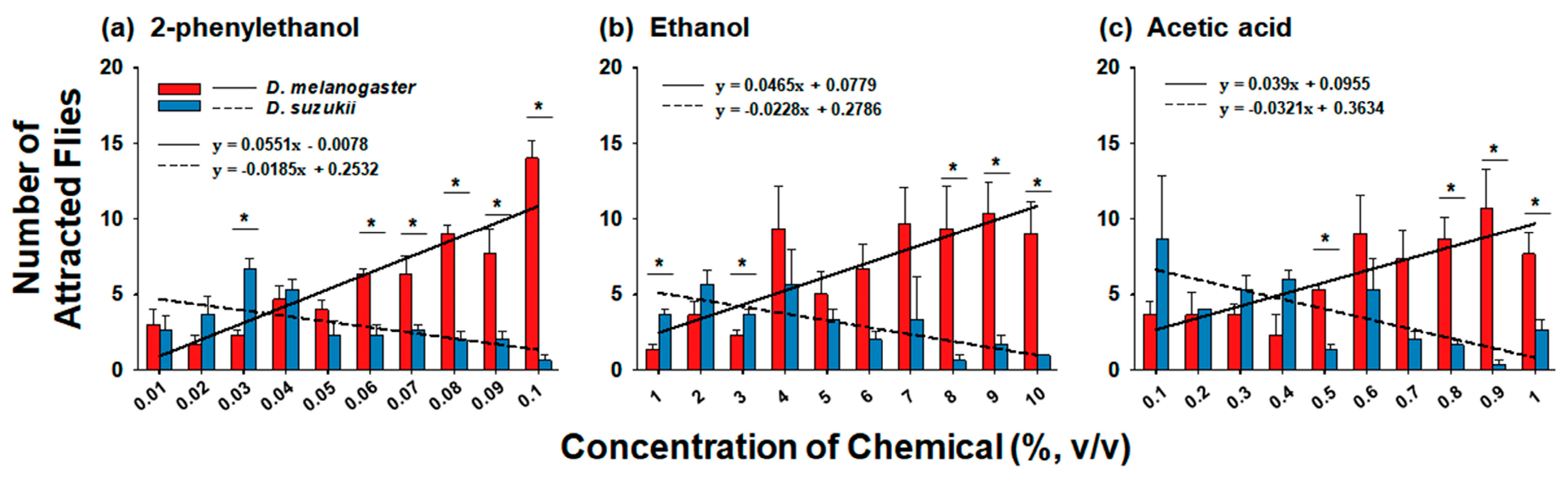
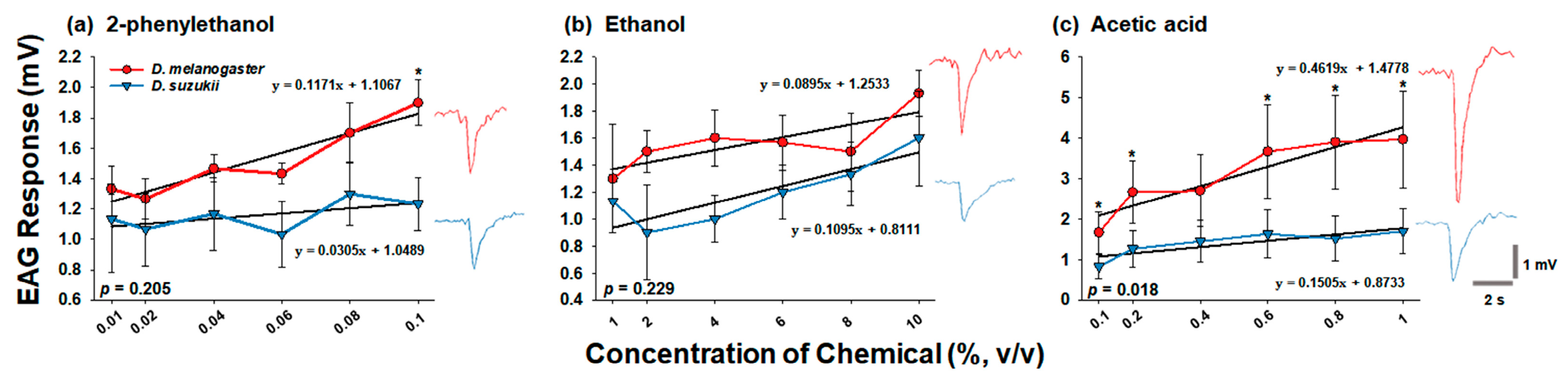
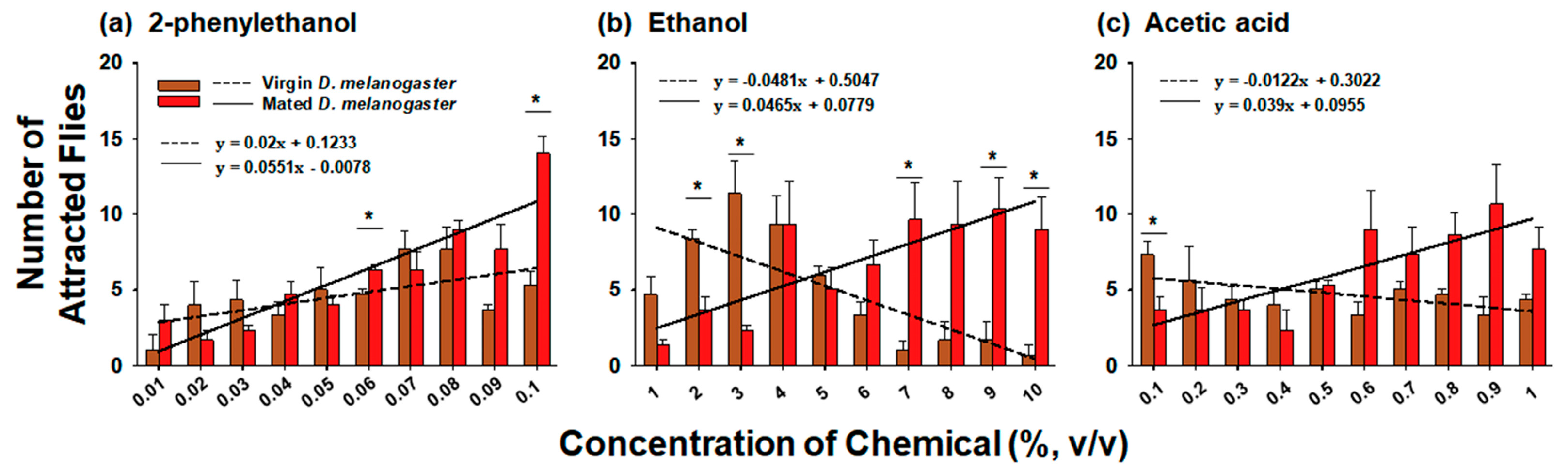
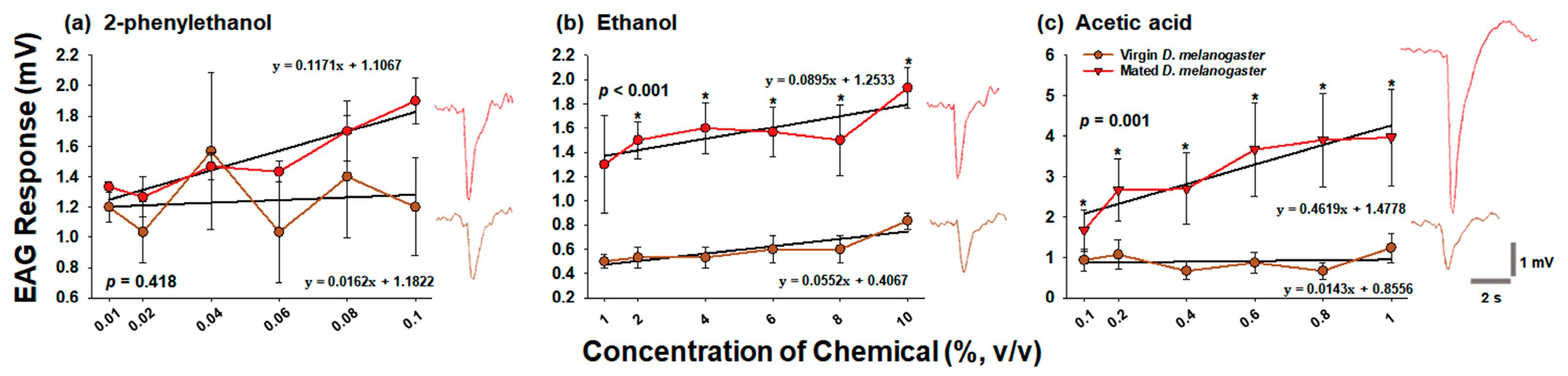
Different species of Drosophila show evolutionary specializations in host preference, habitat choice, and morphology. Therefore, the selection of different species belonging to the Drosophila genus is advantageous for understanding evolutionary adaptations to certain environments. In particular, two taxonomically close species, Drosophila melanogaster and Drosophila suzukii, are known to have distinct habitats; D. melanogaster is mostly found near overripe, decaying, abandoned, and fermented fruits, whereas D. suzukii is attracted to fresh fruits. The infection of microorganisms promotes fruit fermentation accompanied by the production of large amounts of chemicals. Therefore, chemical concentrations are typically higher in fermented fruits than in fresh fruits. Considering the distinct habitats of the two flies, D. melanogaster and D. suzukii are thought to be more attracted to high and low concentrations of chemicals, respectively. In this study, Y-tube olfactometer and electroantennogram assays revealed that D. melanogaster had a higher preference for relatively high concentrations of 2-phenylethanol, ethanol, and acetic acid than that of D. suzukii. In the comparison between virgin and mated females of D. melanogaster, mated flies were more attracted to high concentrations of chemicals than virgin flies. These results suggest that high concentrations of chemicals are an important attraction factor for D. melanogaster seeking appropriate sites for oviposition.
Abstract
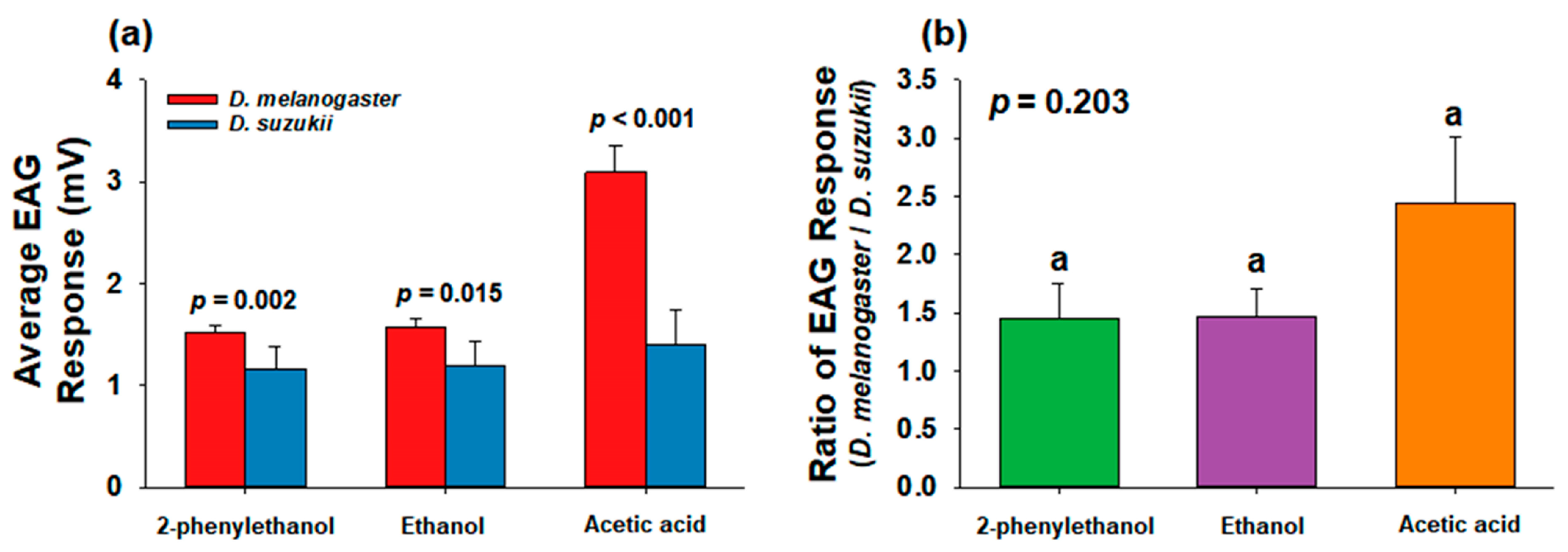
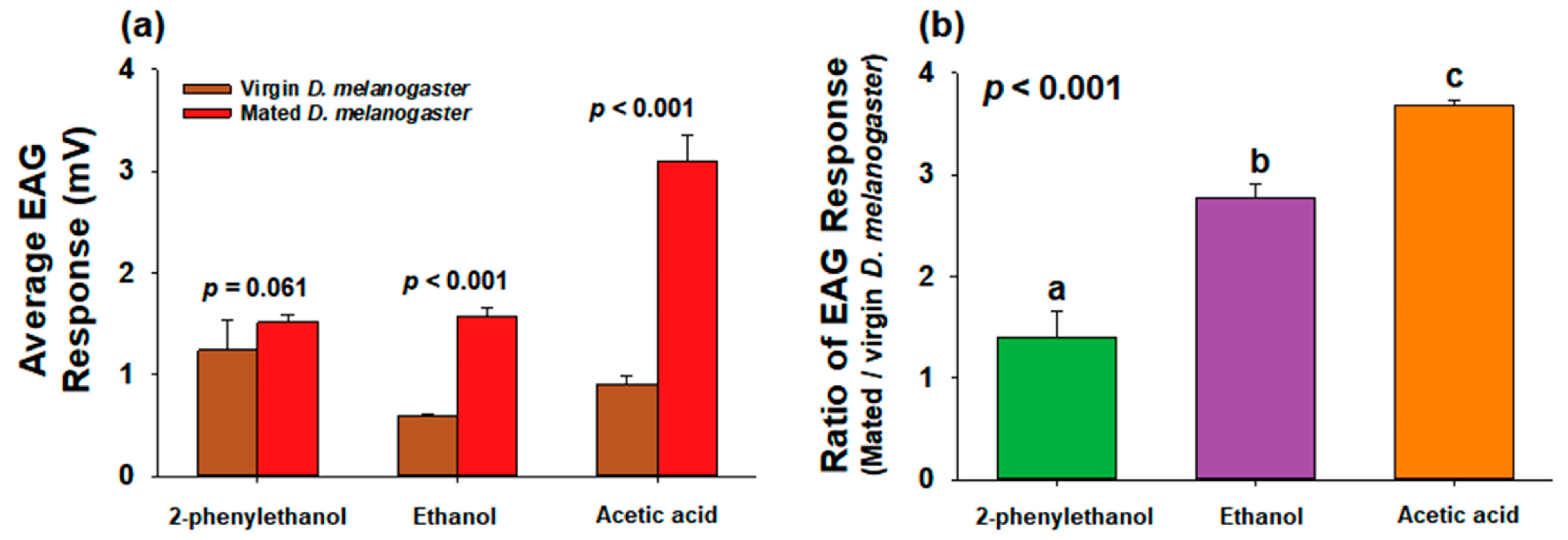
Two taxonomically similar Drosophila species, Drosophila melanogaster and Drosophila suzukii, are known to have distinct habitats: D. melanogaster is mostly found near overripe and fermented fruits, whereas D. suzukii is attracted to fresh fruits. Since chemical concentrations are typically higher in overripe and fermented fruits than in fresh fruits, D. melanogaster is hypothesized to be attracted to higher concentrations of volatiles than D. suzukii. Therefore, the chemical preferences of the two flies were compared via Y-tube olfactometer assays and electroantennogram (EAG) experiments using various concentrations of 2-phenylethanol, ethanol, and acetic acid. D. melanogaster exhibited a higher preference for high concentrations of all the chemicals than that of D. suzukii. In particular, since acetic acid is mostly produced at the late stage of fruit fermentation, the EAG signal distance to acetic acid between the two flies was higher than those to 2-phenylethanol and ethanol. This supports the hypothesis that D. melanogaster prefers fermented fruits compared to D. suzukii. When comparing virgin and mated female D. melanogaster, mated females showed a higher preference for high concentrations of chemicals than that of virgin females. In conclusion, high concentrations of volatiles are important attraction factors for mated females seeking appropriate sites for oviposition.