


Abstract
Normal contact stiffness of textured interfaces is controlled by the load-bearing contribution of deterministic texture and by the nonlinear response of rough load-bearing regions. This study formulates a hybrid deterministic–microlevel model that couples regular relief patterns—including dimples, grooves, periodic ribs and scraped high points—with a micromechanical representation of plateau roughness. Depending on texture topology and scale hierarchy, the microlevel response is represented either by a Greenwood–Williamson (GW) statistical contact model with a smooth elastic–plastic (EP) transition or by a fractal contact model. The deterministic level accounts for open-area fraction, texture depth and load redistribution, and it includes a finite-gauge spectral correction for periodic ribs and grooves to account for the finite measurement window. In a metallic dimple benchmark, the hybrid deterministic-texture/GW–EP formulation yields a mean relative error of 16.3% across all data points in the two selected textured series. In a saturated square-wave benchmark, the finite-gauge spectral correction yields a mean relative error of 10.37% for the independent patterned points. A compliance-based topology criterion is then established to determine, from open-area fraction, element depth, applied load and the ratio between texture period and plateau-roughness spacing, whether stiffness is governed primarily by deterministic texture, by micro-roughness or by their coupled response. The resulting formulation supports early-stage design exploration without requiring a full three-dimensional contact calculation at every parameter point. Independent periodic three-dimensional checks for circular-dimple cells showed that the finest FE solution agreed with the spectral prediction of the deterministic normal approach within 1.2%; the correction estimated by direct unilateral BEM changed total stiffness by no more than approximately 5% in the tested texture-influenced case.
1. Introduction
Normal contact stiffness links surface geometry to the mechanical response of assemblies. It controls load transfer, local normal approach, resonance frequencies, nonlinear dynamics and the service life of assemblies containing mechanical contact interfaces. In machine-tool guideways, bolted joints, support assemblies and other tribological interfaces, the interface cannot be characterized solely by a mean roughness value: contact pressure, real contact area and stiffness evolve across micro-, meso- and macro-scales [1,2,3,4].
Surface texturing is an established route for controlling interface behavior. Reviews of surface texturing—covering laser methods, engineered surfaces and tribological applications—show that deterministic textures can affect lubrication, friction and wear in a wide range of contacts [5,6,7,8]. Recent experimental and computational studies have further confirmed that microdimples, microgrooves, micropatterned ribs and scraped load-bearing high points influence frictional response, vibration and normal contact stiffness [9,10,11,12,13,14,15]. Taken together, these studies show that texture is not a generic modifier; it acts through topology-dependent mechanisms. Microindented and dimpled surfaces show that the response depends on dimple size, density and void fraction [9]. Microgrooved textures modify contact behavior and vibration response in friction systems [10,14]. Micropatterned interfaces demonstrate that normal contact stiffness can be tuned by repeatable positive and negative geometry [11,12]. Scraped surfaces form another class, in which load is carried by high points rather than by a continuous rough area [13]. Studies of textured joint interfaces also show that grooves and dimples can change normal stiffness and damping, making texture geometry an active element of the mechanical response rather than a passive roughness parameter [14,15]. Consequently, a parametric tool for early-stage exploration should distinguish texture topologies while remaining computationally efficient enough to survey shape, depth, spacing and open-area fraction.
In the model, the surface is described at two levels. Mesotexture denotes a deterministic repeating surface pattern: negative textures, such as dimples and grooves, remove part of the nominal surface from direct contact, whereas positive textures, such as ribs and high points, localize load on protruding regions. For periodic textures, the repeating domain is the unit cell. The microcontact level (hereafter, microlevel) describes the small-scale random or fractal topography of the regions that transmit load.
The terminology follows ISO/GPS standards for profile and areal surface texture and for instrumented indentation, together with the classical parameter set for regular microrelief [16,17,18,19].
Classical rough-contact theory primarily addresses asperity-scale behavior. The Greenwood–Williamson model represents a rough surface as an ensemble of statistically distributed summits, and later elastic–plastic models refine the deformation law of individual microcontacts [20,21,22]. Fractal and spectral approaches, including Weierstrass–Mandelbrot fractal surface descriptions, Majumdar–Bhushan-type contact models, Persson-type theories and truncation-based multiscale models, reduce sensitivity to a single measurement scale and provide useful descriptions of micro-roughness [23,24,25]. These models are essential at the microlevel, but alone they do not identify the deterministic shape, topology and load-bearing contribution of a regular surface texture.
A second class of methods relies on finite element and homogenized contact analyses. Such methods can incorporate measured or reconstructed topography, textured profiles and elastic–plastic material response [1,3,4,25]. Their limitation at the early-design stage is practical rather than conceptual: each new texture variant may require a new geometry, mesh, unit-cell discretization or re-identification of topographic parameters. This limits their suitability for fast CAD/CAE/FEA-linked exploration of surface textures with prescribed normal contact stiffness. Recent studies already provide contact-stiffness models for machined textured surfaces and scale-coupled homogenized contact of rough textured surfaces [3,4]. The distinctive feature of the present model is its design-oriented coupling logic: the governing compliance mechanism is identified from the texture topology and coupled to the micro-roughness response, so different texture types can be compared parametrically without rebuilding a full textured topographic model for each variant.
The theory of periodic elastic contact provides a natural starting point for regular mesotexture. The classical solution for regular wavy surfaces, together with later studies of the same problem, shows how deterministic topography controls contact area, pressure redistribution and the transition toward near-complete contact [26,27]. The localization approach developed by Goryacheva and Tsukanov provides a theoretical basis for regular microgeometry because it relates the shape of a regular element to pressure redistribution and interaction between neighboring contact spots [28,29]. Direct use of these solutions in industrial design remains difficult when regular texture must be coupled to nonlinear micro-roughness and compared across different texture topologies.
The central challenge is the non-additive coupling of mesotexture and micro-roughness. Mesotexture changes the regions through which the applied normal load is transmitted and redistributes local pressure over the load-bearing parts of the unit cell. The micro-roughness of these regions responds nonlinearly to local pressure: real contact area, the number of microcontacts and the elastic or elastic–plastic state of asperities all evolve with load. The regular and microlevel contributions therefore cannot be combined as two independent stiffnesses. Scale-coupled contact formulations, localization models and studies of textured viscoelastic or rough contacts all point to this coupling mechanism [4,14,15,28,30].
A gap remains between general contact theories and the needs of parametric texture design. Existing approaches either resolve a specific topography in detail, describe only stochastic roughness or analyze a particular regular geometry without a unified rule for identifying the dominant compliance mechanism. A useful design model should link texture topology to the governing compliance mechanism and handle dimples, grooves, ribs and high points within a unified framework, without requiring a full three-dimensional contact model for each candidate geometry or parameter point.
This study presents a hybrid deterministic–microlevel model of normal contact stiffness for textured surfaces. The deterministic level defines the geometry and load-bearing contribution of the mesotexture, whereas the microlevel describes the nonlinear response of the rough contact zones. The method extends the Goryacheva–Tsukanov localization concept into a numerical form that covers a wide range of deterministic textures—dimples, grooves and high-point topologies—including shapes and lattices beyond those covered by the original analytical solutions. The main contribution is a compliance-based criterion that identifies the primary source of compliance for a given texture topology and contact role. The rule uses open-area fraction, element depth, applied load and the ratio of texture period to the characteristic roughness spacing to determine whether the governing compliance arises from regular geometry, micro-roughness or their coupled response. Negative textures with a large open-area fraction emphasize load redistribution over the remaining bearing zones; positive ribs and high points emphasize localized load carrying; and high loads, or comparable meso- and micro-scales, activate the coupled response.
The article first introduces the two-level representation and the texture-dependent model components. The model is then tested against two independent benchmarks: a metallic dimpled interface (Fan and Zhou [31]), which evaluates the combination of deterministic texture with the GW+EP plateau, and a saturated square-wave interface (Perris et al. [11]), which tests the finite-gauge spectral correction for periodic ribs and grooves. Parametric design studies of dimples, lattices, grooves and high points are then presented, followed by a discussion of the governing mechanisms, trend comparisons, applicability range and limitations of the numerical formulation.
2. Materials and Methods
Surface-texture terminology and indentation-related material terms follow ISO/GPS profile, areal and instrumented-indentation standards. Regular microrelief is described using the classical RMR parameter set [16,17,18,19].
2.1. Model Architecture and Dominant-Compliance Criterion
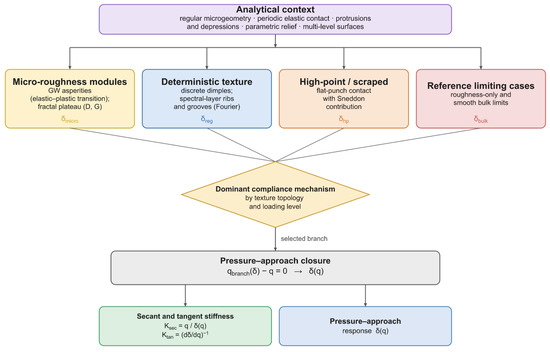
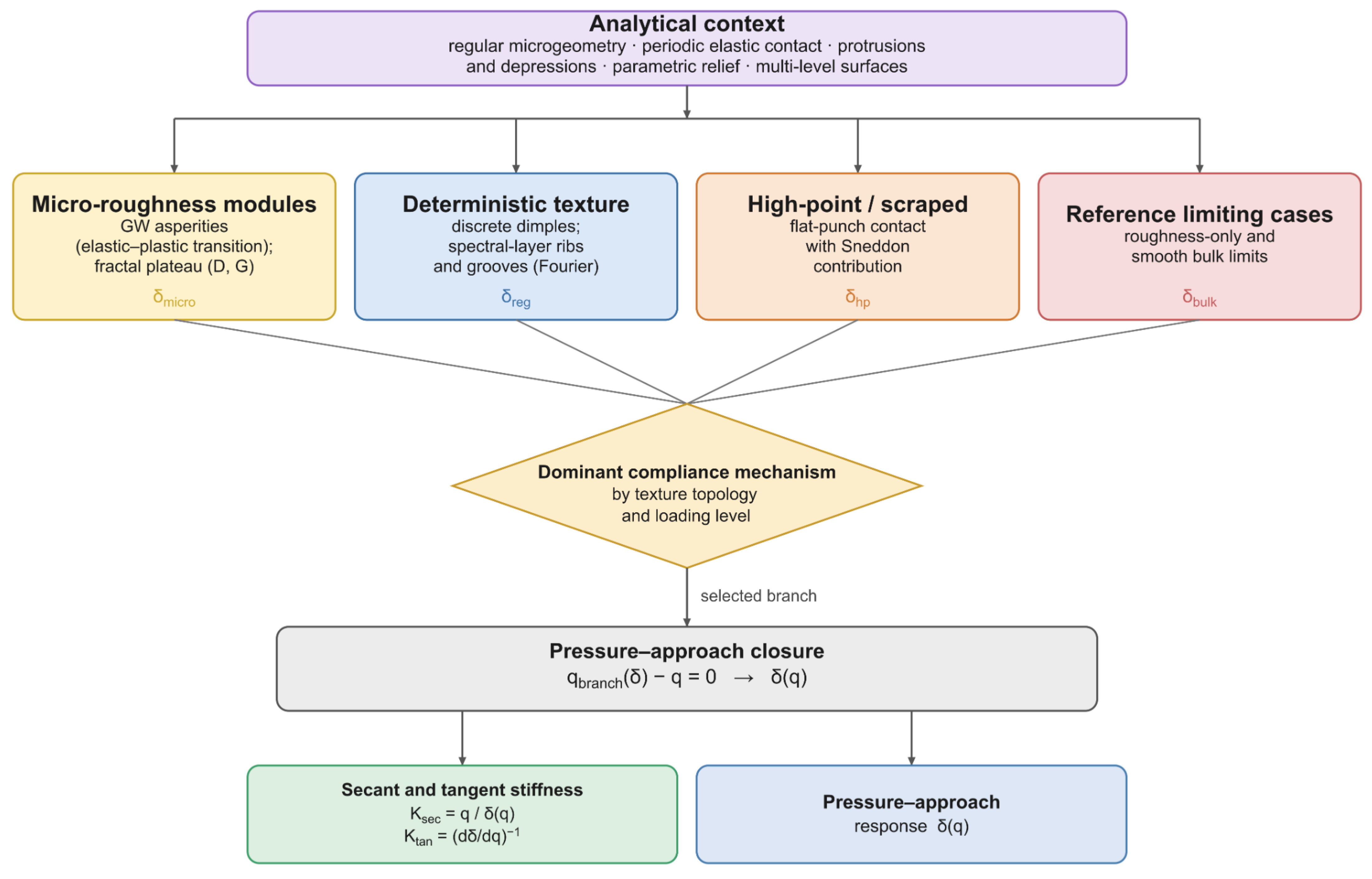
The localization principle for contact of surfaces with regular microgeometry provides the closest analytical context [28]. The present model develops this idea into a hybrid deterministic–microlevel formulation for rough surfaces carrying regular relief. It contains four physical components: (i) a deterministic texture level for dimples or grooves, (ii) a micro-roughness level for the load-bearing plateau, (iii) a high-point formulation for scraped or protruding features, and (iv) a pressure–approach closure that combines the active compliance contributions in series. Figure 1 summarizes the model architecture.
Figure 1.
Physical structure of the hybrid deterministic–microlevel model. The deterministic texture level represents discrete dimples, grooves and periodic ribs; the micro-roughness level represents either a GW+EP or fractal plateau response; and the high-point block represents protruding scraped topologies. The classification step identifies the governing compliance mechanism.
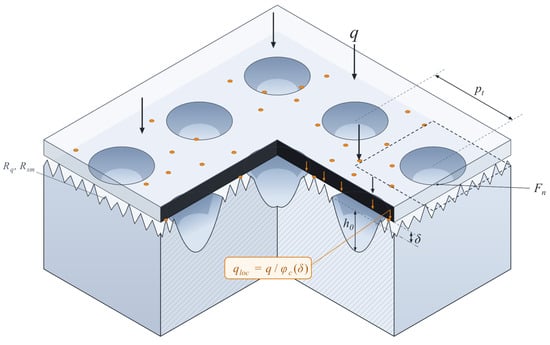
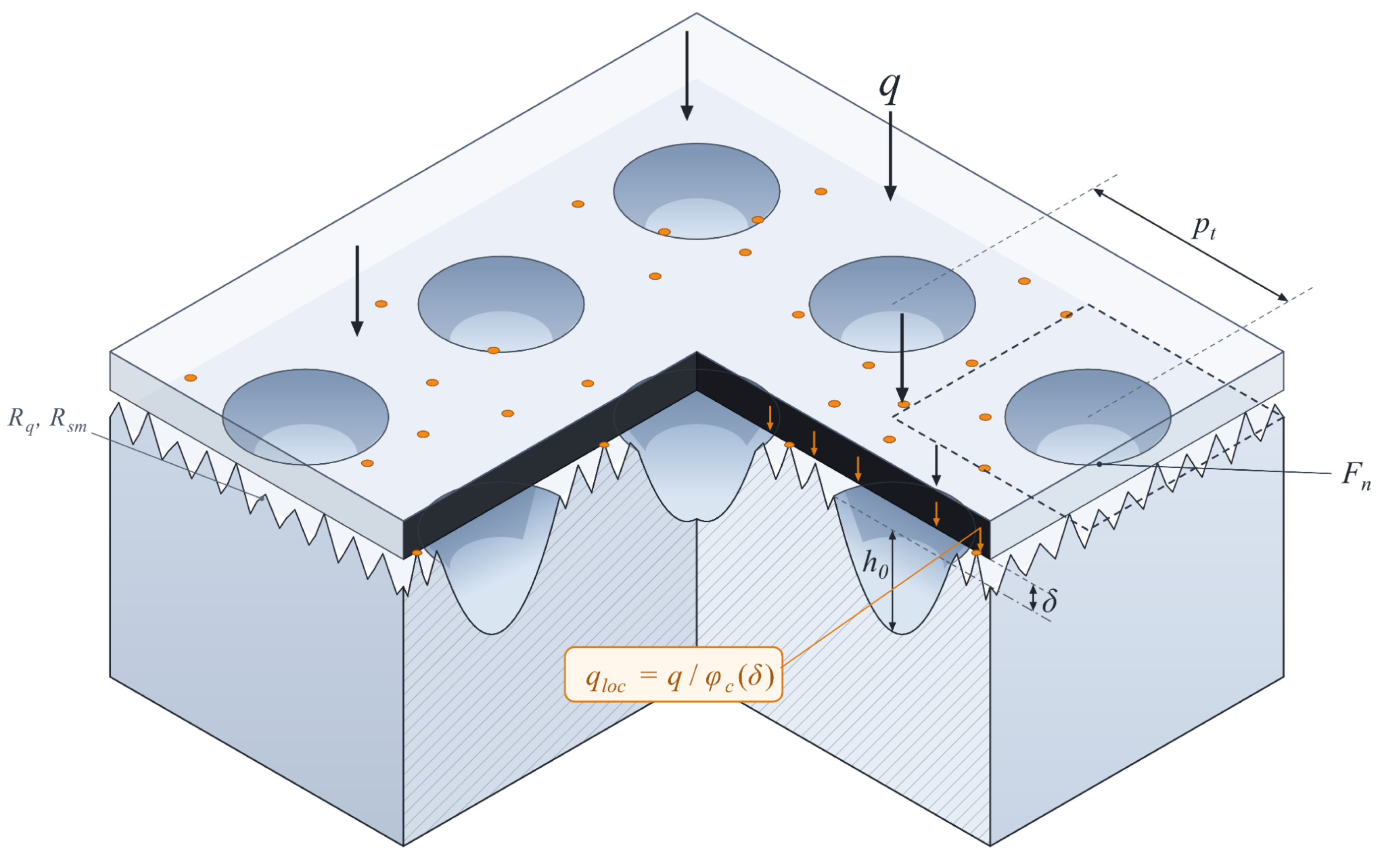
Figure 2 defines the geometric and loading variables used in the closure relation: the deterministic texture excludes or localizes part of the nominal area, whereas the remaining rough regions carry the local pressure transmitted to the microlevel.
Figure 2.
Calculation scheme for a textured contact with deterministic depressions and rough load-bearing regions. The scheme defines the nominal pressure q, the open-area fraction , the texture period , the texture depth , the normal approach , the local pressure and the roughness descriptors and used in the microlevel closure.
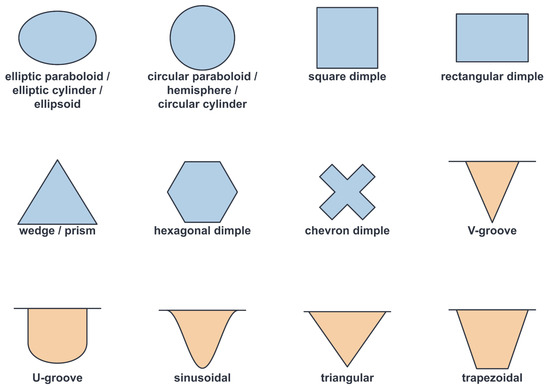
The geometries considered in this article are shown in Figure 3. The term dimples is used consistently for localized depressions with a finite footprint in both in-plane directions. Grooves are one-dimensional line features that are periodic in one direction. High points are regular protrusions that carry load on a scraped or bearing-type surface. Table 1 lists the ranges of roughness-derived fractal parameters used in the trend-comparison datasets.
Figure 3.
Overview of surface textures considered in this study: dimple-type local depressions (blue) and groove-type line features (orange).
Table 1.
Ranges of roughness-derived fractal parameters used in the trend-comparison datasets. Values are obtained from published roughness statistics.
The topology rule is expressed through two compliance indicators and two scale indicators. For a nominal pressure q, let
where is the deterministic texture contribution and is the microlevel approach evaluated at the local plateau pressure . The scale hierarchy is characterized by
where is the texture depth, is the texture period or characteristic spacing, is the RMS roughness of the plateau and is the mean profile element spacing. The compliance mechanism is classified as regular-texture-dominated when and the scale hierarchy is clear ( and ), micro-roughness-dominated when , and coupled when or when the hierarchy between texture and roughness is weak.
These thresholds define regime ranges rather than sharp material constants. By definition, corresponds to equal contributions from regular texture and micro-roughness; means that the regular contribution is only 20% of the total normal approach and can be neglected in a first engineering assessment. When and , the texture depth and pitch are well separated from the plateau-roughness scale, so the regular displacement can become governing at a lower value of . When this scale separation is weak, even a sizable regular contribution remains coupled to the microlevel because edge deformation and asperity deformation occur over comparable lengths.
The open-area fraction and depth enter through and , whereas the applied load enters through both and the nonlinear microlevel response. For protruding textures, the same criterion is used with the high-point displacement instead of the excluded-area contribution of a dimple texture. The lower threshold is an engineering screening rule: a component contributing no more than one fifth of the total approach is treated as secondary in preliminary classification. Threshold sensitivity is reported in Section 5; changing the categorical threshold does not alter the computed field or any stiffness value.
2.2. Surface Decomposition
The textured surface is written as a deterministic relief superposed on a stochastic or fractal load-bearing plateau,
where is the plateau roughness, is the lattice of texture centers, is the dimple or groove depth function, and contains depth, semi-axes, pitch, aspect ratio and opening parameters. The decomposition assumes scale separation between deterministic texture and plateau roughness. In practical terms, the texture depth and period should exceed the characteristic roughness amplitude and summit spacing; otherwise, the local-plateau-pressure approximation is no longer well justified and a full topography-resolved contact calculation is required. The bearing-area fraction of the untextured plateau is written as
Here, is the maximum open-area fraction, is the texture depth scale, q is the nominal pressure and is the local pressure acting on the remaining plateau. The lower bound prevents unphysical pressure concentration as the bearing area tends to zero.
2.3. Deterministic Texture Compliance for Dimples and Grooves
For circular, elliptical and rectangular openings, the deterministic level can be represented by Fourier coefficients of the open-area indicator,
with a spectral compliance length
Physically, is the elastic compliance length of the periodic array of openings. It increases with open area and texture depth. The factor is the Fourier-space Green-function scaling of an elastic half-space: long-wavelength pressure redistribution is more compliant than short-wavelength redistribution. With q and in MPa and in millimeters, is obtained in millimeters and converted to micrometers for plotting. For rectangular unit cells, the reciprocal vectors are , with and in millimeters and in . The coefficients are normalized by the unit-cell area. The Fourier series is truncated at wavenumbers for which the remaining relative contribution to is below 0.1%, keeping the convergence error smaller than the experimental scatter. In the reported calculations, this criterion corresponds to a symmetric cutoff for the standard two-dimensional dimple lattice and 512 nonzero harmonics for one-dimensional finite-gauge groove and square-wave calculations. The finite-gauge kernel is , where L is expressed in the same length unit as the period.
2.4. Plateau Microlevel: GW+EP and Fractal Representations
The baseline plateau representation follows the Greenwood–Williamson integral,
where is the summit density, is the summit radius and is the height probability density. A smooth, bounded correction to the elastic GW response represents the elastic–plastic transition,
The limiting pressure is defined using the hardness H and the nominal contact-area fraction of the summit ensemble,
The load-dependent plasticity index is evaluated from the mean active interference,
In the reported calculations, is used as the transition value and controls the smoothness of the elastic–plastic transition. The weight models the progressive activation of plastic flow as the local plasticity index grows, while preserving a bounded transition from elastic summit deformation to hardness-limited contact. Equation (8) is therefore used as a compact surrogate for the full piecewise Kogut–Etsion law, retaining the same physical meaning of a gradual transition from elastic summit deformation to hardness-limited contact. In the Fan and Zhou benchmark, the plastic fraction remains small, so this response is close to the elastic GW plateau with a bounded plasticity correction.
The fractal representation uses a Majumdar–Bhushan/Weierstrass–Mandelbrot-type area distribution,
with the elastic stiffness of a single contact patch
Integration over contact-patch sizes gives
When roughness statistics indicate self-affine scaling, or when summit parameters are unavailable, the microlevel is represented by the fractal branch.
2.5. Roughness-to-Fractal Conversion
For the Fan and Zhou benchmark, the baseline values , m and are used because raw profilometry is not available in the published data. For Zhang et al. (IJSS), Zhu and Yan, and the Perris PhD dataset, D and G are derived from the available roughness statistics using a self-affine PSD-moment estimator. The conversion uses
for Gaussian profile roughness and areal roughness, respectively. The RMS slope is taken as
The estimator uses the one-dimensional profile PSD
where is ordinary spatial frequency. The fractal dimension follows from the measured moment ratio,
and the equivalent Weierstrass–Mandelbrot amplitude is
Equations (14)–(18) are evaluated with m and the reported long-wavelength scale. The long wavelength is m for Zhang et al. (IJSS), –m for the Zhu and Yan cases and –m for the Perris PhD rough polystyrene surfaces. A lower numerical bound is applied when the unconstrained moment estimate falls below this value; this occurs for three Perris cases. The fractal response uses . The stiffness data were not used to estimate D or G.
2.6. Closure Equation and Scale Coupling
For a dimpled rough plateau, the total normal approach is obtained from the implicit closure
Equation (19) is solved with the bracketed Brent–Dekker method. The search interval is . The absolute root tolerance is , the residual acceptance limit is and the maximum iteration count is 120. All 2700 root-finding calculations for the classification maps converged in no more than seven iterations. The closure adds displacements rather than stiffnesses. This constitutes a first-order coupling approximation: the regular texture changes the load-bearing area and local pressure, and the microlevel responds nonlinearly to that local pressure. The approximation is appropriate when the deterministic texture and plateau roughness remain scale separated. It becomes less accurate for deep textures with very narrow plateaus, where the deformation fields of neighboring texture edges and microcontacts strongly overlap. For design comparisons, the secant normal stiffness is also evaluated; it is the load-to-approach ratio at a given nominal pressure and complements the tangent (differential) stiffness given by the local slope of the same closure.
2.7. High-Point Formulation for Scraped Surfaces
For scraped or high-point surfaces, the load-carrying features are protrusions rather than dimples. The high-point formulation adds a localization-consistent displacement term for regular protrusions. The closure becomes
For the Wu et al. scraped-surface comparison [13], the dimple fraction is set to zero and the high-point mechanism is enabled. The protrusion top is treated with a flat-punch approximation, whereas the sides are represented by a Sneddon-type truncated-cone contribution,
where is the load carried by one high point, and are the top and base radii of the truncated cone, and activates the side contribution when the protrusion is not cylindrical. The angle is the semi-angle of the conical flank measured from the indentation axis (the surface normal); with this convention, the square-root term follows the Sneddon conical-punch load–penetration form, [32]. The first term is the classical elastic compliance of a flat circular punch on an elastic half-space, whereas the second term represents the conical side contribution. This expression links regular protrusion geometry to normal approach.
2.8. Finite-Gauge Spectral Formulation for Square-Wave Ribs and Grooves
The Perris micropatterned benchmark is a saturated square-wave interface. The model therefore separates the zero Fourier mode from the nonzero periodic modes. The parameter L is the gauge length determined from the specimen geometry and the digital image correlation (DIC) measurement setup. It is fixed by the flat-on-flat reference point and is not adjusted for the patterned points. The flat-on-flat point determines the specimen/DIC finite-gauge compliance associated with the zero Fourier mode, whereas the patterned points are predicted by the nonzero square-wave modes. The same finite-gauge spectral kernel is then reused for linear grooves with different Fourier coefficients. This avoids treating area reduction and periodic localization as independent additive effects.
2.9. Software and Numerical Implementation
All analytical calculations, root-finding operations, data processing, and plotting were performed in Python 3.12.2 using NumPy 2.4.6, SciPy 1.17.1 and Matplotlib 3.10.9. On an AMD Ryzen 9 7950X workstation, a single analytical model evaluation took approximately 1 ms and a complete 2700-point classification map took approximately 3 s.
The direct periodic boundary-element calculations used a custom Python driver with Tamaas 2.9.0 and the Polonsky–Keer–Rey contact algorithm. Circular-dimple cells were solved on , and grids with a solver tolerance of and a maximum of 20,000 iterations; all load steps showed monotone mesh convergence. A load point required 7.4–10.5 s. The finite-element cross-check used CalculiX 2.17 with linear eight-node brick elements (C3D8), periodic side constraints imposed by *EQUATION, a block depth of , and meshes with 16, 24, 32 and 48 elements along each in-plane direction and 24, 36, 48 and 72 elements through the depth, respectively. A flat-cell reference on the same mesh removed the finite-depth mean-compression term. The textured/flat pair required approximately 28 min. Because Richardson extrapolation did not reach a clear asymptotic convergence regime, the finest-mesh result was reported.
The model parameters are summarized in Table 2.
Table 2.
Unified parameter set used in the benchmarks, design maps and numerical cross-checks.
3. Validation
3.1. Metallic Dimpled Interface Benchmark
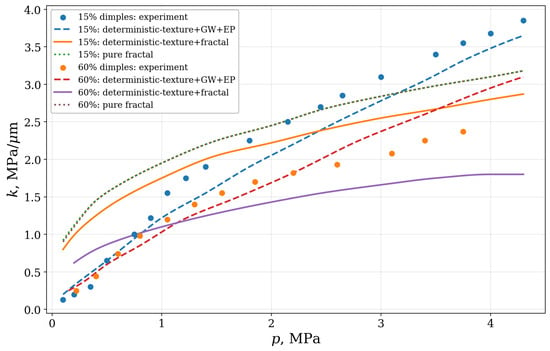
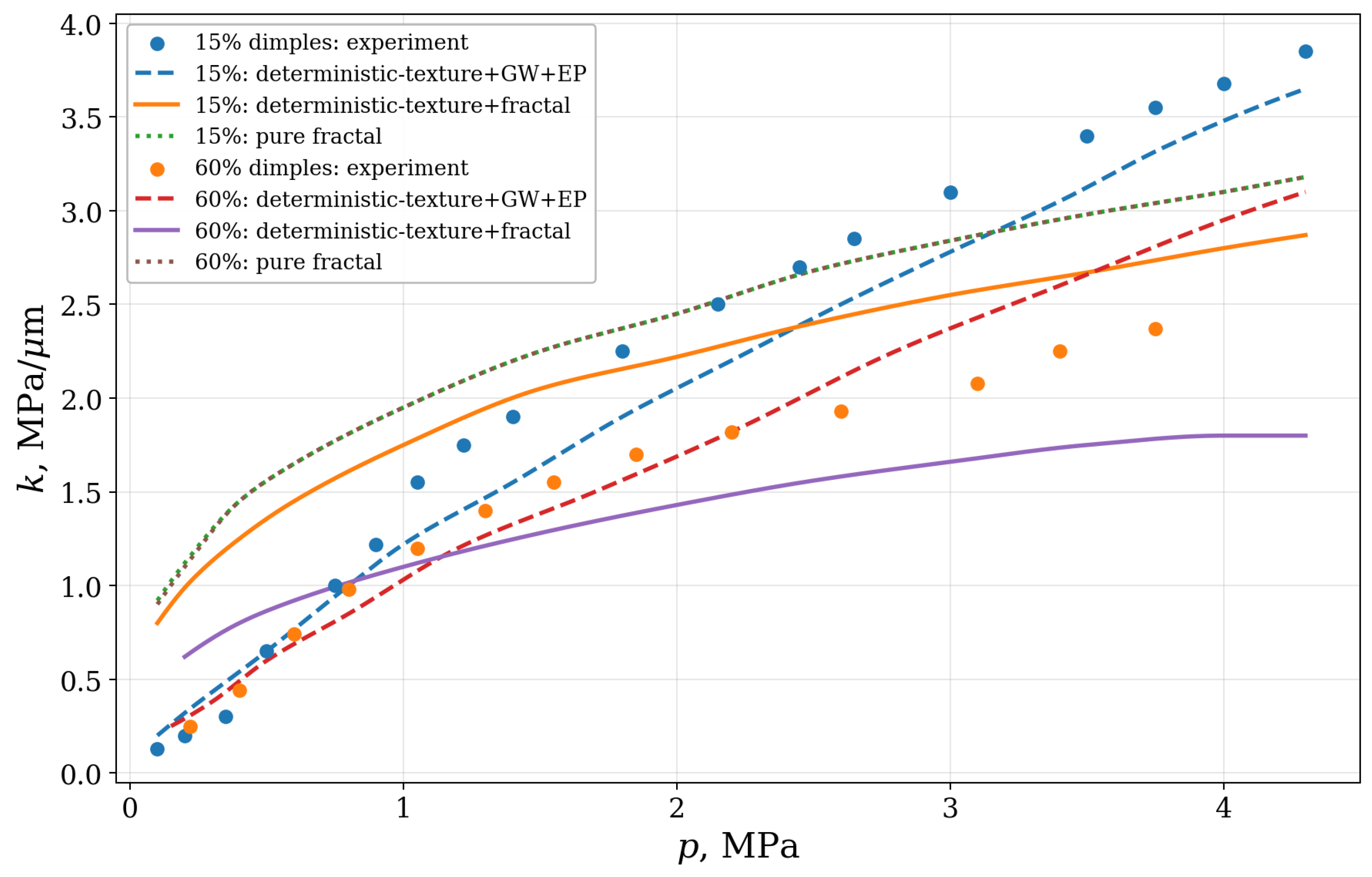
The Fan and Zhou dataset serves as the primary static benchmark for a metallic dimpled interface [31]. The dataset represents a textured load-bearing surface with a rough plateau and measured normal contact stiffness under increasing normal pressure. The smooth reference and the 30% dimpled-area-fraction case are excluded from the primary error calculation. The reference lacks a regular dimple pattern, whereas the 30% case exhibits a non-monotonic stiffness trend caused by the remelted-rim mechanism (a hardened ridge around laser-textured dimples that alters local contact stiffness), which cannot be captured by a purely geometric texture model. The remaining two textured surfaces, with 15% and 60% dimpled-area fractions, are consistent with the assumptions of the present model and serve as the quantitative validation set. Figure 4 compares the predicted and measured contact stiffness for these two surfaces, and Table 3 reports the corresponding RMSE and MAE values.
Figure 4.
Normal contact stiffness versus nominal pressure for the Fan and Zhou metallic dimple benchmark [31].
Table 3.
RMSE and MAE for the Fan and Zhou benchmark, in MPa/m.
The mean RMSE is 0.268 MPa/m for the deterministic-texture+GW+EP representation, 0.501 MPa/m for deterministic-texture+fractal and 0.674 MPa/m for pure fractal. For the hybrid deterministic-texture/GW–EP formulation, the mean pointwise relative errors are 19.5% for the 15% dimple series and 11.9% for the 60% dimple series, giving a mean relative error of 16.3% across all data points in the two selected textured series. The corresponding maximum relative errors are 66.8% and 27.8%, respectively. The largest value occurs at the lowest stiffness levels, where relative errors are particularly sensitive to digitization uncertainty and small absolute deviations. For this benchmark, the GW plateau model with fixed parameters combined with the dimple geometry gives the closest representation. The polished cast-iron plateau is plausibly better represented by a statistical summit population because the estimated plastic fraction is small and the dimple opening mainly redistributes pressure over the remaining load-bearing regions. The original publication does not provide repeatability statistics for the digitized stiffness curves; the reported errors are therefore pointwise deviations from the published trend rather than uncertainty-bounded confidence intervals.
3.2. Saturated Square-Wave Interface Benchmark
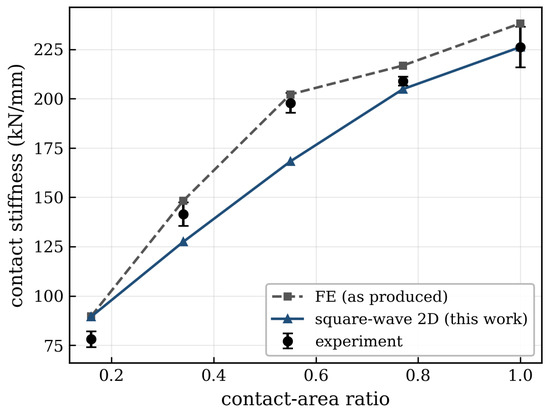
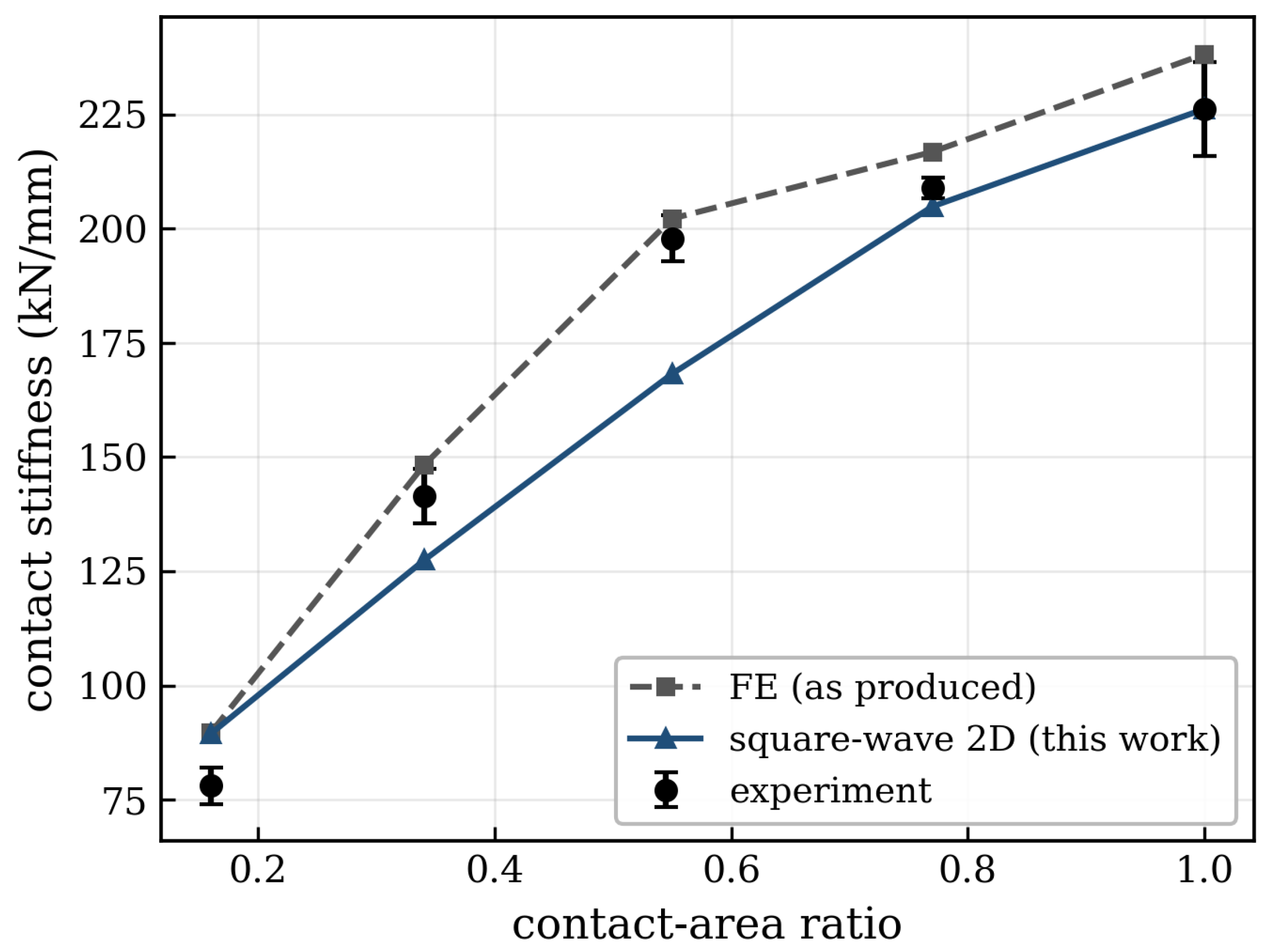
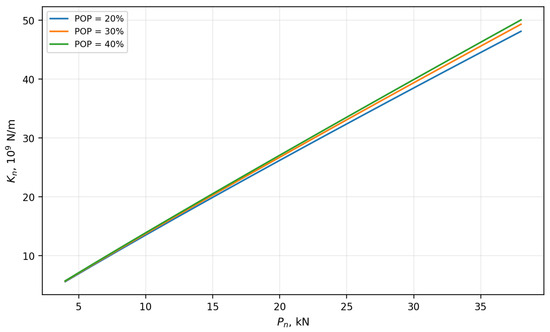
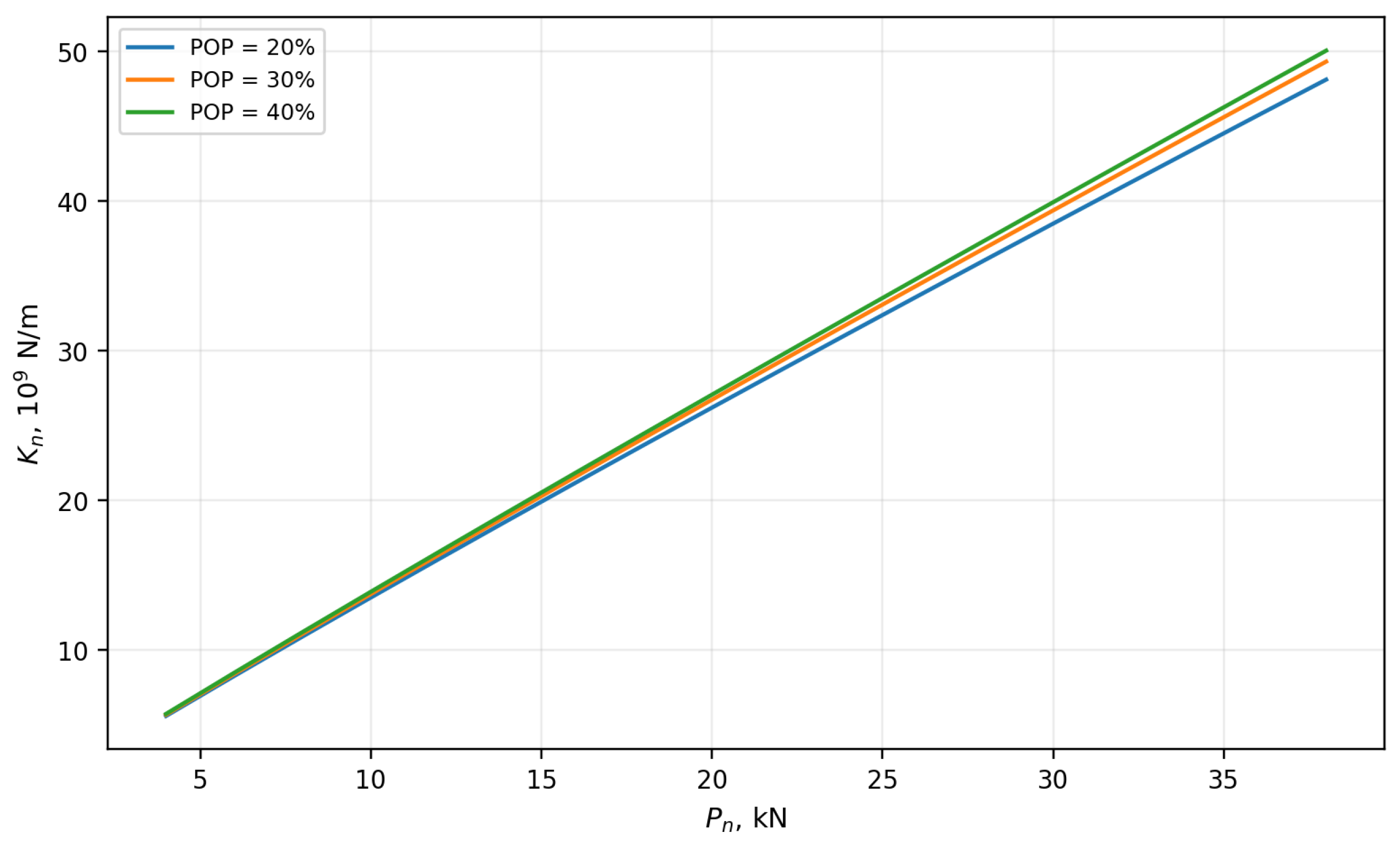
Perris et al. developed micropatterned polycarbonate interfaces with tailorable and repeatable normal contact stiffness [11]. In the present model, this dataset is used to evaluate the mode-resolved finite-gauge spectral correction for saturated square-wave ribs. The gauge length L is fixed by the specimen geometry and DIC setup through the flat-on-flat reference, and the four patterned ratios evaluate the nonzero modes. The benchmark layout and the selected contact-area ratios are shown in Figure 5, and Table 4 summarizes the dataset.
Figure 5.
Saturated square-wave benchmark of Perris et al. [11]. The flat point determines the zero finite-gauge mode; the patterned points are used to evaluate the nonzero Fourier modes.
Table 4.
Perris et al. benchmark summary.
Because the published benchmark does not provide a full statistical error model for all reconstructed quantities, the relative errors in Table 4 are interpreted as pointwise deviations over the reported contact-area ratios.
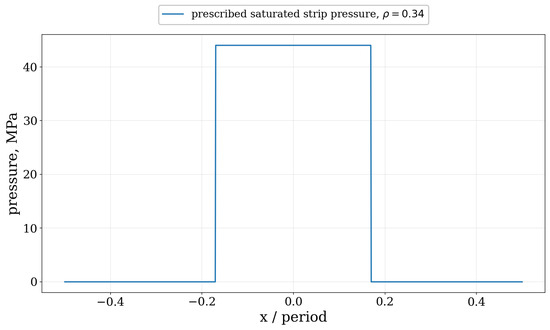
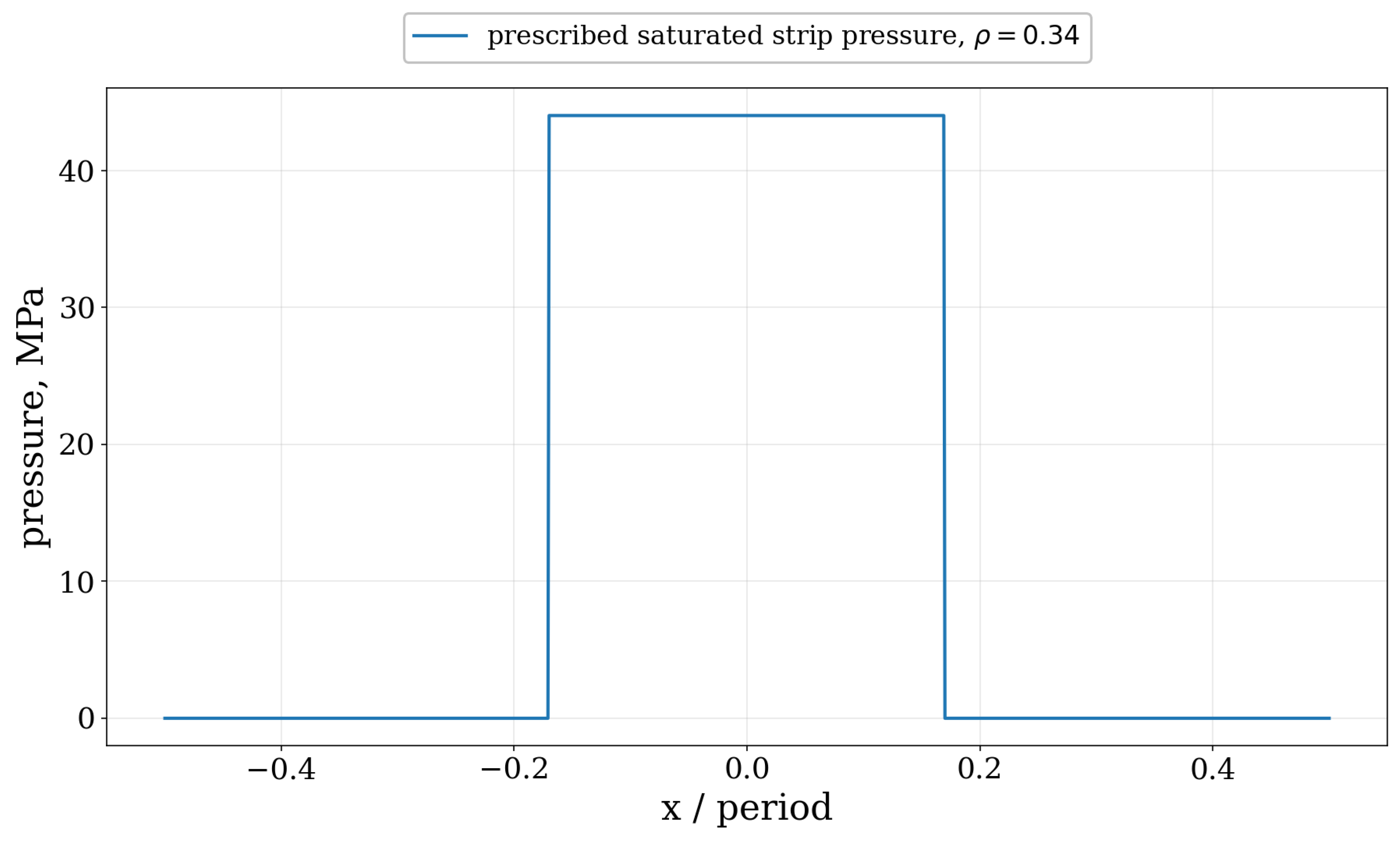
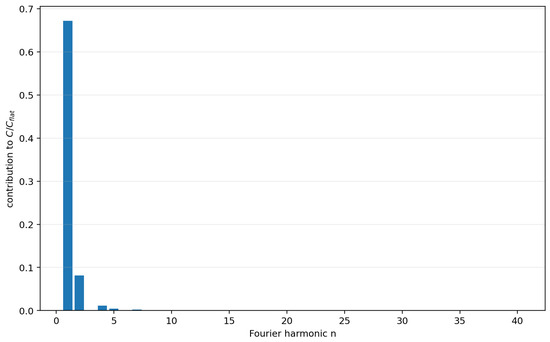
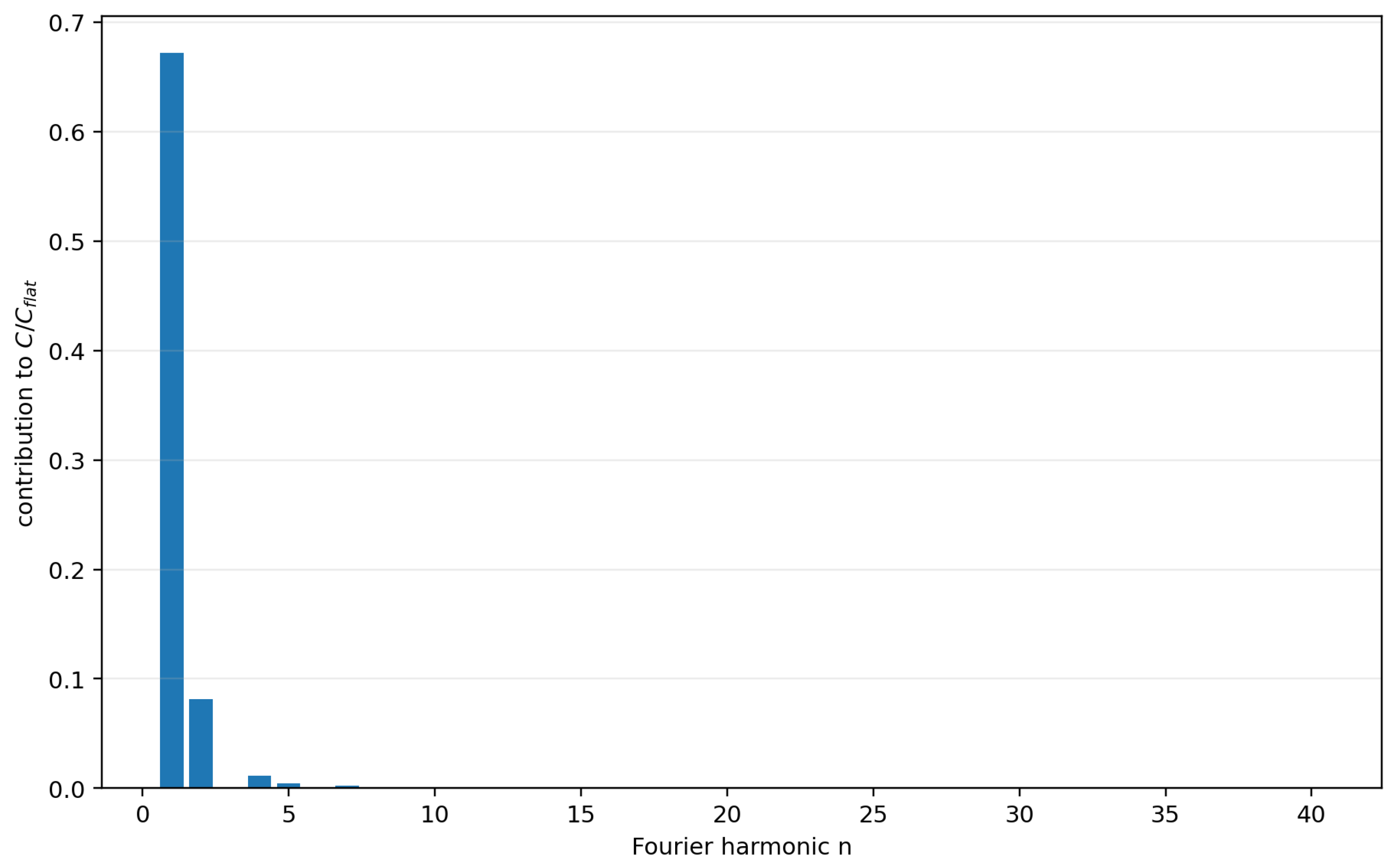
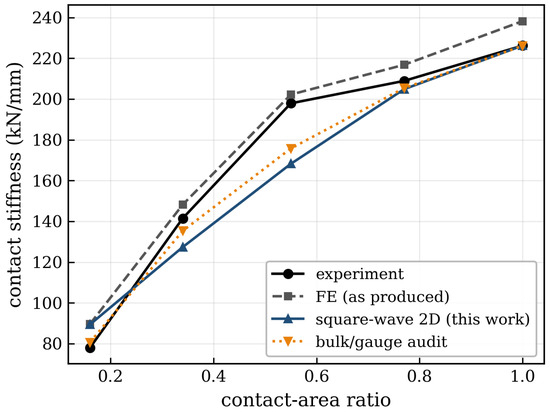
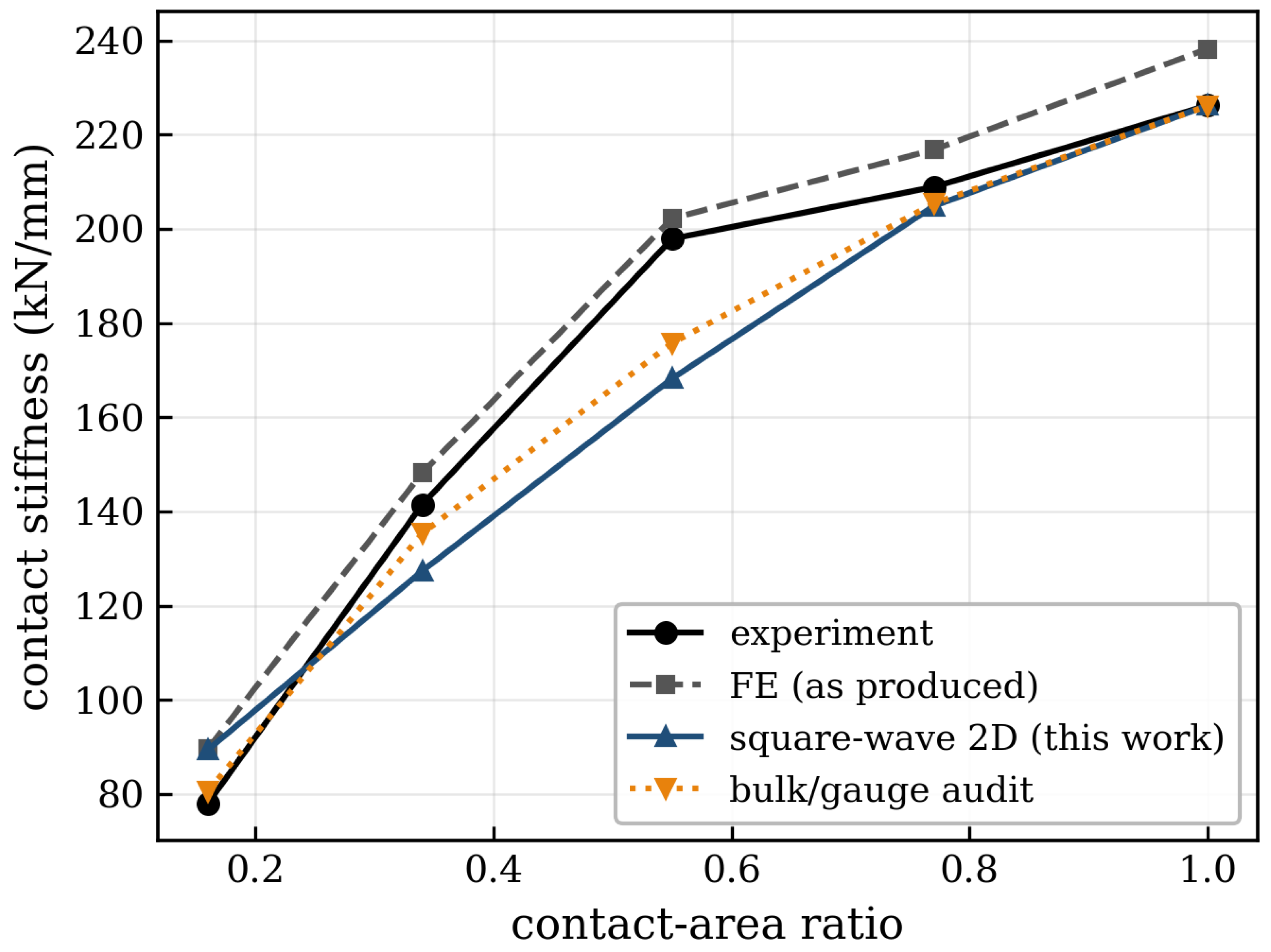
The pressure and harmonic components are shown in Figure 6 and Figure 7. The results show that the scalar constant-kernel expression is recovered as a limiting case of the mode-resolved formulation. The finite-gauge length filters out long-wavelength modes that are not registered by a local measurement window; spectral resolution is used to isolate the periodic-relief contribution. Figure 8 compares the scalar bulk correction, the finite-gauge spectral correction and the benchmark points.
Figure 6.
Square-wave pressure profile reconstructed from Perris et al. [11] for the finite-gauge spectral correction. Here is the nominal contact-area ratio of the loaded strip.
Figure 7.
Harmonic contribution for the Perris et al. square-wave benchmark [11]. Nonzero Fourier modes are filtered by the finite-gauge spectral correction.
Figure 8.
Methodological comparison for the Perris et al. benchmark [11]: scalar bulk correction, finite-gauge spectral correction and benchmark points.
3.3. Independent Three-Dimensional Numerical Cross-Checks
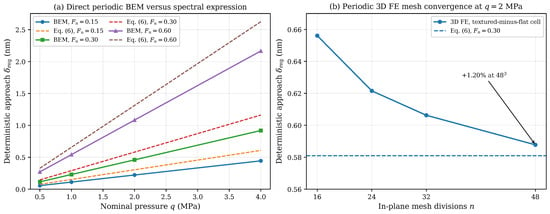
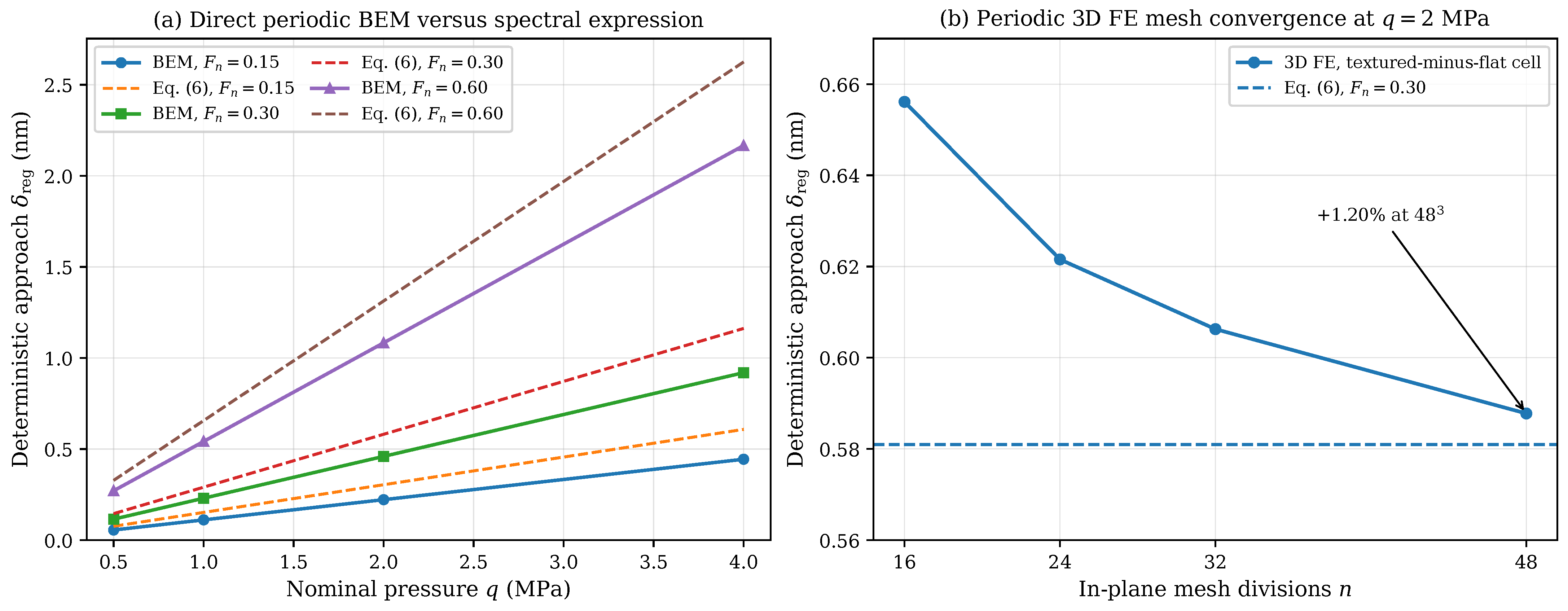
The deterministic component was examined independently with periodic three-dimensional BEM and FE unit-cell calculations. The BEM calculations used circular dimples with the Fan–Zhou diameter and depth at , 0.30 and 0.60 and nominal pressures of 0.5, 1, 2 and 4 MPa. The BEM problem was formulated independently of Equation (6) and imposed unilateral, frictionless contact between a rigid plane and the discretized elastic surface. The , and grids converged monotonically at every load point. The extrapolated BEM solutions predicted normal approaches 27.0%, 20.9% and 17.5% lower than the spectral values from Equation (6) for , 0.30 and 0.60, respectively; equivalently, the deterministic secant stiffnesses were 37.0%, 26.4% and 21.2% higher. This comparison estimates the effect of the first-order uniform-pressure approximation in the spectral expression. Because the deterministic component contributes only a fraction of the total approach, replacing the spectral component by the direct BEM result changed total stiffness by no more than approximately 5% in the tested texture-influenced case and by fractions of a percent in the baseline regime.
In a separate three-dimensional FE unit-cell calculation at and , the same uniform land-pressure idealization used by Equation (6) was applied. The deterministic approach decreased monotonically from 0.656 nm on the mesh to 0.588 nm on the mesh. The finest-mesh result was 1.20% higher than the spectral value of 0.581 nm. The FE calculation confirms numerical consistency under the same idealization, whereas the direct BEM calculation provides an independent estimate of the correction introduced by unilateral contact and pressure redistribution. Figure 9 and Table 5 summarize both checks.
Figure 9.
Independent periodic three-dimensional cross-checks: (a) direct unilateral BEM approaches and the spectral expression for three circular-dimple area fractions; (b) three-dimensional FE mesh convergence at and .
Table 5.
Summary of the independent periodic-cell cross-checks. Differences in normal approach are reported relative to the spectral prediction from Equation (6).
4. Parametric Study and Design Maps
4.1. Discrete Dimples and Pressure Window
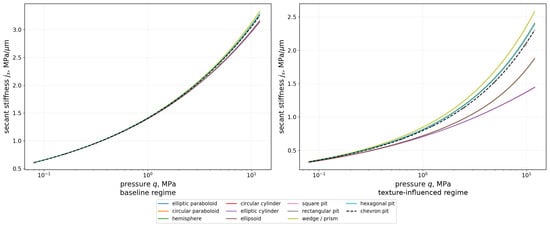
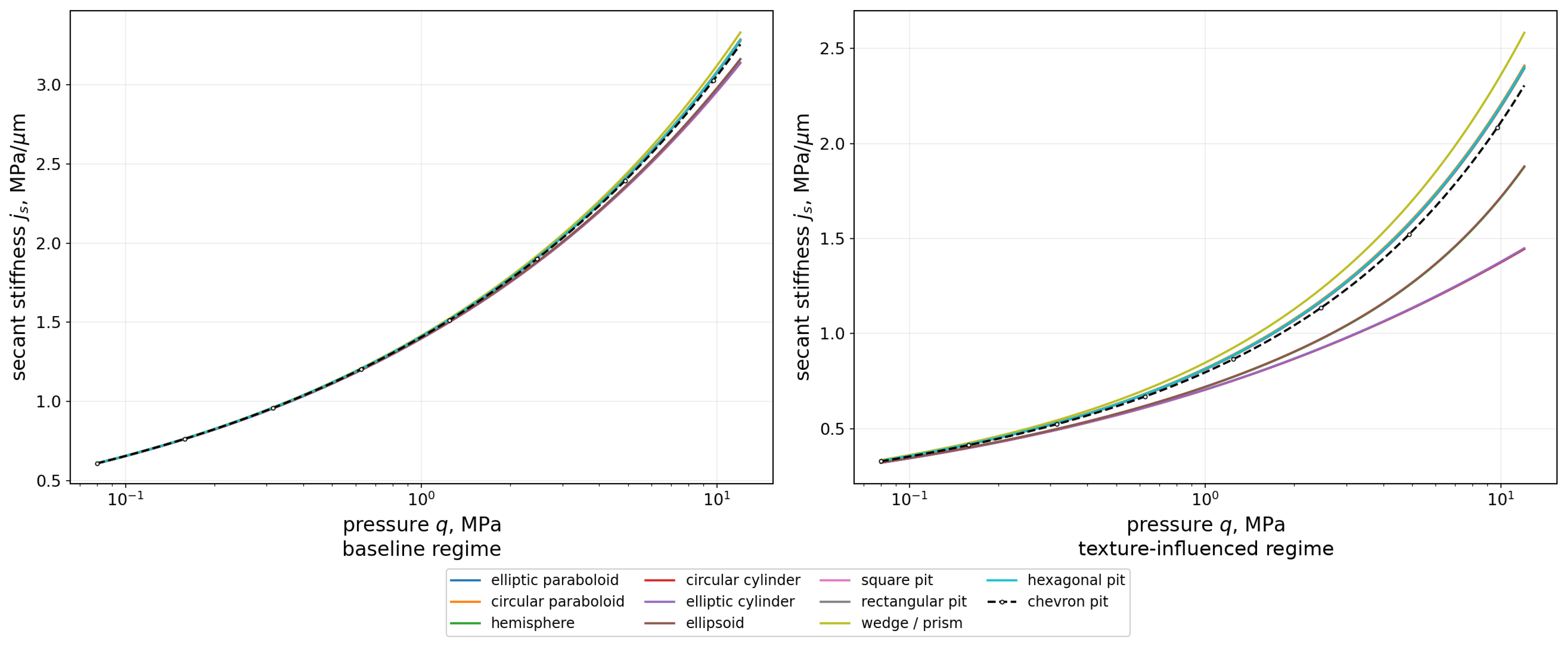
The parametric dimple study compares 11 dimple-shape variants over a common pressure range. Figure 10 contrasts a baseline regime with a texture-influenced regime. In the baseline regime, the curves remain close because the normal approach is controlled mainly by the microlevel response of the load-bearing regions. In the texture-influenced regime, the predicted curves diverge clearly. The divergence indicates that dimple shape becomes an important design variable when deterministic texture compliance is appreciable: footprint aspect ratio, edge sharpness and one- or two-dimensional support alter open-area redistribution and the spectral/localization length. At , the secant-stiffness spread was 2.32% in the baseline regime and 28.84% in the texture-influenced regime. In the latter regime, it increased to 38.91% at and 50.13% at ; the 25% level was crossed at approximately .
Figure 10.
Pressure-window comparison of 11 dimple shapes in two regimes: baseline regime (left) and texture-influenced regime (right). The separation of the curves in the texture-influenced regime shows that dimple shape becomes important when deterministic texture compliance is no longer masked by the microlevel response.
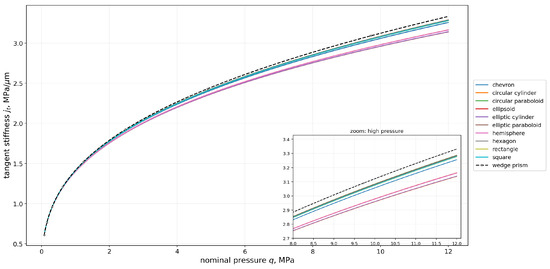
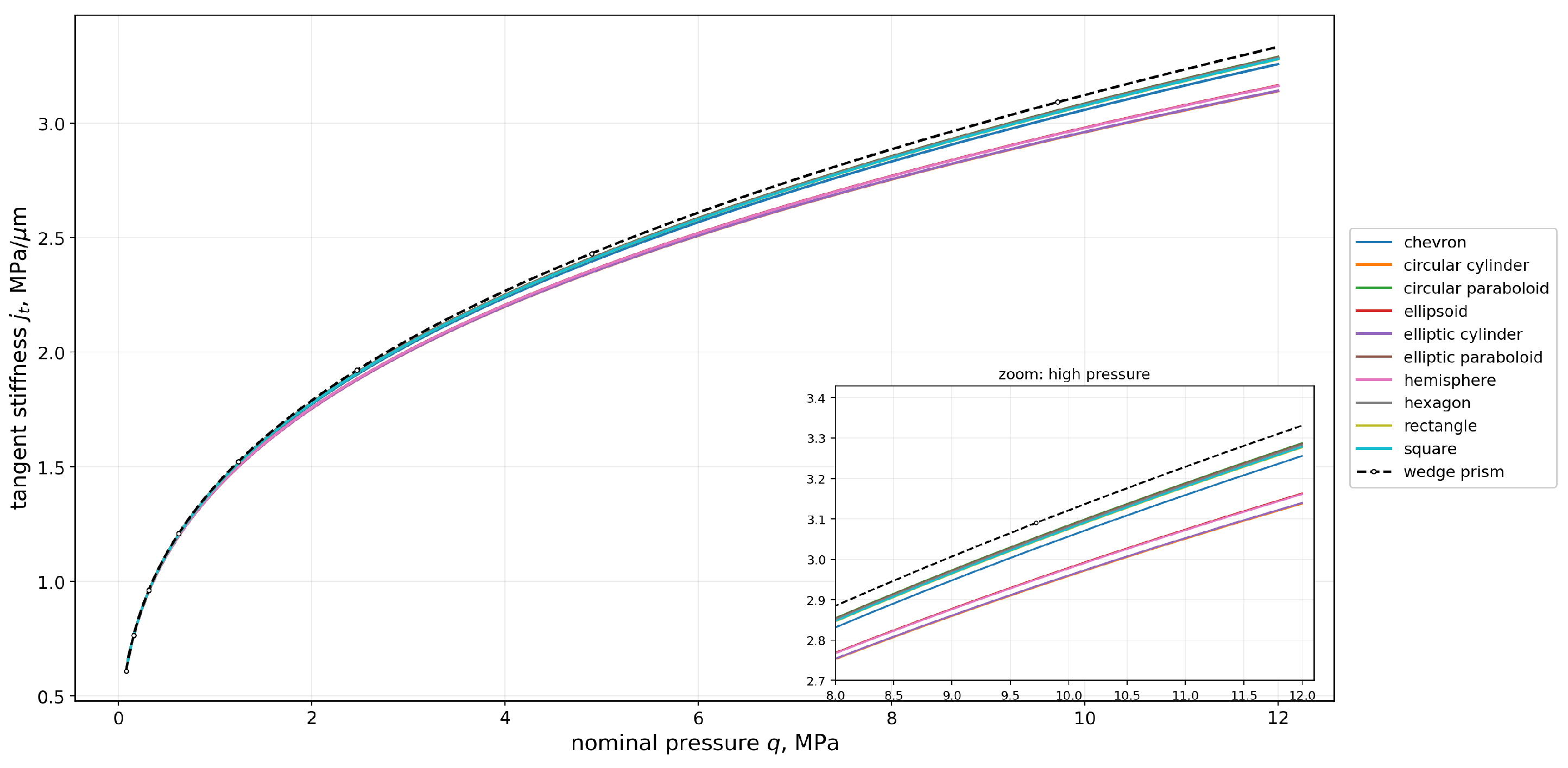
Figure 11 shows the tangent (differential) normal contact stiffness for the same 11 shapes. Shape effects are small at low pressure because the microlevel contribution to the normal approach dominates; at higher pressure, both the load-bearing area and the spectral compliance of the footprint contribute appreciably to the closure, and the shape families separate. The inset enlarges the high-pressure range where these differences are most pronounced.
Figure 11.
Tangent normal contact stiffness of the 11 dimple shapes over the evaluated pressure range. The inset enlarges the high-pressure range, where dimple-shape differences become more pronounced.
4.2. Dimple Geometry Maps
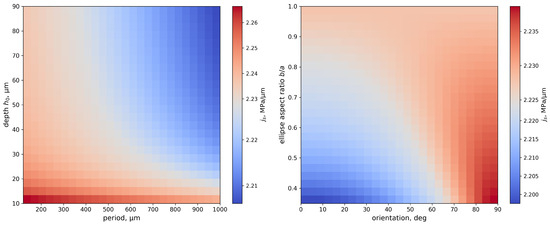
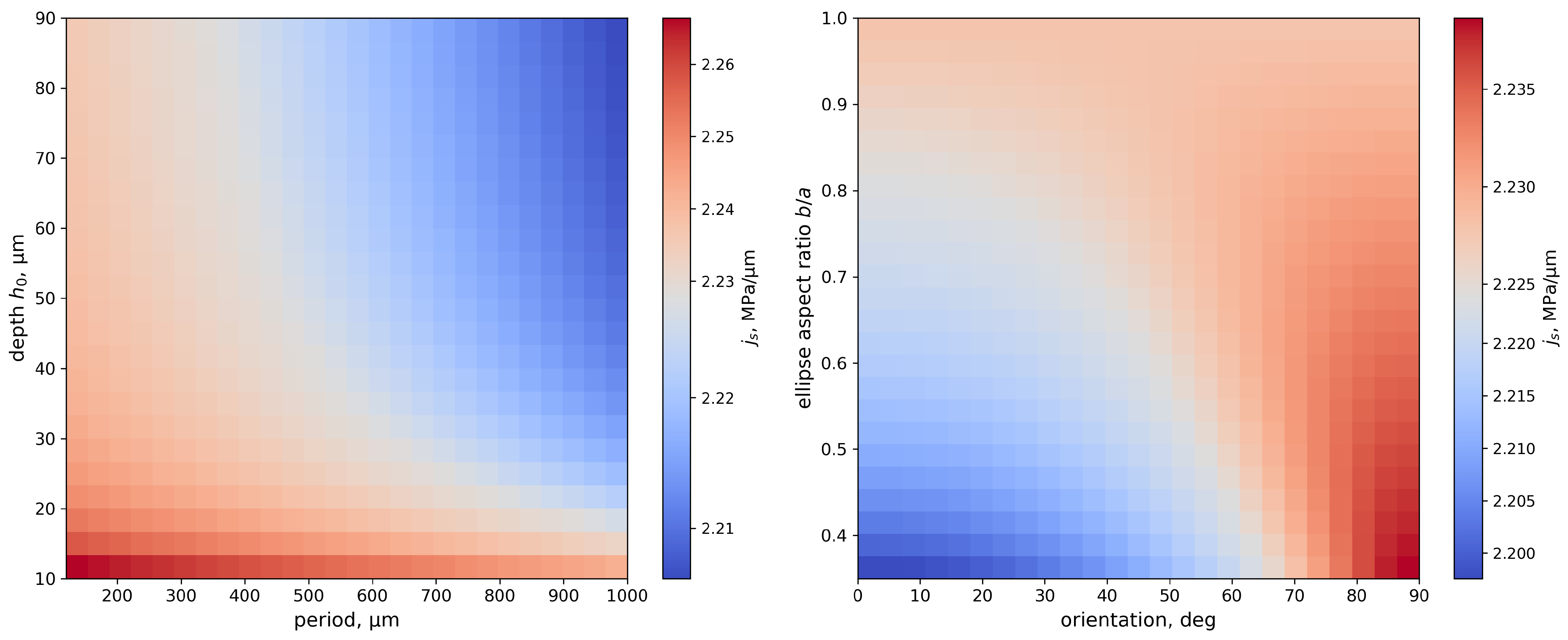
The period–depth and anisotropy maps connect geometric design variables to the predicted stiffness ratio. Texture period, depth and footprint aspect ratio are not interchangeable, because they enter both the open-area fraction and the spectral/localization length. Depth has a stronger effect than period over the range shown because it changes the active open-area evolution and the regular compliance contribution. At a fixed fraction, period mainly changes the spectral length scale. These period–depth and anisotropy/orientation effects are mapped in Figure 12.
Figure 12.
Parametric geometry maps for discrete dimples: period/depth sensitivity and anisotropy/orientation effects. Because the stiffness variations are small, a narrow color scale is used to make their systematic trend visible.
4.3. Lattice Type
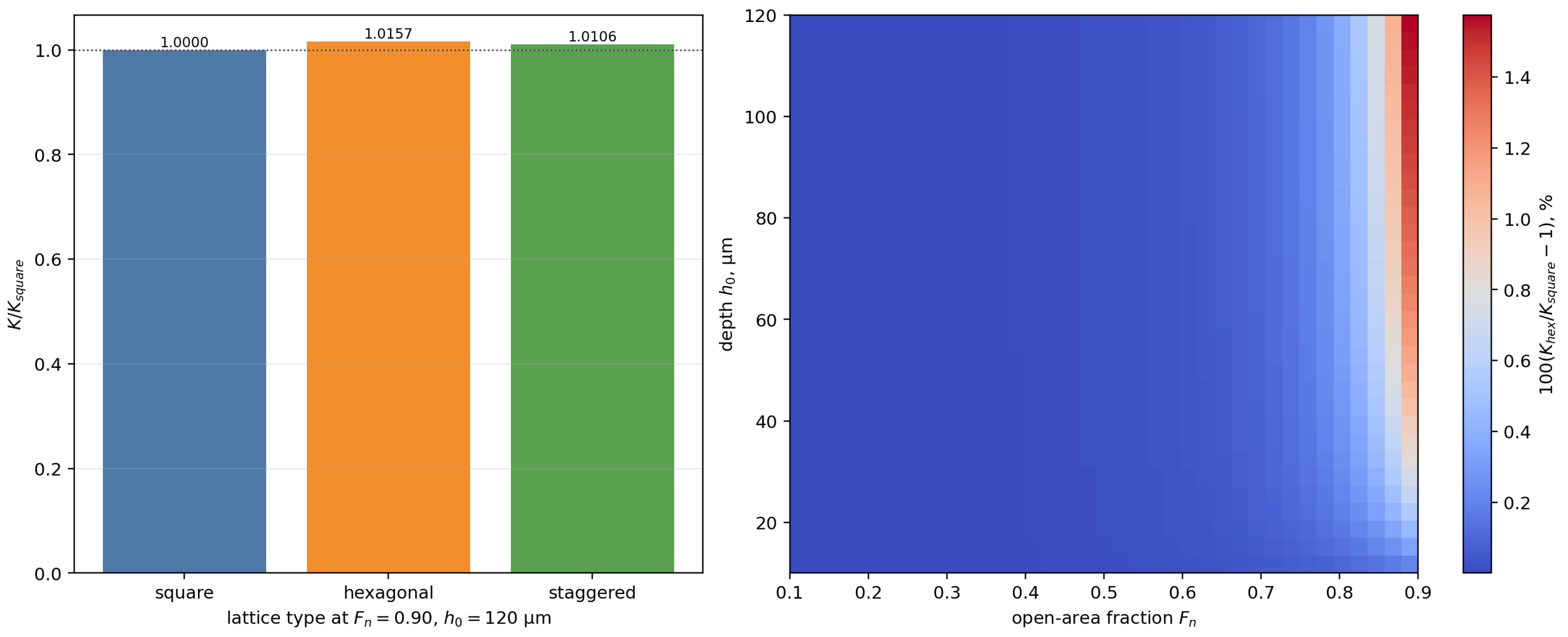
Square, hexagonal and staggered lattices were compared for a circular-paraboloid dimple footprint at fixed area fraction. Across –0.9 and –120 m, the maximum relative difference in predicted stiffness between the hexagonal and square lattices was 1.57%. For the circular-dimple geometry examined here, lattice type therefore had a smaller effect than area fraction, depth and plateau roughness. At fixed open-area fraction and circular dimple shape, far-field pressure redistribution depends weakly on packing as long as the spacing between neighboring dimples remains comparable to their diameter. Figure 13 compares the lattice types and the corresponding sensitivity map.
Figure 13.
Comparison of lattice types for discrete dimples: representative parameter set selected to emphasize lattice differences and wide sensitivity map.
4.4. Linear Grooves
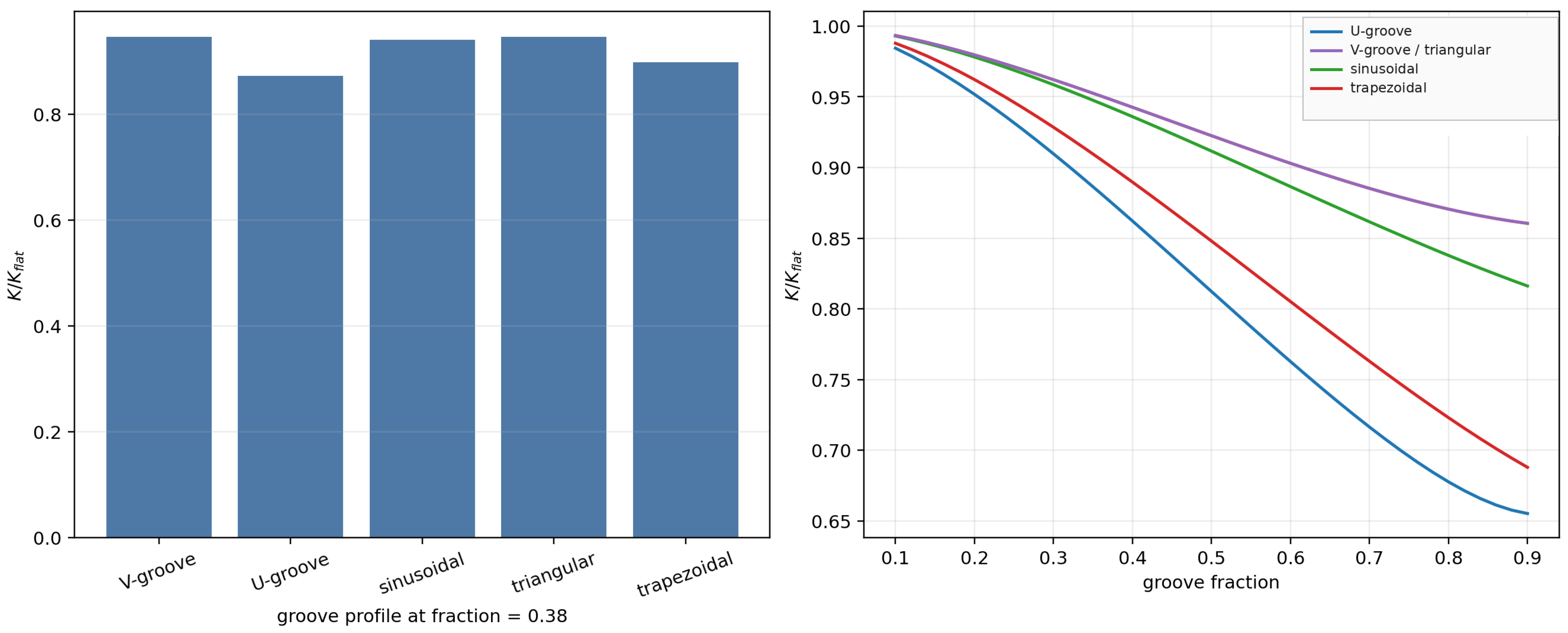
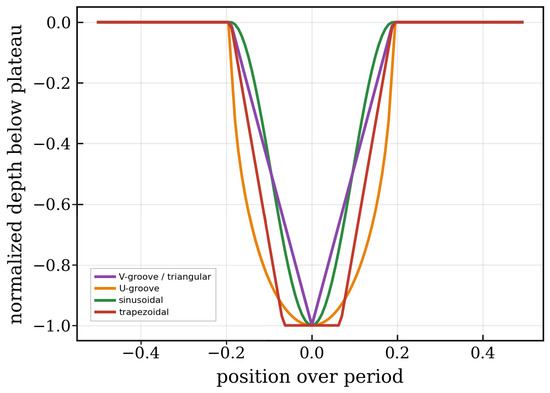
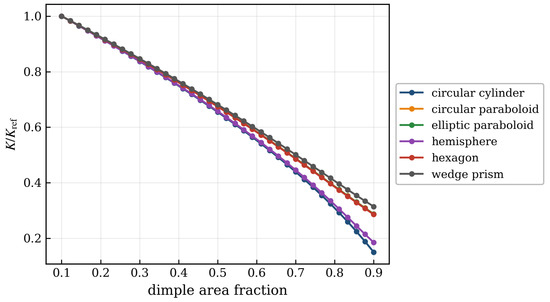
Linear grooves are treated as a distinct topology class rather than as infinitely elongated dimples. The same finite-gauge spectral correction is used, but the Fourier coefficients are those of one-dimensional groove profiles. The open-area fraction sweep is extended to 0.9. Grooves are generally more compliant than equivalent compact dimples because line-like features have slowly decaying spectral components and therefore retain stronger long-wavelength compliance through the elastic kernel. The finite-gauge spectral comparison of groove shapes and fractions is shown in Figure 14, the centered groove pressure profiles in Figure 15, and the extended dimple-fraction sweep in Figure 16.
Figure 14.
Finite -gauge spectral comparison of groove shapes and groove fractions.
Figure 15.
Centered groove pressure profiles for , where p is the groove period.
Figure 16.
Dimple fraction sweep for the extended shape family.
4.5. Scraped High-Point Parametric Trends
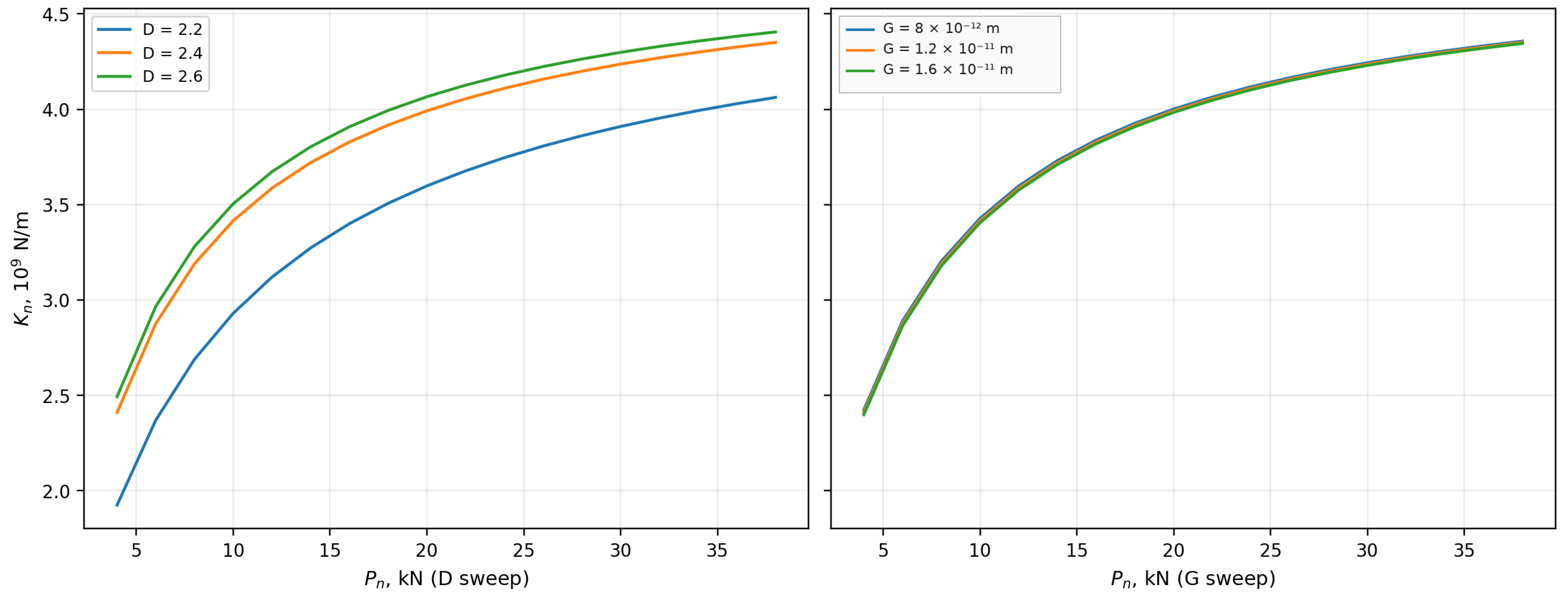
Wu et al. modeled the normal contact stiffness of scraped surfaces with truncated-cone high points and fractal asperities [13]. Such surfaces are topologically different from dimpled surfaces: high points carry the load, whereas dimples remove part of the nominal contact area. The high-point formulation in Equation (21) is therefore used here as a parametric topology study for protruding textures, not as another dimple configuration. Parameter sweeps were carried out over the ranges reported in the original study.
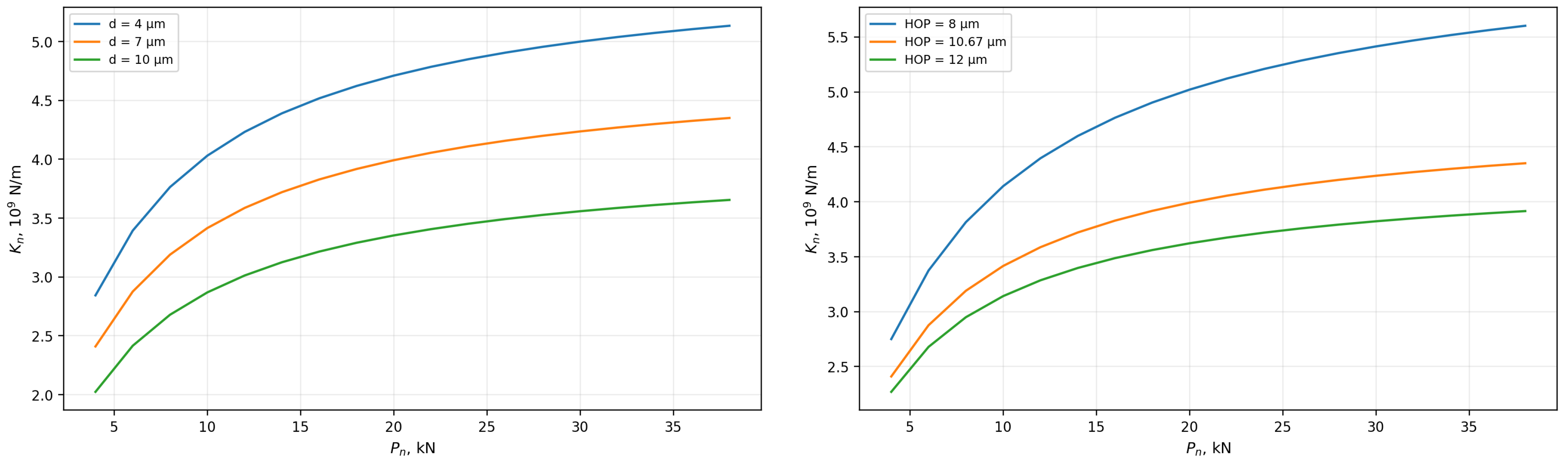
The obtained parametric trends are physically consistent with the high-point interpretation. Increasing the fractal dimension or fractal roughness parameter G changes the microlevel stiffness of the contact patches. Decreasing the initial gap increases the active contact state. Decreasing high-point height or increasing bearing-area fraction increases the effective stiffness of the scraped interface. These trends are shown in Figure 17, Figure 18 and Figure 19. The sweeps illustrate the response of the high-point term to its governing parameters and complement the other design studies.
Figure 17.
High-point parametric study based on Wu et al. [13]: influence of fractal dimension and fractal roughness parameter G on normal contact stiffness.
Figure 18.
High-point parametric study based on Wu et al. [13]: influence of contact gap (left) and high-point height (right) on normal contact stiffness.
Figure 19.
High-point parametric study based on Wu et al. [13]: influence of bearing-area fraction on normal contact stiffness.
5. Discussion
5.1. Dominant Compliance Mechanisms
For a plateau characterized by summit statistics, the GW–EP formulation is the more natural representation because stiffness is governed by the number and state of asperity contacts. Self-affine topography is instead represented by the fractal branch, in which contact area evolves over a hierarchy of patch sizes. A deep or high-fraction deterministic texture increases the regular compliance contribution because the texture changes where load is transmitted. When is intermediate, neither level can be treated as an independent stiffness: the regular geometry redistributes pressure, and the microlevel responds nonlinearly to that redistributed pressure. For the metallic dimple benchmark, the fractal representation gives a larger error (Table 3), but it remains useful when summit statistics are unavailable and self-affine scaling is the only accessible microlevel description. The independent periodic-cell calculations in Section 3.3 confirm numerical consistency of Equation (6) under the same uniform-pressure idealization. For the tested circular-dimple cases, the spectral term overpredicted deterministic compliance relative to unilateral BEM and may therefore be regarded as conservative within this limited set.
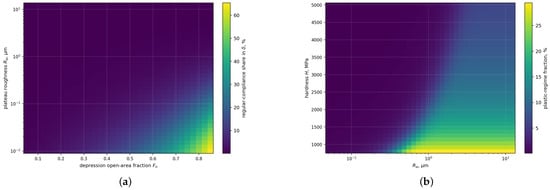
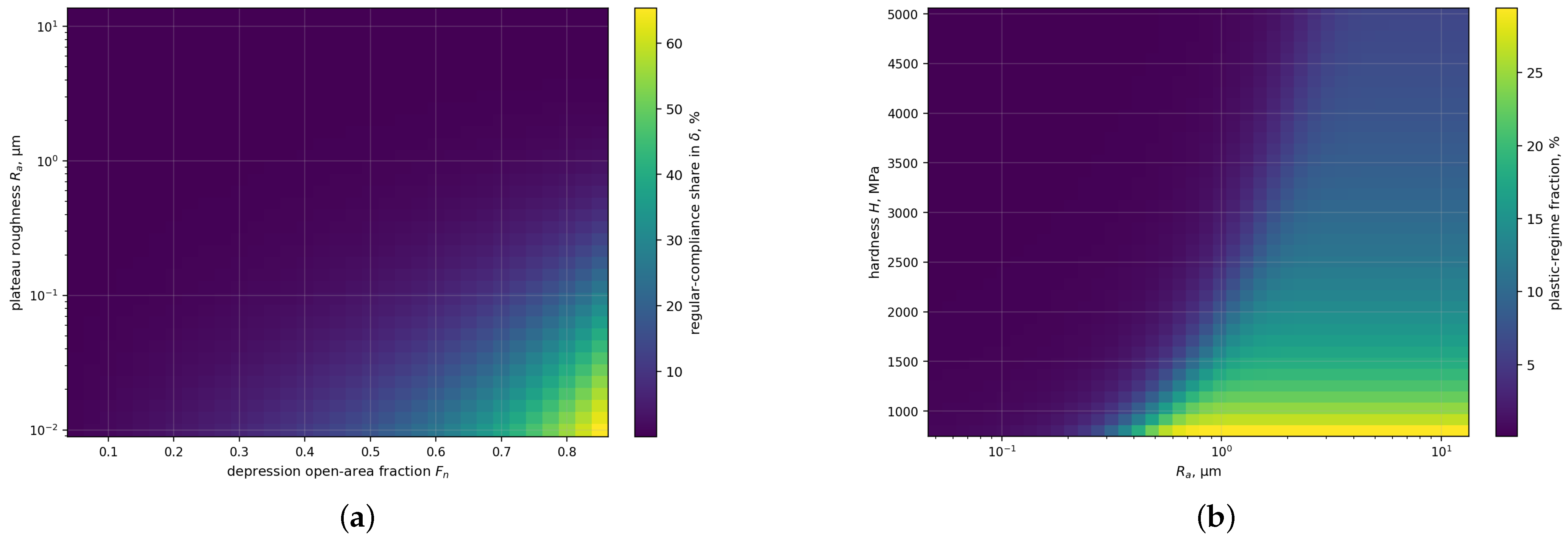
The shape of the texture elements affects the dominant compliance through two paths. Compact openings, such as circular or square dimples, concentrate the reduction of bearing area locally and lead to a stiffer regular contribution than elongated grooves at the same open-area fraction, because one-dimensional openings have slowly decaying Fourier components that increase the spectral compliance length . For dimples, sharper footprint corners or higher aspect ratios also increase and soften the deterministic level. For protruding high-point textures, stiffness is primarily controlled by the top area of the protrusions and the side-wall angle, as described by the flat-punch and Sneddon terms in Equation (21). These shape effects become pronounced when the regular contribution is sufficiently large, for example, when exceeds approximately 0.2, and when the scale separation is clear; otherwise, the micro-roughness response masks the shape-dependent differences. Figure 10 shows this two-regime behavior: in the baseline regime, the curves nearly collapse, while in the texture-influenced regime compact dimples, elongated dimples and polygonal footprints follow different pressure–stiffness curves. In the baseline regime, the secant stiffness varies by only about 2.3% among the 11 dimple shapes; in the texture-influenced regime, the spread reaches 50% at (Section 4.1), consistent with the regime classification based on . The tangent stiffness exhibits the same transition in differential form (Figure 11). Figure 20a maps the fraction of displacement carried by the deterministic level, and Figure 20b shows the activation of the elastic–plastic plateau correction.
Figure 20.
Deterministic-level dominance and plasticity activation: (a) fraction of total displacement associated with the deterministic texture level at ; the map indicates when the regular level becomes a dominant source of compliance; (b) activation map of the elastic–plastic plateau correction at ; the baseline polished plateau case lies in the weak-plasticity range.
The transition between mechanisms is controlled mainly by , , , and the plasticity index of the plateau. A smooth plateau with a high open-area fraction moves the response toward regular-texture dominance. A rough plateau with weak scale separation moves the response toward micro-roughness dominance. Plasticity reduces the effective plateau stiffness and can shift the same geometry from regular-dominated to coupled behavior. For a representative texture-influenced map (m and a 2 mm texture diameter), changing the lower threshold from 0.20 to 0.10 or 0.30 reclassified 22.2% or 8.9% of the grid points, respectively. The corresponding , 0.20 and 0.30 contours first appeared within the evaluated parameter domain at nominal pressures of approximately 0.22, 0.90 and 2.97 MPa, respectively. These changes shift only the categorical boundary; the continuous values, stiffness predictions and ranking of design points remain unchanged.
5.2. Trend Comparisons and Applicability Limits
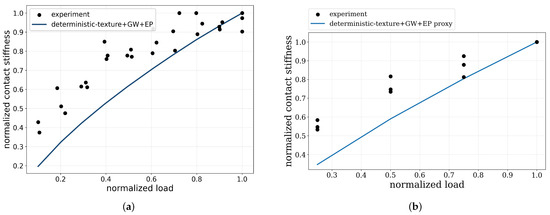
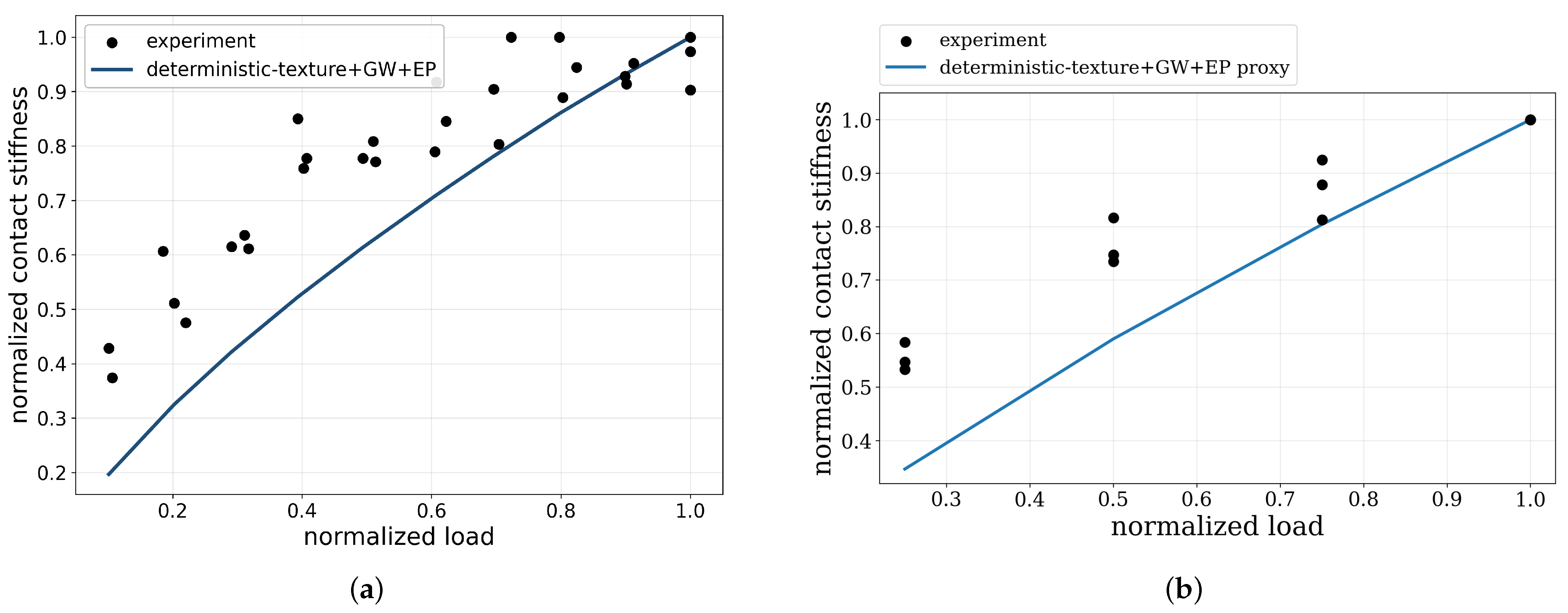
Zhang et al. (IJSS) studied normal contact stiffness for surfaces with machining-induced textures and stochastic micro-asperities [3]. The shallow texture and relatively high plateau roughness suppress deterministic compliance, so the response is micro-roughness dominated according to the criterion in Section 2. Figure 21a shows that the model captures the normalized load and roughness trends, consistent with the expected micro-roughness-dominated response.
Figure 21.
Normalized trend studies for textured joint interfaces: (a) normalized load and roughness study based on Zhang et al. (IJSS 2023) [3]; (b) quasi-static normalized trend study based on Zhu and Yan [15]. Experimental points and the deterministic-texture+GW+EP model are shown in normalized coordinates; the quasi-static model result in panel (b) is included only as a qualitative comparator.
Zhu and Yan studied the dynamic characteristics of a textured joint interface using contact-resonance methods and fractal theory [15]. The effective area used for pressure conversion is . As in the Zhang case, shallow texture and relatively high plateau roughness suppress deterministic compliance, so the response is governed mainly by the microlevel. Figure 21b compares the normalized contact-stiffness trends using the deterministic-texture+GW+EP response as a quasi-static proxy. A full dynamic comparison would require additional mass, damping and frequency-response data.
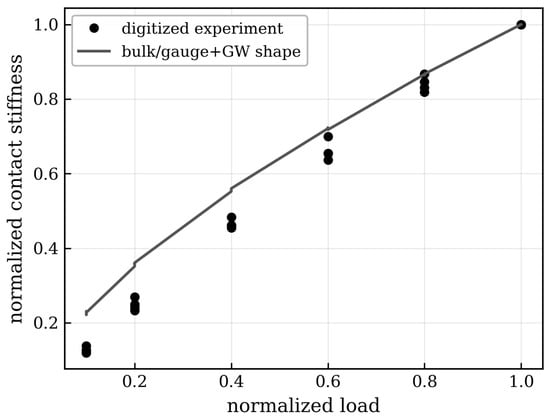
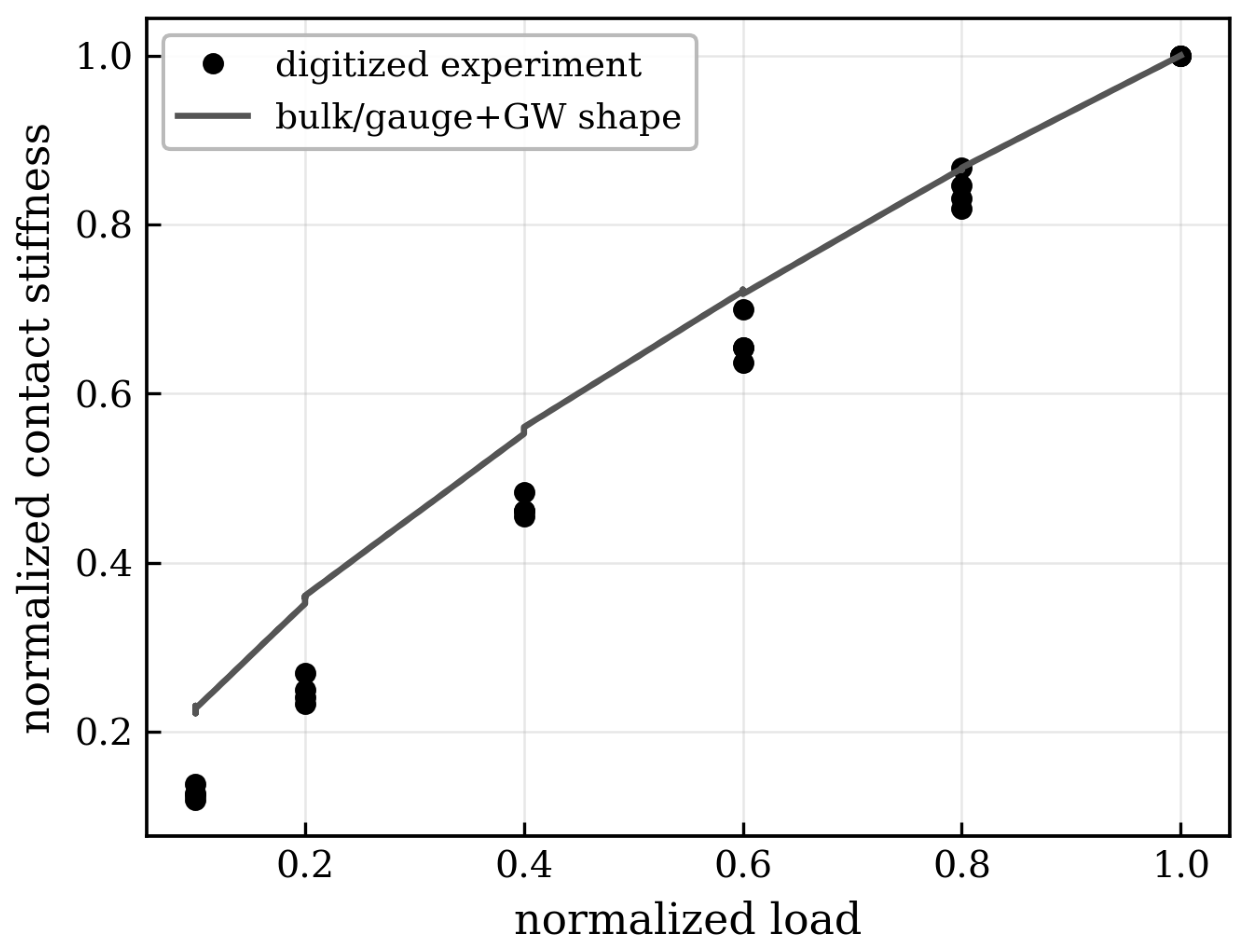
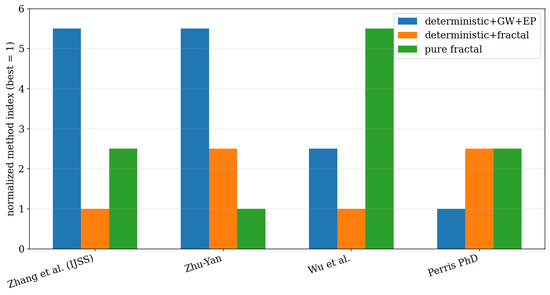
Wu et al. modeled scraped surfaces with truncated-cone high points and fractal asperities [13]. Such surfaces are topologically different from dimpled surfaces: load is carried by protruding islands, so the high-point term in Equation (21) is the relevant deterministic contribution. The associated parametric trends are reported in Figure 17, Figure 18 and Figure 19. The Perris PhD dataset [12] provides information for random rough polystyrene surfaces with areal roughness statistics and measured stiffness curves. Figure 22 shows the normalized stiffness trend for these surfaces. The roles of all benchmark and trend datasets are summarized in Figure 23, and Table 6 interprets each block within the present framework.
Figure 22.
Perris PhD normalized trend study for random rough polystyrene surfaces [12].
Figure 23.
Grouped methodology comparison of the model components and the roles of the trend-study datasets. Source datasets are Zhang et al. (IJSS) [3], Zhu and Yan [15], Wu et al. [13] and Perris PhD [12].
Table 6.
Interpretation of benchmark datasets, parametric studies and trend comparisons.
5.3. Limitations
The main limitations fall into three groups. At the micromechanical level, the GW+EP representation uses a smooth transition rather than the full piecewise Kogut–Etsion single-asperity law, and roughness-derived fractal parameters remain engineering estimates until raw three-dimensional topography is available. The sigmoid multiplier in Equation (8) and the fractal conversion in Equations (14)–(17) should therefore be interpreted as controlled microlevel representations for the available data, not as replacements for direct topographic characterization.
At the deterministic level, Equation (6) uses a first-order uniform redistribution of pressure over the load-bearing surface. The direct periodic BEM calculations predicted deterministic normal approaches 17.5–27.0% lower than the spectral values from Equation (6) for the three tested circular-dimple fractions. Since this contribution forms only part of the total approach, the corresponding change in total stiffness was no more than approximately 5% in the tested texture-influenced case and usually a fraction of a percent in the baseline regime. The additive displacement closure assumes scale separation and weak overlap between deterministic texture-edge deformation and asperity-scale deformation. The groove and lattice sweeps are design studies, and the Wu et al. high-point study is limited to the parameter range reported in the original work.
At the data level, a full dynamic comparison for Zhu and Yan would require mass, damping and frequency-response data, while quantitative use of the Perris PhD data would require a three-dimensional random-topography contact model. The substrate-deformation model of Li et al. [33] suggests that compliance of the underlying substrate can shift the absolute level of measured joint stiffness even when the surface-texture trend is reproduced; this effect may account for the absolute offsets observed in the comparisons with Zhang et al. and with Zhu and Yan. All quantitative error values reported in Section 3 and Section 5.2 are pointwise deviations from digitized published curves, as the original publications do not provide full experimental statistics.
6. Conclusions
This work establishes a hybrid deterministic–microlevel model for the normal contact stiffness of regularly textured surfaces. The main practical result is a compliance criterion that identifies the governing mechanism early in design, before a full three-dimensional contact model is built for every candidate texture. The governing regime is controlled by open-area fraction, texture depth, applied load and the scale separation between mesotexture period and plateau roughness. Deep or high-fraction textures can dominate through pressure redistribution and spectral compliance. On rough plateaus, microcontact deformation accounts for most of the normal approach. Intermediate cases require coupled closure through the local pressure.
The metallic dimple benchmark gave a mean RMSE of 0.268 MPa/m and a mean relative error of 16.3% for the hybrid deterministic-texture/GW–EP formulation across the two selected textured series. The saturated square-wave benchmark gave a mean relative error of 10.37% and a maximum patterned-point relative error of 14.99% for the finite-gauge spectral correction. The periodic finite element calculation agreed with the spectral deterministic normal approach within 1.2% under the same pressure idealization, whereas the BEM calculations estimated a total-stiffness correction of no more than approximately 5% in the tested texture-influenced case. The parametric studies showed systematic shifts with shape, depth, period and lattice type. For the tested dimple family, the secant-stiffness spread among shapes increased from about 2% to 50% as the regular contribution became dominant; these trends were consistent with the regime classification based on .
For a given texture class and loading level, the criterion identifies whether stiffness is governed primarily by deterministic texture, by micro-roughness or by their coupled response without requiring a full three-dimensional calculation at every parameter point. The formulation supports parametric process–texture–stiffness studies and preliminary inverse design of regular microrelief surfaces. The model is intended for quasi-static, non-adhesive contact in which deterministic pressure redistribution remains elastic; it does not cover extensive plasticity, dynamic coupling or thermal effects. When scale separation is weak, textures are very deep with narrow plateaus, or adhesion, extensive plasticity, dynamics or thermal coupling governs the response, the model should not be used as a quantitative predictor and a fully coupled topography-resolved three-dimensional calculation is required.
Author Contributions
Conceptualization, K.A.B. and A.V.Z.; methodology, K.A.B. and A.V.Z.; software, K.A.B.; validation, K.A.B. and A.V.Z.; formal analysis, K.A.B.; investigation, K.A.B. and A.V.Z.; data curation, K.A.B.; writing—original draft preparation, K.A.B.; writing—review and editing, K.A.B. and A.V.Z.; visualization, K.A.B. All authors have read and agreed to the published version of the manuscript.
Funding
This research received no external funding. The APC was funded by the authors.
Data Availability Statement
The datasets and source code generated during the current study are available from the corresponding author upon reasonable request.
Conflicts of Interest
The authors declare no conflicts of interest.
Abbreviations
| BEM | Boundary element method |
| CAD | Computer-aided design |
| CAE | Computer-aided engineering |
| DIC | Digital image correlation |
| EP | Elastic–plastic |
| FEA | Finite element analysis |
| GW | Greenwood–Williamson |
| ISO/GPS | International Organization for Standardization/Geometrical Product Specifications |
| MAE | Mean absolute error |
| PSD | Power spectral density |
| RMSE | Root mean square error |
| RMR | Regular microrelief |
References
- Wang, L.; Liu, H.; Zhang, J.; Zhao, W. Analysis and Modeling for Flexible Joint Interfaces under Micro and Macro Scale. Precis. Eng. 2013, 37, 817–824. [Google Scholar] [CrossRef] [Scilit]
- Li, L.; Wang, J.; Pei, X.; Chu, W.; Cai, A. A New Method for Modeling Mechanical Joint Surface Contact Stiffness. J. Mech. Eng. 2020, 56, 162–169. [Google Scholar] [CrossRef] [Scilit]
- Zhang, C.; Yu, W.; Yin, L.; Zeng, Q.; Chen, Z.; Shao, Y. Modeling of Normal Contact Stiffness for Surface with Machining Textures and Analysis of Its Influencing Factors. Int. J. Solids Struct. 2023, 262–263, 112042. [Google Scholar] [CrossRef] [Scilit]
- Yang, T.; Peng, H.; Wang, G.; Tang, X.; Zheng, Y. A Unified Scale-Coupling Homogenized Contact Model for Elasto-Plastic Rough Surfaces with Textures. Tribol. Int. 2025, 212, 110995. [Google Scholar] [CrossRef] [Scilit]
- Etsion, I. State of the Art in Laser Surface Texturing. J. Tribol. 2005, 127, 248–253. [Google Scholar] [CrossRef] [Scilit]
- Bruzzone, A.A.G.; Costa, H.L.; Lonardo, P.M.; Lucca, D.A. Advances in Engineered Surfaces for Functional Performance. CIRP Ann. 2008, 57, 750–769. [Google Scholar] [CrossRef] [Scilit]
- Gachot, C.; Rosenkranz, A.; Hsu, S.M.; Costa, H.L. A Critical Assessment of Surface Texturing for Friction and Wear Improvement. Wear 2017, 372–373, 21–41. [Google Scholar] [CrossRef] [Scilit]
- Vencl, A.; Ivanovic, L.; Stojanovic, B.; Zadorozhnaya, E.; Miladinovic, S.; Svoboda, P. Surface Texturing for Tribological Applications: A Review. Proc. Eng. Sci. 2019, 1, 227–239. [Google Scholar] [CrossRef] [Scilit]
- Davoodi, F.; Guglielmi, P.; Palumbo, G.; Carbone, G. Experimental Evaluation of 100Cr6 Steel Microindented Surfaces under Lubricated Nonconformal Point Contacts. Adv. Eng. Mater. 2026, e202500646. [Google Scholar] [CrossRef] [Scilit]
- Zhang, Q.X.; Mo, J.L.; Xiang, Z.Y.; Wang, Q.; Yu, Z.; Zhai, C.Z.; Zhu, S. Effect of Surface Micro-Grooved Textures in Suppressing Stick-Slip Vibration in High-Speed Train Brake Systems. Tribol. Int. 2023, 189, 108946. [Google Scholar] [CrossRef] [Scilit]
- Perris, J.; Xu, Y.; Kartal, M.E.; Gadegaard, N.; Mulvihill, D.M. Tailorable and Repeatable Normal Contact Stiffness via Micropatterned Interfaces. Tribol. Lett. 2021, 69, 106. [Google Scholar] [CrossRef] [Scilit]
- Perris, J.A.N. Studies on the Fabrication and Contact Stiffness of Mechanical Interfaces with Tailored Rough and Structured Surfaces. Ph.D. Thesis, University of Glasgow, Glasgow, UK, 2023. [Google Scholar]
- Wu, Y.; Wang, L.; Yu, Y.; Tian, C.; Jiang, W. Normal Contact Stiffness Modeling and Contact Characteristic Research of Scraped Surfaces Considering the Truncated Cone High Points. Tribol. Int. 2025, 201, 110278. [Google Scholar] [CrossRef] [Scilit]
- Zhang, Q.; Liu, Q.-A.; Mo, J.; Xiang, Z.; Wang, Q.; Zhai, C.; Zhu, S. Analysis of Contact Characteristics and Dynamic Response of Joint Interface with Surface Micro-Grooved Texture Based on Fractal Theory. Mech. Syst. Signal Process. 2024, 218, 111553. [Google Scholar] [CrossRef] [Scilit]
- Zhu, C.; Yan, Z. Research on the Micro and Dynamic Characteristics of Combination Surface Based on Fractal Theory. Mech. Sci. 2020, 11, 1–27. [Google Scholar] [CrossRef] [Scilit]
- ISO 21920-2:2021; Geometrical Product Specifications (GPS)—Surface Texture: Profile—Part 2: Terms, Definitions and Surface Texture Parameters. International Organization for Standardization: Geneva, Switzerland, 2021.
- ISO 25178-2:2021; Geometrical Product Specifications (GPS)—Surface Texture: Areal—Part 2: Terms, Definitions and Surface Texture Parameters. International Organization for Standardization: Geneva, Switzerland, 2021.
- ISO 14577-1:2026; Metallic Materials—Instrumented Indentation Test for Hardness and Materials Parameters—Part 1: Test Method. International Organization for Standardization: Geneva, Switzerland, 2026.
- GOST 24773-81; Surfaces with Regular Microrelief: Classification, Parameters and Characteristics. State Committee for Standards: Moscow, Russia, 1981.
- Greenwood, J.A.; Williamson, J.B.P. Contact of Nominally Flat Surfaces. Proc. R. Soc. Lond A 1966, 295, 300–319. [Google Scholar] [CrossRef] [Scilit]
- Chang, W.R.; Etsion, I.; Bogy, D.B. An Elastic-Plastic Model for the Contact of Rough Surfaces. J. Tribol. 1987, 109, 257–263. [Google Scholar] [CrossRef] [Scilit]
- Kogut, L.; Etsion, I. Elastic-Plastic Contact Analysis of a Sphere and a Rigid Flat. J. Appl. Mech. 2002, 69, 657–662. [Google Scholar] [CrossRef] [Scilit]
- Majumdar, A.; Bhushan, B. Fractal Model of Elastic-Plastic Contact between Rough Surfaces. J. Tribol. 1991, 113, 1–11. [Google Scholar] [CrossRef] [Scilit]
- Persson, B.N.J. Theory of Rubber Friction and Contact Mechanics. J. Chem. Phys. 2001, 115, 3840–3861. [Google Scholar] [CrossRef] [Scilit]
- Zhai, C.; Hanaor, D.; Gan, Y. Contact Stiffness of Multiscale Surfaces by Truncation Analysis. Int. J. Mech. Sci. 2017, 131–132, 305–316. [Google Scholar] [CrossRef] [Scilit]
- Johnson, K.L.; Greenwood, J.A.; Higginson, J.G. The Contact of Elastic Regular Wavy Surfaces. Int. J. Mech. Sci. 1985, 27, 383–396. [Google Scholar] [CrossRef] [Scilit]
- Yastrebov, V.A.; Anciaux, G.; Molinari, J.-F. The Contact of Elastic Regular Wavy Surfaces Revisited. Tribol. Lett. 2014, 56, 171–183. [Google Scholar] [CrossRef] [Scilit]
- Goryacheva, I.G.; Tsukanov, I.Y. Analysis of Elastic Normal Contact of Surfaces with Regular Microgeometry Based on the Localization Principle. Front. Mech. Eng. 2020, 6, 45. [Google Scholar] [CrossRef] [Scilit]
- Tsukanov, I.Y. An Extended Asymptotic Analysis for Elastic Contact of Three-Dimensional Wavy Surfaces. Tribol. Lett. 2019, 67, 107. [Google Scholar] [CrossRef] [Scilit]
- Makhovskaya, Y.Y.; Morozov, A.V. Influence of Groove-Textured Surface on Sliding Friction in Contact with a Viscoelastic Material. Mech. Solids 2022, 57, 759–769. [Google Scholar] [CrossRef] [Scilit]
- Fan, J.; Zhou, D. Study on the Effect of Pit Texture on Contact Stiffness of Mechanical Joint Surface. China Sci. Highlights 2020, 13, 139–144. (In Chinese) [Google Scholar]
- Sneddon, I.N. The Relation between Load and Penetration in the Axisymmetric Boussinesq Problem for a Punch of Arbitrary Profile. Int. J. Eng. Sci. 1965, 3, 47–57. [Google Scholar] [CrossRef] [Scilit]
- Li, L.; Yun, Q.; Li, Z.; Liu, Y.; Cao, C. A New Contact Model of Joint Surfaces Accounting for Surface Waviness and Substrate Deformation. Int. J. Appl. Mech. 2019, 11, 1950079. [Google Scholar] [CrossRef] [Scilit]

Disclaimer/Publisher’s Note: The statements, opinions and data contained in all publications are solely those of the individual author(s) and contributor(s) and not of MDPI and/or the editor(s). MDPI and/or the editor(s) disclaim responsibility for any injury to people or property resulting from any ideas, methods, instructions or products referred to in the content. |
© 2026 by the authors. Licensee MDPI, Basel, Switzerland. This article is an open access article distributed under the terms and conditions of the Creative Commons Attribution (CC BY) license.