


Abstract
We studied the effects of the Lorentz invariance violation on the rotation of neutron stars (NSs) in the minimal gravitational Standard-Model Extension framework, and calculated the quadrupole radiation generated by them. Aiming at testing Lorentz invariance with observations of continuous gravitational waves (GWs) from rotating NSs in the future, we compared the GW spectra of a rotating ellipsoidal NS under Lorentz-violating gravity with those of a Lorentz-invariant one. The former were found to possess frequency components higher than the second harmonic, which does not happen for the latter, indicating those higher frequency components to be potential signatures of Lorentz violation in continuous GW spectra of rotating NSs.
1. Introduction
The observation of gravitational waves (GWs) from the compact binary system GW170817 initiates the era of multimessenger astronomy [1,2]. Gravitational theories, including the renowned general relativity (GR), are being exposed to unprecedented tests utilizing GW signals [3]. Lorentz invariance, incorporated locally in GR and many other alternative gravitational theories, is certainly one of the fundamental principles subjected to these tests [4,5,6,7,8]. By employing the Standard-Model Extension (SME) framework [9,10,11,12,13], which is widely used to investigate consequences from possible violations of Lorentz invariance in terrestrial experiments and astrophysical observations [14], stringent bounds have been set for the coefficients for Lorentz violation in the gravitational sector of the SME framework after analyzing the observed GW data [2,5,6,7].
Besides the coalescence of compact binary systems, GW sources of another type are deformed rotating neutron stars (NSs). In particular, when the angular velocity of a deformed NS is misaligned with its angular momentum, the star precesses about the direction of the angular momentum, radiating out GWs continuously [15,16]. The search for such continuous GW signals is ongoing [17,18,19,20,21,22]. Once detected, the continuous GW signals will tell us a substantial piece of information on NS structure and deformability. Furthermore, they will bring new tests for the laws of physics, among which lies Lorentz invariance as one of the fundamental principles (see e.g., [8]).
To test Lorentz invariance, an investigation of the scenario where it is violated is necessary. The effects of Lorentz violation on rotating spheroidal stars are studied in detail in [23] under the minimal gravitational SME framework. The modification to the free precession of a deformed star is depicted by the term "twofold precession," as briefly speaking, Lorentz violation causes the angular momentum to precess about a fixed direction while at the same time the star still precesses about the instantaneous direction of the angular momentum. The correction in the quadrupole radiation due to the modification of the rotation of the star was calculated in [23], and it was found that the quadrupole radiation from a spheroidal star affected by Lorentz violation has frequency components over double the frequency of the fundamental one.
In this work, we extend the numerical results in [23] to ellipsoidal NSs. The characteristically higher harmonics due to Lorentz violation remain in the GW spectra, as we expected. More importantly, our numerical calculation for the quadrupole radiation from an ellipsoidal NS in the absence of Lorentz violation indicates that though the nonaxisymmetry of the star modulates the first and the second harmonics in the GW spectra, as discussed in [16,24,25], it does not generate harmonics higher than the second for freely precessing NSs. Therefore, harmonics higher than the second are indeed possible signatures for Lorentz violation in the GW spectra of rotating solitary NSs.
We organize the paper as follows. In Section 2, we present the analytical equations to construct the quadrupole radiation from a rotating ellipsoid under Lorentz-violating gravity. Then in Section 3, numerical solutions to the rotation equations for ellipsoids with uniform density are obtained and used to construct examples of the quadrupole radiation. Subsequently, Fourier transformations are performed to extract the frequency components of the quadrupole GWs, and we show that while the GW from an ellipsoid under the twofold precession contains harmonics higher than the second, the GW from an ellipsoid under free precession only has frequencies around the first and the second harmonics. In the end, the conclusions are summarized in Section 4. For simplicity in writing equations, we use the geometrized unit system where . However, standard units do appear when numerical estimations are desired for realistic NSs.
2. Theoretical Basics
To proceed with the calculation, we neglect relativistic corrections to the NS’s structure and motion, and solve its motion from the rotation equations for rigid bodies.1 Assuming that in the body frame x–y–z, the surface of the star is described by
with semi-axes and , then the Lagrangian for the rotation of the star can be written as
where and are the eigenvalues of the moment of inertia tensor along the principal axes, and and are the components of the angular velocity of the star in the x–y–z frame. The orientation-dependent self-energy is calculated from the anisotropic correction to the Newtonian potential in the minimal gravitational SME, namely [13],
where , with , are the coefficients for Lorentz violation in the body frame [12,13], and is the density of the star.
In the SME framework, the coefficients for Lorentz violation are assumed to be constant in inertial frames. Therefore, as the star rotates, the coefficients depend on the orientation of the star according to
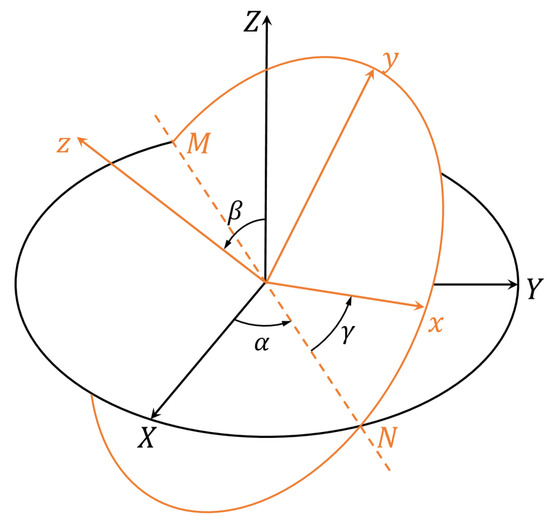
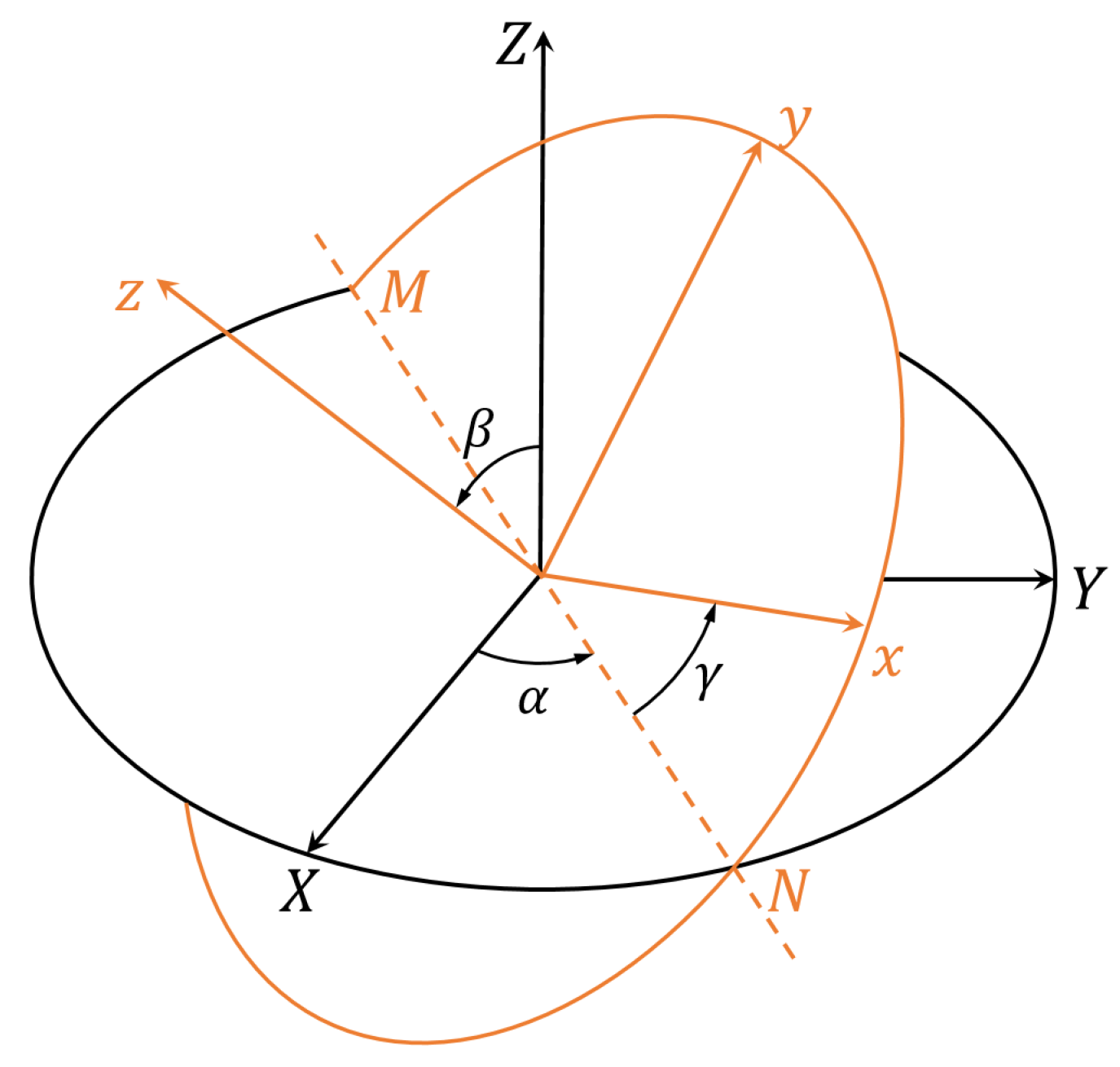
where represents the rotation matrix transforming an inertial frame X–Y–Z to the body frame x–y–z. The capital indices run over and Z, and are constant coefficients for Lorentz violation. The orientation dependence of , originated from the rotation matrix, can be easily described by the Euler angles in Figure 1, as the rotation matrix in terms of the Euler angles is
Figure 1.
Euler angles transforming the X–Y–Z inertial frame to the x–y–z body frame. First, rotate the X–Y–Z frame about the Z axis with angle so that the X-axis aligns with the intersection line . Then, rotate the just obtained X–Y–Z frame about the line with angle so that the Z-axis aligns with the z-axis. Last, rotate the new X–Y–Z frame about the z-axis with angle so that it overlaps with the x–y–z frame.
Together with the relations between the velocity components and the Euler angles [26],
where dots denote time derivatives, the Euler–Lagrange equations for the Euler angles can be obtained from the Lagrangian (2). Given the shape and density of the star, the moment of inertia tensor and the integrals in can be calculated, and then the Euler angles can be solved to describe the rotation of the star.
Once the rotation of the star is known, its gravitational quadrupole radiation can be calculated via the metric perturbation
where r is the distance from the distant star to the observer, and the double dots denote the second time derivative. In [23], it is shown that can be written as
with the body-frame quantities being
for any rigid body subjected to arbitrary rotations. The quantities and are defined as
and the components of the torque, and , are calculated from the orientation-dependent self-energy via
Finally, the two physical degrees of freedom in the GW can be extracted from by defining the plus and the cross modes for an observer whose colatitude and azimuth are and in the X–Y–Z frame [27],
where and are the -components of the transverse unit vectors
Note that and are the unit vectors of the X–Y–Z frame, and and will be used as the unit vectors of the x–y–z frame.
3. Numerical Examples
Now we can use the above equations to numerically calculate the GW spectra of a rotating ellipsoidal NS affected by Lorentz violation. To simplify the calculation of , we assume the density of the star to be constant. Extension to realistic nonuniform NSs is straightforward. The advantage of using a constant density is that the angular parts of the integrals in can be carried out analytically. Specifically speaking, define
then they are related to the Newtonian potential
via
The Newtonian potential of a uniform ellipsoid is known to be [27,28]
where
with . Consequently, the nonvanishing are found to be
For NSs, the density varies from the center to the surface. For our purposes, we take a uniform density of in numerical calculations. As for the semi-axes, because NSs are compact objects having tiny deformations if any, we can only say that they are all about , roughly the radius of a spherical NS predicted by GR. The most often used parameters to characterize NS deformation are the oblateness and the nonaxisymmetry . They are defined as
with an assumption that is the largest eigenvalue of the moment of inertia tensor. NS models have suggested that is less than [29], while the magnitude of is hardly known. For demonstration, we take 0.1 for both and in the following numerical examples. In addition, we use for , and then the values of and are determined by noticing
for uniform ellipsoids.
Then to compute as a function of the Euler angles, we take numerical values and for the coefficients for Lorentz violation in the inertial frame. This means that the axes of the inertial frame are the principal axes of the tensor. Note that this is a theoretical inertial frame fixed by the coefficients for Lorentz violation. It generally does not coincide with the widely used experimental inertial frame, namely, the Sun-centered celestial-equatorial frame defined in [11].
All the parameters in the Lagrangian (2) have been set now. Numerical solutions for the Euler angles can be obtained once initial values are given. For numerical calculations, a dimensionless parametrization for the angular velocities is helpful. This can be achieved by employing a time unit. To be consistent with the choice in [23], it is taken to be
For a uniform ellipsoid, while keeping only the leading contributions from and , it is
where the magnitude estimation is made for and . Therefore, a dimensionless angular velocity at order unity in our numerical results corresponds to about .
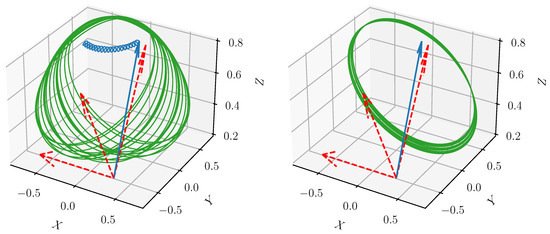
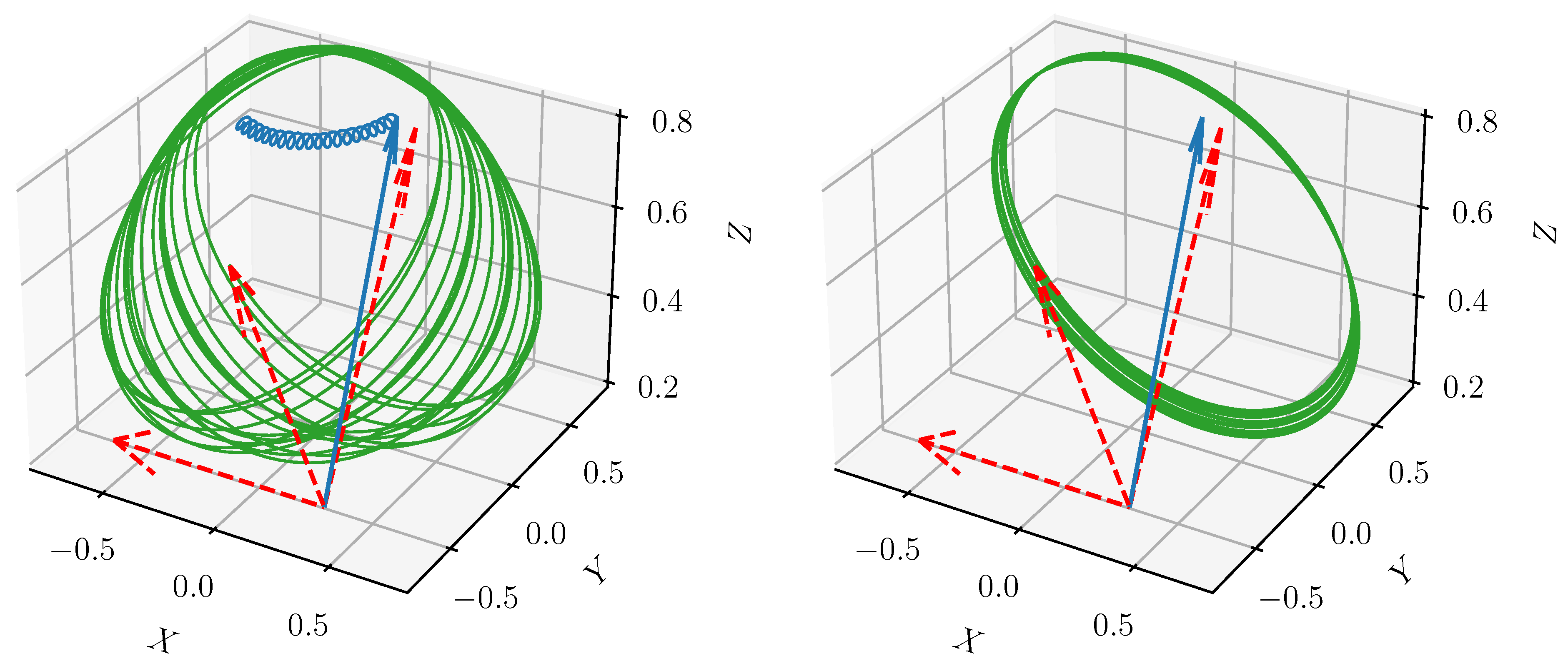
Figure 2 shows the trajectories of the tail of the unit vector in the inertial frame to intuitively illustrate the rotations of the star for a certain set of initial values. Our examples consist of two solutions: the plot on the left shows a twofold precession with taking the above values, and the plot on the right shows a free precession without Lorentz violation for comparison. The distinction is also reflected by the trajectories of the tail of the angular momentum unit vector: in the left plot, there is a nontrivial trajectory for the angular momentum unit vector, and in the right plot the angular momentum unit vector does not change with time.
Figure 2.
Illustrations for an example of the Lorentz-violating twofold precession (left) and an example of the Lorentz-invariant free precession (right). The green trajectories trace the tail of the body-frame unit vector in the inertial frame, while the blue trajectory in the left plot traces the tail of the angular momentum unit vector in the inertial frame. The red arrows are the body-frame unit vectors and at , while the blue arrows indicate the angular momentum unit vector at . The angular momentum is conserved in free precessions so the blue arrow in the right plot remains unchanged with time. The initial values for both solutions are , , , , and . Time and time derivatives are dimensionless under the time unit given by Equation (23).
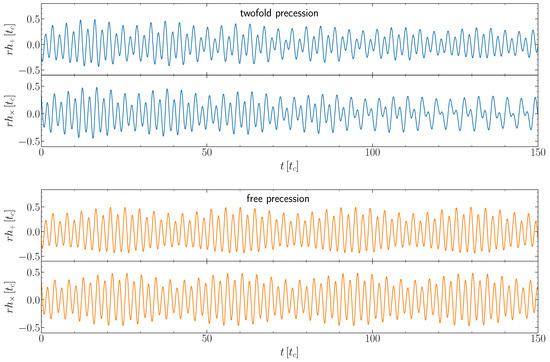
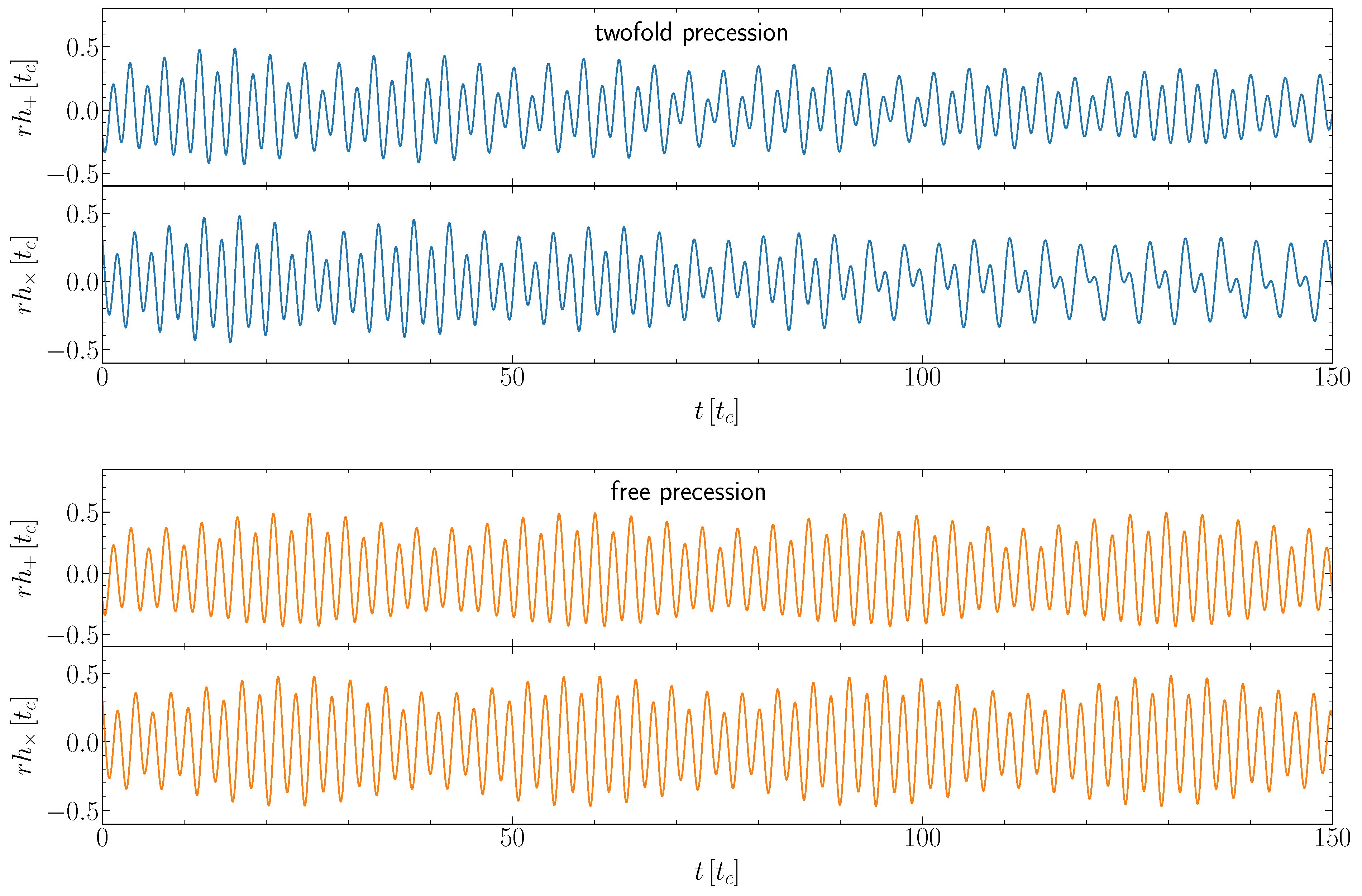
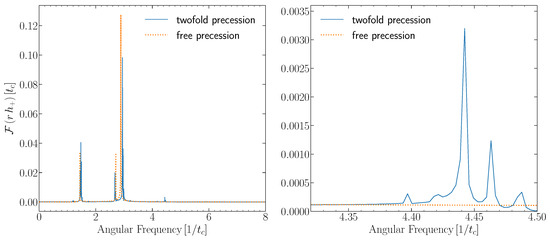
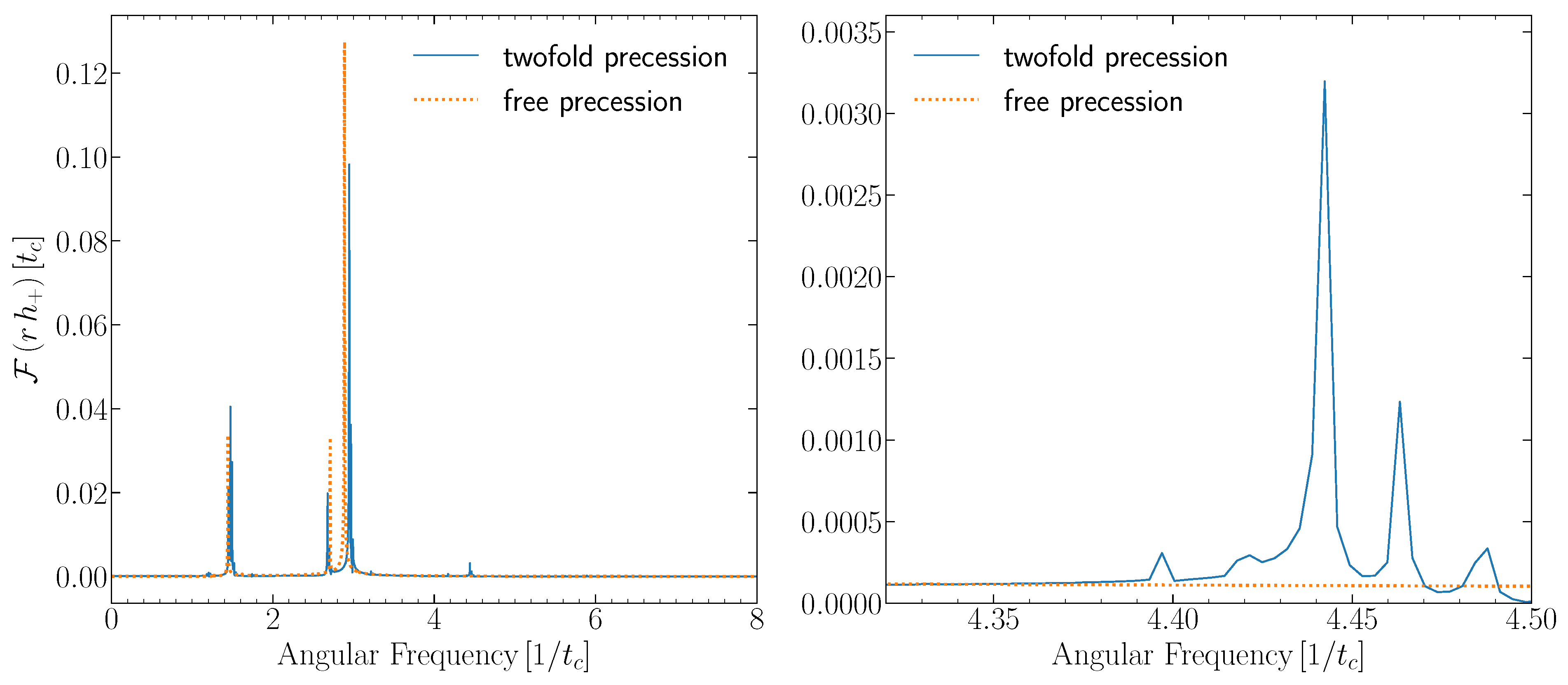
With the two solutions, we calculated the GWs according to Equation (12) for an observer at and . The results are presented in Figure 3. Their Fourier transformations are shown in Figure 4; only the plus mode is shown, as the cross mode has very much the same spectra. The spectrum of the free precession shows a fundamental angular frequency at about , and peaks around the second harmonic at about . We know that if the star is axisymmetric, free precessions generate GWs having exactly two frequencies, with one being twice the other. The nonaxisymmetry here modulates both the fundamental frequency and the second harmonic. This has been discussed in references [16,24,25]. What we are showing in the left plot of Figure 4 tells us that the twofold precession, namely, the rotation of an otherwise freely precessing NS under Lorentz-violating gravity, generates similar GW frequency components. However, more interestingly, in the enlarged plot on the right, we clearly see the distinction that while the twofold precession generates frequency components around the third harmonic, the free precession has no component of the third harmonic at all. Higher frequency components exist in the spectra of the Lorentz-violating twofold precession, but they can easily be missed as they are too small.
Figure 4.
Fourier transformations of the waves in Figure 3. The two noticeable peaks at about 1.4 and 2.9 in the left plot are the first and the second harmonics for both twofold precession and free precession. The modulation due to nonaxisymmetry is clearly represented by the adjacent peak at about 2.7 close to the second harmonic for both kinds of motion. However, the barely visible tiny peaks, reflecting modulations due to Lorentz violation, only exist for twofold precession. The right plot, which zooms in on the tiny peak between 4 and 5, demonstrates the point. Note that in the plots the geometrized unit of Fourier amplitude is , and the geometrized unit of angular frequency is .
4. Conclusions
We have presented the analytical formulae to calculate the rotation of NSs under Lorentz-violating gravity in the minimal gravitational SME framework, and to construct the quadrupole GWs emitted from these NSs. Numerical examples were plotted to demonstrate our conclusion that while freely precessing NSs in the Lorentz-invariant gravity do not emit quadrupole GWs at frequencies higher than the second harmonic, NSs undergoing the twofold precession due to Lorentz violation do. Therefore, harmonics higher than the second in the spectra of continuous GWs are appealing signatures of Lorentz violation. Once continuous GWs from rotating NSs are detected, a potential test of Lorentz invariance can be performed by examining harmonics higher than the second in the spectra. However, we do notice a possible difficulty in this test: there might be conventional torques, such as the electromagnetic spin-down torque [30,31,32,33], acting on the NS to cause similar twofold precession motions and to generate higher harmonics in the GW spectra. Although the questions of whether the twofold precession caused by Lorentz violation can be distinguished from rotations of NSs under the electromagnetic spin-down torque and whether the GW spectra of the latter have frequency components higher than the second harmonic lie beyond the scope of this work, they are certainly worth being investigated further. Furthermore, a statistical study of continuous GWs from an ensemble of NSs might have the potential to distinguish between the two scenarios, as the Lorentz violation is universal for all NSs, and the astrophysical torques are different for different systems.
Author Contributions
Conceptualization, L.S.; formal analysis, R.X.; writing—original draft preparation, R.X.; writing—review and editing, Y.G. and L.S.; visualization, Y.G. and R.X.; funding acquisition, L.S. All authors have read and agreed to the published version of the manuscript.
Funding
This work was supported by the National Natural Science Foundation of China (11975027, 11991053, 11721303), the National SKA Program of China (2020SKA0120300), the Young Elite Scientists Sponsorship Program by the China Association for Science and Technology (2018QNRC001), the Max Planck Partner Group Program funded by the Max Planck Society and the High-Performance Computing Platform of Peking University. It was partially supported by the Strategic Priority Research Program of the Chinese Academy of Sciences through the grant number XDB23010200. R.X. is supported by the Boya Postdoctoral Fellowship at Peking University.
Acknowledgments
We are grateful to Marco Schreck for the invitation to submit an article to this special issue.
Conflicts of Interest
The authors declare no conflict of interest.
References
- Abbott, B.P.; Abbott, R.; Abbott, T.D.; Acernese, F.; Ackley, K.; Adams, C.; Adams, T.; Addesso, P.; Adhikari, R.X.; Adya, V.B.; et al. Multi-messenger Observations of a Binary Neutron Star Merger. Astrophys. J. Lett. 2017, 848, L12. [Google Scholar] [CrossRef] [Scilit]
- Abbott, B.P.; Abbott, R.; Abbott, T.D.; Acernese, F.; Ackley, K.; Adams, C.; Adams, T.; Addesso, P.; Adhikari, R.X.; Adya, V.B.; et al. Gravitational Waves and Gamma-rays from a Binary Neutron Star Merger: GW170817 and GRB 170817A. Astrophys. J. Lett. 2017, 848, L13. [Google Scholar] [CrossRef] [Scilit]
- Corda, C. Interferometric detection of gravitational waves: The definitive test for General Relativity. Int. J. Mod. Phys. D 2009, 18, 2275–2282. [Google Scholar] [CrossRef] [Scilit]
- Mirshekari, S.; Yunes, N.; Will, C.M. Constraining Generic Lorentz Violation and the Speed of the Graviton with Gravitational Waves. Phys. Rev. D 2012, 85, 024041. [Google Scholar] [CrossRef] [Scilit]
- Kostelecký, V.A.; Mewes, M. Testing local Lorentz invariance with gravitational waves. Phys. Lett. B 2016, 757, 510–514. [Google Scholar] [CrossRef] [Scilit]
- Shao, L. Combined search for anisotropic birefringence in the gravitational-wave transient catalog GWTC-1. Phys. Rev. D 2020, 101, 104019. [Google Scholar] [CrossRef] [Scilit]
- Liu, X.; He, V.F.; Mikulski, T.M.; Palenova, D.; Williams, C.E.; Creighton, J.; Tasson, J.D. Measuring the speed of gravitational waves from the first and second observing run of Advanced LIGO and Advanced Virgo. Phys. Rev. D 2020, 102, 024028. [Google Scholar] [CrossRef] [Scilit]
- Xu, R.; Zhao, J.; Shao, L. Neutron Star Structure in the Minimal Gravitational Standard-Model Extension and the Implication to Continuous Gravitational Waves. Phys. Lett. B 2020, 803, 135283. [Google Scholar] [CrossRef] [Scilit]
- Colladay, D.; Kostelecký, V.A. CPT violation and the standard model. Phys. Rev. D 1997, 55, 6760–6774. [Google Scholar] [CrossRef] [Scilit]
- Colladay, D.; Kostelecký, V.A. Lorentz violating extension of the standard model. Phys. Rev. D 1998, 58, 116002. [Google Scholar] [CrossRef] [Scilit]
- Kostelecký, V.A.; Mewes, M. Signals for Lorentz violation in electrodynamics. Phys. Rev. D 2002, 66, 056005. [Google Scholar] [CrossRef] [Scilit]
- Kostelecký, V.A. Gravity, Lorentz violation, and the standard model. Phys. Rev. D 2004, 69, 105009. [Google Scholar] [CrossRef] [Scilit]
- Bailey, Q.G.; Kostelecký, V.A. Signals for Lorentz violation in post-Newtonian gravity. Phys. Rev. D 2006, 74, 045001. [Google Scholar] [CrossRef] [Scilit]
- Kostelecký, V.A.; Russell, N. Data Tables for Lorentz and CPT Violation. Rev. Mod. Phys. 2011, 83, 11–31. [Google Scholar] [CrossRef] [Scilit]
- Zimmermann, M.; Szedenits, E. Gravitational waves from rotating and precessing rigid bodies: Simple models and applications to pulsars. Phys. Rev. D 1979, 20, 351–355. [Google Scholar] [CrossRef] [Scilit]
- Zimmermann, M. Gravitational waves from rotating and precessing rigid bodies. 1. general solutions and computationally useful formulas. Phys. Rev. D 1980, 21, 891–898. [Google Scholar] [CrossRef] [Scilit]
- Abbott, B.P.; Abbott, R.; Abbott, T.D.; Acernese, F.; Ackley, K.; Adams, C.; Adams, T.; Addesso, P.; Adhikari, R.X.; Adya, V.B.; et al. All-sky search for continuous gravitational waves from isolated neutron stars using Advanced LIGO O2 data. Phys. Rev. D 2019, 100, 024004. [Google Scholar] [CrossRef] [Scilit]
- Covas, P.B.; Sintes, A.M. First all-sky search for continuous gravitational-wave signals from unknown neutron stars in binary systems using Advanced LIGO data. Phys. Rev. Lett. 2020, 124, 191102. [Google Scholar] [CrossRef] [Scilit]
- Dergachev, V.; Papa, M.A. Results from the first all-sky search for continuous gravitational waves from small-ellipticity sources. Phys. Rev. Lett. 2020, 125, 171101. [Google Scholar] [CrossRef] [Scilit]
- Papa, M.A.; Ming, J.; Gotthelf, E.V.; Allen, B.; Prix, R.; Dergachev, V.; Eggenstein, H.B.; Singh, A.; Zhu, S.J. Search for Continuous Gravitational Waves from the Central Compact Objects in Supernova Remnants Cassiopeia A, Vela Jr., and G347.3–0.5. Astrophys. J. 2020, 897, 22. [Google Scholar] [CrossRef] [Scilit]
- Steltner, B.; Papa, M.; Eggenstein, H.B.; Allen, B.; Dergachev, V.; Prix, R.; Machenschalk, B.; Walsh, S.; Zhu, S.; Kwang, S. Einstein@Home all-sky search for continuous gravitational waves in LIGO O2 public data. arXiv 2020, arXiv:2009.12260. [Google Scholar]
- Zhang, Y.; Papa, M.A.; Krishnan, B.; Watts, A.L. Search for Continuous Gravitational Waves from Scorpius X-1 in LIGO O2 Data. Astrophys. J. Lett. 2021, 906, L14. [Google Scholar] [CrossRef] [Scilit]
- Xu, R.; Gao, Y.; Shao, L. Precessions of Spheroidal Stars under Lorentz Violation and Observational Consequences. arXiv 2020, arXiv:2012.01320. [Google Scholar]
- Van Den Broeck, C. The Gravitational wave spectrum of non-axisymmetric, freely precessing neutron stars. Class. Quant. Grav. 2005, 22, 1825–1840. [Google Scholar] [CrossRef] [Scilit]
- Gao, Y.; Shao, L.; Xu, R.; Sun, L.; Liu, C.; Xu, R.X. Triaxially-deformed Freely-precessing Neutron Stars: Continuous electromagnetic and gravitational radiation. Mon. Not. Roy. Astron. Soc. 2020, 498, 1826–1838. [Google Scholar] [CrossRef] [Scilit]
- Landau, L.D.; Lifshitz, E.M. Mechanics; Butterworth-Heinemann: Oxford, UK, 1976. [Google Scholar] [CrossRef] [Scilit]
- Poisson, E.; Will, C.M. Gravity: Newtonian, Post-Newtonian, Relativistic; Cambridge University Press: Cambridge, UK, 2014. [Google Scholar] [CrossRef] [Scilit]
- Chandrasekhar, S.; Lebovitz, N.R. The Potentials and the Superpotentials of Homogeneous Ellipsoids. Astrophys. J. 1962, 136, 1037. [Google Scholar] [CrossRef] [Scilit]
- Owen, B.J. Maximum elastic deformations of compact stars with exotic equations of state. Phys. Rev. Lett. 2005, 95, 211101. [Google Scholar] [CrossRef] [Scilit]
- Goldreich, P. Neutron Star Crusts and Alignment of Magnetic Axes in Pulsars. Astrophys. J. Lett. 1970, 160, L11. [Google Scholar] [CrossRef] [Scilit]
- Jones, D.; Andersson, N. Gravitational waves from freely precessing neutron stars. Mon. Not. Roy. Astron. Soc. 2002, 331, 203. [Google Scholar] [CrossRef] [Scilit]
- Zanazzi, J.; Lai, D. Electromagnetic Torques, Precession and Evolution of Magnetic Inclination of Pulsars. Mon. Not. Roy. Astron. Soc. 2015, 451, 695–704. [Google Scholar] [CrossRef] [Scilit]
- Gao, Y.; Shao, L. Precession of triaxially deformed neutron stars. arXiv 2020, arXiv:2011.04472. [Google Scholar]
| 1 | Relativistic corrections are reasonably characterized by the compactness of the body, which is about for a NS. |
Publisher’s Note: MDPI stays neutral with regard to jurisdictional claims in published maps and institutional affiliations. |
© 2021 by the authors. Licensee MDPI, Basel, Switzerland. This article is an open access article distributed under the terms and conditions of the Creative Commons Attribution (CC BY) license (http://creativecommons.org/licenses/by/4.0/).