


Abstract
We investigate nucleosynthesis during very strong, non-dynamical recurrent He-flashes that are expected to occur in close binary systems hosting a carbon–oxygen white dwarf and a type-B subdwarf companion. In these systems, due to gravitational wave emissions, the subdwarf star is expected to fill its Roche lobe on a short timescale, resulting in mass transfer onto the companion. As accreted matter also deposits angular momentum, the external layers of the accretor begin to rotate very fast. So, dynamical He burning is avoided, and the WD instead experiences recurrent strong He flashes, which secularly reduce its mass. We consider the PTF J2238+743015.1 system as representative of the whole class of similar objects and compute its evolution by coupling our evolutionary code with a full nuclear network, including isotopes with a lifetime longer than 0.8 s. We find that during He-flash episodes, the delivered neutron flux is typical for the i-process nucleosynthesis, even if it is available for a very short time (1–10 h). As a consequence, only weak s-process nucleosynthesis takes place. The nucleosynthetic path in the ejected matter is quite similar to that of supernovae descending from massive stars. However, due to the rarity of these systems, as well as to the small amount of matter ejected during the He-flashes phase, their contribution to the evolution of the interstellar medium is negligible.
1. Introduction
Recently, Kupfer et al. [1] and Piersanti et al. [2] investigated the expected evolution of the PTF J2238+743015.1 object. It is a short period ( min) detached binary system harboring a 0.75 carbon-oxygen (CO) white dwarf (WD) with a 0.39 type B subdwarf (sdB) companion, which is a low-mass star with an He-burning core capped by a very thin H-rich shell.
This system, as well as recently detected similar ones (OW J0815-3421 [3], CD 30°11223 [4,5]), formed via two mass-transfer episodes in progenitor binaries hosting (2–3) components. According to [1] (see also [6]), the first mass transfer episode was stable and occurred during the RGB phase of the primary, leading to the formation of the sdB component, while the second one occurred when the secondary was an AGB star and led to the formation of the CO WD. Due to the very short orbital period, the future evolution of PTF J2238+743015.1-like systems will be totally driven by gravitational wave emission, up to Roche lobe overflow by the sdB star, when a stable mass transfer will begin.
PTF J2238+743015.1 and similar systems are interesting for many reasons. First of all, they clearly demonstrate that compact objects in interacting binaries do not emerge as a naked core, but retain some traces of the envelope of the progenitor star [7]. The PTF J2238+743015.1 system and similar ones can be regarded as the penultimate progenitors of AM CVn systems. Moreover, as their orbital periods are short (less than 100 min), they emit a gravitational signal that should be detectable by gravitational wave antennas like LISA [8,9,10]. Since their orbital parameters are known, they can be used as verification binaries. At the end, when sdB components fill their Roche lobes, mass transfer onto CO WDs will occur, so that these systems could display eruptive phenomena, such as novae, He-novae, or thermonuclear explosions of Type-Ia supernovae (SNe Ia) proportions.
There are known related semidetached binaries ZTF J2130+4420 [11] and ZTF J2055+4651 [12] in which sdB stars currently fill their Roche lobes. It has been suggested [11,12] that sdB stars in them are in a short (≃1 Myr) helium-shell-burning stage. After the completion of this stage, subdwarfs will contract and turn into WDs. Later, the components of the systems will merge thanks to the orbital angular momentum loss via emission of the gravitational waves. Though it is expected that there should exist 10 to 100 detached sdB+WD systems per one semidetached system, observational selection effects favor the discovery of the latter. We expect that, in the long-period ( 100 min.) detached sdB+WD system HD 265435 [13], the sdB component also will overflow its Roche lobe at the stage of core helium exhaustion and follow an evolutionary path similar to that of ZTF J2130+4420 and ZTF J2055+4651.
According to [1], PTF J2238+743015.1 system will undergo a series of novalike H-flashes, during which all the mass transferred to the CO WD will be ejected from the system. Later on, when He-rich matter is accreted, a massive He-buffer (∼0.17 ) will be piled up onto the WD, triggering a dynamical He-flash, which will determine the explosion of the star as a low-energy, faint, peculiar-nucleosynthesis SN Ia. However, in [1], the effects of rotation in the evolution of the accretor were ignored, while, as remarked in [2], due to mass deposition, the WD should acquire a large amount of angular momentum. The latter occurrence is expected to deeply modify the physical and chemical properties of the WD. In particular, Piersanti et al. [2] demonstrated that, as a consequence of the reduction of the local effective gravity due to rotation (gravitational lifting), as well as to the mixing determined by rotation-induced instabilities, the mass of CO WD is secularly reduced during the H-accretion phase. Moreover, they showed that during the He-accretion phase, the WD never develops physical conditions suitable for a detonation, but it undergoes six very strong He-flashes, during which, once again, the accretor mass is reduced. In this case, the fate of the PTF J2238+743015.1 system is the formation of a CO core capped by a massive He-rich buffer. Interestingly enough, Piersanti et al. [2] showed that during He-flash episodes, the temperature at the base of the He-rich zone largely exceeds K, so that the reaction 22Ne25Mg delivers neutrons efficiently. 22Ne represents the ashes of the entire C, N, and O in the sdB progenitor star, which have been processed into 14N during central and shell H-burning. The matter transferred to the CO WD is enriched in nitrogen that is converted into neon via the reaction chain 14N18F18O22Ne at the very beginning of the He-flash. As a matter of fact, during the six He-flashes, the 22Ne mass fraction abundance is as large as the initial metallicity and, hence, a very large neutron flux is expected.
In order to correctly estimate the expected nucleosynthesis during recurrent He-flashes in the future evolution of the PTF J2238+743015.1 system and its possible contribution to the chemical evolution of interstellar medium, we make use of the same code as in [2], coupling it in this study with a full nuclear network from H to 254Cf, including all the isotopes with a decay timescale longer than 0.8 s (all in all 1198 isotopes linked by more than 3000 nuclear processes, including -, p- and n-captures, as well as e-captures and -decays). In the following, we present the preliminary results of our computations.
2. Results
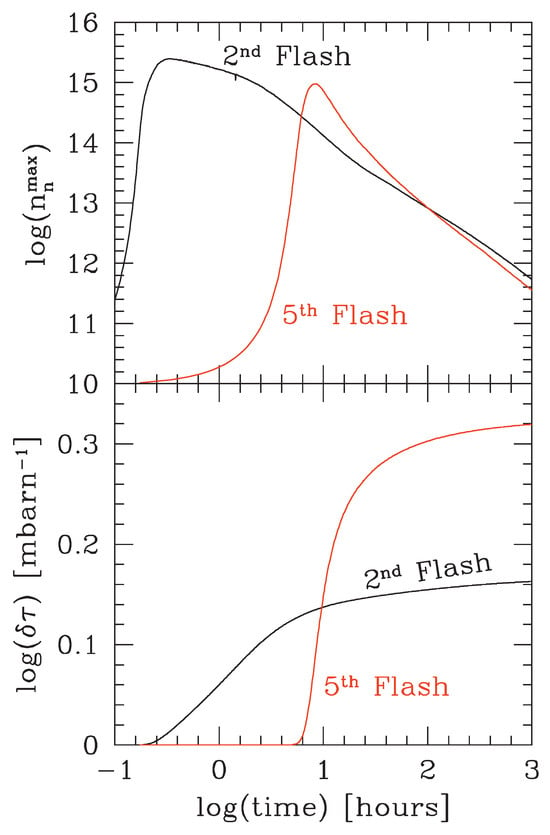
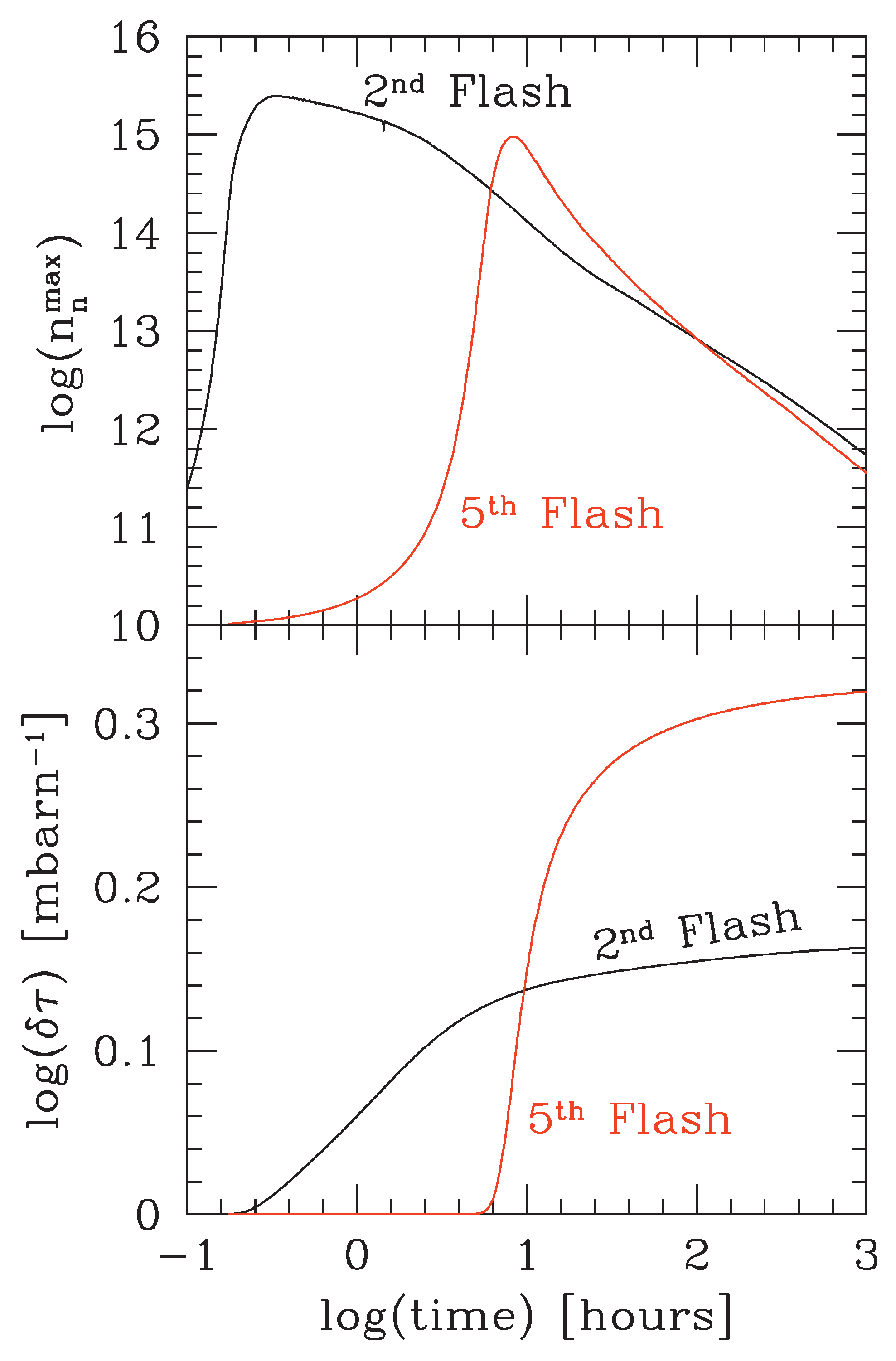
In Figure 1, we report the time evolution of the neutron density at the mass coordinate where temperature is at the maximum (upper panel) and the neutron exposure is defined as:
where is the mass extension of the flash-driven convective zone and is the thermal velocity. We report the profiles for the strongest (2nd—black lines) and the weakest (5th—red lines) flashes. The origin of the evolutionary time has been set to zero at the epoch when the neutron density first exceeds cm−3 during each flash episode. As it can be seen, the neutron density is very large, exceeding the typical value for i-process nucleosynthesis ( cm−3). Moreover, Figure 1 shows that the timescale for the neutron flux to increase depends on the strength of the flash: the stronger the flash, the more rapidly the nuclear energy is delivered, the sooner the temperature exceeds K, so that 14N can be converted into 22Ne and neutrons can be released. However, as it can be seen, the time during which matter is exposed to a very high neutron flux is short (1–10 h) so that successive neutron captures can not build very heavy isotopes up to actinides, as may occur in the i-process nucleosynthesis [14].
Figure 1.
Maximum neutron density (upper panel) and neutron exposure (lower panel) during the second and the fifth He-flash episodes. The origin of the x-scale has been arbitrarily set to zero at the epoch when first exceeds cm−3 during each flash episode.
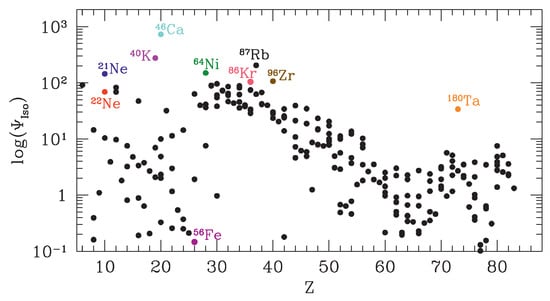
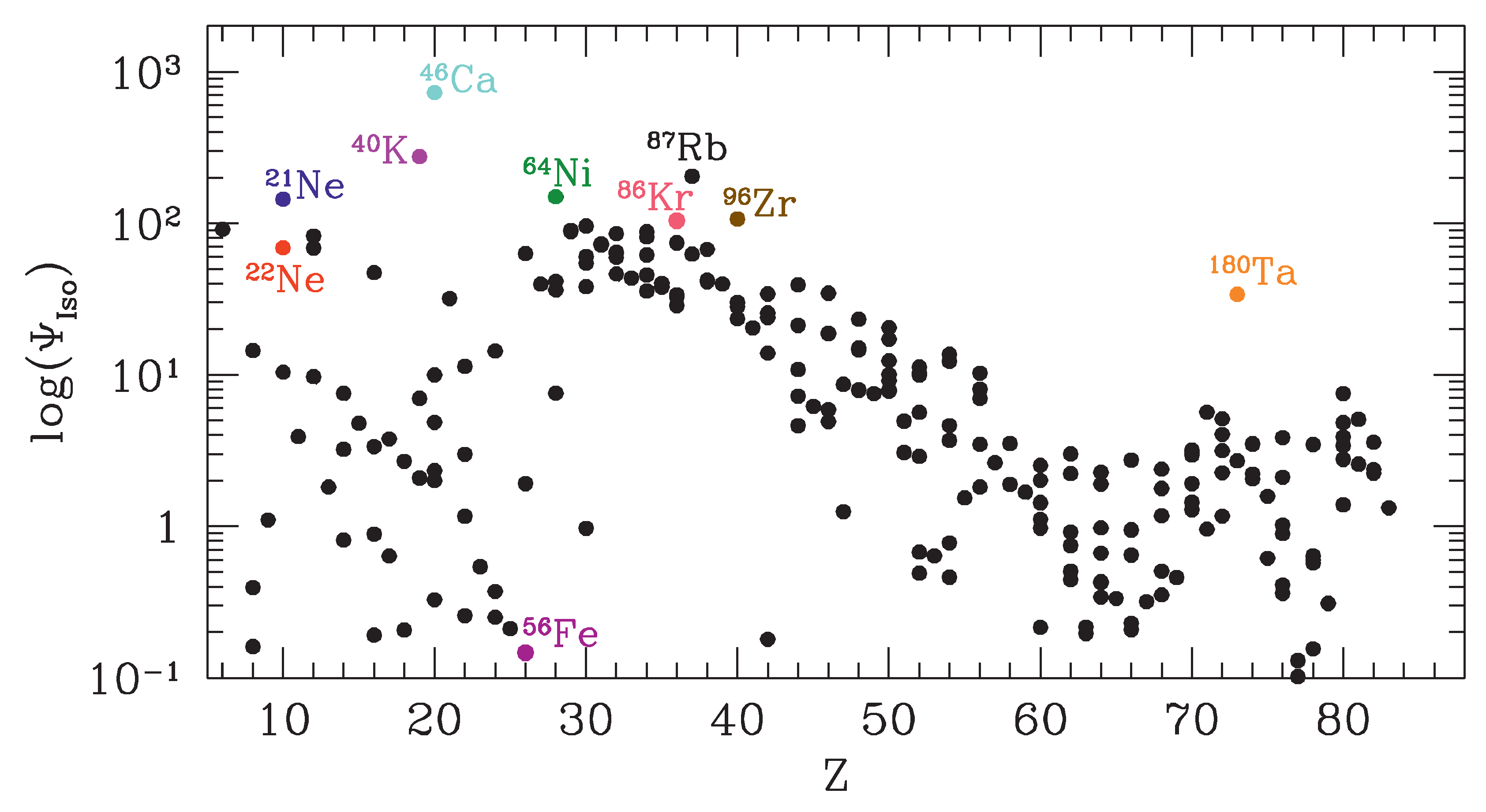
In Figure 2, we report the production factor as a function of the atomic number for all the isotopes up to bismuth in the total mass ejected from the PTF J2238+743015.1 system during the recurrent He-flashes phase. The production factor is defined as the ratio of the number abundance of a given isotope in the ejected matter () and its solar value :
where . As observed in Figure 2, -isotopes up to 24Mg exhibit significant overproduction. 21Ne and 22Ne are enhanced by factors of approximately 140 and 70, respectively. In this context, 22Ne serves primarily as a tracer of unburnt material surviving He-flash-driven convective episodes, whereas 21Ne originates from neutron captures on 20Ne.
Figure 2.
Cumulative production factor for all the considered isotopes up to bismuth in the matter ejected from the PTF J2238+743015.1 system during the six He-flash episodes. In the plot, we mark points corresponding to the relevant isotopes discussed in the main text. The production factor of 60Fe is not displayed in the figure as its solar abundance is zero.
Other isotopes showing production factors larger than 100 include 64Ni, 86Kr, and 96Zr. More pronounced enrichments are found for 40K and 87Rb (exceeding 200), while 46Ca reaches a factor above 700. Notably, 180Ta is overproduced by a factor of ∼30, a value significantly higher than those of neighboring nuclei. Finally, 60Fe is produced abundantly, reaching a final mass fraction abundance of .
Substantial enrichment of 40K in our models is primarily driven by neutron captures on the initial 39K seeds, given that no significant secondary production from 39Ar occurs during neutron irradiation due to its relatively long half-life ( yr) relative to the neutron-capture timescale.
Regarding the rare isotope 46Ca, its synthesis is strictly governed by the branching point at 45Ca ( d). In our model, an efficient production of 46Ca is guaranteed by the high neutron densities achieved, which allows the neutron flux to overcome the competitive -decay channel. This mechanism, in conjunction with the remarkably low neutron capture cross-section of 46Ca ( mbarn at 40 keV), leads to a significant accumulation of this isotope.
The production of 60Fe from 56Fe seeds is a key indicator of high-flux environments. In our simulations, we find a significant ratio . This efficiency is regulated by the 59Fe branching ( d), which necessitates neutron densities exceeding to bypass the decay toward 59Co. These conditions are readily achieved during convective thermal pulses through the activation of the 22Ne()25Mg source. Similarly, for nickel isotopes, the flux proceeds directly to 64Ni. Given the high neutron densities, neutron capture on 63Ni [15] is orders of magnitude faster than its temperature-dependent -decay [16], making the branching toward 63Cu negligible.
The abundances of 86Kr and 87Rb are intrinsically coupled through the magic shell bottleneck. At 40 keV, approximately 74% of the neutron captures on 84Kr populate the 85mKr isomer [17], which mostly decays to 85Rb. However, the remaining flux through the ground state of 85Kr leads to the accumulation of 86Kr, which has a very low neutron capture cross-section ( mbarn). Simultaneously, the high neutron densities fully activate the 86Rb branch ( d), allowing for the direct synthesis and accumulation of 87Rb.
Finally, the overproduction of 180Ta is explained by the thermal population of excited states in 179Hf. At temperatures exceeding K, characteristic for the He-flash convective episodes in our models, the 179Hf state at 214 keV undergoes -decay to 179Ta. Subsequent neutron captures on 179Ta efficiently feed the long-lived isomer 180mTa, explaining the significant overabundances found in our calculations [18].
3. Discussion
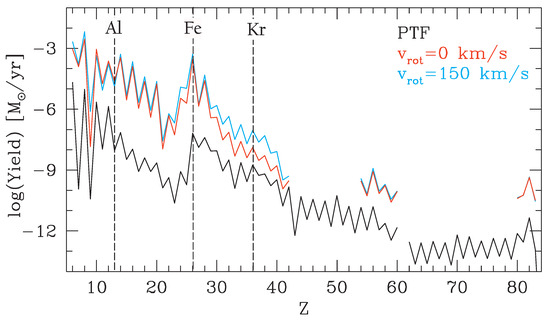
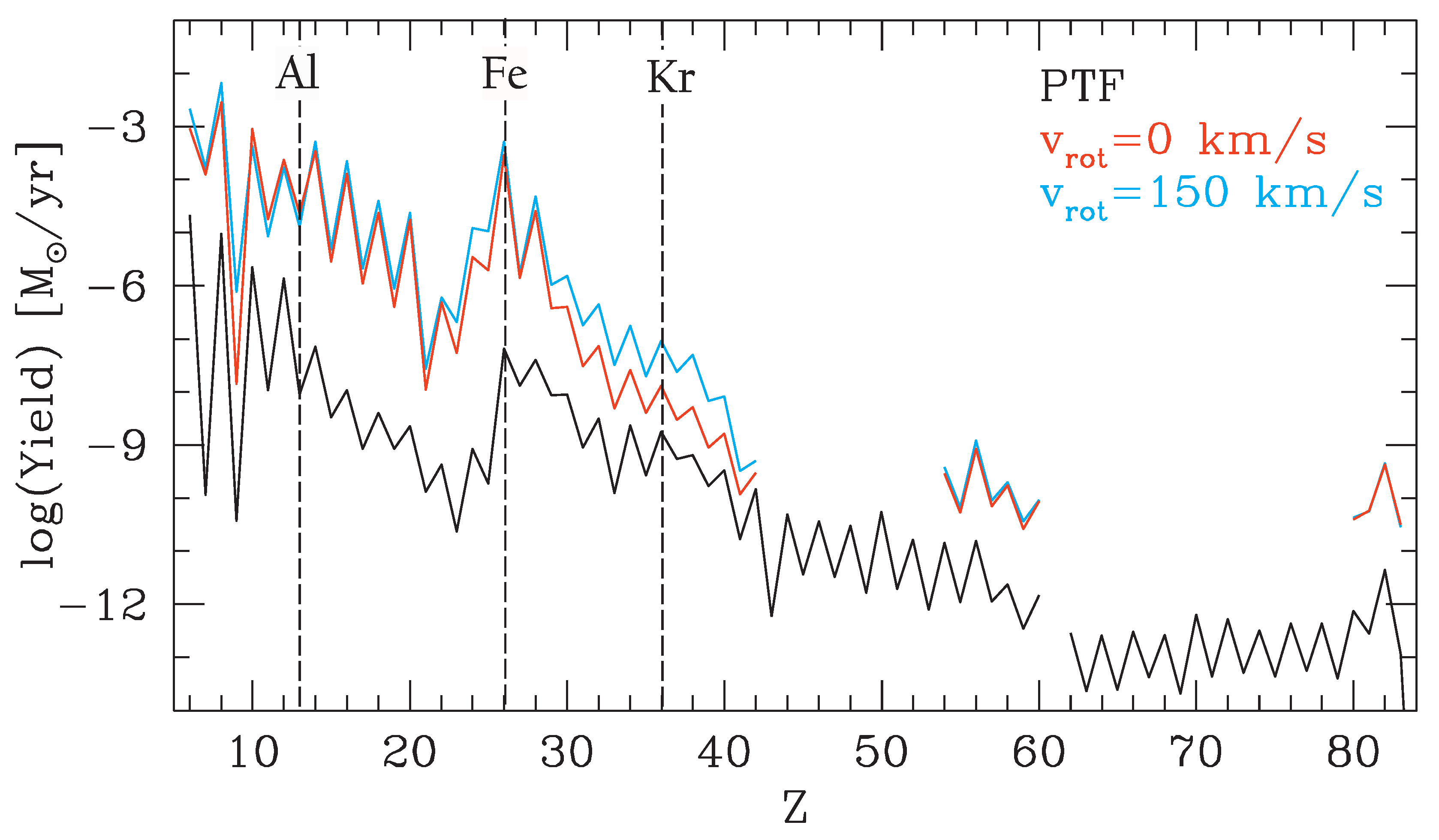
Figure 2 discloses that elements from copper to tin are largely overproduced during the recurrent He-flashes phase experienced by the WD in the PTF J2238+743015.1 system, while heavier isotopes are produced to a lower level. Such an occurrence is the consequence of the short time duration of the peak-temperature phase during the He-flashes. In fact, even if a large neutron flux is delivered, there is not enough time to build up heavy elements and, hence, interacting binary systems similar to PTF J2238+743015.1 are unable to provide any significant contribution to the production of isotopes beyond lead. Such a feature is similar to what happens in the He-shell of massive stars, where only weak s-process nucleosynthesis occurs. However, when considering a population of massive stars exploding as Type-II supernovae (SNe II), it comes out that the production factor in the range , 1–2 orders of magnitude lower than the values obtained for the system under study. Motivated by this finding, we computed the possible contribution of the PTF-like systems to the chemical evolution of the interstellar medium. It has to be remarked that the formation channel of PTF-like systems is very selective so that their number, as estimated via binary population synthesis simulation, is 2% of the number of massive stars with initial mass in the range 13–30 . In addition, the matter ejected during the evolution with recurrent strong He-flashes is of the order of a few tenths of solar mass, while in massive stars exploding as SNe II, the mass of ejected material is two orders of magnitude larger.
In Figure 3, we report as a function of the atomic number the yields (in ) delivered by a population of PTF-like systems (black line) and by a population of massive stars, computed by including (blue line) or not (red line) the effects of rotation. We consider a single burst of star formation and we derive the yields of massive stars from [19], as available in [20]. As it can be seen, the contribution of interacting binaries harboring a CO WD and a sdB companion is negligible. Nevertheless, these systems exhibit a distinctive signature that may help identifying interstellar regions enriched by PTF-like events. In particular, our calculations indicate that a population of rotating PTF-like systems produces an amount of 60Fe of approximately . This value is comparable to the 60Fe yield predicted for a population of non-rotating massive stars (∼), and about one order of magnitude lower than that obtained when rotation is included (∼).
Figure 3.
Yields delivered by model population of PTF-like systems (black line) and of massive stars, computed assuming an equatorial velocity in main sequence equal to = 150 km/s (blue line) or = 0 km/s (red line).
At the same time, the production of 26Al in PTF-like systems is practically negligible, being approximately six orders of magnitude lower than the typical 26Al yields of massive stars. Therefore, these systems are capable of synthesizing 60Fe in quantities comparable to those of massive stars, but without the associated enrichment in 26Al that characterizes massive-star winds and core-collapse supernovae.
This decoupling between 60Fe and 26Al production represents a potentially useful diagnostic. Since the 60Fe/26Al ratio is commonly employed as a tracer of massive-star activity, the identification of environments characterized by significant 60Fe enrichment but extremely low 26Al could provide indirect evidence for pollution by PTF-like systems. Such a signature, if observationally accessible, would offer an additional constraint on the different sources contributing to the radioactive isotopes inventory of the interstellar medium.
Author Contributions
Conceptualization, L.P. and L.R.Y.; methodology, L.P. and D.V.; software, L.P. and D.V.; validation, I.D., L.R.Y. and S.C.; formal analysis, L.P. and D.V.; investigation, A.G.K., L.R.Y. and I.D.; writing—original draft preparation, L.P. and D.V.; writing—review and editing, L.R.Y., E.B. and S.C.; funding acquisition, L.P., S.C., I.D. and E.B. All authors have read and agreed to the published version of the manuscript.
Funding
This research was partially funded by INAF Minigrant 2023 “Self-consistent Modeling of Interacting Binary Systems”, by INAF Theory Grant “URKA”, by the Italian MUR project 2022RJLWHN: “Understanding R-process & Kilonovae Aspects, and by the Spanish project PID2021-123110NB-100, financed by MCIN/AEI/10.13039/501100011033/FEDER/UE.
Institutional Review Board Statement
Not applicable.
Informed Consent Statement
Not applicable.
Data Availability Statement
The raw data supporting the conclusions of this article will be made available by the authors upon request.
Acknowledgments
Work of L.R.Y. and A.G.K. was carried out under the state assignments to their Institutes.
Conflicts of Interest
The authors declare no conflicts of interest. The funders had no role in the design of the study; in the collection, analyses, or interpretation of data; in the writing of the manuscript; or in the decision to publish the results.
References
- Kupfer, T.; Bauer, E.B.; van Roestel, J.; Bellm, E.C.; Bildsten, L.; Fuller, J.; Prince, T.A.; Heber, U.; Geier, S.; Green, M.J.; et al. Discovery of a Double-detonation Thermonuclear Supernova Progenitor. Astrophys. J. Lett. 2022, 925, L12. [Google Scholar] [CrossRef] [Scilit]
- Piersanti, L.; Yungelson, L.R.; Bravo, E. Expected evolution of the binary system PTF J2238+743015.1. Astron. Astrophys. 2024, 689, A287. [Google Scholar] [CrossRef] [Scilit]
- Ramsay, G.; Woudt, P.A.; Kupfer, T.; van Roestel, J.; Paterson, K.; Warner, B.; Buckley, D.A.H.; Groot, P.J.; Heber, U.; Irrgang, A.; et al. The OmegaWhite survey for short-period variable stars—VII. High amplitude short-period blue variables. Mon. Not. R. Astron. Soc. 2022, 513, 2215–2225. [Google Scholar] [CrossRef] [Scilit]
- Vennes, S.; Kawka, A.; O’Toole, S.J.; Németh, P.; Burton, D. THE SHORTEST PERIOD sdB PLUS WHITE DWARF BINARY CD–30 11223 (GALEX J1411–3053). Astrophys. J. 2012, 759, L25. [Google Scholar] [CrossRef] [Scilit]
- Deshmukh, K.; Bauer, E.B.; Kupfer, T.; Dorsch, M. Modelling the AM CVn and double detonation supernova progenitor binary system CD-30°11223. Mon. Not. R. Astron. Soc. 2024, 527, 2072–2082. [Google Scholar] [CrossRef] [Scilit]
- Hernandez, M.S.; Kupfer, T.; Belloni, D.; Schreiber, M.R. From main-sequence binary to blast: MESA modeling of the double-detonation progenitor PTF1 J2238+7430. Astron. Astrophys. 2026, 708, A108. [Google Scholar] [CrossRef] [Scilit]
- Ziółkowski, J. Evolution of Close Binaries. VII. Evolution of Binaries of Low and Moderate Mass. Acta Astron. 1970, 20, 213. [Google Scholar]
- Liu, W.M.; Yungelson, L.; Kuranov, A. He-star donor AM CVn stars and their progenitors as LISA sources. Astron. Astrophys. 2022, 668, A80. [Google Scholar] [CrossRef] [Scilit]
- Amaro-Seoane, P.; Andrews, J.; Arca Sedda, M.; Askar, A.; Baghi, Q.; Balasov, R.; Bartos, I.; Bavera, S.S.; Bellovary, J.; Berry, C.P.L.; et al. Astrophysics with the Laser Interferometer Space Antenna. Living Rev. Relativ. 2023, 26, 2. [Google Scholar] [CrossRef] [Scilit]
- Colpi, M.; Danzmann, K.; Hewitson, M.; Holley-Bockelmann, K.; Jetzer, P.; Nelemans, G.; Petiteau, A.; Shoemaker, D.; Sopuerta, C.; Stebbins, R.; et al. LISA Definition Study Report. arXiv 2024, arXiv:2402.07571. [Google Scholar] [CrossRef] [Scilit]
- Kupfer, T.; Bauer, E.B.; Marsh, T.R.; van Roestel, J.; Bellm, E.C.; Burdge, K.B.; Coughlin, M.W.; Fuller, J.; Hermes, J.; Bildsten, L.; et al. The First Ultracompact Roche Lobe-Filling Hot Subdwarf Binary. Astrophys. J. Lett. 2020, 891, 45. [Google Scholar] [CrossRef] [Scilit]
- Kupfer, T.; Bauer, E.B.; Burdge, K.B.; Roestel, J.v.; Bellm, E.C.; Fuller, J.; Hermes, J.; Marsh, T.R.; Bildsten, L.; Kulkarni, S.R.; et al. A New Class of Roche Lobe-filling Hot Subdwarf Binaries. Astrophys. J. Lett. 2020, 898, L25. [Google Scholar] [CrossRef] [Scilit]
- Pelisoli, I.; Neunteufel, P.; Geier, S.; Kupfer, T.; Heber, U.; Irrgang, A.; Schneider, D.; Bastian, A.; van Roestel, J.; Schaffenroth, V.; et al. A hot subdwarf-white dwarf super-Chandrasekhar candidate supernova Ia progenitor. Nat. Astron. 2021, 5, 1052–1061. [Google Scholar] [CrossRef] [Scilit]
- Choplin, A.; Siess, L.; Goriely, S. The intermediate neutron capture process. III. The i-process in AGB stars of different masses and metallicities without overshoot. Astron. Astrophys. 2022, 667, A155. [Google Scholar] [CrossRef] [Scilit]
- Lederer, C.; Massimi, C.; Altstadt, S.; Andrzejewski, J.; Audouin, L.; Barbagallo, M.; Bécares, V.; Bečvář, F.; Belloni, F.; Berthoumieux, E.; et al. Neutron Capture Cross Section of Unstable 63Ni: Implications for Stellar Nucleosynthesis. Phys. Rev. Lett. 2013, 110, 022501. [Google Scholar] [CrossRef] [Scilit] [PubMed]
- Takahashi, K.; Yokoi, K. Beta-Decay Rates of Highly Ionized Heavy Atoms in Stellar Interiors. At. Data Nucl. Data Tables 1987, 36, 375. [Google Scholar] [CrossRef] [Scilit]
- Tessler, M.; Zappala, J.; Cristallo, S.; Roberti, L.; Paul, M.; Halfon, S.; Heftrich, T.; Jiang, W.; Kijel, D.; Kreisel, A.; et al. Stellar s-process neutron capture cross sections on 78,80,84,86Kr determined via activation, atom trap trace analysis, and decay counting. Phys. Rev. C 2021, 104, 015806. [Google Scholar] [CrossRef] [Scilit]
- Käppeler, F.; Arlandini, C.; Heil, M.; Voss, F.; Wisshak, K.; Reifarth, R.; Straniero, O.; Gallino, R.; Masera, S.; Travaglio, C. Stellar neutron capture on 180Tam. II. Defining the s-process contribution to nature’s rarest isotope. Phys. Rev. C 2004, 69, 055802. [Google Scholar] [CrossRef] [Scilit]
- Limongi, M.; Chieffi, A. Presupernova Evolution and Explosive Nucleosynthesis of Rotating Massive Stars in the Metallicity Range −3 ≤ [Fe/H] ≤ 0. Astrophys. J. Suppl. Ser. 2018, 237, 13. [Google Scholar] [CrossRef] [Scilit]
- Limongi, M.; Chieffi, A. VizieR Online Data Catalog: Models and Yields of 13-120M⊙ Massive Stars (Limongi+). 2018. Available online: https://cdsarc.cds.unistra.fr/viz-bin/cat/J/ApJS/237/13 (accessed on 13 April 2026).
Disclaimer/Publisher’s Note: The statements, opinions and data contained in all publications are solely those of the individual author(s) and contributor(s) and not of MDPI and/or the editor(s). MDPI and/or the editor(s) disclaim responsibility for any injury to people or property resulting from any ideas, methods, instructions or products referred to in the content. |
© 2026 by the authors. Licensee MDPI, Basel, Switzerland. This article is an open access article distributed under the terms and conditions of the Creative Commons Attribution (CC BY) license.