

Skip to Content
You are currently on the new version of our website. Access the old version .

Galaxies, Volume 10, Issue 2

2022 April - 22 articles

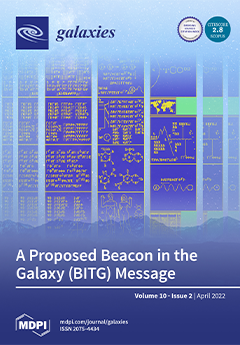
Cover Story: A printout of the Beacon in the Galaxy (BITG) Message. It includes basic mathematical and physical concepts to establish a universal means of communication followed by information on the biochemical composition of life on Earth, the solar system’s time-stamped position in the milky way relative to known globular clusters, as well as digitized depictions of the solar system and Earth’s surface. The message concludes with digitized images of the human form, along with an invitation for any receiving intelligences to respond. View this paper
  • Issues are regarded as officially published after their release is announced to the table of contents alert mailing list .
  • You may sign up for email alerts to receive table of contents of newly released issues.
  • PDF is the official format for papers published in both, html and pdf forms. To view the papers in pdf format, click on the "PDF Full-text" link, and use the free Adobe Reader to open them.

Articles (22)

  • Article
  • Open Access
2,917 Views
14 Pages

12 April 2022

In the present paper, a model for the pulsed γ-ray emission of the Crab pulsar from 0.01 GeV to 1 TeV in the context of synchrotron emission generated in the vicinity of a light cylinder is developed. The generation of such high energies throug...

  • Article
  • Open Access
6 Citations
3,690 Views
11 Pages

Dynamics and Kinematics of the EUV Wave Event on 6 May 2019

  • Ramesh Chandra,
  • P. F. Chen,
  • Pooja Devi,
  • Reetika Joshi and
  • Y. W. Ni

10 April 2022

We present here the kinematics of the EUV wave associated with a GOES M1.0-class solar flare, which originates in NOAA AR 12740. The event is thoroughly observed with Atmospheric Imaging Assembly (AIA) onboard Solar Dynamics Observatory (SDO) with hi...

  • Article
  • Open Access
21 Citations
3,418 Views
14 Pages

Modelling Quintessential Inflation in Palatini-Modified Gravity

  • Konstantinos Dimopoulos,
  • Alexandros Karam,
  • Samuel Sánchez López and
  • Eemeli Tomberg

We study a model of quintessential inflation constructed in R2-modified gravity with a non-minimally coupled scalar field, in the Palatini formalism. Our non-minimal inflaton field is characterised by a simple exponential potential. We find that succ...

  • Article
  • Open Access
2,937 Views
11 Pages

A new class of dusty post-Red Giant Branch (post-RGB) stars has recently been identified in the Magellanic Clouds. Their spectral energy distributions (SEDs) suggest that their mass-ejecta are similar to dusty post-Asymptotic Giant Branch (post-AGB)...

  • Article
  • Open Access
10 Citations
28,922 Views
28 Pages

A Beacon in the Galaxy: Updated Arecibo Message for Potential FAST and SETI Projects

  • Jonathan H. Jiang,
  • Hanjie Li,
  • Matthew Chong,
  • Qitian Jin,
  • Philip E. Rosen,
  • Xiaoming Jiang,
  • Kristen A. Fahy,
  • Stuart F. Taylor,
  • Zhihui Kong and
  • Zong-Hong Zhu
  • + 1 author

25 March 2022

An updated, binary-coded message has been developed for transmission to extraterrestrial intelligences in the Milky Way galaxy. The proposed message includes basic mathematical and physical concepts to establish a universal means of communication fol...

  • Article
  • Open Access
8 Citations
3,613 Views
17 Pages

Isolating an Outflow Component in Single-Epoch Spectra of Quasars

  • Paola Marziani,
  • Alice Deconto-Machado and
  • Ascension Del Olmo

24 March 2022

Gaseous outflows appear to be a universal property of type-1 and type-2 active galactic nuclei (AGN). The main diagnostic is provided by emission features shifted to higher frequencies via the Doppler effect, implying that the emitting gas is moving...

  • Article
  • Open Access
3 Citations
2,764 Views
11 Pages

24 March 2022

Many bipolar nebulae with a pronounced cylindrical shape, such as Henize 3-401, show no indication whatsoever of interaction between a disk and a stellar wind, or a jet on the nebular axis. I propose that the disk that is observed at the base of the...

  • Article
  • Open Access
5 Citations
3,506 Views
8 Pages

23 March 2022

We show that masses of binary black hole mergers are overestimated, since a large gravitational redshift is not taken into account. Such a phenomenon occurs due to time dilation in a close neighborhood of any black hole. This fact allows us to explai...

  • Article
  • Open Access
14 Citations
5,395 Views
36 Pages

23 March 2022

Quintessential inflation refers to scenarios in which a single scalar field is used to describe inflation and late time acceleration. This review is dedicated to the framework of quintessential inflation, with a focus on the building blocks of formal...

  • Article
  • Open Access
17 Citations
3,864 Views
19 Pages

17 March 2022

Inflation and quintessence can both be described by a single scalar field. The cosmic time evolution of this cosmon field realizes a crossover from the region of an ultraviolet fixed point in the infinite past to an infrared fixed point in the infini...

  • Article
  • Open Access
2 Citations
2,713 Views
6 Pages

Millimetre Observations of Maser-Emitting Planetary Nebulae

  • Lucero Uscanga,
  • José R. Rizzo,
  • Miguel Santander-García,
  • José F. Gómez,
  • Luis F. Miranda,
  • Olga Suárez,
  • Panayotis Boumis,
  • Mónica I. Rodríguez,
  • Gerardo Ramos-Larios and
  • Roldán A. Cala

11 March 2022

Observations in the millimetre bands of maser-emitting planetary nebulae (PNe) are crucial to study their circumstellar molecular gas at the beginning of the PN phase. Maser-emitting PNe are in the earliest phases of PN formation; therefore, these so...

  • Article
  • Open Access
6 Citations
3,397 Views
9 Pages

M 1–92 Revisited: New Findings and Open Questions: New NOEMA Observations of Minkowski’s Footprint

  • Javier Alcolea,
  • Marcelino Agúndez,
  • Valentín Bujarrabal,
  • Arancha Castro-Carrizo,
  • Jean-François Desmurs,
  • John-Eduard Martínez-Fernández,
  • Carmen Sánchez Contreras and
  • Miguel Santander-García

10 March 2022

PN M 1–92, also known as Minkowski’s Footprint, is a textbook example of a massive pre-planetary nebula. It presents all the characteristics of this type of source: non-spherical symmetry (bipolar cylindrical symmetry in this case), high-...

  • Review
  • Open Access
24 Citations
9,171 Views
16 Pages

Squeezing in Gravitational Wave Detectors

  • Sheila E. Dwyer,
  • Georgia L. Mansell and
  • Lee McCuller

Injecting optical squeezed states of light, a technique known as squeezing, is now a tool for gravitational wave detection. Its ability to reduce quantum noise is helping to reveal more gravitational wave transients, expanding the catalog of observat...

  • Article
  • Open Access
3,252 Views
11 Pages

Integral field unit (IFU) spectroscopy of planetary nebulae (PNe) provides a plethora of information about their morphologies and ionization structures. An IFU survey of a sample of PNe around hydrogen-deficient stars has been conducted with the Wide...

  • Feature Paper
  • Article
  • Open Access
5 Citations
3,358 Views
9 Pages

Further Studies of the Association of Planetary Nebula BMP J16135406 with Galactic Open Cluster NGC 6067

  • Vasiliki Fragkou,
  • Quentin A. Parker,
  • Albert A. Zijlstra,
  • Lisa Crause,
  • Laurence Sabin and
  • Roberto Vázquez

Planetary Nebulae (PNe) that are physical members of Galactic open clusters are powerful probes that allow precise determination of their distance and crucially their initial mass on the main sequence. Here, we revisit the physical association of the...

  • Review
  • Open Access
4 Citations
4,853 Views
13 Pages

Accreting white dwarfs (WDs) in cataclysmic variables (CVs) provide crucial insights about the accretion of mass and angular momentum in all types of binaries, including accreting NSs and BHs. Accreting WDs are the critical component in the single de...

  • Article
  • Open Access
5 Citations
3,442 Views
14 Pages

The detection of gravitational-wave signals by the LIGO and Virgo observatories during the past few years has ushered us into the era of gravitational-wave astronomy, shifting our focus from detection to source parameter estimation. This has imposed...

  • Article
  • Open Access
11 Citations
3,622 Views
10 Pages

Follow-Up of Extended Shells around B[e] Stars

  • Tiina Liimets,
  • Michaela Kraus,
  • Alexei Moiseev,
  • Nicolas Duronea,
  • Lydia Sonia Cidale and
  • Cecilia Fariña

B[e] stars are massive B type emission line stars in different evolutionary stages ranging from pre-main sequence to post-main sequence. Due to their mass loss and ejection events these objects deposit huge amounts of mass and energy into their envir...

  • Article
  • Open Access
12 Citations
3,164 Views
13 Pages

Cylindrical Gravastar Like-Structures in f(G) Gravity

  • M. Z. Bhatti,
  • Z. Yousaf and
  • A. Rehman

23 February 2022

The aim of this manuscript is to explore singularity-free solution for a specific self-gravitating highly dense object known as gravastar suggested by Mazur and Mottola, in the context of f(G) gravity theory. Gravastars are regarded as a possible alt...

  • Review
  • Open Access
24 Citations
6,969 Views
28 Pages

22 February 2022

The propagation of gamma-rays over cosmological distances is the subject of extensive theoretical and observational research at GeV and TeV energies. The mean free path of gamma-rays in the cosmic web is limited above 100 GeV due to the production of...

  • Review
  • Open Access
20 Citations
6,142 Views
20 Pages

The GRB Prompt Emission: An Unsolved Puzzle

  • Željka Bošnjak,
  • Rodolfo Barniol Duran and
  • Asaf Pe’er

22 February 2022

The recent multi-messenger and multi-wavelength observations of gamma-ray bursts (GRBs) have encouraged renewed interest in these energetic events. In spite of the substantial amount of data accumulated during the past few decades, the nature of the...

Get Alerted

Add your email address to receive forthcoming issues of this journal.

XFacebookLinkedIn
Galaxies - ISSN 2075-4434