


Abstract
Background/Objectives: About one-third of patients who receive cardiac resynchronization therapy (CRT) do not show meaningful clinical improvement. One possible reason is that current criteria for diagnosing left bundle branch block (LBBB) do not clearly separate true conduction block from other conditions that can produce a similar QRS pattern, since they rely mainly on surface ECG features. The Strauss criteria have been proposed as a stricter alternative. They include sex-specific QRS duration thresholds and require a mid-QRS notch or slur, with the goal of better identifying patients whose conduction abnormality may be correctable. Selecting candidates on this basis reflects a personalized-medicine approach that matches resynchronization to the individual conduction substrate rather than applying a single wide-QRS threshold to all patients. In this review, we assess whether LBBB defined by the Strauss criteria is linked to better CRT outcomes, and we examine how these criteria have been used in the design of randomized clinical trials investigating conduction system pacing (CSP). Methods: A systematic search of PubMed, EMBASE, and the Cochrane Library was conducted (last updated April 2026) in accordance with PRISMA 2020 guidelines. Evidence was drawn from two groups of studies: (1) observational studies comparing CRT outcomes in Strauss-positive versus Strauss-negative patients, and (2) randomized CSP trials conducted in populations enriched using either Strauss-type or typical LBBB morphology. Results: A total of 17 comparative studies (n ≈ 4200) were included in Part 1; most (14 of 17) reported outcomes favouring Strauss-defined LBBB, with the greatest signal in non-ischemic cardiomyopathy, although these were mostly small retrospective studies with heterogeneous outcome definitions. However, two large registry analyses found no incremental benefit of strict over conventional criteria. In Part 2, six randomized controlled trials were analyzed. The HeartSync-LBBP trial (n = 200, 36-month follow-up) demonstrated significantly lower rates of mortality or heart failure hospitalization with LBBP compared to BiVP (8% vs. 28%; HR 0.26; 95% CI 0.12–0.57), with 98% technical success for LBBP. In contrast, the PhysioSync-HF trial (n = 173) showed superiority of BiVP, with CSP success of only 69% and 42.8% of procedures performed by less experienced operators. Similarly, the LEFT-BUNDLE-CRT trial (n = 176) found that LBBAP did not meet non-inferiority criteria compared to BiVP (RR 0.95; 95% CI 0.88–1.02). Conclusions: Strauss-defined LBBB is associated with improved CRT outcomes in observational studies, particularly in non-ischemic cardiomyopathy; this reflects an association rather than established superiority or causal benefit, and no randomized trial has yet compared Strauss-guided against guideline-based patient selection. In randomized CSP trials, both operator experience and patient selection appear to be critical determinants of success. BiVP remains effective even in patients meeting strict Strauss criteria. Further research is needed to determine whether the application of Strauss criteria improves outcomes beyond current guideline-based patient selection.
1. Introduction
Two decades ago, landmark trials showed that cardiac resynchronization therapy (CRT) with biventricular pacing (BiVP) reduces the risk of death and heart failure–related hospitalization in patients with a wide QRS complex [1,2,3,4,5]. However, a considerable proportion of patients still do not respond to CRT, with about one-quarter to one-third experiencing no meaningful clinical benefit. This rate has changed little since those early trials, despite ongoing improvements in lead design, device technology, and programming strategies [6,7,8].
An important and often overlooked issue is that the criteria currently used to diagnose left bundle branch block (LBBB) were not designed to distinguish true conduction system failure from other conditions that can produce similar QRS patterns. For example, QRS widening due to diffuse myocardial fibrosis, partial conduction delay, or left ventricular hypertrophy with strain may all meet guideline-defined LBBB criteria, yet may not result in the electrical dyssynchrony that CRT is intended to correct [9,10,11]. These patients may undergo an invasive procedure from which they are unlikely to benefit, and their inclusion in clinical trials can dilute the apparent treatment effect in patients with true conduction block. Refining who is offered CRT is therefore a question of personalized medicine—individualising device therapy to a patient’s specific conduction substrate rather than applying uniform wide-QRS criteria—an approach increasingly emphasised for resynchronization and conduction system pacing and reflected in the most recent physiologic-pacing guidance [12,13].
In 2011, Strauss et al. proposed an alternative approach to defining true complete LBBB. Instead of relying on ECG features associated with CRT response, they based their definition on the expected electrical pattern of complete interruption of the left bundle branch. Their criteria included a QRS duration ≥ 140 ms in men or ≥130 ms in women, the presence of mid-QRS notching or slurring in at least two contiguous leads, and a QS or rS pattern in lead V1. Using these criteria, it was estimated that roughly one in three patients who met conventional ECG definitions of LBBB did not have true complete block and were therefore less likely to benefit from CRT [14]. How LBBB is defined therefore materially changes which patients are identified as CRT candidates, a point underscored by recent analyses of the left bundle branch block criteria in the 2021 European guidelines [15].
This review explores the clinical evidence that has emerged since, focusing on two related but distinct questions. First, whether LBBB defined by the Strauss criteria is associated with improved CRT outcomes compared with conventional definitions—an issue examined in 17 comparative studies summarized in Table 1. Second, how these criteria have been incorporated into the design of randomized trials of conduction system pacing (CSP), and what insights these trials provide—addressed through six completed randomized controlled trials (RCTs) summarized in Table 2.
Table 1.
Part 1: Studies evaluating Strauss-defined LBBB and CRT outcomes (2011–2025), ordered chronologically.
Table 2.
Part 2: Randomized trials of conduction system pacing (CSP) versus biventricular pacing (BiVP) in populations enriched for Strauss-type or typical LBBB morphology (2021–2026). Note: LEVEL-AT also enrolled patients with non-LBBB wide QRS ≥ 150 ms; PhysioSync-HF required LBBB with QRS ≥ 130 ms but did not formally mandate strict Strauss criteria; LEFT-BUNDLE-CRT used Strauss criteria and a response-based primary endpoint (not time-to-event), and is shown separately at the bottom of the table.
These two lines of evidence are complementary. Observational studies indicate that Strauss-defined LBBB may better identify patients who are more likely to benefit from resynchronization, and more recent CSP trials have increasingly enriched their populations with patients exhibiting Strauss-type, typical or otherwise physiologically correctable LBBB morphology. The study by Saplaouras et al. (ESC Heart Failure, 2025), represents the authors’ own previously published work and is discussed below on the same objective terms, and by the first author’s name, as the other included studies [32].
2. Methods
2.1. Search Strategy
The review was conducted according to PRISMA 2020 recommendations [39], the systematic review and meta-analysis was not prospectively registered. We performed a systematic search of PubMed, EMBASE, and the Cochrane Library using combinations of the terms “Strauss,” “strict LBBB,” “true LBBB,” “complete LBBB,” “CRT,” “CRT response,” “CSP,” and “LBBP,” without language restrictions. We also screened the reference lists of all relevant articles. The initial search was carried out in December 2025 and updated in April 2026.
This review is reported in accordance with PRISMA 2020 but is best characterised as a systematic evidence synthesis rather than a conventional systematic review with quantitative meta-analysis: it was not prospectively registered, no formal grading of the certainty of evidence (e.g., GRADE) was undertaken, and no meta-analysis was performed because the marked heterogeneity in study designs, populations, LBBB definitions and outcome measures precluded valid statistical pooling. The complete Boolean combination applied to each database, adapted to its syntax, was: (“Strauss” OR “strict LBBB” OR “true LBBB” OR “complete LBBB”) AND (“cardiac resynchronization therapy” OR “CRT” OR “CRT response” OR “conduction system pacing” OR “CSP” OR “left bundle branch pacing” OR “LBBP”).
With respect to study quality, 16 of the 17 observational studies scored 7–9 on the Newcastle–Ottawa Scale (high quality; range 6–9, median 8), with only one cohort rated moderate (6/9); the most common limitations were retrospective, single-center design and, in the smaller cohorts, limited adjustment for confounders. Among the six randomized trials, five were rated “some concerns” on the Cochrane RoB 2 tool—chiefly reflecting the structurally unavoidable lack of operator blinding in device-implantation trials (domain D2)—and one (HeartSync-LBBP) was at low risk of bias, with none at high risk. Detailed ratings are provided in Table S1 (Newcastle–Ottawa Scale) and Table S2 (Cochrane RoB 2). The full line-by-line search strategy for each database (Table S3) and the completed PRISMA 2020 checklist (Table S4) are provided as Supplementary Material.
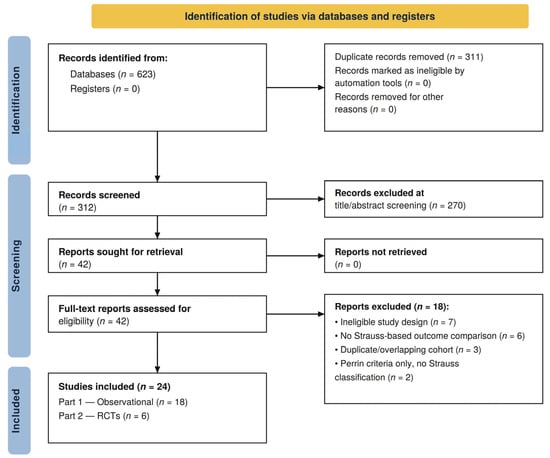
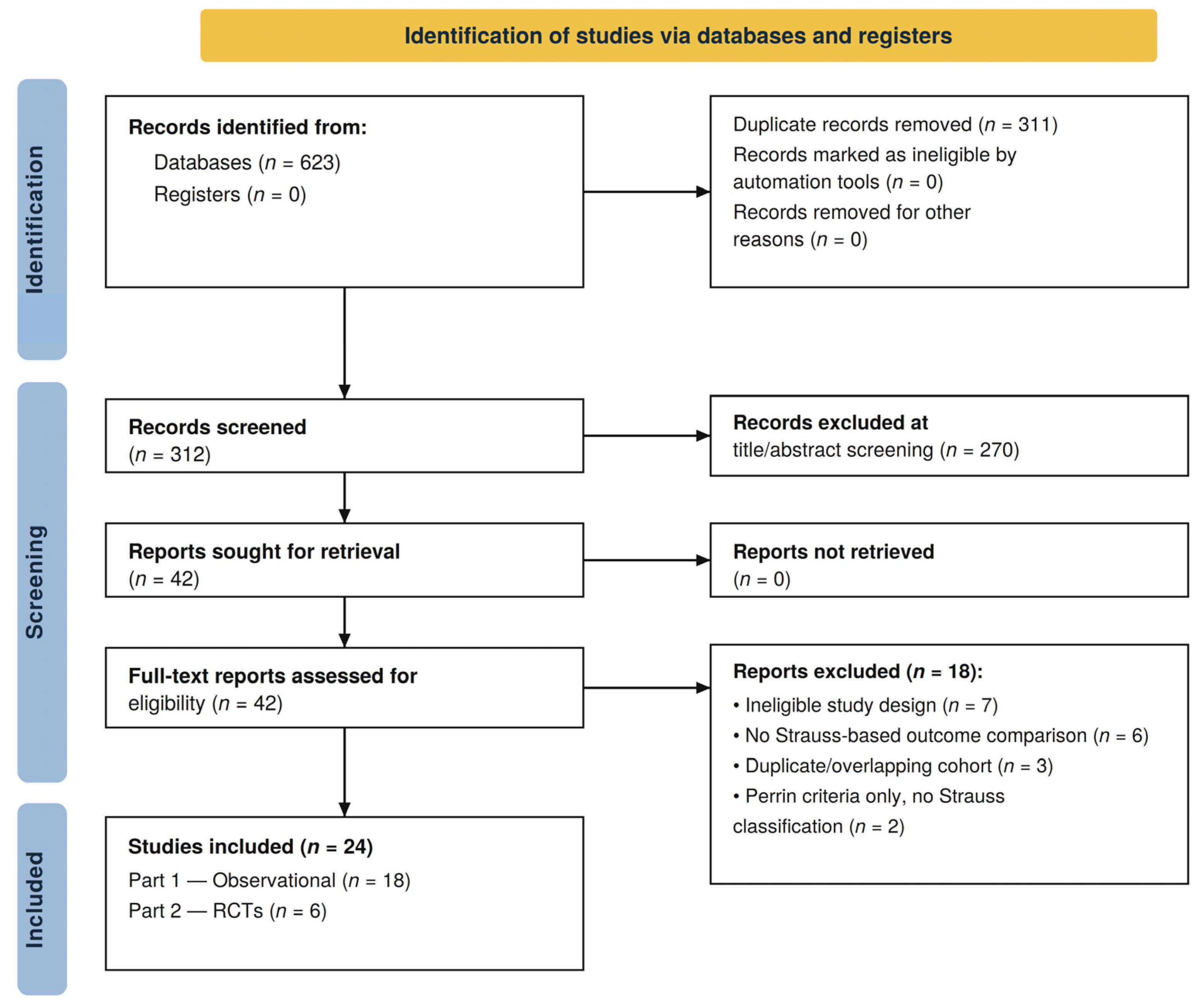
Titles and abstracts were screened independently by two reviewers (A.S. and P.M.), and all potentially relevant studies were reviewed in full. Any disagreements were resolved through discussion with a third reviewer (K.P.L.). After removing duplicates, 312 records remained; 270 were excluded during title and abstract screening, leaving 42 studies for full-text review. Of these, 18 were excluded: 7 due to ineligible study design, 6 because they did not report outcomes that could be compared using Strauss criteria, 3 due to overlapping cohorts, and 2 because they applied Perrin criteria without including Strauss criteria.
In total, 24 studies were included. Part 1 consisted of 18 studies (17 comparative studies plus the original 2011 criteria paper), while Part 2 included 6 randomized controlled trials, with LEFT-BUNDLE-CRT added as the sixth RCT following the April 2026 update. Because of differences in study design, patient populations, and endpoints, a formal meta-analysis was not feasible. Instead, the findings are presented as a structured narrative synthesis (Figure 1).
Figure 1.
PRISMA 2020 flow diagram showing the identification, screening, eligibility assessment, and inclusion of studies in this systematic evidence synthesis.
2.1.1. Part 1: Studies Evaluating Strauss-Defined LBBB and CRT Outcomes (Table 1)
Studies were included if they met three main criteria: use of strict morphological ECG criteria to define left bundle branch block (LBBB), enrollment of patients undergoing CRT or CRT-D, and reporting at least one relevant outcome comparing Strauss-positive and Strauss-negative groups (such as echocardiographic findings, heart failure hospitalization, ventricular arrhythmias, or all-cause mortality). Case reports and editorials were excluded. Study quality was assessed using the Newcastle–Ottawa Scale (see Table S1) [40].
2.1.2. Part 2: Randomized Trials of CSP in Populations Enriched for Strauss-Type or Typical LBBB Morphology (Table 2)
Randomized controlled trials were included if they enrolled patients with Strauss-defined or Strauss-type/typical left bundle branch block morphology, compared conduction system pacing (His bundle pacing or left bundle branch area pacing) with BiVP or another control strategy, and reported at least one pre-specified cardiac outcome. Studies based only on QRS duration, without selection for the relevant morphology, were excluded.
PhysioSync-HF was included as a predefined exception. Although enrollment was based on QRS duration and did not require Strauss criteria, most patients in both arms (96.6% in the CSP group and 94.2% in the BiVP group) had Strauss-type or typical LBBB morphology at baseline [37]. This was determined retrospectively and should be considered a limitation; its results are best interpreted alongside rather than equivalent to studies that used Strauss criteria as a formal enrollment standard. Ongoing studies meeting these criteria are reported separately. Study quality was assessed using the Cochrane risk-of-bias tool (Table S2) [41].
Terminology note. Several related terms are used throughout the literature, and it is important to keep their differences in mind. “Strauss-defined LBBB” refers specifically to cases classified using the original Strauss ECG criteria, which include sex-specific QRS duration thresholds and the presence of mid-QRS notching or slurring.
In contrast, “Strauss-type” or “typical” LBBB morphology is used more loosely to describe ECG patterns that resemble those described by Strauss, even if the formal criteria were not applied. In many studies, these cases were identified retrospectively or drawn from populations that were not prospectively selected using Strauss criteria, which can affect consistency.
The term “physiologically correctable” LBBB refers to cases in which the conduction abnormality can be corrected with His-bundle pacing or left bundle branch area pacing. These are related but distinct concepts and should not be used interchangeably in this review.
3. Results
3.1. Part 1: Strauss Criteria as Predictors of CRT Response—Overview (2011–2025)
Seventeen studies compared CRT outcomes between Strauss-positive and Strauss-negative patients (Table 1), in addition to the original 2011 criteria paper. Altogether, these studies included roughly 4200 patients. Six were prospective cohorts [17,18,19,21,29,30], while the remaining eleven were retrospective or registry-based analyses. Study sizes varied widely (from 37 to 1492 patients), as did follow-up, which ranged from 6 months to 9 years.
Most studies pointed in the same direction. Fourteen of the 17 reported better outcomes in Strauss-positive patients. Bertaglia et al. did not find any clear advantage of strict over conventional LBBB criteria [22], and both van Stipdonk et al. and Shoman et al. reported results that varied depending on the endpoint analyzed [28,30]. It is worth noting that none of these studies was designed to test Strauss-based selection prospectively against guideline-based criteria, so their findings do not directly answer how this approach would perform in routine clinical practice.
3.1.1. Electrophysiological Validation: The Risum Study
Before drawing conclusions from these data, a more basic question needs to be considered: do the Strauss ECG criteria actually identify true conduction block? This was explored by Risum et al. in a 2013 prospective study of 66 patients [17]. They compared strict ECG classification with echocardiographic identification of LBBB as an independent reference. Among the 45 patients who met Strauss criteria, 82% responded at six months, compared with 21% of those who did not. Sensitivity was 90% and specificity was 65%.
The most clinically relevant finding came from the concordance analysis. When both ECG and echocardiography indicated that LBBB was absent, 94% of patients failed to respond to CRT. This high negative predictive value is clinically meaningful, as it suggests that patients meeting neither criterion are unlikely to benefit and may not be good candidates for CRT.
3.1.2. Early Observational Evidence (2012–2015)
Mascioli et al. were among the first to apply the Strauss criteria in a clinical CRT cohort. In 111 patients, they found that true LBBB, defined by Strauss morphology, was independently associated with better echocardiographic response, clinical improvement, and survival [16]. Around the same time, Tian et al. reported similar findings in a smaller cohort of 58 patients: true complete LBBB by Strauss-type criteria was an independent predictor of super-response (OR 11.68; 95% CI 1.97–69.4; p = 0.007), and all patients meeting the strict criteria responded to CRT [18]. Although these studies were relatively small, the consistency between them was notable and helped drive further interest in the criteria.
Emerek et al., in a study of 49 patients, showed that strict LBBB criteria more accurately identified significant left ventricular activation delay than conventional definitions, with the difference greater in ischemic (responder proportion 62% to 78%) than in dilated cardiomyopathy (90% to 95%) [20]. Jackson et al. approached the problem differently, using cine CMR to classify contraction patterns within a strict LBBB population. All 19 patients with a type II (U-shaped septal) contraction pattern showed reverse remodeling, compared with 6 of 18 (33%) with a type I pattern (p < 0.01); super-response rates were 84% versus 28% [19]. Taken together, these findings suggest that ECG classification and imaging are likely capturing the same underlying substrate from different perspectives. This was explored more formally by Risum et al. in 2015. In a cohort of 208 patients followed for four years, adding echocardiographic contraction pattern assessment to strict ECG classification improved the C-statistic for predicting death, LVAD implantation, or transplantation from 0.63 to 0.71 (HR 3.13 for absence of a contraction pattern; 95% CI 1.64–5.88; p < 0.005) [21].
3.1.3. Larger Cohorts and Comparative Definition Studies (2017–2020)
Bertaglia et al. analyzed 335 patients from the CRT MORE registry and did not find a clear advantage of Strauss-like morphology over conventional LBBB criteria (response 65% vs. 59%, p = 0.267) [22]. As a registry study, it has the usual limitations, but given its size, the findings are difficult to ignore. In contrast, Caputo et al. examined five LBBB definitions in 316 patients and found that Strauss criteria were independently associated with the composite outcome of death or heart failure hospitalization (HR 0.57; 95% CI 0.40–0.80) [25].
Jastrzębski et al. compared four definitions—ESC, Marriott, WHO/AHA, and Strauss—in 552 CRT patients followed for nine years. The proportion of patients classified as LBBB varied widely depending on the definition used (63.4% for conventional vs. 40.9% for Strauss). During follow-up, 232 patients died and 292 reached the combined endpoint of death or heart failure admission. Among the four definitions, Strauss criteria showed the strongest association with outcomes, with the lowest hazard ratio for all-cause mortality (HR 0.51) [26]. García-Seara et al., studying 198 patients, reported greater reductions in LVESV (−27.6% vs. −19.7%, p = 0.04) and larger improvements in LVEF (10.8 vs. 5.1 percentage points, p = 0.03) in patients meeting strict LBBB criteria. There was no meaningful difference between Strauss and Perrin definitions [23,42]. Hadjis et al. found similar patterns in 231 patients: QRS duration shortened after CRT in those with strict LBBB (−20.9 ± 12.4 ms) but not in those with conventional LBBB (+6.7 ± 19.4 ms, p < 0.0001), and strict LBBB was independently associated with lower mortality (OR 0.49; 95% CI 0.24–0.99; p = 0.046) [27].
Kashtanova et al., in a smaller cohort of 39 patients, showed that strict LBBB was associated with better-preserved baseline global longitudinal strain and more pronounced mechanical dyssynchrony before implantation, which in turn was linked to better echocardiographic response at six months [24]. Although the sample size was limited, this fits with earlier observations that strict ECG criteria reflect the degree of underlying dyssynchrony.
Van Stipdonk et al. analyzed the largest dataset in this field (1492 patients) and found that no single LBBB definition was clearly superior across all endpoints [28]. This study is often cited as evidence against the Strauss criteria, but the results are more nuanced. All four definitions were significantly associated with the primary endpoint (LVAD, transplantation, or all-cause mortality), with similar relative risk reductions (39–43%). For Strauss-defined LBBB, the hazard ratio was 0.61 (95% CI 0.51–0.73). Only 13.8% of patients met all four definitions at the same time, highlighting how much the classifications differ. Notably, the ECG features most strongly linked to outcomes—QS or rS in V1, notching or slurring in lateral leads, and absence of Q waves in lateral leads—closely match the components of the Strauss criteria.
3.1.4. Arrhythmia Prediction (2021, 2025)
Most earlier studies focused on mechanical outcomes. Bouazzi et al. looked beyond this, asking whether Strauss criteria might also relate to ventricular arrhythmic risk after CRT. In a prospective cohort of 206 patients followed for two years, absence of a typical LBBB contraction pattern was independently associated with appropriate ICD therapy (HR 1.89; 95% CI 1.04–3.44; p = 0.036), whereas strict ECG criteria alone were not [29]. Patients who lacked both Strauss ECG features and the typical contraction pattern had the highest risk, with a 3.3-fold increase in ventricular arrhythmias (HR 3.34; 95% CI 1.75–6.94; p < 0.001).
A similar signal was seen in the study by Saplaouras et al. Lower ventricular arrhythmia burden in Strauss-defined LBBB was observed in patients with non-ischemic cardiomyopathy (p = 0.049), with no significant difference in those with ischemic cardiomyopathy, suggesting that the effect depends on the underlying substrate [32]. Overall, strict LBBB classification appears to carry information beyond predicting CRT response, with potential implications for ICD management after implantation.
3.1.5. Contemporary Evidence (2022–2025)
In a prospective cohort, Shoman et al. studied 67 patients and found that those with Strauss-defined LBBB had greater improvements in NYHA class, LVEF, LVESV, and global strain at six months. However, there was no significant difference in binary echocardiographic response (p = 0.463) [30]. The small sample size—particularly the limited number of Strauss-positive patients—likely reduced the ability to detect a difference in response rates.
Mugnai et al. analyzed 236 patients to examine whether the individual components of the Strauss criteria add predictive value beyond QRS duration alone [31]. In multivariable analysis, only LVEF (OR 0.92) and the QRS-duration threshold (OR 3.70) remained independent predictors; overall, Strauss criteria were associated with response (sensitivity 71.3%, specificity 64.1%). Adding the absence of an S wave in leads V5–V6 improved specificity to 82.6% and positive predictive value to 90.5%. In contrast, a higher Selvester score was associated with a lower likelihood of response (OR 0.818; 95% CI 0.75–0.89; p < 0.001), highlighting the impact of myocardial scar.
The study by Saplaouras et al. included 82 patients from two Greek centers, of whom 46 (56.1%) met Strauss criteria [32]. Over a mean follow-up of 52 months, Strauss-defined LBBB was associated with higher CRT response rates (78.3% vs. 27.8%; p < 0.01), fewer heart failure hospitalizations (p < 0.0001), and lower mortality (17.4% vs. 36.1%; p = 0.0475). A lower ventricular arrhythmia burden was also observed, but only in patients with non-ischemic cardiomyopathy (p = 0.049).
These benefits were largely seen in the non-ischemic group, where 30 of 33 St-LBBB patients with non-ischemic cardiomyopathy (91%) responded, compared with 6 of 13 (46%) among those with ischemic cardiomyopathy. In the ischemic subgroup, Strauss status was not clearly linked to differences in arrhythmic burden or mortality. This supports the idea that Strauss-defined LBBB reflects a distinct substrate, with the greatest benefit seen when myocardial contractile reserve is preserved. Individualising selection by substrate in this way—combining refined ECG criteria with quantitative, observer-independent measures such as vectorcardiographic QRS area—is precisely the kind of precision-medicine strategy that could translate the observed association into actionable patient selection [43].
One additional study provides some supporting context, although it did not meet the inclusion criteria for this analysis. In a single-arm pilot study of 54 patients, Atabekov et al. included only patients with Strauss-defined LBBB and did not include a comparison group [44]. In this cohort, 72.2% were classified as super-responders. A combined model using S-wave amplitude in V2, global longitudinal strain, and interventricular delay showed strong predictive performance (AUC 0.957; sensitivity 87.2%; specificity 100%). The study was not included in Table 1 because it lacked a Strauss-negative comparator group.
3.2. Part 2: Randomized Trials of CSP in Populations Enriched for Strauss-Type or Typical LBBB Morphology—Overview
The use of Strauss criteria in CSP trials reflects a simple idea: if resynchronization works best when pacing at or beyond a proximal conduction block, then it makes sense to study patients who actually have that type of block, rather than those with nonspecific QRS widening. Six randomized trials have now reported results in populations enriched for Strauss-type or typical LBBB morphology (Table 2).
3.2.1. His-Alternative
The His-Alternative trial was the first randomized study to use Strauss-defined LBBB as its only enrollment criterion. It included 50 patients with LVEF ≤ 35%, randomized 1:1 to His bundle–corrective CRT or conventional BiVP. In the His-CRT group, conduction correction was achieved in 72% of patients. There was no significant difference in the intention-to-treat analysis. However, among patients in whom corrective capture was achieved, outcomes were better, with higher LVEF (48% vs. 42%, p < 0.05) and lower LVESV (65 vs. 83 mL, p < 0.05) compared with BiVP [33]. The study was small, and the fact that nearly one-third of patients did not achieve corrective capture likely diluted the overall result. Still, the per-protocol findings suggest that pacing closer to the site of block may be more effective than pacing around it, even if the study was not powered to prove this.
3.2.2. LBBP-RESYNC
LBBP-RESYNC was the first randomized trial to compare left bundle branch pacing with BiVP in a population selected using Strauss criteria [34]. Forty patients with non-ischemic cardiomyopathy, Strauss-defined LBBB, and LVEF ≤ 40% were randomized 1:1 to LBBP or BiVP and followed for six months. LBBP led to a greater increase in LVEF (mean difference 5.6%; 95% CI 0.3–10.9; p = 0.039), along with larger reductions in LVESV and lower NT-proBNP levels. Technical success was 90%. Other outcomes—NYHA class, 6 min walk distance, QRS duration, and overall response—were similar between groups. Restricting enrollment to non-ischemic patients with Strauss-defined LBBB helped create a more uniform study group, although it also limits how broadly the results can be applied.
3.2.3. LEVEL-AT
LEVEL-AT enrolled 70 patients with a standard indication for CRT, including a subgroup with Strauss-defined LBBB, and randomized them to CSP (His bundle pacing or LBB area pacing) or BiVP [35]. The primary endpoint was change in left ventricular activation time at 45 days, assessed using electrocardiographic imaging, with a non-inferiority design. About 23% of patients assigned to CSP crossed over to BiVP due to unsuccessful lead placement. Despite this, CSP met the non-inferiority criterion for the primary endpoint and produced similar reverse remodeling and clinical outcomes at six months. This suggests that when it can be performed successfully, conduction system pacing achieves resynchronization comparable to BiVP, although feasibility remains a limitation.
3.2.4. HeartSync-LBBP
HeartSync-LBBP enrolled 200 patients with LBBB and LVEF ≤ 35% across six centers in China, randomizing them to LBBP or BiVP, with a median follow-up of 36 months [36]. One of the main strengths of the study was the procedural approach: LBBB correction was confirmed during implantation rather than assumed from the ECG. Success rates were high in both groups (98% for LBBP and 94% for BiVP), and all operators had extensive experience with CSP. Most patients (82.5%) had non-ischemic cardiomyopathy.
The primary endpoint—death or heart failure hospitalization—occurred less often in the LBBP group (8% vs. 28%; HR 0.26; 95% CI 0.12–0.57), mainly due to fewer hospitalizations for heart failure (7% vs. 28%). Mortality alone was similar between groups. These findings suggest that, when the procedure is performed successfully and in experienced hands, LBBP can lead to better long-term outcomes.
3.2.5. PhysioSync-HF
PhysioSync-HF enrolled 173 patients across 14 centers in Brazil and randomized them to CSP or BiVP, with 12 months of follow-up. Patients had LBBB with QRS ≥ 130 ms and LVEF ≤ 35%. Strauss criteria were not required, although most patients in both groups had a typical Strauss-type LBBB pattern [96.6% (CSP) and 94.2% (BiVP)] at baseline [37]. The primary outcome—a composite of death, heart failure hospitalization, urgent HF visits, and change in LVEF—favored BiVP (OR 2.36; 95% CI 1.37–4.06). CSP did not meet non-inferiority and instead showed a significant difference between groups (p = 0.002). A time-to-event analysis showed a similar trend, with outcomes numerically worse in the CSP group (HR 2.35; 95% CI 0.99–5.61). LVEF improved in both groups but remained higher with BiVP at 12 months (39% vs. 35%; mean difference 3.8%; 95% CI 0.3–7.3%). Other clinical measures improved to a similar extent in both groups.
The procedural setting was quite different from HeartSync-LBBP. CSP success was achieved in 69% of patients, and some patients received deep septal pacing instead of confirmed left bundle capture. In addition, many procedures were performed by operators with limited experience. These factors likely influenced the results.
3.2.6. LEFT-BUNDLE-CRT
LEFT-BUNDLE-CRT enrolled 176 patients across several centers in Spain, all with a class I or IIa indication for CRT and Strauss-defined LBBB [38]. Patients were randomized to LBBAP (n = 92) or BiVP (n = 84). The primary endpoint was CRT response at six months, defined as either improvement in the clinical composite score or a ≥15% reduction in LVESV. Crossovers occurred in 26 patients (14.9%).
Response rates were high in both groups (94.6% with BiVP and 89.7% with LBBAP; RR 0.95; 95% CI 0.88–1.02), and the study did not meet its non-inferiority criterion. The individual components showed a similar pattern, with slightly greater improvement in the BiVP group, while adverse events and heart failure hospitalizations were similar between groups.
Overall, these findings are consistent with those from PhysioSync-HF. In patients with Strauss-defined LBBB, LBBAP was not shown to be non-inferior to BiVP when using a response-based endpoint, although both approaches were associated with high response rates and broadly similar clinical outcomes.
4. Discussion
4.1. Observational Evidence
The available comparative studies show a broadly consistent pattern. Patients meeting Strauss criteria have a more complete form of left bundle conduction failure, more severe pre-implant mechanical dyssynchrony, and a substantially higher probability of CRT response. The pattern holds across independent groups from Greece, Denmark, Poland, Russia, Canada, Spain, Egypt, Italy, and Switzerland, across follow-up periods ranging from six months to nine years, and across endpoints ranging from echocardiographic remodeling to all-cause mortality and ventricular arrhythmias. Most studies showed a consistent direction of effect, although publication bias and differences in endpoints remain important limitations.
However, these studies do not establish whether selecting patients prospectively using Strauss criteria improves outcomes compared with current guideline-based selection—that question has not been tested in a randomized trial. Bertaglia and van Stipdonk, whose datasets are the largest in the literature, both failed to demonstrate that strict criteria outperform conventional ones in practice [22,28]. Registry analyses have limitations; they offer generalizability that single-center cohorts cannot match. The association between Strauss-defined LBBB and improved outcomes is consistent across studies. Whether that association translates into a prospective selection tool that outperforms guideline-based selection is a separate, as yet untested, claim.
4.2. Non-Ischemic Cardiomyopathy: Where Strict Criteria Matter Most
The concentration of benefit in non-ischemic patients is mechanistically predictable. In ischemic cardiomyopathy, scar limits the contractile response to resynchronization regardless of how precisely the conduction abnormality has been characterized; correcting the electrical sequence does not help tissue that cannot contract. In non-ischemic disease, where the conduction abnormality is often the dominant driver of dyssynchrony and the myocardium retains contractile reserve, accurate substrate identification makes a proportionally larger difference to outcome. The clinical case for Strauss assessment is strongest in this subgroup. In non-ischemic cardiomyopathy, Strauss-defined LBBB seems to identify patients in whom dyssynchrony is mainly conduction-driven and myocardial contractile reserve is preserved. This mechanistic distinction has implications for trial design: a selection strategy trial would have greatest power—and most clinical relevance—if stratified by aetiology.
4.3. Randomized Trial Evidence
The six trials addressed related but not identical clinical questions, and their findings are easier to interpret when considered in sequence. His-Alternative established that the substrate identified by Strauss criteria can be corrected by conduction system pacing in a substantial proportion of patients, though the 72% technical success rate foreshadowed the execution problems that would surface in later trials. LBBP-RESYNC demonstrated that in a deliberately homogeneous non-ischemic Strauss population, correcting the block with LBBP produced better echocardiographic outcomes than BiVP at six months [34]. LEVEL-AT confirmed that electrical resynchronization with CSP is comparable to BiVP, while its 23% crossover rate was a candid acknowledgement that technical success cannot be taken for granted [35]. HeartSync-LBBP, with 200 patients, 36 months of follow-up, 98% technical success, and LBBB correction confirmed at implantation, provides the strongest clinical evidence to date, with 8% versus 28% for the primary endpoint [36]. PhysioSync-HF enrolled a broadly similar LBBB population (96.6% CSP-arm and 94.2% BiVP-arm patients had Strauss-type LBBB at baseline) [37]; however, CSP was technically successful in only 69% of cases, and 42.8% of implants were performed by operators with fewer than 40 prior CSP cases. In this context, BiVP was associated with superior outcomes. LEFT-BUNDLE-CRT, a multi-center Spanish trial in 176 Strauss-defined LBBB patients randomized to LBBAP or BiVP, reported in April 2026 that LBBAP did not meet non-inferiority for CRT response at six months (89.7% vs. 94.6%; RR 0.95; 95% CI 0.88–1.02), though both arms achieved high response rates and comparable clinical outcomes including heart failure hospitalization [38].
PhysioSync-HF does not appear to be primarily limited by patient selection; rather, outcomes were likely influenced by variability in CSP delivery, procedural success, and operator experience. Identifying the right substrate and executing the correction are two distinct requirements; the trial met the first without reliably meeting the second. Left bundle branch area pacing follows a steep learning curve, and the outcome data of PhysioSync-HF reflect that curve directly. Differences in procedural success and operator experience likely account for some of the variation across trials, but the findings of LEFT-BUNDLE-CRT suggest that these factors do not fully explain the results. In a strictly Strauss-defined population with adequate enrollment rigor, LBBAP still failed to demonstrate non-inferiority to BiVP. This suggests that even optimal substrate selection does not guarantee CSP superiority, and that BiVP is a highly effective and consistently deliverable strategy even in physiologically ideal substrates. The hypothesis that CSP is intrinsically superior for true LBBB remains unconfirmed by randomized evidence. Larger real-world datasets and recent meta-analyses of left bundle branch area pacing versus biventricular pacing point in a similar direction, reporting comparable or better resynchronization with conduction system pacing while leaving the question of Strauss-based selection unanswered [45,46]. Importantly, none of the available randomized trials were designed to test Strauss-based selection against guideline-based selection; rather, they evaluated pacing modality within populations already enriched for physiologically correctable LBBB.
4.4. Reproducibility and the Path to Implementation
The practical barrier to wider adoption of Strauss criteria is not conceptual but operational. Mid-QRS notching and slurring require deliberate visual attention and generate genuine disagreement between experienced readers, particularly when QRS duration or notch depth is borderline. Van Stipdonk et al. documented substantial inter-observer variability when different raters applied different criteria to identical ECGs [47]. Findings observed in expert settings may not translate directly into routine clinical practice. In the short term, involving an electrophysiologist in reviewing borderline ECGs before the implant decision is made provides a pragmatic safeguard. Longer-term, deep learning classifiers trained and validated on well-annotated Strauss datasets could make morphological classification as reproducible as automated QRS duration measurement [48].
Beyond refined morphology, a complementary strategy is to replace dichotomous visual classification with an objective, continuous measure of ventricular activation delay. The reader-dependence of morphological classification is greatest for precisely the features that define Strauss LBBB, namely mid-QRS notching or slurring and the sex-specific duration thresholds, and it extends to procedural assessment during left bundle branch area pacing [49]. Vectorcardiographic (VCG) QRS area, derived automatically from the 12-lead ECG-synthesised vectorcardiogram, is not subject to the intra- and inter-observer variability that affects these judgements, and it can be analyzed as a continuous variable rather than a black-or-white category. In its original description QRS area predicted echocardiographic response substantially better than QRS duration or morphology (odds ratio approximately 10.2 versus 2.5 and 5.5, respectively) [50], and in a large multicenter cohort it was an independent determinant of the composite clinical outcome after CRT [51]. QRS area therefore represents a reproducible adjunct to Strauss classification and shares the same objective, observer-independent rationale as the deep-learning approaches noted above [48].
The electrical substrate captured by Strauss criteria is only one of several determinants of CRT response and should not be interpreted in isolation. In addition to heart-failure aetiology, discussed above as the dominant modifier, female sex is associated with higher response rates and greater reverse remodelling, in part because women more often have smaller ventricles, true LBBB and non-ischaemic disease and a higher ratio of QRS duration to ventricular size [52,53]. Older age, ischaemic aetiology, larger left ventricular volumes, atrial fibrillation and greater myocardial scar burden attenuate the response. These modifiers, together with the under-representation of women noted in the Limitations, should be weighed alongside ECG morphology when Strauss criteria are applied to individual patients.
Finally, CRT response is better understood as a continuum than as a binary outcome. The widely used threshold of a 15% reduction in left ventricular end-systolic volume oversimplifies a graded phenomenon, and agreement among binary response definitions is itself poor [6]. A more informative benchmark is how closely a patient approaches the maximal reverse remodelling achievable for their substrate. In the most favourable substrate, women with true (Strauss-defined) LBBB and non-ischaemic cardiomyopathy, super-response with left ventricular end-systolic volume reductions on the order of 50% and frequent normalisation of ejection fraction is an appropriate expectation rather than a nominal 15% decrease, and accepting less may signal suboptimal resynchronization. This interpretation is consistent with the high super-response rates reported across the studies reviewed here and further supports both rigorous substrate selection and the use of continuous predictors such as QRS area [18,36,44].
Differences in outcome across the included observational studies may also reflect confounding beyond ECG morphology. Ischaemic versus non-ischaemic aetiology and myocardial scar burden, baseline QRS duration, left ventricular lead position, the adequacy of guideline-directed medical therapy, the use of imaging-guided implantation, and device programming (including atrioventricular and interventricular optimisation and the percentage of effective biventricular pacing) vary substantially between studies and can influence CRT response independently of Strauss classification. Because these variables were inconsistently reported and rarely adjusted for, residual confounding cannot be excluded, and the association between Strauss-defined LBBB and outcome should be interpreted accordingly.
5. Limitations
Part 1 includes 17 comparative studies (Strauss-positive versus Strauss-negative patients); one additional single-arm study enrolling only Strauss-positive patients (Atabekov et al., 2025) was identified but excluded from the comparative analyses because it lacks a Strauss-negative comparator group and does not contribute to the positive rate calculation [44]. The vast majority of the 17 comparative studies are retrospective or observational. Publication bias likely inflates the 82% positive rate, and the fact that two of the largest datasets found no incremental benefit is an important counterweight that should not be minimized. The 14-of-17 positive-rate summary is descriptive only: it aggregates studies with markedly heterogeneous endpoints—echocardiographic response, all-cause mortality, HF hospitalization, ventricular arrhythmia burden, and contraction pattern—and should not be interpreted as a pooled estimate of effect consistency. Outcome definitions differ substantially across studies—ranging from six-month echocardiographic response to nine-year mortality—which precludes direct comparison. Women are consistently underrepresented, despite the fact that Strauss criteria incorporate sex-specific QRS thresholds. For Part 2, the six RCTs differ enough in population characteristics, operator experience requirements, CSP modalities, and definitions of technical success that drawing firm cross-trial conclusions carries risk. None of them was designed to test Strauss-based selection against guideline-based selection: they all enrolled populations enriched to varying degrees for Strauss-type, typical, or otherwise physiologically correctable LBBB morphology and then randomized pacing strategy. That is a meaningful limitation when interpreting what the trials say about the value of the selection criteria themselves.
6. Conclusions
Observational evidence. Across the 17 comparative studies, Strauss-defined LBBB was generally associated with improved CRT outcomes. Patients meeting Strauss criteria appear to represent a more homogeneous physiological substrate than those classified by broader guideline-based LBBB definitions. One of the most informative studies was the Jastrzębski cohort—nine years of follow-up in 552 patients, with Strauss outperforming three competing definitions on mortality prediction [26]. The mechanistic link was explored by Risum et al., who demonstrated an association between strict ECG classification and the contraction pattern on echocardiography that predicts reverse remodeling [21]. The study by Saplaouras et al. reports the same signal across CRT response rates, heart failure hospitalization, ventricular arrhythmia burden, and mortality [32].
Randomized trial evidence. The six randomized CSP trials add a different but complementary dimension. Morphological enrichment for Strauss-type or typical LBBB has become a standard design feature, built on the premise that true complete conduction block is the substrate most likely to benefit from physiological resynchronization. HeartSync-LBBP demonstrated the potential when substrate identification is rigorous and procedural execution is consistent: LBBP produced a large, sustained reduction in death and HF hospitalization [36]. PhysioSync-HF demonstrated what happens when patient selection is adequate but execution is not: BiVP may have performed better in part because it was more reliably delivered. Both patient selection and operator experience are important [37]. LEFT-BUNDLE-CRT further demonstrates that even with rigorous Strauss-defined substrate selection, LBBAP did not achieve non-inferiority to BiVP, confirming that high BiVP efficacy persists even in physiologically ideal substrates [38].
Clinical implications. Strauss ECG criteria may be useful as an adjunct when LBBB classification is uncertain or when the indication for CRT is borderline, particularly in non-ischemic cardiomyopathy where substrate identification is likely to matter more. For patients being considered for CSP, operator experience with left bundle branch area pacing is also an important factor and should be considered alongside ECG morphology. These are pragmatic suggestions informed by the observational evidence; they have not been tested in prospective selection trials. A key next step would be a prospective randomized trial comparing Strauss-based with guideline-based selection for CRT. Framed in this way, Strauss-based characterization exemplifies the personalized-medicine goal of matching device therapy to the individual conduction substrate, aligning CRT candidate selection with the broader move toward precision cardiovascular care [12].
Supplementary Materials
The following supporting information can be downloaded at: https://www.mdpi.com/article/10.3390/jpm16070389/s1, Table S1: Quality assessment of observational studies (Part 1) using the Newcastle-Ottawa Scale; Table S2: Quality assessment of randomized controlled trials (Part 2) using the Cochrane Risk-of-Bias Tool version 2 (RoB 2). Table S3: full electronic search strategies (PubMed, EMBASE, Cochrane CENTRAL); Table S4: completed PRISMA 2020 checklist.
Author Contributions
Conceptualization, A.S. and K.P.L.; Methodology, A.S. and P.M.; Investigation, A.S., P.M., S.K. and A.M.; Data Curation, A.S. and P.M.; Writing—Original Draft Preparation, A.S.; Writing—Review and Editing, A.S., P.M., S.K., A.M., S.O., V.C., T.E., A.B., O.K., G.B., S.X., T.K., C.P., N.F., M.E. and K.P.L.; Supervision, M.E. and K.P.L. All authors have read and agreed to the published version of the manuscript.
Funding
This research received no external funding.
Institutional Review Board Statement
Not applicable.
Informed Consent Statement
Not applicable.
Data Availability Statement
No new data were created or analyzed in this study. Data sharing is not applicable to this article.
Conflicts of Interest
The authors declare no conflicts of interest.
References
- Cleland, J.G.F.; Daubert, J.-C.; Erdmann, E.; Freemantle, N.; Gras, D.; Kappenberger, L.; Tavazzi, L. The Effect of Cardiac Resynchronization on Morbidity and Mortality in Heart Failure. N. Engl. J. Med. 2005, 352, 1539–1549. [Google Scholar] [CrossRef] [Scilit] [PubMed]
- Bristow, M.R.; Saxon, L.A.; Boehmer, J.; Krueger, S.; Kass, D.A.; De Marco, T.; Carson, P.; DiCarlo, L.; DeMets, D.; White, B.G.; et al. Cardiac-Resynchronization Therapy with or without an Implantable Defibrillator in Advanced Chronic Heart Failure. N. Engl. J. Med. 2004, 350, 2140–2150. [Google Scholar] [CrossRef] [Scilit] [PubMed]
- Moss, A.J.; Hall, W.J.; Cannom, D.S.; Klein, H.; Brown, M.W.; Daubert, J.P.; Estes, N.A.M.; Foster, E.; Greenberg, H.; Higgins, S.L.; et al. Cardiac-Resynchronization Therapy for the Prevention of Heart-Failure Events. N. Engl. J. Med. 2009, 361, 1329–1338. [Google Scholar] [CrossRef] [Scilit] [PubMed]
- Tang, A.S.L.; Wells, G.A.; Talajic, M.; Arnold, M.O.; Sheldon, R.; Connolly, S.; Hohnloser, S.H.; Nichol, G.; Birnie, D.H.; Sapp, J.L.; et al. Cardiac-Resynchronization Therapy for Mild-to-Moderate Heart Failure. N. Engl. J. Med. 2010, 363, 2385–2395. [Google Scholar] [CrossRef] [Scilit] [PubMed]
- Linde, C.; Abraham, W.T.; Gold, M.R.; St. John Sutton, M.; Ghio, S.; Daubert, C. Randomized Trial of Cardiac Resynchronization in Mildly Symptomatic Heart Failure Patients and in Asymptomatic Patients with Left Ventricular Dysfunction and Previous Heart Failure Symptoms. J. Am. Coll. Cardiol. 2008, 52, 1834–1843. [Google Scholar] [CrossRef] [Scilit] [PubMed]
- Fornwalt, B.K.; Sprague, W.W.; BeDell, P.; Suever, J.D.; Gerritse, B.; Merlino, J.D.; Fyfe, D.A.; León, A.R.; Oshinski, J.N. Agreement Is Poor Among Current Criteria Used to Define Response to Cardiac Resynchronization Therapy. Circulation 2010, 121, 1985–1991. [Google Scholar] [CrossRef] [Scilit] [PubMed]
- Shanks, M.; Delgado, V.; Ng, A.C.T.; Auger, D.; Mooyaart, E.A.Q.; Bertini, M.; Marsan, N.A.; van Bommel, R.J.; Holman, E.R.; Poldermans, D.; et al. Clinical and echocardiographic predictors of nonresponse to cardiac resynchronization therapy. Am. Heart J. 2011, 161, 552–557. [Google Scholar] [CrossRef] [Scilit] [PubMed]
- Chung, E.S.; Leon, A.R.; Tavazzi, L.; Sun, J.-P.; Nihoyannopoulos, P.; Merlino, J.; Abraham, W.T.; Ghio, S.; Leclercq, C.; Bax, J.J.; et al. Results of the Predictors of Response to CRT (PROSPECT) Trial. Circulation 2008, 117, 2608–2616. [Google Scholar] [CrossRef] [Scilit] [PubMed]
- Surawicz, B.; Childers, R.; Deal, B.J.; Gettes, L.S. AHA/ACCF/HRS Recommendations for the Standardization and Interpretation of the Electrocardiogram. J. Am. Coll. Cardiol. 2009, 53, 976–981. [Google Scholar] [CrossRef] [Scilit] [PubMed]
- Brignole, M.; Auricchio, A.; Baron-Esquivias, G.; Bordachar, P.; Boriani, G.; Breithardt, O.-A.; Cleland, J.G.F.; Deharo, J.-C.; Delgado, V.; Elliott, P.M.; et al. 2013 ESC Guidelines on cardiac pacing and cardiac resynchronization therapy: The Task Force on cardiac pacing and resynchronization therapy of the European Society of Cardiology (ESC). Developed in collaboration with the European Heart Rhythm Association (EHRA). Europace 2013, 15, 1070–1118. [Google Scholar] [CrossRef] [Scilit] [PubMed]
- Glikson, M.; Nielsen, J.C.; Kronborg, M.B.; Michowitz, Y.; Auricchio, A.; Barbash, I.M.; Barrabés, J.A.; Boriani, G.; Braunschweig, F.; Brignole, M.; et al. 2021 ESC Guidelines on cardiac pacing and cardiac resynchronization therapy. EP Eur. 2022, 24, 71–164. [Google Scholar] [CrossRef] [Scilit] [PubMed]
- de Vere, F.; Wijesuriya, N.; Howell, S.; Elliott, M.K.; Mehta, V.; Mannakkara, N.N.; Strocchi, M.; Niederer, S.A.; Rinaldi, C.A. Optimizing outcomes from cardiac resynchronization therapy: What do recent data and insights say? Expert Rev. Cardiovasc. Ther. 2024, 22, 663–680. [Google Scholar] [CrossRef] [Scilit] [PubMed]
- Chung, M.K.; Patton, K.K.; Lau, C.-P.; Dal Forno, A.R.J.; Al-Khatib, S.M.; Arora, V.; Birgersdotter-Green, U.M.; Cha, Y.-M.; Chung, E.H.; Cronin, E.M.; et al. 2023 HRS/APHRS/LAHRS guideline on cardiac physiologic pacing for the avoidance and mitigation of heart failure. Heart Rhythm 2023, 20, e17–e91. [Google Scholar] [CrossRef] [Scilit] [PubMed]
- Strauss, D.G.; Selvester, R.H.; Wagner, G.S. Defining Left Bundle Branch Block in the Era of Cardiac Resynchronization Therapy. Am. J. Cardiol. 2011, 107, 927–934. [Google Scholar] [CrossRef] [Scilit] [PubMed]
- Beela, A.S.; Rijks, J.H.J.; Manetti, C.A.; Vernooy, K.; van Stipdonk, A.M.W.; Prinzen, F.W.; Delhaas, T.; Herbots, L.; Lumens, J. Left bundle branch block criteria in the 2021 ESC guidelines on CRT: A step back in identifying CRT candidates? Eur. Heart J. Cardiovasc. Imaging 2024, 25, e213–e215. [Google Scholar] [CrossRef] [Scilit] [PubMed]
- Mascioli, G.; Padeletti, L.; Sassone, B.; Zecchin, M.; Lucca, E.; Sacchi, S.; Boggian, G.; Tondo, A.L.; Belvito, C.; Bakhtadze, N.; et al. Electrocardiographic Criteria of True Left Bundle Branch Block: A Simple Sign to Predict a Better Clinical and Instrumental Response to CRT. Pacing Clin. Electrophysiol. 2012, 35, 927–934. [Google Scholar] [CrossRef] [Scilit] [PubMed]
- Risum, N.; Strauss, D.; Sogaard, P.; Loring, Z.; Hansen, T.F.; Bruun, N.E.; Wagner, G.; Kisslo, J. Left bundle-branch block: The relationship between electrocardiogram electrical activation and echocardiography mechanical contraction. Am. Heart J. 2013, 166, 340–348. [Google Scholar] [CrossRef] [Scilit] [PubMed]
- Tian, Y.; Zhang, P.; Li, X.; Gao, Y.; Zhu, T.; Wang, L.; Li, D.; Wang, J.; Yuan, C.; Guo, J. True complete left bundle branch block morphology strongly predicts good response to cardiac resynchronization therapy. EP Eur. 2013, 15, 1499–1506. [Google Scholar] [CrossRef] [Scilit] [PubMed]
- Jackson, T.; Sohal, M.; Chen, Z.; Child, N.; Sammut, E.; Behar, J.; Claridge, S.; Carr-White, G.; Razavi, R.; Rinaldi, C.A. A U-shaped type II contraction pattern in patients with strict left bundle branch block predicts super-response to cardiac resynchronization therapy. Heart Rhythm 2014, 11, 1790–1797. [Google Scholar] [CrossRef] [Scilit] [PubMed]
- Emerek, K.; Risum, N.; Hjortshøj, S.; Riahi, S.; Rasmussen, J.G.; Bloch Thomsen, P.E.; Graff, C.; Søgaard, P. New strict left bundle branch block criteria reflect left ventricular activation differences. J. Electrocardiol. 2015, 48, 758–762. [Google Scholar] [CrossRef] [Scilit] [PubMed]
- Risum, N.; Tayal, B.; Hansen, T.F.; Bruun, N.E.; Jensen, M.T.; Lauridsen, T.K.; Saba, S.; Kisslo, J.; Gorcsan, J.; Sogaard, P. Identification of Typical Left Bundle Branch Block Contraction by Strain Echocardiography Is Additive to Electrocardiography in Prediction of Long-Term Outcome After Cardiac Resynchronization Therapy. J. Am. Coll. Cardiol. 2015, 66, 631–641. [Google Scholar] [CrossRef] [Scilit] [PubMed]
- Bertaglia, E.; Migliore, F.; Baritussio, A.; De Simone, A.; Reggiani, A.; Pecora, D.; D’Onofrio, A.; Rapacciuolo, A.; Savarese, G.; Pierantozzi, A.; et al. Stricter criteria for left bundle branch block diagnosis do not improve response to CRT. Pacing Clin. Electrophysiol. 2017, 40, 850–856. [Google Scholar] [CrossRef] [Scilit] [PubMed]
- García-Seara, J.; Iglesias Alvarez, D.; Alvarez Alvarez, B.; Gude Sampedro, F.; Martínez Sande, J.L.; Rodríguez-Mañero, M.; Kreidieh, B.; Fernández-López, X.A.; Melchor, L.G.; Juanatey, J.R.G. Cardiac resynchronization therapy response in heart failure patients with different subtypes of true left bundle branch block. J. Interv. Card. Electrophysiol. 2018, 52, 91–101. [Google Scholar] [CrossRef] [Scilit] [PubMed]
- Kashtanova, S.Y.; Mironova, N.A.; Shitov, V.N.; Gupalo, E.M.; Kiktev, V.G.; Saidova, M.A.; Golitsyn, S.P. Role of electrocardiographic and echocardiographic types of left bundle branch block in prediction of response to cardiac resynchronization therapy. Ter. Arkhiv 2018, 90, 76–83. [Google Scholar] [CrossRef] [Scilit] [PubMed]
- Caputo, M.L.; van Stipdonk, A.; Illner, A.; D’Ambrosio, G.; Regoli, F.; Conte, G.; Moccetti, T.; Klersy, C.; Prinzen, F.W.; Vernooy, K.; et al. The definition of left bundle branch block influences the response to cardiac resynchronization therapy. Int. J. Cardiol. 2018, 269, 165–169. [Google Scholar] [CrossRef] [Scilit] [PubMed]
- Jastrzębski, M.; Kukla, P.; Kisiel, R.; Fijorek, K.; Moskal, P.; Czarnecka, D. Comparison of four LBBB definitions for predicting mortality in patients receiving cardiac resynchronization therapy. Ann. Noninvasive Electrocardiol. 2018, 23, e12563. [Google Scholar] [CrossRef] [Scilit] [PubMed]
- Hadjis, A.; AlTurki, A.; Proietti, R.; Montemezzo, M.; Bernier, M.; Joza, J.; Hadjis, T.; Essebag, V. Predicting response to cardiac resynchronization therapy: Use of strict left bundle branch block criteria. Pacing Clin. Electrophysiol. 2019, 42, 431–438. [Google Scholar] [CrossRef] [Scilit] [PubMed]
- van Stipdonk, A.M.W.; Hoogland, R.; Ter Horst, I.; Kloosterman, M.; Vanbelle, S.; Crijns, H.J.G.M.; Prinzen, F.W.; Meine, M.; Maass, A.H.; Vernooy, K. Evaluating Electrocardiography-Based Identification of Cardiac Resynchronization Therapy Responders Beyond Current Left Bundle Branch Block Definitions. JACC Clin. Electrophysiol. 2020, 6, 193–203. [Google Scholar] [CrossRef] [Scilit] [PubMed]
- Bouazzi, S.; Tayal, B.; Hansen, T.F.; Vinther, M.; Kisslo, J.; Gorcsan, J.; Svendsen, J.H.; Søgaard, P.; Saba, S.; Risum, N. Left bundle branch block without a typical contraction pattern is associated with increased risk of ventricular arrhythmias in cardiac resynchronization therapy patients. Int. J. Cardiovasc. Imaging 2021, 37, 1843–1851. [Google Scholar] [CrossRef] [Scilit] [PubMed]
- Shoman, K.A.; Eldamanhory, H.M.; Fakhry, E.E.; Badran, H.A. Role of Strauss ECG criteria as predictor of response in patients undergoing cardiac resynchronization therapy. Egypt. Heart J. 2022, 74, 69. [Google Scholar] [CrossRef] [Scilit] [PubMed]
- Mugnai, G.; Donazzan, L.; Tomasi, L.; Piccoli, A.; Cavedon, S.; Manfrin, M.; Bolzan, B.; Perrone, C.; Lavio, S.; Rauhe, W.G.; et al. Electrocardiographic predictors of echocardiographic response in cardiac resynchronization therapy: Update of an old story. J. Electrocardiol. 2022, 75, 36–43. [Google Scholar] [CrossRef] [Scilit] [PubMed]
- Saplaouras, A.; Vlachos, K.; Mililis, P.; Batsouli, A.; Bazoukis, G.; Xydonas, S.; Niarchou, P.; Frontera, A.; Dragasis, S.; Kariki, O.; et al. Cardiac Resynchronization Therapy in Heart Failure Based on Strauss Criteria for Left Bundle Branch Block. ESC Heart Fail. 2025, 12, 174–184. [Google Scholar] [CrossRef] [Scilit] [PubMed]
- Vinther, M.; Risum, N.; Svendsen, J.H.; Møgelvang, R.; Philbert, B.T. A Randomized Trial of His Pacing Versus Biventricular Pacing in Symptomatic HF Patients with Left Bundle Branch Block (His-Alternative). JACC Clin. Electrophysiol. 2021, 7, 1422–1432. [Google Scholar] [CrossRef] [Scilit] [PubMed]
- Wang, Y.; Zhu, H.; Hou, X.; Wang, Z.; Zou, F.; Qian, Z.; Wei, Y.; Wang, X.; Zhang, L.; Li, X.; et al. Randomized Trial of Left Bundle Branch vs Biventricular Pacing for Cardiac Resynchronization Therapy. J. Am. Coll. Cardiol. 2022, 80, 1205–1216. [Google Scholar] [CrossRef] [Scilit] [PubMed]
- Pujol-Lopez, M.; Jiménez-Arjona, R.; Garre, P.; Guasch, E.; Borràs, R.; Doltra, A.; Ferró, E.; García-Ribas, C.; Niebla, M.; Carro, E.; et al. Conduction System Pacing vs Biventricular Pacing in Heart Failure and Wide QRS Patients. JACC Clin. Electrophysiol. 2022, 8, 1431–1445. [Google Scholar] [CrossRef] [Scilit] [PubMed]
- Chen, X.; Liu, X.; Li, R.; Wang, Z.; Liang, Y.; Zhang, L.; Wang, W.; Bai, J.; Wang, J.; Qin, S.; et al. Long-Term Outcomes of Left Bundle-Branch Pacing vs Biventricular Pacing in Heart Failure. JAMA Cardiol. 2026, 11, 352. [Google Scholar] [CrossRef] [Scilit] [PubMed]
- Zimerman, A.; dal Forno, A.; Rohde, L.E.; Ternes, C.M.; Alves, F.D.; Damiani, L.P.; Martinelli-Filho, M.; Costa, R.; Fagundes, A.A.; Barbosa, R.M.; et al. Conduction System vs Biventricular Pacing in Heart Failure. JAMA Cardiol. 2026, 11, 360. [Google Scholar] [CrossRef] [Scilit] [PubMed]
- Cano, Ó.; Pérez-Roselló, V.; Di Marco, A.; Ramos-Maqueda, J.; Moriña, P.; Brouzet, T.; Rodríguez-Muñoz, D.; Castro, V.; Giacoman, S.; Peñafiel, P.; et al. Left bundle branch area vs biventricular pacing for cardiac resynchronization therapy: The LEFT-BUNDLE-CRT trial. Eur. Heart J. 2026, ehag225. [Google Scholar] [CrossRef] [Scilit] [PubMed]
- Page, M.J.; McKenzie, J.E.; Bossuyt, P.M.; Boutron, I.; Hoffmann, T.C.; Mulrow, C.D.; Shamseer, L.; Tetzlaff, J.M.; Akl, E.A.; Brennan, S.E.; et al. The PRISMA 2020 statement: An updated guideline for reporting systematic reviews. BMJ 2021, 372, n71. [Google Scholar] [CrossRef] [Scilit] [PubMed]
- Wells, G.A. The Newcastle-Ottawa Scale (NOS) for Assessing the Quality of Nonrandomised Studies in Meta-Analyses. Available online: https://ohri.ca/en/who-we-are/core-facilities-and-platforms/ottawa-methods-centre/newcastle-ottawa-scale (accessed on 4 July 2025).
- Sterne, J.A.C.; Savović, J.; Page, M.J.; Elbers, R.G.; Blencowe, N.S.; Boutron, I.; Cates, C.J.; Cheng, H.Y.; Corbett, M.S.; Eldridge, S.M.; et al. RoB 2: A revised tool for assessing risk of bias in randomised trials. BMJ 2019, 366, l4898. [Google Scholar] [CrossRef] [Scilit] [PubMed]
- Perrin, M.J.; Green, M.S.; Redpath, C.J.; Nery, P.B.; Keren, A.; Beanlands, R.S.; Birnie, D.H. Greater response to cardiac resynchronization therapy in patients with true complete left bundle branch block: A PREDICT substudy. Europace 2012, 14, 690–695. [Google Scholar] [CrossRef] [Scilit] [PubMed]
- Dural, M.; Eerenberg, F.; Smits, K.C.; Nguyên, U.C.; Vernooy, K.; van Stipdonk, A.M.W. Vectorcardiography in CRT: What We Know and What There Is to Learn. J. Cardiovasc. Dev. Dis. 2025, 12, 177. [Google Scholar] [CrossRef] [Scilit] [PubMed]
- Atabekov, T.; Smorgon, A.; Mishkina, A.; Krivolapov, S.; Sazonova, S.; Khlynin, M.; Batalov, R.; Popov, S. A Prospective Pilot Study for Prognosis of Cardiac Resynchronization Therapy Super-Response Using Electrical and Mechanical Dyssynchrony Assessment in Patients with Heart Failure and Strauss Left Bundle Branch Block Criteria. Life 2025, 15, 605. [Google Scholar] [CrossRef] [Scilit] [PubMed]
- Vijayaraman, P.; Sharma, P.S.; Cano, Ó.; Ponnusamy, S.S.; Herweg, B.; Zanon, F.; Jastrzebski, M.; Zou, J.; Chelu, M.G.; Vernooy, K.; et al. Comparison of Left Bundle Branch Area Pacing and Biventricular Pacing in Candidates for Resynchronization Therapy. J. Am. Coll. Cardiol. 2023, 82, 228–241. [Google Scholar] [CrossRef] [Scilit] [PubMed]
- Zheng, Z.; Jiang, L.; Gao, Y.; Peng, X.; Feng, H.; Lu, J. Left bundle branch area pacing vs. biventricular pacing significantly improves clinical outcomes and cardiac remodeling in cardiac resynchronization therapy: A systematic review and meta-analysis. Front Cardiovasc. Med. 2025, 12, 1644033. [Google Scholar] [CrossRef] [Scilit] [PubMed]
- van Stipdonk, A.M.W.; Vanbelle, S.; Ter Horst, I.A.H.; Luermans, J.G.; Meine, M.; Maass, A.H.; Auricchio, A.; Prinzen, F.; Vernooy, K. Large variability in clinical judgement and definitions of left bundle branch block to identify candidates for cardiac resynchronisation therapy. Int. J. Cardiol. 2019, 286, 61–65. [Google Scholar] [CrossRef] [Scilit] [PubMed]
- Wouters, P.C.; van de Leur, R.R.; Vessies, M.B.; van Stipdonk, A.M.W.; Ghossein, M.A.; Hassink, R.J.; Doevendans, P.A.; van der Harst, P.; Maass, A.H.; Prinzen, F.W.; et al. Electrocardiogram-based deep learning improves outcome prediction following cardiac resynchronization therapy. Eur. Heart J. 2023, 44, 680–692. [Google Scholar] [CrossRef] [Scilit] [PubMed]
- van Koll, J.; Luermans, J.G.L.M.; Joza, J.; Burri, H.; Curila, K.; Bressi, E.; Grieco, D.; van Kuijk, S.M.; Rijks, J.H.; van Stipdonk, A.M.; et al. Heterogeneity in clinical judgment of septal lead position and capture type in left bundle branch area pacing. Heart Rhythm 2025, 22, 3218–3227. [Google Scholar] [CrossRef] [Scilit] [PubMed]
- van Deursen, C.J.M.; Vernooy, K.; Dudink, E.; Bergfeldt, L.; Crijns, H.J.G.M.; Prinzen, F.W.; Wecke, L. Vectorcardiographic QRS area as a novel predictor of response to cardiac resynchronization therapy. J. Electrocardiol. 2015, 48, 45–52. [Google Scholar] [CrossRef] [Scilit] [PubMed]
- van Stipdonk, A.M.W.; Ter Horst, I.; Kloosterman, M.; Engels, E.B.; Rienstra, M.; Crijns, H.J.G.M.; Vos, M.A.; van Gelder, I.C.; Prinzen, F.W.; Meine, M.; et al. QRS Area Is a Strong Determinant of Outcome in Cardiac Resynchronization Therapy. Circ. Arrhythm. Electrophysiol. 2018, 11, e006497. [Google Scholar] [CrossRef] [Scilit] [PubMed]
- Arshad, A.; Moss, A.J.; Foster, E.; Padeletti, L.; Barsheshet, A.; Goldenberg, I.; Greenberg, H.; Hall, W.J.; McNitt, S.; Zareba, W.; et al. Cardiac Resynchronization Therapy Is More Effective in Women Than in Men. J. Am. Coll. Cardiol. 2011, 57, 813–820. [Google Scholar] [CrossRef] [Scilit] [PubMed]
- Zusterzeel, R.; Selzman, K.A.; Sanders, W.E.; Caños, D.A.; O’Callaghan, K.M.; Carpenter, J.L.; Piña, I.L.; Strauss, D.G. Cardiac Resynchronization Therapy in Women. JAMA Intern. Med. 2014, 174, 1340. [Google Scholar] [CrossRef] [Scilit] [PubMed]

Disclaimer/Publisher’s Note: The statements, opinions and data contained in all publications are solely those of the individual author(s) and contributor(s) and not of MDPI and/or the editor(s). MDPI and/or the editor(s) disclaim responsibility for any injury to people or property resulting from any ideas, methods, instructions or products referred to in the content. |
© 2026 by the authors. Licensee MDPI, Basel, Switzerland. This article is an open access article distributed under the terms and conditions of the Creative Commons Attribution (CC BY) license.