


Abstract
Background: Major gynecologic oncology procedures are associated with substantial postoperative pain that may hinder recovery. Personalized anesthesia for women undergoing oncologic gynecologic surgery integrates tailored anesthetic and pharmacological strategies with individualized pain management to optimize safety, comfort, and overall perioperative care. Blended anesthesia combining general anesthesia with intrathecal morphine may improve early analgesia and reduce systemic opioid exposure in the perioperative period. Methods: We performed a single-center, registry-based retrospective cohort study including women undergoing cytoreductive surgery for ovarian, endometrial or cervical cancer. Exposure was 100 μg intrathecal morphine plus general anesthesia compared with a general anesthesia (GA)-based multimodal strategy including a single-shot fascial plane block or wound infiltration and postoperative intravenous morphine patient-controlled analgesia. The primary outcome was pain intensity assessed using the Numerical Rating Scale (NRS, 0–10) at predefined time points: preoperatively, at emergence from general anesthesia, and at 6, 12 and 24 h postoperatively. Secondary outcomes included clinically relevant pain (NRS > 3) at 6, 12 and 24 postoperative hours, analyzed with multivariable logistic regression adjusted for age, body mass index, ASA class, surgical approach, intraoperative opioid and duration of surgery, as well as opioid use, recovery endpoints and adverse effects. Results: We analyzed 278 patients (intrathecal morphine plus general anesthesia group n = 154; GA-based strategy group n = 124). Compared with the GA-based strategy, 100 μg intrathecal morphine was associated with lower NRS from emergence through 24 h, lower intraoperative opioid use and less postoperative rescue analgesia. In adjusted multivariable logistic regression, 100 μg intrathecal morphine was associated with lower odds of NRS > 3 at 6 h (OR 0.21, 95% CI 0.09–0.60; p = 0.01) and 12 h (OR 0.24, 95% CI 0.08–0.73; p = 0.01), whereas the 24-h estimate favored intrathecal morphine but was not significant (OR 0.38, 95% CI 0.09–1.64; p = 0.19). Pruritus was more frequent with intrathecal morphine (40.9% vs. 24.2%; p = 0.01), whereas the difference in PONV did not reach statistical significance (26.6% vs. 16.9%; p = 0.054); early mobilization and ileus did not differ. No respiratory depression was recorded, although the sample was not powered for rare events. Conclusions: In this retrospective single-center cohort, 100 μg intrathecal morphine added to general anesthesia was associated with lower postoperative pain scores in the first 24 postoperative hours and lower odds of clinically relevant pain (NRS > 3) at 6 and 12 h compared with a GA-based multimodal strategy, but not at 24 h. By quantifying the trade-off between early analgesic benefit and opioid-related side effects, these data may support an individualized, risk-stratified choice of analgesic strategy; being associative, they require confirmation in randomized trials.
1. Introduction
Anesthesia techniques for oncologic gynecologic surgery have significantly evolved over the years, primarily focusing on minimizing pain, enhancing safety, and improving perioperative outcomes. Oncologic gynecologic surgery often involves extensive tissue manipulation, leading to substantial postoperative pain. If not effectively managed, uncontrolled postoperative pain can trigger autonomic and endocrine responses, potentially resulting in cardiovascular, respiratory, and metabolic complications, as well as delayed recovery. Therefore, optimizing postoperative pain management is critical to improve patient mobilization, minimize perioperative morbidity, and enhance overall patient satisfaction [1,2].
Despite guideline-driven multimodal analgesia, real-world pain control after cytoreductive gynecologic surgery remains suboptimal [3,4]. Personalized anesthesia for women undergoing oncologic gynecologic surgery integrates tailored anesthetic and pharmacological strategies with individualized pain management to optimize safety, comfort, and overall perioperative care. Postoperative management further benefits from a patient-centered approach, incorporating individualized pain control, early mobilization, and other recovery-enhancing strategies to promote functional recovery and improve overall surgical outcomes. Blended anesthesia, combining neuraxial analgesia with general anesthesia, can attenuate intraoperative nociception, reducing systemic opioid exposure and facilitating enhanced recovery after surgery [5,6,7].
Intrathecal morphine (ITM) provides prolonged segmental analgesia by direct modulation of spinal nociceptive pathways and can extend significant pain relief into the first 24 postoperative hours. The principal advantage of intrathecal over systemic opioid administration is the potential to provide segmental analgesia, with analgesic effect localized to the relevant spinal segments while minimizing systemic adverse effects [3,4,5,6,7,8,9,10,11]. This technique is relatively simple, with a low risk of failure or complications, and its role is increasingly recognized within Enhanced recovery after surgery (ERAS) protocols as a potential alternative to epidural analgesia, as spinal techniques are easier to perform and simpler to manage. Furthermore, the management of concomitant anticoagulant therapy in the inpatient setting is less complex compared with that required in the presence of an epidural catheter. Owing to these advantages, spinal analgesia may reasonably complement epidural techniques within ERAS pathways in gynecologic oncology, offering an effective and practical option in selected patients.
However, achieving effective analgesia without clinically relevant side effects has proven difficult and has limited the widespread use of intrathecal opioids. To improve their safety profile while preserving analgesic efficacy, the use of low-dose intrathecal opioids has therefore been advocated. Low-dose intrathecal morphine can be effective as a component of multimodal analgesia in postoperative pain control and several authors concur that the risk of respiratory depression in the postoperative period with low dose (up to 150 mcg) is no greater than that with systemic opioids [7]. Previous meta-analyses confirm that low-dose ITM (≤150 μg) can provide robust analgesia without significantly increasing the risk of hypoxemia or sedation compared to systemic opioids. Importantly, the same meta-analysis noted that higher doses (>500 μg) were associated with increased risk of respiratory depression, underscoring the value of dose stewardship [11,12].
Kjolhede et al. reported that ITM, compared with epidural analgesia, is associated with a shorter length of hospital stay and reduced postoperative opioid consumption, while providing comparable quality of life. Additionally, ITM has been shown to be an effective modality for postoperative analgesia in cancer surgery, aiming at limiting postoperative inflammatory response to surgical stress [8]. Accordingly multimodal analgesic regimes minimizing opioid use have been shown to enhance recovery and ITM has become a well-documented component in several ERAS protocols [1,2,3].
Beyond respiratory complications, recent evidence demonstrates that ITM increases the incidence of pruritus, postoperative nausea and vomiting (PONV), and urinary retention in a dose-independent manner [13]. While these effects are typically self-limiting and manageable, they remain a practical barrier to wider adoption in perioperative pathways.
However, the available evidence leaves several questions open for this specific population. First, the meta-analyses pooled various surgical populations, a wide range of intrathecal doses, and comparators [12,13,14,15,16,17]; few data are available for women undergoing cytoreductive surgery for gynecologic malignancy [6,8]. Moreover, contemporary multimodal pathways increasingly rely on abdominal blocks or wound infiltration rather than on systemic opioids alone, and the comparative value of low-dose ITM against such locoregional strategies in routine practice remains poorly defined [3,4,5].
Therefore, there is a need for real-world data specific to gynecologic oncology patients, a population frequently exposed to extensive tissue trauma, prolonged procedures, and elevated baseline risks [1,2]. From a personalized medicine perspective, the optimal analgesic strategy varies by patient: the expected benefit of each technique must be weighed against its specific adverse effects, contraindications, and resource requirements in light of individual clinical characteristics. Real-world data describing the magnitude and time course of the analgesic benefit of low-dose ITM, together with its trade-offs, in a well-defined oncologic population are therefore a prerequisite for individualized, risk-stratified decision-making, and represent the rationale for the present analysis. This retrospective observational cohort study aimed to assess the efficacy of low-dose ITM (100 µg) added to general anesthesia, compared with the GA-based multimodal strategy including a fascial plane block or wound infiltration and postoperative intravenous morphine PCA. This study also contributes to the broader understanding of the role of intrathecal morphine and provides valuable real-world data in a specific surgical population by situating the findings within the existing literature.
2. Materials and Methods
2.1. Study Design
This single-center, retrospective cohort study utilized a clinical registry of 300 consecutive women undergoing oncologic gynecologic surgery at Fondazione Policlinico Universitario A. Gemelli IRCCS (Rome, Italy). All patients were monitored by the institutional acute pain service and captured in an electronic registry. The study received approval for data analysis and processing from an independent Ethics Committee (Policlinico A. Gemelli Ethics Committee, protocol ID 5421). Given the retrospective nature of the study, the clinical data analyzed were obtained from surgical procedures performed prior to approval by the competent Ethics Committee. The study adheres to the applicable STROBE guideline.
2.2. Study Population
Eligible patients were adult women (ASA physical status I–III) who underwent elective cytoreductive surgery for ovarian, endometrial, or cervical cancer between January 2019 and February 2023. Exclusion criteria were age < 18 years, ASA > III, previous chronic analgesic use and psychiatric disorders.
Patients were retrospectively categorized according to the anesthetic technique.
During the study period, the attending anesthesiologist followed the institutional protocol, which provided only two accepted options for anesthesiologic management, both within the same standardized multimodal non-opioid regimen: (i) ITM combined with GA, or (ii) a single-shot locoregional technique (fascial plane block or wound infiltration) combined with GA and postoperative intravenous morphine patient-controlled analgesia (PCA). The protocol did not mandate one option over the other. Only the choice between these two options was left to the anesthesiologist, mainly based on contraindications to neuraxial puncture (e.g., coagulation abnormalities or timing of anticoagulant/antiplatelet therapy) and patient refusal.
The first group consisted of patients who received blended anesthesia with intrathecal morphine (ITM + GA group): 100 µg of ITM was administered in the sitting position at the L2–L3, L3–L4, or L4–L5 interspace using a 25-gauge Whitacre needle before induction, followed by general anesthesia.
GA induction consisted of sufentanil (0.1–0.2 µg·kg−1), propofol (1.5–2 mg·kg−1), and rocuronium (0.6 mg·kg−1). After tracheal intubation, volume-controlled ventilation was set with a tidal volume of 6–8 mL·kg−1, a positive end-expiratory pressure of 5–7 cmH2O according to the patient’s condition and respiratory rate, regulating to keep a normocapnia (PaCO2 35–45 mmHg). General anesthesia was then maintained with sevoflurane or desflurane at 1 MAC and oxygen (from 30% to 40%) in air at a flow rate of 2–3 L·min−1, and sufentanil as needed (1–1.5 µg·kg−1).
PONV prophylaxis included dexamethasone (4 mg) and ondansetron (4–8 mg). Postoperative analgesia comprised intravenous paracetamol (1 g every 6 h) and intravenous ketorolac (30 mg every 12 h) unless contraindicated. Additional analgesic management with tramadol could be provided as a rescue dose or via an elastomeric pump, as required (maximum 400 mg daily). Rescue analgesia was defined as any administration of tramadol (bolus or elastomeric infusion) in the first 24 postoperative hours in addition to the scheduled regimen.
This group was compared with patients who underwent general anesthesia without a prior neuraxial block (GA group). When a neuraxial block was not performed, the anesthesiologist could, in accordance with institutional protocol, opt for a bilateral, single-shot fascial plane block; in the GA group Quadratus Lumborum block (QLB) or Transversus Abdominis Plane block (TAP) or wound infiltration with ropivacaine (0.375–0.5%, 20–40 mL) could be performed at the end of the surgery. This locoregional technique was part of the standard analgesic strategy of the GA group and the three techniques were considered interchangeable components of the same strategy. In the GA group, morphine self-administered via PCA (intravenous bolus: 1 mg; lockout time 8 min; maximum doses per hour: 7) was part of the planned regimen and was recorded separately as PCA morphine consumption. Patients in the ITM + GA group did not receive adjunctive intravenous morphine. PONV prophylaxis was identical in both groups.
2.3. Data Collection and Outcomes
Baseline demographics (age, BMI, ASA physical status), diagnosis and comorbidities, surgical approach, duration of surgery, intraoperative data, intraoperative and postoperative opioids, postoperative analgesics, pain at rest and incident pain, recovery room (RR) discharge time, PONV, pruritus, sedation, ileus, day of mobilization and any reported adverse effect were extracted from the institutional acute pain service team registry.
The primary outcome was pain intensity, assessed using the Numerical Rating Scale (NRS, 0–10) at predefined time points: preoperatively, at emergence from general anesthesia, and at 6, 12 and 24 h postoperatively. Pain intensity at rest and with movement was assessed using NRS at each visit, with the highest recorded value at each time point used for analysis.
Secondary outcomes included clinically relevant pain (NRS > 3) at 6, 12 and 24 postoperative hours, analyzed with multivariable logistic regression adjusted for age, body mass index, ASA class, surgical approach, intraoperative opioid and duration of surgery.
Consistent with ERAS principles in gynecologic oncology, pain scores > 3 on the NRS may indicate suboptimal analgesia, as effective recovery is associated with maintaining pain at mild levels (NRS ≤ 3), thereby warranting rescue analgesia [14]. Consequently, this cut-off was predefined as a threshold for the multivariable logistic regression model.
Other secondary outcomes included intraoperative opioid consumption, requirement for postoperative rescue analgesics (tramadol), recovery room (RR) discharge time, adverse effects related to analgesic therapy (pruritus, PONV, sedation, respiratory depression), postoperative day (POD) of mobilization and ileus. On the ward, respiratory rate, peripheral oxygen saturation (SpO2) and sedation level were recorded by the acute pain service at each scheduled visit, according to the same protocol in both groups. Respiratory depression was defined as a respiratory rate < 8 breaths·min−1 and/or SpO2 < 90% on room air or the need for naloxone; sedation was assessed with Ramsay Sedation Scale and clinically relevant sedation was defined as ≥3. PONV and pruritus were recorded as present when reported by the patient or when treatment was required.
2.4. Statistical Analysis
Continuous variables are summarized as mean ± SD or as median [IQR]. For between-group comparisons, Welch’s t-test was used for normally distributed continuous variables and the Mann–Whitney U test for non-normally distributed variables. Categorical variables are reported as n (%) and compared using the χ2 test or Fisher’s exact test, as appropriate.
Although this was a retrospective registry-based study including all eligible patients during the study period, an a priori sample size estimation was performed for the primary outcome (pain intensity) at the 24-h time point. Assuming a two-sided α = 0.05, 80% power, an allocation ratio of approximately 1.2:1, and expected proportions of NRS > 3 of 50% in the GA group versus 30% in the ITM + GA group, the required sample size was approximately 190 patients overall.
Multivariable logistic regression models were fitted to evaluate the independent association between anesthetic technique and the risk of clinically relevant pain NRS >3 at prespecified time points (6, 12, 24 h). Covariates were selected a priori on clinical grounds and on the basis of the literature as plausible determinants of both the choice of technique and postoperative pain, and included: age (per year), BMI (per unit), ASA physical status (per class), anesthetic technique (ITM + GA vs. GA), surgical approach (laparotomy vs. laparoscopy), intraoperative sufentanil dose (per 10 μg increment), and duration of surgery (per 30-min increment). Results are reported as adjusted odds ratios (ORs) with 95% confidence intervals (CIs). Analyses were performed on complete cases; patients with missing NRS data were excluded. All tests were two-tailed, and a p-value < 0.05 was considered statistically significant. Statistical analyses were performed using Python (statsmodels 0.15.0).
3. Results
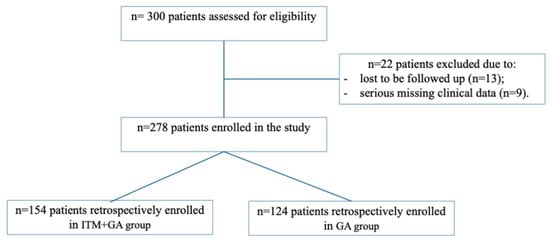
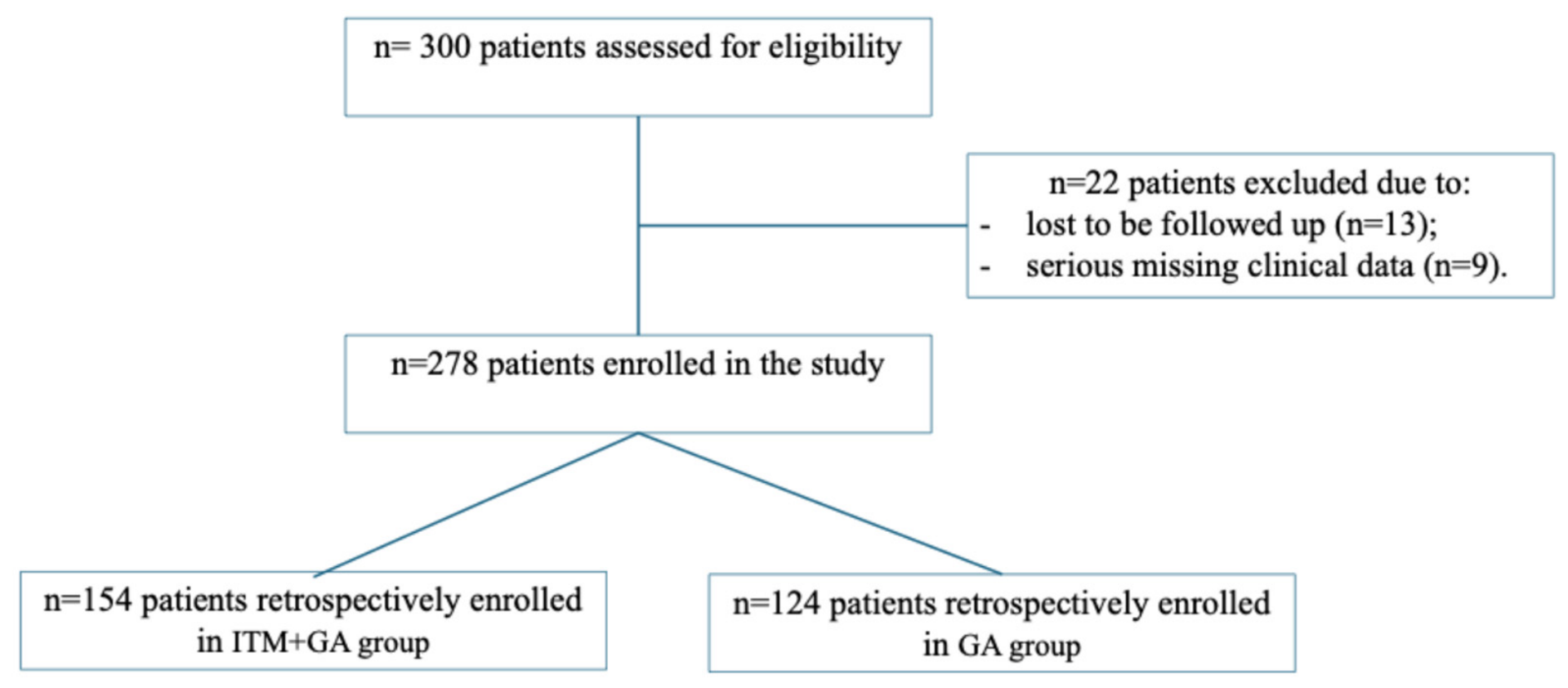
Of the 300 consecutive patients in the registry, 22 (7.3%) were excluded. A total of 278 patients were analyzed (ITM + GA group, n = 154; GA group, n = 124), which exceeded the estimated sample size of approximately 190 patients. The flow diagram for patient enrollment and analysis is shown in Figure 1.
Figure 1.
Flow diagram for patient enrollment and analysis.
Baseline characteristics, including age, BMI, ASA physical status, comorbidities, surgical approach and duration of surgery, were comparable between groups. In particular, the incidence of laparotomy was similar between the two groups (92/154 [59.7%] in the ITM + GA group and 67/124 [54.0%] in the GA group; p = 0.34). The distribution of cancer types did not differ significantly overall (p = 0.06), but cervical cancer was more frequent in the ITM + GA group (18.8% vs. 8.9%; p = 0.02) (Table 1).
Table 1.
Baseline characteristics, preoperative and surgery data.
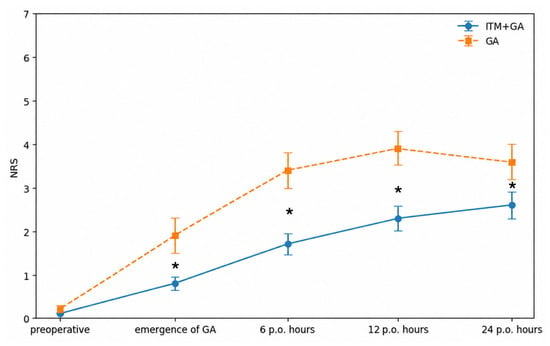
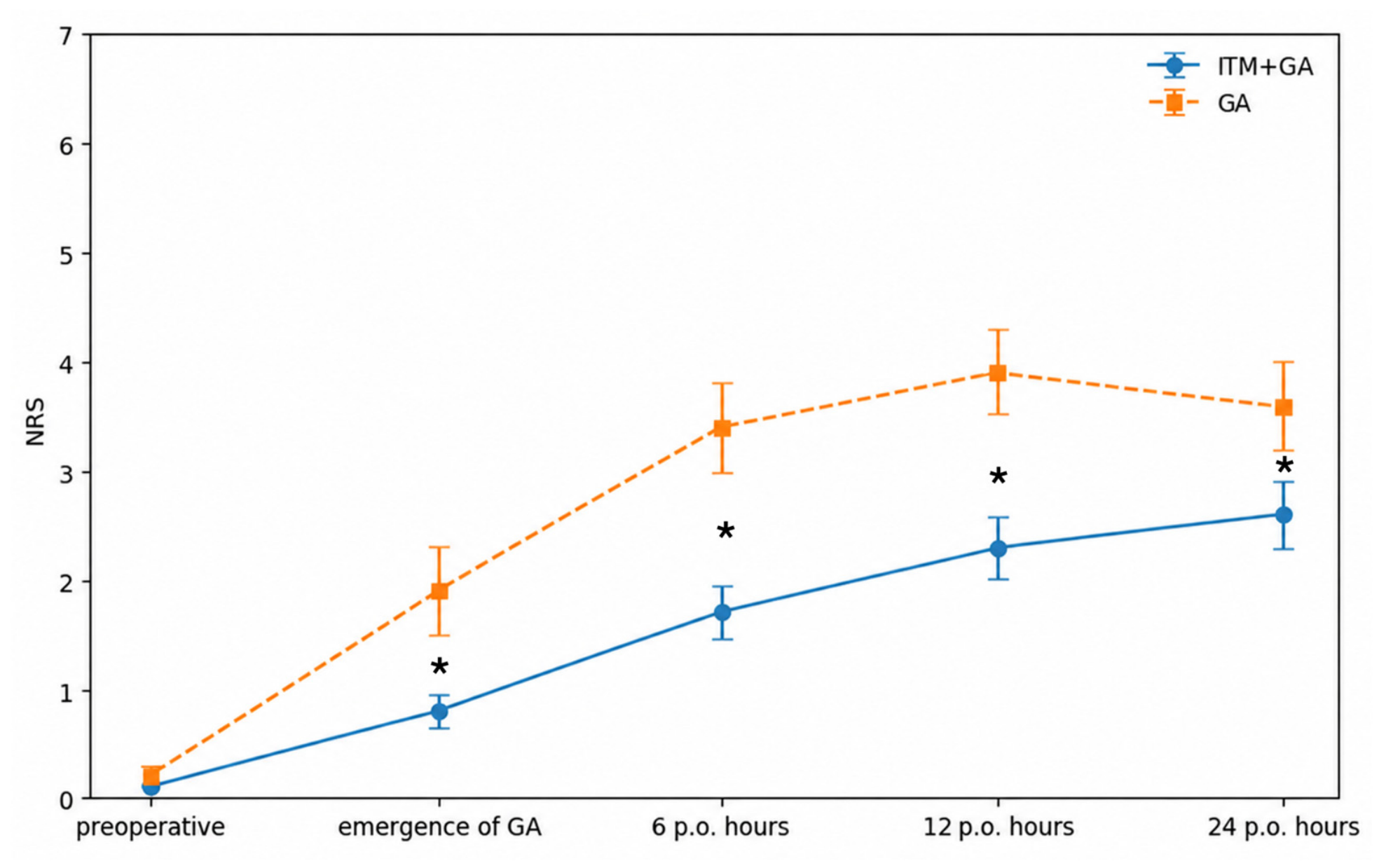
Pain scores were lower in the ITM + GA group throughout the postoperative period. Mean NRS scores were significantly lower in the ITM + GA group at emergence and at 6, 12, and 24 h (all p < 0.05 vs. GA), while preoperative pain levels did not differ between groups. The greatest difference was observed at 6 and 12 h, narrowing thereafter but remaining statistically significant at 24 h (Figure 2).
Figure 2.
Pain intensity maximum value (NRS) by time point. * p < 0.05 between groups.
Descriptive statistics of Pain intensity (NRS) (mean [95% CI]) are reported in Table 2.
Table 2.
Pain intensity (NRS) at each time point.
Intraoperative sufentanil requirements were significantly lower with ITM + GA (43.6 ± 20.6 µg) compared with GA (64.0 ± 26.7 µg; p < 0.001). In the GA group, QLB was performed in 61 patients (49.2%), TAP block in 40 patients (32.3%), and wound infiltration in 23 patients (18.5%).
The proportion of patients requiring adjunctive rescue analgesia was lower in the ITM + GA group (5.2%) than in the GA group (78.2%; p < 0.001). The mean dose of PCA intravenous morphine consumed in the GA group in the first 24 h was 9.2 ± 2.1 mg; by design, patients in the ITM + GA group did not receive PCA, so opioid consumption is not directly comparable between groups.
Pruritus was reported in 40.9% of patients receiving ITM + GA compared with 24.2% of those in the GA group (p = 0.003). PONV occurred in 26.6% of patients in the ITM + GA group and in 16.9% of patients in the GA group; this difference did not reach statistical significance (p = 0.054). Recovery room stay was shorter with ITM + GA (115.9 ± 53.4 min) than with GA (148.4 ± 97.0 min), although this difference did not reach statistical significance. No episodes of respiratory depression, as defined in the Methods, were recorded in either group. One case of orthostatic headache occurred in the ITM + GA group and resolved within 24 h with supine rest. Early mobilization and postoperative ileus outcomes were comparable between groups (Table 3).
Table 3.
Intraoperative and recovery data.
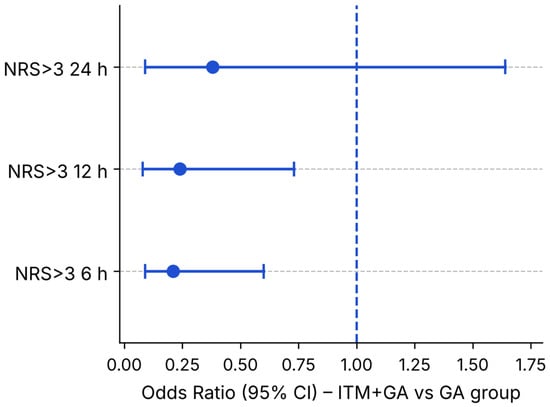
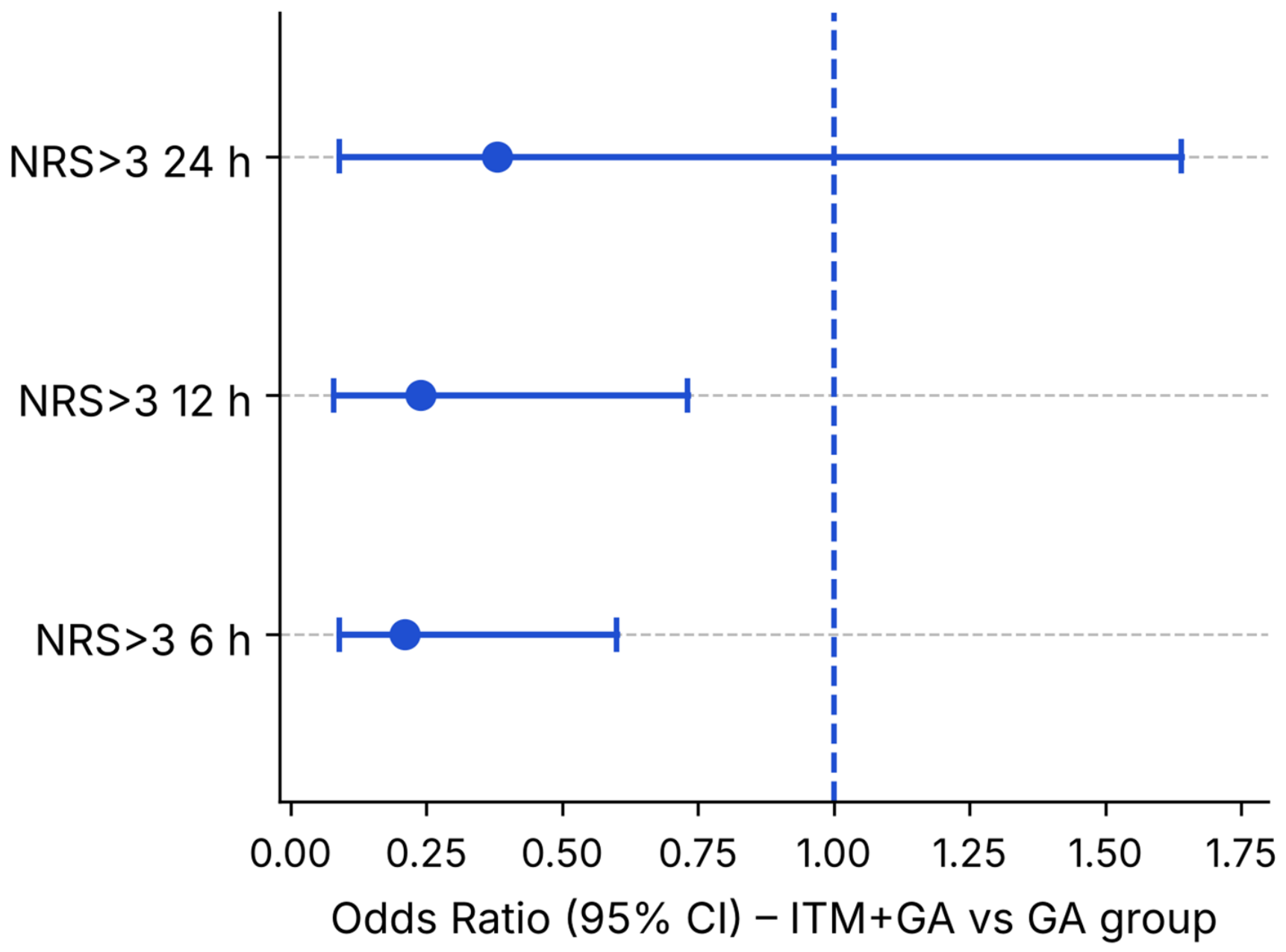
In multivariable logistic regression, ITM + GA was independently associated with lower odds of NRS >3 at 6 h (OR 0.21, 95% CI 0.09–0.60; p = 0.01) and at 12 h (OR 0.24, 95% CI 0.08–0.73; p = 0.01). At 24 h, the estimate favored ITM + GA but was not statistically significant (OR 0.38, 95% CI 0.09–1.64; p = 0.19) (Table 4 and Figure 3).
Table 4.
Multivariable logistic regression for clinically relevant pain (NRS > 3): main model adjusted for age (per year), BMI (per unit), ASA (per class), anesthetic technique (ITM + GA vs. GA), surgical approach (laparotomy vs. laparoscopy), intraoperative sufentanil (10 µg increments), and duration of surgery (per 30 min).
Figure 3.
Forest plot of adjusted odds ratios (95% CI) for ITM + GA vs. GA group on the risk of NRS > 3 at 6, 12 and 24 h.
Laparotomy, intraoperative sufentanil dose and duration of surgery were not associated with NRS > 3 at any time point after adjustment.
4. Discussion
In this retrospective cohort study of women undergoing cytoreductive surgery for gynecologic cancer, the addition of 100 μg ITM to GA was associated with lower postoperative pain scores from emergence through 24 h, compared with a GA-based multimodal strategy that included a fascial plane block or wound infiltration and intravenous morphine PCA. After adjustment for age, BMI, ASA physical status, surgical approach, intraoperative sufentanil and duration of surgery, ITM + GA was independently associated with lower odds of clinically relevant pain (NRS > 3) at 6 and 12 h. At 24 h, the association remained in the same direction but was not statistically significant, consistent with the gradual convergence of pain trajectories and the expected waning of the intrathecal effect; the wide confidence interval at this time point, however, means that neither a relevant benefit nor its absence can be excluded.
These differences also appear clinically relevant. The between-group differences in mean NRS at 6 and 12 h exceed the minimal clinically important difference of about 1 point [18], whereas the difference at 24 h lies around this threshold. Consistently, rescue analgesia was required far less often with ITM + GA (5.2% vs. 78.2%).
Our findings are in line with randomized and observational studies showing that neuraxial opioids provide superior early analgesia and reduce systemic opioid requirements after major abdominal surgery [5,6,7,8]. In gynecologic oncology, ITM or epidural analgesia improved postoperative recovery compared with conventional strategies in a randomized trial [8], and Bang et al., in 68 women with ASA physical status I–II undergoing cytoreductive surgery, reported lower morphine consumption and higher satisfaction with ITM, while calling for further research to optimize intrathecal opioid use in oncologic settings [6]. Other findings likewise confirm robust early analgesia with ITM in abdominal surgery [11]. The prolonged effect is explained by the hydrophilic profile of morphine, whose delayed rostral spread in the cerebrospinal fluid provides segmental analgesia for up to 24 h; the lower pain scores still observed at 24 h may also reflect more effective early analgesia and the synergy of ITM with the multimodal regimen. Our study adds to this evidence by focusing on a well-defined gynecologic oncology population and by quantifying, with adjusted models, the magnitude and time course of the association between ITM and clinically relevant pain.
These results must be interpreted in the light of the comparator. The GA group did not receive general anesthesia alone, but a multimodal strategy in which one of three locoregional techniques (QLB, TAP block or wound infiltration) was combined with intravenous morphine PCA. These techniques provide predominantly somatic analgesia of the abdominal wall, with limited effect on visceral pain and have variable efficacy after open cytoreductive surgery [3,4,5]. Our results therefore estimate the effect of an ITM-based strategy compared with the locoregional-plus-PCA strategy routinely used at our institution, rather than the isolated effect of intrathecal morphine. This comparator reflects real-world practice, in which fascial plane blocks and wound infiltration are the most common alternatives to neuraxial techniques.
Consistent with prior reports [12,13,14,15,16,17,19,20,21,22,23,24], ITM + GA was associated with a higher rate of pruritus and a numerically higher rate of PONV, both generally self-limiting and manageable with standard prophylaxis and rescue therapy (e.g., ondansetron); neither delayed early mobilization nor gastrointestinal recovery. Respiratory depression remains the main concern with neuraxial opioids, but its risk at low doses is small in appropriately monitored settings [7,8,9,10,11,15]: a recent meta-analysis of 127 randomized trials by El-Boghdadly et al. found that ITM was not associated with increased sedation or hypoxemia, whereas doses > 500 μg carried a greater risk of respiratory depression [12]. The absence of recorded respiratory depression in our cohort is consistent with these data but must be interpreted cautiously, because a sample of 154 exposed patients cannot establish safety with respect to uncommon but serious complications. Careful surveillance during the first 24 postoperative hours therefore remains mandatory, particularly in high-risk patients (e.g., obesity, obstructive sleep apnea, chronic pulmonary disease or chronic sedative/opioid use).
From a practical standpoint, single-shot ITM is a low-complexity technique: unlike catheter-based neuraxial analgesia, it avoids catheter-related complications and resource demands, requires minimal postoperative maintenance and does not interfere with mobilization. In our cohort, it was also associated with lower intraoperative opioid requirements, less rescue analgesia and a non-significant trend toward a shorter recovery room stay. The 100 μg dose lies at the lower end of the range commonly used in major abdominal surgery, whereas higher doses may provide incremental analgesia at the cost of more pruritus and PONV [15]. Within the limits of an observational design and a heterogeneous comparator, our data suggest that 100 μg ITM may be a reasonable option for cytoreductive gynecologic surgery within ERAS protocols, provided that appropriate monitoring, opioid stewardship, multimodal co-analgesia and proactive antiemetic prophylaxis are ensured; they do not, however, establish this dose as optimal or universally appropriate.
Our findings also have implications for personalized perioperative medicine. Personalized anesthesia implies choosing, for each patient, the analgesic strategy whose expected benefit–risk balance best matches her clinical profile and preferences. From this perspective, ITM and fascial plane block-based strategies are not competing universal standards, but complementary options within an individualized pathway. Our data quantify the elements of this trade-off: a lower probability of clinically relevant pain during the first 12 h and less need for rescue analgesia with ITM, at the cost of more pruritus and possibly more PONV. ITM may therefore be preferable in patients undergoing extended laparotomy with a major visceral pain component or at high risk of severe early postoperative pain, whereas a fascial plane block-based strategy may be favored in patients with contraindications to neuraxial puncture (e.g., ongoing anticoagulation) or with conditions that call for caution with neuraxial opioids, such as respiratory disease, obesity or frailty. Integrating these clinical factors with known predictors of postoperative pain (e.g., preoperative pain, anxiety and pain catastrophizing) and, in the future, with pharmacogenomic determinants of opioid response could support individualized analgesic algorithms for women undergoing cytoreductive surgery, with potential benefits for analgesic quality and safety in frail, high-risk patients.
Several questions remain open. Dose–response studies (e.g., 75 vs. 100 vs. 150 μg) should determine whether lower doses provide comparable analgesia in cytoreductive gynecologic surgery with fewer opioid-related adverse effects, such as PONV and pruritus. Prospective randomized trials should compare ITM with a single, standardized fascial plane block, with blinded outcome assessment and follow-up beyond 24 h (e.g., pain and opioid use at 48–72 h, quality of recovery and chronic postsurgical pain), and should test whether risk-stratified, patient-tailored allocation improves outcomes compared with a uniform approach.
This study has several strengths: the inclusion of consecutive patients from a dedicated acute pain service registry, standardized pain assessment at predefined time points, an identical non-opioid multimodal regimen and PONV prophylaxis in both groups and a sample size exceeding the a priori estimate in a homogeneous population.
It also has several limitations. First, the retrospective, non-randomized design entails a risk of selection bias and residual confounding that cannot be excluded despite adjustment. In addition, the limited number of events may have introduced instability into some regression estimates. Second, the comparator group was heterogeneous. Third, follow-up was limited to the first 24 postoperative hours, so later outcomes (pain and opioid consumption at 48–72 h, quality of recovery, length of stay and chronic postsurgical pain) could not be assessed. Fourth the sample size did not allow meaningful subgroup analyses (e.g., ITM versus each regional block, or laparoscopy versus laparotomy), and the study was not powered to detect rare adverse events such as respiratory depression.
5. Conclusions
In this retrospective single-center cohort, 100 μg intrathecal morphine added to general anesthesia was associated with lower pain scores in the first 24 postoperative hours and lower odds of clinically relevant pain (NRS > 3) at 6 and 12 h, but not at 24 h, compared with a heterogeneous GA-based multimodal strategy including fascial plane block or wound infiltration and intravenous morphine PCA. Given the observational design, the heterogeneous comparator and the 24-h follow-up, these findings are associative; they suggest that low-dose ITM may be a feasible adjunct within ERAS programs for cytoreductive gynecologic oncology surgery. From a personalized medicine perspective, the magnitude and time course of the analgesic benefit may help clinicians tailor the choice between ITM and fascial plane block-based strategies to each patient’s clinical profile. Prospective randomized trials with a standardized comparator and longer follow-up are warranted to confirm these findings, optimize dosing strategies, and evaluate integration with multimodal analgesic regimens.
Author Contributions
Conceptualization, S.C. and G.D.; Methodology, S.C.; Validation, S.C.; Formal analysis, S.C., B.A.Z., E.C., G.M.M., G.L.G., P.P.G., L.F., M.C., F.M., P.L. and G.D.; Writing—original draft, S.C., B.A.Z., E.C., G.M.M., G.L.G., P.P.G., L.F., M.C., F.M., P.L. and G.D.; Writing—review & editing, S.C., B.A.Z., E.C., G.M.M., G.L.G., P.P.G., L.F., M.C., F.M., P.L. and G.D. All authors have read and agreed to the published version of the manuscript.
Funding
This research received no external funding.
Institutional Review Board Statement
The study was conducted in accordance with the Declaration of Helsinki, and approved by the Policlinico Universitario A. Gemelli Ethics Committee (protocol ID 5421; 9 February 2023).
Informed Consent Statement
Informed consent for data extraction and processing was obtained from all subjects involved in the study.
Data Availability Statement
The original contributions presented in this study are included in the article. Further inquiries can be directed to the corresponding author.
Conflicts of Interest
The authors declare no conflicts of interest.
Abbreviations
The following abbreviations are used in this manuscript:
| ITM | IntraThecal Morphine |
| ERAS | Enhanced Recovery After Surgery |
| PONV | PostOperative Nausea and Vomiting |
| GA | General Anesthesia |
| QLB | Quadratus Lumborum block |
| TAP | Transversus Abdominis Plane block |
| MAC | Minimum Alveolar Concentration |
| NRS | Numerical Rating Scale |
| RR | Recovery Room |
| BMI | Body Mass Index |
| POD | PostOperative Day |
| PCA | Patient-Controlled Analgesia |
| OR | Odds Ratio |
References
- Nelson, G.; Bakkum-Gamez, J.; Kalogera, E.; Glaser, G.; Altman, A.; Meyer, L.A.; Taylor, J.S.; Iniesta, M.; Lasala, J.; Mena, G.; et al. Guidelines for perioperative care in gynecologic/oncology: Enhanced Recovery After Surgery (ERAS®) Society recommendations—2019 update. Int. J. Gynecol. Cancer 2019, 29, 651–668. [Google Scholar] [CrossRef] [Scilit]
- Nelson, G.; Fotopoulou, C.; Taylor, J.; Glaser, G.; Bakkum-Gamez, J.; Meyer, L.A.; Stone, R.; Mena, G.; Elias, K.; Altman, A.; et al. Enhanced recovery after surgery (ERAS®) Society guidelines for gynecologic oncology: Addressing implementation challenges—2023 update. Gynecol. Oncol. 2023, 173, 58–67. [Google Scholar] [CrossRef] [Scilit]
- Joshi, G.P.; Wu, C.L.; Moka, E.; Van de Velde, M.; Lobo, D.N.; PROSPECT Working Group of the European Society of Regional Anaesthesia and Pain Therapy (ESRA). A survey of knowledge about PROcedure-SPEcific Postoperative Pain ManagemenT (PROSPECT) recommendations. Eur. J. Anaesthesiol. 2025. Epub ahead of print. [Google Scholar] [CrossRef] [Scilit] [PubMed]
- Higgins, N.; Nelson, A.; Toledo, P. Deconstructing postoperative analgesia for gynecologic malignancy surgery: Stand-alone intrathecal morphine. Anesth. Analg. 2023, 137, 522–524. [Google Scholar] [CrossRef] [Scilit] [PubMed]
- Nathan, N. Intrathecal analgesia for gynecologic oncology surgery. Anesth. Analg. 2023, 137, 453–455. [Google Scholar] [CrossRef] [Scilit]
- Bang, Y.J.; Lee, E.K.; Kim, C.S.; Hahm, T.S.; Jeong, H.; Cho, Y.J.; Noh, J.J.; Lee, Y.-Y.; Choi, C.H.; Lee, J.-W.; et al. The effect of intrathecal morphine on postoperative opioid consumption in patients undergoing abdominal surgery for gynecologic malignancy: A randomized sham-controlled trial. Anesth. Analg. 2023, 137, 525–533. [Google Scholar] [CrossRef] [Scilit] [PubMed]
- Rawal, N. Intrathecal opioids for the management of post-operative pain. Best Pract. Res. Clin. Anaesthesiol. 2023, 37, 123–132. [Google Scholar] [CrossRef] [Scilit] [PubMed]
- Kjølhede, P.; Bergdahl, O.; Borendal Wodlin, N.; Nilsson, L. Effect of intrathecal morphine and epidural analgesia on postoperative recovery after abdominal surgery for gynecologic malignancy: An open-label randomised trial. BMJ Open 2019, 9, e024484. [Google Scholar] [CrossRef] [Scilit]
- Koning, M.V.; Teunissen, A.J.W.; van der Harst, E.; Ruijgrok, E.J.; Stolker, R.J. Intrathecal morphine for laparoscopic segmental colonic resection as part of an enhanced recovery protocol: A randomized controlled trial. Reg. Anesth. Pain Med. 2018, 43, 166–173. [Google Scholar] [CrossRef] [Scilit]
- Engström, A.J.E.; Ivarsson, C.A.; Aldergård, Å.; Henningsson, R.N. Analgesic effects of intrathecal morphine and bupivacaine during robotic-assisted surgery: A prospective randomized controlled study. Pain Pract. 2023, 23, 631–638. [Google Scholar] [CrossRef] [Scilit]
- El Sherif, F.A.; Othman, A.H.; Abd El-Rahman, A.M. Effect of adding intrathecal morphine to a multimodal analgesic regimen for postoperative pain management after laparoscopic bariatric surgery: A prospective, double-blind, randomized controlled trial. Br. J. Pain 2016, 10, 209–216. [Google Scholar] [CrossRef] [Scilit]
- El-Boghdadly, K.; Renard, Y.; Rossel, J.; Moka, E.; Volk, T.; Rawal, N.; Jaques, C.; Szyszko, M.; Albrecht, E. Pulmonary complications after intrathecal morphine administration: A systematic review and meta-analysis with meta-regression and trial sequential analysis. Anaesthesia 2025, 80, 959–972. [Google Scholar] [CrossRef] [Scilit] [PubMed]
- Renard, Y.; El-Boghdadly, K.; Rossel, J.B.; Nguyen, A.; Jaques, C.; Albrecht, E. Non-pulmonary complications of intrathecal morphine administration: A systematic review and meta-analysis with meta-regression. Br. J. Anaesth. 2024, 133, 823–838. [Google Scholar] [CrossRef] [Scilit] [PubMed]
- Ljungqvist, O.; Scott, M.; Fearon, K.C. Enhanced Recovery After Surgery: A review. JAMA Surg. 2017, 152, 292–298. [Google Scholar] [CrossRef] [Scilit] [PubMed]
- Gonvers, E.; El-Boghdadly, K.; Grape, S.; Albrecht, E. Efficacy and safety of intrathecal morphine for analgesia after lower joint arthroplasty: A systematic review and meta-analysis with meta-regression and trial sequential analysis. Anaesthesia 2021, 76, 1648–1658. [Google Scholar] [CrossRef] [Scilit] [PubMed]
- Meylan, N.; Elia, N.; Lysakowski, C.; Tramèr, M.R. Benefit and risk of intrathecal morphine without local anaesthetic in patients undergoing major surgery: Meta-analysis of randomized trials. Br. J. Anaesth. 2009, 102, 156–167. [Google Scholar] [CrossRef] [Scilit] [PubMed]
- Koning, M.V.; Klimek, M.; Rijs, K.; Stolker, R.J.; Heesen, M.A. Intrathecal hydrophilic opioids for abdominal surgery: A meta-analysis, meta-regression, and trial sequential analysis. Br. J. Anaesth. 2020, 125, 358–372. [Google Scholar] [CrossRef] [Scilit] [PubMed]
- Myles, P.S.; Myles, D.B.; Galagher, W.; Boyd, D.; Chew, C.; MacDonald, N.; Dennis, A. Measuring acute postoperative pain using the visual analog scale: The minimal clinically important difference and patient acceptable symptom state. Br. J. Anaesth. 2017, 118, 424–429. [Google Scholar] [CrossRef] [Scilit]
- Pirie, K.; Doane, M.A.; Riedel, B.; Myles, P.S. Analgesia for major laparoscopic abdominal surgery: A randomised feasibility trial using intrathecal morphine. Anaesthesia 2022, 77, 428–437. [Google Scholar] [CrossRef] [Scilit] [PubMed]
- Rebel, A.; Sloan, P.; Andrykowski, M. Retrospective analysis of high-dose intrathecal morphine for analgesia after pelvic surgery. Pain Res. Manag. 2011, 16, 19–26. [Google Scholar] [CrossRef] [Scilit]
- Tang, J.Z.J.; Weinberg, L. A literature review of intrathecal morphine analgesia in patients undergoing major open hepato-pancreatic-biliary (HPB) surgery. Anesth. Pain Med. 2019, 9, e94441. [Google Scholar] [CrossRef] [Scilit] [PubMed]
- Pirie, K.P.; Wang, A.; Yu, J.; Twelves, C.; Foo, I. Postoperative analgesia for upper gastrointestinal surgery: A retrospective cohort analysis. Perioper. Med. 2023, 12, 40. [Google Scholar] [CrossRef] [Scilit]
- Tong, C.; Yue, Y.; Wei, H. A pain model after gynecologic surgery: The effect of intrathecal and systemic morphine. Anesth. Analg. 2006, 103, 1288–1293. [Google Scholar] [CrossRef] [Scilit]
- Gehling, M.; Tryba, M. Risks and side-effects of intrathecal morphine combined with spinal anaesthesia: A meta-analysis. Anaesthesia 2009, 64, 643–651. [Google Scholar] [CrossRef] [Scilit]

Disclaimer/Publisher’s Note: The statements, opinions and data contained in all publications are solely those of the individual author(s) and contributor(s) and not of MDPI and/or the editor(s). MDPI and/or the editor(s) disclaim responsibility for any injury to people or property resulting from any ideas, methods, instructions or products referred to in the content. |
© 2026 by the authors. Licensee MDPI, Basel, Switzerland. This article is an open access article distributed under the terms and conditions of the Creative Commons Attribution (CC BY) license.