


Abstract
Background/Objectives: The bioadaptor represents a novel alternative to drug-eluting stents (DESs) for percutaneous coronary intervention (PCI). We aimed to synthesize and critically appraise randomized evidence comparing bioadaptors with contemporary DES with regard to clinical outcomes. Methods: We searched PubMed, Embase, Scopus, MEDLINE Ultimate, and Web of Science through 9 September 2026 for randomized controlled trials (RCTs) enrolling adult patients undergoing PCI with either a bioadaptor or DES. Risk of bias was assessed using the RoB 2 tool. The primary endpoint was target lesion failure (TLF), defined as a composite of cardiovascular death, target vessel myocardial infarction, and clinically driven target lesion revascularization. Secondary endpoints included the individual components of TLF, device thrombosis, patient-oriented composite endpoint, all-cause mortality, clinically driven target vessel revascularization, non-target vessel myocardial infarction (NTV-MI), and stroke. Results: Three RCTs met the inclusion criteria, of which two were included in the quantitative synthesis. The primary analysis comprised 2835 patients. At 12-month follow-up, no significant difference in TLF was observed between bioadaptors and DES (RR: 0.82, 95% CI: 0.51–1.30). No statistically significant differences were observed for any of the pooled secondary endpoints. Pooled estimates for NTV-MI and stroke could not be calculated because of non-estimable risk ratios. The certainty of evidence ranged from low to moderate across the evaluated outcomes. Conclusions: The available randomized evidence shows no statistically significant differences between bioadaptors and contemporary DES in clinical outcomes at 12-month follow-up. However, the certainty of evidence ranges from low to moderate, warranting cautious interpretation of these findings.
1. Introduction
The development of modern drug-eluting stents (DESs) has led to significantly better long-term clinical outcomes for patients with coronary artery disease who undergo percutaneous coronary intervention (PCI) [1]. However, the risk of stent-related adverse events persists after the first year, occurring at an annual rate of approximately 2–4% and showing no discernible plateau over time [1,2,3]. A primary disadvantage of traditional DES technology is the permanent presence of a metallic prosthesis within the coronary artery. This rigid structure suppresses the vessel’s natural compliance, which interferes with its intrinsic biomechanical behavior and compromises vital physiological processes [4,5,6].
The technology of bioresorbable materials was tested in the past with completely bioresorbable scaffolds. The idea was that if the stent disappeared over time, the natural functions of coronary vessels would be restored. However, trials yielded ambiguous results and some disturbing safety signals [7,8]. In recent years, newer devices have emerged in an attempt to improve those outcomes.
The DynamX™ Bioadaptor, a new class of coronary implant, was designed to provide the immediate support of a metallic DES with the ability to restore the vessel’s natural long-term function. This is accomplished through a novel design featuring unique “uncaging elements” integrated within its sinusoidal rings. Initially, these elements are secured by a polymer coating that is designed to be absorbed over approximately six months. As the coating dissolves, the elements are released, unlocking the scaffold’s rigid structure and uncaging the artery. This, in theory, allows the vessel to regain its natural physiological movement, including expansion and contraction [9,10]. Early mechanistic and imaging studies suggest that the uncaging process causes improvements in vascular function, including a 70% reduction in peak device stress, restoration of coronary rotational motion [9], improvement in cyclic pulsatility [10] and restoration of segmental compliance at follow-up [6], although those studies do not address the impact of mechanical improvements on clinical outcomes. Subsequently, pivotal randomized controlled trials (RCTs) such as BIOADAPTOR-RCT and INFINITY-SWEDEHEART have since established that, for the primary outcome of target lesion failure (TLF) at one year, the bioadaptor’s performance is non-inferior to that of contemporary DES. Furthermore, these trials have indicated superior results on imaging, such as reduced late lumen loss. They also revealed a potential clinical advantage emerging six months post-procedure, a timeframe that corresponds with the device’s uncaging process [11,12].
While these initial results are promising, individual studies vary in methodology, patient populations, and endpoint selection. A recent systematic review and meta-analysis included a pairwise comparison of coronary bioadaptors and DES across three randomized trials, as well as separate single-arm landmark analyses [13]. We aimed to complement previous evidence by assessing additional patient- and vessel-oriented outcomes, namely the patient-oriented composite endpoint (POCE), all-cause mortality, and clinically-driven target vessel revascularization (CD-TVR). Additionally, we reported pooled risk ratios and appraised the certainty of the evidence using the GRADE framework.
2. Materials and Methods
2.1. Eligibility Criteria
This systematic review and meta-analysis adhered to the PRISMA 2020 guidelines (Supplementary Materials, Table S1). We included RCTs enrolling adult patients undergoing PCI due to chronic or acute coronary syndrome treated with either a bioadaptor or drug-eluting stent (DES). We included only studies that reported the primary endpoint, TLF. Book chapters, case reports, commentaries, conference abstracts, editorials, errata, guidelines, letters to the editor, notes, preprints, protocols, reviews (systematic reviews, narrative reviews, meta-analyses) and studies published exclusively in non-English languages were excluded from this review.
2.2. Information Sources
We searched five databases: PubMed, Embase, Scopus, MEDLINE Ultimate and Web of Science. Each database was last searched on 9 September 2026. Trial registries and conference proceedings were not searched.
2.3. Search Strategy
The exact search strategy used for each database can be found in the Supplementary Materials (Method S1). No filters were applied during the database searches.
2.4. Selection Process
The screening process was performed by two independent teams using EndNote Reference Manager Version 21.5 and rerun on 9 September 2026 by GP and KJ working independently. Each time, the screening process consisted of five stages: duplicate removal, records screening based on article type, eligibility assessment based on title and abstract, search for full-texts, and full-publications evaluation for inclusion. All inconsistencies identified were discussed and resolved by reaching a consensus among the reviewers.
2.5. Data Collection Process
Data for each eligible study were extracted by two teams. The information of interest included study type, enrollment period, follow-up duration, number of patients in respective cohorts, patient baseline characteristics, and outcome details. Extracted data were entered into Cochrane RevMan Web Version 9.10.0.
2.6. Data Items
We collected all available data for the intervention and control groups for the following outcomes at 12 months: (a) TLF, (b) cardiovascular death, (c) target vessel myocardial infarction (TV-MI), (d) clinically-driven target lesion revascularization (CD-TLR), (e) device thrombosis, (f) POCE, (g) all-cause mortality, (h) CD-TVR, (i) non-target vessel myocardial infarction (NTV-MI), (j) stroke. For all the above-mentioned outcomes, we collected the number of events in each group. We also collected the percentages for the following procedural outcomes: (a) procedure success, (b) device success, (c) post-dilation.
For each group, we collected baseline characteristics data: age [years], male sex [%], smoking status [%], diabetes [%], hypertension [%], hyperlipidemia/dyslipidemia [%], previous MI [%], previous PCI [%], previous coronary artery bypass grafting [%], current coronary syndrome type [%], target vessel [%], target lesion classification B2/C [%], bifurcation [%], calcified lesion (moderate/severe) [%], tortuous lesion (moderate/severe) [%], reference vessel diameter [mm] and lesion length [mm]. In the Erlinge et al. [11] and Saito et al. [12] studies, vessel and lesion characteristics at the index procedure were assessed preferably using quantitative coronary angiography (QCA) or visual assessment if QCA was not available. In the Tsai et al. study [14], coronary computed tomography angiography (CCTA) was mandatory to assess coronary vessels and include patients in the study.
2.7. Endpoint Definition
The primary endpoint was TLF as a composite of cardiovascular death, TV-MI, and CD-TLR. The secondary endpoints included: (a) individual components of TLF, (b) device thrombosis, (c) POCE (the composite of all-cause mortality, stroke, myocardial infarction and revascularization), (d) all-cause mortality, (e) CD-TVR, (f) NTV-MI, and (g) stroke.
Detailed definitions of TLF and its components used by the included studies can be found in Supplementary Materials—Table S2.
2.8. Study Risk of Bias Assessment
The risk of bias was assessed with the use of the RoB 2 tool. Each study included in the quantitative analysis was evaluated by two teams consisting of randomly selected authors, with any discrepancies being resolved by consensus.
2.9. Effect Measures
We calculated pooled estimates for all dichotomous variables by calculating the overall risk ratio (RR) with 95% confidence intervals (95% CIs).
2.10. Synthesis Methods
For synthesis, we considered eligible studies that unambiguously reported the primary outcome. Given the limited information available to estimate between-study variance, a fixed-effect inverse-variance model was used to derive pooled RRs with 95% CIs. For formal assessment of heterogeneity, a chi-square test was used with I2 statistics to evaluate its degree. Each outcome was presented on a forest plot with risk of bias assessment next to each study. We performed a sensitivity analysis comparing pooled RRs and 95% CIs from fixed-effect and random-effects models for all outcomes included in the meta-analysis. The random-effects model used inverse-variance weighting, restricted maximum likelihood (REML) to estimate between-study variance (τ2), and Wald-type 95% CIs for the pooled RRs. We used an AI-based language model (ChatGPT GPT-6.1 Sol, OpenAI, San Francisco, CA, USA) to assist with editing of the manuscript text; the authors remain fully responsible for the content.
2.11. Reporting Bias Assessment
Due to a limited number of included studies, we did not formally assess the publication bias.
2.12. Certainty Assessment
The certainty of evidence was assessed for all outcomes included in the quantitative synthesis. Five GRADE considerations were applied: risk of bias, inconsistency, indirectness, imprecision, and publication bias. The certainty of evidence was judged as high, moderate, low, or very low. The summary of findings table was prepared with GRADEpro GDT software [15].
2.13. Registration and Protocol
This systematic review has been registered in the International Prospective Register of Systematic Reviews (PROSPERO) under CRD42024620913. We did not prepare the protocol other than the PROSPERO registry record. Compared with the PROSPERO record, we restricted eligibility to English-language reports of trials reporting TLF and limited pooling to 12-month outcomes. The registered plan specified a random-effects model with the DerSimonian–Laird estimator for the primary synthesis. We used a fixed-effect model for the primary synthesis and a random-effects model with the REML estimator in a sensitivity analysis. The planned subgroup analyses and meta-regression were not performed due to the limited number of included studies. POCE was added as a secondary outcome, and the GRADE framework was used to assess the certainty of evidence. Two prespecified outcomes, target vessel failure and lesion success, were not reported separately in this review.
3. Results
3.1. Study Selection
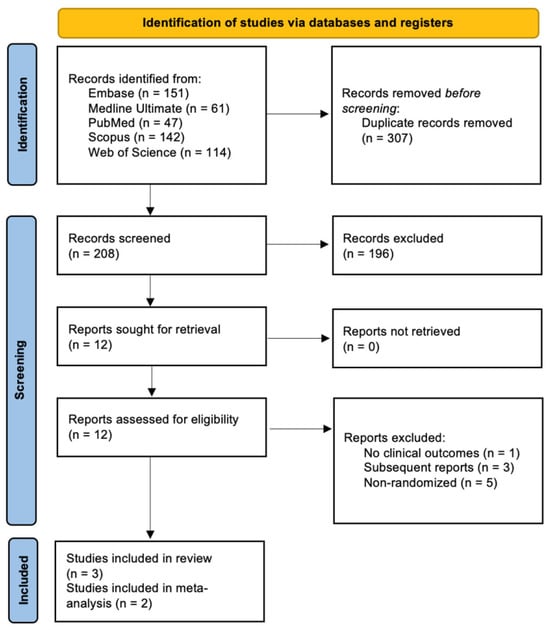
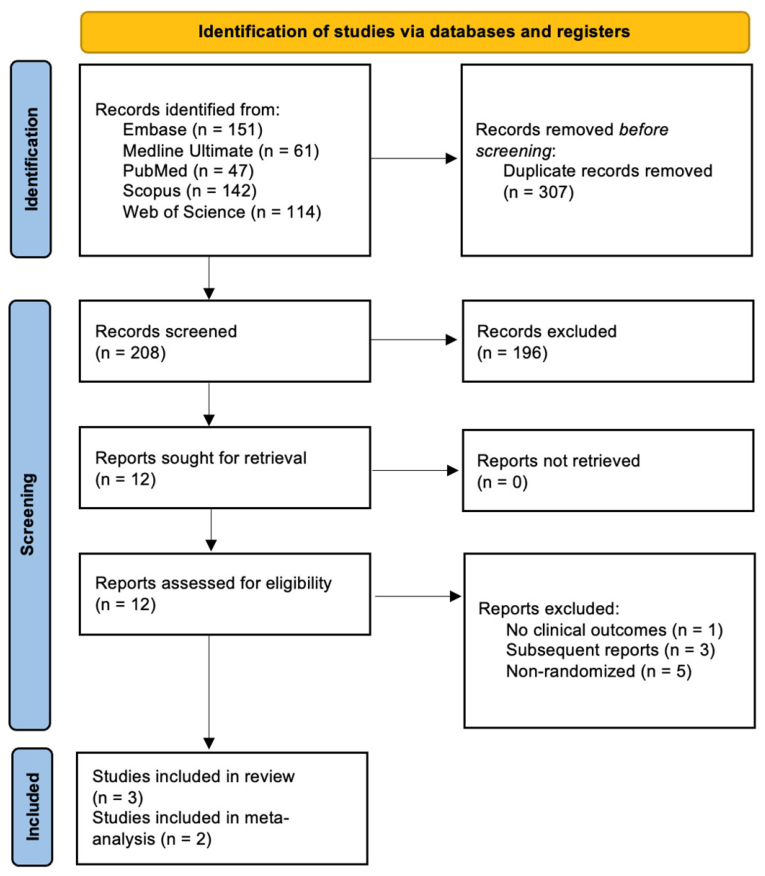
The initial search yielded a total of 515 records. After we removed 307 duplicates, we screened the remaining 208 records by article type. We excluded 104 records based on article type. The remaining 104 records were screened based on title and abstract. This yielded 12 articles that were deemed appropriate and were chosen for full-text search. All studies were retrieved in complete form. We assessed the complete data reports for these articles, and we evaluated them for eligibility, excluding 9 studies due to (1) no clinical outcomes reported [9], (2) subsequent reports of other studies [3,6,16], (3) non-randomized studies [10,17,18,19,20]. Ultimately, three RCTs were included in the systematic review [11,12,14] and two RCTs were included in the meta-analysis [11,12] (Figure 1).
Figure 1.
The flowchart for the selection process; n—number of studies.
We included the study by Tsai et al. [14] in the systematic review but not in the meta-analysis. All 48 analyzed participants (24 per arm) completed 12-month follow-up. The authors reported no TLF events, myocardial infarctions, or deaths. With zero TLF events in both arms, the study-specific RR was non-estimable under our pooling method.
3.2. Study Characteristics
The baseline characteristics of participants in each included study are reported in Table 1. The procedural characteristics are presented in Supplementary Materials, Table S3. The two trials contributing to the quantitative synthesis randomized 2844 patients. The denominators used to calculate the pooled 12-month TLF RR totaled 2835 patients, comprising 436 from BIOADAPTOR-RCT and 2399 from INFINITY-SWEDEHEART. Sample sizes for secondary outcomes varied because BIOADAPTOR-RCT reported outcome-specific denominators.
Table 1.
Baseline characteristics of patients in included studies. The continuous variables are reported as mean (SD) or median (IQR), as in the primary source. The categorical variables are reported as percentages. Abbreviations: ACS, acute coronary syndrome; CABG, coronary artery bypass graft; CCS, chronic coronary syndrome; DES, drug-eluting stent; MI, myocardial infarction; n/a, not available; PCI, percutaneous coronary intervention.
3.3. Primary Endpoint
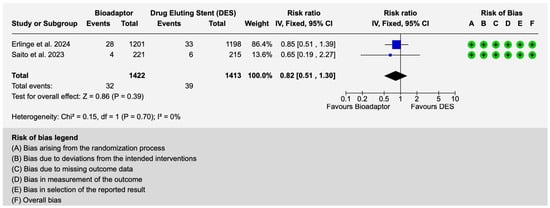
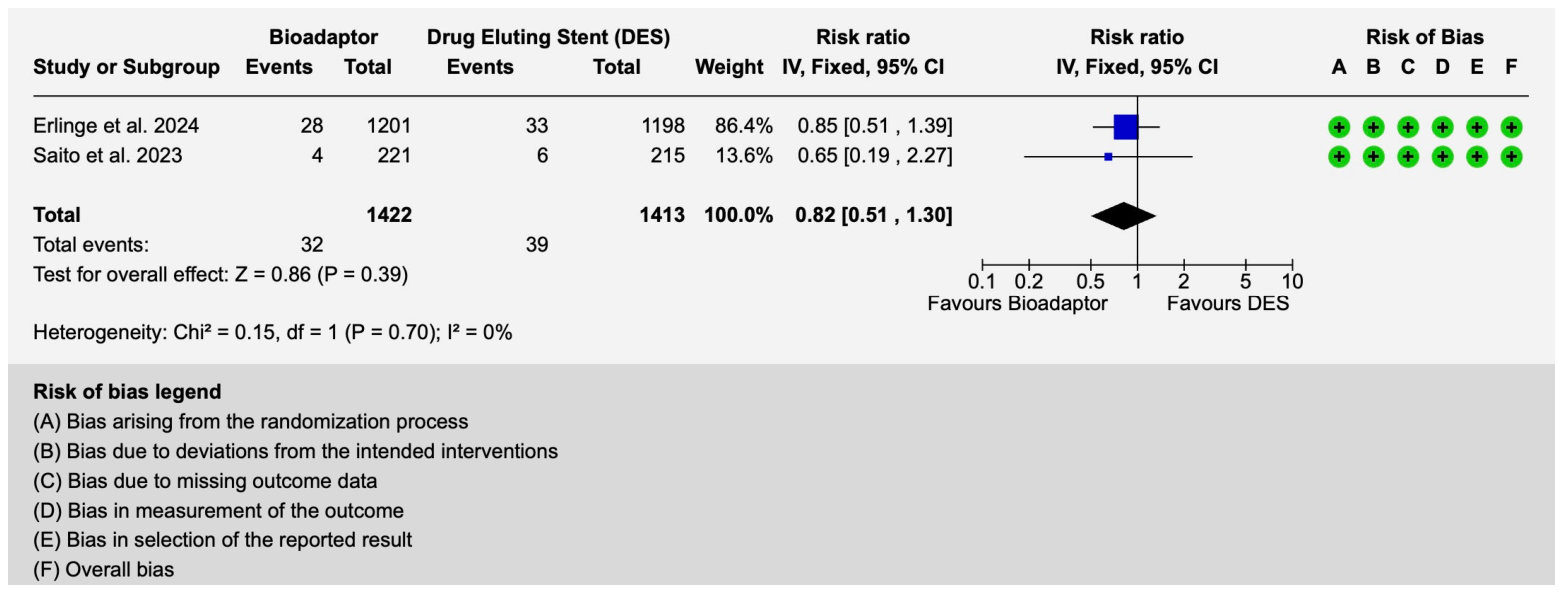
Two RCTs, including a total of 2835 patients undergoing PCI, contributed to the pooled analysis of target lesion failure. The pooled estimate showed no statistically significant difference between the groups treated with a bioadaptor and DES (RR: 0.82, 95% CI: [0.51, 1.30], p = 0.39, I2 = 0%, Figure 2). The certainty of evidence was assessed as moderate (Supplementary Materials, Table S4).
Figure 2.
Forest plot comparing target lesion failure of patients undergoing percutaneous coronary intervention between the group treated with a bioadaptor and the group treated with a drug-eluting stent [11,12]. The pooled estimate showed no statistically significant difference between the groups.
3.4. Secondary Endpoints
3.4.1. Individual Components of Target Lesion Failure
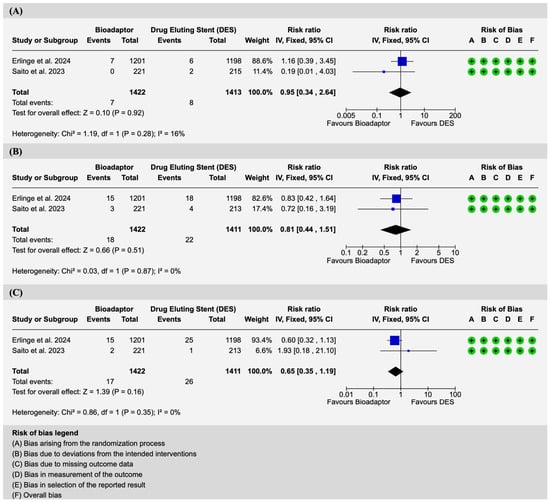
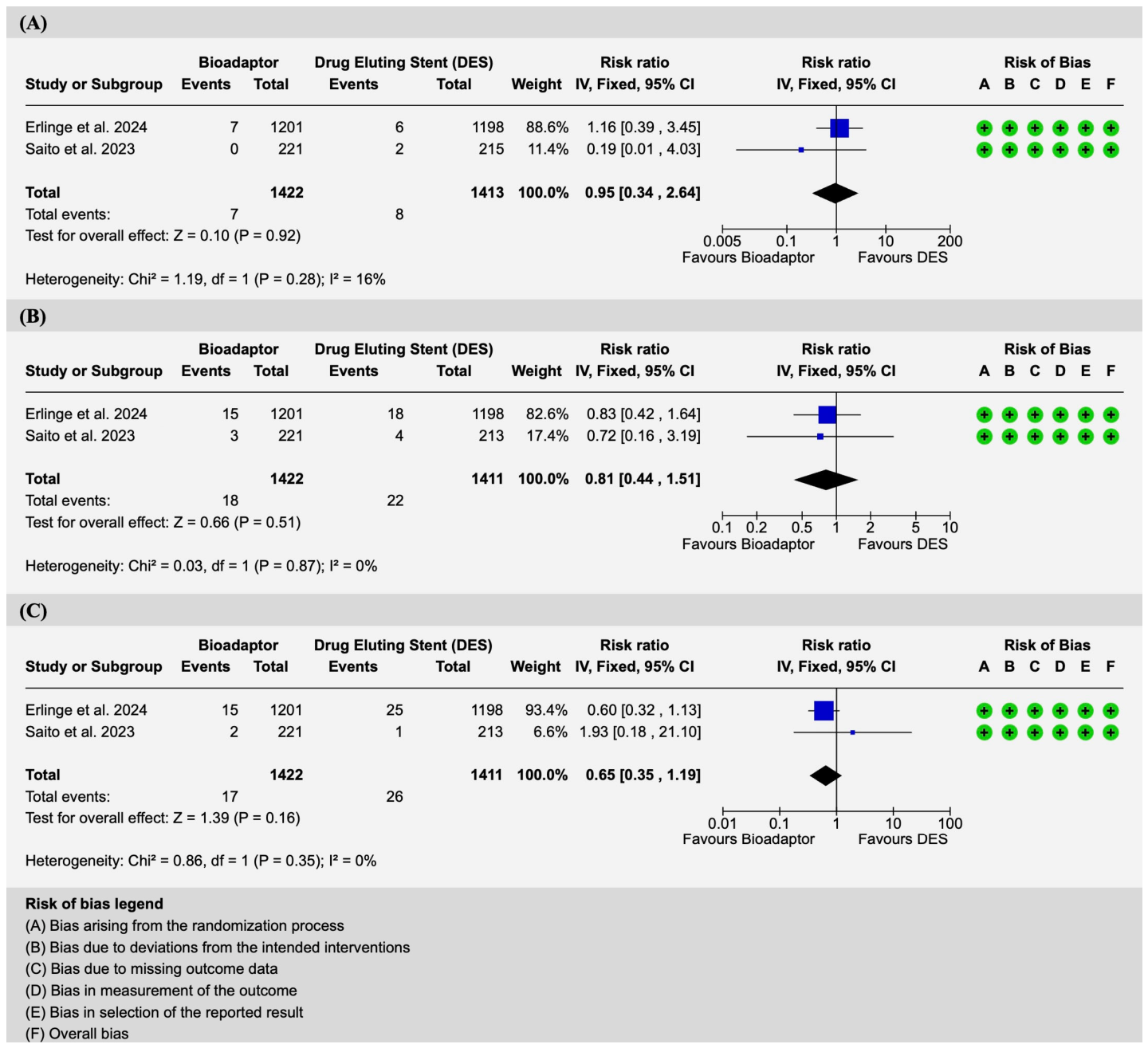
Two RCTs, including a total of 2835 patients undergoing PCI, reported cardiovascular death, and two RCTs, including a total of 2833 patients undergoing PCI, reported TV-MI and CD-TLR. The pooled estimate showed no statistically significant difference between the groups treated with a bioadaptor and DES in cardiovascular death (RR: 0.95, 95% CI: [0.34, 2.64], p = 0.92, I2 = 16%, Figure 3A), TV-MI (RR: 0.81, 95% CI: [0.44, 1.51], p = 0.51, I2 = 0%, Figure 3B), and CD-TLR (RR: 0.65, 95% CI: [0.35, 1.19], p = 0.16, I2 = 0%, Figure 3C). The certainty of evidence was assessed as low for cardiovascular death and CD-TLR, and as moderate for TV-MI (Supplementary Materials, Table S4).
Figure 3.
Forest plots comparing individual components of target lesion failure: cardiovascular death (A), target vessel myocardial infarction (B), and clinically-driven target lesion revascularization (C) in patients undergoing percutaneous coronary intervention between the group treated with a bioadaptor and the group treated with a drug-eluting stent [11,12]. The pooled estimate showed no statistically significant difference between the groups in any of the outcomes.
3.4.2. Device Thrombosis
Two RCTs, including a total of 2834 patients undergoing PCI, reported device thrombosis. The pooled estimate showed no statistically significant difference between the groups treated with a bioadaptor and DES (RR: 1.28, 95% CI: [0.48, 3.42], p = 0.63, I2 = 0%, Supplementary Materials, Figure S1). The certainty of evidence was assessed as low (Supplementary Materials, Table S4).
3.4.3. Patient-Oriented Composite Endpoint
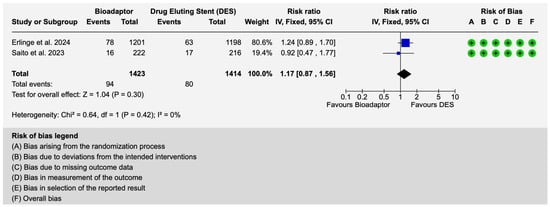
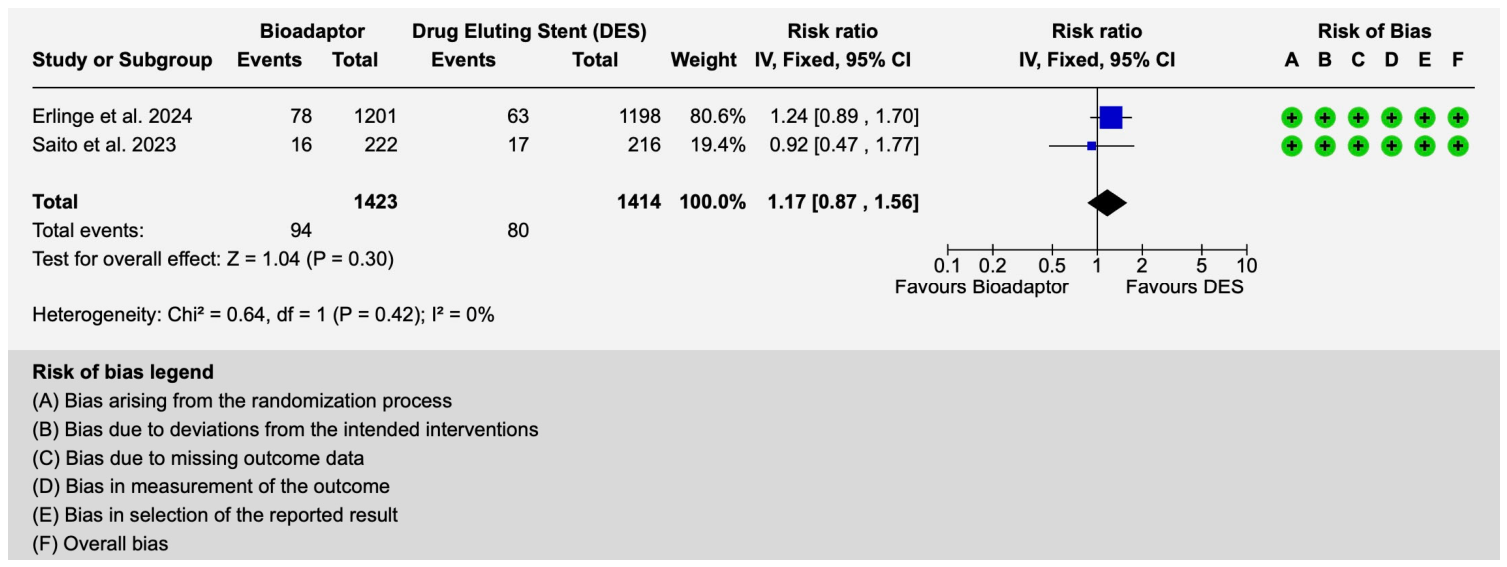
Two RCTs, including a total of 2837 patients undergoing PCI, reported POCE. The pooled estimate showed no statistically significant difference between the groups treated with a bioadaptor and DES (RR: 1.17, 95% CI: [0.87, 1.56], p = 0.30, I2 = 0%, Figure 4). The certainty of evidence was assessed as low (Supplementary Materials, Table S4).
Figure 4.
Forest plot comparing patient-oriented composite endpoint in patients undergoing percutaneous coronary intervention between the group treated with a bioadaptor and the group treated with a drug-eluting stent [11,12]. The pooled estimate showed no statistically significant difference between the groups.
3.4.4. Other Secondary Endpoints
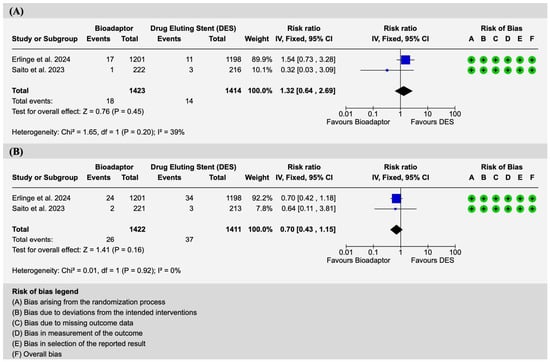
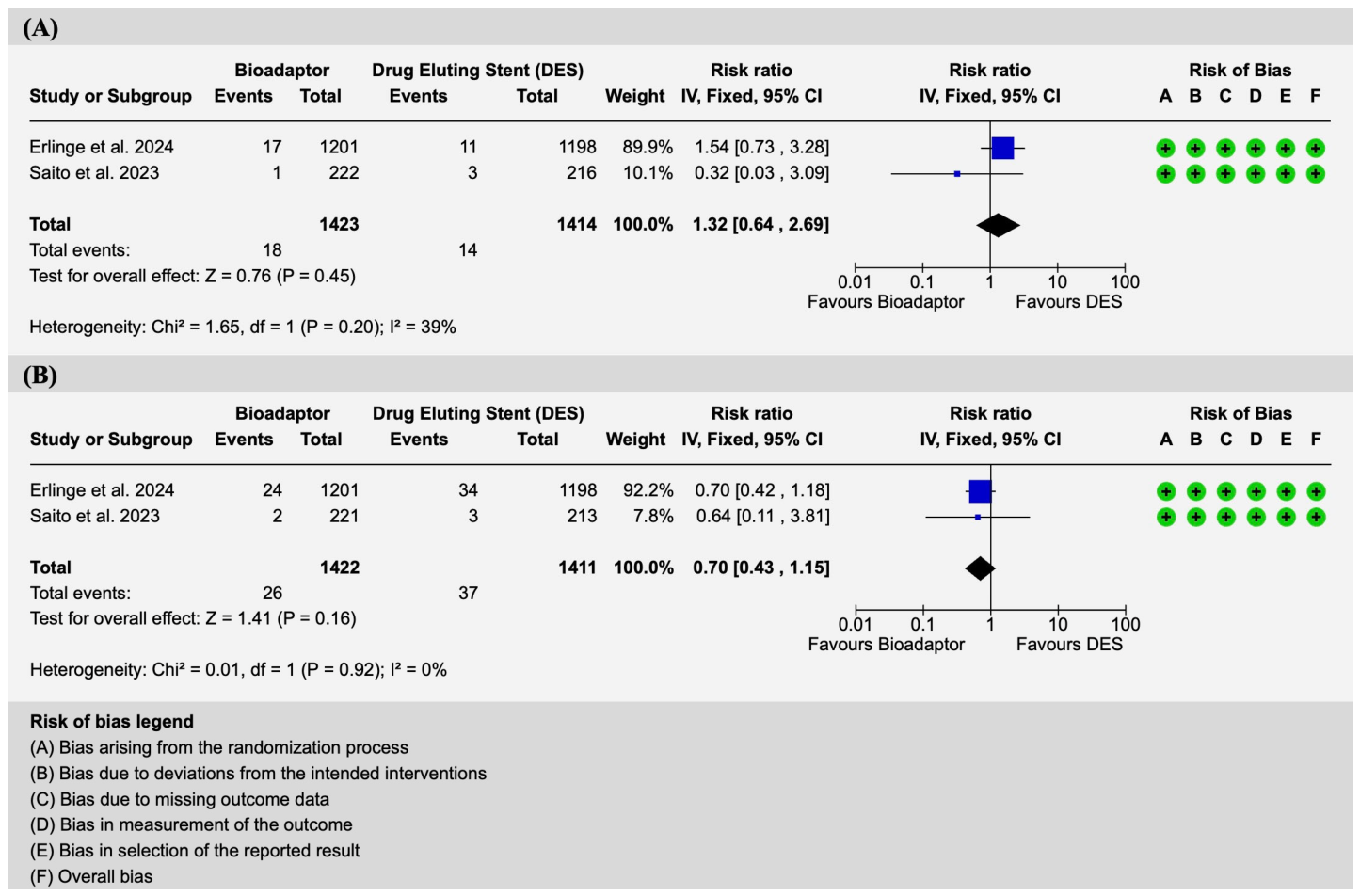
We were able to synthesize the results of these 2 RCTs, including a total of 2837 and 2833 patients undergoing PCI for all-cause mortality and CD-TVR, respectively. The pooled estimate showed no statistically significant difference between the groups treated with a bioadaptor and DES in either all-cause mortality (RR: 1.32, 95% CI: [0.64, 2.69], p = 0.45, I2 = 39%, Figure 5A), or CD-TVR (RR: 0.70, 95% CI: [0.43, 1.15], p = 0.16, I2 = 0%, Figure 5B). The certainty of evidence was assessed as low for all-cause mortality and as moderate for CD-TVR (Supplementary Materials, Table S4).
Figure 5.
Forest plots comparing all-cause mortality (A) and clinically-driven target vessel revascularization (B) in patients undergoing percutaneous coronary intervention between the group treated with a bioadaptor and the group treated with a drug-eluting stent [11,12]. The pooled estimate showed no statistically significant difference between the groups for either outcome.
Erlinge et al. reported a higher hazard of NTV-MI in the bioadaptor group than in the DES group (HR: 5.52, 95% CI: [1.22, 24.9]). Arm-level data for NTV-MI and stroke are presented in Table 2. We did not pool the results for these outcomes because the study-specific RRs for Saito et al. were non-estimable, with zero events in both arms.
Table 2.
Reported event counts and denominators by treatment arm for non-target vessel myocardial infarction (NTV-MI) and stroke. Abbreviations: DES, drug-eluting stent.
3.5. Sensitivity Analysis
The results of the sensitivity analysis comparing pooled risk ratios and 95% confidence intervals from fixed-effect and random-effects models for all outcomes included in the meta-analysis are presented in Table S5 of the Supplementary Materials. Briefly, these models yielded identical pooled estimates and confidence intervals for all outcomes except cardiovascular death and all-cause mortality, for which the random-effects model produced lower pooled risk ratios and wider confidence intervals.
4. Discussion
The main findings of our study are as follows: (1) no significant differences between the bioadaptor and DES were observed for either the primary endpoint or any of the secondary outcomes that could be quantitatively synthesized; and (2) the certainty of evidence ranged from low to moderate, primarily due to imprecision.
Our systematic review identified three RCTs, of which two—BIOADAPTOR-RCT and INFINITY-SWEDEHEART [11,12]—were included in the quantitative synthesis. The primary analysis comprised 2835 adult patients undergoing PCI with either a bioadaptor or contemporary DES for chronic or acute coronary syndrome. The primary endpoint, TLF, was defined as a composite of cardiovascular death, TV-MI, and CD-TLR. No significant difference in TLF was observed between the bioadaptor and DES groups, suggesting a lack of statistically significant difference in clinical performance at 12 months. Similarly, no statistically significant differences were identified for any of the evaluated secondary endpoints, including cardiovascular death, TV-MI, CD-TLR, CD-TVR, device thrombosis, and POCE. POCE, which incorporates all-cause mortality, stroke, myocardial infarction, and revascularization, provides a broader assessment of patient-level clinical outcomes beyond events directly attributable to the treated lesions. However, some secondary endpoints such as cardiovascular death, all-cause mortality or device thrombosis had a low number of events, and therefore the 95% CIs for their RRs are very wide, which indicates uncertainty regarding the potential treatment effect and does not allow us to draw clear and reliable conclusions based on these results. Taken together, these findings indicate that, based on the currently available randomized evidence, bioadaptors achieve 12-month clinical outcomes not significantly different from those of contemporary DES across both lesion- and patient-oriented endpoints.
Although the available findings do not unequivocally favor bioadaptors over contemporary DES, bioadaptors may still represent a valuable alternative because of their unique mechanism of action. Restoration of dynamic vessel support, improvement in vasomotion, and facilitation of adaptive vascular remodeling are considered among their key potential advantages [11,17]. The authors of the included studies suggest that some particular subgroups of patients might benefit from bioadaptor implantation, including patients with left anterior descending (LAD) artery lesions, small-caliber vessels, long lesions, or lipid-rich plaques [11,12]; however, there were no appropriate data available to expand our analysis. Supplementary Materials from INFINITY-SWEDEHEART present Kaplan–Meier estimates at 12 months with a landmark analysis at 6 months, which suggest that males (HR: 0.14, 95% CI: [0.03–0.63]), patients without diabetes (HR: 0.15, 95% CI: [0.03–0.65]), patients without bifurcation lesions (HR: 0.16, 95% CI: [0.04–0.69]), or patients with a target lesion in the LAD (HR: 0.27, 95% CI: [0.08–0.98]) had better outcomes if they received a bioadaptor rather than a DES [11]. Saito et al. reported similar but statistically nonsignificant results with an HR of 0.59 (95% CI: [0.14–2.47]) for male patients and an HR of 0.71 (95% CI: [0.19–2.64]) for patients with diabetes in favor of the bioadaptor [12]. However, the small number of endpoint events in those subgroups does not allow us to draw any clear conclusions. Further studies specifically designed to evaluate such subgroups are warranted to determine whether there are any potential benefits in selected anatomical or clinical settings and whether an individualized, patient- and lesion-specific approach to device selection may be justified.
Although acute coronary syndrome (ACS) is generally associated with a higher risk of recurrent cardiovascular events than chronic coronary syndrome (CCS), both conditions represent established indications for PCI. Importantly, the clinical populations enrolled in the two RCTs differed substantially. In one trial, the vast majority of patients presented with ACS [11], whereas the other predominantly enrolled patients with CCS and excluded those with acute myocardial infarction within 72 h before enrolment [12]. Thus, rather than representing two highly similar patient populations, these trials provide complementary evidence across different clinical settings.
The timing of outcome assessment warrants further consideration. We selected 12-month follow-up for the quantitative synthesis because resorption of the drug-polymer coating and the subsequent vascular effects associated with bioadaptor uncaging may extend beyond 6 months. Although this time frame allows assessment of early and intermediate clinical outcomes, it may not fully capture the long-term effects of the technology. The potential clinical benefits of restored vessel motion may become more apparent beyond 12 months. Therefore, definitive conclusions regarding the long-term clinical effects of bioadaptors cannot be drawn from the present analysis. Device thrombosis illustrates this limitation particularly well. A 12-month follow-up permits the assessment of acute (up to 24 h), subacute (24 h to 30 days) and late (31 days to 1 year) thrombosis, but does not capture very late device thrombosis occurring more than 1 year after implantation. Although the literature provides inconclusive data regarding the relative frequency of different thrombosis subtypes [21,22,23], very late thrombosis remains a clinically relevant concern and may account for a substantial proportion of thrombotic events during long-term follow-up [21,23]. This underscores the importance of the planned 5-year follow-up of INFINITY-SWEDEHEART [11]. At the same time, the favorable 36-month outcomes reported by Verheye et al. in a single-arm study, which was excluded from the present review because of its non-randomized design, provide encouraging preliminary evidence regarding the longer-term safety of the bioadaptor [6].
The 2-year results of BIOADAPTOR-RCT [16] were published before this meta-analysis. Although results of the landmark analysis from 6 months to 2 years in INFINITY-SWEDEHEART were presented at the Transcatheter Cardiovascular Therapeutics (TCT) 2025 Congress, they had not been published in full by our search date. Thus, this meta-analysis is limited to 1-year outcomes. However, the 2-year outcomes from the Saito et al. study shed new light on the bioadaptor’s long-term performance. Kaplan–Meier estimates showed that the rate of the primary outcome (TLF) at 2 years after PCI was significantly lower in the bioadaptor group (1.8%) compared to the DES group (5.5%) with a difference of −3.6% (95% CI: [−7.8%, 0.0%], log-rank p = 0.044) and an HR of 0.32 (95% CI: [0.10, 0.99], p = 0.048). Despite the statistically significant results, we interpret them with caution as the number of events was low (4/219 vs. 12/221 in the bioadaptor and DES groups, respectively); therefore, uncertainty in the evidence remains. That is why we still need long-term outcome data from studies with a larger number of patients, such as INFINITY-SWEDEHEART or other new trials.
The need for data on long-term safety outcomes (such as device thrombosis) from randomized studies is even greater because the idea of using bioresorbable materials in PCI was previously explored with completely bioresorbable scaffolds. Those devices, however, did not meet expectations, and meta-analyses have shown a higher risk of MI and stent thrombosis in comparison with standard DES [24]. Bioadaptors are supposed to be a new approach to using bioresorbable materials in coronary interventions, but, as mentioned above, further studies and long-term outcome data are needed to determine whether they are a safe alternative to contemporary DES.
The risk of bias was assessed as low for both RCTs included in the quantitative synthesis. According to the information reported by the authors, in both trials the randomization process raised no concerns. Operators were not blinded, which is understandable in trials on PCI, but patients and the clinical events committees were blinded. Primary outcome data were missing for less than 5% of the study population in each trial, and results were reported clearly. Nevertheless, the certainty of evidence was not rated as high for any of the evaluated outcomes. Moderate certainty was assigned to the primary endpoint, as well as to two secondary outcomes, TV-MI and CD-TVR, supporting a reasonable degree of confidence in these estimates while still warranting cautious interpretation. In contrast, the certainty of evidence was rated as low for cardiovascular death, CD-TLR, device thrombosis, POCE, and all-cause mortality. Consequently, conclusions regarding these outcomes should be interpreted with greater caution.
Our findings are largely consistent with those of a recent systematic review and meta-analysis evaluating coronary bioadaptors versus contemporary DES [13]. Despite several methodological differences, the pooled estimate for the primary endpoint, TLF, was broadly comparable between the two analyses. At 12 months, our analysis of two RCTs (2835 participants) yielded an RR of 0.82 (95% CI: [0.51, 1.30]) and Wölbert et al. reported an odds ratio of 0.81 (95% CI: [0.51, 1.31]) across three RCTs (2892 participants). We applied a fixed-effect model for the main quantitative syntheses, while Wölbert et al. used a random-effects, generalized linear mixed model. The study by Tsai et al. reported zero TLF events in both arms, making its study-specific RR non-estimable under our pooling method. In addition, our study pooled 12-month data for three additional outcomes, namely POCE, all-cause mortality, and CD-TVR. Finally, we assessed the certainty of evidence using the GRADE framework, thereby complementing the pooled effect estimates with an appraisal of the strength and reliability of the available evidence.
Several limitations should be acknowledged. First, only a small number of studies were available for inclusion, which limits the robustness and generalizability of the pooled estimates. Although three randomized trials were identified, only two contributed to the quantitative analysis, with INFINITY-SWEDEHEART accounting for most of the statistical weight, which creates the possibility that the results are influenced disproportionately by this much larger trial. The small number of included studies also limited our ability to evaluate publication bias reliably. Second, the populations enrolled in the included RCTs represented only a subset of patients encountered in routine clinical practice, with certain higher-risk patients excluded, including some with recent myocardial infarction. Complex bifurcations and severely calcified lesions were underrepresented. Left main coronary artery target lesions were rare. This may further limit the external validity of our findings. Third, the quantitative synthesis was restricted to 12-month outcomes despite the availability of 2-year data from BIOADAPTOR-RCT. Therefore, potential differences in long-term efficacy and safety remain to be established. Fourth, pooled estimates could not be obtained for stroke and NTV-MI because BIOADAPTOR-RCT reported zero events in both arms for both outcomes. Fifth, estimates of between-study heterogeneity based on only two studies should be interpreted with caution. Sixth, eligibility was restricted to full-text reports published in English to facilitate full-text assessment and data extraction. We acknowledge that this pragmatic decision may have introduced language bias.
5. Conclusions
In conclusion, the available randomized evidence shows no statistically significant differences between bioadaptors and contemporary DES in clinical outcomes at 12-month follow-up. Given the small number of randomized trials, the differences between their populations and designs, and the certainty of evidence ranging from low to moderate, the conclusions should be interpreted with caution. Results from the ongoing five-year follow-up are expected to clarify whether differences emerge over the longer term and may help inform future strategies for device selection in PCI.
Supplementary Materials
The following supporting information can be downloaded at https://www.mdpi.com/article/10.3390/jpm16120594/s1, Figure S1: Forest plot comparing device thrombosis; Method S1: Search query used for database searches; Table S1: PRISMA checklist; Table S2: Definitions of Target Lesion Failure (TLF) and its components used by the trials included in the quantitative synthesis; Table S3: Procedural characteristics of included studies; Table S4: The summary of findings in terms of the certainty of evidence regarding all 12-month endpoints included in the meta-analysis; Table S5: Sensitivity analysis comparing pooled risk ratios and 95% confidence intervals from fixed-effect and random-effects models for all outcomes included in the meta-analysis.
Author Contributions
Conceptualization, K.J. and G.P.; data curation, K.J. and G.P.; formal analysis, K.J. and G.P.; funding acquisition, G.P.; investigation, K.J., G.P., P.S.Z., S.F., R.P., A.F., K.V. and K.P.; methodology, K.J. and G.P.; project administration, K.J. and G.P.; resources, G.P.; software, G.P.; supervision, Z.H. and A.G.; validation, K.J. and G.P.; visualization, G.P.; writing—original draft preparation, K.J., G.P., P.S.Z., S.F. and A.F.; writing—review and editing, Z.H. and A.G. All authors have read and agreed to the published version of the manuscript.
Funding
This research received no external funding.
Institutional Review Board Statement
Not applicable.
Informed Consent Statement
Not applicable.
Data Availability Statement
The original contributions presented in this study are included in the article/Supplementary Materials. Further inquiries can be directed to the corresponding author.
Acknowledgments
We used an AI-based language model (ChatGPT GPT-6.1 Sol, OpenAI, San Francisco, CA, USA) to assist with editing of the manuscript text; the authors remain fully responsible for the content.
Conflicts of Interest
The authors declare no conflicts of interest.
Abbreviations
The following abbreviations are used in this manuscript:
| ACS | Acute coronary syndrome |
| CCS | Chronic coronary syndrome |
| CD-TLR | Clinically-driven target lesion revascularization |
| CD-TVR | Clinically-driven target vessel revascularization |
| CI | Confidence interval |
| DES | Drug-eluting stent |
| LAD | Left anterior descending artery |
| MI | Myocardial infarction |
| NTV-MI | Non-target vessel myocardial infarction |
| PCI | Percutaneous coronary intervention |
| POCE | Patient-oriented composite endpoint |
| RCT | Randomized controlled trial |
| RR | Risk ratio |
| TLF | Target lesion failure |
| TV-MI | Target vessel myocardial infarction |
References
- Madhavan, M.V.; Kirtane, A.J.; Redfors, B.; Généreux, P.; Ben-Yehuda, O.; Palmerini, T.; Benedetto, U.; Biondi-Zoccai, G.; Smits, P.C.; von Birgelen, C.; et al. Stent-Related Adverse Events >1 Year After Percutaneous Coronary Intervention. J. Am. Coll. Cardiol. 2020, 75, 590–604. [Google Scholar] [CrossRef] [Scilit] [PubMed]
- Kereiakes, D.J. The TWENTE Trial in Perspective: Stents and Stent Trials in Evolution. JAMA Cardiol. 2017, 2, 235–237. [Google Scholar] [CrossRef] [Scilit] [PubMed]
- Verheye, S.; Morice, M.C.; Zivelonghi, C.; Mehmedbegovic, Z.; Neylon, A.; Bhat, V.; Colombo, A. 24-Month Clinical Follow-Up and Mechanistic Insights From Intravascular Imaging Following Coronary Implantation of the Novel DynamX Bioadaptor Platform. Cardiovasc. Revasc. Med. 2023, 46, 106–112. [Google Scholar] [CrossRef] [Scilit] [PubMed]
- Challa, K.K.; Kansal, M.M.; Frazin, L.; Nikanorov, A.; Kohler, R.; Martinsen, B.J.; Vidovich, M.I. Coronary artery rotation in native and stented porcine coronary arteries. Catheter. Cardiovasc. Interv. 2018, 91, 1092–1100. [Google Scholar] [CrossRef] [Scilit] [PubMed]
- Stone, G.W.; Kimura, T.; Gao, R.; Kereiakes, D.J.; Ellis, S.G.; Onuma, Y.; Chevalier, B.; Simonton, C.; Dressler, O.; Crowley, A.; et al. Time-Varying Outcomes With the Absorb Bioresorbable Vascular Scaffold During 5-Year Follow-up: A Systematic Meta-analysis and Individual Patient Data Pooled Study. JAMA Cardiol. 2019, 4, 1261–1269. [Google Scholar] [CrossRef] [Scilit] [PubMed]
- Verheye, S.; Vrolix, M.; Montorfano, M.; Giannini, F.; Bedogni, F.; Dubois, C.; De Bruyne, B.; Costa, R.A.; Chamié, D.; Costa, J.R., Jr.; et al. Final 36-Month Outcomes from the Multicenter DynamX Study Evaluating a Novel Thin-Strut Novolimus-Eluting Coronary Bioadaptor System and Supporting Preclinical Data. Rev. Cardiovasc. Med. 2023, 24, 221. [Google Scholar] [CrossRef] [Scilit] [PubMed]
- Omar, W.A.; Kumbhani, D.J. The Current Literature on Bioabsorbable Stents: A Review. Curr. Atheroscler. Rep. 2019, 21, 54. [Google Scholar] [CrossRef] [Scilit] [PubMed]
- Gallinoro, E.; Almendarez, M.; Alvarez-Velasco, R.; Barbato, E.; Avanzas, P. Bioresorbable stents: Is the game over? Int. J. Cardiol. 2022, 361, 20–28. [Google Scholar] [CrossRef] [Scilit] [PubMed]
- Kansal, M.M.; Wolska, B.; Verheye, S.; Vidovich, M.I. Adaptive Coronary Artery Rotational Motion Through Uncaging of a Drug-Eluting Bioadaptor Aiming to Reduce Stress on the Coronary Artery. Cardiovasc. Revasc. Med. 2022, 39, 52–57. [Google Scholar] [CrossRef] [Scilit] [PubMed]
- Verheye, S.; Vrolix, M.; Montorfano, M.; Zivelonghi, C.; Giannini, F.; Bedogni, F.; Dubois, C.; De Bruyne, B.; Costa, R.A.; Chamié, D.; et al. Twelve-month clinical and imaging outcomes of the uncaging coronary DynamX bioadaptor system. EuroIntervention 2020, 16, E974–E981. [Google Scholar] [CrossRef] [Scilit] [PubMed]
- Erlinge, D.; Andersson, J.; Fröbert, O.; Törnerud, M.; Hamid, M.; Kellerth, T.; Grimfjärd, P.; Winnberg, O.; Jurga, J.; Wagner, H. Bioadaptor implant versus contemporary drug-eluting stent in percutaneous coronary interventions in Sweden (INFINITY-SWEDEHEART): A single-blind, non-inferiority, registry-based, randomised controlled trial. Lancet 2024, 404, 1750–1759. [Google Scholar] [CrossRef] [Scilit] [PubMed]
- Saïto, S.; Bennett, J.; Nef, H.M.; Webster, M.; Namiki, A.; Takahashi, A.; Kakuta, T.; Yamazaki, S.; Shibata, Y.; Scott, D. First randomised controlled trial comparing the sirolimus-eluting bioadaptor with the zotarolimus-eluting drug-eluting stent in patients with de novo coronary artery lesions: 12-month clinical and imaging data from the multi-centre, international, BIODAPTOR-RCT. eClinicalMedicine 2023, 65, 102304. [Google Scholar] [CrossRef] [Scilit] [PubMed]
- Wölbert, S.; Kühne, S.; Patrignani, A.; Chiarito, M.; von Scheidt, M.; Torzewski, J.; Raake, P.; Bongiovanni, D. A Comprehensive Meta-Analysis of Bioadaptor Versus Drug-Eluting Stents in Randomised Trials With Exploratory Single-Arm Landmark Analyses. Eur. J. Clin. Investig. 2026, 56, e70217. [Google Scholar] [CrossRef] [Scilit] [PubMed]
- Tsai, C.H.; Chu, H.H.; Huang, C.C.; Yeh, C.F.; Chen, Y.H.; Lin, M.S.; Ko, T.Y.; Chen, C.K.; Huang, Y.C.; Chiang, P.Y.; et al. Dynamic Change of Coronary Artery Geometry After Bioadaptor Implantation: A Single-blind Randomized Controlled Trial. Circ. Cardiovasc. Interv. 2026, 19, e016191. [Google Scholar] [CrossRef] [Scilit] [PubMed]
- GRADEpro GDT: GRADEpro Guideline Development Tool [Software]; McMaster University and Evidence Prime: Hamilton, ON, Canada, 2026.
- Saito, S.; Bennett, J.; Nef, H.M.; Webster, M.; Namiki, A.; Takahashi, A.; Kakuta, T.; Yamazaki, S.; Shibata, Y.; Scott, D.; et al. Percutaneous Coronary Treatment With Bioadaptor Implant vs Drug-Eluting Stent: 2-Year Outcomes From BIOADAPTOR RCT. JACC Cardiovasc. Interv. 2025, 18, 988–997. [Google Scholar] [CrossRef] [Scilit] [PubMed]
- Webster, M.; Scott, D.; Menon, M.; McClean, D.; El-Jack, S.; Wilkins, G.; Harding, S.A. Percutaneous Coronary Intervention Using the DynamX Sirolimus-Eluting Bioadaptor: 12-Month Clinical and Imaging Outcomes. J. Interv. Cardiol. 2024, 2024, 8876443. [Google Scholar] [CrossRef] [Scilit]
- Hoang, V.; Tran, G.T.; Ngoc, D.T.; Dang, D.N.; Van, D.T.; Hung, C.P.; Dinh, T.T. Feasibility and short-term outcomes of bioadaptor in bifurcation intervention using culotte technique: Intravascular ultrasound analysis from a single-center experience. J. Cardiovasc. Imaging 2026, 34, 20. [Google Scholar] [CrossRef] [Scilit] [PubMed]
- Leone, P.P.; Mangieri, A.; Calamita, G.; Regazzoli, D.; Oliva, A.; Gitto, M.; Cozzi, O.; Gasparini, G.; Stefanini, G.; Condorelli, G.; et al. DYNAMX Bioadaptor Implantation for Treatment of Complex Coronary Artery Disease: The DYNAMITE Study. Am. J. Cardiol. 2026, 267, 84–92. [Google Scholar] [CrossRef] [Scilit] [PubMed]
- Nooryani, A.A.; Khashaba, A.; Sianos, G.; Abdelrahman, N. Acute Performance of the DynamX Bioadaptor in Complex Coronary Lesions: An Optical Coherence Tomography-based Evaluation. Interv. Cardiol. Rev. Res. Resour. 2026, 21, e11. [Google Scholar] [CrossRef] [Scilit] [PubMed]
- Adriaenssens, T.; Joner, M.; Godschalk, T.C.; Malik, N.; Alfonso, F.; Xhepa, E.; De Cock, D.; Komukai, K.; Tada, T.; Cuesta, J.; et al. Optical Coherence Tomography Findings in Patients With Coronary Stent Thrombosis: A Report of the PRESTIGE Consortium (Prevention of Late Stent Thrombosis by an Interdisciplinary Global European Effort). Circulation 2017, 136, 1007–1021. [Google Scholar] [CrossRef] [Scilit] [PubMed]
- Mohamed, M.O.; Sirker, A.; Chieffo, A.; Avanzas, P.; Nolan, J.; Rashid, M.; Dafaalla, M.; Moledina, S.; Ludman, P.; Kinnaird, T.; et al. Temporal patterns, characteristics, and predictors of clinical outcomes in patients undergoing percutaneous coronary intervention for stent thrombosis. EuroIntervention 2022, 18, 729–739. [Google Scholar] [CrossRef] [Scilit] [PubMed]
- Souteyrand, G.; Amabile, N.; Mangin, L.; Chabin, X.; Meneveau, N.; Cayla, G.; Vanzetto, G.; Barnay, P.; Trouillet, C.; Rioufol, G.; et al. Mechanisms of stent thrombosis analysed by optical coherence tomography: Insights from the national PESTO French registry. Eur. Heart J. 2016, 37, 1208–1216. [Google Scholar] [CrossRef] [Scilit] [PubMed]
- Lipinski, M.J.; Escarcega, R.O.; Baker, N.C.; Benn, H.A.; Gaglia, M.A., Jr.; Torguson, R.; Waksman, R. Scaffold Thrombosis After Percutaneous Coronary Intervention With ABSORB Bioresorbable Vascular Scaffold: A Systematic Review and Meta-Analysis. JACC Cardiovasc. Interv. 2016, 9, 12–24. [Google Scholar] [CrossRef] [Scilit] [PubMed]

Disclaimer/Publisher’s Note: The statements, opinions and data contained in all publications are solely those of the individual author(s) and contributor(s) and not of MDPI and/or the editor(s). MDPI and/or the editor(s) disclaim responsibility for any injury to people or property resulting from any ideas, methods, instructions or products referred to in the content. |
© 2026 by the authors. Licensee MDPI, Basel, Switzerland. This article is an open access article distributed under the terms and conditions of the Creative Commons Attribution (CC BY) license.