


Abstract
Background/Objectives: Medial osteoarthritis with anterior cruciate ligament deficiency may be treated with total knee arthroplasty (TKA) or, in selected patients, combined unicompartmental arthroplasty and ligament reconstruction (UKA–ACLR). We compared function, knee motion and activity to inform personalized surgical selection based on anatomical eligibility and functional goals. Methods: This retrospective cohort included 62 knees in 59 patients, with 31 knees per group. Mean follow-up was 59.78 months for TKA and 130.23 months for UKA–ACLR. Main models adjusted for the corresponding baseline outcome used patient-clustered standard errors and applied Holm correction across five endpoints. Sensitivity analyses assessed demographic and follow-up adjustment. Results: Postoperative Knee Society Score (KSS) Clinical was 90.97 ± 4.52 after TKA and 94.74 ± 7.96 after UKA–ACLR. KSS Function was 94.19 ± 4.67 and 98.06 ± 4.22, and flexion was 120.81 ± 5.18° and 126.13 ± 6.15°, respectively. Baseline-adjusted UKA–ACLR minus TKA differences were 4.21 (1.83 to 6.59) points for KSS Function and 4.17 (0.63 to 7.71)° for flexion (95% confidence intervals). Only KSS Function remained significant after Holm correction (p = 0.004). The University of California Los Angeles activity difference was 0.44 (−0.42 to 1.30) points. KSS Function estimates remained positive in demographic and follow-up sensitivity analyses. Conclusions: Both groups showed substantial improvement. UKA–ACLR was associated with a modestly higher KSS Function score, whose clinical importance remains uncertain. These findings may inform personalized counseling in anatomically eligible patients, accounting for the retrospective design, baseline imbalance and unequal follow-up.
1. Introduction
Medial compartment osteoarthritis in an anterior cruciate ligament (ACL)-deficient knee presents a combined problem of degeneration and instability. The consequences of untreated ACL rupture and management of associated unicompartmental arthritis have long been recognized [1,2]. Treatment selection depends on cartilage distribution, ligament competence, deformity and functional expectations. This clinical approach reflects personalized medicine by matching the extent of joint replacement and ligament reconstruction to each patient’s pattern of degeneration, stability requirements and functional goals. Osteotomy with or without ACL reconstruction (ACLR) remains an option in selected varus knees [3,4,5,6]. When arthroplasty is considered, eligibility for medial unicompartmental knee arthroplasty (UKA) requires assessment of the remaining compartments and supporting soft tissues [7].
Combining medial UKA with ACLR addresses the arthritic and unstable components while preserving unaffected compartments. Published reports have demonstrated the feasibility of concomitant or staged reconstruction with unicompartmental replacement [8,9]. Other studies examined function and implant survival and documented the possibility of late deterioration [10,11]. Fixed-bearing and long-term series, including primary and revision ACLR, have broadened the evidence for the combined procedure in selected patients [12,13,14]. These series do not independently establish a comparative advantage over total knee arthroplasty (TKA).
Broader comparisons of UKA and TKA have examined functional recovery, satisfaction and joint awareness [15,16,17], as well as perioperative events and revision risk [18,19]. Robotic assistance has also been described for combined UKA–ACLR [20]. These findings provide context, but results from conventional UKA populations and different operative techniques cannot automatically be transferred to simultaneous UKA–ACLR.
A systematic review summarized the clinical experience with simultaneous UKA–ACLR [21], and a retrospective study subsequently compared the combined procedure with TKA [22]. Direct comparative evidence remains limited. The purpose of the present study was to compare documented clinical function, knee motion and activity in historical TKA and UKA–ACLR cohorts to inform personalized surgical selection, accounting for baseline differences and examining sensitivity to demographic covariates and assessment timing.
2. Materials and Methods
2.1. Study Design and Cohort Assembly
This single-center retrospective comparative cohort study was conducted at IRCCS Galeazzi Sant’Ambrogio Hospital, Milan, Italy, using the operative registry and clinical records. Consecutive cases within the respective surgical periods were retrospectively identified from the operative registry and screened against the study eligibility criteria. All eligible cases were included. Reporting follows the Strengthening the Reporting of Observational Studies in Epidemiology (STROBE) guidelines [23]. The operated knee was the analytical unit, with patient-level clustering for bilateral procedures. Eligible knees had medial compartment osteoarthritis with symptomatic ACL deficiency, complete baseline clinical outcomes and an available postoperative assessment. The final cohort included 62 knees in 59 patients: 31 TKA knees in 29 patients and 31 UKA–ACLR knees in 30 patients.
Knees were excluded for anatomical ineligibility, loss to follow-up or incomplete preoperative outcome data. Participant flow and group-specific exclusions are reported in Section 3.1 and Figure S1.
TKA procedures were performed between January 2019 and October 2021, with postoperative assessments between December 2023 and September 2026. UKA–ACLR procedures were performed between January 2004 and December 2021. Follow-up duration is reported in months for both cohorts.
2.2. Clinical Selection and Surgical Procedures
Shared clinical eligibility criteria comprised medial compartment osteoarthritis with symptomatic ACL deficiency, preservation of the lateral compartment, limited patellofemoral degeneration, competent collateral ligaments and correctable deformity [7,14]. These criteria defined the population in which either treatment could be considered. The choice between TKA and UKA–ACLR was individualized and based on clinical assessment, taking into account age, functional demands, the distribution of articular degeneration and the feasibility of ACL reconstruction. Treatment allocation was observational rather than randomized, and the groups were not individually matched.
2.2.1. Surgical Team and Operative Principles
All procedures were performed by the same team of three senior knee surgeons, each performing more than 300 knee procedures annually. A tourniquet-free protocol was used throughout exposure, bone preparation, implantation and ligament reconstruction.
2.2.2. Total Knee Arthroplasty
TKA was performed through an anterior incision and mid-vastus arthrotomy using conventional instrumentation for mechanical alignment. Implant systems were Persona in 25 knees (80.6%), Vanguard in 4 (12.9%) and Innex in 2 (6.5%). Innex implants were mobile-bearing, whereas Persona and Vanguard implants were fixed-bearing. Cruciate-retaining (CR) femoral components were used in all TKA knees. Innex and Vanguard were implanted in CR configurations, whereas Persona knees received ultracongruent (UC) tibial inserts. Trial reduction assessed flexion and extension balance, coronal stability, range of motion and patellar tracking.
2.2.3. Medial UKA with ACL Reconstruction
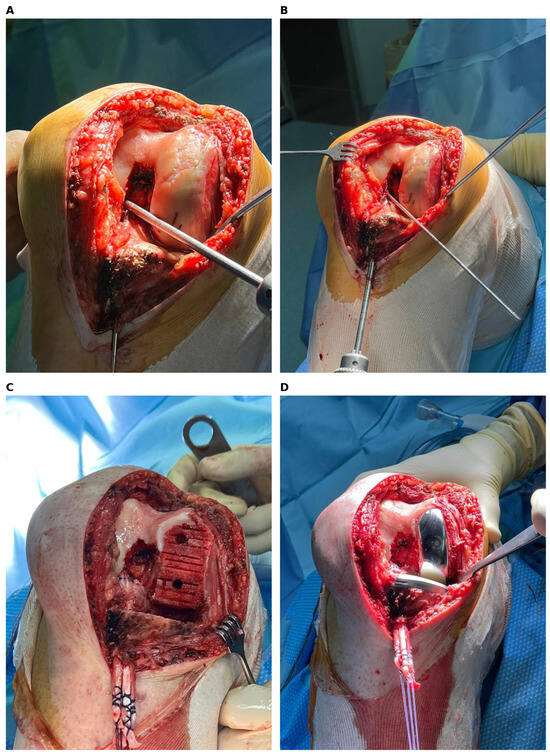
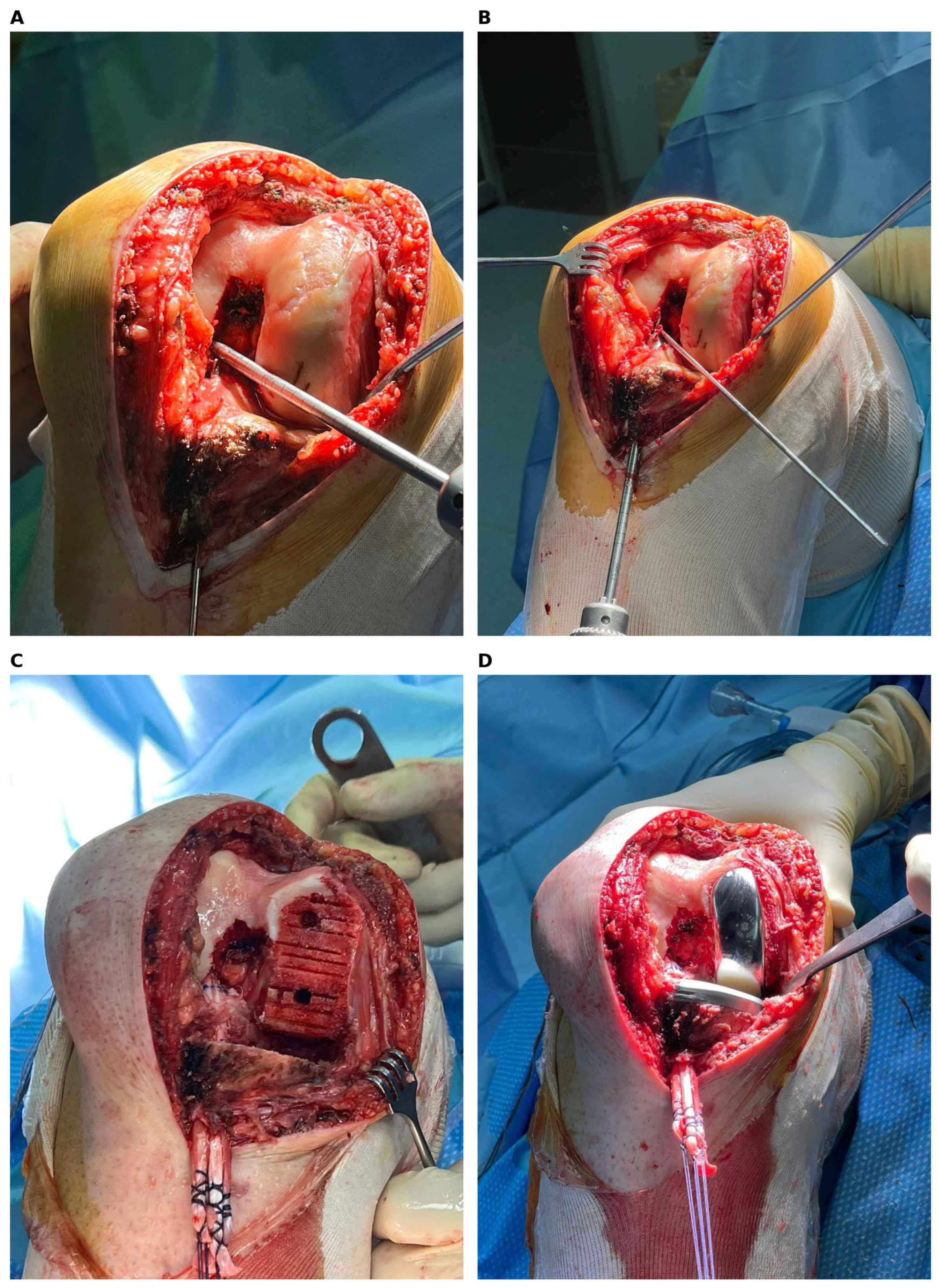
All 31 combined medial UKA–ACLR procedures were performed simultaneously in a single surgical session. Fourteen combined procedures (45.2%) involved revision of a previously reconstructed ACL following graft failure; the remaining 17 (54.8%) involved primary ACL reconstruction in knees without previous ACL reconstruction. Revision ACL reconstruction was performed as part of the index combined procedure. Medial UKA used an anterior mini-mid-vastus exposure; ACL reconstruction was open in 20 knees (64.5%) and arthroscopically assisted in 11 (35.5%). Semitendinosus or tibialis anterior tendon allografts were used in 19 knees (61.3%) and Ligament Advanced Reinforcement System (LARS) synthetic ligaments in 12 (38.7%). Femoral suspensory fixation and tibial interference screw fixation were used in all cases. Operative principles included inspection of the remaining compartments, avoidance of valgus overcorrection, prevention of tibial tunnel–component interference, and assessment of graft tension and impingement [14]. Cemented fixed-bearing medial components were used, with a target posterior tibial slope of approximately 0–3°. Graft passage and component implantation were sequenced according to graft and fixation requirements. Figure 1 illustrates the exposure and reconstruction steps.
Figure 1.
Representative operative views of combined medial UKA and ACL reconstruction. (A,B) Exposure of the medial compartment and intercondylar region. (C) Prepared medial bone surfaces with graft and suture material. (D) Medial arthroplasty components with graft and suture material visible. The selected views illustrate the technique and do not define a uniform operative sequence for the entire cohort. UKA, unicompartmental knee arthroplasty; ACL, anterior cruciate ligament.
UKA implant systems were Allegretto in 3 knees, ZUK in 16, Persona Partial Knee in 11 and Genesis in 1. ACL graft and fixation characteristics were not included as covariates or used to define subgroups.
2.2.4. Rehabilitation
UKA–ACLR rehabilitation began with passive and active motion within 12 h and progressive weight-bearing from postoperative day 1 [14]. Discharge criteria included independent ambulation with crutches and approximately 90° of flexion. TKA rehabilitation similarly emphasized early mobilization and progressive weight-bearing.
2.3. Outcomes and Data Handling
The five main comparative endpoints were the original Knee Society clinical and function scores (KSS Clinical and KSS Function, each 0–100) [24], active flexion, motion arc and University of California Los Angeles activity (UCLA, 1–10) [25]. Higher KSS and UCLA values indicate better status. Preoperative scores had been recorded before surgery during routine clinical care and were subsequently extracted from clinical records for the present retrospective analysis. Consistency across the study period was maintained through the use of the same outcome instruments and standardized assessment and measurement procedures. Clinical and activity assessments were administered in Italian using standardized instructions. The KSS incorporated clinical examination and an interview. Postoperative stability in the UKA–ACLR group was assessed using the Lachman and anterior drawer tests. Active knee flexion and extension deficit were measured with the patient supine using a long-arm universal goniometer. Two readings separated by 30 s were averaged. The same protocol was applied at baseline and follow-up by an orthopedic clinician who was not involved in the operation. Extension deficit was the positive shortfall from full extension; motion arc was flexion minus extension deficit. Change was calculated as postoperative minus preoperative value.
Tegner activity (0–10) [26] was analyzed preoperatively and postoperatively in UKA–ACLR and at the five-year assessment in TKA. The secondary between-group comparison therefore assessed postoperative Tegner without baseline adjustment.
Additional TKA outcomes comprised the Forgotten Joint Score (FJS-12) [27], Oxford Knee Score (OKS, 0–48) [28,29], pain visual analog scale (VAS, 0–10), satisfaction (0–10) and a binary sport-resumption response. The Italian FJS-12 was self-completed before the clinical interview. Raw sums coded from 0 to 48, with zero indicating the best state, were normalized as 100 × [1 − (raw sum/48)]. Full numerical precision was retained until presentation. Pain was measured on a 100 mm VAS and converted to a 0–10 scale. Higher FJS-12, OKS and satisfaction scores indicate better outcomes; lower VAS indicates less pain. These additional measures were available only for TKA in the present dataset and were summarized descriptively; they were not included in between-group comparisons. The sport-resumption item was a yes/no response to the following question: “At the time of this follow-up, have you resumed participation in at least one sporting activity after your knee surgery, even at a lower frequency, intensity, or level than before surgery?” A “yes” was classified as a positive sport-resumption response, reported per knee-linked assessment.
Age at index surgery and body mass index (BMI) were summarized once per patient and linked to the operated knees. Index age was a patient-level descriptor in bilateral cases. Three UKA patients lacked age and one lacked BMI; demographic sensitivity analyses used complete cases without imputation. Patient identifiers linked bilateral procedures for clustered statistical analyses. Data availability by group is summarized in Table S3.
2.4. Follow-Up
Postoperative follow-up assessments were performed as part of routine clinical care. TKA outcomes were assessed at the five-year visit, with a mean follow-up of 59.78 ± 1.15 months (range 58.1–61.7). UKA–ACLR outcomes were assessed at the latest follow-up, averaging 130.23 ± 59.46 months (range 26–225). Duration was available for all 31 knees in each group. Follow-up-adjusted sensitivity models included all 62 knees in 59 patients.
2.5. Scope of the Comparison
The comparison focused on clinical function, knee motion and activity. Comparative radiographic, complication and implant-survival endpoints were not evaluated. ACL graft failure was not analyzed as a separate endpoint. Accordingly, the functional comparison cannot establish differences or equivalence in safety or implant survival between the two procedures.
2.6. Statistical Analysis
Continuous variables are reported as mean ± sample standard deviation (SD), with selected medians and interquartile ranges (IQRs) to describe ceiling effects. Categorical data use explicit denominators. All treatment contrasts are UKA–ACLR minus TKA. Unadjusted postoperative and change-score contrasts used ordinary least squares. The comparison involved two unmatched historical cohorts. Given the limited sample size and the relative rarity of combined UKA–ACLR, matching could have further reduced the analyzable sample. The main exploratory adjusted model for each endpoint therefore included treatment and the corresponding preoperative value in all 62 knees. Sensitivity analyses additionally included age, sex and BMI, as specified below. These adjustments do not eliminate residual confounding. No common fixed postoperative assessment window was used.
Covariance estimates were clustered by patient using the CR1 finite-sample correction G/(G − 1) × (N − 1)/(N − p), where G is the number of patients, N the number of knees and p the number of fitted coefficients. Two-sided p-values and 95% confidence intervals (CIs) used a t distribution with G − 1 degrees of freedom. Holm correction was applied across the five main adjusted endpoints. Confidence intervals are pointwise rather than simultaneous. Secondary Tegner and change-score contrasts were exploratory; they were not used to define additional confirmatory findings.
Sensitivity models retained one knee per patient, selected by the lowest knee identifier (59 knees/59 patients); added age, sex and BMI in complete cases (58 knees/55 patients); added follow-up duration or log-transformed follow-up (62 knees/59 patients); and combined demographic and follow-up adjustment (58 knees/55 patients). Holm correction was applied within each five-endpoint sensitivity-model family. Full estimates and model specifications are reported in Tables S1–S4. Baseline standardized mean differences were used to describe imbalance, without implying matching. Sample size was determined by available records; no post hoc power calculation was used. NumPy 2.3.5 and SciPy 1.17.0 were used for calculations. Baseline adjustment addressed differences in initial clinical status; demographic and follow-up models examined sensitivity to patient characteristics and assessment timing.
3. Results
3.1. Cohort Characteristics
Consecutive registry screening identified 74 knees in 71 patients: 38 TKA knees in 36 patients and 36 UKA–ACLR knees in 35 patients. Eight knees were excluded for anatomical ineligibility, equating to four per group; the reasons were lateral compartment degeneration in four knees, patellofemoral degeneration in two and uncorrectable deformity in two. Two additional TKA knees were excluded for loss to follow-up, and one knee per group for incomplete preoperative outcome data. The final cohort comprised 62 knees in 59 patients. Two TKA patients and one UKA–ACLR patient contributed bilateral knees. Female patients accounted for 9/29 (31.0%) in TKA and 7/30 (23.3%) in UKA–ACLR. All 62 knees contributed to the five main outcome analyses (Table 1; Figure S1).
Table 1.
Cohort characteristics and assessment timing.
UKA–ACLR patients were younger and had lower BMI. Absolute standardized mean differences were 0.73 for age and 0.59 for BMI. Baseline differences also affected clinical status: absolute standardized differences were 1.13 for KSS Clinical, 0.55 for KSS Function, 1.27 for flexion and 2.70 for UCLA activity. The groups therefore showed substantial baseline imbalance.
3.2. Clinical Outcomes
Both groups improved from baseline. At follow-up, KSS Clinical was 90.97 ± 4.52 after TKA and 94.74 ± 7.96 after UKA–ACLR. KSS Function was 94.19 ± 4.67 and 98.06 ± 4.22, respectively. Final flexion averaged 120.81 ± 5.18° and 126.13 ± 6.15° (Table 2).
Table 2.
Preoperative and postoperative clinical outcomes.
Final KSS Function reached 100 in 8/31 TKA knees (25.8%) and 23/31 UKA–ACLR knees (74.2%). The median was 95 (IQR 90–97.5) in TKA and 100 (97.5–100) in UKA–ACLR, demonstrating a pronounced ceiling effect in the combined-procedure group. Extension deficit was 0.81 ± 1.87° in TKA and zero in all UKA–ACLR knees. No episodes of giving way were reported in the UKA–ACLR group (0/31 knees). No subsequent revision or other reoperation occurred before the designated functional assessment in either the TKA group (0/31 knees) or the UKA–ACLR group (0/31 knees); no UKA–ACLR knee was converted to TKA. The reported functional scores therefore describe outcomes after the index procedure, including primary or revision ACL reconstruction as applicable, without an intervening reoperation.
Postoperative Tegner scores were 4.61 ± 0.72 after TKA and 4.90 ± 1.14 after UKA–ACLR. The unadjusted difference was 0.29 (−0.19 to 0.77) points (95% CI; p = 0.233). UKA–ACLR preoperative Tegner was 0.71 ± 0.46. A between-group contrast in Tegner change could not be calculated because TKA baseline scores were unavailable.
3.3. Main Comparative Estimates
Unadjusted postoperative means favored UKA–ACLR numerically for KSS and knee motion. Baseline-adjusted contrasts are shown in Table 3. Only KSS Function remained statistically significant after correction across the five endpoints. A statistically significant UCLA difference was not detected, and the confidence interval did not establish equivalence.
Table 3.
Main postoperative contrasts expressed as UKA–ACLR minus TKA.
3.4. Changes and Sensitivity Analyses
TKA began with lower KSS Clinical and flexion and showed larger gains in these domains, whereas UKA–ACLR showed larger gains in KSS Function and UCLA activity. These changes reflect different starting points and assessment intervals (Table 4).
Table 4.
Changes from baseline to the designated postoperative assessment.
The baseline-adjusted KSS Function difference was 4.47 (2.17 to 6.77) points when one knee per patient was retained, and 4.39 (1.46 to 7.33) points after additional demographic adjustment. Baseline-plus-follow-up adjustment in all 62 knees yielded 4.86 (1.80 to 7.92) points (Holm p = 0.012); log-follow-up yielded 4.69 (2.01 to 7.38) points. Combined demographic and follow-up adjustment yielded 4.75 (1.86 to 7.64) points. KSS Function remained significant within every sensitivity-model family. No other endpoint remained significant after Holm correction. Full estimates and adjusted p-values are provided in Tables S1 and S2.
3.5. Additional TKA Outcomes
Additional patient-reported outcomes at the five-year TKA assessment are summarized in Table 5. A positive sport-resumption response was recorded in 26/31 knee-linked assessments (83.9%). This denominator includes all TKA assessments, irrespective of preoperative sport participation. The reported proportion should therefore not be interpreted as a return-to-sport rate among preoperatively active patients.
Table 5.
Additional outcomes at the five-year TKA assessment.
4. Discussion
4.1. Principal Findings and Clinical Importance
Both cohorts showed substantial improvement in clinical scores, motion and activity. UKA–ACLR had numerically higher attained KSS and motion values, but the most consistent adjusted finding was a modest KSS Function difference. This association persisted after accounting for bilateral knees, available demographic variables and follow-up durations. KSS Clinical and motion findings were less robust, and no statistically significant difference in attained UCLA or secondary Tegner activity was detected.
The main KSS Function estimate was 4.21 points, with a 95% CI of 1.83–6.59. Lee et al. reported individual-change estimates of the minimal clinically important difference of approximately 6.1–6.4 points for KSS Function after TKA [30]. These thresholds were obtained in a different setting and cannot be directly applied to the adjusted between-group contrast here. Nevertheless, statistical significance alone does not demonstrate a clinically important advantage. The 74.2% ceiling rate in UKA–ACLR further limits discrimination among high-functioning knees.
Larger TKA gains in KSS Clinical and flexion were compatible with lower preoperative values, while UKA–ACLR attained somewhat higher final values. Reporting both change and attained status avoids interpreting improvement from different baselines as a direct treatment effect. The marked baseline UCLA imbalance also warrants caution when interpreting the large difference in raw activity change.
4.2. Relation to Previous Studies
Published series support the feasibility of combined UKA–ACLR and describe favorable outcomes in selected patients, while also documenting late deterioration and revision [8,9,10,11,12,13,14,21]. Legnani et al. reported broadly comparable outcomes in a direct comparison with TKA [22]. The present analysis provides additional comparative estimates across function, motion and activity, but differs in baseline characteristics, outcome instruments and assessment intervals.
A previous study described long-term outcomes of combined UKA–ACLR [14]. The present study adds a comparison with TKA using baseline-adjusted estimates of function, motion and activity.
Broader UKA-versus-TKA studies have described differences in function, satisfaction and joint awareness [15,16,17], but their estimates cannot be transferred directly to ACL-deficient knees requiring reconstruction. The FJS-12, OKS, pain VAS and satisfaction results in the TKA cohort provide descriptive context only. The absence of corresponding UKA–ACLR measurements in the present dataset precludes between-treatment comparisons of joint awareness, patient-reported pain or satisfaction.
4.3. Personalized Surgical Selection and Assessment Timing
The contribution to personalized medicine lies in informing surgical counseling for patients who meet the anatomical criteria for both procedures. Selection should integrate the distribution of cartilage degeneration, ligament competence, correctability of deformity, feasibility of ACL reconstruction and individual functional goals [7,14]. The modest KSS Function association may help frame expectations for UKA–ACLR in eligible patients, alongside the substantial improvements observed after TKA. Interactions between treatment and patient characteristics were not evaluated, so these group-level estimates cannot identify the optimal procedure for an individual patient.
Despite shared clinical eligibility, the groups differed in age, BMI, baseline knee status and activity. Confounding by treatment selection therefore remains possible. Demographic adjustment attenuated several associations, supporting interpretation of the estimates as adjusted associations rather than causal effects.
The comparison between TKA outcomes assessed at approximately five years and UKA–ACLR outcomes assessed at the latest available follow-up is an important limitation. The reported outcomes therefore represent results attained at different postoperative times. Sensitivity analyses incorporating follow-up duration and its logarithm included all knees and supported the KSS Function finding. These analyses explore the influence of assessment timing but cannot replace a comparison at a common postoperative interval.
Rehabilitation may also influence functional recovery, knee motion and activity after arthroplasty. Vitalis et al. reported higher short-term KSS and KOOS scores with a tailored 12-week rehabilitation program than with standard rehabilitation in younger TKA recipients [31]. Both cohorts in the present study followed pathways emphasizing early mobilization and progressive weight-bearing. However, rehabilitation intensity, adherence and changes in protocols over the study period were not quantified in this analysis and may have contributed to outcome variability. The short-term rehabilitation findings cannot be directly extrapolated to the present mid- to long-term comparison.
4.4. Strengths and Limitations
Strengths include complete paired observations for the five main endpoints, explicit handling of bilateral procedures, standardized clinical measurement, and reporting of effect estimates with confidence intervals and multiplicity correction.
The retrospective nonrandomized design, modest sample size, baseline imbalance and unequal follow-up limit causal interpretation. Exclusion of patients without follow-up or complete baseline outcomes may introduce selection bias. The single specialist-center setting and variation in implant and reconstruction characteristics may limit generalizability. Demographic adjustment used complete cases. The marked KSS Function ceiling effect and the relationship between flexion, motion arc and the motion component of KSS Clinical limit discrimination and independence across endpoints. Additional patient-reported outcomes were analyzed only in TKA. The absence of comparative analyses of complications, revisions and implant survival is an important limitation, particularly given the longer follow-up in the UKA–ACLR group. Favorable functional outcomes cannot establish comparable safety or implant durability. The younger age and lower BMI of the UKA–ACLR group may favor its functional outcomes; the net direction and magnitude of residual bias cannot be quantified from this comparison.
5. Conclusions
TKA and combined medial UKA–ACLR were associated with substantial improvements in knee function, motion and activity. UKA–ACLR had a modestly higher adjusted KSS Function score that persisted after multiplicity correction and in sensitivity analyses; the clinical importance of this difference remains uncertain. No consistent multiplicity-adjusted advantage was established for the other endpoints. These findings support considering UKA–ACLR as a bone- and ligament-preserving option within personalized surgical selection based on compartment involvement, ligament status and functional goals, with interpretation accounting for the observational design and unequal follow-up.
Supplementary Materials
The following supporting information can be downloaded at https://www.mdpi.com/article/10.3390/jpm16120588/s1: Figure S1, participant flow; Table S1, Sensitivity-analysis estimates; Table S2, Holm-adjusted p-values; Table S3, Data availability by treatment group; Table S4, Model specifications and analysis populations.
Author Contributions
Conceptualization and methodology, S.P., D.A. and M.M.; investigation and surgical procedures, S.P., M.M. and D.A.; data curation, M.C., M.M. and F.B.; writing—original draft preparation and project administration, D.A.; supervision, S.R. All authors have read and agreed to the published version of the manuscript.
Funding
This work was supported by the Italian Ministry of Health—‘Ricerca Corrente’. No implant manufacturer or other external party was involved in study design, data analysis, interpretation, manuscript preparation or the decision to submit the work.
Institutional Review Board Statement
The study was conducted under protocol ALLCCP at IRCCS Galeazzi Sant’Ambrogio Hospital. The Comitato Etico Territoriale Lombardia 1 approved amendment v04, dated 2 January 2026, on 4 February 2026 (amendment registration CET Em. 44-2026).
Informed Consent Statement
Written informed consent for the use of clinical data for research was obtained from all 59 participants in accordance with the approved study documents. Consent for publication of the representative operative images was obtained.
Data Availability Statement
De-identified data supporting the findings and the associated data dictionary may be made available by the corresponding author upon reasonable request, subject to institutional authorization and applicable ethics and privacy requirements. Identifiable participant data will not be shared.
Acknowledgments
During manuscript preparation, the authors used ChatGPT (GPT-6; OpenAI; accessed November 2026) to assist with drafting and organization of the text and preparation of statistical analysis scripts. The authors reviewed and edited the output and take full responsibility for the content of this publication.
Conflicts of Interest
The authors declare no conflicts of interest.
References
- Hellberg, C.; Kostogiannis, I.; Stylianides, A.; Neuman, P. Outcomes >30 Years After Initial Nonoperative Treatment of Anterior Cruciate Ligament Injuries. Am. J. Sports Med. 2024, 52, 320–329. [Google Scholar] [CrossRef] [Scilit]
- Vajapey, S.P.; Alvarez, P.M.; Greco, N.J.; Chonko, D.J. Medial Osteoarthritis in an ACL-Deficient Knee: A Critical Analysis Review. JBJS Rev. 2021, 9, e20.00132. [Google Scholar] [CrossRef] [Scilit]
- Legnani, C.; Ventura, A.; Mangiavini, L.; Maffulli, N.; Peretti, G.M. Management of Medial Femorotibial Knee Osteoarthritis in Conjunction with Anterior Cruciate Ligament Deficiency: Technical Note and Literature Review. J. Clin. Med. 2024, 13, 3143. [Google Scholar] [CrossRef] [Scilit]
- Han, G.; Li, F.; Xu, Q.; Qi, P. Simultaneous anterior cruciate ligament reconstruction with valgus high tibial osteotomy improves mid- to long-term clinical outcomes without increasing the complication rates in young anterior cruciate ligament deficient patients with varus malalignment: A systematic review and meta-analysis. J. Orthop. Surg. Res. 2025, 20, 1033. [Google Scholar] [CrossRef] [Scilit]
- Schneider, A.; Gaillard, R.; Gunst, S.; Batailler, C.; Neyret, P.; Lustig, S.; Servien, E. Combined ACL reconstruction and opening wedge high tibial osteotomy at 10-year follow-up: Excellent laxity control but uncertain return to high level sport. Knee Surg. Sports Traumatol. Arthrosc. 2020, 28, 960–968. [Google Scholar] [CrossRef] [Scilit]
- Gupta, A.; Tejpal, T.; Shanmugaraj, A.; Horner, N.S.; Simunovic, N.; Duong, A.; Ayeni, O.R. Surgical techniques, outcomes, indications, and complications of simultaneous high tibial osteotomy and anterior cruciate ligament revision surgery: A systematic review. HSS J. 2019, 15, 176–184. [Google Scholar] [CrossRef] [Scilit]
- Price, A.; Thienpont, E.; Catani, F.; Abram, S.; Troelsen, A.; BASK and EKS Consensus Group. Consensus statement on unicompartmental knee replacement: A collaboration between BASK and EKS. Knee 2023, 41, 391–396. [Google Scholar] [CrossRef] [Scilit]
- Vosoughi, F.; Menbari Oskouie, I.; Kasaeian, A.; Imani, M.; Luo, T.D.; Alvand, A.; Vahedi, P. Ten-Year Implant Survival and Functional Outcomes Following Combined Medial Unicompartmental Knee Arthroplasty and Anterior Cruciate Ligament Reconstruction: A Systematic Review and Call for High-Quality Comparative Trials. JBJS Open Access 2026, 11, e25.00200, Erratum in JBJS Open Access 2026, 11, eER.25.00200. https://doi.org/10.2106/JBJS.OA.ER.25.00200. [Google Scholar] [CrossRef] [Scilit]
- Legnani, C.; Massaro, E.; Peretti, G.M.; Macchi, V.; Borgo, E.; Ventura, A. Medial Unicompartmental Knee Arthroplasty Combined with Anterior Cruciate Ligament Reconstruction Yields Similar Outcomes Compared to Unicompartmental Knee Arthroplasty Alone. Transl. Sports Med. 2025, 2025, 7606835. [Google Scholar] [CrossRef] [Scilit]
- Kennedy, J.A.; Molloy, J.; Mohammad, H.R.; Mellon, S.J.; Dodd, C.A.F.; Murray, D.W. Mid- to long-term function and implant survival of ACL reconstruction and medial Oxford UKR. Knee 2019, 26, 897–904. [Google Scholar] [CrossRef] [Scilit]
- Iriberri, I.; Suau, S.; Payán, L.; Aragón, J.F. Long-term deterioration after one-stage unicompartmental knee arthroplasty and anterior cruciate ligament reconstruction. Musculoskelet. Surg. 2019, 103, 251–256. [Google Scholar] [CrossRef] [Scilit]
- Kurien, T.; Stragier, B.; Senevirathna, S.; Geutjens, G. Excellent outcomes with combined single stage Physica ZUK medial unicompartment knee replacement and anterior cruciate ligament reconstruction results in young, active patients with instability and osteoarthritis with a mean follow up of 5 years. Knee 2022, 36, 114–119. [Google Scholar] [CrossRef] [Scilit]
- Jaber, A.; Kim, C.M.; Barié, A.; Streit, M.; Schmitt, H.; Clarius, M.; Merle, C.; Bangert, Y. Combined treatment with medial unicompartmental knee arthroplasty and anterior cruciate ligament reconstruction is effective on long-term follow-up. Knee Surg. Sports Traumatol. Arthrosc. 2023, 31, 1382–1387. [Google Scholar] [CrossRef] [Scilit]
- Marullo, M.; Petrillo, S.; Russo, A.; Bertelle, F.; Romagnoli, S. Long-term outcomes of combined medial unicompartmental knee replacement and anterior cruciate ligament reconstruction in middle-aged patients with ACL-deficient knees. J. Clin. Med. 2025, 14, 6439. [Google Scholar] [CrossRef] [Scilit]
- Migliorini, F.; Tingart, M.; Niewiera, M.; Rath, B.; Eschweiler, J. Unicompartmental versus total knee arthroplasty for knee osteoarthritis. Eur. J. Orthop. Surg. Traumatol. 2019, 29, 947–955. [Google Scholar] [CrossRef] [Scilit]
- Annapareddy, A.; Mulpur, P.; Prakash, M.; Suhas Masilamani, A.B.; Eachempati, K.K.; Gurava Reddy, A.V. Partial versus total knee arthroplasty for isolated antero-medial osteoarthritis—An analysis of PROMs and satisfaction. SICOT-J 2023, 9, 11. [Google Scholar] [CrossRef] [Scilit]
- Brilliant, Z.R.; Garvey, M.D.; Haffner, R.; Chiu, Y.F.; Mayman, D.J.; Blevins, J.L. Unicompartmental knee arthroplasty patients have lower joint awareness and higher function at 5 years compared to total knee arthroplasties: A matched comparison. J. Arthroplast. 2023, 38, 1464–1469. [Google Scholar] [CrossRef] [Scilit]
- Hunt, L.P.; Blom, A.W.; Matharu, G.S.; Kunutsor, S.K.; Beswick, A.D.; Wilkinson, J.M.; Whitehouse, M.R. Patients Receiving a Primary Unicompartmental Knee Replacement Have a Higher Risk of Revision but a Lower Risk of Mortality Than Predicted Had They Received a Total Knee Replacement: Data From the National Joint Registry for England, Wales, Northern Ireland, and the Isle of Man. J. Arthroplast. 2021, 36, 471–477.e6. [Google Scholar] [CrossRef] [Scilit]
- O’Neill, C.N.; Gowd, A.K.; Waterman, B.R.; Kates, S.L.; Patel, N.K. Significant reduction in short-term complications following unicompartmental versus total knee arthroplasty: A propensity score matched analysis. J. Arthroplast. 2022, 37, 2014–2019. [Google Scholar] [CrossRef] [Scilit]
- Foissey, C.; Batailler, C.; Shatrov, J.; Servien, E.; Lustig, S. Is combined robotically assisted unicompartmental knee arthroplasty and anterior cruciate ligament reconstruction a good solution for the young arthritic knee? Int. Orthop. 2023, 47, 963–971. [Google Scholar] [CrossRef] [Scilit]
- Albo, E.; Campi, S.; Zampogna, B.; Torre, G.; Papalia, G.F.; Diaz Balzani, L.A.; Alifano, A.M.; Papalia, R.; Denaro, V. Results of Simultaneous Unicompartmental Knee Arthroplasty and Anterior Cruciate Ligament Reconstruction: A Systematic Review. J. Clin. Med. 2021, 10, 4290. [Google Scholar] [CrossRef] [Scilit]
- Legnani, C.; Borgo, E.; Macchi, V.; Terzaghi, C.; Ventura, A. Unicompartmental knee replacement combined with anterior cruciate ligament reconstruction provides comparable results to total knee replacement with no increased risk of complications. SICOT-J 2024, 10, 10. [Google Scholar] [CrossRef] [Scilit]
- Cuschieri, S. The STROBE guidelines. Saudi J. Anaesth. 2019, 13, S31–S34. [Google Scholar] [CrossRef] [Scilit]
- Heitkamp, H.; Heußner, D.; Rosenberger, D.C.; Schnabel, K.; Rosenthal, D.; Bigalke, S.; Maeßen, T.V.; Hohenschurz-Schmidt, D.; Liedgens, H.; Kaiser, U.; et al. Systematic reviews and quality assessment of patient-reported outcome measures for physical function in comparative effectiveness studies regarding acute postoperative pain after total knee arthroplasty—Do we need to start all over again? Eur. J. Pain 2024, 28, 1415–1430. [Google Scholar] [CrossRef] [Scilit]
- Mørup-Petersen, A.; Skou, S.T.; Holm, C.E.; Holm, P.M.; Varnum, C.; Krogsgaard, M.R.; Laursen, M.; Odgaard, A. Measurement properties of UCLA Activity Scale for hip and knee arthroplasty patients and translation and cultural adaptation into Danish. Acta Orthop. 2021, 92, 681–688. [Google Scholar] [CrossRef] [Scilit]
- Napoli, R.; Fortina, M.; Plebani, G.; Giannotti, S.; Pannone, A.; Rossi, A.; Visonà, E.; Tegner, Y.; Brindisino, F.; Vascellari, A. Cross Cultural Adaptation and Multi Centric Validation of The Italian Version of the Tegner Activity Scale. Muscles Ligaments Tendons J. 2023, 13, 156–162. [Google Scholar] [CrossRef] [Scilit]
- Sansone, V.; Fennema, P.; Applefield, R.C.; Marchina, S.; Ronco, R.; Pascale, W.; Pascale, V. Translation, cross-cultural adaptation, and validation of the Italian language Forgotten Joint Score-12 (FJS-12) as an outcome measure for total knee arthroplasty in an Italian population. BMC Musculoskelet. Disord. 2020, 21, 23. [Google Scholar] [CrossRef] [Scilit]
- Wang, Y.; Yin, M.; Zhu, S.; Chen, X.; Zhou, H.; Qian, W. Patient-reported outcome measures used in patients undergoing total knee arthroplasty: A COSMIN systematic review. Bone Jt. Res. 2021, 10, 203–217. [Google Scholar] [CrossRef] [Scilit]
- Clement, N.D.; Afzal, I.; Liu, P.; Phoon, K.M.; Asopa, V.; Sochart, D.H.; Kader, D.F. The Oxford Knee Score is a reliable predictor of patients in a health state worse than death and awaiting total knee arthroplasty. Arthroplasty 2022, 4, 33. [Google Scholar] [CrossRef] [Scilit]
- Lee, W.C.; Kwan, Y.H.; Chong, H.C.; Yeo, S.J. The minimal clinically important difference for Knee Society Clinical Rating System after total knee arthroplasty for primary osteoarthritis. Knee Surg. Sports Traumatol. Arthrosc. 2017, 25, 3354–3359. [Google Scholar] [CrossRef] [Scilit]
- Vitalis, L.; Feier, A.M.; Russu, O.; Zuh, S.G.; Szórádi, G.T.; Pop, T.S. Evaluating a Tailored 12-Week Post-Operative Rehabilitation Program for Younger Patients Following Total Knee Arthroplasty: Addressing a Growing Need. Balneo PRM Res. J. 2023, 14, 611. [Google Scholar] [CrossRef] [Scilit]

Disclaimer/Publisher’s Note: The statements, opinions and data contained in all publications are solely those of the individual author(s) and contributor(s) and not of MDPI and/or the editor(s). MDPI and/or the editor(s) disclaim responsibility for any injury to people or property resulting from any ideas, methods, instructions or products referred to in the content. |
© 2026 by the authors. Licensee MDPI, Basel, Switzerland. This article is an open access article distributed under the terms and conditions of the Creative Commons Attribution (CC BY) license.