


Abstract
Background: Patients with non-ST-segment elevation myocardial infarction (NSTEMI) are frequently admitted to intensive care or monitored settings despite heterogeneous risk of ICU-requiring complications. We developed NSTEMI-CARE, a calibrated multilayer decision-support algorithm for early hospital level-of-care assignment. Methods: We conducted a retrospective cohort study of consecutive patients with NSTEMI and angiographically confirmed obstructive coronary artery disease admitted between 1 July 2017 and 31 December 2020 to a cardiovascular referral center in Bogotá, Colombia. The primary outcome was a composite of ICU-requiring complications. Candidate machine-learning models were evaluated for discrimination and calibration. The selected probabilistic model was integrated with predefined clinical triggers and a Gray-Zone decision rule to generate a binary recommendation for general ward versus ICU/monitored care. Results: Among 981 patients, 155 (15.8%) experienced the primary outcome. The isotonic-calibrated HistGradientBoosting model achieved an AUC of 0.821, average precision of 0.618, and Brier score of 0.092 during five-fold out-of-fold internal validation. The final algorithm assigned 464 patients (47.3%) to general ward care and 517 (52.7%) to ICU/monitored care. The observed event rate among ward-assigned patients was 3.9%. Sensitivity was 88.4%, specificity 54.0%, positive predictive value 26.5%, and negative predictive value 96.1%. In secondary comparative analysis, NSTEMI-CARE showed greater discrimination than ACTION-ICU (AUC 0.821 vs. 0.645; p < 0.001). Conclusions: NSTEMI-CARE identified a substantial subgroup potentially suitable for general ward management while maintaining a high negative predictive value. By integrating calibrated risk estimation with explicit clinical decision rules, the algorithm provides a clinically interpretable framework for early level-of-care assignment in NSTEMI. External and prospective validation is required before clinical implementation.
1. Introduction
Acute coronary syndrome (ACS) encompasses a spectrum of clinical presentations, of which non-ST-segment elevation acute coronary syndrome (NSTE-ACS) accounts for approximately 70%, including both NSTEMI and unstable angina [1]. The widespread adoption of high-sensitivity cardiac troponin assays has shifted this spectrum toward NSTEMI by detecting smaller degrees of myocardial necrosis and reclassifying many patients previously diagnosed with unstable angina [2]. Consequently, the contemporary NSTEMI population is increasingly heterogeneous, encompassing patients with markedly different clinical risk profiles, including a substantial subgroup with a relatively low likelihood of in-hospital complications requiring intensive monitoring or advanced cardiovascular support [3].
Current guidelines recommend close monitoring during the first 24–48 h after NSTEMI to detect early ischemic, electrical, or hemodynamic complications [4]. In practice, this often translates into ICU admission even among lower-risk patients, despite contemporary in-hospital mortality rates of approximately 2–3% following advances in invasive and medical management [5]. This highlights the need for clinical decision-support tools that translate individualized risk into practical and reproducible recommendations for appropriate level-of-care assignment.
Machine learning offers the ability to capture complex nonlinear interactions among routinely available clinical variables and generate individualized risk estimates. Nevertheless, prediction alone is insufficient to support operational triage decisions. We therefore hypothesized that integrating a calibrated probabilistic machine learning model with explicit clinical decision rules within a multilayer clinical decision-support framework could improve the early identification of patients likely to require escalation to ICU-level care during hospitalization, thereby supporting appropriate initial level-of-care assignment while preserving patient safety. Accordingly, we developed NSTEMI-CARE, a multilayer clinical decision-support tool designed to provide a binary recommendation (general ward versus ICU/monitored care) during the early clinical course of patients with NSTEMI.
2. Methods
2.1. Study Design and Population
We conducted a retrospective observational cohort study of consecutive patients with NSTEMI admitted between 1 July 2017 and 31 December 2020 to a high-complexity cardiovascular referral center in Bogotá, Colombia (Fundación Cardioinfantil–Instituto de Cardiología). The study was designed to develop and internally validate a clinically interpretable decision-support framework to assist early level-of-care assignment during the early hospital evaluation, with a final binary output classifying patients as suitable for either general ward care or ICU/monitored care.
NSTEMI was defined according to the Fourth Universal Definition of Myocardial Infarction, based on clinical evidence of myocardial ischemia, absence of persistent ST-segment elevation, and a rise and/or fall in cardiac troponin with at least one value above the 99th percentile upper reference limit [2]. Patients were included if obstructive coronary artery disease was documented on coronary angiography, defined as at least one epicardial coronary stenosis ≥50% or a lesion requiring revascularization. Clinical records were required to contain sufficient information to derive the candidate predictors, estimate model probabilities, and apply the prespecified clinical decision rules.
Patients without obstructive coronary artery disease, those with inadequate clinical records, and those with incomplete follow-up during the index hospitalization were excluded from the analysis.
2.2. Data Collection and Candidate Predictors
Candidate predictors included demographic characteristics, medical history, physical examination findings, vital signs, laboratory results, electrocardiographic findings, and echocardiographic variables routinely obtained during the initial emergency department evaluation of patients with NSTEMI. Candidate predictors included both baseline variables obtained during the initial clinical assessment and early dynamic clinical variables recorded during the first 24 h after presentation. Most clinical, laboratory, electrocardiographic, and hemodynamic variables were obtained during the initial evaluation, generally within the first hours after presentation. Recurrent ischemic chest pain and newly detected atrial fibrillation were recorded during the first 24 h and were therefore considered early dynamic markers rather than baseline characteristics.
Demographic and baseline variables included age, sex, body mass index, and relevant cardiovascular and noncardiovascular comorbidities. Clinical variables comprised vital signs, recurrent ischemic chest pain during the first 24 h, bradycardia, and signs of acute heart failure. Acute heart failure was defined by the presence of one or more findings suggestive of congestion or impaired cardiopulmonary reserve, including jugular venous distension, pulmonary crackles or congestion, imaging evidence of pulmonary edema or congestion, bilateral lower-extremity edema, bendopnea, or orthopnea. These findings were recorded independently from a previous diagnosis of chronic heart failure.
Additional candidate predictors included electrocardiographic, laboratory, and imaging variables obtained during the initial evaluation. Electrocardiographic variables comprised ST-segment depression, T-wave inversion, and new-onset atrial fibrillation occurring within the first 24 h. Laboratory variables included cardiac troponin, creatinine, sodium, potassium, white blood cell count, and hemoglobin. Left ventricular ejection fraction, time to coronary angiography, and angiographic disease burden were also recorded when available. Candidate predictors and their operational definitions are summarized in Supplementary Table S1.
2.3. Outcome Definition
The primary outcome was the occurrence of clinically significant in-hospital deterioration requiring escalation beyond standard ward management. The composite endpoint included major in-hospital cardiovascular complications (ventricular arrhythmia, high-grade atrioventricular block, cardiac arrest, post-infarction cerebrovascular event, or in-hospital death) and the need for advanced therapeutic support (continuous intravenous vasodilator, vasopressor, or inotropic therapy, ventilatory support, or mechanical circulatory support). Advanced therapeutic support was included as an objective treatment-based marker of escalation of care, as the specific clinical indication could not always be reliably adjudicated from retrospective records. Accordingly, the outcome was designed to capture both major in-hospital cardiovascular complications and the need for advanced therapeutic support, consistent with the study objective of guiding early level-of-care assignment rather than predicting mortality alone.
2.4. Model Development, Triage Algorithm, and Internal Validation
The NSTEMI-CARE model was developed as a multilayer clinical decision-support framework for early level-of-care assignment in patients with NSTEMI. Several candidate prediction models, including penalized logistic regression and machine-learning algorithms, were developed and evaluated. Internal validation was performed using stratified five-fold out-of-fold cross-validation. Within each fold, the model was trained on four-fifths of the cohort and evaluated on the held-out fifth, ensuring that each patient was assessed using a prediction from a model that had not been trained on that individual. Missing continuous values were imputed using the median within the modeling pipeline, and probability calibration using isotonic regression was performed within each training fold to avoid information leakage into the corresponding held-out fold. Hyperparameter tuning was performed using grid search with stratified internal cross-validation, with the negative Brier score used as the optimization criterion. No synthetic oversampling or under sampling was applied for class imbalance. A fixed random seed (20260726) was used to ensure reproducibility.
The final algorithm combined the calibrated probability generated by the prediction model with predefined clinical decision rules to assign patients to either general ward care or ICU/monitored care. Patients fulfilling predefined low-risk criteria together with clinical stability were directly assigned to the general ward, whereas those meeting predefined high-risk criteria or major clinical triggers were directly assigned to ICU/monitored care. Patients who did not meet either set of criteria underwent a secondary clinical assessment using a simplified bedside safety score to determine the final recommendation.
Model performance was evaluated using the pooled five-fold out-of-fold predictions across the complete cohort. Discrimination was assessed using the area under the receiver operating characteristic curve (AUC) and average precision, whereas calibration was assessed using the Brier score. The final binary triage recommendation was evaluated using sensitivity, specificity, positive and negative predictive values, likelihood ratios, and overall accuracy.
As an exploratory benchmark, NSTEMI-CARE was compared with the ACTION-ICU score, a previously published risk score specifically developed to predict complications requiring ICU-level care in patients with NSTEMI. ACTION-ICU was calculated according to its original nine-variable point-based scoring system, without recalibration. Operating characteristics were assessed at thresholds of ≥3 and ≥5, selected based on the original ACTION-ICU study and our previous evaluation in a Latin American NSTEMI cohort [6,7].
2.5. Web-Based Clinical Decision Support Prototype
The final NSTEMI-CARE algorithm was implemented as a web-based clinical decision support prototype designed to facilitate bedside application. The prototype allows standardized entry of patient variables, automatically applies the calibrated prediction model and clinical decision algorithm, and generates a recommendation for either general ward care or ICU/monitored care. For each assessment, the application also generates a downloadable report summarizing the input variables, predicted risk, and final recommendation.
2.6. Statistical Analysis and Computational Environment
Continuous variables were summarized as mean ± standard deviation or median (interquartile range), according to their distribution. Categorical variables were summarized as counts and percentages. Between-group comparisons in Table 1 and Table 2 were descriptive. Continuous variables reported as mean ± standard deviation were compared using Welch’s t-test, whereas variables reported as median (interquartile range) were compared using the two-sided Mann–Whitney U test. Categorical variables were compared using Pearson’s chi-square test or Fisher’s exact test when expected cell counts were <5. No adjustment for multiple comparisons was applied. Model performance was evaluated using discrimination, calibration, and classification metrics, including the area under the receiver operating characteristic curve (AUC), average precision, Brier score, sensitivity, specificity, positive and negative predictive values, likelihood ratios, and overall accuracy.
Data preprocessing, model development, calibration, and internal validation were performed in Python 3 using Jupyter Notebook (version 7.4.5) within the Anaconda environment and scikit-learn version 1.7.2. Complementary statistical analyses, variable derivation, and data quality assessment were performed in R version 4.6.0 (R Foundation for Statistical Computing, Vienna, Austria).
2.7. Ethical Considerations
The ethical review and approval of the study protocol was waived by the institutional ethics committee. The requirement for informed consent was waived because of the retrospective design and use of anonymized data. In accordance with Colombian regulations governing health research, the study was classified as research without risk because it involved secondary analysis of existing clinical data without patient contact or intervention. Patient confidentiality and privacy were maintained throughout all stages of data collection, analysis, and reporting.
3. Results
3.1. Baseline Characteristics and Early Clinical Profile
A total of 981 patients with NSTEMI were included; 685 (70%) were male, and the primary outcome occurred in 155 patients (15.8%). The most frequent comorbidities were hypertension (65.5%), overweight status (57.6%), smoking history (42.9%), dyslipidemia (41.5%), diabetes mellitus (27.0%), and prior coronary artery disease (27.1%). Baseline demographic and medical history characteristics are summarized in Table 1. Predictor missingness was low, with the highest proportions observed for sodium (1.33%) and potassium (1.02%); missingness for creatinine, hemoglobin, troponin, and white blood cell count was 0.31% each.
Table 1.
Demographics and medical history of the study population.
Patients who experienced the primary outcome had a higher prevalence of hypertension, diabetes mellitus, chronic heart failure, chronic kidney disease/renal history, prior atrial fibrillation, and high comorbidity burden. In contrast, age, sex, body mass index, overweight status, dyslipidemia, smoking history, prior coronary artery disease, and prior revascularization were similar between groups.
During the early clinical evaluation, patients with the primary outcome had higher heart rate, systolic blood pressure, respiratory rate, creatinine, and white blood cell count, as well as lower hemoglobin and left ventricular ejection fraction. Recurrent chest pain, bradycardia, acute heart failure signs, ST-segment depression and/or T-wave inversion, and new atrial fibrillation within 24 h were also more frequent among patients with complications. Troponin levels, diastolic blood pressure, sodium, and potassium did not differ significantly between groups. Detailed comparisons are provided in Table 2.
Table 2.
Clinical, electrocardiographic, laboratory and imaging variables.
Among patients who reached the primary outcome, the most frequent component was the need for pharmacological advanced support, including continuous intravenous vasodilator, vasopressor, or inotropic therapy, followed by ventilatory and mechanical circulatory support. Other events, including ventricular arrhythmias, cardiac arrest, and high-grade atrioventricular block, were less common. Overall in-hospital mortality was 1.6% in the total cohort and 10.3% among patients who developed complications. A detailed distribution of in-hospital events is provided in Table 3.
Table 3.
Distribution of in-hospital complications.
3.2. Model Development and Construction of the NSTEMI-CARE Algorithm
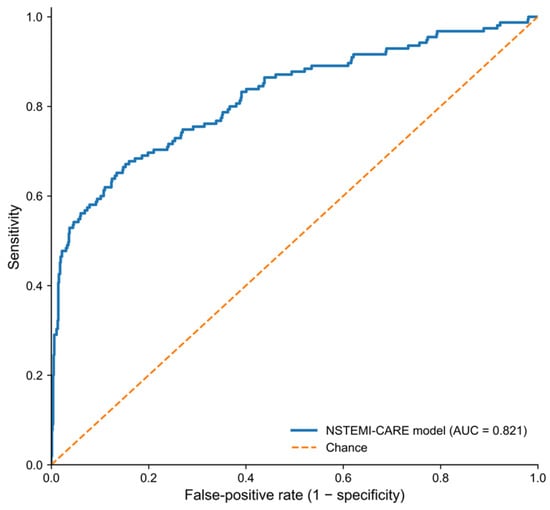
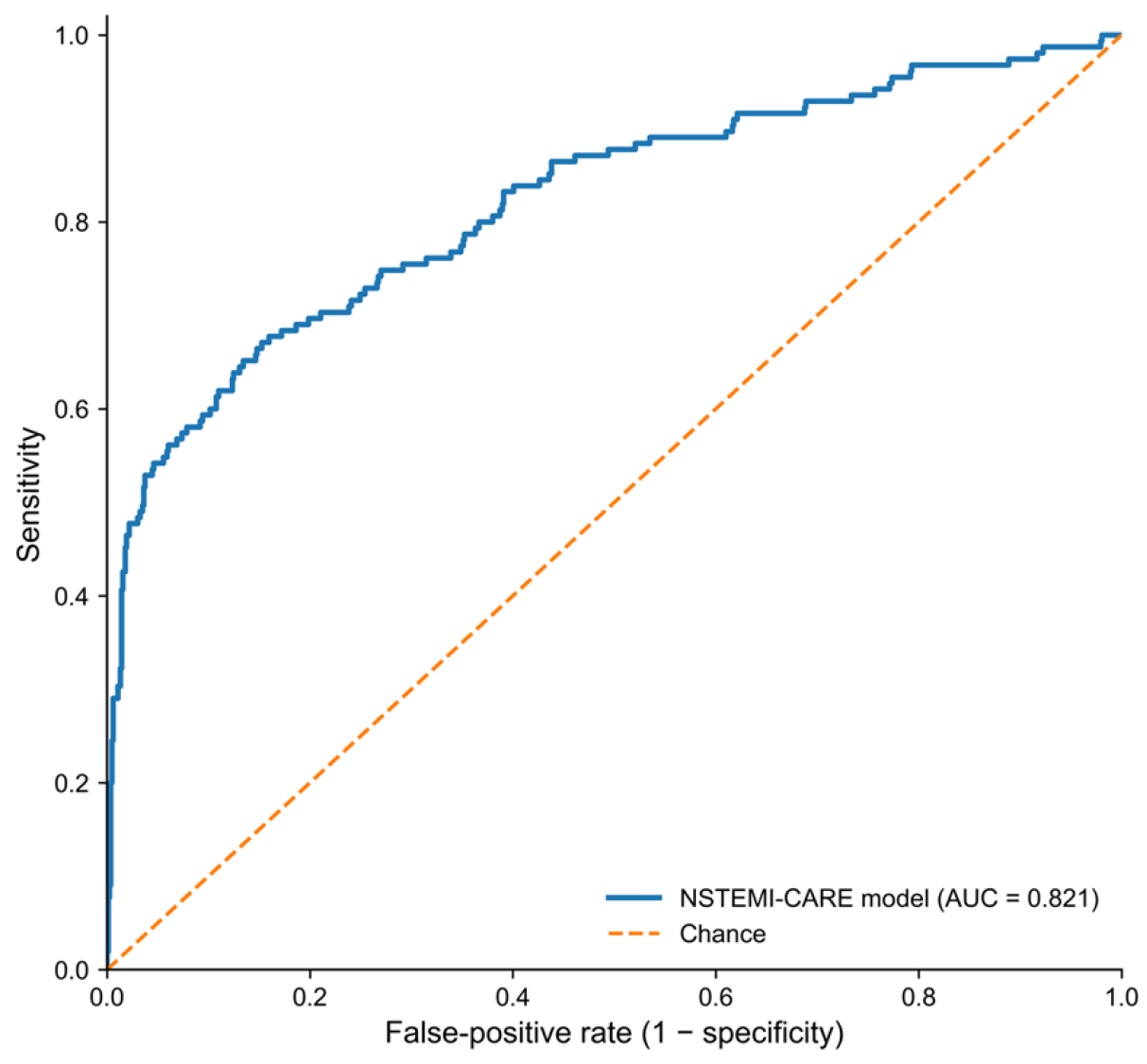
Three machine-learning approaches, including penalized logistic regression, Random Forest, and HistGradientBoosting classifiers, were evaluated during model development. The isotonic-calibrated HistGradientBoosting model demonstrated the best overall balance between discrimination and calibration and was selected as the probabilistic component of the NSTEMI-CARE algorithm. During five-fold out-of-fold internal validation, the final probabilistic model achieved good discrimination (AUC 0.821), an average precision of 0.618, and a Brier score of 0.092. The calibration plot, based on pooled out-of-fold predictions, showed overall agreement between predicted probabilities and observed event rates across risk groups (Supplementary Figure S2). The receiver operating characteristic curve is shown in Figure 1, and the precision–recall curve is provided in Supplementary Figure S1. Detailed performance across individual cross-validation folds is presented in Supplementary Table S2.
Figure 1.
Receiver Operating Characteristic Curve of the Final NSTEMI-CARE Probabilistic Model. Receiver operating characteristic (ROC) curve of the final isotonic-calibrated HistGradientBoosting probabilistic model obtained using five-fold out-of-fold internal validation. The model achieved an area under the ROC curve (AUC) of 0.821, demonstrating good discrimination for predicting the composite primary outcome.
SHAP analysis identified recurrent chest pain within 24 h, white blood cell count, hemoglobin, cardiac troponin, serum creatinine, systolic blood pressure, and other routinely available clinical variables among the principal contributors to model predictions (Supplementary Figure S3).
To translate probabilistic predictions into a clinically actionable triage strategy, candidate probability thresholds were explored across the full range of predicted risks. Based on their operating characteristics and clinical considerations, probability thresholds of <8% and ≥60% were selected for direct ward and direct ICU assignment, respectively (Supplementary Table S3). Within the probabilistic direct-classification layer, the <8% threshold provided a negative predictive value of 95.5%, identifying a subgroup with a relatively low observed risk of subsequent clinical deterioration, whereas the ≥60% threshold achieved a positive predictive value of 90.5% and a specificity of 99.5%, identifying a subgroup at very high risk of the primary outcome. Direct ICU assignment also incorporated predefined major clinical triggers—including recurrent chest pain within the first 24 h, acute heart failure signs, systolic blood pressure ≤90 mmHg, and heart rate <45 beats/min—to ensure immediate classification of clinically unstable patients irrespective of predicted risk. Among these, recurrent chest pain showed the strongest association with the primary outcome (OR 29.28, 95% CI 15.68–54.69), followed by systolic blood pressure ≤90 mmHg (OR 9.01, 95% CI 3.83–21.22) and acute heart failure (OR 7.96, 95% CI 4.93–12.86) (Supplementary Table S3).
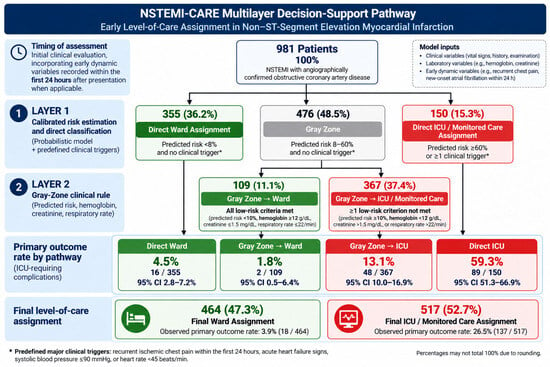
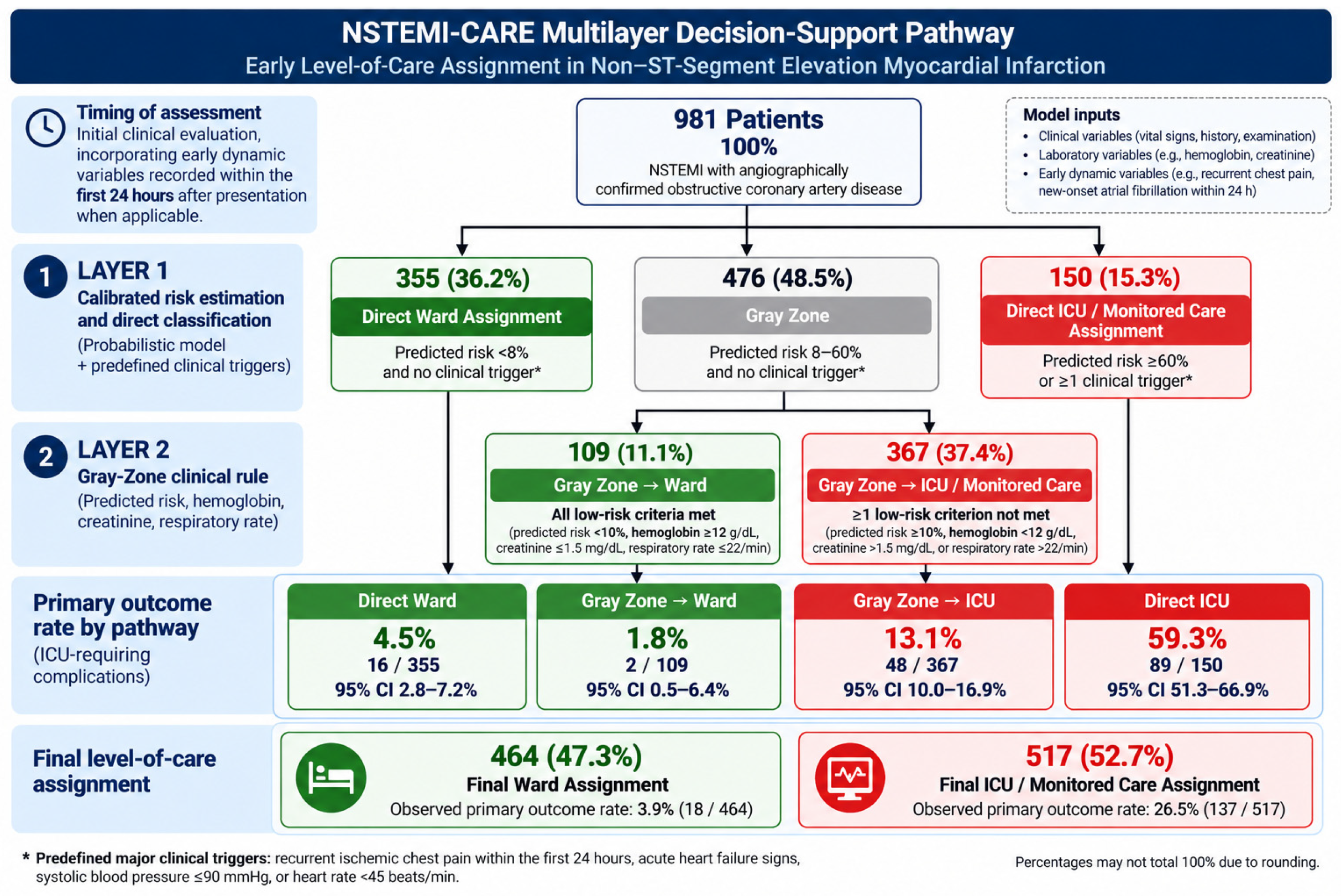
Application of the direct classification layer assigned 355 patients (36.2%) directly to the general ward and 150 (15.3%) directly to ICU/monitored care, whereas the remaining 476 patients (48.5%) entered an intermediate Gray-Zone pathway for secondary clinical assessment. Within this cohort, 50 patients (10.5%) experienced the primary outcome. To resolve this intermediate-risk group, a simplified secondary clinical decision rule was developed. Candidate bedside variables were evaluated within the Gray-Zone cohort according to their ability to stratify residual event risk, and the final rule retained variables that provided the greatest separation in observed event rates while preserving simplicity for bedside implementation (Supplementary Table S4). The final rule incorporated predicted risk, hemoglobin, serum creatinine, and respiratory rate. Gray-Zone patients were assigned to the general ward only if all predefined low-risk criteria were satisfied (predicted risk < 10%, hemoglobin ≥ 12 g/dL, serum creatinine ≤ 1.5 mg/dL, and respiratory rate ≤ 22 breaths/min); otherwise, the recommendation was ICU/monitored care.
After integration of both decision layers, the final NSTEMI-CARE algorithm assigned 464 patients (47.3%) to general ward care and 517 (52.7%) to ICU/monitored care. The observed primary outcome rate was 3.9% (18/464) among patients assigned to the general ward, compared with 26.5% (137/517) among those assigned to ICU/monitored care (Figure 2).
Figure 2.
Multilayer Patient Assignment Pathway of the Final NSTEMI-CARE Algorithm. The algorithm applies a sequential two-layer approach using clinical information available during the early clinical course, generally within the first 24 h after presentation. Layer 1 integrates calibrated risk estimation and predefined major clinical triggers to classify patients directly to ward-level care, ICU/monitored care, or the Gray Zone. Layer 2 applies the Gray-Zone clinical rule to determine the final level-of-care assignment. The figure shows patient flow through each pathway, pathway-specific primary outcome rates, and final assignment to ward or ICU/monitored care. Green indicates ward-level care, red indicates ICU/monitored care, and gray indicates patients requiring further assessment through the Gray-Zone clinical rule.
Overall, the complete algorithm achieved a sensitivity of 88.4%, specificity of 54.0%, positive predictive value of 26.5%, negative predictive value of 96.1%, and an overall accuracy of 59.4% (Table 4).
Table 4.
Performance of the Complete NSTEMI-CARE Algorithm.
Among the 18 patients assigned to general ward who subsequently experienced the primary outcome, the most frequent component was the subsequent need for continuous intravenous vasodilator therapy (10/18, 55.6%). Cardiac arrest (4/18, 22.2%), ventricular arrhythmias (2/18, 11.1%), advanced atrioventricular block, stroke, and in-hospital death (2/18, 11.1%) were less frequent. Notably, both in-hospital deaths occurred after cardiovascular surgical interventions during prolonged hospitalizations and were documented as postoperative complications rather than direct consequences of the index NSTEMI presentation.
A web-based implementation of the final NSTEMI-CARE algorithm was developed to facilitate patient-level risk estimation and level-of-care assignment. The application is publicly available at: https://huggingface.co/spaces/Coper820/nstemi-care-icu-triage (accessed on 21 May 2026).
3.3. Comparative Performance Against ACTION-ICU
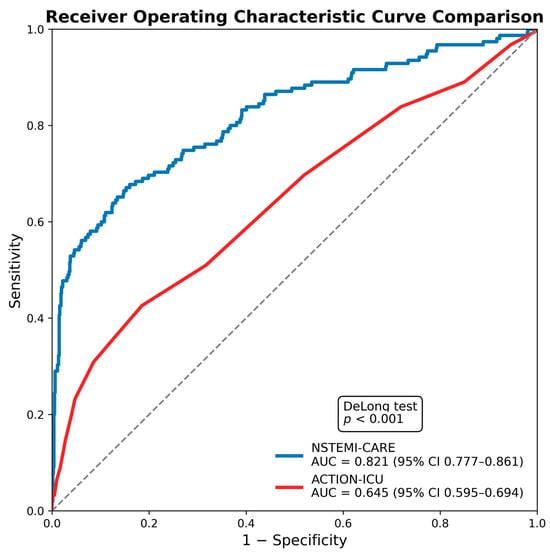
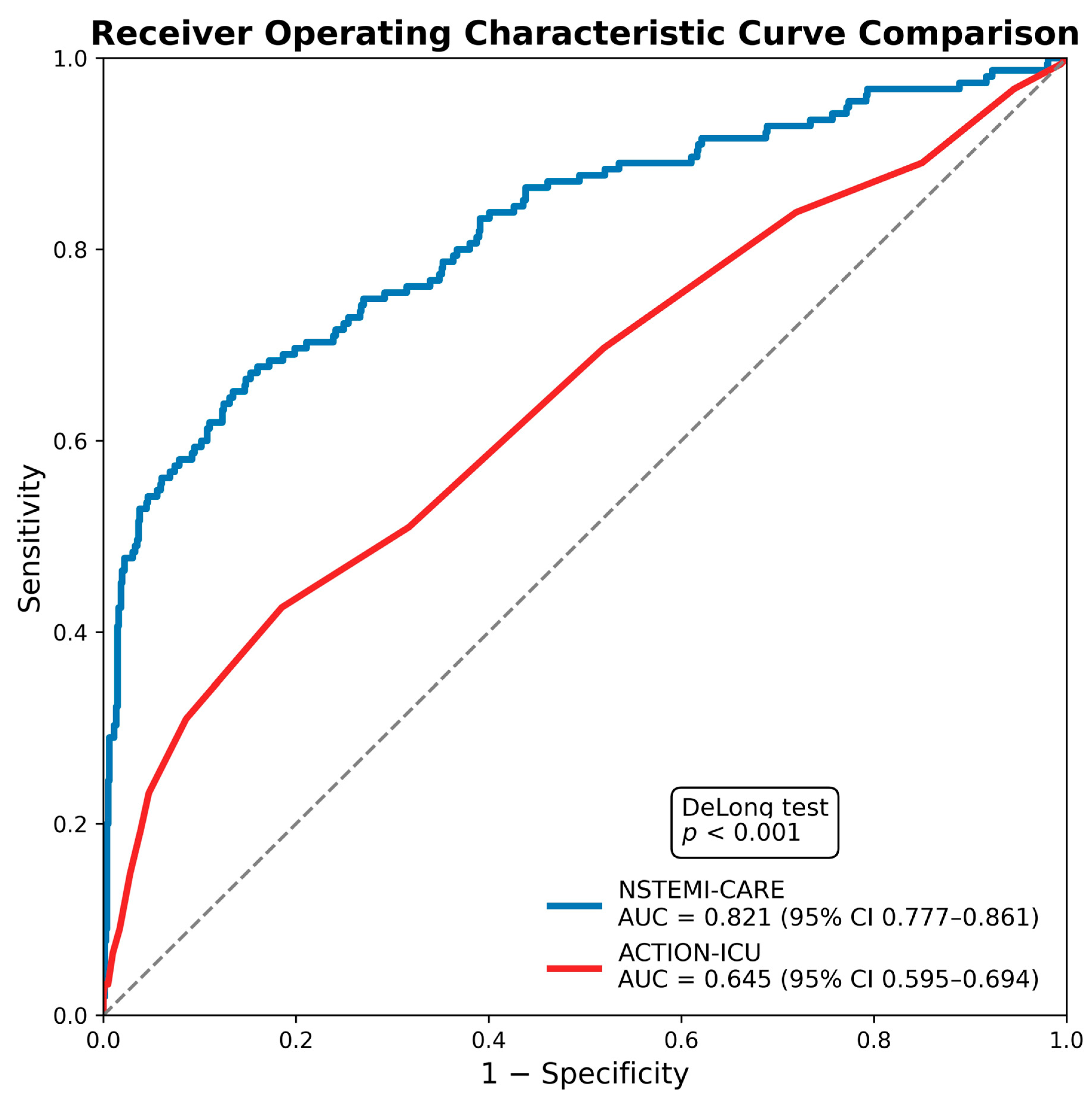
ACTION-ICU, the only previously published score specifically developed to support ICU triage in patients with NSTEMI, was evaluated in the same cohort for comparison with NSTEMI-CARE [7]. The final NSTEMI-CARE algorithm demonstrated significantly better discrimination than ACTION-ICU (AUC 0.821, 95% CI 0.777–0.861 vs. 0.645, 95% CI 0.595–0.694; DeLong p < 0.001) (Figure 3). At the recommended ACTION-ICU cutoff of ≥3 points, sensitivity was comparable to that of NSTEMI-CARE (89.0% vs. 88.4%) but at the expense of substantially reduced specificity (15.0% vs. 54.0%) and negative predictive value (87.9% vs. 96.1%). Increasing the ACTION-ICU threshold to ≥5 improved specificity (48.1%) but reduced sensitivity to 69.7%, resulting in substantially more false-negative classifications than NSTEMI-CARE (47 vs. 18 patients). The discriminative performance and operating characteristics of both algorithms are summarized in Supplementary Table S5.
Figure 3.
Receiver operating characteristic (ROC) curves comparing the discriminative performance of NSTEMI-CARE and ACTION-ICU for prediction of the primary outcome. NSTEMI-CARE showed significantly greater discrimination than ACTION-ICU (AUC 0.821 [95% CI 0.777–0.861] vs. 0.645 [95% CI 0.595–0.694]; DeLong p < 0.001).The gray dashed diagonal line represents chance-level discrimination (AUC = 0.50).
4. Discussion
In this retrospective cohort of patients with NSTEMI, we developed NSTEMI-CARE, a calibrated multilayer decision-support algorithm designed to support early hospital level-of-care assignment by integrating machine-learning-derived risk estimation with explicit clinical decision rules. Several findings deserve emphasis. First, although approximately one in six patients experienced the composite outcome requiring ICU-level care, the sequential architecture of NSTEMI-CARE identified nearly half of the cohort as candidates for general ward management, with a relatively low observed event rate and a high negative predictive value (96.1%).
Second, the probabilistic component demonstrated good discrimination and calibration following isotonic calibration (AUC 0.821; Brier score 0.092), with SHAP analysis identifying clinically plausible patterns of feature contribution to model predictions. Of note, although troponin levels did not differ significantly between outcome groups in univariable analysis, troponin contributed to individual predictions within the multivariable model. This finding illustrates that feature contribution within a nonlinear model may differ from marginal associations observed in conventional group comparisons. Serial troponin kinetics were not evaluated and may provide additional prognostic information in future studies. Other prominent SHAP features also have plausible clinical correlates: recurrent chest pain may reflect ongoing or recurrent ischemia, elevated white blood cell count may accompany the inflammatory response associated with acute coronary syndromes, and renal dysfunction may identify patients with greater clinical vulnerability [8]. These associations provide clinical context for model behavior but should not be interpreted as evidence of causal or independent mechanistic relationships.
Third, incorporation of predefined major clinical triggers and a simplified Gray-Zone decision rule enabled complete patient classification without leaving any intermediate-risk patients unresolved, while preserving a low event rate among patients ultimately assigned to the general ward (3.9%). The variables retained in the Gray-Zone rule are also clinically plausible markers of residual risk, reflecting anemia and reduced oxygen-carrying capacity, renal dysfunction, and increased respiratory demand. Finally, NSTEMI-CARE demonstrated significantly greater discrimination than ACTION-ICU, with higher specificity and fewer false-negative classifications in this cohort.
Collectively, these findings support further evaluation of NSTEMI-CARE as a transparent and clinically interpretable framework for early level-of-care decision support in patients with NSTEMI.
At first glance, identifying a subgroup of patients with NSTEMI who may be suitable for management outside the intensive care unit may appear counterintuitive, given the dynamic clinical course of NSTEMI and the multiple factors influencing early in-hospital deterioration. However, this perception reflects the common tendency to consider NSTEMI as a homogeneous high-risk condition despite its well-recognized clinical heterogeneity. Contemporary management increasingly requires distinguishing patients who require intensive monitoring from those at sufficiently low risk to potentially receive care in lower-acuity settings [9]. In this context, NSTEMI-CARE was specifically designed not only to estimate the probability of ICU-level complications, but also to support the practical clinical decision of early hospital level-of-care assignment by integrating individualized risk estimation with explicit bedside clinical decision rules.
Several risk stratification tools are available for patients with NSTEMI, although they address different clinical objectives. The TIMI and GRACE scores were primarily developed to estimate ischemic events and mortality, respectively, rather than the need for ICU-level care. In contrast, ACTION-ICU was specifically developed to predict complications requiring intensive care among initially stable patients with NSTEMI and therefore represents a more clinically aligned comparator for NSTEMI-CARE [7,10,11].
In its original development cohort, ACTION-ICU demonstrated moderate discrimination for ICU-requiring complications [7]. Our previous external evaluation in a Latin American NSTEMI cohort showed preserved discrimination but important threshold-dependent trade-offs between sensitivity and specificity [6]. In the present cohort, NSTEMI-CARE demonstrated greater discrimination than ACTION-ICU (AUC 0.821 vs. 0.645; DeLong p < 0.001), with higher specificity at comparable sensitivity using the ≥3-point ACTION-ICU threshold. These findings demonstrate different discriminative and classification performance in this cohort but should not be interpreted as evidence of superior clinical utility. Prospective comparative evaluation is required to determine whether these differences translate into improved level-of-care decisions.
From a clinical perspective, the potential value of NSTEMI-CARE lies in complementing probabilistic risk estimation with explicit bedside decision rules for level-of-care assignment. Current ACS guidelines recommend intensive cardiac care for patients with high-risk or unstable features and emphasize risk-based decisions regarding the intensity and duration of monitoring [4]. Previous observational studies have shown substantial variation in critical-care use among patients with NSTE-ACS and suggest that a considerable proportion of initially stable patients may be managed in monitored non-ICU settings [12]. More recent data have similarly highlighted substantial heterogeneity in hospital resource utilization among patients with ACS, supporting the potential role of risk-based stratification in guiding ICU use among patients with NSTEM [13]. In this context, identifying patients with a relatively low observed risk of deterioration may help inform individualized decisions regarding monitoring intensity and location of care.
This question may be particularly relevant in healthcare systems where ICU admission remains common despite heterogeneous patient risk. In a Brazilian cohort of 1263 patients with NSTEMI, nearly 95% were admitted to the ICU, whereas complications requiring intensive care occurred in only 4.9% of patients [14]. Similarly, substantial interhospital variation in ICU utilization has been reported across large U.S. cohorts of patients with acute myocardial infarction, including NSTEMI, without consistent differences in risk-adjusted mortality according to hospital-level ICU use [15,16]. In our cohort, NSTEMI-CARE retrospectively assigned 47.3% of patients to general ward care, among whom the observed primary outcome rate was 3.9%. These findings suggest that individualized risk-based level-of-care assignment could potentially contribute to more selective use of intensive-care resources while maintaining attention to the risk of clinical deterioration.
5. Limitations
This study has several limitations. First, its retrospective design is subject to biases related to data availability, documentation quality, and physician decision-making. Although candidate variables were routinely available during initial evaluation, some potentially relevant clinical information may not have been consistently documented or captured. In addition, granular timestamps were not uniformly available to establish the precise temporal relationship between dynamic predictors and individual outcome components.
Second, the study was conducted at a single high-complexity cardiovascular referral center, which limits the generalizability of the findings to other hospitals, healthcare systems, and patient populations with different resource availability, ICU admission practices, monitoring capacity, nurse-to-patient ratios, or triage protocols. In addition, only patients with angiographically confirmed obstructive coronary artery disease were included. Therefore, the applicability of NSTEMI-CARE to patients with suspected NSTEMI, myocardial injury, MINOCA, or nonobstructive coronary artery disease remains uncertain and should not be assumed without external validation in these populations and settings.
Third, although the probabilistic model underwent internal validation using five-fold out-of-fold cross-validation and calibration, the probability thresholds and Gray-Zone decision rules were developed and evaluated within the same cohort, which may result in optimistic estimates of the performance of the complete algorithm. External and prospective validation remain essential before clinical implementation. Future studies should evaluate the calibration, clinical safety, operational impact, and cost-effectiveness of NSTEMI-CARE across diverse healthcare systems.
Finally, the primary outcome was a composite of clinically relevant ICU-level complications designed to reflect escalation of care rather than individual disease-specific events. Although this endpoint captures scenarios that generally justify ICU or monitored care, some components may be influenced by institutional practice patterns and thresholds for initiating advanced therapies. Consequently, NSTEMI-CARE should be considered a decision-support tool intended to complement—not replace—clinical judgment within individualized patient assessment.
6. Conclusions
NSTEMI-CARE is a calibrated multilayer decision-support algorithm integrating individualized risk estimation with explicit bedside clinical decision rules for early level-of-care assignment in NSTEMI. In this retrospective single-center cohort, the algorithm demonstrated good discrimination and a high negative predictive value and identified a substantial subgroup with a relatively low observed risk of the primary outcome. These findings support further evaluation of NSTEMI-CARE as a potential decision-support framework for individualized level-of-care assignment. External prospective validation of the complete algorithm is required before routine clinical implementation.
Supplementary Materials
The following supporting information can be downloaded at https://www.mdpi.com/article/10.3390/jpm16110539/s1, Figure S1: Precision–Recall Curve of the Final NSTEMI-CARE Probabilistic Model; Figure S2: Calibration Plot of the Final NSTEMI-CARE Probabilistic Model; Figure S3: SHAP Summary Plot of the Final Probabilistic Model; Table S1: Operational definitions of all candidate predictors; Table S2: Internal Validation Metrics of the Final Probabilistic Model Using Five-Fold Cross-Validation; Table S3: Development of the direct classification layer of the NSTEMI-CARE algorithm; Table S3A (Panel A): Operating Characteristics of the Selected Probability Thresholds; Table S3B (Panel B): Performance of Predefined Major Clinical Triggers; Table S4: Derivation of the Gray-Zone Secondary Decision Rule; Table S4A (Panel A): Candidate variables retained in the final rule; Table S4B (Panel B): Final performance of the secondary rule; Table S5: Comparative Performance of NSTEMI-CARE and ACTION-ICU for ICU Triage.
Author Contributions
Conceptualization, J.F.V.-R. and D.I.; methodology, J.F.V.-R.; software, J.F.V.-R.; validation, J.F.V.-R.; formal analysis, J.F.V.-R. and C.I.-T.; investigation, J.F.V.-R., R.E.R.-T., D.G.D.-P., R.M.-M., C.I.-T. and D.I.; resources, R.E.R.-T.; data curation, J.F.V.-R., R.E.R.-T., D.G.D.-P., J.P.E.-M., J.J.P.-C., V.R.-L., R.M.-M., C.I.-T., K.L.R.-R. and N.A.-O.; writing—original draft, J.F.V.-R., R.E.R.-T., D.G.D.-P., J.P.E.-M., J.J.P.-C., V.R.-L., R.M.-M., C.I.-T., K.L.R.-R. and N.A.-O.; writing—review and editing, J.F.V.-R., R.E.R.-T., D.G.D.-P., J.P.E.-M., J.J.P.-C., V.R.-L., R.M.-M., C.I.-T., K.L.R.-R., N.A.-O. and D.I.; visualization, R.E.R.-T., J.P.E.-M., J.J.P.-C., C.I.-T., K.L.R.-R. and N.A.-O.; supervision, J.F.V.-R. and D.I.; project administration, V.R.-L. and D.I. All authors have read and agreed to the published version of the manuscript.
Funding
This research received no external funding.
Institutional Review Board Statement
Ethical review and approval were waived for this study by the Ethics Committee for Clinical Research of Fundación Cardioinfantil–Instituto de Cardiología due to the retrospective nature of the study, as no new patient intervention or contact occurs and confidentiality is preserved.
Informed Consent Statement
The informed consent was waived because of the retrospective design and use of anonymized data.
Data Availability Statement
The original contributions presented in this study are included in the article. The analytical code and model implementation are available from the corresponding author upon reasonable request. Further inquiries can be directed to the corresponding author.
Acknowledgments
The authors gratefully acknowledge Fundación Cardioinfantil—Instituto de Cardiología for its continued support of clinical research, innovation, and the generation of scientific evidence to improve cardiovascular care.
Conflicts of Interest
Carolina Idrovo-Turbay is an employee of AR SAS. The company had no role in the design or conduct of the study; collection, management, analysis, or interpretation of the data; preparation, review, or approval of the manuscript; funding of the research; or the decision to submit the manuscript for publication. The affiliation therefore reflects the authors’ professional clinical affiliation and does not represent a conflict of interest related to this research.
References
- Amsterdam, E.A.; Wenger, N.K.; Brindis, R.G.; Casey, D.E., Jr.; Ganiats, T.G.; Holmes, D.R., Jr.; Jaffe, A.S.; Jneid, H.; Kelly, R.F.; Kontos, M.C.; et al. 2014 AHA/ACC guideline for the management of patients with Non-ST-Elevation acute coronary syndromes: A report of the American College of Cardiology/American Heart Association Task Force on Practice Guidelines. J. Am. Coll. Cardiol. 2014, 64, e139–e228. [Google Scholar] [CrossRef] [Scilit] [PubMed]
- Thygesen, K.; Alpert, J.S.; Jaffe, A.S.; Chaitman, B.R.; Bax, J.J.; Morrow, D.A.; White, H.D.; Executive Group on behalf of the Joint European Society of Cardiology (ESC)/American College of Cardiology (ACC)/American Heart Association (AHA)/World Heart Federation (WHF) Task Force for the Universal Definition of Myocardial Infarction. Fourth Universal Definition of Myocardial Infarction (2018). J. Am. Coll. Cardiol. 2018, 72, 2231–2264. [Google Scholar] [CrossRef] [Scilit] [PubMed]
- Burgstaller, J.M.; Held, U.; Gravestock, I.; Klauser, B.S.; Gort, L.M.; Melzer, L.; Hasler, S.; Bierreth, T.D.; Müller, S.E.; Steurer, J.; et al. Impact of the Introduction of High-Sensitive Troponin Assay in the Emergency Department: A Retrospective Study. Am. J. Med. 2020, 133, 976–985. [Google Scholar] [CrossRef] [Scilit] [PubMed]
- Byrne, R.A.; Rossello, X.; Coughlan, J.J.; Barbato, E.; Berry, C.; Chieffo, A.; Claeys, M.J.; Dan, G.-A.; Dweck, M.R.; Galbraith, M.; et al. 2023 ESC Guidelines for the management of acute coronary syndromes. Eur. Heart J. 2023, 44, 3720–3826. [Google Scholar] [CrossRef] [Scilit] [PubMed]
- Varughese, V.J.; Pollock, J.; Patel, P.; Richardson, C.; Joseph, C.; Vacca, D.; Mujadzic, H. Outcomes of NSTEMI Admissions and Significance of TIMI Scores: A Nationwide Analysis Using the National Inpatient Sample. J. Clin. Med. 2025, 14, 171. [Google Scholar] [CrossRef] [Scilit] [PubMed]
- Vasquez-Rodriguez, J.F.; Idrovo-Turbay, C.; Perez-Fernandez, O.M.; Cruz-Tapias, P.; Isaza, N.; Navarro, A.; Medina-Mur, R.; Ramirez-Lovera, V.; Giraldo, L.E.; Ariza, N.; et al. Risk of complications after a non-ST segment elevation acute myocardial infarction in a Latin-American cohort: An application of the ACTION ICU score. Heart Lung 2023, 57, 124–129. [Google Scholar] [CrossRef] [Scilit] [PubMed]
- Fanaroff, A.C.; Chen, A.Y.; Thomas, L.E.; Pieper, K.S.; Garratt, K.N.; Peterson, E.D.; Newby, L.K.; de Lemos, J.A.; Kosiborod, M.N.; Amsterdam, E.A.; et al. Risk Score to Predict Need for Intensive Care in Initially Hemodynamically Stable Adults with Non-ST-Segment-Elevation Myocardial Infarction. J. Am. Heart Assoc. 2018, 7, e008894. [Google Scholar] [CrossRef] [Scilit] [PubMed]
- Intravaia, R.C.M.; Tognola, C.; Maloberti, A.; Brucato, F.; Campione, E.; Giannattasio, C.; Zuin, M.; Mojoli, M.; Abrignani, M.G.; Oliva, F.; et al. The role of inflammation in acute coronary syndrome: A systematic review on biochemical inflammatory assessment and anti-inflammatory therapies. Nutr. Metab. Cardiovasc. Dis. 2026, 36, 104409. [Google Scholar] [CrossRef] [Scilit] [PubMed]
- Fox, K.A.A.; Langrish, J.P. Estratificación del riesgo en los síndromes coronarios agudos. Rev. Esp. Cardiol. 2010, 63, 629–632. [Google Scholar] [CrossRef] [Scilit]
- Antman, E.M.; Cohen, M.; Bernink, P.J.L.M.; McCabe, C.H.; Horacek, T.; Papuchis, G.; Mautner, B.; Corbalan, R.; Radley, D.; Braunwald, E. The TIMI risk score for unstable angina/non-ST elevation MI: A method for prognostication and therapeutic decision making. JAMA 2000, 284, 835–842. [Google Scholar] [CrossRef] [Scilit] [PubMed]
- Fox, K.A.A.; Dabbous, O.H.; Goldberg, R.J.; Pieper, K.S.; Eagle, K.A.; Van de Werf, F.; Avezum, Á.; Goodman, S.G.; Flather, M.D.; Anderson, F.A.; et al. Prediction of risk of death and myocardial infarction in the six months after presentation with acute coronary syndrome: Prospective multinational observational study (GRACE). BMJ 2006, 333, 1091–1094. [Google Scholar] [CrossRef] [Scilit] [PubMed]
- Van Diepen, S.; Lin, M.; Bakal, J.A.; McAlister, F.A.; Kaul, P.; Katz, J.N.; Fordyce, C.B.; Southern, D.A.; Graham, M.M.; Wilton, S.B.; et al. Do stable non-ST-segment elevation acute coronary syndromes require admission to coronary care units? Am. Heart J. 2016, 175, 184–192. [Google Scholar] [CrossRef] [Scilit] [PubMed]
- Saxena, M.; Bloos, S.M.; Graber-Naidich, A.; Sundaram, V.; Pasao, M.; Yiadom, M.Y.A.B. Variation in ACS patient hospital resource utilization: Is it time for advanced NSTEMI risk stratification in the ED? Am. J. Emerg. Med. 2023, 70, 171–174. [Google Scholar] [CrossRef] [Scilit] [PubMed]
- Guimarães, P.O.; Sampaio, M.C.; Malafaia, F.L.; Lopes, R.D.; Fanaroff, A.C.; Silva, P.G.d.B.e.; dos Santos, T.M.; Okada, M.Y.; Mouallem, A.R.; Diniz, M.d.S.; et al. Clinical outcomes and need for intensive care after non-ST-segment-elevation myocardial infarction. Eur. J. Intern. Med. 2020, 76, 58–63. [Google Scholar] [CrossRef] [Scilit] [PubMed]
- Fanaroff, A.C.; Peterson, E.D.; Chen, A.Y.; Thomas, L.; Doll, J.A.; Fordyce, C.B.; Newby, L.K.; Amsterdam, E.A.; Kosiborod, M.N.; de Lemos, J.A.; et al. Intensive Care Unit Utilization and Mortality Among Medicare Patients Hospitalized With Non-ST-Segment Elevation Myocardial Infarction. JAMA Cardiol. 2017, 2, 36–44. [Google Scholar] [CrossRef] [Scilit] [PubMed]
- Chen, R.; Strait, K.M.; Dharmarajan, K.; Li, S.-X.; Ranasinghe, I.; Martin, J.; Fazel, R.; Masoudi, F.A.; Cooke, C.R.; Nallamothu, B.K.; et al. Hospital variation in admission to intensive care units for patients with acute myocardial infarction. Am. Heart J. 2015, 170, 1161–1169. [Google Scholar] [CrossRef] [Scilit] [PubMed]

Disclaimer/Publisher’s Note: The statements, opinions and data contained in all publications are solely those of the individual author(s) and contributor(s) and not of MDPI and/or the editor(s). MDPI and/or the editor(s) disclaim responsibility for any injury to people or property resulting from any ideas, methods, instructions or products referred to in the content. |
© 2026 by the authors. Licensee MDPI, Basel, Switzerland. This article is an open access article distributed under the terms and conditions of the Creative Commons Attribution (CC BY) license.