


Abstract
Background/Objectives: Reported cytomegalovirus (CMV) frequency after autologous haematopoietic stem cell transplantation (auto-HSCT) varies widely. We asked how much of that variation reflects how CMV is sought rather than how often it occurs and how often it causes disease. Methods: PubMed, Europe PMC, Embase and Scopus were searched from inception to 12 September 2026. Reports of at least 20 predominantly adult autologous recipients with an extractable CMV outcome were eligible. Virological detection, symptomatic infection, antiviral-treated infection, confirmed end-organ disease and attributed death were pooled separately by random-effects meta-analysis and a binomial-normal mixed model, stratified by monitoring strategy, denominator, and whether the case definition required symptoms. Results: Thirty-eight reports were included. Detection tracked ascertainment: 17.6% (95% confidence interval (CI) 12.7–23.9) under systematic surveillance, 3.9% (95% CI 1.0–14.4) under symptom-triggered testing, and 37.4% (95% CI 29.9–45.6) where the denominator was restricted to seropositive recipients. That difference disappeared once both arms were restricted to reports enumerating laboratory-detected CMV (2.7%; Q = 2.37, p = 0.12), an artefact of case definition. Clinical consequences were uncommon and stable across strategies: end-organ disease 1.8% (95% CI 1.2–2.7), confirmed disease 1.7% (95% CI 1.0–2.9), attributed death 0.8% (95% CI 0.5–1.2). Median first detection was 30–35 days. Heterogeneity was high for detection (I2 75–96%) and absent for death. Conclusions: After auto-HSCT, how often CMV is reported depends mainly on who is tested and how infection is defined, while end-organ disease and attributed death remain uncommon under every strategy. These data support evaluating risk-adapted monitoring rather than universal surveillance.
1. Introduction
Cytomegalovirus (CMV) establishes lifelong latency and may reactivate when cellular immune control is impaired. Its consequences are best characterised after allogeneic haematopoietic cell transplantation, where surveillance, pre-emptive therapy and prophylaxis are central to prevention [1,2,3]. Autologous transplantation (auto-HSCT) involves shorter profound immunosuppression and no routine graft-versus-host disease prophylaxis, yet CMV remains clinically relevant and incompletely characterised [4].
Recipients transplanted for myeloma or lymphoma experience neutropenia, lymphopenia and delayed pathogen-specific immune recovery whose depth depends on previous treatment, conditioning and graft manipulation. Historical antigen and polymerase chain reaction (PCR) surveillance detected infection that checking symptoms alone would have missed [5,6], and earlier marrow-transplant experience documented severe pneumonia [7]. Transient detection must therefore be distinguished from symptomatic infection and end-organ disease.
Monitoring practice varies between centres. European Conference on Infections in Leukaemia recommendations identified selected autologous recipients, including those receiving manipulated grafts or lymphocyte-depleting treatment, as potentially higher risk [1]; American Society for Transplantation and Cellular Therapy guidance addresses the limited evidence for routine surveillance after unmodified autografts [2]; more recent European recommendations concern mainly allogeneic transplantation [3]. None transfers directly to every autologous recipient, and standardised definitions remain essential for comparing heterogeneous reports [8].
A recent editorial highlighted continuing uncertainty about monitoring duration and treatment thresholds [9], and a large 2026 surveillance cohort proposed a risk-adapted approach [10]; that cohort is included here. Reviews of bispecific-antibody and chimeric antigen receptor T-cell therapy describe related but distinct populations [11,12].
No previous synthesis has pooled the published autologous experience while keeping laboratory detection separate from clinically consequential disease. This review pools every extractable autologous CMV outcome within strata defined by monitoring strategy and denominator; separates virological detection, symptomatic infection, antiviral-treated infection, confirmed end-organ disease and attributed death, which earlier summaries report interchangeably; and applies an endpoint-specific appraisal quantifying how far reported figures depend on assay sensitivity, testing completeness and case definition rather than on biological risk.
It compares findings by monitoring strategy, identifies reported risk factors and outcomes, and documents the gaps left by unavailable reports.
2. Materials and Methods
2.1. Review Design and Eligibility
This systematic review of observational evidence followed the Preferred Reporting Items for Systematic Reviews and Meta-Analyses (PRISMA) 2020 statement [13] (File S1: PRISMA 2020 Checklist). It was not prospectively registered. Population, exposures and outcomes were defined before screening, and every decision was recorded with its reason.
Eligible English-language, peer-reviewed primary reports were cohort studies, secondary analyses and research letters enrolling at least 20 autologous recipients, in adult or predominantly adult populations transplanted predominantly for haematological malignancy. Mixed-age cohorts were eligible only where adults formed the majority and no separate paediatric denominator could be extracted, and they were removed in a prespecified sensitivity analysis. Cohorts dominated by solid tumours were eligible only where a haematological subgroup of at least 20 recipients had separately extractable outcomes. Paediatric-only, autoimmune-only and solid-tumour-only studies, series without a usable autologous denominator, case reports and non-original publications were excluded.
CMV had to be a stated objective or defined outcome, with a CMV-specific numerator and denominator or association estimate. Blood pp65 antigenaemia or nucleic acid testing qualified for infection ascertainment, and disease-only cohorts were eligible where organ disease was confirmed by tissue or bronchoalveolar lavage testing; an exception was made for a transplant registry reporting treated infection, with its assay uncertainty made explicit. Administrative codes, culture-only estimates, inseparable composite viral outcomes and incidental mentions were ineligible.
2.2. Search and Selection
PubMed, Europe PMC, Embase and Scopus were searched from inception through 12 September 2026 using their application programming interfaces or advanced-search interfaces. Each strategy combined three concept groups—cytomegalovirus (cytomegalovirus, CMV, cytomegalo*), autologous transplantation (autologous, autograft*, ASCT, auto-HSCT, AHSCT) and haematopoietic transplantation (“hematopoietic stem cell transplantation”, “bone marrow transplantation”, transplant*, HSCT, HCT, SCT)—through Medical Subject Headings or Emtree terms and title, abstract and keyword fields. No language, publication-type or disease restriction was imposed within the queries; these were applied at screening.
Duplicates were removed using PubMed identifiers and digital object identifiers, and reference lists of relevant reviews and included reports were checked against the database set without yielding additional records. No Web of Science, trial-register or grey-literature search was performed, and corresponding authors were not contacted directly. Retrieval was attempted through publisher sites and public repositories; previews and abstracts were not treated as full texts. Reports whose full text could not be obtained were recorded as not retrieved with eligibility undetermined, not as exclusions [7,14,15,16,17,18,19,20,21,22].
Titles of all unique records were screened, abstracts were examined where the title suggested an autologous cohort with a CMV outcome, and full texts were sought for all candidates, each decision recorded with its reason.
Full-text exclusions comprised a report without a transplant-specific autologous denominator, one relying on culture-based ascertainment only, and one ascertaining infection by culture and viruria without a qualifying blood-assay policy [23,24,25]. The central nervous system lymphoma comparison was included because clinically relevant CMV infections were reported separately from a composite viral outcome [26]. A report was classed as excluded only after full-text assessment.
2.3. Data Checking and Critical Appraisal
Each entry was checked for bibliographic identity, eligibility, monitoring strategy, outcome definition, denominator and internal numerical consistency, and every reference was verified against its PubMed record. Extracted items included design, dates, diagnoses, age, serostatus, graft and conditioning, assay and schedule, prevention and treatment policies, event counts, disease and death attribution and timing. Whole-cohort, tested, seropositive, procedure and subgroup denominators were kept distinct, and unresolved source discrepancies were flagged rather than silently corrected.
Methodological quality was appraised with the Joanna Briggs Institute checklist for prevalence studies [27], and reports contributing prognostic estimates were additionally appraised with the Quality in Prognosis Studies tool [28]. Because ascertainment differs between endpoints within the same report, appraisal was performed separately for infection, end-organ disease and attributed mortality, and each was graded as low, moderate or serious concern by prespecified rules. Low concern required a complete denominator, a protocol-defined ascertainment method applied uniformly and a stated observation window; moderate concern applied where one element was incomplete or era-dependent; serious concern applied where two or more were absent, where the denominator was restricted to tested or surviving recipients without a reconcilable whole-cohort figure, or where the endpoint was neither confirmed nor explicitly enumerated.
2.4. Outcome Definitions
Five endpoints were defined before extraction and kept separate. Virological detection was CMV DNA or pp65 antigen in blood at or above the source report’s threshold, irrespective of symptoms. Symptomatic infection was detection with clinical features attributed to CMV by the authors, without histological confirmation. Antiviral-treated infection was detection leading to pre-emptive or therapeutic antiviral administration. End-organ disease was compatible clinical findings with CMV demonstrated in tissue or bronchoalveolar lavage fluid or an equivalent standard definition [8]; disease labelled as such without organ confirmation was recorded as author-defined. CMV-attributed death was death the source report attributed to CMV, distinguished from death during an episode of infection.
Symptomatic infection, antiviral-treated infection and confirmed disease were retained separately wherever the source data permitted; because many reports did not separate symptomatic from treated infection, these were also combined into a composite termed clinically significant infection, reported alongside the separate endpoints. Each report was additionally classified by the endpoint its case definition actually enumerated: reports ascertaining CMV by antigenaemia or nucleic acid testing irrespective of symptoms were classified as enumerating laboratory-detected CMV, and reports whose numerator required accompanying symptoms or antiviral treatment were classified as symptom-dependent or treatment-dependent. This classification, rather than the stated monitoring policy, determined entry to the primary virological-detection analysis. Reactivation is used only as a virological endpoint, denoting detection in a recipient known to be seropositive before transplantation.
2.5. Synthesis and Meta-Analysis
Monitoring was classified as systematic surveillance, clinically driven testing, mixed, disease-only or registry ascertainment, and denominators as whole autologous cohort, seropositive recipients or tested recipients. Endpoints were analysed separately, with end-organ disease additionally distinguished as confirmed or author-defined. Crude study-level proportions are shown with exact (Clopper–Pearson) 95% confidence intervals (CIs).
Proportions were pooled by random-effects meta-analysis of logit-transformed proportions using the DerSimonian–Laird estimator, with a 0.5 continuity correction for zero-event studies; heterogeneity is reported as I2 and τ2, with 95% prediction intervals where at least three studies contributed. Because the Rome/Regina Elena and Campus Bio-Medico reports share recruitment periods, the primary analysis retained one report per overlapping cohort (Marchesi 2019 [29] for the Rome clinically driven series), with all overlapping reports added in a sensitivity analysis. Further prespecified analyses excluded reports graded as serious concern and those enrolling mixed-age populations and restricted attributed death to deaths clearly attributed by the source report, with possible or unadjudicated contributions pooled separately. The primary virological-detection analysis was restricted to reports enumerating laboratory-detected CMV irrespective of symptoms, with a prespecified sensitivity analysis pooling separately those requiring symptoms or antiviral treatment. Any infection was pooled by monitoring strategy and denominator and strategies compared with a between-subgroup Q statistic; because strategy was neither randomised nor assigned, this tests the association between monitoring and reported detection, is descriptive, and is not advanced as a primary result. Because several reports recorded no events and the disease and death endpoints were rare, every estimate was recomputed with a binomial-normal generalised linear mixed model—a random-intercept logistic model fitted to the exact binomial likelihood by adaptive Gauss–Hermite quadrature with profile-likelihood intervals, requiring no continuity correction—as a rare-event sensitivity analysis. Registry cumulative incidences and reports without an extractable count were not pooled. Reporting follows the Synthesis Without Meta-analysis guideline for non-pooled comparisons [30]. Analyses used Python 3.11 (SciPy 1.17; Matplotlib 3.10).
3. Results
3.1. Search Results and Included Reports
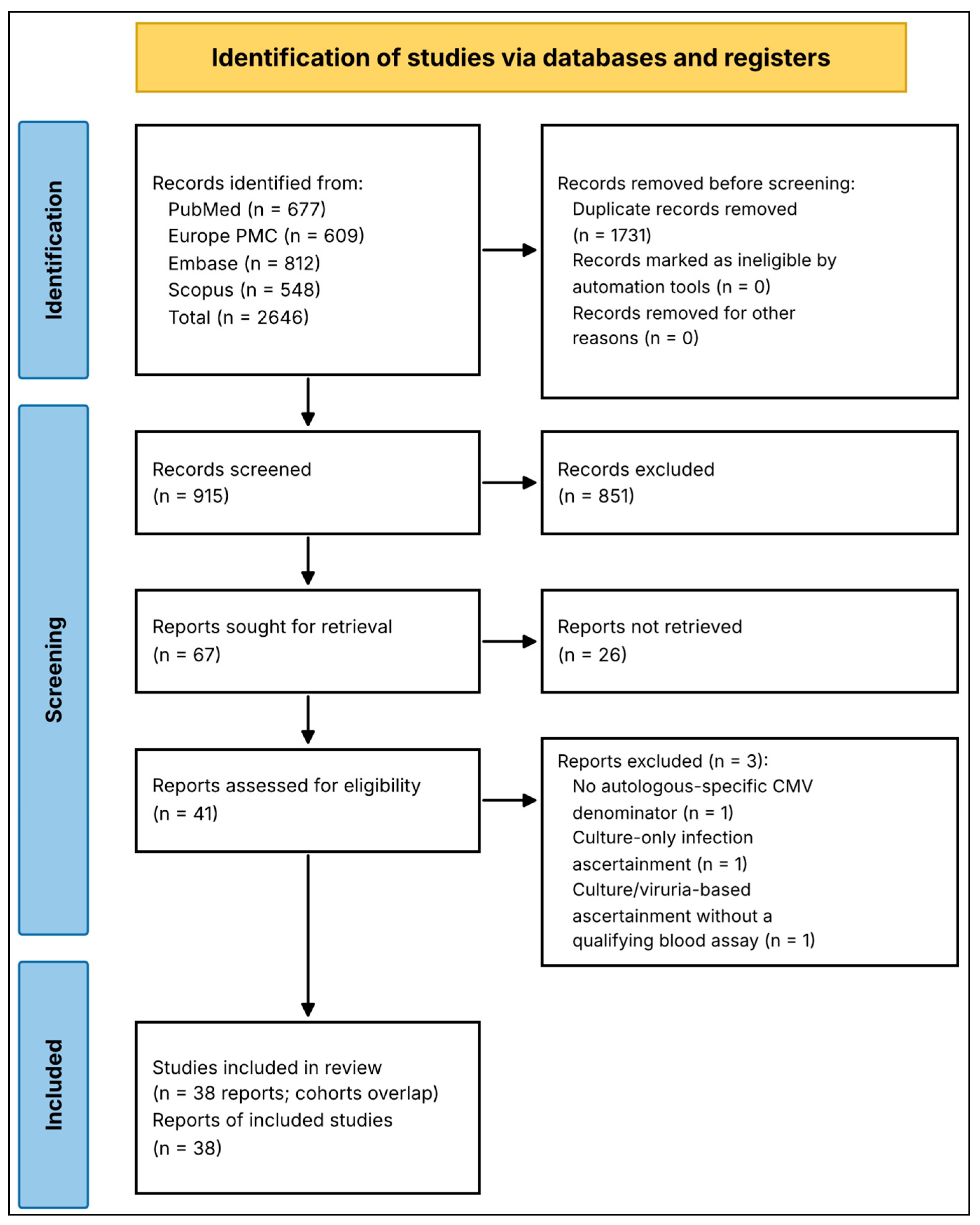
PubMed returned 677 records, Europe PMC 609, Embase 812 and Scopus 548; after removal of 1731 duplicates, 915 unique records were screened and 848 excluded at title and abstract. Full texts were sought for 67 reports: 26 could not be retrieved and remain of undetermined eligibility, 41 were assessed in full, three were excluded for defined reasons, and 38 were included (Figure 1).
Figure 1.
PRISMA 2020 flow diagram of study selection [13]. Counts refer to reports because several included reports describe overlapping cohorts. Reports not retrieved (n = 26), whose eligibility could not be determined, are shown separately from reports excluded after full-text assessment (n = 3).
3.2. Study Characteristics and Monitoring
The 38 reports span 1996–2026 and 18 countries or regions (Table 1). Twenty-two used systematic surveillance, ten clinically driven testing, three a mixed design, and one each disease-only, registry or uncertain ascertainment. Denominators ranged from 26 to 2130 recipients (median 136): 30 whole-cohort, four seropositive-only, and four tested-recipient. Quantitative PCR was the principal assay in 20 reports, pp65 antigenaemia in seven, qualitative or nested PCR in seven, and culture, histology or unreported methods in four. Thirty-six reports carried at least one appraisal flag, most often non-systematic or truncated ascertainment (28) and restricted or inconsistent denominators (24).
Joanna Briggs Institute items satisfied ranged from three to eight of nine (median five) (Table 2). Concern for the infection endpoint was low in two reports, moderate in 18 and serious in 16; for end-organ disease, low in 15, moderate in 10 and serious in five; and for attributed mortality, low in 13, moderate in nine and serious in three, with 13 reports not enumerating attributed death. Among the 28 reports providing a quantitative association, Quality in Prognosis Studies appraisal indicated low concern in one, moderate in 16 and serious in 11, most often because confounding was unaddressed.
3.3. Infection, Disease, Death and Timing
Any detected infection ranged from 0% to 48.5%, clinically significant infection from 0% to 37.9%, end-organ disease from 0% to 10.8% and attributed death from 0% to 3.0% (Table 3). The median day of first detection was 30–35 days in 14 of the 23 reports providing a median (range 8–65 days). Disease was confirmed by tissue, bronchoalveolar lavage or standard definitions in 24 reports and author-defined in six. Every entry was re-verified against its source report, and the Peggs 2003 [31], Holmberg 1999 [32] and Ben Moussa 2025 [33] entries are shown with their restricted or alternative source values.
Symptomatic infection was separately extractable in 12 reports, antiviral-treated infection in 15 plus one registry cumulative incidence, and organ-confirmed disease in 24; four reports enumerated none of the three (Table 4). Three reports gave a clinically significant count without stating whether it rested on symptoms or treatment, and those were not assigned to either component.
Table 1.
Characteristics, monitoring strategy, assay and appraisal of the 38 included reports.
Table 2.
Structured critical appraisal of the 38 included reports, graded separately for each endpoint.
Table 3.
CMV infection, clinically significant infection, end-organ disease, attributed death and timing of first detection.
Table 4.
Symptomatic CMV infection, antiviral-treated CMV infection and confirmed CMV end-organ disease, reported separately where the source data permit.
In non-overlapping reports with whole-cohort denominators, any detected infection was 17.6% (95% CI 12.7–23.9) under systematic surveillance (14 reports, 1737 recipients; I2 = 87%) and 3.9% (95% CI 1.0–14.4) under clinically driven testing (four reports, 1635 recipients; I2 = 96%) (Figure 2). Monitoring strategy was associated with reported detection (Q = 4.89, p = 0.027); because strategy was not assigned, this describes how completely infection was sought rather than an effect of monitoring. Surveillance restricted to seropositive recipients gave 37.4% (95% CI 29.9–45.6) (five reports, 1318 recipients), higher than whole-cohort surveillance (p < 0.001), and clinically driven testing with tested-recipient denominators gave 8.3% (95% CI 5.0–13.5). Prediction intervals were wide throughout (5–47% for whole-cohort surveillance). Reclassification by the endpoint actually enumerated showed that two of the four clinically driven whole-cohort reports defined their numerator by symptoms or antiviral treatment rather than laboratory detection [26,29], whereas all 14 surveillance reports enumerated laboratory-detected CMV. Restricting both arms to laboratory-detected CMV left surveillance unchanged and gave 2.7% (95% CI 0.2–26.7; two reports, 1152 recipients) under clinically driven testing, the strategies no longer being distinguishable (Q = 2.37, p = 0.12); the symptom- or treatment-dependent reports pooled separately to 5.5% (95% CI 0.5–40.2). The apparent contrast between strategies is therefore substantially attributable to case definition rather than monitoring intensity.
Clinically significant infection was 11.0% (95% CI 8.3–14.5) under systematic surveillance (15 reports, 2729 recipients; I2 = 79%), 2.9% (95% CI 0.9–9.3) under clinically driven testing (five reports, 1912 recipients; I2 = 94%; p = 0.029) and 8.0% (95% CI 5.8–11.0) overall (20 reports, 4641 recipients) (Figure 3).
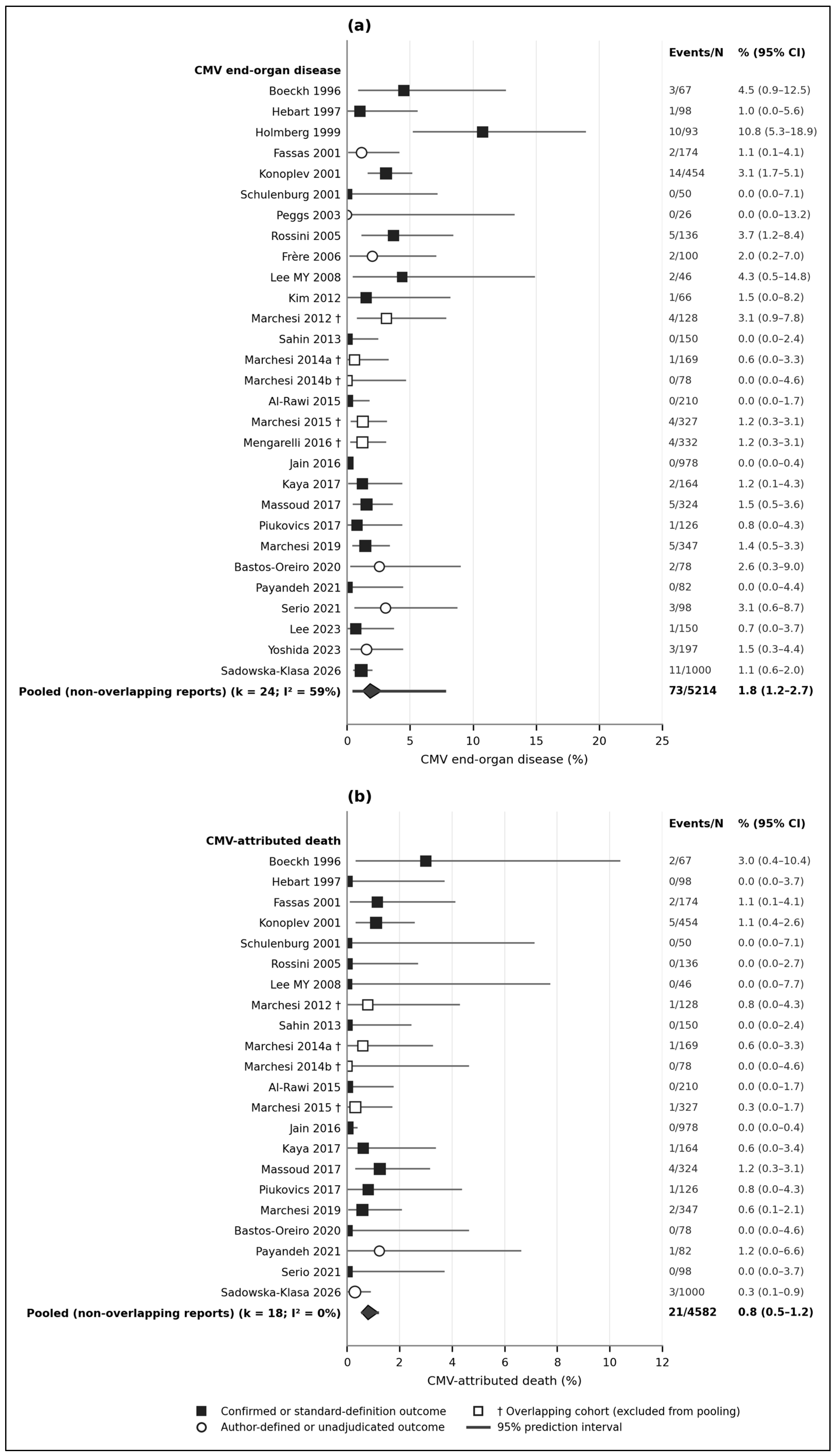
End-organ disease was 1.8% (95% CI 1.2–2.7) in 24 non-overlapping reports (5214 recipients; I2 = 59%; prediction interval 0.4–7.9%), with similar estimates for confirmed (1.7%, 95% CI 1.0–2.9) and author-defined (2.0%, 95% CI 1.1–3.4) disease (p = 0.71) (Figure 4); the highest study-level proportion, 10.8%, was in the CD34-selection comparison [32]. Attributed death was 0.8% (95% CI 0.5–1.2) in 18 reports (4582 recipients; I2 = 0%). Omitting the two reports describing attribution as possible or unadjudicated [10,58] gave clearly attributed death of 0.9% (95% CI 0.6–1.4; 16 reports, 3500 recipients), those contributions pooling separately to 0.5% (95% CI 0.1–1.7).
3.4. Pooled Estimates and Sensitivity Analyses
Table 5 lists all pooled estimates, prediction intervals and heterogeneity statistics, including analyses by assay type and the prespecified sensitivity analyses. Adding the overlapping reports changed no estimate by more than 0.6 percentage points. Among whole-cohort surveillance reports, PCR-based cohorts pooled to 17.5% (95% CI 11.7–25.4) and the two antigenaemia-based cohorts to 23.0% (95% CI 13.4–36.4). Every estimate quoted in the text was reconciled against Table 5; the combined end-organ disease estimate of 1.8% is used throughout for the primary analysis, the value of 1.7% being reserved for confirmed disease.
Excluding reports graded as serious concern, any detected infection was 18.6% (95% CI 12.2–27.2) under whole-cohort systematic surveillance (nine reports) and 5.5% (95% CI 0.5–40.2) under clinically driven testing (two reports), the strategies no longer being distinguishable (Q = 1.15, p = 0.28). Clinically significant infection was 11.0% (95% CI 7.3–16.1) and 5.2% (95% CI 0.5–36.3), respectively (Q = 0.44, p = 0.51), end-organ disease was 1.7% (95% CI 1.0–2.8) and attributed death was 0.8% (95% CI 0.5–1.2). Excluding mixed-age cohorts changed no estimate by more than 1.3 percentage points. Analysed separately, antiviral-treated infection was 9.0% (95% CI 6.0–13.2) and symptomatic infection was 6.3% (95% CI 3.1–12.2) (Q = 0.79, p = 0.37).
Table 5.
Pooled proportions (random-effects meta-analysis), prediction intervals and heterogeneity, with sensitivity analyses.
Figure 2.
Forest plot of any detected CMV infection or reactivation by monitoring strategy and denominator. Squares, diamonds and triangles denote whole-cohort, CMV-seropositive and tested-recipient denominators; marker size is proportional to log sample size; horizontal lines are exact 95% confidence intervals. Pooled estimates (random-effects logit model) are shown as diamonds with the 95% prediction interval as a thick line. Open markers (†) denote reports from overlapping cohorts, which were excluded from the pooled estimates. The registry estimate and the two reports without an extractable infection count for the eligible population are not shown [32,35,63]. The reports shown are [5,6,10,26,29,31,33,34,36,37,38,39,40,41,42,43,44,45,46,47,48,49,50,51,52,53,54,55,58,59,60,61,62]. Marchesi 2014a and Marchesi 2014b denote references [45] and [46], respectively.
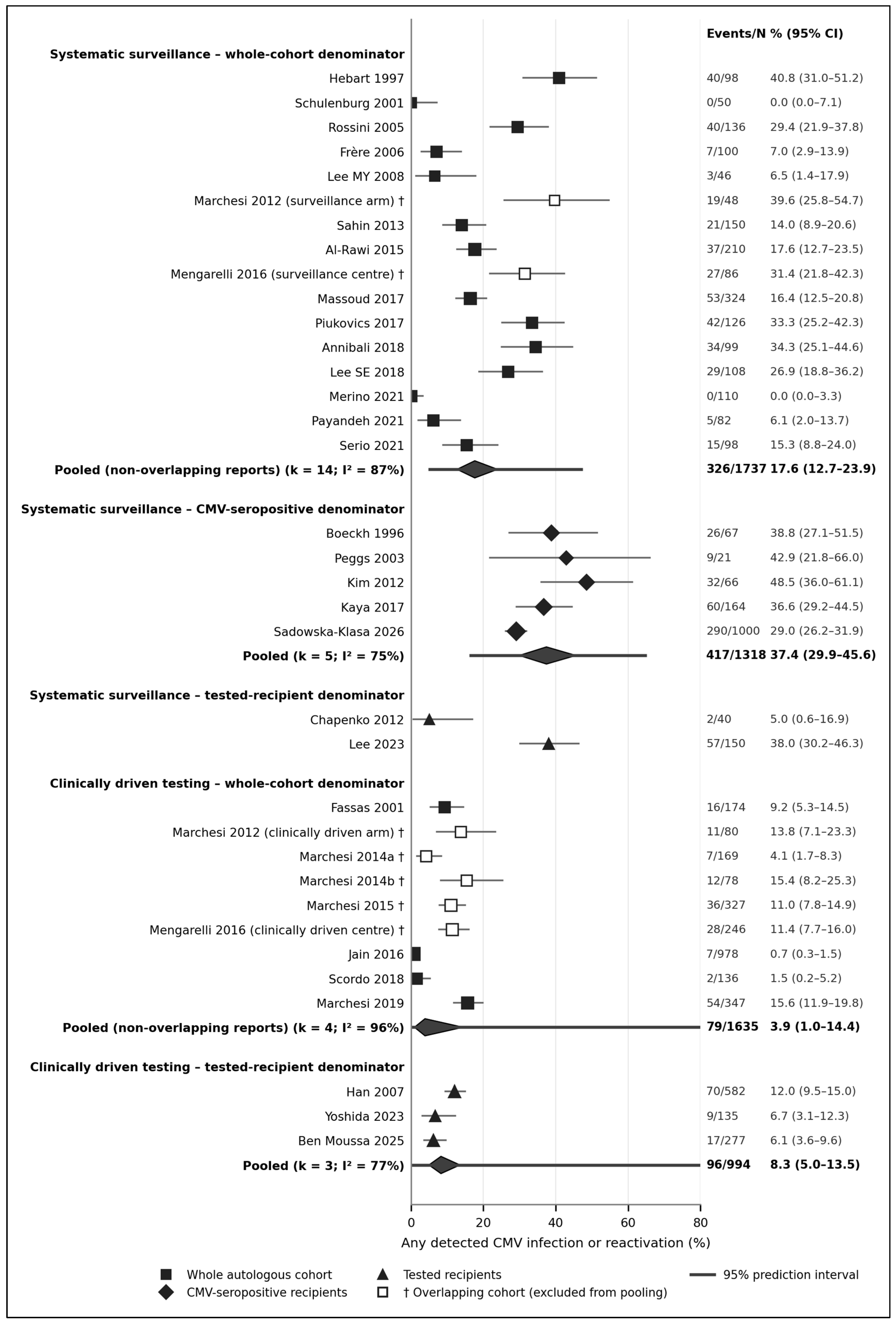
Figure 3.
Forest plot of clinically significant CMV infection (symptomatic infection and/or infection treated with antiviral therapy) by monitoring strategy. Symbols as in Figure 2. Pooled estimates exclude overlapping cohorts (†). Reports without an extractable count were not included. The reports shown are [5,6,10,26,29,31,33,34,37,40,41,42,45,46,47,48,49,50,51,52,53,55,59,60,61]. Marchesi 2014a and Marchesi 2014b denote references [45] and [46], respectively.
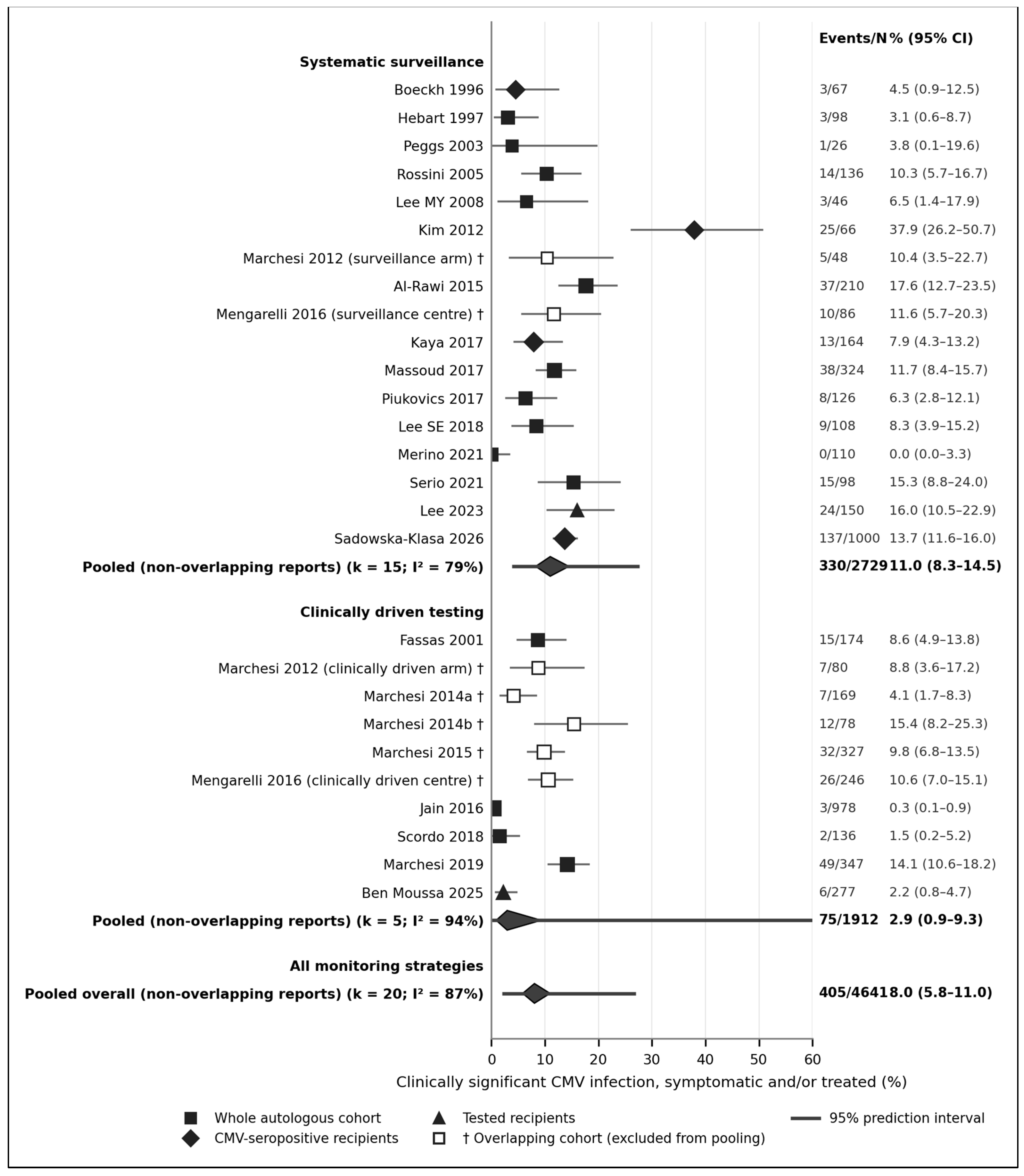
Figure 4.
Forest plots of (a) CMV end-organ disease and (b) CMV-attributed death. Filled squares denote confirmed or standard-definition outcomes and open circles denote author-defined or unadjudicated outcomes; open squares (†) denote overlapping cohorts excluded from the pooled estimates. Pooled estimates are random-effects logit proportions with 95% prediction intervals. The Seattle attributed-death count refers to deaths to which CMV possibly contributed [10]. The reports shown are [5,6,10,29,31,32,34,35,36,37,38,40,41,42,44,45,46,47,48,49,50,51,52,53,57,58,60,61,62] in panel (a) and [5,6,10,29,34,35,36,37,40,42,44,45,46,47,48,50,51,52,53,57,58,60] in panel (b). Marchesi 2014a and Marchesi 2014b denote references [45] and [46], respectively.
Recomputation with the binomial-normal mixed model agreed closely with the logit-transformed analysis wherever no report recorded zero events and gave lower estimates where zero-event reports were present. Any detected infection under whole-cohort surveillance was 13.0% (95% CI 6.1–22.9) against 17.6%, in a set containing two zero-event reports, and 3.7% (95% CI 0.6–17.5) against 3.9% under clinically driven testing. In the seropositive cohorts, where every report recorded events, the methods agreed (36.8%, 95% CI 30.0–46.3, against 37.4%). Divergence was greatest for the rare endpoints: end-organ disease 1.2% (95% CI 0.7–2.0) against 1.8% with six zero-event reports, and attributed death 0.4% (95% CI 0.2–0.7) against 0.8% with nine. The continuity correction therefore inflates the rare-event estimates, and the mixed-model values are the more conservative bound; no conclusion depends on the choice of model.
3.5. Reported Associations
Twenty-eight reports provided at least one quantitative association, with adjusted estimates in 11 (Table 6). Factors associated with infection in at least one adjusted analysis were CD34 selection, hepatitis B core antibody positivity, T-cell lymphoma, prolonged neutropenia, tandem transplantation, corticosteroid exposure, pre-transplant viraemia and a lower CD3+CD4+CD161+ T-cell proportion; rituximab, bortezomib-based induction, diagnosis and age were associated in some univariable analyses and not others. Associations with haematological recovery, transplant-related mortality and survival were reported in 10 studies, in both directions [48,52,61].
Table 6.
Quantitative risk-factor and outcome associations reported by the included studies.
4. Discussion
4.1. Principal Findings and Their Interpretation
This review identified 38 reports of CMV after auto-HSCT in predominantly adult haematological-malignancy cohorts. Its principal finding is that reported detection is strongly associated with monitoring strategy and denominator: systematic surveillance detected infection in roughly one recipient in six (17.6%), symptom-triggered testing in roughly one in twenty-five (3.9%) and seropositive-only cohorts in more than one in three (37.4%), whereas end-organ disease (1.8% overall, 1.7% confirmed) and attributed death (0.8%, or 0.9% clearly attributed) were uncommon under every strategy. A positive surveillance test, antiviral initiation and tissue-invasive disease describe different clinical states and cannot be read as interchangeable estimates of an underlying risk. Because strategy was not assigned, the comparison between strategies is an association rather than an effect of monitoring and is not retained as a primary result: it survives neither restriction to reports enumerating laboratory-detected CMV (Q = 2.37, p = 0.12) nor exclusion of reports graded as serious concern (Q = 1.15, p = 0.28). Wide prediction intervals and I2 above 75% indicate that assay sensitivity, sampling completeness, observation windows and case definitions, rather than biological differences between programmes, drive most between-study variation. What the data support is the narrower statement that how completely CMV is sought, and in whom, determines how often it is reported.
The denominator is a major determinant of interpretation. A tested-patient proportion addresses yield among selected recipients; a whole-cohort proportion also depends on how completely infection was sought; restricting to seropositive recipients removes lower-risk patients and raises the estimate; and counting procedures rather than people permits repeated events. This is why the Rossini patient and procedure estimates, the two Jain denominators and the tested subset in Lee 2023 must remain separate [37,50,61].
Assay sensitivity is equally consequential. A threshold close to the detection limit identifies low-level DNA that may clear untreated, as the difference between positivity above detection and quantification limits within one Korean cohort shows [61]. Antigen assays depend on leukocyte availability, nested PCR amplifies small amounts of DNA without quantification, and quantitative assays differ in specimen, extraction and calibration [5,6,31,36,43]. Copies per millilitre cannot be converted into international units without assay-specific calibration, and even standard-calibrated assays differ in reported plasma values [64,65], so no transferable treatment threshold can be derived here [58,60].
The rarity of end-organ disease is reassuring but does not show that surveillance is unnecessary: most contemporary cohorts offered diagnostic assessment and antiviral treatment, so their disease rates reflect an observed care pathway rather than untreated natural history. Conversely, detecting more asymptomatic infection does not establish benefit—the difference in detection was not accompanied by a difference in disease or death that these data can resolve, and the two Rome comparisons are confounded by centre practice and patient selection [42,49].
Reactivation should be used selectively. Some DNA-positive recipients were seronegative before transplantation, so the endpoint may combine reactivation, primary infection and unresolved classification [6,58], which argues for reporting the underlying assay result before assigning a clinical label.
Timing deserves comparable attention. Most reports covered the early post-transplant period, but several described later events or extended surveillance after a positive test [35,52,60,61]. A longer window increases cumulative detection without implying higher instantaneous risk, while follow-up limited to hospitalisation may miss outpatient disease.
4.2. Comparison with the Previous Literature
The earlier literature showed that severe CMV pneumonia could follow autologous marrow transplantation and that sensitive surveillance detected more infection than clinical assessment alone [5,6,7], while a later review and editorial identified uncertainty about whom to monitor and when to treat [4,9]. This synthesis supports that uncertainty: it neither justifies assuming every positive test is harmless nor shows that routine testing of every recipient improves patient-important outcomes.
The contrast with the allogeneic setting is instructive. There, cohort and registry analyses link early viraemia and higher viral loads with non-relapse mortality, and randomised letermovir prophylaxis reduced clinically significant infection and was associated with lower mortality [66,67,68], underpinning current guidance [2,3,69]. No autologous cohort reviewed here provides comparable evidence of a survival effect or prophylaxis benefit; the only letermovir observation concerned allogeneic recipients [60]. Allogeneic thresholds therefore cannot be transferred without evaluation.
The association between CD34 selection and CMV disease was pronounced in the historical Seattle comparison [32], but the Belgian comparison found no increased incidence, the disease-only MD Anderson series reported no pneumonia among selected-graft recipients, and the London cohort found similar detection rates with selected and unselected grafts [31,35,38]. These reports support caution for selected grafts without establishing a replicated effect.
Reviews of bispecific-antibody and chimeric antigen receptor T-cell therapy describe higher reactivation in heavily pretreated populations, but those exposures typically follow rather than coincide with the autologous episode [11,12], which should be treated as one segment of a longer exposure history.
4.3. Risk Factors and Immune Recovery
Signals involving corticosteroids, lymphoma, renal dysfunction, albumin and pre-transplant viraemia in the recent Seattle report are plausible, since each may capture impaired immune control, disease burden or treatment intensity [10]. That report contributes the largest seropositive denominator here; omitting it raised the pooled seropositive estimate from 37.4% to 40.0% and removed heterogeneity within that subgroup, indicating a more completely sampled denominator rather than a discrepant result. A prognostic association does not show that modifying a predictor prevents disease, and the derived risk score requires external validation.
Rituximab, bortezomib-based induction, tandem transplantation and hepatitis B core antibody positivity showed inconsistent associations. Some positive findings arose from overlapping Rome cohorts and are not independent replications [29,42,45,46,48,49], and other cohorts did not identify them [47,50,51,54]; such markers may reflect previous treatment lines or remission status rather than causation.
Diagnosis-based comparisons require similar restraint: some reports found higher detection in myeloma, others in non-Hodgkin or T-cell lymphoma, and others no difference [37,47,48,51,52,53,61], a category that may stand in for age, prior therapy or sampling intensity. The central nervous system lymphoma comparison shows why outcome-specific extraction matters: its clinically relevant CMV events satisfy the inclusion rule, whereas its hazard ratio for a composite DNA-virus outcome cannot be attributed to CMV [26].
Associations with delayed haematological recovery, hospitalisation and non-relapse mortality are most concerning when infection is symptomatic, persistent or high-level [10,29,45,48,52]. The temporal relationship can run either way: marrow suppression may prompt testing and increase risk, while viral illness or myelotoxic treatment may delay recovery. Deaths during CMV infection should be distinguished from adjudicated attributable deaths; conflicting counts and differing attribution language prevent a uniform estimate [33,52], so the analysis restricted to clearly attributed deaths (0.9%) is the more conservative summary.
The apparent association between early reactivation and better survival in one myeloma subgroup should not be read as a benefit of infection [61], since it can reflect disease status, treatment selection and time-dependent exposure. The immune-reconstitution reports remain exploratory: a CD4+CD161+ subset was associated with lower reactivation risk, CMV detection preceded CD8+ T-cell expansion, and adaptive natural killer cells expanded in seropositive recipients without detectable reactivation [31,55,59]. Because CMV preceded large-granular-lymphocyte expansion, that expansion cannot be a baseline predictor [62].
4.4. Diagnostic and Clinical Implications
Testing should be considered in relation to immune suppression, symptoms and local diagnostic capability, with unexplained fever, persistent cytopenia, gastrointestinal illness or pulmonary symptoms after engraftment meriting evaluation. Blood viral load does not replace organ-directed assessment when tissue-invasive disease is suspected, since gastrointestinal disease has been reported with negative blood PCR [52]. Treatment decisions should weigh severity, viral kinetics, assay characteristics and drug toxicity rather than a single threshold.
The included reports span three generations of laboratory practice: culture with antigenaemia, qualitative or nested PCR, and calibrated quantitative PCR. Only the last permits kinetic interpretation, and even then, pre-emptive thresholds ranged from any detectable DNA to several thousand copies or international units per millilitre. Reporting in international units, stating limits of detection and quantification, specifying specimen type and describing the sampling schedule are minimal requirements for cross-centre interpretation [64,65,70]; without them, a single result near the detection limit conveys little prognostic information [10,33].
Risk-adapted surveillance is a reasonable strategy to test, particularly for recipients with prolonged immune suppression, selected grafts, HIV infection or substantial corticosteroid exposure, but this synthesis cannot establish its effectiveness, duration or cost-effectiveness; the recent risk-adapted proposal remains to be tested outside its derivation setting [10].
The value of a monitoring programme depends on more than the number of infections detected: time to recognition of clinically significant illness, repeat testing, antiviral exposure, toxicity and admissions all matter. No contrast here measures that balance, which favours explicit local pathways and prospective evaluation.
4.5. Limitations of the Evidence and of the Review
Primary studies differed in selection, era, serostatus, assay, testing frequency, thresholds, treatment availability and outcome definitions. Three enrolled mixed-age populations and others reported only tested subsets; excluding the mixed-age reports changed no estimate materially. A registry-based treated-infection estimate was retained under an explicit exception and not pooled [63], and missing data were not interpreted as absence of events. The pooled proportions combine different assays, thresholds and windows, their prediction intervals are wide, and no publication-bias test is reliable for proportions; they are descriptive averages of the published experience, not incidence estimates transferable to a single centre.
Cohort overlap is a further limitation. The Rome reports share centres and recruitment periods, and several institutional series have potentially overlapping windows [5,17,19,31]. Without participant identifiers, the number of independent patients cannot be established; the primary analyses retained one report per overlapping cohort, and adding the overlapping reports changed no estimate materially.
The search is reproducible but not exhaustive. English-language eligibility, the absence of Web of Science, trial-register and grey-literature searching, the lack of direct author contact, and unavailable reports may have introduced selection and availability bias. The 26 not-retrieved reports were neither assessed nor excluded: several are letters or immune-reconstitution studies with small or mixed populations, while four historical reports describe large marrow-transplant cohorts whose disease counts could not be incorporated [7,15,17,18]. Their potential influence was therefore quantified. Because the pooled disease estimate rests on 73 events among 5214 recipients, adding four cohorts of the size their abstracts suggest would move it by less than one percentage point even under adverse assumptions: from 1.8% to 2.2% if their disease proportion were twice the pooled value and to 2.6% if eight times. Since their era and culture-based ascertainment make a higher proportion more plausible, the disease estimate is best regarded as representative of the PCR era.
Appraisal used structured, endpoint-specific gradings rather than a numerical risk-of-bias score. Missingness cannot be resolved by assigning favourable outcomes to unreported fields: a paper that does not tabulate CMV deaths may have observed none, combined them with other infection-related deaths, or not adjudicated attribution. This review therefore preserves “not reported” separately from explicit zero counts.
4.6. Future Research
Prospective multicentre cohorts should use consistent infection and organ-disease definitions, calibrated viral-load reporting in international units, an explicit sampling schedule and both whole-cohort and serostatus-specific denominators, and should distinguish asymptomatic detection, treated infection, confirmed disease and adjudicated attributable death. Contemporary exposures should be recorded with dose and timing.
Prediction research should validate proposed models externally and report calibration, discrimination and consequences at candidate thresholds, with biomarkers measured before the outcome they predict. Survival analyses should account for time-dependent exposure, competing events and survivor selection. Comparative implementation studies could then assess whether risk-adapted surveillance reduces disease, hospitalisation and toxicity at acceptable cost.
5. Conclusions
How often CMV is reported after autologous haematopoietic stem cell transplantation depends mainly on who is tested, how testing is performed and how infection is defined. Symptomatic, persistent or high-level infection may accompany clinically important complications, whereas transient low-level detection often has a different course, and confirmed end-organ disease remains uncommon under every monitoring strategy examined. The evidence supports further evaluation of monitoring tailored to immune suppression and clinical risk but does not establish that universal surveillance improves outcomes.
Supplementary Materials
The following supporting information can be downloaded at https://www.mdpi.com/article/10.3390/diagnostics16223897/s1, File S1: PRISMA 2020 Checklist.
Author Contributions
Conceptualization, F.B.; methodology, F.B.; software, F.B.; validation, F.B.; formal analysis, L.S., I.G.B. and S.A.P.; investigation, L.S., I.G.B. and S.A.P.; resources, L.S., I.G.B. and S.A.P.; data curation, L.S., I.G.B. and S.A.P.; writing—original draft preparation, F.B.; writing—review and editing, L.S., I.G.B. and S.A.P.; visualization, L.S., I.G.B. and S.A.P.; project administration, L.S., I.G.B. and S.A.P.; supervision, L.S., I.G.B. and S.A.P. All authors have read and agreed to the published version of the manuscript.
Funding
We would like to acknowledge the “Victor Babeș” University of Medicine and Pharmacy Timișoara for their support in covering the costs of publication for this research paper.
Institutional Review Board Statement
Ethical review and approval were waived for this study because it is a systematic review of previously published, de-identified aggregate data and did not involve human participants or animals.
Informed Consent Statement
Not applicable.
Data Availability Statement
No new data were created or analysed in this study. Data sharing is not applicable to this article.
Acknowledgments
During the preparation of this manuscript, the authors used Claude (Anthropic, version Opus 5.5) and ChatGPT (OpenAI, version GPT-5) to assist with database retrieval, title and abstract screening, checking of extracted data against the source reports, language editing and reference formatting. Every screening decision, extracted value, analysis, result and interpretation was made or verified by the authors; no confidential or unpublished third-party material was entered into these tools. The authors reviewed, verified and approved all content and take full responsibility for it.
Conflicts of Interest
The authors declare no conflicts of interest.
References
- Ljungman, P.; de la Camara, R.; Cordonnier, C.; Einsele, H.; Engelhard, D.; Reusser, P.; Styczynski, J.; Ward, K. Management of CMV, HHV-6, HHV-7 and Kaposi-sarcoma herpesvirus (HHV-8) infections in patients with hematological malignancies and after SCT. Bone Marrow Transplant. 2008, 42, 227–240. [Google Scholar] [CrossRef] [Scilit] [PubMed]
- Hakki, M.; Aitken, S.L.; Danziger-Isakov, L.; Michaels, M.G.; Carpenter, P.A.; Chemaly, R.F.; Papanicolaou, G.A.; Boeckh, M.; Marty, F.M. American Society for Transplantation and Cellular Therapy Series: #3—Prevention of Cytomegalovirus Infection and Disease After Hematopoietic Cell Transplantation. Transplant. Cell. Ther. 2021, 27, 707–719. [Google Scholar] [CrossRef] [Scilit] [PubMed]
- Ljungman, P.; Alain, S.; Chemaly, R.F.; Einsele, H.; Galaverna, F.; Hirsch, H.H.; Sadowska-Klasa, A.; Navarro, D.; Styczynski, J.; de la Camara, R. Recommendations from the 10th European Conference on Infections in Leukaemia for the management of cytomegalovirus in patients after allogeneic haematopoietic cell transplantation and other T-cell-engaging therapies. Lancet Infect. Dis. 2025, 25, e451–e462. [Google Scholar] [CrossRef] [Scilit] [PubMed]
- Marchesi, F.; Pimpinelli, F.; Ensoli, F.; Mengarelli, A. Cytomegalovirus infection in hematologic malignancy settings other than the allogeneic transplant. Hematol. Oncol. 2018, 36, 381–391. [Google Scholar] [CrossRef] [Scilit] [PubMed]
- Boeckh, M.; Stevens-Ayers, T.; Bowden, R.A. Cytomegalovirus pp65 antigenemia after autologous marrow and peripheral blood stem cell transplantation. J. Infect. Dis. 1996, 174, 907–912. [Google Scholar] [CrossRef] [Scilit] [PubMed]
- Hebart, H.; Schröder, A.; Löffler, J.; Klingebiel, T.; Martin, H.; Wassmann, B.; Gerneth, F.; Rabenau, H.; Jahn, G.; Kanz, L.; et al. Cytomegalovirus monitoring by polymerase chain reaction of whole blood samples from patients undergoing autologous bone marrow or peripheral blood progenitor cell transplantation. J. Infect. Dis. 1997, 175, 1490–1493. [Google Scholar] [CrossRef] [Scilit] [PubMed]
- Reusser, P.; Fisher, L.D.; Buckner, C.D.; Thomas, E.D.; Meyers, J.D. Cytomegalovirus infection after autologous bone marrow transplantation: Occurrence of cytomegalovirus disease and effect on engraftment. Blood 1990, 75, 1888–1894. [Google Scholar] [CrossRef] [Scilit]
- Ljungman, P.; Boeckh, M.; Hirsch, H.H.; Josephson, F.; Lundgren, J.; Nichols, G.; Pikis, A.; Razonable, R.R.; Miller, V.; Griffiths, P.D. Definitions of Cytomegalovirus Infection and Disease in Transplant Patients for Use in Clinical Trials. Clin. Infect. Dis. 2017, 64, 87–91. [Google Scholar] [CrossRef] [Scilit] [PubMed]
- Mittal, A.; Hutchinson, H.J.; Lucke-Wold, B.P. Cytomegalovirus reactivation and the prevalence in autologous hematopoietic stem cell transplantation. World J. Virol. 2026, 15, 117651. [Google Scholar] [CrossRef] [Scilit] [PubMed]
- Sadowska-Klasa, A.; Xie, H.; Holmberg, L.A.; Waghmare, A.; Leisenring, W.M.; Boeckh, M.J. Cytomegalovirus After Autologous Hematopoietic Cell Transplantation: Impact on Outcome and A Personalized Risk-Adapted Prevention Strategy. Transplant. Cell. Ther. 2026, 32, 1489.e1–1489.e13. [Google Scholar] [CrossRef] [Scilit] [PubMed]
- Aparicio-Minguijón, E.; Rodríguez-Goncer, I.; López-Muñoz, N.; Pérez-Jacoiste Asín, M.A.; Bartolomé Herguedas, G.; Boán, J.; Sáez Marín, A.J.; Sánchez-Pina, J.M.; Martínez-López, J.; Calbacho, M.; et al. Cytomegalovirus infection in patients receiving bispecific antibodies for multiple myeloma and B-cell malignancies: A single-center cohort and meta-analysis. Front. Oncol. 2026, 16, 1918863. [Google Scholar] [CrossRef] [Scilit] [PubMed]
- Benda, M.; Reimann, P.; Willenbacher, W.; Gunsilius, E.; Weisel, K.; Strassl, I.; Krauth, M.T.; Knop, S.; Winder, T.; Steiner, N. Infectious toxicities associated with bispecific antibodies and CAR-T cells in multiple myeloma: A systematic review. Ann. Hematol. 2026, 105, 397. [Google Scholar] [CrossRef] [Scilit] [PubMed]
- Page, M.J.; McKenzie, J.E.; Bossuyt, P.M.; Boutron, I.; Hoffmann, T.C.; Mulrow, C.D.; Shamseer, L.; Tetzlaff, J.M.; Akl, E.A.; Brennan, S.E.; et al. The PRISMA 2020 statement: An updated guideline for reporting systematic reviews. BMJ 2021, 372, n71. [Google Scholar] [CrossRef] [Scilit] [PubMed]
- Hasegawa, T.; Aisa, Y.; Shimazaki, K.; Ito, C.; Nakazato, T. Cytomegalovirus reactivation in patients with multiple myeloma. Eur. J. Haematol. 2016, 96, 78–82. [Google Scholar] [CrossRef] [Scilit] [PubMed]
- Wingard, J.R.; Chen, D.Y.; Burns, W.H.; Fuller, D.J.; Braine, H.G.; Yeager, A.M.; Kaiser, H.; Burke, P.J.; Graham, M.L.; Santos, G.W. Cytomegalovirus infection after autologous bone marrow transplantation with comparison to infection after allogeneic bone marrow transplantation. Blood 1988, 71, 1432–1437. [Google Scholar] [CrossRef] [Scilit]
- Ljungman, P.; Biron, P.; Bosi, A.; Cahn, J.Y.; Goldstone, A.H.; Gorin, N.C.; Link, H.; Messina, C.; Michallet, M.; Richard, C. Cytomegalovirus interstitial pneumonia in autologous bone marrow transplant recipients. Infectious Disease Working Party of the European Group for Bone Marrow Transplantation. Bone Marrow Transplant. 1994, 13, 209–212. [Google Scholar] [PubMed]
- Boeckh, M.; Gooley, T.A.; Reusser, P.; Buckner, C.D.; Bowden, R.A. Failure of high-dose acyclovir to prevent cytomegalovirus disease after autologous marrow transplantation. J. Infect. Dis. 1995, 172, 939–943. [Google Scholar] [CrossRef] [Scilit] [PubMed]
- Alessandrino, E.P.; Varettoni, M.; Colombo, A.A.; Caldera, D.; Bernasconi, P.; Malcovati, L. High incidence of symptomatic cytomegalovirus infection in multiple myeloma patients undergoing autologous peripheral blood stem cell transplantation. Blood 2000, 95, 4016–4018. [Google Scholar] [CrossRef] [Scilit]
- Peggs, K.S.; Ings, S.J.; Kottaridis, P.D.; Yong, K.; Williams, C.D.; Goldstone, A.H.; Mackinnon, S. Cytomegalovirus infection and disease after autologous CD34-selected peripheral blood stem cell transplantation for multiple myeloma: No evidence of increased incidence based on polymerase-chain-reaction monitoring. Blood 2000, 96, 369–370. [Google Scholar] [CrossRef] [Scilit] [PubMed]
- Nishio, M.; Koizumi, K.; Endo, T.; Fujimoto, K.; Koike, T.; Sawada, K. Diminished T-cell recovery after CD34+ selected autologous peripheral blood stem cell transplantation increases the risk of cytomegalovirus infection. Haematologica 2001, 86, 667–668. [Google Scholar] [PubMed]
- Inazawa, N.; Hori, T.; Nojima, M.; Saito, M.; Igarashi, K.; Yamamoto, M.; Shimizu, N.; Yoto, Y.; Tsutsumi, H. Virus reactivations after autologous hematopoietic stem cell transplantation detected by multiplex PCR assay. J. Med. Virol. 2017, 89, 358–362. [Google Scholar] [CrossRef] [Scilit] [PubMed]
- Liberatore, C.; D’Uva, M.; Natale, A.; Guardalupi, F.; Di Re, L.; Fioritoni, F.; Pulini, S.; Spadano, R.; Vaddinelli, D.; Santarone, S.; et al. Cytomegalovirus infection after autologous transplantation in patients with multiple myeloma exposed to daratumumab. Bone Marrow Transplant. 2025, 60, 1181–1183. [Google Scholar] [CrossRef] [Scilit] [PubMed]
- Ng, A.P.; Worth, L.; Chen, L.; Seymour, J.F.; Prince, H.M.; Slavin, M.; Thursky, K. Cytomegalovirus DNAemia and disease: Incidence, natural history and management in settings other than allogeneic stem cell transplantation. Haematologica 2005, 90, 1672–1679. [Google Scholar] [PubMed]
- Singhal, S.; Powles, R.; Treleaven, J.; Horton, C.; Pinkerton, C.R.; Meller, S.; Mehta, J. Cytomegaloviremia after autografting for leukemia: Clinical significance and lack of effect on engraftment. Leukemia 1997, 11, 835–838. [Google Scholar] [CrossRef] [Scilit] [PubMed]
- Bilgrami, S.; Aslanzadeh, J.; Feingold, J.M.; Bona, R.D.; Clive, J.; Dorsky, D.; Edwards, R.L.; Tutschka, P.J. Cytomegalovirus viremia, viruria and disease after autologous peripheral blood stem cell transplantation: No need for surveillance. Bone Marrow Transplant. 1999, 24, 69–73. [Google Scholar] [CrossRef] [Scilit] [PubMed]
- Scordo, M.; Morjaria, S.M.; Littmann, E.R.; Bhatia, A.; Chung, H.H.; Maloy, M.; DeAngelis, L.M.; Giralt, S.A.; Taur, Y.; Sauter, C.S. Distinctive Infectious Complications in Patients with Central Nervous System Lymphoma Undergoing Thiotepa, Busulfan, and Cyclophosphamide-conditioned Autologous Stem Cell Transplantation. Biol. Blood Marrow Transplant. 2018, 24, 1914–1919. [Google Scholar] [CrossRef] [Scilit] [PubMed]
- Munn, Z.; Moola, S.; Lisy, K.; Riitano, D.; Tufanaru, C. Methodological guidance for systematic reviews of observational epidemiological studies reporting prevalence and cumulative incidence data. Int. J. Evid. Based Healthc. 2015, 13, 147–153. [Google Scholar] [CrossRef] [Scilit] [PubMed]
- Hayden, J.A.; van der Windt, D.A.; Cartwright, J.L.; Côté, P.; Bombardier, C. Assessing bias in studies of prognostic factors. Ann. Intern. Med. 2013, 158, 280–286. [Google Scholar] [CrossRef] [Scilit] [PubMed]
- Marchesi, F.; Pimpinelli, F.; Di Domenico, E.G.; Renzi, D.; Gallo, M.T.; Regazzo, G.; Rizzo, M.G.; Gumenyuk, S.; Toma, L.; Marino, M.; et al. Association between CMV and Invasive Fungal Infections After Autologous Stem Cell Transplant in Lymphoproliferative Malignancies: Opportunistic Partnership or Cause-Effect Relationship? Int. J. Mol. Sci. 2019, 20, 1373. [Google Scholar] [CrossRef] [Scilit] [PubMed]
- Campbell, M.; McKenzie, J.E.; Sowden, A.; Katikireddi, S.V.; Brennan, S.E.; Ellis, S.; Hartmann-Boyce, J.; Ryan, R.; Shepperd, S.; Thomas, J.; et al. Synthesis without meta-analysis (SWiM) in systematic reviews: Reporting guideline. BMJ 2020, 368, l6890. [Google Scholar] [CrossRef] [Scilit] [PubMed]
- Peggs, K.S.; Verfuerth, S.; Pizzey, A.; Khan, N.; Moss, P.; Goldstone, A.H.; Yong, K.; Mackinnon, S. Reconstitution of T-cell repertoire after autologous stem cell transplantation: Influence of CD34 selection and cytomegalovirus infection. Biol. Blood Marrow Transplant. 2003, 9, 198–205. [Google Scholar] [CrossRef] [Scilit] [PubMed]
- Holmberg, L.A.; Boeckh, M.; Hooper, H.; Leisenring, W.; Rowley, S.; Heimfeld, S.; Press, O.; Maloney, D.G.; McSweeney, P.; Corey, L.; et al. Increased incidence of cytomegalovirus disease after autologous CD34-selected peripheral blood stem cell transplantation. Blood 1999, 94, 4029–4035. [Google Scholar] [CrossRef] [Scilit]
- Ben Moussa, M.L.; Chelbi, Y.; Kharrat, R.; Berred, R.; Ben Lakhal, R.; Hamdoun, M.; Bahri, O. Cytomegalovirus reactivation risk after autologous hematopoietic stem cell transplantation: Results of a Tunisian study. World J. Virol. 2025, 14, 115626. [Google Scholar] [CrossRef] [Scilit] [PubMed]
- Fassas, A.B.; Bolaños-Meade, J.; Buddharaju, L.N.; Rapoport, A.; Cottler-Fox, M.; Chen, T.; Lovchik, J.C.; Cross, A.; Tricot, G. Cytomegalovirus infection and non-neutropenic fever after autologous stem cell transplantation: High rates of reactivation in patients with multiple myeloma and lymphoma. Br. J. Haematol. 2001, 112, 237–241. [Google Scholar] [CrossRef] [Scilit] [PubMed]
- Konoplev, S.; Champlin, R.E.; Giralt, S.; Ueno, N.T.; Khouri, I.; Raad, I.; Rolston, K.; Jacobson, K.; Tarrand, J.; Luna, M.; et al. Cytomegalovirus pneumonia in adult autologous blood and marrow transplant recipients. Bone Marrow Transplant. 2001, 27, 877–881. [Google Scholar] [CrossRef] [Scilit] [PubMed]
- Schulenburg, A.; Watkins-Riedel, T.; Greinix, H.T.; Rabitsch, W.; Loidolt, H.; Keil, F.; Mitterbauer, M.; Kalhs, P. CMV monitoring after peripheral blood stem cell and bone marrow transplantation by pp65 antigen and quantitative PCR. Bone Marrow Transplant. 2001, 28, 765–768. [Google Scholar] [CrossRef] [Scilit] [PubMed]
- Rossini, F.; Terruzzi, E.; Cammarota, S.; Morini, F.; Fumagalli, M.; Verga, L.; Elli, E.; Verga, M.; Miccolis, I.; Parma, M.; et al. Cytomegalovirus infection after autologous stem cell transplantation: Incidence and outcome in a group of patients undergoing a surveillance program. Transpl. Infect. Dis. 2005, 7, 122–125. [Google Scholar] [CrossRef] [Scilit] [PubMed]
- Frère, P.; Pereira, M.; Fillet, G.; Beguin, Y. Infections after CD34-selected or unmanipulated autologous hematopoietic stem cell transplantation. Eur. J. Haematol. 2006, 76, 102–108. [Google Scholar] [CrossRef] [Scilit] [PubMed]
- Han, X.Y. Epidemiologic analysis of reactivated cytomegalovirus antigenemia in patients with cancer. J. Clin. Microbiol. 2007, 45, 1126–1132. [Google Scholar] [CrossRef] [Scilit] [PubMed]
- Lee, M.Y.; Chiou, T.J.; Hsiao, L.T.; Yang, M.H.; Lin, P.C.; Poh, S.B.; Yen, C.C.; Liu, J.H.; Teng, H.W.; Chao, T.C.; et al. Rituximab therapy increased post-transplant cytomegalovirus complications in Non-Hodgkin’s lymphoma patients receiving autologous hematopoietic stem cell transplantation. Ann. Hematol. 2008, 87, 285–289. [Google Scholar] [CrossRef] [Scilit] [PubMed]
- Kim, J.H.; Goulston, C.; Sanders, S.; Lampas, M.; Zangari, M.; Tricot, G.; Hanson, K.E. Cytomegalovirus reactivation following autologous peripheral blood stem cell transplantation for multiple myeloma in the era of novel chemotherapeutics and tandem transplantation. Biol. Blood Marrow Transplant. 2012, 18, 1753–1758. [Google Scholar] [CrossRef] [Scilit] [PubMed]
- Marchesi, F.; Giannotti, F.; Avvisati, G.; Petti, M.C.; Pimpinelli, F.; Paba, P.; Dessanti, M.L.; Cerretti, R.; Tirindelli, M.C.; Picardi, A.; et al. The potential role of pre-transplant HBcIgG seroposivity as predictor of clinically relevant cytomegalovirus infection in patients with lymphoma undergoing autologous hematopoietic stem cell transplantation: A study from the Rome Transplant Network. Am. J. Hematol. 2012, 87, 213–217. [Google Scholar] [CrossRef] [Scilit] [PubMed]
- Chapenko, S.; Trociukas, I.; Donina, S.; Chistyakov, M.; Sultanova, A.; Gravelsina, S.; Lejniece, S.; Murovska, M. Relationship between beta-herpesviruses reactivation and development of complications after autologous peripheral blood stem cell transplantation. J. Med. Virol. 2012, 84, 1953–1960. [Google Scholar] [CrossRef] [Scilit] [PubMed]
- Sahin, D.G.; Gunduz, E.; Kasifoglu, N.; Akay, O.M.; Us, T.; Gulbas, Z. Cytomegalovirus DNAemia detected with real-time polymerase chain reaction in hematopoietic stem cell transplant patients. Adv. Ther. 2013, 30, 784–791. [Google Scholar] [CrossRef] [Scilit] [PubMed]
- Marchesi, F.; Mengarelli, A.; Giannotti, F.; Tendas, A.; Anaclerico, B.; Porrini, R.; Picardi, A.; Cerchiara, E.; Dentamaro, T.; Chierichini, A.; et al. High incidence of post-transplant cytomegalovirus reactivations in myeloma patients undergoing autologous stem cell transplantation after treatment with bortezomib-based regimens: A survey from the Rome transplant network. Transpl. Infect. Dis. 2014, 16, 158–164. [Google Scholar] [CrossRef] [Scilit] [PubMed]
- Marchesi, F.; Pimpinelli, F.; Dessanti, M.L.; Gumenyuk, S.; Palombi, F.; Pisani, F.; Romano, A.; Spadea, A.; Maschio, M.; Ensoli, F.; et al. Evaluation of risk of symptomatic cytomegalovirus reactivation in myeloma patients treated with tandem autologous stem cell transplantation and novel agents: A single-institution study. Transpl. Infect. Dis. 2014, 16, 1032–1038. [Google Scholar] [CrossRef] [Scilit] [PubMed]
- Al-Rawi, O.; Abdel-Rahman, F.; Al-Najjar, R.; Abu-Jazar, H.; Salam, M.; Saad, M. Cytomegalovirus Reactivation in Adult Recipients of Autologous Stem Cell Transplantation: A Single Center Experience. Mediterr. J. Hematol. Infect. Dis. 2015, 7, e2015049. [Google Scholar] [CrossRef] [Scilit] [PubMed]
- Marchesi, F.; Pimpinelli, F.; Gumenyuk, S.; Renzi, D.; Palombi, F.; Pisani, F.; Romano, A.; Spadea, A.; Papa, E.; Canfora, M.; et al. Cytomegalovirus reactivation after autologous stem cell transplantation in myeloma and lymphoma patients: A single-center study. World J. Transplant. 2015, 5, 129–136. [Google Scholar] [CrossRef] [Scilit] [PubMed]
- Mengarelli, A.; Annibali, O.; Pimpinelli, F.; Riva, E.; Gumenyuk, S.; Renzi, D.; Cerchiara, E.; Piccioni, L.; Palombi, F.; Pisani, F.; et al. Prospective surveillance vs clinically driven approach for CMV reactivation after autologous stem cell transplant. J. Infect. 2016, 72, 265–268. [Google Scholar] [CrossRef] [Scilit] [PubMed]
- Jain, T.; John, J.; Kotecha, A.; Deol, A.; Saliminia, T.; Revankar, S.; Chandrasekar, P. Cytomegalovirus infection in autologous stem cell transplant recipients in the era of rituximab. Ann. Hematol. 2016, 95, 1323–1327. [Google Scholar] [CrossRef] [Scilit] [PubMed]
- Kaya, A.H.; Tekgunduz, E.; Akpinar, S.; Batgi, H.; Bekdemir, F.; Kayikci, O.; Namdaroglu, S.; Ulu, B.U.; Dal, M.S.; Cakar, M.K.; et al. Is Cytomegalovirus Surveillance Necessary for Patients with Low Reactivation Risk in an Autologous Hematopoietic Cell Transplantation Setting? Transplant. Proc. 2017, 49, 1911–1915. [Google Scholar] [CrossRef] [Scilit] [PubMed]
- Massoud, R.; Assi, R.; Fares, E.; Haffar, B.; Charafeddine, M.; Kreidieh, N.; Mahfouz, R.; Kanj, S.S.; El Zakhem, A.; Kharfan-Dabaja, M.; et al. Cytomegalovirus reactivation in lymphoma and myeloma patients undergoing autologous peripheral blood stem cell transplantation. J. Clin. Virol. 2017, 95, 36–41. [Google Scholar] [CrossRef] [Scilit] [PubMed]
- Piukovics, K.; Terhes, G.; Gurbity-Pálfi, T.; Bereczki, Á.; Rárosi, F.; Deák, J.; Borbényi, Z.; Urbán, E. Cytomegalovirus infection in patients with haematological diseases and after autologous stem cell transplantation as consolidation: A single-centre study. Ann. Hematol. 2017, 96, 125–131. [Google Scholar] [CrossRef] [Scilit] [PubMed]
- Annibali, O.; Piccioni, L.; Tomarchio, V.; Circhetta, E.; Sarlo, C.; Franceschini, L.; Cantonetti, M.; Rizzo, E.; Angeletti, S.; Tirindelli, M.C.; et al. Impact of IFN lambda 3/4 single nucleotide polymorphisms on the cytomegalovirus reactivation in autologous stem cell transplant patients. PLoS ONE 2018, 13, e0200221. [Google Scholar] [CrossRef] [Scilit] [PubMed]
- Lee, S.E.; Lim, J.Y.; Ryu, D.B.; Kim, T.W.; Jeon, Y.W.; Yoon, J.H.; Cho, B.S.; Eom, K.S.; Kim, Y.J.; Kim, H.J.; et al. Circulating CD3+CD4+CD161+ Cells Are Associated with Early Complications after Autologous Stem Cell Transplantation in Multiple Myeloma. BioMed Res. Int. 2018, 2018, 5097325. [Google Scholar] [CrossRef] [Scilit] [PubMed]
- Czyżewski, K.; Styczyński, J.; Giebel, S.; Frączkiewicz, J.; Salamonowicz, M.; Zając-Spychala, O.; Zaucha-Prażmo, A.; Drozd-Sokołowska, J.; Waszczuk-Gajda, A.; Dybko, J.; et al. Age-dependent determinants of infectious complications profile in children and adults after hematopoietic cell transplantation: Lesson from the nationwide study. Ann. Hematol. 2019, 98, 2197–2211. [Google Scholar] [CrossRef] [Scilit] [PubMed]
- Bastos-Oreiro, M.; Balsalobre, P.; Miralles, P.; Berenguer, J.; Dorado, N.; Bailen, R.; Obreoscoa, G.; Anguita, J.; Serrano, D.; Díez-Martín, J.L.; et al. Autologous stem cell transplantation for lymphoma in HIV+ patients: Higher rate of infections compared with non-HIV lymphoma. Bone Marrow Transplant. 2020, 55, 1716–1725. [Google Scholar] [CrossRef] [Scilit] [PubMed]
- Payandeh, M.; Zamanian, M.H.; Nomanpour, B.; Farhadi, M.S.; Janbakhsh, A.; Rostamian, M.; Elahi, A.; Jafari, S.; Dehghannejad, M. Survey of HCMV in allogenic and autologous stem cell transplantation by real-time PCR in Kermanshah, west of Iran. Infect. Agent. Cancer 2021, 16, 8. [Google Scholar] [CrossRef] [Scilit] [PubMed]
- Merino, A.M.; Mehta, R.S.; Luo, X.; Kim, H.; DeFor, T.E.; Janakiram, M.; Cooley, S.; Wangen, R.; Cichocki, F.; Weisdorf, D.J.; et al. Early Adaptive Natural Killer Cell Expansion Is Associated with Decreased Relapse After Autologous Transplantation for Multiple Myeloma. Transplant. Cell. Ther. 2021, 27, 310.e1–310.e6. [Google Scholar] [CrossRef] [Scilit] [PubMed]
- Serio, B.; Giudice, V.; Guariglia, R.; Fontana, R.; Pezzullo, L.; Martorelli, M.C.; Ferrara, I.; Mettivier, L.; D’Addona, M.; Vaccaro, E.; et al. Prophylactic letermovir decreases cytomegalovirus reactivation after stem cell transplantation: A single-center real-world evidence study. Infez. Med. 2021, 29, 102–113. [Google Scholar] [PubMed]
- Lee, B.H.; Jeon, M.J.; Yu, E.S.; Kang, K.W.; Kim, D.S.; Lee, S.R.; Park, Y.; Sung, H.J.; Choi, C.W.; Kim, B.S. Prognostic outcomes of cytomegalovirus reactivation after autologous stem cell transplantation. Int. J. Med. Sci. 2023, 20, 186–193. [Google Scholar] [CrossRef] [Scilit] [PubMed]
- Yoshida, M.; Matsuda, K.; Taoka, K.; Honda, A.; Maki, H.; Masamoto, Y.; Jona, M.; Nishikawa, M.; Yatomi, Y.; Kurokawa, M. Expansion of large granular lymphocytes after autologous hematopoietic stem cell transplantation. Int. J. Hematol. 2023, 117, 839–844. [Google Scholar] [CrossRef] [Scilit] [PubMed]
- Huang, Y.C.; Hsiao, F.Y.; Guan, S.T.; Yao, M.; Liu, C.J.; Chen, T.T.; Lin, T.L.; Liu, Y.C.; Chen, T.Y.; Hong, Y.C.; et al. Ten-year epidemiology and risk factors of cytomegalovirus infection in hematopoietic stem cell transplantation patients in Taiwan. J. Microbiol. Immunol. Infect. 2024, 57, 365–374. [Google Scholar] [CrossRef] [Scilit] [PubMed]
- Fryer, J.F.; Heath, A.B.; Minor, P.D. A collaborative study to establish the 1st WHO International Standard for human cytomegalovirus for nucleic acid amplification technology. Biologicals 2016, 44, 242–251. [Google Scholar] [CrossRef] [Scilit] [PubMed]
- Preiksaitis, J.K.; Hayden, R.T.; Tong, Y.; Pang, X.L.; Fryer, J.F.; Heath, A.B.; Cook, L.; Petrich, A.K.; Yu, B.; Caliendo, A.M. Are We There Yet? Impact of the First International Standard for Cytomegalovirus DNA on the Harmonization of Results Reported on Plasma Samples. Clin. Infect. Dis. 2016, 63, 583–589. [Google Scholar] [CrossRef] [Scilit] [PubMed]
- Green, M.L.; Leisenring, W.; Xie, H.; Mast, T.C.; Cui, Y.; Sandmaier, B.M.; Sorror, M.L.; Goyal, S.; Özkök, S.; Yi, J.; et al. Cytomegalovirus viral load and mortality after haemopoietic stem cell transplantation in the era of pre-emptive therapy: A retrospective cohort study. Lancet Haematol. 2016, 3, e119–e127. [Google Scholar] [CrossRef] [Scilit] [PubMed]
- Teira, P.; Battiwalla, M.; Ramanathan, M.; Barrett, A.J.; Ahn, K.W.; Chen, M.; Green, J.S.; Saad, A.; Antin, J.H.; Savani, B.N.; et al. Early cytomegalovirus reactivation remains associated with increased transplant-related mortality in the current era: A CIBMTR analysis. Blood 2016, 127, 2427–2438. [Google Scholar] [CrossRef] [Scilit] [PubMed]
- Marty, F.M.; Ljungman, P.; Chemaly, R.F.; Maertens, J.; Dadwal, S.S.; Duarte, R.F.; Haider, S.; Ullmann, A.J.; Katayama, Y.; Brown, J.; et al. Letermovir Prophylaxis for Cytomegalovirus in Hematopoietic-Cell Transplantation. N. Engl. J. Med. 2017, 377, 2433–2444. [Google Scholar] [CrossRef] [Scilit] [PubMed]
- Tomblyn, M.; Chiller, T.; Einsele, H.; Gress, R.; Sepkowitz, K.; Storek, J.; Wingard, J.R.; Young, J.A.; Boeckh, M.J. Guidelines for preventing infectious complications among hematopoietic cell transplantation recipients: A global perspective. Biol. Blood Marrow Transplant. 2009, 15, 1143–1238. [Google Scholar] [CrossRef] [Scilit] [PubMed]
- Razonable, R.R.; Hayden, R.T. Clinical utility of viral load in management of cytomegalovirus infection after solid organ transplantation. Clin. Microbiol. Rev. 2013, 26, 703–727. [Google Scholar] [CrossRef] [Scilit] [PubMed]
Disclaimer/Publisher’s Note: The statements, opinions and data contained in all publications are solely those of the individual author(s) and contributor(s) and not of MDPI and/or the editor(s). MDPI and/or the editor(s) disclaim responsibility for any injury to people or property resulting from any ideas, methods, instructions or products referred to in the content. |
© 2026 by the authors. Licensee MDPI, Basel, Switzerland. This article is an open access article distributed under the terms and conditions of the Creative Commons Attribution (CC BY) license.