Review

Update on the Pathogenesis of Enteropathy-Associated T-Cell Lymphoma

by
Shahed Azzam Ahmed Abdullah
1,*,
Patricia Goa
2,
Elisabeth Vandenberghe
3,4 and
Richard Flavin
1,2,*
1
Department of Histopathology, Trinity College Dublin, D02 PN40 Dublin, Ireland
2
Department of Histopathology, St. James’s Hospital, D08 NHY1 Dublin, Ireland
3
Department of Haematology, St. James’s Hospital, D08 NHY1 Dublin, Ireland
4
Department of Haematology, Trinity College Dublin, D02 PN40 Dublin, Ireland
*
Authors to whom correspondence should be addressed.
Diagnostics 2023, 13(16), 2629; https://doi.org/10.3390/diagnostics13162629

Submission received: 26 April 2023 / Revised: 18 July 2023 / Accepted: 21 July 2023 / Published: 9 August 2023
(This article belongs to the Special Issue Advances in Lymphoma Molecular Diagnostics—2nd Edition)

Abstract

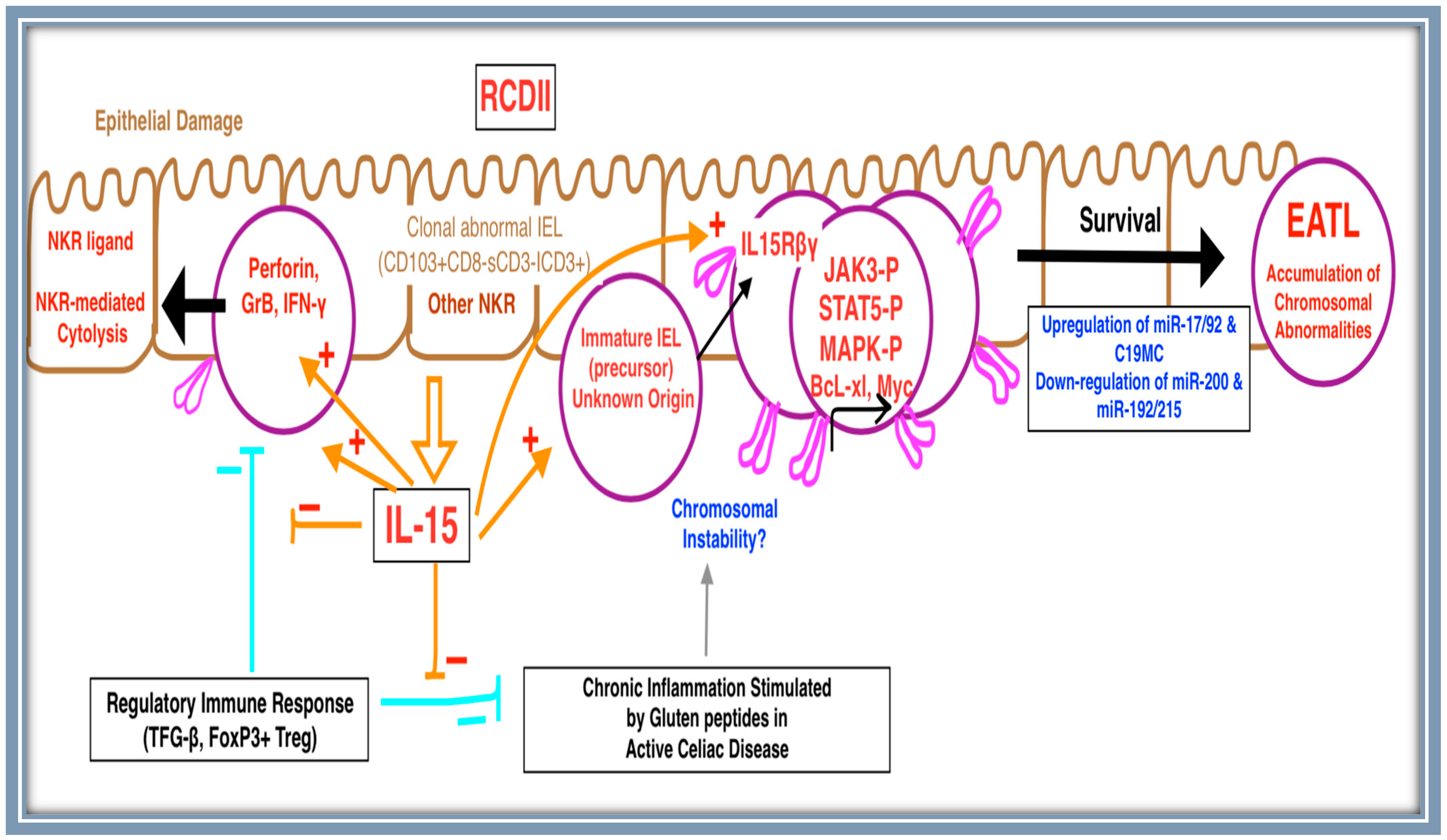
EATL is an aggressive T-cell non-Hodgkin lymphoma with poor prognosis and is largely localized to the small intestine. EATL is closely associated with coeliac disease (CD) and is seen mostly in patients originating from Northern Europe. Various factors are associated with an increased risk of developing EATL, such as viral infection, advanced age, being male, and the presence of the HLA-DQ2 haplotype. Clonal rearrangements in the TCR-β and γ genes have been reported in all EATL morphological variants with distinctive immunophenotypic characteristics. Although EATL can occur de novo, individuals with RCDII are at a higher risk of developing EATL. The cells of origin of EATL has been postulated to be normal small intestinal intraepithelial T-lymphocytes (IELs), and more recent evidence suggests a link between innate precursor IELs and EATL derived from refractory coeliac disease type II (RCDII). The immune microenvironment of mucosal cells within the small intestine enhances the process of neoplastic transformation of IELs into EATL. Cytokines such as IL-15 can activate and crucially deregulate the JAK-STAT signaling pathway by binding to receptors on the surface of IELs. Furthermore, mutations in the JAK/STAT pathway have been associated with RCDII-derived EATL.
Keywords: EATL; T-cell non-Hodgkin lymphoma; intraepithelial T-lymphocytes; coeliac disease; genetics; refractory coeliac disease; small intestine EATL; T-cell non-Hodgkin lymphoma; intraepithelial T-lymphocytes; coeliac disease; genetics; refractory coeliac disease; small intestine