


Abstract
Background: This pilot study examined the association between postoperative day-3 C-reactive protein (CRP) and recorded urinary fistula after radical cystectomy with ileal conduit diversion. Methods: This retrospective single-center cohort included 102 adults who underwent Bricker ileal conduit diversion. The fistula endpoint comprised recorded postoperative urinary leakage; hydronephrosis was assessed separately and descriptively. All analyses were exploratory and unadjusted. Apparent discrimination and the Hodges–Lehmann location shift were evaluated using 10,000 stratified bootstrap samples. No internal validation was performed. Results: Urinary fistula was recorded in seven patients (6.9%), hydronephrosis in 15 (14.7%), and both in six. Median day-3 CRP was 144.00 mg/L (interquartile range [IQR], 129.90–154.46) in the fistula group and 64.68 mg/L (IQR, 32.28–90.28) in the non-fistula group (p < 0.001). The Hodges–Lehmann location shift was 77.0 mg/L (bootstrap 95% confidence interval [CI], 57.3–99.2). The apparent (in-sample) area under the curve (AUC) was 0.956 (95% CI, 0.889–1.000). A post hoc rule of CRP ≥ 96.97 mg/L yielded a sensitivity of 100% (exact 95% CI, 59.0–100%) and a specificity of 80.0% (70.5–87.5%) in the same cohort used to select it. Conclusions: Higher day-3 CRP was associated with recorded urinary fistula. The small event count, unadjusted analysis and incomplete clinical chronology preclude conclusions about independent prediction, early detection, reliable exclusion or clinical surveillance utility. Prospective external validation is required.
1. Introduction
Radical cystectomy with urinary diversion is an established treatment for muscle-invasive bladder cancer and selected patients with very-high-risk non-muscle-invasive disease [1]. Despite advances in perioperative care, substantial morbidity persists because the procedure combines pelvic extirpation, bowel manipulation and urinary reconstruction [2,3,4]. Urinary fistula, bowel leakage, infection and upper-tract obstruction are distinct complications with different diagnostic pathways and should not be combined indiscriminately.
C-reactive protein (CRP) is a nonspecific acute-phase reactant that increases in response to surgical tissue injury and infection [5]. Cystectomy-specific studies have examined postoperative CRP in relation to overall complications, whereas other investigations have assessed preoperative inflammatory markers or prolonged hospital stay [6,7,8]. Differences in sampling schedules and outcome definitions limit direct comparison and do not establish a validated day-3 CRP threshold for urinary fistula after ileal conduit diversion.
The main objective was to examine the unadjusted association between day-3 CRP and recorded urinary fistula after radical cystectomy with Bricker ileal conduit diversion. Absolute and relative changes from the preoperative CRP value were secondary exploratory measures. Hydronephrosis was described separately because its mechanisms and time course differ from those of urinary fistula. The study did not prospectively evaluate a screening, discharge or surveillance rule.
2. Materialsand Methods
2.1. Study Design, Setting, and Participants
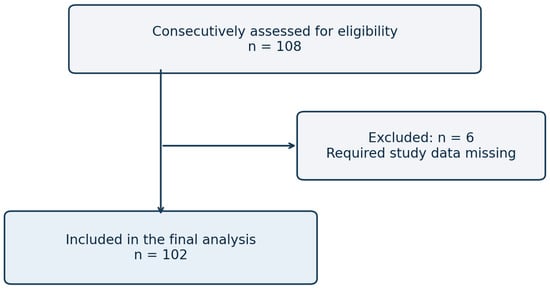
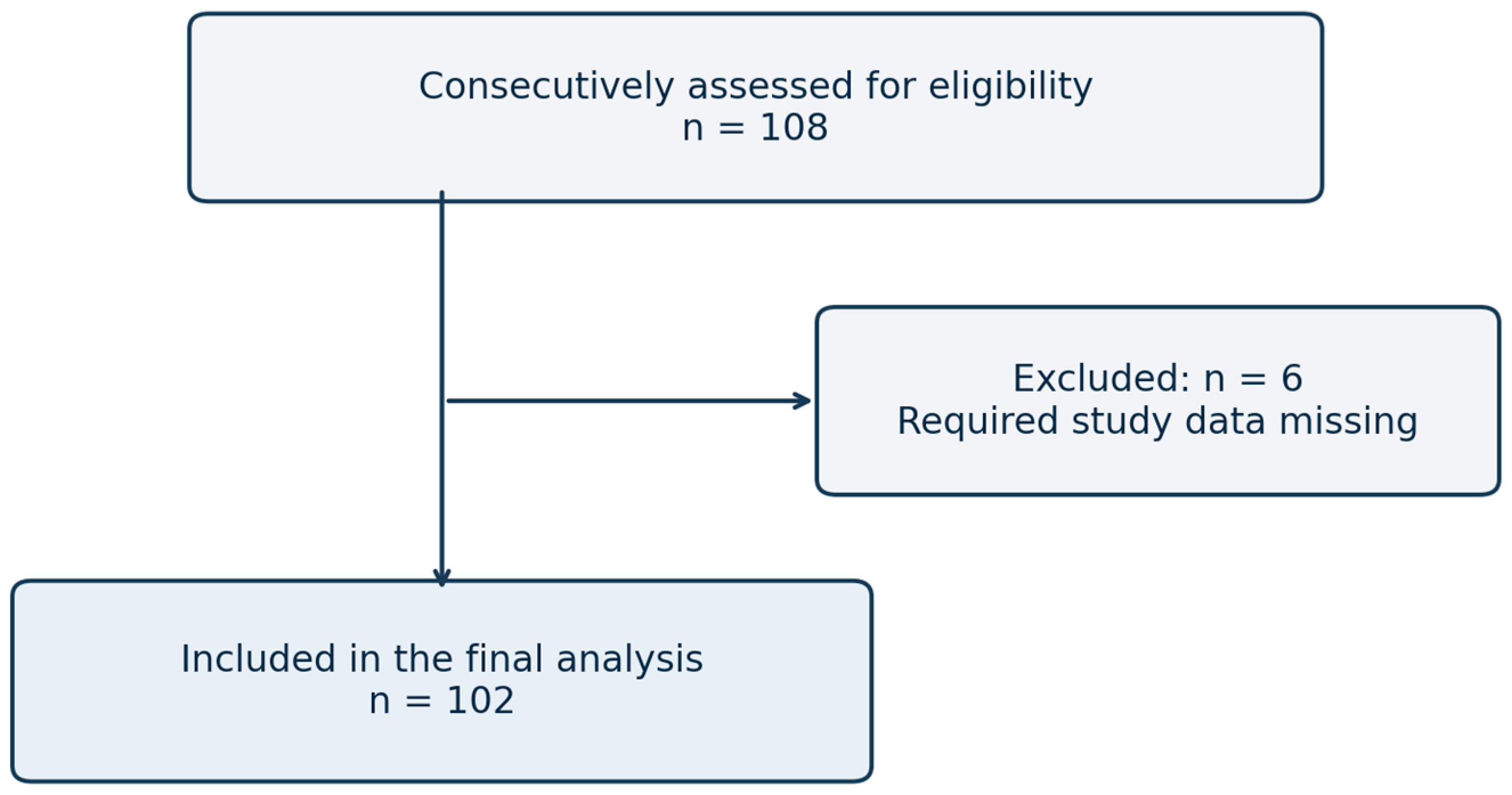
This retrospective cohort study was conducted at Clinical Hospital “Prof. Dr. Th. Burghele”, Bucharest, Romania. Between January 2023 and July 2026, 108 patients were consecutively assessed for eligibility. Six were excluded because required study data were missing, leaving 102 patients in the final analysis (Figure 1). Eligible patients were aged > 18 years, had undergone open radical cystectomy with pelvic lymph-node dissection and Bricker ileal conduit diversion, and had available preoperative and day-3 CRP measurements and an evaluable recorded postoperative outcome during the index hospitalization. The study size was determined by the available cohort; no prospective sample-size calculation was performed.
Figure 1.
Participant flow. A total of 108 patients were consecutively assessed; six were excluded because required study data were missing, and 102 were included in the final analysis.
The six patients excluded because of missing data were not included in the analytical summaries. A field-specific breakdown of the unavailable information could not be recovered from the analytical material. These exclusions may introduce selection bias if excluded and included patients differed systematically.
The study was approved by the Institutional Ethics Committee of Clinical Hospital “Prof. Dr. Th. Burghele”, Bucharest, Romania (approval no. 127, dated 3 March 2026). The approval covered retrospective review of patient records and the complete January 2023–July 2026 study interval. Individual informed consent for this retrospective research review was waived by the committee.
2.2. Oncological and Operative Characteristics
All patients underwent transurethral resection of the bladder tumor (TURBT) before cystectomy. The available TURBT pathological categories were high-grade pT1 in ten patients and pT2 in 92. These categories do not represent complete baseline clinical TNM classification or final cystectomy pathological stage. Concomitant carcinoma in situ and detailed indications for cystectomy were not separately encoded. Final pTNM category, nodal status, lymph-node yield, variant histology, surgical margins and detailed metastatic work-up were unavailable in the analytical file, limiting evaluation of potential stage-related confounding.
Two urological teams performed the open procedures. Pelvic lymph-node dissection included the external iliac, internal iliac, obturator and presacral regions. An isolated ileal segment was used for Bricker urinary diversion, and stents were placed across the ureteroileal anastomoses. Adherence to a specific enhanced-recovery protocol was not assessed.
2.3. Data Sources, Biomarkers, and Outcome Definitions
Variables were retrospectively abstracted into an analytical spreadsheet. Preoperative CRP was measured one day before surgery, and postoperative CRP was measured on postoperative day 3. A calendar postoperative day does not necessarily correspond to an exact 72 h interval. Absolute CRP change was defined as day-3 minus preoperative CRP. Relative change was calculated as (day-3 CRP − preoperative CRP)/preoperative CRP and is dimensionless; it is neither a percentage nor the simple postoperative-to-preoperative ratio.
The main outcome examined was recorded in-hospital urinary fistula, operationally defined here as clinically documented urinary leakage after diversion. The original binary variable was labeled FISTULA. All seven positive cases were urinary rather than intestinal events. The term urinary fistula does not imply that a mature fistulous tract was demonstrated. The case summaries identified the ureteroileal anastomosis as the reported site, with additional conduit involvement in one case. Urinary fistula and hydronephrosis were evaluated separately; no mixed urinary/intestinal or fistula/obstruction endpoint was used.
All seven fistula cases had increased abdominal surgical-drain output, a positive methylene-blue test and subsequent computed tomography (CT) confirmation. Methylene blue was instilled retrogradely through the ureteral stent, and blue dye was observed in abdominal drain fluid. Delayed excretory-phase CT demonstrated iodinated contrast extravasation outside the lumen into surrounding tissues. Serum and drain-fluid specimens were collected together. Individual creatinine concentrations and drain-to-serum ratios are reported in Table S1; each ratio was calculated by dividing the drain-fluid concentration by the paired serum concentration. Exact specimen, imaging and intervention dates and case-specific CT localization were unavailable in the analytical material, preventing verification of their temporal relationship to day-3 CRP.
Postoperative hydronephrosis was identified by ultrasonography during clinical assessment within the index hospitalization. First detection varied between patients and did not occur uniformly on postoperative day 3. Original stent removal was reported during postoperative days 14–21, but individual detection and removal dates were unavailable. Stent dysfunction or migration was considered a possible mechanism for hydronephrosis during hospitalization. Three accidental extractions during urinary-bag changes were reported, without sufficient information to map them to individual hydronephrosis cases or establish their sequence. Table S2 distinguishes the recorded phenotype from proposed mechanisms and unresolved chronology.
CRP was measured by immunoturbidimetry on the hospital’s Roche cobas 8000 series analyzer and reported in mg/L, with a reference interval of 0–5 mg/L. No change in method was reported during the study; calibration and reagent-lot stability were not independently documented. Albumin and total protein were sampled on postoperative day 3 using reported spectrophotometric methods and expressed in g/dL, with reference intervals of 3.4–5.4 and 6.40–8.40 g/dL, respectively. The specific albumin assay chemistry was unavailable. Albumin, total-protein and cohort-wide renal-function comparisons were excluded from the revised inferential tables because source-value and coding verification remained incomplete. The paired diagnostic creatinine values in Table S1 were not substituted for renal measurements obtained at other times.
The original UTI_PREOP field was retained unchanged and was positive in 19/102 patients (18.6%). Clinical clarification indicated that these patients remained asymptomatic throughout perioperative assessment. The field was therefore not interpreted as establishing symptomatic UTI. It included postoperative observations and was not treated as a uniformly preoperative baseline characteristic. A separate organism field contained 20 entries, including Enterococcus spp. for study code 4 despite a zero binary flag. The discrepancy, culture criteria, exact timing, treatment dates and repeat results could not be fully reconciled. The 19-case descriptor was retained descriptively but excluded from baseline characteristics and inferential comparisons. A formal diagnosis of asymptomatic bacteriuria was not assigned retrospectively without quantitative culture criteria [9].
2.4. Outcome Ascertainment, Missing Data, and Potential Bias
The outcome-assessment window extended from cystectomy to discharge from the index hospitalization. Outcomes were identified from inpatient clinical records; post-discharge visits, readmissions and events managed at other institutions were outside the study window and were not counted. The separate follow-up-in-months field was ancillary and was not used to classify study outcomes or in time-to-event analyses. A formal historical database-lock date was not documented, so the reported surgical interval of January 2023–July 2026 cannot be cross-checked against a verified lock date. Exact within-admission timestamps were unavailable in the analytical file. The reported proportions describe in-hospital complications, not standardized 30- or 90-day or long-term risks.
The dataset contained 102 unique study codes, no duplicate rows and complete CRP and binary fistula values. Six bowel-function observations were missing; this variable was not analyzed and no imputation was performed. Stored absolute and relative CRP increases exactly matched the specified formulas. The dataset lacked clinical timestamps needed to establish temporal ordering. Surgical team, intensive-care admission, postoperative infection, transfusion, blood loss and reoperation were not available as dedicated analytical variables. Retrospective selection, incomplete chronology, differential diagnostic work-up and outcome misclassification may have biased the associations.
2.5. Statistical Analysis
Continuous variables were summarized as medians and interquartile ranges (IQRs) using linearly interpolated quartiles. Groups were compared with two-sided Mann–Whitney U tests using asymptotic p values, tie correction and continuity correction. Five categorical variables were compared using two-sided Fisher exact tests. Rank-biserial correlation quantified nonparametric effect size; positive values indicate higher values in the fistula group. All analyses were exploratory and unadjusted. Day-3 CRP was the principal comparison of interest, but prospective prespecification was not documented. No multivariable model was fitted because only seven fistula events occurred. Nonsignificant comparisons were not interpreted as equivalence or absence of confounding. Hospital stay was treated as a postoperative variable, not a baseline confounder.
Apparent discrimination was assessed by receiver operating characteristic (ROC) analysis and summarized as the area under the curve (AUC). The Hodges–Lehmann location shift was the median of all pairwise day-3 CRP differences between fistula and non-fistula patients. Confidence intervals (CIs) for the location shift and AUCs were estimated from 10,000 nonparametric bootstrap replicates, sampled independently with replacement within each outcome group. Every replicate contained seven events and 95 non-events. Resampling used NumPy default_rng with the PCG64 generator and seed 20260920; the same class-specific index draws were used for all three biomarkers and the location-shift analysis. Percentile CIs were obtained from the 2.5th and 97.5th percentiles with linear interpolation. All 10,000 replicates were valid. Single-class samples could not occur because group sizes were fixed by design. These intervals quantify sampling uncertainty conditional on the observed class sizes; they do not correct optimism or provide external validation.
AUCs describe apparent discrimination within the analysis cohort. Operating points were selected once in the full cohort by maximizing the Youden index, choosing the highest finite threshold if the maximum was tied. Selection was not repeated during bootstrapping. The exact day-3 rule was CRP ≥ 96.97 mg/L; lower values were classified as negative. Exact Clopper–Pearson 95% CIs were calculated for sensitivity, specificity, positive predictive value (PPV) and negative predictive value (NPV). These binomial intervals do not account for data-driven operating-point selection. No internal validation, optimism correction or external validation was performed. With only seven events and all marker assessment conducted in the same exploratory cohort, the apparent AUC may overestimate out-of-sample discrimination; the bootstrap CIs do not correct this optimism.
The analysis comprised 16 inferential or discrimination analyses: eight continuous comparisons, five categorical comparisons and three fistula AUC analyses. The culture-variable comparison was omitted because the binary flag and organism field were discordant and their timing was not uniformly preoperative. Albumin, total-protein and cohort-wide renal-function comparisons, hydronephrosis ROC analyses and composite analyses were not retained. No multiplicity adjustment was applied; nominal p values are hypothesis-generating. Analyses used Python 3.13.14, NumPy 2.3.5, pandas 2.2.3, SciPy 1.17.1 and scikit-learn 1.6.1. Reproducible code and full-precision aggregate results are provided in File S2.
3. Results
3.1. Cohort Characteristics
The cohort included 102 patients, of whom 80 (78.4%) were men. Median age was 62.5 years (IQR, 57.0–69.0), and median body mass index (BMI) was 30.0 kg/m2 (IQR, 25.0–35.0). Selected characteristics are summarized in Table 1. The infection flag and culture information are described separately because their timing was not uniformly preoperative.
Table 1.
Selected cohort characteristics (N = 102).
Median recorded hospital stay was 11.5 days (IQR, 9.0–13.8; range, 8–30). This describes the index admission and was treated as a postoperative characteristic, not a baseline confounder.
3.2. Recorded Urinary Fistula and Hydronephrosis
Urinary fistula was recorded in seven patients during the index hospitalization (7/102, 6.9%). All seven had positive retrograde ureteral-stent methylene-blue tests, with blue dye in abdominal drain fluid, and delayed-phase CT showing contrast extravasation. Mean paired serum creatinine was 1.32 mg/dL (range, 1.20–1.40), and mean drain-fluid creatinine was 39.43 mg/dL (range, 32–49). Drain-to-serum ratios ranged from 24.62 to 35.00 (Table S1). Ultrasound-guided renal drainage was recorded as percutaneous nephrostomy in the case summaries. All seven fistula events were recorded as Clavien–Dindo grade IIIa. Abdominal drain output decreased and bowel transit recovered after drainage, but intervention-to-response intervals were unavailable. These observations were not used to infer a causal CRP mechanism or define a prolonged-ileus endpoint.
Nineteen patients (18.6%) had a positive UTI_PREOP flag and were reported to have remained asymptomatic throughout perioperative assessment. The separate organism field contained 20 entries. The records were not altered to force agreement. The source-coded descriptor was not interpreted as a count of confirmed symptomatic infections and was excluded from inferential comparisons.
Hydronephrosis was recorded during the index hospitalization in 15 patients (14.7%), including six with urinary fistula. The case summaries described left-sided unilateral dilation in all 15, grade I in nine and grade II in six, no preoperative hydronephrosis in those 15, and no associated symptoms. The grading protocol and etiological evidence were unavailable for independent verification. Stent dysfunction or migration and three accidental extractions were described, but patient-level causal and temporal relationships could not be established. Earlier labels of external compression or anastomotic stricture were not retained as confirmed etiologies. No clear discriminatory signal for CRP was established for this descriptively assessed outcome. Hydronephrosis ROC results and a corresponding ROC panel were not retained in the main analysis.
3.3. Unadjusted CRP Comparisons
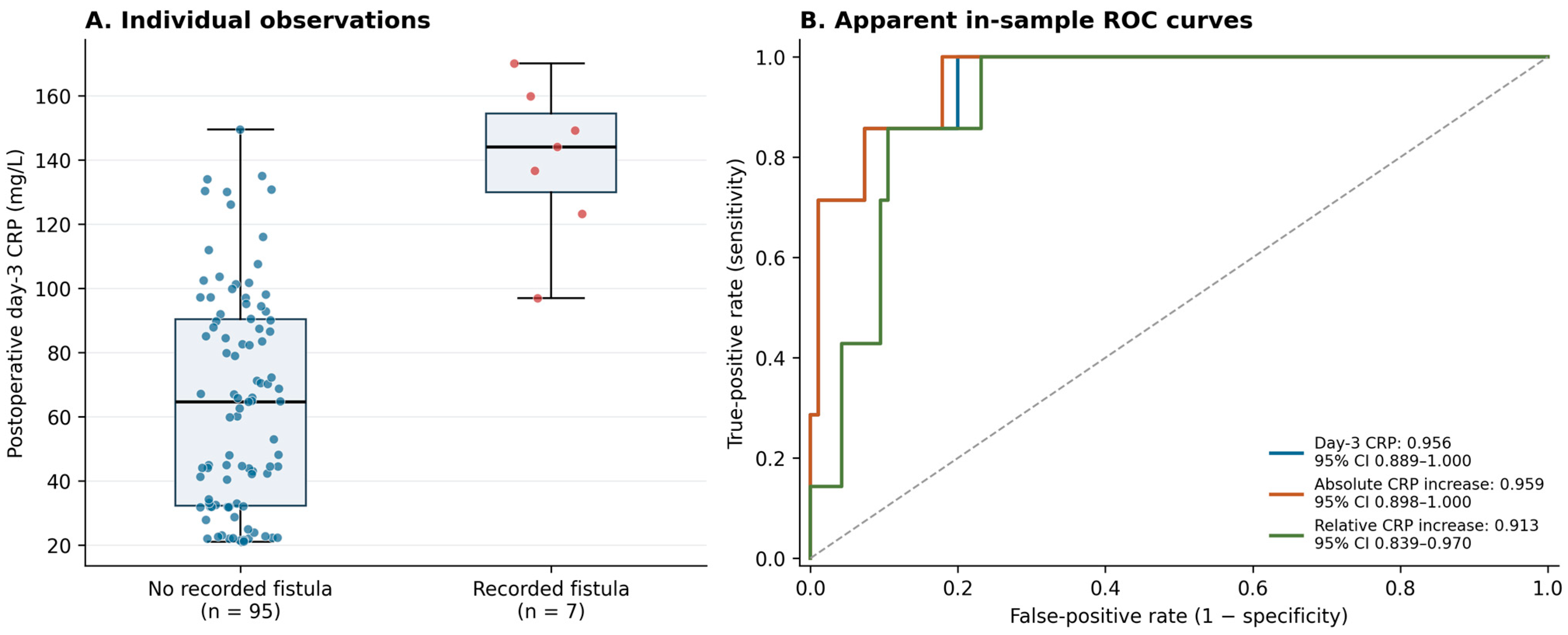
Median day-3 CRP was 144.00 mg/L (IQR, 129.90–154.46) in the fistula group and 64.68 mg/L (IQR, 32.28–90.28) in the non-fistula group (p < 0.001). The Hodges–Lehmann location shift was 77.0 mg/L (stratified-bootstrap 95% CI, 57.3–99.2), and rank-biserial correlation was 0.913. Absolute and relative CRP increases were also higher in the fistula group (as we can see in Table 2 and Table 3). The preoperative CRP comparison (5.00 vs. 4.04 mg/L; nominal p = 0.045) and the absolute/relative change comparisons were exploratory and unadjusted, with no multiplicity correction as we can see in Table 3 and Table 4. They should not be interpreted as additional confirmatory findings.
Table 2.
Selected continuous variables by recorded urinary-fistula status.
Table 3.
Apparent AUC estimates and stratified-bootstrap CIs for recorded urinary fistula.
Table 4.
Day-3 CRP classification counts and exact confidence intervals at the post hoc rule CRP ≥ 96.97 mg/L.
3.4. Exploratory Operating-Point Summary
The full-cohort Youden rule, CRP ≥ 96.97 mg/L, yielded seven true positives, no false negatives, 76 true negatives and 19 false positives (Figure 2). The exact threshold and inequality were verified against all 102 records. A rule of ≥97 mg/L would instead yield six true positives and one false negative because one fistula patient had CRP 96.97 mg/L. The operating point was selected and evaluated in the same cohort and remains hypothesis-generating (Table 4 and Table 5).
Table 5.
Selected categorical variables by recorded urinary-fistula status.
Figure 2.
Day-3 CRP observations and apparent in-sample ROC curves for recorded urinary fistula, defined as postoperative urinary leakage. Panel (A) shows individual values and boxplots for 95 non-events and seven events. Panel (B) shows ROC curves for day-3 CRP, absolute increase and relative increase, with 95% CIs from 10,000 stratified bootstrap samples. The curves and operating points were evaluated in the same cohort and are not external-validation results.
4. Discussion
4.1. Principal Findings
The main finding was an association between higher day-3 CRP and recorded urinary fistula after radical cystectomy with Bricker ileal conduit diversion. CRP was higher in the fistula group both as an absolute postoperative concentration and as a change from baseline. The Hodges–Lehmann location shift of 77.0 mg/L (95% CI, 57.3–99.2) indicates a substantial separation between the observed distributions. However, this result was based on seven events and an unadjusted analysis. It should be interpreted as a hypothesis-generating association, not evidence that CRP independently predicts fistula formation. Calculating change scores does not substitute for multivariable adjustment or establish when the complication began.
The apparent AUC of 0.956 describes how well day-3 CRP separated the recorded groups in this cohort. It does not establish performance in another population. All observations were used to examine the marker and select the operating point, making optimism particularly important. Bootstrap CIs describe sampling uncertainty but do not correct the bias introduced by selecting and evaluating a rule in the same small dataset. The continuous CRP association is therefore more informative than the apparently precise numerical operating point.
4.2. Comparison with Previous Evidence
Cystectomy-specific evidence is the most relevant comparator. Trabelssi et al. studied day-4 CRP in 313 patients undergoing radical cystectomy and evaluated a broad postoperative complication endpoint across different urinary diversions [6]. That study supports interest in postoperative CRP but does not validate a day-3, fistula-specific threshold after Bricker diversion. Hayashi et al. examined preoperative CRP and prolonged hospital stay [7], while Claps et al. assessed preoperative inflammatory markers and perioperative morbidity [8]. Their sampling schedules and endpoints differ from those of the present analysis; neither provides direct validation of our operating point.
Colorectal studies offer indirect evidence about postoperative inflammatory markers. Singh et al. evaluated CRP on postoperative days 3–5 in relation to colorectal anastomotic leakage [10]. Smith et al. examined CRP trajectories [11], and Waterland et al. compared CRP after open and laparoscopic colorectal procedures [12]. These studies involve different reconstructions, complication mechanisms and inflammatory responses. They support studying postoperative CRP, particularly its trajectory, but their numerical thresholds should not be transferred to radical cystectomy.
Other biochemical-marker studies also address different questions. Cystectomy studies of hypoalbuminemia concern broader postoperative outcomes [13,14,15]. Another study examined postoperative albumin decline after major abdominal surgery [16], and Kuroda et al. studied the CRP-to-albumin ratio in relation to oncological prognosis after cystectomy [17]. These findings do not validate a urinary-fistula threshold. In this cohort, unresolved albumin and total-protein inconsistencies precluded reliable comparison with CRP.
4.3. Biological and Clinical Interpretation
CRP reflects an inflammatory response rather than a specific anatomical lesion [5]. Urinary extravasation could contribute to postoperative inflammation, but surgery, infection, tissue injury and other complications may also affect CRP. The positive dye tests, paired fluid measurements and CT findings establish the urinary nature of the recorded events. The subsequent decrease in abdominal drain output and recovery of bowel transit after renal drainage provide clinical context, but they do not show that leakage caused the CRP rise or bowel dysfunction.
Temporality is central to interpretation. The biological process leading to leakage may have begun before the day-3 sample, even if the diagnosis was recorded later. Because symptom-onset, imaging and intervention timestamps were unavailable, reverse causality cannot be excluded. The study therefore cannot determine whether day-3 CRP provides useful lead time or information beyond contemporaneous clinical assessment.
The in-sample operating point must be interpreted with the same caution. Sensitivity was 100% (exact 95% CI, 59.0–100%), and PPV was only 26.9%. PPV also depends on the observed 6.9% event prevalence and may differ in another clinical population. Zero observed false negatives do not demonstrate that a lower CRP reliably excludes fistula. The value of 96.97 mg/L is a data-derived classification boundary, not a recommended trigger for imaging, discharge or treatment. Establishing clinical utility would require independent validation and comparison with an explicit clinical assessment strategy.
4.4. Limitations and Future Research
The retrospective, single-center design, missing-data exclusions, seven events and multiple exploratory analyses limit precision and generalizability. No multivariable model was fitted, and nonsignificant group comparisons cannot exclude confounding. The nominal difference in preoperative CRP also cautions against attributing the postoperative association solely to fistula. The mixed-period infection flag and culture field were discordant. Although the 19 flag-positive patients were reported to remain asymptomatic, this does not establish that other infectious or inflammatory influences were absent. Hospital stay may follow complications and is not a baseline confounder. The four albumin/total-protein discrepancies (study codes 14, 17, 20 and 29) all occurred in non-fistula patients; these analytes were excluded and did not enter the primary CRP calculations. The patients themselves remained in the CRP analysis. Of the 19 asymptomatic UTI flags, two were in the seven fistula patients (codes 19 and 60) and 17 were in the 95 non-fistula patients. The single culture/flag discordance was also in a non-fistula record (code 4). Unresolved timing and coding still preclude exclusion of infectious confounding.
Whether any of the seven fistulas had already been clinically suspected on or before postoperative day 3 could not be determined retrospectively from the available information, even though the events were recorded during the index hospitalization. This uncertainty precludes an early-detection interpretation. The historical database-lock date was undocumented, and exact within-admission timestamps were unavailable. Outcome ascertainment ended at discharge; subsequent readmissions, outpatient events and events managed elsewhere were not included. Findings therefore concern in-hospital events, not standardized 30- or 90-day or long-term risks. Hydronephrosis remained descriptive because its detailed timing, grading protocol and cause were incompletely documented.
Future studies should prospectively define urinary fistula, record the timing of symptoms and diagnostic tests, and evaluate serial CRP measurements alongside clinical findings. Larger event counts would permit adjustment for relevant perioperative factors. Operating points should be developed transparently and tested in independent cohorts before CRP is assigned an early-detection, exclusion or surveillance role.
5. Conclusions
Higher postoperative day-3 CRP was associated with recorded urinary fistula during the index hospitalization after radical cystectomy with Bricker ileal conduit diversion. The association was unadjusted and based on seven events, with incomplete clinical chronology and uncertain control of confounding. The findings do not establish early detection, reliable exclusion, independent prediction or a validated clinical operating point. Day-3 CRP and its perioperative change warrant further investigation in prospectively defined cohorts with standardized fistula ascertainment and independent validation.
Supplementary Materials
The following supporting information can be downloaded at: https://www.mdpi.com/article/10.3390/life16111949/s1, Tables S1 and S2, individual urinary-fistula findings and reported hydronephrosis characteristics; File S1, STROBE cohort reporting checklist; File S2, reproducible analysis code and aggregate statistical outputs.
Author Contributions
Conceptualization, R.A.D. and R.-C.P.; methodology, R.A.D.; software, T.V.C., A.P.; validation, G.P. and L.O.; formal analysis, G.P.; investigation, M.C.B.; data curation, F.I.F.; writing—original draft preparation, V.J.; writing—review and editing, R.A.D.; visualization, A.B.; supervision, V.J.; project administration, V.J. All authors have read and agreed to the published version of the manuscript.
Funding
This research received no external funding.
Institutional Review Board Statement
The study was approved by the Institutional Ethics Committee of Clinical Hospital “Prof. Dr. Th. Burghele”, Bucharest, Romania (approval no. 127, dated 3 March 2026). The approval covered retrospective review of patient records and the complete January 2023–July 2026 study interval. Individual informed consent for this retrospective research review was waived by the committee.
Informed Consent Statement
The Institutional Ethics Committee waived the requirement for individual informed consent for retrospective research review of the patient records. This statement concerns research use of records and is distinct from consent for clinical treatment.
Data Availability Statement
The complete 102-patient clinical dataset is not publicly distributed with this revision. De-identified case summaries are provided in Tables S1 and S2. Analysis code and aggregate statistical outputs are provided in Supplementary File S2.
Conflicts of Interest
The authors declare no conflicts of interest.
References
- European Association of Urology. EAU Guidelines on Muscle-Invasive and Metastatic Bladder Cancer; EAU Guidelines Office: Arnhem, The Netherlands, 2026; Available online: https://uroweb.org/guidelines/muscle-invasive-and-metastatic-bladder-cancer/ (accessed on 20 September 2026).
- Duarte, S.; Felício, E.; Bernardo, G.; Gaboleiro, F.; Pita, A.; Carmali, D.; Furtado, A.; Pinheiro, A.; Barcelos, A.; Ramos, S.; et al. Early complications within 30 days after radical cystectomy: The top seven complications and their predictors. Investig. Clin. Urol. 2026, 67, 254–262. [Google Scholar] [CrossRef] [Scilit] [PubMed]
- Maibom, S.L.; Joensen, U.N.; Poulsen, A.M.; Kehlet, H.; Brasso, K.; Røder, M.A. Short-term morbidity and mortality following radical cystectomy: A systematic review. BMJ Open 2021, 11, e043266. [Google Scholar] [CrossRef] [Scilit] [PubMed]
- Cerantola, Y.; Valerio, M.; Persson, B.; Jichlinski, P.; Ljungqvist, O.; Hubner, M.; Kassouf, W.; Muller, S.; Baldini, G.; Carli, F.; et al. Guidelines for perioperative care after radical cystectomy for bladder cancer: Enhanced Recovery After Surgery (ERAS(®)) society recommendations. Clin. Nutr. 2013, 32, 879–887. [Google Scholar] [CrossRef] [Scilit] [PubMed]
- Pepys, M.B.; Hirschfield, G.M. C-reactive protein: A critical update. J. Clin. Investig. 2003, 111, 1805–1812. [Google Scholar] [CrossRef] [PubMed]
- Trabelssi, M.; Thuret, R.; Droupy, S.; Costa, P.; Rebillard, X.; Poinas, G. Postoperative C-reactive protein is a reliable marker to detect complications after radical cystectomy. Prog. Urol. 2018, 28, 282–290. [Google Scholar] [CrossRef] [Scilit] [PubMed]
- Hayashi, T.; Kawashima, A.; Ujike, T.; Takao, T.; Sato, M.; Yazawa, K.; Horitani, H.; Takayama, H.; Noi, H.; Nishimura, K.; et al. Preoperative CRP is a predictive factor for prolonged hospital stay after radical cystectomy for bladder cancer. BMC Urol. 2025, 25, 162. [Google Scholar] [CrossRef] [Scilit] [PubMed]
- Claps, F.; Rossin, G.; van Rhijn, B.W.G.; Mir, M.C.; Mertens, L.S.; Ongaro, L.; Traunero, F.; Iachimovsky, A.I.; Piasentin, A.; Vedovo, F.; et al. The Utility of Inflammatory Serum Markers in the Assessment of Perioperative Morbidity after Radical Cystectomy for Bladder Cancer. Medicina 2023, 59, 926. [Google Scholar] [CrossRef] [Scilit] [PubMed]
- Nicolle, L.E.; Gupta, K.; Bradley, S.F.; Colgan, R.; DeMuri, G.P.; Drekonja, D.; Eckert, L.O.; Geerlings, S.E.; Köves, B.; Hooton, T.M.; et al. Clinical Practice Guideline for the Management of Asymptomatic Bacteriuria: 2019 Update by the Infectious Diseases Society of America. Clin. Infect. Dis. 2019, 68, e83–e110. [Google Scholar] [CrossRef] [Scilit] [PubMed]
- Singh, P.P.; Zeng, I.S.; Srinivasa, S.; Lemanu, D.P.; Connolly, A.B.; Hill, A.G. Systematic review and meta-analysis of use of serum C-reactive protein levels to predict anastomotic leak after colorectal surgery. Br. J. Surg. 2014, 101, 339–346. [Google Scholar] [CrossRef] [Scilit] [PubMed]
- Smith, S.R.; Pockney, P.; Holmes, R.; Doig, F.; Attia, J.; Holliday, E.; Carroll, R.; Draganic, B. Biomarkers and anastomotic leakage in colorectal surgery: C-reactive protein trajectory is the gold standard. ANZ J. Surg. 2018, 88, 440–444. [Google Scholar] [CrossRef] [Scilit] [PubMed]
- Waterland, P.; Ng, J.; Jones, A.; Broadley, G.; Nicol, D.; Patel, H.; Pandey, S. Using CRP to predict anastomotic leakage after open and laparoscopic colorectal surgery: Is there a difference? Int. J. Colorectal Dis. 2016, 31, 861–868. [Google Scholar] [CrossRef] [Scilit] [PubMed]
- Arora, K.; Hanson, K.T.; Habermann, E.B.; Tollefson, M.K.; Psutka, S.P. Early Complications and Mortality following Radical Cystectomy: Associations with Malnutrition and Obesity. Bladder Cancer 2018, 4, 377–388. [Google Scholar] [CrossRef] [Scilit] [PubMed]
- Manivasagam, S.S.; Raman, J.D.; Kaag, M.G. Impact of Hypoalbuminemia on Morbidity and Mortality After Radical Cystectomy. Cancers 2026, 18, 313. [Google Scholar] [CrossRef] [Scilit] [PubMed]
- Mursi, K.; ElFayoumy, H.; Saad, I.; Tawakol, A.; Badawy, H. The effect of preoperative clinical variables on the 30- and 90-day morbidity and mortality after radical cystectomy: A single-centre study. Arab. J. Urol. 2013, 11, 152–158. [Google Scholar] [CrossRef] [Scilit] [PubMed]
- Labgaa, I.; Joliat, G.R.; Kefleyesus, A.; Mantziari, S.; Schäfer, M.; Demartines, N.; Hübner, M. Is postoperative decrease of serum albumin an early predictor of complications after major abdominal surgery? A prospective cohort study in a European centre. BMJ Open 2017, 7, e013966. [Google Scholar] [CrossRef] [Scilit] [PubMed]
- Kuroda, K.; Tasaki, S.; Horiguchi, A.; Ito, K. Postoperative C-reactive protein-to-albumin ratio predicts poor prognosis in patients with bladder cancer undergoing radial cystectomy. Mol. Clin. Oncol. 2021, 14, 54. [Google Scholar] [CrossRef] [Scilit] [PubMed]

Disclaimer/Publisher’s Note: The statements, opinions and data contained in all publications are solely those of the individual author(s) and contributor(s) and not of MDPI and/or the editor(s). MDPI and/or the editor(s) disclaim responsibility for any injury to people or property resulting from any ideas, methods, instructions or products referred to in the content. |
© 2026 by the authors. Licensee MDPI, Basel, Switzerland. This article is an open access article distributed under the terms and conditions of the Creative Commons Attribution (CC BY) license.