


Abstract
Acute exercise can influence cognitive control, but whether different exercise protocols produce distinct effects on food-related cognitive processing remains unclear. This study compared high-intensity interval training (HIIT), moderate-to-vigorous continuous aerobic exercise (MV-CAE), and seated rest in adults with overweight or obesity. Seventeen participants completed all three conditions, contributing 51 experimental sessions in a randomized within-subject crossover design. Participants performed a food-related Flanker task involving food and furniture targets under congruent and incongruent conditions. Behavioral performance and event-related potential (ERP) amplitudes were analyzed using mixed-effects models, with ERP analyses focused on the N2 (180–230 ms), P3 (400–600 ms), and late positive potential (LPP; 700–1100 ms) time windows at Fz. The primary analyses did not identify significant intervention × target category × congruency interactions after Holm correction in the N2 (adjusted p = 0.1635), P3 (adjusted p = 0.5248), or LPP (adjusted p = 0.5248) windows. The HIIT-versus-MV-CAE planned contrast in the N2 window was 1.859 µV (95% CI [0.337, 3.381]; Holm-adjusted p = 0.1532). Behavioral accuracy remained high, with no significant overall intervention effect (χ2(2) = 0.452, p = 0.7978). RT likewise showed no significant intervention effect (p = 0.7221). Sensitivity analyses identified an LPP-related difference after excluding three prespecified high-risk sessions, suggesting that later electrophysiological responses warrant further investigation. These findings suggest potentially task-dependent electrophysiological responses to different acute exercise protocols, although the observed patterns require confirmation in larger studies with more comprehensive EEG quality control.
1. Introduction
Overweight and obesity remain major public health concerns. According to the World Health Organization, approximately 2.6 billion adults worldwide were overweight in 2024, including 940 million living with obesity [1]. Overweight and obesity are associated with increased risks of type 2 diabetes, cardiovascular disease, and certain cancers [1]. Dietary management and regular physical activity are key components of lifestyle interventions for weight management [1]. Eating behavior is influenced by interactions between reward responses to palatable food cues and top-down cognitive control processes involving prefrontal and frontocingulate networks [2,3]. Previous research has reported greater activation in reward-related brain regions in response to high-calorie food cues among women with obesity than among women with normal weight [3]. These findings underscore the relevance of cognitive control to resisting food-related impulses, filtering distracting information, and maintaining goal-directed eating behavior [4,5].
Inhibitory control is a core component of executive function that supports the suppression of prepotent responses and the regulation of behavior in accordance with longer-term goals [4]. In food-rich environments, salient food cues can compete with weight-management goals and elicit automatic approach tendencies. Food-related Flanker tasks offer an experimental approach to examining interference control by requiring participants to respond to target stimuli while ignoring distracting food-related information [6]. Evidence from other interventions also suggests that cognitive control can be modified. For example, Makaracı et al. reported improved Stroop performance following a four-week biofeedback intervention in tennis players [7].
Acute exercise has been associated with changes in inhibitory control and other aspects of executive function [8]. These effects have been linked to exercise-induced physiological responses, including changes in arousal and neurotransmitter activity [9,10,11], which could influence the processing of distracting or motivationally salient food cues. In research on eating behavior, high-intensity intermittent exercise has been reported to reduce subsequent ad libitum energy intake in inactive men with overweight [12], suggesting that acute exercise can influence eating-related outcomes. ERP studies have also identified changes in neural activity associated with cognitive control following acute exercise. For example, Bailey et al. reported greater P3 amplitude during a Flanker task following higher-intensity aerobic exercise than after seated rest, whereas N2 amplitude did not differ significantly between exercise conditions [13].
The effects of acute exercise on food-related cognitive processing warrant further investigation, particularly across exercise protocols with different physiological demands. High-intensity interval training (HIIT) and moderate-to-vigorous continuous aerobic exercise (MV-CAE) are established exercise approaches that differ in their intensity patterns and physiological demands. In young men with obesity, Xie et al. reported increased P3 and late positive potential (LPP) amplitudes following a single bout of high-intensity interval exercise during a food-related Flanker task [14]. Recent research has compared high-intensity interval exercise with moderate-intensity aerobic exercise using food-related ERP outcomes [15]. Building on this work, the present study examined HIIT, MV-CAE, and seated rest within the same participants, with particular attention to how intervention-related ERP responses varied across central target categories, target–flanker congruency, and predefined electrophysiological time windows. Planned contrasts further examined differences in congruency effects between food and furniture targets across exercise conditions.
Examining different stages of food-related task processing can provide further insight into the cognitive effects of acute exercise. Three event-related potential (ERP) components are particularly relevant. The frontocentral N2 is commonly associated with conflict monitoring and cognitive control, particularly under conditions of response conflict [16]. The P3 has been linked to stimulus evaluation, attentional resource allocation, and context updating [17]. The LPP is sensitive to motivationally salient visual stimuli and has been widely examined in studies of sustained attention to food cues [6,18,19]. These components provide a theoretical basis for examining electrophysiological activity across early and later time windows, although their interpretation depends on event timing and scalp distribution. Behavioral accuracy and reaction time (RT) provide complementary measures of task performance, allowing electrophysiological responses to be considered alongside participants’ behavioral responses to congruent and incongruent stimuli.
In this within-subject crossover study, we compared HIIT, MV-CAE, and seated rest to investigate behavioral performance and electrophysiological activity during a food-related Flanker task in adults with overweight or obesity. The primary electrophysiological outcomes were mean ERP amplitudes at Fz within three predefined time windows corresponding to N2, P3, and LPP. The primary analyses examined intervention × central target category × congruency interactions within these windows. Based on previous research, we expected acute exercise to influence later task-related electrophysiological activity, particularly within the P3 and LPP windows. We further explored potential intervention-related differences in the N2 window and used planned contrasts to characterize differences in congruency effects between food and furniture targets across interventions.
2. Methods
2.1. Participants and Design
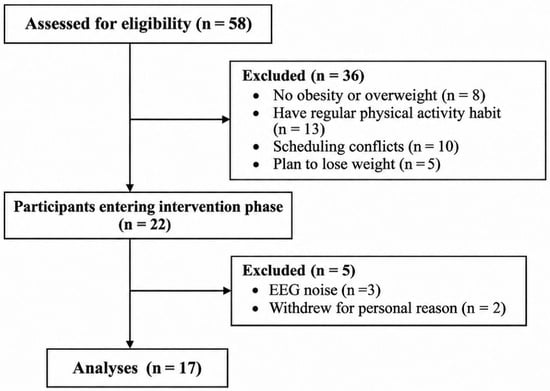
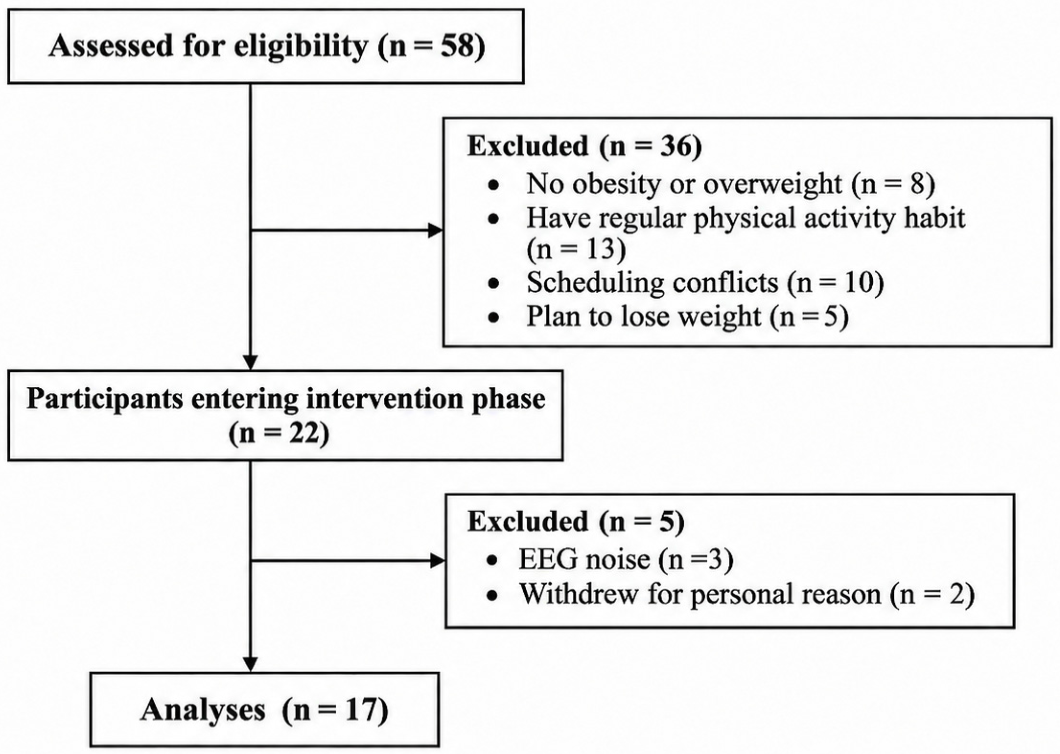
Participants with overweight or obesity who did not engage in regular, structured exercise were recruited from the Tsinghua University campus. Inclusion criteria were age 18–60 years, body mass index (BMI) ≥ 24 kg/m2 according to the Chinese adult BMI classification criteria [20], normal or corrected-to-normal vision, right-handedness, no contraindications to exercise based on the Physical Activity Readiness Questionnaire (PAR-Q) [21], and no relevant cardiovascular, metabolic, neurological, or psychiatric disorders. All participants provided written informed consent before participation. Of the 58 individuals assessed for eligibility, 36 were excluded during initial screening: eight did not meet the BMI criterion, 13 reported regular physical activity, 10 were unable to accommodate the experimental schedule, and five reported ongoing weight-loss behaviors, including restrictive dieting. These exclusions occurred before the experimental interventions. Twenty-two participants entered the intervention phase. Three were subsequently excluded because poor EEG recording quality across their sessions prevented reliable ERP estimation, and two voluntarily withdrew after their first session for personal reasons unrelated to the experimental procedures. The final analysis included 17 participants.The demographic characteristics of the final sample are presented in Table 1.
Table 1.
Demographic characteristics of participants included in the final EEG analysis.
The study was approved by the Tsinghua University Science and Technology Ethics Committee (THU01-20230109) and conducted in accordance with the Declaration of Helsinki.
Data are presented as mean ± standard deviation (SD) unless otherwise indicated. BMI, body mass index. Descriptive statistics were based on the 17 participants included in the final EEG analysis. IPAQ = International Physical Activity Questionnaire (Short Form). BMI categories were defined according to the Chinese adult BMI classification criteria (WS/T 428—2013): overweight, 24.0 ≤ BMI < 28.0 kg/m2; obesity, BMI ≥ 28.0 kg/m2. Overweight participants: n = 10 (58.8%); participants with obesity: n = 7 (41.2%).
The study employed a within-subject crossover design involving three experimental conditions: high-intensity interval training (HIIT), moderate-to-vigorous continuous aerobic exercise (MV-CAE), and seated rest. The intervention order was determined using computer-generated block randomization in Microsoft Excel. The allocation sequence was prepared by an independent researcher who was not involved in data collection or EEG analysis, and participants were assigned to the next available sequence upon enrollment. At least seven days separated consecutive sessions. Although participant blinding was not feasible because of the nature of the interventions, EEG preprocessing and initial ERP extraction were performed by a researcher blinded to intervention labels. Condition labels were revealed after ERP quantification. Actual visit period (first, second, or third visit) was included as a fixed effect in the statistical models to account for potential period-related differences.
The final analysis included 17 participants who completed all three experimental conditions, yielding 51 experimental sessions. Mixed-effects models were used to account for repeated measurements within participants and sessions. For the primary ERP analysis, task-condition cells were included when at least 30 trials were retained after EEG quality control. Additional details on trial retention and sensitivity analyses are provided in Supplementary Methods S1 and S3 and Supplementary Tables S1 and S3.
2.2. Sample Size
An a priori sample size calculation was performed using G*Power 3.1 for a repeated-measures ANOVA with within-subject factors [22]. A medium effect size (f = 0.25) was assumed based on Cohen’s conventional classification and previous research on acute exercise and cognitive processing [13,14,23]. The calculation specified 12 repeated measurements, a correlation of 0.50 among measurements, a nonsphericity correction of 0.75, a significance level of 0.05, and a target power of 80%. The estimated minimum sample size was 15 participants under these assumptions. The final analysis included 17 participants.
2.3. Exercise Conditions
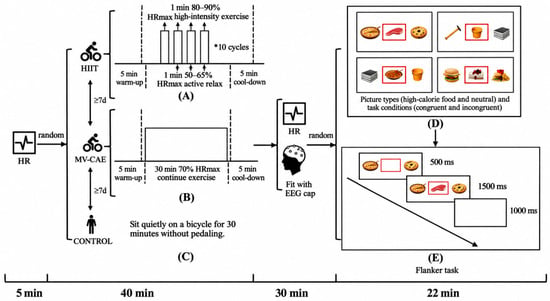
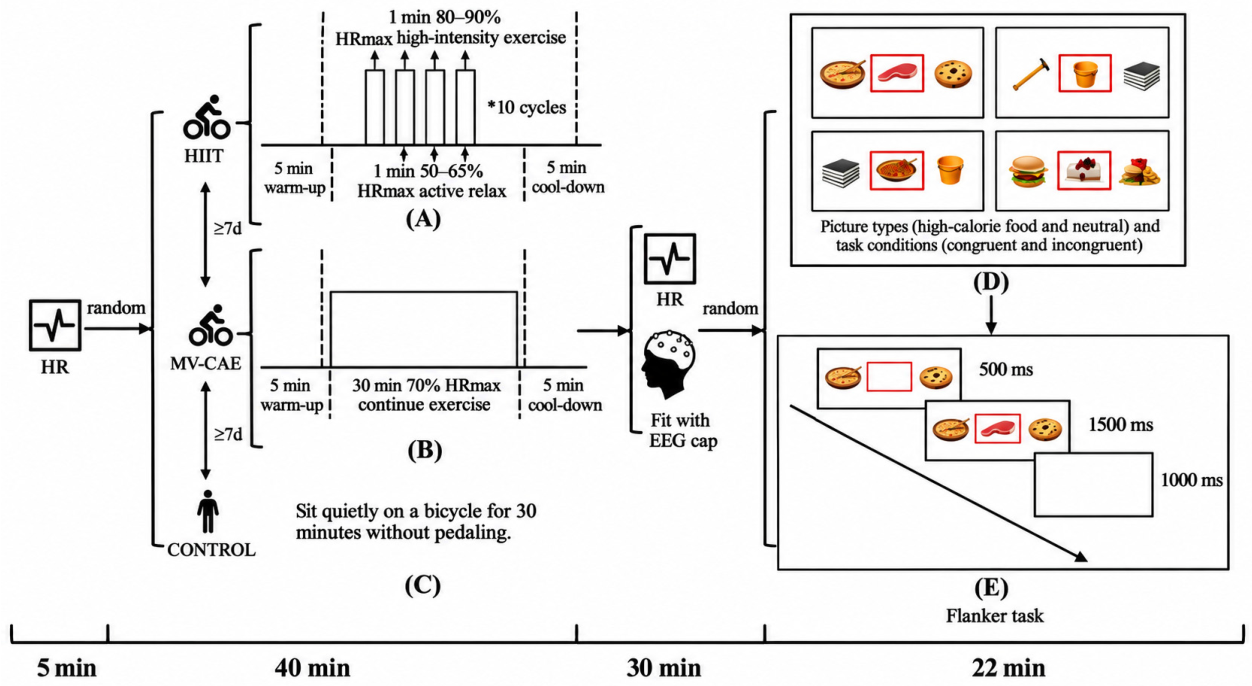
Exercise sessions were performed on a Monark LC7TT cycle ergometer (Monark Exercise AB, Vansbro, Sweden), using protocols adapted from previous studies of acute exercise and food-related cognitive processing [13,14]. The high-intensity interval training (HIIT) protocol consisted of a 5-min warm-up targeting 70% of age-predicted maximal heart rate (HRmax), followed by 10 cycles of 1-min high-intensity cycling at 80–90% HRmax and 1-min active recovery at 50–65% HRmax, and a 5-min cool-down, for a total duration of 30 min. The moderate-to-vigorous continuous aerobic exercise (MV-CAE) protocol comprised a 5-min warm-up, 30 min of continuous cycling at approximately 70% HRmax, and a 5-min cool-down, for a total duration of 40 min.
Age-predicted HRmax was calculated as 200 − 0.5 × age, using an equation previously developed for adults with obesity [24]. Heart rate was monitored continuously, and cycling resistance was adjusted according to real-time heart-rate feedback to maintain the prescribed intensity ranges. Minute-by-minute heart-rate profiles are presented in Supplementary Figure S1. No adverse events occurred during the experimental interventions.
During the control condition, participants remained seated quietly for 30 min without performing structured exercise. Following each experimental condition, participants remained seated during a recovery and EEG preparation period of approximately 30 min. During this period, the EEG cap was fitted, electrodes were prepared, and signal quality was checked. The food-related Flanker task commenced after EEG preparation.The experimental protocols and the food-related Flanker task sequence are illustrated in Figure 1.
Figure 1.
Experimental design. (A) High-intensity interval training (HIIT) protocol; (B) moderate-to-vigorous continuous aerobic exercise (MV-CAE) protocol; (C) seated control condition; (D) food-related Flanker task conditions categorized by central target type and stimulus congruency; (E) schematic sequence of the Flanker task. The unified timeline at the bottom represents the maximum timeline across conditions. The actual intervention durations were 30 min for HIIT, 40 min for MV-CAE, and 30 min for the seated control. Arrows indicate the sequence of experimental procedures and task events.
2.4. Food-Related Flanker Task
The food-related Flanker task required participants to identify a central target while ignoring surrounding distractors. Food and neutral furniture images were selected from the Food-Pics database [25], following the stimulus selection procedures described by Xie et al. [14]. Four conditions were defined by central target category and target–flanker congruency: food-congruent (Code 11), food-incongruent (Code 12), furniture-congruent (Code 13), and furniture-incongruent (Code 14). In incongruent trials, the central target and flankers belonged to different categories. Participants responded using key 4 for food targets and key 6 for furniture targets, with fixed response mappings across participants.
Participants completed a 12-trial practice block and were required to achieve at least 80% accuracy before proceeding. An additional practice block was provided when necessary. The experimental task comprised three blocks of 120 trials, totaling 360 trials per session (90 per condition), with stimuli presented in randomized order within each block. Each trial began with flanker images displayed around a central red frame for approximately 500 ms, followed by the central target appearing alongside the flankers for up to 1500 ms. A 1000-ms blank interval followed each trial. The task-event marker (Code 1) was issued between the two presentation stages and served as the temporal reference for EEG epoch extraction. Behavioral accuracy was calculated as the proportion of correct responses within each intervention and Flanker task condition. The program assigned Code 20 to correct responses and Code 10 to incorrect or omitted responses. Reaction time (RT) was calculated as the interval between Code 1 and Code 20 for correct trials.
2.5. EEG Recording and Preprocessing
EEG was recorded using a 64-channel eegoTM mylab system (eemagine/ANT Neuro, Hengelo, The Netherlands), with electrodes positioned according to the extended international 10–20 system. Electrode impedances were maintained below 10 kΩ during recording. Signals were sampled at 1000 Hz and processed using MNE-Python (version 1.13.2) [26]. Continuous EEG data were band-pass filtered between 0.1 and 40 Hz using a zero-phase finite impulse response (FIR) filter with a Hamming window (33,001 taps). A separate 50-Hz notch filter was not applied. Offline average referencing was performed using eligible scalp electrodes, with channel selection determined at the session level. No channel interpolation, independent component analysis, or ocular artifact correction was performed.
EEG epochs were screened using an Fz peak-to-peak amplitude threshold of 100 µV; exceedances were flagged as potential artifact risks rather than automatically excluded from the primary analysis. ERP averaging was not restricted to trials classified as correct by the task program. Only task-condition cells containing at least 30 retained trials were included in the primary ERP analysis; this minimum was an inclusion criterion rather than a guarantee of component reliability [27]. Additional details on artifact screening, trial retention, and sensitivity analyses are provided in Supplementary Methods S1 and S3.
2.6. ERP Quantification
Mean ERP amplitudes were extracted at Fz within three predefined time windows corresponding to N2 (180–230 ms), P3 (400–600 ms), and the late positive potential (LPP; 700–1100 ms), based on previous research [16,17,18,19]. These labels refer to predefined Code 1-locked analysis windows rather than independently validated ERP component identities. Fz was selected as the primary electrode site to maintain a consistent measurement location across the three analysis windows and facilitate comparisons of task-related electrophysiological activity. FCz, Cz, and Pz were also examined to characterize the spatial distribution of the ERP waveforms. Mean amplitudes were calculated for each participant, session, and task condition and expressed in microvolts (µV). When recordings contained multiple segments, condition-level means were weighted by the number of retained trials. Additional assessments of measurement precision are described in Supplementary Methods S2.
2.7. Statistical Analysis
Statistical analyses were performed in R (version 4.1.1) using the lme4 (version 1.1-27.1), lmerTest (version 3.1-3), pbkrtest (version 0.5.1), and emmeans (version 1.11.0) packages. Behavioral and electrophysiological outcomes were analyzed separately using mixed-effects models to account for repeated measurements within participants and experimental sessions. Intervention (HIIT, MV-CAE, or control), central target category (food or furniture), congruency (congruent or incongruent), their interactions, and actual visit period were included as fixed effects.
Mean ERP amplitudes in each predefined time window were analyzed using linear mixed-effects models fitted by restricted maximum likelihood. Models included participant and session random intercepts and, where estimable, a participant-level random slope for the interaction between target category and congruency. Fixed effects were evaluated using F-tests with Kenward–Roger degrees of freedom. The primary analyses examined the intervention × target category × congruency interaction across the three time windows. A planned contrast, D = (Code 12 − Code 11) − (Code 14 − Code 13), was used to compare congruency effects between food and furniture targets across interventions. Holm correction was applied separately to the three primary interactions, the remaining fixed-effect tests, and the planned intervention contrasts. Effect estimates were reported with pointwise 95% confidence intervals.
Behavioral accuracy was analyzed using a binomial generalized linear mixed-effects model with a logit link, while reaction time (RT) was analyzed using a linear mixed-effects model fitted to log-transformed condition-level mean RT values from correct trials. Both models included participant and session random intercepts. Planned comparisons were adjusted using the Holm method and reported with 95% confidence intervals. Additional sensitivity analyses examined the influence of EEG quality-control criteria, sample inclusion, and measurement precision. Full model specifications, diagnostic procedures, and sensitivity analyses are provided in the Supplementary Methods S2 and S3 and Tables S1–S4.
3. Results
3.1. Participant Inclusion and Trial Retention
The participant recruitment and exclusion process is presented in Figure 2. Of the 58 individuals initially screened, 22 entered the intervention phase, and 17 were included in the final analysis. All 17 participants completed the three experimental conditions, contributing 51 sessions (17 HIIT, 17 MV-CAE, and 17 control), represented by 53 unique EDF recording segments. A total of 18,353 task events were recorded, of which 16,957 trials met the initial EEG quality-control criteria. After applying the minimum threshold of 30 retained trials per task-condition cell, the primary ERP analysis included 16,901 trials across 202 eligible cells (68 HIIT, 68 MV-CAE, and 66 control). Two control cells were excluded because they contained fewer than 30 retained trials. Behavioral analyses included all 51 sessions and were conducted independently of EEG trial-retention criteria. Detailed trial-retention results and sensitivity analyses are provided in Supplementary Methods S1 and S3 and Supplementary Tables S1 and S3.
Figure 2.
Participant recruitment, exclusion, and analysis flow. Of the 58 individuals assessed for eligibility, 36 were excluded during initial screening and 22 entered the intervention phase. Five additional participants were excluded or withdrew, leaving 17 participants in the final analysis. These participants contributed 51 experimental sessions (17 HIIT, 17 MV-CAE, and 17 control), represented by 53 unique EDF recording segments.
3.2. Descriptive Results
Descriptive mean ERP amplitudes at Fz across intervention and Flanker task conditions are presented in Table 2. Mean amplitudes were positive across the N2 (180–230 ms), P3 (400–600 ms), and LPP (700–1100 ms) analysis windows, with variation across intervention conditions, central target categories, and stimulus congruency. In the N2 window, mean amplitude was higher for food-incongruent than food-congruent trials following HIIT (3.19 vs. 2.56 µV), whereas the corresponding differences were smaller or reversed following MV-CAE (2.97 vs. 3.34 µV) and seated rest (2.90 vs. 2.79 µV). In the P3 and LPP windows, amplitudes varied across task conditions without a consistent pattern distinguishing the exercise protocols.
Table 2.
Descriptive ERP amplitudes at Fz and retained trial counts.
Behavioral performance was characterized by high accuracy and relatively similar RT values across conditions (Table 3). Mean accuracy ranged from 96.60% to 98.04%, while mean RT values ranged from approximately 811 to 824 ms. Within each intervention condition, mean RT values were slightly lower for incongruent than congruent trials, with differences of only a few milliseconds. These descriptive findings were further evaluated using mixed-effects models.
Table 3.
Program-coded accuracy and recorded reaction time.
3.3. Effects of Acute Exercise on Behavioral Performance and Electrophysiological Activity
The primary mixed-effects analyses examined whether intervention-related differences in ERP activity varied according to central target category and stimulus congruency. In the N2 time window (180–230 ms), the intervention × target category × congruency interaction did not reach statistical significance (unadjusted p = 0.0545; Holm-adjusted p = 0.1635). The corresponding interactions were also nonsignificant in the P3 (400–600 ms; Holm-adjusted p = 0.5248) and LPP (700–1100 ms; Holm-adjusted p = 0.5248) windows.
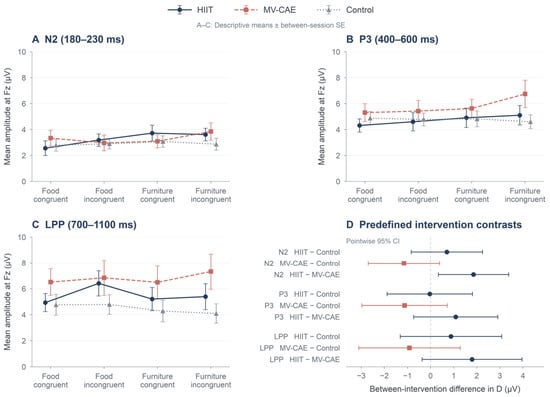
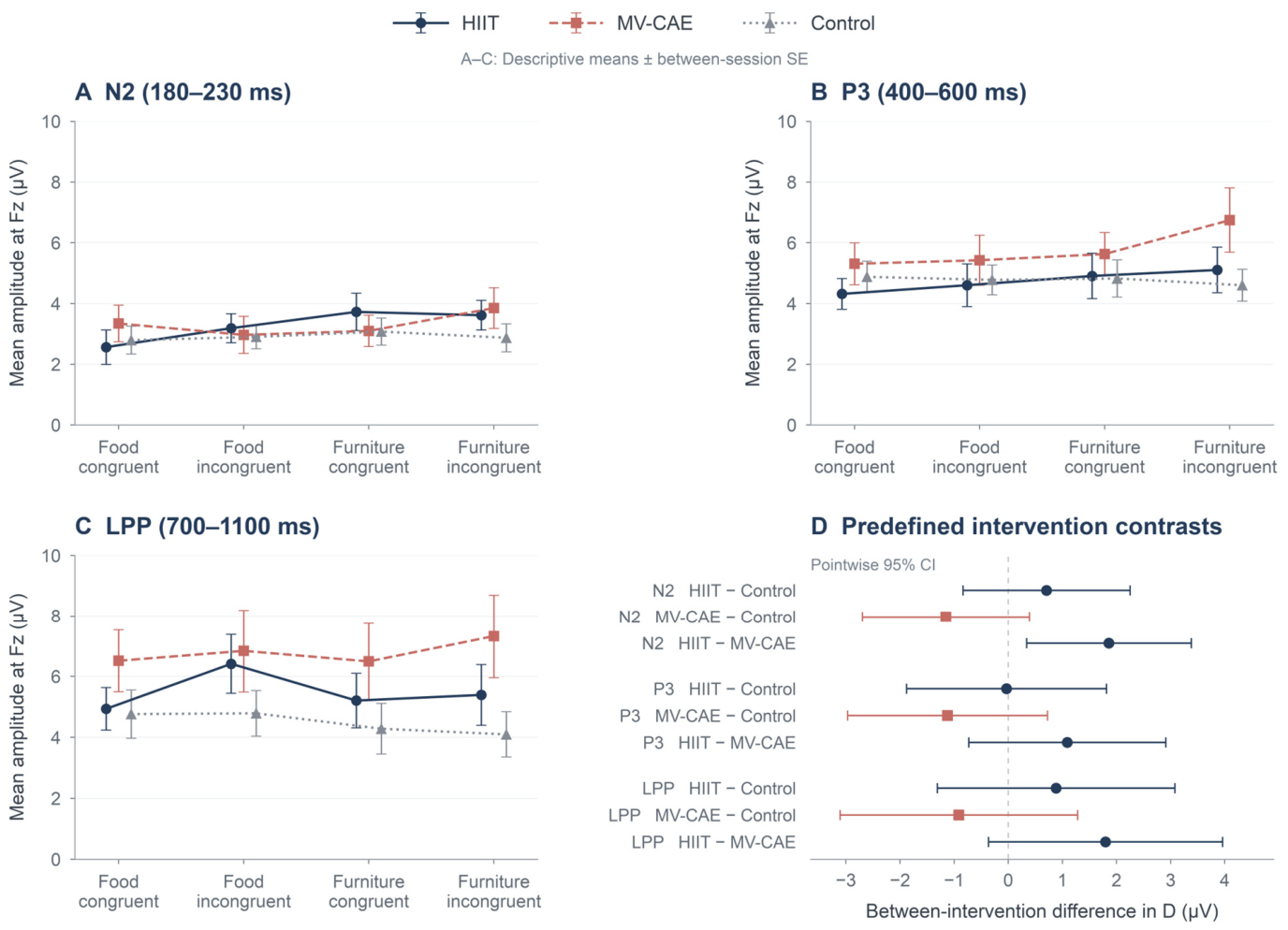
Planned comparisons further examined between-intervention differences in the congruency effects for food and furniture targets. In the N2 window, the HIIT-versus-MV-CAE difference-in-differences contrast was 1.859 µV (95% CI [0.337, 3.381]; Holm-adjusted p = 0.1532). None of the nine planned intervention contrasts reached significance after Holm correction (Figure 3). Supplementary comparisons of intervention-related overall ERP amplitudes were also conducted using estimated marginal means averaged across task conditions and visit periods. No significant overall intervention effects or pairwise differences were observed in the N2, P3, or LPP windows after Holm correction (Supplementary Table S2C).
Figure 3.
Code 1-locked ERP amplitudes and intervention contrasts across three analysis windows. (A–C) Mean ERP amplitudes at Fz within the N2 (180–230 ms), P3 (400–600 ms), and LPP (700–1100 ms) analysis windows across intervention and Flanker task conditions. Values represent unweighted means across eligible session-condition cells, with error bars indicating between-session standard errors. (D) Model-estimated between-intervention differences in the congruency contrast, D = (Code 12 − Code 11) − (Code 14 − Code 13), with pointwise 95% confidence intervals. None of the nine planned contrasts remained significant after Holm correction. Time zero corresponds to the recorded Code 1 event.
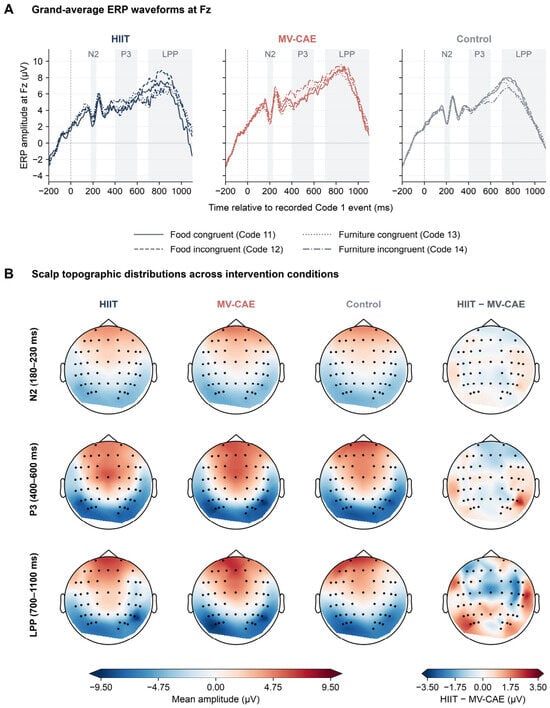
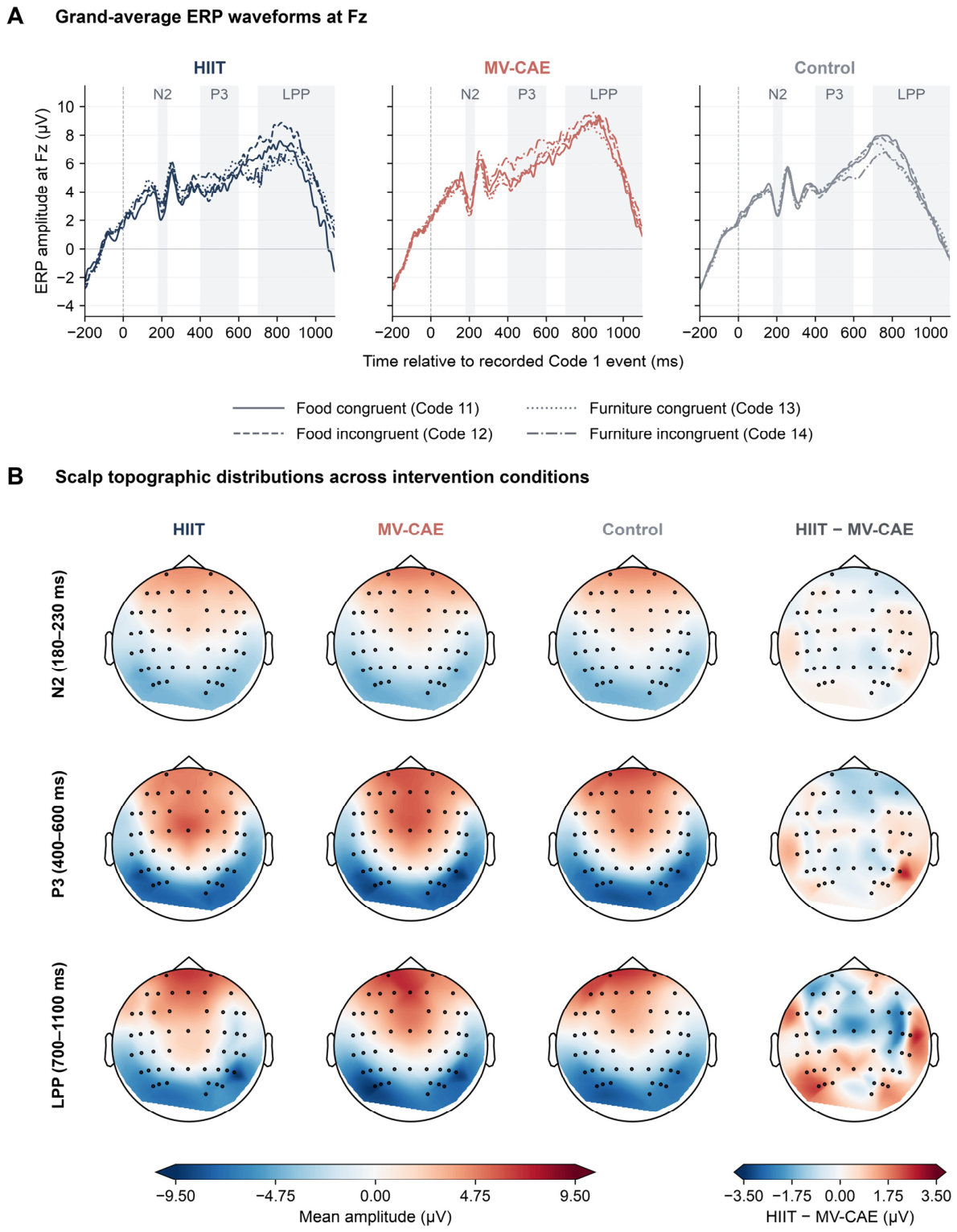
Grand-average ERP waveforms and scalp topographic distributions are presented in Figure 4. The waveforms illustrate the temporal patterns of activity at Fz across the three intervention conditions and four Flanker task conditions, with the N2, P3, and LPP analysis windows indicated. The corresponding scalp maps illustrate the spatial distributions of ERP amplitudes across interventions, including the mean amplitude differences between HIIT and MV-CAE.
Figure 4.
Grand-average ERP waveforms and scalp topographic distributions across intervention conditions. (A) Grand-average ERP waveforms at Fz for the four Flanker task conditions following HIIT, MV-CAE, and seated rest. Shaded regions indicate the N2 (180–230 ms), P3 (400–600 ms), and LPP (700–1100 ms) analysis windows. (B) Scalp distributions of mean amplitudes averaged across eligible session-condition cells, using 49 consistently eligible electrodes and a common color scale. The rightmost column presents descriptive HIIT − MV-CAE differences on a separate zero-centered scale, rather than model-estimated contrasts. Time zero corresponds to the recorded Code 1 event.
Behavioral analyses revealed no significant overall intervention effect on accuracy (χ2(2) = 0.452, p = 0.7978) or intervention × target category × congruency interaction (χ2(2) = 1.433, p = 0.4885). The estimated incongruent-minus-congruent accuracy differences were 0.394 percentage points for food targets (95% CI [−0.103, 0.892]) and 0.243 percentage points for furniture targets (95% CI [−0.245, 0.731]). RT analyses also showed no significant overall intervention effect (F(2, 30) = 0.329, p = 0.7221), with corresponding incongruent-minus-congruent differences of −1.961 ms for food targets (95% CI [−5.435, 1.512]) and −2.887 ms for furniture targets (95% CI [−6.381, 0.608]). Neither the congruency contrasts nor the pairwise intervention comparisons for accuracy and RT were significant after Holm correction.
Sensitivity analyses showed that some ERP estimates varied with session inclusion and quality-control criteria. In particular, excluding three prespecified high-risk sessions yielded a significant intervention × target category × congruency interaction in the LPP window (Holm-adjusted p = 0.0170) and a significant HIIT-versus-MV-CAE planned contrast (estimate = 2.201 µV, 95% CI [0.775, 3.626]; Holm-adjusted p = 0.0248). These findings were not supported by the primary analysis and indicate sensitivity to session inclusion. Detailed results are provided in Supplementary Methods S3 and Supplementary Table S3B.
4. Discussion
This study investigated the effects of high-intensity interval training (HIIT) and moderate-to-vigorous continuous aerobic exercise (MV-CAE) on food-related cognitive control in adults with overweight or obesity, using behavioral performance and three ERP measures (N2, P3, and LPP). The N2 analysis revealed a task-dependent pattern, with a positive HIIT-versus-MV-CAE difference in the congruency-effect contrast between food and furniture targets. Although this difference did not remain significant after correction for multiple comparisons, it provides a preliminary observation relevant to the relationship between exercise modality and early cognitive processing. In contrast, P3 and LPP analyses showed no consistent intervention-related differences, while behavioral accuracy and reaction time (RT) remained relatively stable across exercise conditions. Together, these findings extend the investigation of acute exercise and food-related cognition by examining early cognitive control, later attentional processing, and behavioral performance within a common experimental framework.
The frontocentral N2 has been associated with conflict monitoring and cognitive control under demanding task conditions [16]. Previous studies have reported exercise-related modulation of N2 amplitude, although the direction and magnitude of these responses vary across tasks and populations [28,29]. In the present study, the HIIT-versus-MV-CAE contrast showed a positive estimate of 1.859 µV, suggesting a potentially meaningful difference in early task-related electrophysiological activity between the two exercise protocols. Although this contrast did not remain significant after Holm correction, the observed pattern provides a useful direction for future research. In particular, it highlights the importance of considering central target category and stimulus congruency when investigating exercise-related cognitive processing, rather than treating food-related interference as a uniform process.
The P3 and LPP findings provide additional insight into later stages of task-related processing. P3 has been associated with stimulus evaluation and attentional resource allocation [17], whereas LPP reflects sustained processing of motivationally salient information, including food-related stimuli [6,18,19,30,31,32]. Although the primary analyses did not identify significant intervention-related differences in these windows, sensitivity analyses revealed an LPP interaction and a HIIT-versus-MV-CAE contrast after excluding three high-risk sessions. This finding suggests that later electrophysiological responses may also vary according to exercise protocol and task demands, while highlighting the importance of EEG signal quality in detecting such differences. Together, the N2 and LPP findings provide preliminary evidence of potentially distinct temporal patterns of food-related cognitive processing following acute exercise, warranting further investigation.
Comparing HIIT with MV-CAE adds to research on exercise protocols and cognitive performance. Bailey et al. examined the association between exercise intensity and behavioral and ERP indices of food-related cognitive control [13], while Xie et al. reported P3- and LPP-related responses following high-intensity interval exercise in young adults with obesity [14]. Other investigations have described heterogeneous cognitive and electrophysiological responses across exercise protocols, participant populations, and task paradigms [15,29,33,34,35,36]. By comparing HIIT, MV-CAE, and seated rest within the same participants, the present study provides an experimental comparison of two distinct aerobic exercise protocols under identical cognitive task conditions. The findings did not establish a consistent cognitive advantage of HIIT over MV-CAE. This is relevant to exercise prescription because higher exercise intensity should not be assumed to produce proportionally greater immediate cognitive benefits. Instead, the cognitive consequences of acute exercise should be considered in relation to the exercise protocol, the population being studied, and the specific outcomes used to evaluate cognitive performance.
Behavioral performance provided a complementary perspective on the electrophysiological findings. Accuracy remained high across intervention and Flanker conditions, while RT differences were small and statistically nonsignificant. These findings indicate that the two exercise protocols did not produce detectable improvements in the measured behavioral outcomes. The relatively high accuracy rates could have limited the ability of the task to distinguish subtle changes in cognitive performance. Importantly, the N2, P3, and LPP analyses and the behavioral measures provide different perspectives on task-related processing. Examining these outcomes together is valuable for understanding how neural activity and overt performance relate to one another following acute exercise. Alternative explanations include differences in general arousal, task engagement, stimulus-category processing, and response-related activity [19]. In particular, because actual keypress timing was not independently verified, potential overlap between the LPP analysis window and response-related processes cannot be excluded [37]. Future studies integrating ERP measures with more demanding cognitive tasks and direct assessments of food craving, appetite, and intake could further establish the functional relevance of exercise-related neural responses.
Several limitations should be considered. The relatively small sample size limited statistical precision, while differences in exercise duration and intensity patterns prevented the independent estimation of intensity effects. EEG event timing was not independently verified against visual stimulus onset, and residual artifacts and sensitivity to quality-control procedures introduce uncertainty into the interpretation of N2, P3, and LPP amplitudes. In addition, the fixed target-response mapping and the structure of the congruency contrast limit food-specific interpretations. RT estimates were derived from recorded event timestamps without independent verification against keypress latency, and the absence of direct food-intake measures restricts conclusions about eating behavior. Nevertheless, the combination of a within-subject exercise comparison, food-related cognitive task, and multiple ERP measures provides a useful foundation for further research. Future studies could also explore biomarkers related to arousal and attention, such as orexin-A, alongside electrophysiological measures [38]. Larger studies with validated event timing, comprehensive EEG quality control, and more sensitive behavioral and eating-related outcomes can build on this approach to clarify the cognitive consequences of different acute exercise protocols.
5. Conclusions
This study examined the effects of HIIT and MV-CAE on food-related cognitive control in adults with overweight or obesity using behavioral measures and N2, P3, and LPP analyses. The N2 analysis revealed a preliminary difference between exercise protocols that varied with task conditions, although this finding did not remain significant after correction for multiple comparisons. No consistent intervention-related differences were observed in the primary P3 and LPP analyses or behavioral performance, although sensitivity analyses identified an LPP-related difference that warrants further investigation. These findings contribute to understanding the relationship between acute exercise and food-related cognitive processing by highlighting the importance of considering exercise protocols, task demands, and distinct ERP components. Further research with larger samples and validated electrophysiological and behavioral measurements is needed to clarify whether different exercise modalities produce meaningful changes in food-related cognitive control.
Supplementary Materials
The following supporting information can be downloaded at: https://www.mdpi.com/article/10.3390/life16111925/s1.
Author Contributions
Conceptualization, J.G., B.L. and C.C.; methodology, J.G., B.L. and D.Z.; software, D.Z. and X.C.; validation, J.G., B.L. and C.C.; formal analysis, J.G., B.L. and D.Z.; investigation, J.G., B.L., X.C. and R.Z.; resources, C.C.; data curation, J.G., B.L., D.Z. and R.Z.; writing—original draft preparation, J.G. and B.L.; writing—review and editing, J.G., B.L., D.Z., X.C., R.Z., Y.-K.J. and C.C.; visualization, J.G., B.L. and X.C.; supervision, Y.-K.J. and C.C.; project administration, J.G. and C.C.; funding acquisition, C.C. All authors have read and agreed to the published version of the manuscript.
Funding
This research was supported by the Tsinghua University Initiative Scientific Research Program (Grant No. 2024THZWJC07).
Institutional Review Board Statement
The study was approved by the Tsinghua University Science and Technology Ethics Committee (THU01-20230109) and was conducted in accordance with the Declaration of Helsinki.
Informed Consent Statement
Informed consent was obtained from all subjects involved in the study.
Data Availability Statement
The data that support the findings of this study are available from the corresponding author upon reasonable request. The data are not publicly available due to privacy and ethical considerations related to participant information.
Acknowledgments
The authors thank all participants for their time and contribution to this study.
Conflicts of Interest
The authors declare no conflicts of interest.
References
- World Health Organization. Obesity and Overweight. Available online: https://www.who.int/news-room/fact-sheets/detail/obesity-and-overweight (accessed on 4 November 2026).
- Lowe, C.J.; Morton, J.B.; Reichelt, A.C. Adolescent Obesity and Dietary Decision Making-a Brain-Health Perspective. Lancet Child Adolesc. Health 2020, 4, 388–396. [Google Scholar] [CrossRef] [Scilit] [PubMed]
- Stoeckel, L.E.; Weller, R.E.; Cook, E.W., III; Twieg, D.B.; Knowlton, R.C.; Cox, J.E. Widespread Reward-System Activation in Obese Women in Response to Pictures of High-Calorie Foods. NeuroImage 2008, 41, 636–647. [Google Scholar] [CrossRef] [Scilit] [PubMed]
- Diamond, A. Executive Functions. Annu. Rev. Psychol. 2013, 64, 135–168. [Google Scholar] [CrossRef] [Scilit] [PubMed]
- Allom, V.; Mullan, B.; Hagger, M. Does Inhibitory Control Training Improve Health Behaviour? A Meta-Analysis. Health Psychol. Rev. 2016, 10, 168–186. [Google Scholar] [CrossRef] [Scilit] [PubMed]
- Carbine, K.A.; Rodeback, R.; Modersitzki, E.; Miner, M.; LeCheminant, J.D.; Larson, M.J. The Utility of Event-Related Potentials (ERPs) in Understanding Food-Related Cognition: A Systematic Review and Recommendations. Appetite 2018, 128, 58–78. [Google Scholar] [CrossRef] [Scilit] [PubMed]
- Makaracı, M.; Makaracı, Y.; Zorba, E.; Lautenbach, F. Effects of ten biofeedback sessions on athletes’ physiological, psychological, and cognitive functioning: A randomized controlled trial with international tennis players. Percept. Mot. Ski. 2024, 131, 1664–1686. [Google Scholar] [CrossRef] [Scilit] [PubMed]
- Chang, Y.K.; Labban, J.D.; Gapin, J.I.; Etnier, J.L. The Effects of Acute Exercise on Cognitive Performance: A Meta-Analysis. Brain Res. 2012, 1453, 87–101. [Google Scholar] [CrossRef] [Scilit] [PubMed]
- Zimmer, P.; Stritt, C.; Bloch, W.; Schmidt, F.P.; Huebner, S.T.; Binneboessel, S.; Schenk, A.; Oberste, M. The Effects of Different Aerobic Exercise Intensities on Serum Serotonin Concentrations and Their Association with Stroop Task Performance: A Randomized Controlled Trial. Eur. J. Appl. Physiol. 2016, 116, 2025–2034. [Google Scholar] [CrossRef] [Scilit] [PubMed]
- Hillman, C.H.; Erickson, K.I.; Kramer, A.F. Be Smart, Exercise Your Heart: Exercise Effects on Brain and Cognition. Nat. Rev. Neurosci. 2008, 9, 58–65. [Google Scholar] [CrossRef] [Scilit] [PubMed]
- Cotman, C.W.; Berchtold, N.C. Exercise: A Behavioral Intervention to Enhance Brain Health and Plasticity. Trends Neurosci. 2002, 25, 295–301. [Google Scholar] [CrossRef] [Scilit] [PubMed]
- Sim, A.Y.; Wallman, K.E.; Fairchild, T.J.; Guelfi, K.J. High-Intensity Intermittent Exercise Attenuates Ad-Libitum Energy Intake. Int. J. Obes. 2014, 38, 417–422. [Google Scholar] [CrossRef] [Scilit] [PubMed]
- Bailey, B.W.; Muir, A.M.; Bartholomew, C.L.; Christensen, W.F.; Carbine, K.A.; Marsh, H.; LaCouture, H.; McCutcheon, C.; Larson, M.J. The Impact of Exercise Intensity on Neurophysiological Indices of Food-Related Inhibitory Control and Cognitive Control: A Randomized Crossover Event-Related Potential (ERP) Study. NeuroImage 2021, 237, 118162. [Google Scholar] [CrossRef] [Scilit] [PubMed]
- Xie, C.; Alderman, B.L.; Meng, F.; Chen, Y.-C.; Chang, Y.-K.; Wang, K. Acute High-Intensity Interval Exercise Improves Food-Related Cognition in Young Adults with Obesity: An ERP Study. Int. J. Clin. Health Psychol. 2024, 24, 100430. [Google Scholar] [CrossRef] [Scilit] [PubMed]
- Sun, B.; Lu, Y.-F.; Chen, J.-W.; Xiao, Y.-L.; Ren, J. Acute effects of short-term high-intensity interval exercise and moderate-intensity aerobic exercise on food-related inhibitory control in obese adults: A randomized controlled crossover trial using ERP measures. Front. Psychol. 2025, 16, 1634569. [Google Scholar] [CrossRef] [Scilit] [PubMed]
- Folstein, J.R.; Van Petten, C. Influence of Cognitive Control and Mismatch on the N2 Component of the ERP: A Review. Psychophysiology 2008, 45, 152–170. [Google Scholar] [CrossRef] [Scilit] [PubMed]
- Polich, J. Updating P300: An Integrative Theory of P3a and P3b. Clin. Neurophysiol. 2007, 118, 2128–2148. [Google Scholar] [CrossRef] [Scilit] [PubMed]
- Cuthbert, B.N.; Schupp, H.T.; Bradley, M.M.; Birbaumer, N.; Lang, P.J. Brain Potentials in Affective Picture Processing: Covariation with Autonomic Arousal and Affective Report. Biol. Psychol. 2000, 52, 95–111. [Google Scholar] [CrossRef] [Scilit] [PubMed]
- Hajcak, G.; MacNamara, A.; Olvet, D.M. Event-Related Potentials, Emotion, and Emotion Regulation: An Integrative Review. Dev. Neuropsychol. 2010, 35, 129–155. [Google Scholar] [CrossRef] [Scilit] [PubMed]
- WS/T 428-2013; National Health and Family Planning Commission of the People’s Republic of China. Criteria of Weight for Adults. Standards Press of China: Beijing, China, 2013.
- Thomas, S.; Reading, J.; Shephard, R.J. Revision of the Physical Activity Readiness Questionnaire (PAR-Q). Can. J. Sport Sci. 1992, 17, 338–345. [Google Scholar] [PubMed]
- Faul, F.; Erdfelder, E.; Lang, A.G.; Buchner, A. G*Power 3: A Flexible Statistical Power Analysis Program for the Social, Behavioral, and Biomedical Sciences. Behav. Res. Methods 2007, 39, 175–191. [Google Scholar] [CrossRef] [Scilit] [PubMed]
- Kao, S.C.; Chen, F.T.; Moreau, D.; Drollette, E.S.; Amireault, S.; Chu, C.H.; Chang, Y.K. Acute Effects of Exercise Engagement on Neurocognitive Function: A Systematic Review and Meta-Analysis on P3 Amplitude and Latency. Int. Rev. Sport Exerc. Psychol. 2025, 18, 111–153. [Google Scholar] [CrossRef] [Scilit]
- Miller, W.C.; Wallace, J.P.; Eggert, K.E. Predicting max HR and the HR–VO2 relationship for exercise prescription in obesity. Med. Sci. Sports Exerc. 1993, 25, 1077–1081. [Google Scholar] [CrossRef] [Scilit]
- Blechert, J.; Meule, A.; Busch, N.A.; Ohla, K. Food-Pics: An Image Database for Experimental Research on Eating and Appetite. Front. Psychol. 2014, 5, 617. [Google Scholar] [CrossRef] [Scilit] [PubMed]
- Gramfort, A.; Luessi, M.; Larson, E.; Engemann, D.A.; Strohmeier, D.; Brodbeck, C.; Goj, R.; Jas, M.; Brooks, T.; Parkkonen, L.; et al. MEG and EEG Data Analysis with MNE-Python. Front. Neurosci. 2013, 7, 267. [Google Scholar] [CrossRef] [Scilit] [PubMed]
- Huffmeijer, R.; Bakermans-Kranenburg, M.J.; Alink, L.R.A.; van IJzendoorn, M.H. Reliability of event-related potentials: The influence of number of trials and electrodes. Physiol. Behav. 2014, 130, 13–22. [Google Scholar] [CrossRef] [Scilit] [PubMed]
- Cai, Z.; Shi, L.; Wu, W.; Meng, L.; Ru, Y.; Wu, M. A scoping review of effects of acute exercise on executive function: Evidence from event-related potentials. Front. Psychol. 2025, 16, 1599861. [Google Scholar] [CrossRef] [Scilit] [PubMed]
- Wang, K.; Cai, S.; Huang, T.; Deng, Z.; Qian, J.; Chen, Y.; Chen, G.; Xu, L.; Wang, P.; Zhang, Y.; et al. Unveiling the neural mechanisms of acute aerobic exercise on inhibitory control among young adults with obesity: Insights from an ERP study. Acta Psychol. 2024, 250, 104506. [Google Scholar] [CrossRef] [Scilit] [PubMed]
- Nijs, I.M.T.; Franken, I.H.A.; Muris, P. Food cue-elicited brain potentials in obese and healthy-weight individuals. Eat. Behav. 2008, 9, 462–470. [Google Scholar] [CrossRef] [Scilit] [PubMed]
- Carbine, K.A.; Larson, M.J.; Romney, L.; Bailey, B.W.; Tucker, L.A.; Christensen, W.F.; LeCheminant, J.D. Disparity in neural and subjective responses to food images in women with obesity and normal-weight women. Obesity 2017, 25, 384–390. [Google Scholar] [CrossRef] [Scilit] [PubMed]
- Chami, R.; Cardi, V.; Lautarescu, A.; Mallorquí-Bagué, N.; McLoughlin, G. Neural responses to food stimuli among individuals with eating and weight disorders: A systematic review of event-related potentials. Int. Rev. Psychiatry 2019, 31, 318–331. [Google Scholar] [CrossRef] [Scilit] [PubMed]
- Carbine, K.A.; Anderson, J.; Larson, M.J.; LeCheminant, J.D.; Bailey, B.W. The relationship between exercise intensity and neurophysiological responses to food stimuli in women: A randomized crossover event-related potential (ERP) study. Int. J. Psychophysiol. 2020, 158, 349–361. [Google Scholar] [CrossRef] [Scilit] [PubMed]
- Gusatovic, J.; Gramkow, M.H.; Hasselbalch, S.G.; Frederiksen, K.S. Effects of aerobic exercise on event-related potentials related to cognitive performance: A systematic review. PeerJ 2022, 10, e13604. [Google Scholar] [CrossRef] [Scilit] [PubMed]
- Xie, C.; Huang, T.; Wang, Y.; Wang, P.; Chen, Y.; Qian, J.; Chen, G.; Wang, K. The impact of acute aerobic exercise on general and food-related inhibitory function among young adults with obesity: An event-related potential (ERP) study. Brain Sci. 2025, 15, 59. [Google Scholar] [CrossRef] [Scilit] [PubMed]
- Zhu, C.; Ibrahim, H.B.; Chi, P.; Wang, Y.; Xu, X.; Peng, T.; Chi, A. Effects of exercise on cognitive performance and ERP (P3, N2) in overweight and obese populations: A systematic review and meta-analysis. BMC Sports Sci. Med. Rehabil. 2026, 18, 151. [Google Scholar] [CrossRef] [Scilit] [PubMed]
- Berchicci, M.; Spinelli, D.; Di Russo, F. New insights into old waves: Matching stimulus- and response-locked ERPs on the same time-window. Biol. Psychol. 2016, 117, 202–215. [Google Scholar] [CrossRef] [Scilit] [PubMed]
- Moscatelli, F.; Monda, A.; Messina, A.; Monda, M.; Monda, V.; Villano, I.; De Maria, A.; Nicola, M.; Marsala, G.; de Stefano, M.I.; et al. Evaluation of orexin-A salivary levels and its correlation with attention after non-invasive brain stimulation in female volleyball players. Sports Med. Open 2024, 10, 32. [Google Scholar] [CrossRef] [Scilit] [PubMed]

Disclaimer/Publisher’s Note: The statements, opinions and data contained in all publications are solely those of the individual author(s) and contributor(s) and not of MDPI and/or the editor(s). MDPI and/or the editor(s) disclaim responsibility for any injury to people or property resulting from any ideas, methods, instructions or products referred to in the content. |
© 2026 by the authors. Licensee MDPI, Basel, Switzerland. This article is an open access article distributed under the terms and conditions of the Creative Commons Attribution (CC BY) license.