


Abstract
Serum phenobarbital (PB) monitoring is recommended after treatment initiation and periodically thereafter, but real-world data on monitoring practice are scarce, particularly where imepitoin is not marketed and PB is a controlled substance. All in-house PB determinations performed on a point-of-care analyser reporting PB with a hepatic panel at a Romanian university referral hospital between January 2022 and August 2026 were retrieved and linked to the hospital register. A total of 143 canine runs from 66 dogs were obtained; 10 (7.0%) were suppressed by severe lipaemia. At the first valid determination, 47 of 65 dogs with a valid result (72.3%; 95% CI 60.4–81.7) were within the 15–35 µg/mL target range and 16 (24.6%; 95% CI 15.8–36.3) were below it. The median dose, given as fractionated human 100 mg tablets, was 5.62 mg/kg/day and was not associated with concentration; dogs under 10 kg received almost twice the weight-based dose of larger dogs without reaching higher concentrations. Alkaline phosphatase was increased in 36% of runs and was not associated with concentration in mixed-effects models. At least one determination was obtained in 79% of dogs in continued care and 88% of dogs with six or more prescriptions, but only 40% (95% CI 27–56%) of newly treated dogs were determined within 90 days and none of the 17 dogs seen only once or twice after initiation was determined. Monitoring therefore follows continuity of care; scheduling the first determination at initiation and coupling sampling with prescription renewal are proposed measures whose effectiveness requires prospective evaluation.
1. Introduction
Epilepsy is one of the commonest chronic neurological diseases of dogs, with an estimated prevalence of 0.6–0.75% in the general canine population, and dogs with epilepsy are among the most frequent neurological patients seen in referral practice [1,2]. In Europe, the International Veterinary Epilepsy Task Force (IVETF) recommends phenobarbital (PB) or imepitoin as first-line antiseizure drugs (ASDs) for idiopathic epilepsy, with potassium bromide and levetiracetam as adjunctive options, and advises that serum PB concentrations be measured after steady state is reached and thereafter at regular intervals, with a target range of 15–35 µg/mL [3,4]. Evidence-based reviews rank PB and imepitoin as the ASDs with the strongest evidence of efficacy in dogs [5], and in a randomised comparison PB was more effective and better tolerated than bromide as a first-choice drug [6].
In human medicine, PB occupies a singular position: it is the oldest ASD still in wide use, remains on the World Health Organization Model List of Essential Medicines and is recommended as first-line treatment for convulsive seizures in resource-poor settings because of its efficacy and cost [7,8,9], yet it is scheduled internationally as a psychotropic substance, and undue regulatory control over its prescription has been identified as an overlooked contributor to the epilepsy treatment gap [10]. Therapeutic drug monitoring (TDM) of ASDs is codified in human epileptology, where the International League Against Epilepsy position paper defines reference ranges, indications and sampling rules and stresses that concentrations are useful only when measured for a clear indication and interpreted in the clinical context [11]; nevertheless, a randomised trial failed to show that routine TDM improves outcome in newly diagnosed patients [12], and population pharmacokinetic analyses have repeatedly identified body size and concomitant ASDs among the covariates of the substantial inter-individual variability that motivates monitoring [13].
Dogs share with humans the pharmacokinetic features that make PB TDM necessary. Oral PB is almost completely absorbed [14,15], is eliminated mainly by hepatic biotransformation, and induces its own metabolism so that clearance increases and half-life shortens progressively during chronic treatment [16,17]. The relationship between dose and serum concentration is therefore loose, and dogs on identical mg/kg doses may reach widely different concentrations [17,18,19]. A recent population pharmacokinetic model built on routine TDM data confirmed body weight and age as significant covariates of PB clearance in dogs and indicated that small dogs, in particular, require higher weight-based doses to attain the target range [19]. Chronic PB administration also induces hepatic enzymes: increases in serum alkaline phosphatase (ALP), alanine aminotransferase (ALT) and gamma-glutamyl transferase (GGT) are common in clinically healthy treated dogs and, in a prospective study, occurred without morphological liver damage, whereas aspartate aminotransferase (AST), bilirubin and bile acids were unaffected by induction and therefore remain the more reliable indicators of hepatic injury [20,21]. Hepatotoxicity is nonetheless a real, if uncommon, adverse effect, associated in the original case series with serum concentrations above 40 µg/mL [22], and the need to distinguish induction from injury is a recurrent problem in monitored dogs [21,23,24,25]. Furthermore, PB treatment is associated with hypertriglyceridaemia and widespread changes in the serum lipoprotein profile [26,27], an effect with direct pre-analytical consequences for any assay that is sensitive to lipaemia.
Most published TDM data for canine PB originate from Western European or North American referral centres and commercial laboratories, where veterinary-licenced PB formulations and alternative first-line drugs are available [3,5,18,28]. To our knowledge, no study has described PB monitoring in an Eastern European veterinary population, and none has examined a setting in which imepitoin is not marketed, PB is prescribed as a human 100 mg tablet fractionated for small dogs and dispensed only on a special-regime controlled-substance prescription, and serum concentrations are measured in-house on a point-of-care analyser that reports the drug concentration together with a hepatic biochemical panel. Such a setting reproduces, in the veterinary context, several of the constraints that shape PB use in human medicine in resource-limited health systems [8,9,10].
The aim of this study was to describe, in a single Romanian university referral service, the distribution of serum PB concentrations obtained by in-house point-of-care monitoring between 2022 and 2026, the concurrently measured hepatic biochemical profile and its relationship with PB concentration, the intra-individual variability in dogs with repeated determinations, the frequency of pre-analytical failure of the assay, and the coverage of in-house monitoring among treated dogs, including its uptake after treatment initiation.
2. Materials and Methods
2.1. Study Design, Setting and Ethical Approval
This was a retrospective, single-centre, observational study conducted at the Neurology Service and the Clinical Laboratory of the Faculty of Veterinary Medicine, “Ion Ionescu de la Brad” Iași University of Life Sciences (IULS), Romania. The study period for serum PB determinations was 1 January 2022 to 31 August 2026; the hospital register was consulted from 1 April 2021 to 24 September 2026, starting nine months before the determination period so that treatment histories preceding the first determinations could be captured. The use of clinical and laboratory records was approved by the Ethics Committee of the Faculty of Veterinary Medicine, IULS (protocol code ECA-02626/2026, approved on 6 October 2026), and owners provided written consent for the use of anonymised clinical data at admission. The study is reported in accordance with the STROBE recommendations for observational studies.
2.2. Clinical Context
In Romania, imepitoin is not marketed and PB is the first-line ASD used by the service for dogs with epilepsy, in accordance with the IVETF consensus [3]. PB is a controlled psychotropic substance and is dispensed exclusively on a special-regime prescription form issued by the attending clinician; the formulation available is a human 100 mg tablet, which is fractionated (to one half, one third, one quarter or one fifth of a tablet) for small dogs. Levetiracetam is the adjunctive ASD used by the service; potassium bromide, although used elsewhere in Romania, is not part of the service’s practice. Serum PB monitoring is recommended by the service at least two weeks after treatment initiation or dose adjustment and periodically thereafter, in line with the recommendations of the IVETF and of the American College of Veterinary Internal Medicine (ACVIM) [3,4], and is performed in-house.
2.3. Analytical Method
All determinations were performed on a single VETSCAN VS2 chemistry analyser (serial number 0000V30484; Zoetis, formerly Abaxis, Union City, CA, USA) using the Phenobarbital Profile reagent rotor, which reports serum PB concentration together with ALT, ALP, AST, GGT, total bilirubin (TBIL), albumin (ALB) and blood urea nitrogen (BUN) from the same sample. The analyser reports, for every run, semi-quantitative haemolysis, lipaemia and icterus indices (0 to 3+), and automatically suppresses individual results when an interference index exceeds the manufacturer’s threshold. All determinations were performed on serum, according to the manufacturer’s instructions. Twenty reagent lots were used during the study period. In the manufacturer’s validation, the PB assay of the rotor showed close agreement with a reference clinical chemistry analyser in 52 canine serum samples (slope 1.09, intercept −0.88 µg/mL, R = 0.98) and with a commercial reference laboratory (R = 0.97), a within-run coefficient of variation (CV) of 6.4–8.8% and a total CV of 8.0–11.1% at mean concentrations of 8.3, 22.4 and 44.9 µg/mL (CLSI EP5-A2 design), low variability between whole blood, plasma and serum, and no interference from levetiracetam, potassium bromide, diazepam, zonisamide or other co-administered drugs at the concentrations tested [29]. The analyser subjects every rotor to eight built-in checks of rotor integrity (acceptance range 90–110) and to a chemistry quality-control index (acceptable minimum 50) and suppresses the entire run when a check fails; all runs included in the study had passed these checks. No external quality-control material was run for PB during the study period. The analyser prints canine reference intervals on every report irrespective of the species entered; the reference interval printed for PB is 10.0–45.0 µg/mL; the upper reference limits used for the hepatic analytes are those of the rotor (ALT 118 U/L, ALP 150 U/L, AST 45 U/L, GGT 7 U/L, TBIL 0.6 mg/dL) and the lower limits for ALB and BUN are 2.5 g/dL and 7 mg/dL, respectively. GGT activities below the reporting limit of the rotor are printed as <5 U/L; these values (14 runs) were assigned 4 U/L for the calculation of summary statistics.
2.4. Data Retrieval and Case Selection
All Phenobarbital Profile reports generated between 1 January 2022 and 31 August 2026 were retrieved from three sources: the complete export of the analyser database through the VETSCAN Fuse connectivity system, the archive of PDF reports saved manually by the service, and, for runs no longer present in the analyser database, the printed thermal reports kept in the paper archive of the laboratory and the laboratory’s records of performed determinations, from which values were transcribed manually; a transcribed report was accepted only if the patient identifier, the date and all analyte values were legible. The completeness of the analyser export was checked against the register: every register entry documenting a performed PB determination (laboratory billing code or an explicit statement that the dog was presented for the determination) was matched to an analyser run within ±3 days. The aetiology of the seizures at the time of the first determination (idiopathic epilepsy, structural epilepsy or reactive seizures, confirmed or suspected, or not classifiable) was assigned by the attending clinicians from the clinical records according to the IVETF definitions, together with the IVETF confidence level (Tier I–III) for idiopathic epilepsy [1,2]. Reports were parsed automatically and merged. Because reprinted reports of the same run may differ by a few minutes in the printed time stamp, duplicates were defined as reports from the same patient identifier on the same calendar day with identical PB, ALT and ALP values, and were counted once. Runs of other rotor types retrieved by the export were excluded, as were reports whose analyte values were identical to those of an earlier run of the same animal, interpreted as re-prints with a different date. Runs were assigned to individual animals through the laboratory patient identifier, and one dog recorded under two identifiers was merged after confirmation by the attending clinician; dogs sharing a name were distinguished by identifier and owner. Because the analyser prints “Dog” as the default species on every report, the species of each animal was established from the hospital register by patient name and owner; animals matching a PB-treated cat in the register were classified as cats and excluded from the present analysis, and runs whose species could not be confirmed were also excluded. All dogs were client-owned animals receiving oral PB for the treatment of epileptic seizures under the care of the hospital; no dog was excluded on the basis of aetiology, co-medication or concurrent disease, in order to describe monitoring practice as it occurred. Sex, date of birth (where recorded on the report) and the date and time of each run were extracted from the reports.
Clinical data were obtained from the electronic consultation and treatment register of the hospital (Digitail), exported for all visits handled by the Neurology Service or recorded with a neurological reason for visit between 1 April 2021 and 24 September 2026 (3286 visits, of which 2202 were in dogs). Each analyser run was linked to the register by patient name, owner surname (where printed on the report) and date, accepting a visit of the same dog within ±3 days as the index visit, or else the nearest PB-related visit within ±45 days; dogs with a single unambiguous PB-treated match were accepted on name alone, and identities were checked against the laboratory’s records and by the attending clinicians. Body weight was taken from the register entry closest to the run. The PB regimen was extracted from the free text of the treatment and recommendation fields (tablet strength, number and fraction of tablets per administration, frequency), taking the most recent regimen recorded at or before the run within 240 days, and expressed as mg/kg/day; regimens recorded only in mg/kg or as oral solution were not used, and the tablet fraction administered (whole, half, third, quarter, fifth or other) was recorded. Each reconstructed regimen with an implausible weight-based dose was checked against the record; a time-limited loading regimen, a regimen referring to another drug and a misread asymmetric regimen were excluded or corrected, and the body weights of one dog, which were inconsistent between visits, were not used. The date of the last change in regimen was defined as the earliest of the consecutive register entries carrying the same regimen as the index visit, and steady state was defined operationally as ≥14 days since that date; this definition is based on the clinical records and does not account for individual pharmacokinetic variability or for continuing autoinduction. Concurrent levetiracetam was recorded from register entries within ±45 days of the run. The register also provided four denominators for the coverage of monitoring, all restricted to dogs: (i) all dogs with PB recorded in the treatment fields (treated dogs), counted from 1 April 2021 so that dogs already under treatment at the start of the determination period were included; (ii) dogs in continued care, defined as treated dogs with at least one register entry 90 days or more after their first PB entry; (iii) dogs that obtained at least one controlled-substance PB prescription from the hospital between 2024 and 2026, the period in which prescription visits were recorded in the register, and were therefore in documented care at the hospital, with further strata at three and six prescriptions; and (iv) an incident cohort of dogs in which PB was initiated by the hospital, defined as dogs whose first PB entry was preceded by at least one earlier visit without PB and did not describe pre-existing treatment, or whose entry explicitly recorded the initiation of PB; dogs that died or were euthanised within 90 days of initiation were excluded from this cohort. For the incident cohort, the interval from initiation to the first in-house determination was calculated, together with the proportion determined within 90 days and at any time, and uptake was tabulated against characteristics recorded at initiation: the department recording the initiation, hospitalisation, the number of diagnostic procedures recorded within ±7 days (haematology, biochemistry, computed tomography, electroencephalography, cerebrospinal fluid analysis), presentation with cluster seizures or status epilepticus, concurrent levetiracetam, body weight and the number of subsequent visits. Finally, every register entry containing an explicit recommendation to measure the PB concentration was identified, and the proportion followed by an in-house determination within 60 days was calculated. Determinations performed outside the hospital are not captured by any of these measures, which therefore describe in-house monitoring only.
2.5. Definitions
Serum PB concentrations were classified according to the IVETF target range as subtherapeutic (<15 µg/mL), within range (15–35 µg/mL) or above range (>35 µg/mL) [3]. For comparison, results were also classified against the interval printed on the analyser report (<10, 10–45 and >45 µg/mL). The first valid determination of each dog was used for the cross-sectional analysis; all valid runs were used for run-level analyses. For each run, the hepatic biochemical pattern was classified as normal; an ALP-predominant pattern (ALP above the upper limit with ALT, TBIL, ALB and BUN within limits), compatible with, but not diagnostic of, enzyme induction because ALP isoenzymes are not measured by the rotor [20,21]; ALT increase with or without ALP increase, interpreted as a hepatocellular pattern; or any abnormality of the markers that, unlike the enzymes, are not affected by induction (TBIL above, or ALB or BUN below, the reference limits) [20]. ALP and ALT activities were additionally expressed as multiples of the upper reference limit. A result was considered suppressed when the analyser reported an interference code in place of a numerical PB value.
2.6. Statistical Analysis
Data were analysed in Python 3 (SciPy and statsmodels). Continuous variables are reported as median and interquartile range (IQR) with range, and categorical variables as counts and percentages with Wilson 95% confidence intervals (CI). Because dogs contributed different numbers of determinations, run-level associations were analysed with linear mixed-effects models with dog as a random intercept (restricted maximum likelihood): log10-transformed ALP and ALT activities were modelled against PB concentration, and ALP was compared between PB categories with a likelihood-ratio test. When the between-dog variance component was estimated as zero, as for the association between dose (mg/kg/day) and PB concentration and for the effect of a body weight below 10 kg, ordinary least-squares regression with cluster-robust standard errors (dog as cluster) was used instead. Spearman’s rank correlation and the Kruskal–Wallis test are reported as descriptive complements. Analyses of the first valid determination include one observation per dog. In dogs with at least two valid determinations, intra-individual variability was expressed as the within-dog coefficient of variation (CV) and by the intraclass correlation coefficient (ICC), estimated from the variance components of a random-intercept model, which accommodates unequal numbers of determinations per dog, and the proportion of consecutive determination pairs in which the IVETF category changed was calculated. Significance was set at p < 0.05. No imputation was performed for suppressed results. Because the number of dogs with an in-house determination in the incident cohort was small, uptake was described by subgroup without multivariable modelling, and the sensitivity of the incident-cohort definition to its two criteria was reported. First determinations were also described separately for dogs with idiopathic epilepsy.
3. Results
3.1. Study Population and Monitoring Activity
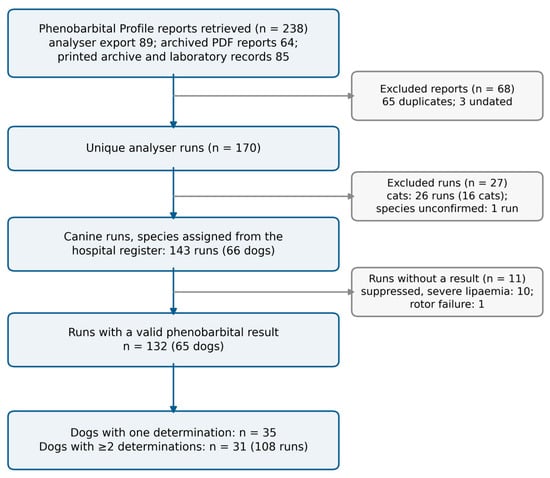
A total of 238 Phenobarbital Profile reports were retrieved (89 from the analyser export, 64 from the archive of saved PDF reports and 85 from the printed archive and records of the laboratory); after removal of 65 duplicate reports and three reports whose date could not be established, 170 unique runs remained. Because the analyser prints “Dog” as the default species on every report, the species was established from the hospital register and confirmed by the clinicians: 143 runs belonged to 66 dogs, 26 runs to 16 cats and the species of one run could not be confirmed; feline and unconfirmed runs were excluded (Figure 1). Eighty of the 143 canine runs (55.9%) were available only from the printed archive or laboratory records, because the analyser export was incomplete for all years and particularly before 2025. Canine runs were distributed as follows: 26 in 2022, 46 in 2023, 25 in 2024, 33 in 2025 and 13 between January and August 2026.
Figure 1.
Flow of phenobarbital determinations from report retrieval to the canine analysis population.
Sex was recorded for 41 dogs (28 male, 13 female). Thirty-five dogs had a single determination and 31 had two or more (two determinations in 13 dogs, three in seven, four in five, five in one, six in three, eight in one and ten in one), contributing 108 runs; the median interval between consecutive determinations was 163 days (IQR 89–264; range 1–1470; n = 77). One hundred and forty runs (97.9%) from 63 dogs were linked to the register. Among linked dogs, the most frequent breed groups were mixed-breed (20), Bichon Maltese (8), Beagle (4), French Bulldog (4) and Labrador Retriever (4); body weight was available for 59 dogs (median 16.3 kg; IQR 7.2–30.0; range 2.9–53.8), 19 of which weighed less than 10 kg. The aetiology assigned at the time of the first determination was idiopathic epilepsy in 44 dogs (IVETF confidence level Tier I in 21, Tier II in five and Tier III in 17, not recorded in one), structural epilepsy in 15 (confirmed in eight, suspected in seven), suspected reactive seizures in five, and not classifiable in two. The register documented, for the same period, 294 dogs with seizure-related visits, two thirds of which (190) were seen only once. Population characteristics are summarised in Table 1.
Table 1.
Characteristics of the canine study population and of the monitoring activity.
3.2. Serum Phenobarbital Concentrations
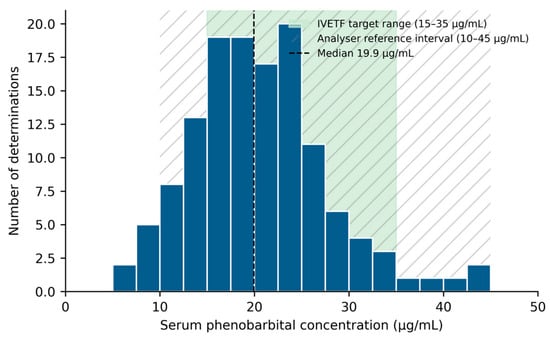
A valid concentration was obtained in 132 of 143 runs (92.3%). The median concentration was 20.0 µg/mL (IQR 15.6–24.6; range 5.6–44.1) (Figure 2). Ninety-nine runs (75.0%; 95% CI 67.0–81.6) were within the IVETF target range, 28 (21.2%; 15.1–28.9) were below 15 µg/mL and five (3.8%; 1.6–8.6) were above 35 µg/mL; none exceeded 45 µg/mL. Against the reference interval printed on the analyser report (10–45 µg/mL), only the seven results below 10 µg/mL were flagged, so that the 21 results between 10 and 15 µg/mL and the five between 35 and 45 µg/mL appeared as normal on the report.
Figure 2.
Distribution of the 132 valid canine serum phenobarbital concentrations. The shaded band indicates the IVETF target range (15–35 µg/mL) and the hatched band the interval printed on the analyser report (10–45 µg/mL); the dashed line marks the median.
At the first valid determination of each dog (n = 65, because one of the 66 dogs had only a suppressed result; median 18.8 µg/mL, IQR 14.8–24.8, range 5.6–42.7), 47 dogs (72.3%; 60.4–81.7) were within range, 16 (24.6%; 15.8–36.3) were subtherapeutic, three of them below 10 µg/mL, and two (3.1%) were above 35 µg/mL. Both dogs above 35 µg/mL had an increased alanine aminotransferase (ALT) of 173 and 298 U/L at that determination. In dogs with idiopathic epilepsy, 32 of 43 (74.4%) were within range and nine (20.9%) subtherapeutic at the first determination, compared with 15 of 22 (68.2%) and seven (31.8%) in dogs with other or unclassified aetiology (Table 2).
Table 2.
Serum phenobarbital concentrations according to the IVETF target range and to the interval printed on the analyser report.
3.3. Hepatic Biochemical Profile
Hepatic analytes were available for 138 to 140 runs (Table 3). Alkaline phosphatase (ALP) exceeded the upper reference limit in 50 of 138 runs (36.2%), twice the limit in 32 (23.2%) and five times the limit in 11 (8.0%), with a maximum of 2132 U/L; gamma-glutamyl transferase (GGT) was increased in 34 of the 50 runs with increased ALP. ALT exceeded the upper limit in 15 of 140 runs (10.7%; maximum 314 U/L), aspartate aminotransferase in 22 of 139 (15.8%) and total bilirubin (TBIL) in six of 139 (4.3%, maximum 0.8 mg/dL), all six with a suppressed PB result. No run showed hypoalbuminaemia; one showed a decreased and two a markedly increased urea nitrogen concentration.
Table 3.
Hepatic biochemical analytes measured concurrently with phenobarbital.
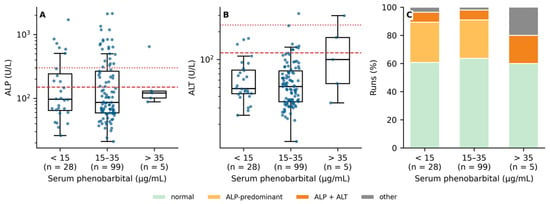
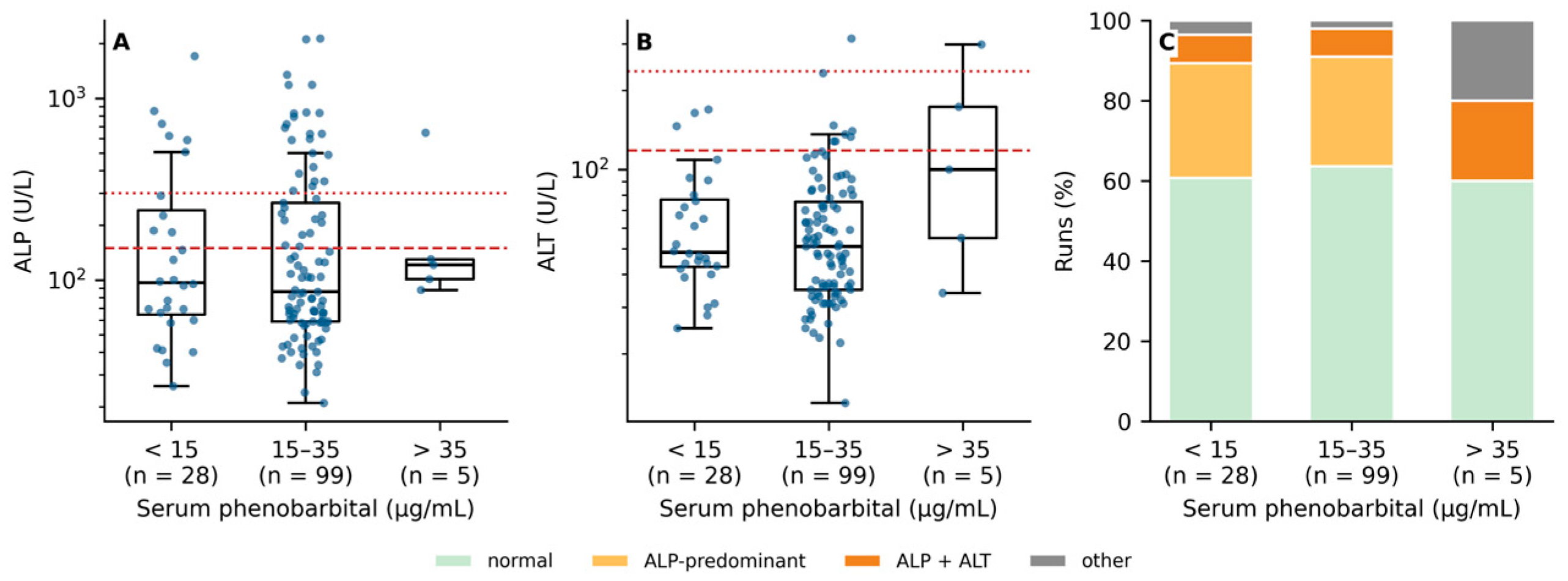
By pattern, 85 of 141 runs with hepatic results (60.3%) were normal, 35 (24.8%) showed an ALP-predominant pattern, 11 (7.8%) a combined ALP and ALT increase and 10 (7.1%) other patterns. ALP exceeded the upper limit in 10 of the 28 subtherapeutic runs, 35 of the 99 runs within range and one of the five runs above 35 µg/mL (Table 4, Figure 3 and Supplementary Figure S1). In mixed-effects models with dog as a random effect, PB concentration was not associated with log10 ALP (β = −0.004 per µg/mL; 95% CI −0.014 to 0.006; p = 0.44; 130 runs from 65 dogs) or log10 ALT (β = 0.003; 95% CI −0.002 to 0.009; p = 0.25), with a substantial between-dog component (ICC 0.60 and 0.55, respectively); ALP did not differ between PB categories (likelihood-ratio test, p = 0.68); the unadjusted Spearman correlations were negligible (ρ = 0.04 and 0.11); and median ALP and ALT were similar at first (85 and 52 U/L) and subsequent determinations (104 and 55 U/L). The most marked abnormalities were ALP activities of 11 to 14 times the upper limit with normal ALT and TBIL in four dogs, one of them at a subtherapeutic concentration, and the two dogs above 35 µg/mL described above. In the 11 runs without a valid PB result (which included all six runs with increased TBIL, as well as four runs with increased ALP and two with increased ALT), the relationship between concentration and the hepatic profile could not be assessed.
Table 4.
Hepatic biochemical pattern according to serum phenobarbital category (valid runs, n = 132).
Figure 3.
Serum alkaline phosphatase (A) and alanine aminotransferase (B) activities by serum phenobarbital category, shown as individual runs with median and interquartile boxes on a logarithmic scale; dashed and dotted lines mark the upper reference limit and twice that limit. (C) Distribution of hepatic biochemical patterns by phenobarbital category; the >35 µg/mL category comprises five runs.
3.4. Intra-Individual Variability
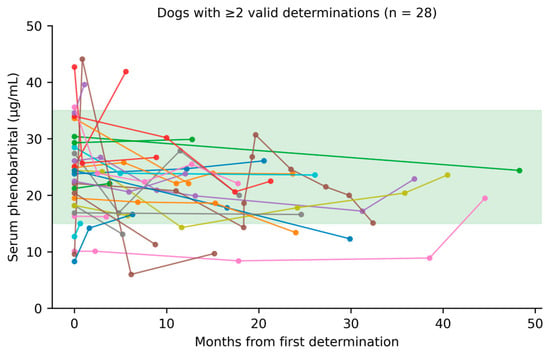
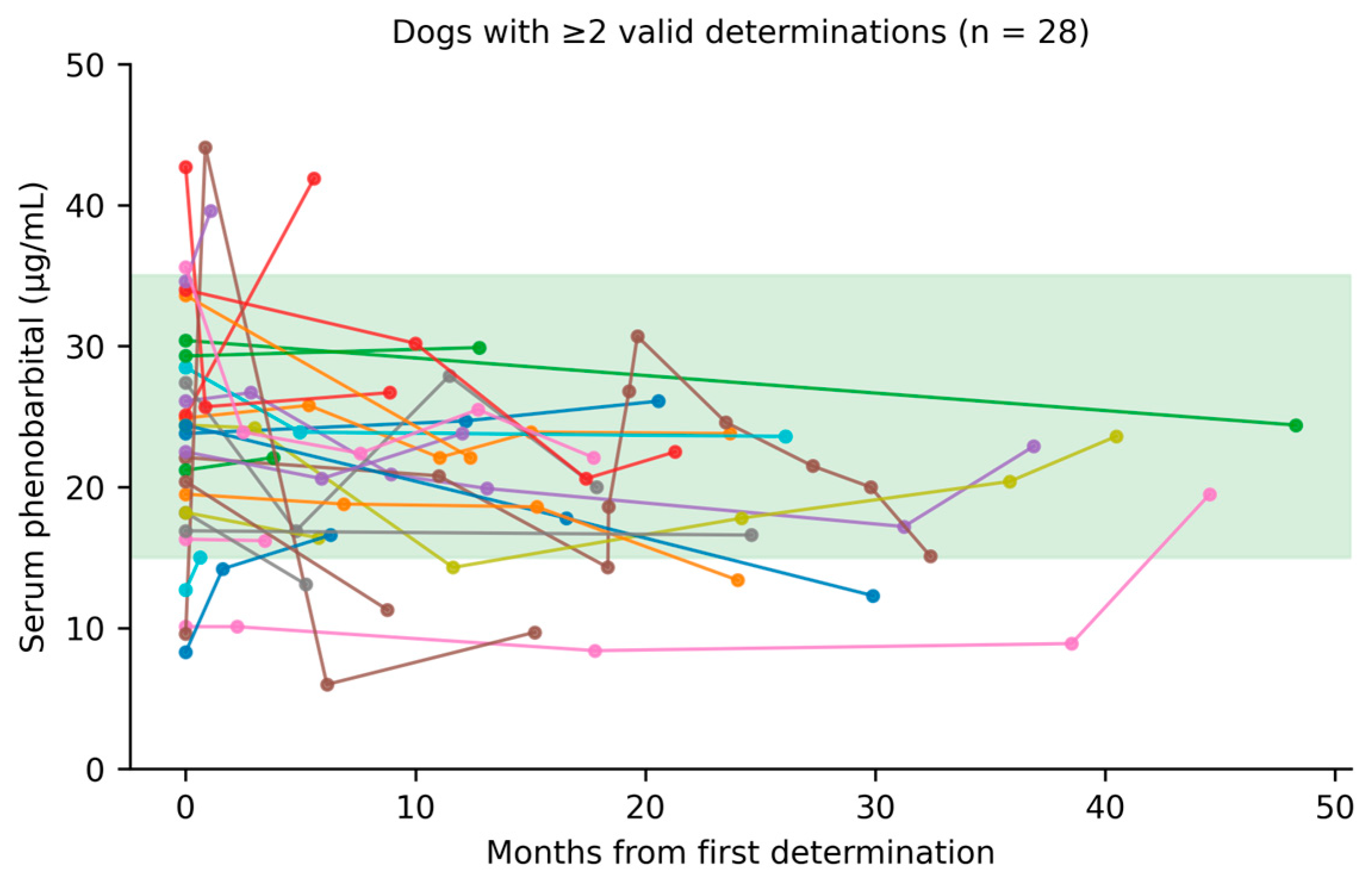
Twenty-eight dogs had at least two valid results (95 values; median three per dog, range 2–10; Figure 4). The median within-dog coefficient of variation (CV) was 18.1% (IQR 7.3–29.9; range 0.4–103.3) and the intraclass correlation coefficient, estimated from a random-intercept model that accommodates the unequal number of determinations per dog, was 0.40. The IVETF category changed between 17 of 67 consecutive pairs of determinations (25.4%). The longest series, ten determinations over 32 months, ranged from 14.3 to 30.7 µg/mL; one dog moved from 9.6 to 44.1 and back to 6.0 µg/mL within six months; and one dog rose from 8.3 to 14.2 and 16.6 µg/mL in the six months after initiation.
Figure 4.
Serum phenobarbital trajectories in the 28 dogs with at least two valid determinations (95 values; median three per dog, range 2–10). Each line represents one dog and connects its consecutive valid determinations in chronological order; each point is a single determination. Time is expressed in months from the first valid determination of that dog, so all trajectories start at month 0. Colours serve only to separate overlapping trajectories and are reused across dogs; lines of the same colour do not belong to the same dog. Runs suppressed by the analyser because of lipaemia are not plotted. The shaded band indicates the IVETF target range (15–35 µg/mL).
3.5. Regimen and Dose–Concentration Relationship
A regimen was reconstructed for 70 of 140 linked runs and a daily dose in mg/kg for 67. All regimens used the human 100 mg tablet, administered as a whole tablet in nine runs, a half in 13, a third in 20, a quarter in 19, a fifth in five and another fraction in four. The median dose was 5.62 mg/kg/day (IQR 4.93–6.35; range 3.91–11.63). A regimen was documented at 23 of the 65 first valid determinations, but at only three of the 16 subtherapeutic first determinations (5.1, 5.8 and 6.3 mg/kg/day). Among 61 runs from 32 dogs with a dose and a valid result, dose was not associated with concentration (cluster-robust regression, β = 0.14 µg/mL per mg/kg/day; 95% CI −0.77 to 1.04; p = 0.76; Spearman ρ = 0.01), and median doses were similar in subtherapeutic (5.83 mg/kg/day), within-range (5.61) and above-range runs (5.84; Kruskal–Wallis p = 0.91). Dogs under 10 kg received the highest weight-based doses (n = 15 runs; median 9.12 mg/kg/day; median concentration 18.6 µg/mL; four subtherapeutic), compared with dogs of 10–25 kg (n = 34; 5.09 mg/kg/day; 22.6 µg/mL; four subtherapeutic) and over 25 kg (n = 12; 5.61 mg/kg/day; 19.8 µg/mL; one subtherapeutic); the lower concentration in dogs under 10 kg was not statistically significant (β = −2.85 µg/mL; 95% CI −7.28 to 1.58; p = 0.21). Regimens administered as a fifth of a tablet were associated with the lowest median concentration (16.4 µg/mL; two of five runs subtherapeutic). Of 70 runs with a known date of the last regimen change, 50 (71%) were obtained at least 14 days after it. Levetiracetam was co-prescribed at 57 of 140 linked runs (40.7%).
3.6. Pre-Analytical and Analytical Failure
The lipaemia index was 1+ in 34 of the 140 runs with recorded indices (24.3%), 2+ in 12 (8.6%) and 3+ in 22 (15.7%). All 10 suppressed results (7.0%; 95% CI 3.8–12.4) occurred in severely lipaemic samples, whereas 12 runs with a 3+ index yielded a result. One further run failed because of a rotor error, so that 11 of 143 runs (7.7%) yielded no concentration. Three suppressed results belonged to a single dog that had been fasted before every sampling. Fenofibrate had been prescribed for hypertriglyceridaemia in March 2022 and was discontinued repeatedly by the owner. Serum triglycerides measured at an external laboratory on eight occasions over three years ranged from 60 to 904 mg/dL (reference < 150 mg/dL): 72 mg/dL while the dog received fenofibrate and 904 mg/dL one month after the owner stopped it; on the two days on which the PB result was suppressed and triglycerides were measured they were 483 and 385 mg/dL, and on the two days with a reported result they were 72 and 154 mg/dL. A further determination of this dog in July 2022 was recorded in the clinical file as hyperlipaemic, but its report could not be retrieved.
3.7. Coverage of Monitoring and Uptake After Initiation
The register recorded 145 dogs with PB in their treatment fields between April 2021 and September 2026, of which 59 (40.7%; 33.0–48.8) had at least one in-house determination; by year, the proportion ranged from 25% (2026) to 56% (2023). Of 57 dogs in continued care, 45 (78.9%; 66.7–87.5) were determined at least once. Of 56 dogs that obtained PB prescriptions from the hospital between 2024 and 2026, 37 (66.1%; 53.0–77.1) were determined, rising to 29 of 34 (85.3%) among dogs with three or more prescriptions and 23 of 26 (88.5%) among dogs with six or more. An explicit written recommendation to measure the concentration, recorded at 65 visits of 32 dogs, was followed by a determination within 60 days in 23 cases (35.4%).
PB was initiated by the hospital in 45 dogs, none of which died or was euthanised within 90 days according to the register. A determination was obtained within 90 days in 17 of 42 dogs with a sufficient observation window (40.5%; 27.0–55.5) and at any time in 22 of 45 (48.9%; 35.0–63.0), after a median of 20 days (IQR 11–98). Uptake was associated with return to the hospital: none of the 17 dogs with one or two visits after initiation was determined, compared with 22 of 28 (79%) dogs with three or more, and four of 24 dogs without any registered entry 90 days or more after initiation were determined, compared with 18 of 21 (86%) dogs with such an entry (Table 5). Hospitalised dogs were determined less often (four of 17) than non-hospitalised dogs (18 of 28), and only two of the 17 hospitalised dogs had any register entry 90 days or more after initiation. Uptake did not differ materially by department of initiation, number of diagnostic procedures, presentation with cluster seizures or status epilepticus, levetiracetam co-prescription or body weight, and was lower for dogs initiated from 2024 (five of 18) than before (17 of 27), a comparison confounded by the shorter follow-up of the more recent dogs.
Table 5.
Uptake of in-house phenobarbital determination at any time in the 45 dogs in which phenobarbital was initiated by the hospital.
4. Discussion
In a university referral hospital relying on in-house point-of-care monitoring, this study found that PB monitoring followed continuity of care: it was established in most dogs that remained under the hospital’s care, but the early determination recommended after initiation was missing in six of ten newly treated dogs and monitoring was absent in dogs that did not return. At the first determination, one dog in four was subtherapeutic, although the regimen was documented for only three of these 16 dogs; ALP-predominant enzyme increases were frequent and not associated with concentration, whereas albumin, bilirubin and urea, which are not affected by enzyme induction, were almost always within reference limits; and severe lipaemia caused the loss of one determination in fourteen.
The coverage of monitoring should be interpreted in relation to its denominators. Among dogs that obtained their controlled-substance prescriptions from the hospital, and therefore had no other prescriber, two thirds were determined at least once and almost nine in ten of those with six or more prescriptions; among dogs in continued care, four in five. Once a dog is established in the hospital’s care, monitoring does take place, although usually at intervals longer than those recommended [3,4]. The loss is concentrated at the beginning of treatment and in dogs that do not return: fewer than half of the dogs started on PB by the hospital were determined within 90 days, none of the dogs seen only once or twice after initiation was ever determined, and hospitalised dogs, only two of which returned after 90 days, were rarely determined. Death at home, which is not recorded in the register, and follow-up by the primary practitioner may explain part of this loss, but neither changes its consequence: the determination recommended two to three weeks after initiation, which in human epileptology is one of the principal indications for TDM [11], is the one most often missing. The wider register context, in which two thirds of the 294 dogs with seizure-related visits were seen only once, indicates that the problem is one of contact rather than of refusal, and even an explicit written recommendation was followed within 60 days in only one third of cases. Under-use of TDM is not peculiar to this setting; it has been identified as an educational need in the largest primary-care network in the United States [30], and variability in the management of idiopathic epilepsy has been documented in primary care in the United Kingdom [31]. The apparent decline in uptake among dogs initiated from 2024 is confounded by their shorter follow-up and should not be interpreted as a trend.
The proportion of subtherapeutic concentrations at first determination is consistent with the inter-individual variability documented in routine monitoring data [18,19]. At the usual starting dose, the first determination serves mainly to identify the subtherapeutic dog and to establish its individual reference value, and its frequent omission is therefore clinically consequential. The median dose of 5.6 mg/kg/day lies at the lower end of the recommended range [3], so that under-prescription cannot be dismissed. Moreover, the regimen was documented for only three of the 16 dogs that were subtherapeutic at their first determination, so that the adequacy of dosing cannot be established for most of them; where a regimen was documented, dose was not associated with concentration, and dogs under 10 kg received almost twice the weight-based dose of larger dogs without reaching higher concentrations. This is consistent with the population pharmacokinetic model of Alvariza et al., which predicts that small dogs require higher weight-based doses [19], and fractionation of a 100 mg human tablet, the only formulation available, into thirds, quarters or fifths for small dogs is an obvious source of imprecision; the lowest median concentration was observed with regimens based on one-fifth tablets. Because autoinduction increases clearance for weeks after initiation [16,17], a second determination at six to eight weeks is advisable in dogs found in the lower half of the range. The proportion subtherapeutic did not differ materially between idiopathic and other aetiologies, which suggests that it is not explained by case mix. Concentrations above 35 µg/mL were rare, which is reassuring with respect to dose-related hepatotoxicity [22], although both dogs above this limit at their first determination had increased ALT.
The interval printed on the analyser report (10–45 µg/mL) differs from the consensus target (15–35 µg/mL) [3,4]. Neither the 21 results between 10 and 15 µg/mL nor the five between 35 and 45 µg/mL were flagged. In human TDM the reference range is a guide to be interpreted in context rather than a laboratory normal range [11], and a report that labels 12 µg/mL as normal may delay dose escalation in a poorly controlled dog. Point-of-care reports should be interpreted against the consensus target, and the printed interval reconfigured where the software permits.
The hepatic findings agree with the prospective study of Müller et al., in which PB at therapeutic concentrations increased ALP, ALT and GGT without histological damage while bile acids and bilirubin were unaffected [20], and with the work of Gaskill et al., in which treated dogs without clinical liver disease nevertheless showed histological abnormalities more often than controls [21]. ALP was increased in a third of the runs and GGT in two-thirds of those, ALT only in one run in ten, and the markers insensitive to induction were almost always normal. The absence of any association between enzyme activities and concentration is consistent with induction at ordinary therapeutic exposure [16,20] and with the view that the magnitude of the ALP increase alone is not informative about hepatic injury [21,24,25]. Because ALP isoenzymes and bile acids are not measured by the rotor, and imaging and histology were not available, these patterns are biochemical descriptions rather than diagnoses: an ALP-predominant pattern is compatible with, but does not prove, enzyme induction, and clinically significant hepatic injury cannot be excluded on these data. The panel nonetheless helps to separate the ALP-predominant pattern from combined patterns with increased ALT, which warrant further investigation. The relationship between concentration and the hepatic profile could not be assessed in the 11 runs without a valid PB result, which included all six runs with hyperbilirubinaemia.
Severe lipaemia caused the loss of 7% of determinations and was graded as at least moderate in a quarter of samples. Hypertriglyceridaemia is a recognised consequence of PB treatment, unrelated to dose or concentration [26], and treated dogs show broad changes in serum lipoproteins [27]. The dog that lost three of eight determinations illustrates the clinical corollary: although it was fasted before every sampling, its triglyceride concentrations normalised on fenofibrate and exceeded 380 mg/dL whenever the drug had been discontinued, and these were the occasions on which the PB result was suppressed. In dogs with PB-associated hypertriglyceridaemia, fasting alone does not prevent monitoring failure, and adherence to lipid-lowering treatment becomes part of successful monitoring. In the same dog, a normal triglyceride concentration coincided with a lipaemia index of 2+, a reminder that the analyser’s index measures sample turbidity and is not a surrogate for serum triglycerides. Fasting before sampling, recording of the lipaemia index as a quality indicator, measurement of triglycerides when lipaemia recurs, and clearing of the sample or use of an alternative method in recurrent cases are simple measures that could reduce this loss.
Within-dog variability (median CV 18%) was about twice the total analytical CV of the assay [29], and the IVETF category changed in one in four pairs of consecutive determinations. This variability therefore exceeds analytical imprecision, but it reflects a combination of analytical variation, biological variability, dose adjustments, treatment duration, autoinduction, adherence and other clinical factors that cannot be separated with retrospective data. Sampling time relative to the last dose was not recorded but has little influence on the concentration category at conventional doses [18,28]; autoinduction [16,17], dose changes and variable owner compliance [32] are plausible contributors, as are concomitant antiseizure drugs, which can change PB concentrations substantially [33].
These findings suggest several changes in practice. They are proposals derived from the observations rather than interventions evaluated in this study, and their effectiveness would have to be established in a prospective implementation study. They include: a written appointment for the first determination given at initiation or at discharge, rather than a recommendation recorded in the file; sampling coupled with the renewal of the controlled-substance prescription at the first renewal and every six months thereafter; a scheduled neurological re-evaluation for dogs started on PB during hospitalisation; fasting before sampling, with the lipaemia index recorded as a quality indicator, because lipaemia interferes with many canine serum assays [34]; interpretation against the consensus target rather than the printed interval; structured recording of dose, tablet fraction, body weight and time of the last dose at every prescription; the use of low-strength veterinary PB tablets, licenced in other European countries [35], to reduce tablet fractionation in small dogs; and the proportion of newly treated dogs determined within 90 days as an audit indicator.
This study has several limitations. First, it was retrospective and single-centred, and dogs were monitored at the discretion of clinicians and owners, so that the proportion of concentrations outside the target range may be overestimated relative to all treated dogs. Second, the analyser database was incomplete, and more than half of the canine runs were recovered from the printed archive and records of the laboratory and transcribed manually; the completeness of this archive cannot be demonstrated, and coverage figures for earlier years should be read as lower bounds. Third, regimens were reconstructed from free-text records and were available for fewer than half of the runs and for only three of the 16 dogs that were subtherapeutic at their first determination, so that the dose–concentration analysis is exploratory; the time of the last dose was not recorded, and steady state was defined operationally from the records. Fourth, coverage describes in-house determinations only, and monitoring by primary practitioners or deaths at home cannot be excluded for dogs that did not return. Fifth, the rotor does not measure bile acids or ALP isoenzymes, imaging and histology were not available, and the hepatic profile could not be related to concentration in runs without a valid PB result; analytical performance rests on the manufacturer’s validation and the analyser’s per-rotor internal checks, without local external quality control [29]. Sixth, aetiology was assigned from clinical records at the first determination, mostly at the Tier I confidence level, and may change with time, as it did in one dog in which a structural lesion was identified three years later. Lastly, seizure frequency was not analysed: the study addresses how monitoring is performed and what it shows, not the efficacy of treatment.
Prospective, protocolised monitoring—an appointment scheduled at initiation or discharge, a standardised record of dose, tablet fraction, weight, time of last dose, fasting status and seizure frequency, and the lipaemia index as a quality indicator—would allow the dose–concentration relationship of fractionated tablets and the contribution of small body size to subtherapeutic concentrations, despite higher weight-based doses, to be tested, and the present data provide the historical comparator for a before–after evaluation of the process changes proposed.
5. Conclusions
In-house phenobarbital monitoring in dogs followed continuity of care: it was established in most dogs that remained under the hospital’s care but was missing in most newly treated dogs at the recommended early time point and absent in those that did not return. One dog in four was subtherapeutic at first determination, and the smallest dogs received the highest weight-based doses without reaching higher concentrations; ALP-predominant enzyme increases were common, whereas albumin, bilirubin and urea were rarely abnormal; and severe lipaemia, recurrent in dogs with treatment-associated hypertriglyceridaemia, caused avoidable loss of determinations. Scheduling the first determination at initiation and coupling sampling with prescription renewal are simple measures that may help to close these gaps, although their effectiveness remains to be established prospectively.
Supplementary Materials
The following supporting information can be downloaded at https://www.mdpi.com/article/10.3390/life16111858/s1, Figure S1: Serum alkaline phosphatase and alanine aminotransferase activities against serum phenobarbital concentration in the 130 canine runs with valid results for both analytes; Table S1: Anonymised dataset of the 143 canine determinations (one record per analyser run). Table S2: Description of the variables in Table S1.
Author Contributions
Conceptualization, M.M. and A.D.; methodology, M.M.; formal analysis, M.M. and A.D.; investigation (clinical management and sampling), A.D., D.A., D.N.B.-C., I.S. and D.G.B.; investigation (laboratory analyses), R.A.Ș. and Ș.R.; data curation, D.A. and D.N.B.-C.; writing—original draft preparation, M.M.; writing—review and editing, A.D., D.A., D.N.B.-C., I.S., R.A.Ș., Ș.R., D.G.B., G.S. and M.M.; supervision, G.S. and M.M.; project administration, M.M. All authors have read and agreed to the published version of the manuscript.
Funding
This research received no external funding.
Institutional Review Board Statement
The study protocol, based on the retrospective analysis of clinical and laboratory records, was approved by the Ethics Committee of the Faculty of Veterinary Medicine, IULS (protocol code ECA-02626/2026, date of approval 6 October 2026).
Informed Consent Statement
Written informed consent for the use of anonymised clinical data was obtained from the owners of all animals at admission.
Data Availability Statement
The anonymised dataset (one record per analyser run) is provided as Supplementary Table S1.
Acknowledgments
The authors thank the staff of the Clinical Laboratory of the Faculty of Veterinary Medicine, IULS, for retrieving the archived reports.
Conflicts of Interest
The authors declare no conflicts of interest.
References
- Volk, H.A. International Veterinary Epilepsy Task Force consensus reports on epilepsy definition, classification and terminology, affected dog breeds, diagnosis, treatment, outcome measures of therapeutic trials, neuroimaging and neuropathology in companion animals. BMC Vet. Res. 2015, 11, 174. [Google Scholar] [CrossRef] [Scilit] [PubMed]
- Berendt, M.; Farquhar, R.G.; Mandigers, P.J.J.; Pakozdy, A.; Bhatti, S.F.M.; De Risio, L.; Fischer, A.; Long, S.; Matiasek, K.; Muñana, K.; et al. International veterinary epilepsy task force consensus report on epilepsy definition, classification and terminology in companion animals. BMC Vet. Res. 2015, 11, 182. [Google Scholar] [CrossRef] [Scilit] [PubMed]
- Bhatti, S.F.M.; De Risio, L.; Muñana, K.; Penderis, J.; Stein, V.M.; Tipold, A.; Berendt, M.; Farquhar, R.G.; Fischer, A.; Long, S.; et al. International Veterinary Epilepsy Task Force consensus proposal: Medical treatment of canine epilepsy in Europe. BMC Vet. Res. 2015, 11, 176. [Google Scholar] [CrossRef] [Scilit] [PubMed]
- Podell, M.; Volk, H.A.; Berendt, M.; Löscher, W.; Muñana, K.; Patterson, E.E.; Platt, S.R. 2015 ACVIM Small Animal Consensus Statement on Seizure Management in Dogs. J. Vet. Intern. Med. 2016, 30, 477–490. [Google Scholar] [CrossRef] [Scilit] [PubMed]
- Charalambous, M.; Brodbelt, D.; Volk, H.A. Treatment in canine epilepsy—A systematic review. BMC Vet. Res. 2014, 10, 257. [Google Scholar] [CrossRef] [Scilit] [PubMed]
- Boothe, D.M.; Dewey, C.; Carpenter, D.M. Comparison of phenobarbital with bromide as a first-choice antiepileptic drug for treatment of epilepsy in dogs. J. Am. Vet. Med. Assoc. 2012, 240, 1073–1083. [Google Scholar] [CrossRef] [Scilit] [PubMed]
- Kwan, P.; Brodie, M.J. Phenobarbital for the treatment of epilepsy in the 21st century: A critical review. Epilepsia 2004, 45, 1141–1149. [Google Scholar] [CrossRef] [Scilit] [PubMed]
- Brodie, M.J.; Kwan, P. Current position of phenobarbital in epilepsy and its future. Epilepsia 2012, 53, 40–46. [Google Scholar] [CrossRef] [Scilit]
- Ilangaratne, N.B.; Mannakkara, N.N.; Bell, G.S.; Sander, J.W. Phenobarbital: Missing in action. Bull. World Health Organ. 2012, 90, 871–871A. [Google Scholar] [CrossRef] [Scilit] [PubMed]
- Bhalla, D.; Aziz, H.; Bergen, D.; Birbeck, G.L.; Carpio, A.; Cavalheiro, E.; Chivorakoun, P.; Cross, J.H.; Houinato, D.; Newton, C.R.; et al. Undue regulatory control on phenobarbital—An important yet overlooked reason for the epilepsy treatment gap. Epilepsia 2015, 56, 659–662, Erratum in Epilepsia 2015, 56, 985. https://doi.org/10.1111/epi.13033. [Google Scholar] [CrossRef] [Scilit] [PubMed]
- Patsalos, P.N.; Berry, D.J.; Bourgeois, B.F.D.; Cloyd, J.C.; Glauser, T.A.; Johannessen, S.I.; Leppik, I.E.; Tomson, T.; Perucca, E. Antiepileptic drugs—Best practice guidelines for therapeutic drug monitoring: A position paper by the subcommission on therapeutic drug monitoring, ILAE Commission on Therapeutic Strategies. Epilepsia 2008, 49, 1239–1276. [Google Scholar] [CrossRef] [Scilit] [PubMed]
- Jannuzzi, G.; Cian, P.; Fattore, C.; Gatti, G.; Bartoli, A.; Monaco, F.; Perucca, E. Italian TDM Study Group in Epilepsy. A multicenter randomized controlled trial on the clinical impact of therapeutic drug monitoring in patients with newly diagnosed epilepsy. Epilepsia 2000, 41, 222–230. [Google Scholar] [PubMed]
- Methaneethorn, J.; Leelakanok, N. Pharmacokinetic variability of phenobarbital: A systematic review of population pharmacokinetic analysis. Eur. J. Clin. Pharmacol. 2021, 77, 291–309. [Google Scholar] [CrossRef] [Scilit]
- Ravis, W.R.; Nachreiner, R.F.; Pedersoli, W.M.; Houghton, N.S. Pharmacokinetics of phenobarbital in dogs after multiple oral administrations. Am. J. Vet. Res. 1984, 45, 1283–1286. [Google Scholar] [CrossRef] [Scilit]
- Al-Tahan, F.; Frey, H.H. Absorption kinetics and bioavailability of phenobarbital after oral administration to dogs. J. Vet. Pharmacol. Ther. 1985, 8, 205–207. [Google Scholar] [CrossRef] [Scilit] [PubMed]
- Hojo, T.; Ohno, R.; Shimoda, M.; Kokue, E. Enzyme and plasma protein induction by multiple oral administrations of phenobarbital at a therapeutic dosage regimen in dogs. J. Vet. Pharmacol. Ther. 2002, 25, 121–127. [Google Scholar] [CrossRef] [Scilit] [PubMed]
- Boothe, D.M.; Perkins, J.; Carpenter, J. Pharmacokinetics of phenobarbital in dogs with idiopathic epilepsy. J. Vet. Pharmacol. Ther. 1998, 21, 85–91. [Google Scholar]
- Monteiro, R.; Anderson, T.J.; Innocent, G.; Evans, N.P.; Penderis, J. Variations in serum concentration of phenobarbitone in dogs receiving regular twice daily doses in relation to the times of administration. Vet. Rec. 2009, 165, 556–558. [Google Scholar] [CrossRef] [Scilit]
- Alvariza, S.; Ibarra, M.; Guevara, N.; Maldonado, C.; Vázquez, M.; Feijoó, G.; Suárez, G. Pharmacometrics modeling and simulation to assist phenobarbital dose optimization in dogs. Front. Vet. Sci. 2025, 12, 1644003. [Google Scholar] [CrossRef] [Scilit] [PubMed]
- Müller, P.B.; Taboada, J.; Hosgood, G.; Partington, B.P.; VanSteenhouse, J.L.; Taylor, H.W.; Wolfsheimer, K.J. Effects of long-term phenobarbital treatment on the liver in dogs. J. Vet. Intern. Med. 2000, 14, 165–171. [Google Scholar] [CrossRef] [Scilit]
- Gaskill, C.L.; Miller, L.M.; Mattoon, J.S.; Hoffmann, W.E.; Burton, S.A.; Gelens, H.C.J.; Ihle, S.L.; Miller, J.B.; Shaw, D.H.; Cribb, A.E. Liver histopathology and liver and serum alanine aminotransferase and alkaline phosphatase activities in epileptic dogs receiving phenobarbital. Vet. Pathol. 2005, 42, 147–160. [Google Scholar] [CrossRef] [Scilit] [PubMed]
- Dayrell-Hart, B.; Steinberg, S.A.; VanWinkle, T.J.; Farnbach, G.C. Hepatotoxicity of phenobarbital in dogs: 18 cases (1985–1989). J. Am. Vet. Med. Assoc. 1991, 199, 1060–1066. [Google Scholar] [CrossRef] [Scilit]
- Bunch, S.E.; Castleman, W.L.; Hornbuckle, W.E.; Tennant, B.C. Hepatic cirrhosis associated with long-term anticonvulsant drug therapy in dogs. J. Am. Vet. Med. Assoc. 1982, 181, 357–362. [Google Scholar] [CrossRef] [Scilit]
- Chauvet, A.E.; Feldman, E.C.; Kass, P.H. Effects of phenobarbital administration on results of serum biochemical analyses and adrenocortical function tests in epileptic dogs. J. Am. Vet. Med. Assoc. 1995, 207, 1305–1307. [Google Scholar] [CrossRef] [Scilit]
- Foster, S.F.; Church, D.B.; Watson, A.D.J. Effects of phenobarbitone on serum biochemical tests in dogs. Aust. Vet. J. 2000, 78, 23–26. [Google Scholar] [CrossRef] [Scilit] [PubMed]
- Kluger, E.K.; Malik, R.; Ilkin, W.J.; Snow, D.; Sullivan, D.R.; Govendir, M. Serum triglyceride concentration in dogs with epilepsy treated with phenobarbital or with phenobarbital and bromide. J. Am. Vet. Med. Assoc. 2008, 233, 1270–1277. [Google Scholar] [CrossRef] [Scilit]
- Ottka, C.; Weber, C.; Müller, E.; Lohi, H. Serum NMR metabolomics uncovers multiple metabolic changes in phenobarbital-treated dogs. Metabolomics 2021, 17, 54. [Google Scholar] [CrossRef] [Scilit] [PubMed]
- Levitski, R.E.; Trepanier, L.A. Effect of timing of blood collection on serum phenobarbital concentrations in dogs with epilepsy. J. Am. Vet. Med. Assoc. 2000, 217, 200–204. [Google Scholar] [CrossRef] [Scilit] [PubMed]
- Nguyen, T.H.T.; Le, U.; Aron, K. VETSCAN VS2 Phenobarbital Profile: Performance and Reliability; White Paper MM-06332; Zoetis Services LLC: Parsippany, NJ, USA, 2019. [Google Scholar]
- Pompermaier, M.; Morrison, J.; Stabile, F.; De Risio, L. Retrospective study on canine idiopathic epilepsy treatment in primary care practices in the United States. Front. Vet. Sci. 2026, 13, 1723038. [Google Scholar] [CrossRef] [Scilit] [PubMed]
- Griffin, S.; Stabile, F.; De Risio, L. Cross Sectional Survey of Canine Idiopathic Epilepsy Management in Primary Care in the United Kingdom. Front. Vet. Sci. 2022, 9, 907313. [Google Scholar] [CrossRef] [Scilit] [PubMed]
- Booth, S.; Meller, S.; Packer, R.M.A.; Farquhar, R.; Maddison, J.E.; Volk, H.A. Owner compliance in canine epilepsy. Vet. Rec. 2021, 188, e16. [Google Scholar] [CrossRef] [Scilit] [PubMed]
- Mahon, E.; Marsh, O.; Uriarte, A.; Stabile, F. The effect of oral zonisamide treatment on serum phenobarbital concentrations in epileptic dogs. Front. Vet. Sci. 2024, 11, 1389615. [Google Scholar] [CrossRef] [Scilit] [PubMed]
- Pérez-Montero, B.; Fermín-Rodríguez, M.L.; Miró, G.; de Juan, L.; Cruz-López, F. Hemolysis, icterus and lipemia interfere with the determination of two oxidative stress biomarkers in canine serum. BMC Vet. Res. 2023, 19, 172. [Google Scholar] [CrossRef] [Scilit] [PubMed]
- Health Products Regulatory Authority. Phenosan 12.5 mg Chewable Tablets for Dogs: Summary of Product Characteristics; HPRA: Dublin, Ireland, 2024; Available online: https://assets.hpra.ie/products/Animal/40982/VPA10980-043-001-CRN00DTSS-03-10-2024-nationalspc_11102024155718.pdf (accessed on 22 October 2026).

Disclaimer/Publisher’s Note: The statements, opinions and data contained in all publications are solely those of the individual author(s) and contributor(s) and not of MDPI and/or the editor(s). MDPI and/or the editor(s) disclaim responsibility for any injury to people or property resulting from any ideas, methods, instructions or products referred to in the content. |
© 2026 by the authors. Licensee MDPI, Basel, Switzerland. This article is an open access article distributed under the terms and conditions of the Creative Commons Attribution (CC BY) license.