


Abstract
Neuromuscular training is increasingly recognised for enhancing football performance and athletes’ capacity to tolerate the repetitive high-intensity demands of match play. The French Contrast Method (FCM) combines heavy resistance, plyometric, and ballistic exercises within a post-activation performance enhancement framework, yet evidence in elite youth players during the competitive season remains limited. This study examined the effects of an eight-week in-season FCM program on reactive strength, neuromuscular performance, maximal strength, anaerobic performance, and short-distance sprint ability. Twenty-eight elite male youth football players were randomly assigned to an experimental group (FCM plus regular football training; n = 14) or a control group (regular training only; n = 14), training twice weekly for eight weeks. Outcome measures included the Reactive Strength Index Modified (RSImod), countermovement jump-derived variables, 10 m sprint performance, Wingate anaerobic parameters, and one-repetition maximum (1RM) strength. Data were analysed using mixed-design repeated-measures ANOVA. Significant group × time interactions favoured the FCM group for RSImod, back squat 1RM, propulsive phase duration, average power, and fatigue index (p < 0.05), whereas no interactions emerged for 10 m sprint, flight time, jump height, or bench press 1RM. The findings indicate that adding an eight-week FCM training programme to regular soccer training results in changes to specific performance outcomes in elite young soccer players. However, because direct neuromuscular measures were not assessed, the underlying mechanisms responsible for these changes cannot be confirmed. Therefore, the results should be interpreted in terms of the observed performance outcomes rather than as direct evidence of neuromuscular adaptations.
1. Introduction
Modern football is characterized by high-intensity intermittent activity, variable physical demands, and limited recovery opportunities between demanding actions [1,2,3,4]. Although aerobic metabolism supports the overall activity profile of football, decisive actions such as sprinting, jumping, and changing direction require substantial contributions from anaerobic energy pathways and the capacity to produce force rapidly [2,3]. Accordingly, contemporary conditioning programmes increasingly incorporate training strategies intended to improve lower-limb strength, explosive performance, and the ability to execute high-intensity actions during competition [5,6,7,8].
The French Contrast Method (FCM) is a complex–contrast training approach that combines heavy resistance exercise, plyometric exercise, loaded ballistic exercise, and assisted ballistic exercise within a structured training sequence [5,6]. By exposing athletes to different loading conditions and movement velocities, FCM aims to develop force and power across a broad portion of the force–velocity spectrum [7,8]. The rationale for this approach is partly informed by research on post-activation performance enhancement (PAPE), which describes an acute improvement in voluntary performance following a conditioning activity. However, acute performance responses observed after an individual exercise sequence must be distinguished from chronic training adaptations resulting from repeated exposure over several weeks [5,8]. Acute responses may provide a theoretical rationale for the sequencing of exercises within FCM, but they do not establish that the same mechanisms account for changes observed after a prolonged training intervention. Because acute post-activation performance responses were not assessed in the present study, the effects of the eight-week programme should be interpreted in terms of the measured pre-to-post changes in physical performance rather than presumed acute potentiation mechanisms. Previous investigations have reported improvements in selected performance outcomes following FCM in football players [9,10], while a systematic review and meta-analysis has also reported beneficial effects of FCM on lower-limb athletic performance in healthy adults [11]. Nevertheless, training responses may vary according to the intervention protocol, participant characteristics, comparison condition, and performance outcome assessed [8,12]. Therefore, the effects of FCM should be evaluated across distinct performance domains rather than assuming that improvement in one physical quality necessarily transfers to all others.
Reactive strength is commonly discussed in relation to the stretch–shortening cycle (SSC), which involves the coordinated actions of eccentric and concentric muscle activity during movements such as jumping [13]. Elastic energy storage and the temporal organization of SSC actions have been proposed as relevant contributors to explosive performance [14,15]. However, the interpretation of reactive strength depends on the test and the variables used to quantify it. In particular, the conventional reactive strength index (RSI), generally derived from drop-jump performance as jump height divided by ground contact time, must be distinguished from the modified reactive strength index (RSImod), which is calculated from countermovement jump (CMJ) height divided by time to take-off. Although both indices provide information relevant to explosive performance, they are derived from different tasks and temporal variables and should not be treated as interchangeable measures [13]. RSImod reflects the combined relationship between jump height and time to take-off; it does not directly quantify the duration of the amortization phase or establish that this phase has become shorter. Likewise, although CMJ-derived variables have been investigated in the context of acute neuromuscular fatigue, changes in these variables should not automatically be interpreted as direct evidence of fatigue or of a specific neuromuscular mechanism [13,16]. In the present study, RSImod was therefore considered a performance outcome, while the interpretation of its change was restricted to the variables actually measured.
Sprint performance represents a further, distinct performance domain. Acceleration depends on the athlete’s ability to apply force effectively in the horizontal direction, together with the mechanical and technical characteristics of sprinting [17,18]. Consequently, improvements in vertically oriented explosive performance do not necessarily produce proportional improvements in short-distance sprint performance, although transfer between these domains remains possible [19,20]. This distinction is particularly relevant when evaluating an intervention that combines several strength and power exercises rather than relying exclusively on sprint-specific practice. The inclusion of broad jumps and assisted sprints within an FCM programme provides a rationale for investigating its potential effects on sprint performance; it does not, by itself, establish whether the sprint-specific stimulus is sufficient or insufficient to improve acceleration. Accordingly, sprint performance should be assessed as a separate outcome, and its response should be determined empirically rather than prespecified as an expected absence of improvement.
In youth football, maintaining physical performance throughout the competitive season is an important consideration for athlete development. Injury prevention, player availability, and long-term health are also relevant broader concerns; however, these outcomes require dedicated assessment and cannot be inferred directly from changes in strength, jumping, or sprint tests. The present study did not assess injury incidence, athlete availability, or long-term health outcomes. These considerations therefore provide background context rather than hypothesized direct effects of the intervention. The primary rationale for the present investigation is to determine whether adding an eight-week FCM programme to regular in-season football training produces different changes in the physical performance outcomes assessed in elite male youth football players. Although interest in FCM has increased, the specific responses of elite youth football players across several complementary performance domains require further investigation. The present study addressed this issue by examining changes following an eight-week FCM intervention in RSImod, short-distance sprint performance, Wingate anaerobic performance, maximal strength, and CMJ-derived variables. In addition, the Propulsive Phase Relative Index (PPRI), an exploratory CMJ-derived variable intended to characterize aspects of propulsive-phase performance, was included as a secondary outcome. Because PPRI has not been independently validated, its findings were interpreted cautiously and were not treated as equivalent to established performance measures. By evaluating established outcomes alongside this exploratory variable, the study aimed to characterize the range of performance changes associated with the intervention without assuming a specific underlying neuromuscular mechanism.
The aim of this study was to investigate the effects of an eight-week FCM programme, performed in addition to regular in-season football training, on reactive strength as assessed by RSImod, 10 m sprint performance, Wingate anaerobic performance, maximal strength, and CMJ-derived variables in elite male youth football players. PPRI was examined as an exploratory secondary outcome. It was hypothesized that the FCM group would demonstrate greater improvements than the control group in selected explosive and anaerobic performance outcomes. Because sprint acceleration represents a distinct performance domain and the direction of transfer from combined strength–power training cannot be assumed from jumping outcomes alone, the response of 10 m sprint performance was evaluated separately rather than presuming in advance that no improvement would occur.
2. Materials and Methods
2.1. Research Design
This research was planned as a parallel group randomized controlled trial with pre-test/post-test methodology in accordance with the CONSORT guidelines [21]. This study investigated the impact of 8 weeks of FCM training on RS, anaerobic performance, 10 m sprint performance, and associated neuromuscular responses among elite youth football players. The main outcomes were RSImod, 10 m sprint performance, average power in the Wingate test, fatigue index, and maximum strength. Secondary outcomes comprised CMJ-derived variables, including jump height, flight time, time to take-off, propulsive phase duration, and the exploratory PPRI, providing a more comprehensive characterization of neuromuscular performance.
Participants were randomly assigned to either an experimental group (FCM) or a control group using a 1:1 allocation ratio. Randomization was performed using a computer-generated random sequence (randomizer.org, accessed on 15 April 2026) by an independent researcher who was not involved in testing or intervention delivery. Allocation concealment was achieved using sequentially numbered, opaque, sealed envelopes that were opened after baseline assessments. Because of the nature of the intervention, participant blinding was not possible. However, outcome assessors and the statistician responsible for data analysis were blinded to group allocation.
Both groups continued their regular in-season football training throughout the study period. In addition to routine football training, the experimental group completed the FCM intervention twice weekly for eight weeks. The control group maintained its regular training program. Pre- and post-intervention assessments were conducted under standardized laboratory conditions at the Atatürk University Sports Sciences Application and Research Centre. FCM sessions were performed between 17:00 and 19:00 on non-consecutive training days.
2.2. Participants
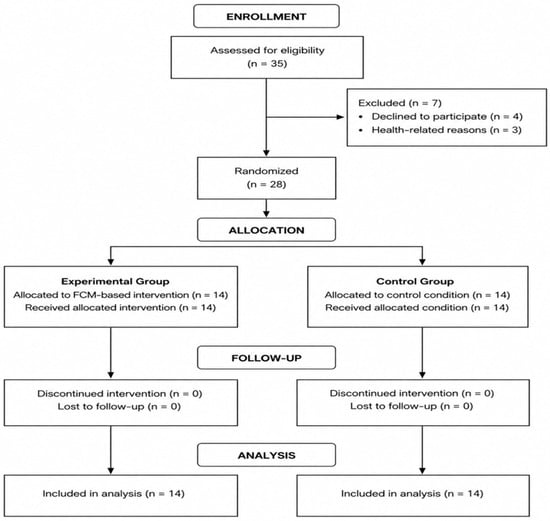
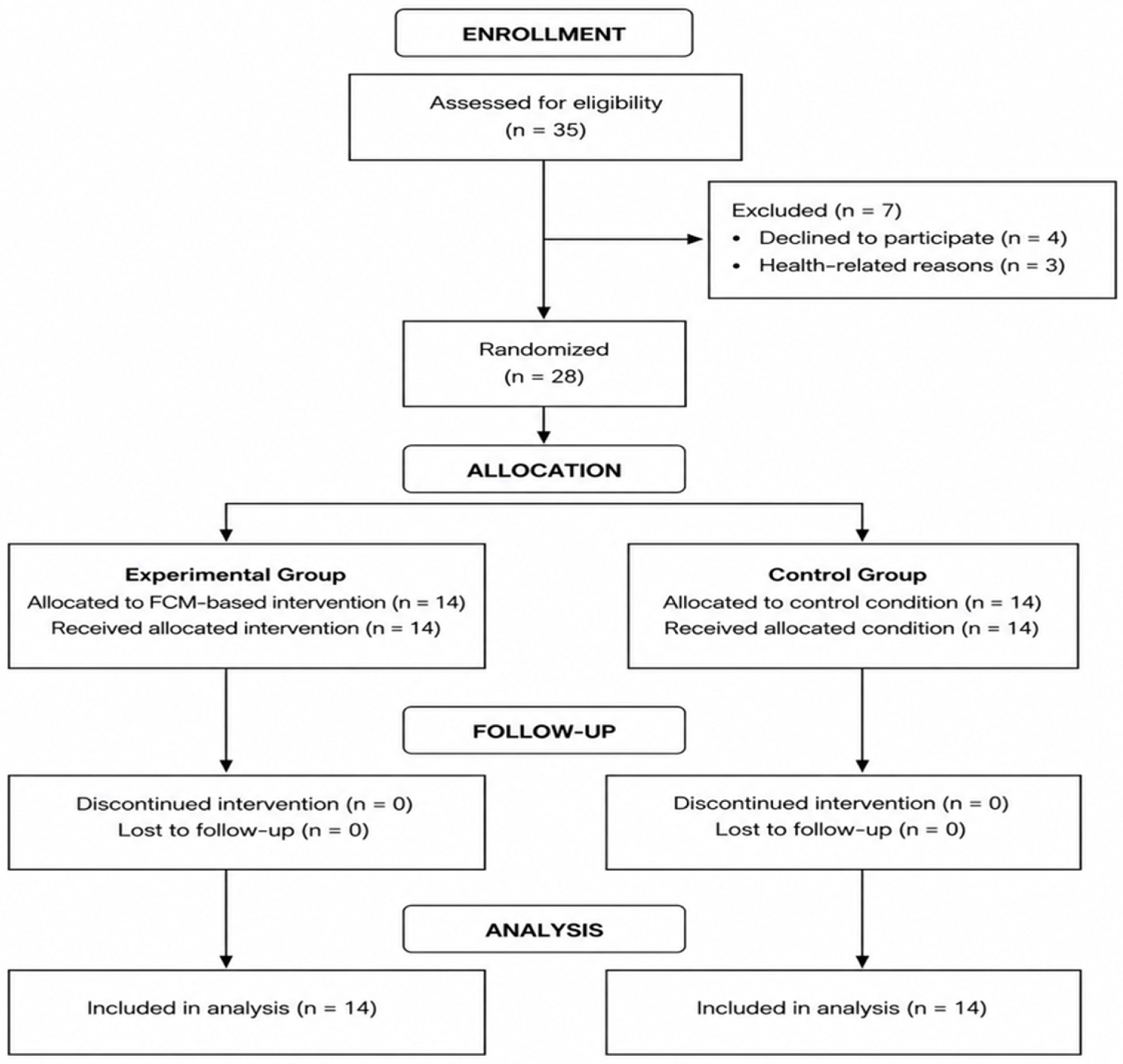
Initially, 35 elite male youth football players from the Erzurumspor F.K. Academy competing in the U-18 category of the 2025–2026 National Development League were screened for eligibility. Four players declined participation, and three were excluded for health-related reasons. The remaining 28 players were randomly assigned to the experimental (n = 14) or control group (n = 14). The experimental group had a mean age of 18.35 ± 0.84 years, height of 180.21 ± 4.81 cm, and body mass of 73.26 ± 6.16 kg. Corresponding values for the control group were 18.28 ± 0.72 years, 179.21 ± 6.62 cm, and 69.87 ± 8.07 kg.
The study sample size was determined using G*Power version 3.1.9.7 (Heinrich Heine University Düsseldorf, Düsseldorf, Germany). The original trial registration specified a planned sample size of 28 participants and identified two primary outcomes. Following a reassessment of the study design and sample-size requirements, the protocol and trial registration were amended on 04 March 2026 to specify a total target sample of 28 participants and a single primary outcome: anaerobic power score. The revised sample-size calculation, which indicated a required total sample of 28 participants, was performed before participant enrolment. The analysis was based on the planned Group × Time interaction for the primary outcome, Y-Balance performance, using an F test for ANOVA with repeated measures (within-between interaction). The assumed effect size was Cohen’s f = 0.50, corresponding to a partial eta squared of approximately ηp2 = 0.20, based on the relationship f = √[ηp2/(1 − ηp2)]. The analysis used an alpha level of 0.05, a statistical power of 0.95, two groups, and two repeated measurements. The assumed correlation between repeated measurements was 0.50, and the nonsphericity correction was set to ε = 1.0. The final sample comprised 28 participants, who were allocated equally to the French Contrast Method (FCM) group (n = 14) and the control group (n = 14). The amendment to the sample-size target and primary outcome hierarchy was made before enrolment of the first participant and before access to post-intervention outcome data, as documented in the study records. Participants were randomly allocated to either the FCM group or the control group in a 1:1 ratio. The allocation sequence was implemented using sealed envelopes. The experimental group completed two additional French Contrast Method (FCM) training sessions per week for eight weeks alongside their regular football training, whereas the control group continued their regular football training without the additional FCM sessions. Accordingly, the study evaluated the effects of adding an FCM training programme to regular football training, rather than isolating the effects of the FCM sequence from those of additional training volume or exposure.
Participants met the following inclusion criteria: (a) participation in organized academy-level football training for at least 3 years, (b) regular participation in ≥80% of scheduled team training sessions during the previous competitive season, and (c) no musculoskeletal injury or neuromuscular disorder within the previous 6 months. Participants were excluded if they: (a) presented with any medical or orthopaedic condition affecting performance, (b) failed to maintain the minimum attendance requirement during the intervention, (c) participated in additional structured strength-training programs outside the club schedule, or (d) used ergogenic aids or medications affecting neuromuscular performance. Eligibility criteria were assessed before enrolment. Throughout the eight-week intervention, attendance at the scheduled training sessions was monitored using [Completed sessions/160 × 100 (156/160 × 100 = 97.5)]. Accordingly, a participation rate of 97.5% was achieved. Participants were instructed to report any illness, injury, or other circumstance that could affect their eligibility to continue participating, and any such occurrences were documented. The experimental group was scheduled to complete 16 FCM sessions over the intervention period. The prescribed FCM exercise sequence and exercise selection remained unchanged throughout the study; no exercises were replaced or omitted from the planned protocol. Training loads and exercise progression were implemented according to the prescribed intervention protocol. The number and percentage of completed FCM sessions, together with attendance in the regular football training programme, are reported for the experimental group.
All participants and their legal guardians received written and verbal explanations regarding the experimental procedures before providing written informed consent. All procedures were in accordance with the Declaration of Helsinki. The study procedures were approved by the Gümüşhane University Scientific Publication and Ethics Committee (Approval No: E-95674917-108.99-379723; 12 November 2025). Participant enrollment, group allocation, follow-up, and data analysis procedures throughout the study are presented in Figure 1. Before enrollment, all participants and, where applicable, their legal guardians received detailed information regarding the study procedures, potential risks, and benefits, and written informed consent was obtained prior to participation. Participant assent was also obtained where applicable. The randomized controlled trial was prospectively registered with ClinicalTrials.gov (Date: 28 March 2026, ID: NCT07511348, Brief Title: “Neuromuscular Adaptations Following Eight Weeks of French Contrast Training in Elite Youth Football Players: Implications for Athlete Health and Performance”) prior to enrollment of the first participant. The first participant was enrolled on 10 April 2026. The intervention lasted eight weeks, followed by the planned post-intervention assessments, and the study was completed after all protocol-specified data collection procedures had been finalized. Throughout the eight-week intervention, both groups continued the club’s regular in-season football training programme, which comprised four on-field sessions per week. The experimental group additionally completed two FCM sessions per week on separate days (Friday and Tuesday).
Figure 1.
CONSORT flow diagram illustrating participant enrolment, randomization, allocation, follow-up, and analysis procedures.
2.3. Procedures
Participants were instructed to maintain their habitual diet and sleep routines and to avoid strenuous physical activity for 24 h before testing. All assessments were performed between 10:00 AM and 02:00 PM to minimize circadian variation [22]. Before performance testing, participants completed a standardized 15 min warm-up consisting of low-intensity running, dynamic lower-limb mobility exercises, progressive accelerations, change-of-direction drills, and submaximal plyometric actions. Following the warm-up, maximal strength assessments were performed for the back squat and bench press exercises using standardized one-repetition maximum (1RM) procedures. Loads were progressively increased by 2.5–5 kg for the bench press and 5–10 kg for the back squat until the maximal successful lift was achieved within three to five attempts. Rest intervals of two to three minutes were used for submaximal attempts, and three to five minutes were provided between maximal attempts. A successful repetition was defined as completion of the movement through the full range of motion (crease of the hip drops below the top of the patella) without technical compensation. Direct trap-bar deadlift 1RM testing was not performed to minimize excessive fatigue and disruption to the in-season training schedule. Instead, relative loading for trap-bar exercises was estimated according to back squat performance. The physical performance tests were conducted over three separate testing sessions. Countermovement jump and 10 m sprint assessments were performed during the first session, the back squat and bench press one-repetition maximum (1RM) tests during the second session, and the Wingate anaerobic test during the third session. The interval between sessions was 48 h. We standardised the test sequence and recovery intervals between the pre-intervention and post-intervention assessments. Direct trap-bar deadlift 1RM testing was not performed to minimise additional testing-related fatigue and disruption to the in-season training schedule. Instead, trap-bar deadlift loading was prescribed using the back-squat-based loading procedure implemented in the training protocol. Consequently, the prescribed loads should not be interpreted as percentages of a directly measured trap-bar deadlift 1RM.
2.4. Performance Assessments
2.4.1. Anthropometric and Body Composition Measurements
Height and body weight were measured by means of a stadiometer and digital scales (Seca, Hamburg, Germany; Beurer, Ulm, Germany). Height was measured in centimeters up to 0.1 cm, while body weight was determined in kilograms up to 0.1 kg [23]. The study was conducted barefoot and in light clothing. Air-displacement Plethysmography (BOD POD) was used for measuring body composition characteristics such as percentage of body fat, fat-free mass, BMI, and basal metabolic rate.
2.4.2. Countermovement Jump Test
Vertical ground-reaction force (vGRF) data were collected using a dual uniaxial force-platform system (ForceDecks FD4000; VALD Performance, Brisbane, Australia) at a sampling frequency of 1000 Hz. Countermovement jump (CMJ) metrics were analysed using the proprietary ForceDecks software (version 2.4, VALD Performance). Movement onset was identified using the software’s automated detection algorithm, defined as the first instance where the vGRF deviated by ±20 N from the baseline system mass determined during a 2 s quiet standing period. Take-off was operationally defined as the exact time point at which the vertical force dropped below a threshold of 20 N. Time to take-off (contraction time) was calculated as the duration between movement onset and take-off [13,24]. The concentric phase was defined as the interval from the point of minimum centre-of-mass displacement (corresponding to zero velocity) to the instant of take-off, with concentric duration calculated accordingly. Jump height was calculated via the impulse–momentum method based on the mathematical integration of the net force-time curve, whereas flight time was defined as the interval between take-off and landing. The modified reactive strength index (RSImod) was calculated as jump height divided by time to take off. The calculation was checked against the operational definitions and units of the underlying CMJ variables. The PPRI calculation was also reviewed to ensure that its formula, units, and interpretation were consistent with the recorded force-platform outputs. Lastly, the Peak Power Relative Impulse (PPRI) was calculated as peak power divided by concentric net impulse (expressed in W·N−1·s−1), reflecting the efficacy of mechanical power generation per unit of propulsive impulse. The best result was used in the analysis. The ICC for the CMJ assessment was 0.819, indicating good reliability according to established interpretation thresholds [25].
2.4.3. Wingate Anaerobic Test (WAnT)
The Wingate anaerobic test was performed using a Monark 894E peak bike (Monark Exercise AB, Vansbro, Sweden). Before the test, participants completed a standardised warm-up consisting of 5 min of pedalling at 60–70 rpm against a light load (60 W), interspersed with two 3 s all-out sprints, followed by a 3 min passive recovery on the bike. The Wingate test lasted 30 s and was performed against a resistance of 8.5% of the participant’s body mass [26]. Participants were instructed to accelerate to their maximum cadence immediately upon a 3 s countdown and maintain an all-out maximal effort throughout the entire duration under vigorous verbal encouragement [27]. The recovery interval between the preceding performance tests and the Wingate test was 15 min. The sequence of testing procedures and the rest intervals between tests were standardised across participants. The fatigue index (FI) was calculated using the following formula: FI (%) = [(Peak Power − Minimum Power)/Peak Power] × 100. In this equation, peak power represents the highest mechanical power output achieved during the test (W), and minimum power represents the lowest power output recorded during the final 5 s of the test (W). The power values used in the calculation were obtained from the Monark Anaerobic Test Software (Version 2.2).
2.4.4. Sprint Performance Test
Sprint performance was assessed over a 30 m distance using a Witty wireless timing system (Microgate, Bolzano, Italy). The timing gates were positioned at 0 and 10 m and aligned at a height of 100 cm above the ground [28]. The 10 m sprint is a test often used for the assessment of acceleration performance in football players [17,18]. Sprint timing was initiated by the participant breaking the first infrared beam at the 0 m mark and stopped when the participant’s torso broke the final infrared beam at the 10 m mark. Participants started from a standardised stationary split-stance position at 50 cm behind the initial timing gate. Each participant completed 3 trials, with 3 min of passive rest between trials. The best sprint time was used for analysis. Reliability of the 10 m sprint test was estimated by means of the two-way random effects ICC with absolute agreement [25]. The ICC for the sprint was 0.826.
2.5. Training Intervention
Both groups undertook the same in-season football training program devised by the club coaches during the 8-week intervention period. The weekly microcycle was composed of four training sessions on the field that lasted 60–80 min, leading to the accumulation of approximately 240–320 min per week. The first training session of the week had an emphasis on endurance-conditioning training activities, the second training session included strength conditioning activities, while the last two training sessions were aimed at technical-tactical preparations, including position playing, transitional actions, sprinting and small-sided games. The experimental group undertook additional FCM intervention twice a week on different days of the week, while the control group maintained their usual football training regime. Intervention was performed in 16 training sessions. The four exercise modalities involved in each session were as follows: (a) heavy resistance exercise, (b) plyometric exercise, (c) loaded power exercise, and (d) assisted ballistic exercise. The sequence of these exercises was previously used for FCM interventions.
Resistance training exercises were performed at intensities of 80% to 90% of 1RM for the entire duration of the intervention. The plyometric exercises were conducted without additional loads, using only body mass. The loaded power exercises utilized about 30–40% of 1RM in order to increase speed and explosiveness. Assisted ballistic exercises were incorporated to increase movement velocity.
Progression in training was achieved through gradual increases in the intensity of exercise, external load, and sprint distance throughout the 8-week program. The rest periods between each exercise were kept constant at around 20 s, while the rest periods between sets were maintained at between three and four minutes [7,29,30].
The internal load of training was assessed through the sRPE technique using the CR-10 scale. The sRPE scores were determined about 30 min after each training session, and the weekly load was computed in arbitrary units (AU) through the multiplication of sRPE scores and the duration of the sessions. The weekly sRPE scores were between six and nine during the intervention period. The overall attendance rate for the training sessions was 94% during the intervention period. Exercise choice and progress in loading are given in Table 1.
Table 1.
Structured French Contrast Method intervention with progressive loading and force-vector emphasis.
2.6. Load Prescription and Progression
Resistance-training loads were prescribed according to the exercise-specific loading procedures. For the back squat, the prescribed load was determined as 70% to 85% of the back squat one-repetition maximum (1RM). For the trap-bar deadlift, loading was prescribed according to the study’s back-squat-based loading procedure because a direct trap-bar deadlift 1RM assessment was not performed. Accordingly, the prescribed percentages represent the protocol-defined loading targets and should not be interpreted as verified percentages of an individually measured trap-bar deadlift 1RM.
The prescribed loads were adjusted throughout the eight-week intervention according to a linear periodisation schedule, where training intensity increased by 5% 1RM every two weeks. The reference 1RM values were reassessed at the end of week 4 to accurately adjust the training stimulus for the final 4 weeks. When participants were unable to complete the prescribed repetitions or demonstrated a failure to maintain proper lifting technique (e.g., technical breakdown), the load was decreased by 5% for the next set to maintain training quality. These procedures were applied consistently across participants in accordance with the intervention protocol.
Band-assisted jumping and sprinting exercises were performed using heavy-duty elastic resistance bands (Super Bands, Perform Better, Cranston, RI, USA). The bands were applied using a standardized setup in which the bands were vertically suspended from a rigid overhead structural frame at a height of 2.6 m and securely attached to a customized waist harness worn by the participant, thereby providing a direct upward assist force during the movements. The level of assistance was determined and standardized using a digital crane scale attached in series with the band configuration; the band’s anchor height was micro-adjusted for each individual until the system elicited an upward force equivalent to exactly 10% of the participant’s total body mass at the static standing position. Assistance was adjusted across participants and throughout the intervention according to a progressive overload schedule, where the assist load was reduced to 5% of body mass during the final two weeks of the intervention to transition the athletes toward full body-weight loading. Any changes in band setup or assistance were recorded and applied consistently in accordance with the intervention protocol.
2.7. Statistical Analysis
All statistical analyses were performed using SPSS version 29.0 (IBM Corp., Armonk, NY, USA). Data normality was assessed using the Shapiro–Wilk test. Homogeneity of variances was evaluated using Levene’s test. Assumptions of normality and homogeneity were additionally verified through visual inspection of Q–Q plots and residual distributions. Baseline differences between groups were assessed using independent-samples t-tests. A two-way mixed ANOVA was performed to examine the effects of time (pre-test vs. post-test), group (experimental vs. control), and time × group interactions on maximal strength (back squat 1RM and bench press 1RM), countermovement jump–derived variables (RSImod, jump height, flight time, time to take-off, propulsive phase duration, and PPRI), 10 m sprint performance, and Wingate-derived anaerobic performance variables. Effect sizes were interpreted using partial eta squared (ηp2), with values of 0.01, 0.06, and 0.14 representing small, medium, and large effects, respectively [31].
Relative reliability was assessed using ICC with absolute agreement. Within-session reliability was evaluated using the three repeated countermovement jump (CMJ) trials performed by each participant. This analysis assessed the agreement between repeated trials within the same testing session and was not intended to represent between-day test–retest reliability. Intraclass correlation coefficients (ICCs) were calculated for the relevant CMJ-derived variables, including the modified reactive strength index (RSImod) and Peak Power Relative Impulse (PPRI), using the appropriate ICC model, a two-way random-effects model (ICC(2,k)) with absolute agreement, with average-measure estimates and 95% confidence intervals. The ICC model and measurement definition were selected to reflect the repeated-trial design and the use of the mean of three successful trials for the primary analyses. ICC values between 0.50 and 0.75 were interpreted as moderate, values between 0.75 and 0.90 as good, and values greater than 0.90 as excellent reliability [25]. Data are presented as mean ± standard deviation (SD), and statistical significance was set at p < 0.05.
3. Results
Baseline demographic and anthropometric characteristics of the participants are presented in Table 2. The experimental and control groups demonstrated comparable values for age, height, body mass, BMI, and body fat percentage at baseline.
Table 2.
Baseline characteristics of the participants (values are presented as mean ± standard deviation (SD); BMI = body mass index).
Table 3 presents baseline comparisons between the experimental and control groups. No statistically significant between-group differences were observed for RSImod (0.49 ± 0.05 vs. 0.46 ± 0.07 m·s−1, p = 0.22), PPRI (1.17 ± 0.11 vs. 1.13 ± 0.16 m·s−1, p = 0.41), Sprint10 (1.81 ± 0.07 vs. 1.83 ± 0.07 s, p = 0.64), AP (557.35 ± 62.71 vs. 555.88 ± 48.46 W, p = 0.94), FI (61.22 ± 7.91 vs. 62.17 ± 6.48%, p = 0.42), maximal strength variables (SQ1RM and BP1RM), or CMJ-derived variables (FT, TTO, PPD, and JH) (all p > 0.05).
Table 3.
Baseline performance comparisons between the experimental and control groups (EG = Experimental Group; CG = Control Group; RSImod = Reactive Strength Index Modified; PPRI = Propulsive Phase Relative Index; Sprint10 = 10 m Sprint Performance; AP = Average Power; FI = Fatigue Index; SQ1RM = Back Squat One-Repetition Maximum; BP1RM = Bench Press One-Repetition Maximum; FT = Flight Time; TTO = Time to Take-Off; PPD = Propulsive Phase Duration; JH = Jump Height. Values are presented as mean ± standard deviation (SD). Independent-samples t-tests were used to compare baseline differences between groups.).
Table 4 presents descriptive pre- and post-intervention values for all performance outcomes in the experimental and control groups. Overall, the experimental group demonstrated improvements across most neuromuscular and anaerobic performance variables, whereas changes in the control group were generally smaller and less consistent. Mean ± SD values and 95% confidence intervals are reported for each variable.
Table 4.
Pre- and post-intervention performance outcomes in the experimental and control groups. (Values are presented as mean ± standard deviation (SD) with 95% confidence intervals (CI). The 95% confidence intervals (CIs) in parentheses represent the confidence intervals for the group means at each assessment time point, calculated using the two-sided t distribution based on the corresponding sample size. These intervals describe the precision of the group means and should not be interpreted as confidence intervals for within-group changes or between-group intervention effects. RSImod = Reactive Strength Index Modified; PPRI = Propulsive Phase Relative Index; Sprint10 = 10 m Sprint Performance; AP = Average Power; FI = Fatigue Index; SQ1RM = Back Squat One-Repetition Maximum; BP1RM = Bench Press One-Repetition Maximum; FT = Flight Time; TTO = Time to Take-Off; PPD = Propulsive Phase Duration; JH = Jump Height.
Table 5 summarizes the mixed ANOVA results. Significant group × time interactions were observed for RSImod (F = 5.057, p = 0.033, ηp2 = 0.163), SQ1RM (F = 7.324, p = 0.012, ηp2 = 0.220), PPRI (F = 4.675, p = 0.040, ηp2 = 0.152), PPD (F = 6.598, p = 0.016, ηp2 = 0.202), AP (F = 4.642, p = 0.041, ηp2 = 0.151), and FI (F = 11.210, p = 0.002, ηp2 = 0.301). No significant interaction effects were observed for Sprint10, BP1RM, FT, TTO, or JH (all p > 0.05). Significant main effects of group were observed for AP (F = 6.642, p = 0.016, ηp2 = 0.203), TTO (F = 7.871, p = 0.009, ηp2 = 0.232), and PPD (F = 5.737, p = 0.024, ηp2 = 0.181). Significant main effects of time were observed for BP1RM (F = 31.671, p = 0.001, ηp2 = 0.549), FT (F = 19.662, p = 0.001, ηp2 = 0.431), JH (F = 15.427, p = 0.001, ηp2 = 0.372), PPD (F = 4.383, p = 0.046, ηp2 = 0.144), AP (F = 4.479, p = 0.044, ηp2 = 0.147), and SQ1RM (F = 5.702, p = 0.025, ηp2 = 0.180).
Table 5.
Time and group × time effects for performance outcomes (p < 0.05. F-values, p-values, and partial eta squared (ηp2) are reported for the main effects of time, group, and the group × time interaction. RSImod = Reactive Strength Index Modified; PPRI = Propulsive Phase Relative Index; Sprint10 = 10 m Sprint Performance; AP = Average Power; FI = Fatigue Index; SQ1RM = Back Squat One-Repetition Maximum; BP1RM = Bench Press One-Repetition Maximum; FT = Flight Time; TTO = Time to Take-Off; PPD = Propulsive Phase Duration; JH = Jump Height.). * p < 0.05.
The mixed ANOVA revealed significant group × time interactions for RSImod, PPRI, average power (AP), fatigue index (FI), squat 1RM, and propulsive phase duration (PPD), indicating that pre–post changes differed significantly between the experimental and control groups for these outcomes. In contrast, the group × time interactions were not statistically significant for 10-m sprint time, bench press 1RM, flight time (FT), time to take-off (TTO), or jump height (JH), indicating no statistically significant evidence of differential pre–post changes between groups for these variables. Significant main effects of time, where observed, reflected overall pre–post changes averaged across both groups, whereas significant main effects of group reflected overall differences between groups averaged across measurement occasions. These main effects were interpreted separately from the group × time interactions.
4. Discussion
The present study investigated the effects of an 8-week FCM intervention on reactive strength, anaerobic performance, and short-distance sprint acceleration in elite youth football players. The main findings from this study were that the FCM protocol induced greater improvements in reactive strength, lower-body maximal strength, propulsive-phase characteristics, and anaerobic performance characteristics compared with sport-specific training alone. Statistically significant group × time interactions were observed for RSImod, back squat 1RM, propulsive phase duration, average power, and fatigue index. In contrast, 10 m sprint performance and TTO remained unchanged following the intervention. These findings suggest that the adaptations induced by FCM may not fully transfer to short-distance sprint performance during the eight-week intervention period.
Both jump height and flight time increased from pre- to post-intervention in the descriptive data. However, the group × time interactions for these outcomes were not statistically significant. Therefore, these changes should be interpreted as overall temporal changes rather than effects specific to the French Contrast Method (FCM) programme. In contrast, the significant group × time interaction for propulsive phase duration indicates that its pre–post change differed between groups. Nevertheless, this finding alone does not establish the physiological mechanism underlying the observed change.
The improvements observed in RSImod are consistent with previous studies reporting improvements in explosive performance following complex- and contrast-based training interventions [11,32,33]. By combining high-load resistance exercises with plyometric and ballistic movements in a single sequence, FCM may create favourable conditions for rapid force production and PAPE-related neuromuscular responses [5,6]. These adaptations may involve enhanced motor unit recruitment and more efficient neuromuscular coordination during explosive actions [12,34]. The changes that were seen in the experimental group are probably due to better SSC efficiency and the capability of transitioning more quickly from eccentric to concentric muscle contraction [14,15]. These attributes are strongly linked to reactive strength performance and explosiveness and football-specific actions [13,35].
The current results should also be considered in light of the additional CMJ-derived measurements. Although there was an increase in both jump height and flight time, the group × time interaction showed no statistically significant main effects on either variable. On the other hand, propulsive phase duration showed a significant interaction effect. It appears, then, that the FCM training program might have changed the temporal characteristics of force production in the concentric phase of the CMJ. Taken together, the results suggest that any improvements in RSImod seen in the current study cannot be attributed exclusively to increased jump height but rather to changes in the characteristics of jump performance as well. One of the major advantages of the current study is the fact that several CMJ-derived variables, along with RSImod, were measured in order to assess the temporal characteristics of jump performance. These results offer additional information on the characteristics of reactive-strength improvement beyond what can be obtained using only one index. Furthermore, since these variables showed a significant main effect of time but did not show a significant group × time interaction, the improvements cannot be considered specific to the FCM training program.
While PPRI showed clear sensitivity to the intervention, care must be taken when interpreting these results due to the lack of validation that the test has undergone. Thus, the results presented here can only be taken as tentative evidence showing that PPRI may be able to detect neuromuscular changes rather than validating the test physiologically. Further studies must be conducted on PPRI to validate its construct validity, reliability, and usefulness for athletes.
Statistically significant main effects were also found for back squat 1RM. The observed strength gains indicate the impact of the heavy resistance phase of the FCM series and align with earlier research, which revealed that contrast training contributes to increasing force production ability [11,32]. Maximal strength gains can become an essential prerequisite for developing explosive ability through improved ability to generate force.
Although changes were noted in the reactive strength qualities, no significant differences were seen in the 10 m sprint after the completion of the training period. This could be attributed to the force vector specificity of the stimulus used for training [12]. It should be noted that the FCM exercises mainly involved a vertical force production pattern. However, an early stage of sprint running relies heavily on horizontal force production during sprint acceleration [17,18]. As a result, the training-induced adaptations may not have fully transferred to short-distance acceleration performance. This interpretation is further supported by evidence indicating that vertical and horizontal force–velocity characteristics represent distinct mechanical qualities with task-specific transfer potential [20].
Similar task-specific adaptation patterns have been reported in force- and movement-oriented training models performed under fatigue conditions. Force-oriented loading was associated with improvements in force-production characteristics. Movement-oriented approaches appeared to better preserve coordination and directional control [36]. Comparable findings have also been reported in football-specific plyometric training studies, where the direction of force application influenced sprint-transfer adaptations [19,37]. Collectively, these findings reinforce the importance of mechanical specificity when designing training interventions targeting sprint acceleration performance [17,38].
The lack of statistically significant improvements in 10 m sprint performance should be interpreted in the context of the current FCM literature on football players. Previous studies and recent meta-analytic evidence have generally reported positive effects of FCM on explosive and sprint-related performance outcomes [11]. Short-term complex- and contrast-based interventions in football players have previously demonstrated improvements in sprint and jump performance, although these adaptations have not been consistently observed across all performance variables [39]. Thomsen et al. (2026) also reported improvements in 5 m, 10 m, and 30 m sprint performance following a 14-week intervention period [10]. Differences in intervention duration, exercise selection, sprint-specific exposure, and horizontal force-production demands may partly explain the divergent findings between studies [19,38]. In contrast, the present findings suggest that sprint-transfer adaptations may depend heavily on the mechanical characteristics of the training stimulus and the specific demands of the assessed sprint task [8,12].
Although 10 m sprint performance did not show a statistically significant group × time interaction, this finding should not be attributed solely to the predominantly vertical orientation of the training stimulus. As detailed in Table 1, the FCM intervention included a dedicated horizontal-force and acceleration-orientated session incorporating broad jumps, loaded broad jumps, and assisted sprints. The prescribed assisted-sprint distance progressed from 3 × 10 m during weeks 1–2 to 3 × 15 m during weeks 3–4 and 4 × 20 m during weeks 5–8. Thus, the intervention provided a measurable horizontal training component, although the presence of these exercises does not necessarily establish that the magnitude or specificity of the sprint stimulus was sufficient to improve 10 m acceleration. The actual transfer may have depended on factors such as the intensity and execution of assisted sprinting, the degree of assistance applied, and the extent to which the training reproduced the technical and mechanical demands of unassisted maximal acceleration. These factors were not independently quantified in the present study and therefore remain potential explanations rather than established mechanisms.
Other explanations should also be considered. The eight-week intervention may have been sufficient to elicit changes in strength and reactive neuromuscular performance without producing a detectable between-group difference in short-distance sprint performance; however, the duration of the intervention cannot be identified as a causal explanation from the present data. In addition, the 10 m sprint test demonstrated good relative reliability (ICC = 0.826), but this statistic alone does not establish its absolute measurement error or its ability to detect small changes in performance. The relatively small sample and the uncertainty surrounding the estimated group × time effect also warrant caution when interpreting the absence of statistical significance. Finally, the participants continued their regular in-season football training, including sprinting and small-sided games, while external training load and match exposure were not objectively monitored. These concurrent exposures may have influenced individual responses and reduced our ability to isolate the specific contribution of the FCM intervention. Taken together, the findings indicate that the eight-week FCM programme did not produce a statistically detectable additional improvement in 10 m sprint performance compared with regular football training, despite incorporating horizontal-force-orientated exercises. Future studies should quantify assisted-sprint loading and velocity, monitor maximal sprint exposure and external training load, and include larger samples, longer follow-up periods, and more comprehensive sprint-performance assessments to clarify the conditions under which FCM adaptations transfer to acceleration performance. Although sprint performance remained unchanged, the improvements observed in strength and reactive performance may still represent meaningful adaptations for maintaining physical robustness during congested competition schedules.
The observed changes in anaerobic performance variables further support the effectiveness of FCM for enhancing anaerobic and high-intensity performance characteristics in elite youth football players [11,32]. Average power output increased following the intervention, indicating an improved ability to sustain mechanical power during short-duration maximal efforts. Given the repeated high-intensity demands of football competition [2,3], these adaptations may enhance performance under conditions of accumulating neuromuscular and physiological fatigue. Such improvements may be particularly relevant for repeated high-intensity actions commonly performed during match play, including accelerations, transitions, pressing actions, and repeated sprint efforts.
Fatigue index also demonstrated statistically significant outcomes, with lower post-intervention values observed in the experimental group. In the context of the Wingate test, reductions in fatigue index are generally associated with an improved ability to maintain power output during maximal exercise [26]. Together, these findings suggest that the FCM intervention enhanced both explosive power production and short-duration anaerobic performance capacity. Such adaptations may be partly related to improved neuromuscular efficiency and tolerance to high-intensity exercise demands [12,15,40,41,42].
The observed changes in Wingate-derived anaerobic performance variables indicate that the FCM intervention may have influenced short-duration maximal cycling performance in the participating players. Specifically, changes in average power output reflect performance during the Wingate cycling test, whereas the fatigue index represents the decline in power output across the test. These outcomes should, however, be interpreted within the specific context of the assessment protocol. Although anaerobic power and the ability to produce high power outputs are relevant physiological characteristics in football, the present findings do not establish that the observed changes translate into improved repeated-sprint ability, greater resistance to fatigue during football-specific activities, or enhanced match performance. These outcomes were not directly assessed in this study. Furthermore, Wingate-derived performance variables obtained during cycling cannot be considered direct measures of sprint performance during running or of repeated high-intensity actions in football. The mechanical and task-specific demands of cycling differ from those of sprinting and match play. Accordingly, any potential relevance of the observed changes to football performance remains hypothetical. Future studies should incorporate repeated-sprint tests, football-specific fatigue protocols, and objective match-performance indicators to determine whether changes in Wingate-derived anaerobic performance are accompanied by meaningful improvements in sport-specific performance. Until such evidence is available, the present findings should be interpreted as changes in laboratory-assessed anaerobic cycling performance rather than evidence of improved repeated-sprint capacity or match performance.
From a mechanistic perspective, the present findings suggest that FCM provides an integrated neuromuscular stimulus through the sequential combination of heavy resistance, plyometric, and ballistic exercises [7,30]. The heavy resistance component may have contributed to adaptations related to neural activation and rapid force production [5,34]. Plyometric and ballistic elements may also have supported improvements in SSC function and explosive movement characteristics [12]. These combined neuromuscular adaptations may help explain the observed improvements in reactive strength and anaerobic power characteristics following the intervention [11,32]. The observed improvements in propulsive phase duration further suggest that FCM may influence the temporal characteristics of force application during explosive movements, potentially contributing to more efficient concentric force production.
Overall, the findings suggest that FCM can be an effective approach for improving reactive strength, lower-body maximal strength, and anaerobic power characteristics in elite youth football players. Not all performance outcomes responded in the same way, though. Gains were observed on measures of vertically oriented explosive performance, while short-distance acceleration showed little change. These findings highlight the role of task specificity in training adaptation. In practical settings, FCM may be a useful option for enhancing explosive SSC-related performance. If acceleration is a primary target, additional sprint-specific work and greater emphasis on horizontal force production may be needed.
Although injury outcomes were not evaluated in the present study, the observed improvements in reactive strength, lower-body strength, and anaerobic power may have broader implications for athlete health. Previous literature suggests that greater neuromuscular capacity contributes to improved movement control, more efficient force attenuation, and increased tolerance to repetitive high-intensity loading, all of which are considered relevant components within multifactorial injury-prevention models in football. Therefore, the present findings may indirectly support training strategies aimed at maintaining athlete availability throughout the competitive season.
From a public health perspective, maintaining the health and availability of professional athletes has implications beyond individual performance, influencing long-term participation, career longevity, healthcare utilization, and the sustainability of elite sport systems. Therefore, neuromuscular interventions capable of enhancing physical robustness may represent an important component of comprehensive athlete health management.
An important consideration when interpreting these findings is the difference in training exposure between groups. Participants in the experimental group completed two additional FCM sessions per week, whereas those in the control group continued regular football training without these additional sessions. Therefore, the between-group differences reflect the effect of implementing the FCM programme as an addition to regular football training. The present design does not allow the effects of the specific FCM exercise sequence to be separated from those potentially attributable to increased training volume, additional training exposure, or their combined effects. Future studies using a time- and workload-matched active control group are warranted to determine whether the observed adaptations are specifically attributable to the FCM training sequence.
The observed changes in RSImod and PPRI should be interpreted as changes in CMJ-derived performance indices. Although these indices may be relevant to explosive-jump performance, the present study did not directly assess muscle activation, motor-unit recruitment, neuromuscular coordination, or stretch–shortening cycle efficiency. Therefore, the findings do not establish that the intervention altered these underlying physiological mechanisms. Further studies incorporating direct neuromuscular assessments would be required to investigate these potential explanations.
4.1. Limitations
Several limitations should be considered when interpreting the findings. First, the sample was relatively small and consisted exclusively of elite male youth football players, limiting the generalisability of the results to other populations. The eight-week intervention also precludes conclusions regarding the long-term maintenance of the observed adaptations. Second, although both groups continued their regular in-season football training, external training load, match exposure, and relevant recovery-related factors were not objectively monitored. Furthermore, the control group did not receive a time- and workload-matched alternative neuromuscular intervention. Consequently, the specific contribution of the FCM sequence cannot be fully distinguished from the effects of additional training exposure. Third, although the intervention incorporated resistance, plyometric, and ballistic exercises, the extent to which the prescribed exercise loads and training stimuli were consistently achieved could not be fully established beyond the available training records. In addition, direct mechanistic measures, including electromyographic activity, sprint biomechanics, and horizontal force production, were not assessed. Therefore, the proposed neuromuscular mechanisms underlying the observed changes remain plausible explanations rather than directly verified adaptations. The Propulsive Phase Relative Index (PPRI) should also be interpreted cautiously because its construct validity, reliability, and responsiveness require further investigation. Finally, multiple performance outcomes were assessed, increasing the potential for chance findings, particularly if multiplicity was not controlled through a prespecified adjustment procedure. The results should therefore be interpreted in conjunction with the magnitude and precision of the estimated effects, rather than statistical significance alone. Injury incidence, movement quality, and athlete availability were not monitored; accordingly, no conclusions can be drawn regarding injury prevention or health-related benefits. Future studies should use larger samples, time- and workload-matched comparator groups, more comprehensive monitoring of training exposure, direct biomechanical and neuromuscular assessments, and prespecified statistical analysis plans with transparent reporting of effect estimates and their uncertainty. A methodological limitation is that trap-bar deadlift 1RM was not directly assessed. The prescribed trap-bar deadlift loads were determined using the loading procedure specified in the study protocol rather than an individually measured trap-bar deadlift 1RM. Because back-squat and trap-bar deadlift performance may differ within individuals, the prescribed load may not have represented the same relative intensity for all participants. This may have introduced variability in the actual loading stimulus. Future studies should directly assess trap-bar deadlift 1RM or use a validated exercise-specific method for prescribing relative training intensity. Another limitation is that nutritional intake, sleep, and recovery status were not systematically monitored during the intervention. Because the study was conducted during the competitive season, these factors may have contributed to interindividual variability in training adaptations and may have influenced the observed outcomes. As these variables were not assessed, their potential contribution to the between-group differences cannot be determined. Future studies should incorporate validated measures of sleep quality and subjective recovery, alongside systematic monitoring of nutritional intake and training load, to better characterize the factors that may influence neuromuscular adaptations during in-season training. Another limitation is that biological maturation status was not assessed. Although the participants were approximately 18 years old, chronological age alone does not establish equivalent biological maturity among individuals. Differences in biological maturation may contribute to interindividual variability in neuromuscular characteristics and training adaptations. Therefore, the potential influence of biological maturity on the observed outcomes cannot be excluded. Future studies involving young athletes should consider assessing biological maturation using an appropriate, validated method to improve the interpretation of training-related adaptations.
4.2. Practical Applications
The findings suggest that the French Contrast Method may be considered as an in-season training option for developing selected neuromuscular performance characteristics, including reactive strength and lower-body maximal strength, in elite male youth football players. However, the observed changes should be interpreted in relation to the specific outcomes measured in this study and should not be assumed to indicate improvements in match performance or health-related outcomes. The absence of a statistically significant additional improvement in 10 m sprint performance indicates that FCM should not be considered a substitute for sprint-specific training when acceleration is the primary training objective. Coaches may consider combining neuromuscular training with appropriately prescribed sprint drills, while monitoring athletes’ responses and the overall demands of the in-season training schedule. As injury incidence, athlete availability, and health-related outcomes were not assessed, the present findings do not establish that FCM reduces injury risk or provides direct health benefits. These outcomes require dedicated investigation in future studies.
5. Conclusions
In conclusion, adding an eight-week FCM programme to regular football training was associated with improvements in selected neuromuscular and anaerobic performance outcomes in elite youth football players. These findings support the potential value of incorporating FCM sessions into football training programmes; however, the present study cannot establish whether the observed effects were specific to the FCM sequence or partly attributable to the additional training exposure.
From an applied perspective, the present findings support the integration of FCM as an evidence-based neuromuscular training strategy for improving physical qualities that underpin repeated high-intensity football actions during the competitive season. Enhanced reactive strength, maximal force production, and anaerobic power may increase athletes’ capacity to tolerate the substantial neuromuscular demands imposed by training and match play, thereby contributing to the maintenance of physical readiness throughout the season. Importantly, although the observed neuromuscular adaptations may be relevant to athlete management and long-term physical robustness, the present study did not assess injury incidence, movement quality, external workload, or athlete availability. Therefore, no direct conclusions can be drawn regarding the effectiveness of FCM for injury prevention. Instead, the current findings should be interpreted as evidence that FCM enhances physical capacities considered important within contemporary neuromuscular training frameworks, which have been proposed to support both performance optimization and the management of mechanical demands in elite football. PPRI should be interpreted cautiously because its independent validity, reliability, and practical applicability have not yet been established. Further independent validation is required before it can be recommended for routine use in research or applied sports settings.
Future randomized controlled trials should extend these findings by incorporating prospective injury surveillance, external and internal workload monitoring, biomechanical assessments, and athlete availability metrics to determine whether the neuromuscular adaptations induced by FCM translate into meaningful reductions in injury risk and improvements in long-term athlete health and competitive readiness.
Author Contributions
O.D., T.A. and C.Y.: conceptualization. O.D., M.B. and C.Y.: data collection and original study development. O.D., T.A., M.B. and C.Y.: data curation and preliminary data processing. O.D., T.A., M.B. and C.Y.: manuscript preparation, restructuring, formatting, and project coordination. C.Y., T.A. and O.D.: literature review, data interpretation, and critical revision of the manuscript. C.Y., T.A., M.B., C.B.T. and O.D.: manuscript editing, methodological review, and final preparation for submission. O.D., T.A., M.B., C.B.T. and C.Y.: writing—review and editing. All authors have read and agreed to the published version of the manuscript.
Funding
This research received no external funding.
Institutional Review Board Statement
This study was approved by the Scientific Publication and Ethics Committee of Gumushane University (Meeting No. 11, 12 November 2025; Approval Code: E-95674917-108.99-379723) and was conducted in accordance with the ethical standards of the committee and the principles of the Declaration of Helsinki. The trial was registered with ClinicalTrials.gov, Date: 28 March 2026, ID: NCT07511348; Brief Title: “Neuromuscular Adaptations Following Eight Weeks of French Contrast Training in Elite Youth Football Players: Implications for Athlete Health and Performance”. All study procedures involving human participants were conducted in accordance with the ethical standards of the responsible institutional research committee and with applicable national regulations. Written informed consent was obtained from all participants and, where applicable, from their legal guardians prior to participation.
Informed Consent Statement
Written informed consent was obtained from all participants before enrolment in the study. The study procedures were explained to the participants, and participation was voluntary.
Data Availability Statement
The raw data supporting the results of this article can be accessed at this link: https://doi.org/10.5281/zenodo.22844865.
Conflicts of Interest
The authors declare no conflicts of interest.
References
- Altuğ, T.; Söyler, M.; Yılmaz, C.; Eraslan, M.; Aydın, A.S.; Kadı, M.N.; Akyol, P.; Küçük, H. Eccentric hamstring strength and interlimb asymmetry in professional football players: A NordBord-based longitudinal analysis of two professional teams. Life 2026, 16, 532. [Google Scholar] [CrossRef] [Scilit] [PubMed]
- Stølen, T.; Chamari, K.; Castagna, C.; Wisløff, U. Physiology of soccer. Sports Med. 2005, 35, 501–536. [Google Scholar] [CrossRef] [Scilit] [PubMed]
- Paul, D.J.; Bradley, P.S.; Nassis, G.P. Factors affecting match running performance of elite soccer players: Shedding some light on the complexity. Int. J. Sports Physiol. Perform. 2015, 10, 516–519. [Google Scholar] [CrossRef] [Scilit] [PubMed]
- Cortez, A.; Yousefian, F.; Folgado, H.; Brito, J.; Travassos, B.; Abade, E.; Liu, H.; Niu, Z.; Gonçalves, B. Physical, tactical and technical performance of the most demanding passages of kinematic activity in elite soccer. BMC Sports Sci. Med. Rehabil. 2026, 18, 195. [Google Scholar] [CrossRef] [Scilit] [PubMed]
- Blazevich, A.J.; Babault, N. Post-activation potentiation versus post-activation performance enhancement in humans: Historical perspective, underlying mechanisms, and current issues. Front. Physiol. 2019, 10, 1359. [Google Scholar] [CrossRef] [Scilit] [PubMed]
- Boullosa, D. Post-activation performance enhancement strategies in sport: A brief review for practitioners. Hum. Mov. 2021, 22, 101–109. [Google Scholar] [CrossRef] [Scilit]
- Makaracı, Y.; Nas, K.; Gündüz, K.; İleri, M. Relationship between functional movement screen scores and postural stability in football players: An asymmetrical approach. Balt. J. Health Phys. Act. 2024, 16, 6. [Google Scholar] [CrossRef] [Scilit]
- Thapa, R.K.; Weldon, A.; Freitas, T.T.; Boullosa, D.; Afonso, J.; Granacher, U.; Ramirez-Campillo, R. What do we know about complex-contrast training? A systematic scoping review. Sports Med. Open 2024, 10, 104. [Google Scholar] [CrossRef] [Scilit] [PubMed]
- Aslan, T.V.; Aygun, Y.; Tufekci, S.; Yagin, F.H.; Buyukcelebi, H.; Ahmad, I.; Ardigò, L.P. The effects of French contrast method on explosive power and speed-related skills in female soccer players: A randomized controlled trial. BMC Sports Sci. Med. Rehabil. 2026, 18, 111. [Google Scholar] [CrossRef] [Scilit] [PubMed]
- Thomsen, J.B.S.; Kilburn, B.A.; Sørensen, J.W.; Lundbye-Jensen, J. French contrast training can improve sprint performance in elite male youth soccer players compared to conventional strength training. Res. Q. Exerc. Sport 2026. Online ahead of print. [Google Scholar] [CrossRef] [Scilit] [PubMed]
- Zhao, Z.; Ma, Z.; Wu, C.; Zheng, X.; Liu, T.; Deng, N.; Zhou, K. The effects of French contrast training on lower limb athletic performance in healthy adults: A systematic review and meta-analysis. Front. Physiol. 2025, 16, 1672353. [Google Scholar] [CrossRef] [Scilit] [PubMed]
- Del Vecchio, A.; Enoka, R.; Farina, D. Specificity of early motor unit adaptations with resistive exercise training. J. Physiol. 2024, 602, 2679–2688. [Google Scholar] [CrossRef] [Scilit] [PubMed]
- Jarvis, P.; Turner, A.; Read, P.; Bishop, C. Reactive strength index and its associations with measures of physical and sports performance: A systematic review with meta-analysis. Sports Med. 2022, 52, 301–330. [Google Scholar] [CrossRef] [Scilit] [PubMed]
- Wilson, J.M.; Flanagan, E.P. The role of elastic energy in activities with high force and power requirements: A brief review. J. Strength Cond. Res. 2008, 22, 1705–1715. [Google Scholar] [CrossRef] [Scilit] [PubMed]
- Nicol, C.; Avela, J.; Komi, P.V. The stretch-shortening cycle: A model to study naturally occurring neuromuscular fatigue. Sports Med. 2006, 36, 977–999. [Google Scholar] [CrossRef] [Scilit] [PubMed]
- Gathercole, R.; Sporer, B.; Stellingwerff, T.; Sleivert, G. Alternative countermovement-jump analysis to quantify acute neuromuscular fatigue. Int. J. Sports Physiol. Perform. 2015, 10, 84–92. [Google Scholar] [CrossRef] [Scilit] [PubMed]
- Morin, J.B.; Edouard, P.; Samozino, P. Technical ability of force application as a determinant factor of sprint performance. Med. Sci. Sports Exerc. 2011, 43, 1680–1688. [Google Scholar] [CrossRef] [Scilit] [PubMed]
- Rabita, G.; Dorel, S.; Slawinski, J.; Sáez-de-Villarreal, E.; Couturier, A.; Samozino, P.; Morin, J.B. Sprint mechanics in world-class athletes: A new insight into the limits of human locomotion. Scand. J. Med. Sci. Sports 2015, 25, 583–594. [Google Scholar] [CrossRef] [Scilit] [PubMed]
- Loturco, I.; Pereira, L.A.; Kobal, R.; Zanetti, V.; Kitamura, K.; Abad, C.C.C.; Nakamura, F.Y. Transference effect of vertical and horizontal plyometrics on sprint performance of high-level U-20 soccer players. J. Sports Sci. 2015, 33, 2182–2191. [Google Scholar] [CrossRef] [Scilit] [PubMed]
- Jiménez-Reyes, P.; Samozino, P.; García-Ramos, A.; Cuadrado-Peñafiel, V.; Brughelli, M.; Morin, J.B. Relationship between vertical and horizontal force-velocity-power profiles in various sports and levels of practice. PeerJ 2018, 6, e5937. [Google Scholar] [CrossRef] [Scilit] [PubMed]
- Schulz, K.F.; Altman, D.G.; Moher, D.; The CONSORT Group. CONSORT 2010 Statement: Updated guidelines for reporting parallel group randomized trials. BMJ 2010, 340, c332. [Google Scholar] [CrossRef] [Scilit] [PubMed]
- Kaba, I.; Engin Çelikel, B.; Adanur, O.; Yılmaz, C.; Yonca Sezer, S.; Tan, Ç.; Durhan, T.A.; Özer, U.; Ceylan, T. Maximizing performance in child footballers: Chronotype and time of day study. Front. Physiol. 2025, 16, 1591728. [Google Scholar] [CrossRef] [Scilit] [PubMed]
- Stewart, A.; Marfell-Jones, M.; Olds, T.; de Ridder, H. International Standards for Anthropometric Assessment; ISAK: Lower Hutt, New Zealand, 2011. [Google Scholar]
- Pleša, J.; Kozinc, Ž.; Smajla, D.; Šarabon, N. The association between reactive strength index and reactive strength index modified with approach jump performance. PLoS ONE 2022, 17, e0264144. [Google Scholar] [CrossRef] [Scilit] [PubMed]
- Koo, T.K.; Li, M.Y. A guideline of selecting and reporting intraclass correlation coefficients for reliability research. J. Chiropr. Med. 2016, 15, 155–163, Erratum in J. Chiropr. Med. 2017, 16, 346. [Google Scholar] [CrossRef] [Scilit] [PubMed]
- Kayacan, Y.; Makaracı, Y.; Ucar, C.; Amonette, W.E.; Yıldız, S. Heart Rate Variability and Cortisol Levels Before and After a Brief Anaerobic Exercise in Handball Players. J. Strength Cond. Res. 2023, 37, 1479–1485. [Google Scholar] [CrossRef] [Scilit] [PubMed]
- Bar-Or, O. The Wingate anaerobic test. An update on methodology, reliability and validity. Sports Med. 1987, 4, 381–394. [Google Scholar] [CrossRef] [Scilit] [PubMed]
- Glatthorn, J.F.; Gouge, S.; Nussbaumer, S.; Stauffacher, S.; Impellizzeri, F.M.; Maffiuletti, N.A. Validity and reliability of Optojump photoelectric cells for estimating vertical jump height. J. Strength Cond. Res. 2011, 25, 556–560. [Google Scholar] [CrossRef] [Scilit] [PubMed]
- Petisco, C.; Ramirez-Campillo, R.; Hernández, D.; Gonzalo-Skok, O.; Nakamura, F.Y.; Sanchez-Sanchez, J. Post-activation potentiation: Effects of different conditioning intensities on measures of physical fitness in male young professional soccer players. Front. Psychol. 2019, 10, 1167. [Google Scholar] [CrossRef] [Scilit] [PubMed]
- Long, M.; Fee, C.; Taber, C. The French contrast method—Theory and application. NSCA Coach 2023, 9. 4. [Google Scholar]
- Richardson, J.T. Eta squared and partial eta squared as measures of effect size in educational research. Educ. Res. Rev. 2011, 6, 135–147. [Google Scholar] [CrossRef] [Scilit]
- Huang, R.; Gao, Y.-H.; Yang, K.; Mo, Y.; Lu, Y.; Gao, Z. Comparative effects of French Contrast Method vs. Complex Training on explosive power and its endurance in youth badminton athletes. PLoS ONE 2025, 20, e0338383. [Google Scholar] [CrossRef] [Scilit] [PubMed]
- Ramirez-Campillo, R.; Castillo, D.; Raya-Gonzalez, J.; Moran, J.; de Villarreal, E.S.; Lloyd, R.S. Effects of Plyometric Jump Training on Jump and Sprint Performance in Young Male Soccer Players: A Systematic Review and Meta-analysis. Sports Med. 2020, 50, 2125–2143. [Google Scholar] [CrossRef] [Scilit] [PubMed]
- Seitz, L.B.; Trajano, G.S.; Haff, G.G.; Dumke, C.C.; Tufano, J.J.; Blazevich, A.J. Relationships between maximal strength, muscle size, and myosin heavy chain isoform composition and postactivation potentiation. Appl. Physiol. Nutr. Metab. 2016, 41, 491–497. [Google Scholar] [CrossRef] [Scilit] [PubMed]
- Flanagan, E.P.; Comyns, T.M. The use of contact time and the reactive strength index to optimize fast plyometric training. Strength Cond. J. 2008, 30, 32–38. [Google Scholar] [CrossRef] [Scilit]
- Altug, T.; Soyler, M.; Aydin, A.S.; Celik, S.; Taber, C.B. Effects of kinetic- and kinematic-oriented change-of-direction training on anterior cruciate ligament risk factors in elite soccer players under fatigue. J. Strength Cond. Res. 2026, 40, e281–e290. [Google Scholar] [CrossRef] [Scilit] [PubMed]
- Arcos, A.L.; Yanci, J.; Mendiguchia, J.; Gorostiaga, E.M. Short-term training effects of vertically and horizontally oriented exercises on neuromuscular performance in professional soccer players. Int. J. Sports Physiol. Perform. 2014, 9, 480–488. [Google Scholar] [CrossRef] [Scilit] [PubMed]
- Samozino, P.; Rabita, G.; Dorel, S.; Slawinski, J.; Peyrot, N.; Sáez-de-Villarreal, E.; Morin, J.B. A simple method for measuring power, force, velocity properties, and mechanical effectiveness in sprint running. Scand. J. Med. Sci. Sports 2016, 26, 648–658. [Google Scholar] [CrossRef] [Scilit] [PubMed]
- Maio Alves, J.M.V.; Rebelo, A.N.; Abrantes, C.; Sampaio, J. Short-term effects of complex and contrast training in soccer players’ vertical jump, sprint, and agility abilities. J. Strength Cond. Res. 2010, 24, 936–941. [Google Scholar] [CrossRef] [Scilit] [PubMed]
- Oliver, J.L.; Lloyd, R.S.; Whitney, A. Monitoring of in-season neuromuscular and perceptual fatigue in youth rugby players. Eur. J. Sport Sci. 2015, 15, 514–522. [Google Scholar] [CrossRef] [Scilit] [PubMed]
- Cross, M.R.; Brughelli, M.; Samozino, P.; Brown, S.R.; Morin, J.B. Methods of power-force-velocity profiling during sprint running: A narrative review. Sports Med. 2017, 47, 1255–1269. [Google Scholar] [CrossRef] [Scilit] [PubMed]
- Zhou, L.; Meng, S.; Guo, Z.; Zhang, M. Effects of 10-week French contrast training on lower-limb power, short-distance acceleration, and change-of-direction performance in female collegiate basketball players. Front. Physiol. 2026, 17, 1885685. [Google Scholar] [CrossRef] [Scilit] [PubMed]

Disclaimer/Publisher’s Note: The statements, opinions and data contained in all publications are solely those of the individual author(s) and contributor(s) and not of MDPI and/or the editor(s). MDPI and/or the editor(s) disclaim responsibility for any injury to people or property resulting from any ideas, methods, instructions or products referred to in the content. |
© 2026 by the authors. Licensee MDPI, Basel, Switzerland. This article is an open access article distributed under the terms and conditions of the Creative Commons Attribution (CC BY) license.