


Abstract
The rhizosphere microbial community of melon (Cucumis melo L.) plays an important role in soil nutrient transformation and plant growth. The application of microbial inoculants is an effective approach for regulating rhizosphere microecology and improving soil nutrient availability. In this study, Bacillus altitudinis and Rhodopseudomonas palustris were applied to melon plants during the vine extension stage. Soil physicochemical analysis and metagenomic sequencing of rhizosphere soil microorganisms using the DNBSEQ-T7 sequencing platform were conducted to investigate the effects of microbial inoculants on soil nutrients, bacterial community diversity, and community structure. The results showed that microbial inoculant application effectively altered soil physicochemical properties and affected rhizosphere bacterial diversity and community structure, while not substantially changing the overall composition of dominant bacterial phyla. Redundancy analysis indicated that bacterial community structure was positively associated with AK and NO3−-N, but negatively associated with Cl− following microbial inoculant application. Metagenomic analysis revealed that the microbial inoculants used in this study did not substantially alter the overall functional structure of the microbial community, but only showed the potential to modulate specific functions. In summary, this study provides a theoretical basis for improving the physicochemical properties of melon rhizosphere soil and regulating rhizosphere microbial community structure through the application of microbial inoculants.
1. Introduction
Melon (Cucumis melo L.) is one of the important horticultural crops, with high nutritional and commercial value [1]. The quality of melon is regulated by the genetic characteristics of the cultivar and is also closely associated with soil environmental conditions and rhizosphere microbial ecological processes [2]. The rhizosphere microorganisms of melon are closely associated with different growth stages, and the rhizosphere microbial communities vary significantly among growth stages [3]. The seedling stage is an important period for rapid root establishment and the development of nutrient absorption capacity. Rhizosphere microorganisms promote root development and enhance soil nutrient availability, thereby providing a foundation for the subsequent rapid growth of melon [4]. During the flowering and fruit-setting stage, rhizosphere microbial communities can promote flowering, fruit set, fruit development, and yield formation [5]. As a vigorous growth stage of melon plants, the vine extension stage is characterized by rapid development of the stems, leaves, and roots, accompanied by an increased demand for soil nutrients. During this process, rhizosphere soil microorganisms can participate in the transformation of nutrients such as N, P, and K through multiple pathways, thereby enhancing soil nutrient availability and the capacity of plants to acquire nutrients [6,7]. Studies have shown that the composition and diversity of plant rhizosphere microbial communities can regulate nutrient cycling, promote the availability of mineral elements, and induce plant stress resistance, thereby exerting important effects on crop growth and development [8,9]. Therefore, the rhizosphere soil microbial community during the vine extension stage serves as an important biological link between soil nutrient transformation and the vegetative growth of melon. Therefore, elucidating the composition, structure, and functional characteristics of the rhizosphere soil microbial community during the vine extension stage is of great significance for investigating the relationship between rhizosphere microecology and melon growth.
For a long time, chemical fertilizers have been extensively applied in agriculture to achieve the goal of increasing crop yields. However, numerous studies have shown that excessive application of chemical fertilizers can lead to soil acidification, nutrient imbalance, and a decline in soil organic matter, further resulting in reduced soil microbial diversity and simplified community structure [10,11]. For example, continuous and intensive application of nitrogen fertilizers can significantly alter the composition of soil bacterial and fungal communities, weaken soil ecosystem stability, and reduce its nutrient cycling functions [12]. These issues not only limit the sustainable production capacity of crops but also pose potential threats to the safety of the agricultural ecological environment. Therefore, exploring green fertilizers as alternatives to or partial substitutes for chemical fertilizers has become an important direction in modern agricultural research. Organic fertilizers have gradually become a research focus due to their significant advantages in improving soil structure, enhancing soil fertility, and regulating microbial communities. Organic fertilizers can provide soil microorganisms with abundant carbon sources and energy substrates, promote microbial growth and reproduction, and optimize the proportion of soil nutrients through slow nutrient release, thereby improving the efficiency of crop nutrient uptake and utilization [13]. Studies have shown that the application of organic fertilizers can significantly increase soil microbial biomass carbon and diversity indices and promote the enrichment of beneficial functional groups [14].
In recent years, microbial inoculants, as an important branch of functional organic fertilizers, have been extensively studied because they combine the dual functions of nutrient supply and microbial regulation. Bacillus spp. can promote plant growth by producing antimicrobial substances, solubilizing phosphate, and secreting plant growth hormones such as IAA, thereby improving the rhizosphere microecological environment [15]. As a typical plant growth-promoting bacterium, Bacillus altitudinis has been demonstrated to enhance plant stress resistance and improve nutrient use efficiency [16]. On the other hand, Rhodopseudomonas palustris is a typical photosynthetic bacterium with diverse metabolic capabilities. It can participate in the degradation of various organic compounds and carbon transformation, and promote plant growth through nitrogen fixation, nutrient activation, and plant hormone regulation. It also has the potential to improve soil nutrient availability and physicochemical conditions [17]. The combined application of different functional microorganisms may further enhance their overall regulatory effects in soil ecosystems through functional complementarity. However, the mechanisms underlying their effects on rhizosphere microbial communities during critical growth stages of specific crops remain to be further elucidated.
The effects of microbial inoculants on regulating soil fertility, improving crop growth, and alleviating continuous cropping obstacles have been extensively demonstrated [18]. Previous studies on greenhouse-grown melon have mainly focused on soil fertility, disease control, and yield and quality [19], whereas research on the responses of rhizosphere microbial community structure, diversity, and functional potential to different growth stages, particularly the vine extension stage, remains limited. Therefore, this study selected the vine extension stage of melon as the critical time point. Microbial inoculants containing Bacillus altitudinis, Rhodopseudomonas palustris, or a combination of both were separately added on the basis of conventional fertilization. Metagenomic sequencing combined with soil physicochemical property analysis was used to investigate the effects of different microbial inoculants on the structure and functional characteristics of rhizosphere soil microbial communities of melon. This study provides a theoretical basis and data support the scientific application of microbial fertilizers for greenhouse-grown melon.
2. Materials and Methods
2.1. Study Site Description
This study was conducted in Malianzhuang Town, Laixi City, Qingdao, Shandong Province, China (37°00′–37°09′ N, 120°21′–120°33′ E). The region has a warm temperate, semi-humid monsoon climate, with precipitation concentrated from June to September. The soils in this area are mainly sandy loam.
2.2. Experimental Design
This study used melon plants of the “Japanese Sweet Treasure” cultivar grown in a plastic greenhouse, with a plant spacing of 45 cm and a row spacing of 90 cm. Rhodoseudomonas palustris and Bacillus altitudinis were prepared in the laboratory. Based on previous studies, three microbial inoculant treatments (VT1, VT2, and VT3) were established [20]. VT1, VT2, and VT3, were established. In the VT1 group, 10 mL of Bacillus altitudinis suspension was applied to each plant, with a viable cell count exceeding 9 × 10⁸ CFU/mL. This strain was previously isolated and screened in our laboratory for potassium-solubilizing activity. In the VT2 group, 10 mL of Rhodopseudomonas palustris suspension was applied to each plant, with a viable cell count exceeding 3 × 10⁹ CFU/mL. In the VT3 group, 10 mL of a mixed bacterial suspension was applied to each plant. The mixed bacterial suspension was prepared by mixing the two bacterial suspensions at a 1:1 (v/v) ratio, concentrating the cells by centrifugation, and resuspending them in an equal volume of sterile water to ensure that the viable cell count of each strain in VT3 matched that of the corresponding strain in VT1 or VT2. All treatments received a single application of microbial inoculants by root-zone irrigation at the early vine extension stage of melon growth on 21 March 2026. Specifically, approximately 5 cm of surface soil around the melon rhizosphere was removed, and 10 mL of the microbial suspension was slowly injected into the root-zone soil using a sterile syringe. The removed soil was then returned to its original position. The Vck group was used as the control and received 10 mL of sterile water without microbial inoculants.
A plot-based comparative experiment was conducted, with three plots for each treatment and approximately 3 m2 per plot, resulting in 12 plots in total. Rhizosphere soil was collected from each plot using an S-shaped random sampling method, and the collected soil was mixed and treated as one biological replicate. The basal fertilizer was a sulfur-based compound fertilizer (N:P2O5:K2O = 17:17:17), applied once at 300 kg/ha during soil preparation and ridge formation before melon transplanting. After application, the fertilizer was incorporated into the ridges by tillage. The same compound fertilizer was subsequently applied by root application at the early fruit enlargement stage at a rate of 150 kg/ha. Before flowering, a low-nitrogen, high-phosphorus water-soluble fertilizer was applied by root application at a rate of 30 kg/ha.
2.3. Soil Sampling and Determination of Soil Physicochemical Properties
On 16 April 2026, at the late vine extension stage, 5 melon plants were randomly selected from each experimental plot using an S-shaped sampling method. Soil samples were collected from the root-distribution zone while minimizing root damage. Specifically, surface loose soil was first removed to minimize contamination by extraneous materials, and soil surrounding the roots was collected from a depth of 5–10 cm, taking care to avoid the main roots and minimize root damage to allow the plants to continue growing normally. The soil samples collected from the five plants within each plot were placed in sealed sample bags, thoroughly mixed, and transported to the laboratory under refrigerated conditions for analysis. Each soil sample was divided into two portions. One portion was stored at −80 °C for subsequent metagenomic analysis. The other portion was naturally air-dried at room temperature and then passed through a 0.25 mm sieve. The soil physicochemical properties were subsequently determined based on the established methods of our laboratory. In brief, soil pH was determined using a pH meter. Soil available K (AK) was determined using a flame photometer [21]. Soil available P (AP) was determined using the molybdenum blue colorimetric method [22]. Soil chloride ions (Cl−) were determined using the silver nitrate titration method in accordance with the Chinese agricultural industry standard NY/T 1378-2007. Soil ammonium nitrogen (NH4+-N), soil organic matter (OM), and soil nitrate nitrogen (NO3−-N) were determined using the KCl extraction–indophenol blue colorimetric method, the potassium dichromate volumetric method with external heating, and the phenol-2,4-disulfonic acid colorimetric method, respectively, as reported in previous studies [20]. Each physicochemical parameter of the samples from each group (n = 3) was measured in triplicate. The homogeneity of variances was assessed using Levene’s test, and the normality of the data was evaluated using the Shapiro–Wilk test. One-way ANOVA was used to compare differences among treatments, with statistical significance set at p < 0.05.
2.4. Genomic DNA Extraction and Metagenomic Sequencing
Genomic DNA was extracted from the samples using the Mag-Bind® Soil DNA Kit (Omega Bio-tek, Norcross, GA, USA). DNA integrity was assessed by 1% agarose gel electrophoresis. The DNA was then fragmented using a Covaris M220 (Gene Company, Hong Kong, China), and fragments of approximately 400 bp were selected. PE libraries were constructed using the NEXTFLEX Rapid DNA-Seq kit (Bioo Scientific, Austin, TX, USA). Sequencing was performed on the DNBSEQ-T7 platform using the DNBSEQ-T7RS Reagent Kit (FCL PE150) version 3.0.
2.5. Metagenomic Sequencing Analysis
Reads were quality-trimmed at the 3′ and 5′ ends to remove adapter sequences using fastp v0.23.0. Reads shorter than 50 bp after trimming and reads with an average base quality score below 20 were removed. High-quality paired-end and single-end reads were retained. The optimized sequences were assembled using MEGAHIT v1.1.2 based on the succinct de Bruijn graph algorithm. ORFs were predicted from the assembled contigs using Prodigal/MetaGene. Genes with nucleic acid sequences ≥ 100 bp were selected and translated into amino acid sequences using Emboss v6.6.0. A non-redundant gene set was constructed using CD-HIT v4.6.1, and gene abundance was calculated using SOAPaligner v2.21.
2.6. Species Annotation and Functional Annotation
Species annotation, COG functional annotation, and KEGG functional annotation were performed using Diamond v0.8.35. The amino acid sequences of the non-redundant gene set were compared against the NR, COG, and KEGG databases to obtain species annotations, COG functions, and KEGG functions, respectively. The abundance of each species was calculated as the sum of the gene abundances corresponding to that species. The abundance of each COG was calculated as the sum of the gene abundances corresponding to that COG. The abundance of each functional category was calculated as the sum of the gene abundances corresponding to the respective KEGG Orthology (KO). The amino acid sequences of the non-redundant gene set were compared against the CAZy database using hmmscan, and the abundance of carbohydrate-active enzymes was subsequently calculated.
2.7. Data Analysis
Analysis of variance was performed using SPSS (IBM SPSS Statistics (Version 26.0)) to analyze soil environmental factors and bacterial α-diversity indices, and differences among treatments were compared. Differences were considered significant at p < 0.05. Different lowercase letters in the figures and tables indicate significant differences among treatments, whereas the same letters indicate no significant differences. Soil microbial community-related data were analyzed using the Majorbio Cloud Platform, and detailed experimental parameters are provided in the Supplementary Materials.
3. Results
3.1. Effects of Microbial Inoculants on Rhizosphere Soil Physicochemical Properties
The effects of different microbial inoculant treatments on soil physicochemical properties are shown in Table 1. Compared with Vck, the effects of all treatments on soil pH were relatively small, and no significant differences were observed among the four treatments (p > 0.05). Different microbial treatments exhibited distinct regulatory effects on soil nutrient availability. Soil available K (AK) content was significantly higher in all microbial inoculant treatments than in Vck (p < 0.05). The AK content in the VT1 treatment reached 179.91 ± 2.85 mg kg−1, representing a 30.65% increase compared with Vck and the highest value among all treatment groups. The VT3 treatment (179.14 ± 2.63 mg kg−1) did not differ significantly from VT1, whereas the VT2 treatment (162.20 ± 1.75 mg kg−1), although significantly higher than Vck, was lower than those of VT1 and VT3. In contrast, soil available P (AP) showed different responses to the microbial inoculant treatments. Only the VT2 and VT3 treatments were significantly higher than Vck and VT1 (p < 0.05), reaching 1.60 ± 0.05 and 1.63 ± 0.22 mg kg−1, respectively, whereas no significant difference was observed between Vck and VT1. The soil organic matter (OM) content remained relatively stable among all treatments, with no significant differences observed (p > 0.05). In terms of inorganic nitrogen components, the VT1 treatment significantly increased the soil NH4+-N content to 15.28 ± 0.41 mg kg−1, representing a 14.97% increase compared with Vck. In contrast, all three microbial treatments significantly increased soil NO3−-N content (p < 0.05). The VT2 treatment reached 91.35 ± 5.80 mg kg−1, the highest among all treatments, representing a 43.88% increase compared with Vck. The VT3 and VT1 treatments increased NO3−-N content by 43.06% and 27.82%, respectively, compared with Vck. In addition, the application of microbial inoculants significantly reduced soil Cl− content (p < 0.05). The Cl− contents in the VT1, VT2, and VT3 treatments decreased to 25.96 ± 4.10, 30.65 ± 4.16, and 30.62 ± 4.06 mg kg−1, respectively, representing decreases of 35.41%, 23.74%, and 23.81%, respectively, compared with Vck. Among them, the VT1 treatment showed the greatest reduction.
Table 1.
Physicochemical Properties of Soil in Different Groups.
3.2. Effects of Microbial Inoculants on Rhizosphere Soil Microbial Community Composition
3.2.1. Analysis of Soil Bacterial Community Composition
During the vine extension stage, rapid root growth and changes in root exudation may alter the rhizosphere environment [6,7]. Meanwhile, the application of microbial inoculants introduces specific microorganisms that may further influence the rhizosphere environment and bacterial community composition. These factors make the vine extension stage an important period for investigating the effects of microbial inoculants on microbial community structure. Accordingly, characterizing the bacterial community under different inoculant treatments can help assess treatment-associated differences in community composition and structure. The results of the soil metagenomic sequencing are shown in Table S1. After quality control of the raw sequences, adapter removal, and filtering of low-quality sequences, a total of 842 million high-quality Clean Reads were obtained from all samples. The number of clean reads per sample ranged from 66.2 to 73.6 million. A total of 6,693,385 contigs were obtained after assembly, with the number of contigs per sample ranging from 507,535 to 605,147. The N50 values ranged from 965.67 to 991.00 bp across the four treatment groups. These metrics describe the sequencing data volume and assembly characteristics of the samples and provide a basis for subsequent analyses of soil microbial community composition and predicted functional potential.
Soil bacterial α-diversity showed different responses to the different microbial inoculant treatments (Table 2). The Sobs, ACE, and Chao indices were used to characterize bacterial community richness. The Sobs index (6386.50 ± 16.26) and ACE index (6580.89 ± 19.30) were significantly higher in the VT2 treatment than in the VT1 treatment (p < 0.05), whereas no significant differences were observed between VT2 and either Vck or VT3. The Chao index did not differ significantly among treatments (p > 0.05), suggesting that the effects of microbial inoculant treatments on bacterial community richness were not consistent across the richness-related indices [23]. The Shannon and Simpson indices were used to characterize bacterial community diversity. The Shannon index was significantly higher in all three inoculant treatments (VT1, VT2, and VT3) than in Vck (p < 0.05). The VT2 treatment had the highest mean value (6.34 ± 0.01), followed by VT1 and VT3, with values of 6.33 ± 0.01 and 6.31 ± 0.04, respectively. In contrast, the Simpson index ranged from 0.005 to 0.006 across treatments, with no significant differences among treatments (p > 0.05). Overall, the application of microbial inoculants had relatively limited effects on soil bacterial community richness but effectively increased community diversity, with the VT2 showing the most pronounced promoting effect. This indicates that the application of microbial inoculants can alter soil bacterial community diversity to some extent and exert a certain regulatory effect on soil microbial community structure.
Table 2.
α-diversity index of bacteria of the among sample groups.
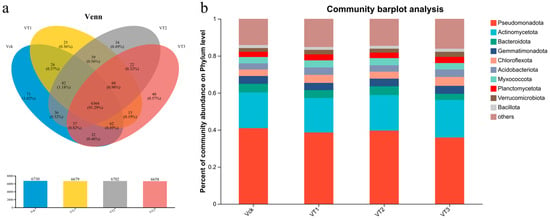
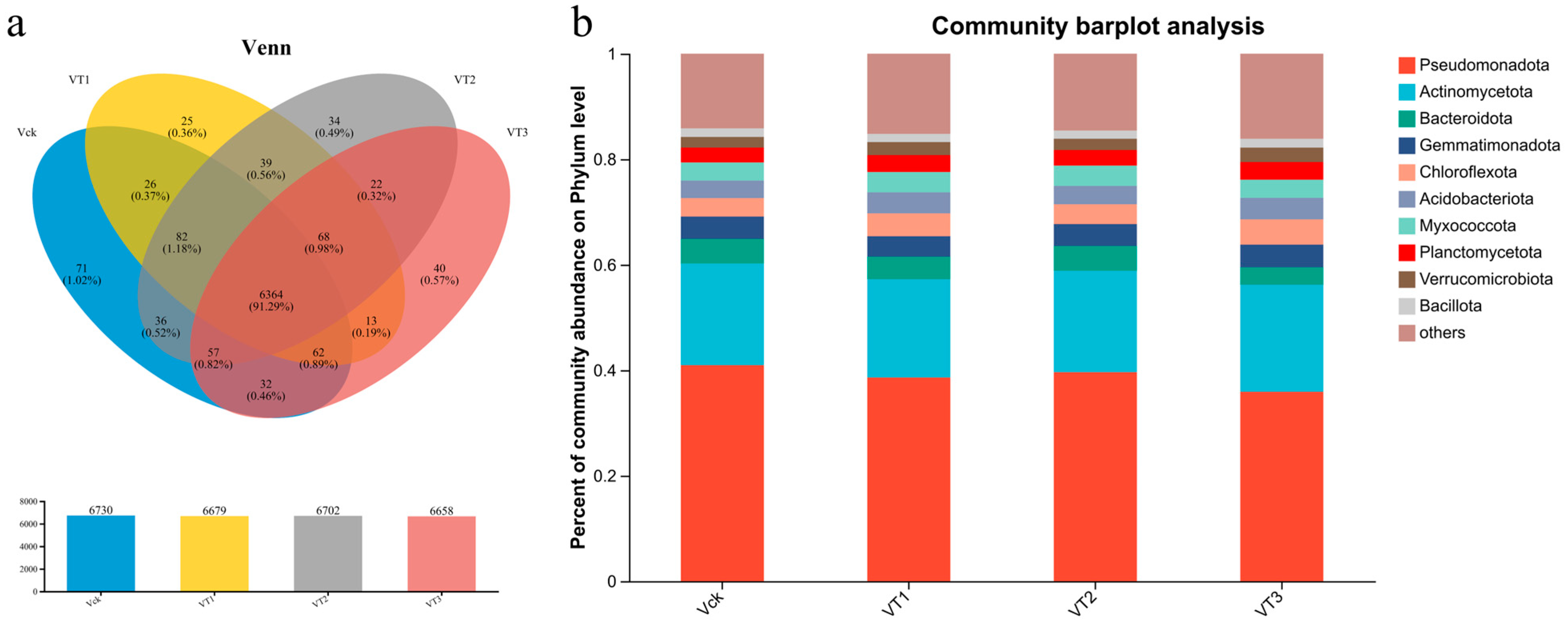
To determine the effects of microbial inoculants on soil microorganisms, we investigated the microbial composition of the soil. Venn diagram analysis at the genus level revealed similarities and differences in soil bacterial community composition among the microbial inoculant treatments (Figure 1a). The Vck, VT1, VT2, and VT3 treatments contained 6730, 6679, 6702, and 6658 bacterial genera, respectively. A total of 6364 genera were shared among all four treatments, accounting for 91.29% of the total detected genera. This high proportion of shared genera indicated substantial overlap in bacterial community composition among the treatments. Meanwhile, each treatment contained a number of unique genera. The Vck, VT1, VT2, and VT3 treatments contained 71, 25, 34, and 40 unique genera, respectively, accounting for 1.02%, 0.36%, 0.49%, and 0.57% of the total detected genera, respectively. Overall, the Venn diagram showed that the four treatments shared most of the detected bacterial genera, although a small number of treatment-specific genera were also observed. These results suggest that the microbial inoculant treatments were associated with some differences in bacterial community composition, while a large proportion of genera remained shared across treatments. Phylum-level community composition analysis showed that the overall composition of soil bacterial communities remained relatively stable under different microbial inoculant treatments (Figure 1b). The dominant bacterial phyla in the soil mainly included Pseudomonadota, Actinomycetota, Bacteroidota, Gemmatimonadota, Chloroflexota, Acidobacteriota, Myxococcota, Planctomycetota, Verrucomicrobiota, and Bacillota, collectively accounting for approximately 85% of the total soil bacterial abundance. Among them, Pseudomonadota consistently represented the dominant phylum, accounting for 36–40% of the total abundance. Actinomycetota was the second most dominant bacterial group, accounting for approximately 18–20% of the relative abundance. The remaining phyla, such as Bacteroidota, Gemmatimonadota, Chloroflexota, and Acidobacteriota, maintained relatively low but stable abundances and together constituted major components of the soil bacterial community. The different microbial inoculant treatments had certain effects on the relative abundance of dominant bacterial phyla, but the overall magnitude of variation was relatively small.
Figure 1.
Venn diagram analysis at the genus level (a) and community composition analysis at the phylum level (b).
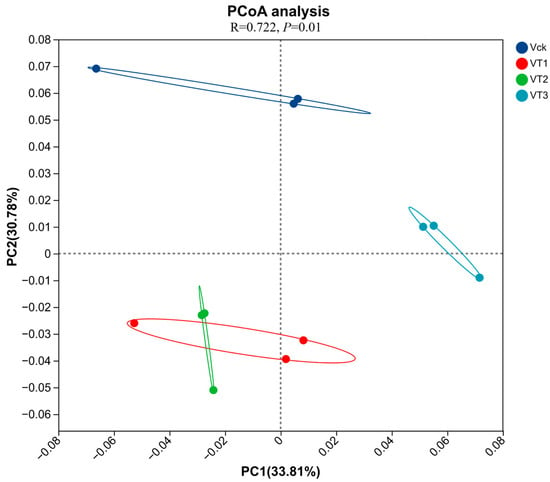
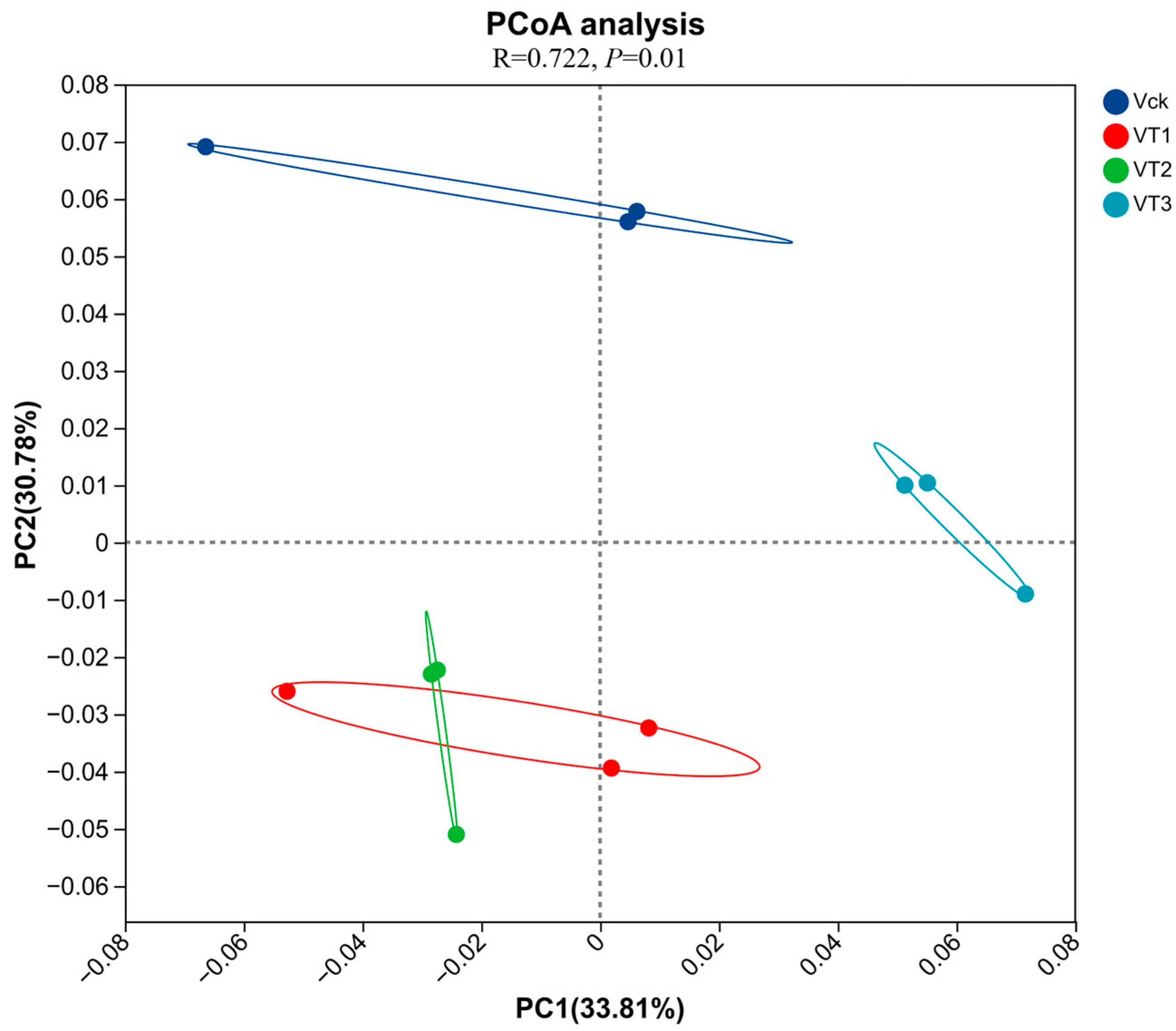
Principal coordinate analysis (PCoA) at the genus level was performed to evaluate the effects of different microbial inoculant treatments on soil bacterial community structure (Figure 2). PCoA results showed significant differences in soil bacterial communities following the application of microbial inoculants (R = 0.722, p = 0.001). After the application of microbial inoculants, the soil bacterial community structure showed a certain degree of separation. The samples from the Vck treatment were mainly distributed in the positive direction of PC2, whereas those from the VT1 and VT2 treatments were mainly clustered in the negative direction of PC2, indicating that the application of functional microbial inoculants exerted a certain shaping effect on soil bacterial community structure.
Figure 2.
PCoA analysis at the genus level.
3.2.2. Interactions Between Environmental Factors and Microbial Communities
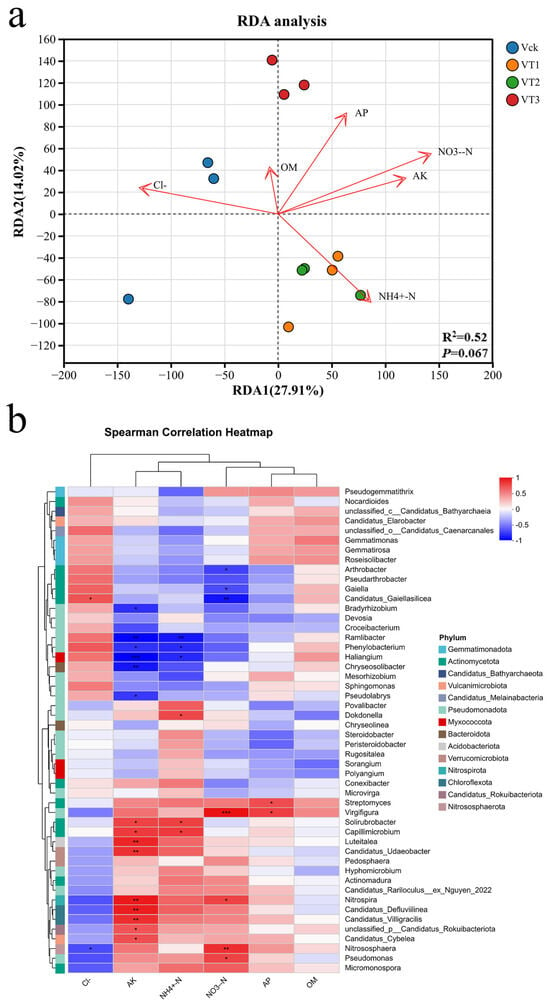
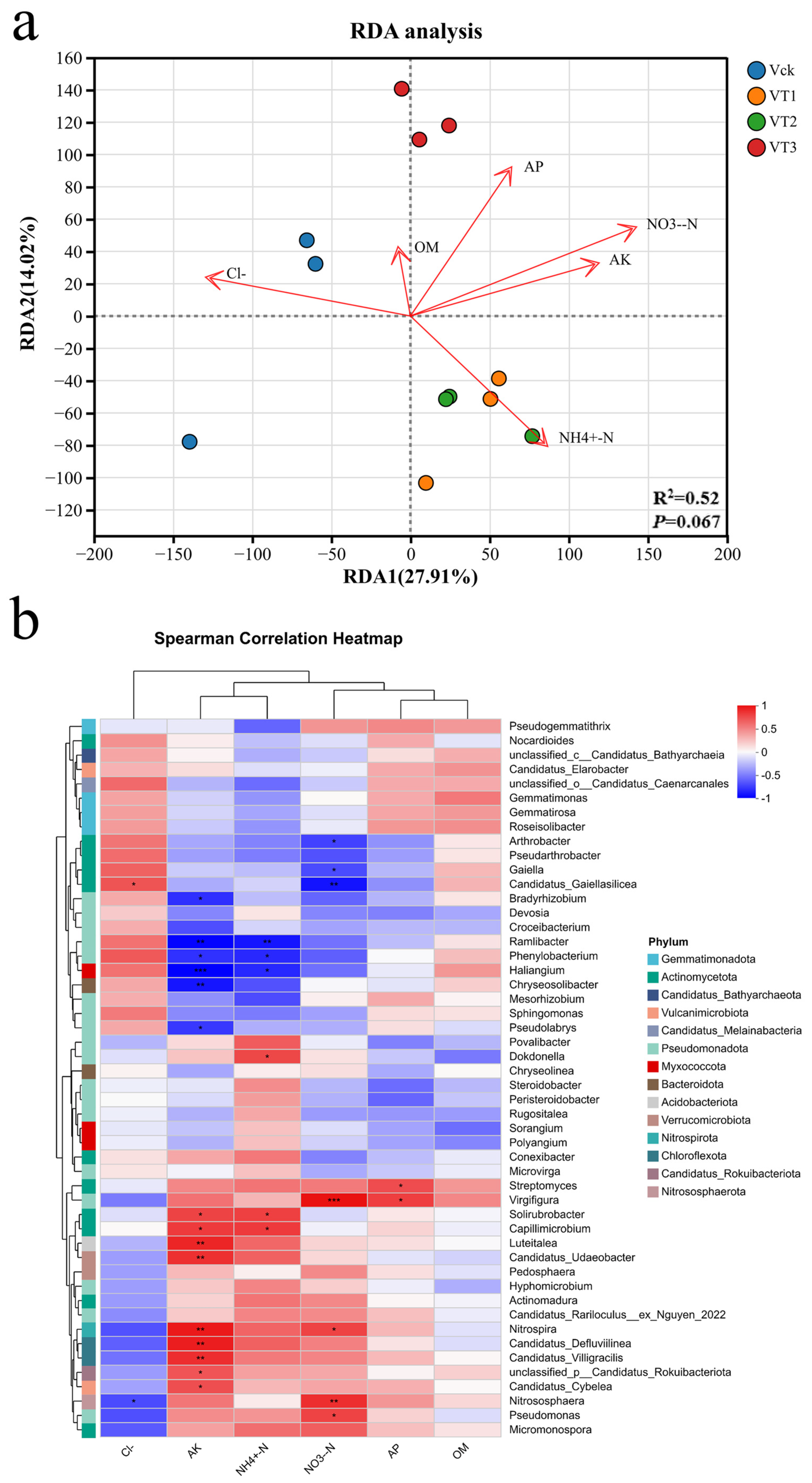
To elucidate the relationship between soil physicochemical factors and bacterial community structure, redundancy analysis (RDA) was first performed (Figure 3a and Table S2). The results showed that RDA1 and RDA2 explained 27.91% and 14.02% of the total variation in bacterial community structure, respectively. Among the environmental factors, AK (R2 = 0.5539, p = 0.027), NO3−-N (R2 = 0.8430, p = 0.001), and Cl− (R2 = 0.6055, p = 0.015) were significantly associated with bacterial community structure. The RDA ordination showed that samples from the Vck group were positively associated with Cl−, whereas samples in the VT1, VT2, and VT3 groups were negatively associated with Cl− and positively associated with AK and NO3−-N. Considering the differences in the relative abundances of different bacterial genera, correlation analysis was further conducted between the 50 most abundant genera at the genus level and soil physicochemical properties (Figure 3b). The results showed that some dominant bacterial genera were significantly correlated with soil AK and NO3−-N contents. Luteitalea, Candidatus_Udaeobacter, Nitrospira, Candidatus_Defluviilinea, and Candidatus_Villigracilis were significantly positively correlated with AK (p < 0.01), which may reflect the responses of these genera to changes in rhizosphere AK and the overall nutrient environment [24]. Conversely, Haliangium, Ramlibacter, and Chryseosolibacter were significantly negatively correlated with AK (p < 0.01), which may be related to resource competition or their responses to changes in the rhizosphere nutrient environment [25]. Nitrososphaera showed a significant positive correlation with NO3−-N (p < 0.05), which may reflect an association between this taxon and nitrate availability in the rhizosphere soil [26]. Candidatus_Gaiellasilicea showed a significant negative correlation with NO3−-N (p < 0.05), which may reflect an association between the abundance of this taxon and nitrate availability in the rhizosphere soil [27]. Overall, these correlations indicate a close ecological coupling between the microbial community and soil nutrient status.
Figure 3.
RDA at the genus level (a) and correlation heatmap (b). * p < 0.05; ** p < 0.01; *** p < 0.001.
3.3. Functional Annotation Analysis of Soil Microorganisms Based on Metagenomic Sequencing
3.3.1. COG Functional Annotation
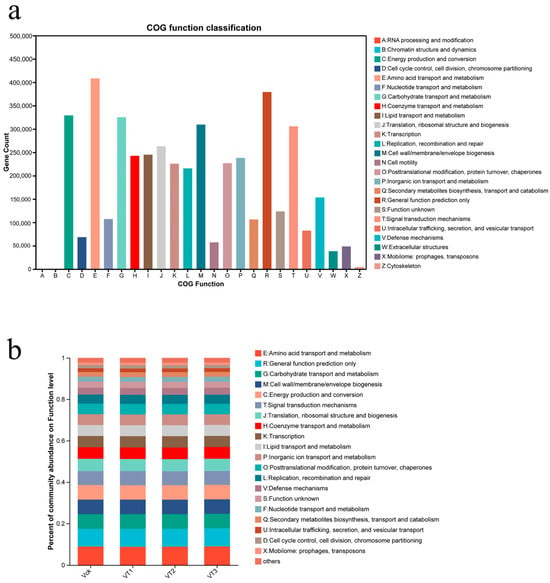
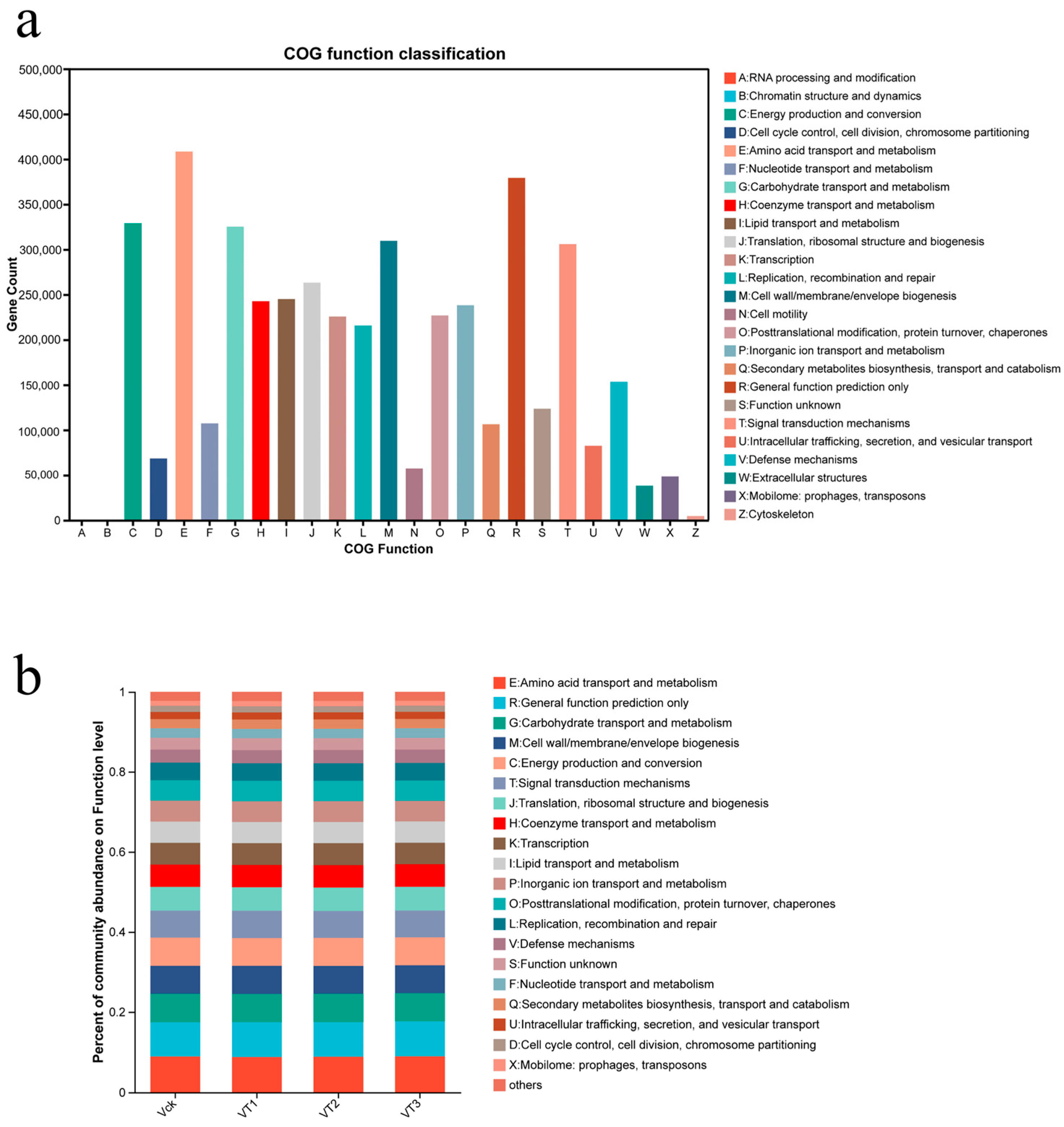
Based on the statistical analysis of COG functional categories, as shown in Figure 4a, the read abundance associated with amino acid transport and metabolism (E) was the highest overall, reaching 411,196, which is highly consistent with the fundamental requirements of organisms for maintaining basic genetic information flow and protein synthesis. The read abundance associated with energy production and conversion (C) reached 331,101, indicating that the microbial community harbored the richest read abundance reservoirs for amino acid and energy metabolism., with vigorous metabolic and energy metabolism activities [28]. The read abundance associated with carbohydrate transport and metabolism (G), cell wall/membrane/envelope biogenesis (M), signal transduction mechanisms (T), and inorganic ion transport and metabolism (P) were substantial, indicating that the microbial community possessed well-developed systems for ion homeostasis regulation and environmental stress sensing, with the capacity to respond to external environmental stresses such as heavy metals and organic pollutants and to adapt to varying inorganic salt conditions [29]. A total summed read abundance of 125,231 was assigned to categories of general function prediction only or function unknown, indicating the limitations of the current functional annotation and suggesting that the community genomes contain a substantial amount of genetic information that remains poorly characterized. In terms of the relative abundance of community-level functions, the COG functional composition patterns of the four groups (Vck, VT1, VT2, and VT3) were highly similar overall (Figure 4b). No obvious fluctuations in the abundance of individual functional categories were observed among the groups, indicating that the experimental treatments did not cause significant perturbations to the overall functional structure of the microbial community. In terms of relative abundance, amino acid transport and metabolism (E), general function prediction only (R), and carbohydrate transport and metabolism (G) were among the most abundant COG functional categories across the microbial community, followed by energy production and conversion (C), signal transduction mechanisms (T), translation (J), and cell wall/membrane/envelope biogenesis (M). Overall, amino acid, carbohydrate, and energy-related functions represented major components of the predicted functional profile based on gene number and relative abundance at the community level. The overall distribution of COG functional categories was broadly similar among the experimental treatments, with no obvious differences in the major functional categories.
Figure 4.
COG functional profiles of rhizosphere microbial communities. (a) Summed read abundance for each COG functional category. Reported values represent aggregated metagenomic reads mapped to COG-annotated ORFs (Diamond v2.0.13, blastp, E-value ≤ 1 × 10⁻⁵), not unique gene counts. (b) Relative-abundance distribution of COG functional categories in four treatment groups (Vck, VT1, VT2, VT3).
3.3.2. KEGG Functional Analysis
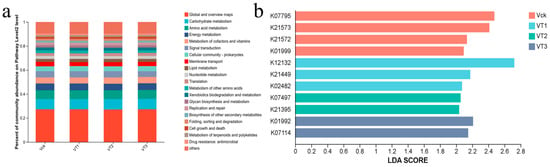
Based on functional annotation of the microbial communities in the four groups (Vck, VT1, VT2, and VT3) at KEGG Level 2, the relative abundance composition of functional genes in each group is shown in Figure 5a. Overall, carbohydrate metabolism and amino acid metabolism accounted for the highest relative abundances and represented the core functions of the microbial community in this environment. Through comparisons among groups, differences in gene abundance were observed across multiple metabolic pathways between the Vck and the VT1 and VT3 treatment groups. In the VT3 treatment group, the abundances of genes involved in carbohydrate metabolism, amino acid metabolism, and energy metabolism were all higher than those in Vck. Meanwhile, the abundances of genes associated with xenobiotics biodegradation and metabolism and terpenoid and polyketide metabolism also showed an increasing trend. Previous studies have shown that carbohydrate, amino acid, and energy metabolism in rhizosphere microbial communities are important functional foundations for maintaining microbial growth, material transformation, and nutrient cycling [30,31]. Given the lack of statistical significance for these gene-abundance changes, we can only infer from this observed trend that the application of combined microbial inoculants may modulate basic-metabolism- and substrate-utilization-related profiles of the rhizosphere microbial community, and could alter the community’s genetic potential for degradation and transformation of complex organic compounds. LEfSe analysis was performed to identify candidate functional features distinguishing the Vck, VT1, VT2, and VT3 groups, and the corresponding LDA scores are shown in Figure 5b. A total of 11 candidate KOs with LDA scores > 2.0 were identified, showing distinct distribution patterns among the four groups. In the VT1 group, K12132, K21449, and K02482 were identified as candidate features, with K12132 (prkC) exhibiting the highest LDA score. K12132 encodes PrkC, a Hanks-type serine/threonine protein kinase involved in cellular physiological processes and environmental signal responses through protein phosphorylation [32]. This annotation suggests a potential association with signal transduction and physiological regulation in the rhizosphere microbial community. In the VT2 group, candidate features included KOs associated with transposases and TRAP-type transport proteins. Transposases mediate the movement of genetic elements and may contribute to genome rearrangement and genetic exchange, whereas TRAP-type transport systems facilitate the uptake of various substrates, including organic acids [33,34]. In the VT3 group, K01992 and K07114 were identified as candidate features. According to functional annotation from the KEGG database, K01992 putatively encodes an ABC-2-type transporter permease predicted to facilitate transmembrane substrate transport [35], and K07114 is annotated as a Ca2+-activated chloride channel homolog with putative roles in ion transport [36]. Overall, the LEfSe analysis identified treatment-associated differences in predicted functional potential, with candidate KOs related to signal transduction and physiological regulation in VT1, genetic mobility and substrate transport in VT2, and transmembrane transport and ion regulation in VT3.
Figure 5.
KEGG abundance proportions under different treatments (a) and LDA analysis at the KO (KEGG Orthology) level (b).
3.3.3. CAZy Carbohydrate Analysis
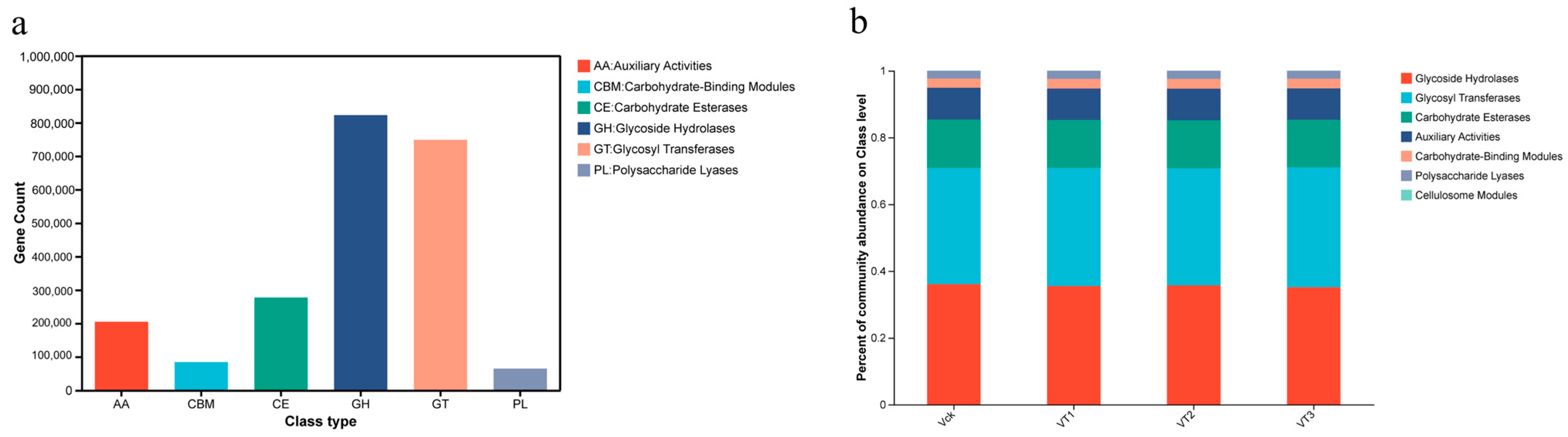
Carbohydrate-active enzymes (CAZymes) are involved in the synthesis, degradation, and modification of carbohydrates. Rhizosphere microorganisms play an important role in the utilization and decomposition of plant-derived carbon through CAZymes, thereby indirectly affecting melon growth [37]. Based on annotation against the CAZy database, six major CAZyme families were identified in this study: glycoside hydrolases (GH), glycosyltransferases (GT), carbohydrate esterases (CE), carbohydrate-binding modules (CBM), polysaccharide lyases (PL), and auxiliary activities (AA). As shown in Figure 6a, a total of 220,007 genes were identified in the CAZy functional categories across the different microbial inoculant treatments, with GH being the most abundant, followed by GT. As shown in Figure 6b, among the GHs, the Vck group had the highest relative abundance at 36.05%, followed by 35.49%, 35.72%, and 35.76% in the VT1, VT2, and VT3 treatment groups, respectively. In the GT group, the VT3 treatment had the highest relative abundance at 35.92%, while Vck, VT1, and VT2 accounted for 34.86%, 35.43%, and 35.07%, respectively. GHs mainly participate in polysaccharide degradation by hydrolyzing glycosidic bonds, whereas GTs are involved in glycosidic bond formation and the synthesis of carbohydrates and glycoconjugates [38,39]. Overall, GHs and GTs remained the predominant CAZy categories across all treatments, and only modest differences were observed in their relative abundances among groups. These results indicate that microbial inoculant treatments were associated with slight variations in the predicted CAZy functional composition of the rhizosphere microbial community.
Figure 6.
CAZy functional annotation of carbohydrate-active enzyme genes (a) and CAZy abundance under different treatments (b).
4. Discussion
As an active stage of vegetative growth and root development in melon, the vine extension stage requires an adequate supply of mineral nutrients to support plant growth [40]. Root–microbe interactions are also important during this stage. Therefore, microbial inoculants were applied to melon plants at the early vine extension stage, and root-zone soil was subsequently collected and analyzed. In this study, Bacillus altitudinis and Rhodopseudomonas palustris were applied individually and in combination. The results showed that soil pH did not change significantly following microbial inoculant application, consistent with the findings of Martínez et al. [41], and remained within the suitable range for melon growth [42]. Instead, the effects may have been primarily manifested in the regulation of soil nutrient availability and microbial community composition. As a potassium-loving crop, melon has a high demand for potassium. Soil AK is an important indicator of soil potassium availability and nutrient status. Therefore, changes in AK content can help characterize the effects of microbial inoculants on rhizosphere soil nutrient availability [43]. The VT1, VT2, and VT3 treatments all significantly increased soil AK content, with the VT1 treatment showing the highest AK content. This may be attributed to the potassium-solubilizing ability of Bacillus altitudinis, which can promote the release of insoluble potassium in soil and thereby increase soil available potassium content [44]. Meanwhile, the VT2 and VT3 treatments significantly increased soil AP content. This may be attributed to the potential mechanisms by which Rhodopseudomonas palustris promotes phosphorus transformation, including the production of organic acids and siderophores, which may facilitate the conversion of insoluble phosphorus into plant-available forms in soil [45]. All three microbial inoculant treatments significantly increased NO3−-N content, with the VT2 treatment showing the highest level. However, the two microbial inoculants differed in their effects on NH4+-N content. Under the VT1 treatment, both NH4+-N and NO3−-N may be linked to nitrogen metabolism and ammonification by Bacillus altitudinis [46]. Meanwhile, the increase in NO3−-N content under the VT2 treatment may be related to the nitrogen-fixing capacity of Rhodopseudomonas palustris [47].
We further analyzed the effects of microbial inoculants on soil microbial community structure. The α-diversity analysis showed that microbial inoculant application did not substantially increase the number of bacterial species in rhizosphere soil but altered the relative abundance distribution among different taxa, resulting in a more balanced microbial community structure. From the perspective of community composition, no significant changes were observed in the dominant bacterial groups. This suggests that the application of microbial inoculants did not disrupt the stability of the pre-existing rhizosphere bacterial community structure, consistent with the findings of Quiroga et al. [48]. Venn analysis showed that the species shared among the four treatments accounted for 91.29% of all detected species, further indicating the high stability of the rhizosphere soil bacterial community. Meanwhile, PCoA analysis revealed clear separation in bacterial community structure among the different treatments, with significant differences observed between the microbial inoculant treatments and Vck. These results indicate that although the addition of exogenous functional microorganisms did not result in the replacement of dominant bacterial phyla, it could nevertheless alter the overall structure of the rhizosphere bacterial community, which is consistent with previous studies [49,50]. RDA revealed that AK, NO3−-N, and NH4+-N were strongly associated with bacterial community structure, suggesting that shifts in rhizosphere nutrient availability after inoculation may correlate with changes in the rhizosphere bacterial community [51].
Metagenomic functional analysis revealed changes in the functional potential of the rhizosphere microbial community following microbial inoculant application. COG annotation indicated that the rhizosphere microbial community of sweet melon possessed substantial potential for material transformation and energy acquisition [52]. KEGG analysis showed that carbohydrate metabolism and amino acid metabolism were the predominant functional categories in the rhizosphere microbial community. Furthermore, the functional genes enriched in the mixed inoculant treatment were not completely consistent with those enriched in the individual inoculant treatments. This suggests that different microbial inoculants and their combinations may influence the rhizosphere microbial community in different ways, potentially shaping its functional composition through differential functional selection [53,54]. The CAZy analysis showed that microbial inoculant application resulted in slight changes in the relative abundances of GH- and GT-related genes. However, the differences were relatively small, suggesting that the microbial inoculants caused only minor changes in CAZy functional composition without inducing a clear shift in carbohydrate utilization strategies. Overall, microbial inoculant application was associated with changes in the predicted functional potential of the rhizosphere microbial community. However, the overall functional composition, including the major COG, KEGG, and CAZy categories, remained relatively stable across treatments. It is worth noting that these analyses only reflect the genetic composition and predicted functional potential of the microbial community [55]. In future studies, further investigations could combine transcriptomic, proteomic, or gene expression analyses with complementary functional assays to better elucidate the biological significance of the observed changes.
In summary, this study investigated the physicochemical properties, microbial community structure, and predicted functional potential of rhizosphere soil during the melon vine extension stage following the application of individual and combined microbial inoculants based on Bacillus altitudinis and Rhodopseudomonas palustris. The findings provide a reference for the selection of functional microbial strains and the application of combined inoculants, while also indicating the potential of Bacillus altitudinis and Rhodopseudomonas palustris as microbial inoculants for improving soil nutrient availability and modulating rhizosphere bacterial community structure. Future studies should consider multiple plant growth stages and a greater number of biological replicates to obtain a more comprehensive assessment of inoculant effects. Measuring soil physicochemical properties before inoculation and including inactivated-cell or culture-medium controls would help account for initial soil variability and distinguish the effects of viable microorganisms from those of other inoculant components. In addition, assessing strain survival and functional activity would help clarify the biological significance of the observed changes. Metagenomic analysis provides insights into the functional potential of microbial communities, but further studies should combine it with complementary approaches to better assess the relationship between microbial inoculant application and actual microbial activity. These approaches may provide further insight into the potential mechanisms by which microbial inoculants influence rhizosphere soil properties and microbial community structure.
5. Conclusions
This study demonstrated that different microbial inoculant treatments had differential effects on rhizosphere soil nutrient status, bacterial community structure, and functional potential during the melon vine extension stage. Microbial inoculants not only regulated the levels of available nutrients in rhizosphere soil but also altered bacterial community diversity and composition. Further metagenomic analysis revealed distinct treatment-specific patterns in the functional responses of microbial communities to different inoculants. These results elucidate the effects of microbial inoculants on rhizosphere soil nutrient status, bacterial community structure, and predicted functional potential during the melon vine extension stage, and may inform the functional screening and rational formulation of microbial inoculants for melon production. Future studies could include inactivated-strain or uninoculated culture-medium controls to distinguish the effects of the inoculated strains from those of other inoculant components. In addition, strain viability and functional activity assays could be combined with gene expression analysis and other complementary functional assays to further investigate actual soil microbial activity and function.
Supplementary Materials
The following supporting information can be downloaded at https://www.mdpi.com/article/10.3390/life16111810/s1, Table S1: Metagenome sequencing statistics of each sample. Table S2. Envfit test results of environmental variables in RDA.
Author Contributions
Conceptualization, J.S., Z.W.; methodology, J.S., M.L., M.Z., Q.W.; software, Y.H.; validation, J.S., M.Z., Q.W.; formal analysis, M.L.; investigation, J.S., M.L., M.Z.; resources, Z.W., J.L.; data curation, J.S., M.L., C.Z., M.Z.; writing—original draft preparation, J.S., M.L., M.Z.; writing—review and editing, J.Y., Z.W.; visualization, Y.H.; supervision, Z.W.; project administration, J.L., J.Y., Z.W.; funding acquisition, Z.W. All authors have read and agreed to the published version of the manuscript.
Funding
This study was supported by National Natural Science Foundation of China (Grant No. 22478216), the Science and Technology Benefiting People Demonstration Special Project of Qingdao (Grant No. 25-1-5-xdny-25-nsh and 26-1-5-cspz-4-nsh), the State Key Laboratory of Microbial Technology Open Projects Fund (Grant No. M2025-06), Shandong Provincial Colleges and Universities “Youth Innovation Team Program” (Grant No. 2022KJ167), and Natural Science Foundation of Shandong Province (Grant No. ZR2020QC069 and ZR2022QB143).
Institutional Review Board Statement
Not applicable.
Informed Consent Statement
Not applicable.
Data Availability Statement
The datasets presented in this study can be found in online repositories. The names of the repository/repositories and accession number(s) can be found below: https://www.ncbi.nlm.nih.gov/, PRJNA1538873 (accessed on 23 October 2026).
Acknowledgments
The authors would like to thank Caroline Stone Harwood and Rui Xu, Qingdao Engineering Center for Microbial Resource Innovation and Application, and the “Laboratory for Agricultural Molecular Biology” of Qingdao Agricultural University.
Conflicts of Interest
The authors declare no conflict of interest.
Abbreviations
The following abbreviations are used in this manuscript:
| AP | Available P |
| AK | Available K |
| NO3−-N | Nitrate nitrogen |
| NH4+-N | Ammonium nitrogen |
| Cl− | Chloride ions |
| OM | Organic matter |
References
- Yang, R.; Cao, L.; Wang, G.; Nie, M.; Hou, J.; Li, X.; Wang, P.; Li, L.; Luo, C.; Li, Q. The CmMAPK6-CmbHLH100 module regulates melon senescence by modulating iron homeostasis. Plant Physiol. 2026, 201, kiag528. [Google Scholar] [CrossRef] [Scilit] [PubMed]
- Xue, D.; Wang, Y.; Sun, H.; Fu, L.; Zhu, L.; Liu, J.; Zhi, Z.; He, J.; Wang, W.; Wu, C. Effects of Soil Conditioner (Volcanic Ash) on Yield Quality and Rhizosphere Soil Characteristics of Melon. Plants 2024, 13, 1787. [Google Scholar] [CrossRef] [Scilit] [PubMed]
- Yan, M.; Liang, Q.; Yang, J.; Mao, J.; Wang, Q.; Xiong, T.; Hu, G. Effects of deep slow-release fertilizer on melon yield, economic benefits and rhizosphere microorganisms. Front. Plant Sci. 2026, 17, 1831940. [Google Scholar] [CrossRef] [Scilit] [PubMed]
- Altuntaş, Ö.; Kutsal, İ.K. Enhancing plant growth, nutrient uptake, and stress resilience in melon through plant growth-promoting rhizobacteria: A two-year comprehensive study. J. Plant Nutr. 2026, 49, 1746–1760. [Google Scholar] [CrossRef] [Scilit]
- Sciurba, L.; Esposito, A.; Busetta, G.; Moncada, A.; Paci, V.; Vetrano, F.; Gaglio, R.; Miceli, A.; Settanni, L. Influence of a multi-species bacterial biostimulant on rhizosphere dynamics, yield earliness, and fruit quality of open-field winter melon (Cucumis melo L. var. inodorus). Sci. Hortic. 2026, 366, 115013. [Google Scholar] [CrossRef] [Scilit]
- Singh, B.K.; Hu, H.-W.; Macdonald, C.A.; Xiong, C. Microbiome-facilitated plant nutrient acquisition. Cell Host Microbe 2025, 33, 869–881. [Google Scholar] [CrossRef] [Scilit] [PubMed]
- Zhao, B.; Jia, X.; Yu, N.; Murray, J.D.; Yi, K.; Wang, E. Microbe-dependent and independent nitrogen and phosphate acquisition and regulation in plants. New Phytol. 2024, 242, 1507–1522. [Google Scholar] [CrossRef] [Scilit] [PubMed]
- Van Der Heijden, M.G.A.; Bardgett, R.D.; Van Straalen, N.M. The unseen majority: Soil microbes as drivers of plant diversity and productivity in terrestrial ecosystems. Ecol. Lett. 2008, 11, 296–310. [Google Scholar] [CrossRef] [Scilit] [PubMed]
- Philippot, L.; Raaijmakers, J.M.; Lemanceau, P.; van der Putten, W.H. Going back to the roots: The microbial ecology of the rhizosphere, Nature reviews. Microbiology 2013, 11, 789–799. [Google Scholar] [CrossRef] [Scilit] [PubMed]
- Geisseler, D.; Scow, K.M. Long-term effects of mineral fertilizers on soil microorganisms—A review. Soil Biol. Biochem. 2014, 75, 54–63. [Google Scholar] [CrossRef] [Scilit]
- Martin, H.; Beat, F.; Jochen, M.; Paul, M.; Franco, W. Distinct soil microbial diversity under long-term organic and conventional farming. ISME J. 2015, 9, 1177–1194. [Google Scholar] [CrossRef] [Scilit] [PubMed]
- Noah, F. Embracing the unknown: Disentangling the complexities of the soil microbiome, Nature reviews. Microbiology 2017, 15, 579–590. [Google Scholar] [CrossRef] [Scilit] [PubMed]
- Edmeades, D.C. The long-term effects of manures and fertilisers on soil productivity and quality: A review. Nutr. Cycl. Agroecosystems 2003, 66, 165–180. [Google Scholar] [CrossRef] [Scilit]
- Ren, F.; Sun, N.; Xu, M.; Zhang, X.; Wu, L.; Xu, M. Changes in soil microbial biomass with manure application in cropping systems: A meta-analysis. Soil Tillage Res. 2019, 194, 104291. [Google Scholar] [CrossRef] [Scilit]
- Kloepper, J.W.; Ryu, C.-M.; Zhang, S. Induced Systemic Resistance and Promotion of Plant Growth by Bacillus spp. Phytopathology 2004, 94, 1259–1266. [Google Scholar] [CrossRef] [Scilit] [PubMed]
- Shobana, N.; Sugitha, T.; Sowmya, K.; Sridar, R.; Sivakumar, U. Complete genome sequence analysis of a plant growth-promoting phylloplane Bacillus altitudinis FD48 offers mechanistic insights into priming drought stress tolerance in rice. Genomics 2022, 115, 110550. [Google Scholar] [CrossRef] [Scilit] [PubMed]
- Bian, H.; Lu, H.; Chen, P.; Wang, C.; Zhang, G. Unlocking the Potential of Rhodopseudomonas palustris as a Biofertilizer: Soil Factors and Microbial Partnerships Governing Enhanced Free-Living Nitrogen Fixation. Environ. Res. 2026, 297, 124086. [Google Scholar] [CrossRef] [Scilit] [PubMed]
- Chen, W.; Teng, Y.; Li, Z.; Liu, W.; Ren, W.; Luo, Y.; Christie, P. Mechanisms by which organic fertilizer and effective microbes mitigate peanut continuous cropping yield constraints in a red soil of south China. Appl. Soil Ecol. 2018, 128, 23–34. [Google Scholar] [CrossRef] [Scilit]
- Zhao, Q.; Dong, C.; Yang, X.; Mei, X.; Ran, W.; Shen, Q.; Xu, Y. Biocontrol of Fusarium wilt disease for Cucumis melo melon using bio-organic fertilizer. Appl. Soil Ecol. 2011, 47, 67–75. [Google Scholar] [CrossRef] [Scilit]
- Wang, S.; Zhang, B.; Ma, S.; Hao, J.; Zhang, L.; Guo, C.; Hong, J.; Ding, H.; Zhang, Y.; Wu, Y.; et al. Effects of microbial organic fertilizers on soil microbial communities and physicochemical properties in tobacco cultivation. Front. Environ. Sci. 2025, 13, 1555622. [Google Scholar] [CrossRef] [Scilit]
- Hao, X.; Zhu, P.; Zhang, H.; Liang, Y.; Yin, H.; Liu, X.; Bai, L.; Liu, H.; Jiang, H. Mixotrophic acidophiles increase cadmium soluble fraction and phytoextraction efficiency from cadmium contaminated soils. Sci. Total Environ. 2019, 655, 347–355. [Google Scholar] [CrossRef] [Scilit] [PubMed]
- Yu, X.; Zhang, Y.; Shen, M.; Dong, S.; Zhang, F.; Gao, Q.; He, P.; Shen, G.; Yang, J.; Wang, Z.; et al. Soil Conditioner Affects Tobacco Rhizosphere Soil Microecology. Microb. Ecol. 2022, 86, 460–473. [Google Scholar] [CrossRef] [Scilit] [PubMed]
- Liang, R.; Hou, R.; Li, J.; Lyu, Y.; Hang, S.; Gong, H.; Ouyang, Z. Effects of Different Fertilizers on Rhizosphere Bacterial Communities of Winter Wheat in the North China Plain. Agronomy 2020, 10, 93. [Google Scholar] [CrossRef] [Scilit]
- Han, S.; Li, X.; Luo, X.; Wen, S.; Chen, W.; Huang, Q. Nitrite-Oxidizing Bacteria Community Composition and Diversity Are Influenced by Fertilizer Regimes, but Are Independent of the Soil Aggregate in Acidic Subtropical Red Soil. Front. Microbiol. 2018, 9, 885. [Google Scholar] [CrossRef] [Scilit] [PubMed]
- Wu, C.; Ren, H.; Liu, Z.; Lu, H.; Huang, Y.; Jian, S.; Hui, D.; Liu, H.; Zhu, C.; Zhang, S.; et al. Spatial heterogeneity of resource availability drives soil bacterial community assembly along the sandy coast of Southern China. Glob. Ecol. Conserv. 2024, 54, e03171. [Google Scholar] [CrossRef] [Scilit]
- Maria, T.; Michaela, S.; Anja, S.; Martin, K.; Arno, S.; Tim, U.; Marion, E.; Michael, S.; Michael, W.; Andreas, R.; et al. Nitrososphaera viennensis, an ammonia oxidizing archaeon from soil. Proc. Natl. Acad. Sci. USA 2011, 108, 8420–8425. [Google Scholar] [CrossRef] [Scilit] [PubMed]
- Li, F.; Qiu, Z.; Pei, Z.; Zhu, Q.; Shen, S.; Fan, L.; Xu, L.; Huang, C.; Wang, J.; Huang, B.; et al. Effects of pesticides on soil microbial community structure and nitrogen transformation in tobacco fields affected by root rot. Front. Microbiol. 2026, 16, 1733977. [Google Scholar] [CrossRef] [Scilit] [PubMed]
- Lian, W.H.; Mohamad, O.A.A.; Dong, L.; Zhang, L.Y.; Wang, D.; Liu, L.; Han, M.X.; Li, S.; Wang, S.; Antunes, A.; et al. Culturomics- and metagenomics-based insights into the microbial community and function of rhizosphere soils in Sinai desert farming systems. Environ. Microbiome 2023, 18, 4. [Google Scholar] [CrossRef] [Scilit] [PubMed]
- Abilda, Z.; Isgandarov, I.; Kanat, R.; Daurov, D.; Sapakhova, Z.; Zhambakin, K.; Daurova, A.; Begaliyeva, D.; Choi, K.; Shamekova, M. Genome-resolved metagenomics reveals co-selection of antibiotic and metal resistance in chronically polluted industrial soils. Front. Microbiol. 2026, 17, 1829529. [Google Scholar] [CrossRef] [Scilit] [PubMed]
- Lopes, L.D.; Pereira E Silva, M.D.C.; Andreote, F.D. Bacterial abilities and adaptation toward the rhizosphere colonization. Front. Microbiol. 2016, 7, 1341. [Google Scholar] [CrossRef] [Scilit] [PubMed]
- Zhang, L.; Yuan, L.; Wen, Y.; Zhang, M.; Huang, S.; Wang, S.; Zhao, Y.; Hao, X.; Li, L.; Gao, Q. Maize functional requirements drive the selection of rhizobacteria under long-term fertilization practices. New Phytol. 2024, 242, 1275–1288. [Google Scholar] [CrossRef] [Scilit] [PubMed]
- Madec, E.; Laszkiewicz, A.; Iwanicki, A.; Obuchowski, M.; Séror, S. Characterization of a membrane-linked Ser/Thr protein kinase in Bacillus subtilis, implicated in developmental processes. Mol. Microbiol. 2002, 46, 571–586. [Google Scholar] [CrossRef] [Scilit] [PubMed]
- Arnold, B.J.; Huang, I.-T.; Hanage, W.P. Horizontal gene transfer and adaptive evolution in bacteria. Nat. Rev. Microbiol. 2022, 20, 206–218. [Google Scholar] [CrossRef] [Scilit] [PubMed]
- Davies, J.S.; Currie, M.J.; Dobson, R.C.; Horne, C.R.; North, R.A. TRAPs: The ‘elevator-with-an-operator’mechanism. Trends Biochem. Sci. 2024, 49, 134–144. [Google Scholar] [CrossRef] [Scilit] [PubMed]
- Feng, L.; Senchenkova, S.Y.N.; Yang, J.; Shashkov, A.S.; Tao, J.; Guo, H.; Cheng, J.; Ren, Y.; Knirel, Y.A.; Reeves, P.R. Synthesis of the heteropolysaccharide O antigen of Escherichia coli O52 requires an ABC transporter: Structural and genetic evidence. J. Bacteriol. 2004, 186, 4510–4519. [Google Scholar] [CrossRef] [Scilit] [PubMed]
- Liu, W.; Li, C.; Xie, W.; Fan, Y.; Zhang, X.; Wang, Y.; Li, L.; Zhang, Z. The signature of the gut microbiota associated with psoriatic arthritis revealed by metagenomics. Ther. Adv. Musculoskelet. Dis. 2024, 16, 1759720X241266720. [Google Scholar] [CrossRef] [Scilit] [PubMed]
- Fan, K.; Holland-Moritz, H.; Walsh, C.; Guo, X.; Wang, D.; Bai, Y.; Zhu, Y.-G.; Fierer, N.; Chu, H. Identification of the rhizosphere microbes that actively consume plant-derived carbon. Soil Biol. Biochem. 2022, 166, 108577. [Google Scholar] [CrossRef] [Scilit]
- Lombard, V.; Golaconda Ramulu, H.; Drula, E.; Coutinho, P.M.; Henrissat, B. The carbohydrate-active enzymes database (CAZy) in 2013. Nucleic Acids Res. 2014, 42, D490–D495. [Google Scholar] [CrossRef] [Scilit] [PubMed]
- Lombard, V.; Henrissat, B.; Garron, M.-L. CAZac: An activity descriptor for carbohydrate-active enzymes. Nucleic Acids Res. 2025, 53, D625–D633. [Google Scholar] [CrossRef] [Scilit] [PubMed]
- Seno, N.C.; Seno, N.C.; Bernardes, C.F.A. N:K Ratio for phenological growth stages of net melon cultivated in NFT hydroponic system. Rev. Caatinga 2020, 33, 108–115. [Google Scholar] [CrossRef] [Scilit]
- Martínez, J.I.; Gómez-Garrido, M.; Gómez-López, M.D.; Faz, Á.; Martínez-Martínez, S.; Acosta, J.A. Pseudomonas fluorescens affects nutrient dynamics in plant-soil system for melon production. Chil. J. Agric. Res. 2019, 79, 223–233. [Google Scholar] [CrossRef] [Scilit]
- Yang, L.; Song, X.; Feng, Y.; Qiu, X.; Yan, X.; Ruan, R.; Cheng, P. Improving soil structure and function for continuous cropping of sweet melon using microalgae-based biological fertilizer. Algal Res. 2025, 85, 103868. [Google Scholar] [CrossRef] [Scilit]
- Zhaoyu, K.; Hongguang, L. Modification of Rhizosphere Microbial Communities: A Possible Mechanism of Plant Growth Promoting Rhizobacteria Enhancing Plant Growth and Fitness. Front. Plant Sci. 2022, 13, 920813. [Google Scholar] [CrossRef] [Scilit] [PubMed]
- Goswami, M.; Deka, S. Isolation of a novel rhizobacteria having multiple plant growth promoting traits and antifungal activity against certain phytopathogens. Microbiol. Res. 2020, 240, 126516. [Google Scholar] [CrossRef] [Scilit] [PubMed]
- Khuong, N.Q.; Kantachote, D.; Nookongbut, P.; Onthong, J.; Xuan, L.N.T.; Sukhoom, A. Mechanisms of acid-resistant Rhodopseudomonas palustris strains to ameliorate acidic stress and promote plant growth. Biocatal. Agric. Biotechnol. 2020, 24, 101520. [Google Scholar] [CrossRef] [Scilit]
- Mumtaz, M.Z.; Aslam, R.; Li, L.; Ghafoor, S.; Khan, S.; Fahim, A.M.; Alsakkaf, W.A.A.; Ali, H.M. Bacillus altitudinis and Bacillus cereus strains improve soil fertility, nutrient acquisition, biomass production, and yield of wheat grown on calcareous soil. Chem. Biol. Technol. Agric. 2025, 12, 146. [Google Scholar] [CrossRef] [Scilit]
- Tuan, L.M.; Huyen, N.P.T.; Thuy, V.T.B.; Quang, L.T.; Thu, L.T.M.; Dao, N.T.X.; Nhan, T.C.; Xuan, L.N.T.; Khuong, N.Q. Effects of adding N2-fixing Rhodopseudomonas palustris to stimulate the growth and yield of canary melon (Cucumis melo L.). PLoS ONE 2025, 20, e0329938. [Google Scholar] [CrossRef] [Scilit] [PubMed]
- Quiroga, S.; Ratering, S.; Porto, D.R.; Rekowski, A.; Schulz, F.; Zörb, C.; Schnell, S. Seed inoculation of Hartmannibacter diazotrophicus does not alter the rhizosphere bacterial microbiome of wheat and barley in a three-year field trial. Appl. Soil Ecol. 2025, 206, 105823. [Google Scholar] [CrossRef] [Scilit]
- Sun, R.; Zhang, X.-X.; Guo, X.; Wang, D.; Chu, H. Bacterial diversity in soils subjected to long-term chemical fertilization can be more stably maintained with the addition of livestock manure than wheat straw. Soil Biol. Biochem. 2015, 88, 9–18. [Google Scholar] [CrossRef] [Scilit]
- Wang, B.; Sun, M.; Yang, J.; Shen, Z.; Ou, Y.; Fu, L.; Zhao, Y.; Li, R.; Ruan, Y.; Shen, Q. Inducing banana Fusarium wilt disease suppression through soil microbiome reshaping by pineapple–banana rotation combined with biofertilizer application. SOIL 2022, 8, 17–29. [Google Scholar] [CrossRef] [Scilit]
- Ren, Y.; Xun, W.; Yan, H.; Ma, A.; Xiong, W.; Shen, Q.; Zhang, R. Functional compensation dominates the assembly of plant rhizospheric bacterial community. Soil Biol. Biochem. 2020, 150, 107968. [Google Scholar] [CrossRef] [Scilit]
- Li, X.-Q.; Liu, Y.-Q.; Li, Y.-J.; Han, H.; Zhang, H.; Ji, M.-F.; Chen, Z.-J. Enhancing Mechanisms of the Plant Growth-Promoting Bacterial Strain Brevibacillus sp. SR-9 on Cadmium Enrichment in Sweet Sorghum by Metagenomic and Transcriptomic Analysis. Int. J. Environ. Res. Public Health 2022, 19, 16309. [Google Scholar] [CrossRef] [Scilit] [PubMed]
- Shen, M.; Li, J.; Dong, Y.; Zhang, Z.; Zhao, Y.; Li, Q.; Dang, K.; Peng, J.; Liu, H. The Effects of Microbial Inoculants on Bacterial Communities of the Rhizosphere Soil of Maize. Agriculture 2021, 11, 389. [Google Scholar] [CrossRef] [Scilit]
- Wang, J.; Zhao, S.; Xu, S.; Zhao, W.; Zhang, X.; Lei, Y.; Zhai, H.; Huang, Z. Co-inoculation of antagonistic Bacillus velezensis FH-1 and Brevundimonas diminuta NYM3 promotes rice growth by regulating the structure and nitrification function of rhizosphere microbiome. Front. Microbiol. 2023, 14, 1101773. [Google Scholar] [CrossRef] [Scilit] [PubMed]
- Myrold, D.D.; Zeglin, L.H.; Jansson, J.K. The Potential of Metagenomic Approaches for Understanding Soil Microbial Processes. Soil Sci. Soc. Am. J. 2014, 78, 3–10. [Google Scholar] [CrossRef] [Scilit]

Disclaimer/Publisher’s Note: The statements, opinions and data contained in all publications are solely those of the individual author(s) and contributor(s) and not of MDPI and/or the editor(s). MDPI and/or the editor(s) disclaim responsibility for any injury to people or property resulting from any ideas, methods, instructions or products referred to in the content. |
© 2026 by the authors. Licensee MDPI, Basel, Switzerland. This article is an open access article distributed under the terms and conditions of the Creative Commons Attribution (CC BY) license.