


Abstract
Acute pancreatitis (AP) is an acute inflammatory disorder of the pancreas that disrupts its normal function and often requires hospitalization because of severe abdominal pain. While most patients recover without major complications, some develop pancreatic necrosis, infected pancreatic necrosis (IPN), persistent organ failure, and other severe complications associated with increased morbidity and mortality. A key clinical challenge is distinguishing infected pancreatic necrosis from sterile pancreatic inflammation, as delayed or inaccurate diagnosis may result in inappropriate antibiotic use and poorer clinical outcomes. This review aimed to evaluate the diagnostic and prognostic utility of procalcitonin (PCT) in differentiating infected pancreatic necrosis from sterile inflammation and to assess its role in supporting antimicrobial decision-making in patients with AP. A structured narrative literature review was conducted using PubMed, Embase, Scopus, and Web of Science to identify English-language human studies, meta-analyses, randomized controlled trials, and international guidelines published between January 2000 and December 2025. A total of 60 studies were included in the narrative synthesis. The reviewed evidence indicates that PCT may provide greater diagnostic specificity for bacterial infection than conventional inflammatory markers such as C-reactive protein (CRP) and leukocyte count in selected clinical settings. Elevated or persistently increasing PCT concentrations have been associated with IPN, sepsis, organ failure, and increased mortality. Furthermore, PCT-guided antibiotic stewardship strategies may reduce unnecessary antibiotic exposure without adversely affecting clinical outcomes in selected settings. Overall, PCT represents a potentially valuable adjunctive biomarker for differentiating IPN from sterile inflammation in patients with AP. When interpreted alongside clinical assessment and imaging findings, PCT may facilitate the assessment of infection risk, prognostic stratification, and antimicrobial stewardship. However, further large-scale prospective multicenter studies are warranted to establish standardized diagnostic thresholds and optimize its integration into routine clinical practice.
1. Introduction
AP is a major cause of gastrointestinal hospital admissions worldwide [1,2], with an estimated incidence of 34 cases per 100,000 persons annually [3]. While most cases are mild, approximately 20% progress to severe acute pancreatitis (SAP) with necrosis, systemic complications, and persistent organ failure [4,5]. The change to IPN is a major turning point. Sterile necrosis carries a baseline mortality rate of 5–10%; however, superinfection of necrotic tissue drives mortality to between 20% and 40% [6,7]. When IPN coincides with persistent organ failure-designated as “critical acute pancreatitis”—mortality can exceed 40%, underscoring the paramount importance of prompt infection identification [8,9]. Yet, differentiating the sterile systemic inflammatory response syndrome (SIRS) that dominates the early phase of SAP from secondary bacterial sepsis poses a formidable clinical challenge [10]. Standard clinical parameters such as fever, tachycardia, tachypnea and leukocytosis lack specificity in SAP, as sterile inflammation can closely mimic bacterial sepsis [11]. Although CRP is widely used for severity assessment, its delayed peak at 48–72 h limits its usefulness for early diagnosis [11,12]. Although extraluminal gas on contrast-enhanced computed tomography (CT) is pathognomonic for infection, it appears in only a minority of IPN cases, rendering standard imaging largely insensitive for early detection [1]. CT-guided fine-needle aspiration (FNA) is invasive, carries a risk of false-negative results or iatrogenic infection, and has consequently been removed from routine recommendations in modern guidelines [1,13]. Amidst these diagnostic challenges, PCT has emerged as a potential adjunctive biomarker for assessing infectious complications in AP. Being an inactive propeptide of calcitonin, PCT is rapidly released in response to bacterial endotoxins and proinflammatory cytokines; its levels generally begin to increase within 2–4 h of a bacterial stimulus [11]. This relatively rapid kinetic pattern has prompted investigation of PCT as an adjunctive biomarker for differentiating sterile inflammation from infected necrosis, although its diagnostic performance relative to other biomarkers varies across clinical settings [14]. While previous systematic reviews have primarily evaluated the pooled diagnostic accuracy and prognostic associations of PCT in AP [11], the present narrative review integrates evidence on PCT kinetics, clinically relevant thresholds, comparative findings with other biomarkers, and its potential application in antimicrobial stewardship. Specifically, the review synthesizes evidence on clinically relevant PCT thresholds and kinetics and interprets these findings in the context of contemporary recommendations, including the 2025 revised IAP (International Association of Pancreatology) guidelines [15]. In addition, it examines factors that may influence PCT interpretation, such as renal dysfunction, and discusses how PCT may support antimicrobial stewardship and contemporary clinical decision-making in patients with suspected IPN [15,16]. Accordingly, this review evaluates the diagnostic and prognostic utility of PCT in AP, with particular emphasis on its potential role in differentiating infected from sterile pancreatic necrosis, interpreting PCT thresholds and kinetics, and supporting antibiotic decision-making and antimicrobial stewardship.
2. Methodology
2.1. Review Design and Literature Search
This study was designed as a structured narrative review to synthesise the available evidence on the role of PCT in AP, with particular emphasis on differentiating IPN from sterile pancreatic inflammation and on the potential role of PCT in antimicrobial stewardship. The structured narrative approach was selected to accommodate the heterogeneity of the available evidence, including diagnostic studies, observational studies, randomized controlled trials (RCT), evidence syntheses, and clinical practice guidelines addressing different clinical applications of PCT.
To enhance the transparency and comprehensiveness of the narrative review, a structured literature search was conducted in PubMed, Embase, Scopus, and Web of Science for articles published between January 2000 and May 2026. This period was selected to capture the evolution of evidence regarding PCT as a biomarker of infection, inflammation, disease severity, and antimicrobial management in AP.
Search terms included combinations of “procalcitonin”, “PCT”, “acute pancreatitis”, “infected pancreatic necrosis”, “infected necrosis”, “sterile necrosis”, “diagnosis”, “prognosis”, “biomarkers”, “antimicrobial stewardship”, and “antibiotic therapy”, combined using standard Boolean operators. A representative PubMed search strategy was: (“Procalcitonin” OR “PCT”) AND (“Acute Pancreatitis” OR “Acute Pancreatitis, Necrotizing”) AND (“Infected Pancreatic Necrosis” OR “Infected Necrosis” OR “Sterile Necrosis” OR “Pancreatic Necrosis” OR “Infection” OR “Prognosis” OR “Severity” OR “Biomarkers”). For PubMed, Medical Subject Headings (MeSH), where applicable, and free-text terms were used. Equivalent search strategies were adapted for Embase, Scopus, and Web of Science according to their respective indexing conventions. Reference lists of included studies and relevant review articles were also manually screened to identify additional eligible publications.
2.2. Eligibility Criteria
Evidence was considered eligible when it was relevant to the clinical role of PCT in adult patients with AP, including evidence from RCT, prospective and retrospective observational studies, diagnostic studies, evidence syntheses, and international clinical practice guidelines. Relevant outcomes included diagnosis of IPN, disease severity, organ dysfunction, mortality, infection, comparison with other biomarkers, and antimicrobial use. Studies were excluded if they were non-English publications, editorials or opinion pieces without relevant original data, conference abstracts, non-peer-reviewed material, grey literature, single-case reports, animal or preclinical studies, pharmacokinetic/pharmacodynamic-only studies, or studies that did not report a PCT-related diagnostic, prognostic, or antimicrobial-stewardship outcome relevant to AP.
2.3. Literature Screening and Data Extraction
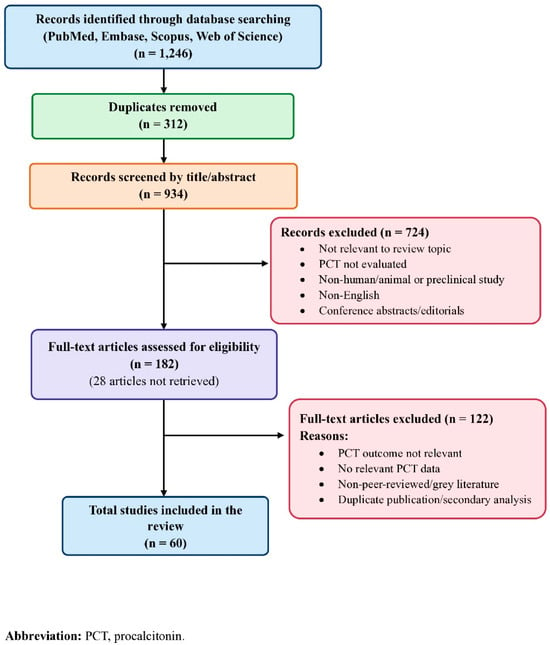
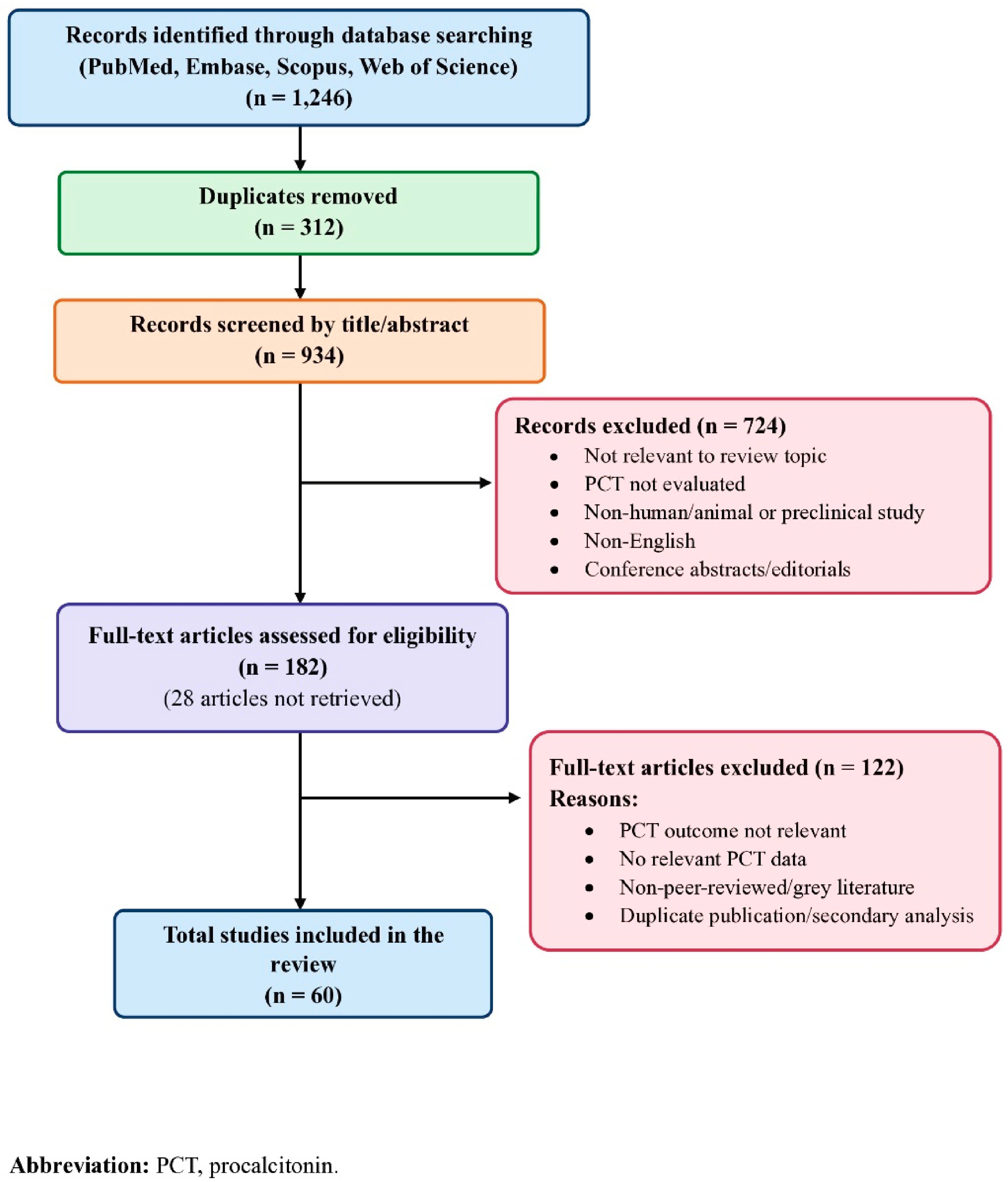
The identified literature was screened for relevance to the review objectives. Two reviewers independently assessed the titles and abstracts of potentially relevant publications and subsequently evaluated the corresponding full texts for inclusion. Disagreements were resolved through discussion and consensus. A total of 1246 records were identified, of which 312 duplicates were removed. Of the remaining 934 records, 724 were excluded during initial screening. Full-text retrieval was sought for 210 publications; 28 could not be retrieved, leaving 182 publications for full-text assessment. Following full-text evaluation, 122 publications were excluded, resulting in 60 publications being included in the narrative synthesis Figure 1.
Figure 1.
Flow diagram of the literature identification, screening, and study selection process for the structured narrative review.
For each included publication, information was extracted on study design, clinical setting, patient population, sample size, PCT assay method and threshold, comparator biomarker(s), timing and frequency of PCT measurement, relevant clinical outcomes, follow-up duration, and principal findings. Methodological characteristics relevant to interpretation were also recorded when reported, including prospective versus retrospective design, single versus serial PCT measurement, blinding, independent outcome adjudication, outcome/reference-standard definitions, and relevant features of clinical-care standardization or antibiotic protocols. When these characteristics were not reported in the original publication, they were recorded as “Not reported.”
2.4. Narrative Synthesis
The included evidence was synthesized narratively and thematically according to the principal clinical applications of PCT: diagnosis and early prediction of IPN, prognostic assessment, and PCT-guided antimicrobial stewardship. Differences in study design, patient population, PCT measurement strategies, thresholds, reference standards, and treatment protocols were considered when interpreting the findings. No quantitative pooling or meta-analysis was performed.
3. Results
3.1. Pathophysiological Basis of Infection and Pct Elevation in Acute Pancreatitis
AP pathogenesis proceeds through a complex cascade, premature trypsin activation initiates pancreatic autodigestion, leading to release of damage-associated molecular patterns (DAMPs) that amplify immune signaling beyond local injury [3,14]. These signals trigger systemic inflammatory responses mediated by Interleukin- 1beta (IL-1β), Interleukin-6 (IL-6), Interleukin-8 (IL-8), and Tumor Necrosis Factor- alpha (TNF-α), leading to sterile inflammation [17,18]. Consequently, early clinical features resemble sepsis, explaining why clinical parameters fail to differentiate sterile SIRS from infection [11,19]. The intensity of this inflammatory response determines early organ dysfunction risk [17,20]. Importantly, sterile inflammation may produce some PCT elevation, but levels are generally lower than those observed with bacterial infection [11].
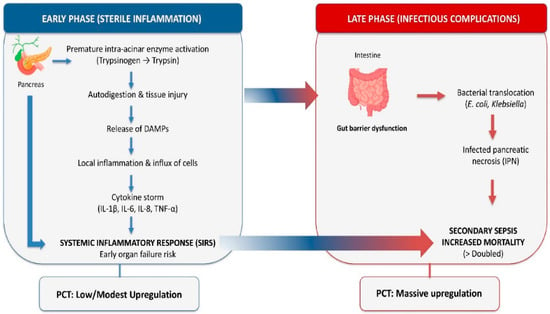
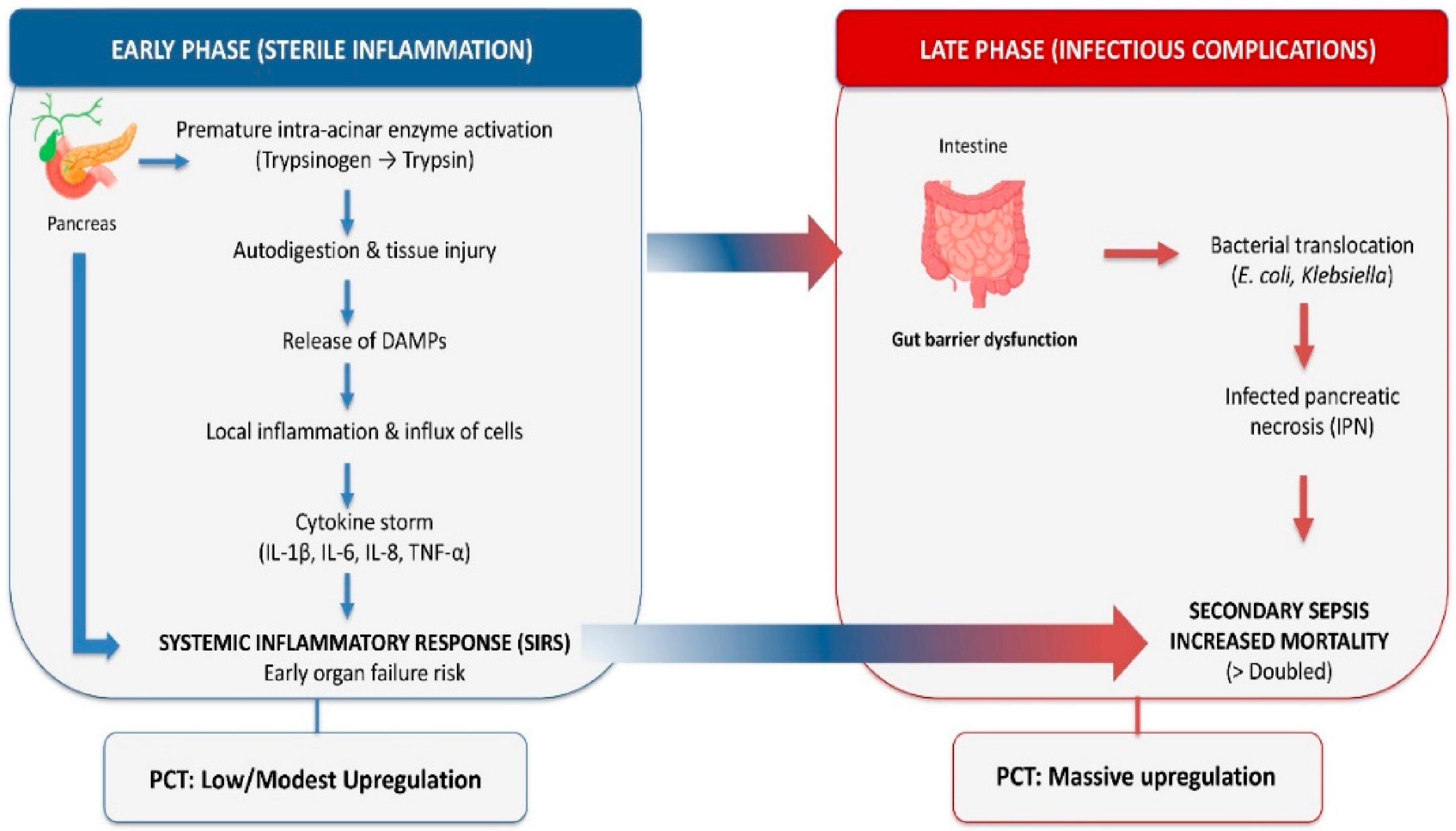
During the late phase, gut barrier failure results primarily from hypovolemia and splanchnic hypoperfusion, increasing intestinal permeability and enabling bacterial translocation into necrotic pancreatic tissue [13,14,18]. Infection of previously sterile necrosis leads to IPN and secondary sepsis, which worsens prognosis, with mortality more than doubling and rising from 22% with organ failure alone to 43% when infection coexists with organ failure [7,9,21]. Thus, the critical clinical transition is the shift from sterile inflammation to infection, where rising PCT levels may provide useful information to support antimicrobial decision-making [11]. The proposed progression from early sterile inflammation to late infectious complications, together with the corresponding changes in PCT expression, is illustrated in Figure 2.
Figure 2.
Pathophysiology progression of AP from sterile inflammation to infectious complications and its association with PCT dynamics. Abbreviations: DAMPs, damage-associated molecular patterns; SIRS, systemic inflammatory response syndrome; IPN, infected pancreatic necrosis; TNF-α, tumor necrosis factor-alpha; IL-1β, interleukin-1 beta; IL-6, interleukin-6; IL-8, Interleukin-8; PCT, procalcitonin; early phase is characterized by sterile inflammation and cytokine-mediated SIRS with low to modest PCT elevation, whereas late phase involves bacterial translocation, IPN, and secondary sepsis with marked PCT upregulation.
3.2. Biology and Kinetics of Procalcitonin
PCT is a highly specific 116-amino acid glycoprotein serving as the precursor propeptide for calcitonin [22]. Under healthy physiological conditions, PCT is synthesized mostly by thyroid C-cells and undergoes rapid intracellular proteolytic cleavage. Consequently, circulating prohormone levels remain negligible, below the standard detection limit of 0.05–0.1 ng/mL [23,24].
During states of severe systemic bacterial inflammation, PCT biological production alters dramatically. Through “hormokine” expression, PCT synthesis becomes ubiquitous across extrathyroidal parenchymal tissues, including the liver, kidneys, adipose tissue, and skeletal muscle [6,22]. This constitutive synthesis bypasses standard intracellular cleavage, resulting in massive release of intact PCT directly into the systemic circulation [25].
Extrathyroidal PCT gene expression is primarily induced by bacterial endotoxins (e.g., lipopolysaccharide) and specific proinflammatory cytokines, notably TNF-α, IL-1β, and IL-6 [24]. A critical differentiating feature of PCT biology is its divergent regulation. While proinflammatory cytokines strongly stimulate PCT release, interferon-gamma (IFN-γ), secreted extensively during viral infections, actively attenuates and suppresses PCT production [24,26]. This biological regulation may contribute to the stronger association of PCT with bacterial infection than with some viral conditions [25,27].
PCT’s kinetic profile is exceptionally suited for acute diagnostics. Serum PCT levels rise measurably within 2–4 h following substantial bacterial stimulus, appearing significantly earlier than CRP [11,24]. Circulating PCT levels typically peak between 24 and 48 h [23,24]. With an estimated half-life of 25–30 h, PCT concentrations decline rapidly once the infectious stimulus is controlled [26,27]. Although sterile necrosis can also produce substantial PCT elevations through systemic inflammatory activation, available evidence suggests that concentrations may be higher in bacterial infection than in isolated sterile inflammation in some clinical settings [4,6].
3.3. Diagnostic Challenges in Acute Pancreatitis
AP clinical management depends on accurate differentiation between sterile inflammation and IPN. Standard clinical signs of infection (fever, tachycardia, tachypnea) possess high sensitivity but poor diagnostic specificity in AP [14]. The massive sterile inflammation associated with SAP induces SIRS, clinically indistinguishable from true bacterial sepsis [23,28].
While CRP remains the traditional laboratory marker, its diagnostic accuracy is hampered by latency. CRP levels ≥ 150 mg/L indicate severe disease but fail to distinguish between sterile and infected necrosis within the first 48 h of admission [2,14]. Leukocytosis is similarly non-specific, serving as an expected component of the sterile SIRS response [19]. Comprehensive scoring systems like Acute Physiology and Chronic Health Evaluation II (APACHE II) and Ranson’s criteria require 48 h to complete and do not specifically predict bacterial infection [4,24].
Contrast-enhanced computed tomography (CECT) remains the anatomical gold standard for assessing pancreatic necrosis but has limitations in early detection. Because necrosis may not be apparent until 72–96 h after symptom onset, early imaging can underestimate disease severity [24]. Macroscopic CT findings for sterile and infected necrosis are often identical. The truly pathognomonic “air bubble” sign (extraluminal gas) is present in only 20–50% of documented IPN cases [19,24]. Repeated CT scanning exposes vulnerable patients to significant radiation burdens and contrast-induced nephrotoxicity risks [14,24].
Failure to distinguish sterile from infected necrosis leads to errors like the unnecessary use of empiric broad-spectrum antibiotics in patients with sterile inflammation. Observational studies report antibiotic use in up to 63% of AP cases, often inappropriately, contributing to antimicrobial resistance, increased healthcare costs, and complications such as Clostridioides difficile infection [6,28,29]. Prophylactic antibiotics have not been shown to reduce IPN incidence or mortality and are discouraged by modern guidelines [1,14]. Conversely, failure to definitively diagnose IPN promptly can be fatal. Infected necrosis associates with a mortality rate of 20–40%, compared to <10% for sterile necrosis [24,30]. Mortality escalates if interventions are delayed in uncontrolled sepsis [28]. These challenges highlight the clinical need for biomarkers that can provide additional information for distinguishing bacterial infection from sterile inflammation in selected patients with AP.
3.4. Clinical Evidence Supporting Pct
PCT has been evaluated in numerous prospective studies and meta-analyses of AP over the past two decades. Although PCT has been associated with overall disease severity, its main clinical utility is to provide adjunctive information for differentiating sterile from IPN and for supporting early assessment of organ failure [14,31,32].
During the initial stage of AP (first 24–48 h), available evidence suggests that PCT may provide earlier risk-stratification information than conventional markers such as CRP in selected clinical settings, consistent with its relatively rapid kinetic profile [14,33]. Prospective studies and systematic reviews have reported associations between PCT concentrations and disease severity, with discriminatory value for differentiating sterile from infected necrosis and for identifying patients at increased risk of severe complications [14,31,32]. However, the magnitude of the diagnostic performance of PCT varies across studies according to patient population, timing of measurement, disease severity, diagnostic threshold, and reference standard [11,31,32]. In patients with mild or uncomplicated AP, the discriminatory value of individual inflammatory biomarkers may be less pronounced; IL-6, for example, has demonstrated useful early information for severity stratification in some studies [34].
The diagnostic performance of PCT for IPN reported in selected prospective studies and systematic reviews is summarized in Table 1. The available evidence includes both individual cohort studies and pooled analyses, but differences in study design, timing of sampling, reference standards, and thresholds limit direct comparison across studies.
PCT may also provide adjunctive information in the evaluation of suspected IPN, as higher or persistently elevated concentrations have been reported in some studies of infected compared with sterile necrosis [14,29,31,33]. Serial PCT measurements may provide additional prognostic information, with persistent elevation or an insufficient decline being associated with poorer outcomes, whereas decreasing concentrations have been associated with clinical improvement and treatment response [14,35].
Selected studies evaluating the prognostic performance of PCT for disease severity, organ failure, mortality, or composite infectious complications are summarized in Table 2. These studies illustrate the variability in PCT thresholds, sampling schedules, and clinical endpoints used to assess prognostic utility. Optimal PCT thresholds vary according to the study population, timing of assessment, assay, and clinical endpoint. Lower thresholds, including approximately 0.5 ng/mL, have been evaluated for infection-risk assessment and antibiotic-related decision-making, whereas higher thresholds have been investigated for predicting severe complications and infected necrosis [14,30,36,37]. These differences indicate that a single universal PCT cut-off cannot be applied across all clinical settings. Current evidence therefore supports interpretation of PCT in conjunction with clinical findings and other investigations, with serial trends potentially providing more useful information than reliance on a single measurement [27,35].
Table 1.
Diagnostic and early-prediction accuracy of PCT for infected pancreatic necrosis.
Table 2.
Prognostic performance of PCT (target: severity, organ failure, mortality or composite infectious complications).
3.5. Comparison with Other Biomarkers
As summarized in Table 3, PCT has been investigated alongside conventional inflammatory biomarkers such as CRP, white blood cells (WBC), IL-6, and presepsin for differentiating IPN from sterile inflammatory responses. Available comparative evidence suggests that PCT may provide useful discriminatory information in selected clinical settings; however, direct comparisons between biomarkers remain heterogeneous because of differences in patient populations, timing of measurement, disease severity, assays, diagnostic thresholds, and reference standards [11,14,31,38].
CRP is constrained by delayed kinetics, generally reaching peak concentrations 48–72 h after symptom onset [4,17,25,39]. Although CRP is widely used as a marker of inflammatory severity, its ability to distinguish sterile inflammation from infection is limited [14,28]. Some studies in SAP have reported greater discriminatory performance of PCT than CRP for selected infection-related outcomes, although the relative sensitivity and specificity have varied according to the outcome, timing of sampling, and threshold used [14,31]. These findings should therefore not be interpreted as evidence of consistent superiority of PCT over CRP across all clinical settings [11,14,31]. Leukocytosis similarly lacks specificity because both sterile and infected necrosis can produce substantial inflammatory responses [32]. Thus, WBC counts should be interpreted in conjunction with other clinical, biochemical, and imaging findings rather than used alone to guide antibiotic decisions [40].
IL-6 provides useful information for early inflammatory and severity assessment and may rise rapidly during the initial phase of AP [11,18]. However, its short half-life may limit its usefulness for continuous monitoring, and routine clinical application may be constrained by assay availability [18,23]. Comparative studies of PCT and IL-6 have reported heterogeneous findings, partly because of differences in study populations, sampling time, and clinical outcomes [34,41]. Some studies have demonstrated useful discriminatory performance of PCT for infection-related outcomes, whereas IL-6 may provide valuable early information regarding inflammatory severity [34,41]. Accordingly, PCT should be considered a complementary biomarker rather than a uniformly superior alternative to IL-6.
Presepsin has also been investigated as an early biomarker of bacterial infection. In a prospective study of patients with severe acute necrotizing pancreatitis, presepsin concentrations were higher in patients with infected complications than in those with sterile necrosis, suggesting potential diagnostic utility for identifying infection [42]. However, this evidence is based on a relatively small single-center study, and the evidence base for presepsin in AP remains more limited than that for PCT. Therefore, current evidence does not support a consistent diagnostic advantage of presepsin over PCT in AP.
Overall, PCT may provide complementary information when bacterial infection is suspected, but its comparative diagnostic performance varies across studies and clinical settings. Differences in patient population, disease severity, timing of measurement, assay characteristics, diagnostic thresholds, and reference standards should be considered when interpreting comparisons with CRP, WBC, IL-6, and presepsin [11,14,31,38,42]. PCT is therefore best regarded as an adjunctive biomarker rather than a stand-alone or universally superior diagnostic test. Its dynamic behavior may additionally support serial assessment of disease progression and response to treatment [27,35].
Table 3.
Comparative characteristics of biomarkers used in acute pancreatitis.
3.6. Antibiotic Stewardship
The excessive use of broad-spectrum antibiotics in AP is an ongoing global issue. Studies show that antibiotics are still widely used at rates of 31–80% even though the guidelines clearly state that routine prophylaxis should be avoided. Thus, this practice results in the development of microbial resistance, increased healthcare costs and the occurrence of undesired effects such as Clostridioides difficile infection and fungal complications [6,47]. One big clinical difficulty nowadays is that severe sterile SIRS generally cannot be visually or otherwise differentiated from sepsis, complicating antibiotic decision-making [29].
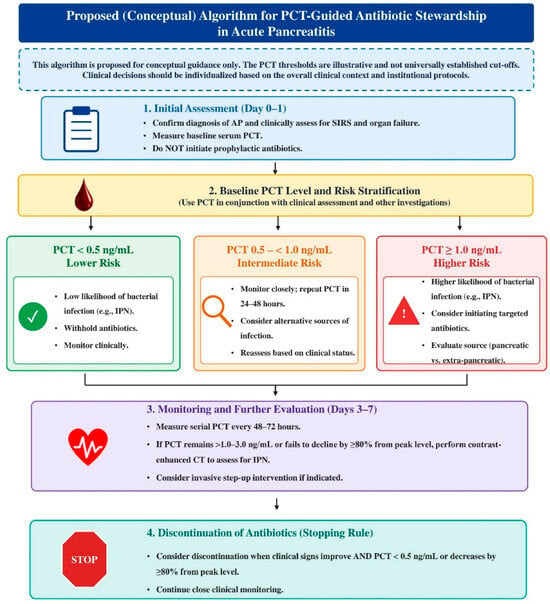
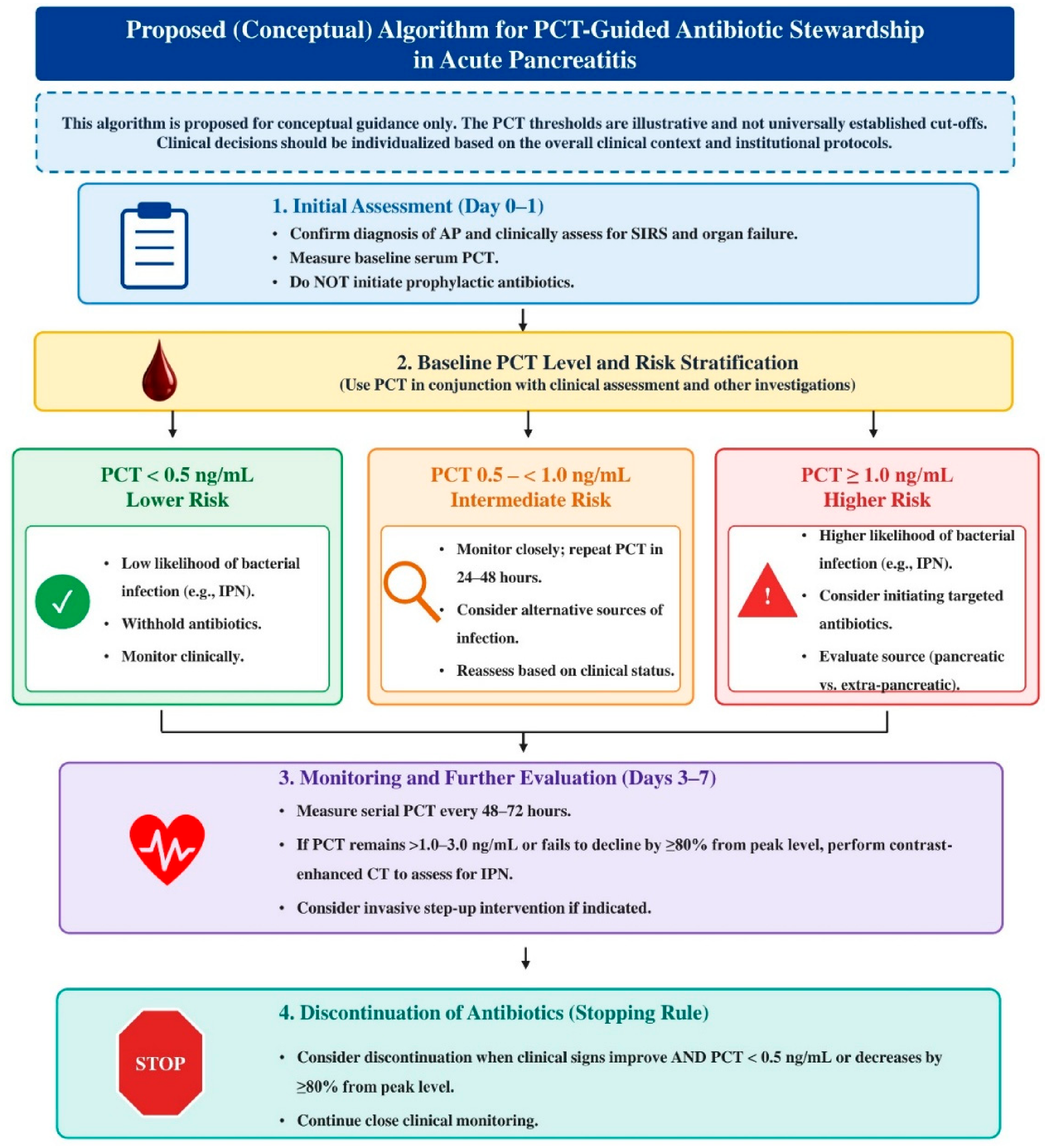
Therefore, Antibiotic Stewardship Programs (ASPs) are turning more to PCT-guided algorithms to support decisions on whether or not to start or stop antimicrobial treatment. PCT-guided antibiotic algorithms have been investigated as a strategy to reduce unnecessary antibiotic exposure using predefined serum PCT thresholds. The PROCAP study was initially described in a 2019 study protocol, which evaluated a PCT threshold of 1.0 ng/mL for guiding antibiotic initiation and discontinuation [30]. The subsequent final PROCAP randomized controlled trial evaluated this algorithm in 260 patients with AP and compared PCT-guided care with usual care [48]. Other PCT-guided approaches, such as the study by Qu et al., used a lower threshold, with antibiotics initiated when overt clinical signs of infection were present and PCT concurrently exceeded 0.5 ng/mL [36] (Figure 3). Similarly, consensus statements from the International Association of Pancreatology (IAP) recognize that elevated PCT may provide supportive information when considering antimicrobial treatment, particularly when microbiological confirmation is unavailable [40]. The characteristics and outcomes of the available PCT-guided randomized trials are summarized in Table 4.
Figure 3.
Context-dependent framework for PCT-guided antibiotic stewardship in acute pancreatitis. Abbreviations: PCT, procalcitonin; AP, acute pancreatitis; SIRS, systemic inflammatory response syndrome; IPN, infected pancreatic necrosis; CT, computed tomography; clinical decisions are guided by serum PCT thresholds, where levels < 0.5 ng/mL suggests low likelihood of bacterial infection, 0.5–<1.0 ng/mL indicate intermediate risk requiring monitoring, and ≥1.0 ng/mL indicate high likelihood warranting antibiotic initiation and further evaluation; persistent elevation or inadequate decline of PCT supports imaging and consideration of invasive intervention, while declining levels guide safe discontinuation of antibiotics.
Stopping rules designed for the safe discontinuation of antibiotics may incorporate serial PCT measurements together with clinical assessment. In the PROCAP protocol, antibiotic discontinuation was planned when repeat PCT measurements on days 4 and 7 fell below 1.0 ng/mL in the absence of ongoing clinical concern [30]. Qu et al. reported discontinuation of therapy when clinical signs improved and PCT decreased to <0.5 ng/mL for three consecutive days [36] (Figure 3). Sepsis algorithms commonly recommend discontinuing antibiotics when PCT decreases by ≥80% from peak levels or falls below 0.5 ng/mL [49]. In the final PROCAP randomized controlled trial, antibiotic use decreased from 63% with usual care to 45% with PCT-guided care (adjusted risk difference −15.6%; p = 0.0071) [48]. Importantly, there was no significant increase in clinical infection, hospital-acquired infection, or mortality with PCT-guided management [48]. Similarly, Qu et al. reported shorter antibiotic duration in the PCT-guided group (10.9 ± 2.9 vs. 16.1 ± 2.5 days; p < 0.001), alongside reduced Intensive Care Unit (ICU) and hospital stay, without increases in infection, mortality, or adverse outcomes [36,49]. Observational evidence suggests that adherence to PCT-guided algorithms may reduce unnecessary exposure to broad-spectrum antibiotics, including carbapenems and fluoroquinolones [10]. Overall, these findings suggest that PCT-guided strategies may support antibiotic stewardship in selected patients with AP, although differences in thresholds, treatment algorithms, patient populations, and study settings should be considered when interpreting the available evidence (Table 4).
Table 4.
PCT-guided antibiotic-stewardship randomised trials.
4. Discussion
4.1. Critical Appraisal of Evidence
The diagnostic and prognostic value of PCT in AP is supported by a body of observational studies and meta-analytic evidence, although large definitive RCT data remain limited. Meta-analyses demonstrate moderate-to-high diagnostic accuracy in some settings for predicting IPN and SAP, with pooled analyses suggesting that PCT may provide useful diagnostic information and may offer earlier indication of infectious complications than CRP in selected populations [11,33,39]. However, these findings should not be interpreted as evidence of consistent superiority over CRP or other biomarkers, as direct head-to-head comparisons remain limited and heterogeneous with respect to patient populations, timing of measurement, assay characteristics, thresholds, and clinical endpoints. Importantly, the final PROCAP randomized controlled trial provided clinical evidence that PCT-guided management reduced antibiotic prescribing from 63% with usual care to 45% with PCT-guided care, without a significant increase in clinical infection, hospital-acquired infection, or mortality [48]. However, the trial was single-centre, and further multicentre studies are needed to establish the generalizability of these findings across different healthcare settings.
4.2. Clinical Guidelines
The role of PCT in AP guidelines has evolved from an experimental biomarker to a potentially useful adjunct in selected clinical situations, although adoption remains inconsistent. The 2013 IAP/American Pancreatic Association (APA) guidelines describe PCT as a promising marker for pancreatic infection, particularly with persistent organ failure, while emphasizing that it should not be used as a standalone diagnostic test [8]. The 2019 World Society of Emergency Surgery (WSES) guidelines identify serum PCT as potentially valuable for predicting the risk of IPN and assign a Grade 1B recommendation to its use [5]. They emphasize that PCT may assist in distinguishing infectious from non-infectious causes of persistent systemic inflammation [5].
Additionally, recent international consensus statements aimed directly at reducing systemic antibiotic overuse suggest that elevated PCT levels during the early phase of AP may provide supportive information when considering antibiotic treatment, although antimicrobial decisions should remain integrated with clinical assessment and other diagnostic findings [40]. This is particularly important because elevated PCT alone does not establish microbiologically confirmed infection.
Despite these recommendations, significant gaps between evidence and daily clinical practice remain. Widespread implementation is hindered by variation in proposed PCT thresholds and the lack of universally accepted, actionable cut-off values within the guidelines themselves. While modern guidelines strongly discourage routine prophylactic antibiotics [2,5] they do not uniformly recommend PCT-guided algorithms as the standard of care, partly because of differences in assay availability, clinical protocols, healthcare resources, and cost compared with CRP testing [26]. Several recent reviews note that while PCT testing may have a role in supporting antimicrobial stewardship programs (ASPs), its effects in countries with already restrictive antibiotic policies remain to be fully evaluated [50].
4.3. Limitations of Procalcitonin
While PCT may provide useful diagnostic information for suspected bacterial infection in selected clinical settings, its interpretation is subject to several physiological and analytical limitations. Recent evidence indicates that the diagnostic performance of PCT varies according to the timing of measurement and clinical context. In a systematic review and meta-analysis of acute necrotizing pancreatitis, PCT and CRP demonstrated similarly limited predictive value within the first 72 h after admission, whereas both biomarkers showed greater predictive value after 72 h, with substantial variation in pooled estimates [11]. Comparative findings should therefore be interpreted cautiously because direct head-to-head comparisons between PCT and other biomarkers remain heterogeneous and may be influenced by differences in patient populations, disease severity, timing of measurement, assay characteristics, diagnostic thresholds, and reference standards [11]. Accordingly, PCT should not be interpreted as a universally superior biomarker, and its diagnostic value is best considered in conjunction with clinical assessment, imaging findings, and other laboratory markers. PCT levels can be falsely elevated in the absence of confirmed bacterial infection, particularly during severe systemic inflammation. During the initial days of SAP, marked inflammatory responses associated with SIRS may contribute to PCT elevation even without documented infection [7]. Markedly high PCT levels may also be observed following severe blunt trauma, major open surgery, severe burns, and prolonged cardiogenic shock [23,26]. Renal dysfunction is an additional important consideration because acute kidney injury (AKI) is common in SAP and may be associated with increased circulating PCT concentrations. Impaired renal function may alter PCT concentrations through reduced clearance and other mechanisms, potentially affecting the interpretation of conventional PCT thresholds [24,51]. Therefore, PCT values should be interpreted in conjunction with renal function and the overall clinical context, particularly in patients with AKI or significant renal impairment.
Diagnostic blind spots also exist. PCT may remain falsely low in highly localized infections that fail to elicit a substantial systemic inflammatory response [24,52]. A deeply seated infected necrotic collection might not immediately trigger a systemic PCT rise if infection is localized or contained, or if it is caused by organisms associated with a weaker PCT response [26,27].
The lack of high-quality evidence for the interpretation of PCT is further compounded by methodological issues in studies found in the literature. A Cochrane review on the subject reported that only a few high-quality studies were available to evaluate the diagnostic accuracy of PCT as a standalone triage test, including only three diagnostic studies with a total of 242 participants, resulting in wide confidence intervals for sensitivity (0.51–0.97) [53]. Such small study samples reduce the precision of diagnostic estimates and may limit the generalizability of findings to different pancreatitis populations and etiologies [54]. There is also a lack of assay standardization and variation in assay platforms, which may contribute to differences between studies and affect comparability. Earlier studies used semi-quantitative strip tests (e.g., PCT-Q), which provide results by visually interpreting color changes corresponding to broad PCT concentration ranges (<0.5, 0.5–2, 2–10, >10 ng/mL) [33]. While these kits are rapid, they provide less precise quantitative measurements than modern immunoassays, such as Kryptor or chemiluminescence-based platforms used in more recent studies [26,55].
Lastly, cost and laboratory availability represent additional practical considerations. Although conventional quantitative immunoassays may reduce some of the variability associated with semi-quantitative testing, differences between assay platforms can still affect measured concentrations and the applicability of thresholds across settings. Semi-quantitative strip tests offer rapid results but may provide less precise measurements than quantitative assays, which can be relevant when applying PCT thresholds to antimicrobial stewardship strategies [26,56]. In addition, PCT assays are generally more expensive than standard CRP testing, which may limit routine availability in resource-constrained settings [57].
4.4. Future Directions
To integrate PCT widely into the routine management of AP, several uncertainties regarding its clinical use and interpretation need to be addressed. The reported cut-off values show substantial variation, with thresholds ranging from >0.5 ng/mL for infection risk assessment to >3.8 ng/mL for predicting organ failure, emphasizing the need for standardized, clinically validated and risk-stratified thresholds for assessing infected necrosis, supporting antibiotic decisions, and discontinuing treatment [14,19,35].
Although the final PROCAP randomized controlled trial provided evidence supporting the potential role of PCT in antibiotic stewardship, further multicenter and multinational prospective studies are needed to determine the safety, effectiveness, and generalizability of PCT-guided strategies across different healthcare settings and to compare escalation and de-escalation approaches [48,50]. Future studies should also evaluate whether combining PCT with clinical markers or established scoring systems, such as APACHE II and the Bedside Index for Severity in Acute Pancreatitis (BISAP), improves predictive performance [58,59]. Such approaches may ultimately position PCT as one component of a multimodal prognostic or antimicrobial-stewardship strategy rather than as an isolated biomarker.
Emerging artificial intelligence-assisted and data-driven approaches may further enhance antimicrobial optimization by integrating clinical, microbiological, pharmacokinetic, and biomarker information to support individualized treatment decisions [60]. In AP, serial PCT measurements could potentially be incorporated into such multimodal decision-support models together with clinical trajectory, microbiological findings, organ function, and imaging to inform decisions regarding antibiotic initiation, continuation, de-escalation, and discontinuation. Such an approach represents a potential future application of data-driven antimicrobial stewardship in AP rather than an established clinical strategy. However, these models would require prospective development and validation specifically in AP populations before their routine clinical implementation.
5. Conclusions
PCT has emerged as a potentially valuable adjunctive biomarker in the management of AP, particularly for differentiating IPN from sterile inflammation. Compared with conventional inflammatory markers such as CRP and leukocyte count, PCT has generally shown greater diagnostic specificity for bacterial infection in relevant clinical settings and may provide clinically useful information during the early stages of disease. In addition to its diagnostic role, elevated or persistently increasing PCT concentrations have been associated with severe AP, organ failure, sepsis, and mortality, supporting its potential role in early risk stratification. The available evidence also suggests that PCT-guided antibiotic strategies may reduce unnecessary antibiotic exposure without adversely affecting clinical outcomes in selected settings, thereby contributing to antimicrobial stewardship. However, PCT should be interpreted in conjunction with clinical assessment, laboratory findings, and imaging studies rather than as a standalone diagnostic test. Variability in reported diagnostic thresholds, study populations, assays, and clinical protocols currently limits the universal application of PCT-guided decision-making. Overall, current evidence supports the use of PCT as an adjunct rather than a standalone tool in the diagnosis and management of AP. Future large-scale prospective multicenter studies are needed to establish standardized cut-off values, validate PCT-guided clinical algorithms, and further define its role in routine clinical practice.
Author Contributions
Conceptualization, L.S., Y.A.P., G.K., S.A., A.P., R.A. and V.M.; methodology, L.S., Y.A.P., G.K., S.A., A.P., R.A. and V.M.; investigation, L.S., Y.A.P., G.K., S.A., A.P., R.A. and V.M.; writing—original draft preparation, L.S., Y.A.P., G.K., S.A., A.P., R.A. and V.M.; writing—review and editing, L.S., Y.A.P., G.K., S.A., A.P., R.A. and V.M. All authors have read and agreed to the published version of the manuscript.
Funding
The authors extend their appreciation to the Deanship of Research and Graduate studies at King Khalid University for funding this work through large Research Project under grant number RGP2/443/46.
Institutional Review Board Statement
Not applicable.
Informed Consent Statement
Not applicable.
Data Availability Statement
No new data were created or analyzed in this study. Data discussed in this review are available in the cited publications.
Conflicts of Interest
The authors declare no conflicts of interest.
References
- Song, Y.; Lee, S.-H. Recent Treatment Strategies for Acute Pancreatitis. J. Clin. Med. 2024, 13, 978. [Google Scholar] [CrossRef] [Scilit] [PubMed]
- Tenner, S.; Vege, S.S.; Sheth, S.G.; Sauer, B.; Yang, A.; Conwell, D.L.; Yadlapati, R.H.; Gardner, T.B. American College of Gastroenterology Guidelines: Management of Acute Pancreatitis. Am. J. Gastroenterol. 2024, 119, 419–437. [Google Scholar] [CrossRef] [Scilit] [PubMed]
- Zheng, Z.; Ding, Y.X.; Qu, Y.X.; Cao, F.; Li, F. A narrative review of acute pancreatitis and its diagnosis, pathogenetic mechanism, and management. Ann. Transl. Med. 2021, 9, 69. [Google Scholar] [CrossRef] [Scilit] [PubMed]
- Kandasamy, S. Is It All Clear if Procalcitonin Clears in Acute Pancreatitis? Indian J. Crit. Care Med. 2020, 24, 149–150. [Google Scholar] [CrossRef] [Scilit] [PubMed]
- Leppäniemi, A.; Tolonen, M.; Tarasconi, A.; Segovia-Lohse, H.; Gamberini, E.; Kirkpatrick, A.W.; Ball, C.G.; Parry, N.; Sartelli, M.; Wolbrink, D.; et al. 2019 WSES guidelines for the management of severe acute pancreatitis. World J. Emerg. Surg. 2019, 14, 27. [Google Scholar] [CrossRef] [Scilit] [PubMed]
- Sartelli, M.; Ansaloni, L.; Bartoletti, M.; Catena, F.; Cardi, M.; Cortese, F.; Di Marzo, F.; Pea, F.; Plebani, M.; Rossolini, G.M.; et al. The role of procalcitonin in reducing antibiotics across the surgical pathway. World J. Emerg. Surg. 2021, 16, 15. [Google Scholar] [CrossRef] [Scilit] [PubMed]
- Werge, M.; Novovic, S.; Schmidt, P.N.; Gluud, L.L. Infection increases mortality in necrotizing pancreatitis: A systematic review and meta-analysis. Pancreatology 2016, 16, 698–707. [Google Scholar] [CrossRef] [Scilit] [PubMed]
- Dellinger, E.P.; Forsmark, C.E.; Layer, P.; Lévy, P.; Maraví-Poma, E.; Petrov, M.S.; Shimosegawa, T.; Siriwardena, A.K.; Uomo, G.; Whitcomb, D.C.; et al. Determinant-Based Classification of Acute Pancreatitis Severity: An International Multidisciplinary Consultation. Ann. Surg. 2012, 256, 875–880. [Google Scholar] [CrossRef] [Scilit] [PubMed]
- Petrov, M.S.; Shanbhag, S.; Chakraborty, M.; Phillips, A.R.J.; Windsor, J.A. Organ Failure and Infection of Pancreatic Necrosis as Determinants of Mortality in Patients With Acute Pancreatitis. Gastroenterology 2010, 139, 813–820. [Google Scholar] [CrossRef] [Scilit] [PubMed]
- Cai, Y.; Ee, J.; Liew, Y.X.; Lee, W.; Chlebicki, M.P.; Goh, Y.C.; Kwa, A.L. A procalcitonin-based guideline promotes shorter duration of antibiotic use safely in acute pancreatitis. J. Infect. 2014, 69, 412–415. [Google Scholar] [CrossRef] [Scilit] [PubMed]
- Tarján, D.; Szalai, E.; Lipp, M.; Verbói, M.; Kói, T.; Erőss, B.; Teutsch, B.; Faluhelyi, N.; Hegyi, P.; Mikó, A. Persistently High Procalcitonin and C-Reactive Protein Are Good Predictors of Infection in Acute Necrotizing Pancreatitis: A Systematic Review and Meta-Analysis. Int. J. Mol. Sci. 2024, 25, 1273. [Google Scholar] [CrossRef] [Scilit] [PubMed]
- Yonetci, N.; Sungurtekin, U.; Oruc, N.; Yilmaz, M.; Sungurtekin, H.; Kaleli, I.; Kaptanoglu, B.; Yuce, G.; Ozutemiz, O. Is procalcitonin a reliable marker for the diagnosis of infected pancreatic necrosis? ANZ J. Surg. 2004, 74, 591–595. [Google Scholar] [CrossRef] [Scilit] [PubMed]
- Van Baal, M.C.; Bollen, T.L.; Bakker, O.J.; van Goor, H.; Boermeester, M.A.; Dejong, C.H.; Gooszen, H.G.; van der Harst, E.; van Eijck, C.H.; van Santvoort, H.C.; et al. The role of routine fine-needle aspiration in the diagnosis of infected necrotizing pancreatitis. Surgery 2014, 155, 442–448. [Google Scholar] [CrossRef] [Scilit] [PubMed]
- Rau, B.M.; Kemppainen, E.A.; Gumbs, A.A.; Büchler, M.W.; Wegscheider, K.; Bassi, C.; Puolakkainen, P.A.; Beger, H.G. Early Assessment of Pancreatic Infections and Overall Prognosis in Severe Acute Pancreatitis by Procalcitonin (PCT): A Prospective International Multicenter Study. Ann. Surg. 2007, 245, 745–754. [Google Scholar] [CrossRef] [Scilit] [PubMed]
- Párniczky, A.; Mikó, A.; Uc, A.; Singh, A.N.; Elhence, A.; Saluja, A.; Masamune, A.; Abu Dayyeh, B.K.; Davidson, B.; Wilcox, C.M.; et al. International Association of Pancreatology Revised Guidelines on Acute Pancreatitis 2025: Supported and Endorsed by the American Pancreatic Association, European Pancreatic Club, Indian Pancreas Club, and Japan Pancreas Society. Pancreatology 2025, 25, 770–814. [Google Scholar] [CrossRef] [Scilit] [PubMed]
- Buxbaum, J.L.; Gardner, T.B.; Chari, S.T. Updates From the 2025 IAP Acute Pancreatitis Guidelines. Pancreas 2026, 55, e147–e149. [Google Scholar] [CrossRef] [Scilit] [PubMed]
- Banks, P.A.; Freeman, M.L. Practice Guidelines in Acute Pancreatitis. Am. J. Gastroenterol. 2006, 101, 2379–2400. [Google Scholar] [CrossRef] [Scilit] [PubMed]
- Werner, J.; Hartwig, W.; Uhl, W.; Müller, C.; Büchler, M.W. Useful Markers for Predicting Severity and Monitoring Progression of Acute Pancreatitis. Pancreatology 2003, 3, 115–127. [Google Scholar] [CrossRef] [Scilit] [PubMed]
- Beger, H.G.; Rau, B.M. Severe acute pancreatitis: Clinical course and management. World J. Gastroenterol. 2007, 13, 5043–5051. [Google Scholar] [CrossRef] [Scilit] [PubMed]
- Banks, P.A.; Bollen, T.L.; Dervenis, C.; Gooszen, H.G.; Johnson, C.D.; Sarr, M.G.; Tsiotos, G.G.; Vege, S.S. Classification of acute pancreatitis—2012: Revision of the Atlanta classification and definitions by international consensus. Gut 2013, 62, 102–111. [Google Scholar] [CrossRef] [Scilit] [PubMed]
- Mayer, J.; Rau, B.; Gansauge, F.; Beger, H.G. Inflammatory mediators in human acute pancreatitis: Clinical and pathophysiological implications. Gut 2000, 47, 546–552. [Google Scholar] [CrossRef] [Scilit] [PubMed]
- Schepers, N.J.; Bakker, O.J.; Besselink, M.G.; Ahmed Ali, U.; Bollen, T.L.; Gooszen, H.G.; van Santvoort, H.C.; Bruno, M.J. Impact of characteristics of organ failure and infected necrosis on mortality in necrotising pancreatitis. Gut 2019, 68, 1044–1051. [Google Scholar] [CrossRef] [Scilit] [PubMed]
- Becker, K.L.; Nylén, E.S.; White, J.C.; Müller, B.; Snider, R.H. Procalcitonin and the Calcitonin Gene Family of Peptides in Inflammation, Infection, and Sepsis: A Journey from Calcitonin Back to Its Precursors. J. Clin. Endocrinol. Metab. 2004, 89, 1512–1525. [Google Scholar] [CrossRef] [Scilit] [PubMed]
- Meisner, M. Update on Procalcitonin Measurements. Ann. Lab. Med. 2014, 34, 263–273. [Google Scholar] [CrossRef] [Scilit] [PubMed]
- Working Group IAP/APA Acute Pancreatitis Guidelines. IAP/APA evidence-based guidelines for the management of acute pancreatitis. Pancreatology 2013, 13, e1–e15. [Google Scholar] [CrossRef] [Scilit] [PubMed]
- Becker, K.L.; Snider, R.; Nylen, E.S. Procalcitonin assay in systemic inflammation, infection, and sepsis: Clinical utility and limitations. Crit. Care Med. 2008, 36, 941–952. [Google Scholar] [CrossRef] [Scilit] [PubMed]
- Schuetz, P.; Albrich, W.; Mueller, B. Procalcitonin for diagnosis of infection and guide to antibiotic decisions: Past, present and future. BMC Med. 2011, 9, 107. [Google Scholar] [CrossRef] [Scilit] [PubMed]
- Wacker, C.; Prkno, A.; Brunkhorst, F.M.; Schlattmann, P. Procalcitonin as a diagnostic marker for sepsis: A systematic review and meta-analysis. Lancet Infect. Dis. 2013, 13, 426–435. [Google Scholar] [CrossRef] [Scilit] [PubMed]
- Alberti, P.; Pando, E.; Mata, R.; Cirera, A.; Fernandes, N.; Hidalgo, N.; Gomez-Jurado, M.J.; Vidal, L.; Dopazo, C.; Blanco, L.; et al. The role of procalcitonin as a prognostic factor for acute cholangitis and infections in acute pancreatitis: A prospective cohort study from a European single center. HPB 2022, 24, 875–884. [Google Scholar] [CrossRef] [Scilit] [PubMed]
- Siriwardena, A.K.; Jegatheeswaran, S.; Mason, J.M.; Baltatzis, M.; Chan, A.; Sheen, A.J.; O’Reilly, D.; Jamdar, S.; Deshpande, R.; Carino, N.L.; et al. PROCalcitonin-based algorithm for antibiotic use in Acute Pancreatitis (PROCAP): Study protocol for a randomised controlled trial. Trials 2019, 20, 463. [Google Scholar] [CrossRef] [Scilit] [PubMed]
- Mofidi, R.; Suttie, S.A.; Patil, P.V.; Ogston, S.; Parks, R.W. The value of procalcitonin at predicting the severity of acute pancreatitis and development of infected pancreatic necrosis: Systematic review. Surgery 2009, 146, 72–81. [Google Scholar] [CrossRef] [Scilit] [PubMed]
- Chen, H.Z.; Ji, L.; Li, L.; Wang, G.; Bai, X.W.; Cheng, C.D.; Sun, B. Early prediction of infected pancreatic necrosis secondary to necrotizing pancreatitis. Medicine 2017, 96, e7487. [Google Scholar] [CrossRef] [Scilit] [PubMed]
- Kylänpää-Bäck, M.L.; Takala, A.; Kemppainen, E.; Puolakkainen, P.; Haapiainen, R.; Repo, H. Procalcitonin strip test in the early detection of severe acute pancreatitis. Br. J. Surg. 2001, 88, 222–227. [Google Scholar] [CrossRef] [Scilit] [PubMed]
- Cho, I.R.; Do, M.Y.; Han, S.Y.; Jang, S.I.; Cho, J.H. Comparison of Interleukin-6, C-Reactive Protein, Procalcitonin, and the Computed Tomography Severity Index for Early Prediction of Severity of Acute Pancreatitis. Gut Liver 2023, 17, 629–637. [Google Scholar] [CrossRef] [Scilit] [PubMed]
- Samanta, J.; Dhar, J.; Birda, C.L.; Gupta, P.; Yadav, T.D.; Gupta, V.; Sinha, S.K.; Kochhar, R. Dynamics of Serum Procalcitonin Can Predict Outcome in Patients of Infected Pancreatic Necrosis: A Prospective Analysis. Dig. Dis. Sci. 2023, 68, 2080–2089. [Google Scholar] [CrossRef] [Scilit] [PubMed]
- Qu, R.; Ji, Y.; Ling, Y.; Ye, C.Y.; Yang, S.M.; Liu, Y.Y.; Yang, R.Y.; Luo, Y.F.; Guo, Z. Procalcitonin is a good tool to guide duration of antibiotic therapy in patients with severe acute pancreatitis. A randomized prospective single-center controlled trial. Saudi Med. J. 2012, 33, 382–387. [Google Scholar] [CrossRef] [Scilit]
- Lee, S.Y.; Goh, B.K.; Chan, C.Y. CHAPTER 55—Etiology, pathogenesis, and diagnostic assessment of acute pancreatitis. In Blumgart’s Surgery of the Liver, Biliary Tract and Pancreas, 2-Volume Set; Elsevier: Amsterdam, Netherlands, 2017; pp. 883–889. [Google Scholar]
- Chen, L.; Jiang, J. The Diagnostic Value of Procalcitonin in Patients with Severe Acute Pancreatitis: A Meta-Analysis. Turk. J. Gastroenterol. 2022, 33, 722–730. [Google Scholar] [CrossRef] [Scilit] [PubMed]
- Stirling, A.D.; Moran, N.R.; Kelly, M.E.; Ridgway, P.F.; Conlon, K.C. The predictive value of C-reactive protein (CRP) in acute pancreatitis—Is interval change in CRP an additional indicator of severity? HPB 2017, 19, 874–880. [Google Scholar] [CrossRef] [Scilit] [PubMed]
- Párniczky, A.; Lantos, T.; Tóth, E.M.; Szakács, Z.; Gódi, S.; Hágendorn, R.; Illés, D.; Koncz, B.; Márta, K.; Mikó, A.; et al. Antibiotic therapy in acute pancreatitis: From global overuse to evidence based recommendations. Pancreatology 2019, 19, 488–499. [Google Scholar] [CrossRef] [Scilit] [PubMed]
- Riché, F.C.; Cholley, B.P.; Laisné, M.J.C.; Vicaut, E.; Panis, Y.H.; Lajeunie, E.J.; Boudiaf, M.; Valleur, P.D. Inflammatory cytokines, C reactive protein, and procalcitonin as early predictors of necrosis infection in acute necrotizing pancreatitis. Surgery 2003, 133, 257–262. [Google Scholar] [CrossRef] [Scilit] [PubMed]
- Rotar, O.; Khomiak, I.; Kropyva, V.; Rak, O. Utility of Presepsin for Prognosis of Infected Complications of Acute Necrotizing Pancreatitis. HPB 2022, 24, S240. [Google Scholar] [CrossRef] [Scilit]
- Shiferaw, B.; Bekele, E.; Kumar, K.; Boutin, A.; Frieri, M. The Role of Procalcitonin as a Biomarker in Sepsis. J. Infect. Dis. Epidemiol. 2016, 2, 6. [Google Scholar] [CrossRef] [Scilit]
- Liu, C.; Fang, C.; He, Q.; Xie, L. The value of interleukin-6 (IL-6) within 6 hours after birth in the prompt diagnosis of early-onset neonatal sepsis. Transl. Pediatr. 2020, 9, 629–635. [Google Scholar] [CrossRef] [Scilit] [PubMed]
- Summers, C.; Rankin, S.M.; Condliffe, A.M.; Singh, N.; Peters, A.M.; Chilvers, E.R. Neutrophil kinetics in health and disease. Trends Immunol. 2010, 31, 318–324. [Google Scholar] [CrossRef] [Scilit] [PubMed]
- Kulkarni, A.V.; Premkumar, M.; Arab, J.P.; Kumar, K.; Sharma, M.; Reddy, N.D.; Padaki, N.R.; Reddy, R.K. Early Diagnosis and Prevention of Infections in Cirrhosis. Semin. Liver Dis. 2022, 42, 293–312. [Google Scholar] [CrossRef] [Scilit] [PubMed]
- Baron, T.H.; DiMaio, C.J.; Wang, A.Y.; Morgan, K.A. American Gastroenterological Association Clinical Practice Update: Management of Pancreatic Necrosis. Gastroenterology 2020, 158, 67–75. [Google Scholar] [CrossRef] [Scilit] [PubMed]
- Siriwardena, A.K.; Jegatheeswaran, S.; Mason, J.M.; PROCAP Investigators. A procalcitonin-based algorithm to guide antibiotic use in patients with acute pancreatitis (PROCAP): A single-centre, patient-blinded, randomised controlled trial. Lancet Gastroenterol. Hepatol. 2022, 7, 913–921. [Google Scholar] [CrossRef] [Scilit] [PubMed]
- Seok, H.; Park, D.W. Role of biomarkers in antimicrobial stewardship: Physicians’ perspectives. Korean J. Intern. Med. 2024, 39, 413–429. [Google Scholar] [CrossRef] [Scilit] [PubMed]
- Van Den Berg, F.F.; Boermeester, M.A. Update on the management of acute pancreatitis. Curr. Opin. Crit. Care 2023, 29, 145–151. [Google Scholar] [CrossRef] [Scilit] [PubMed]
- Huang, H.L.; Nie, X.; Cai, B.; Tang, J.T.; He, Y.; Miao, Q.; Song, H.-L.; Luo, T.-X.; Gao, B.-X.; Wang, L.-L.; et al. Procalcitonin Levels Predict Acute Kidney Injury and Prognosis in Acute Pancreatitis: A Prospective Study. PLoS ONE 2013, 8, e82250. [Google Scholar] [CrossRef] [Scilit] [PubMed]
- Dutta, N.; Gupta, P.; Rawat, A.; Sinha, S.K. Diagnosis of infected pancreatic necrosis: A review of the role of blood biomarkers. Indian J. Gastroenterol. 2025, 44, 761–776. [Google Scholar] [CrossRef] [Scilit] [PubMed]
- Komolafe, O.; Pereira, S.P.; Davidson, B.R.; Gurusamy, K.S.; Cochrane Upper GI and Pancreatic Diseases Group. Serum C-reactive protein, procalcitonin, and lactate dehydrogenase for the diagnosis of pancreatic necrosis. Cochrane Database Syst. Rev. 2017, 4, CD012645. [Google Scholar] [CrossRef] [Scilit] [PubMed]
- Ozen, C.; Karasoy, D.; Yalcinkaya, A.; Pedersen, S.H.; Fagerberg, S.K.; Hindersson, P.; Leutscher, P.D.C.; Holte, K. Evaluation of procalcitonin versus conventional inflammatory biomarkers for clinical severity grading in patients with intra-abdominal infection. Langenbecks Arch. Surg. 2025, 410, 93. [Google Scholar] [CrossRef] [Scilit] [PubMed]
- Kaur, K.; Singh, K. Evaluation of Procalcitonin as an Early Prognostic Marker in Acute Pancreatitis. J. Evid. Based Med. Healthc. 2020, 7, 203–207. [Google Scholar] [CrossRef] [Scilit]
- Dias, B.H.; Rozario, A.P.; Olakkengil, S.A.; V, A. Procalcitonin Strip Test as an Independent Predictor in Acute Pancreatitis. Indian J. Surg. 2015, 77, 1012–1017. [Google Scholar] [CrossRef] [Scilit] [PubMed]
- Bezmarevic, M.; Mirkovic, D.; Soldatovic, I.; Stamenkovic, D.; Mitrovic, N.; Perisic, N.; Marjanovic, I.; Mickovic, S.; Karanikolas, M. Correlation between procalcitonin and intra-abdominal pressure and their role in prediction of the severity of acute pancreatitis. Pancreatology 2012, 12, 337–343. [Google Scholar] [CrossRef] [Scilit] [PubMed]
- Zhong, Y.; Yu, Z.; Wang, L.; Yang, X. Combined detection of procalcitonin, heparin-binding protein, and interleukin-6 is a promising assay to diagnose and predict acute pancreatitis. J. Clin. Lab. Anal. 2021, 35, e23869. [Google Scholar] [CrossRef] [Scilit] [PubMed]
- Zhou, H.; Li, W.; Yang, S.; Yang, H.; Cai, Y. Prediction of acute pancreatitis severity using NLR, procalcitonin, and CT severity score: A retrospective study. Medicine 2025, 104, e43055. [Google Scholar] [CrossRef] [Scilit] [PubMed]
- Stoia, O.; Anderco, P.; Badiu, T.; Todor, S.B.; Ichim, C. Artificial intelligence in optimizing antimicrobial therapy for gastro-renal disorders. Front. Cell. Infect. Microbiol. 2026, 16, 1792361. [Google Scholar] [CrossRef] [Scilit] [PubMed]
Disclaimer/Publisher’s Note: The statements, opinions and data contained in all publications are solely those of the individual author(s) and contributor(s) and not of MDPI and/or the editor(s). MDPI and/or the editor(s) disclaim responsibility for any injury to people or property resulting from any ideas, methods, instructions or products referred to in the content. |
© 2026 by the authors. Licensee MDPI, Basel, Switzerland. This article is an open access article distributed under the terms and conditions of the Creative Commons Attribution (CC BY) license.