


Abstract
Granular jamming enables switchable stiffness modulation through vacuum-induced particle confinement and has attracted increasing interest in variable-stiffness robotic systems. However, quantitative characterization of pressure-dependent mechanical behavior remains limited. This study experimentally investigates the relationship between vacuum pressure and structural stiffness using a cylindrical granular-jamming specimen subjected to impact and static three-point bending tests. Coffee granules enclosed within an elastomeric membrane were evaluated under vacuum pressures ranging from 0 to −10 kPa. Under quasi-static loading, beam deflections were converted to equivalent Young’s modulus using classical beam theory, whereas the impact measurements were used to derive an apparent impact-response metric for relative comparison. Both loading conditions exhibited pressure-dependent increases in stiffness accompanied by reduced beam deflection. The static loading configuration showed an approximately linear pressure–stiffness relationship, whereas the impact tests exhibited nonlinear behavior at higher pressure levels, indicating that the apparent mechanical response depends on the loading condition. The results demonstrate that loading conditions influence the measured stiffness characteristics and should therefore be considered when evaluating granular-jamming structures. The presented methodology provides preliminary experimental characterization data that may support the design and evaluation of pressure-controlled variable-stiffness mechanisms for robotic and adaptive mechanical systems.
1. Introduction
1.1. Granular Jamming for Variable-Stiffness Systems
Variable-stiffness systems are increasingly used in robotics and mechatronics because they can transition between compliant and rigid configurations according to task requirements. Such capability is particularly valuable when a structure must remain compliant during interaction or navigation while providing sufficient rigidity for positioning, manipulation, or load transmission [1,2]. Various approaches have been developed for controllable stiffness, including shape-memory alloys, low-melting-point materials, tendon-based mechanisms, and jamming-based structures [1,2]. Among these approaches, granular jamming offers simple construction, lightweight implementation, and switchable stiffness modulation through pneumatic control [3,4,5,6].
A granular-jamming mechanism typically consists of discrete particles enclosed within a flexible membrane connected to a vacuum source. In the unjammed state, the particles can freely rearrange, allowing the structure to deform readily under external loading. Applying vacuum increases particle confinement and interparticle contact forces and friction, restricting particle rearrangement and increasing the apparent structural stiffness. Releasing the vacuum restores macroscopic compliance, although this does not imply that the microscopic particle configuration or contact network returns to an identical state. The mechanical response depends on multiple parameters, including particle size and morphology, packing conditions, membrane properties, structural geometry, and confinement pressure [3,4,5,6].
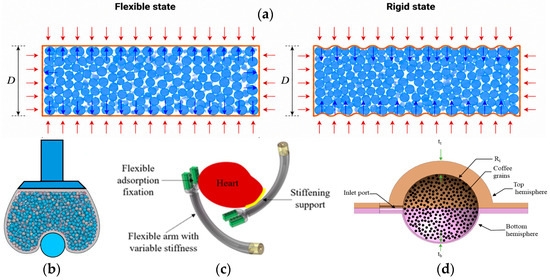
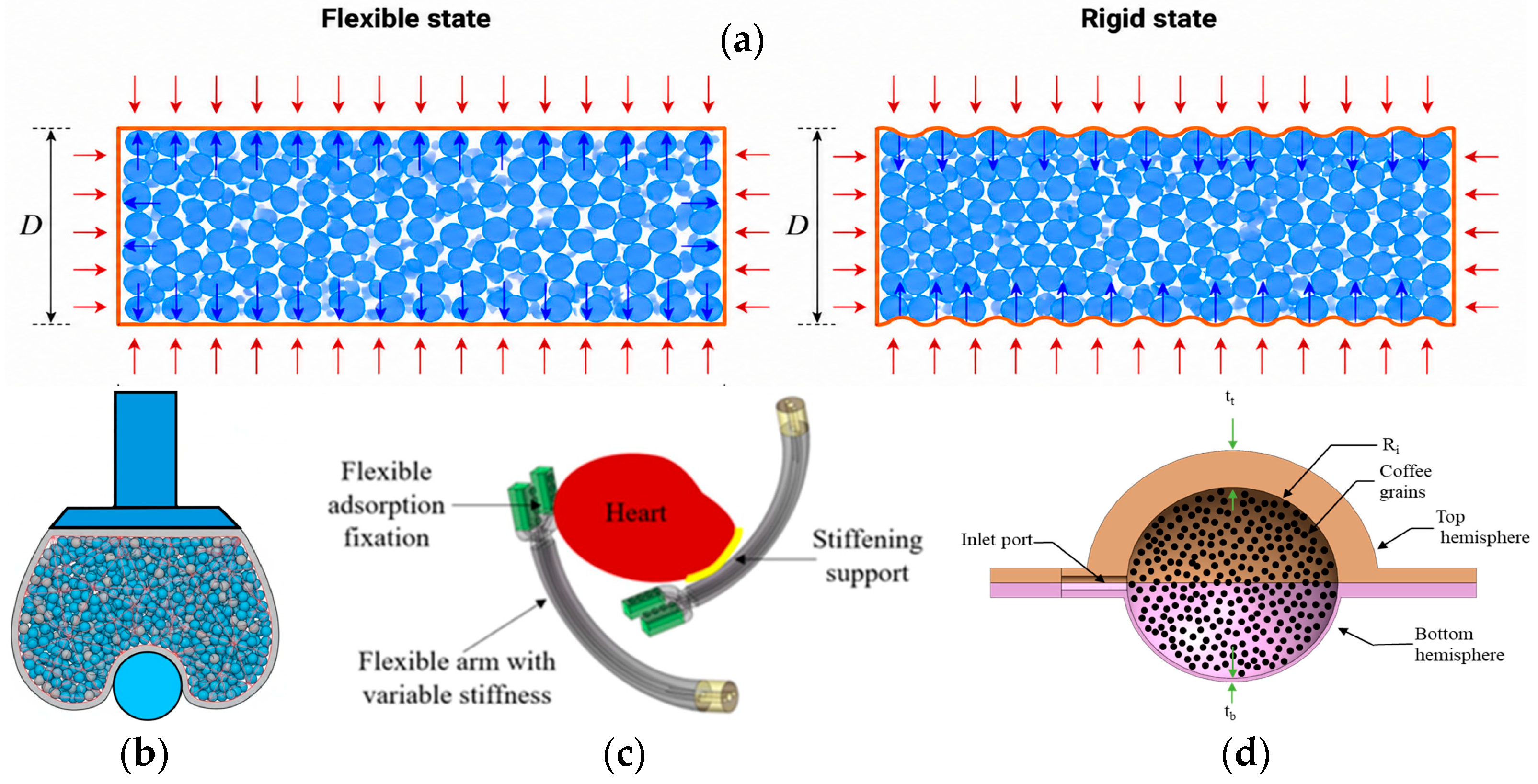
This combination of compliance and controllable rigidity has enabled granular jamming to be applied to robotic grippers, variable-stiffness manipulators, surgical devices, orthotic and fixation systems, and haptic interfaces [5,6,7,8,9,10,11,12,13,14,15,16,17,18]. Robotic grippers, for example, can conform to irregular objects before stiffening to improve grasp stability [7,12], while variable-stiffness surgical devices can remain flexible during navigation and increase rigidity during manipulation [8,9,17]. Granular jamming has also been investigated in tactile and palpation systems in which pressure-dependent stiffness is used to reproduce different mechanical conditions [10,11,16]. The operating principle and representative applications are illustrated in Figure 1, and selected engineering applications are summarized in Table 1.
Figure 1.
(a) Operating principle of granular jamming illustrating the transition from the unjammed (left) to the jammed (right) state, where vacuum-induced particle confinement increases interparticle friction and structural stiffness. Representative applications include (b) robotic gripper [19], (c) minimally invasive surgical devices [20], and (d) tactile/palpation interfaces [11].
Table 1.
Representative engineering applications of granular-jamming mechanisms.
1.2. Mechanical Characterization and Research Gap
Although granular-jamming mechanisms have been widely demonstrated in engineering applications, quantitative characterization of their pressure-dependent mechanical response remains important for design and control. The apparent stiffness of a granular-jamming structure is not an intrinsic property of the granular medium alone but results from interactions among the particles, enclosing membrane, specimen geometry, packing conditions, confinement pressure, and applied loading conditions. Experimentally determined stiffness should therefore be interpreted as the structural response of the complete granular–membrane system.
Pressure-dependent mechanical behavior is also a fundamental characteristic of jammed granular packings and has been extensively investigated in granular physics. Previous studies have examined the evolution of bulk and shear moduli and related mechanical properties near jamming as functions of confining pressure, particle friction, particle shape, and particle deformability [24,25,26,27]. These investigations demonstrate the importance of evolving particle-contact networks and confinement in determining the mechanical response of granular assemblies. In membrane-confined granular-jamming structures used in engineering applications, these effects are additionally coupled with membrane mechanics, specimen geometry, packing conditions, and externally applied vacuum pressure.
Engineering studies of granular jamming have used performance measures such as grasping force, manipulation accuracy, deformation capability, and device functionality [5,6,7,8,10,11,12,16,22,23]. While these studies demonstrate the effectiveness of granular jamming for specific applications, differences in granular media, membranes, specimen geometries, pressure conditions, and loading methods make direct comparison among systems difficult. Quantitative pressure–stiffness relationships obtained under controlled conditions are therefore useful for evaluating granular-jamming structures and determining how operating pressure influences their mechanical response.
Loading conditions are particularly relevant because granular structures exhibit particle rearrangement, frictional interactions, and energy dissipation. A stiffness response obtained under quasi-static loading may therefore differ from the apparent response observed during transient loading. Characterizing these differences is important when pressure-dependent stiffness data are used to inform the design or operation of variable-stiffness mechanisms.
1.3. Objective and Scope
The objective of this study is to experimentally investigate the pressure-dependent mechanical response of a cylindrical granular-jamming structure under two loading conditions. A single specimen consisting of commercial coffee granules enclosed within a latex membrane was evaluated over a vacuum-pressure range of 0 to −10 kPa using impact and quasi-static bending tests. The same specimen and pressure-control procedure were used throughout the study to provide internally consistent comparisons across the investigated pressure conditions.
The quasi-static measurements were analyzed using an equivalent-beam representation to obtain an effective structural stiffness for comparison across vacuum pressures. The impact experiment was used to examine the corresponding pressure-dependent response under transient loading and to determine whether the observed trend differed from that obtained under quasi-static conditions. Because the study uses a single specimen without replicated measurements at each pressure condition, the results are intended as a preliminary engineering characterization rather than a statistically validated constitutive description of granular-jamming materials.
The principal contributions of this study are: (1) preliminary experimental characterization of the pressure-dependent bending response of a cylindrical granular-jamming structure over a controlled vacuum-pressure range; (2) comparison of quasi-static and impact loading to examine the influence of loading condition on the measured response; and (3) baseline engineering observations that may inform the design and future systematic characterization of pressure-controlled variable-stiffness mechanisms. Importantly, the comparison identifies distinct pressure-dependent mechanical responses under quasi-static and transient loading, highlighting the importance of loading conditions in the application-relevant characterization of granular-jamming structures.
2. Materials and Methods
2.1. Granular-Jamming Specimen
A cylindrical granular-jamming specimen was fabricated to experimentally investigate the pressure-dependent stiffness of a vacuum-controlled variable-stiffness structure. The specimen consisted of a granular medium enclosed within a flexible elastomeric membrane and connected to an external vacuum source. Reducing the internal pressure increased the confinement of the granular particles, thereby restricting particle rearrangement and increasing the apparent structural stiffness through the granular-jamming mechanism.
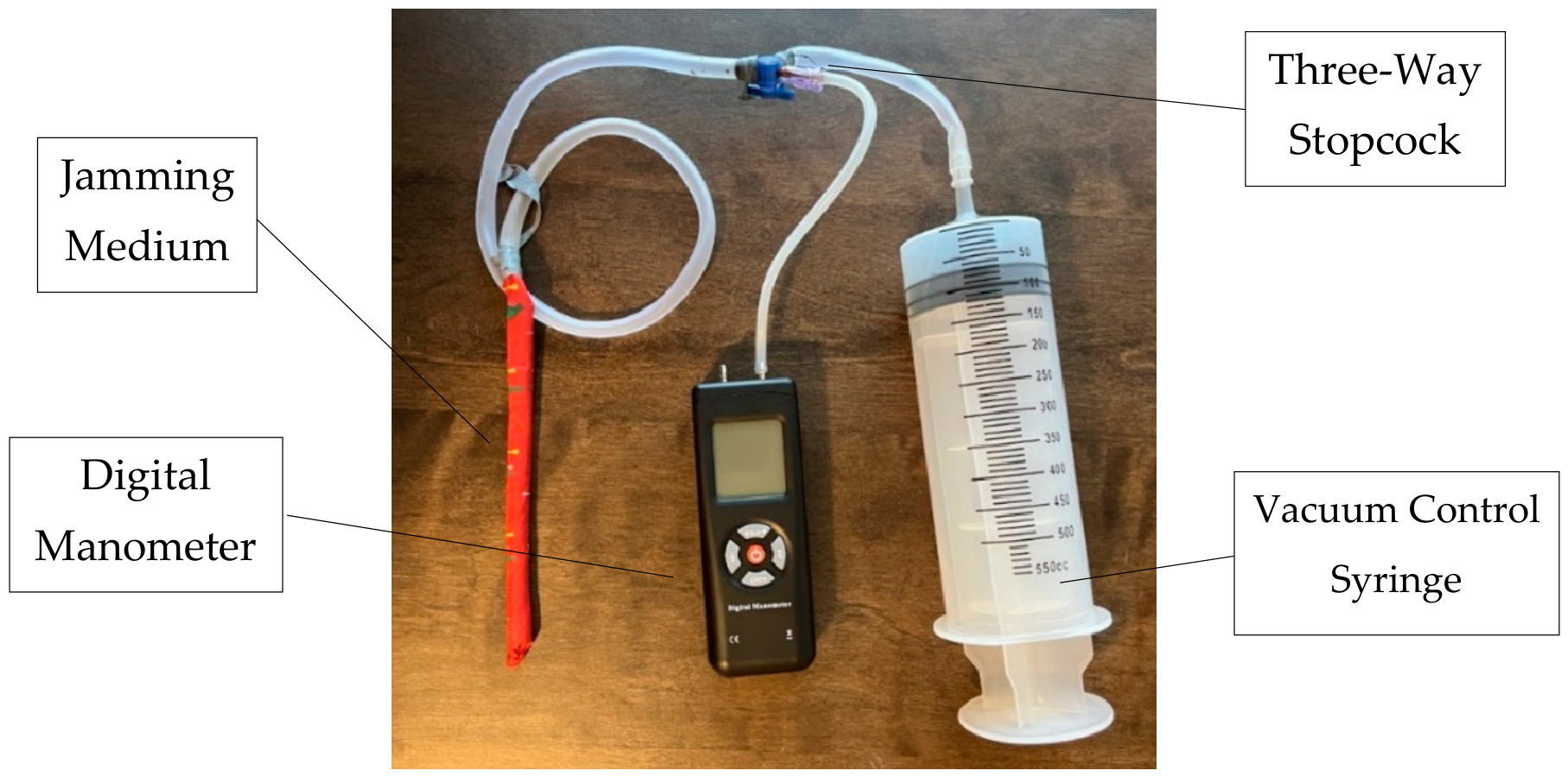
Commercially available coffee granules were selected as the granular medium because of their irregular particle morphology, availability, low cost, and demonstrated suitability for granular-jamming applications reported in previous studies [4,5,6,7,12]. The granules were sealed within a thin latex membrane to produce a compliant cylindrical specimen capable of switchable transitions between unjammed and jammed states while maintaining a constant external geometry. One end of the specimen was connected to flexible pneumatic tubing to regulate the internal pressure using an external vacuum source.
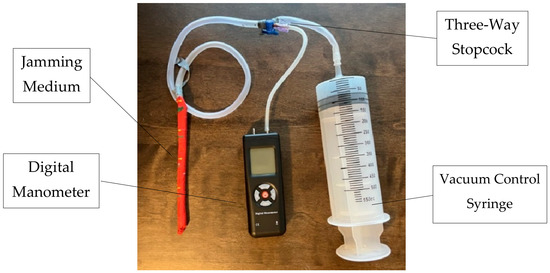
The fabricated specimen is shown in Figure 2. The specimen geometry remained unchanged throughout the study, and only the applied vacuum pressure was varied during the experiments. To eliminate specimen-to-specimen variability, the same specimen was used for both the impact-loading and static-loading experiments.
Figure 2.
Fabricated cylindrical granular-jamming specimen used for experimental investigation. The figure illustrates the specimen configuration, granular medium enclosed within the elastomeric membrane, and pneumatic connection employed for vacuum-pressure control.
The principal parameters of the granular-jamming specimen are summarized in Table 2. These parameters are reported based on the information documented during the original experiments. Because the study was originally conducted as an exploratory investigation, several parameters relevant to detailed reproducibility, including membrane thickness and specific latex formulation, particle-size distribution, granular mass, and packing density, were not independently measured.
Table 2.
Geometric and material parameters of the granular-jamming specimen.
Because the experiments were conducted as an exploratory study using a commercially available membrane and granular medium, membrane thickness, particle-size distribution, granular mass, and packing density were not independently measured. These parameters are therefore not reported retrospectively and are recognized as limitations affecting full reproducibility.
2.2. Mechanical Analysis
The quasi-static pressure-dependent mechanical response of the granular-jamming specimen was evaluated by converting the experimentally measured beam deflections into equivalent flexural stiffness and equivalent Young’s modulus using classical Euler–Bernoulli beam theory [28]. For the impact experiment, the same geometric normalization was used only to derive an apparent impact-response metric for relative comparison across pressure conditions, as described in Section 2.4. Although a granular-jamming structure is not a homogeneous elastic material, representing the specimen as an equivalent beam provides practical engineering parameters for quantitatively comparing stiffness under different vacuum pressures.
The specimen was modeled as a simply supported cylindrical beam subjected to a concentrated transverse load applied at its midpoint. Under the assumptions of Euler–Bernoulli beam theory, the midpoint deflection of a simply supported beam subjected to a central point load is given by Equation (1), where is the midpoint deflection, is the applied load, is the support span, is the equivalent Young’s modulus, is the second moment of area of the cross-section, and is the equivalent flexural rigidity. For a cylindrical specimen with diameter , the second moment of area is given by Equation (2). The specimen diameter used in the original calculations was 25.18 mm and remained constant throughout all experiments. This value was used to calculate the second moment of area and equivalent Young’s modulus. Rearranging Equation (1) yields the equivalent flexural rigidity (), as expressed in Equation (3). Substituting Equation (2) into Equation (3) gives the equivalent Young’s modulus, as shown in Equation (4). The equivalent Young’s modulus at each vacuum-pressure condition was calculated from the measured force–deflection response using Equation (4). Because the vacuum-jammed specimen is a heterogeneous granular composite rather than a homogeneous elastic material, the calculated Young’s modulus represents an equivalent (effective) modulus that was used to quantitatively compare the flexural behavior under different vacuum pressures.
The above equations were used to calculate the equivalent flexural stiffness and equivalent Young’s modulus at each vacuum-pressure condition using the experimentally measured deflections. The calculated values represent equivalent structural properties of the entire granular-jamming specimen and are used solely as comparative engineering metrics. They should not be interpreted as intrinsic material properties of the granular medium because the measured response depends on particle interactions, membrane deformation, confinement pressure, and specimen geometry. The assumptions adopted in the mechanical analysis are summarized in Table 3.
Table 3.
Assumptions adopted in mechanical analysis.
2.3. Experimental Setup
A custom experimental apparatus was developed to evaluate the pressure-dependent stiffness of the granular-jamming specimen under controlled loading conditions. The setup consisted of a support fixture, vacuum-pressure regulation system, loading mechanism, and displacement measurement system. The same apparatus and specimen were used throughout the study, with only the loading configuration differing between the impact-loading and static-loading experiments.
The granular-jamming specimen was positioned on two rigid supports to establish a simply supported boundary condition with a support span of 100 mm, which was maintained constant throughout all experiments and used as L in the equivalent stiffness calculations described in Section 2.2. Vacuum pressure was supplied through flexible pneumatic tubing connected to an external vacuum source. The internal pressure was adjusted over a range of 0 to −10 kPa and verified using a vacuum gauge before each measurement. After the desired pressure level was reached, sufficient time was allowed for the specimen to stabilize before mechanical testing.
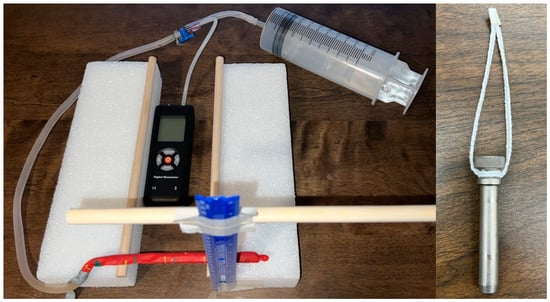
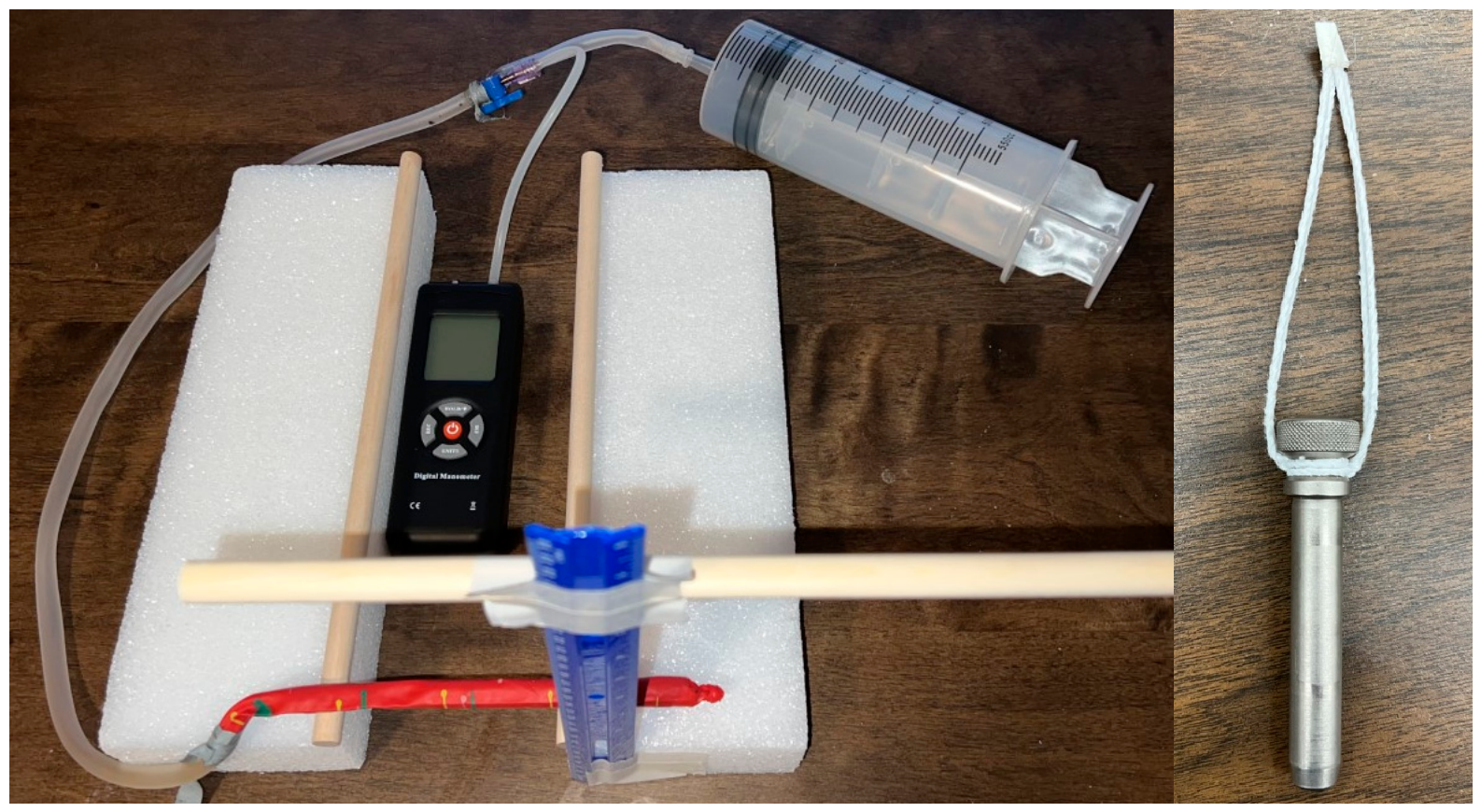
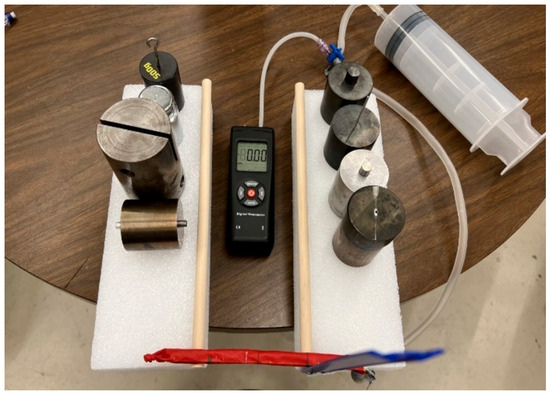
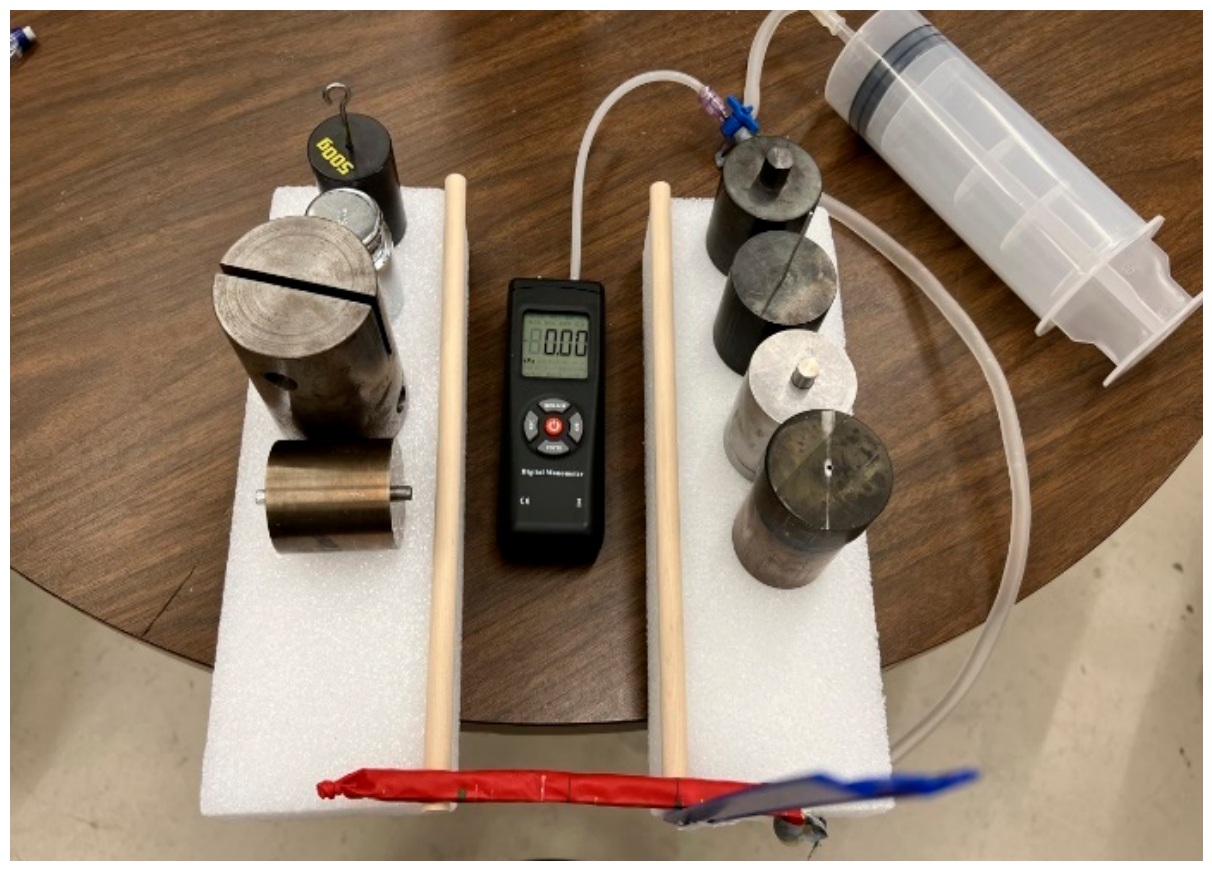
As shown in Figure 3 and Figure 4, the loading device was aligned with the midpoint of the specimen to ensure consistent loading conditions throughout the experiments. Midpoint deformation was measured relative to the unloaded configuration using a fixed reference scale. All measurements were conducted under identical environmental conditions while maintaining the same specimen geometry, support span, and pressure-control procedure.
Figure 3.
Experimental configuration of the impact-loading test. The specimen was positioned on a simply supported fixture, and a rigid impactor was released to apply a concentrated load at the specimen midpoint.
Figure 4.
Experimental configuration of the static-loading test. The specimen was positioned at the edge of the table to allow the weight to hang freely under gravity.
To maintain consistent experimental conditions, each pressure condition was evaluated using the same experimental protocol. Between successive measurements, the external load was removed and the vacuum was released, allowing the specimen to recover toward its unloaded compliant configuration before the next pressure condition was established. No imaging or particle-tracking measurements were performed to verify restoration of the internal granular configuration; therefore, an identical particle arrangement or contact network between successive measurements cannot be assumed.
One measurement was obtained at each vacuum-pressure condition using the same specimen. Consequently, the present dataset does not provide replicate measurements from which trial-to-trial variability, standard deviation, or other statistical repeatability metrics can be determined. The measured responses were subsequently analyzed using the procedures described in Section 2.2, Section 2.4 and Section 2.5. The principal components of the experimental apparatus are summarized in Table 4.
Table 4.
Experimental setup and measurement equipment.
2.4. Impact Loading Test
An impact-loading experiment was conducted to evaluate the pressure-dependent mechanical response of the granular-jamming specimen under dynamic loading conditions. The experimental configuration is illustrated in Figure 3. The specimen was positioned on the simply supported fixture described in Section 2.3 and connected to the vacuum-pressure regulation system. Prior to each measurement, the desired vacuum pressure was established and verified using the vacuum gauge.
A rigid impactor was released from a constant height to strike the midpoint of the specimen, producing transient flexural deformation. The impact conditions were maintained constant throughout the experiments to ensure that variations in the measured response were attributable only to changes in vacuum pressure. Following each impact event, the maximum midpoint deflection was recorded and used for subsequent mechanical analysis.
The experiment was repeated over the entire vacuum-pressure range of 0 to −10 kPa while maintaining identical specimen geometry, support conditions, impact configuration, and measurement procedure. Between successive tests, the specimen was allowed to return to its initial unloaded configuration before the vacuum pressure was adjusted to the next test condition. In addition, although the specimen was returned to its macroscopic unloaded configuration between measurements, restoration of an identical internal particle arrangement and contact network could not be verified.
Because Euler–Bernoulli beam theory is based on quasi-static equilibrium, the impact-test results were not interpreted as measurements of an intrinsic or dynamic Young’s modulus. The measured maximum midpoint deflections were used with the geometric normalization described in Section 2.2 only to provide an apparent impact-response metric for relative comparison among the investigated vacuum-pressure conditions. This metric does not account for inertia, damping, strain-rate effects, energy dissipation, or transient particle rearrangement and therefore should not be interpreted as, or quantitatively compared with, the equivalent Young’s modulus obtained from the quasi-static experiment. The principal experimental parameters for the impact-loading test are summarized in Table 5.
Table 5.
Experimental parameters for the impact-loading test.
2.5. Static Loading Test
A static-loading experiment was conducted to evaluate the pressure-dependent mechanical response of the granular-jamming specimen under quasi-static loading conditions. The experimental configuration is illustrated in Figure 4. The specimen was positioned on the simply supported fixture described in Section 2.3, with one end of the support assembly placed at the edge of the table to allow a hanging load to be applied freely at the midpoint of the specimen.
Prior to each measurement, the desired vacuum pressure was established and verified using the vacuum gauge. A constant hanging mass of 12.08 g was then carefully applied at the specimen midpoint and maintained until the deformation reached a stable equilibrium. Unlike the impact-loading experiment, the load was applied gradually without an initial velocity, allowing the influence of static loading on the pressure-dependent stiffness to be evaluated independently of impact-induced dynamic effects.
The experiment was repeated over the entire vacuum-pressure range of 0 to −10 kPa while maintaining identical specimen geometry, support conditions, loading location, and measurement procedure. Between successive tests, the hanging load was removed, the specimen was allowed to recover to its initial unloaded configuration, and the vacuum pressure was adjusted to the next test condition.
The measured midpoint deflections were subsequently converted into equivalent flexural stiffness and equivalent Young’s modulus using the analytical relationships presented in Section 2.2. These calculated values were used to characterize the influence of vacuum pressure on the apparent stiffness of the granular-jamming specimen under quasi-static loading. The principal experimental parameters for the static-loading test are summarized in Table 6.
Table 6.
Experimental parameters for the static-loading test.
3. Results
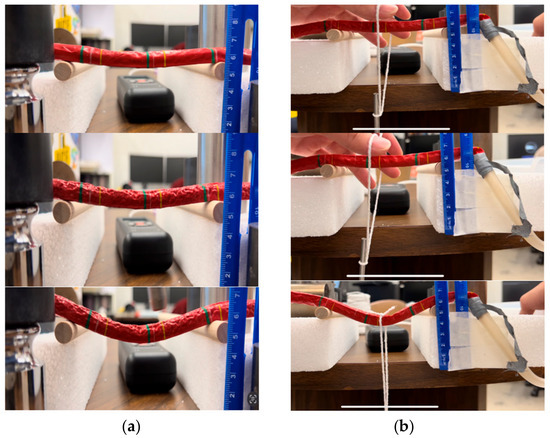
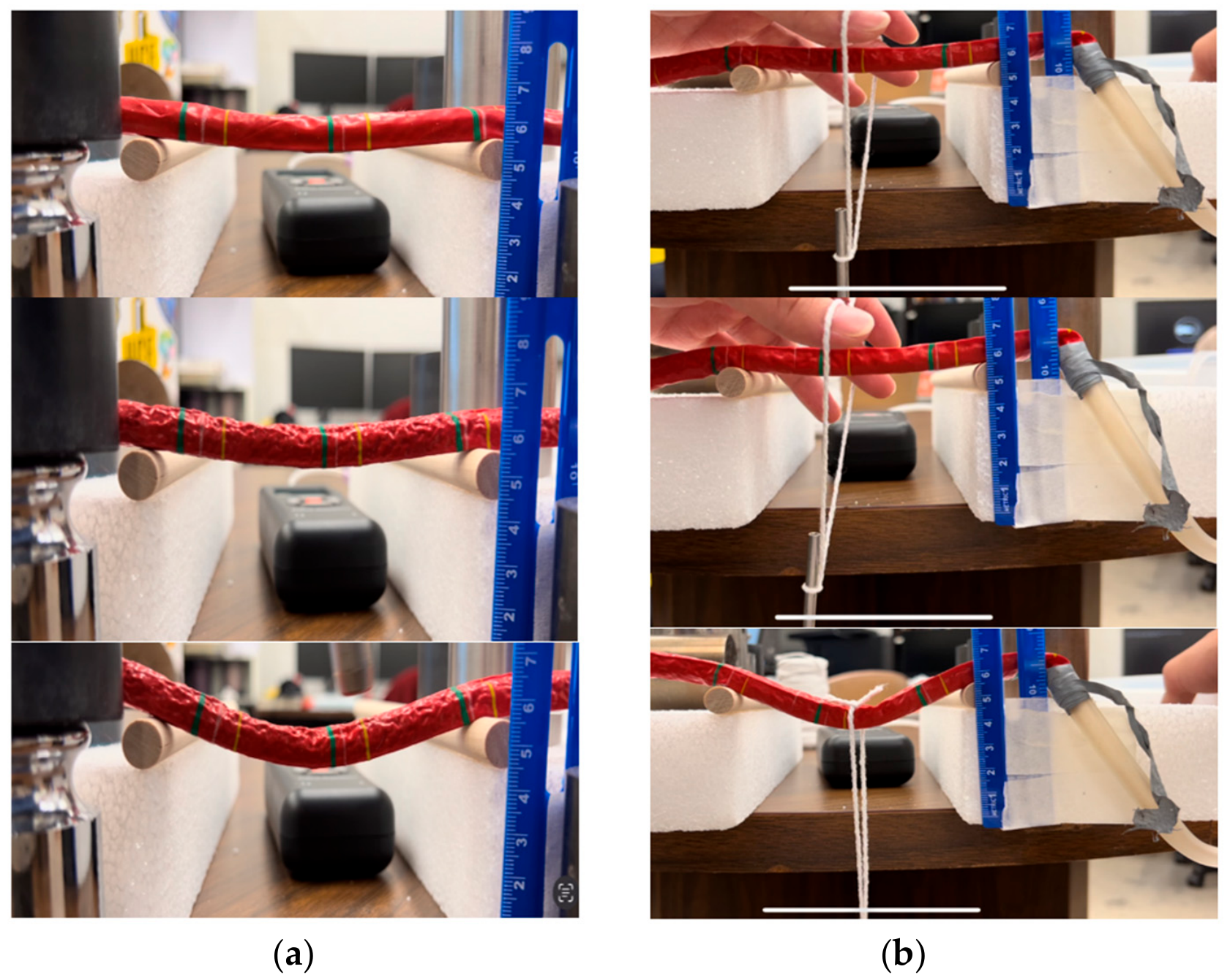
Representative photographs of the specimen during impact and static loading are shown in Figure 5. The images qualitatively illustrate the reduction in beam deflection with increasing vacuum pressure, demonstrating the pressure-dependent stiffening behavior of the granular-jamming structure.
Figure 5.
Representative photographs illustrating the deformation of the granular-jamming specimen during (a) impact loading and (b) static loading under different vacuum-pressure conditions.
3.1. Pressure–Deflection Relationship
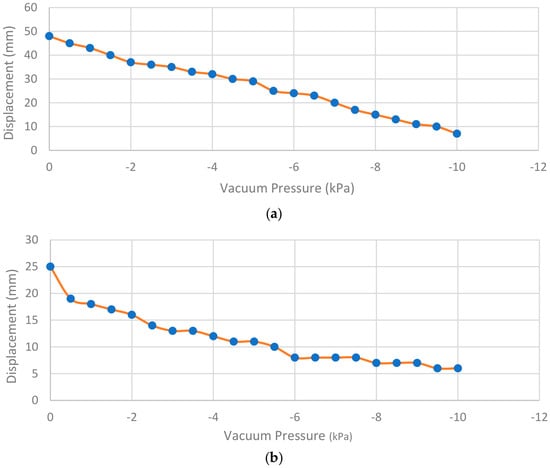
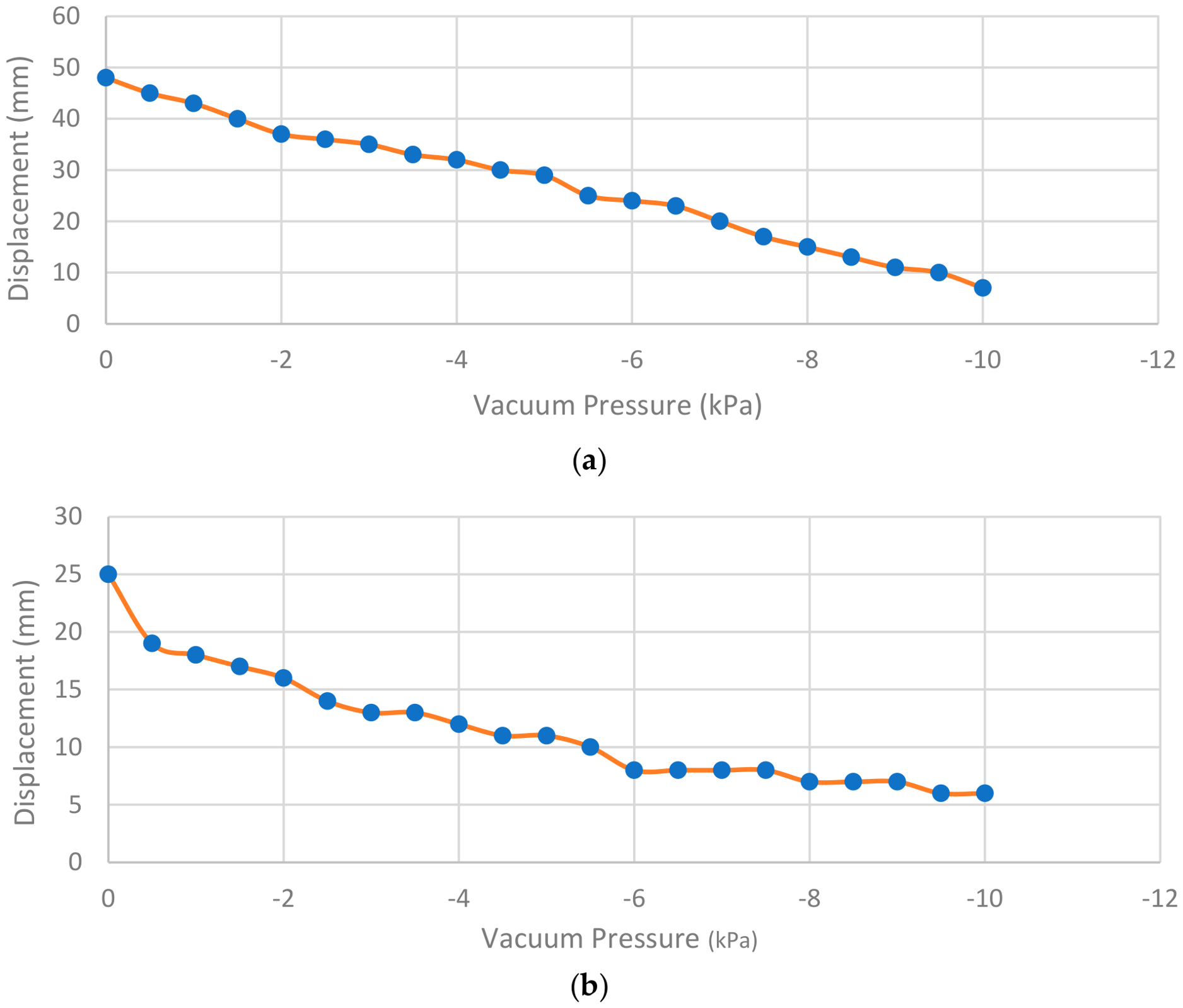
The measured midpoint deflections of the granular-jamming specimen under both impact and static loading conditions are presented in Figure 6. For both loading configurations, increasing vacuum pressure resulted in progressively smaller beam deflections, indicating an increase in the apparent structural stiffness of the specimen.
Figure 6.
Midpoint deflection of the granular-jamming specimen as a function of vacuum pressure under (a) impact loading and (b) static loading.
Under impact loading, the measured deflection decreased continuously as the vacuum pressure increased from 0 to −10 kPa. The reduction in deflection was most pronounced at lower vacuum pressures, while the rate of change became less apparent at higher pressure levels.
A similar trend was observed under static loading, where increasing vacuum pressure also produced progressively smaller beam deflections. Compared with the impact-loading results, however, the reduction in deflection occurred more uniformly throughout the investigated pressure range.
The results demonstrate that vacuum pressure effectively controls the deformation of the granular-jamming specimen regardless of the loading method. Nevertheless, the measured pressure–deflection relationship differed between the two loading conditions, suggesting that loading mode influences the apparent mechanical response of the structure.
3.2. Pressure–Stiffness Relationship
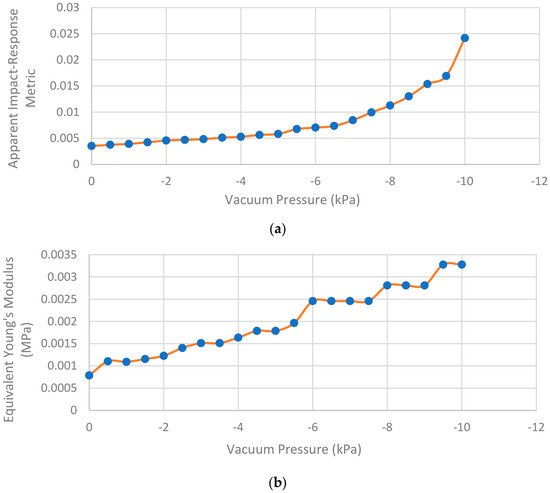
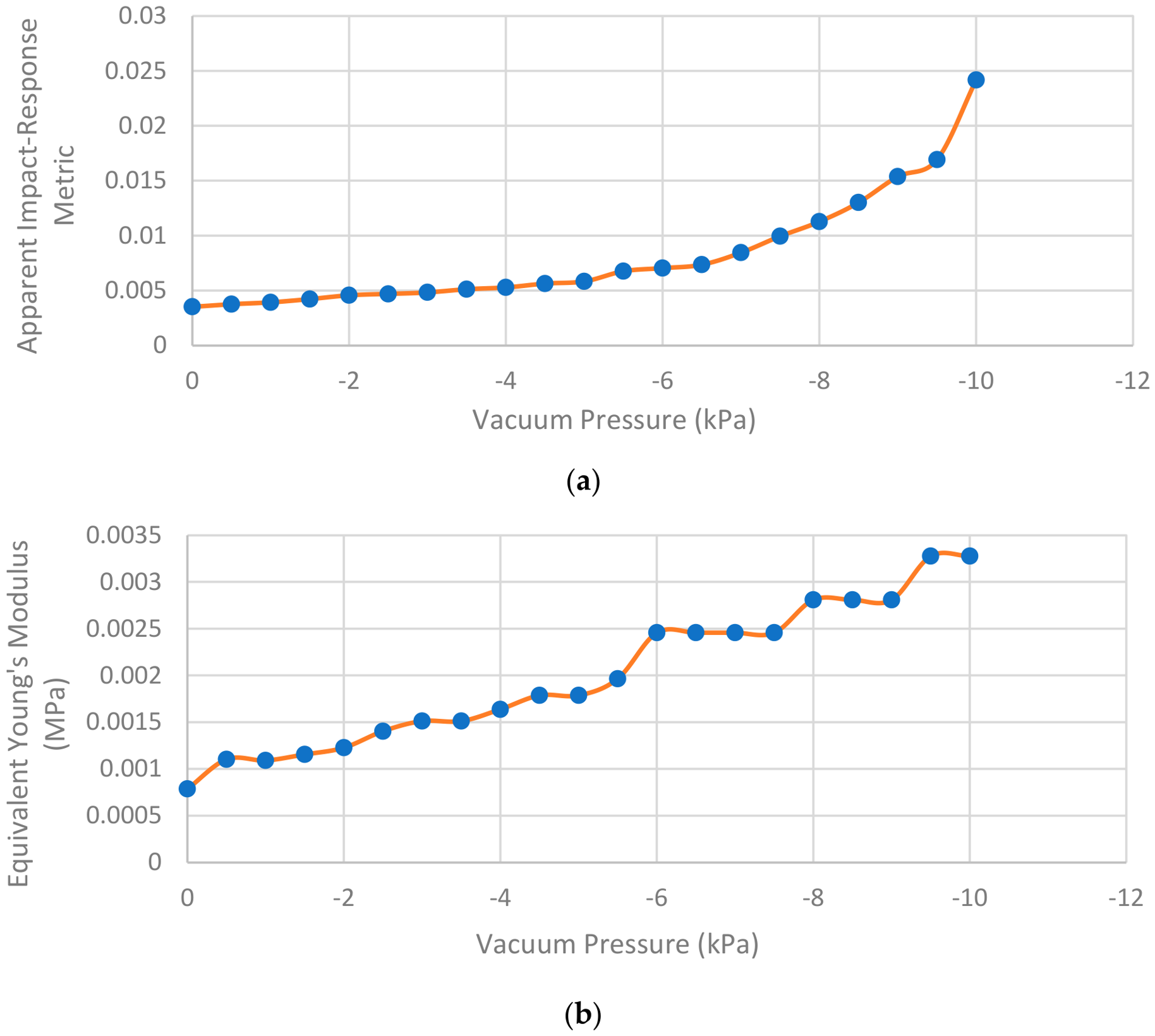
The pressure-dependent mechanical response derived from the measured beam deflections is presented in Figure 7. For the impact-loading experiment, the results are expressed as an apparent impact-response metric for relative comparison, whereas the static-loading results are expressed as equivalent Young’s modulus using the analytical relationships presented in Section 2.2. Both metrics increased with increasing vacuum pressure, demonstrating increased structural resistance to deformation with increasing particle confinement.
Figure 7.
Pressure-dependent mechanical response of the granular-jamming specimen: (a) apparent impact-response metric under impact loading and (b) equivalent Young’s modulus under static loading.
The static-loading experiment demonstrated an approximately linear increase in equivalent Young’s modulus over the investigated pressure range. In contrast, the impact-loading results exhibited a nonlinear trend, with larger stiffness increases observed at lower vacuum pressures and a reduced rate of increase at higher pressures. This difference indicates that loading conditions influence the measured apparent stiffness, particularly as particle confinement becomes more pronounced.
Although the mechanical-response metrics differed between the two loading methods, both experiments consistently demonstrated the ability of granular jamming to provide switchable and controllable stiffness modulation through vacuum-pressure regulation.
3.3. Comparison of Loading Conditions
A direct comparison of the two experimental methods highlights the influence of loading conditions on the measured mechanical response of the granular-jamming specimen. Both methods demonstrated the same overall trend of increasing stiffness with increasing vacuum pressure; however, differences were observed in the shape of the pressure–stiffness relationship.
The static-loading measurements exhibited a relatively uniform increase in equivalent Young’s modulus throughout the investigated pressure range, whereas the impact-loading measurements showed a more nonlinear pressure–stiffness relationship at higher vacuum pressures. These differences may be attributed to the dynamic nature of the impact test, where transient particle rearrangement, localized energy dissipation, and rate-dependent frictional interactions influence the measured deformation.
Despite these differences, the two experimental approaches produced consistent qualitative conclusions regarding pressure-dependent stiffness modulation. The agreement between the two loading methods supports the observed trend of increasing stiffness while demonstrating that loading conditions should be considered when experimentally characterizing granular-jamming structures. The principal differences in the observed mechanical responses under impact and static loading are summarized in Table 7.
Table 7.
Summary of the observed mechanical response under the two loading conditions.
4. Discussion
4.1. Pressure-Dependent Stiffness Modulation
The experimental results demonstrated that increasing vacuum pressure consistently increased the apparent stiffness of the granular-jamming specimen under both loading conditions. As the internal pressure decreased, greater confinement of the granular particles increased interparticle contact forces and frictional resistance, thereby restricting particle rearrangement during bending. Consequently, the specimen exhibited progressively smaller beam deflections and larger equivalent flexural stiffness as the vacuum pressure increased.
The observed pressure-dependent behavior is consistent with the fundamental mechanics of granular jamming, where the transition from an unjammed to a jammed state is governed by the degree of particle confinement rather than changes in the material properties of the individual particles [3,4,5,6]. The calculated equivalent Young’s modulus therefore represents the overall structural response of the specimen and provides a convenient engineering metric for comparing stiffness under different operating conditions.
The measured response also includes the mechanical contribution of the enclosing latex membrane. The membrane provides tensile resistance during bending and may exhibit nonlinear deformation depending on specimen curvature and vacuum pressure. Because the membrane was not independently characterized, its contribution cannot be quantitatively separated from that of the granular packing in the present data. Accordingly, the calculated equivalent Young’s modulus should be interpreted as an effective property of the complete granular–membrane structure rather than an intrinsic property of the granular medium alone. Independent membrane testing and comparison with an unfilled membrane specimen would be required to quantify these contributions separately.
The ability to continuously regulate stiffness using only pneumatic control represents one of the principal advantages of granular-jamming systems. Unlike conventional mechanical locking mechanisms, vacuum-induced jamming provides switchable stiffness modulation, without requiring complex actuators or structural reconfiguration [3,4,5,6,7,12]. The experimental results demonstrate that relatively small changes in vacuum pressure can produce measurable changes in structural rigidity, supporting the use of granular jamming as a practical variable-stiffness mechanism.
4.2. Influence of Loading Conditions
Although both loading methods demonstrated the same overall trend of increasing stiffness with increasing vacuum pressure, differences were observed in the measured pressure–stiffness relationships. The static-loading experiment exhibited an approximately linear increase in equivalent Young’s modulus over the investigated pressure range, whereas the impact-loading experiment produced a more nonlinear response, particularly at higher vacuum pressures. The more linear response under quasi-static loading may be associated with greater time for particle rearrangement and redistribution of interparticle contact forces, whereas transient impact loading introduces additional rate-dependent effects.
These differences likely arise from the different deformation mechanisms associated with quasi-static and dynamic loading. Under static loading, the granular medium has sufficient time to redistribute internal contact forces, resulting in a comparatively stable structural response. In contrast, impact loading introduces transient deformation, localized particle rearrangement, and energy dissipation that may influence the measured maximum deflection. Consequently, the apparent stiffness obtained from impact loading reflects both structural rigidity and dynamic effects associated with the loading event.
These findings indicate that loading conditions should be considered when experimentally characterizing granular-jamming structures. While both methods effectively captured pressure-dependent stiffness modulation, static loading may provide more consistent measurements for quantitative mechanical characterization, whereas impact loading may be more representative of applications involving transient loading or dynamic interactions.
The key insight from this comparison is that the pressure-dependent mechanical response cannot be characterized solely by the general trend of increasing stiffness with vacuum pressure. The form of the pressure–response relationship also depends on the loading condition: the quasi-static response was approximately linear over the investigated pressure range, whereas the impact response became increasingly nonlinear at higher vacuum levels. Although the present preliminary experiments do not establish the underlying dynamic mechanisms, this difference indicates that pressure–stiffness relationships obtained under quasi-static conditions should not be directly generalized to transient loading. Future characterization and modeling of granular-jamming structures should therefore consider loading conditions representative of the intended application.
4.3. Engineering Implications
The experimental characterization presented in this study establishes baseline engineering data describing the relationship between vacuum pressure and structural stiffness for a cylindrical granular-jamming structure. Such information is useful for the design and evaluation of pressure-controlled variable-stiffness mechanisms in robotics and adaptive mechanical systems.
Although only a single specimen configuration was investigated, the experimental methodology may be readily extended to alternative granular media, membrane materials, and structural geometries. The use of equivalent flexural stiffness and equivalent Young’s modulus also provides common engineering metrics that facilitate comparison among different granular-jamming designs.
Potential applications include variable-stiffness robotic manipulators, adaptive gripping systems, haptic interfaces, wearable assistive devices, and biomedical simulation platforms, where controllable structural rigidity can improve both functionality and safety. The experimental data presented here may therefore serve as a reference for future engineering studies involving the design and optimization of pressure-controlled variable-stiffness structures.
For example, in a granular-jamming element incorporated into a variable-stiffness robotic manipulator, an experimentally determined pressure–deflection relationship can assist in selecting the vacuum pressure required to achieve a desired level of compliance or rigidity under a specified loading condition. The present comparison also indicates that a relationship obtained under quasi-static loading should not necessarily be assumed to represent the response under transient loading. Therefore, pressure-dependent characterization under application-relevant loading conditions can provide useful design information for selecting operating pressures and evaluating variable-stiffness mechanisms. Integration of such relationships into closed-loop stiffness control represents a potential future application rather than an outcome demonstrated in the present study.
4.4. Limitations and Future Work
The results of this study should be interpreted as a preliminary engineering characterization rather than a comprehensive constitutive characterization of granular-jamming materials. Several limitations of the original experimental design restrict the quantitative generalizability and reproducibility of the reported results.
First, a single specimen and a single commercially available granular medium were used. Although using the same specimen eliminated specimen-to-specimen variation when comparing pressure conditions and loading methods, it does not establish repeatability across independently fabricated specimens. In addition, several parameters that can influence jamming behavior, including particle-size distribution, granular mass, packing density, and membrane thickness, were not independently measured during the original experiments. Consequently, the reported pressure-dependent response is specific to the tested specimen and should not be interpreted as a material property of coffee granules or as a universal relationship for granular-jamming structures.
Second, the original experiments used one measurement at each pressure condition. Replicate measurements were therefore not available for calculation of standard deviations, confidence intervals, or formal repeatability metrics. The observed trends demonstrate systematic changes with vacuum pressure within the tested specimen, but the experimental uncertainty and trial-to-trial variability cannot be quantified from the available data. Future studies should incorporate repeated measurements at each pressure, independently fabricated specimens, and formal uncertainty propagation for pressure, force, displacement, and geometric measurements.
Third, the equivalent Young’s modulus calculated in this study represents an effective structural parameter of the complete granular–membrane system rather than an intrinsic material modulus. The latex membrane contributes to the structural response and may exhibit nonlinear behavior, while particle rearrangement, friction, and evolving contact networks introduce additional nonlinearity and history dependence. Future experiments should therefore characterize the membrane independently and compare filled and unfilled specimens to quantify its contribution.
Fourth, Euler–Bernoulli beam theory provides a first-order approximation for the quasi-static bending experiment but does not describe the transient mechanics of the impact event. In particular, inertia, damping, strain-rate effects, energy dissipation, and transient particle rearrangement are not represented. Accordingly, values calculated from the impact deflection should be interpreted only as apparent or equivalent impact-response metrics for comparison within the present experiment, rather than as true dynamic Young’s moduli. Future impact studies should incorporate force and displacement measurements with sufficient temporal resolution and employ dynamic or energy-based mechanical models.
Finally, only bending behavior over a vacuum-pressure range of 0 to −10 kPa was investigated. Future systematic characterization should examine controlled granular materials with specified particle size and morphology, multiple membrane materials and thicknesses, packing density and filling ratio, broader pressure ranges, cyclic loading, loading-rate dependence, and alternative deformation modes. Such experiments would allow the preliminary trends identified here to be developed into statistically validated and reproducible design relationships for granular-jamming structures.
5. Conclusions
This study presents a preliminary experimental characterization of the pressure-dependent mechanical response of a cylindrical granular-jamming structure under quasi-static and impact loading conditions. A vacuum-controlled specimen containing coffee granules enclosed within a latex membrane was evaluated over a vacuum pressure range of 0 to −10 kPa. Under quasi-static loading, experimentally measured beam deflections were converted into equivalent flexural stiffness and equivalent Young’s modulus using classical beam theory, whereas the impact measurements were interpreted using an apparent impact-response metric for relative comparison.
As expected from established granular-jamming mechanics, increasing vacuum pressure consistently reduced beam deflection and increased the apparent structural stiffness under both loading conditions. More importantly, the measured pressure-dependent response differed between the two loading conditions. The static-loading configuration produced an approximately linear pressure–stiffness relationship, whereas the impact-loading configuration exhibited a nonlinear response at higher vacuum pressures. This difference indicates that the pressure-dependent mechanical response of a granular-jamming structure is influenced by the loading condition and that a relationship obtained under quasi-static loading should not necessarily be generalized to transient loading.
The comparison of these two loading conditions provides an engineering insight beyond the established phenomenon of pressure-dependent stiffening. The results indicate that pressure–stiffness relationships used for characterization, design, or control of variable-stiffness systems should be determined under loading conditions representative of the intended application. The experimental methodology and baseline characterization data therefore provide a practical basis for further investigation of pressure-controlled variable-stiffness systems, including robotic platforms that integrate adaptive mechanics with perception, learning, and intelligent control.
The preliminary findings identified in this study provide a basis for more systematic characterization of pressure-controlled granular-jamming structures. Future studies should incorporate independently fabricated specimens, repeated measurements and uncertainty analysis, controlled granular media with characterized particle properties, independent membrane characterization, and time-resolved force and displacement measurements under different loading conditions and rates. Such investigations will be necessary to determine whether the loading-dependent behavior observed in this study is generalizable, identify the mechanisms underlying the differences between quasi-static and transient responses, and establish statistically validated and reproducible pressure–stiffness relationships suitable for predictive engineering design.
Author Contributions
Conceptualization, C.Q. and S.S.; Data curation, C.Q.; Methodology, C.Q., Y.B. and S.S.; Project administration, Y.B. and S.S.; Supervision, Y.B. and S.S.; Visualization, C.Q., Y.B. and S.S.; Writing—original draft preparation, C.Q., S.A., P.P., M.K. and S.S.; Writing—review & editing, Y.B. and S.S. All authors have read and agreed to the published version of the manuscript.
Funding
This research received no external funding.
Data Availability Statement
The original contributions presented in this study are included in the article. Further inquiries can be directed to the corresponding author.
Conflicts of Interest
The authors declare no conflicts of interest.
References
- Vanderborght, B.; Albu-Schaeffer, A.; Bicchi, A.; Burdet, E.; Caldwell, D.G.; Carloni, R.; Catalano, M.; Eiberger, O.; Friedl, W.; Ganesh, G.; et al. Variable Impedance Actuators: A Review. Rob. Auton. Syst. 2013, 61, 1601–1614. [Google Scholar] [CrossRef] [Scilit]
- Wolf, S.; Hirzinger, G. A New Variable Stiffness Design: Matching Requirements of the next Robot Generation. In Proceedings of the 2008 IEEE International Conference on Robotics and Automation, Pasadena, CA, USA, 19–23 May 2008; pp. 1741–1746. [Google Scholar] [CrossRef] [Scilit]
- Cates, M.E.; Wittmer, J.P.; Bouchaud, J.P.; Claudin, P. Jamming, Force Chains, and Fragile Matter. Phys. Rev. Lett. 1998, 81, 1841. [Google Scholar] [CrossRef] [Scilit]
- Brown, E.; Rodenberg, N.; Amend, J.; Mozeika, A.; Steltz, E.; Zakin, M.R.; Lipson, H.; Jaeger, H.M. Universal Robotic Gripper Based on the Jamming of Granular Material. Proc. Natl. Acad. Sci. USA 2010, 107, 18809–18814. [Google Scholar] [CrossRef] [Scilit]
- Jiang, Y.; Chen, D.; Liu, C.; Li, J. Chain-Like Granular Jamming: A Novel Stiffness-Programmable Mechanism for Soft Robotics. Soft Robot. 2019, 6, 118–132. [Google Scholar] [CrossRef] [Scilit]
- Park, W.; Lee, D.; Bae, J. A Hybrid Jamming Structure Combining Granules and a Chain Structure for Robotic Applications. Soft Robot. 2022, 9, 669–679. [Google Scholar] [CrossRef] [Scilit] [PubMed]
- Li, H.; Sun, J.; Herrmann, J.M. Beyond Jamming Grippers: Granular Material in Robotics. Adv. Robot. 2024, 38, 715–729. [Google Scholar] [CrossRef] [Scilit]
- Cavallo, A.; Brancadoro, M.; Tognarelli, S.; Menciassi, A. A Soft Retraction System for Surgery Based on Ferromagnetic Materials and Granular Jamming. Soft Robot. 2019, 6, 161–173. [Google Scholar] [CrossRef] [Scilit]
- De Falco, I.; Cianchetti, M.; Menciassi, A. A Soft Multi-Module Manipulator with Variable Stiffness for Minimally Invasive Surgery. Bioinspir. Biomim. 2017, 12, 056008. [Google Scholar] [CrossRef] [Scilit]
- Rørvik, S.B.; Auflem, M.; Dybvik, H.; Steinert, M. Perception by Palpation: Development and Testing of a Haptic Ferrogranular Jamming Surface. Front. Robot. AI 2021, 8, 745234. [Google Scholar] [CrossRef] [Scilit]
- Sikander, S.; Biswas, P.; Song, S.E. Feasibility Study and Experimental Evaluation of the Design of Nodule Prototype Developed for Palpation Display Apparatus: A Novel Device for Contactless Primary Tactile Diagnosis. Micromachines 2021, 12, 576. [Google Scholar] [CrossRef] [Scilit]
- Fitzgerald, S.G.; Delaney, G.W.; Howard, D. A Review of Jamming Actuation in Soft Robotics. Actuators 2020, 9, 104. [Google Scholar] [CrossRef] [Scilit]
- Simonds, E.; Colton, J.; Kogler, G.; Chang, Y.H. Design and Testing of a Prototype Foot Orthosis That Uses the Principle of Granular Jamming. Prosthet. Orthot. Int. 2021, 45, 240–245. [Google Scholar] [CrossRef] [Scilit]
- Wellborn, P.S.; Russell, P.T.; Webster, R.J. A Multi-Subject Accuracy Study on Granular Jamming for Non-Invasive Attachment of Fiducial Markers to Patients. Int. J. Comput. Assist. Radiol. Surg. 2020, 15, 69–74. [Google Scholar] [CrossRef] [Scilit]
- LeBlanc, K.J.; Niemi, S.R.; Bennett, A.I.; Harris, K.L.; Schulze, K.D.; Sawyer, W.G.; Taylor, C.; Angelini, T.E. Stability of High Speed 3D Printing in Liquid-Like Solids. ACS Biomater. Sci. Eng. 2016, 2, 1796–1799. [Google Scholar] [CrossRef] [Scilit]
- He, L.; Herzig, N.; De Lusignan, S.; Nanayakkara, T. Granular Jamming Based Controllable Organ Design for Abdominal Palpation. In Proceedings of the 2018 40th Annual International Conference of the IEEE Engineering in Medicine and Biology Society, Honolulu, HI, USA, 18–21 July 2018; pp. 2154–2157. [Google Scholar] [CrossRef] [Scilit]
- Amanov, E.; Nguyen, T.D.; Markmann, S.; Imkamp, F.; Burgner-Kahrs, J. Toward a Flexible Variable Stiffness Endoport for Single-Site Partial Nephrectomy. Ann. Biomed. Eng. 2018, 46, 1498–1510. [Google Scholar] [CrossRef] [Scilit]
- He, L.; Leong, F.; Lalitharatne, T.D.; de Lusignan, S.; Nanayakkara, T. A Haptic Mouse Design with Stiffening Muscle Layer for Simulating Guarding in Abdominal Palpation Training. In Proceedings of the 2021 IEEE International Conference on Robotics and Automation (ICRA), Xi’an, China, 30 May–5 June 2021; pp. 12588–12594. [Google Scholar] [CrossRef] [Scilit]
- Cortes, J.; Miranda, C. Design, Control, and Applications of Granular Jamming Grippers in Soft Robotics. Robotics 2025, 14, 132. [Google Scholar] [CrossRef] [Scilit]
- Gao, L.; He, Y.; Zhu, H.; Sun, G.; Zhu, L. Stiffness Modelling and Performance Evaluation of a Soft Cardiac Fixator Flexible Arm with Granular Jamming. Machines 2021, 9, 303. [Google Scholar] [CrossRef] [Scilit]
- Hrehova, S.; Hošovský, A.; Husár, J.; Krenický, T. Granular Jamming in Soft Robotics: Simulation Frameworks and Emerging Possibilities—Review. Biomimetics 2026, 11, 193. [Google Scholar] [CrossRef] [Scilit] [PubMed]
- Cheng, N.; Amend, J.; Farrell, T.; Latour, D.; Martinez, C.; Johansson, J.; McNicoll, A.; Wartenberg, M.; Naseef, S.; Hanson, W.; et al. Prosthetic Jamming Terminal Device: A Case Study of Untethered Soft Robotics. Soft Robot. 2016, 3, 205. [Google Scholar] [CrossRef] [Scilit]
- Howard, G.D.; Brett, J.; O’Connor, J.; Letchford, J.; Delaney, G.W. One-Shot 3D-Printed Multimaterial Soft Robotic Jamming Grippers. Soft Robot. 2022, 9, 497–508. [Google Scholar] [CrossRef] [Scilit]
- O’Hern, C.S.; Silbert, L.E.; Liu, A.J.; Nagel, S.R. Jamming at Zero Temperature and Zero Applied Stress: The Epitome of Disorder. Phys. Rev. E 2003, 68, 19. [Google Scholar] [CrossRef] [Scilit]
- Somfai, E.; Van Hecke, M.; Ellenbroek, W.G.; Shundyak, K.; Van Saarloos, W. Critical and Noncritical Jamming of Frictional Grains. Phys. Rev. E 2007, 75, 020301. [Google Scholar] [CrossRef] [Scilit]
- Heussinger, C. Packings of Frictionless Spherocylinders. Phys. Rev. E 2020, 102, 022903. [Google Scholar] [CrossRef] [Scilit]
- Wang, D.; Treado, J.D.; Boromand, A.; Norwick, B.; Murrell, M.P.; Shattuck, M.D.; O’Hern, C.S. The Structural, Vibrational, and Mechanical Properties of Jammed Packings of Deformable Particles in Three Dimensions. Soft Matter 2021, 17, 9901. [Google Scholar] [CrossRef] [Scilit]
- Goodno, B.J.; Gere, J.M. Mechanics of Materials, 9th ed.; Cengage Learning: Boston, MA, USA, 2018. [Google Scholar]

Disclaimer/Publisher’s Note: The statements, opinions and data contained in all publications are solely those of the individual author(s) and contributor(s) and not of MDPI and/or the editor(s). MDPI and/or the editor(s) disclaim responsibility for any injury to people or property resulting from any ideas, methods, instructions or products referred to in the content. |
© 2026 by the authors. Licensee MDPI, Basel, Switzerland. This article is an open access article distributed under the terms and conditions of the Creative Commons Attribution (CC BY) license.