


Abstract
Distributed independent pump-controlled systems enhance excavator energy efficiency by reducing throttling losses, but sustained high-load and high-speed operation often forces a single pump into low-efficiency regions. To overcome this limitation, this study proposes a dual-pump load-sharing architecture that enables load sharing and dynamic cooperative operation of two pumps within the high-efficiency region. An adaptive closed-loop GOA-SQP optimization strategy is also developed for real-time pump speed distribution. The proposed strategy combines the global exploration capability of the Grasshopper Optimization Algorithm (GOA) with the rapid local convergence characteristics of Sequential Quadratic Programming (SQP). Unlike conventional serial hybrid optimization methods, a bidirectional efficiency-feedback mechanism is introduced to dynamically coordinate global exploration and local refinement processes in real time. Furthermore, a local perturbation and re-explosion mechanism is incorporated to suppress premature convergence, enhance population diversity, and reduce redundant iterations. Experimental validation on an excavator test platform under four-quadrant conditions shows that the proposed system improves mechanical, volumetric, and overall pump efficiencies by 14.22, 4.57, and 18.79 percentage points, respectively, and reduces total energy consumption by 8.83%. Compared with GOA, SQP, GA-SQP, and PSO-SQP, the proposed GOA-SQP algorithm reduces solution time by 39.15% and improves optimization accuracy by 0.5%. The proposed architecture and optimization strategy offer a novel and effective solution for further improving the energy efficiency of distributed independent pump-controlled excavator systems.
1. Introduction
As global energy demand continues to rise, the depletion of finite fossil fuel resources and the associated environmental pollution have become increasingly critical concerns. The construction machinery industry predominantly relies on internal combustion engines coupled with electro-hydraulic systems, an architecture characterized by inherently low energy utilization efficiency that leads to excessive greenhouse gas emissions [1]. In the context of global efforts to achieve carbon neutrality and the implementation of progressively stringent emission regulations, enhancing the energy efficiency of electro-hydraulic systems in construction machinery has emerged as an urgent and strategically essential objective [2].
Construction machinery, as exemplified by excavators, typically adopts a centralized throttling-based speed control strategy. Although widely used, this control architecture suffers from inherently poor energy efficiency. In response, there is an urgent need to explore more efficient drive architectures for excavators. Ge et al. proposed an accumulator-based gravitational potential energy recovery system that enables efficient capture and reuse of boom energy in hydraulic excavators, achieving over 75.9% energy recovery, reducing pump input by up to 52%, and significantly lowering overall energy consumption and carbon emissions [3]. A three-chamber accumulator-based hydraulic system has been proposed by integrating a conventional accumulator with the hydraulic cylinder, enabling efficient recovery and reuse of boom potential energy without modifying the original system, and achieving up to a 47.99% reduction in hydraulic circuit energy consumption and 11.42% savings in fuel consumption [4]. These studies improve energy efficiency by implementing partial modifications to components based on conventional centralized throttling-controlled excavators, but they do not fundamentally update the drive system [5]. Independent metering control hydraulic systems offer superior energy efficiency and control performance by decoupling meter-in and meter-out flows, thereby enabling reduced throttling losses, enhanced motion controllability, and improved adaptability to varying load conditions [6,7,8]. The results of the comparison indicated that pump power consumption is reduced by employing IMVs, achieving energy-saving rates of 44% during boom-down motion and 21% during arm-down motion. Furthermore, from an architectural perspective, hybrid electro-hydraulic systems can recover and reuse potential or braking energy through batteries, supercapacitors, or accumulators, thereby improving overall energy utilization [9]. However, these systems usually require additional energy storage devices and complex energy management strategies. Common-pressure-rail or multi-pressure-rail systems decouple pressure generation from actuator flow control and can reduce throttling losses by supplying actuators from different pressure levels [10]. Digital hydraulics based on high-speed on/off valves or digital pumps provides another promising solution by using switching control to replace continuous throttling [11]. Nevertheless, pressure pulsation, switching frequency limitation, and control complexity restrict its application in heavy-duty excavator actuators. Although the aforementioned studies have made substantial modifications to the hydraulic system of excavators to maximize energy efficiency, throttling losses still persist.
Ivantysynova et al. proposed a novel distributed pump-controlled scheme in which four independently controlled variable-displacement pumps are employed to replace the conventional single-pump architecture, and they also successfully implemented on a Bobcat 435H excavator [12]. An advanced control algorithm is introduced to adjust the pressure and displacement of each variable pump in real time, thereby enabling demand-oriented energy allocation [13]. Both simulation analyses and field experiments indicated that, compared with conventional load-sensing (LS) hydraulic excavators [14], the proposed hydraulic system can achieve energy savings of approximately 40–50% [15], while operational tests further confirmed a fuel reduction of about 40% [16]. However, despite these notable improvements, several key challenges still limit its broader application. Specifically, the system exhibits poor efficiency under partial displacement conditions, and the co-axial multi-pump configuration driven by an internal combustion engine reduces energy utilization efficiency [17].
In response, there is an urgent need to explore more efficient drive architectures for excavators. Among the emerging solutions, distributed independent pump-controlled systems have attracted considerable attention. The concept of distributed independent electro-hydraulic servo pump control originates from the aerospace field [18] and is realized through EHAs [19]. By replacing centralized valve control with electric motor-driven pump-controlled actuators, such systems can effectively eliminate throttling losses and achieve actuator decoupling, thereby providing a promising pathway toward high-efficiency excavator operation. Li et al. proposed a novel hydraulic drive system integrating EHA, hybrid, and charging modes, dynamically switching operational modes based on real-time conditions to enhance system responsiveness [20]. Mu et al. developed a motor torque feedback control strategy and established design criteria for core parameters in EHA, achieving an 11.4% reduction in battery energy consumption compared to conventional LS systems. Du et al. [21] introduced a novel EHA configuration, developing a force–velocity-dependent mathematical model to explore energy conversion mechanisms [22]. Through experimental validation and parameter identification—obtaining critical parameters including torque, leakage, and damping coefficients—the system demonstrated a driving efficiency of 87% and an energy recovery efficiency of 88%. Qu et al. proposed a control strategy and structural design for four-quadrant operation under both open and closed-loop architectures, facilitating actuator speed expansion [23]. Agostini et al. investigated the comprehensive energy efficiency of systems with and without energy recovery under target operating conditions [24]. Their findings indicated significant efficiency improvements under optimally matched conditions, achieving a 46% reduction in energy consumption relative to an electro-hydraulic servo system. Huang et al. addressed the inherent conflict between EHA heat generation and the demands for high dynamic performance and efficiency [25]. They proposed a dual-control variable architecture based on load-sensing principles, coordinating motor speed and pump displacement regulation to suppress motor heating while maintaining dynamic performance [26].
Numerous studies have investigated the energy-saving potential of distributed independent pump-controlled systems [27]; however, the entire operation relies solely on pump regulation. Once pump efficiency deteriorates, the overall energy-saving performance of the system is significantly compromised. This issue is particularly critical in excavators, which frequently operate under heavy-load and high-speed conditions, where pumps tend to function within low-efficiency regions. If an additional pump can be utilized to share the speed demand, the operating points of the pumps can be shifted toward high-efficiency regions, thereby further enhancing the energy efficiency of the distributed independent pump-controlled system. Meanwhile, in practical excavator operations, the three hydraulic cylinders rarely operate simultaneously, and at least one pump often remains idle. Therefore, based on the distributed independent pump-controlled system, this paper proposes a cost-effective solution that requires only the installation of switching valves to interconnect two pumps without introducing additional hardware costs. By dynamically reconfiguring two distributed circuits into a load-sharing configuration via switching valves, it enables cooperative dual-pump operation within high-efficiency zones. This fundamentally mitigates pump efficiency degradation caused by single-pump operation at high load rates and high speeds. From an industrial application perspective, the proposed architecture is intended to provide a compact and cost-effective energy-saving solution for electrified excavators and other construction machinery. It has potential compatibility with existing distributed pump-controlled layouts and is beneficial for reducing system complexity, packaging difficulty, and retrofit cost. In addition, the optimization strategy is implemented through pump speed commands, which is consistent with the control interface of electric motor-driven fixed-displacement pumps. These features improve the practical applicability of the proposed dual-pump load-sharing strategy for industrial excavator systems. Consequently, the key challenge to be addressed is how to realize a rational distribution of pump speeds.
To achieve the highest overall system efficiency without changing the hydraulic cylinder speed, the rotational speeds of the two pumps can be allocated using an intelligent optimization algorithm. The pump speed distribution problem considered in this study is a constrained nonlinear optimization problem with low-dimensional decision variables but a complex efficiency derived from the experimentally identified pump efficiency map. In addition, excavator operation requires the optimizer to provide reliable solutions within a short computational time. Therefore, the selected optimization strategy should be capable of rapidly locating high-efficiency operating regions while maintaining acceptable computational efficiency. Compared with GA, PSO, DE, GWO, and other population-based algorithms, Grasshopper Optimization Algorithm (GOA) has a relatively simple parameter structure and uses an adaptive attraction–repulsion mechanism to balance global exploration and local exploitation. This feature is suitable for rapidly locating a promising high-efficiency region with limited computational cost. However, its limited local search precision constrains overall optimization efficacy [28,29,30]. To enhance the optimization performance of the GOA, scholars have proposed various improved schemes. Wu et al. integrated random weights and Cauchy mutation into GOA, developing RWGOA [31]. Yildiz et al. proposed EOBL-GOA by integrating elite opposition-based learning [32]. Wu et al. proposed the LFGOA algorithm by incorporating the Levy flight mechanism into GOA, which makes the exploration and exploitation of the algorithm more reasonable [33]. Saxena et al. proposed a sine truncation function-based connection mechanism and chaotic operator crossover with standardized chaotic sequences to explore their impact on GOA, effectively balancing exploration and exploitation [34]. Sharma et al. proposed a novel grasshopper hopping local search strategy (GH) and integrated it into the artificial bee colony (ABC) algorithm, forming the GH-inspired artificial bee colony (GHABC) [35,36]. For GOA improvements, the above schemes mostly introduce weight coefficients, mutated particles, or the “GOA global search with other algorithms” local optimization hybrid framework. Although they boost accuracy, these methods increase computational time, necessitating an optimizer with high accuracy and fast convergence. Sequential Quadratic Programming (SQP), a classic constrained nonlinear programming method, approximates the optimal solution via quadratic programming with high accuracy and fast convergence [37,38].
To enhance the computational efficiency of the GOA algorithm and enable real-time pump speed distribution under the highly variable operating conditions of excavators, this paper proposes an adaptive closed-loop GOA-SQP algorithm based on efficiency feedback. The model dynamically adjusts the SQP initial point based on GOA search results, while SQP convergence reciprocally tunes core GOA parameters. Local perturbation and re-explosion mechanisms enhance population diversity and reduce redundant iterations. Through this low-redundancy closed-loop feedback, the framework achieves synergistic optimization of computational cost and search performance, transcending limitations of conventional hybrid approaches.
In this paper, to address the degradation of energy efficiency in distributed independent pump-controlled excavator systems caused by single-pump operation under high load and high-speed conditions, a dual-pump load-sharing architecture based on pump speed distribution is proposed. Furthermore, to achieve optimal pump speed distribution while maintaining actuator performance, an adaptive closed-loop GOA–SQP optimization algorithm based on efficiency feedback is developed. This article provides the following contributions: (1) A novel distributed independent pump-controlled excavator system based on pump speed distribution is proposed, in which two pumps are dynamically reconfigured into a load-sharing architecture via switching valves, enabling cooperative operation within high-efficiency regions and mitigating efficiency degradation under single-pump high load and speed conditions. (2) An efficiency-feedback-based adaptive closed-loop GOA-SQP optimization algorithm is developed to achieve optimal pump speed distribution by combining the global search capability of GOA with the rapid local convergence of SQP. A local perturbation and re-explosion mechanism is introduced to enhance computational efficiency and solution accuracy. (3) Experimental validation on the excavator test platform demonstrates that the proposed method significantly enhances system energy efficiency while maintaining actuator performance, achieving an improvement of approximately 18.79 percentage points in overall pump efficiency and a reduction of about 8.83% in total system energy consumption.
This article aims to answer the following research questions:
- RQ1:
- Can a dual-pump load-sharing architecture based on pump speed distribution shift the operating points of the pumps toward high-efficiency regions during single-actuator operation in a distributed independent pump-controlled excavator system?
- RQ2:
- Can the proposed efficiency-feedback-based GOA-SQP closed-loop optimization algorithm achieve accurate and computationally efficient pump speed distribution under nonlinear efficiency-map constraints?
- RQ3:
- Can the proposed architecture and optimization strategy improve pump efficiency and reduce total energy consumption while maintaining the actuator motion performance under four-quadrant excavator operating conditions?
2. Working Modes and Mathematical Modeling
2.1. Working Modes of System
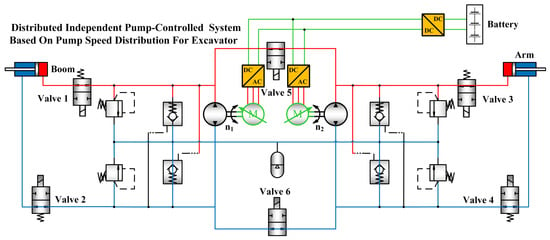
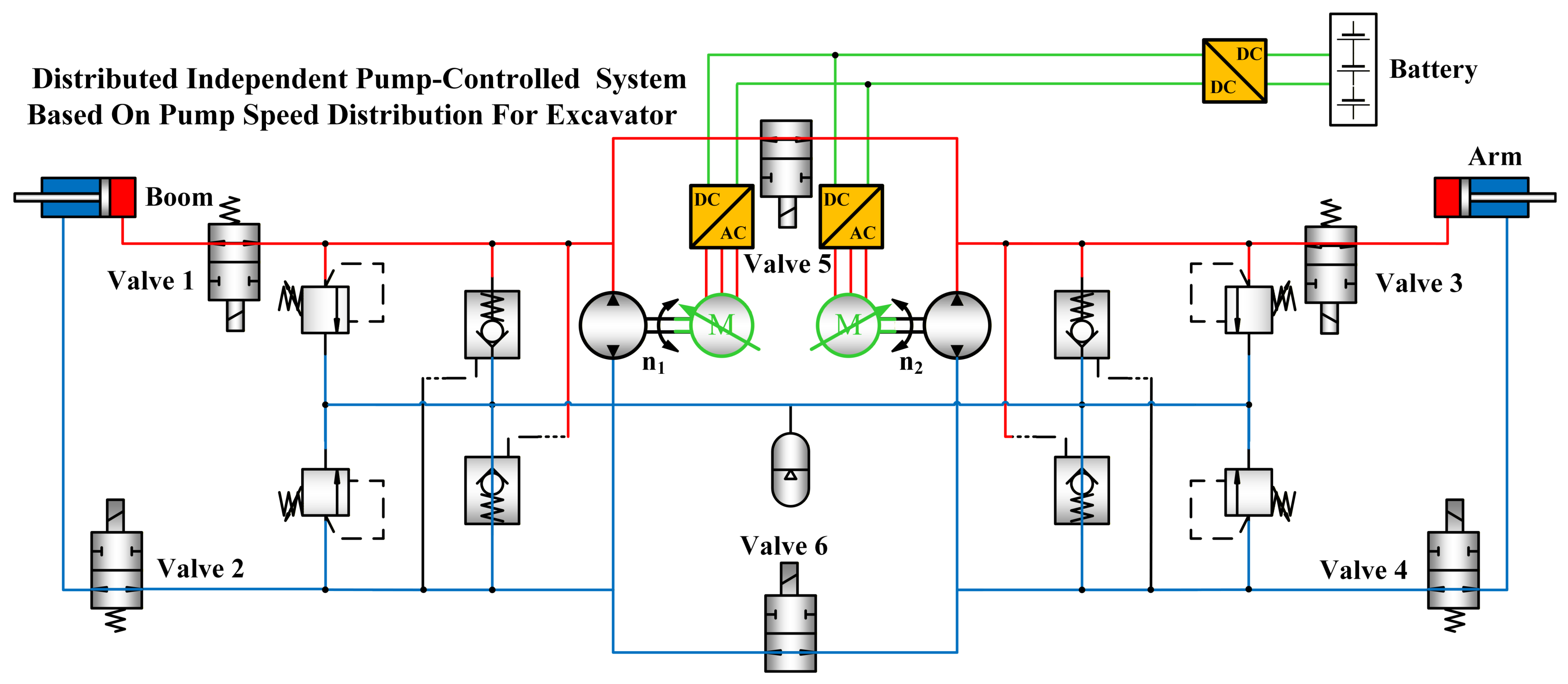
This article mainly studies a distributed independent pump-controlled system based on pump speed distribution for excavators. In this system, as shown in Figure 1, the boom and arm are arranged in an independent closed architecture. The power units consist of fixed-displacement hydraulic pumps driven by variable-speed permanent magnet synchronous motors. An accumulator connected to the low-pressure side compensates for differential flow induced by asymmetric cylinders, dynamically balancing loop flow with demand flow. Without generating a throttling effect, the opening and closing of the oil path are accomplished by six two-position two-way solenoid valves.
Figure 1.
Distributed independent pump-controlled system based on pump speed distribution.
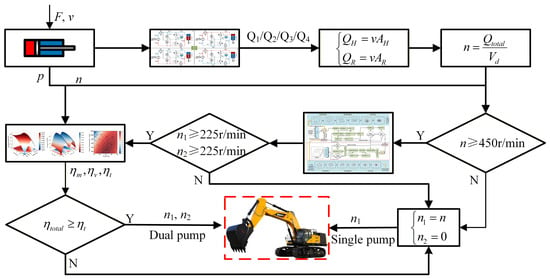
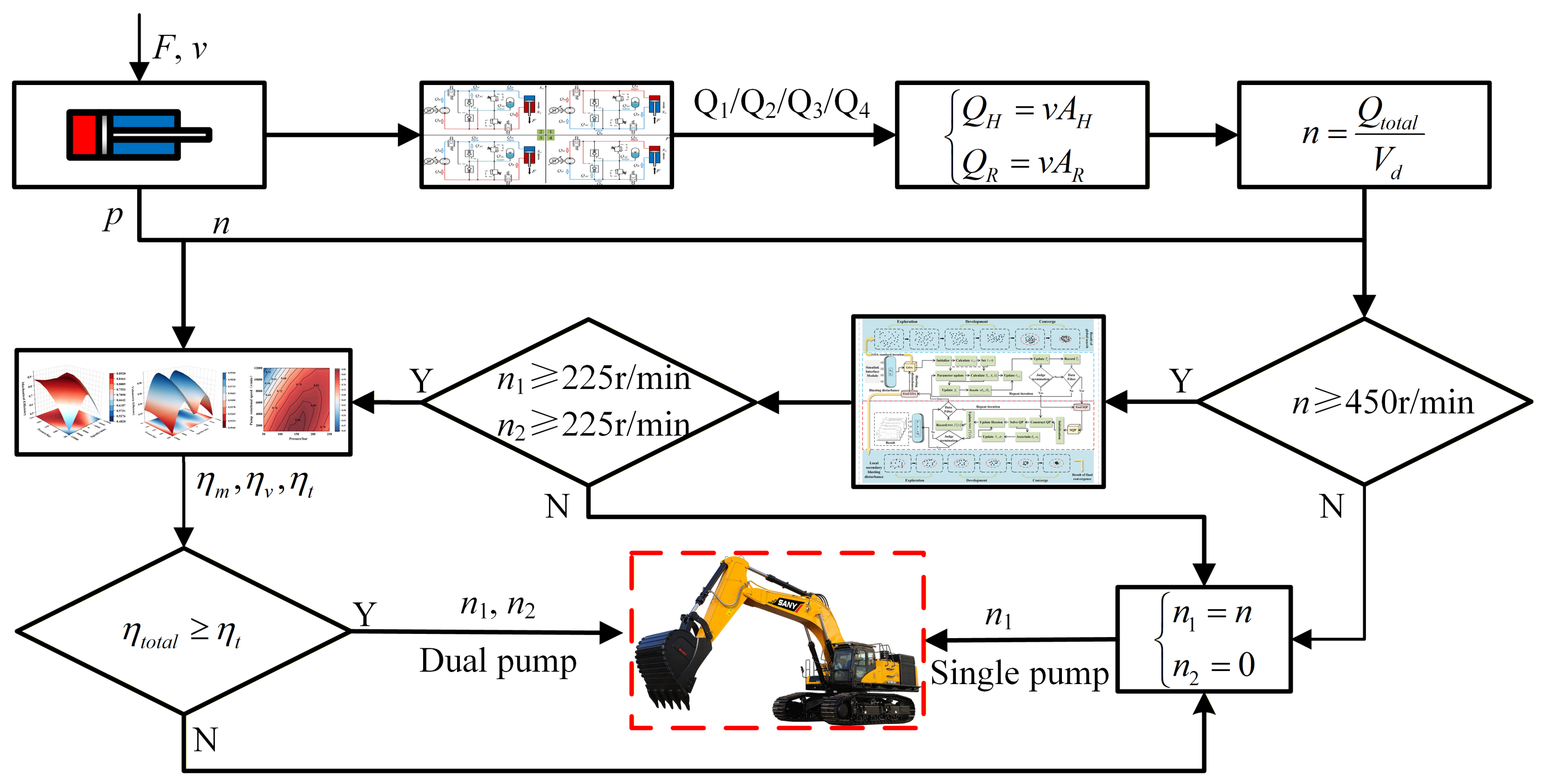
To address the efficiency degradation issue caused by single-pump operation under high-load and high-speed conditions in a distributed independent pump-controlled system, a dual-pump load-sharing architecture based on pump speed distribution is proposed. Meanwhile, in practical excavator operations, the three hydraulic cylinders rarely operate simultaneously, and at least one pump often remains idle. Due to the similarity in drive configurations, only the boom and the arm are taken as the research objects here. Unlike the distributed independent pump-controlled system, two additional valves (Valve 5 and Valve 6) are introduced here, enabling the two distributed circuits to be dynamically reconfigured into a shared load circuit during single-actuator operation. The working mechanism is described as follows: (1) Compound action: When the operator commands simultaneous boom and arm movement, the merging valves remain closed. (2) Single action: When the operator commands only one actuator (boom or arm), the control strategy determines target pump speed based on desired actuator velocity. The proposed intelligent optimization algorithm is used to solve for the optimal speed distribution scheme. The opening condition for Valve 5 and Valve 6 is satisfied when the total efficiency of both pumps operating simultaneously is higher than that of a single pump. Pump speed signals are sent to both independent circuits, dynamically reconfiguring the two distributed circuits into a shared load circuit. This achieves efficient dual-pump coordinated operation, reduces total energy consumption, and alleviates the degradation of pump efficiency caused by single-pump operation.
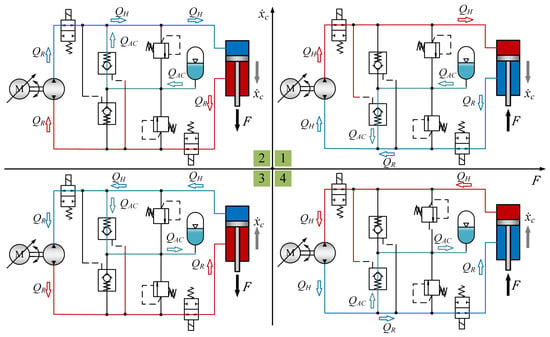
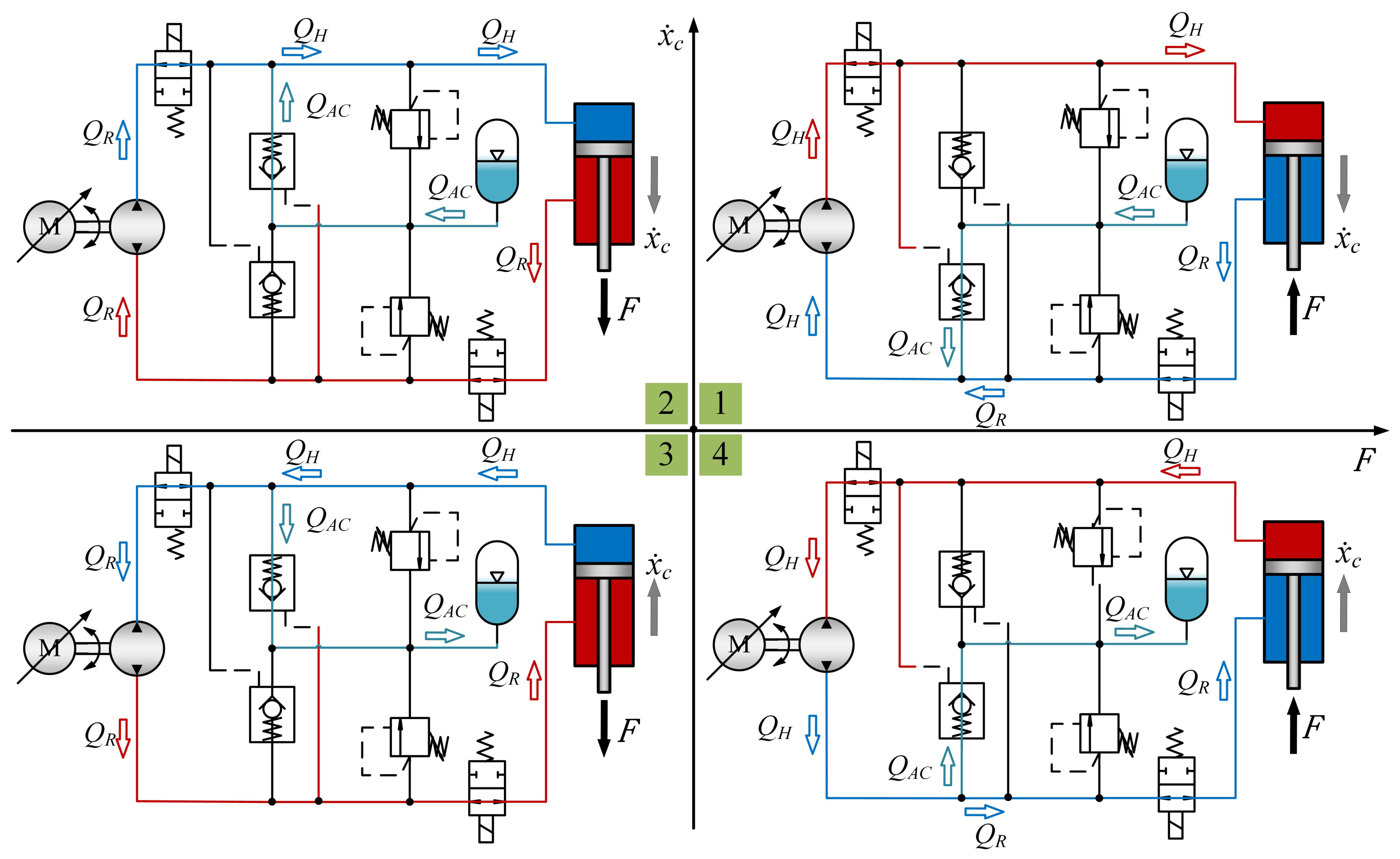
Based on the velocity and applied load on the hydraulic cylinder, the excavator’s operation process is classified into four distinct working modes, namely the four-quadrant working modes, which are shown in Figure 2. With velocity as the vertical axis and load force as the horizontal axis, piston rod extension is defined as positive velocity with negative load force; conversely, retraction corresponds to negative velocity with positive load force. Based on this convention, Quadrants 1 and 3 are classified as resistive modes, corresponding to the pumping condition, whereas Quadrants 2 and 4 represent assistive modes, corresponding to the motoring condition. Since the four-quadrant operating conditions encompass all working modes of the excavator, the subsequent analysis of pump efficiency and energy consumption is conducted from the perspective of these four quadrants.
Figure 2.
Four-quadrant working modes.
Figure 3 presents the speed distribution procedure of the dual-pump load-sharing architecture that is based on pump speed distribution.
Figure 3.
Pump speed distribution flowchart.
Component-Level Description
The proposed system mainly consists of two electric motor–pump units, six two-position two-way solenoid valves, accumulators, and hydraulic cylinders. Each fixed-displacement pump is driven by a variable-speed servo motor, and the actuator flow is regulated by pump speed rather than throttling control. Valves 1–4 are used for oil-path switching in the independent pump-controlled circuits, enabling the boom and arm cylinders to operate independently during compound motion. Valves 5 and 6 are load-sharing valves. During single-actuator operation, these two valves are opened to connect the two distributed pump-controlled circuits, so that the idle pump can participate in driving the active cylinder. During compound motion, Valves 5 and 6 remain closed to keep the boom and arm circuits independent.
The accumulator is connected to the low-pressure side of each closed circuit to compensate for the differential flow caused by the asymmetric hydraulic cylinder and to maintain the low-pressure-side oil supply. The accumulator specifications, including precharge pressure and operating pressure range, are listed in experimental section. The boom and arm cylinders are taken from the SANY SY60 mini-excavator (SANY Heavy Machinery Co., Ltd., Suzhou, China), and their piston diameters, rod diameters, and moving masses are also given in experimental section.
The power flow of the pump depends on the operating quadrant. In Quadrants 1 and 3, the cylinder motion is opposite to the load direction, and the pump works mainly in the pumping mode to provide hydraulic power to the actuator. In Quadrants 2 and 4, the load assists the cylinder motion, and the pump/motor may operate in the motoring mode, where hydraulic energy can be converted into mechanical shaft power. Therefore, the efficiency and energy-consumption analysis in this study is conducted separately under four-quadrant operating conditions.
2.2. Mathematical Modeling of System
The volumetric efficiency of the pump/motor can be calculated as follows:
where is the actual output flow rate in the pumping mode, is the actual input flow rate in the motoring mode (m3/s), n is the speed (r/min), and is the theoretical displacement (m3/r).
The mechanical efficiency of the pump/motor is calculated as follows:
where is the theoretical torque, is the actual input torque in the pumping mode, is the actual output torque in the motoring mode (N · m), and is the pressure differential across the pump/motor (Pa).
The overall efficiency of the pump/motor is given by
where is the output power, and is the input power.
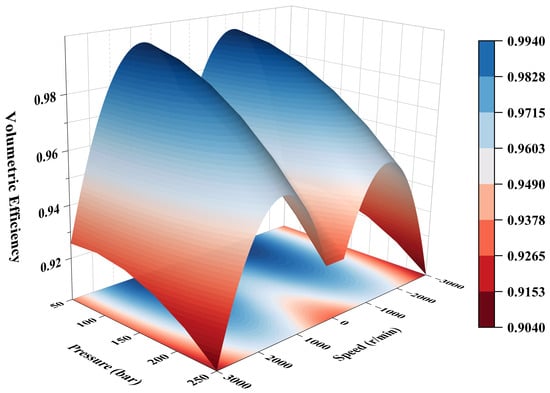
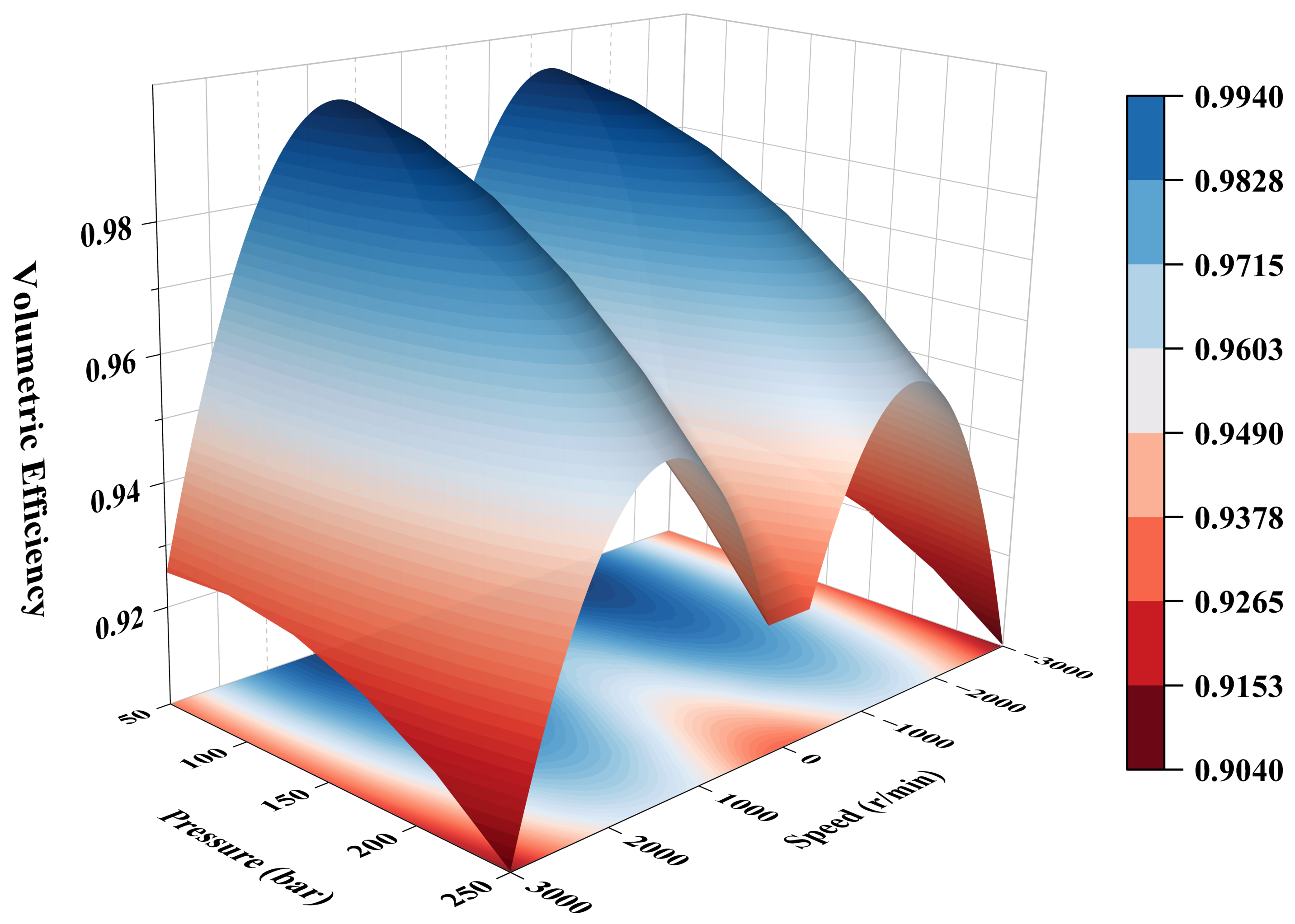
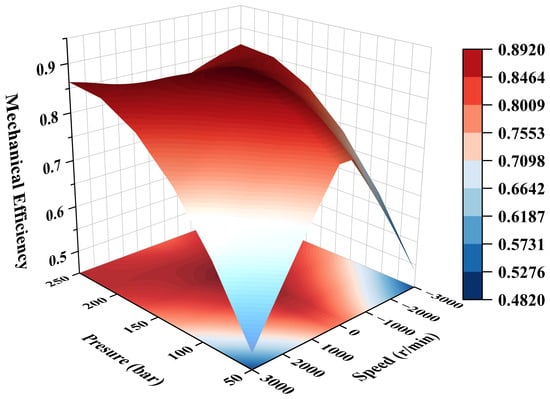
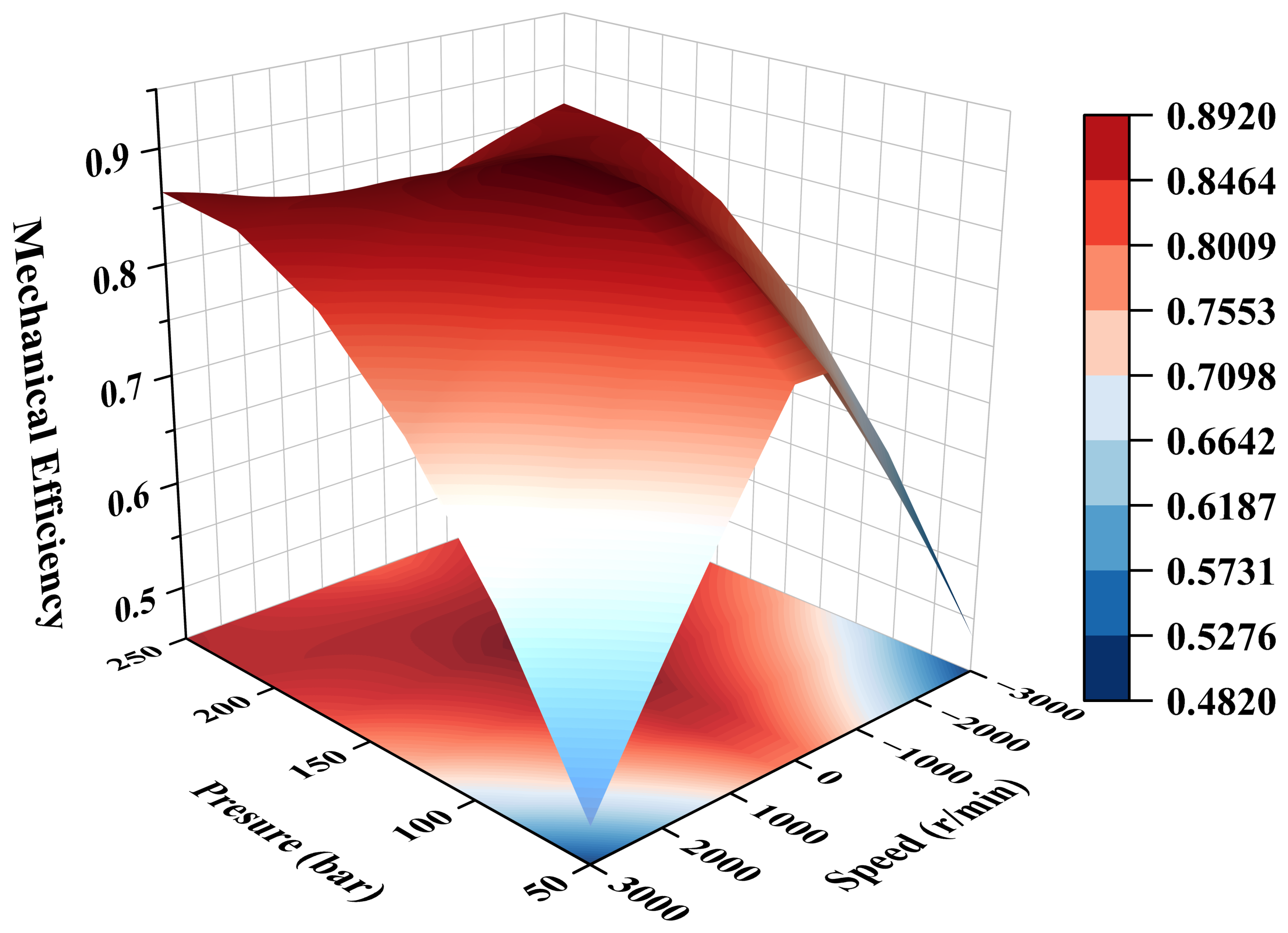
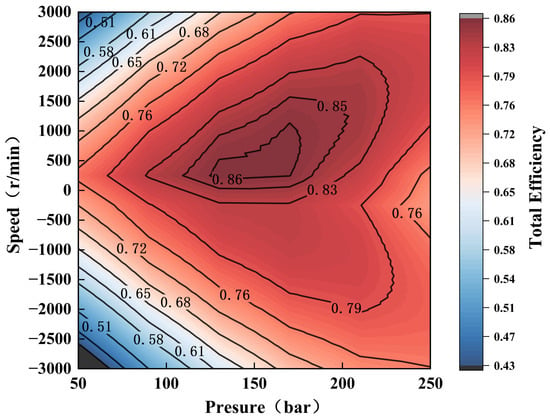
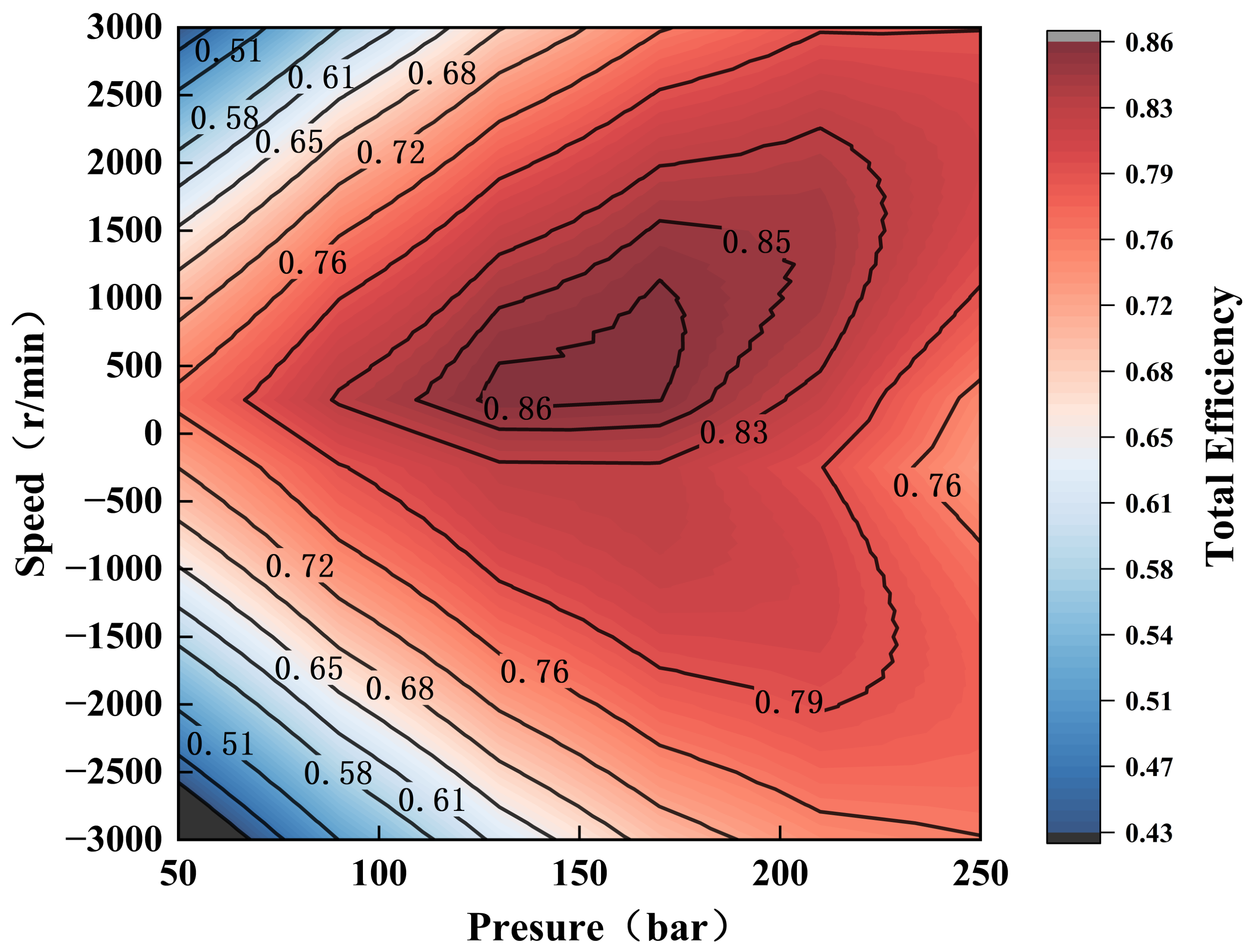
Experiments are conducted on a dedicated pump test bench, where the rotational speed is varied from −3000 r/min to 3000 r/min in increments of 25 r/min, and the differential pressure is adjusted over a range of 50 to 250 bar at intervals of 40 bar, resulting in a total of 1332 operating points. Based on these measurements, the mechanical, volumetric, and overall efficiencies are determined according to Equations (1)–(3), respectively. The experimental results are presented in Figure 4, Figure 5 and Figure 6. In the efficiency maps, positive speed is used to denote pump mode operation, while negative speed is used to denote motor mode operation. It should be emphasized that the positive and negative signs in the efficiency maps are used only to distinguish the pump and motor operating modes, rather than to represent the forward and reverse rotation directions of the shaft.
Figure 4.
Volumetric Efficiency Diagram.
Figure 5.
Mechanical Efficiency Diagram.
Figure 6.
Total Efficiency Model Diagram.
When two pumps operate simultaneously, the overall efficiency is defined as follows:
where and are the pressure differentials across the pumps and are equal to each other. Similarly, and are the actual output flow rates of the two pumps in pumping mode, and are the actual input flow rates of the two motors in the motoring mode, and and represent the overall single-pump efficiencies. This equation is employed as the objective function in the subsequent intelligent optimization algorithm to achieve optimal pump speed distribution.
Based on the target speed of the hydraulic cylinder, the flow rate to be delivered by the pump is expressed as follows:
where represents the flow rate into the piston chamber and represents the flow rate out of the rod chamber; and are effective action areas of the two chambers, respectively; and v is the velocity of the hydraulic cylinder. Therefore, if the excavator is operating in Quadrant 1 and Quadrant 4, the flow rate demanded from the pumps can be expressed as . If the excavator is operating in Quadrant 2 and Quadrant 3, the flow rate demanded from the pumps can be expressed as . Since the subsequent efficiency and energy consumption analyses are conducted separately in four quadrants, quadrant identification is not required.
After obtaining the total flow rate that the pump needs to supply, the sum of the allocated rotational speeds of the pump can be obtained by the following equation:
where and denote the rotational speeds of the two pumps (r/min).
For the energy consumption analysis, the energy losses of each pump attributable to mechanical efficiency and volumetric efficiency are given by
where and denote the energy losses caused by mechanical inefficiency and volumetric inefficiency, respectively.
From the perspective of the drive motor, the total energy consumption during operation can be calculated as follows:
where and represent the input voltage and current of the motor, respectively.
3. GOA-SQP-Based Intelligent Optimization for Pump Speed Distribution
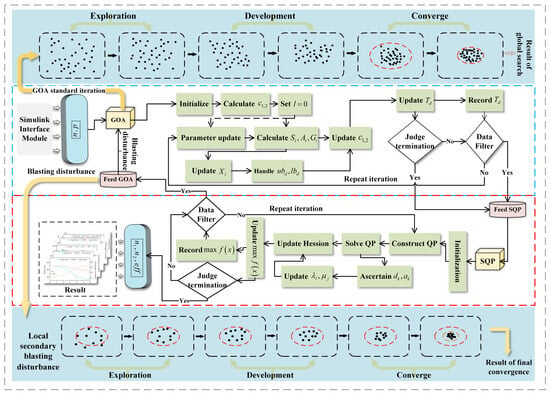
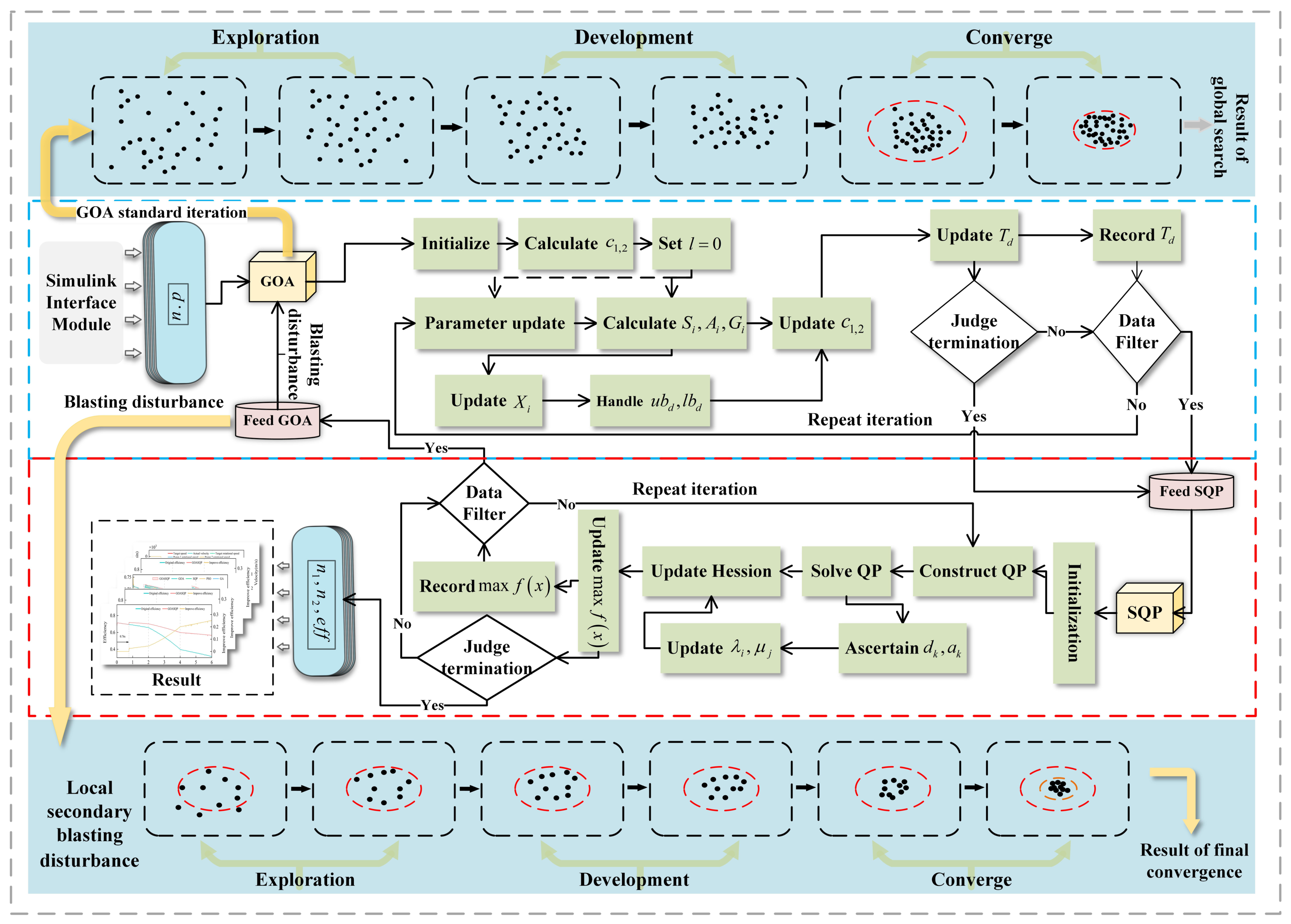
To mitigate the conflict between convergence accuracy and computational efficiency in pump speed distribution optimization, an adaptive closed-loop GOA-SQP framework is proposed. It should be emphasized that the proposed GOA-SQP framework is different from conventional serial hybrid strategies. In most existing hybrid strategies, the optimization algorithm is first used to obtain an approximate global solution, which is then directly taken as the initial point of SQP. Such a one-way coupling improves local accuracy but does not allow the local search results to regulate the subsequent global search process. In contrast, the proposed method establishes a closed-loop interaction between GOA and SQP. The population distribution and best solution of GOA determine the initial point and local search region of SQP, while the convergence behavior and efficiency improvement of SQP are fed back to adjust the GOA search process. Moreover, when the efficiency improvement becomes saturated, a local perturbation and re-explosion mechanism is activated to reconstruct the population around the most promising high-efficiency region rather than randomly restarting the search. As a result, the proposed algorithm achieves superior convergence speed, accuracy, and robustness, providing an efficient solution for real-time pump speed distribution. The optimization strategy model is illustrated in Figure 7.
Figure 7.
Efficiency feedback-based adaptive closed-loop optimization strategy framework for GOA-SQP.
3.1. Problem Formulation
To achieve optimal energy efficiency in the dual-pump load-sharing architecture, the pump speed distribution problem is formulated as a constrained nonlinear optimization problem. Under a prescribed actuator velocity, the total required flow determines the sum of pump speeds as
The decision variables are defined as follows:
where and denote the rotational speeds of the two pumps.
The optimization objective is to maximize the overall efficiency of the dual- pump system:
with the following constraints:
where is the objective function from Equation (4). Given the low efficiency and control limitations of the pump under low-speed conditions, the rotational speed is constrained to a minimum of 225 r/min. If this condition is not satisfied, no speed distribution is performed. The maximum rotational speed of the pump is 3000 r/min.
Due to the strong nonlinearity of the efficiency map and the presence of equality and inequality constraints, this problem exhibits multiple local optima and requires both global exploration and fast local convergence.
3.2. Global Exploration via Grasshopper Optimization Algorithm
The Grasshopper Optimization Algorithm (GOA) simulates the social interaction behavior of grasshopper swarms during foraging and migration, mapping the three stages of egg, larva, and adult onto algorithm exploration, exploitation, and convergence to construct a global optimization model in continuous space. The grasshopper population achieves continuous spatial position updates through a dynamic “repulsion–attraction” mechanism, enabling adaptive optimization with robust global search capability.
The position update of the i-th individual is expressed as
where and are the position and gravitational force acting on the i-th grasshopper, respectively; is the social interaction force; represents wind advection; and are random numbers in the interval [0, 1].
where and are the distance and unit vector between the i-th and j-th individuals, respectively, and s is the function defining the strength of social forces, which partitions the space between two individuals into repulsion, comfort, and attraction zones.
where f represents the attraction intensity and l denotes the attraction length scale, both of which influence social behavior.
where g is the gravitational constant and is the unit vector toward the earth’s center.
where u is the constant drift and is the unit vector in the wind direction.
Since the model in Equation (13) causes individuals to rapidly reach the comfort zone without converging to a specified point, it cannot be applied directly. To better adapt to optimization problem-solving, relevant parameters are introduced based on Equation (13), yielding the improved model:
where and are the upper and lower bounds, respectively, is the current optimal solution, and c is the attraction coefficient that reduces the comfort, repulsion, and attraction zones. To balance exploration and exploitation, the parameter is designed to be inversely proportional to the number of iterations, promoting exploitation as iterations increase.
where and are the maximum and minimum values of , respectively, l is the current iteration number, and L is the preset maximum number of iterations.
This mechanism enables a smooth transition from global exploration in early iterations to local exploitation in later stages.
3.3. Local Refinement via Sequential Quadratic Programming
Sequential Quadratic Programming (SQP) is well suited for solving constrained nonlinear optimization problems. Its fundamental principle is to approximate the original problem by a quadratic programming (QP) subproblem at each iteration. The resulting subproblem is then solved to obtain the search direction and step size for updating the decision variables, thereby progressively approaching the optimal solution. Owing to its fast convergence and high accuracy, SQP has been widely recognized as an effective method for constrained nonlinear optimization. In this paper, it is particularly suitable for the speed distribution optimization problem under pump speed constraints.
To improve solution accuracy under constraints, Sequential Quadratic Programming (SQP) is employed for local refinement. Based on the quadratic approximation of the objective function and the linear approximation of the constraints, the QP subproblem to be solved at the k-th iteration is
Linear constraint approximation (iteration k):
Solve QP for optimal search direction and determine step size via line search ; H is the Hessian matrix.
Update the next iteration point:
where is obtained via line search. The procedure repeats the following steps: solving the QP approximation and updating the current iterate. The iteration terminates when the prescribed condition is fulfilled.
where and are Lagrange multipliers of the QP subproblem; is the reset precision threshold.
3.4. Efficiency-Feedback-Based Closed-Loop GOA–SQP Framework
To fully exploit the complementary strengths of GOA and SQP, an adaptive closed-loop framework based on efficiency feedback is developed. Unlike conventional sequential hybrid strategies, the proposed method establishes a bidirectional interaction between global and local search processes.
Specifically, the population distribution of GOA determines the initial point and search region of SQP:
while the convergence behavior of SQP feeds back to regulate the exploration–exploitation balance of GOA. The efficiency improvement at iteration k is defined as
When the improvement falls below a predefined threshold, the algorithm adaptively switches between global exploration and local refinement, thereby avoiding both excessive computation and premature convergence. This closed-loop mechanism enables dynamic coordination between the two optimization stages and significantly enhances convergence speed and robustness.
3.5. Local Perturbation and Re-Explosion Mechanism
To further enhance robustness against stagnation, a local perturbation and re-explosion mechanism is integrated into the closed-loop framework. When the efficiency improvement remains below a threshold for consecutive iterations, one gets
The optimization process is considered trapped in a locally saturated region. The criteria for determining the threshold are listed in Table 1. The mechanism is activated only after three consecutive sub-threshold outcomes, which corresponds to .
Table 1.
Thresholds of filter acceptance criteria.
Instead of reinitializing the population globally, a local perturbation is performed around the current best solution , such that new candidate solutions are generated as
where is a random vector following a uniform distribution, D is the scaling matrix defined by the pump speed boundaries, and is an adaptive perturbation radius. To balance exploration and exploitation, is designed to decrease with iteration while being enlarged under persistent stagnation, ensuring both convergence precision and escape capability.
After generating one or several local perturbation points, the algorithm further performs re-explosion by reconstructing a small population around . Let the regenerated population be
where controls the balance between newly injected random disturbance and inherited population structure. This formula reflects the essence of “re-explosion”: the population is not entirely reset, but is re-expanded around the currently most promising region. Such a design is especially suitable for the present pump speed distribution problem, because the optimum generally lies in a constrained high-efficiency region rather than anywhere in the full domain.
Only candidates satisfying the efficiency improvement criterion
are accepted. The reconstructed population is then fed back into the GOA stage, forming a localized reinitialization within the closed-loop optimization process.
Through this mechanism, the algorithm avoids unnecessary global exploration while effectively escaping local optima. Compared with conventional random restart strategies, it preserves accumulated search information and significantly improves both convergence stability and computational efficiency.
4. Experimental Results and Discussion
To validate the pump speed distribution optimization strategy presented in the previous section, an experimental test platform for a distributed independent pump-controlled excavator system is developed. The platform consists of two electro-hydraulic servo pump-controlled systems, which can be connected through switching valves. This configuration allows the platform to drive both the boom and the arm simultaneously, or to drive each actuator independently by disconnecting the switching valves. Experimental studies are subsequently performed on the proposed strategy using the established platform.
4.1. Experimental Test Platform and Parameters
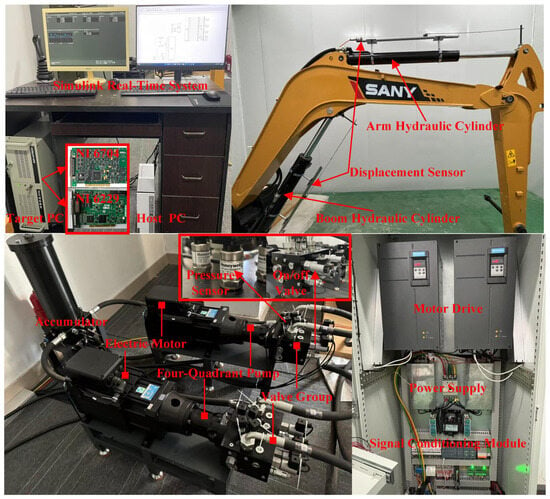
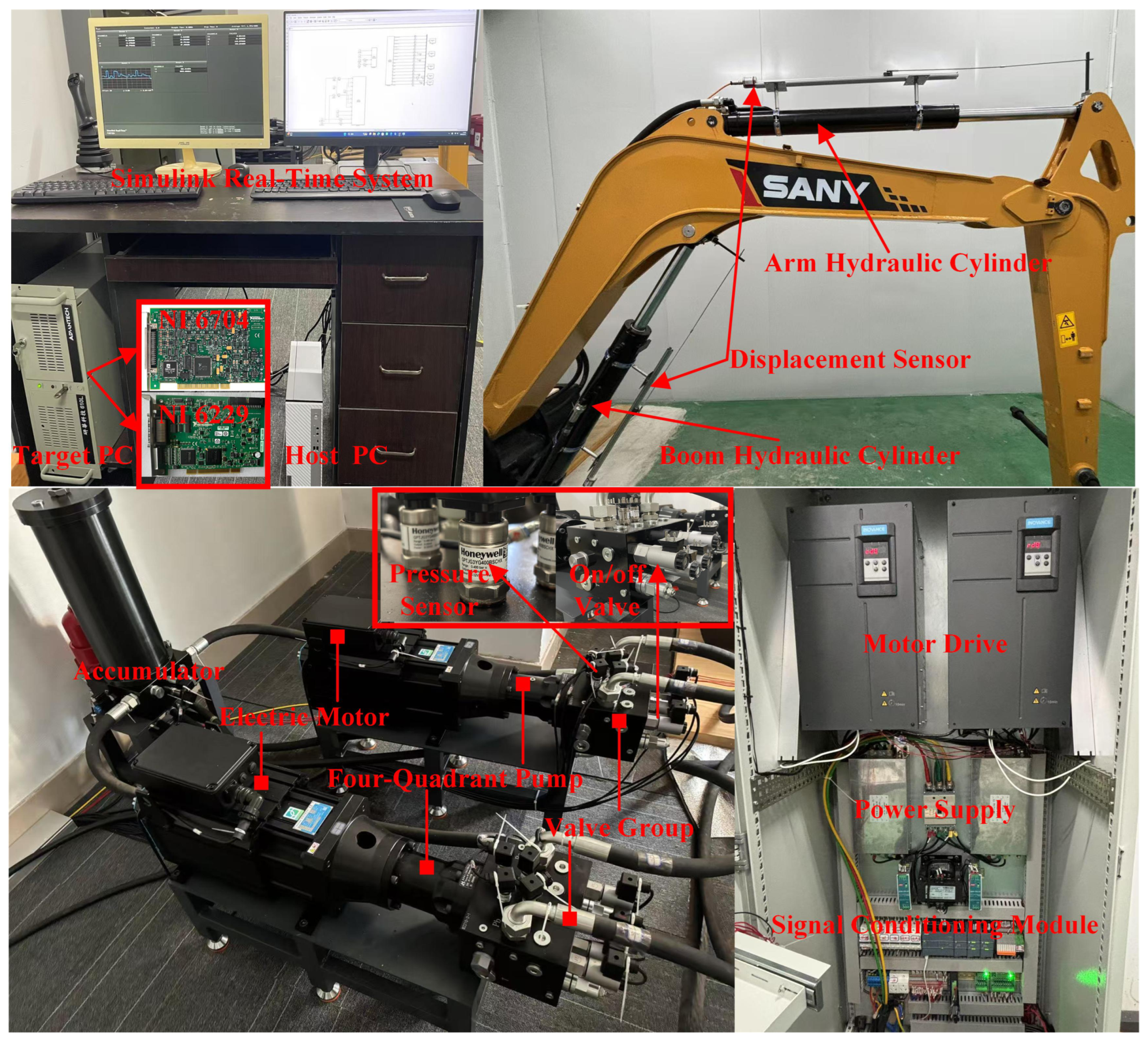
As illustrated in Figure 8, the experimental test platform is composed of four primary subsystems: the electro-hydraulic servo pump-controlled system, the excavator boom and arm mechanism, an electrical control cabinet, and a measurement and control unit. A fixed-displacement axial piston pump functioning as a four-quadrant unit is directly connected to a valve group composed of on/off valves. The accumulator adopts a bladder-type structure, and a check valve is installed at its head to facilitate adjustment of the bladder precharge pressure. The boom and arm assemblies, together with their corresponding hydraulic cylinders, are derived from the SY60 series mini-excavators manufactured by SANY.
Figure 8.
Experimental test platform.
The experimental platform realizes both closed-loop control and data acquisition through the Simulink Real-Time system. The optimization algorithm is developed in MATLAB/Simulink R2016a on a host PC, then compiled into executable code and transmitted to the target PC via Ethernet for real-time execution. Two National Instruments data acquisition (DAQ) cards are installed in the target PC to support system operation. The PCI-6229 card is employed to collect sensor signals during experimental tests, while the PCI-6704 card is used to generate voltage outputs for regulating the servo motor speed and actuating the on/off valves. The main configuration parameters of the experimental test platform are summarized in Table 2.
Table 2.
Parameters of the experimental test platform.
In order to demonstrate the superiority of the proposed GOA-SQP algorithm in addressing the pump speed distribution problem, a comparative investigation is performed on four optimization strategies: GOA, SQP, GA-SQP, and PSO-SQP. GA-SQP denotes a hybrid method combining a Genetic Algorithm with SQP, while PSO-SQP denotes a hybrid method combining Particle Swarm Optimization with SQP. The degree of pump efficiency enhancement and the computational time are adopted as the performance metrics.
A structured Design of Experiments (DOE) framework is adopted to clarify the experimental arrangement. The main factors are operating quadrant, target cylinder speed, and optimization strategy. The response variables are mechanical efficiency, volumetric efficiency, overall pump efficiency, total energy consumption, optimization time, and actuator motion performance. For each operating condition, the actuator flow demand is kept unchanged, while the optimization algorithms only redistribute the rotational speeds of the two pumps. Thus, the comparison focuses on the effect of pump speed distribution and optimization strategy under the same actuator motion requirement.
Because the present investigation addresses the configuration in which two pumps drive a single hydraulic cylinder concurrently, and the modes of operation for the boom and arm are identical, the experimental validation is carried out exclusively on the boom cylinder. Under four-quadrant conditions, four sets of increasing target speed commands for the hydraulic cylinder are designed as listed in Table 3 to investigate the efficiency after pump speed distribution. For a comprehensive comparison of the efficiency enhancement before and after speed distribution, the speed values presented in the table cover the entire operating range of a single hydraulic pump in each quadrant, from the minimum of 225 r/min to the maximum of 3000 r/min.
Table 3.
Target speed of the hydraulic cylinder.
Having sufficiently validated the efficiency enhancement achieved by the proposed pump speed distribution optimization strategy, the energy consumption during system operation is subsequently studied. Still under four-quadrant operating conditions, energy consumption analysis experiments are conducted under light, medium, and full loads, as well as at low, medium, and high speeds. Energy consumption analysis experiments are further conducted under four-quadrant operating conditions by simulating multi-level load and speed scenarios of an excavator, ranging from light load to full load and from low speed to high speed. This approach enables a systematic evaluation of the energy-saving characteristics of the pump-controlled excavator employing pump speed distribution across its entire operational envelope.
4.2. Validation and Comparative Analysis of the GOA-SQP Optimization Algorithm
In this section, the performance of the GOA-SQP closed-loop feedback algorithm model is systematically assessed from the perspectives of pump efficiency enhancement and computational time. Four optimization algorithms, namely GOA, SQP, GA-SQP [39], and PSO-SQP [40], are adopted as benchmark models for comparative analysis. Given that the evaluation metric includes the computational time of the algorithm, the experiments are performed exclusively under the first-quadrant operating condition. In the experiment, a load of 5 kN is applied to the end of the arm, while the target velocity of the hydraulic cylinder is set to 0.085 m/s.
As depicted by the pump overall efficiency model in Figure 6 and the objective function in Equation (4), when two pumps are configured to drive a single hydraulic cylinder, the pressure across the two pumps is exactly the same. Thus, pump efficiency cannot be adjusted via pressure allocation, leaving speed as the primary determinant of pump efficiency. As a result, the solution accuracy of the speed distribution algorithm directly governs the extent of efficiency improvement. However, because the optimal speed sequence is difficult to quantify and directly compare, the present study adopts the efficiency value computed by Equation (4) following speed distribution as a unified evaluation metric for assessing the solution accuracy of the compared models.
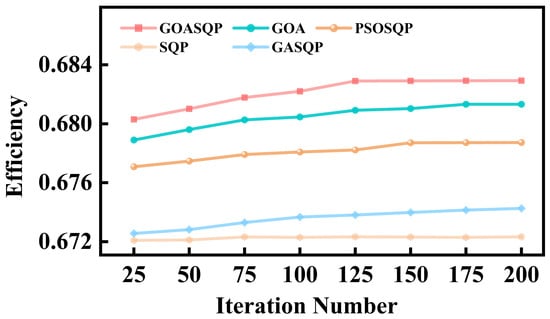
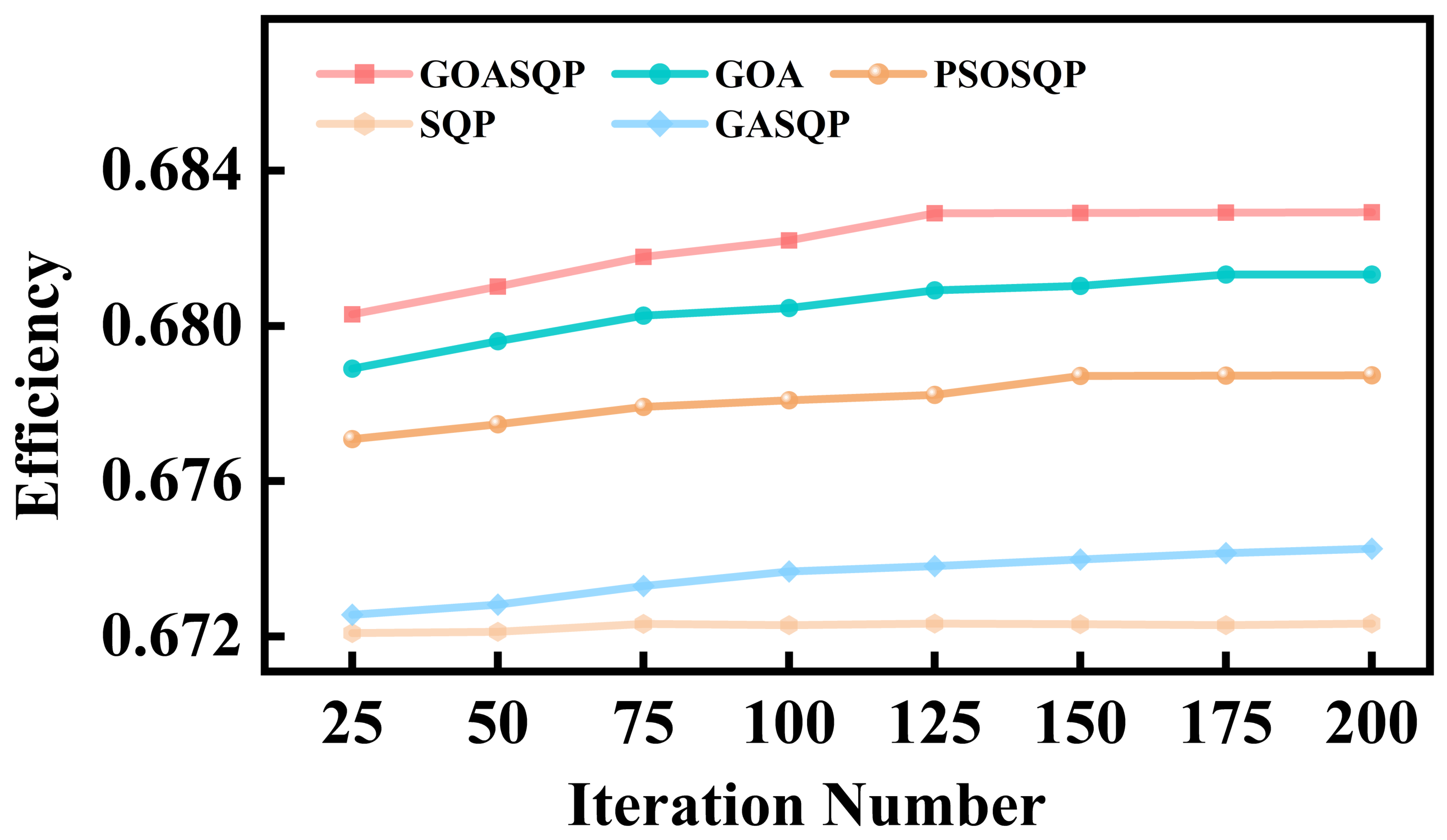
Furthermore, algorithm solution accuracy is positively correlated with iteration count, but redundant iterations significantly increase computational time, potentially causing actuator lag in excavators. To balance solution accuracy and speed, this study incrementally adjusted iteration counts to obtain corresponding pump efficiency values, thereby determining the critical iteration number maximizing time utilization. The iteration-accuracy relationship curve is shown in Figure 9.
Figure 9.
Iteration-accuracy curve.
Experimental results demonstrate that as iteration count increases, GOA-SQP achieves rapid initial search via closed-loop feedback, with efficiency rising from 0.6805 to 0.684, reaching a convergence plateau after 125 iterations with no subsequent significant fluctuations. In comparison, GOA under identical iterations achieves only 0.681 with a gradual upward trend; PSO-SQP, due to insufficient early exploration, reaches 0.678 only after 150 iterations; SQP becomes trapped in a local optimum at 0.673 around 75 iterations, with subsequent iterations proving redundant, while GA-SQP exhibits linear efficiency growth with slow convergence. Thus, GOA-SQP achieves high-precision, stable convergence within 125 iterations, offering superior accuracy, a faster approach to the efficiency upper bound, and optimal time utilization, satisfying the real-time requirements of excavator speed distribution.
This outcome is attributed to the unique closed-loop feedback and local perturbation re-explosion mechanisms of GOA-SQP. When the GOA feedback suggests decreasing population diversity, signifying that high-efficiency regions have been located, the system instantaneously switches to the SQP algorithm to conduct local optimization of the speed distribution. Conversely, if SQP feedback signals stagnation in efficiency gain, the system promptly restarts GOA for small-scale re-explosion, generating new populations and parameters to rapidly explore novel speed combinations. This closed-loop feedback alternating strategy significantly reduces redundant iterations, enabling the algorithm to stabilize near the efficiency upper bound in early stages while effectively suppressing late-stage fluctuations.
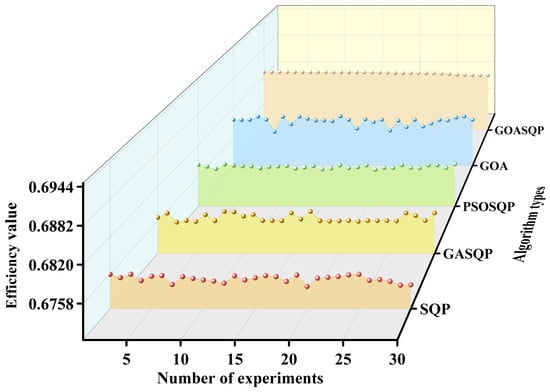
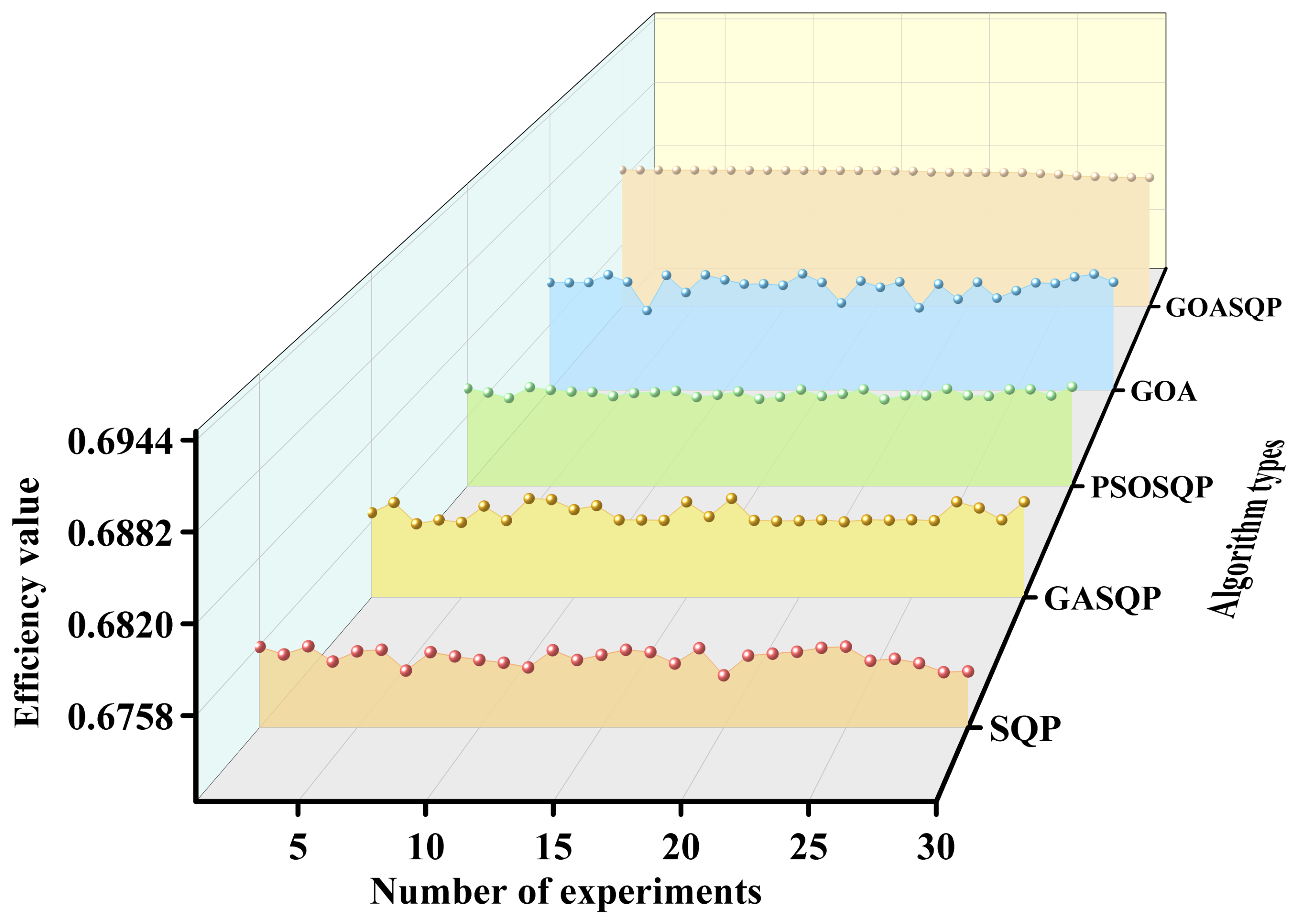
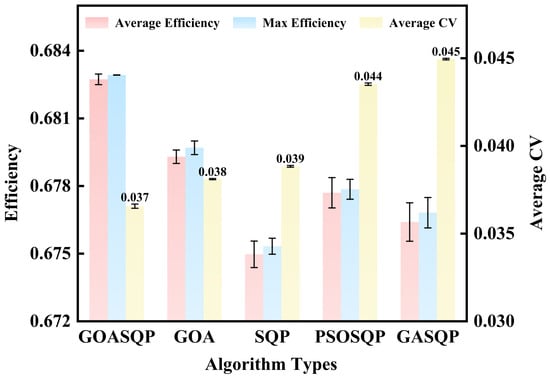
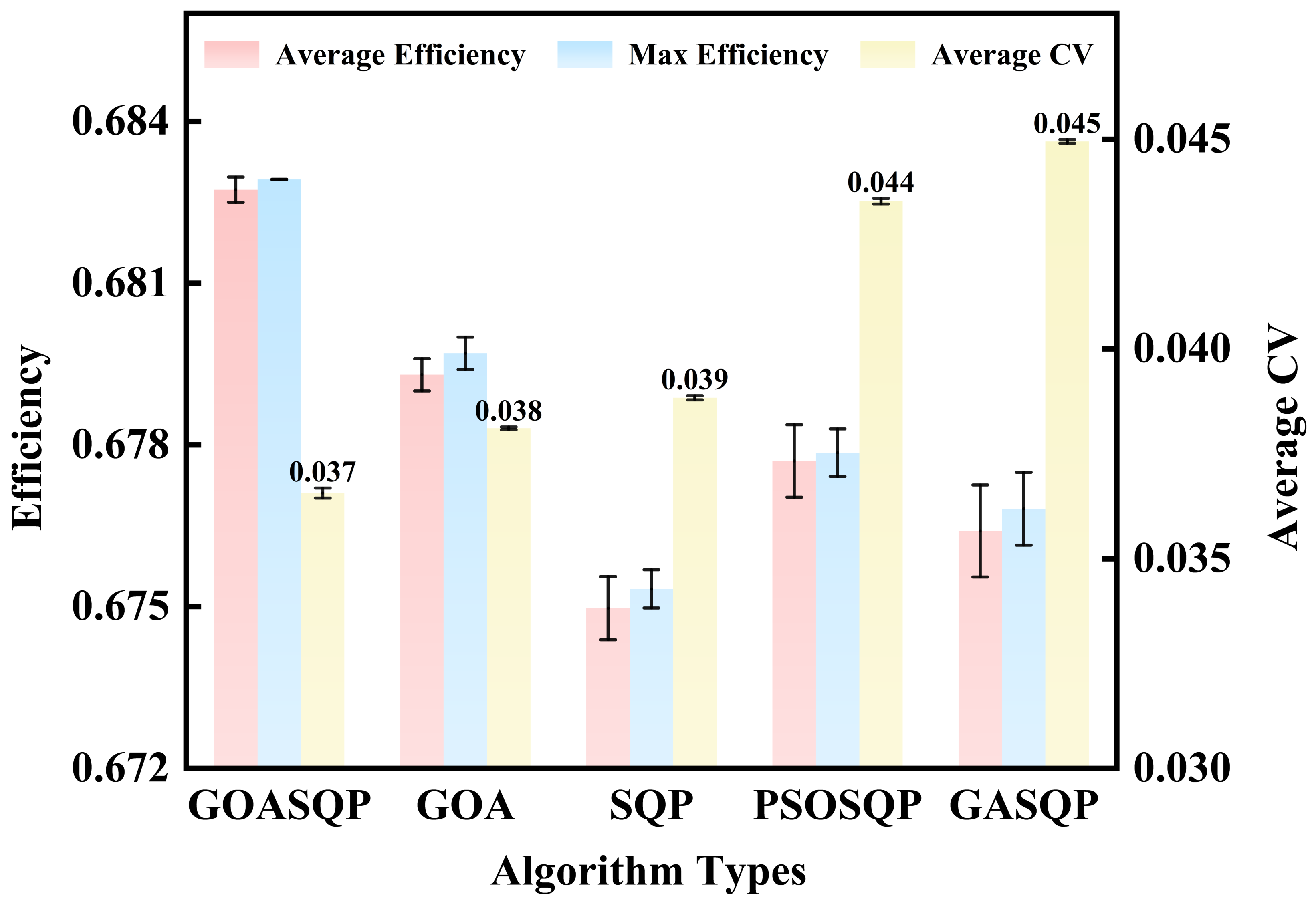
To further validate the solution accuracy of the GOA-SQP model, all algorithms are configured with 125 iterations and receive identical steady-state desired velocity commands, with each model being independently run 30 times. To mitigate the influence of random factors, the mean overall pump efficiency after 30 speed distribution runs is adopted as the evaluation metric. Additionally, the average efficiency of the top five results from the 30 runs is calculated as the peak efficiency indicator. Experimental results are shown in Figure 10 and Figure 11.
Figure 10.
Efficiency distribution of 30 solutions for each model.
Figure 11.
Experimental results of the average efficiency, peak efficiency, and CV.
Experimental results indicate that GOA-SQP achieves a mean solution efficiency of 0.683, significantly outperforming SQP (0.675), GA-SQP (0.676), GOA (0.648), and PSO-SQP (0.678), while improving upon standalone GOA by approximately 0.5%, demonstrating superior solution accuracy. The trend in peak efficiency mirrors that of the mean values. This is attributable to the following: SQP readily falls into local optima, where increased iterations yield no accuracy gain; pure GOA suffers from weak local search capability, creating a convergence bottleneck; PSO-SQP particles cluster around local extremes in later stages, lacking fine-tuning to approach peak efficiency; and GA-SQP’s crossover and mutation exhibit strong randomness, often either overshooting the optimum due to excessive step size or stagnating with insufficient step size, consistently yielding suboptimal efficiency.
Thus, GOA-SQP leverages GOA global search to identify high-efficiency regions, then triggers SQP local refinement using this region as the initial solution, fully activating its gradient-based convergence advantages. When SQP feedback indicates efficiency gains falling below the acceptance criterion, local perturbation and re-explosion are immediately activated, restarting GOA to achieve adaptive switching between global and local search. This bidirectional feedback dynamically adjusts the search starting point, enabling closer approximation to peak efficiency and significantly enhancing solution accuracy.
To quantify the consistency of speed distribution optimization results and the sensitivity of each model to initial conditions, the coefficient of variation (CV) defined in Equation (32) is introduced.
where represents the efficiency value from a single experiment, while and denote the standard deviation and mean of efficiency across multiple experiments, respectively. To eliminate random errors, experiments are repeated 10 times under five different speed conditions, with the mean CV adopted as the evaluation metric to assess the stability of each model’s allocation results. The findings are presented in Figure 11.
The experimental results in Figure 11 show that GOA-SQP achieves a CV of 0.037, significantly lower than GA-SQP (0.045), GOA (0.038), and SQP (0.039). This indicates that, compared to benchmark models, the closed-loop feedback mechanism of GOA-SQP dynamically corrects initial value deviations through alternating global-local feedback, rendering it the least sensitive to initial conditions and demonstrating superior convergence stability.
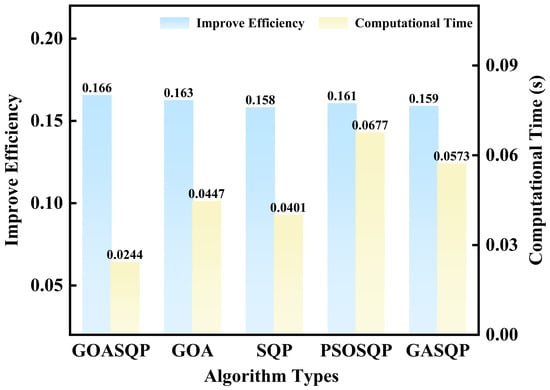
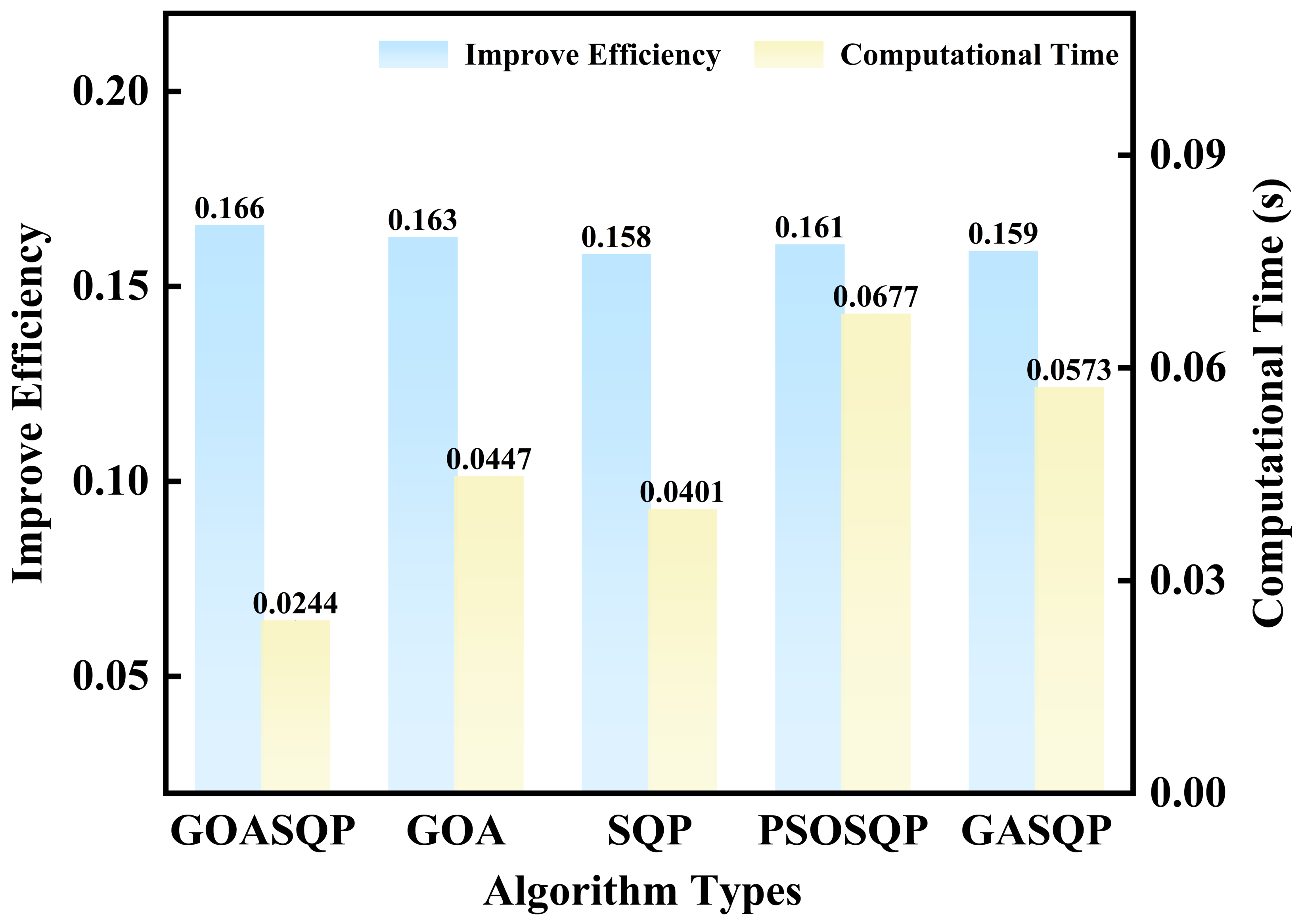
As shown in Figure 12, GOA-SQP achieves a solution time of 0.0244 s, significantly lower than GA-SQP (0.0573 s), PSO-SQP (0.0677 s), SQP (0.0447 s), and GOA (0.0447 s). In comparison with SQP, which exhibits the shortest solution time, GOA-SQP decreases the solution time by 39.15%. This time discrepancy stems from distinct search mechanisms and computational overhead. PSO-SQP and GA-SQP maintain 30∼50 particles, incurring substantial per-generation fitness evaluation costs, with random crossover and mutation frequently generating infeasible solutions, increasing average computation time. Sensitive to initial values, SQP frequently backtracks when trapped in local optima, which implicitly increases computational time. GOA reduces per-generation overhead via small populations, but later-stage diversity degradation leads to redundant regional searches, increasing solution time. GOA-SQP, however, dynamically switches search strategies via feedback. Although adaptive feedback increases procedural steps, it avoids extensive redundant computations typical of conventional algorithms, achieving lower solution time than standalone SQP and GOA.
Figure 12.
Efficiency improvement and solution time.
In summary, the GOA-SQP closed-loop optimization algorithm demonstrates substantial advantages in key performance metrics including solution accuracy and computational time, fully meeting the application requirements of distributed independent pump-controlled excavators based on pump speed distribution in actual operation.
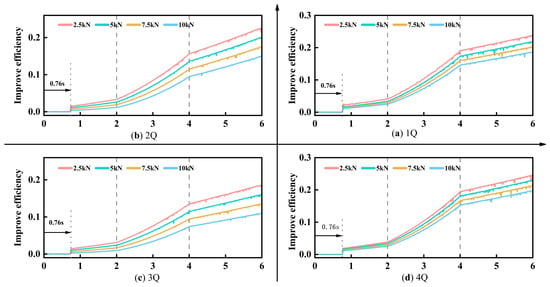
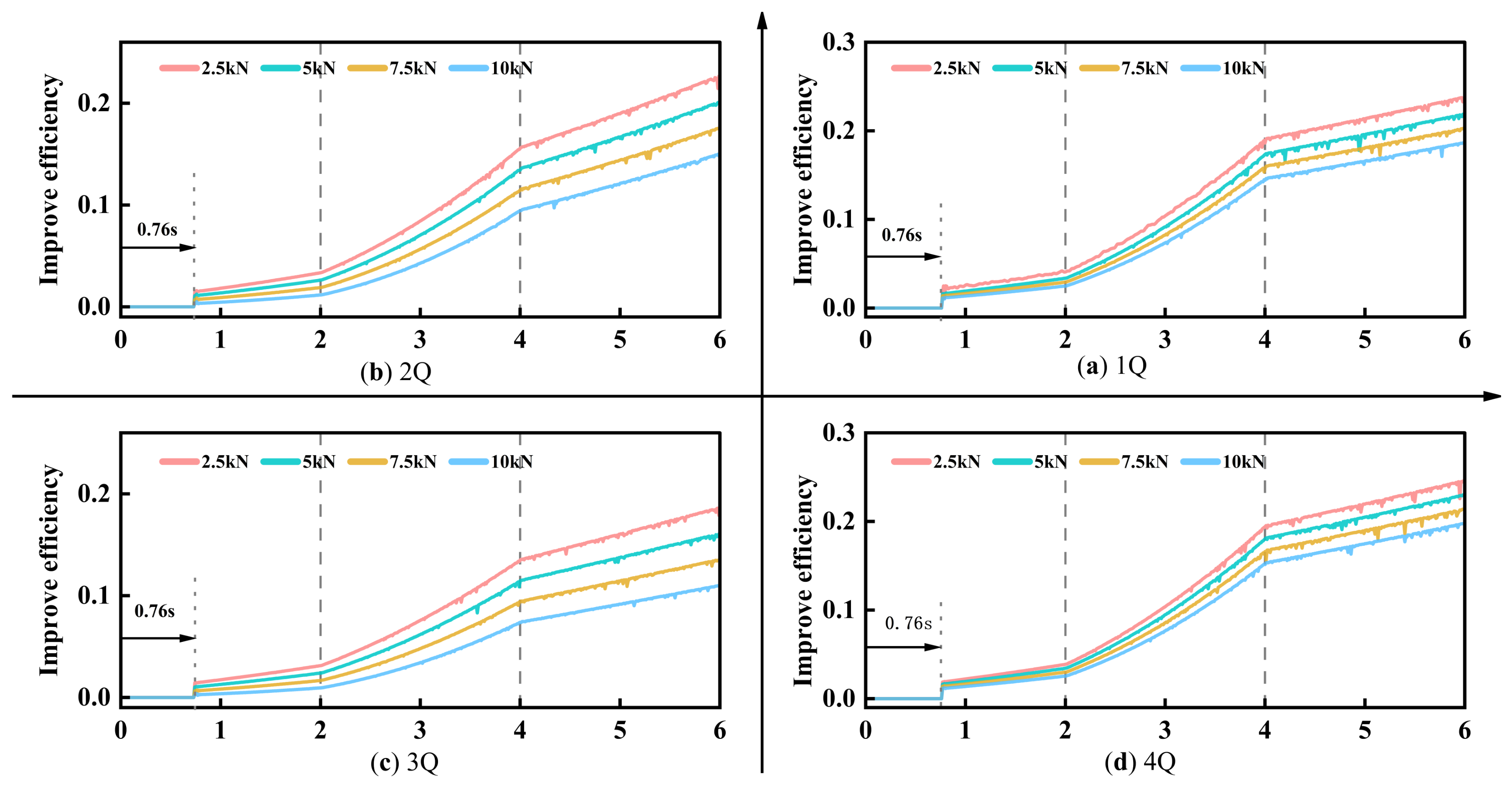
To comprehensively verify the adaptability of the GOA-SQP model across the full spectrum of speeds and loads, experimental studies are carried out under four-quadrant operating conditions employing the hydraulic cylinder target speed sequences designed in Table 3. To represent different loading conditions of the SY60-series excavator, loads of 2.5 kN, 5 kN, 7.5 kN, and 10 kN are applied at the end of the arm, covering operating scenarios from light load to full load conditions. Under a load of 10 kN, the driving motor employed in the test bench approached its operational limit. Figure 13 illustrates the efficiency improvement curves before and after pump speed distribution under each load condition.
Figure 13.
Efficiency improvement under four-quadrant variable loads.
Experimental results indicate that under four-quadrant operating conditions, pump efficiency improves significantly, ranging from light load to full load. This is attributed to the closed-loop feedback mechanism, which monitors dynamic load variations in real time and dynamically adjusts the dual-pump speed distribution strategy, substantially enhancing the pump’s load adaptability and maintaining high efficiency gains across the full load range. Furthermore, each 2.5 kN load increment leads to an average efficiency gain reduction of approximately 3.22%. The underlying reason is that an increased load raises the circuit pressure, thereby exacerbating internal friction, oil viscous resistance, and leakage flow within the pump. As a result, both volumetric and mechanical efficiencies are compromised, a characteristic inherent to pumps that cannot be entirely eliminated.
To separate the contribution of the dual-pump load-sharing architecture to pump efficiency improvement from that of the speed distribution algorithm, an additional intermediate baseline is introduced. Three comparison levels are considered in this study. The first level is the original single-pump operation, which represents the baseline distributed independent pump-controlled system. The second level is the dual-pump load-sharing operation with a fixed speed split, in which the total required pump speed is equally distributed between the two pumps without optimization. This baseline is used to evaluate the contribution of the dual-pump architecture itself. The third level is the dual-pump load-sharing operation with optimized speed distribution, in which the proposed GOA-SQP is employed to determine the pump speed allocation. To more clearly illustrate the extent of the pump efficiency improvement, the most commonly used excavator load of 5 kN and the maximum speed of the hydraulic cylinder in each quadrant are selected as the experimental conditions, because these represent the operating conditions under which the pump efficiency is relatively poor at conventional loads. The pump efficiency values in the four quadrants are shown in Table 4.
Table 4.
The pump efficiency values in four quadrants.
As shown in Table 4, the average efficiency of the single-pump scheme over the four quadrants is 0.5017. With the fixed equal pump-speed split, the average efficiency increases to 0.6086, while the GOA-SQP-optimized dual-pump scheme further improves the average efficiency to 0.6896. Compared with the single-pump scheme, the efficiency increments achieved by the GOA-SQP-optimized dual-pump scheme in four quadrants are 0.1987, 0.1935, 0.1495, and 0.2101, respectively, with an average increment of 0.1879, namely 18.80 percentage points. Compared with the fixed equal pump-speed split, the corresponding efficiency increments are 0.0845, 0.0821, 0.0683, and 0.0892, respectively, with an average increment of 0.0810, namely 8.1 percentage points. These results indicate that the fixed equal dual-pump scheme already improves the pump operating efficiency by introducing the load-sharing architecture, while the GOA-SQP algorithm provides an additional efficiency gain by adaptively redistributing the pump speeds according to the operating quadrant and flow demand. Therefore, the overall efficiency improvement is attributable to the combined effect of the dual-pump load-sharing architecture and the GOA-SQP-based optimal speed distribution.
In summary, the system operates stably across the full four-quadrant operating envelope while sustaining substantial efficiency gains, demonstrating that the GOA-SQP model possesses broad-range adaptability for real-world excavator operating conditions.
4.3. Speed Distribution Performance Validation
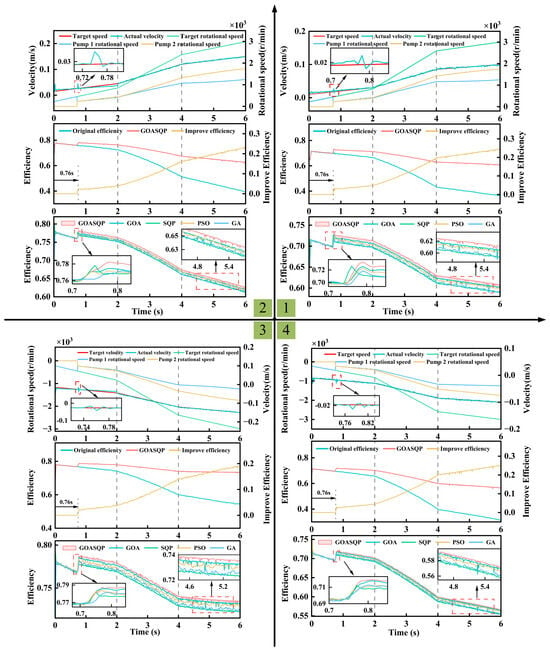
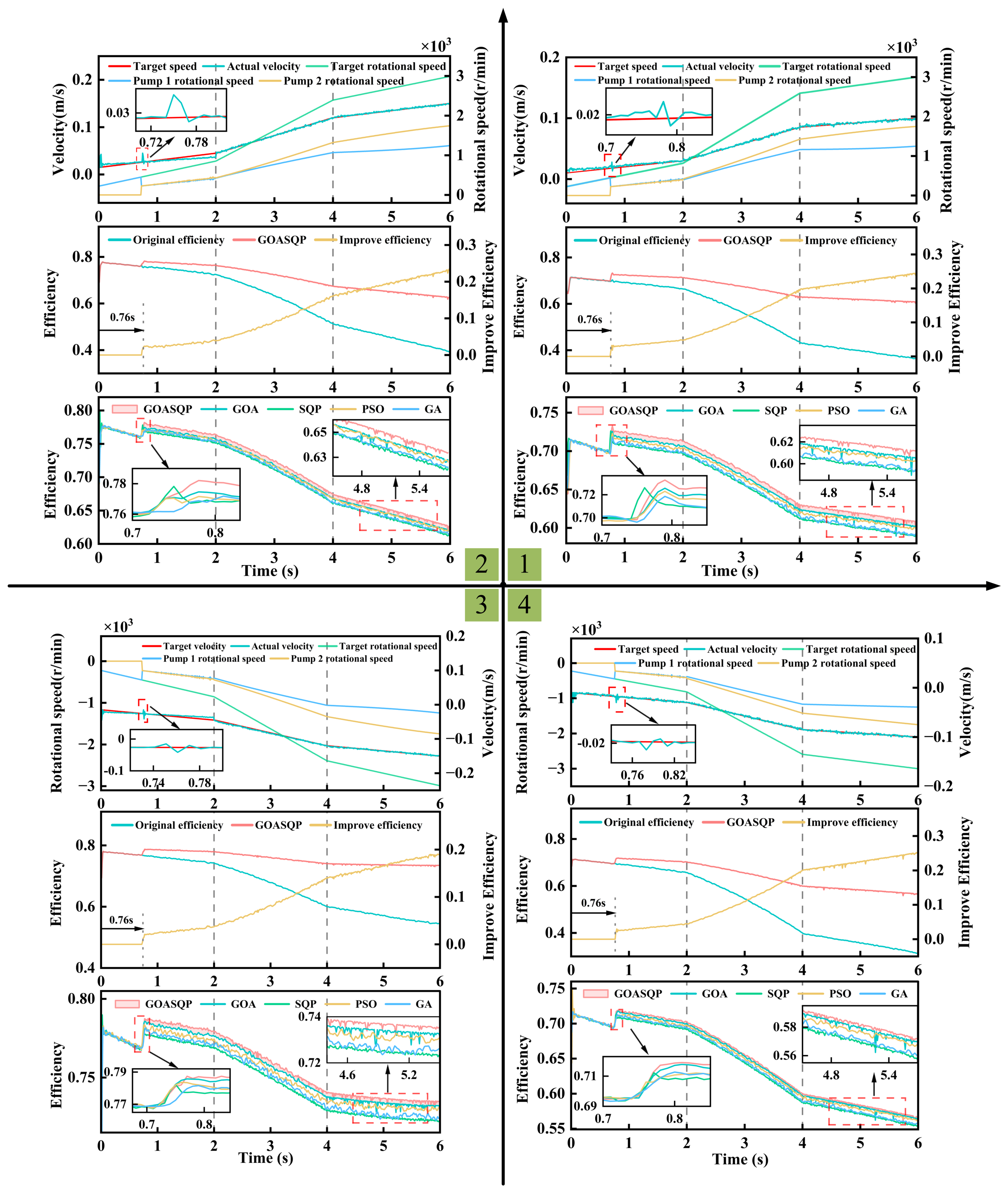
To validate the solution performance of the GOA-SQP model, the four-quadrant desired velocity commands specified in Table 3 are input to the boom circuit on the test bench under a 5 kN load. In single-motion boom operation mode, the following metrics are examined: tracking accuracy between actual and desired boom velocity, speed distribution results, and pump efficiency improvement after speed distribution for each model. The results are presented in Figure 14.
Figure 14.
Experimental results of the four quadrants.
As evidenced by the experimental results, the speed tracking error remains within 0.01 m/s throughout four-quadrant operation, which meets the practical accuracy requirements for excavator reengineering applications. This indicates that the hydraulic cylinder speed is scarcely influenced following pump speed allocation. Only when the distributed speeds of both pumps exceed 225 r/min, exemplified at the instant of 0.76 s in the figure, do valves 5 and 6 open to form the dual-pump load-sharing circuit. Otherwise, the system runs with a single pump while valves 5 and 6 remain closed. Experimental results show that at the moment of merging (0.76 s), a transient velocity oscillation of approximately 0.03 s occurs, which rapidly decays and stabilizes. The disturbance is short in duration and small in amplitude, falling within an acceptable range and exerting no impact on overall system performance.
It can be seen from the figure that the efficiency improvement curve rises rapidly above zero immediately after the pump speed distribution mode is activated at 0.76 s. As the actuator speed increases, both the efficiencies before and after pump speed distribution exhibit a decreasing trend. However, the decreasing slope of efficiency after pump speed distribution is significantly gentler, and the efficiency improvement gap continues to widen. The rate of efficiency improvement is highest under medium-speed operating conditions, corresponding to Stage II, and lowest under low-speed conditions, corresponding to Stage I. The enhancement in efficiency becomes particularly prominent under high-speed operating conditions, which correspond to Stage III. The root cause is that, in the high-speed range, pump efficiency deteriorates rapidly as speed increases, thereby creating a larger optimization margin. The proposed GOA-SQP adaptive speed distribution strategy dynamically transfers the workload from a single pump to two pumps, ensuring that both pumps are consistently maintained within their high-efficiency operating region. Consequently, volumetric and mechanical losses are effectively suppressed, enabling a sustained and larger efficiency gain under high-speed conditions. This finding further demonstrates that the proposed GOA-SQP-based pump speed allocation strategy exerts its maximum efficacy in the high-speed range, a region in which excavators spend most of their operational time. Under four-quadrant operating conditions, the pump speed distribution achieved by the GOA-SQP algorithm shows significantly superior efficiency performance when compared to the GOA, SQP, PSO-SQP, and GA-SQP optimization algorithms.
4.4. Energy Consumption Comparison
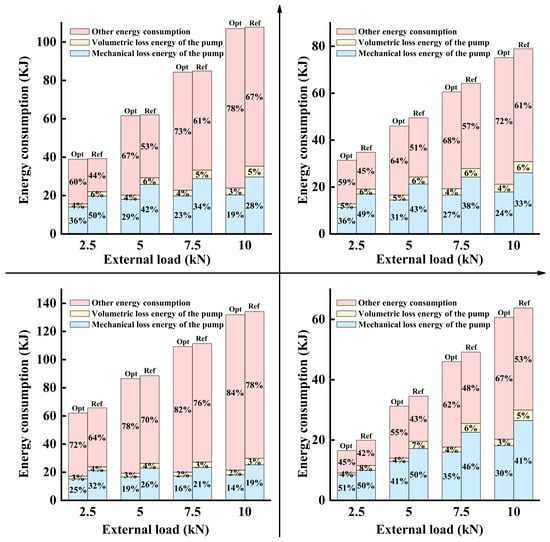
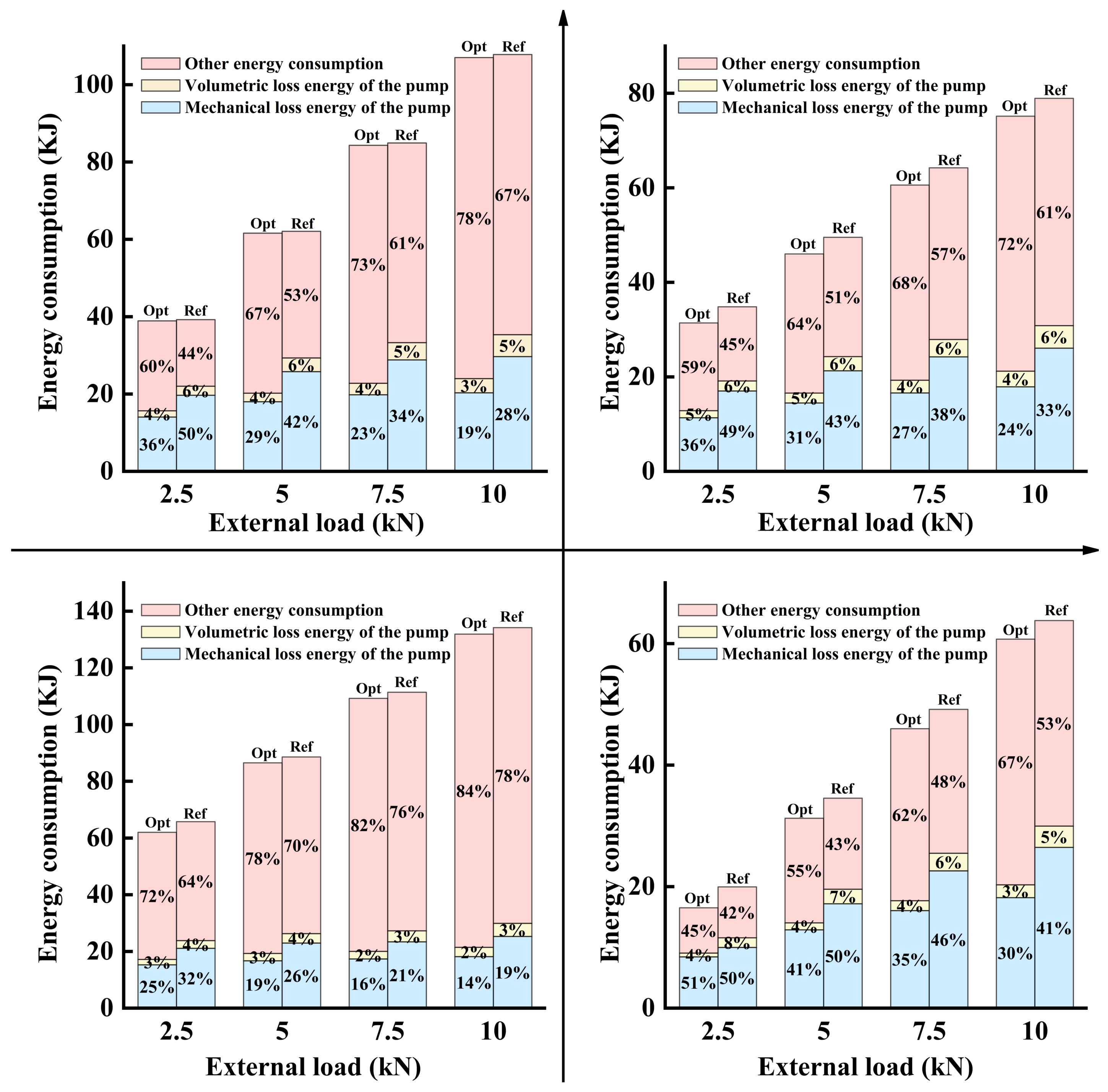
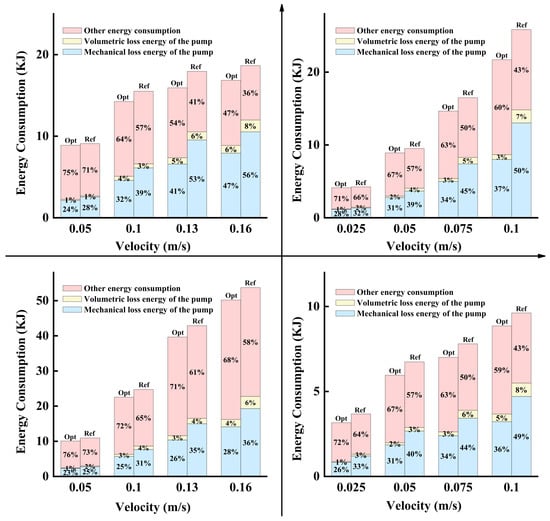
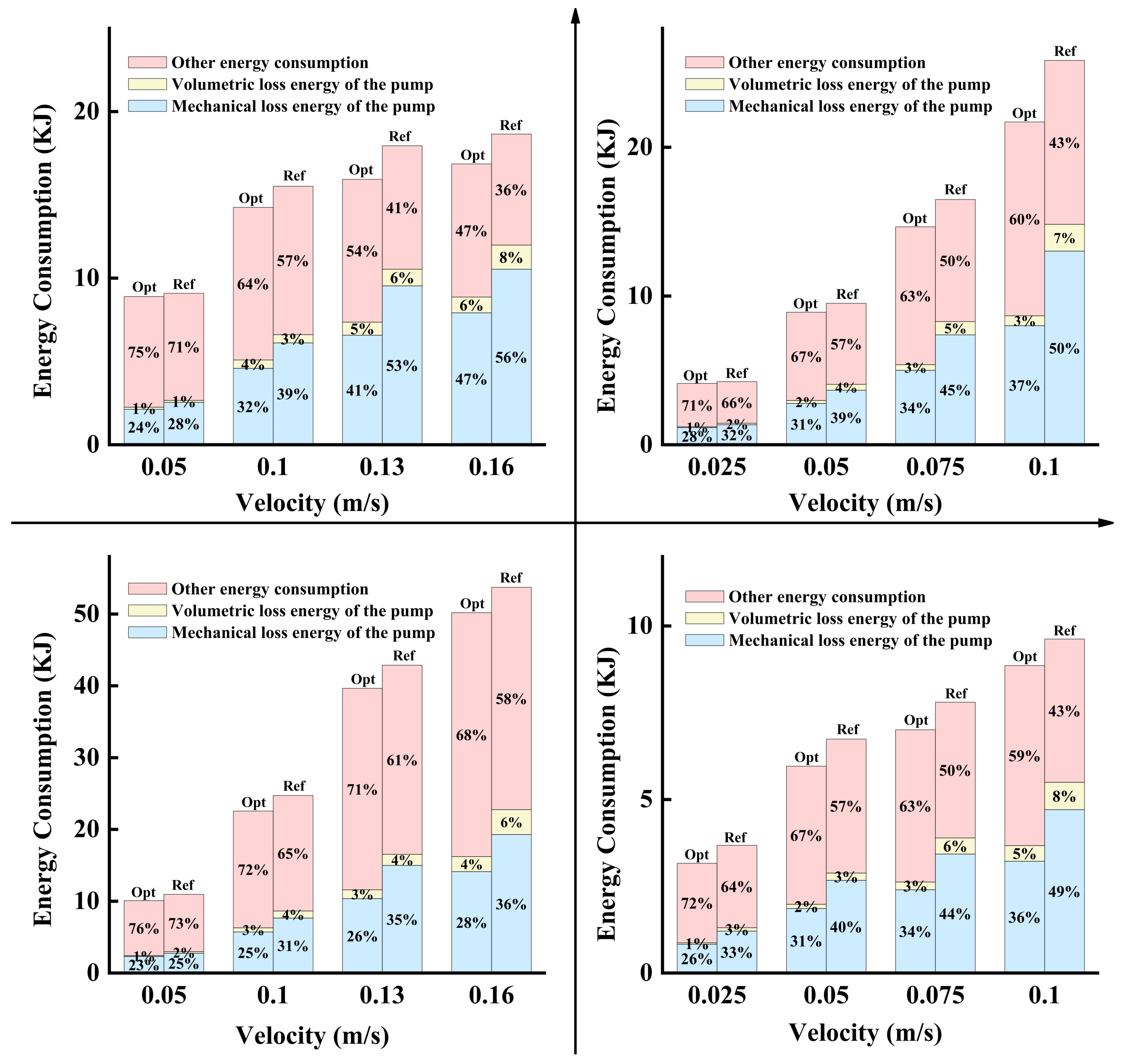
For a systematic evaluation of the influence of the system employing pump speed distribution and the GOA-SQP model on energy consumption characteristics, as well as the improvement in pump efficiency, the system without pump speed distribution is adopted as the baseline reference. By adopting the speed-load dual-variable fixation approach, speed and load are sequentially designated as locked variables. For load variation tests, a fixed speed is adopted, corresponding to 50% of the maximum operating speed for each quadrant according to Table 3. For speed variation tests, a constant load of 5 kN is imposed across all four quadrants. The operation time is 4 s. Following Equations (8) and (13), the energy consumption of the two systems is computed across a range of load and speed gradients. The results are presented in Figure 15 and Figure 16, in which “Opt” indicates the energy consumption of the system employing pump speed distribution, while “Ref” indicates the energy consumption of the system without pump speed distribution.
Figure 15.
Energy consumption comparison under variable loads.
Figure 16.
Energy consumption comparison under variable speeds.
Figure 15 shows that as load increases, the proportions of total system energy consumption, volumetric loss, and other energy losses all increase, while the proportion of mechanical loss decreases. This occurs because higher load enlarges the pressure differential across the pump, causing a sharp rise in internal leakage and a consequent drop in volumetric efficiency—hence the increased share of volumetric loss. Meanwhile, since more energy is expended to overcome the load, the total energy consumption base expands more rapidly, leading to a corresponding decrease in the proportion of mechanical loss.
Figure 16 indicates that as actuator velocity increases, total energy consumption across the four quadrants rises monotonically, with both mechanical and volumetric loss proportions expanding simultaneously. This occurs because higher velocity demands increase drive power, elevating total system energy consumption. Concurrently, increased pump speed intensifies internal friction and leakage flow, exacerbating both mechanical and volumetric losses, thereby continuously raising their respective shares in total energy consumption.
Both Figure 15 and Figure 16 demonstrate that under all speed and load conditions, the proposed pump speed distribution system exhibits lower mechanical efficiency loss, volumetric efficiency loss, and total system energy consumption compared to the pump speed distribution system. This confirms the system’s superior energy efficiency characteristics, reducing energy losses.
In summary, under single-motion operating conditions, the pump speed distribution system coupled with GOA-SQP dynamically optimizes dual-pump speed distribution, enabling real-time matching to full-range excavator operating conditions. Over the entire operational envelope, the proposed system achieves improvements of 14.22 and 4.57 percentage points in pump mechanical efficiency and volumetric efficiency, respectively, along with an 8.83% reduction in total system energy consumption. These results demonstrate outstanding energy efficiency and significant energy-saving potential.
5. Conclusions
Aiming to improve the pump efficiency of distributed independent pump-controlled excavator systems subjected to sustained high-load and high-speed conditions, this study proposes a dual-pump load-sharing architecture based on pump speed distribution and develops an adaptive closed-loop GOA-SQP optimization algorithm utilizing efficiency feedback. Through dynamic reconfiguration of two independent distributed circuits into a load-sharing architecture during single-cylinder actuation, the hydraulic system facilitates collaborative dual-pump operation within the high-efficiency zone, thereby mitigating the efficiency degradation induced by high-load and high-speed demands on a single pump.
Comparative analyses with GOA, SQP, GA-SQP, and PSO-SQP algorithms demonstrate that the proposed GOA-SQP method achieves superior optimization performance in both solution accuracy and computational efficiency. The adaptive closed-loop feedback mechanism effectively balances global exploration and local exploitation, reducing solution time by 39.15% while improving optimization accuracy by approximately 0.5%. This improvement enables real-time speed distribution and enhances system adaptability under varying operating conditions.
The effectiveness of the proposed system is further corroborated by experimental validation conducted under four-quadrant operating conditions. By capitalizing on the speed complementarity between the two pumps, the pump speed distribution system ensures that both pumps consistently operate within the high-efficiency region across the full operating envelope. Relative to the system prior to speed distribution, the proposed method increases pump mechanical efficiency, volumetric efficiency, and overall efficiency by 14.22, 4.57, and 18.79 percentage points, respectively, while reducing total system energy consumption by 8.83%. These results collectively demonstrate that the proposed dual-pump load-sharing architecture significantly enhances energy utilization efficiency.
Despite the significant energy efficiency improvements achieved by the proposed method, the present study is primarily limited to single-motion operating conditions. Future work will therefore extend the proposed dual-pump load-sharing architecture and GOA-SQP optimization strategy to accommodate compound motions of the excavator and more complex operational scenarios, thereby further improving the practical applicability and robustness of the distributed independent pump-controlled system.
Author Contributions
S.M.: Writing—draft preparation. M.J.: Algorithm testing. C.Y. (Chenbo Yin): Writing—review and editing. C.Y. (Chao Yang): Experimental setup. D.C.: Resources. All authors have read and agreed to the published version of the manuscript.
Funding
This work is supported by the National Key Research and Development Program of China (2021YFB2011904).
Institutional Review Board Statement
Not applicable.
Informed Consent Statement
Not applicable.
Data Availability Statement
The data that support the findings of this study are available from the corresponding author upon reasonable request.
Acknowledgments
The authors would like to thank the United Institute of Excavator Key Technology for its support and the engineers at SANY Group for their valuable technical guidance.
Conflicts of Interest
Author Donghui Cao is employed by SANY Group Company, Ltd. SANY Group provided technical guidance and resources related to the experimental platform. The remaining authors declare that they have no known competing financial interests or personal relationships that could have appeared to influence the work reported in this paper.
References
- Marasht, M.R.S.; Jazayeri, S.A.; Ebrahimi, M. Detailed analysis of a pure hydrogen-fueled dual-fuel engine in terms of performance and greenhouse gas emissions. Alex. Eng. J. 2024, 109, 250–261. [Google Scholar] [CrossRef] [Scilit]
- Ghadamkheir, K.; Zareei, J.; Yang, X.; Hatami, M. The effects of diesel-OME1 blended fuel on combustion characteristics of a heavy-duty compression ignition engine by a numerical study. Alex. Eng. J. 2023, 64, 493–503. [Google Scholar] [CrossRef] [Scilit]
- Ge, L.; Dong, Z.; Quan, L.; Li, Y. Potential energy regeneration method and its engineering applications in large-scale excavators. Energy Convers. Manag. 2019, 195, 1309–1318. [Google Scholar] [CrossRef] [Scilit]
- Yang, C.; Zhou, L.; Wang, J.; Xu, T.; Yang, C.; Ye, G. Research on energy saving system of hydraulic excavator based on three-chamber accumulator. J. Energy Storage 2023, 72, 108571. [Google Scholar] [CrossRef] [Scilit]
- Nguyen, V.H.; Do, T.C.; Ahn, K.K. Investigation and optimization of energy consumption for hybrid hydraulic excavator with an innovative powertrain. Actuators 2023, 12, 382. [Google Scholar] [CrossRef] [Scilit]
- Ding, R.; Zhang, J.; Xu, B.; Cheng, M.; Pan, M. Energy efficiency improvement of heavy-load mobile hydraulic manipulator with electronically tunable operating modes. Energy Convers. Manag. 2019, 188, 447–461. [Google Scholar] [CrossRef] [Scilit]
- Zhou, Y.; Helian, B.; Chen, Z.; Yao, B. Adaptive robust constrained motion control of an independent metering electro-hydraulic system considering kinematic and dynamic constraints. IEEE Trans. Ind. Inform. 2025, 21, 5943–5953. [Google Scholar] [CrossRef] [Scilit]
- Zhou, Y.; Ding, R.; Cheng, M.; Liao, L.; Chen, Z.; Yao, B. Precision motion control of independent metering hydraulic swing system with large inertia loads: A case study on a rotary drilling rig. IEEE Trans. Ind. Electron. 2025, 72, 10390–10400. [Google Scholar] [CrossRef] [Scilit]
- Yu, Y.; Do, T.C.; Park, Y.; Ahn, K.K. Energy saving of hybrid hydraulic excavator with innovative powertrain. Energy Convers. Manag. 2021, 244, 114447. [Google Scholar] [CrossRef] [Scilit]
- Guo, X.; Lengacher, J.; Vacca, A. A variable pressure multi-pressure rail system design for agricultural applications. Energies. 2022, 15, 6173. [Google Scholar] [CrossRef] [Scilit]
- Wang, H.; Chen, Z.; Huang, J.; Quan, L.; Zhao, B. Development of high-speed on–off valves and their applications. Chin. J. Mech. Eng. 2022, 35, 67. [Google Scholar] [CrossRef] [Scilit]
- Zimmerman, J.; Ivantysynova, M. Hybrid displacement controlled multi-actuator hydraulic systems. In Proceedings of the 12th Scandinavian International Conference on Fluid Power; Tampere University of Technology: Tampere, Finland, 2011; pp. 18–20. [Google Scholar]
- Williamson, C.; Ivantysynova, M. The effect of pump efficiency on displacement-controlled actuator systems. In Proceedings of the Tenth Scandinavian International Conference on Fluid Power; Tampere University of Technology: Tampere, Finland, 2007; pp. 301–326. [Google Scholar]
- Williamson, C.; Ivantysynova, M. Power optimization for multi-actuator pump-controlled systems. In Proceedings of the 7th International Fluid Power Conference Aachen 2010 (7IFK); Apprimus Verlag: Aachen, Germany, 2010; pp. 91–102. [Google Scholar]
- Williamson, C. Efficiency study of an excavator hydraulic system based on displacement-controlled actuators. In Proceedings of the Bath/ASME Symposium on Fluid Power and Motion Control (FPMC); University of Bath: Bath, UK, 2008; pp. 291–307. [Google Scholar]
- Zimmerman, J.; Busquets, E.; Ivantysynova, M. 40% fuel savings by displacement control leads to lower working temperatures—A simulation study and measurements. In Proceedings of the 52nd National Conference on Fluid Power (NCFP); National Fluid Power Association: Las Vegas, NV, USA, 2011; pp. 23–25. [Google Scholar]
- Fresia, P.; Rundo, M.; Padovani, D.; Altare, G. Combined speed control and centralized power supply for hybrid energy-efficient mobile hydraulics. Autom. Constr. 2022, 140, 104337. [Google Scholar] [CrossRef] [Scilit]
- Rosero, J.A.; Ortega, J.A.; Aldabas, E.; Romeral, L.A.R.L. Moving towards a more electric aircraft. IEEE Aerosp. Electron. Syst. Mag. 2007, 22, 3–9. [Google Scholar] [CrossRef] [Scilit]
- Dermouche, R.; Talaoubrid, A.; Barazane, L.; Sellami, Y.; Tadjine, M.; Zioui, N. Qualitative and quantitative analysis of the reliability of NPC and ANPC power converters for aeronautical applications. Alex. Eng. J. 2022, 61, 4863–4873. [Google Scholar] [CrossRef] [Scilit]
- Li, Z.; Shang, Y.; Jiao, Z.; Lin, Y.; Wu, S.; Li, X. Analysis of the dynamic performance of an electro-hydrostatic actuator and improvement methods. Chin. J. Aeronaut. 2018, 31, 2312–2320. [Google Scholar] [CrossRef] [Scilit]
- Mu, H.; Cheng, M.; Tang, X.; Ding, R.; Ma, W. A hybrid distributed-centralized load sensing system for efficiency improvement of electrified construction machinery. Energy 2025, 314, 134123. [Google Scholar] [CrossRef] [Scilit]
- Du, S.; Zhou, J.; Zhao, H.; Ma, S. Research on the energy transfer and efficiency performance of an electro-hydrostatic actuator for wheel-legged robot joint. Energy 2024, 291, 130417. [Google Scholar] [CrossRef] [Scilit]
- Qu, S.; Fassbender, D.; Vacca, A.; Busquets, E. A high-efficient solution for electro-hydraulic actuators with energy regeneration capability. Energy 2021, 216, 119291. [Google Scholar] [CrossRef] [Scilit]
- Agostini, T.; De Negri, V.; Minav, T.; Pietola, M. Effect of energy recovery on efficiency in electro-hydrostatic closed system for differential actuator. Actuators 2020, 9, 12. [Google Scholar] [CrossRef] [Scilit]
- Huang, L.; Yu, T.; Jiao, Z.; Li, Y. Research on power matching and energy optimal control of active load-sensitive electro-hydrostatic actuator. IEEE Access 2020, 9, 51121–51133. [Google Scholar]
- Jiao, Z.; Li, Y.; Yu, T. Dynamic thermal coupling modeling and analysis of wet electro-hydrostatic actuator. Chin. J. Aeronaut. 2022, 35, 298–311. [Google Scholar] [CrossRef] [Scilit]
- Yuan, Z.; Ma, W.; Yin, C.; Ma, S.; Cao, D. Research on control and energy consumption characteristics of distributed independent electrical-hydraulic actuator control system used on excavators. IEEE Sens. J. 2024, 24, 34070–34082. [Google Scholar] [CrossRef] [Scilit]
- Saremi, S.; Mirjalili, S.; Lewis, A. Grasshopper optimisation algorithm: Theory and application. Adv. Eng. Softw. 2017, 105, 30–47. [Google Scholar] [CrossRef] [Scilit]
- Mafarja, M.; Aljarah, I.; Faris, H.; Hammouri, A.I.; Al-Zoubi, A.M.; Mirjalili, S. Binary grasshopper optimisation algorithm approaches for feature selection problems. Expert Syst. Appl. 2019, 117, 267–286. [Google Scholar] [CrossRef] [Scilit]
- Veza, I.; Karaoglan, A.D.; Ileri, E.; Afzal, A.; Hoang, A.T.; Tamaldin, N.; Said, M.F.M. Multi-objective optimization of diesel engine performance and emission using grasshopper optimization algorithm. Fuel 2022, 323, 124303. [Google Scholar] [CrossRef] [Scilit]
- Wu, L.; Wu, J.; Wang, T. The improved grasshopper optimization algorithm with Cauchy mutation strategy and random weight operator for solving optimization problems. Evol. Intell. 2024, 17, 1751–1781. [Google Scholar]
- Yildiz, B.S.; Pholdee, N.; Bureerat, S.; Yildiz, A.R.; Sait, S.M. Enhanced grasshopper optimization algorithm using elite opposition-based learning for solving real-world engineering problems. Eng. Comput. 2022, 38, 4207–4219. [Google Scholar]
- Wu, L.; Wu, J.; Wang, T. Enhancing grasshopper optimization algorithm (GOA) with levy flight for engineering applications. Sci. Rep. 2023, 13, 124. [Google Scholar] [CrossRef] [Scilit] [PubMed]
- Saxena, A. A comprehensive study of chaos embedded bridging mechanisms and crossover operators for grasshopper optimisation algorithm. Expert Syst. Appl. 2019, 132, 166–188. [Google Scholar] [CrossRef] [Scilit]
- Sharma, N.; Sharma, H.; Sharma, A.; Bansal, J.C. Grasshopper inspired artificial bee colony algorithm for numerical optimisation. J. Exp. Theor. Artif. Intell. 2021, 33, 363–381. [Google Scholar]
- Abualigah, L.; Diabat, A. A comprehensive survey of the Grasshopper optimization algorithm: Results, variants, and applications. Neural Comput. Appl. 2020, 32, 15533–15556. [Google Scholar] [CrossRef] [Scilit]
- Gill, P.E.; Kungurtsev, V.; Robinson, D.P. A stabilized SQP method: Superlinear convergence. Math. Program. 2017, 163, 369–410. [Google Scholar]
- Curtis, F.E.; O’Neill, M.J.; Robinson, D.P. Worst-case complexity of an SQP method for nonlinear equality constrained stochastic optimization. Math. Program. 2024, 205, 431–483. [Google Scholar]
- Al-Bhadely, F.; İnan, A. Improving directional overcurrent relay coordination in distribution networks for optimal operation using hybrid genetic algorithm with sequential quadratic programming. Energies 2023, 16, 7031. [Google Scholar] [CrossRef] [Scilit]
- Hong, L.; Yu, X.; Tao, G.; Özcan, E.; Woodward, J. A sequential quadratic programming based strategy for particle swarm optimization on single-objective numerical optimization. Complex Intell. Syst. 2024, 10, 2421–2443. [Google Scholar]

Disclaimer/Publisher’s Note: The statements, opinions and data contained in all publications are solely those of the individual author(s) and contributor(s) and not of MDPI and/or the editor(s). MDPI and/or the editor(s) disclaim responsibility for any injury to people or property resulting from any ideas, methods, instructions or products referred to in the content. |
© 2026 by the authors. Licensee MDPI, Basel, Switzerland. This article is an open access article distributed under the terms and conditions of the Creative Commons Attribution (CC BY) license.