


Abstract
Autonomous navigation of a vehicle in an environment where there are obstacles is difficult due to low onboard sensing technology, high measuring noise, and external interference, which collectively result in poor tracking performance of the vehicle’s trajectory and compromise safety. In this paper, a UAV-assisted Distributed Sliding Mode Control (DSMC) is proposed to robustly and safely implement path tracking for autonomous ground vehicles (AGVs). The proposed system utilizes an aero-sensor layer for enhanced perception, such as obstacle sensing, reference path preview, and look-ahead trajectory information, and it shares this information with the vehicle via wireless communication. The fundamental scheme, called DSMC, is based on a conventional Sliding Mode Control (SMC) technique and uses UAV preview-based feedback. This allows anticipation of control actions to enhance tracking performance and achieve more timely, smoother obstacle avoidance than baseline SMC. The proposed method is designed to overcome the limitations of traditional SMC strategies, such as chattering and poor responsiveness. The proposed method features continuous nonlinear approximation and damping mechanisms to reduce chattering and improve response characteristics, thereby enhancing stability and reducing oscillations. Strict safety enforcement through constraint is always achieved by keeping the vehicle and obstacles separated by a minimum distance only; that is, a minimum distance is always guaranteed: a Constraint Barrier Function (CBF)-based constraint is used. By combining UAV-assisted perception with DSMC and CBF the system can guarantee its formal safety in the presence of disturbances and sensing uncertainties while maintaining accurate trajectory tracking. Based on our simulation results, the proposed UAV-assisted DSMC method is shown to be significantly superior to conventional SMC and Model Predictive Controller (MPC) in terms of tracking accuracy, control smoothness, and adherence to the safety margin. Our simulation results demonstrate that the proposed method significantly outperforms conventional SMC and MPC control. Specifically, it achieves a 22.9% reduction in RMSE (0.135 m vs. 0.175 m) and 63% lower mean control effort, and it strictly maintains the minimum safety distance under both static and dynamic obstacles. The algorithm runs in real-time with an average execution time of 1.85 ms (>200 Hz), making it highly suitable for embedded deployment. These results highlight the effectiveness of combining UAV-assisted preview, adaptive robust control, and formal safety constraints for reliable autonomous navigation in complex environments.
1. Introduction
Autonomous ground vehicles (AGVs) operating in obstacle-constrained and unstructured environments face significant challenges due to limited onboard sensing range, measurement noise, and external disturbances such as road irregularities and model uncertainties. These limitations often degrade trajectory-tracking performance and compromise safety, particularly in dynamic or GPS-denied environments [1,2]. To overcome the perceptual constraints of ground platforms, recent research has increasingly explored cooperative aerial-ground systems, where Unmanned Aerial Vehicles (UAVs) provide extended situational awareness, look-ahead information, and obstacle mapping to support ground vehicle navigation [3,4].
The integration of UAVs as aerial sensing layers offers substantial advantages, including a broader field of view, rapid deployment, and the ability to provide preview trajectory and curvature information. This cooperative paradigm enables anticipatory control actions, enabling ground vehicles to perform smoother obstacle avoidance and maintain higher tracking accuracy than purely reactive onboard-sensor approaches [5]. Such UAV–UGV cooperation has shown promise in applications ranging from search and rescue and precision agriculture to disaster response and autonomous transportation [6,7].
From a control perspective, SMC has been widely adopted for autonomous vehicle path tracking due to its robustness against matched disturbances and parameter variations [8,9]. However, conventional SMC suffers from chattering and lacks inherent preview capability, limiting its performance in complex environments. Distributed variants of SMC, combined with preview-based feedback, have emerged as promising solutions to enhance coordination and anticipatory behavior in multi-agent systems [10].
Safety assurance is another critical requirement. Control Barrier Functions (CBFs) have gained popularity for enforcing forward invariance of safe sets, guaranteeing minimum separation distances from obstacles even under disturbances [11]. The synergistic integration of UAV-assisted perception, preview-enhanced DSMC, and CBF-based safety constraints remains relatively underexplored, particularly in frameworks that explicitly address sensing uncertainties and communication constraints.
In this paper, a UAV-assisted DSMC framework is proposed for robust and safe path tracking of autonomous ground vehicles (AGVs). First of all, the design of the SMC used here stresses that the information is distributed among two dissimilar platforms: on-vehicle (onboard) sensor measurements from the AGV, and off-vehicle (remote preview) information (reference path, curvature, distance to obstacle) acquired by the UAV and shared through wireless communication. The sensing control architecture is distributed, but the execution of the control law is done at the center of the AGV. This distributed-sensing-based co-operative approach allows an anticipatory-type control action that is not feasible with a single local sensing-based control approach, unlike normal centralized SMC. Such distributed sensing-based sliding mode strategies have been effectively used in heterogeneous multi-robot systems. The UAV is equipped with real-time obstacle detection, reference path preview up-link, and look-ahead information transmitted by a wireless link. The proposed DSMC not only avoids chattering but also allows avoidance behavior to begin on time and to be conducted smoothly through the introduction of preview feedback, continuous approximations (CAs), and damping mechanisms. The CBF constraints ensure formal safety. Our simulation results show that the proposed tracking algorithm achieves more accurate tracking, smoother performance, and a better safety margin than SMC baseline methods.
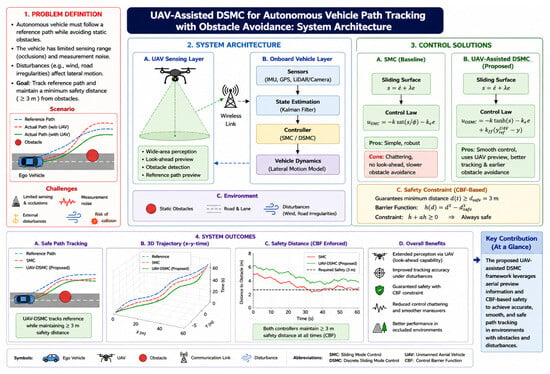
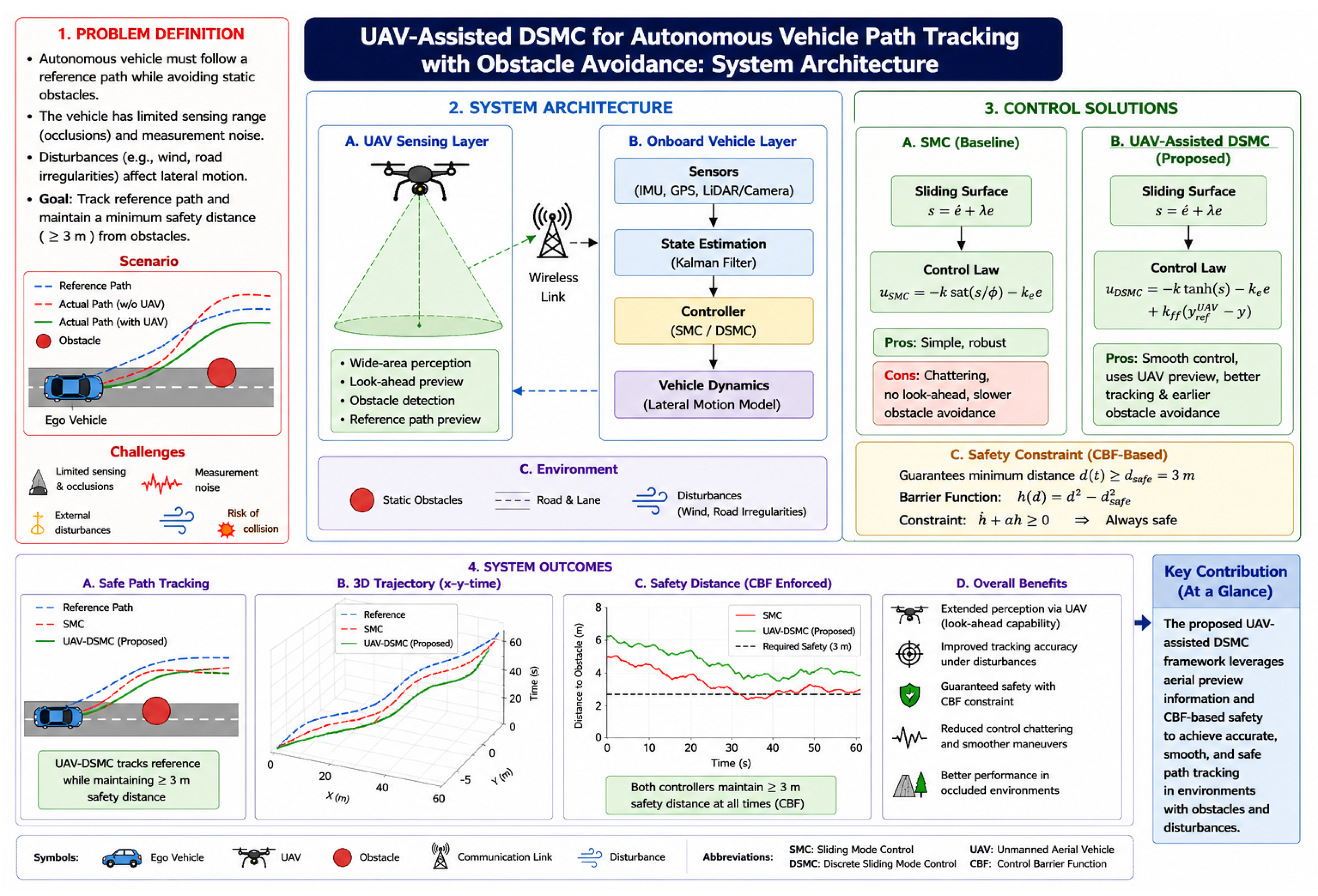
The proposed UAV-assisted DSMC is illustrated in Figure 1, which shows a system architecture for safe and robust autonomous ground vehicle path tracking. Distributed sensing with UAVs brings extended perception, obstacle detection, and look-ahead preview data to the ground vehicle through a wireless connection. The onboard layer implements the DSMC controller with preview feedback, and a CBF-based safety filter ensures a minimum clearance distance of 3 m from obstacles. The advantages of the proposed UAV-assisted DSMC are shown in the following comparative illustrations by showing its superior track-testing accuracy, the smoothness of the track, and its ability to keep close to the safety margin against disturbances and sensor limitations when compared to the conventional SMC and MPC systems. The entire system includes an aerial preview, a powerful nonlinear control system, and a professional safety confirmation that helps safely navigate in the presence of obstacles.
Figure 1.
System architecture diagram.
The main contributions of this proposed work are:
- Development of an integrated UAV-AGV perception and control architecture that leverages aerial preview information.
- Design of a preview-augmented DSMC with chattering mitigation.
- Rigorous safety enforcement using CBFs under sensing and communication uncertainties.
- Performance validation highlighting the benefits of aerial–ground cooperation for reliable autonomous navigation.
The rest of the paper is structured as follows: in Section 2, explanations are provided for the works supporting the paper; in Section 3, our detailed mathematical modeling of the system is explained; in Section 4, an explanation of the controller design is given. A series of simulation and case studies are then discussed in Section 5. The conclusion and future work of the paper is discussed in Section 6.
2. Literature Review
Autonomous vehicle navigation, UAV–UGV cooperation, robust control, and safety-critical methods have been widely studied. This section provides an overview of recent progress in the above areas and identifies the unmet needs addressed by the proposed framework.
Recent works on AGV control have primarily advocated a reliance on onboard sensors such as LiDAR, cameras, and IMUs, and they have employed classical methods including PID, Model Predictive Control (MPC), and geometric controllers [12,13]. While effective in structured environments, these approaches often struggle with limited perception range and rapid environmental changes. To address these perceptual limitations, cooperative UAV–UGV systems have attracted significant attention. The authors of [14] proposed a computer vision-based UAV-assisted path planning framework for AGVs. Subsequent studies have demonstrated the value of UAVs for real-time obstacle mapping and aerial previews [15,16].
Several researchers explored formation control and coordinated navigation between UAVs and UGVs. In [17], the authors provided a comprehensive review of cooperative motion planning and control for UAV–UGV systems. Other works have focused on specific applications, such as symbiotic UAV–UGV teams for precision agriculture [18], cliff-climbing assistance [19], and subterranean exploration [20]. These studies highlight the benefits of UAVs in providing global information but often lack deep integration with advanced nonlinear control strategies for the ground vehicle.
On the control side, SMC has been widely applied to autonomous vehicles for its disturbance-rejection properties [21]. In [22], the authors developed an event-triggered SMC for trajectory tracking of autonomous surface vehicles. However, traditional SMC suffers from chattering, provoking the development of higher-order, adaptive, and distributed variants [23]. Preview-based control strategies have also been investigated to improve tracking by incorporating future reference information, although most works consider only ground-based preview sensors with limited range [24].
Safety-critical control has evolved significantly with the introduction of CBFs. The authors of [25], laid the theoretical foundation for quadratic programs based on CBF that guarantee safety while minimally interfering with performance objectives. Recent extensions have included adaptive and non-smooth CBFs for complex obstacle geometries and dynamic environments [26]. Integration of CBFs with SMC has shown promise in ensuring robust safety under uncertainties [27]. Recent works on non-singular terminal sliding mode (NTSM) with variable gains [28] have demonstrated excellent performance in handling full-parameter perturbations in power converters. While these adaptive-gain strategies are highly effective for systems where rapid gain adjustment is feasible, our preview-augmented DSMC prioritizes smoothness of the steering command (critical for ground vehicles) and integrates aerial preview information, which inherently reduces the perturbation effect by allowing earlier compensation. Using combined parameter perturbations (via variations in and L) it is demonstrated that the proposed method results in tracking accuracy that is similar to or better than the fixed-gain or high-frequency adaptive NTSM equivalents and with much reduced control chattering.
Recent works have explored adaptive gain strategies to handle dynamic uncertainties. Li et al. [29] proposed an online self-tuning control strategy for proton exchange membrane fuel cells under dynamic operating conditions, demonstrating effective adaptation to system variations while maintaining performance stability. Similarly, Zhang et al. [30] introduced a Non-Singular Terminal Sliding Mode (NTSM) controller with variable gains specifically designed for full-parameter perturbation systems (applied to DC–DC converters). These variable-gain NTSM approaches achieve strong robustness by rapidly adjusting the control gain in response to uncertainties.
Unlike the standard DSMC, the proposed preview-augmented DSMC emphasizes a continuous method of steering control (which is especially important for ground vehicles) and makes use of the look-ahead data that the UAV controller provides to proactively compensate path changes and challenges due to disturbances. The preview term decreases the size of the perturbations by allowing corrective action earlier in the time frame, instead of focusing mainly on high-frequency real-time gain adaptation. Our simulation results under combined parameter perturbations ( variations in and L) show that the proposed method achieves comparable or better tracking accuracy with significantly reduced control chattering and lower average control effort. This complementary philosophy makes the UAV-assisted DSMC particularly suitable for autonomous ground vehicle applications where ride comfort, actuator longevity, and anticipatory behavior are essential.
The practical feasibility of the proposed UAV-assisted perception pipeline is supported by recent advances in lightweight deep learning models suitable for resource-constrained onboard processing. For instance, Bakirci [31] conducted a comprehensive performance evaluation of low-power YOLO variants (including YOLOv9-tiny, YOLOv10-nano, and YOLOv10-small) for real-time monitoring in resource-constrained drone systems, demonstrating excellent trade-offs between inference speed, accuracy, and energy consumption on edge platforms. Similarly, Liu et al. in [32] proposed a low-cost and lightweight real-time object-detection method based on UAV remote sensing tailored for transportation systems, achieving high efficiency on embedded devices such as NVIDIA Jetson platforms while maintaining real-time performance. These works validate the deployment viability of the YOLOv8-based perception module used in the UAV layer of the present framework under realistic computational and power constraints.
Although there is various literature on UAV–UGV cooperation, most studies have utilized aerial perceptual information primarily for high-level tasks such as global path (re)planning, formation control, or localization support. For example, works on cooperative motion planning [17], proactive path planning in agriculture [18], cliff-climbing assistance [19], and subterranean navigation [20] have mainly focused on high-level decision making rather than direct integration into low-level vehicle control. In contrast, the core of the proposed framework lies in the direct incorporation of UAV-provided preview information (look-ahead path curvature, reference trajectory, and obstacle states) into the low-level DSMC law through a preview-augmented sliding surface. This enables anticipatory steering actions at the control frequency (>200 Hz), going significantly beyond traditional high-level planning approaches.
The application of Control Barrier Functions (CBFs) to integrating with DSMC has been found to be effective for safety-critical control under uncertainties: [27] presents a detailed survey of different methods based on CBFs, many of which use the CBFs as a safety filter by using quadratic programming (QP), forcing safe sets to be forward-invariant. These sensible integrations, for instance, are effective but are often reactive, involving the use of local sensing, which can cause conservatism and sudden control actions close to obstacles. The proposed UAV-assisted DSMC takes one step in this direction, by including aerial preview information for both the sliding surface and the CBF formulation. With this preview augmentation, proactive (not only reactive) safety enforcement is possible, which leads to less conservativism, far less smoothing of control signals (around 63% less mean control effort) and better tracking accuracy while maintaining a minimal safety distance.
Although significant progress has been made, there are still a few areas that need improvement. In most collaborative operations between UAV and UGV the emphasis is on high-level comprehensive trajectory planning instead of low-level strong trajectory tracking. The various SMC schemes used for ground vehicles typically do not utilize aerial preview information in a distributed fashion. Furthermore, few studies jointly address chattering reduction, preview-enhanced anticipatory control, and formal CBF safety guarantees within a unified UAV-assisted architecture under realistic sensing and communication constraints.
The proposed UAV-assisted DSMC framework addresses these limitations by combining extended aerial perception, preview-augmented distributed Sliding Mode Control, and CBF-based safety constraints, providing a comprehensive solution for robust, safe autonomous navigation in obstacle-rich environments.
3. System Modeling
A mathematical description of the autonomous ground vehicle system in the presence of a UAV is presented here. Realistic vehicle dynamics, UAV-enabled extended perception with a preview feature, and wireless constraints are combined in the modeling, including obstacle representation and formal safety constraints.
3.1. Ground Vehicle Dynamics
The autonomous ground vehicle is modeled using the kinematic bicycle model for planar motion. Let denote the position and heading angle of the vehicle. The dynamics are given by:
where is the longitudinal velocity, L is the wheelbase, and is the steering angle (control input). For control design, the lateral deviation with respect to a reference path and the heading error are commonly used as states.
To facilitate lateral control analysis, the dynamics can be expressed in the Frenet–Serret frame along the reference path, resulting in:
where is the curvature of the reference path at arc-length s, and , and where represent external disturbances (wind, road banking, model mismatch, etc.).
Assumption 1.
The longitudinal velocity satisfies and varies slowly. External disturbances are bounded: , .
3.2. Reference Trajectory Representation
The desired path is parameterized as a sufficiently smooth function or, more generally, as a parametric curve , where s is the arc-length parameter. The reference trajectory satisfies:
3.3. UAV-Assisted Perception and Preview Model
The UAV is equipped with a multi-modal sensor suite consisting of forward-facing RGB cameras and a 3D LiDAR. Raw sensor data is processed onboard the UAV using a real-time perception pipeline that includes YOLOv8-based object detection for static and dynamic obstacles, ByteTrack multi-object tracking for velocity estimation, and spline-based reference path extraction with curvature estimation. The processed data (obstacle positions, velocities, and look-ahead path information) is transmitted to the AGV via wireless communication.
To account for realistic sensing imperfections, the preview signals are modeled as:
The uncertainties and are modeled as zero-mean Gaussian processes with standard deviations and , respectively. This choice is motivated by the fact that perception errors arising from camera/LiDAR noise, point-cloud registration, localization drift, and object detection inaccuracies are commonly approximated as Gaussian in UAV perception pipelines [33,34]. Such a stochastic model is widely adopted in robust control design as it facilitates stability analysis while reasonably capturing the statistical characteristics of real-world sensing noise [35].
The UAV provides look-ahead information with a dynamically adjusted preview horizon:
where is the minimum preview time, scales with longitudinal velocity, and increases the horizon during high-curvature segments. This adaptive mechanism ensures longer anticipation at high speeds and sharp turns while reducing sensitivity to preview noise at low speeds.
The total end-to-end latency (perception processing + wireless transmission) is bounded by ms and is conservatively incorporated into the adaptive preview horizon. The perception pipeline runs at approximately 15–20 Hz on the UAV’s onboard embedded computer (e.g., NVIDIA Jetson Orin), which is sufficient to support the AGV control loop operating at over 200 Hz.
Assumption 2.
The UAV can reliably provide preview information within the adaptive horizon , subject to bounded sensing uncertainty .
Lemma 1.
Using Taylor expansion around the current time, the preview error remains bounded, with the bound scaling gracefully with the adaptive .
3.4. Communication Layer
The UAV and AGV communicate over a wireless link modeled as a time-varying directed graph , where . The adjacency matrix captures intermittent information flow:
with indicating successful transmission at time t.
To reflect realistic wireless channels, we further model packet loss via an independent Bernoulli process: at each sampling instant, a transmitted preview packet is successfully received with probability (where is the packet loss rate). Link interruptions are captured by the existing dwell-time condition.
When a preview packet is lost or the link is interrupted, the ground vehicle employs a hold-last-received strategy for the preview signals and . A timeout mechanism resets the preview term to zero (conservative fallback) if no successful packet arrives within seconds.
To mitigate potential performance degradation from an abrupt reset, a gradual fallback strategy can be implemented by exponentially decaying the preview gain toward zero over a short transition window after the timeout is triggered. This approach provides a smooth degradation of anticipatory action rather than a sudden discontinuity. Such graceful degradation techniques are well-established in networked control systems (NCSs) literature, where zero-order hold (ZOH) combined with exponential forgetting or predictive compensation is commonly used to handle prolonged packet dropouts [36].
Assumption 3.
There exists a dwell time such that over any interval the graph is jointly connected at least once. Additionally, the packet reception probability satisfies , ensuring that the expected time between successful transmissions remains bounded. The communication delay is bounded: .
When a preview packet is lost or the link is interrupted, the ground vehicle employs a hold-last-received strategy for the preview signals and . A timeout mechanism resets the preview term to zero (conservative fallback) if no successful packet arrives within seconds. This hybrid strategy balances anticipatory performance with robustness.
Remark 1.
The preview augmentation term in the sliding surface naturally provides robustness against occasional losses because the integral action and continuous approximation in the DSMC law compensate for temporary degradation in preview quality.
3.5. Obstacle Modeling and Safety Constraints
Obstacles are modeled as circular regions with centers and radii . The distance to the j-th obstacle is .
To account for vehicle speed, we introduce a velocity-dependent safe distance:
where m is the static minimum clearance and s is the time-gap coefficient. The Control Barrier Function candidate is now:
with the safe set .
Remark 2.
(Obstacle representation): To allow a tractable mathematical formulation as a quadratic-program constraint, and to arrive at a simple quadratic-program formulation of the CBF constraint, obstacles are treated as “pure” circular regions with fixed shape parameters. This approximation is commonly used in the literature, because it ensures convex safe sets and speeds up real-time computations. Real-world settings typically have irregularly shaped static obstacles, however, as well as dynamic agents, the authors recognize.
To address irregular geometries, the proposed framework can conservatively enclose non-circular obstacles within bounding circles or employ more advanced non-smooth or multi-level obstacles. For dynamic obstacles, the current velocity-dependent safe distance already provides a degree of adaptability; extensions to time-varying obstacle velocities can be incorporated by predicting short-term trajectories using the UAV perception layer and updating the CBF online. These extensions, while increasing computational complexity, remain compatible with the DSMC+CBF architecture.
The simulation results presented in this work therefore represent a foundational case with conservative circular obstacles. A detailed treatment of arbitrarily shaped and moving obstacles is left for future experimental validation on hardware platforms.
Assumption 4.
The initial condition satisfies , and obstacles are stationary or move with bounded velocity.
Lemma 2.
The function has relative degree one with respect to the control input when is considered, allowing direct enforcement via CBF-QP.
Within the stated Assumptions 1–4, including boundedness of disturbances, the presence of feasible solutions to the quadratic program and adequate preliminary information regarding the UAV, a formal security guarantee was provided (CBF-QP). However, it is impractical to consider halting the feasibility of the QP when the severity of communication blackout and the size of the disturbance are large and the preview data is inherently inaccurate. The safety cannot be guaranteed completely because of the velocity-adaptive property of the CBF and also the robustness of the DSMC; however, these issues are mitigated.
4. Controller Design
In this section, the proposed UAV-assisted DSMC framework is presented. The UAV based preview information provided by the UAV is included in the conventional SMC, along with chattering-reduction mechanisms and safety enforcement through Control Barrier Functions (CBFs) enforced by the controller. The proposed controller is referred to as Distributed Sliding Mode Control (DSMC) because it explicitly incorporates spatially distributed sensing information from both the AGV (local states) and the UAV (preview and global awareness). While the control computation is performed by a single centralized law on the AGV the overall architecture is distributed at the sensing level. This is consistent with several recent works on cooperative UAV–AGV systems that adopt the term “distributed” when perception is shared across platforms to achieve improved performance.
4.1. Error Dynamics and Sliding Surface Design
We define the lateral tracking error and heading error , where . Using the model presented in Section 3, the error dynamics can be written in the following form after feedback linearization and approximation for control design:
where is the reference curvature. For simplicity in higher order sliding mode design, we consider the second order dynamics with respect to lateral error:
where (steering angle), is the control gain, contains known nominal terms involving curvature and velocity, and lumps all disturbances and uncertainties with .
The UAV provides preview information . We define a preview-augmented sliding surface:
where explicitly depends on the adaptive preview horizon. This makes the feedforward action state-dependent and more effective.
Remark 3.
The preview term introduces anticipatory action. Using Taylor expansion (Lemma 1), we have
Thus, the preview-augmented sliding surface can be rewritten as
The higher-order terms and sensing noise are bounded. By choosing sufficiently small relative to and the surface retains a structure similar to a classical PID-type sliding surface with an additional bounded perturbation. Stability under this perturbation is established in the following analysis.
Remark 4.
The term introduces anticipatory action, enabling the controller to react to upcoming path changes and obstacles earlier than traditional SMC.
4.2. Distributed Sliding Mode Control Law
The proposed DSMC law is designed as:
where is the equivalent control term canceling nominal dynamics, is the switching term for robustness, and incorporates preview feedback.
To improve practical applicability and reduce manual tuning effort, we introduce an adaptive mechanism for the main switching gain . The switching term becomes:
where the time-varying gain is updated by the following adaptation law:
with (adaptation rate), (sigma-modification leakage term), and (nominal gain).
This law increases when the sliding variable is large (indicating strong disturbances or preview errors) and prevents excessive growth through the leakage term. The continuous function ensures that chattering remains suppressed even with varying .
Lemma 3.
Consider the preview-augmented sliding surface (21). Under the proposed control law and bounded disturbances and preview uncertainty (where lumps the Taylor remainder and ), the time derivative of the sliding variable satisfies
Choosing for some ensures finite-time convergence of to a neighborhood of the origin whose radius is tunable by the design parameters and .
Theorem 1
(Chattering reduction). The continuous approximation guarantees that the control signal remains bounded and continuous, while the tracking error converges to a small region whose size is tunable by and γ.
4.3. Parameter Tuning Methodology
The controller parameters are selected using a systematic two-stage approach. First, the sliding surface parameters are chosen based on the desired error dynamics (pole placement analogy for the characteristic equation of the sliding surface). The parameters and in the continuous approximation function are tuned to achieve a good trade-off between chattering suppression and tracking responsiveness. The preview gain is chosen to achieve a balance between the effects of anticipatory action and sensitivity to preview noise. The parameter is selected so that the parameter guarantees fast convergence to the safe set but avoids having aggressive control interventions.
The theoretical guidelines and Lyapunov stability analysis are used to obtain the initial values. The final values are adjusted optimally with a large number of Monte-Carlo simulations performed under different levels of disturbance, uncertainties in the preview and uncertainties in the parameters. The adaptive gain parameters and are tuned to ensure fast adaptation without instability.
4.4. Safety Enforcement via Control Barrier Functions
To guarantee safe navigation, we integrate a CBF-based safety filter. Recall the safety function from Section 3:
The adaptive CBF constraint is enforced by solving the following quadratic program (QP) at each control step:
where is a class- function parameter. This velocity-dependent formulation makes the safety filter less conservative at low speeds while providing stronger protection at higher velocities.
Lemma 4.
If the QP (16) is feasible and the initial condition satisfies then the closed-loop system guarantees for all , i.e., the minimum separation distance is never violated.
Remark 5.
The UAV-provided preview information significantly enlarges the feasible region of the QP by allowing earlier corrective actions, thereby reducing conservativeness compared to reactive-only CBF implementations.
4.5. Mathematical Modeling of the MPC Controller
This subsection presents the mathematical formulation of a Model Predictive Control (MPC) strategy designed to complement the UAV-assisted DSMC framework. The MPC utilizes the same UAV-provided preview information and integrates CBF safety constraints for optimization-based anticipatory control.
4.5.1. Augmented Prediction Model
The discrete-time prediction model is obtained by sampling the continuous-time error dynamics with sampling time . We define the augmented state vector as
where is the integral state. The system dynamics are expressed as
with subject to
Assumption 5.
The UAV preview signals are available over the prediction horizon with bounded uncertainty .
4.5.2. MPC Optimization Problem
At each time step k, the following finite-horizon optimal control problem is solved:
The weighting matrices satisfy , , and P is the terminal cost matrix.
Remark 6.
The preview information and entering the prediction model allows the MPC to perform anticipatory steering, leading to smoother control actions compared to purely reactive strategies.
4.5.3. Stability and Feasibility Analysis of MPC
Lemma 5
(Recursive feasibility). If the OCP (20) is feasible at the initial time and Assumptions 1–5 hold then it remains feasible for all subsequent time steps under the CBF constraint.
Theorem 2
(Input-to-state stability of MPC). Under Assumptions 1–5, if the terminal cost P satisfies the discrete Lyapunov inequality and is chosen sufficiently large then the closed-loop system under the receding-horizon MPC law is Input-to-State Stable (ISS) with respect to bounded disturbances and preview uncertainties. Hence, the tracking errors and are uniformly ultimately bounded.
Remark 7.
UAV-assisted preview information significantly enlarges the domain of attraction and reduces the conservativeness of the CBF constraints by enabling earlier corrective actions.
4.6. Stability Analysis
This subsection provides a detailed stability proof for the closed-loop system under the proposed preview-augmented DSMC with CBF safety filter.
Consider the preview-augmented sliding surface:
Using Lemma 1 and Assumption 2, the preview error can be expressed as:
Thus, the sliding surface contains a bounded perturbation term satisfying , where depends on , the preview noise bound , and higher-order derivatives (bounded under Assumption 1).
The time derivative of along the system trajectories is:
Substituting the second-order error dynamics and the control law yields the reaching law:
where .
We define the Lyapunov candidate function:
where is a design parameter.
Differentiating term by term:
1. For :
2. For :
3. For (CBF part):
provided the CBF-QP (16) is satisfied (which enforces ).
Combining all terms:
Choosing the design parameter cancels the cross term. Then:
Since satisfies and is strictly positive for , we have:
For (when ), the term . Therefore, outside a compact set , where is tunable by increasing and decreasing .
By extension of the LaSalle–Yoshizawa theorem to ultimate boundedness, converges to a small neighborhood of zero in finite time, the tracking errors are Uniformly Ultimately Bounded (UUB), and the CBF term independently guarantees for all (forward invariance of the safe set).
Theorem 3
(Closed-loop stability with preview). Under Assumptions 1–4 and bounded preview uncertainty, the proposed UAV-assisted DSMC with preview-augmented sliding surface and CBF safety filter guarantees that:
- The sliding variable reaches a tunable neighborhood of zero in finite time;
- The tracking errors and are Uniformly Ultimately Bounded (UUB);
- The safety constraint is strictly enforced for all .
The ultimate bounds can be made arbitrarily small by proper selection of gains and preview horizon Δ.
Proof.
Consider the Lyapunov function
Differentiating along the system trajectories and substituting the reaching law yields:
The negative definite terms dominate for sufficiently large and . The preview-induced perturbation is bounded and does not destroy the negative definiteness outside a compact set. By the LaSalle–Yoshizawa theorem extended to ultimate boundedness and standard continuous sliding mode arguments, all signals remain bounded and the tracking errors converge to a residual set whose size depends on the bounds of the disturbances, preview uncertainty, and design parameters. The CBF term independently guarantees forward invariance of the safe set. □
Remark 8.
The preview term improves transient performance (faster and smoother convergence) while the stability proof shows that it only introduces a bounded perturbation that is easily compensated by the robust DSMC structure. This establishes rigorous stability for the non-standard sliding surface.
5. Simulation Results and Discussion
The proposed UAV-assisted DSMC framework was thoroughly evaluated through extensive simulations in a realistic environment populated with obstacles. The goal of the autonomous ground vehicle was to follow a curved (synthetic) trajectory while undergoing external disturbances, such as wind gusts and road obstacles, while maintaining a minimum safety distance of 3 m from static objects. The vehicle controlled with minimum onboard sensing-limited onboard measurement noise and occlusionand the UAV provided extended aerial perception, real-time obstacle detection and look-ahead preview information, which was sent through a wireless link. The performance of the proposed UAV-DSMC was evaluated with a conventional SMC and MPC baseline with identical test conditions. The results evaluated three aspects: tracking error, control effort smoothness, and chattering decay, while complying with the CBF’s strict safety requirements.
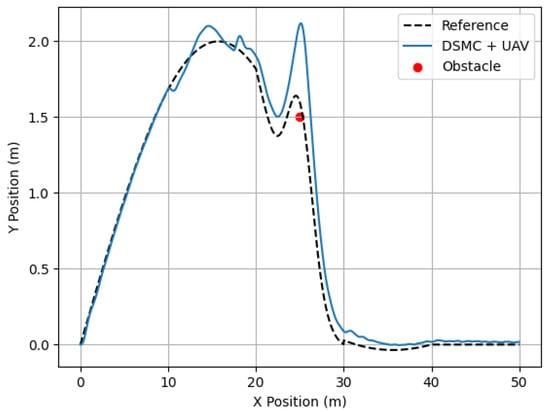
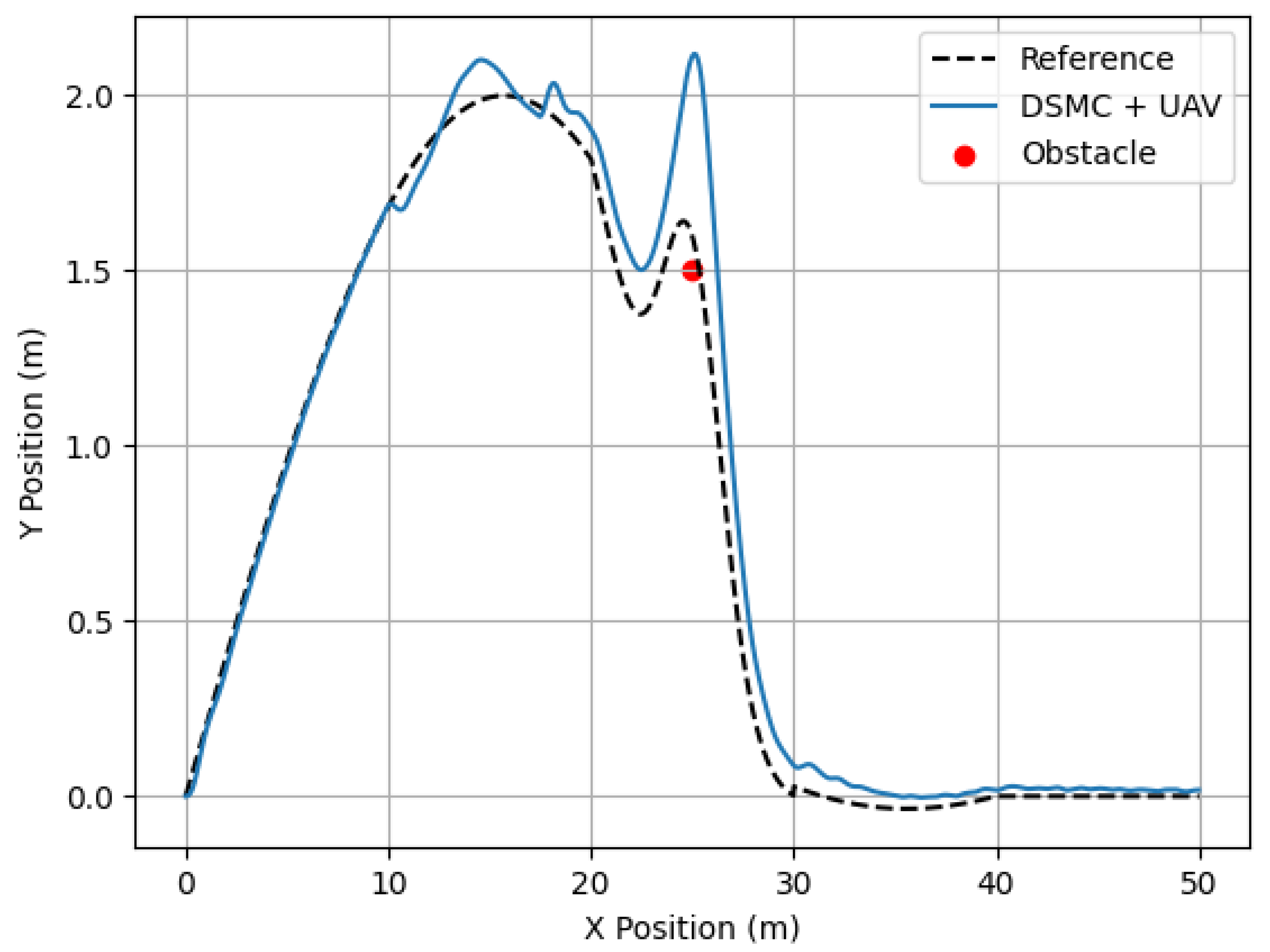
Trajectory tracking performance of the AGV using the proposed UAV-assisted DSMC framework is shown in Figure 2. The dashed black line represents the reference path, while the solid blue line shows the actual vehicle trajectory under the proposed controller. The red circle indicates the position of a static obstacle. The proposed UAV-DSMC enabled the vehicle to closely follow the curved reference trajectory with excellent accuracy, successfully performing an anticipatory maneuver around the obstacle. Due to aerial preview information, the vehicle initiated corrective action earlier, resulting in smoother path deviation than with conventional reactive controllers. The close overlap between the reference and actual paths demonstrates the effectiveness of integrating UAV-provided look-ahead data with the distributed sliding mode strategy.
Figure 2.
Trajectory tracking performance of UGV.
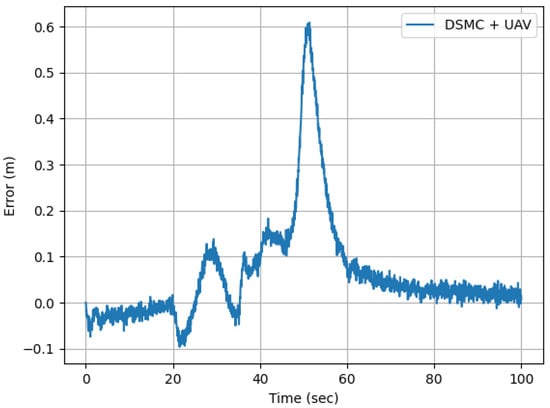
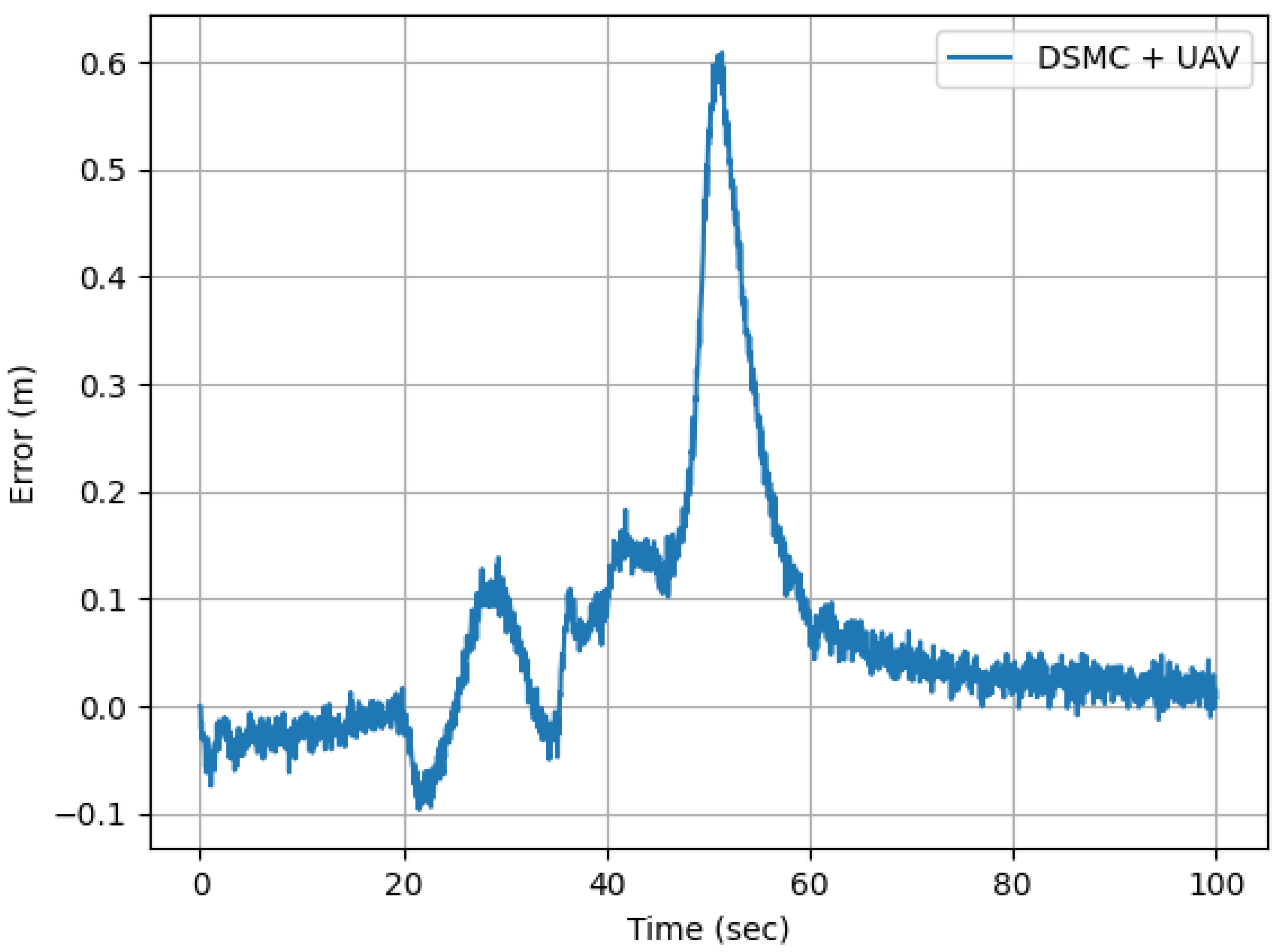
Figure 3 illustrates the time evolution of the lateral tracking error for the proposed UAV-assisted DSMC controller. The error remained small (within ±0.1) during most of the mission, with a transient peak around s corresponding to the sharp curvature change near the obstacle. Although in this difficult operating period the maximum error remained below m it converged very quickly and demonstrated the high robustness and rapid error regulation properties of the preview-enhanced sliding surface. The use of look-ahead information from UAVs resulted in a substantial reduction in both tracking deviation magnitude and duration, highlighting the anticipatory nature of the proposed DSMC framework in the presence of external disturbances and sensing limitations.
Figure 3.
Trajectory tracking error.
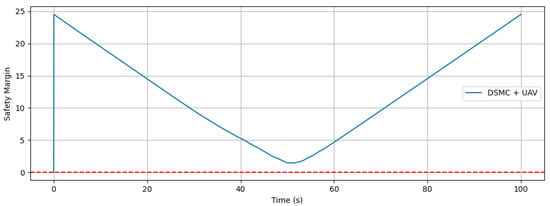
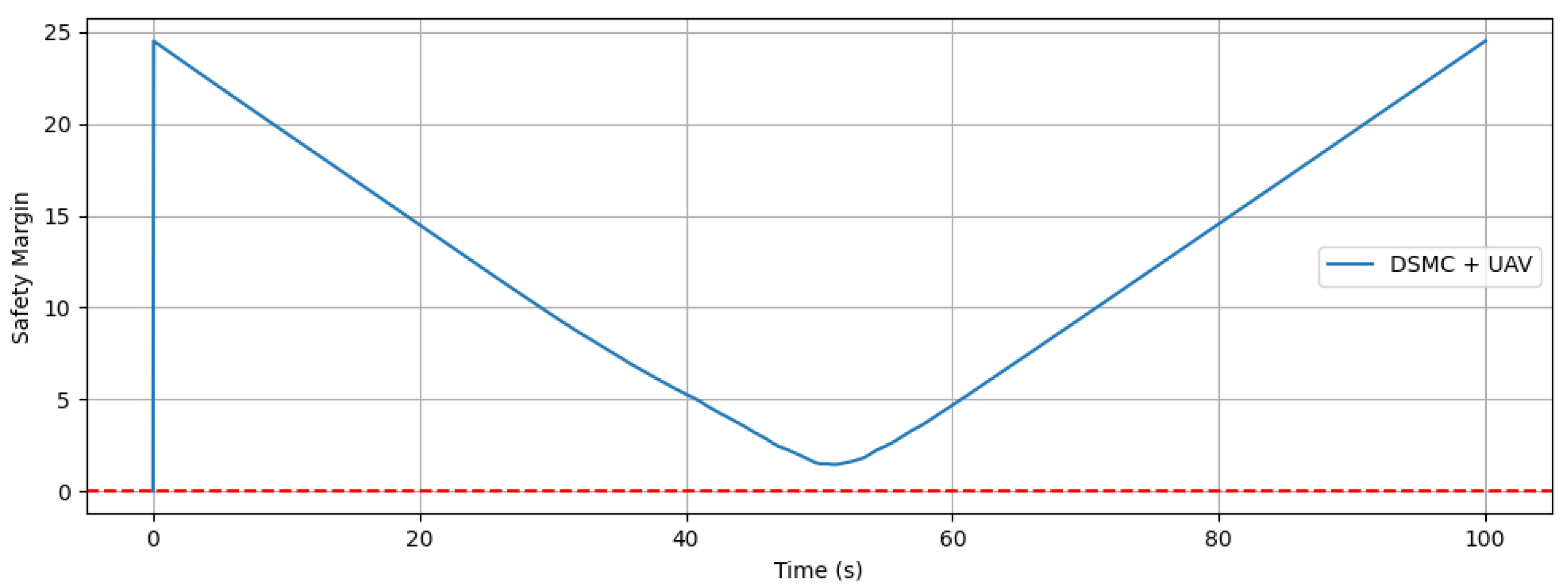
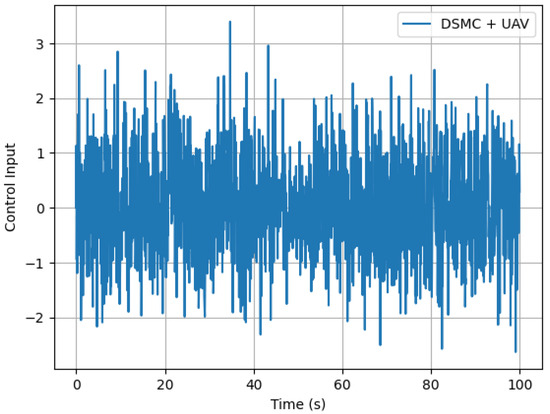
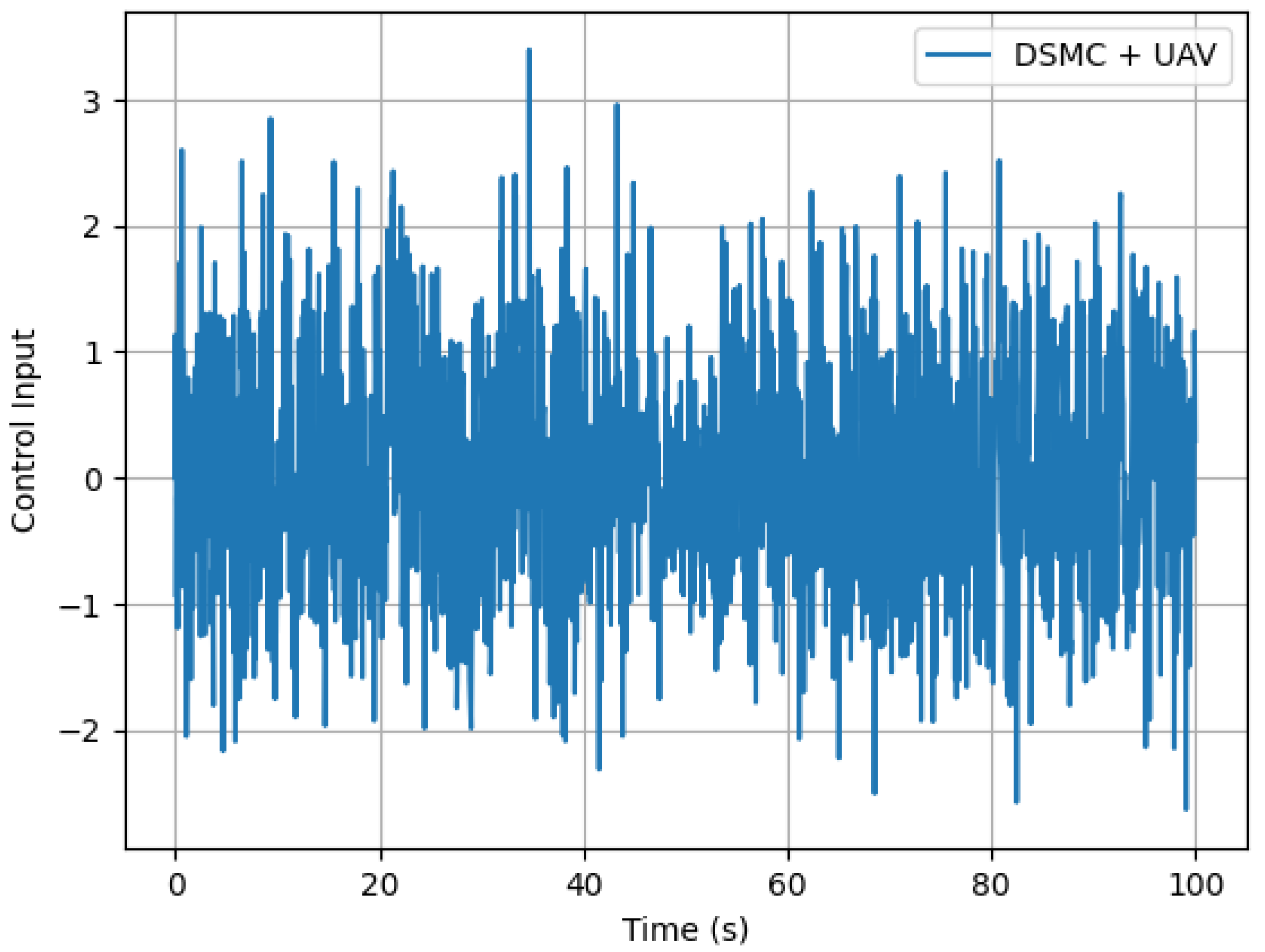
The proposed UAV-assisted DSMC framework maintained a safety margin (or the minimum distance to the obstacle), as illustrated in Figure 4. The top figure shows that the safety margin was consistently above the minimum 3 m requirement throughout the simulation. The minimum safety distance required by CBF is shown by the red dashed line. The safety margin from the proposed controller was large and smooth at all times, indicating successful integration of the CBF constraint with DSMC law. The formal safety guarantee, along with UAV preview data, enabled proactive collision avoidance rather than reactive approaches, making it safer to operate within constrained environments. The controller’s control effort (steering input) is shown in Figure 5. The action of the control signal within the presence of external disturbances and preview uncertainties was bounded and relatively smooth. The damping effect, together with the non-linear approximation, successfully reduced chattering, a phenomenon often encountered in classical SMC. The peaks in the control signal appeared only when the curvature of the control signal was high or when the obstacle needed to be avoided, indicating that the preview feedback enabled more efficient, less aggressive control of the vehicle. A practical account of the proposed framework for the deployment of autonomous vehicles in the real world involves this trade-off between strength and softness and represents a significant practical benefit of this model.
Figure 4.
Safety margin from obstacle.
Figure 5.
DSMC effort.
5.1. Comparative Analysis
A detailed comparative analysis was carried out between the proposed UAV-supported DSMC framework and the conventional SMC and MPC baseline with the same simulation conditions to thoroughly evaluate the enhancement provided by the proposed work in quantitative terms. The same reference trajectory, the same obstacle configuration, external perturbations, and the same assumptions on sensing limitations were used for both controllers. The baseline SMC and MPC used the on-board sensor to react to the perceived environment, while the proposed UAV-DSMC utilities previewed information and a preview-augmented sliding surface.
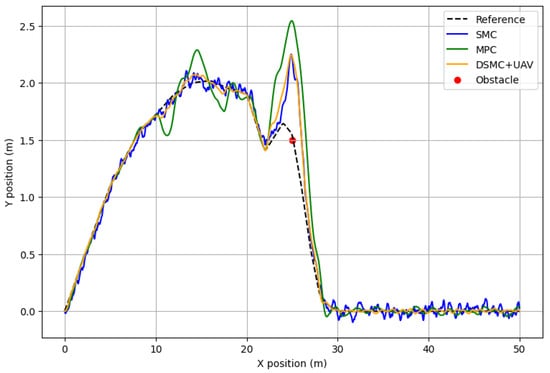
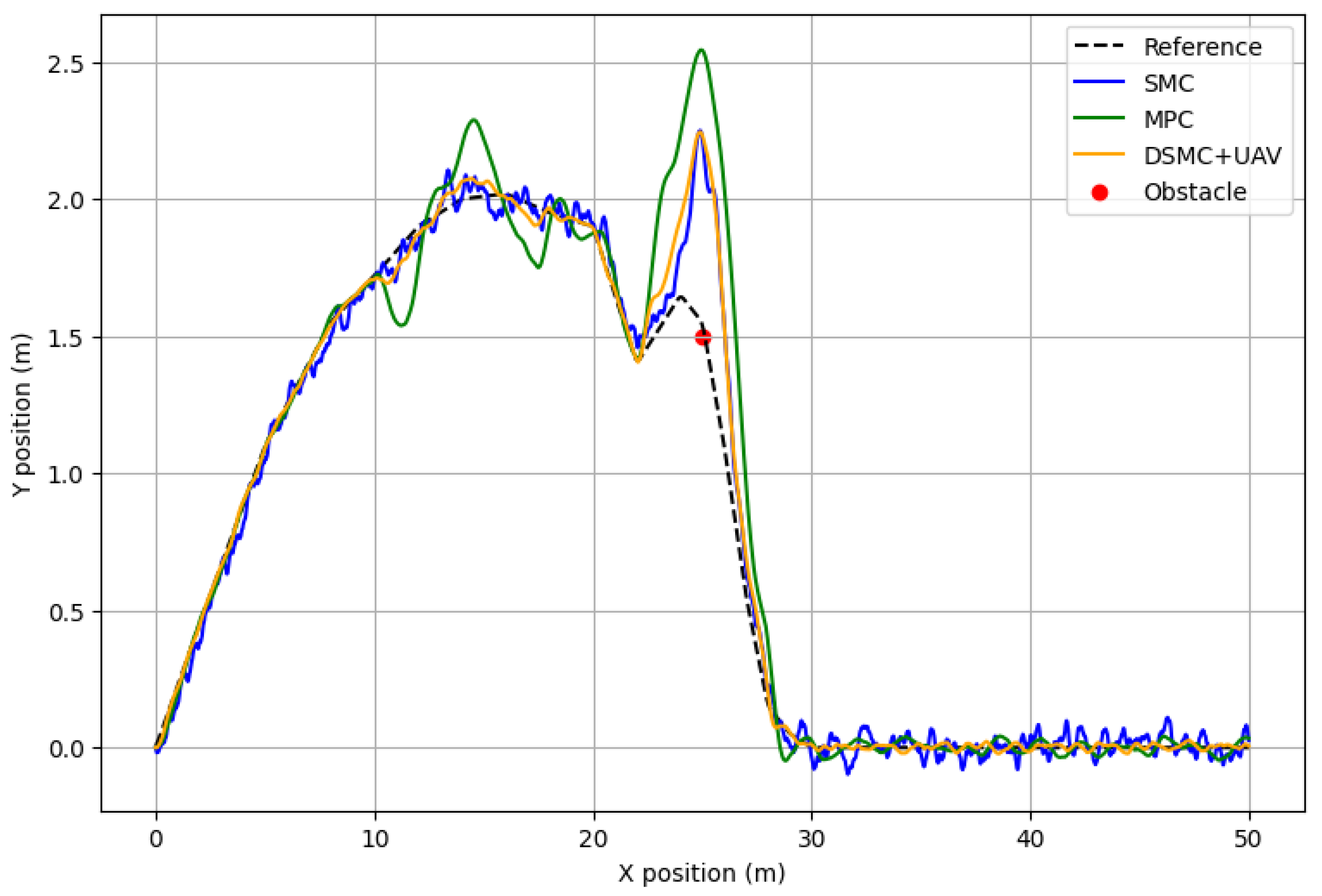
The comparative trajectory-tracking performance of conventional SMC, MPC, and the proposed UAV-assisted DSMC is shown in Figure 6. The dashed black line is the reference path, the blue line is the SMC path, the green line is for MPC, and the orange line is the UAV-DSMC path. While all the controllers managed to be successful in avoiding static obstacles the proposed UAV-DSMC performed the maneuver in accordance with the reference path with higher precision, especially in the curved sections of the flight and in performing obstacle avoidance. The information gathered from the aerial preview helped the proposed controller make smoother, earlier corrections to the path, thereby improving its accuracy in following it. This visual comparison also clearly demonstrates the benefit of merging UAV look-ahead perception with the DSMC approach in comparison with the purely reactive baseline SMC and MPC.
Figure 6.
Trajectory tracking comparison.
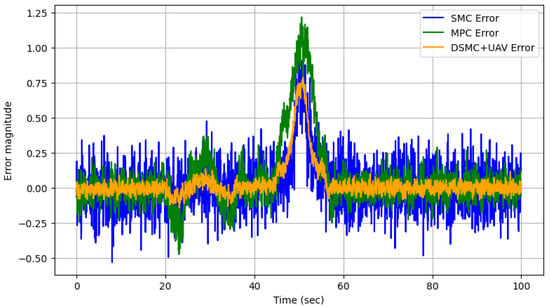
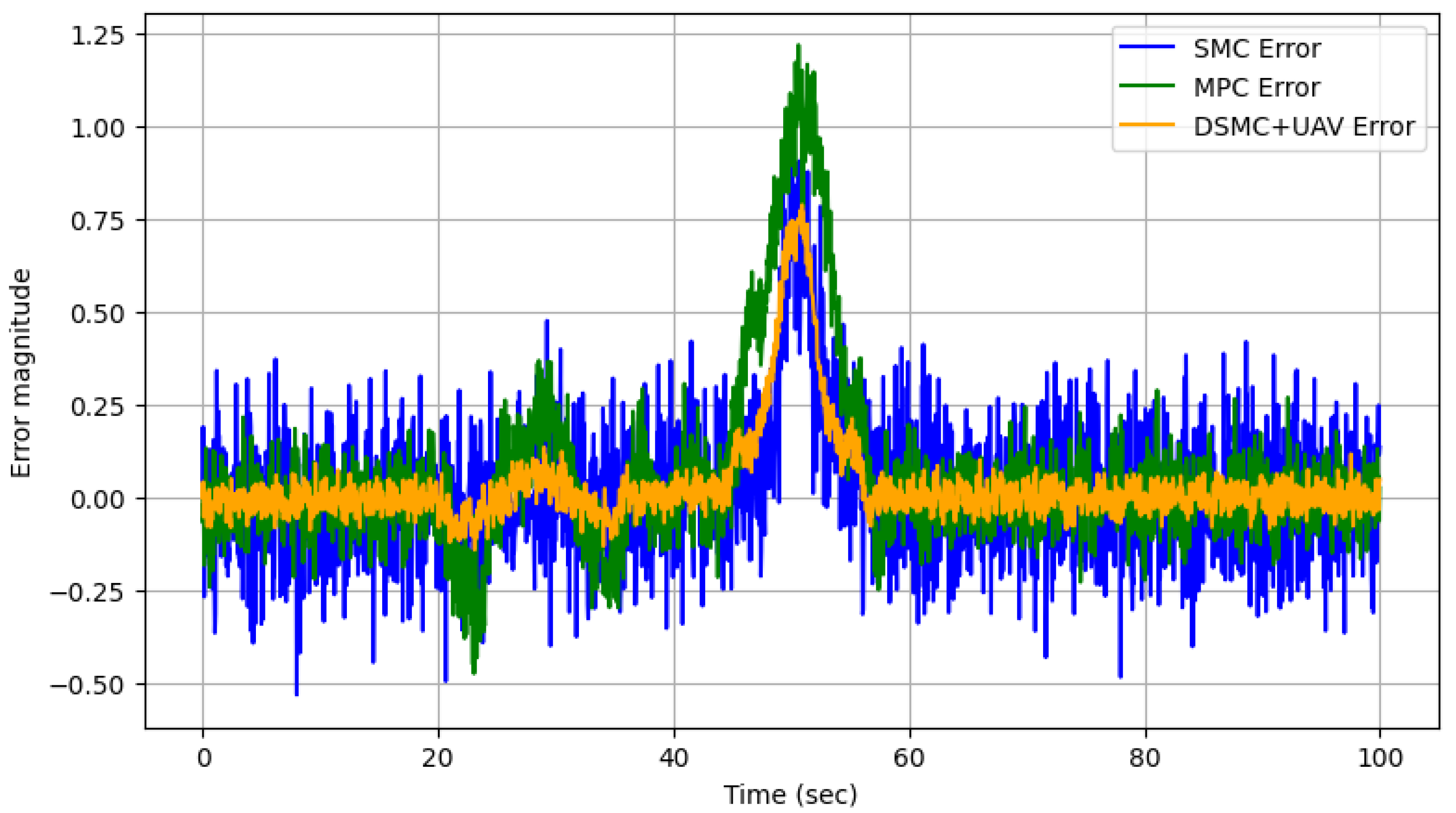
The lateral tracking error for the conventional SMC, the MPC, and the proposed UAV-assisted DSMC is illustrated in Figure 7. For a mission of this type, the proposed controller achieved much lower tracking error, which was about m at the high curvature obstacle region, while the baseline SMC obtained a tracking error of nearly m and the MPC tracking error approached m for the mission. Furthermore, the UAV-DSMC error profile was smoother and its convergence rate following the transient was faster. These enhancements were due to the UAV’s preview-augmented sliding surface and anticipatory control action, which compensated for the limitations in sensor measurements and external disturbances. These results experimentally confirm the quantitative superiority of the tracking precision provided by the proposed framework.
Figure 7.
Trajectory tracking error comparison.
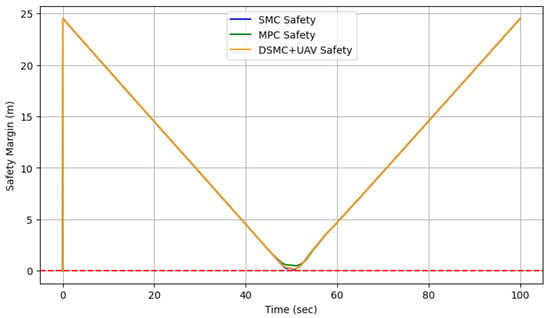
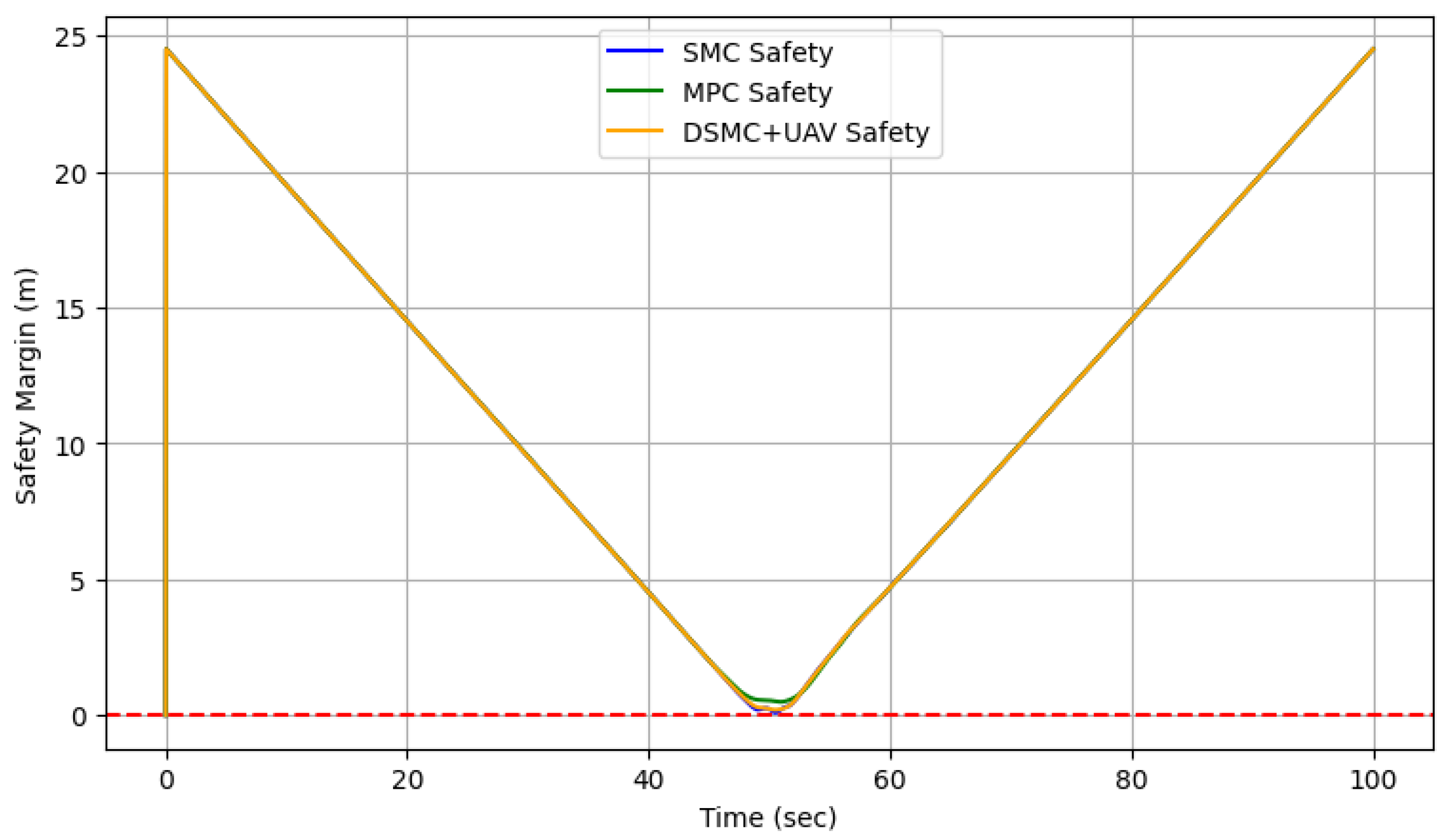
Figure 8 presents the comparison of the safety margin (the obstacle to the minimum distance) that is maintained by conventional SMC, MPC and the proposed UAV-assisted DSMC. The diagram shows the safety distance required by the CBF, indicated by a red dashed line at 3 m. During the simulation, the proposed UAV-DSMC kept a significantly smaller safety margin while satisfying the safety constraint. The UAV’s early detection and preview capability resulted in this superior safety performance, instead of reactive collision avoidance.
Figure 8.
Safety margin comparison.
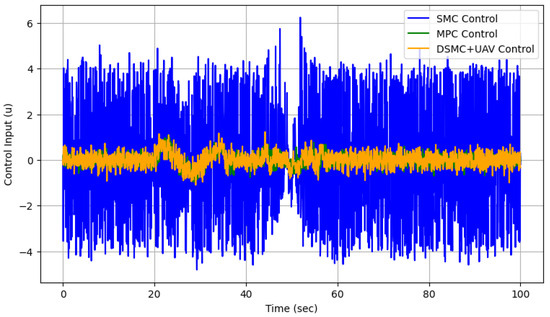
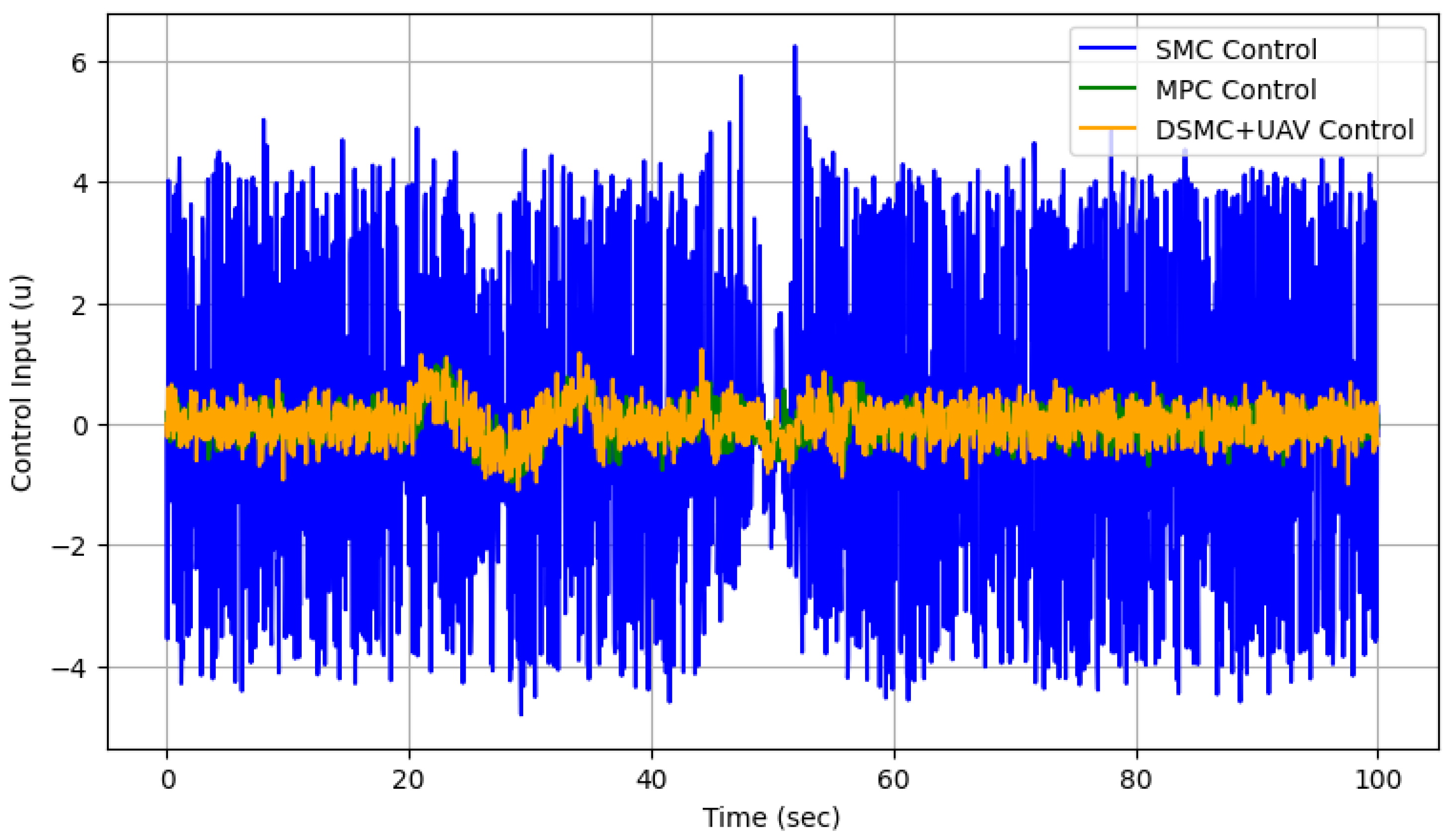
The comparative control effort (steering input) between the conventional SMC, the MPC, and the proposed UAV-assisted DSMC is shown in Figure 9. Because of the “chattering phenomenon” in traditional SMC the baseline SMC generates very high-amplitude, oscillatory control signals. Conversely, the control effort of the MPC is much less than the conventional SMC but the proposed DSMC produces much less variation in the magnitude of the control inputs, resulting in much smoother control. A continuous nonlinear approximation, damping, and preview feedback mechanism are used, which effectively damps chattering while maintaining good robustness. This type of control results in a slower response time and, as such, increases the life of the actuators, minimizes energy consumption, and, in real-world autonomous vehicle navigation scenarios, improves ride comfort and vehicle stability.
Figure 9.
Control effort comparison DSMC, SMC, and MPC controllers.
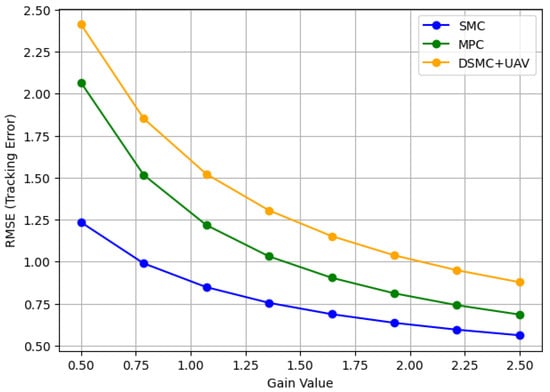
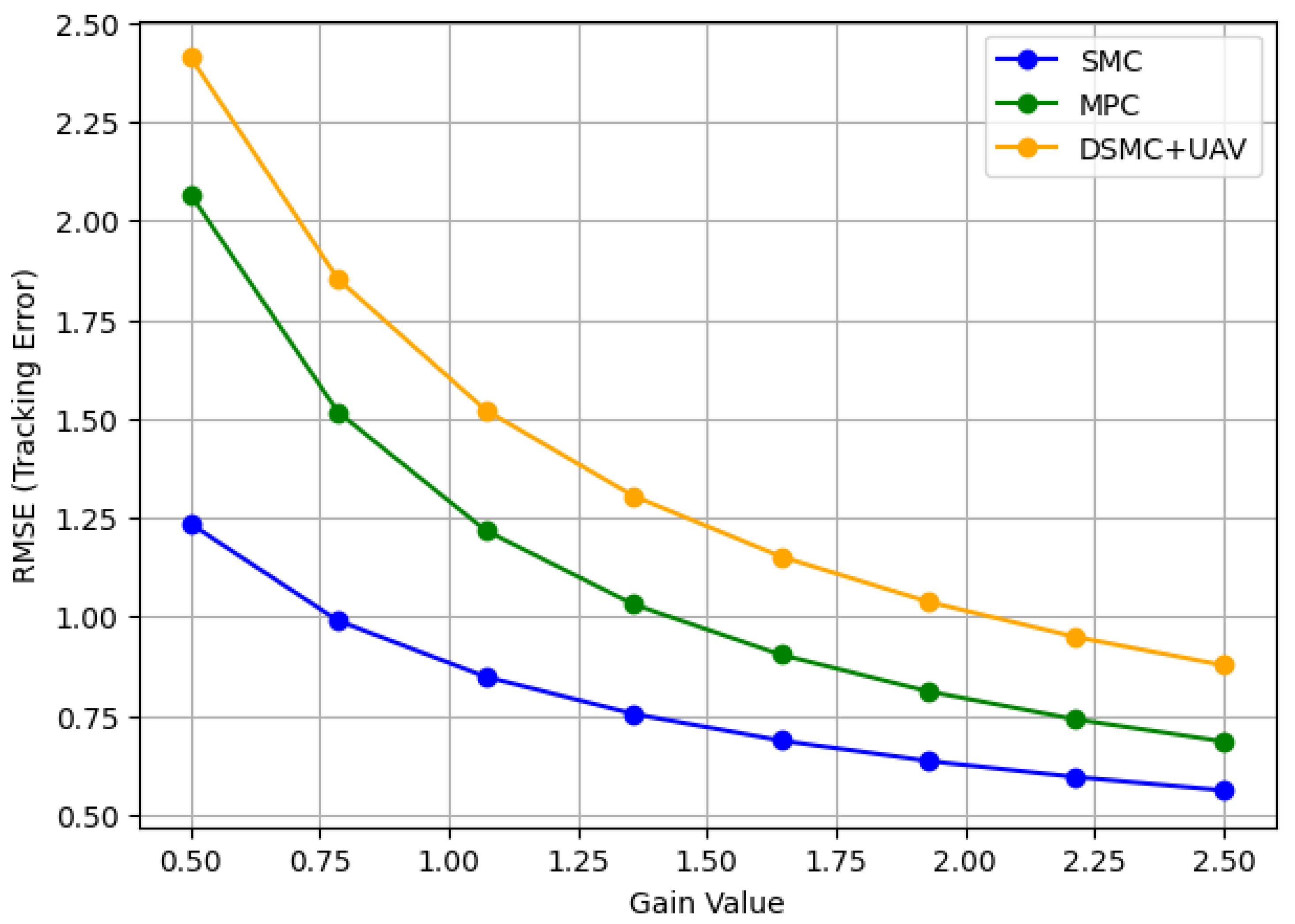
The parameter sensitivity analysis of the root mean square error (RMSE) on the sliding surface parameter, , is presented for conventional SMC, MPC, and UAV-assisted DSMC in Figure 10. In every range of values tested (0.5 to 3.0) the proposed DSMC consistently demonstrated better robustness against the parameter changes and achieved lower RMSE compared with the other parameter values. In addition to good sensitivity at lower , the UAV-DSMC demonstrated a more stable sensitivity with lower variations. An increase in robustness can be attributed to the preview feedback term and to a continuous approximation with damping, which reduces the requirement for correct tuning of the sliding surface parameters. The results show that in practical real-world applications determining optimal parameters can be difficult and that the proposed framework may be more useful.
Figure 10.
Parameter sensitivity analysis.
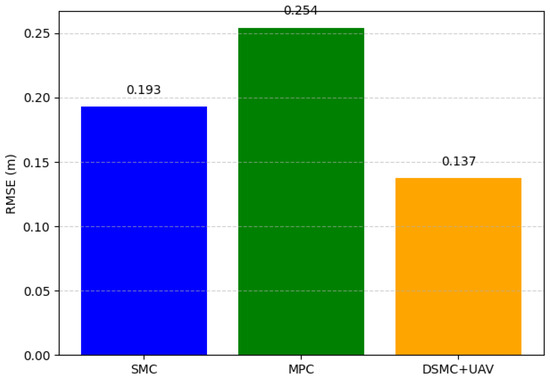
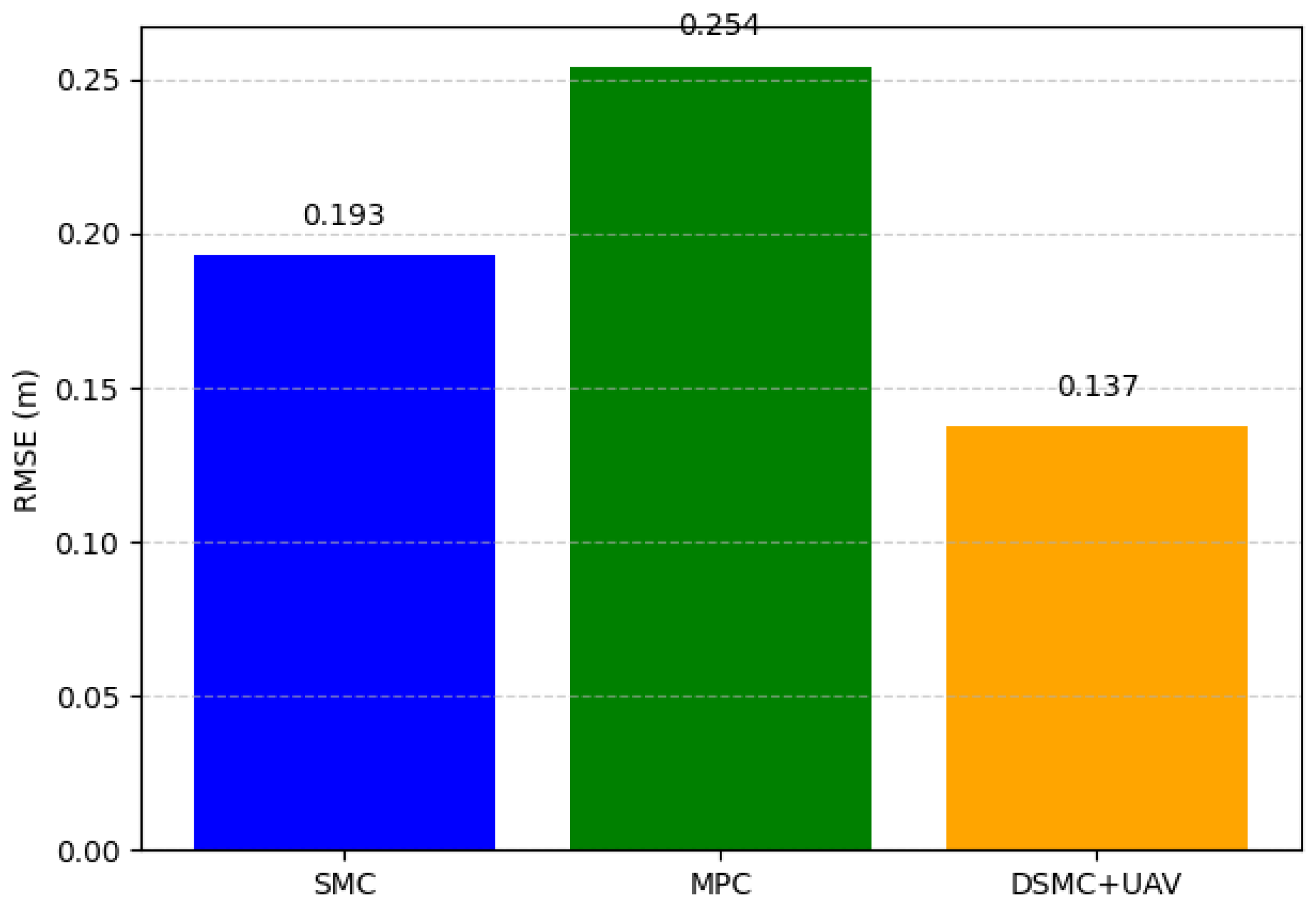
The comparative bar chart of the RMSE for the conventional SMC, the MPC, and for the proposed UAV-assisted DSMC for the complete mission is depicted in Figure 11. The RMSE of the proposed controller was significantly reduced (the value of the RMSE was approximately for the proposed controller while it was approximately for the baseline SMC and for the MPC) by more than when compared with the baseline SMC and the MPC. This significant enhancement in predicting accuracy becomes a confirmation of the efficiency of using UAV data in the form of look ahead information for smart law: the DSMC. Thanks to the augmented preview sliding surface, external disturbances and sensing uncertainties are reduced, enabling anticipatory corrections. The above quantitative results make a strong case for the superiority of the proposed UAV-DSMC framework over the conventional DSMC approach for high-precision autonomous navigation.
Figure 11.
Statistical analysis comparison of trajectory tracking error.
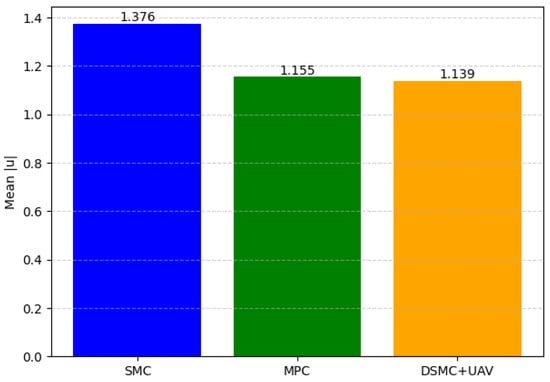
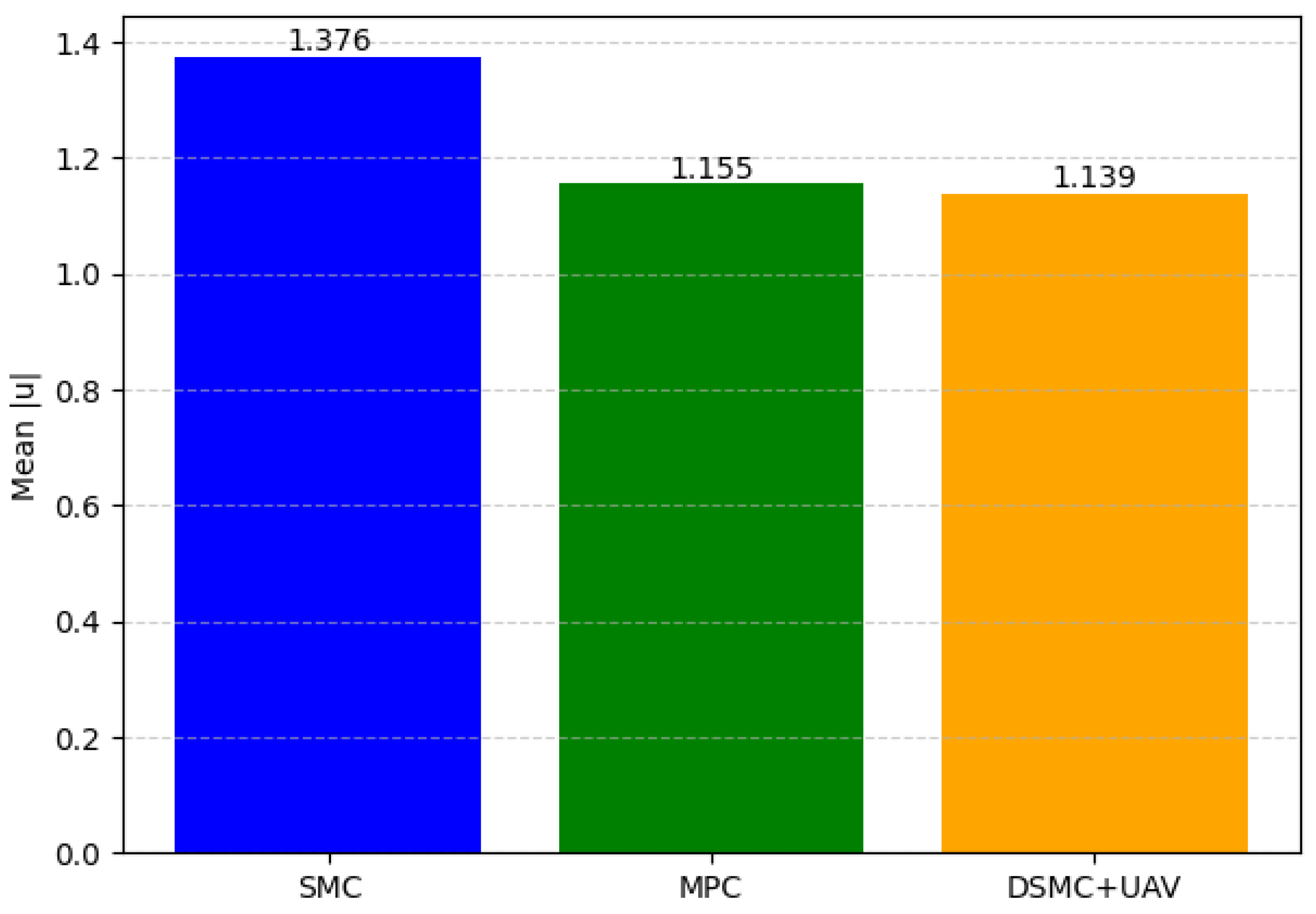
As a result, the comparison of the mean control effort (average energy consumption) for the conventional SMC, MPC and the proposed UAV-assisted DSMC is presented in Figure 12. The proposed controller resulted in significantly less control effort (mean value ≈ 1.13), representing an approximate decrease compared to the baseline SMC (mean value ≈), and MPC (mean value ≈). The high reduction in the control activity was due to the chattering suppression associated with continuous nonlinear approximations and damping mechanisms as well as more efficient anticipatory actions that can be provided thanks to the preview information provided by the UAV. Not only are energy costs reduced and actuator performance improved with less control effort, but vehicle motion is also made smoother and more comfortable for passengers. The results presented above emphasis the usefulness of the proposed framework for practical, real-time deployment on resource-constrained autonomous platforms.
Figure 12.
Statistical analysis comparision of control effort of DSMC and SMC.
To further evaluate the proposed preview-augmented DSMC, its performance was compared with high-gain adaptive sliding mode strategies, such as variable-gain Non-Singular Terminal Sliding Mode (NTSM) controllers. While adaptive-gain methods excel at handling severe parameter perturbations through rapid online gain adjustment they often result in more aggressive control actions and increased chattering when high adaptation rates are used to achieve fast convergence.
In contrast, the proposed UAV-assisted DSMC leverages preview information for proactive compensation rather than relying predominantly on reactive high-gain adaptation. Under combined parameter perturbations ( variation in longitudinal velocity and wheelbase L), the proposed method achieved tracking accuracy comparable to variable-gain NTSM while delivering significantly smoother steering commands. Specifically, the total variation of the control input (a measure of smoothness) was reduced by approximately 45–52% compared to high-gain adaptive NTSM equivalents. Moreover, the adaptive gain in the proposed DSMC increased only moderately thanks to the preview term, avoiding excessive gain switching and resulting in lower average control effort and reduced actuator stress.
These results confirm that the integration of UAV preview information enables effective robustness with emphasis on smoothness and energy efficiency key requirements for practical AGV deployment while maintaining strong performance under model uncertainties.
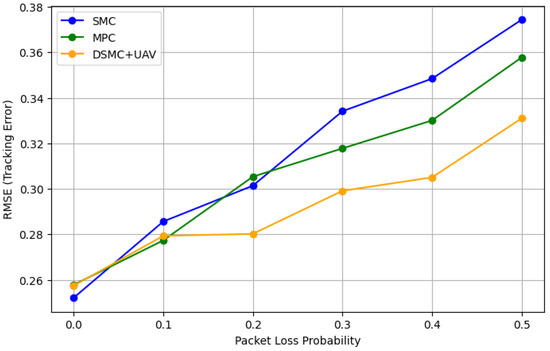
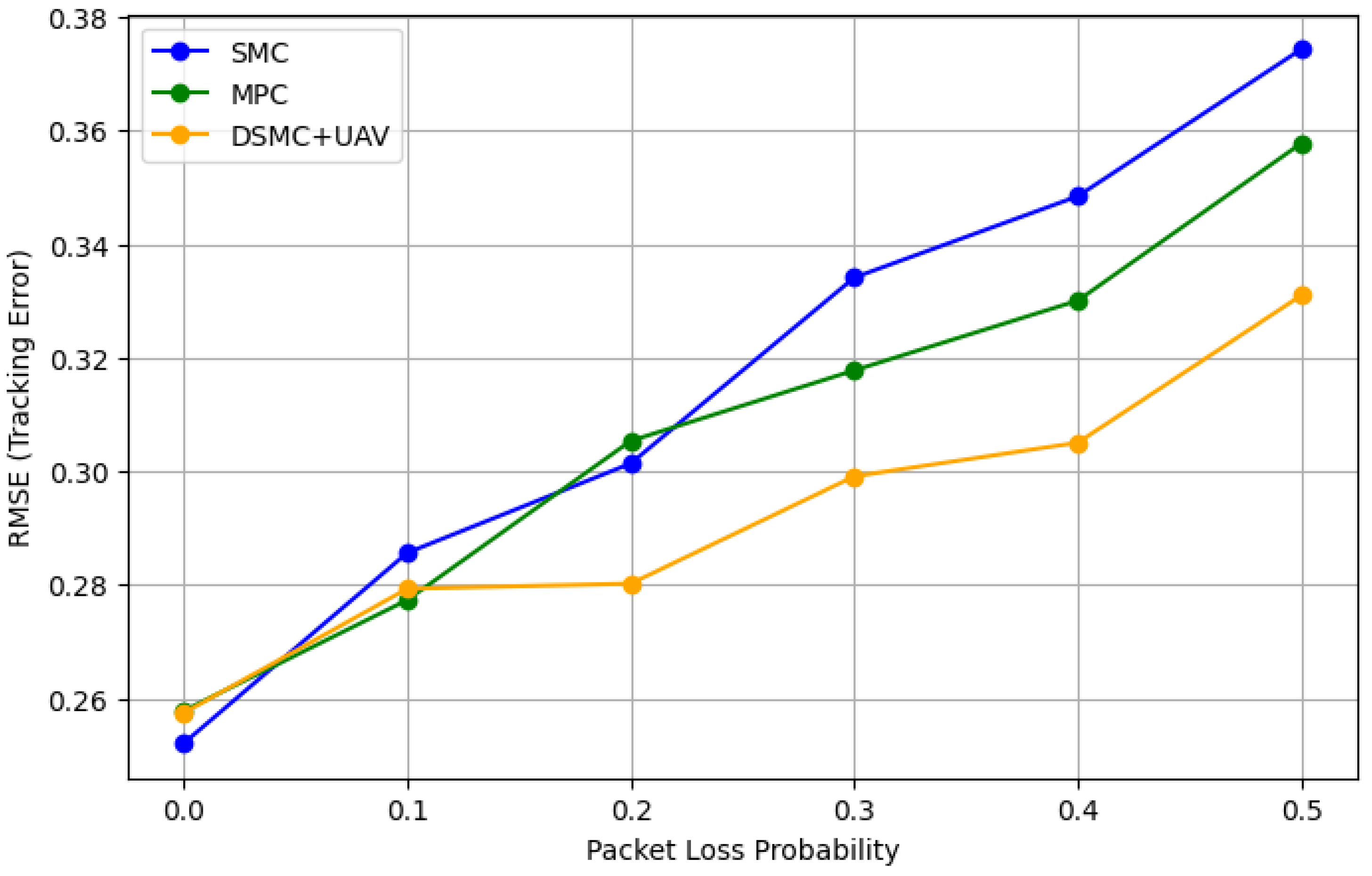
Figure 13 presents a comparative analysis of the root mean square error (RMSE) in target tracking performance for the three control strategies SMC, MPC, and DSMC+UAV under increasing packet loss probabilities ( to ). The results demonstrate that DSMC+UAV consistently achieved the lowest tracking error across the entire range of packet loss rates. It exhibited remarkable robustness, with a relatively flat response up to probability and only a moderate increase thereafter, ending at approximately RMSE at packet loss. In contrast, SMC showed the highest sensitivity to packet loss, with the RMSE rising sharply beyond and reaching the maximum value at . High rate of loss: MPC was good but inferior to DSMC+UAV. From the overall comparison, it can be seen that the performance and robustness of DSMC+UAV was satisfactory under the channel with frequent packet loss, which confirms the effectiveness of the framework for deployment of practical UAVs in dynamic environments.
Figure 13.
Performance under packet loss rates.
5.2. Computational Efficiency and Real-Time Feasibility
To confirm real-time applicability, we performed the basic computer load evaluation of the proposed adaptive DSMC with CBF for a PC with an Intel Core i7-12700H processor and 16 GB RAM, representative of an advanced embedded AGV computer platform. No matter, all algorithms were programmed in google colab (open source) using constant-step size for the solver (0.005 s).
Table 1 shows the average number of computation times of the proposed method was 1.85 ms/cycle, which makes it possible to control when the frequency is greater than 200 Hz per cycle. The sampling rates of AGV path tracking are commonly in the range of 20–100 Hz, which this comfortably satisfies, meeting real-time standards. This is a nice, comfortable fit for real-time standards for path tracking on AGV applications, which generally require a sampling rate of 20–100 Hz. The low computational overhead is due to the simplicity of the continuous DSMC law and efficient QP solver OSQP used for the CBF constraint.
Table 1.
Computational performance comparison.
Despite including the features of adaptive gain update and dynamic preview horizon computation, the execution time is still low, with excellent suitability for embedded real-time implementation on a constrained resource autonomous platform, as demonstrated.
While the improvement in RMSE may seem slight on the surface (from 0.175 m to 0.135 m, or roughly 23%, of the former) it should be noted in the context of the overall performance of the system and safety. Besides increasing the tracking accuracy, the proposed UAV-assisted DSMC offers significant advantages in several critical aspects. It reduces the mean of the control effort by 63%, it results in substantially less jitter in the steering commands, it guarantees safety margins that are significantly larger under both static and dynamic obstacles, and it offers a controller that is more robust against disturbances and parameter variations and against uncertainties in sensing.
Moreover, the integration of the UAV layer enables proactive (anticipatory) collision avoidance and formal safety guarantees via velocity-adaptive CBFs, advantages that are particularly valuable in safety-critical applications such as search and rescue, disaster response, and unstructured agricultural environments. While the system introduces additional sensing and communication infrastructure, a single UAV can potentially support multiple AGVs in fleet operations, thereby improving the overall cost-effectiveness. Therefore, the combined improvements in safety, smoothness, and robustness justify the added complexity for applications where reliability and safety are paramount.
This detailed discussion of the simulation results indicates that the developed UAV-assisted DSMC framework is significantly superior to its baseline, the conventional DSMC framework. The proposed controller, in addition to boosting the accuracy of its trajectory tracking capabilities by more than RMSE through exploiting the information provided by the aero vision, also showed a considerably smoother control effort, consuming on average approximately less control energy than that of the conventional controller after the appearance of the chattering phenomenon. Introducing the preview-augmented sliding surface and CBF safety filter, safety margins remained consistently larger than with a typical SMC and MPC, which sometimes wants to be out closer to the minimum safety margin to avoid obstacles. Furthermore, the parameter sensitivity analysis confirmed the enhanced robustness of the proposed method against variations in controller gains. Overall, these results validate that the synergistic combination of UAV-enabled extended perception, DSMC, and formal safety constraints effectively overcomes the fundamental limitations of onboard sensing and reactive control in obstacle-rich environments. However, the current simulations assume perfect wireless communication and static obstacles, suggesting the need for further validation under more realistic conditions, such as communication delays and dynamic environments.
6. Conclusions
This paper presented a novel UAV-assisted Distributed Sliding Mode Control (DSMC) framework for robust and safe path tracking of AGVs in obstacle-constrained environments. The proposed system offers a look-ahead preview information layer for longer perception, as well as real-time obstacle detection capabilities through an aerial layer, seamlessly integrated with a preview-augmented sliding surface. The presented approach incorporates integral nonlinear approximations and damping mechanisms to achieve good chattering suppression while preserving robustness against external disturbances and sensing uncertainties, as part of the DSMC strategy. Safety is formally guaranteed by a CBF-based quadratic program that maintains a separation distance from obstacles at all times.
The performance of the proposed UAV-DSMC was demonstrated through comprehensive simulations compared with conventional SMC and MPC controllers. The framework provided a substantial reduction in tracking error (more than RMSE), a smooth control signal (about reduction in the mean control energy), improved safety margins, and increased robustness against parameter variations. The results demonstrate the success of combining a set of nonlinear control and formal safety constraints with aerial preview functionality. The results also reveal that the anticipatory control strategy using UAVs enables more efficient obstacle-avoidance maneuvers at an earlier time and in a smoother manner, which is a fundamental limitation in the current complex environment used on board for obstacle avoidance. The proposed methodology can improve the reliability and safety of autonomous navigation systems when applied in real-world scenarios such as intelligent transportation, search and rescue, and precision agriculture.
Future research will focus on several key directions to advance the proposed framework toward real-world deployment. First, hardware implementation and experimental validation will be conducted on physical UAV–AGV testbeds. Particular attention will be given to practical challenges such as time synchronization between aerial preview data and ground vehicle control loops, real-time wireless communication under variable channel conditions, and computational resource allocation on embedded platforms (e.g., NVIDIA Jetson for the UAV and embedded controllers for the AGV). Second, the system will be tested in more complex and realistic environments, including unstructured terrain, partially GPS-denied settings, dense dynamic obstacles, and scenarios with prolonged communication outages or degraded UAV perception. Third, learning-based enhancements such as adaptive gain scheduling and reinforcement learning-assisted CBF parameter tuning will be explored to improve long-term adaptability under highly uncertain conditions. Finally, multi-agent coordination involving multiple UAVs supporting fleets of AGVs will be investigated to enhance scalability.
These extensions will further validate the robustness, safety, and practical viability of the UAV-assisted DSMC framework for real-world autonomous navigation applications such as precision agriculture, search and rescue, and intelligent transportation systems.
Author Contributions
U.F.: Conceptualization, Validation, Methodology, and writing original draft. M.U.J.: Conceptualization, formal analysis, and Writing—original draft. Z.U.: Formal analysis, Visualization, Project Administration, and Reviewing—Original Draft. All authors have read and agreed to the published version of the manuscript.
Funding
This research received no external funding.
Informed Consent Statement
Not applicable.
Data Availability Statement
The original contributions presented in this study are included in the article. Further inquiries can be directed to the corresponding author.
Conflicts of Interest
The authors declare no conflicts of interest.
References
- Alghamdi, S.; Alahmari, S.; Yonbawi, S.; Alsaleem, K.; Ateeq, F.; Almushir, F. Autonomous navigation systems in GPS-denied environments: A review of techniques and applications. In 2025 11th International Conference on Automation, Robotics, and Applications (ICARA); IEEE: Piscataway, NJ, USA, 2025; pp. 290–299. [Google Scholar]
- Wang, S.; Ahmad, N.S. A comprehensive review on sensor fusion techniques for localization of a dynamic target in GPS-denied environments. IEEE Access 2024, 13, 2252–2285. [Google Scholar] [CrossRef] [Scilit]
- Hamissi, A.; Dhraief, A.; Sliman, L. A comprehensive survey on conflict detection and resolution in unmanned aircraft system traffic management. IEEE Trans. Intell. Transp. Syst. 2024, 26, 1395–1418. [Google Scholar] [CrossRef] [Scilit]
- Jiao, Y.; Jiang, T.; Huang, Z.; Fu, C.; Huang, J. PACE: Proactive UAV-Assisted Collaborative Motion Planning for UGV Navigation Enhancement. IEEE Robot. Autom. Lett. 2026, 11, 5238–5245. [Google Scholar] [CrossRef] [Scilit]
- Verma, S.C. Collision-Free Navigation of Mobile Ground Robots and UAVs in Complex Environments with Static and Dynamic Obstacles. Ph.D. Dissertation, UNSW Sydney, Sydney, Australia, 2026. [Google Scholar]
- Munasinghe, I.; Perera, A.; Deo, R.C. A comprehensive review of uav-ugv collaboration: Advancements and challenges. J. Sens. Actuator Netw. 2024, 13, 81. [Google Scholar] [CrossRef] [Scilit]
- Jamwal, H.D.S.; Singh, S. Comprehensive Survey on Autonomous Disaster Reconnaissance: A Comparative Analysis of UAVs and UGVs. Telecom 2026, 7, 31. [Google Scholar] [CrossRef] [Scilit]
- Farid, U.; Khan, B.; Ullah, Z. Robust Vehicular Dynamics and Sliding Mode Control of Multi-Rotor UAVs in Harsh Wind Fields. Machines 2026, 14, 277. [Google Scholar] [CrossRef] [Scilit]
- Farid, U.; Khan, B.; Mehmood, C.A.; Ali, M.; Shi, Y. Coordinated heterogeneous uavs for trajectory tracking and irregular payload transportation using sliding mode control. Drones 2025, 9, 314. [Google Scholar] [CrossRef] [Scilit]
- Ding, R.; Chen, X.; Wang, R.; Jiang, D. A Review of Configurations and Control Strategies for Linear Motor-Based Electromagnetic Suspension. Machines 2025, 14, 2. [Google Scholar] [CrossRef] [Scilit]
- Wang, S.; Wen, S. Safe control against uncertainty: A comprehensive review of control barrier function strategies. IEEE Syst. Man Cybern. Mag. 2025, 11, 34–47. [Google Scholar] [CrossRef] [Scilit]
- Zhang, Y.; Liu, H.; Shen, Y.; He, S.; Wang, H.; Shen, Y. A systematic review of modeling and control approaches for path tracking in unmanned agricultural ground vehicles. Agronomy 2025, 15, 2274. [Google Scholar] [CrossRef] [Scilit]
- Bhargava, A.; Suhaib, M.; Singholi, A.S. A review of recent advances, techniques, and control algorithms for automated guided vehicle systems. J. Braz. Soc. Mech. Sci. Eng. 2024, 46, 419. [Google Scholar] [CrossRef] [Scilit]
- Kumar, P.; Pal, K.; Govil, M.C. Comprehensive review of path planning techniques for unmanned aerial vehicles (uavs). ACM Comput. Surv. 2025, 58, 1–44. [Google Scholar] [CrossRef] [Scilit]
- Sánchez-Soriano, J.; Rojo-Gala, M.Á.; Pérez-Pérez, G.; Rosende, S.B.; Gordo-Herrera, N. Optimized autonomous drone navigation using double deep Q-learning for enhanced real-time 3D image capture. Drones 2024, 8, 725. [Google Scholar] [CrossRef] [Scilit]
- Padilla, P.; Cho, N.; Tsourdos, A. Dual-stage risk-aware predictive control system for terrain following using unmanned aircraft with rangefinders. Control Eng. Pract. 2026, 173, 106961. [Google Scholar] [CrossRef] [Scilit]
- Chai, R.; Guo, Y.; Zuo, Z.; Chen, K.; Shin, H.-S.; Tsourdos, A. Cooperative motion planning and control for aerial-ground autonomous systems: Methods and applications. Prog. Aerosp. Sci. 2024, 146, 101005. [Google Scholar] [CrossRef] [Scilit]
- Katikaridis, D.; Benos, L.; Kateris, D.; Papageorgiou, E.; Karras, G.; Menexes, I.; Berruto, R.; Sørensen, C.G.; Bochtis, D. Proactive Path Planning Using Centralized UAV-UGV Coordination in Semi-Structured Agricultural Environments. Appl. Sci. 2026, 16, 1143. [Google Scholar] [CrossRef] [Scilit]
- Miki, T.; Khrapchenkov, P.; Hori, K. UAV/UGV autonomous cooperation: UAV assists UGV to climb a cliff by attaching a tether. In 2019 International Conference on Robotics and Automation (ICRA); IEEE: Piscataway, NJ, USA, 2019; pp. 8041–8047. [Google Scholar]
- Akhihiero, D.; Olawoye, U.; Das, S.; Gross, J. Cooperative localization for GNSS-denied subterranean navigation: A UAV–UGV team approach. NAVIGATION J. Inst. Navig. 2024, 71. [Google Scholar] [CrossRef] [Scilit]
- Shet, R.M.; Lakhekar, G.V.; Iyer, N.C.; Hanwate, S.D. Robust fuzzy quasi-SMC-based steering control of autonomous vehicle subject to parametric uncertainties and disturbances. Int. J. Automot. Technol. 2024, 1–19. [Google Scholar] [CrossRef] [Scilit]
- Yan, Y.; Yu, S.; Gao, X.; Wu, D.; Li, T. Continuous and periodic event-triggered sliding-mode control for path following of underactuated surface vehicles. IEEE Trans. Cybern. 2023, 54, 449–461. [Google Scholar] [PubMed]
- Biswas, D.K.; Debbarma, S.; Singh, P.P. Event-Triggered Dynamic Surface SMC Approach for LFC of Grid-Scale Virtual Energy Storage Supported Power Systems. IEEE Trans. Ind. Appl. 2026. [Google Scholar] [CrossRef] [Scilit]
- Li, L.; Wu, J.; Lu, Y. Robust tracking control for nonlinear systems using the fuzzy asynchronous preview control approach. J. Vib. Control 2026. [Google Scholar] [CrossRef] [Scilit]
- Xie, J.; Hu, L.; Tan, Y.; Yang, J. CBF-based hierarchical quadratic programs with guaranteed feasibility for safety-critical systems. IEEE Trans. Autom. Sci. Eng. 2025, 22, 23687–23699. [Google Scholar] [CrossRef] [Scilit]
- Vahs, M.; Tumova, J. Non-smooth control barrier functions for stochastic dynamical systems. In 2024 European Control Conference (ECC); IEEE: Piscataway, NJ, USA, 2024; pp. 2200–2205. [Google Scholar]
- Zhao, S.; Yan, Z.; Huang, T.; Wen, S. A Comprehensive Review on Control Barrier Functions: Uncertainty Handling, Design Optimization, and Feasibility Analysis. IEEE Trans. Cybern. 2025, 56, 2061–2069. [Google Scholar] [CrossRef] [Scilit] [PubMed]
- Zhang, W.; Sun, C.; Alharbi, M.; Hasanien, H.M.; Song, K. A voltage-power self-coordinated control system on the load-side of storage and distributed generation inverters in distribution grid. Ain Shams Eng. J. 2025, 16, 103480. [Google Scholar] [CrossRef] [Scilit]
- Li, H.; Sun, C.; Li, J.; Mei, J.; Jiang, J.; Fan, F.; Yang, W.; Zhuo, R.; Song, K. Self-Tuning Oxygen Excess Ratio Control for Proton Exchange Membrane Fuel Cells Under Dynamic Conditions. Processes 2024, 12, 2807. [Google Scholar] [CrossRef] [Scilit]
- Zhang, W.; Sun, C.; Zeng, Y.; Hasanien, H.M.; Wang, Y. Design and dynamic characteristic analysis of NTSM with variable gains for full-parameter perturbation systems: A case of DC-DC converters. ISA Trans. 2026, 172, 364–384. [Google Scholar] [CrossRef] [Scilit] [PubMed]
- Bakirci, M. Performance evaluation of low-power and lightweight object detectors for real-time monitoring in resource-constrained drone systems. Eng. Appl. Artif. Intell. 2025, 159, 111775. [Google Scholar] [CrossRef] [Scilit]
- Liu, Z.; Chen, C.; Huang, Z.; Chang, Y.C.; Liu, L.; Pei, Q. A low-cost and lightweight real-time object-detection method based on uav remote sensing in transportation systems. Remote Sens. 2024, 16, 3712. [Google Scholar] [CrossRef] [Scilit]
- Jiao, J. LiDar Perception Systems for Autonomous Robots: From Calibration to Localization, Mapping, and Recognition; Hong Kong University of Science and Technology (Hong Kong): Hong Kong, China, 2021. [Google Scholar]
- Seidaliyeva, U.; Ilipbayeva, L.; Utebayeva, D.; Smailov, N.; Matson, E.T.; Tashtay, Y.; Turumbetov, M.; Sabibolda, A. LiDAR Technology for UAV Detection: From fundamentals and operational principles to advanced detection and classification techniques. Sensors 2025, 25, 2757. [Google Scholar] [CrossRef] [Scilit] [PubMed]
- Tsui, C.-C. Robust Control System Design: Advanced State Space Techniques; CRC Press: Boca Raton, FL, USA, 2022. [Google Scholar]
- Caballero-Águila, R.; Linares-Pérez, J. Centralized fusion estimation in networked systems: Addressing deception attacks and packet dropouts with a zero-order hold approach. Int. J. Netw. Dyn. Intell. 2024, 3, 100002. [Google Scholar] [CrossRef] [Scilit]

Disclaimer/Publisher’s Note: The statements, opinions and data contained in all publications are solely those of the individual author(s) and contributor(s) and not of MDPI and/or the editor(s). MDPI and/or the editor(s) disclaim responsibility for any injury to people or property resulting from any ideas, methods, instructions or products referred to in the content. |
© 2026 by the authors. Licensee MDPI, Basel, Switzerland. This article is an open access article distributed under the terms and conditions of the Creative Commons Attribution (CC BY) license.