


Abstract
Polycrystalline diamond has great potential for power-device heat dissipation and precision manufacturing owing to its exceptional hardness, excellent thermal conductivity, and superior wear resistance. However, the challenges of material removal and controlling thermal damage hinder high-quality machining. In this study, a three-dimensional transient temperature field model is developed for multi-pulse nanosecond laser ablation of polycrystalline diamond. The model incorporates the Gaussian spatial distribution of laser energy, Lambert–Beer depth-dependent absorption, multi-pulse energy superposition, and three-dimensional heat conduction. The heat conduction equation is numerically solved using MATLAB, and lateral and longitudinal temperature gradients are introduced to characterize thermal accumulation and material removal behavior. The model is validated by comparing the predicted ablation depths with experimental measurements, which show consistent variation trends. The results indicate that increasing the number of scans, single-pulse energy, and pulse frequency enhances thermal accumulation, expands the microgroove width, and increases the ablation depth, whereas increasing the scanning speed weakens thermal accumulation and reduces the ablation depth. In addition, a shorter pulse width increases the instantaneous power density and strengthens near-surface thermal concentration. This study provides theoretical guidance for controlling the heat-affected region and optimizing process parameters in precision laser machining of diamond.
1. Introduction
Polycrystalline diamond (PCD), owing to its excellent thermal conductivity, good electrical insulation, extremely high wear resistance, and low coefficient of thermal expansion, is regarded as one of the most promising semiconductor materials for heat dissipation in power devices [1,2]. It meets the application requirements of high-power heat-dissipation equipment in power electronics, aerospace, and high-frequency power amplifiers and therefore has the potential to become a key semiconductor material in the fields of power engineering, aerospace, and communications [3,4]. As a critical component in power device heat dissipation, the surface machining quality of PCD has a decisive influence on device performance: form accuracy must reach the nanometer level, surface roughness must be controlled at the sub-nanometer level, and nearly damage-free subsurface quality is also required [5,6]. However, its high hardness, brittleness, and strong chemical inertness render it a typical difficult-to-machine material, posing severe challenges for precision machining. Loose-abrasive grinding is currently the most commonly used processing method, in which material removal is achieved through the mechanical interaction between abrasive particles and the workpiece. However, because of the extremely high hardness of diamond, this process suffers from a low material removal rate [7]. In addition, the strong mechanical action can easily induce machining defects such as chipping, resulting in low efficiency and poor process stability in the precision machining of PCD substrates. This has become a key factor restricting the widespread application of diamond-based semiconductor devices [8,9,10].
To address this issue, laser machining, as a non-contact, efficient, and flexible processing method, has shown considerable potential [11]. High-energy laser beams directly interact with the surface of PCD, converting optical energy into thermal energy and enabling localized material removal without the mechanical contact between abrasive particles and the workpiece that occurs in conventional machining methods [12,13]. Consequently, laser machining can effectively avoid chipping and other forms of damage while improving machining efficiency, demonstrating distinct advantages in overcoming the inherent processing resistance of super-hard substrates like PCD [14,15]. In recent years, driven by the ongoing evolution of laser technologies, precision laser-based processing of PCD is emerging as a robust strategy to circumvent the previously noted constraints, thereby unlocking novel potential for diverse industrial applications.
In recent years, research on laser machining of diamond has mainly focused on surface quality control. Early studies primarily verified the feasibility of laser machining for precision surface treatment of diamond. Ozkan et al. [16] employed a multi-step process combining a Nd:YAG laser and an ArF excimer laser, achieving effective polishing of large-area CVD diamond substrates with low surface roughness. Subsequently, research increasingly focused on how operational variables dictate the evolution of surface topography and structural soundness. Zhang et al. [17] found that shortening the pulse width led to an increase in the roughness at the bottom of microgrooves, while the surface morphology evolved from periodic ripples to damaged and cracked structures. Okamoto et al. [18] further revealed the relationship between the number of scans, average power, pulse frequency, and surface morphology. On this basis, related studies were further extended to factors such as laser type, auxiliary conditions, and processing environment. Chen et al. [19] suggested that higher-energy ablation is beneficial for obtaining straighter kerfs, higher aspect ratios, and better surface quality. Dong et al. [20] reported that, compared with nanosecond lasers, femtosecond lasers offer greater advantages in surface quality control. Further, Ding et al. [21] realized the rapid customization of high-performance antireflective windows based on a femtosecond laser spatiotemporal modulation machining method. Their results indicate that the combination of ultrafast laser processing and spatiotemporal energy regulation can effectively improve the machining quality of microstructures, providing a new strategy for reducing thermal effects and enhancing the fabrication accuracy of complex structures. Li et al. [22] further reported that high-repetition-rate femtosecond laser processing of ceramic/fused-silica systems can generate rapid thermal accumulation and localized interfacial modification, highlighting the importance of energy coupling and thermal effect control in the laser processing of hard and brittle materials. Zou et al. [23] introduced cryogenic-cooling-assisted femtosecond laser machining, which reduced both the surface roughness and graphitization degree of PCD. Furthermore, Zhang et al. [24] systematically analyzed the effects of pulse frequency, power, scanning speed, and the number of scans on ablation depth, surface roughness, and graphitization behavior under cryogenic-assisted processing conditions, showing that auxiliary cooling helps balance machining quality and processing efficiency. Wang et al. [25] found that inert-gas-assisted laser ablation can improve the surface quality of CVD diamond and enhance its subsequent grindability. Luo et al. [26] further showed that focal position, scan spacing, and scanning speed all have significant effects on surface roughness, material removal characteristics, and graphitization behavior. Overall, existing studies have systematically revealed the influence of laser type, energy input mode, auxiliary conditions, and process parameters on the surface quality of diamond.
With a deeper understanding of diamond machining processes, the research focus has gradually shifted from direct evaluation of surface quality to the investigation of thermal effects and temperature field evolution during material removal. Since laser machining essentially removes material through the absorption of optical energy and its conversion into thermal energy, the temperature field distribution is regarded as a key factor linking laser parameters with material removal behavior [27,28,29]. This process not only involves local temperature rise on the surface but also significantly influences surface morphology evolution. To gain deeper insight into this effect, Hu et al. [30] analyzed laser propagation in a single-crystal diamond tool and its temperature field response by coupling a ray-tracing model with a thermal finite element model, highlighting the importance of laser propagation behavior in predicting thermal response. Zhang et al. [31] simulated the transient evolution of electron and lattice temperatures during diamond ablation under ultrafast laser irradiation, revealing the close relationship between the ablation mechanism and nonequilibrium thermal processes. Xing et al. [32] established a finite element model of the diamond temperature field and analyzed the energy transfer process with and without a gold-film coating, clarifying the relationship between thermally driven graphitization phase transformation and ablation damage.
With further advances in this field, research on thermal effects has gradually been extended to graphitization modification and thermal influence mechanisms under nanosecond laser conditions. Cui et al. [33] analyzed the graphitization modification mechanism of PCD under nanosecond pulsed laser irradiation through a combination of experiments and numerical simulations, demonstrating that laser power, defocus amount, and grain boundary structure significantly affect graphitization behavior. Yuan et al. [34] investigated the effects of scanning speed, power, defocus amount, and scan spacing on surface morphology and graphitization degree, providing a theoretical basis for subsequent control of the heat-affected zone. Meanwhile, increasing attention has also been paid to the relationship between temperature field evolution and machining quality. Cao et al. [35] combined numerical simulations with experiments to investigate the influence of ultraviolet picosecond laser process parameters on the etching quality of CVD diamond microgrooves, providing deeper insights into how the transient thermal dynamics dictate the final surface characteristics.
Accordingly, existing studies on laser processing of diamond have mainly focused on the analysis of experimental phenomena, single-pulse thermal responses, ultrafast laser ablation mechanisms, or two-dimensional temperature field characteristics. However, a systematic quantitative description of the three-dimensional transient thermal accumulation behavior induced by continuous multi-pulse irradiation during nanosecond laser scanning remains insufficient. In actual machining, the material surface is successively subjected to multiple laser pulses as the laser beam scans along its trajectory. Before the heat generated by the preceding pulse is fully dissipated, it is further superimposed by subsequent pulses, thereby significantly altering the spatiotemporal distribution of the internal temperature field. This process further affects the ablation depth, lateral removal boundary, and extent of the heat-affected region.
To address these issues, this study focuses on the nanosecond laser scanning ablation process of PCD and establishes a transient temperature field model that incorporates the spatial Gaussian energy distribution, Lambert–Beer depth absorption, multi-pulse energy superposition, and three-dimensional heat conduction effects. The model is used to describe the evolution characteristics of the internal temperature field of PCD under continuous pulse irradiation. Furthermore, the three-dimensional transient heat conduction equation is numerically solved using MATLAB. Ablation experiments are conducted under different conditions regarding the number of scans, scanning speed, single-pulse energy, and pulse frequency, and the ablation depths calculated by the model are compared with the experimentally measured results to verify the model’s predictive capability for the actual material removal trend. On this basis, the lateral and longitudinal temperature gradients are introduced as characteristic indicators to reveal the influence mechanism of temperature gradient distribution on the lateral expansion of microgrooves, the steepness of removal boundaries, and the longitudinal ablation depth. In addition, based on the established model, the effects of pulse width on the temporal energy deposition characteristics, peak temperature, and near-surface thermal concentration effect are further analyzed. This study provides a theoretical basis for ablation depth prediction, heat-affected region control, and process parameter optimization in the precision nanosecond laser machining of PCD.
2. Methodology
2.1. Diamond Surface Temperature Field Distribution Model
When a nanosecond laser pulse irradiates the PCD surface, part of the incident optical energy is absorbed and rapidly converted into heat, leading to a transient temperature rise in the near-surface region. This model describes the temperature response characteristics resulting from laser heat input, heat diffusion, and multi-pulse accumulation effects, providing a theoretical foundation for subsequent model validation and parameter sensitivity analysis.
To emphasize the heat-conduction-driven evolution of the temperature field, the simulation framework is predicated on several key simplifications:
- (1)
- PCD is considered a homogeneous, continuous, and isotropic medium, with its internal heat conduction behavior represented by equivalent thermal properties.
- (2)
- Diamond is assumed to gradually transform into graphite at 1073 K, and when the temperature increases to 4098 K, the graphite phase sublimates, resulting in material removal.
- (3)
- Complex effects such as melt splashing, plasma shielding, latent heat of phase change, and material recoil pressure are neglected during the ablation process, focusing only on the heat conduction driven by laser energy input.
- (4)
- Convective and radiative heat exchange between the material surface and the environment are neglected, and the material’s thermal conductivity, density, and specific heat capacity are treated as constants during the calculation.
The above simplifications may affect the absolute values of the calculated temperature field. Specifically, neglecting plasma shielding may overestimate the laser energy coupled into the material; neglecting the latent heat associated with graphitization, sublimation, or vaporization may overestimate the local temperature rise; and neglecting recoil pressure and material ejection may limit the model’s capability to predict the detailed ablation morphology. Therefore, the model developed in this study should be regarded as a heat-conduction-based thermal response model rather than a complete ablation dynamics model. It is more suitable for comparing the relative effects of different laser parameters on thermal accumulation and temperature gradient evolution.
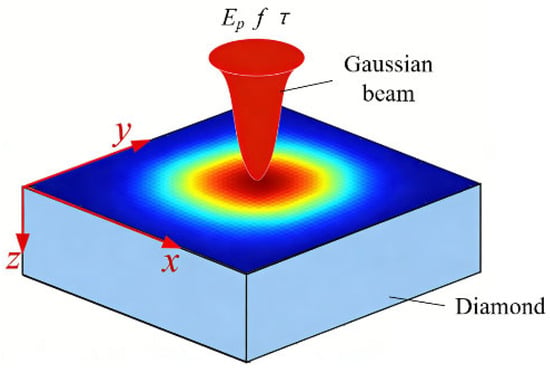
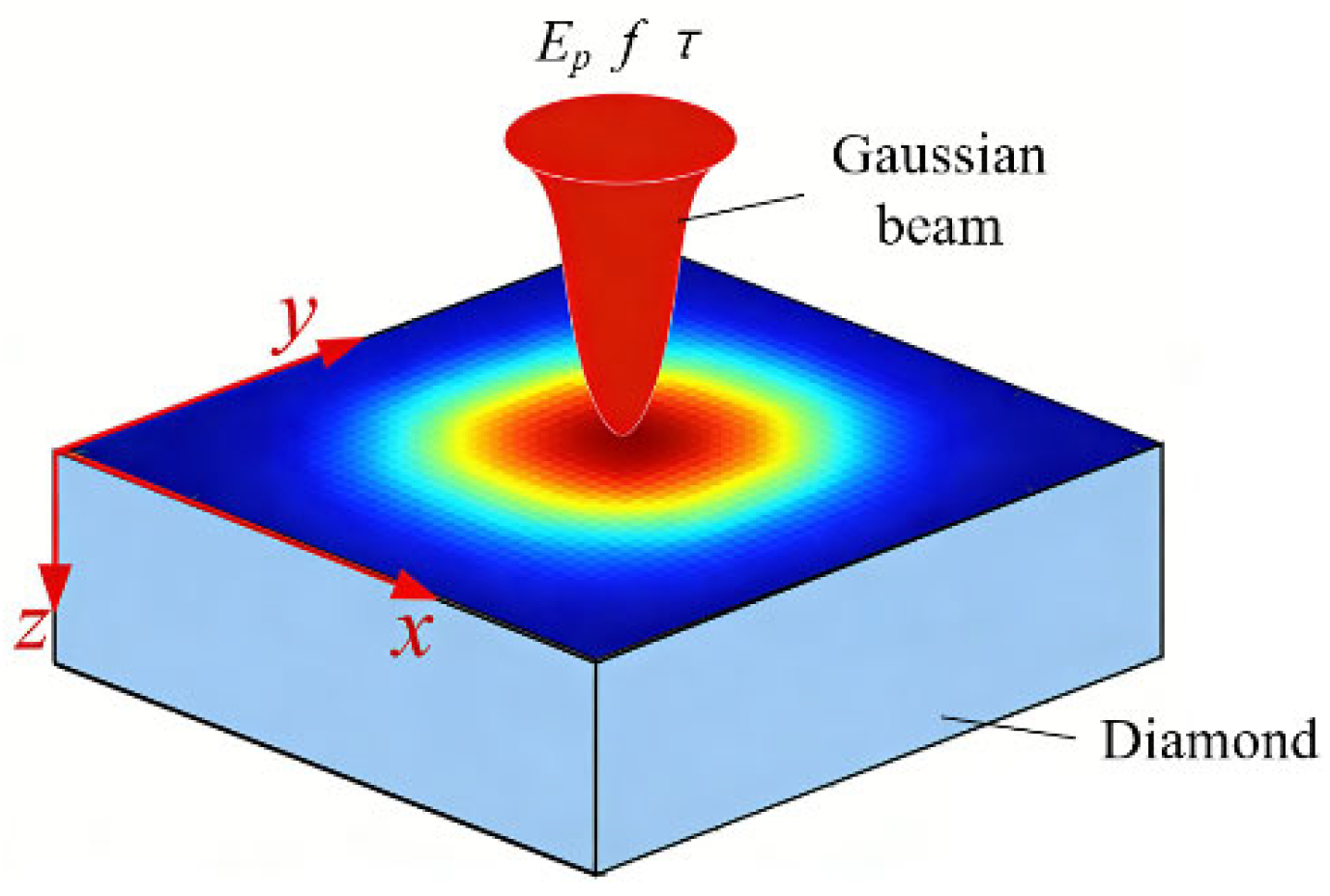
Under the above assumptions, the thermal process of nanosecond laser ablation of PCD can be simplified to a three-dimensional transient heat conduction problem driven by a volumetric heat source. Upon the impingement of nanosecond laser pulses onto the diamond substrate, the incident energy undergoes localized deposition within the superficial layer, acting as a heat source that drives the transient temperature evolution within the subsurface region. To characterize the laser thermal input, a laser energy deposition model is established, considering spatial distribution, temporal distribution, and depth-dependent absorption. To further describe how laser energy is distributed within the material, this model is developed, as illustrated in Figure 1.
Figure 1.
Laser energy deposition model.
Based on this model, a two-dimensional light intensity distribution model of a single laser pulse on the diamond surface is first established, which can be expressed by Equation (1).
where is the peak light intensity, is the single-pulse energy, is the pulse duration, and is the radius of the laser spot.
The temporal release characteristics of the nanosecond laser pulse are described using a Gaussian function, as shown in Equation (2) [36].
The attenuation of energy in the depth direction of the diamond during absorption follows the Lambert–Beer law. Equation (3) is established to represent the energy absorbed in the depth direction [36].
where is the laser absorption rate of the diamond material and is the absorption coefficient, which is used to describe the rate of laser attenuation within the material.
After considering the spatial, temporal, and depth direction distributions, the volumetric heat source generated by a single laser pulse can be obtained, as shown in Equation (4).
However, during actual scanning machining, any given point on the material surface is typically subjected to multiple effective pulses as the laser scans along its path, rather than being influenced by a single pulse. Therefore, considering only single-pulse thermal input is insufficient to accurately represent the temperature field distribution under realistic processing conditions, necessitating the development of a multi-pulse energy accumulation model. For any point along the scanning path, the number of effective pulses it receives can be approximately expressed by Equation (5) [37].
where is the number of effective pulses, is the number of scans, is the pulse frequency, and is the scanning speed.
Therefore, the total heat source under multi-pulse laser irradiation can be expressed by Equation (6):
where is the pulse index.
In the laser energy deposition model described above, both single-pulse and multi-pulse thermal input processes have been characterized in detail. However, as multi-pulse laser irradiation continuously acts on the material surface, the dynamic thermal response of the substrate is governed not only by the heat source configuration but also by the internal conduction mechanisms. Therefore, to more accurately describe the temperature field variation within the material, the temperature field is solved using the heat conduction equation based on the obtained heat source information, with further characterization of the spatial distribution of the temperature gradient. By solving the internal temperature field in detail, a better understanding of thermal diffusion behavior and thermal accumulation effects during laser heating can be achieved, providing a theoretical foundation for further optimization of process parameters.
2.2. Temperature Field Solution and Gradient Characterization
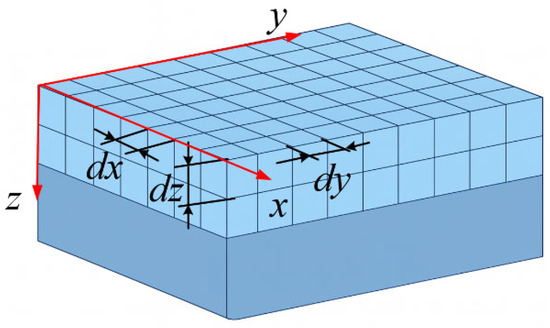
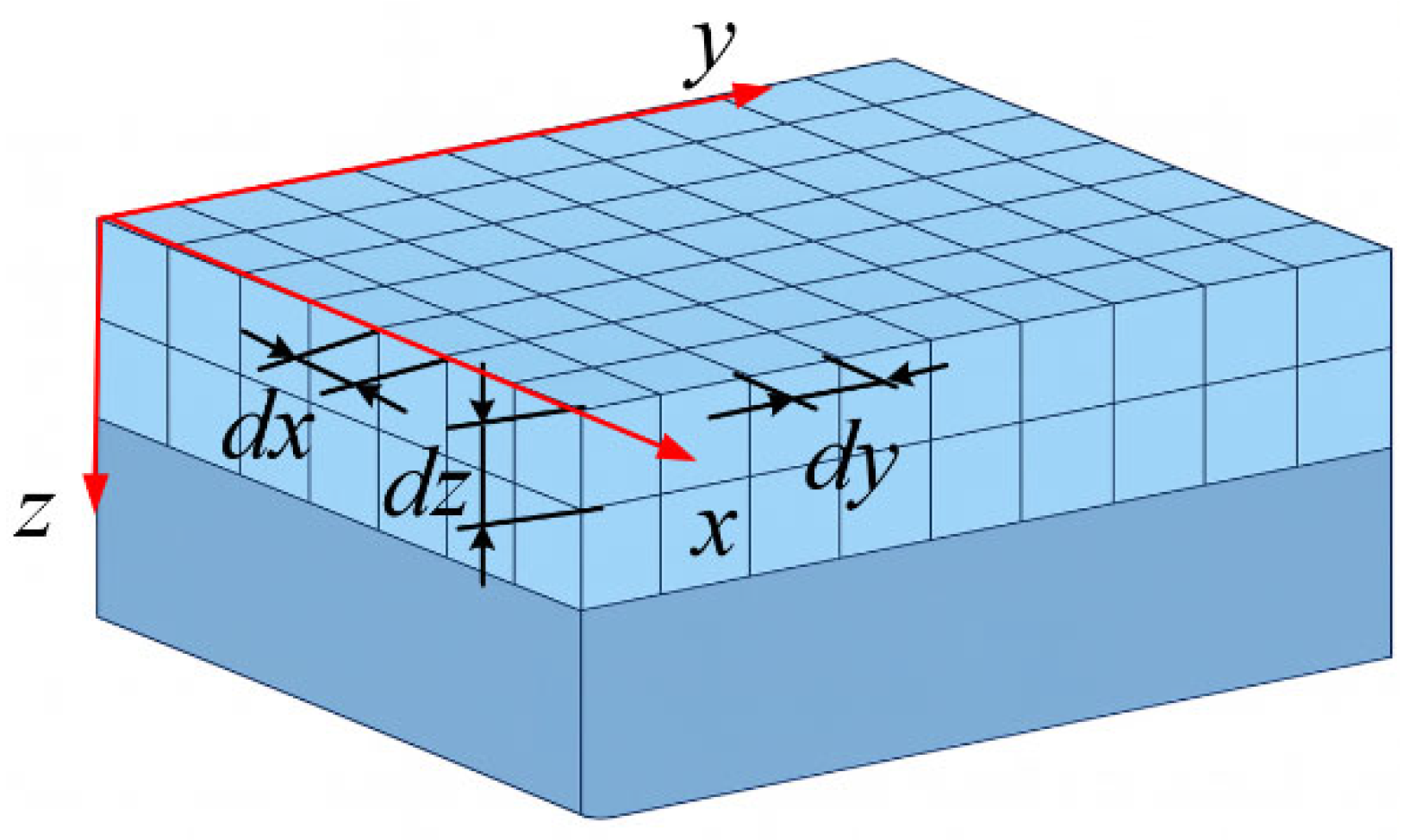
Once the multi-pulse laser heat source is determined, the transient thermal response within the medium is dictated by the principles of heat conduction. To characterize the spatial thermal profile within the computational domain, the domain is discretized, with the grid layout shown in Figure 2.
Figure 2.
Discretized grid division.
Following the determination of the laser heat source term, the transient thermal response throughout the material is dictated by the principles of heat conduction. Based on the principle of energy conservation, the transient heat conduction equation for multi-pulse laser irradiation in a three-dimensional Cartesian coordinate system is given by
where is the temperature field, is the material density, is the specific heat capacity, and is the thermal conductivity.
The initial condition is taken as
where is the initial ambient temperature. After establishing the heat conduction equation, this study first derives the analytical integral expressions under single-pulse and multi-pulse irradiation based on the semi-infinite heat conduction assumption and the superposition principle. These expressions are used to theoretically analyze the spatiotemporal evolution characteristics of the temperature field. This analytical approach can reveal the fundamental variation patterns of the temperature distribution in both time and space, thereby providing a theoretical basis for understanding the formation mechanisms of the lateral and longitudinal temperature gradients. Specifically, the temperature field under multi-pulse laser irradiation can be expressed in the following analytical integral form:
In the equation, is the Heavisine step function; is the thermal diffusivity; represents the thermal diffusion time; is the equivalent heat spot width parameter after diffusion; is the thermal diffusion function in the depth direction; is the complementary error function.
It should be noted that the analytical expression shown in Equation (9) is mainly used to clarify the formation mechanisms of the temperature field and temperature gradients. Under specific process parameter conditions, the three-dimensional transient heat conduction equation is numerically solved using MATLAB (V2021) in this study to obtain the temperature field and gradient distributions under multi-pulse irradiation. The computational domain is discretized using a structured grid, and the temporal integration is performed using an explicit finite difference method. The boundaries far from the laser-affected region are set as isothermal boundaries, while the other outer surfaces are approximately treated as adiabatic boundaries. The energy input on the laser-irradiated surface is described through the volumetric heat source term.
Based on the obtained spatiotemporal distribution of the temperature field, the lateral and longitudinal temperature gradients are further extracted using the finite difference method. This allows the relative effects of different laser process parameters on thermal accumulation behavior and material removal characteristics to be quantitatively analyzed.
Since the temperature field is essentially a multivariable function of the spatial coordinates , , and time , partial derivatives of the analytical expression for the temperature field are taken along the , and directions to further analyze the distribution characteristics and variation rate of the temperature field in different spatial directions. According to the total differential principle of multivariable functions, the local variation of the temperature field in space can be expressed as
Here, and characterize the decay rate of the temperature field and the boundary features of the high-temperature region in the lateral direction on the surface, while describes the propagation and attenuation of heat along the depth direction.
Since and mainly appear in the lateral Gaussian term in Equation (9), taking partial derivatives with respect to and gives the following results:
From Equations (11) and (12), it can be seen that the lateral temperature gradient is primarily determined by the Gaussian distribution of the laser spot. The larger its absolute value, the faster the temperature decay in the surface direction, indicating a more concentrated high-temperature region and a steeper boundary.
On the other hand, primarily appears in the depth function , so taking the partial derivative with respect to gives
Equation (13) shows that the temperature gradient in the depth direction is not only related to the material’s absorption attenuation but also closely associated with thermal diffusion time and the multi-pulse accumulation process.
The theoretical ablation depth is calculated based on the temperature field and temperature gradients. Taking the central axis of the laser spot as the primary analysis path, material removal is assumed to occur when the temperature reaches 4098 K. Accordingly, the ablation depth can be expressed as
where denotes the ablation threshold temperature and represents the theoretical ablation depth.
Through the above method, not only can the internal temperature distribution and gradient characteristics of the material be obtained, but the evolution patterns of heat in both the lateral and longitudinal directions can also be quantitatively revealed. However, theoretical analysis alone is insufficient to fully evaluate the engineering applicability of the model. Therefore, systematic experiments are required to obtain the ablation depth and three-dimensional microgroove profiles of PCD, thereby validating the proposed model.
3. Experimental Verification
3.1. Experimental Conditions and Design
The samples used in the ablation experiments were PCD specimens with dimensions of 10 mm × 10 mm × 0.3 mm. Before the experiments, the sample surfaces were ultrasonically cleaned with anhydrous ethanol to remove impurities, and the initial surface roughness was measured to be 0.362 μm. The material properties of diamond are listed in Table 1.
Table 1.
Material properties of the diamond specimen [38,39,40].
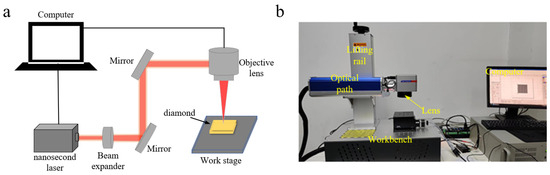
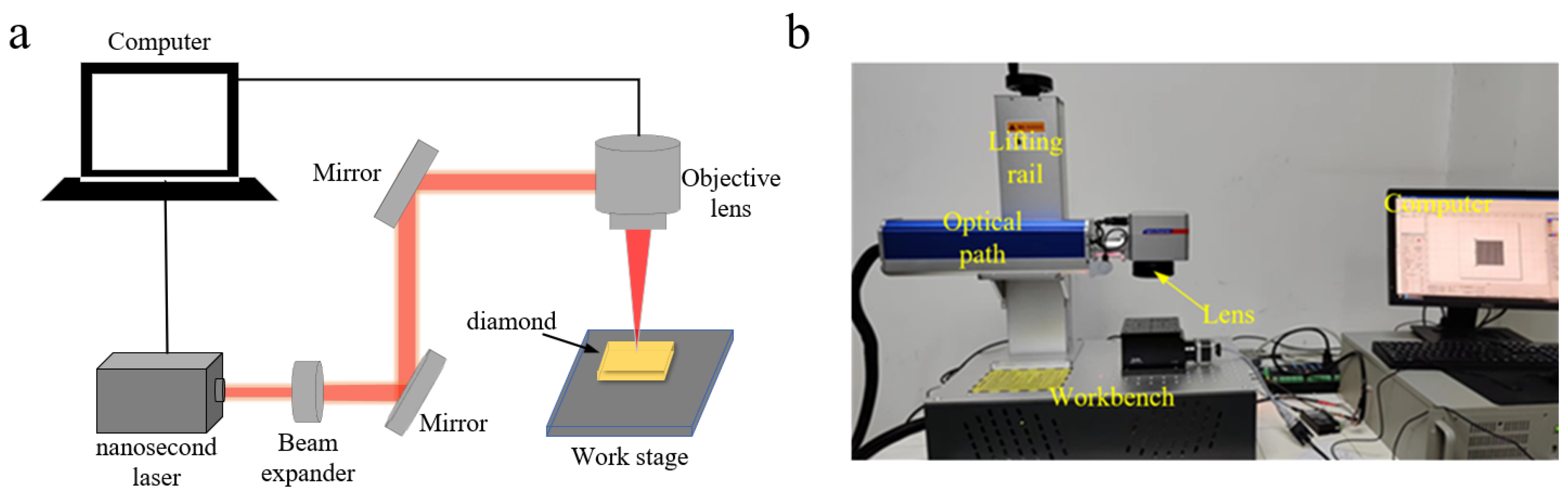
The laser equipment used in this experiment (Shanghai Sanke Laser Technology Co., Ltd., Shanghai, China) is shown in Figure 3. The system mainly consists of a fiber nanosecond laser, beam expander, scanning galvanometer, focusing objective lens, three-dimensional motion stage, and computer control system. During the experiments, the laser beam was focused perpendicularly onto the surface of the PCD. The main output parameters of the laser are listed in Table 2.
Figure 3.
(a) Nanosecond laser machining system; (b) nanosecond laser machining equipment.
Table 2.
Main output parameters of the laser.
To systematically investigate the effects of multi-pulse thermal accumulation and heat input on the three-dimensional ablation characteristics of the material, four groups of single-factor process experiments were designed using the control variable method. The number of scans , scanning speed , single-pulse energy , and pulse frequency were varied sequentially to achieve gradient regulation of the spatiotemporal overlap degree of the laser pulses and the total energy deposition. The detailed machining parameters and control group settings are listed in Table 3.
Table 3.
Laser machining experimental parameters.
3.2. Surface Ablation Morphology and Material Removal Characteristics
To evaluate the material removal behavior under different laser processing parameters, the surface micro-morphology of the machined regions was characterized by scanning electron microscopy (Japan Electron Optics Laboratory Co., Ltd., Tokyo, Japan) after the experiments, while the three-dimensional surface profiles were obtained using a three-dimensional optical profilometer (Bruker Alicona, Graz, Austria).
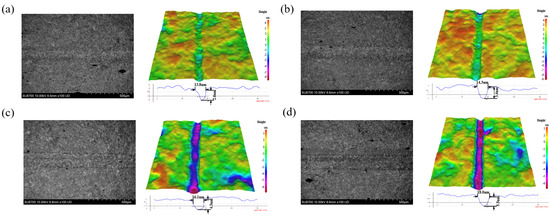
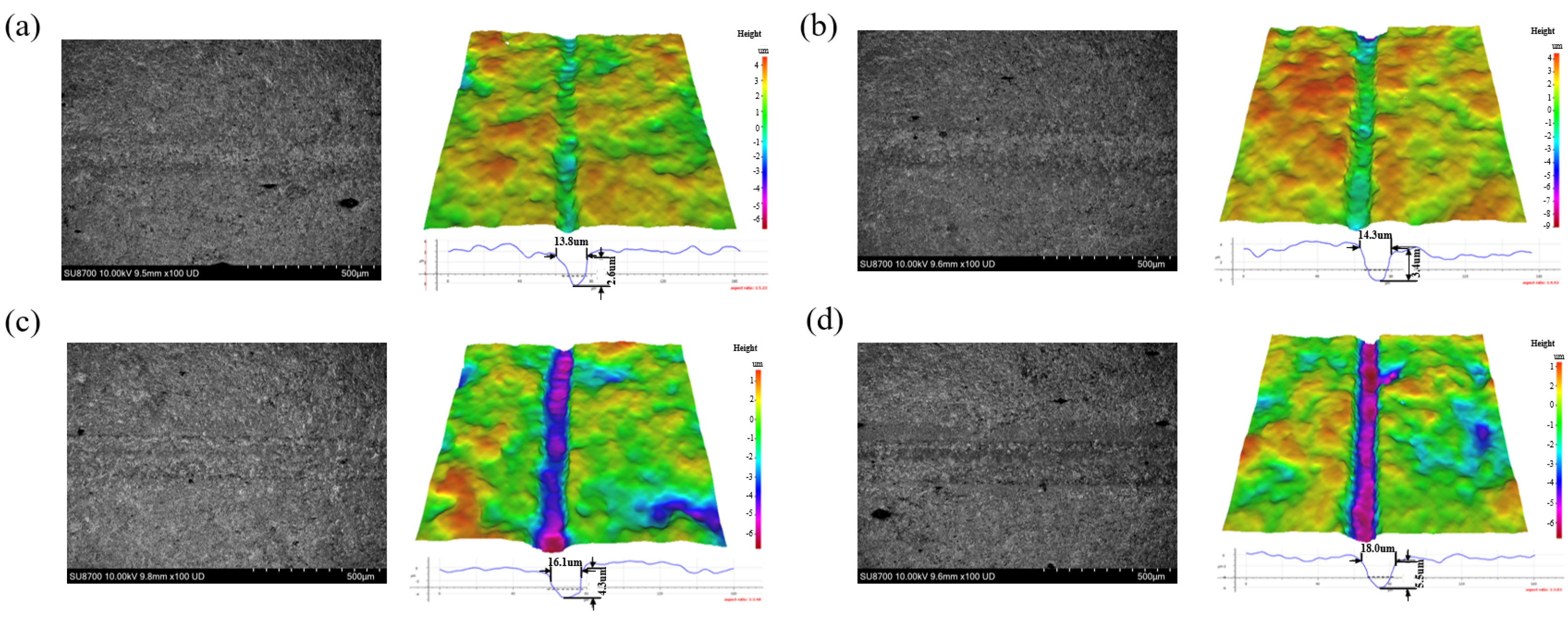
The experimental results indicate that variations in single-pulse energy significantly affect both the ablation depth and the lateral edge profile of the microgrooves. Taking the single-pulse energy as an example, Figure 4 illustrates the evolution of the ablation morphology with increasing energy level. Based on the SEM surface morphology images and the Alicona three-dimensional topography maps shown in Figure 4, it can be observed that as the single-pulse energy increases from 0.3 mJ to 0.45 mJ, the local laser energy deposition is intensified, leading to a continuous increase in the ablation groove depth. Meanwhile, it is worth noting that the lateral width of the ablation groove also expands markedly, and the microgroove edges become steeper, indicating a sharper lateral removal boundary. This synchronous morphological evolution in three-dimensional space indicates that with increasing thermal input, material removal is not only intensified in the depth direction, but the heat diffusing outward along the surface also reshapes the lateral ablation boundary. These experimentally observed differences in three-dimensional morphology must be further interpreted in terms of the evolution characteristics of the three-dimensional temperature field inside the material.
Figure 4.
Ablated surfaces at different single-pulse energies (): (a) 0.3 mJ; (b) 0.35 mJ; (c) 0.4 mJ; (d) 0.45 mJ.
4. Results and Discussion
4.1. Model Validation
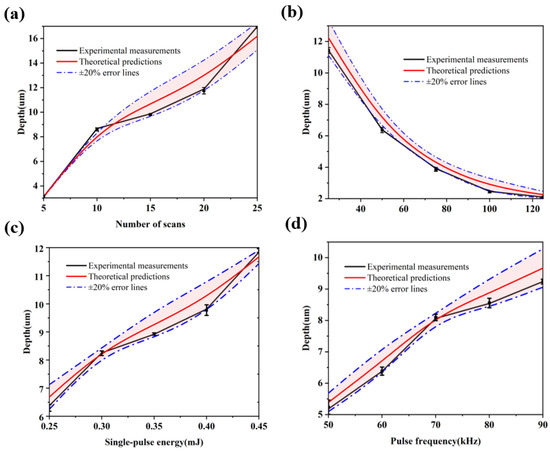
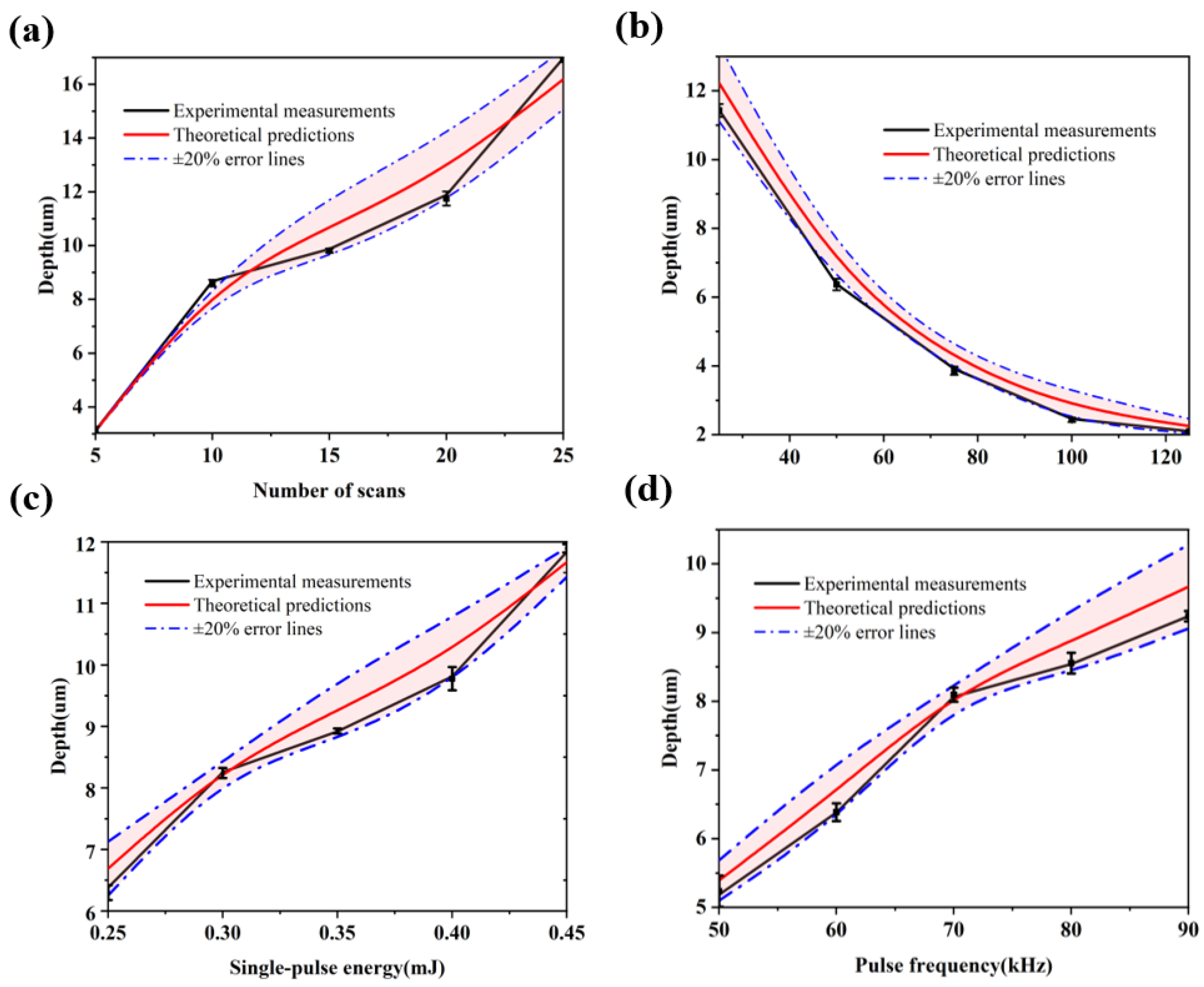
To quantitatively verify the accuracy of the established three-dimensional transient temperature field model, the experimental ablation depth data measured in Section 3.2 were extracted. Based on Equation (14), the corresponding theoretical ablation depths of the material surface under different process parameters were calculated. The variation trends of the experimental and theoretically predicted ablation depths were then compared and analyzed. Figure 5a–d present the comparison curves between the experimental ablation depth and the theoretically predicted ablation depth under four typical process parameters.
Figure 5.
Variation curves of the experimental ablation depth and theoretically predicted ablation depth with different laser parameters: (a) number of scans; (b) scanning speed; (c) single-pulse energy; and (d) pulse frequency.
The simulation results and experimental measurements are shown in Figure 5, where the red line represents the simulated ablation depth, the black line denotes the experimentally measured ablation depth, and the blue dashed lines indicate the ±20% error range of the simulation results. As shown in Figure 5a–d, the ablation depth gradually increases with increasing number of scans, single-pulse energy, and pulse frequency, whereas it decreases as the scanning speed increases. The ablation depth predicted by the simulation model exhibits the same variation trend as the experimentally measured results. Moreover, the relative error between the measured ablation depth and the predicted ablation depth is less than 20%, which is within an acceptable range. Therefore, the established model can be considered reasonable and capable of predicting the material removal trend under different laser processing parameters.
The strong positive correlation between the experimental results and the model calculations not only demonstrates that the established three-dimensional transient temperature field model can reasonably capture the variations in thermal response intensity and ablation depth under different process parameters but also further confirms that the macroscopic removal depth of PCD during nanosecond laser ablation is dominated by local thermodynamic effects.
4.2. Effects of Laser Parameters on the Lateral Temperature Distribution
To analyze the surface thermal distribution characteristics of PCD under multi-pulse nanosecond laser irradiation, the surface temperature field and lateral temperature gradient were investigated based on the established three-dimensional transient temperature field model. The surface temperature field reflects the spatial distribution of laser thermal input on the material surface, while the lateral temperature gradient is used to characterize the temperature decay rate along the surface direction and the degree of local thermal concentration.
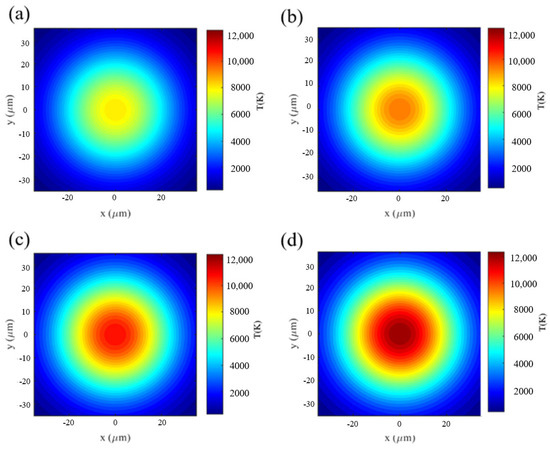
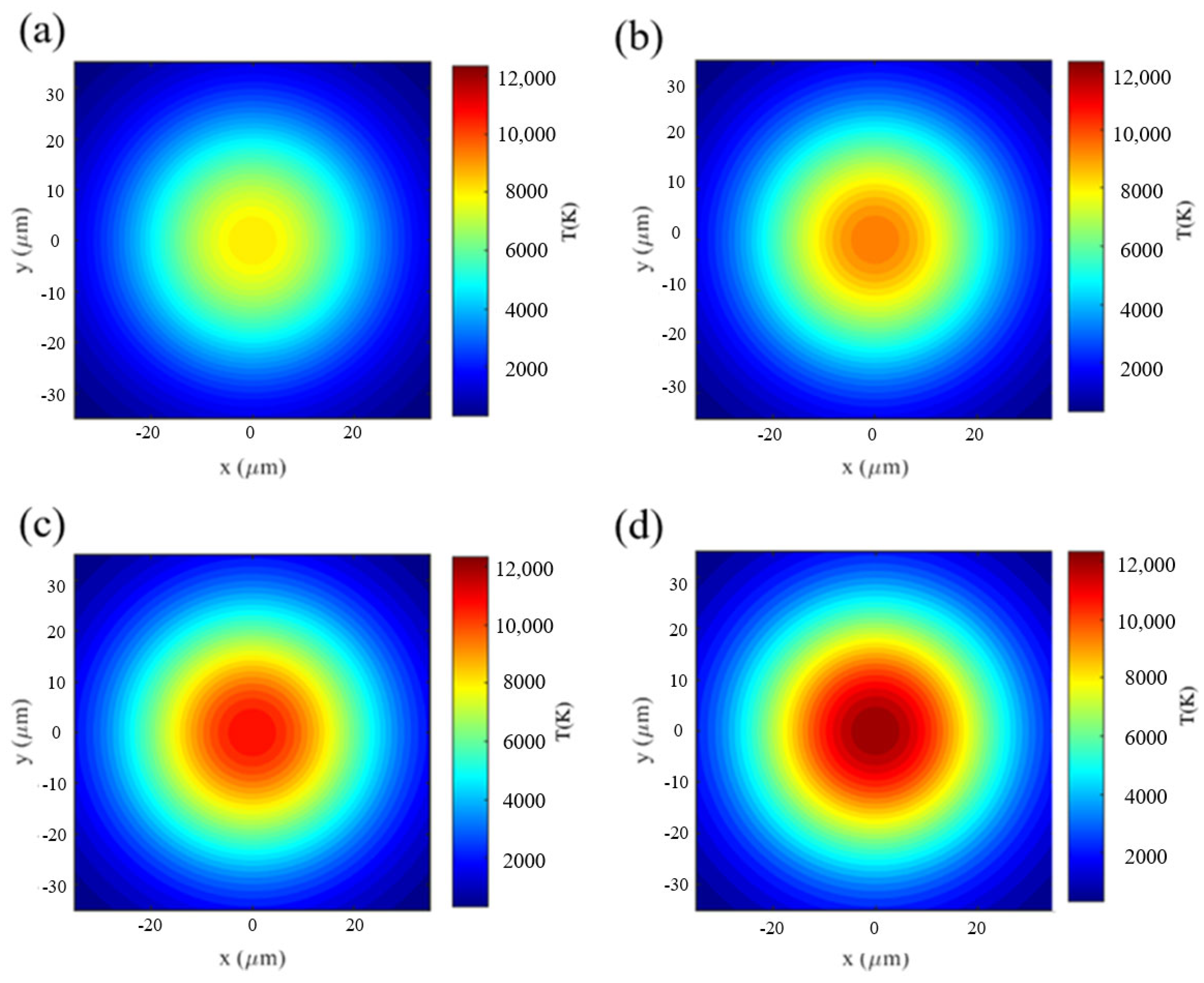
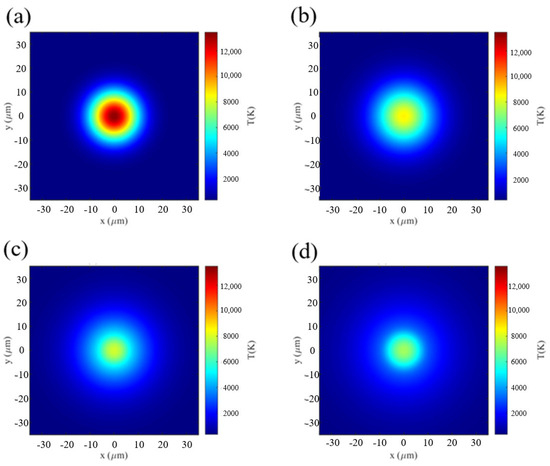
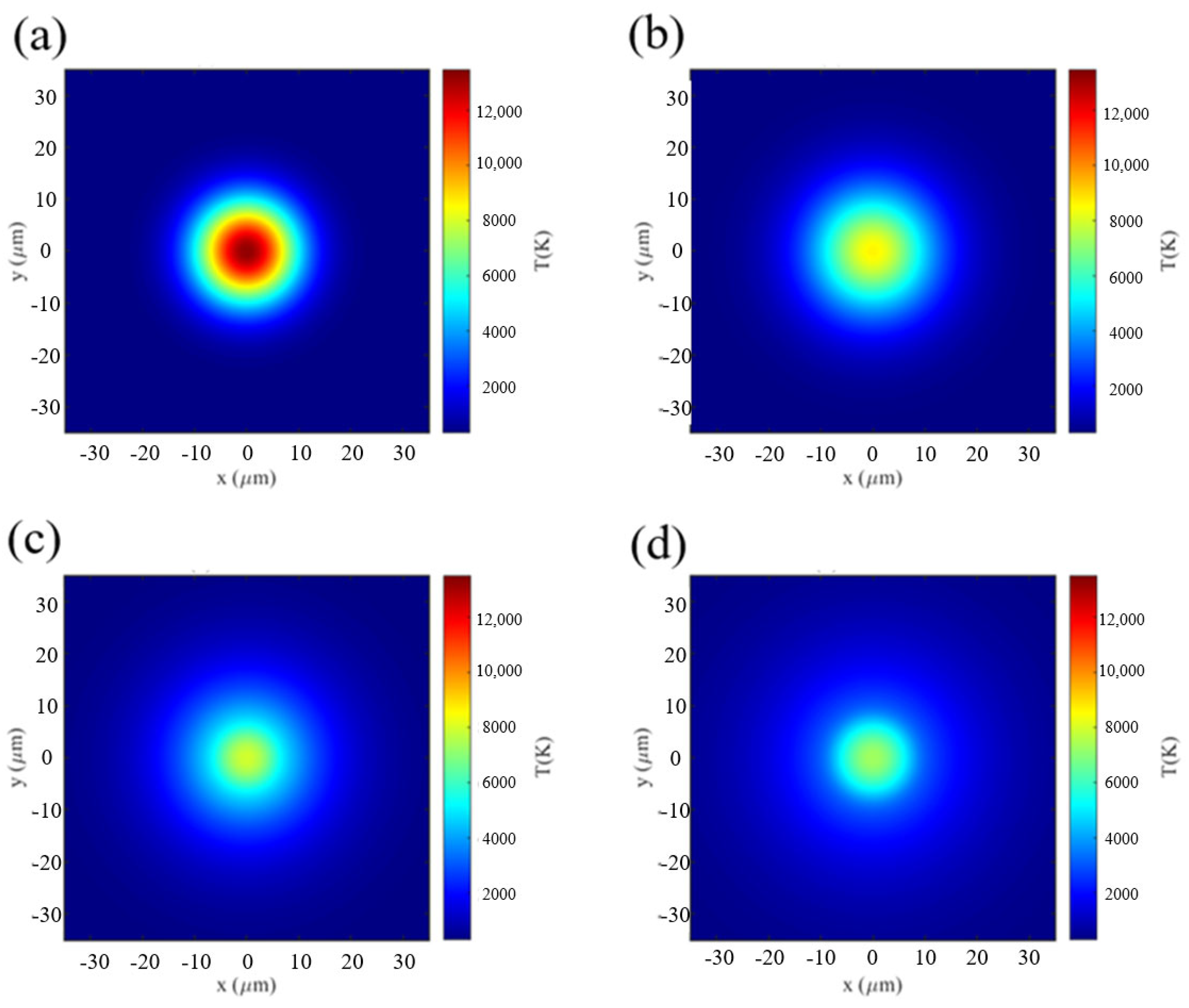
Considering the common characteristics of the spatial evolution of the temperature field under different parameters, the single-pulse energy, which directly represents the transient heat input, is selected as a representative parameter in this study. As shown in Figure 6, the spatial morphological evolution of the two-dimensional temperature field is visually presented. Meanwhile, to comprehensively and quantitatively evaluate the influence of multiple process parameters on the thermal concentration degree, the extreme values of the temperature gradient under different parameter conditions are uniformly extracted and compared in the form of one-dimensional curves, as shown in Figure 7.
Figure 6.
Contour maps showing the effect of single-pulse energy on the surface temperature field: (a) 0.3 mJ; (b) 0.35 mJ; (c) 0.4 mJ; (d) 0.45 mJ.
Figure 7.
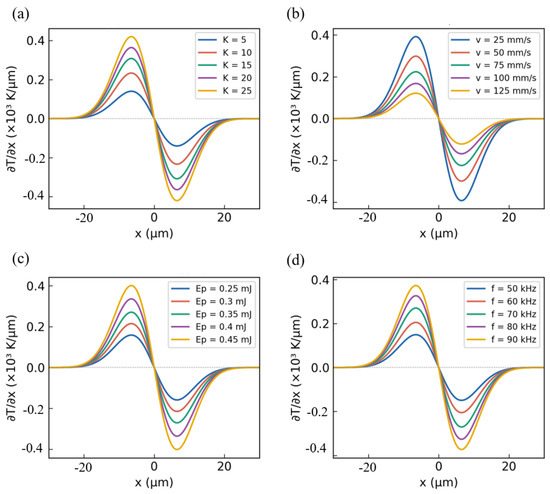
Variation curves of the lateral temperature gradient, , under different laser parameters: (a) number of scans (), (b) scanning speed (), (c) single-pulse energy (), (d) pulse frequency ().
Figure 6 shows the surface temperature field distributions under different single-pulse energy conditions. It can be observed that the surface temperature reaches its maximum at the center of the laser spot and gradually decays radially outward, exhibiting an approximately axisymmetric distribution. This indicates that the heat is mainly deposited in the central region of laser irradiation. As the single-pulse energy increases from 0.30 mJ to 0.45 mJ, the temperature at the center of the laser spot continuously rises, the high-temperature region gradually expands, and the isotherms extend outward. These results suggest that increasing the single-pulse energy can significantly enhance the surface thermal input and enlarge the heat-affected region, while the fundamental distribution pattern of the temperature field, characterized by a central peak, remains unchanged.
Figure 7 shows the variation curves of the lateral temperature gradient under different conditions of the number of scans , scanning speed , single-pulse energy , and pulse frequency . All sets of curves exhibit an antisymmetric distribution on both sides of the laser spot center, with large gradient variations occurring near the central region. This indicates that the temperature mainly decays rapidly near the boundary of the high-temperature region. As the number of scans, single-pulse energy, and pulse frequency increase, the multi-pulse thermal accumulation effect and local thermal input are significantly enhanced, resulting in a continuous increase in the absolute value of the lateral temperature gradient. In contrast, with increasing scanning speed, the effective heat input per unit area decreases, leading to an overall reduction in the absolute value of the gradient and a more gradual surface thermal distribution.
Based on Figure 6 and Figure 7, it can be concluded that the lateral temperature field and its gradient variation are mainly governed by the heat input per unit area, the degree of pulse overlap, and the thermal accumulation effect. Increasing the number of scans, single-pulse energy, and pulse frequency enhances the surface thermal concentration effect and increases the absolute value of the lateral temperature gradient, whereas increasing the scanning speed weakens the local heat input and makes the lateral temperature distribution more uniform. These results indicate that laser parameters can significantly regulate the surface thermal distribution characteristics and further influence the ablation morphology and material removal behavior.
4.3. Effects of Laser Parameters on the Longitudinal Temperature Distribution
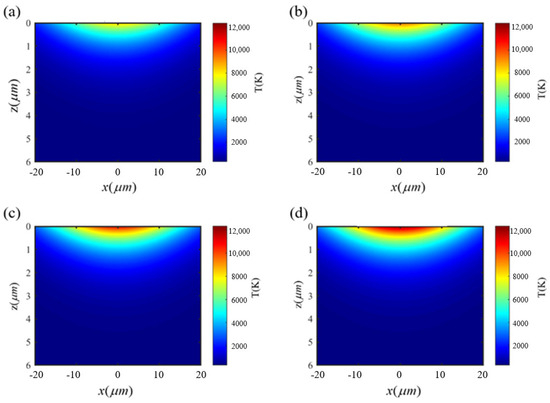
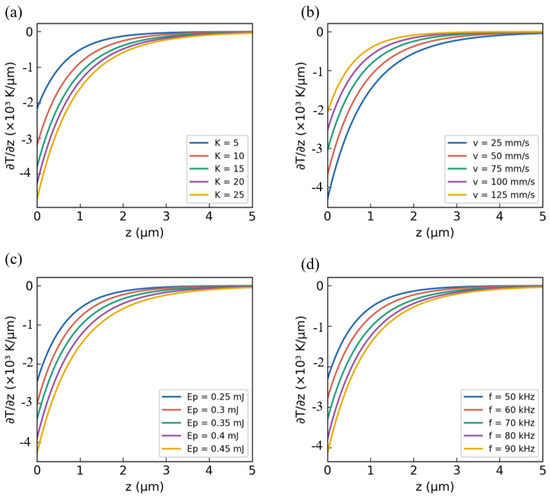
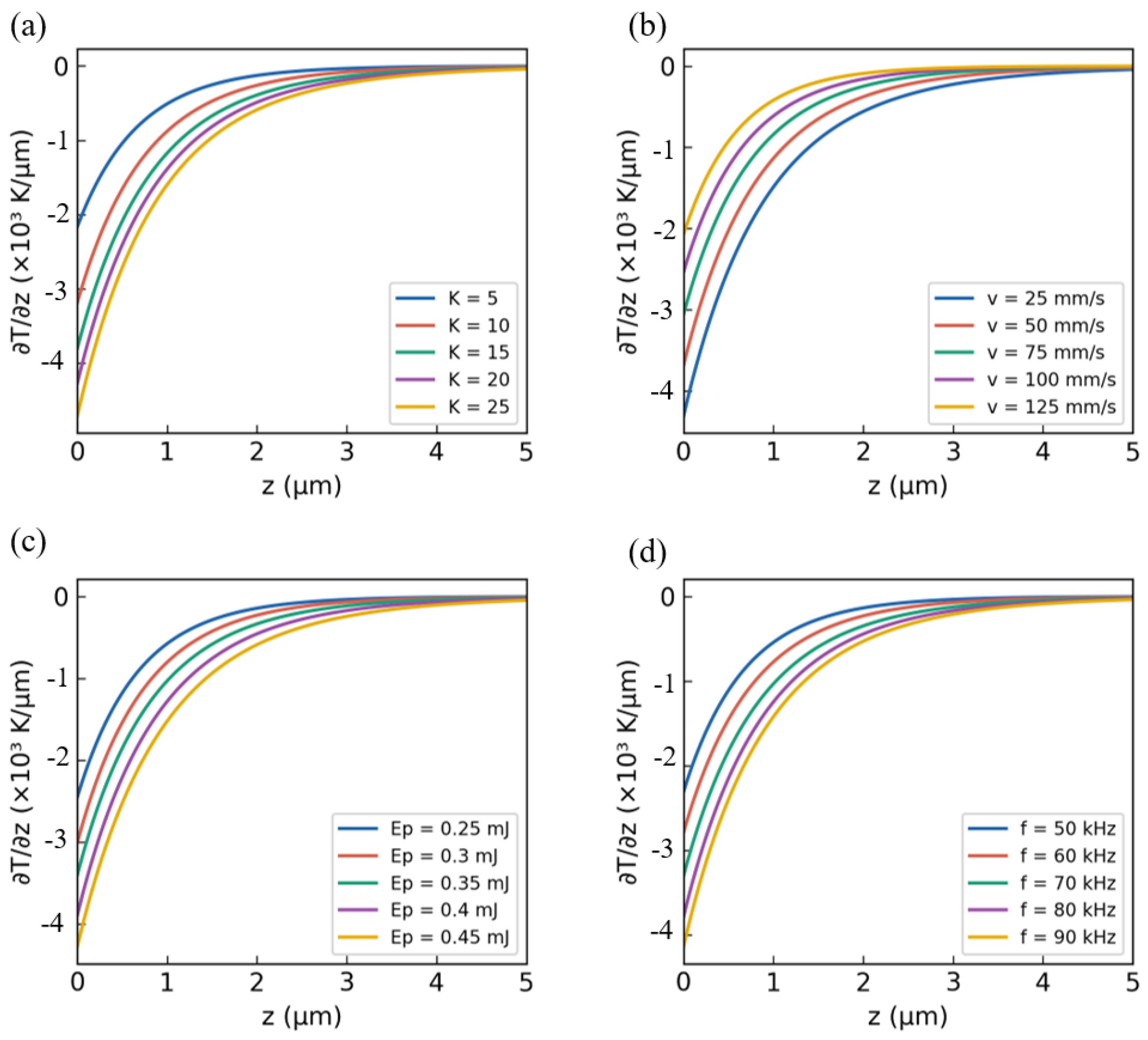
To further reveal the propagation and attenuation patterns of heat within the material, the temperature field in the - plane and the longitudinal temperature gradient () were analyzed. The temperature field in the - plane characterizes the heat diffusion process from the surface layer into the interior, while the longitudinal temperature gradient quantitatively describes the temperature decay rate along the thickness direction. Since is primarily negative, a larger absolute value () indicates a faster temperature decrease along the depth direction, meaning that the thermal effect is more concentrated in the near-surface region.
Figure 8 shows the temperature field distribution in the - plane under different single-pulse energy conditions. The results indicate that the highest temperature is always located near the center of the laser spot on the surface layer, and it rapidly decays along the depth direction. This suggests that the laser’s thermal input is initially deposited on the material surface and then diffuses inward due to heat conduction [41]. As the single-pulse energy increases from 0.30 mJ to 0.45 mJ, the superficial thermal footprint gradually strengthens and extends deeper into the material. This indicates that increasing the single-pulse energy not only enhances the surface thermal input but also increases the penetration depth of the thermal field [42].
Figure 8.
Contour maps showing the effect of single-pulse energy on the temperature field in the - plane: (a) 0.3 mJ; (b) 0.35 mJ; (c) 0.4 mJ; (d) 0.45 mJ.
Figure 9 shows the evolution curves of the longitudinal temperature gradient with depth under four typical process parameters. All curves reach the maximum negative value near the material surface and rapidly approach zero as the depth increases, indicating that the thermal influence of nanosecond laser irradiation is highly concentrated in the surface layer. As the number of scans or pulse frequency increases, the longitudinal gradient curves shift overall in the negative direction, suggesting that multi-pulse thermal accumulation significantly enlarges the temperature difference between the surface layer and the interior. The increase in single-pulse energy enhances the transient temperature rise in the surface layer, further increasing the absolute magnitude of . In contrast, increasing the scanning speed shortens the thermal interaction time per unit area, thereby reducing the absolute value of the gradient and making the temperature distribution along the depth direction more gradual.
Figure 9.
Variation curves of the longitudinal temperature gradient, , under different laser parameters: (a) number of scans (), (b) scanning speed (), (c) single-pulse energy (), (d) pulse frequency ().
Based on Figure 8 and Figure 9, it can be concluded that the depth-direction temperature field distribution and its gradient characteristics directly dominate the longitudinal material removal behavior. Increasing the number of scans, single-pulse energy, and pulse frequency enhances the longitudinal thermal effect, thereby driving a continuous increase in the ablation depth.
4.4. Effects of Pulse Width on the Temperature Field Distribution
To further analyze the influence of the temporal energy deposition characteristics of the laser on the thermal response of PCD, the pulse width is investigated as a numerical variable in the established three-dimensional transient temperature field model. Although the pulse width of the nanosecond laser used in the experiments is fixed at 100 ns, the pulse width directly affects the energy release duration and instantaneous power density of a single pulse, thereby further altering the surface temperature field, the depth-direction temperature distribution, and the ablation depth estimated based on the temperature field.
In this analysis, to independently examine the effect of pulse width, the other laser parameters are kept constant. The number of scans, scanning speed, single-pulse energy, and pulse frequency are fixed at , , , and , respectively. The pulse widths are set as , 50, 100, and 200 ns, among which ns corresponds to the pulse width used in the experiments.
Figure 10 shows the surface temperature field distributions under different pulse width conditions. It can be observed that in all cases, the temperature field exhibits an approximately axisymmetric distribution, with the peak located at the center of the laser spot and gradually decaying toward the surrounding region. As the pulse width decreases from 200 ns to 10 ns, the peak temperature at the center of the laser spot rises significantly, and the high-temperature region becomes more concentrated. This is because, under the condition of constant single-pulse energy, a shorter pulse width corresponds to a higher instantaneous power density, causing the laser energy to be deposited within the surface layer over a shorter time interval. In contrast, under a longer pulse width, the energy deposition duration is extended, and thermal diffusion becomes more sufficient during the pulse action, resulting in a more gradual temperature field distribution.
Figure 10.
Surface temperature field distributions under different pulse widths: (a) ns; (b) ns; (c) ns; (d) ns.
As the pulse width decreases, the higher peak temperature and larger longitudinal temperature gradient further enhance the thermal concentration effect, and, therefore, the ablation depth predicted based on the temperature field increases with decreasing pulse width. It should be noted that the predicted ablation depth here reflects the ablation trend under the heat-conduction-based model, rather than an accurate prediction of the complete material removal process.
These results indicate that pulse width is an important parameter affecting the temporal concentration of laser energy, the temperature gradient, and the estimated ablation depth. A shorter pulse width enhances the instantaneous thermal input and the near-surface thermal concentration effect, whereas a longer pulse width promotes thermal diffusion during pulse action and makes the temperature field distribution more gradual. It should also be emphasized that the present analysis is based on the classical heat conduction model. When the pulse width is further reduced to the picosecond or femtosecond scale, electron–phonon nonequilibrium, nonlinear absorption, and non-thermal ablation mechanisms may become significant, and a two-temperature model or molecular dynamics model should be introduced for further investigation.
5. Conclusions
This study establishes a three-dimensional transient temperature field model for multi-pulse nanosecond laser ablation of PCD and numerically solves the three-dimensional transient heat conduction equation using MATLAB. The effects of different process parameters on the temperature field, temperature gradients, and ablation behavior are analyzed. The main conclusions are as follows:
- (1)
- The established three-dimensional transient temperature field model can describe the heat deposition, heat diffusion, and thermal accumulation processes inside diamond under multi-pulse nanosecond laser irradiation. The ablation depth calculated by the numerical model exhibits a consistent variation trend with the experimentally measured results, and the relative error is controlled within 20%. This indicates that the proposed model can provide a theoretical basis for ablation depth trend prediction, heat-affected region control, and process parameter optimization.
- (2)
- The lateral temperature gradient mainly determines the lateral removal boundary of the material, while the longitudinal temperature gradient primarily governs the ablation depth. By increasing the number of scans, single-pulse energy, and pulse frequency, the thermal accumulation effect is enhanced, and the absolute values of both the lateral and longitudinal temperature gradients increase. This is manifested as the expansion of microgroove width, the steepening of the groove edge, and the increase in ablation depth.
- (3)
- Scanning speed and pulse width have significant regulatory effects on the temperature field distribution. Increasing the scanning speed weakens the thermal accumulation effect, reduces the temperature gradients, and decreases the ablation depth. Under the condition of constant single-pulse energy, a shorter pulse width increases the instantaneous power density and peak temperature, thereby enhancing the near-surface thermal concentration effect.
Author Contributions
Conceptualization, H.Z. and S.D.; Methodology, Z.W. and S.Y.; Software, H.Z. and Y.Z.; Validation, Z.W., H.Z. and S.Y.; Formal analysis, Z.W. and H.Z.; Investigation, H.Z., S.D. and Y.Z.; Resources, Z.W., H.Z., S.D., X.G. and S.Y.; Data curation, Z.W., H.Z. and Y.Z.; Writing—original draft, Z.W. and H.Z.; Writing—review & editing, Z.W., H.Z., X.G., Y.L., Z.S. and S.Y.; Visualization, H.Z. and S.D.; Supervision, X.G., Y.L., Z.S. and S.Y.; Project administration, Z.W., X.G., Y.L., Z.S. and S.Y.; Funding acquisition, Z.W., X.G., Y.L., Z.S. and S.Y. All authors have read and agreed to the published version of the manuscript.
Funding
This research was funded by the Guangdong Basic and Applied Basic Research Foundation (2025A1515011366), Liaoning Provincial Department of Education Basic Scientific Research Projects for Higher Education Institutions (LJ212410150018), and the National Natural Science Foundation of China (52375169, 52175382).
Data Availability Statement
The original contributions presented in this study are included in the article. Further inquiries can be directed to the corresponding author.
Conflicts of Interest
The authors declare no conflict of interest.
References
- Du, J.; Wei, X.; Sun, H.; Shi, S.; Tu, J.; Ji, F.; Wei, J.; Wang, W.; Zhang, C. Fully diamond-based embedded manifold microchannel heat sink: Achieving ultra-high heat flux cooling. Int. J. Heat Mass Transf. 2026, 260, 128420. [Google Scholar] [CrossRef] [Scilit]
- Gao, J.; Chen, Q.; Zhang, Z.; Hou, Z.; Wang, C.; Li, H.; Yang, Y.; Yang, J.; Tang, Y.; Wang, H. Simultaneous Enhancement of Wear Resistance and Impact Toughness in Polycrystalline Diamond Compact via Gradient Structure Design. Ceram. Int. 2025, 52, 3584–3595. [Google Scholar] [CrossRef] [Scilit]
- Moriyama, C.; Cheng, Z.; Huang, Z.; Ohno, Y.; Inoue, K.; Nagai, Y.; Shigekawa, N.; Liang, J. Direct Integration of Polycrystalline Diamond with 3C-SiC for Enhanced Thermal Management in GaN HEMTs: Impact of Grain Structure and Interface Engineering. Adv. Mater. Technol. 2025, 10, e00437. [Google Scholar] [CrossRef] [Scilit]
- Soman, R.; Malakoutian, M.; Woo, K.; Kim, J.-K.; Rodriguez, T.A.; Martinez, R.P.; DeJarld, M.; Tahhan, M.; Valliancourt, J.; Chumbes, E.M. Integration of top-side low-temperature diamond on AlGaN/GaN RF HEMT for device-level cooling. Appl. Phys. Lett. 2025, 126, 213503. [Google Scholar] [CrossRef] [Scilit]
- Yang, Z.L.; Yang, A.; Liu, P.; Chen, L.; An, K.; Wei, J.; Liu, J.; Wu, L.; Li, C. Preparation of 3-Inch Diamond Film on Silicon Substrate for Thermal Management. J. Inorg. Mater. 2023, 39, 283–290. [Google Scholar] [CrossRef] [Scilit]
- Huang, X.; Zhou, C.; Wu, B.; Geng, Z.; Zhang, X. Wafer-scale polishing of polycrystalline MPACVD-diamond. Surfaces 2022, 5, 155–164. [Google Scholar] [CrossRef] [Scilit]
- Yuan, S.; Cheung, C.F.; Shokrani, A.; Zhan, Z.; Wang, C. Atomic-level flat polishing of polycrystalline diamond by combining plasma modification and chemical mechanical polishing. CIRP Ann. Manuf. Technol. 2025, 74, 441–445. [Google Scholar] [CrossRef] [Scilit]
- Du, Y.; Liang, Z.; Su, Z.; Ma, Y.; Zhao, X.; Liu, Z.; Xiao, Y.; Huang, H.; Yuan, H.; Zhou, T. Machining damage in the fabrication of polycrystalline diamond micro end mill with laser and grinding combined processing method. Diam. Relat. Mater. 2024, 148, 111454. [Google Scholar] [CrossRef] [Scilit]
- Haochen, Z.; Zengyu, Y.; Zhipeng, S.; Shuai, Z.; Zilong, Z.; Guo, C.; Meiyong, L.; Guangchao, C. The polishing methods for large area CVD diamond wafer. Funct. Diam. 2023, 3, 2246495. [Google Scholar] [CrossRef] [Scilit]
- Li, Z.; Jiang, F.; Jiang, Z.; Tian, Z.; Qiu, T.; Zhang, T.; Wen, Q.; Lu, X.; Lu, J.; Huang, H. Energy beam-based direct and assisted polishing techniques for diamond: A review. Int. J. Extrem. Manuf. 2024, 6, 99–130. [Google Scholar] [CrossRef] [Scilit]
- Yuan, S.; Cheung, C.F.; Fang, F.; Huang, H.; Wang, C. Multi-physical field coupling polishing of diamond for atomic-scale damage-free surface. Int. J. Extrem. Manuf. 2026, 8, 032004. [Google Scholar] [CrossRef] [Scilit]
- Ye, S.; Zhao, S.; Xing, Z.; Peng, Z.; Zheng, Y.; Chen, L.; Liu, J.; Li, C.; Wei, J. Research and Application Progress of Laser Technology in Diamond Processing. Infrared Laser Eng. 2024, 53, 44–65. [Google Scholar]
- Soleimani, M.; Nankali, M.; Duley, W.W.; Zhou, Y.N.; Peng, P. Additive manufacturing processing with ultra-short-pulse lasers. J. Manuf. Process. 2024, 131, 2133–2163. [Google Scholar] [CrossRef] [Scilit]
- Ma, Y.; Liang, Z.; Du, Y.; Su, Z.; Xu, J.; Guo, C.; Zhang, S.; Guo, H.; Chen, P. Fabrication method of polycrystalline diamond micro-drill using a hybrid process of pulsed laser, EDM and precision grinding. Int. J. Refract. Met. Hard Mater. 2025, 129, 107124. [Google Scholar] [CrossRef] [Scilit]
- Yuan, S.; Zhang, W.; Cheung, C.F.; Zhang, Q.; Li, Z.; Wang, C. Atomic-scale damage mechanism of diamond during laser processing. Int. J. Mech. Sci. 2026, 312, 111247. [Google Scholar] [CrossRef] [Scilit]
- Ozkan, A.M.; Malshe, A.P.; Brown, W.D. Sequential multiple-laser-assisted polishing of free-standing CVD diamond substrates. Diam. Relat. Mater. 1997, 6, 1789–1798. [Google Scholar] [CrossRef] [Scilit]
- Zhang, J.; Lan, J.; Lu, J.; Luo, Z.; Yan, Q.; Xu, S. Study on laser processing characteristics of single-crystal diamond with different pulse widths. Appl. Phys. A 2025, 131, 334. [Google Scholar] [CrossRef] [Scilit]
- Okamoto, Y.; Okada, A.; Kajitani, A.; Shinonaga, T. High surface quality micro machining of monocrystalline diamond by picosecond pulsed laser. CIRP Ann. 2019, 68, 197–200. [Google Scholar] [CrossRef] [Scilit]
- Chen, S.; Jin, T.; Lin, Z.; Wu, M.; Huang, J.; Chen, J.; Nie, A. Energy-dependent machining mechanism and process in water-jet guided laser processing single crystal diamond. Alex. Eng. J. 2025, 118, 681–691. [Google Scholar] [CrossRef] [Scilit]
- Dong, Z.W.; Zhang, W.B.; Zheng, L.W.; Jiang, T.; Fan, G.X.; Zhao, X.; Zhao, Q.L.; Chen, D.Y.; Xia, Y.Q. Processing of diamond applying femtosecond andnanosecond laser pulses. Infrared Laser Eng. 2015, 44, 893–896. [Google Scholar]
- Ding, Y.; Jiang, X.; Wang, C.; Jia, X.; Liu, L.; Han, W.; Gao, Z.; Wang, S.; Lin, N.; Yan, D. Femtosecond laser rapid customization of high-performance anti-reflection windows. Opto Electron. Sci. 2026, 5, 260004. [Google Scholar] [CrossRef] [Scilit]
- Li, W.; Xu, L.; Fu, Y.; Tan, H.; Jia, X.; Li, K.; Zhang, L.; Wang, C.; Duan, J. Femtosecond laser welding of non-optical-contact ceramic and fused silica. Opt. Lett. 2026, 51, 532–535. [Google Scholar] [CrossRef] [Scilit]
- Zou, J.; Ye, S.; Sedov, V.; Leng, W.; Liu, P.; Pivovarov, P.; Chen, L.; Zhang, J.; Liu, J.; Li, C. Ultrafast planarization of large-scale polycrystalline diamond by microsecond laser processing: Investigation of polishing mechanisms and impact on the material. Appl. Surf. Sci. 2025, 713, 164282. [Google Scholar] [CrossRef] [Scilit]
- Zhang, D.; Cai, Y.; Aslam, J.; Tang, K.; Huang, Z.; Song, Q.; Wang, B.; Liu, Z. Cryogenic assisted femtosecond laser ablation of polycrystalline diamond. Diam. Relat. Mater. 2024, 144, 110902. [Google Scholar] [CrossRef] [Scilit]
- Wang, R.; Chen, N.; Yan, B.; Wu, Y.; Ran, L.; He, N. Inert ambiance-assisted laser ablation of CVD diamond leads to enhanced surface quality and grindability. Ceram. Int. 2023, 49, 1154–1164. [Google Scholar] [CrossRef] [Scilit]
- Luo, Z.; Lu, J.; Wu, L.; Yan, Q. Study on the material removal characteristics of single crystal diamond polished by infrared picosecond laser. Int. J. Refract. Met. Hard Mater. 2025, 132, 107275. [Google Scholar] [CrossRef] [Scilit]
- Wang, H.; Wen, Q.; Xu, X.; Lu, J.; Jiang, F.; Cui, C. Ablation characteristics and material removal mechanisms of a single-crystal diamond processed by nanosecond or picosecond lasers. Opt. Express 2021, 29, 22714–22731. [Google Scholar] [CrossRef] [Scilit]
- Wang, H.; Wen, Q.L.; Huang, H.; Huang, Q.; Jiang, F.; Wu, X. Ablation Characteristics and Mechanism of Femtosecond Laser Processing of CVD Single Crystal Diamond. Acta Photonica Sin. 2023, 52, 51–65. [Google Scholar]
- Wen, Q.L.; Wei, X.Y.; Wang, H.L.; Cui, C.; Lu, J.; Hu, Z.; Jiang, F. Characteristics and Mechanism of Picosecond Laser Processing of CVD Single Crystal Diamond. Acta Photonica Sin. 2021, 50, 126–136. [Google Scholar]
- Hu, W.; Lu, S.; Zhang, J. Coupling optical-thermal simulations of laser-induced temperature fields in in-situ laser-assisted diamond turning. Appl. Therm. Eng. 2025, 261, 125193. [Google Scholar] [CrossRef] [Scilit]
- Zhang, L.; Peng, K.; Gan, Z.; Zhou, J.; Cao, L. Numerical simulation of ultrafast laser ablation on single crystal diamond by two-temperature model and molecular dynamics. Comput. Mater. Sci. 2026, 262, 114383. [Google Scholar] [CrossRef] [Scilit]
- Xing, H.; Wang, S.; Zheng, W.; Bao, X.; Wang, X.; Zhao, Q. Gold film suppresses ablation damage of CVD polycrystalline diamond by sub-nanosecond pulsed laser processing: Experimental and theoretical investigation. Diam. Relat. Mater. 2025, 153, 112100. [Google Scholar] [CrossRef] [Scilit]
- Cui, X.; Zhang, C.; Li, G.; Song, C.; Qin, W.; Wang, T. Mechanisms behind graphitization modification in polycrystalline diamond by nanosecond pulsed laser. Materials 2024, 17, 6200. [Google Scholar] [CrossRef] [Scilit] [PubMed]
- Yuan, H.; Zhang, C.; Song, C.; He, Z.; Li, G.; Li, L. Experimental investigation of laser parameters dependence of surface graphitization in nanosecond laser ablation of nanocrystalline diamond. Micromachines 2025, 16, 374. [Google Scholar] [CrossRef] [Scilit] [PubMed]
- Cao, L.C.; Hu, W.X.; Wang, J.T.; Li, W.H.; Guo, W.T.; Cai, W.; Wu, C.Y. Defect Characteristics of Picosecond Laser Ablated CVD Diamond Microgrooves. Chin. J. Lasers 2025, 52, 0802405. [Google Scholar]
- Zhang, J.; Chen, Y.; Hu, M.; Chen, X. An improved three-dimensional two-temperature model for multi-pulse femtosecond laser ablation of aluminum. J. Appl. Phys. 2015, 117, 063104. [Google Scholar] [CrossRef] [Scilit]
- Bruhier, H.; Bourquard, F.; Garrelie, F.; Steyer, P.; Colombier, J.-P. Effective pulse number and energy distribution uniformity in laser scanning with Gaussian and cylindrical beams. J. Appl. Phys. 2025, 138, 123102. [Google Scholar] [CrossRef] [Scilit]
- Konov, V.I.; Garnov, S.V.; Tsarkova, O.; Obraztsova, E.; Lubnin, E.; Dausinger, F. Laser measurements of optical and thermal properties of CVD diamond at high temperatures. In Proceedings of the Lasers in Synthesis, Characterization, and Processing of Diamond, Tashkent, Uzbekistan, 6–9 October 1997; SPIE: Washington, DC, USA, 1998. [Google Scholar]
- Vins, V.; Yelisseyev, A.; Smovzh, D.; Novopashin, S. Optical properties of CVD single crystal diamonds before and after different post-growth treatments. Diam. Relat. Mater. 2018, 86, 79–86. [Google Scholar] [CrossRef] [Scilit]
- Savitski, V.G.; Kemp, A. Simplified method of calorimetric measurements of background loss in crystals. Devices Methods Meas. 2015, 2, 76–78. [Google Scholar]
- Mirkoohi, E.; Seivers, D.E.; Garmestani, H.; Liang, S.Y. Heat source modeling in selective laser melting. Materials 2019, 12, 2052. [Google Scholar] [CrossRef] [Scilit]
- Yilbas, B.; Shuja, S. Heat transfer analysis of laser heated surfaces—Conduction limited case. Appl. Surf. Sci. 1997, 108, 167–175. [Google Scholar] [CrossRef] [Scilit]

Disclaimer/Publisher’s Note: The statements, opinions and data contained in all publications are solely those of the individual author(s) and contributor(s) and not of MDPI and/or the editor(s). MDPI and/or the editor(s) disclaim responsibility for any injury to people or property resulting from any ideas, methods, instructions or products referred to in the content. |
© 2026 by the authors. Licensee MDPI, Basel, Switzerland. This article is an open access article distributed under the terms and conditions of the Creative Commons Attribution (CC BY) license.