


Abstract
Particulate matter (PM) emissions are common in technological processes, and effective mitigation requires gas pre-treatment before high-efficiency filtration to reduce fine and ultrafine PM that are particularly dangerous to the human health. This study evaluates a multichannel electric field manipulator (agglomerator) as a flow pre-treatment stage and investigates the aerodynamic conditions that govern particle–gas flow distribution and variation in trajectories and dynamics at different flow rates. These factors provide meaningful assumptions about the possible behavior of particles in the flow, and they are critical for optimizing an agglomeration and its intensity. Such phenomena can have an impact on the probability of agglomeration in the manipulator channels, i.e., the adherence of small particles into larger ones, and this allows for improving the design and operating conditions of the apparatus. Gas flow velocities and pressure were analyzed experimentally at various cross-sectional points in the inlet and outlet ducts at inflow rates of 3.4 L/s and 50 L/s. The static inlet pressure of the manipulator ranged from 8 Pa to 178 Pa. This study provides new insights into flow pre-treatment using the electric field mechanism in a multichannel modular apparatus and provides a reasonable understanding of the necessary characteristics of gas flow distribution to support subsequent improvements targeting higher agglomeration.
1. Introduction
Conventional treatment technologies, based on gravity, centrifugal force, and electrostatics, are widely employed for PM control, but their capture efficiency decreases markedly for PM smaller than 1 µm [1,2,3,4]. The upcoming Euro 7 standard (European vehicle-emissions regulation) is expected to tighten particle number (PN) limits by moving from PN23 (particle number > 23 nm to PN10 (particle number > 10 nm) [5].
PM, including fine and ultrafine PM (UFPM), poses significant risks to both human health and the natural environment [6].
PM is a mixture of particles and liquid droplets (aerosols) in the air, which can contain various components such as acids, sulfates, nitrates, organic compounds, metals, soil particles, dust, soot, etc. The solid particles emitted into the air exhibit significant variation in their physical and chemical compositions, particle sizes, and sources of emission [7].
The most painful effects are caused by solid particles with a size of 10–0.1 µm. Once inhaled, particles deposit along the respiratory tract—larger particles mainly in the upper airways, whereas ultrafine particles can reach the alveoli and may enter the bloodstream. The lung deposited surface area (LDSA) quantifies the particle surface area likely to deposit in alveolar and bronchiolar regions, providing a health-relevant metric beyond mass or PN for UFPM (smaller than 100 nm) [8].
Additionally, many existing filtration-based systems have limited adaptability across wide PM concentrations and can clog rapidly, often necessitating pre-treatment or specialized handling of contaminated gas flows [9]. As standalone treatment units, their performance strongly depends on PM type/characteristics and gas flow properties [10,11].
Small PM can agglomerate through several processes. Despite their small diameters, strong forces such as Van der Waals interactions, electrostatic forces, and capillary forces act between such PM. Collectively, these forces create an attractive force, allowing the PM to form larger compounds [12].
The agglomeration of PM can occur due to various interactions, which can be grouped into solid bridges, mobile liquid binding, intermolecular and electrostatic forces, and mechanical interlocking. Solid bridges may form through sintering, crystallization, or with the aid of bonding agents such as resins. The driving forces behind mobile liquid binding include interfacial forces and capillary suction, with bond strength depending on the binder’s properties. Intermolecular and electrostatic forces act between PM without the formation of material bridges. These forces are more prominent in smaller-sized PM, as gravitational forces tend to dominate in larger-sized PM. Mechanical interlocking occurs due to the geometrical properties of the PM. During mixing processes, PM can become entangled and accumulate into larger agglomerates [13].
The most used methods to apply these mechanisms to PM are chemical agglomeration, ultrasonic agglomeration and, electrostatic agglomeration [7,10].
Chemicals can be used to induce agglomeration in PM. Therefore, chemical agglomerants are directly sprayed into the flow of the gas stream to be cleaned [14,15].
An effective method for PM agglomeration is the application of sound waves to PM, known as ultrasonic agglomeration. In addition to orthokinetic interactions, ultrasonic agglomeration at frequencies ranging from 16 kHz to 1 MHz can also make use of ultrasonic cavitation. This phenomenon enhances PM collisions and interactions, leading to the growth of PM size. Furthermore, ultrasonic waves can reduce surface charges to eliminate electrostatic repulsion and increase surface energy, which improves the adhesion of PM [16].
Despite extensive research on electrostatic PM charging and agglomeration mechanisms, the aerodynamic behavior of a specifically engineered modular bipolar electric field manipulator is yet to be systematically characterized. In particular, the influence of the internal multichannel cassette geometry on flow redistribution, pressure evolution, and PM transport under varying operating gas flow rates remains insufficiently understood. The present study investigates the aerodynamic performance of the modular bipolar electric field manipulator developed and constructed by the authors. This device incorporates a multichannel plate cassette designed to control PM residence time and enhance exposure to the electric field. A comprehensive experimental analysis of velocity distribution, static pressure, and aerodynamic resistance is combined with three-dimensional CFD modelling to characterize the internal flow structures of this specific apparatus. From a practical point of view, the characteristics of the gas flow and its distribution allow for the necessary aerodynamic parameters to be precisely selected in order to achieve the most effective PM agglomeration performance, taking into account restrictions on energy consumption and the operating time of the setup.
Theoretical Foundation
The application of an electric field is important for the study of flow electro-hydrodynamics. Zhou et al. [17] deals with devices with electro-convective flow, which is induced by so-called charge spray. Such technology is used for the micro-mixing of liquids, as well as for their atomization. Unipolar electric fields are mainly applied to alternating currents with a sinusoidal phase, but changes in alternating and pulsed electric fields and the transition from DC to AC are also investigated. In the case of a unipolar field, the charge carriers are usually assumed to be electrons and positive, so the electric potential is calculated using Poisson’s equation, which takes into account the charge density [18].
Electrostatic agglomerators can be categorized into two main groups [19]. A bipolar agglomerator typically consists of a charging section and an electric field section. In the charging section, the gas stream is split into two halves, and a corona discharge is used to polarize each of these streams with opposite polarities. As the charged gas streams enter the electric field section, the particles collide due to Coulombic attraction forces. The motion of these particles can be described by Equation (1) [20]:
where q is the charge of the particle, E is the intensity of the electric field, m is the particle mass, and µ is the gas viscosity. It should be noted that both the electrical parameters as well as properties of the particles influence the agglomeration process.
Equation (2) describes the time-dependent increase in the particle charge Qp of a spherical particle with a diameter dp:
Key influencing factors include the ion concentration in the charging zone ci, the mobility of the gaseous ions bi, the relative permittivity of the particles εr, the electric field constant ε0, and the elementary charge e. The only actively controllable parameter is the electric field strength E.
As the particle charge increases, a Coulombic repulsion force develops, preventing further charge accumulation. This results in a saturation limit, known as the Pauthenier limit, with the saturation charge Qs, which can be determined using the Pauthenier equation (Equation (3)):
It follows that the saturation charge depends only on the electric field and is independent of the ion concentration.
The second mechanism, diffusion charging, occurs through collisions between ions and particles due to Brownian motion. Temperature is a crucial factor, as it significantly influences the mean kinetic energy of the ions. Here, Equation (4) is used to describe the charge increase over time:
As previously mentioned, this introduces the root-mean-square velocity i, which depends on the kinetic energy according to Maxwell–Boltzmann statistics, the Boltzmann constant k, and the absolute temperature T in K.
Like the bipolar agglomerator, a unipolar agglomerator also consists of a charging section and an agglomeration section. However, in this case, the gas stream is not separated, and the entire stream is charged with the same polarity. In the agglomeration section, an alternating electric field is used to induce oscillatory motion, forcing the particles to collide and agglomerate. The difference in the velocity and amplitude of the oscillatory movement between larger and smaller particles is the primary cause of collisions [21].
Understanding the motion and velocities of particles in a gas stream is crucial as these factors determine the probability of particle collisions, the frequency and efficiency of such a phenomenon, as well as the subsequent agglomeration in both primary and secondary modes. The application of a forced electric field in air channels can change the trajectories of charged particles, also called general ion wind flow. The distribution of air flow velocity from the entrance to the distribution system of channels and available local barriers, where the flow pressure drop occurs, have a direct impact on the particle dynamics, and hence on the agglomeration efficiency [22]. Grosshans [23] investigated an electro-vortex technology to improve particle capture efficiency. The importance of the combination of mechanisms is to direct the particles in the desired trajectory, to create conditions in which the particles stay long enough in the electric field for their agglomeration, but also not to create excessive pressure losses, rather, to stabilize the particle motion and reduce velocity fluctuations, which leads to a more homogeneous distribution of particles and improved agglomeration.
Particle charging occurs through two primary mechanisms: field charging and diffusion charging. In corona discharge systems, the surrounding gas becomes ionized, generating free ions that enable charge transfer. During field charging, electric field lines concentrate around particles due to differences in electrical permittivity, directing ions toward the particle surface, where charge transfer occurs. In diffusion charging, ions undergo random motion driven by Brownian motion, leading to collisions with particles and subsequent charge transfer. These processes continue until the particle reaches its charge saturation limit [4,24]. In contrast, field charging requires an external electric field that moves the ions along the field lines, causing them to collide with the particles along their path. The ion flux is correlated with ion mobility Z and the electric field strength E, which therefore influences particle charging. Additionally, particle properties such as the dielectric constant K and the saturation charge of the particles play a role in this process [25]. The space between the electrodes can be divided into two regions: the ionization region and the drift region. The ionization region is confined near the discharge electrode, where an asymmetric geometry produces a very high electric field strength; electrons are rapidly accelerated toward the grounded electrode and gain enough energy to ionize gas molecules upon collision, creating additional electrons and positive ions. Farther from the discharge electrode, the electric field weakens, and the drift region begins, where electrons no longer sustain further ionization and instead attach to neutral molecules, forming negative ions that migrate toward the collecting electrode under electrostatic forces. Corona discharge also produces a localized luminous glow due to photon emission during electron transitions, which remain limited to the ionization region, and an ion-driven gas flow toward the collecting electrode, commonly termed corona wind [26].
Thonglek and Kiatsiriroat [27] examined aerodynamic effects in an electric field and showed that performance depends strongly on gas velocity and duct conditions. At a peak voltage of 45 kV and a pulse frequency of 20 kHz, efficiency increased as the velocity increased from 0.5 m/s to 1 m/s, but decreased when the velocity exceeded 1 m/s. Under these conditions, sub-micron PN reduction exceeded 90% for all particle sizes in a non-thermal plasma ESP. A practical mitigation is intentional agglomeration by enlarging particles; conventional collection methods become more effective and the electric-field-driven relaxation of particles is central to this mechanism [28].
To maintain air quality, especially in rooms where people spend long periods of time, it is necessary to rationally solve the problem of dust from both natural and anthropogenic sources. People are increasingly spending time in enclosed spaces such as administrative buildings, as well as temporary spaces such as airport waiting rooms, movie theaters, etc. High-efficiency filters (HEPA or ULPA) are used to precipitate micron-sized PM with sufficient efficiency, but these filters are not effective enough at trapping submicron and nanoscale particles due to their structure [29]. UFPM is concentrated and thus constitutes the predominant fraction in the air, and with multiple sources, the probability of it entering the human respiratory zone increases. The pretreatment of contaminated flow facilitates the purification process, makes it more economical, and selectively acts on the smallest PM for agglomeration, allowing for the use of already-known technologies with the best flow characteristics. Various scenarios for the volume flow rate of the purified air flow in this study indicate critical phenomena in the agglomeration process and the distribution of trajectories in this device, thereby predetermining their potential area of application and operating modes. The digital model, built from the physical test bench, reproduces the main process trends and supports the identification of design improvements to maximize PM impact and agglomeration effectiveness across operating conditions.
2. Materials and Methods
2.1. Experimental Setup
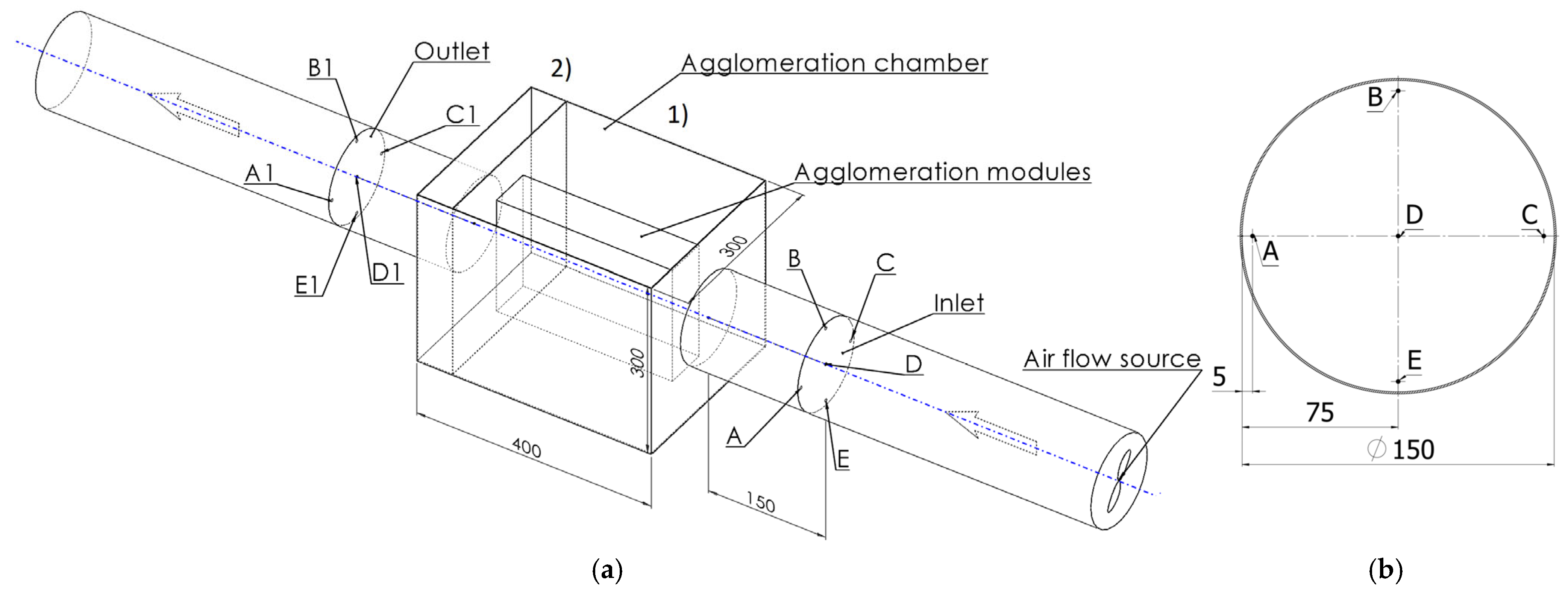
Physical experiments were performed at VilniusTech laboratories, whereas the simulations were performed at a National Sun Yat-Sen university. For experimental studies on the dynamic limits of gas flow and pressure at the laboratory, a specialized research bench was employed. This bench includes a fan, airflow velocity meters at both the inlet and outlet, static pressure meters at the inlet and outlet, an agglomeration chamber, and a fan control unit. The total length of the bench was 2.6 m, with the agglomeration apparatus measuring 340 mm. Figure 1 provides a schematic representation of the research bench. All measurement guidelines were followed in accordance with the recommended standardized methodology for the experimental study.
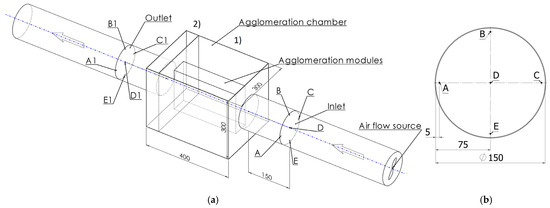
Figure 1.
Principal scheme of the research bench (a) with a cassette of electric field modules in the primary zone (1) and a separated secondary zone inside the agglomeration chamber (2), and principal scheme of inlet cross-section view, where the gas flow rate was measured at test points A–E in the inlet duct, and test points A1–E1 in the outlet duct (b).
The design and electrical circuit of the agglomerator system were tailored to transfer the necessary critical charge from the electrode plane, as the source of the electric field, to the PM in each of the channels of the manipulator cassette. To create the necessary charge, also known as the saturation charge qsat, PM with radius r must be in an electric field with strength Ecrit. For micro-PM, this value is usually taken to be 3 × 10⁶ V/m, based on which the necessary distance between the electrode planes can be calculated using Equation (5):
where ε0 is the electrical constant.
At present, the manipulator technology is in the patenting stage, so information is partially limited in this work. However, a national patent has already been obtained and a European patent application is being considered, which describe, in more detail, the principle of the operation and design characteristics of the manipulator [30,31].
The gas enters from the inlet of the bench and exits from the outlet, establishing a controlled flow environment. A notable feature of the setup is the equalizing section near the fan (Same sky CFM-80BF-2130-631), which minimizes turbulence as the gas flows into the agglomeration chamber, resulting in a stable gas flow. The system is managed via a control unit that allows for adjustments to the agglomeration chamber’s voltage and the gas flow rate, expressed as a percentage of the nominal flow. This setup provides precise control over experimental conditions, facilitating the observation of the effects of flow rates and electrical charges on PM agglomeration. All elements of the air ducts were grounded, including the metal elements of the parameter-measurement devices for safety reasons, as well as all tubes used for collecting PM samples to reduce the accumulation of PM due to static charge.
Experimental research was carried out under microclimate conditions typically observed inside the apparatus during the study; the temperature was 22.4–22.8 °C and the relative humidity was 28.2–28.6%.
Gas flow velocity was recorded at five distinct cross-sectional points at both the inlet (A–E) and outlet (A1–E1) before and after the agglomeration chamber, as illustrated in Figure 1. The duct features an inner diameter of 148 mm. The height of the agglomeration module was 190 mm and the length of each module was 280 mm. Velocity measurement probes were inserted through the center of the duct, aligned with both horizontal and vertical planes, and positioned 5 mm from the inner wall, as shown in Figure 1b. Gas flow rate measurements were conducted with a total of 800 data points over 60 s. It was determined that the speed and pressure sensors altered the flow dynamics by no more than 2%, so we decided to disregard these errors as insignificant.
The fan started spinning once it reaches 6% efficiency. By adjusting the gas flow rate the measurements were taken at 10%, 50%, and 100%. All test results were recorded using the “testo 440 dP” and “testo 440” measuring devices. Technical data of the multimeter (same for both): measuring ranges of 0–50 m/s, −20–+70 °C, 5–95% RH, and 700–1100 hPa; accuracy ± (0.03 m/s + 4% of the measured value (m.v.)) (0 to 20 m/s), ±0.5 °C (0 to +70 °C), ±3.0% RH (10 to 35% RH) and ±2.0% RH (35 to 65% RH), and ±3 hPa; resolution 0.01 m/s, 0.1 °C, 0.1% RH, and 0.1 hPa.
Static pressure measurements were conducted before and after the agglomeration chamber, specifically at points D and D1, as shown in Figure 1a. The “testo 440 dP” pressure-measuring device was used for these measurements. Static pressure readings were taken at 10% intervals from 10% to 100%. Each static pressure measurement lasted for 60 s, with data collected every second.
Aerodynamic resistance measurements were subsequently performed between the inlet point D and the outlet point D1 in the middle of the duct. These measurements also lasted for 60 s, with data collected every second.
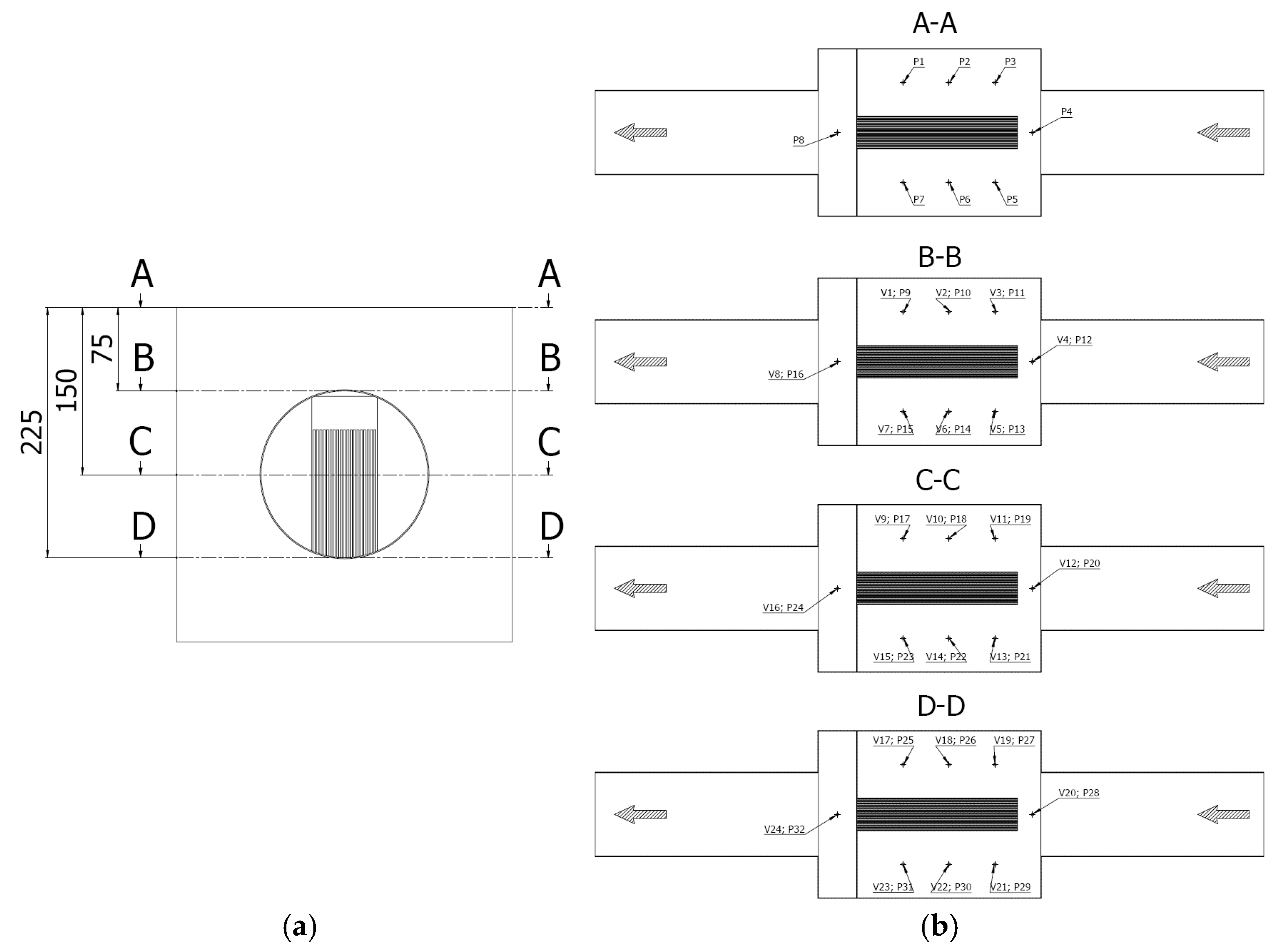
The agglomeration chamber was segmented into four cross sections, labeled A–A through D–D, as depicted in Figure 2. Each section contained specific measuring points, also shown in Figure 2. Cross section A–A was solely used for measuring static pressure. Cross sections B–B through D–D correspond to the top, middle, and bottom of the multi-layer plate modular cassette. The distances from the top of the chamber (A–A) to the other cross sections are indicated in Figure 2a in millimeters. The chamber was designed to direct gas flow through the plates and the electric field before exiting. During these measurements, the gas flow rate was set to 10%, 50%, and 100%. For further distribution of results, cases and measurement points were numbered in this way, e.g., A50 is the inlet point at 50% of the gas flow rate, A1 100 is the outlet point at 100% of the gas flow rate, etc. A total of 800 data points were collected over one minute. No voltage was applied to the plates during the experiment, so no electric field was generated. Figure 2b shows cross sections with the location and numbering of flow velocity measurement points in the agglomeration chamber; the cross-section level is indicated in Figure 2a.
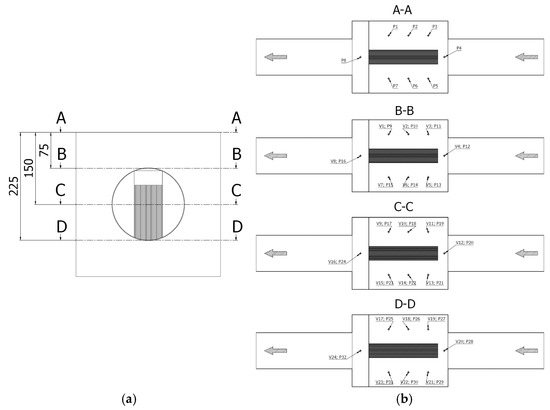
Figure 2.
Available measuring planes (a) and points for gas velocity measurements (b).
The gas velocity was measured using an eATVS-8™ automatic temperature and velocity scanner (Advanced Thermal Solutions, Inc., Norwood, MA, USA). This system, integrated with the setup, enables simultaneous gas velocity measurements at four points. According to the data sheet, the velocity range is from 0 m/s to 51 m/s with an accuracy of ±2%.
For each measurement location and operating condition, the recorded time series was post-processed to obtain a single representative value. The flow velocity and static pressure data were reduced using the median of the sampled values to ensure robustness against short-term fluctuations and occasional outliers. The temporal variability during each measurement was quantified using the sample standard deviation of the corresponding time series. The standard deviation was calculated according to the following equation:
The PM agglomeration experiment using the apparatus was carried out at the Institute of Particle Process Engineering, Technical University Kaiserslautern (Germany). For the test, a submicron PM generation apparatus was used, with sodium chloride (40 mg/L) and a Collison atomizer, through filtration of compressed air through a HEPA filter. The PM stream passed through a diffusive desiccant dryer and neutralized in a radioactive aerosol neutralizer TSI 3012 A (TSI, Aachen, Germany). The PM distribution before and after the agglomeration apparatus was measured using SMPS TSI 3934 (TSI, Aachen, Germany) [32].
2.2. Mathematical Model: Governing Equations
A computational model was created based on the experimental setup shown in Figure 1 and Figure 2. The conservation of mass and momentum [33] must be solved simultaneously to obtain the air flow field in the chamber. Assuming steady-state operation, where all flow and thermal properties are at equilibrium, the conservation of mass is given by (Equation (7)):
where is air density and is the velocity vector. The conservation of momentum for the flow is given by (Equation (8)):
where the pressure gradient force is denoted as and is any imposed external body forces. The viscous stress tensor, , is given by (Equation (9)):
where is the dynamic viscosity. The conservation of energy [33] in this case is as follows (Equation (10)):
where is the total energy, is the effective thermal conductivity, is the source term, and is temperature.
The turbulence in the flow field is described by the realizable k-ε model [34]. This is a very efficient and very robust two-equation model for turbulence. One equation is for the turbulent kinetic energy (), given as (Equation (11)):
where is the production of turbulence kinetic energy and is the turbulent viscosity. A second transport equation is used to describe the eddy dissipation rate (ε) and it is given as (Equation (12)):
where is turbulent Prandtl number for , and and are model constants.
2.3. Numerical Setup
Numerical simulations were performed using ANSYS Fluent 2023r2, which is very a widely used commercial CFD software package. A full three-dimensional model of the main agglomeration chamber shown in Figure 2a was created using the Autodesk Auto CAD 2024 software in the ANSYS package. A computational grid was then imposed on to the computational domain. All wall boundaries were modeled as adiabatic. Atmospheric air entered the chamber through the inlet and left through the outlet. All simulations presented in this study were completed under an assumed steady state. In ANSYS Fluent, the pressure-based solver with the coupled scheme for pressure–velocity coupling was used. The presto! scheme was used for the discretization of the pressure field. Velocity, turbulent kinetic energy, eddy dissipation rate, and temperature were all discretized by the QUICK scheme.
Atmospheric conditions (101 kPa and 300 K) were specified at the domain outlet to mimic the experimental conditions. All walls in the model were assumed to be adiabatic. The flow velocity was specified at the domain inlet, for which the magnitude was equal to the average velocity on the D–D cross-section in Figure 3 measured during the experiment. Three different flow velocities were considered, 10%, 50%, and 100% of the gas flow rate, as shown in Table 1, including inlet velocity, pressure at the inlet and outlet, and wall roughness. The inlet velocity was set to 10%, 50%, and 100% fan speed, as shown in Table 1. Note that the velocity at the inlet was assumed to be uniform. The objective of this modelling approach was to develop an initial digital representation of the experimental apparatus based on its physical model.
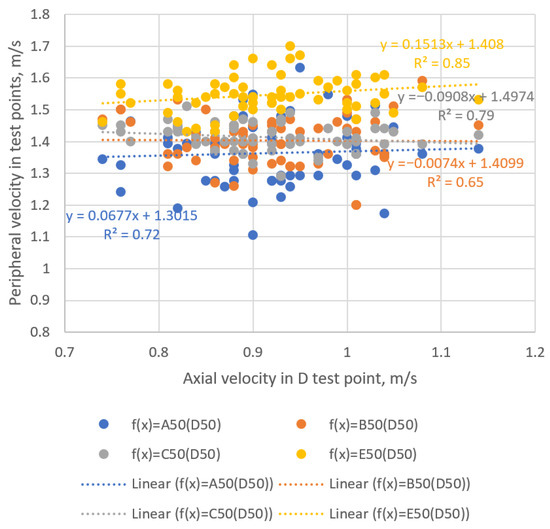
Figure 3.
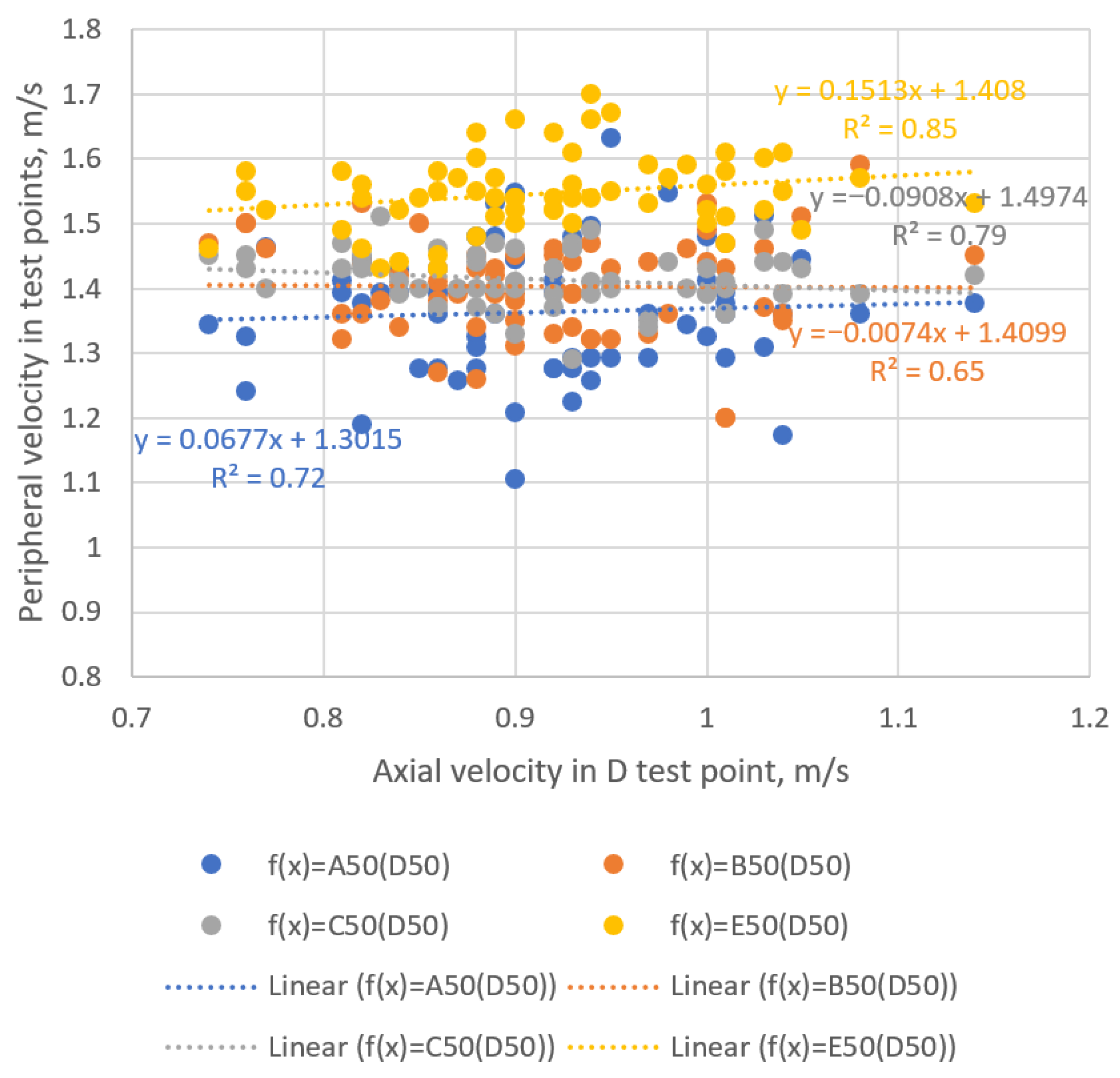
Distribution of the gas velocity at the inlet at the points of the cross-sectional periphery presented as a scatter diagram relative to the axial velocity at 50% of the nominal flow.

Table 1.
Measuring points and corresponding gas velocity medians at different the part of nominal gas flow (flow rate).
3. Results
3.1. Experimental Case Study
The distribution was quite difficult to measure due to the difference in cross-sectional shape from the circular shape of the supply air duct to the rectangular shape of the sintering chamber, and then back to the exhaust air duct. Detailed experiments made it possible to determine the ratio of the axial velocity to the peripheral velocity, and formulas were derived for calculating values based on linear dependence.
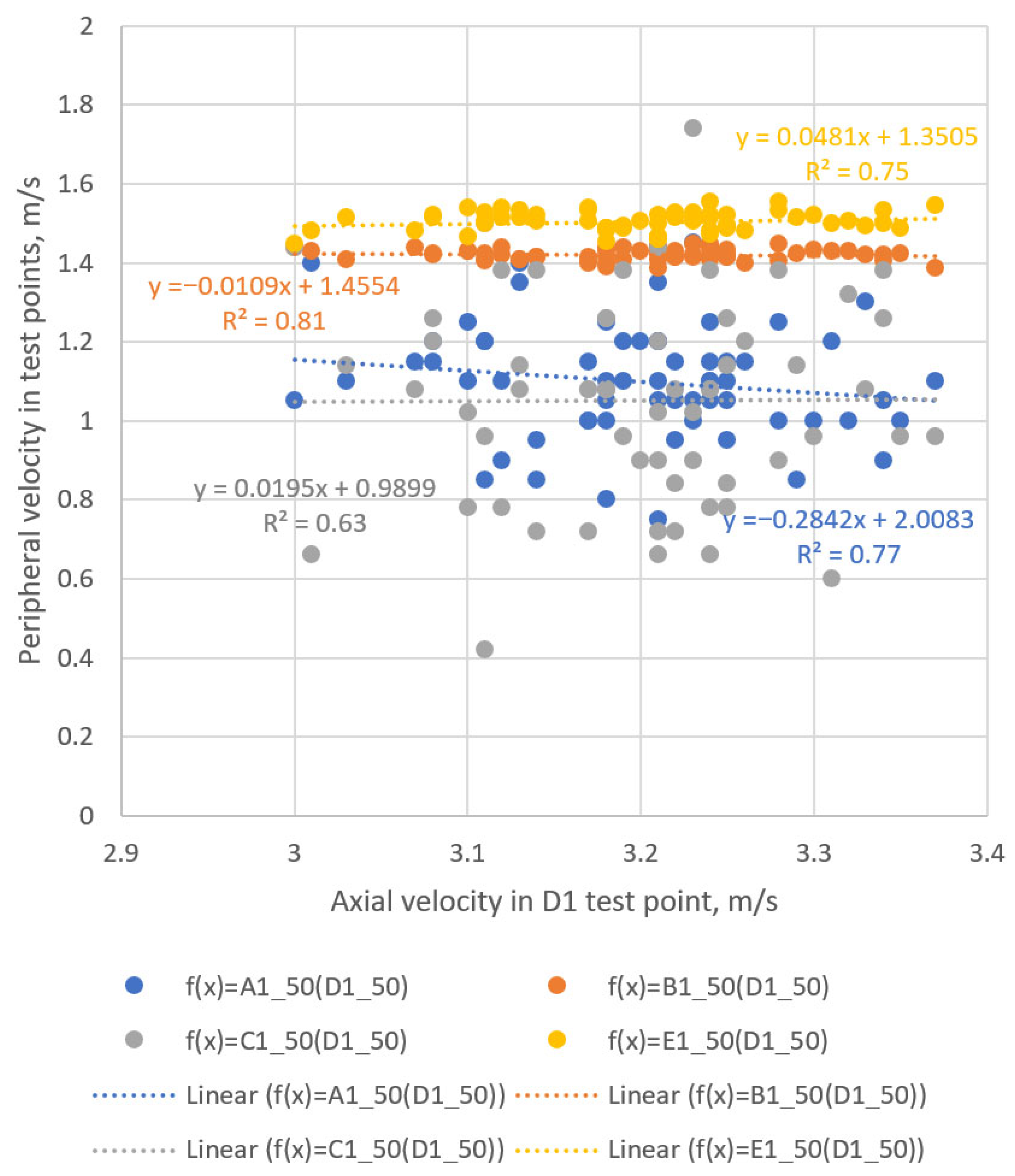
The distribution of gas flow rate was assessed at five distinct cross-sectional locations at the inlet (A–E) (Figure 3) and at the outlet (A1–E1) (Figure 4). Scatter plots are presented with a comparison of a middle test point (D and D1) and peripheral points (A, B, C, E) accordingly. The axis values correspond to the flow velocity in each pair for comparison.
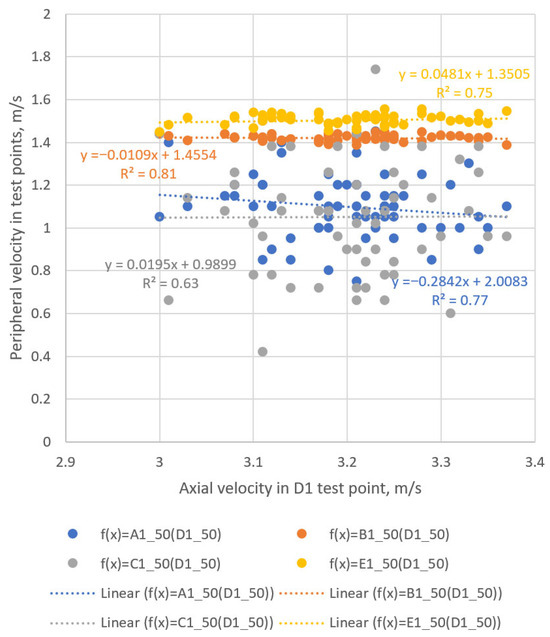
Figure 4.
Distribution of the outlet gas velocity at the points of the cross-sectional periphery presented as a scatter diagram relative to the axial velocity at 50% of the nominal flow.
A phenomenon was observed at the outlet location: the gas flow velocities at the vertically positioned measuring points (B1, D1, and E1) increased significantly compared with those at the inlet duct (Figure 3). Specifically, at these vertically arranged measurement points with a gas flow rate of 50%, the gas flow rate increased by 1.9, 3, and 1.4 times, respectively, in comparison with that at the inlet points (B, D, and E). Furthermore, at the maximum gas flow rate of 100%, the gas flow rate increased by 2, 2.6, and 1.6 times, respectively.
The flow velocity (in m/s) at points A–E with a gas flow rate of 10% varied from 0.13–0.22 m/s, that at a gas flow rate of 50% varied from 0.96–1.7, and that at a gas flow rate of 100% was 2.35–3.3 m/s. The flow velocity at the outlet (A1–E1 points) varied within the interval of 0.05–0.43 at a gas flow rate of 10%. The variation in velocity was 0.29–3.37 m/s at a gas flow rate of 50%, and variation in the range of 0.48–6.3 m/s was observed at a gas flow rate of 100%.
The distribution on the inlet pipe relative to the axial velocity was symmetrical with a slight deviation in zones A and E. The overall average velocity was 1.43 m/s, whereas the deviation in zone A was −0.07 m/s, and at point E, it was +0.11 m/s. The values slightly exceeded the measurement device errors, but the residual vortex turbulence after the flow equalizer (perforated mesh insert in the air duct after the fan) and the effect of the transition to the agglomeration chamber could have had an insignificant impact. The regression formulas obtained for determining the flow velocity in the peripheral zone had a similar error range of 1.3 to 1.5, the coefficients of the equation for zones A and E had a positive (directly proportional) value, whereas for zones B and C, the coefficients were negative. Given that these results were obtained at 50% volumetric air flow rate, it can be assumed that this distribution most closely reflected the real situation, when the system does not experience the operating pressures of a peak gas flow source, and the background values are tens of times lower than the generated flow.
The apparent higher outlet volumetric flow rate compared with that at the inlet does not indicate a real mass imbalance. It results from reconstructing the volumetric flow rate from point-wise velocity measurements under strongly non-uniform outlet profiles. Downstream of the multichannel cassette, preferential flow pathways lead to locally accelerated regions, such that sampling locations positioned in these high-velocity zones (e.g., B1, D1, and E1) can bias the cross-sectional mean velocity upward.
The elevated velocities at the vertically arranged outlet points are consistent with a heterogeneous outlet flow field shaped by the chamber-to-duct transition and the cassette geometry, which promotes jetting and uneven redistribution before the profile fully develops.
Furthermore, the reduced growth rate of aerodynamic resistance at higher flow rates indicates that the dominant loss mechanisms are established and the system approaches a regime in which additional flow-rate increases produce comparatively smaller incremental changes in the pressure-loss scaling. The flow distribution in the outlet air duct differs from that in the inlet air duct, firstly, because the transition from the rectangular agglomeration chamber along a longitudinal vertical trajectory is clearly visible (Figure 4). This is noticeable in peripheral zones B and E. The overall average value in all peripheral zones is 1.27 m/s, while in zone B, the average velocity is almost 12% higher than this overall average, and in zone E, it is 18.5% higher. Secondly, the dispersion of values shows that the velocity fluctuates in zones A and C, with results of ±0.33 m/s for zone A and ±0.65 m/s for zone C. Such a wide range of values was most likely obtained due to the narrow cross-section of the multi-module sintering cassette located in the sintering chamber, even at a distance in accordance with the standards for velocity measurement points to maintain uniform flow conditions. The regression equations also include cases for zones C and E, where there is direct proportionality, and in cases A and B, proportionality is inverse.
The volumetric flow rate calculated at a gas flow rate of 10% in the inlet duct was 12.4 m3/h, that calculated at 50% was 85.5 m3/h, and that calculated at 100% reached 174.3 m3/h. In contrast, the volumetric flow rate at 10% in the outlet duct was 14.5 m3/h, that at 50% was 115.4 m3/h, and that at 100% was 226.9 m3/h. These flow rates were determined using fundamental equations. When comparing the inlet to the outlet, the outlet volumetric flow rates at gas flow rates of 10%, 50%, and 100% were 17%, 35%, and 30% higher, respectively.
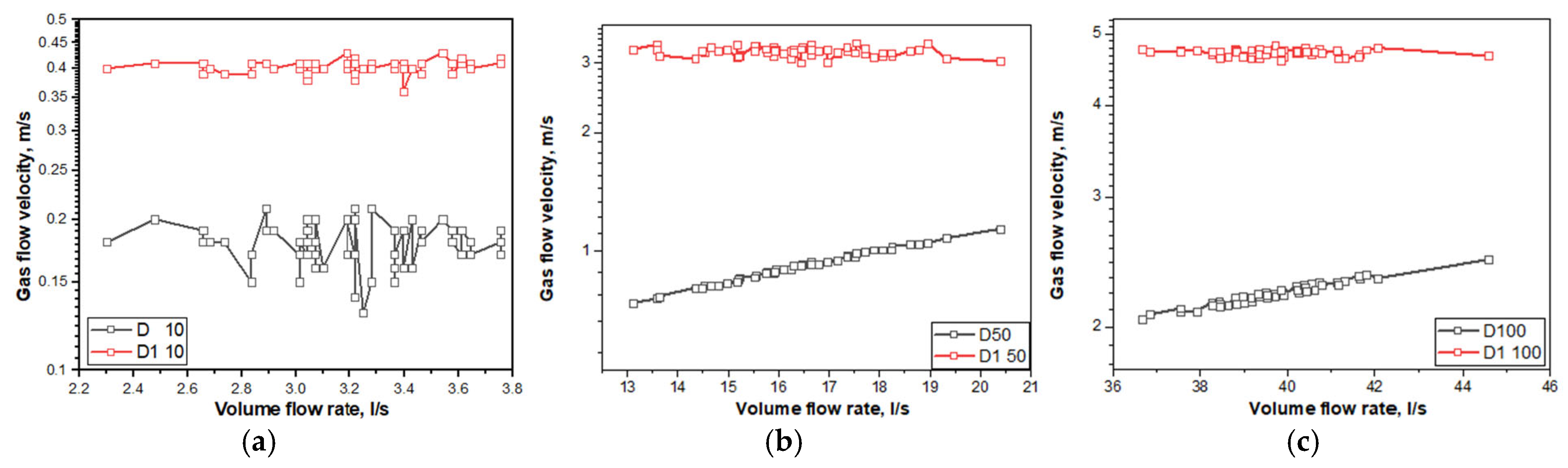
In the experiments conducted, attention was also paid to the distribution of axial velocity at the inlet (corresponding to zone D) and outlet (corresponding to zone D1) air ducts, and results were obtained at different volume flow rates—minimum (10%), average (50%), and nominal (100%) (Figure 5).
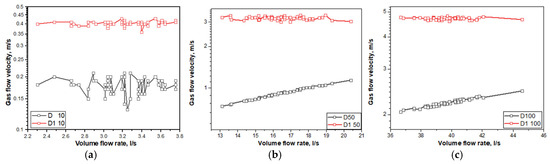
Figure 5.
Dependance of gas flow rate distribution in the center point of the inlet (D) and outlet (D1) on the flow rate with values of (a) 10%, (b) 50%, and (c) 100%.
At minimum flow rates, there were large velocity fluctuations, especially in the inlet air duct, whereas the velocity in the outlet was more uniform and, due to the free exit from the high-pressure zone in the agglomeration cassette, was approximately 2.3 times higher (Figure 5a). With an increase in the volume flow rate to 50%, the distribution in the inlet air duct evened out and fluctuated during the experiment within the range of −0.18 to 0.22 from the average value, but was directly proportional to the volume flow rate, indicating that background errors were overcome (Figure 5b). At the outlet air duct, the average value was 3.2 m/s, and the deviation width did not exceed ±0.19 m/s. At the nominal volume flow rate, which reached up to 45 L/s, the velocity distribution became even more averaged (Figure 5c). At the inlet air duct, the deviation from the average flow velocity at the lower boundary was no more than −0.17 m/s and that at the upper boundary was no more than 0.25 m/s. In the outlet air duct, due to the high volumetric flow rate, the average velocity increased even more to 4.72 L/s, whereas the deviations remained at the same absolute values of ±0.10 m/s.
Aerodynamic resistance (pressure drop when comparing the static pressure at the corresponding points of investigation before and after the chamber) was measured. The aerodynamic resistance increased 8.5 times, that is, from 8 Pa to 68 Pa, when the gas flow rate was changed from 10% to 50%. Additionally, the aerodynamic resistance increased 2.6 times, that is, from 68 Pa to 175 Pa (see Table 2), when the gas flow rate was changed from 50% to 100%. Static pressure at high gas flow rates from 80% to 100% in the inlet differed by ~3 Pa (equal/below to equipment measuring limit) compared with aerodynamic resistance.
Table 2.
Dependance of system resistance and static pressures on the inlet flow amount.
The static pressure at the outlet was measured to be in the range of 3 to 8 Pa, which corresponds to a relatively low pressure. Notably, this pressure is 22.5 times lower than the maximum static pressure at the inlet.
During the study of gas flow velocities and static pressure, irregularities in the duct cross-section for both supply and exhaust gas flows were observed. Specifically, as the gas flow rate increased, the non-uniformity of velocities within the ducts became more pronounced.
Based on the results obtained from analyzing the dynamic limits of gas flow in the connecting channels of the agglomeration apparatus, a recommendation is made to apply these findings to further investigations into PM agglomeration.
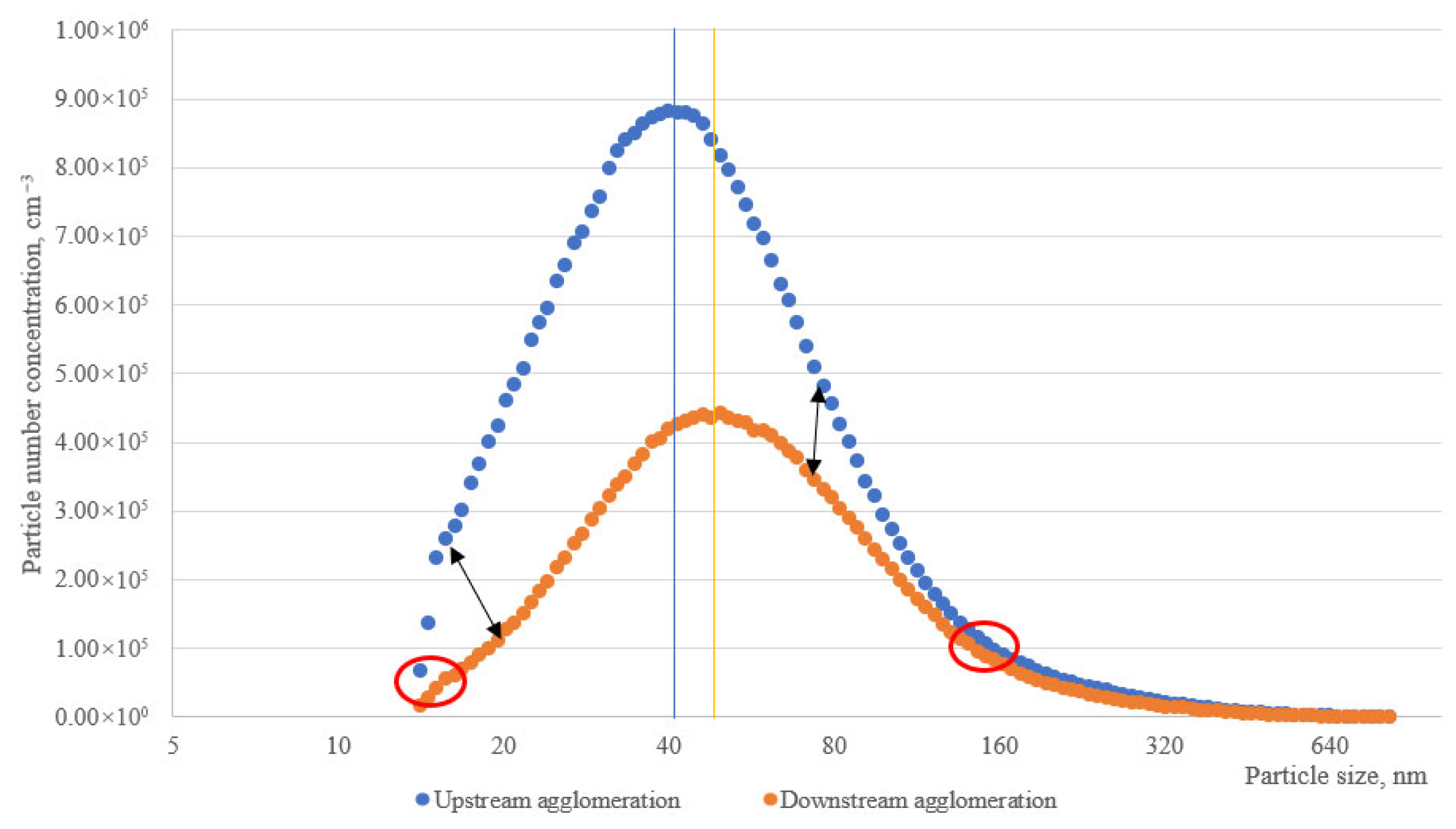
Based on initial tests of PM agglomeration in the apparatus, the PM distribution before and after treatment was obtained (Figure 6). Agglomeration was assessed as the change in PN concentration from the upstream to the downstream. At nominal voltage, including losses in the electric network of 3.5 kV and volume flow rate of 30 L/min corresponded to 1.75 m/s average velocity in the apparatus system.
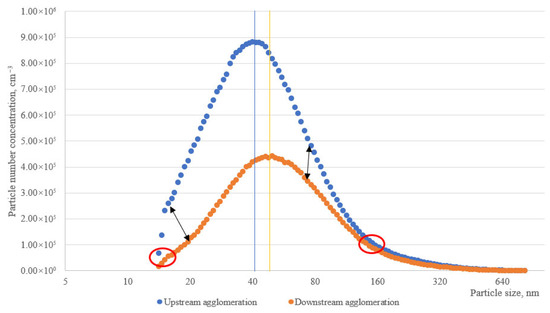
Figure 6.
Dependance of PN concentration on PM size distribution before and after agglomerator device at nominal voltage of 3.5 kV and current of 5 mA.
The data show a decrease in PM concentration after the device across the entire size range. PM of at least 20 nm were intensively aggregated up to a size of 40 nm, when the maximum difference in the numerical concentration of PM before and after the apparatus was reached. The ratio of the numerical concentration before and after agglomeration reached 2.1 times, but the highest ratio was achieved for PM with a size of 14.1–24.1 nm, when the average concentration reduction reached 4 times. A detailed change in the PN concentration from upstream to downstream is presented in Table 3. Here, there are a set of three test series for PM 15.1–820.5 nm in size.
Table 3.
Series of PN concentration changes upstream and downstream of the manipulator depending on nano PM size.
The largest fractional shift was recorded in the range of 41.4–51.4 nm. PM distribution shifts due to agglomeration in the intervals of 51–98 nm and (less significant) 230–550 nm were also determined. The maximum value of the numerical concentration at the outlet of the agglomerator reached 4.43–105 PM, with an average size of 49.6 nm. The most uniform distribution of PM before and after exposure to electric field was found in the PM size range of 79–820 nm.
The higher apparent removal observed for smaller PM sizes is consistent with their stronger response to electrostatic forcing. Owing to their low inertia and comparatively high electrical mobility, small PM is more readily deflected from streamlines and driven into regions with increased interaction probability. In addition, random motion and rapid charge acquisition support particle–particle encounters once the electric field induces drift and local concentration gradients.
The observed dependence on both applied voltage and volumetric flow rate reflects a coupled mechanism. Increasing voltage intensifies PM charging and electrostatic interaction, whereas the flow rate governs residence time within the active field region and the degree of mixing and redistribution inside the cassette. Consequently, effective agglomeration requires a combination of sufficiently strong electrical forcing and adequate residence time under stable flow conditions.
Aerodynamic performance directly affects PM trajectories and collision probability by shaping the internal flow field. Non-uniform velocity distributions, recirculation zones, and flow impingement can increase trajectory crossing and local relative velocities, thereby promoting collisions. Conversely, at high flow rates, jetting and short flow pathways may reduce exposure time and limit the achievable interaction intensity, which can diminish the overall conditioning effect. However, it should also be noted that the agglomeration process in this technology requires further analysis to allow the investigation of the decrease in the concentration of PM of certain sizes (corresponding to PM involved in agglomeration) and the corresponding increase in concentration at larger diameters, which reflects the formation of agglomerates. In this study, it can be concluded that the shape of the curves (Figure 6) may be due to several phenomena, such as the generation of unstable PM, the deposition of PM between the inlet and outlet openings, or the combined effect of agglomeration and deposition. In the case of deposition alone, the observed decrease in concentration, especially for PM smaller than 200 nm, could be explained by diffusion capture, which is more effective for smaller PM. Based on such reasoning, it can be understood that the device not only affects PM agglomeration, but also contributes to PM capture in the same way as an electrostatic precipitator by charging the PM and partially depositing it on the surface of the device.
3.2. Numerical Modelling Case Study
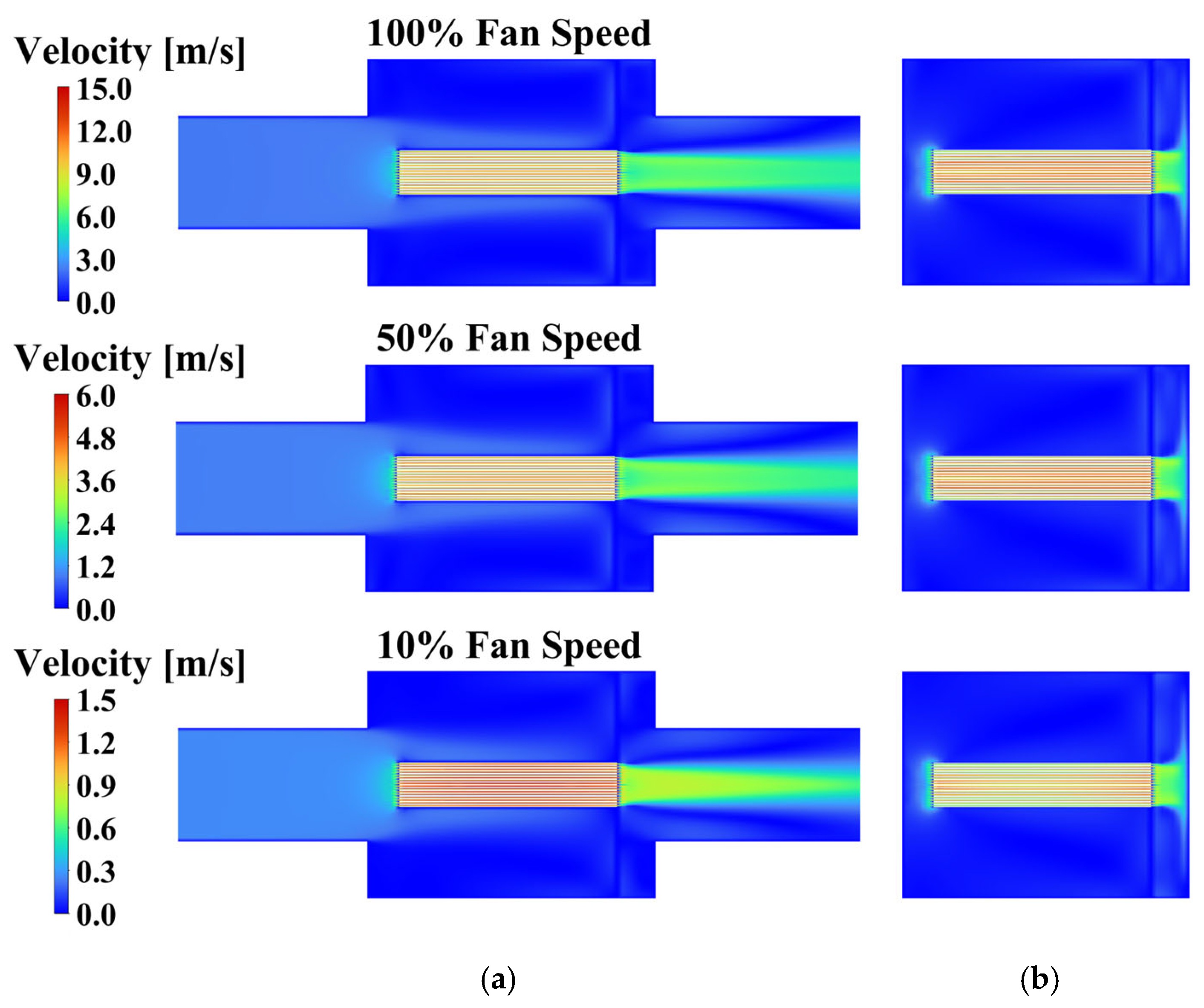
Table 4 compares the local static pressure at measurement points V23, V26, V27, V28, and V31 against the computed pressures at the same locations on plane C–C. Table 5 compares the same, but at measurement points V38, V41, V42, V43, and V46 on plane D–D instead. For each of the cases, three gas flow rates (10%, 50%, and 100%) were considered. It appears that the static pressure data between experiment and simulation had rather large differences at a gas flow rate of 100% compared with those at lower rates. In particular, the largest deviation appeared to be at V31 and V46, the point right outside the electrode cassette. This is particularly true for plane D–D. Further examination of the flow field shows that the flow somewhat assembled an impingement flow when exiting the electrode cassette, as shown in Figure 7. This was the probable cause of the larger discrepancy at that particular location. With an impingement-like flow pattern, the flow coming out of the electrode spread out and there were strong vortices in that region. Note that the vortices became stronger as the flow velocity increased. This was most likely the cause of larger discrepancies causing huge differences between experiment data and simulation data when the system was operating with 100% gas flow rate.
Table 4.
Comparison of predicted versus measured pressure at selected measurement points on plane C−C in Figure 2.
Table 5.
Comparison of predicted versus measured pressure at selected measurement points on plane D−D in Figure 3.
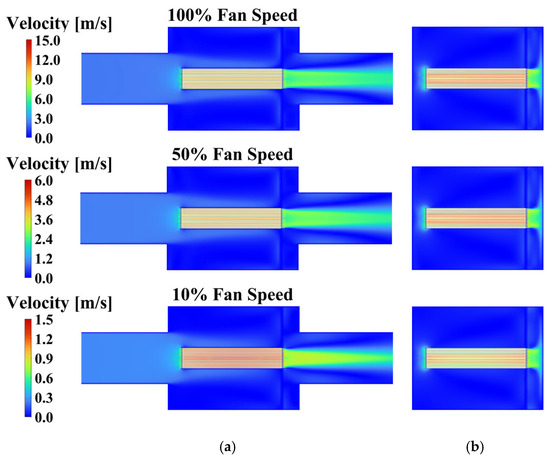
Figure 7.
Velocity distribution along plane (a) C–C and plane (b) D–D.
Table 4 and Table 5 present the experimental and calculated values of static pressure at characteristic measurement points on planes C–C (V23–V31) and D–D (V38–V46) for three gas flow rates (10%, 50%, and 100%), which correspond to the volumetric flow rate in the system. An analysis of the comparison of the results of the experimental studies and modeling determined that, at a 10% volumetric flow rate, in most cases, there was a very high coincidence in static pressure values (error < 1 Pa). However, a local discrepancy was identified at point V31, which may indicate the influence of edge effects or incorrect boundary approximation in the model. In general, the model adequately reproduced the low-rate mode. For the mode with 50% volumetric flow rate, the discrepancies for points V23–V28 were within tenths of a Pascal, which indicates very high model accuracy. However, at point V31, there was a significant systematic deviation (~15 Pa), which sharply worsened the local correlation. At the nominal volumetric flow rate, the model significantly overestimated the absolute pressure level (error of about 30–40%). However, the correct spatial distribution structure was preserved (homogeneity of V26–V28). At point V31, an abnormal discrepancy remained, probably associated with recirculation, a turbulent zone, or requiring additional simplifications, or, conversely, detailing with boundary conditions. For cases with a volumetric flow rate of 10% and 50%, a very high linear agreement between the experiment and the model was obtained. The pressure distribution shape was virtually identical. The main deterioration in correlation was associated exclusively with point V31. In the case of a nominal volumetric flow rate, the correlation in the distribution shape was preserved, but there was a systematic shift—the model overestimated the pressure by ~55 Pa. This means that the model correctly described the pressure gradients, but required large-scale calibration in terms of absolute values at high modes, which could be caused by the design features of the physical model. The trend was reproduced correctly, but the slope of the dependence in the model was higher, which indicates an overestimated sensitivity of the model to an increase in the gas flow rate.
An analysis of the comparability of pressure levels based on experimental pressure values on both planes practically coincided in order of magnitude, for example, at 10% volumetric flow rate, the difference was 7–10 Pa, at 50%, it was 65–70 Pa, and at 100%, it was 175–180 Pa. This indicates the similarity of aerodynamic conditions in the sections under consideration and confirms the representativeness of the selected planes for pressure field analysis. The calculated values also showed similar levels on both planes, including a characteristic overestimation at 100% volumetric flow rate (~230 Pa), which indicates the global, rather than local, nature of the systematic error of the model.
Both planes showed high pressure uniformity in groups of points (V26–V28 for C–C and V41–V43 for D–D), which was correctly reproduced by the model. This indicates the stability of the main flow and the absence of significant transverse pressure gradients in the central areas of the channel. Local points V31 (C–C) and V46 (D–D) showed the greatest deviations between the experiment and the calculation. The similarity in the behavior of these points on different planes suggests the presence of similar local hydrodynamic effects, which should be studied in more detail in the turbulence model used or in the mesh approximation.
Performing such coupled simulations is often complex, especially in such a complex context. Indeed, the numerical model does not take into account the influence of the electric field or particle charge, but the integration of electrostatic forces in CFD is particularly relevant and necessary for studying and gaining a deeper understanding of this phenomenon and improving models in comparison with physical experiments.
4. Discussion
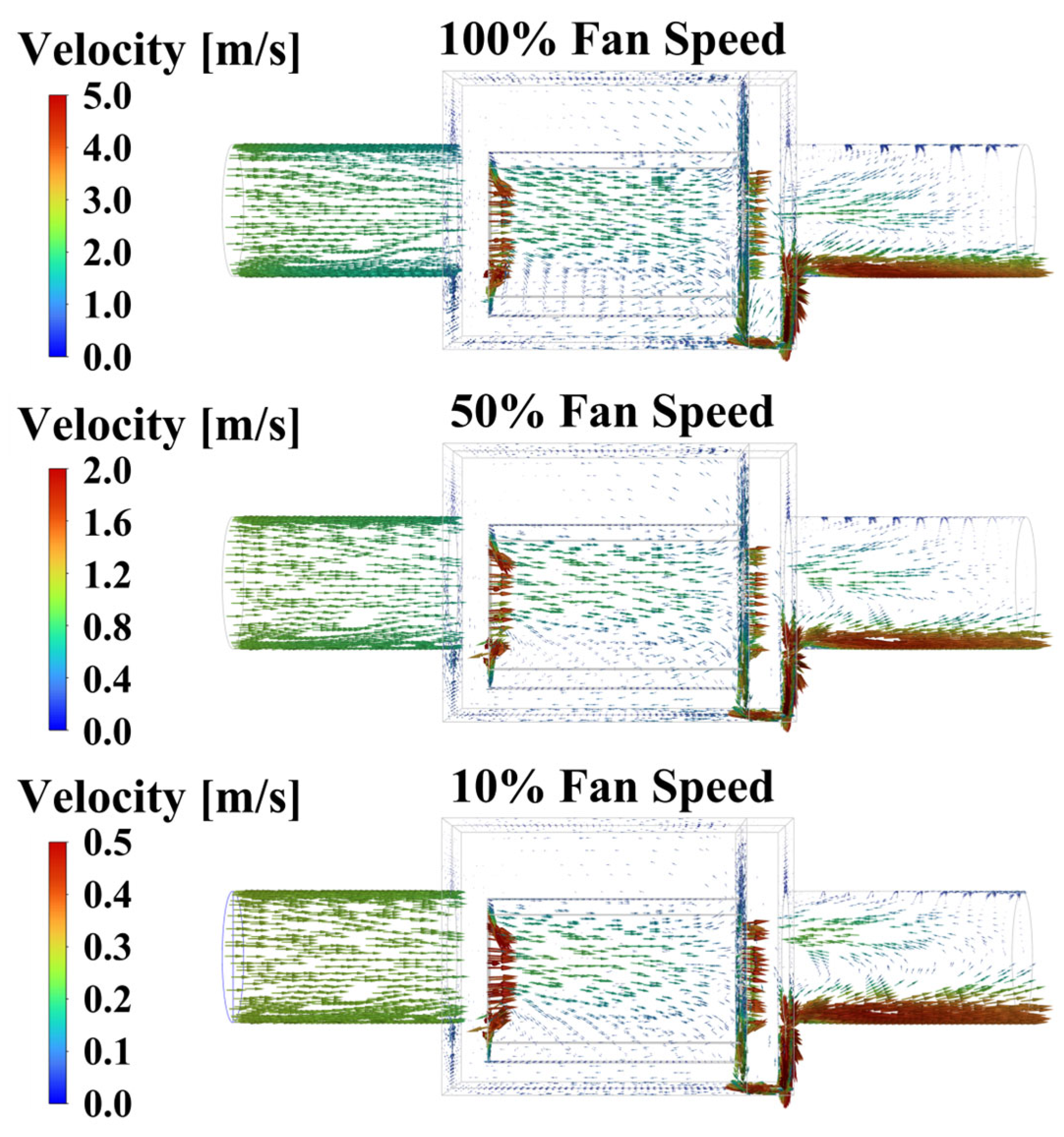
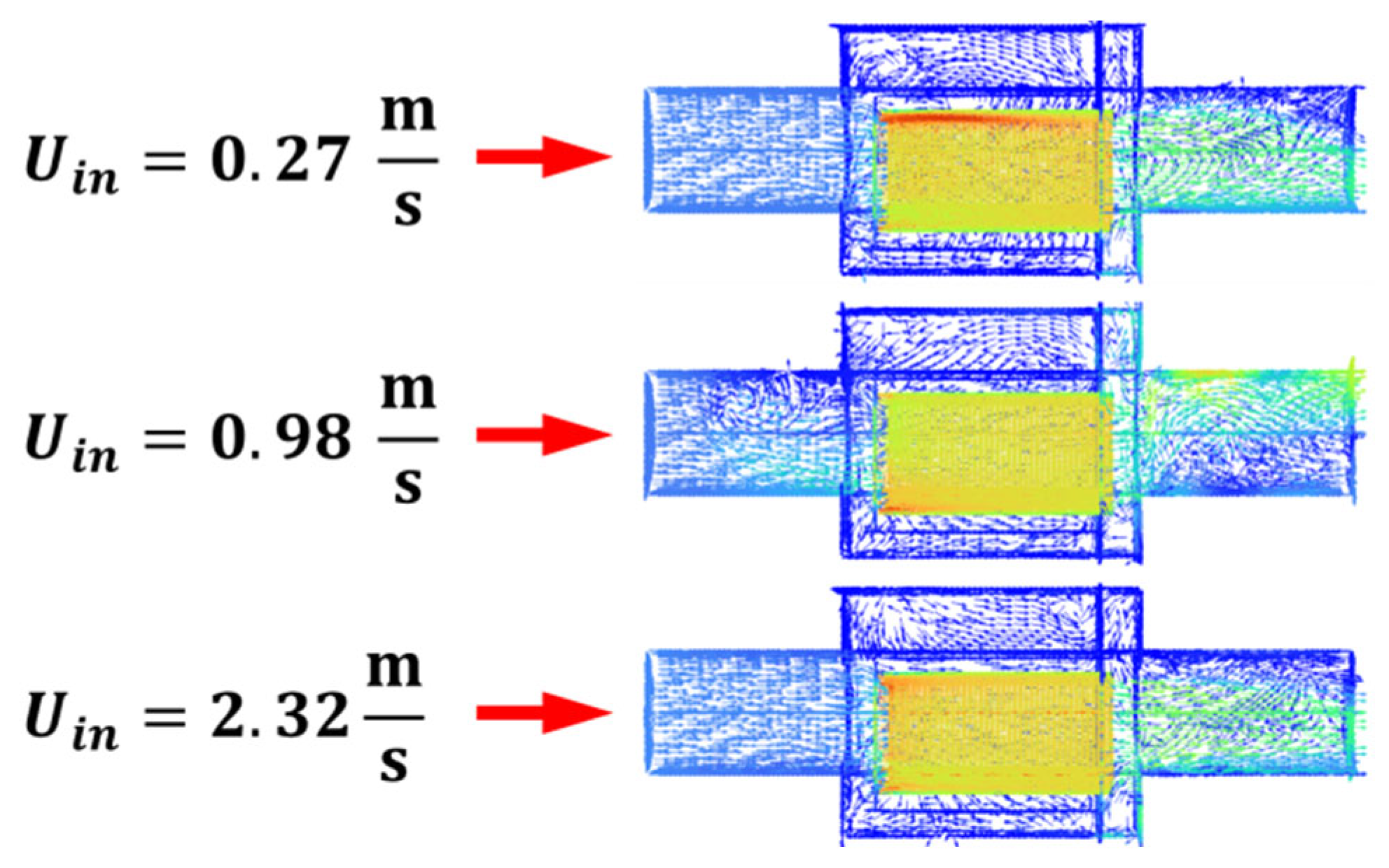
It appears that the static pressure data between the experiment and simulation had rather large differences in the case with a gas flow rate of 100% compared with other case of nominal gas flow (flow rate). In order to elucidate the cause of this phenomenon, we analyzed the velocity vector in the space without plates. Figure 8 shows the velocity vector under different gas flow rates.
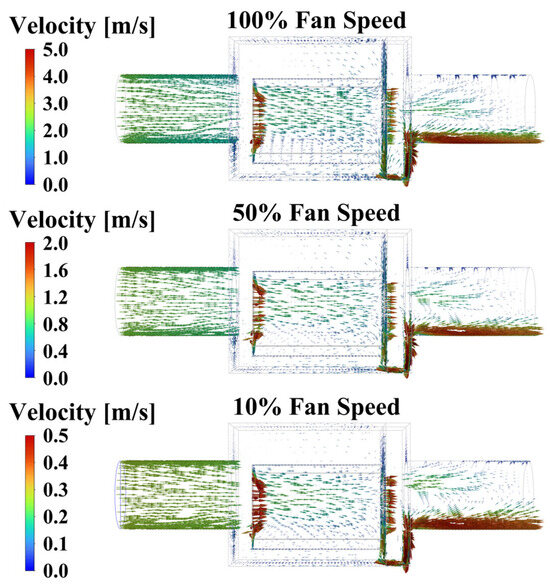
Figure 8.
Resulting velocity vectors along the symmetry plane at different gas flow rates.
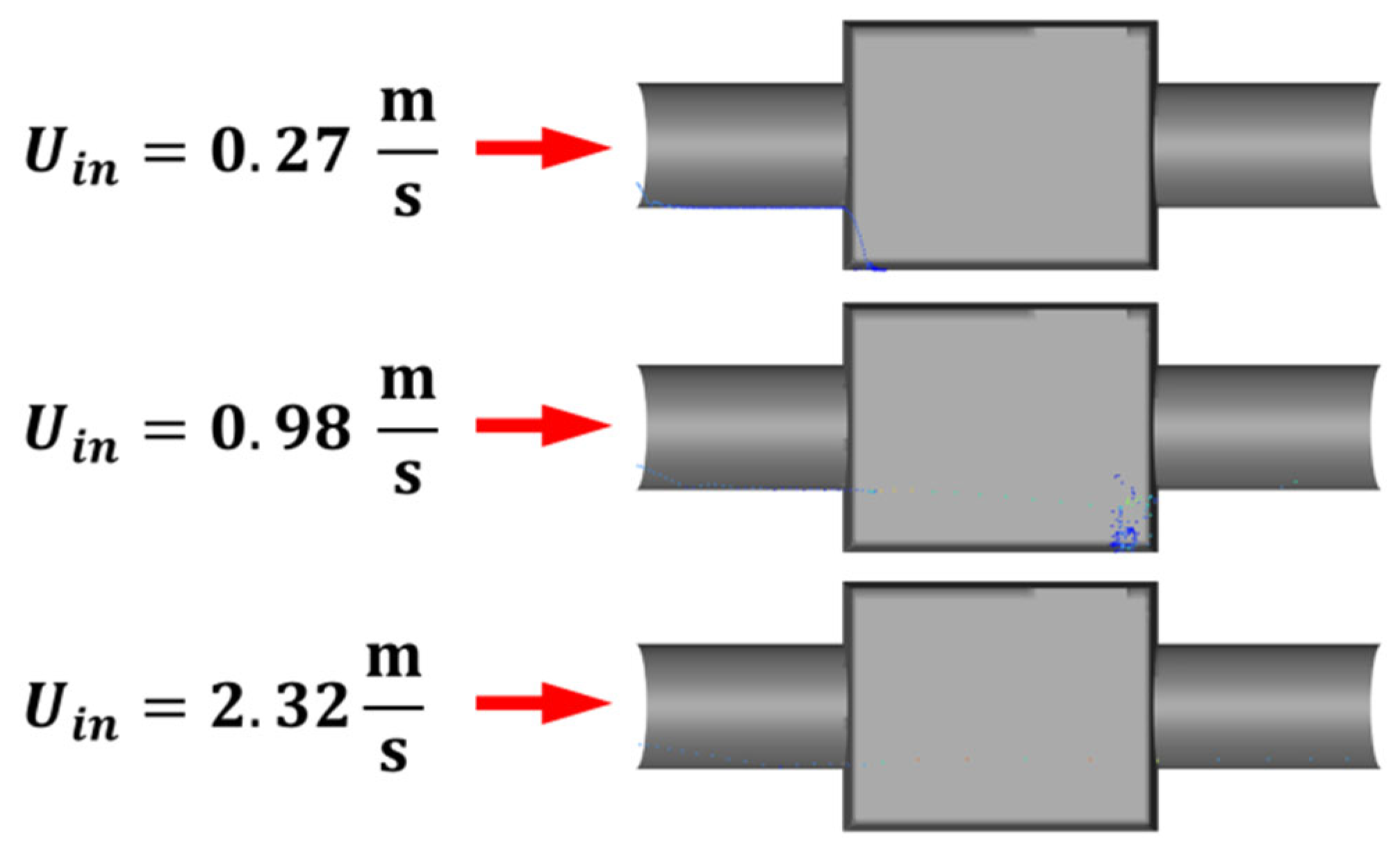
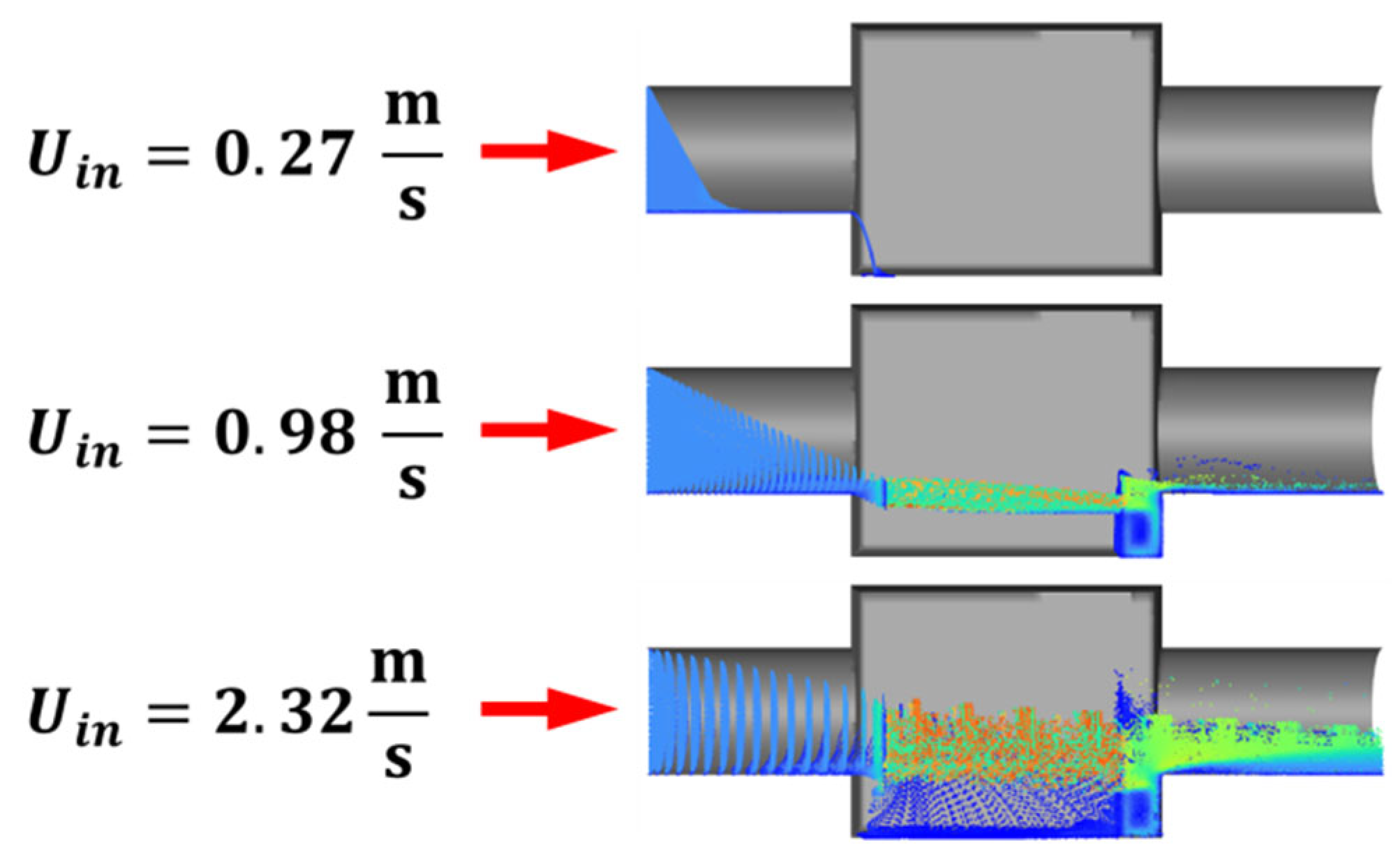
Discrete phase modelling was activated using carbon particles with a diameter of 1 µm for 200 time-steps. (Each of the attached figures consists of three images from top to bottom for 0.27, 0.98, and 2.32 m/s air inlet velocities.) Note that the DEM collision and MHD model have not been enabled. To examine the PM distribution accompanied by air flow, the discrete particle model in Fluent was activated. The patterns of particle distribution are shown in Figure 9. Figure 9 shows that, as the inlet velocity increases, the particles gain more kinetic energy and spread farther from the inlet. Additionally, it seems that for certain velocities being reached, the particles tend to not accumulate in the chamber and just directly pass through the chamber, as shown in Figure 9.
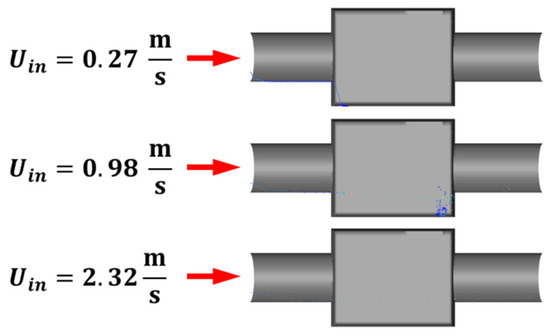
Figure 9.
The resulting particle tracks over 200 time steps for a particle enters from a fixed location at the inlet.
However, this is not the case when one looks at the aggregate velocity distribution for all particles entering the chamber, as shown in Figure 10. It is more likely that, as the velocity reaches a certain value, particles carried by air flow tend to recirculate, as shown in Figure 10. Note that the resulting velocity vector plot shows a main recirculation zone in the outlet pipe, as illustrated in Figure 11. The particles are then rotated back into the chamber and accumulated at the bottom of the chamber due to the effect of gravity.
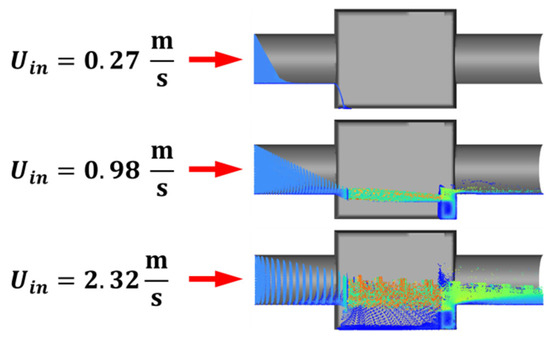
Figure 10.
Resulting particle tracks over 200 time-steps for all particle entering at the inlet at t = 0 s.
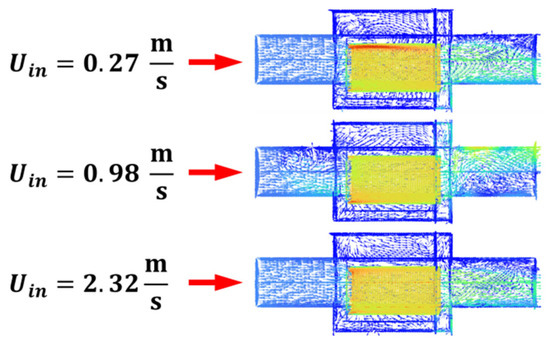
Figure 11.
Velocity distribution in the chamber with carbon particles entering the chamber.
The distribution of gas flows in the agglomeration chamber is a key factor in determining the efficiency of charging, collision, and agglomeration of solid ultrafine particles. This process depends on various parameters, including flow velocity, turbulence, particle concentration, and electrostatic field parameters. Particle charging occurs through interaction with ions generated during corona discharge [35]. Smaller particles (<0.1 µm) are charged by diffusion, which is slower than field charging, and therefore require a longer residence time in the charging zone [36]. If the flow is too fast, the particles do not have time to acquire sufficient charge, which reduces the probability of their agglomeration. Particle collisions and agglomeration depend on their relative velocities, which increase in turbulence [37]. Turbulent flow promotes particle mixing and collisions, but excessive turbulence can disperse the formed agglomerates. Therefore, it is necessary to optimize the flow structure to achieve an efficient agglomeration process.
The ion wind generated by the electrohydrodynamic effect can also affect the particle motion. This phenomenon creates additional air flow, which can increase the probability of particle collisions, but can also carry particles out of the agglomeration zone if not properly controlled. The particle concentration also affects the agglomeration efficiency. Too low a concentration reduces the probability of collisions, while too high a concentration can lead to the inhibition of ion uptake and space charge effects, reducing the charging efficiency. Therefore, it is necessary to optimize the particle concentration in the agglomeration chamber. Particles of different sizes behave differently at different flow rates. Larger particles tend to deviate from the flow path due to inertia and can “catch” finer particles, whereas fine particles are more affected by Brownian motion and require a longer time for charging [38]. By optimizing the flow parameters, particle concentration, and electrostatic field properties, an efficient agglomeration process for UFPM can be achieved.
In addition to the results presented above, it is important to summarize the advantages, limitations, and operational boundaries of the investigated apparatus and of the applied methodology. A clear advantage of this study is the combined experimental and numerical aerodynamic characterization of a specific modular agglomerator design, which allows for key flow structures and pressure loss trends to be identified in a reproducible manner. The experimental data show stable trends at low and moderate flow rates, where the agreement between measured and simulated quantities is acceptable and supports the interpretation of the internal flow behaviour.
However, several limitations were also observed. The outlet flow field exhibits pronounced non uniformity, such that volumetric flow rates reconstructed from point-wise velocity measurements can be biased by locally accelerated regions, especially downstream of the cassette. In addition, at the highest flow rate, the deviation between simulated and measured static pressure indicates increased sensitivity to turbulence, local recirculation, and geometric details, which may not be fully represented by the simplified numerical model and the chosen turbulence closure.
Based on these observations, the operational range that yields the most reliable and consistent results is given by low to moderate flow rates, where pressure losses remain moderate and the flow distribution is comparatively stable. At a high flow rate, pressure losses increase substantially and flow redistribution becomes more pronounced, which limits the predictive accuracy and should be considered when interpreting the performance of the device under these conditions.
5. Conclusions
An investigation was conducted into the dynamics of gas flow in the connecting channels of an agglomeration apparatus. Specifically, the focus was on understanding the limits and behavior of gas flow under varying conditions. The aim of the analysis was to shed light on critical aspects related to gas transport within the system. The maximum, average, and minimum volume flow rates were calculated, the bottom line of application was determined, and the possibility of applying the system from which the PM–gas flow transfer system of the agglomeration apparatus starts to operate from the minimal gas flow rate was evaluated. The final remarks are presented in depth and organized point-wise as follows:
- The experimentally assessed inlet volumetric flow rates were 12.4/85.5/174.3 m3/h at 10/50/100%, whereas the outlet values were 14.5/115.4/226.9 m3/h, respectively. CFD matched experiments well at low gas flow rates, but deviations increased at high gas flow rates due to turbulence and geometric sensitivity; the internal plate structure stabilized and guided the flow, with the largest static-pressure and velocity-field differences at 100%.
- The experimentally determined average flow velocities at points A–E and A1–E1 were equal to 0.2 m/s and 0.234 m/s at the minimal gas flow rate of 10%. From 10% to 50%, the average velocity increased by approximately 7–8 times. From 50% to 100%, the increase was approximately 2 times. The total increase in velocity comparing the gas flow rates of 10% and 100% reached about 14–16 times, depending on the point group. Points A1–E1 exhibited higher mean velocities and slightly higher growth ratios than points A–E. The measurements demonstrated a systematic vertical pathway acceleration (A1–E1 > A–E), consistent with the development of preferential high-velocity pathways induced by the cassette’s vertically arranged channel geometry.
- Aerodynamic resistance was researched experimentally, increasing the gas flow rate from 10% to 50% increased the aerodynamic resistance 8.5 times, from 8 Pa to 68 Pa, and from 50% to 100%, the aerodynamic resistance increased 2.6 times, from 68 Pa to 175 Pa.
- The change in PN concentration in the experiments showed a pronounced size dependence, with the strongest decrease observed for nano PM up to 51.4 nm, followed by a progressive recovery up to approximately 310 nm, after which the concentration change increased, indicating the onset of agglomeration. Using the main average values, the magnitude of the concentration reduction decreased from 45.4% at 51.4 nm to 24.3% at 310.6 nm, which corresponded to a 46.5% reduction in the loss magnitude. A similar trend was observed in the individual tests: in Test 1, the magnitude decreased from 32.8% to 12.1%, indicating a 63.1% reduction; in Test 2, it decreased from 46.7% to 24.2%, corresponding to a 48.2% reduction; and in Test 3, it decreased from 48.2% to 24.5%, yielding a 49.2% reduction. The results establish a characteristic transition size of ~300 nm, beyond which agglomeration becomes dominant.
This systematic weakening of PM loss with increasing size suggests that smaller PM is more efficiently removed, whereas larger PM increasingly undergoes agglomeration, reducing is apparent loss between the upstream and downstream sections. Consequently, both the averaged data and the individual test results consistently confirm that agglomeration becomes significant beyond approximately 300 nm, leading to partial recovery in the PM number concentration.
In addition to the presented findings, the investigated modular bipolar electric field agglomerator demonstrated practical relevance as a PM conditioning unit operating within defined aerodynamic regimes. The experimental results confirm that stable and predictable flow behavior could be achieved at low and moderate volumetric flow rates, where the numerical and experimental results showed good agreement.
At higher volumetric rates, increasing pressure losses and deviations between experimental and simulated results indicated the aerodynamic limitations of the current configuration. These observations underline the importance of defining optimal operating conditions for reliable device performance.
The measured reduction in PM concentration under the applied voltage further supports the potential of the developed apparatus as a pre-treatment stage prior to conventional separation technologies. By influencing particle interactions within the electric field under controlled flow conditions, the system may contribute to enhanced downstream filtration efficiency.
Future investigations should therefore focus on evaluating the device performance under application-relevant operating ranges and on assessing its integration into existing PM removal systems.
Author Contributions
Conceptualization, A.C., S.Z., and W.L.C.; methodology, A.C., S.Z., J.H.G., and W.L.C.; software, W.L.C.; validation, W.L.C.; formal analysis, A.C., J.H.G., and W.L.C.; investigation, A.C., S.Z., J.H.G., and W.L.C.; resources, A.C. and W.L.C.; data curation, A.C., S.Z., J.H.G., and W.L.C.; writing—original draft preparation, A.C., S.Z., J.H.G., and W.L.C.; writing—review and editing, A.C., S.Z., J.H.G., and W.L.C.; visualization, A.C., S.Z., J.H.G., and W.L.C.; supervision, A.C.; project administration, A.C.; funding acquisition, A.C. All authors have read and agreed to the published version of the manuscript.
Funding
This research received no external funding.
Data Availability Statement
The raw data supporting the conclusions of this article will be made available by the authors on request.
Acknowledgments
This project has received funding from the Research Council of Lithuania (LMTLT), agreement No. [S-MIP-24-88].
Conflicts of Interest
The authors declare no conflicts of interest.
References
- Brunetti, A.; Macedonio, F.; Cui, Z.; Drioli, E. Membrane Condenser as Efficient Pre-Treatment Unit for the Abatement of Particulate Contained in Waste Gaseous Streams. J. Environ. Chem. Eng. 2020, 8, 104353. [Google Scholar] [CrossRef]
- Aslam, A.; Ibrahim, M.; Mahmood, A.; Mubashir, M.; Sipra, H.F.K.; Shahid, I.; Ramzan, S.; Latif, M.T.; Tahir, M.Y.; Show, P.L. Mitigation of Particulate Matters and Integrated Approach for Carbon Monoxide Remediation in an Urban Environment. J. Environ. Chem. Eng. 2021, 9, 105546. [Google Scholar] [CrossRef]
- Tan, Z. Nanofiber Filter Technologies for Filtration of Submicron Aerosols and Nanoaerosols Wallace Woon-Fong Leung Elsevier 2021, 570 Pages, ISBN 9780128244685. Can. J. Chem. Eng. 2022, 101, 1722–1723. [Google Scholar] [CrossRef]
- De Oliveira, A.E.; Guerra, V.G. Electrostatic precipitation of nanoparticles and submicron particles: Review of technological strategies. Process Saf. Environ. Prot. 2021, 153, 422–438. [Google Scholar] [CrossRef]
- European Parliament and Council. Regulation (EU) 2024/1257 of the European Parliament and of the Council of 24 April 2024 on Type-Approval of Motor Vehicles and Engines and of Systems, Components and Separate Technical Units Intended for Such Vehicles, with Respect to Their Emissions and Battery Durability (Euro 7), Amending Regulation (EU) 2018/858 and Repealing Regulations (EC) No 715/2007 and (EC) No 595/2009, Commission Regulation (EU) No 582/2011, Commission Regulation (EU) 2017/1151, Commission Regulation (EU) 2017/2400 and Commission Implementing Regulation (EU) 2022/1362 (Text with EEA Relevance); Publications Office of the European Union: Luxembourg, 2024; Available online: https://eur-lex.europa.eu/eli/reg/2024/1257/oj (accessed on 10 February 2026).
- Cai, J.; Yu, S.; Pei, Y.; Peng, C.; Liao, Y.; Liu, N.; Ji, J.; Cheng, J. Association between Airborne Fine Particulate Matter and Residents’ Cardiovascular Diseases, Ischemic Heart Disease and Cerebral Vascular Disease Mortality in Areas with Lighter Air Pollution in China. Int. J. Environ. Res. Public Health 2018, 15, 1918. [Google Scholar] [CrossRef]
- Sun, Z.; Yang, L.; Shen, A.; Zhou, L.; Wu, H. Combined Effect of Chemical and Turbulent Agglomeration on Improving the Removal of Fine Particles by Different Coupling Mode. Powder Technol. 2019, 344, 242–250. [Google Scholar] [CrossRef]
- US EPA. Particulate Matter (PM) Basics. Available online: https://www.epa.gov/pm-pollution/particulate-matter-pm-basics (accessed on 13 October 2024).
- Jia, Y.; Yang, Z.; Bu, S.; Xu, W. Experimental Investigation on the Agglomeration Performance of Pre-Charged Micro-Nano Particles in Uniform Magnetic Field. Chem. Eng. Res. Des. 2024, 201, 523–533. [Google Scholar] [CrossRef]
- He, M.; Luo, Z.; Wang, H.; Fang, M. The Influences of Acoustic and Pulsed Corona Discharge Coupling Field on Agglomeration of Monodisperse Fine Particles. Appl. Sci. 2020, 10, 1045. [Google Scholar] [CrossRef]
- Riera, E.; González-Gomez, I.; Rodríguez, G.; Gallego-Juárez, J.A. 34-Ultrasonic Agglomeration and Preconditioning of Aerosol Particles for Environmental and Other Applications. In Power Ultrasonics; Gallego-Juárez, J.A., Graff, K.F., Eds.; Woodhead Publishing: Oxford, UK, 2015; pp. 1023–1058. ISBN 978-1-78242-028-6. [Google Scholar] [CrossRef]
- Zheng, Q.J.; Yang, R.Y.; Zeng, Q.H.; Zhu, H.P.; Dong, K.J.; Yu, A.B. Interparticle Forces and Their Effects in Particulate Systems. Powder Technol. 2024, 436, 119445. [Google Scholar] [CrossRef]
- Don Green, W.; Robert, H. Perry Principles of Size Enlargement. In Perry’s Chemical Engineers’ Handbook, 8th ed.; McGraw-Hill Education: New York, NY, USA, 2008; ISBN 978-0-07-142294-9. [Google Scholar]
- Li, H.; Zhang, J.; Zhao, Y.; Zhang, L.; Zheng, C. Integrated Control of Submicron Particles and Toxic Trace Elements by ESPs Combined with Chemical Agglomeration. In Proceedings of the Electrostatic Precipitation 11th International Conference on Electrostatic Precipitation, Hangzhou, China, 27–29 May 2009; Yan, K., Ed.; Springer: Berlin/Heidelberg, Germany, 2009; pp. 238–241. [Google Scholar]
- Wei, F.; Zhang, J.; Zheng, C. Agglomeration Rate and Action Forces between Atomized Particles of Agglomerator and Inhaled-Particles from Coal Combustion. J. Environ. Sci. 2005, 17, 335–339. [Google Scholar]
- Rivera-Tobar, D.; Pérez-Won, M.; Jara-Quijada, E.; González-Cavieres, L.; Tabilo-Munizaga, G.; Lemus-Mondaca, R. Principles of Ultrasonic Agglomeration and Its Effect on Physicochemical and Macro- and Microstructural Properties of Foods. Food Chem. 2025, 463, 141309. [Google Scholar] [CrossRef]
- Zhou, C.-T.; Yao, Z.-Z.; Chen, D.-L.; Luo, K.; Wu, J.; Yi, H.-L. Numerical Prediction of Transient Electrohydrodynamic Instabilities under an Alternating Current Electric Field and Unipolar Injection. Heliyon 2023, 9, e12812. [Google Scholar] [CrossRef] [PubMed]
- Christen, T.; Seeger, M. Simulation of Unipolar Space Charge Controlled Electric Fields. J. Electrost. 2007, 65, 11–20. [Google Scholar] [CrossRef]
- Jaworek, A.; Marchewicz, A.; Sobczyk, A.T.; Krupa, A.; Czech, T. Two-Stage Electrostatic Precipitators for the Reduction of PM2.5 Particle Emission. Prog. Energy Combust. Sci. 2018, 67, 206–233. [Google Scholar] [CrossRef]
- Kanazawa, S.; Ohkubo, T.; Nomoto, Y.; Adachi, T. Submicron Particle Agglomeration and Precipitation by Using a Bipolar Charging Method. J. Electrost. 1993, 29, 193–209. [Google Scholar] [CrossRef]
- Hautanen, J.; Kilpeläinen, M.; Kauppinen, E.I.; Lehtinen, K.; Jokiniemi, J. Electrical Agglomeration of Aerosol Particles in an Alternating Electric Field. Aerosol Sci. Technol. 1995, 22, 181–189. [Google Scholar] [CrossRef]
- Zhang, X.-R.; Wang, L.-Z. Effects of an external electric field on the collision and agglomeration between bipolarly charged particles. Beijing Ligong Daxue Xuebao 2012, 32, 91–94. [Google Scholar]
- Grosshans, H. Modulation of Particle Dynamics in Dilute Duct Flows by Electrostatic Charges. Phys. Fluids 2018, 30, 083303. [Google Scholar] [CrossRef]
- Fuchs, N.A. On the Stationary Charge Distribution on Aerosol Particles in a Bipolar Ionic Atmosphere. Geofis. Pura E Appl. 1963, 56, 185–193. [Google Scholar] [CrossRef]
- Liu, B.Y.H.; Yeh, H. On the Theory of Charging of Aerosol Particles in an Electric Field. J. Appl. Phys. 1968, 39, 1396–1402. [Google Scholar] [CrossRef]
- Wang, J.; Zhu, T.; Cai, Y.; Zhang, J.; Wang, J. Review on the Recent Development of Corona Wind and Its Application in Heat Transfer Enhancement. Int. J. Heat Mass Transf. 2020, 152, 119545. [Google Scholar] [CrossRef]
- Thonglek, V.; Kiatsiriroat, T. Agglomeration of Sub-Micron Particles by a Non-Thermal Plasma Electrostatic Precipitator. J. Electrost. 2014, 72, 33–38. [Google Scholar] [CrossRef]
- NG, B.F.; Xiong, J.; Wan, M.-P. Application of Acoustic Agglomeration to Enhance Air Filtration Efficiency in Air-Conditioning and Mechanical Ventilation (ACMV) Systems. PLoS ONE 2017, 12, e0178851. [Google Scholar] [CrossRef]
- Leung, W.W.-F. (Ed.) Chapter Thirteen—Applications of Nanofiber Filters. In Nanofiber Filter Technologies for Filtration of Submicron Aerosols and Nanoaerosols; Elsevier: Amsterdam, The Netherlands, 2022; pp. 445–496. ISBN 978-0-12-824468-5. [Google Scholar] [CrossRef]
- Chlebnikovas, A.; Kilikevičius, A. Daugiasluoksnė Plokštelinė Modulinė Kasetė Dujose Esančias Kietąsias Daleles Aglomeruoti Ir Nusodinti. 2025, pp. 1–20. Available online: https://gs.elaba.lt/object/elaba:239567755/ (accessed on 10 February 2026).
- Chlebnikovas, A.; Kilikevičius, A. Multilayer Plate Modular Cartridge for Agglomeration and Deposition of Particulate Matter in Gas. European patent application, 2026; pp. 1–20, unpublished. [Google Scholar]
- Kerner, M.; Schmidt, K.; Schumacher, S.; Asbach, C.; Antonyuk, S. Ageing of Electret Filter Media Due to Deposition of Submicron Particles—Experimental and Numerical Investigations. Sep. Purif. Technol. 2020, 251, 117299. [Google Scholar] [CrossRef]
- Panton, R.L. Incompressible Flow; John Wiley & Sons: Hoboken, NJ, USA, 2024; ISBN 978-1-119-98439-9. [Google Scholar]
- Shih, T.-H.; Liou, W.W.; Shabbir, A.; Yang, Z.; Zhu, J. A New k-ϵ Eddy Viscosity Model for High Reynolds Number Turbulent Flows. Comput. Fluids 1995, 24, 227–238. [Google Scholar] [CrossRef]
- Vaddi, R.S.; Guan, Y.; Novosselov, I. Behavior of Ultrafine Particles in Electro-Hydrodynamic Flow Induced by Corona Discharge. J. Aerosol Sci. 2020, 148, 105587. [Google Scholar] [CrossRef]
- Vallero, D.A. Chapter 11—Sampling and Analysis. In Air Pollution Calculations, 2nd ed.; Vallero, D.A., Ed.; Elsevier: Amsterdam, The Netherlands, 2024; pp. 321–396. ISBN 978-0-443-13987-1. [Google Scholar] [CrossRef]
- Anderson, J.P.; Mortimer, L.F.; Hunter, T.N.; Peakall, J.; Fairweather, M. Numerical Simulation of the Agglomeration Behaviour of Spheroidal Particle Pairs in Chaotic Flows. Flow Turbul. Combust. 2025, 114, 941–965. [Google Scholar] [CrossRef]
- Alguacil, F.J.; Alonso, M. The Motion of Brownian Particles Suspended in a Non-Uniform Fluid Flow. J. Aerosol Sci. 2024, 179, 106382. [Google Scholar] [CrossRef]
Disclaimer/Publisher’s Note: The statements, opinions and data contained in all publications are solely those of the individual author(s) and contributor(s) and not of MDPI and/or the editor(s). MDPI and/or the editor(s) disclaim responsibility for any injury to people or property resulting from any ideas, methods, instructions or products referred to in the content. |
© 2026 by the authors. Licensee MDPI, Basel, Switzerland. This article is an open access article distributed under the terms and conditions of the Creative Commons Attribution (CC BY) license.