


Abstract
Origami systems have been developed for diverse engineering applications, yet the capabilities of existing design methodologies across different stages of systematic engineering design remain insufficiently compared. This review evaluates origami design methodologies in terms of requirement capture, concept and architecture development, and final design creation. Scopus was searched for publications from 1980 to 2026 (exported on 7 August 2026), supplemented by backward and forward citation searching completed on 15 August 2026. One reviewer screened studies for identifiable origami design methodologies and conducted a qualitative comparative synthesis. Of 2126 Scopus records, 282 studies met the inclusion criteria; citation searching added 77, yielding 359 included studies. Five categories were identified: geometric rule-based design, topology optimization, simulation-based design, bio-inspired design, and machine-learning-assisted design. The methods provide complementary capabilities, although the reviewed literature has not established a generally applicable methodology that comprehensively integrates requirement capture, concept and architecture generation, and final design creation. Computational representations were examined as a means of exchanging design information among methods and stages. Limitations include reliance on one database, single-reviewer screening and classification, and no formal individual-study quality assessment. The findings indicate a need to integrate design requirements, architecture development, complementary methodologies, and computational representations to support systematic and automated origami system design. The review was not registered and received no specific funding.
1. Introduction
Origami originally refers to the art of creating forms by folding paper [1]. In engineering, however, origami has developed beyond paper folding into a general design principle for creating compact, deployable, reconfigurable, and multifunctional systems. Through crease-based transformations of sheet-like materials, origami systems can convert a planar or compact configuration into a three-dimensional structure, mechanism, or robotic system. This transformation capability has led to applications across multiple engineering domains. In aerospace engineering, origami principles have been used for deployable antennas and solar arrays [2,3,4,5,6,7]. In architecture, foldable and deployable structures support compact storage, transportation, and rapid deployment [8,9]. In biomedical engineering, origami-inspired designs have been explored for surgical tools [10,11,12], stents and stent grafts [13,14,15], drug delivery systems [16], and microsurgical devices [17]. Origami systems also provide mechanical advantages, including compact deployment, simplified fabrication from planar materials [18,19], energy absorption [20,21], energy harvesting [22,23], and impact protection in structures such as crash boxes [24,25]. At smaller scales, origami’s geometric precision supports sensors and microdevices [26,27,28]. These applications show that origami systems extend beyond folded geometries; their performance as engineering systems depends on geometry, mechanics, materials, and fabrication.
Previous reviews have examined origami engineering and design methods from different perspectives. Meloni et al. [29] comprehensively reviewed origami applications, design methods, computational tools, and manufacturing considerations, while Zhu et al. [30] focused on simulation approaches spanning origami kinematics, mechanics, and multiphysics. Hasanshahi et al. [31] evaluated soft-robot design methods using three criteria derived from the systematic engineering design process: requirement capture, concept or architecture generation, and systematic final design creation. These reviews provide important foundations, but a systematic comparison of how different origami design methodologies support these engineering design activities, individually and in combination, remains insufficiently established.
This review examines 359 selected studies across five major methodological categories, with emphasis on their design principles, procedures, capabilities, limitations, and combinations. By adapting Cr1–Cr3 to the characteristics of origami systems, the review evaluates methodological support across the engineering design process. The findings reveal partial support for explicit requirement capture across all five categories, with differing capabilities for architecture generation and final design creation. The review further examines complementary methodological roles and computational representations, identifying limitations in connecting design activities and transferring design information across different methods. This comparative synthesis provides a basis for selecting suitable methods for specific design activities and identifying opportunities for integrating complementary methods.
The remainder of this paper is organized as follows. Section 2 presents systematic review methodology and research questions. Section 3 introduces the basic concepts and terminology of origami systems. Section 4 establishes the systematic engineering design framework and the evaluation criteria used to assess origami design methods. Section 5 reviews and classifies the major design methodologies identified in the literature. Section 6 comparatively evaluates these methodologies against the three proposed criteria. Section 7 reviews computational representations used in origami system design. Section 8 identifies the major knowledge gaps and discusses future research directions. Section 9 concludes the paper.
2. Systematic Review Methodology
This systematic review aims to identify and critically examine design methodologies for origami systems from a systematic engineering design perspective. The review was reported with reference to the Preferred Reporting Items for Systematic Reviews and Meta-Analyses (PRISMA) 2020 statement [32], with literature-search reporting guided by the PRISMA-S extension [33]. The review employs a qualitative comparative synthesis of design methodologies without statistical meta-analysis.
The review was conducted in four stages: (i) defining the research questions and review scope; (ii) searching the literature using a systematic database search; (iii) screening the retrieved studies and extending the literature set through snowball searching; and (iv) classifying and analyzing the selected studies according to the research questions.
The review addresses the following research questions (RQs):
RQ1: What major design methods have been developed for origami systems, and what are their characteristic design principles, workflows, and outputs?
RQ2: How can existing origami design methods be evaluated from a systematic engineering design perspective?
RQ3: How is design information computationally represented in origami systems, and to what extent do existing representations support the transfer and integration of information across different design stages and methods?
Scopus was selected as the primary literature database to provide multidisciplinary coverage of engineering research and consistent bibliographic records for screening and citation searching. The search was restricted to this database for practical reasons, and supplementary citation searching was used to identify additional relevant methodological studies.
The literature was searched in the Scopus database and covered publications from 1980 to 2026. The core concepts of the search were origami and design, combined with terms related to design methods or approaches using Boolean operators. The search string was:
- TITLE-ABS-KEY (origami* AND design* AND (method* OR approach*))
- AND PUBYEAR > 1979
- AND PUBYEAR < 2027
- AND NOT TITLE-ABS-KEY (“DNA origami” OR “molecular origami” OR “protein folding”)
- AND NOT DOCTYPE (re)
- AND NOT DOCTYPE (cr)
- AND NOT DOCTYPE (sh)
The wildcard operator * was used to broaden the search and capture variations in the selected terms. For example, origami* retrieves expressions such as origami, origami-inspired, origami system, and origami structure, while design*, method*, and approach* capture their corresponding word variations. The Boolean operators “AND”, “OR”, and “NOT” were used to ensure that the retrieved publications addressed origami, design, and a method or approach simultaneously. Studies related to DNA origami, molecular origami, and protein folding were excluded due to their limited relevance to engineering origami systems. Review articles (re), conference reviews (cr), and short surveys (sh) were also excluded to focus the analysis on primary research contributions.
The search terms were selected to identify publications explicitly presenting origami design methods or approaches, consistent with the review’s focus on transferable design methodologies. Supplementary backward and forward citation searching was used to broaden the literature coverage and identify additional methodological contributions beyond the initial database search.
The search yielded 2126 records from Scopus. Figure 1 shows the annual distribution of the 2126 records retrieved from the Scopus search. The number of publications remained relatively low before 2010, followed by a gradual increase during the early 2010s and a pronounced acceleration after approximately 2013. The annual search output exceeded 100 publications in the late 2010s and increased rapidly after 2021, reaching a maximum of 304 records in 2025. This trend indicates the substantial growth of research associated with origami design in recent years. The lower number reported for 2026 should not be interpreted as a decline, as the 2026 search covers only publications indexed before the database export date (7 August 2026).
Figure 1.
Publication trend of retrieved studies.
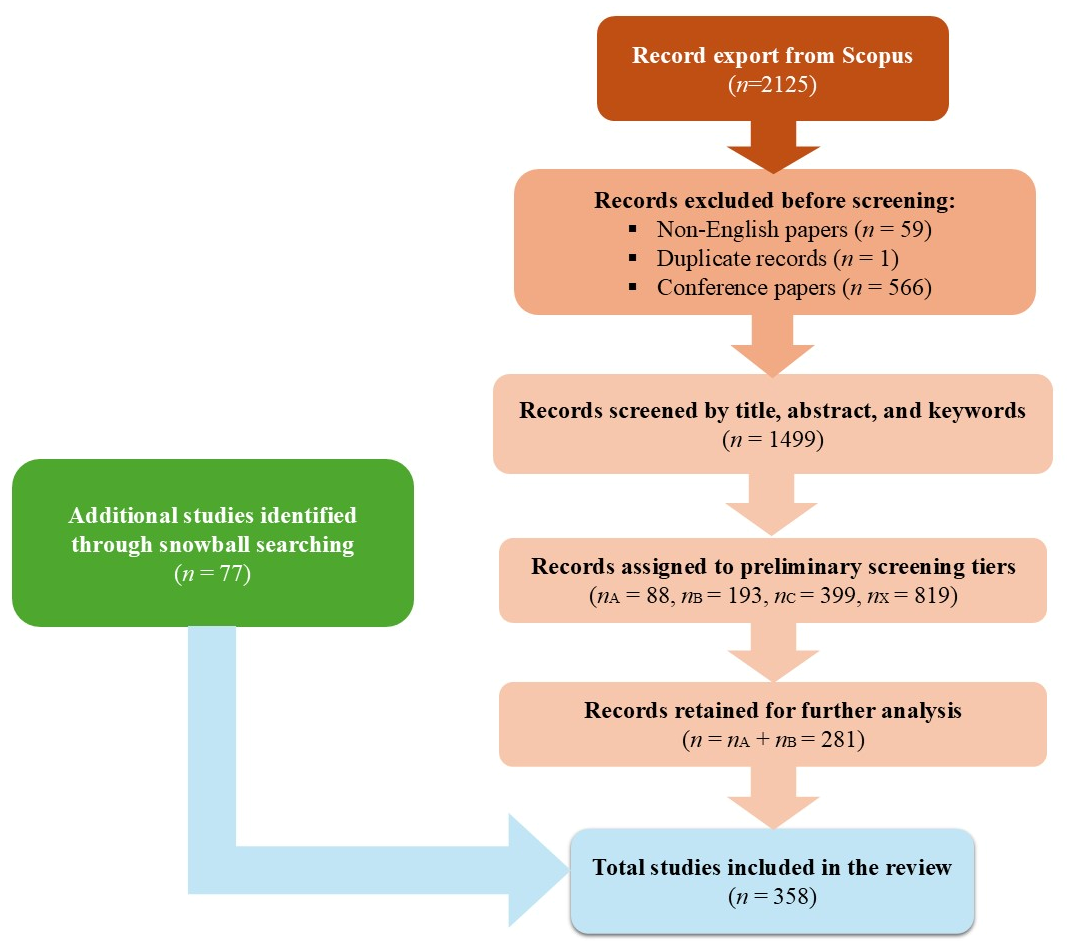
The retrieved records were screened according to their relevance to transferable origami design methodologies. Studies were considered eligible when they proposed, developed, applied, or demonstrated an identifiable design method relevant to engineering origami systems. Publications focused exclusively on fabrication, experimental performance, or specific applications without an identifiable design methodology were excluded from the methodological review. Before title, abstract, and keyword screening, 59 non-English records, 2 duplicate records, and 566 records classified by Scopus as “Conference paper” were removed, leaving 1499 Scopus records for further screening.
The initial Scopus screening prioritized non-conference publications to establish a manageable primary literature set, with emphasis on studies providing sufficiently developed and documented design methodologies. Conference papers were assigned a supplementary role, as they may report emerging methodological contributions with varying levels of development and validation. To capture additional relevant work, snowball searching was conducted, allowing conference publications with identifiable methodological contributions to be considered alongside other studies. This strategy was intended to balance screening efficiency and methodological coverage, without aiming for exhaustive identification of conference literature.
The 1499 records were screened and assigned to four mutually exclusive relevance categories: A, studies primarily proposing or developing an origami design method (n = 89); B, studies applying or demonstrating an identifiable design method (n = 193); C, background or application-oriented studies without a sufficient transferable methodological contribution (n = 399); and X, studies outside the review scope (n = 818). The 282 studies classified as A or B were retained for full-text eligibility assessment, while 1217 records classified as C or X were excluded. All 282 full-text reports were successfully retrieved and assessed, and no additional studies were excluded at this stage.
Supplementary snowball searching was conducted through backward and forward citation searching using five seed publications selected for their methodological relevance to origami design: Lang (2012), Origami Design Secrets; Tachi (2009), Simulation of Rigid Origami; Filipov et al. (2017), Bar and hinge models for scalable analysis of origami; Fuchi et al. (2015), Origami Actuator Design and Networking Through Crease Topology Optimization; and Li et al. (2025), Topology-manifold-based parametric design of dual-spherical-4R chiral origami mechanisms. Backward searching examined the reference lists of these publications, while forward citation searching was conducted using Scopus to identify subsequent publications citing them. The seed publications served as citation-search starting points and were not automatically included in the review. Additional publications identified through these searches were assessed according to the methodological eligibility criteria described above. The snowball search was completed on 15 August 2026.
Snowball searching identified 112 additional publications, with no duplicates among these publications or with the 282 studies selected from Scopus. All 112 full-text reports were successfully retrieved and assessed according to the methodological inclusion criteria. Of these, 35 were excluded because they were outside the scope of origami design methodologies, and 77 were included. Conference publications encountered through snowball searching were also examined for methodological relevance. Together with the 282 studies selected through Scopus, the final review comprised 359 studies. The selection process is presented in Figure 2, and the included studies and their methodological classifications are provided in Supporting Table S1.
Figure 2.
PRISMA 2020 flow diagram of literature identification, screening, eligibility assessment, and inclusion.
The descriptive statistics were derived from the included-study inventory in Supporting Table S1. Each included study was counted once according to its publication year and assigned primary methodological category. The annual distribution of studies was obtained by aggregating these records by year and primary category. Method co-occurrence was calculated from the recorded primary and secondary categories, with each secondary category contributing one primary–secondary pairing. The PRISMA flow diagram was prepared from the identification, screening, eligibility, and inclusion counts. These procedures provide the basis for the reported publication trends and methodological comparisons.
Study selection, full-text eligibility assessment, data extraction, and methodological classification were conducted by a single reviewer. No independent duplicate screening or data extraction was performed. No study authors were contacted for additional information, and no automated tools were used for data extraction. For each included study, bibliographic information, identification source, and methodological classification were recorded. Each study was assigned one primary design-method category according to the method making the principal contribution to design generation, analysis, or decision-making. Secondary methodological categories were also recorded when a study substantively employed additional design methods. When methodological descriptions were incomplete or ambiguous, classification was based on the reviewer’s qualitative judgment using the information available in the publication; no missing study-level information was imputed.
The selected studies were classified into five major methodological categories according to their principal design principles and procedures: geometric rule-based design, topology optimization, simulation-based design, bio-inspired design, and machine-learning-assisted design. These categories distinguish different approaches to generating, evaluating, and refining origami designs. Geometric rule-based methods employ geometric relationships and folding rules; topology optimization determines or modifies structural and crease arrangements through optimization formulations; simulation-based methods use computational models for design evaluation and refinement; bio-inspired methods translate biological principles into engineering concepts; and ML-assisted methods employ learned relationships for prediction, design generation, and decision-making. Topology optimization was treated as a separate category when explicitly employed in the reported methodology; general numerical or parametric optimization alone was insufficient for this classification. The categories are not mutually exclusive, as individual studies may combine multiple approaches. The principal methodological contribution determines the primary category, while additional substantive methods are recorded as secondary categories. The combination of different design methods within individual studies is examined in Section 5.6. One study [34] was classified separately as an integrated system-level design methodology, as its principal contribution spans multiple design activities without a single dominant methodological category. Thus, 358 studies were assigned to the five primary categories, while the remaining study was retained as a cross-category exception.
The five identified design methodologies were qualitatively evaluated against the three criteria (Cr1–Cr3) defined in Section 4. The evaluation considered findings across the studies within each methodological category, focusing on their reported capabilities and limitations in capturing design requirements, supporting rational architecture development, and supporting the systematic creation of final designs. Descriptive ratings were assigned according to the reviewer’s qualitative judgment. No numerical scoring or weighting procedure was employed. The evaluation concerned the capabilities of the design methodologies and did not constitute a quality assessment of individual studies.
To improve the consistency and traceability of the review, several procedures were applied. First, explicit methodological inclusion and exclusion criteria were used throughout the screening process. Second, the five methodological categories were defined according to their characteristic design principles and roles in the engineering design process. Third, DOI and normalized-title matching were used to identify duplicate publications between the Scopus-selected and snowball-selected studies. Finally, the identification source and methodological classification of the included studies were documented in Supporting Table S1. These procedures supported a structured literature-selection and classification process.
No formal methodological-quality or risk-of-bias assessment was conducted for individual studies. Risk of bias arising from missing or selectively reported findings was not formally assessed. No formal certainty-of-evidence assessment was conducted; the Cr1–Cr3 ratings assess methodological capabilities, not confidence in the underlying evidence. The review synthesized methodological principles, design procedures, and reported capabilities through qualitative comparison. No statistical meta-analysis was performed, as the review did not seek to combine quantitative effects or estimate a common outcome across studies. No formal review protocol was prepared, and the review was not registered in a review registry.
Several methodological limitations should be acknowledged. The search expression may have omitted relevant studies describing origami design through alternative terminology, particularly those addressing optimization, inverse design, or computational modeling without explicitly using the selected methodology-related keywords. The database search was restricted to Scopus, and relevant studies indexed exclusively in other databases may therefore have been missed. The exclusion of records classified by Scopus as “Conference paper”, alongside consideration of relevant conference-origin publications during snowball searching, may have resulted in uneven coverage of conference literature. A publication-level record of the 35 studies excluded during supplementary snowball searching was not retained, limiting the traceability of these eligibility decisions. In addition, study selection, classification, and comparative evaluation were performed by a single reviewer, and the qualitative ratings were subject to reviewer interpretation. The absence of a formal individual-study quality assessment further limits conclusions about the strength of the underlying evidence. Accordingly, the review provides a structured comparison of origami design methodologies within the adopted search and evaluation procedures.
3. Basic Concepts of Origami Systems
Basic concepts of the design and construction of origami systems, along with their relationships, are discussed in the following Section 3.1, Section 3.2, Section 3.3 and Section 3.4. It is noted that concepts and their relationships may also be called ontology, referring to [35] for details but beyond the scope of the present paper. The discussion will also include the clarification of different names for concepts as well as their relationships in different contexts.
3.1. Basic Terminology of Origami Systems
An origami system is formed through folding operations applied to a sheet-like material [36,37]. The basic components of an origami system include panels, creases, vertices, and free edges, as shown in Figure 3. A panel refers to a structural face or region bounded by creases or edges. In the literature, the terms “panel”, “facet”, and “sheet” are used with slight differences. In this review, “panel” is used to describe a local structural region bounded by creases or edges, while “sheet” refers more generally to the original or continuous material from which the origami system is formed.
Figure 3.
Basic components of origami system.
A crease is a line or narrow region along which folding occurs. Creases are classified as mountain (convex) creases and valley (concave) creases, see Figure 3, in terms of folding direction [37,38,39]. Creases are classified as plastic creases (hinged creases) and elastic creases (soft creases) [36,37,38]. Here, plastic creases allow rotation mainly through a localized fold line [40], whereas elastic or soft creases deform through recoverable material deformation [41]. A vertex is a point at which multiple creases meet, and a free edge is a boundary edge of a panel that is not shared with another panel.
These basic elements are important to origami system design, as both the geometric arrangement of panels and creases and their mechanical behavior influence the resulting structure. For engineering applications, a crease is not merely a geometric line; it may also represent a hinge, a compliant region, an actuator location, or a structural transition between rigid and flexible parts.
3.2. Hard, Soft, and Hybrid Origami Systems
Origami systems can be classified according to the mechanical properties of their panels and creases. A hard origami system consists of rigid or nearly rigid panels connected by ideal or hinged creases [38,40]. In this review, the terms “hard origami” and “rigid origami” are used interchangeably. In this type of system, deformation is assumed to occur mainly through rotation about crease lines, while panel deformation is neglected.
A soft origami system contains elastic panels and elastic creases. In this type of system, folding and deformation are not restricted to ideal hinge rotation. Instead, material compliance contributes directly to the shape change and mechanical response of the system. Wheeler and Culpepper defined soft origami systems as highly compliant origami structures involving elastic deformation and actuation [41].
In this paper, a hybrid origami system is defined as an origami system that combines hard and soft components in the same folded structure. In terms of mechanical behavior, an origami system may contain rigid-body motion, regions that undergo elastic deformation, and regions that undergo plastic deformation. A hybrid origami system that combines hard and soft components may therefore involve a combination of these mechanical behaviors. For example, a hybrid origami system may include hard panels connected by flexible creases, elastic panels combined with hinged creases, or hard and soft regions distributed within the same structure. Recent multi-material and hard-flexible origami studies further demonstrate this hybrid design logic by combining rigid panels, flexible hinges, soft regions, or printed multi-material components within the same origami system [34,42,43,44].
3.3. Origami Structures, Mechanisms, and Robots
In the engineering domain, origami systems can function as structures, mechanisms, and robots. Hence, an origami system generally consists of structural and kinematic components that achieve desired functions through folding and unfolding operations. Origami structures consist of folded geometry with defined shapes. Origami mechanisms can be viewed as kinematic systems, where folds become motion-enabling joints or linkages. According to the definition of autonomous robot in [45], an origami robot is an origami mechanism with a power generator and supply on board, an actuator, a sensor, and a controller.
3.4. Relationship Between Origami Mechanisms and Compliant Mechanisms
Origami mechanisms and compliant mechanisms (CMs) are related through their shared ability to achieve motion by localized flexibility or elastic deformation. CMs are flexible monolithic structures that transmit motion through elastic deformation of their members, without relying on discrete rigid links and joints [46], as shown in Figure 4a. During deformation, the shape of a compliant mechanism is determined by the external load, boundary constraints, and internal elastic forces, see Figure 4b. When the external load is removed, the mechanism may recover its original configuration if the deformation remains within the elastic range. A CM obtains at least some of its mobility from the deformation of its elastic components. CMs are further classified into lumped CMs (Figure 5b) and distributed CMs (Figure 5c), depending on whether deformation is concentrated in localized regions or distributed throughout the mechanism. CMs can also be classified into fully compliant mechanisms (Figure 5c) and partially compliant mechanisms (Figure 5d), depending on whether all the mobilities of the CM come from the deformation of components or not [47]. Origami mechanisms in which motion is produced partly through elastic deformation can therefore be interpreted as three-dimensional compliant mechanisms. Depending on whether deformation is concentrated in localized crease regions or distributed throughout the panels and creases, they may exhibit lumped or distributed compliance.
Figure 4.
A compliant four-bar mechanism with lumped compliance. (a) the original shape; (b) the new shape under the external force, .
Figure 5.
Four types of four-bar mechanisms. Reproduced from [47] with permission of the author. (a) a four-bar rigid-body mechanism; (b) a four-bar lumped fully CM; (c) a four-bar distributed fully CM; (d) a four-bar partially CM.
This relationship between origami and CMs is important for engineering design, as it highlights the need to consider origami systems beyond geometric folding patterns alone. When the mechanical behavior of panels and creases becomes important, the design must also account for material compliance and structural deformation.
4. Engineering Design Foundations and Evaluation Criteria
The design process and design methodologies are related but serve distinct roles in engineering design. The design process provides a framework that guides a project from problem identification to the final solution. In contrast, a design methodology is a generalization of design methods used to solve design problems within the design process. Design knowledge can be considered at different levels of generality. A general design theory provides principles applicable across a broad range of products, whereas a specific design theory provides knowledge applicable to a particular type of product [48,49]. This section introduces the systematic engineering design process in Section 4.1 and Axiomatic Design Theory in Section 4.2. Section 4.3 discusses direct and inverse design in origami, and Section 4.4 presents the criteria used in this review to evaluate origami system design methods, adapted from Hasanshahi et al. [31].
4.1. Systematic Engineering Design Process
The engineering design process proposed by Pahl and Beitz provides a general framework for developing engineering products from requirements to final realization [50], as shown in Figure 6. The process includes four steps. The first step, defining design requirements, translates customer needs for an origami system into a technical description with measurable parameters. The technical description of needs is also called the technical specification of needs or the design requirements or requirements [31]. The second step is concept design, which determines the working principle for an origami system under design. Step 1 and Step 2 may take several iterations; as such a set of requirements (R1, R2, …, Rn) along with a set of corresponding device concepts (C1, C2, …, Cn) are created. The outcome of concept design is often termed the product architecture [51]. The third step, embodiment design, determines the shape, size, and material of components, and assembly of components. The final step, detail design, specifies the surface features of the components. It is noted that these steps require iteration to achieve design requirements.
Figure 6.
The engineering design process plot based on Pahl and Beitz [50].
4.2. Axiomatic Design Theory (ADT)
ADT, developed by Nam P. Suh [52], provides a systematic framework for designing products, systems, or processes by establishing a scientific basis for decision-making. This theory is grounded in two fundamental axioms: the Independence Axiom and the Information Axiom. The Independence Axiom states that functional requirements (FRs) should be satisfied independently by design parameters (DPs), minimizing coupling to achieve robust and controllable designs. The Information Axiom posits that the best design minimizes information content, favoring solutions with the highest probability of meeting functional requirements. These axioms guide designers in mapping customers’ needs to functional requirements, then to design parameters, and finally to process variables, using a hierarchical decomposition process. Although this review does not apply axiomatic design theory directly, ADT is included to illustrate the importance of explicitly mapping requirements to design parameters.
4.3. Direct and Inverse Design in Origami
Origami design has been discussed in terms of direct design and inverse design [29]. These two terms describe the direction of design reasoning; they are not separate design methods. Direct design refers to a process in which an existing crease pattern, origami principle, or known folding form is selected and adapted to satisfy a design objective. In contrast, inverse design begins with a desired shape, motion, stiffness or Poisson’s ratio [53], and then generates, selects, or optimizes a crease pattern or folding configuration that can realize that target. In this sense, inverse design is closer to a requirement-driven or target-driven logic, whereas direct design is closer to a solution-driven logic based on known origami forms. However, these two logics should not be confused with the stages of systematic engineering design. Concept design and embodiment design describe different stages of the design process, while direct and inverse design describe how the designer moves between requirements and origami configurations.
4.4. Evaluation Criteria for Origami System Design Methods
Based on the systematic engineering design process and the criteria proposed by Hasanshahi et al. [31] for evaluating soft robot design methods, this review adapts three criteria for evaluating design methods. These criteria are adapted to the context of origami systems, where geometry, folding motion, material behavior, actuation, fabrication, and system architecture may all influence the final design.
Criterion 1 (Cr1): Explicit capture of design requirements. A design method should comprehensively and explicitly capture the design requirements for an origami system. “Comprehensively” means that the method should be able to include functional, performance, and conditional requirements [31]. Functional requirements describe what the origami system should do, such as fold, deploy, grasp, locomote, or reconfigure. Performance requirements describe how well the system should perform, such as stiffness, folding angle, displacement, force, stability, compactness, or energy absorption. Conditional requirements describe constraints imposed by materials, fabrication, actuation, environment, or scale. “Explicitly” means that requirements should be represented in a clear object, schematic, semantic, or mathematical model and should not remain hidden within a specific simulation setting, boundary condition, or optimization parameter.
Criterion 2 (Cr2): Rational generation of concept or architecture. A design method should support the rational development of the concept or architecture of an origami system. In this review, “rational” means that the concept or architecture is derived from explainable principles, such as geometry, kinematics, mechanics, material behavior, actuation principles, or biological mechanisms, and does not rely solely on intuition or trial-and-error. For origami systems, this may involve generating panel-crease arrangements, selecting folding principles, defining system modules, or developing mechanism architectures that can satisfy the intended requirements.
Criterion 3 (Cr3): Systematic creation of the final design. A design method should facilitate the systematic creation of the final origami design. “Systematic” means that the method provides a structured process that guides the designer from requirements and concept generation to embodiment, analysis, refinement, and final realization. For origami systems, this includes the generation of a fold pattern together with the development of the folding sequence, material distribution, actuation strategy, fabrication details, and performance verification.
Manufacturability and material selection are considered within these three criteria as aspects of the engineering design process. Under Cr1, they concern the explicit representation of fabrication and material-related requirements and constraints. Under Cr2, manufacturing feasibility and material behavior may influence the generation or selection of concepts and architectures. Under Cr3, they concern the systematic development of material specifications, fabrication procedures, and related verification activities during embodiment and detailed design. Their inclusion within Cr1–Cr3 allows the evaluation to consider these engineering factors without introducing separate criteria. The assessment distinguishes the incorporation of material properties or fabrication constraints into an individual design model from a systematic procedure for material selection or manufacturing realization.
The five methodological categories are evaluated qualitatively against Cr1–Cr3 using evidence from the reviewed studies. The assessment considers the reported design inputs, procedures, outputs, and connections between design stages. Table 1 defines the low, moderate, and high levels of support used in the comparison.
Table 1.
Definitions of qualitative support for the three evaluation criteria.
5. Design Methods for Origami Systems
This section addresses RQ1 by examining the design principles, procedures, applicable scopes, and limitations of the five methodological categories established in Section 2. Based on the 359 selected papers, five major categories of origami design methods were identified: geometric rule-based design, topology optimization, simulation-based design, bio-inspired design, and machine-learning-assisted (ML-assisted) design. Where a study employed more than one approach, the primary category was assigned according to the methods making the principal contribution to design generation, analysis, or decision-making. The five primary methodological categories account for 358 of the 359 included studies. It is noted that one study [34] was classified separately as an integrated system-level design methodology, as its principal contribution spans multiple design activities without a single dominant category. Thus, the categories represent the dominant methodological role of each study and should not be interpreted as mutually exclusive uses of individual techniques.
Figure 7 presents the annual distribution of the included studies according to the classifications described in Section 2, including the single integrated methodology classified separately from the five primary categories. Geometric rule-based design accounts for a substantial proportion of the studies across the period, while the numbers of studies on topology optimization and simulation-based design also increased markedly in recent years. Bio-inspired design has a comparatively smaller number of studies, whereas machine-learning-assisted design appears mainly in the most recent years and shows a rapid increase. Overall, the publication distribution indicates substantial growth in all five categories, particularly during the 2020s. It is noted that the number reported for 2026 should be interpreted with caution, as the literature search covered only publications indexed before the writing of this paper.
Figure 7.
Annual distribution of the reviewed studies by primary origami design methods.
5.1. Geometric Rule-Based Design Methods
Flat foldability is a fundamental concept in the design of origami structures, particularly in engineering applications, where compactness and deployability are essential. Two classical theorems—Kawasaki’s Theorem and Maekawa’s Theorem—provide necessary conditions for the local flat-foldability of a single vertex crease pattern. These theorems are foundational rules in origami design methods and serve as the starting point for integrating mathematical rigor into the art and engineering of origami. In this paper, design methods that follow such geometric theorems and rules are referred to as geometric rule-based design methods. It is noted that geometric rule-based design methods are based on the assumptions of rigid and zero-thickness panels.
5.1.1. Kawasaki’s Theorem
Kawasaki’s Theorem [54] states that for a single-vertex crease pattern to be flat-foldable, the alternating sum of the angles between consecutive crease lines must be zero. More commonly, this is expressed as
or equivalently:
where θi denotes i-th sector angle, defined as the angle between two consecutive creases around the vertex in cyclic order, and n is the number of creases around the vertex. Figure 8 shows a single-vertex origami with four creases. This condition implies that the angles around a vertex must be arranged in such a way that the paper can be folded flat without tearing or overlapping.
Figure 8.
A single-vertex origami with four creases.
Kawasaki’s Theorem is both necessary and sufficient for local flat foldability at a single vertex with an even number of creases. It provides a geometric constraint that is often embedded into computational algorithms that generate or validate crease patterns.
5.1.2. Maekawa’s Theorem
Maekawa’s Theorem [55,56] provides a different but complementary criterion. It states that at any flat-foldable vertex, the number of mountain folds (M) and valley folds (V) must satisfy the relation:
|M − V| = 2
This theorem does not depend on the angular configuration but instead focuses on the assignment of fold directions. It is a necessary condition for flat foldability, assuming the creases are labeled as either mountain or valley folds. For a valid four-crease flat-foldable vertex, one possible mountain–valley assignment is M = 3 and V = 1; therefore, |M − V| = 2, satisfying Equation (3).
In practical terms, Maekawa’s Theorem aids in determining valid folding patterns when designing mechanisms or robotic elements that require a specific fold actuation sequence. It has been instrumental in developing rule-based folding strategies and automated design tools that encode valley–mountain assignment algorithms [57].
5.1.3. Inverse Crease-Pattern Generation
The circle-river packing model is a representative method in this stream, extending flat-foldability rules to inverse crease-pattern generation. Instead of starting from an existing crease pattern, the method begins with a desired folded form and abstracts it into a tree-like skeleton, where nodes represent important junctions or terminal points and edges represent connected branches, limbs, or flaps. In Lang’s formulation, a base describes an intermediate folded configuration that contains the essential geometric organization of the final model, while a flap is a group of facets that corresponds to a terminal branch or edge of the tree (see Figure 9) [58]. In Lang’s formulation, free-ended flaps are represented as circles, while connecting regions are represented as rivers [59]. By packing these circles and rivers within the sheet boundary, the designer can generate a two-dimensional layout that satisfies the geometric relationships required by the target folded form. After the circle-river layout is obtained, crease lines and mountain–valley assignments are constructed to realize the corresponding folded base. This method is powerful for generating complex branching origami forms, but it mainly addresses geometric feasibility; material properties, crease stiffness, actuation, loading conditions, and manufacturing constraints must still be considered through additional simulation, optimization, or experimental validation. Figure 10 illustrates this idea using a scorpion-like target, where the branches of the target shape are converted into circles and rivers before the crease pattern is derived. Figure 11 demonstrates the final crease pattern of the model in Figure 10. Lang further developed the TreeMaker software to support this design process [60].
Figure 9.
An origami is interpreted into flaps and base. (a) an origami crease pattern within the unit square; (b) the origami crease pattern embedded in 3-space and transformed into a base. The projection of the base lies in the x-y plane. Adapted with permission from Ref. [58]. Copyright 1996, ACM.
Figure 10.
A scorpion-like origami target and its circle-river packing model. (a) the stick figure superimposed over a photograph of the subject; (b) representation of the stick figure by circles and rivers. Adapted with permission from Ref. [59].
Figure 11.
Crease pattern for the scorpion-like origami target. (a) the computed crease pattern with structural coloring; (b) final crease pattern with mountain–valley assignment. Adapted with permission from Ref. [59].
Mitani’s method further used numerical optimization to generate flat-foldable crease patterns with randomly placed vertices, showing that computational search can extend geometric design beyond hand-constructed patterns [61]. Chen et al.’s later work on mountain–valley assignment treated a given geometric configuration as a graph and used cycle detection together with mixed-integer linear programming to identify assignments that satisfy local flat-foldability and vertex-degree constraints [62]. This method formalizes the transition from a desired folded form or drawn crease pattern to a computationally checkable and foldable rule set.
5.1.4. Tessellation and Surface Approximation
The second stream concerns tessellation design and surface approximation. A waterbomb-based method generates cylindrical or axisymmetric surfaces by modeling a strip of tessellation, repeating it in longitudinal and circumferential directions, and minimizing flat-foldability residuals before regulating the crease pattern [63]. Generalized waterbomb tessellations approximate target surfaces by tiling a parametric surface with waterbomb bases and applying numerical optimization so that the resulting mesh remains developable and unfoldable [64]. Miura-based cylindrical origami design similarly derives the relationship between two-dimensional crease lines and three-dimensional cylindrical structures and then validates the theoretical model through fabrication [65]. These studies show that geometric design is not limited to flat folded models; it can also support target-surface approximation under developability and foldability constraints.
5.1.5. Limitations of the Geometric Rule-Based Design Methods
Geometric rule-based design methods have several limitations when applied to engineering-oriented origami systems. First, many of these methods are based on assumptions, including rigid panels, zero-thickness materials, perfect crease lines, and geometric foldability. These assumptions are useful for mathematical formulation, flat-foldability analysis, crease-pattern generation, and tessellation design, but they limit direct application to physical origami systems made of real materials, especially soft, elastic, thick, or hybrid origami systems with finite-thickness effects and non-ideal deformation.
Second, geometric rule-based methods mainly define crease patterns, folded shapes, tessellations, or surface approximations, but they do not fully describe the physical folding process. For example, flat-foldability rules and circle-river packing can support inverse crease-pattern generation, while waterbomb- and Miura-based methods can support tessellation design and surface approximation under developability constraints. However, these methods usually do not directly model folding force, strain distribution, deformation energy, dynamic response, actuation behavior, or contact. Therefore, a geometrically valid crease pattern or target-surface approximation may still require additional kinematic analysis, mechanical simulation, or optimization before it can be physically realized.
Third, material and manufacturing constraints are usually not directly included. Factors such as crease stiffness, panel thickness, material anisotropy, hinge width, actuator placement, fabrication tolerance, and assembly strategy are often considered only after the geometric pattern has been generated. This separation between geometric design and physical realization can be problematic for engineering origami systems, where geometry, material behavior, actuation, and fabrication are strongly coupled.
Finally, different geometric rule-based methods have different structural restrictions. Circle-river packing is more suitable for branching forms that can be represented by tree-like skeletons, and is less suitable for closed-loop, continuous-surface, nested, or re-entrant geometries. Tessellation and surface approximation methods are more suitable for repeated or parameterized patterns, but they may be less effective for irregular, non-periodic, or multifunctional robotic architectures. Therefore, geometric rule-based methods are powerful for generating mathematically valid crease patterns, tessellations, and surface approximations, but they need to be integrated with simulation, optimization, actuation design, and fabrication planning for complete engineering design.
5.2. Topology Optimization
Topology optimization (TO) is a computational design approach that determines the distribution of material, structural features, or mechanical properties within a prescribed design domain according to defined objectives and constraints. To address performance requirements such as load-bearing capacity, compliance, actuation efficiency, or energy minimization in origami system design, TO can optimize material layout, support the generation or refinement of crease patterns, and determine the distribution of rigid and compliant regions [66,67].
5.2.1. Applications for Topology Optimization in Designing Origami Systems
The applications of TO in origami system design can be grouped into four directions: mechanical property tailoring, crease-pattern generation, manufacturability-aware design, and function-oriented performance optimization.
The first group of studies uses TO to tailor the mechanical properties of origami structures. Gillman et al. [68] applied TO to origami structures with auxetic behavior, where the objective was to obtain negative Poisson’s ratios through optimized fold stiffness. In their study, a nonlinear truss-based finite element model was used to evaluate folding behavior, and modal perturbation was employed to explore possible folding paths. Cretella et al. [69] further extended this type of truss-based formulation by considering both axial rigidity and fold stiffness as design variables. Their results showed that allowing axial rigidity to vary among truss members expands the design space and enables structures with larger deformation capability. These studies demonstrate that TO can support the mechanical tuning of origami systems by controlling stiffness distribution, deformation mode, and structural response.
The second direction focuses on crease-pattern and folding-architecture generation. Sequenced origami folding work combines a nonlinear mechanics model with ground-structure topology optimization to discover fold patterns that meet performance objectives under large folding motion [70]. Ye et al. developed a variational level-set method for topology optimization of origami fold patterns, in which crease patterns were implicitly represented using level-set functions and folding behavior was modeled using a modified shell finite element model that accounts for bending, stretching, and in-plane shear [71]. By using separate level-set fields for mountain and valley folds, the method enables the design of curved crease patterns and extends the design space beyond traditional straight-line crease layouts. Crease topology optimization for origami actuators distributes fold-line properties within a reference crease pattern, adds or removes folds through optimization, and identifies actuator building blocks and networks [72]. These studies show that topology optimization can tune parameters within a predefined pattern and generate, modify, or select crease and fold-line architectures according to prescribed geometric, mechanical, and functional objectives.
The third group introduces manufacturability into TO-based origami design. Zhou et al. [73] integrated developability and panel-thickness constraints into a density-based TO framework. Their method enforces piecewise developable surfaces by aligning surface normals with a limited number of reference planes, allowing the optimized structure to be flattened into two-dimensional patterns for manufacturing. In addition, Helmholtz partial differential equation filters were used to control panel thickness for fabrication processes such as sheet forming and three-dimensional printing. This study is important for linking optimized origami geometry with physical realization and demonstrates that TO can incorporate fabrication-related constraints in addition to idealized structural performance.
The fourth group applies TO to function-oriented origami systems. Jin et al. [74] introduced a reconfigurable modular origami silencer for tunable and broadband sound attenuation. In this work, TO was used to optimize the internal fillers of sub-chambers, allowing the device to achieve sound attenuation exceeding 10 dB over a frequency range from 600 Hz to 1800 Hz without changing the external dimensions of the silencer. The modular origami configuration also allowed frequency tuning and broadband performance through folding-based reconfiguration. This study demonstrates that TO can support origami design for non-mechanical functions, such as acoustic performance, and can be combined with modular folding structures to achieve adaptable engineering functions.
5.2.2. Limitations of Topology Optimization
TO has not yet been systematically developed for the design of locomotion-capable origami robots. Existing TO studies by Ye et al. [71] and Zhou et al. [73] primarily address fold-pattern generation, structural or kinematic performance, and manufacturability, with limited consideration of time-dependent locomotion or sequential actuation.
On the other hand, recent work by Kobayashi et al. [75] demonstrates how TO can be integrated with multi-physics material point method (MPM) to synthesize soft robots capable of locomotion. However, these designs do not explicitly incorporate origami folding principles such as crease patterns, mountain–valley assignments, or fold kinematics. Instead, they rely on deformable continuum mechanics and voxel-based material tuning.
Overall, TO provides explicit procedures for generating and refining crease and structural architectures according to specified objectives and constraints. However, these formulations generally rely on predefined design domains and selected requirements, while connections to actuation planning, fabrication, and experimental verification remain incomplete. In particular, the reviewed studies do not establish a general TO framework that integrates origami folding geometry with sequential actuation and robotic locomotion requirements. Addressing these limitations could extend TO from the generation and refinement of origami structures toward more integrated engineering design procedures for reconfigurable origami robots.
5.3. Simulation-Based Origami Design Methods
Simulation-based design starts from a candidate geometry and evaluates how that geometry behaves under folding, loading, actuation, or environmental conditions. Its typical workflow involves defining the crease pattern or folded geometry, selecting an appropriate modeling abstraction, assigning material properties, hinge characteristics, loading and boundary conditions, solving for the resulting motion or physical response, and comparing the predicted behavior with the target requirement. The geometry, material, or actuation design can then be refined based on the simulation results. The resulting design therefore incorporates behavioral information in addition to geometric pattern definition.
The classification of simulation-based design in existing reviews of origami simulation methods is divided into kinematics-based, mechanics-based, and multi-physics-based simulations [30]. In this review, the methods are classified according to modeling depth and their role in supporting design. Four model classes are considered: (1) geometric and kinematic folding models, (2) discrete mechanical models, (3) continuum mechanical models, and (4) multi-physics and function-oriented models. This classification illustrates how simulation can support origami design from motion and geometric compatibility to mechanical performance and system-level function.
5.3.1. Geometric and Kinematic Folding Models
Geometric and kinematic folding models describe the admissible configurations and folding motions of origami systems mainly from the viewpoint of geometric compatibility. In these models, the origami panels are usually idealized as rigid or nearly rigid bodies, while creases are treated as rotational axes, hinges, or geometric constraints. Therefore, the primary purpose of these models is to determine whether a crease pattern can fold, how the panels move during folding, and what final configurations can be obtained. Reflection-based methods, spherical trigonometry, rotation-matrix formulations, linkage representations, and loop-closure formulations have been used to describe folding configurations and motion paths [38,76,77,78,79,80,81,82,83,84,85,86,87,88,89,90,91,92,93,94,95]. These methods are particularly useful for early-stage exploration by making folding motion and geometric constraints explicit at relatively low computational cost.
For flat-foldable origami, reflection-based methods have been used to determine folded configurations by reflecting panels across crease lines [76]. These methods are closely related to geometric foldability conditions, such as Kawasaki’s and Maekawa’s theorems, and are effective for verifying local folding consistency. However, they mainly describe the relationship between crease patterns and folded states and provide only limited representation of the complete physical folding process.
For thin hard origami, analytical kinematic methods are widely used to describe the motion of panels connected by ideal creases. Spherical trigonometry has been applied to single-degree-of-freedom origami structures, where the folding angles around a vertex can be solved using geometric relationships in three-dimensional space [77,78]. Basic trigonometric and rotation-matrix-based methods have also been used for origami patterns with repeated unit cells, allowing the folding motion to be described through panel rotations and geometric constraints [79,80]. A computational framework based on the Kangaroo solver [81] was developed to simulate accurate motion paths and folded configurations of rigid-foldable origami tessellations [82]. The framework supports multiple degrees of freedom, sequential folding, and both developable and non-developable patterns, thereby extending simulation beyond simple single-path folding.
Origami systems can also be interpreted as linkage systems when the panels are regarded as links and the creases are regarded as joints [83,84]. For example, Wang et al. [83] extracted a multi-spherical integrated mechanism from a “fortune teller” origami fold and used screw theory to analyze its reconfigurable states, singular configurations, and over-constrained linkage forms. Similarly, a dual-spherical 4R chiral mechanism was developed by symmetrically coupling eggbox origami units [85]. These studies show that linkage theory provides a useful basis for understanding the mobility and constraint characteristics of origami mechanisms.
Loop-closure formulations provide another important approach for kinematic simulation. In these models, folding motion is obtained by solving constraint equations that maintain geometric compatibility among panels and creases. Rotation matrices have been used to formulate loop-closure constraints in origami mechanisms [86,87], while quaternions have also been introduced to represent rotational relationships and reduce singularity problems in spatial motion analysis [40]. A modular deployable antenna mechanism based on Waterbomb-Ori and Miura-Ori units similarly combines a zero-thickness kinematic model with a closed-vector loop-closure formulation and subsequent dynamic analysis to study the deployment of a thick-panel origami mechanism [89]. Such methods are particularly useful for analyzing folding paths and feasible motion ranges in multi-crease systems.
Several extensions have been developed to improve the realism of ideal kinematic models. Compliant-crease origami introduces localized flexibility at crease regions while still treating the panels as rigid or nearly rigid bodies [40,90,91,92]. This approach provides a bridge between ideal rigid-folding models and mechanical models by allowing crease compliance to influence the folding path. Thick-panel origami further relaxes the zero-thickness assumption by considering the geometric effects of panel thickness [96]. Spatial linkage models and rolling-hinge models have been used to avoid interference between thick panels and to represent more physically realistic folding motions [93,94,95].
5.3.2. Discrete Mechanical Models
Discrete mechanical models introduce mechanical quantities into origami simulation while still representing the origami system using simplified structural elements. In contrast to purely geometric and kinematic models, these models describe admissible folding motions together with stiffness, internal force, deformation energy, dynamic response, and stability. However, unlike continuum finite element models, they do not fully discretize the panels and creases as continuous deformable bodies. Instead, the origami system is represented by bars, frames, hinges, springs, or particles. Therefore, discrete mechanical models provide a balance between computational efficiency and physical realism.
Rigid bar-based models are among the basic discrete mechanical representations. In these models, the origami panels are simplified into triangulated bar systems, and the folding behavior is described through the deformation and relative motion of the bar network [97,98,99]. Rigid frame-based models use frame elements to represent the structural skeleton of origami systems, while creases are treated as rotational joints or partially flexible connections [100,101,102]. These models are useful for studying folding behavior and form generation of rigid or partially rigid origami structures, especially when the main interest is the relationship between global shape and structural connectivity.
Bar-and-hinge models provide a more widely used discrete mechanical approach for origami simulation. In this type of model, panel edges and diagonal lines are represented by bars, while crease lines are modeled as rotational hinges with assigned stiffness [86,100,103]. Through this representation, folding can be analyzed by considering both geometric compatibility and mechanical resistance. Compared with purely kinematic models, bar-and-hinge models can predict deformation paths, equilibrium states, and stability-related behavior with relatively low computational cost.
Several extensions of the bar-and-hinge model have been developed to improve its ability to represent practical origami systems. For compliant-crease origami, additional bar elements and rotational spring elements can be introduced in the crease region to represent localized compliance [104,105,106,107]. This consideration is important for engineering origami systems, since folding often occurs through flexible crease zones with finite width and stiffness, not through ideal hinges. By assigning appropriate hinge and panel stiffness, these models can capture the influence of crease compliance on folding behavior, bi-stability, and deployment response.
Particle-based mechanical models provide another discrete representation. In these models, the origami structure is represented by particles connected through bars, springs, hinges, or other discrete interactions. Yu et al. [108] applied the finite particle method to investigate the unfolding process of triangular Resch patterns, while Dong et al. [109] combined a particle–bar–spring representation with the finite particle method to simulate the dynamic unfolding of origami tessellations. Such approaches are particularly useful for investigating time-dependent folding and unfolding behavior, where inertia, deployment speed, and transient response are important.
Other discrete formulations use truss and spring elements to represent the mechanics of physical origami. Zhang [110], for example, discretized origami structures into truss and spring elements to analyze the mechanical behavior of functional origami structures for biomedical robotic applications. These reduced-order models provide an intermediate level of physical detail between ideal kinematic models and continuum models.
Discrete mechanical models have also been applied to dynamic origami systems. Xia et al. [111] developed a reduced-order dynamic model of tubular fluidic origami to investigate deployment dynamics and multi-stability under fluidic pressure.
Recent work further demonstrates the value of reduced-order models for dynamic design analysis. Troise et al. [112] developed an iterative bar-and-hinge formulation for nonlinear origami dynamics using different time-integration schemes and demonstrated its applicability to structures ranging from a single fold to Miura and Waterbomb configurations. The formulation provides an efficient means of evaluating transient folding and dynamic response without resorting to full continuum simulation for every design iteration. An earlier scalable bar-and-hinge formulation similarly established the feasibility of analyzing large origami assemblies using reduced-order mechanical representations [113]. Thus, discrete mechanical models are particularly valuable at early and intermediate design stages when repeated evaluation of stiffness, energy, stability, or dynamic response is required.
5.3.3. Continuum Mechanical Models
Continuum mechanical models represent origami systems at a higher level of physical detail than discrete mechanical models by treating panels, creases, or folding regions as continuous deformable bodies. These models are therefore suitable for analyzing stress, strain, bending, stretching, thickness effects, and local material behavior.
Plate-theory-based models provide one continuum-level approach for modeling physical origami. Zhang et al. [114] developed a plate-theory-based model for origami folding joints, in which the folding hinge is represented as a thin plate and a torsional spring is introduced to account for the semi-rigid connection between the hinge and adjacent panels. The model predicts localized hinge bending and folding stiffness and was validated against finite element simulations and experiments. This approach is useful when the mechanical behavior of a finite-width folding hinge must be represented more explicitly than by an ideal crease or rotational hinge.
Finite element models provide a more general continuum framework for simulating flexible origami structures. Hu et al. [115], for example, developed a finite element approach for flexible origami structures that accounts for the deformation of panels and crease regions. Finite element models can therefore capture local stress and strain, panel and crease deformation, material nonlinearity, thickness effects, and contact more directly, although at a higher computational cost.
Other continuum and hybrid mechanical models extend this treatment to elastic facets and more complex structural responses. Soleimani et al. [116] modeled origami facets using first-order shear deformation plate theory and folds using linear and rotational springs. Filipov et al. [117] used shell elements with rotational hinges to evaluate the structural behavior of reconfigurable origami tubes. Numerical and finite element analyses have also been used to investigate actuator-induced strain propagation [118], graded-stiffness origami structures [119,120], and quasi-static or dynamic compression of origami metamaterials [121,122].
Solid-element models provide an even more detailed representation by discretizing the entire origami structure as a three-dimensional deformable body [123,124]. This approach is useful when the thickness of the panel, local contact, material nonlinearity, or three-dimensional stress distribution cannot be neglected. Compared with shell models, solid finite element models generally require higher computational cost, but they can provide more detailed information about local deformation and stress concentration.
Therefore, they are more suitable for validation studies, detailed design, and cases where the mechanical behavior of the material strongly influences folding performance. For example, a parametric Miura-Ori sandwich-core study generated geometry from a kinematic model, transferred the resulting surfaces to commercial finite-element software for analysis, and compared predicted compression behavior with fabricated specimens and quasi-static tests [125]. Studies on finite-element modeling of flexible delta mechanisms [126], impact response of sandwich structures [127], shape memory alloy (SMA)-enabled deployable structures [128], and fatigue assessment [129] show the same late-stage verification function.
5.3.4. Multi-Physics and Function-Oriented Models
Multi-physics and function-oriented models extend origami simulation beyond geometric folding and mechanical deformation by coupling folding behavior with other physical domains. These models are especially important for engineering origami systems whose functions depend on shape change together with actuation, sensing, acoustic response, electromagnetic behavior, thermal performance, or fluid interaction. In such simulations, the folded configuration is usually not the sole design objective. Instead, folding is treated as a means of producing a target physical response or functional performance.
One important group of multi-physics models focuses on active folding. Active origami systems use stimuli-responsive materials or embedded actuation mechanisms to generate folding motion. Thermal, magnetic, pneumatic, and other stimuli can induce local deformation, stress, or strain, which then produces folding at selected crease regions. Liu et al. [130] proposed an origami-patterned rigidification method in which rigid origami panels are incorporated into a soft robotic chamber and actively driven by external soft actuators. The resulting soft–rigid structure can realize the prescribed origami motion while also generating additional deformation modes through structural bifurcation. Leong et al. [131,132] demonstrated thermally and chemically triggered self-folding microgrippers and microcontainers. These studies show that actuation design and structural mechanics must be considered together when simulating active origami systems.
Magnetically actuated origami provides another example of multi-physics coupling. In these systems, the origami structure responds to an externally applied magnetic field, and the global folding behavior depends on the interaction between magnetic forces and structural deformation. Swaminathan et al. developed a simulation approach using the Kangaroo solver in Rhino to model magnetic interactions in origami-inspired systems [81,133,134]. Thermally activated self-folding has also been demonstrated at larger scales. Chen et al. [6] developed an autonomous deployable solar-panel system in which distributed shape-memory-polymer actuators embedded within an elastic origami architecture enabled temperature-triggered self-deployment. These examples show that actuation modeling is an essential part of simulation when the folding process is controlled by external physical fields or coupled mechanisms.
A second group of multi-physics models focuses on function prediction after folding. In these cases, the origami configuration determines a non-mechanical property or system-level function. For example, origami geometries have been used in frequency selective surfaces for electromagnetic wave filtering [135,136,137,138,139,140]. In such applications, folding changes the spatial arrangement of conductive or dielectric elements, thereby affecting electromagnetic transmission or reflection. Similarly, origami-based acoustic metamaterials use folding geometry to tune wave propagation, sound attenuation, or acoustic band gaps [141,142,143,144,145]. Origami structures have also been studied for thermal expansion [146] and for controlling drag in underwater environments [147]. These applications demonstrate that origami simulation can support both shape design and functional performance design.
5.3.5. Limitations of Simulation-Based Origami Design Methods
The simulation-based methods reviewed above differ mainly in modeling depth, computational cost, and design-stage applicability. Geometric and kinematic folding models are suitable for early-stage exploration due to their efficient representation of foldability, mobility, linkage equivalence, and folding paths under prescribed assumptions. However, they are limited when material deformation, stress distribution, actuation force, or energy consumption must be considered.
Discrete mechanical models provide an intermediate level between ideal kinematic models and continuum models. By representing origami systems using bars, hinges, springs, frames, or particles, these models can approximate stiffness, force, energy, stability, and dynamic response with relatively low computational cost. They are useful for parametric studies and large origami assemblies, but they may not fully capture local stress distribution, material deformation, thickness effects, or complex contact behavior.
Continuum mechanical models, including plate, shell, and solid finite element models, are more suitable for later-stage design verification and mechanical performance evaluation. They can capture panel and crease deformation, stress, and strain while accounting for thickness and nonlinear deformation. Their main limitation is the higher computational cost and stronger dependence on material parameters, boundary conditions, and numerical implementation.
Multi-physics and function-oriented models are required when origami performance depends on coupled physical effects, such as actuation, sensing, acoustic response, electromagnetic behavior, thermal regulation, or hydrodynamic interaction. These models are important for engineering origami systems, but they also increase the complexity of model formulation, parameter identification, and computation. Overall, simulation-based methods provide systematic procedures for evaluating and refining origami configurations through geometric, mechanical, and multi-physics models. Design-oriented applications can explicitly represent selected performance requirements and connect mechanical evaluation with design refinement. However, the formulation of comprehensive requirements and the initial generation of system architectures generally depend on the surrounding design procedure. Further integration with concept development, fabrication planning, and physical verification is therefore required for systematic final design creation.
5.4. Bio-Inspired Design Methods
Bio-inspired origami design can be interpreted as a function-based design process. The process begins with an engineering function or requirement, such as deformation amplification, compact deployment, locomotion, or load bearing. A biological system that performs a comparable function is then identified, and the relevant biological characteristic is abstracted and translated into an origami design. Depending on the biological system, the transferred knowledge may concern motion and actuation, morphology, structural organization, stiffness distribution, or other mechanical principles. The biological principle can then be engineered through origami.
This interpretation distinguishes bio-inspired design from merely assigning an animal or plant analogy to an existing origami application. In a bio-inspired design process, the biological system should contribute identifiable design knowledge that helps transform an engineering function into a concept or architecture. Based on the type of biological knowledge transferred, the reviewed studies are discussed in three groups: biological motion and actuation principles, biological morphology, and biological structural and mechanical principles. These groups are not mutually exclusive, as a biological system can simultaneously provide information about morphology, motion, and mechanical behavior.
5.4.1. Biological Motion and Actuation Principles
The first group transfers biological principles related primarily to motion generation, force transmission, actuation, or locomotion. In these studies, the biological system provides a working principle, while the engineering problem concerns how an origami system should move or act.
For example, Diao et al. [148] addressed the requirement for deformation amplification in soft robots intended to operate in confined spaces. A muscle–skeleton tension principle was used as the biological analogy, with a hollow Miura-origami structure serving as the skeleton and a lever-type actuator arrangement transmitting deformation from a shape-memory-alloy spring. The actuator deformation was thereby transformed into a substantially larger deformation of the origami structure. In this case, the biological contribution is not merely the appearance of a muscle–skeleton system; rather, the biological force-transmission principle guides the relationship between the actuator arrangement and the origami skeleton.
Locomotion-oriented origami robots follow a similar design logic. Fang et al. [149] developed an earthworm-like robot in which origami ball structures and multi-segment actuation generate bidirectional locomotion, while Jin et al. [150] developed a worm-inspired robot in which magnetic actuation produces locomotion and load transport. Vacuum-actuated Kresling structures have also been used to convert local structural deformation into directional crawling [151]. Snake-inspired systems extend this principle to spatial locomotion. The Ori Snake uses a tubular origami architecture and cord-driven actuation to achieve three-dimensional movement [152], while waterbomb-based modular structures have been used to reproduce snake-like locomotion through coordinated deformation [153].
Marine organisms provide further examples. Pufferfish-inspired inflatable origami uses expansion and contraction to generate underwater motion [154], while jellyfish-inspired robots translate biological propulsion into polyhedral origami structures [155]. Waterbomb tessellations are selected to achieve the required propulsion behavior [156]. These studies demonstrate that biological motion principles can influence global architecture, origami-pattern selection, and actuation strategy.
Across these examples, the common design sequence is therefore engineering function, followed by identification of a biological motion or actuation principle, then abstraction of the underlying working principle, and finally origami realization. The biological organism itself is not the primary classification criterion; rather, the relevant question is how its motion or force-transmission principle contributes to solving the engineering problem.
5.4.2. Biological Morphology
The second group uses biological morphology as a source for origami concept or architecture generation. In this approach, geometrical features, spatial arrangements, or morphological transformations observed in a biological system are abstracted and translated into an engineering structure. The resulting origami system may serve functions such as compact deployment, morphing, load bearing, structural adaptation, or multifunctional shape change.
Baruah and Sychterz [157] investigated a meter-scale deployable origami structure based on the functional morphology of a pill bug. The biological system provides a reference for transformation between extended and compact configurations. Dynamic relaxation was used in the computational development of the structure, while finite-element modeling and experiments were used to compare its dynamic behavior during deployment. This study demonstrates how biological morphology can provide the basis for an origami architecture that is subsequently analyzed using conventional engineering tools.
Gao et al. [158] addressed the requirements of low weight, compactness, shock absorption, and weight bearing in a soft prosthetic knee. The design combines origami with a bio-inspired weight-bearing arrangement and biomimetic polycentric flexion. Here, biological morphology contributes to the arrangement by which the structure carries load and reproduces knee-like motion, while the origami structure provides compactness and deformability.
Insect wings are another important morphological source. Dual-stiffness origami inspired by insect wings combines rigid and compliant regions to obtain controlled morphing [159]. Ladybird-beetle-inspired compliant origami transfers characteristics of deployable and self-locking wings into compliant engineering structures [160], while spring-origami structures inspired by earwig wings use characteristic crease arrangements to obtain rapid folding and latching [161]. Detailed studies of earwig wing morphology have also been used to derive crease arrangements for deployable engineering structures [162].
Morphological inspiration is not limited to insect wings. Pelican-eel-inspired dual-morphing structures combine origami folding with skin inflation and use stretchable Miura and Yoshimura patterns to achieve multiple modes of deformation [163,164]. In these examples, the biological morphology does not simply determine the external appearance of the final design. Instead, the morphological transformation—such as folding, expansion, compact deployment, or multi-mode shape change—is abstracted and incorporated into the origami architecture.
Thus, biological morphology can provide an intermediate bridge between an engineering function and a structural concept. However, the morphology must still be interpreted and transformed into engineering variables, such as panel arrangement, crease pattern, material distribution, or mechanism architecture, before it becomes a realizable origami design.
5.4.3. Biological Structural and Mechanical Principles
The third group abstracts structural or mechanical principles from biological systems without directly reproducing their motion or morphology.
Dong et al. [165] developed a dragonfly-inspired three-dimensional folding grid by abstracting the structural organization of dragonfly wings. A branching-structure generation technique was used to represent the principal vein system, a Voronoi grid was then introduced, and origami folding principles were applied to generate a rigid–flexible coupled three-dimensional grid. The biological contribution therefore lies in the hierarchical and branching structural organization of the wing, without directly reproducing dragonfly motion.
Han et al. [166] further illustrate how biological inspiration can expand the mechanical design space of origami. Their flexible multi-stable origami introduces bio-inspired extensible-torsional creases instead of restricting the crease behavior to ideal relative rotation. Geometric and nonlinear dynamic models are then used to investigate the resulting multiple deformation paths and stable states. In this case, biological inspiration contributes a different mechanical interpretation of the crease and therefore introduces additional design variables into the origami system.
Yu et al. [167] developed a bionic origami mechanism with adjustable bi-stability using thin PET sheets, flexible hinges, and pre-tensioned elastic bands. Nonlinear spring models were used to characterize its bistable mechanical response, and the principle was subsequently configured for applications such as fast-response gripping and other motion-generating mechanisms. This example shows how bio-inspired mechanical behavior can be combined with compliant components and stored elastic energy to create functions that would be difficult to obtain through rigid-folding geometry alone.
These studies demonstrate that biological abstraction can occur at multiple structural levels. The transferred principle may concern the system architecture, the organization of load paths, the behavior of an individual crease, the distribution of stiffness, or the stability of the entire structure. Consequently, a bio-inspired origami system does not necessarily need to resemble its biological source. What matters is that an identifiable biological principle is abstracted and converted into an engineering design principle.
5.4.4. Limitations of Bio-Inspired Design Methods
Bio-inspired design is particularly useful when an engineering problem requires new motion strategies, deformation modes, structural organizations, or multifunctional architectures for which established origami patterns provide limited guidance.
However, beginning from an engineering function does not mean that existing bio-inspired studies systematically capture all design requirements. In many studies, only the primary function is explicitly identified, while performance requirements and conditional requirements related to materials, fabrication, actuation, environment, or scale remain implicit. Therefore, the function-driven logic of bio-inspired design should be distinguished from comprehensive requirement capture.
A second limitation concerns the selection and abstraction of biological knowledge. There is currently no general procedure that determines which biological system should be selected for a given engineering function or which biological characteristics should be preserved during abstraction. The transition from biological observation to an origami architecture therefore remains strongly dependent on the designer’s interpretation and on the particular application.
A third limitation is that biological inspiration alone rarely provides a complete final design. After the biological principle has been identified, further decisions are required regarding crease geometry, materials, stiffness, actuation, fabrication, and control. The reviewed studies therefore frequently depend on simulation, optimization, mechanical modeling, or experiments to develop and validate the design.
Overall, bio-inspired design supports function-driven concept development and can connect biological principles with structural design, mechanical analysis, fabrication, and experimental verification, as demonstrated in selected studies [148,158]. However, the selection and abstraction of biological principles remain application-dependent, and generalizable procedures connecting comprehensive design requirements with architecture generation and final realization are not consistently established.
5.5. Machine-Learning-Assisted Design
Machine-learning-assisted (ML-assisted) design has emerged as an increasingly important approach for origami system design. Its distinguishing feature is the use of data to learn relationships between design variables and system behavior or performance, and then to use these learned relationships for prediction, inverse design, design generation, or optimization. The data may be obtained from simulations, experiments, parametric studies, or previously generated origami configurations. Unlike conventional simulation, which predicts behavior through an explicitly formulated physical model, ML-assisted design derives design–performance relationships from data or from a combination of data and physical knowledge.
The reviewed studies show four main roles of machine learning in origami design: data-driven prediction and surrogate modeling, inverse and generative design, ML-assisted optimization and decision making, and physics-informed learning. These roles are not mutually exclusive; a single design framework may combine prediction, inverse design, and optimization. ML-assisted design is therefore classified here according to the role of the learned design–performance relationship in the design process, independent of the particular learning algorithm used.
5.5.1. Design Roles and Workflows
ML-assisted origami design generally begins by defining design variables and target performance, followed by generation or collection of training data. The data may describe crease patterns, geometric parameters, material properties, folding configurations, or system responses. A learning model is then trained to approximate relationships between these design variables and corresponding behaviors or performance. Depending on the design task, the trained model can subsequently be used as a rapid predictor, an inverse mapping from target performance to design parameters, a generative representation of candidate configurations, or an evaluator within an optimization process.
Inverse and generative design represents one of the strongest roles of ML in origami design. Hochuli and Stankovic [168] developed an inverse-design framework for trajectory-following origami in which an automated graph-grammar procedure generated a large dataset of crease patterns. A variational autoencoder was used to map these discrete crease patterns into a continuous latent representation, while normalizing flows further supported exploration of the resulting design space. Candidate origami mechanisms could then be searched according to prescribed trajectories. This study illustrates a generative role of ML, as the learned representation supports the generation and search of new crease-pattern candidates in addition to predicting the performance of predefined configurations.
Zhu and Filipov [169] approached inverse design from the perspective of interpretable machine learning. Design features and functional performance were related using decision-tree- and random-forest-based models, allowing human-interpretable design rules to be extracted from the learned relationships. This approach is particularly relevant to systematic design by identifying candidate designs and providing insight into how individual design features influence functional performance. Machine learning can therefore contribute to the mapping between desired performance and design variables extending its role beyond black-box prediction.
Data-driven prediction and surrogate modeling provide another important role. Chen et al. [170] combined geometric relationships for conical six-fold origami with deep learning to predict customizable geometry and folding morphology. Yue et al. [171] integrated analytical homogenization, finite-element simulation, experiments, neural networks, and multi-objective optimization for hierarchical origami-corrugation structures. Similar data-driven approaches have been applied to relate Kresling geometric parameters to acoustic bandgap characteristics [172] and to support optimization of origami-type thin-walled structures [173]. In these cases, the learned model reduces the cost of repeatedly evaluating candidate designs and thereby enables more efficient exploration or optimization.
More recent approaches increasingly integrate machine learning with physical models or optimization algorithms. Ciampaglia et al. [174] developed a physics-based data-driven approach for the crashworthiness design of origami composite tubes, connecting the responses of constituent modules with the performance of the complete structure. Zhang et al. [175] combined finite-element analysis, deep neural networks, and deep reinforcement learning to optimize multi-stable origami-inspired metamaterials. Ning et al. [176] integrated Kirchhoff rod theory with physics-informed neural networks for both forward prediction and inverse design of ring origami. These approaches illustrate how physical knowledge can be combined with learned relationships to reduce reliance on purely statistical prediction and to support design search.
Machine learning is also used to predict or estimate origami behavior without directly generating the structure. Yasuda et al. [177] used data-driven learning to predict chaotic dynamics in multi-stable origami, while Ray et al. [178] combined capacitive sensing, geometric information, and deep learning for continuous shape estimation of morphing origami structures. Such applications are relevant to origami system design by providing efficient behavioral or state representations, although their primary contribution lies in prediction or sensing, with limited emphasis on architecture generation.
5.5.2. Applicable Scopes and Limitations
Machine-learning-assisted design is particularly useful when the relationship between origami design variables and performance is nonlinear, high-dimensional, or expensive to evaluate repeatedly using numerical simulation or experiments. Learned models can accelerate design exploration, support inverse mapping from desired performance to candidate configurations, and enable optimization over large design spaces. Generative approaches may also support concept generation by providing new candidate crease patterns or parameter combinations.
However, ML-assisted design depends strongly on the data used to construct the learned model. Simulation-generated datasets inherit the assumptions and limitations of the underlying simulation, while experimental datasets may be expensive and limited in size. Predictions are generally more reliable within the range represented by the training data and may become uncertain when extrapolated to substantially different geometries, materials, or operating conditions. Furthermore, conventional black-box models may provide limited explanation of why a particular design is selected. Interpretable and physics-informed approaches partly address these limitations, but they do not eliminate the need for physical modeling or experimental verification.
Another limitation is that ML-assisted design generally begins with predefined design representations, variables, and performance targets. Although generative and inverse-design methods can produce new crease-pattern candidates and support architectural decisions, they do not independently establish a general procedure for defining system-level requirements or connecting computational design results to material selection, actuation design, fabrication, and physical verification. Consequently, ML-assisted methods primarily support selected computational design activities, with limited guidance for subsequent engineering design stages and final physical realization.
5.6. Coupling Among Origami Design Methods
Among the 359 selected papers, 110 had more than one recorded design method: 103 had two, six had three, and one had four. Table 2 shows the co-occurrence of primary and secondary design methods. Rows represent primary method categories, and columns represent secondary method categories. Each cell counts studies with the corresponding primary–secondary combination. A study with multiple secondary methods contributes to each relevant cell, giving 118 pairings across the 110 studies.
Table 2.
Co-occurrence of different design methods within the reviewed studies.
The results show that simulation and geometric rule-based design are the most frequently coupled methods. Among studies classified primarily as simulation-based, 15 also employed geometric rule-based methods. Conversely, 38 studies classified primarily as geometric rule-based design also employed simulation.
These results show that the five methodological categories are not mutually exclusive and can provide complementary capabilities within the same design process. The most frequently observed combination is geometric rule-based and simulation-based design, where geometric methods support crease-pattern or architecture generation, while simulation enables the evaluation and refinement of physical behavior. The combination of topology optimization and simulation is particularly relevant to performance-driven structural and crease-architecture design, as mechanical models can guide optimization according to specified objectives and constraints [70,71]. ML-assisted methods can be combined with simulation to accelerate design exploration while retaining physics-based evaluation of candidate solutions [175,176]. Bio-inspired methods can also be complemented by simulation to evaluate and refine concepts derived from biological principles [157,158]. These combinations address selected limitations of individual methods by connecting concept or architecture generation with behavioral evaluation and refinement. However, their integration does not necessarily establish a complete engineering design procedure covering requirement capture, material and actuation design, fabrication, and physical verification.
6. Comparative Evaluation of Origami Design Methods Against Cr1–Cr3
Section 5 describes five categories of origami design methods in terms of their design logic, workflows, applications, and limitations. To address RQ2, this section qualitatively compares these methods against the three criteria defined in Section 4.4 and evaluates how well each methodological category supports these criteria based on the reviewed literature.
The qualitative evaluation was conducted by comparing the reported capabilities and limitations of each methodological category with the support-level definitions in Table 1. For Cr1, the assessment examined the explicit representation of function, performance, and conditional requirements and their connections to design decisions. For Cr2, it examined the extent to which explainable design principles support concept or architecture generation. For Cr3, it considered the connections established among engineering design stages, including embodiment, analysis, fabrication, and verification. The resulting ratings summarize the methodological capabilities identified in the reviewed literature and do not represent numerical averages of individual-study scores.
Table 3 presents two representative studies from each methodological category to illustrate the evidence informing these assessments, including design inputs, outputs, capabilities, and limitations. For example, geometric rule-based methods explicitly represent geometric and foldability requirements, supporting a Moderate rating for Cr1. Their systematic generation of crease patterns from geometric targets supports a High rating for Cr2, while their limited connections to subsequent mechanical development and physical realization support a Low rating for Cr3 [58,62,64]. The category-level ratings are summarized in Table 4, using only the three support levels defined in Table 1. Studies within the same category may demonstrate different capabilities, and identical ratings across categories do not imply identical methodological contributions.
Table 3.
Representative evidence supporting the qualitative evaluation of origami design methods against Cr1–Cr3.
Table 4.
Comparison of origami design methods against Cr1–Cr3.
6.1. Explicit Capture of Design Requirements (Cr1)
For Cr1, the key distinction is between representing a design requirement explicitly and merely including information related to that requirement within a design model. A method may model many physical or performance factors without providing a systematic representation of the requirements themselves. According to the definition of Cr1, a method should explicitly represent functional, performance, and conditional requirements, with these requirements expressed independently of particular simulation settings, optimization parameters, or predefined design cases.
Geometric rule-based methods explicitly represent target geometry and foldability requirements through geometric conditions, mountain–valley assignments, and developability constraints [58,62,64]. Their requirement coverage is therefore concentrated on shape and geometric feasibility. Additional formulations are needed to capture material, actuation, loading, and fabrication requirements where these are relevant to the intended application. This explicit but partial coverage supports a moderate rating against Cr1.
Topology optimization (TO) explicitly represents selected design requirements through objective functions and constraints. The reviewed formulations address mechanical responses, targeted folding motions, acoustic performance, and geometric conditions relevant to fabrication [68,70,73,74]. These requirements are directly connected to the optimization problem. However, their coverage remains specific to the design task, and the cited formulations do not by themselves establish comprehensive capture of the overall system’s function, performance, and conditional requirements. This explicit but selective coverage supports a moderate Cr1 rating.
Simulation-based methods support explicit requirement representation when desired responses and operating conditions are connected to stated design targets [92,136]. Their contribution lies in expressing selected geometric and physical requirements in a form that can be evaluated computationally. In the reviewed combined design-and-simulation procedures, simulation supports this representation and evaluation, while the broader organization of requirements depends on the surrounding design process. This partial contribution supports a moderate Cr1 rating. Material properties, loads, and boundary conditions count as requirement representations only when their connection to a stated design need is clear.
Bio-inspired design explicitly connects function requirements, such as deformation amplification, locomotion, or load bearing, with relevant biological functions or mechanisms [148,158]. The reviewed examples also demonstrate consideration of performance and practical requirements, including low weight and impact absorption [158]. Requirement capture therefore extends beyond identifying the initial function, although its coverage depends on the application and the accompanying engineering methods. This demonstrated support for selected requirements is consistent with a moderate Cr1 rating.
ML-assisted design explicitly represents selected requirements through desired behaviors, target responses, and performance criteria used for inverse design or candidate selection [168,169]. These representations connect specified requirements with design variables and candidate solutions. The demonstrated contribution is strongest for the behavioral and performance requirements encoded in the design task; comprehensive organization of function, performance, and conditional requirements is not established by this mapping alone. ML-assisted design therefore receives a moderate Cr1 rating. The use of targets defined in advance does not itself indicate weaker requirement capture.
6.2. Rational Generation of Concept or Architecture (Cr2)
For Cr2, the key question is whether a method can rationally generate a concept or architecture from explainable design principles, beyond merely evaluating an already defined configuration.
Geometric rule-based methods provide explicit mathematical relationships for developing crease patterns and folded configurations from geometric targets [58,62,64]. Their contribution ranges from determining selected features, such as mountain–valley assignments within a supplied pattern, to generating crease arrangements for a desired folded form. The latter provides direct support for architectural synthesis through geometric principles. The demonstrated connection between prescribed geometric targets, mathematical principles, and systematic crease-pattern generation supports a high rating against Cr2 within the scope of geometric design.
Topology optimization supports Cr2 by connecting performance objectives and physical models with decisions about structural organization [68,69,70,71,72]. The reviewed approaches include modification of structural properties within an established arrangement and generation or selection of crease architectures. Fold-pattern discovery for targeted motions demonstrates that TO can make architectural decisions beyond adjusting dimensions [70]. The explicit connection between specified objectives, mechanical models, and the generation of structural or crease architectures supports a high rating against Cr2. The requirement for a prescribed design domain does not, by itself, diminish this capability.
Simulation-based methods contribute to rational architectural selection and modification by relating candidate configurations to predicted geometric or mechanical behavior. In coupled design procedures, mechanical criteria can guide changes to crease arrangements, as demonstrated by frame-model-based form generation [101]. However, forward simulation of a supplied configuration provides little direct support for generating its architecture. Simulation-based design therefore receives a moderate rating: support is limited in analysis-only applications and becomes more direct when simulation guides architectural decisions within a design procedure.
Bio-inspired design supports concept generation by translating biological functions, motion, and structural principles into engineering arrangements [148,161,165]. Its contribution can involve selecting and adapting an existing origami configuration or introducing different relationships between components and their mechanical behavior. Biological joint principles, for example, provide a rational basis for extending conventional crease behavior [161]. A moderate rating reflects the extent to which biological abstraction determines the resulting architecture. Application specificity alone does not imply weaker rational support.
ML-assisted methods support Cr2 through inverse design, generation of crease-pattern candidates, and extraction of interpretable design relationships [168,169]. However, the capability to generate new configurations should be distinguished from the capability to explain the design principles underlying their generation. Generative models can produce candidates through learned statistical relationships without providing interpretable design rules [168], while interpretable models can establish explicit relationships between design features and performance [169]. The reliability of these contributions depends on training-data coverage and generalization to new design conditions. Furthermore, geometric and physical constraints are important for evaluating the feasibility of generated configurations, but satisfying these constraints does not itself establish an explainable design rationale. Accordingly, ML-assisted design receives a moderate rating for Cr2, reflecting its demonstrated support for candidate generation and selected interpretable design relationships, alongside limitations in generalization and explainable architecture generation.
6.3. Systematic Creation of the Final Design (Cr3)
For Cr3, the key question is whether a method provides a structured route from requirements and concept generation through embodiment, analysis, refinement, and final engineering realization. A computational procedure that systematically performs one design task should therefore not automatically be considered a complete systematic final-design method.
Geometric rule-based methods provide systematic procedures for generating crease patterns and geometrically admissible folded configurations from prescribed geometric targets [58,64]. However, these procedures primarily address geometric synthesis and provide limited guidance for subsequent mechanical embodiment, material and actuation design, fabrication, and physical verification. Their contribution is therefore concentrated on a particular design activity without establishing a connected procedure for final engineering realization. This limited coverage supports a low rating against Cr3.
Topology optimization connects design objectives, mechanical evaluation, and iterative modification within a structured computational process. The reviewed formulations can also address targeted folding motions and geometric constraints relevant to manufacturing [70,73]. These connections support the development and refinement of an origami structure. However, incorporating such constraints does not itself establish a procedure for fabrication planning, assembly, and physical verification. These connections across selected engineering design stages support a moderate rating against Cr3, although a complete procedure extending to fabrication and physical verification remains to be established.
Simulation-based methods support connected design development when predicted responses guide parameter selection and refinement and are subsequently compared with experimental results [125]. Their contribution extends beyond evaluating an isolated configuration when analysis informs decisions about the developing origami structure. Nevertheless, simulation principally organizes the evaluation and refinement stages; connections to concept generation and fabrication are established within the accompanying design procedure. This contribution supports a moderate rating against Cr3, while analysis-only applications provide more limited support.
Bio-inspired design can connect biological principles with structural development, mechanical analysis, and experimental verification [148,158]. Its contribution therefore extends beyond initial concept generation. The extent of development varies: some procedures establish and validate a particular mechanism, whereas others connect biological targets with parameter selection, fabrication, and testing of an integrated system. A moderate category-level rating recognizes this contribution to connected engineering development, while acknowledging that individual combined workflows demonstrate more complete coverage.
ML-assisted methods can establish structured computational workflows connecting performance targets, design data, candidate generation, and performance evaluation [168,169]. These workflows facilitate inverse design and systematic exploration of candidate configurations. However, they generally remain within computational design activities and do not independently establish the subsequent procedures for material and actuation design, fabrication, and physical verification. This limited connection to final engineering realization supports a low category-level rating against Cr3.
6.4. Synthesis of the Comparative Evaluation
The comparison shows that the five methods provide complementary capabilities across the engineering design process. Geometric rule-based methods support systematic crease-pattern and foldable-architecture generation, while TO supports structural generation and refinement according to specified objectives and constraints. Simulation-based methods primarily support physical behavior prediction and design refinement. Bio-inspired methods provide biological principles for concept and architecture generation, while ML-assisted methods support prediction, inverse design, generative exploration, and optimization. Table 3 presents representative study-level evidence supporting the qualitative evaluation against Cr1–Cr3, and Table 4 summarizes the category-level ratings and principal limitations.
The qualitative ratings in Table 4 summarize the support provided by each methodological category across the three criteria. All five categories receive Moderate ratings for Cr1, although the requirements addressed differ. Geometric rule-based methods focus on geometric and foldability requirements; TO incorporates design objectives and constraints; simulation-based methods evaluate prescribed geometric and physical responses; bio-inspired methods connect engineering functions with biological principles; and ML-assisted methods represent target behaviors and performance criteria. For Cr2, geometric rule-based methods and TO receive high ratings for their systematic support of architecture generation. For Cr3, TO, simulation-based, and bio-inspired methods receive Moderate ratings through connections among engineering design stages, while geometric rule-based and ML-assisted methods receive Low ratings due to limited connections to final engineering realization. These ratings represent a qualitative synthesis of methodological capabilities, and identical ratings do not imply identical capabilities. Table 3 and Section 6.1, Section 6.2 and Section 6.3 provide the supporting study-level evidence and detailed interpretations.
Zhakypov and Paik [34] proposed an integrated design methodology for multimaterial origami robots, connecting geometry, mechanisms, functional materials, fabrication, and iterative characterization. With respect to Cr1, the methodology begins with specified robot functions and design goals, although a comprehensive procedure for explicitly representing design requirements is not established. For Cr2, it coordinates geometric, mechanical, and material considerations during design development, but does not provide a general computational procedure for architecture generation. For Cr3, it establishes an iterative process connecting design, fabrication, characterization, and refinement, demonstrated through the development of a multifunctional origami robot. This study therefore illustrates the potential of integrated system-level methodologies to connect engineering design stages. It was retained in the review but evaluated separately from the five methodological categories, as its principal contribution spans multiple design activities.
7. Computational Representation of Origami Systems
To address RQ3, this section examines how design information is computationally represented in origami systems. Computational representation is not viewed as a design method, but it is an abstract and structured description of a system that can be processed, analyzed, and modified in a digital environment. It therefore provides a basis for computer-supported and increasingly automated design.
In this review, computational representations are discussed in terms of four aspects: geometric representation, kinematic representation, graph representation, and folding-plan representation. These aspects support different stages of origami system design, from describing the initial crease pattern to analyzing folding behavior and planning the transformation from a flat sheet to a target three-dimensional system.
7.1. Geometry Representation
To represent the geometry of an origami system, the basic information includes vertex coordinates, crease geometry, sector angles (θi), and for a specified folded configuration, folding angles (). As illustrated in Figure 12, sector angles are the planar angles between adjacent creases meeting at a vertex (i) in the two-dimensional crease pattern. Folding angles (∅i) are the dihedral angles between adjacent panels and describe the extent of folding in a particular configuration; their variation between configurations is treated as part of the kinematic representation in Section 7.2. For thick-panel origami systems, panel thickness and associated offset geometry may also need to be represented.
Figure 12.
Sector angles (θi) and folding angles () at a single-vertex origami system.
7.2. Kinematic Representation
Kinematic representation describes how the configuration of an origami system changes during folding. Folding angles (∅ij(t)) are time- or state-dependent dihedral angles at creases between vertices (i) and (j), with positive values representing mountain folds and negative values representing valley folds. They provide primary variables for describing folding motion. Vertex positions (Vi(t) = (xi(t),yi(t),zi(t))) are time- or state-dependent 3D coordinates of vertices (i), updated as the origami folds to reflect kinematic changes. Vertex positions track the spatial configuration during folding. For deformable origami, nodal displacements (ui(t) = (ux,uy,uz)) are time-dependent displacements of nodes (vertices or mesh points) and may additionally be used to describe deformation of panels or crease regions relative to the undeformed configuration. These quantities describe configuration and motion and do not, by themselves, specify the forces or stiffness responsible for the motion. Mechanical properties and actuator inputs (Fij(t),Mij(t)) belong to mechanical or dynamic models that may be coupled with the kinematic representation.
7.3. Graph Representation
Chen et al. [179] present a geometric-graph-theoretical framework to model origami crease patterns and their equivalent truss frameworks, addressing the challenge of configuration processing for complex, repetitive origami structures like the Miura-ori pattern, Kresling pattern, and Waterbomb patterns. The method uses graph products (multiplication of graphs) to systematically construct graph representations, where nodes represent vertices and edges represent creases or truss members. Graph products include Cartesian products of undirected graphs, strong Cartesian products of undirected graphs, and products of directed graphs. Subgraphs () and (), typically path or cycle graphs, are used to generate the topology of 2D or 3D patterns. The adjacency relation between nodes in a graph is represented by an adjacency matrix . Geometric properties, such as crease lengths and turning angles, are integrated as weights to enable kinematic and mechanical analysis. As illustrated in Figure 13a,b, a graph P is defined as a path graph whose nodes and members lie on a single straight line. Consequently, the adjacency matrix for the generated graph, shown in Figure 13c, can be directly computed by using the Boolean operation for the Cartesian product, where □ denotes the Cartesian-product operation used in the framework developed by the authors. The corresponding adjacency matrix is given as follows:
where and denote the numbers of vertices in graphs and , respectively.
Figure 13.
The Cartesian product of two simple graphs. (a) a path graph ; (b) a path graph ; (c) the generated graph of . Adapted with permission from Ref. [179]. Copyright 2019, ASME.
7.4. Folding Plan
A folding plan describes how an origami system is transformed from an initial configuration to a target configuration. It may include the sequence in which creases are folded, intermediate folding states, folding directions, and the required folding motions. Thus, the crease pattern specifies where folding can occur, whereas the folding plan specifies how the folding process is carried out.
The development of folding plans is closely related to the geometric and kinematic constraints of the underlying crease pattern. Geometric conditions such as Kawasaki’s and Maekawa’s theorems provide local conditions for flat foldability at a vertex, while computational methods can be used to determine feasible folded configurations and folding paths. Computational tools also support different aspects of this process. TreeMaker supports algorithmic crease-pattern generation from a prescribed tree-like folded form, whereas ORIPA provides tools for editing crease patterns and examining their foldability and folded configurations [60,180].
An et al. [181] introduced a novel approach to designing a self-folding sheet, a single sheet of material with integrated actuators and hinges that can autonomously fold into multiple predefined 3D shapes (e.g., airplane, boat, tray) using a universal box-pleat crease pattern. Unlike modular robotic systems that rely on independent units connecting and disconnecting, this approach uses a single, connected sheet with a fixed hinge structure to achieve reconfigurable shapes (Figure 14), reducing complexity and improving robustness.
Figure 14.
Continuous plans for (a) a bench and (b) a tray computed by unfolding into its 8 × 8 box-pleat pattern. Adapted with permission from Ref. [181]. Copyright 2011, Cambridge University Press.
Song et al. [182] present a framework that unifies folding problems in computational geometry and biology using Probabilistic Roadmap Methods (PRMs). By modeling paper origami and protein backbones as tree-like articulated robots with revolute joints, they leverage Denavit–Hartenberg notation to handle complex kinematics and sample high-dimensional configuration spaces. The framework computes folding pathways for paper models (e.g., polyhedral, boxes) and small proteins, validated against experimental protein folding data. This approach complements geometry-focused origami studies by integrating energetic constraints for proteins. Folding plans can also be embedded in self-folding systems, in which programmed actuation enables a sheet to execute prescribed folding operations autonomously [183].
7.5. Roles and Limitations of Computational Representations
Overall, computational representations support different aspects of origami system design. Geometric representation describes the basic physical layout of panels, creases, vertices, and sector angles, and is useful for capturing geometry-related requirements. Kinematic representation describes folding motion through folding angles, vertex positions, and nodal displacements, and is useful for analyzing folding paths and motion feasibility. Graph representation describes the connectivity among structural elements and is useful for representing system architecture and relationships among components. Folding-plan representation describes the sequence of folding operations and is useful for guiding the transformation from a flat sheet to a target three-dimensional configuration. Therefore, these representations collectively support requirement capture, architecture description, folding analysis, and final configuration planning. However, each representation is limited when used alone. A more integrated computational representation for engineering origami systems would need to connect geometry, connectivity, folding sequences, mechanical behavior, actuation, material properties, and fabrication constraints.
For example, consider the origami-based deployable panel introduced in Section 8.2. Its geometric representation provides vertex coordinates, panel geometry, and crease connectivity [58,62]. Connectivity information can be transferred to a graph representation [179], while geometric information and folding angles provide inputs for kinematic analysis. Mechanical simulation additionally requires material properties, crease stiffness, and boundary conditions [86,103,115]. The computed mechanical responses can provide performance measures for optimization [70,73] or training data for ML-assisted methods [168,169,175]. If optimization modifies the crease arrangement, the updated geometry and connectivity must be reflected in the corresponding graph, kinematic, and mechanical models before further evaluation. Feasible configurations can subsequently inform the generation of folding plans [181,182]. This example illustrates the need for consistent mappings between the inputs and outputs of different computational representations.
8. Knowledge Gaps and Future Research Directions
The comparative evaluation identifies three interconnected directions for advancing origami system design. First, design requirements need to be more explicitly connected to the generation of concepts and architectures. Second, complementary design methods need to be integrated to support the development of initial configurations into mechanically feasible and physically realizable systems. Third, computational representations need to support the exchange of design information across these activities. Together, these directions suggest a future development trajectory from requirement-driven architecture generation toward integrated and increasingly automated origami system design.
8.1. Connecting Design Requirements with Concept and Architecture Generation
A major gap identified in this review is the limited connection between explicitly represented design requirements and the generation of origami concepts or architectures. Existing methods can represent selected geometric, performance, or function requirements and can generate or refine origami configurations, but these two activities are often treated separately. Many methods begin with a predefined origami pattern, design domain, biological analogy, simulation model, or set of design variables.
Future research should therefore strengthen the connection between requirement definition and concept or architecture generation, so that design requirements can more systematically guide the creation and selection of origami configurations. For practical engineering design, such a connection could help designers select suitable folding principles and structural arrangements according to specified functions, performance targets, and constraints, while maintaining traceability between the requirements and architectural decisions.
8.2. Integrating Design Methods Across the Design Process
The reviewed methods provide complementary capabilities across the engineering design process. Although individual studies demonstrate connections among multiple design stages, a generally applicable procedure integrating these capabilities across the complete design process remains insufficiently established.
Future research should therefore focus on integrating these complementary methods within a systematic design process that connects concept development, embodiment, analysis, refinement, folding planning, material and actuation design, fabrication, and verification. This integration is particularly important for soft, hybrid, active, and robotic origami systems.
As an illustrative example, consider the development of an origami-based deployable panel with requirements for compact storage, prescribed deployed geometry, structural stiffness, and feasible fabrication. Geometric rule-based methods could generate candidate crease patterns satisfying the required folding conditions [58,64]. Topology optimization, supported by mechanical simulation, could then refine the structural or crease arrangements according to performance objectives and fabrication constraints [70,73]. Simulation-based methods could further evaluate folding behavior and structural performance to guide design refinement [86,125]. For computationally intensive design problems, ML-assisted methods could accelerate performance prediction and design exploration [175]. The resulting design would undergo material specification, fabrication, and experimental verification, with measured performance compared against the initial requirements. This illustrative workflow demonstrates the potential integration of complementary methodologies across engineering design stages, without implying that the complete procedure has been demonstrated in a single study.
8.3. Computational Representation for More Automated Origami Design
A further gap concerns the computational representation required to support an integrated design process. Existing geometric, kinematic, graph, and folding-plan representations make different aspects of origami systems computationally processable, but no individual representation contains all the information required throughout the design process. Geometry, connectivity, folding states and processes, mechanical properties, materials, actuation, fabrication constraints, and performance information are commonly represented separately.
Future research should therefore develop more integrated computational representations that allow these forms of design information to be processed and exchanged among different design methods. For engineers, consistent representations could reduce the need to reconstruct geometric and structural information when transferring designs between modeling, simulation, and optimization tools. They could also facilitate the coordination of folding configurations, mechanical properties, actuation parameters, and fabrication constraints throughout design development. Such representations could provide an information basis for progressively more automated origami system design.
Figure 15 summarizes the proposed integration of origami design methodologies and computational representations across the engineering design process. The figure illustrates a conceptual framework for future methodological development, rather than an established procedure demonstrated in the reviewed literature.
Figure 15.
Conceptual integration of origami design methodologies and computational representations across the engineering design process. Representative studies include geometric rule-based design [58,62,64], topology optimization [70,73], simulation-based design [101,125], bio-inspired design [148,158], and ML-assisted design [168,169].
9. Conclusions
This review systematically examined 359 studies on origami design methodologies from a systematic engineering design perspective. Three main contributions were established. First, five methodological categories were identified and compared in terms of their design principles, procedures, limitations, and complementary roles. Second, the evaluation against Cr1–Cr3 revealed differences in methodological support across the engineering design process. All five categories provide partial support for explicit requirement capture, while geometric rule-based design and topology optimization demonstrate stronger capabilities for architecture generation. Their contributions to subsequent engineering design stages also differ, particularly in connections to physical realization. Third, the review examined geometric, kinematic, graph, and folding-plan representations and identified limitations in transferring design information across different methodologies and design stages.
Future research should strengthen the explicit mapping of design requirements to origami concepts and architectures, develop integrated procedures connecting geometric synthesis, optimization, mechanical analysis, fabrication, and verification, and establish computational representations that support consistent information exchange across these activities. Advancing these directions could provide a foundation for more systematic and increasingly automated origami system design.
Supplementary Materials
The following supporting information can be downloaded at https://www.mdpi.com/article/10.3390/machines14121410/s1, Supporting Table S1: Included studies and their review classifications.
Author Contributions
Conceptualization, H.W.; methodology, H.W.; investigation, H.W.; data curation, H.W.; writing—original draft preparation, H.W.; writing—review and editing, H.W., L.C., H.Y., K.K.L.W. and W.Z.; supervision, W.Z; and H.W. performed the literature screening and classification; L.C. contributed to the compliant mechanism discussion. All authors have read and agreed to the published version of the manuscript.
Funding
This research received no external funding.
Institutional Review Board Statement
Not applicable.
Informed Consent Statement
Not applicable.
Data Availability Statement
No new data were created or analyzed in this study. Data sharing is not applicable to this article. The list of included studies and their methodological classifications is provided in Supporting Table S1. The literature search strategy and study selection process are described in Section 2. The screening records and relevance classifications (A, B, C, and X) for the 1499 Scopus records are available from the corresponding author upon reasonable request. The original bibliographic records were obtained from Scopus and may be subject to database access restrictions.
Acknowledgments
During the preparation of this manuscript, the authors used ChatGPT (OpenAI; GPT-6) to assist with language editing, readability, and manuscript consistency and formatting checks. The authors reviewed and verified the final content and take full responsibility for the content of this publication.
Conflicts of Interest
The authors declare no conflicts of interest.
References
- Hull, T. Encyclopaedia of the History of Science, Technology, and Medicine in Non-Western Cultures; Springer: Dordrecht, The Netherlands, 2008; pp. 1797–1800. [Google Scholar]
- Georgakopoulos, S.V.; Zekios, C.L.; Sattar-Kaddour, A.; Hamza, M.; Biswas, A.; Clark, B.; Ynchausti, C.; Howell, L.L.; Magleby, S.P.; Lang, R.J. Origami antennas. IEEE Open J. Antennas Propag. 2021, 2, 1020–1043. [Google Scholar] [CrossRef] [Scilit]
- Yao, S.; Zekios, C.L.; Georgakopoulos, S.V. A rigidly foldable and reconfigurable Thick Origami antenna. Philos. Trans. R. Soc. A Math. Phys. Eng. Sci. 2024, 382, 20240002. [Google Scholar] [CrossRef] [Scilit]
- Shah, S.I.; Bashir, S.; Koziel, S. Lightweight deployable origami antennas. In Origami Antennas for Wireless Communication Systems; Springer: Cham, Switzerland, 2024; pp. 109–131. [Google Scholar] [CrossRef] [Scilit]
- Shah, S.I.; Bashir, S.; Ashfaq, M.; Altaf, A.; Rmili, H. Lightweight and low-cost deployable origami antennas-A review. IEEE Access 2021, 9, 86429–86448. [Google Scholar] [CrossRef] [Scilit]
- Chen, T.; Bilal, O.R.; Lang, R.; Daraio, C.; Shea, K. Autonomous deployment of a solar panel using elastic origami and distributed shape-memory-polymer actuators. Phys. Rev. Appl. 2019, 11, 064069. [Google Scholar] [CrossRef] [Scilit]
- Buscicchio, A.; Alessandrino, G.; Troise, A.; Sironi, T.; Gloder, A. SolarCube: An origami-inspired lightweight deployable solar panel for nanosatellites. In 2023 13th European Space Power Conference (ESPC); IEEE: New York, NY, USA, 2023; pp. 1–9. [Google Scholar] [CrossRef] [Scilit]
- Pesenti, M.; Masera, G.; Fiorito, F. Exploration of adaptive origami shading concepts through integrated dynamic simulations. J. Archit. Eng. 2018, 24, 04018022. [Google Scholar] [CrossRef] [Scilit]
- Ando, K.; Izumi, B.; Shigematsu, M.; Tamai, H.; Matsuo, J.; Mizuta, Y.; Miyata, T.; Sadanobu, J.; Suto, K.; Tachi, T. Lightweight rigidly foldable canopy using composite materials. SN Appl. Sci. 2020, 2, 1994. [Google Scholar] [CrossRef] [Scilit]
- Van Lewen, D.; Wang, C.; Lee, H.C.; Devaiah, A.; Upadhyay, U.; Russo, S. Capacitive origami sensing modules for measuring force in a neurosurgical, soft robotic retractor. In 2024 IEEE International Conference on Robotics and Automation (ICRA); IEEE: New York, NY, USA, 2024; pp. 5302–5308. [Google Scholar] [CrossRef] [Scilit]
- Chauhan, M.; Chandler, J.H.; Jha, A.; Subramaniam, V.; Obstein, K.L.; Valdastri, P. An origami-based soft robotic actuator for upper gastrointestinal endoscopic applications. Front. Robot. AI 2021, 8, 664720. [Google Scholar] [CrossRef] [Scilit]
- Ghosh, A.; Yoon, C.; Ongaro, F.; Scheggi, S.; Selaru, F.M.; Misra, S.; Gracias, D.H. Stimuli-responsive soft untethered grippers for drug delivery and robotic surgery. Front. Mech. Eng. 2017, 3, 7. [Google Scholar] [CrossRef] [Scilit]
- Kim, T.; Lee, Y.G. Shape transformable bifurcated stents. Sci. Rep. 2018, 8, 13911. [Google Scholar] [CrossRef] [Scilit]
- Kuribayashi, K.; Tsuchiya, K.; You, Z.; Tomus, D.; Umemoto, M.; Ito, T.; Sasaki, M. Self-deployable origami stent grafts as a biomedical application of Ni-rich TiNi shape memory alloy foil. Mater. Sci. Eng. A 2006, 419, 131–137. [Google Scholar] [CrossRef] [Scilit]
- Zhao, W.; Li, N.; Liu, L.; Leng, J.; Liu, Y. Origami derived self-assembly stents fabricated via 4D printing. Compos. Struct. 2022, 293, 115669. [Google Scholar] [CrossRef] [Scilit]
- Javid, F.; Babaee, S.; Quigley, J.; Kirtane, A.; Mazdiyasni, H.; Rogner, J.; Cleveland, C.; Bensel, T.; Soares, V.; Collins, J.E.; et al. An ingestible origami-inspired metamaterial for prolonged oral delivery of therapeutics. Nat. Commun. 2026, 17, 9090. [Google Scholar] [CrossRef] [Scilit]
- Miyashita, S.; Guitron, S.; Yoshida, K.; Li, S.; Damian, D.D.; Rus, D. Ingestible, controllable, and degradable origami robot for patching stomach wounds. In 2016 IEEE International Conference on Robotics and Automation (ICRA); IEEE: New York, NY, USA, 2016; pp. 909–916. [Google Scholar] [CrossRef] [Scilit]
- Ahn, B.Y.; Shoji, D.; Hansen, C.J.; Hong, E.; Dunand, D.C.; Lewis, J.A. Printed origami structures. Adv. Mater. 2010, 22, 2251–2254. [Google Scholar] [CrossRef] [Scilit]
- Liu, G.; Zhao, Y.; Wu, G.; Lu, J. Origami and 4D printing of elastomer-derived ceramic structures. Sci. Adv. 2018, 4, eaat0641. [Google Scholar] [CrossRef] [Scilit]
- Xiang, X.M.; Lu, G.; You, Z. Energy absorption of origami inspired structures and materials. Thin-Walled Struct. 2020, 157, 107130. [Google Scholar] [CrossRef] [Scilit]
- Chen, Z.; Wu, T.; Nian, G.; Shan, Y.; Liang, X.; Jiang, H.; Qu, S. Ron Resch origami pattern inspired energy absorption structures. J. Appl. Mech. 2019, 86, 011005. [Google Scholar] [CrossRef] [Scilit]
- Hu, G.; Zhao, C.; Yang, Y.; Li, X.; Liang, J. Triboelectric energy harvesting using an origami-inspired structure. Appl. Energy 2022, 306, 118037. [Google Scholar] [CrossRef] [Scilit]
- Rösch, A.G.; Gall, A.; Aslan, S.; Hecht, M.; Franke, L.; Mallick, M.M.; Penth, L.; Bahro, D.; Friderich, D.; Lemmer, U. Fully printed origami thermoelectric generators for energy-harvesting. npj Flex. Electron. 2021, 5, 1. [Google Scholar] [CrossRef] [Scilit]
- Xing, S.; Jiang, Z.; Zhao, J.; Sun, X.; Wang, Y. Failure mechanism and crashworthiness optimization of variable stiffness nested origami crash box. Eng. Fail. Anal. 2025, 167, 108953. [Google Scholar] [CrossRef] [Scilit]
- Zhou, C.; Zhou, Y.; Wang, B. Crashworthiness design for trapezoid origami crash boxes. Thin-Walled Struct. 2017, 117, 257–267. [Google Scholar] [CrossRef] [Scilit]
- Yan, W.; Li, S.; Deguchi, M.; Zheng, Z.; Rus, D.; Mehta, A. Origami-based integration of robots that sense, decide, and respond. Nat. Commun. 2023, 14, 1553. [Google Scholar] [CrossRef] [Scilit]
- Becker, C.; Bao, B.; Karnaushenko, D.D.; Bandari, V.K.; Rivkin, B.; Li, Z.; Faghih, M.; Karnaushenko, D.; Schmidt, O.G. A new dimension for magneto sensitive e-skins: Active matrix integrated micro-origami sensor arrays. Nat. Commun. 2022, 13, 2121. [Google Scholar] [CrossRef] [Scilit]
- Kim, T.H.; Vanloo, J.; Kim, W.S. 3D origami sensing robots for cooperative healthcare monitoring. Adv. Mater. Technol. 2021, 6, 2000938. [Google Scholar] [CrossRef] [Scilit]
- Meloni, M.; Cai, J.; Zhang, Q.; Lee, D.S.; Li, M.; Ma, R.; Parashkevov, T.E.; Feng, J. Engineering origami: A comprehensive review of recent applications, design methods, and tools. Adv. Sci. 2021, 8, 2000636. [Google Scholar] [CrossRef] [Scilit]
- Zhu, Y.; Schenk, M.; Filipov, E.T. A review on origami simulations: From kinematics, to mechanics, toward multiphysics. Appl. Mech. Rev. 2022, 74, 030801. [Google Scholar] [CrossRef] [Scilit]
- Hasanshahi, B.; Cao, L.; Song, K.Y.; Zhang, W. Design of soft robots: A review of methods and future opportunities for research. Machines 2024, 12, 527. [Google Scholar] [CrossRef] [Scilit]
- Page, M.J.; McKenzie, J.E.; Bossuyt, P.M.; Boutron, I.; Hoffmann, T.C.; Mulrow, C.D.; Shamseer, L.; Tetzlaff, J.M.; Akl, E.A.; Brennan, S.E.; et al. The PRISMA 2020 statement: An updated guideline for reporting systematic reviews. BMJ 2021, 372, n71. [Google Scholar] [CrossRef] [Scilit]
- Rethlefsen, M.L.; Kirtley, S.; Waffenschmidt, S.; Ayala, A.P.; Moher, D.; Page, M.J.; Koffel, J.B.; PRISMA-S Group. PRISMA-S: An extension to the PRISMA statement for reporting literature searches in systematic reviews. Syst. Rev. 2021, 10, 39. [Google Scholar] [CrossRef] [Scilit]
- Zhakypov, Z.; Paik, J. Design methodology for constructing multimaterial origami robots and machines. IEEE Trans. Robot. 2018, 34, 151–165. [Google Scholar] [CrossRef] [Scilit]
- Gruber, T.R. A translation approach to portable ontology specifications. Knowl. Acquis. 1993, 5, 199–220. [Google Scholar] [CrossRef] [Scilit]
- Demaine, E.D.; O’Rourke, J. Geometric Folding Algorithms: Linkages, Origami, Polyhedra; Cambridge University Press: Cambridge, UK, 2007. [Google Scholar]
- Lang, R.J. Origami Design Secrets: Mathematical Methods for an Ancient Art; CRC Press: Boca Raton, FL, USA, 2012. [Google Scholar]
- Tachi, T. Simulation of Rigid Origami. In Origami 4: Fourth International Meeting of Origami Science, Mathematics, and Education; Lang, R.J., Ed.; A K Peters: Natick, MA, USA, 2009; pp. 175–187. [Google Scholar]
- Turner, N.; Goodwine, B.; Sen, M. A review of origami applications in mechanical engineering. Proc. Inst. Mech. Eng. Part C J. Mech. Eng. Sci. 2016, 230, 2345–2362. [Google Scholar] [CrossRef] [Scilit]
- Wu, W.; You, Z. Modelling rigid origami with quaternions and dual quaternions. Proc. R. Soc. A Math. Phys. Eng. Sci. 2010, 466, 2155–2174. [Google Scholar] [CrossRef] [Scilit]
- Wheeler, C.M.; Culpepper, M.L. Soft origami: Classification, constraint, and actuation of highly compliant origami structures. J. Mech. Robot. 2016, 8, 051012. [Google Scholar] [CrossRef] [Scilit]
- Ye, H.; Liu, Q.; Cheng, J.; Li, H.; Jian, B.; Wang, R.; Sun, Z.; Lu, Y.; Ge, Q. Multimaterial 3D printed self-locking thick-panel origami metamaterials. Nat. Commun. 2023, 14, 1607. [Google Scholar] [CrossRef] [Scilit]
- Wagner, M.A.; Huang, J.L.; Okle, P.; Paik, J.; Spolenak, R. Hinges for origami-inspired structures by multimaterial additive manufacturing. Mater. Des. 2020, 191, 108643. [Google Scholar] [CrossRef] [Scilit]
- Xue, W.; Sun, Z.; Ye, H.; Liu, Q.; Jian, B.; Wang, Y.; Fang, H.; Ge, Q. Rigid-flexible coupled origami robots via multimaterial 3D printing. Smart Mater. Struct. 2024, 33, 035004. [Google Scholar] [CrossRef] [Scilit]
- Chen, A.; Yin, R.; Cao, L.; Yuan, C.; Ding, H.K.; Zhang, W.J. Soft robotics: Definition and research issues. In Proceedings of the 24th International Conference on Mechatronics and Machine Vision in Practice (M2VIP), Auckland, New Zealand, 21–23 November 2017; pp. 366–370. [Google Scholar] [CrossRef] [Scilit]
- Kota, S.; Joo, J.; Li, Z.; Rodgers, S.M.; Sniegowski, J. Design of compliant mechanisms: Applications to MEMS. Analog Integr. Circuits Signal Process. 2001, 29, 7–15. [Google Scholar] [CrossRef] [Scilit]
- Cao, L.; Dolovich, A.T.; Schwab, A.L.; Herder, J.L.; Zhang, W. Toward a Unified Design Approach for Both Compliant Mechanisms and Rigid-Body Mechanisms: Module Optimization. J. Mech. Des. 2015, 137, 122301. [Google Scholar] [CrossRef] [Scilit]
- Zhao, Y.; Zhu, D.; Zhou, F.; Song, J.; Zhang, W. An axiomatic design theory for design of apparel products. J. Eng. Fibers Fabr. 2022, 17, 15589250221134350. [Google Scholar] [CrossRef] [Scilit]
- Fan, L.X.; Cai, M.Y.; Lin, Y.; Zhang, W.J. Axiomatic design theory: Further notes and its guideline to applications. Int. J. Mater. Product. Technol. 2015, 51, 359–374. [Google Scholar] [CrossRef] [Scilit]
- Pahl, G.; Beitz, W. Engineering Design: A Systematic Approach, 2nd ed.; Wallace, K., Ed.; Springer: London, UK, 1996. [Google Scholar] [CrossRef] [Scilit]
- Bi, Z.M.; Lin, Y.; Zhang, W.J. The general architecture of adaptive robotic systems for manufacturing applications. Robot. Comput.-Integr. Manuf. 2010, 26, 461–470. [Google Scholar] [CrossRef] [Scilit]
- Suh, N.P. Axiomatic design theory for systems. Res. Eng. Des. 1998, 10, 189–209. [Google Scholar] [CrossRef] [Scilit]
- Chen, Y.; Liang, J.; Shi, P.; Feng, J.; Sareh, P.; Dai, J.S. Inverse design of programmable Poisson’s ratio and in-plane stiffness for generalized four-fold origami. Compos. Struct. 2023, 311, 116789. [Google Scholar] [CrossRef] [Scilit]
- Kawasaki, T. On the relation between mountain-creases and valley-creases of a flat origami. In Proceedings of the First International Meeting of Origami Science and Technology, Ferrara, Italy, 6–7 December 1991. [Google Scholar]
- Justin, J. Mathematics of origami, part 9. Br. Origami 1986, 118, 28–30. [Google Scholar]
- Kasahara, K.; Takahama, T. Origami for the Connoisseur; Japan Publications: Tokyo, Japan, 1998. [Google Scholar]
- Hull, T.C. The combinatorics of flat folds: A survey. arXiv 2013, arXiv:1307.1065. [Google Scholar] [CrossRef] [Scilit]
- Lang, R.J. A computational algorithm for origami design. In Proceedings of the Twelfth Annual Symposium on Computational Geometry; Association for Computing Machinery: New York, NY, USA, 1996; pp. 98–105. [Google Scholar] [CrossRef] [Scilit]
- Lang, R.J. Mathematical methods in origami design. In Proceedings of the Bridges 2009: Mathematics, Music, Art, Architecture, Culture, Banff, AB, Canada, 26–29 July 2009; pp. 11–20. [Google Scholar]
- Lang, R.J. TreeMaker. 2015. Available online: https://langorigami.com/article/treemaker/ (accessed on 30 May 2026).
- Mitani, J. A method for designing crease patterns for flat-foldable origami with numerical optimization. J. Geom. Graph. 2011, 15, 195–201. [Google Scholar]
- Chen, Y.; Fan, L.; Bai, Y.; Feng, J.; Sareh, P. Assigning mountain-valley fold lines of flat-foldable origami patterns based on graph theory and mixed-integer linear programming. Comput. Struct. 2020, 239, 106328. [Google Scholar] [CrossRef] [Scilit]
- Zhao, Y.; Li, S.; Zhang, M.; Zeng, L.; Yang, Y.; Kanamori, Y.; Mitani, J. Computational design methods for cylindrical and axisymmetric waterbomb tessellations. Comput. Aided Geom. Des. 2021, 91, 102037. [Google Scholar] [CrossRef] [Scilit]
- Zhao, Y.; Endo, Y.; Kanamori, Y.; Mitani, J. Approximating 3D surfaces using generalized waterbomb tessellations. J. Comput. Des. Eng. 2018, 5, 442–448. [Google Scholar] [CrossRef] [Scilit]
- Du, Y.; Keller, T.; Song, C.; Xiao, Z.; Wu, L.; Xiong, J. Design and foldability of Miura-based cylindrical origami structures. Thin-Walled Struct. 2021, 159, 107311. [Google Scholar] [CrossRef] [Scilit]
- Xue, R.; Li, R.; Du, Z.; Zhang, W.; Zhu, Y.; Sun, Z.; Guo, X. Kirigami pattern design of mechanically driven formation of complex 3D structures through topology optimization. Extrem. Mech. Lett. 2017, 15, 139–144. [Google Scholar] [CrossRef] [Scilit]
- Zhang, W.; Zhuang, X.; Youn, S.K.; Guo, X. Kirigami pattern design for buckling-induced assembly 3D structures via topology optimization. Extrem. Mech. Lett. 2023, 65, 102099. [Google Scholar] [CrossRef] [Scilit]
- Gillman, A.; Fuchi, K.; Cook, A.; Pankonien, A.; Buskohl, P.R. Topology optimization for discovery of auxetic origami structures. In International Design Engineering Technical Conferences and Computers and Information in Engineering Conference; ASME: New York, NY, USA, 2018; Volume 51814, p. V05BT07A059. [Google Scholar] [CrossRef] [Scilit]
- Cretella, V.; Sohouli, A.; Pagani, A.; Suleman, A. Linear and nonlinear topology optimization of origami structures based on crease pattern and axial rigidity. Struct. Multidiscip. Optim. 2024, 67, 78. [Google Scholar] [CrossRef] [Scilit]
- Gillman, A.S.; Fuchi, K.; Buskohl, P.R. Discovering Sequenced Origami Folding Through Nonlinear Mechanics and Topology Optimization. J. Mech. Des. 2019, 141, 041401. [Google Scholar] [CrossRef] [Scilit]
- Ye, Q.; Gu, X.D.; Chen, S. Variational level set method for topology optimization of origami fold patterns. J. Mech. Des. 2022, 144, 081702. [Google Scholar] [CrossRef] [Scilit]
- Fuchi, K.; Buskohl, P.R.; Bazzan, G.; Durstock, M.F.; Reich, G.W.; Vaia, R.A.; Joo, J.J. Origami Actuator Design and Networking Through Crease Topology Optimization. J. Mech. Des. 2015, 137, 091401. [Google Scholar] [CrossRef] [Scilit]
- Zhou, Y.; Nomura, T.; Dede, E.M.; Saitou, K. Topology optimization with wall thickness and piecewise developability constraints for foldable shape-changing structures. Struct. Multidiscip. Optim. 2022, 65, 118. [Google Scholar] [CrossRef] [Scilit]
- Jin, X.; Fang, H.; Zhang, Q.; Yu, X.; Cheng, L. Topology optimization of sub-chambers in a reconfigurable modular origami silencer for tunable and broadband sound attenuation. Appl. Acoust. 2025, 239, 110868. [Google Scholar] [CrossRef] [Scilit]
- Kobayashi, H.; Gholami, F.; Montgomery, S.M.; Tanaka, M.; Yue, L.; Yuhn, C.; Sato, Y.; Kawamoto, A.; Qi, H.J.; Nomura, T. Computational synthesis of locomotive soft robots by topology optimization. Sci. Adv. 2024, 10, eadn6129. [Google Scholar] [CrossRef] [Scilit]
- Mitani, J. The folded shape restoration and the rendering method of origami from the crease pattern. In Proceedings of the International Conference on Geometry and Graphics, Dresden, Germany, 3–8 August 2008; pp. 1–7. [Google Scholar]
- Evans, A.A.; Silverberg, J.L.; Santangelo, C.D. Lattice mechanics of origami tessellations. Phys. Rev. E 2015, 92, 013205. [Google Scholar] [CrossRef] [Scilit]
- Hull, T. Project Origami: Activities for Exploring Mathematics; CRC Press: Boca Raton, FL, USA, 2012. [Google Scholar]
- Schenk, M.; Guest, S.D. Geometry of Miura-folded metamaterials. Proc. Natl. Acad. Sci. USA 2013, 110, 3276–3281. [Google Scholar] [CrossRef] [Scilit]
- Lv, C.; Krishnaraju, D.; Konjevod, G.; Yu, H.; Jiang, H. Origami based mechanical metamaterials. Sci. Rep. 2014, 4, 5979. [Google Scholar] [CrossRef] [Scilit]
- Piker, D. Kangaroo: Form finding with computational physics. Archit. Des. 2013, 83, 136–137. [Google Scholar] [CrossRef] [Scilit]
- Meloni, M.; Zhang, Q.; Cai, J. A computational framework for simulating accurate deployment motion paths of rigid foldable origami tessellations. Comput.-Aided Des. 2026, 190, 103975. [Google Scholar] [CrossRef] [Scilit]
- Wang, R.; Song, Y.; Dai, J.S. Reconfigurability of the origami-inspired integrated 8R kinematotropic metamorphic mechanism and its evolved 6R and 4R mechanisms. Mech. Mach. Theory 2021, 161, 104245. [Google Scholar] [CrossRef] [Scilit]
- Guan, Y.; Zhuang, Z.; Zhang, Z.; Dai, J.S. Design, analysis, and experiment of the origami robot based on spherical-linkage parallel mechanism. J. Mech. Des. 2023, 145, 081701. [Google Scholar] [CrossRef] [Scilit]
- Li, M.; Feng, H.; Dai, J.S. Topology-manifold-based parametric design of dual-spherical-4R chiral origami mechanisms. Mech. Mach. Theory 2025, 209, 105983. [Google Scholar] [CrossRef] [Scilit]
- Wei, Z.Y.; Guo, Z.V.; Dudte, L.; Liang, H.Y.; Mahadevan, L. Geometric mechanics of periodic pleated origami. Phys. Rev. Lett. 2013, 110, 215501. [Google Scholar] [CrossRef] [Scilit]
- Kawasaki, T.; Yoshida, M. Crystallographic flat origamis. Mem. Fac. Sci. Kyushu Univ. Ser. A Math. 1988, 42, 153–157. [Google Scholar] [CrossRef] [Scilit]
- Belcastro, S.-M.; Hull, T.C. Modelling the folding of paper into three dimensions using affine transformations. Linear Algebra Its Appl. 2002, 348, 273–282. [Google Scholar] [CrossRef] [Scilit]
- Wang, Y.; Duan, Y.; Yang, H. Design and analysis of modular array deployable antenna mechanism based on one Waterbomb-Ori and four Miura-Ori basic unit mechanism. Mech. Mach. Theory 2026, 221, 106372. [Google Scholar] [CrossRef] [Scilit]
- Hernandez, E.A.; Hartl, D.J.; Akleman, E.; Lagoudas, D.C. Modeling and analysis of origami structures with smooth folds. Comput.-Aided Des. 2016, 78, 93–106. [Google Scholar] [CrossRef] [Scilit]
- Peraza Hernandez, E.A.; Hartl, D.J.; Lagoudas, D.C. Analysis and design of an active self-folding antenna. In International Design Engineering Technical Conferences and Computers and Information in Engineering Conference; ASME: New York, NY, USA, 2017; Volume 58189, p. V05BT08A049. [Google Scholar] [CrossRef] [Scilit]
- Peraza Hernandez, E.A.; Hartl, D.J.; Lagoudas, D.C. Design and simulation of origami structures with smooth folds. Proc. R. Soc. A Math. Phys. Eng. Sci. 2017, 473, 20160716. [Google Scholar] [CrossRef] [Scilit]
- Jia, G.; Li, B.; Dai, J.S. Oriblock: The origami-blocks based on hinged dissection. Mech. Mach. Theory 2024, 203, 105826. [Google Scholar] [CrossRef] [Scilit]
- Chen, Y.; Peng, R.; You, Z. Origami of thick panels. Science 2015, 349, 396–400. [Google Scholar] [CrossRef] [Scilit]
- Lang, R.J.; Nelson, T.; Magleby, S.; Howell, L. Thick rigidly foldable origami mechanisms based on synchronized offset rolling contact elements. J. Mech. Robot. 2017, 9, 021013. [Google Scholar] [CrossRef] [Scilit]
- Kwok, T.H. Geometry-based thick origami simulation. J. Mech. Des. 2021, 143, 061701. [Google Scholar] [CrossRef] [Scilit]
- Cai, J. Kinematic analysis of foldable plate structures with rolling joints. J. Mech. Robot. 2016, 8, 034502. [Google Scholar] [CrossRef] [Scilit]
- Schenk, M.; Guest, S.D. Origami Folding: A Structural Engineering Approach. In Origami 5: Fifth International Meeting of Origami Science, Mathematics, and Education; Wang-Iverson, P., Lang, R.J., Yim, M., Eds.; CRC Press: Boca Raton, FL, USA, 2011; pp. 291–304. [Google Scholar]
- Zhang, T.; Kawaguchi, K.I.; Wu, M. A folding analysis method for origami based on the frame with kinematic indeterminacy. Int. J. Mech. Sci. 2018, 146, 234–248. [Google Scholar] [CrossRef] [Scilit]
- Zhang, T.; Kawaguchi, K.I. Folding analysis for thick origami with kinematic frame models concerning gravity. Autom. Constr. 2021, 127, 103691. [Google Scholar] [CrossRef] [Scilit]
- Hayakawa, K.; Ohsaki, M. Form generation of rigid origami for approximation of a curved surface based on mechanical property of partially rigid frames. Int. J. Solids Struct. 2021, 216, 182–199. [Google Scholar] [CrossRef] [Scilit]
- Hayakawa, K.; Ohsaki, M. Optimization approach to form generation of rigid-foldable origami for deployable roof structure. In Proceedings of the World Congress of Structural and Multidisciplinary Optimization, Beijing, China, 20–24 May 2019; p. 6. [Google Scholar]
- Liu, C.; Felton, S.M. Transformation dynamics in origami. Phys. Rev. Lett. 2018, 121, 254101. [Google Scholar] [CrossRef] [Scilit]
- Liu, K.; Paulino, G.H. Nonlinear mechanics of non-rigid origami: An efficient computational approach. Proc. R. Soc. A Math. Phys. Eng. Sci. 2017, 473, 20170348. [Google Scholar] [CrossRef] [Scilit]
- Zhu, Y.; Filipov, E.T. Rapid multiphysics simulation for electro-thermal origami systems. Int. J. Mech. Sci. 2021, 202, 106537. [Google Scholar] [CrossRef] [Scilit]
- Zhu, Y.; Filipov, E.T. Simulating compliant crease origami with a bar and hinge model. In International Design Engineering Technical Conferences and Computers and Information in Engineering Conference; ASME: New York, NY, USA, 2019; Volume 59247, p. V05BT07A025. [Google Scholar] [CrossRef] [Scilit]
- Zhu, Y.; Filipov, E.T. A bar and hinge model for simulating bistability in origami structures with compliant creases. J. Mech. Robot. 2020, 12, 021110. [Google Scholar] [CrossRef] [Scilit]
- Yu, Y.; Chen, Y.; Paulino, G.H. On the unfolding process of triangular Resch patterns: A finite particle method investigation. In Proceedings of the International Design Engineering Technical Conferences and Computers and Information in Engineering Conference; ASME: New York, NY, USA, 2019; Volume 59247, p. V05BT07A048. [Google Scholar] [CrossRef] [Scilit]
- Dong, S.; Zhao, X.; Yu, Y. Dynamic unfolding process of origami tessellations. Int. J. Solids Struct. 2021, 226, 111075. [Google Scholar] [CrossRef] [Scilit]
- Zhang, H. Mechanics analysis of functional origamis applicable in biomedical robots. IEEE/ASME Trans. Mechatron. 2021, 27, 2589–2599. [Google Scholar] [CrossRef] [Scilit]
- Xia, Y.; Filipov, E.; Wang, K.W. The deployment dynamics and multistability of tubular fluidic origami. In Active and Passive Smart Structures and Integrated Systems XV; SPIE: Cergy-Pontoise, France, 2021; Volume 11588, pp. 98–108. [Google Scholar] [CrossRef] [Scilit]
- Troise, A.; Fontanella, A.P.; Celli, P.; Cinefra, M. An iterative bar & hinge formulation to model the nonlinear dynamics of origami structures. Comput. Mech. 2026, 78, 1299–1320. [Google Scholar] [CrossRef] [Scilit]
- Filipov, E.T.; Liu, K.; Tachi, T.; Schenk, M.; Paulino, G.H. Bar and hinge models for scalable analysis of origami. Int. J. Solids Struct. 2017, 124, 26–45. [Google Scholar] [CrossRef] [Scilit]
- Zhang, H.; Feng, H.; Huang, J.L.; Paik, J. Generalized modeling of origami folding joints. Extrem. Mech. Lett. 2021, 45, 101213. [Google Scholar] [CrossRef] [Scilit]
- Hu, Y.C.; Zhou, Y.X.; Kwok, K.W.; Sze, K.Y. Simulating flexible origami structures by finite element method. Int. J. Mech. Mater. Des. 2021, 17, 801–829. [Google Scholar] [CrossRef] [Scilit]
- Soleimani, H.; Goudarzi, T.; Aghdam, M.M. Advanced structural modeling of a fold in Origami/Kirigami inspired structures. Thin-Walled Struct. 2021, 161, 107406. [Google Scholar] [CrossRef] [Scilit]
- Filipov, E.T.; Paulino, G.H.; Tachi, T. Origami tubes with reconfigurable polygonal cross-sections. Proc. R. Soc. A Math. Phys. Eng. Sci. 2016, 472, 20150607. [Google Scholar] [CrossRef] [Scilit]
- Grey, S.W.; Scarpa, F.; Schenk, M. Strain reversal in actuated origami structures. Phys. Rev. Lett. 2019, 123, 025501. [Google Scholar] [CrossRef] [Scilit]
- Ma, J.; Song, J.; Chen, Y. An origami-inspired structure with graded stiffness. Int. J. Mech. Sci. 2018, 136, 134–142. [Google Scholar] [CrossRef] [Scilit]
- Yuan, L.; Dai, H.; Song, J.; Ma, J.; Chen, Y. The behavior of a functionally graded origami structure subjected to quasi-static compression. Mater. Des. 2020, 189, 108494. [Google Scholar] [CrossRef] [Scilit]
- Karagiozova, D.; Zhang, J.; Lu, G.; You, Z. Dynamic in-plane compression of Miura-ori patterned metamaterials. Int. J. Impact Eng. 2019, 129, 80–100. [Google Scholar] [CrossRef] [Scilit]
- Zhang, J.; Karagiozova, D.; You, Z.; Chen, Y.; Lu, G. Quasi-static large deformation compressive behaviour of origami-based metamaterials. Int. J. Mech. Sci. 2019, 153, 194–207. [Google Scholar] [CrossRef] [Scilit]
- Peraza Hernandez, E.A.; Hartl, D.J.; Malak, R.J., Jr.; Akleman, E.; Gonen, O.; Kung, H.W. Design tools for patterned self-folding reconfigurable structures based on programmable active laminates. J. Mech. Robot. 2016, 8, 031015. [Google Scholar] [CrossRef] [Scilit]
- Fang, H.; Chu, S.C.; Xia, Y.; Wang, K.W. Programmable self-locking origami mechanical metamaterials. Adv. Mater. 2018, 30, 1706311. [Google Scholar] [CrossRef] [Scilit]
- Wang, J.; Roveroni, M.; Meneghetti, G.; Hao, G. Parametric design, simulation, fabrication, and test of an Origami-core based sandwich composite material. Mech. Based Des. Struct. Mach. 2024, 52, 6011–6032. [Google Scholar] [CrossRef] [Scilit]
- Samankan, S.; Arjomandi Fard, A.; Berkkurt, T.Z.; Altnkaynak, A.; Acer Kalafat, M. Finite element modeling of an origami-inspired delta mechanism with flexible components and joints. Proc. Inst. Mech. Eng. Part C J. Mech. Eng. Sci. 2022, 236, 10914–10922. [Google Scholar] [CrossRef] [Scilit]
- Prashanna Kumaar, K.R.; Rawat, P.; Singh, N. Origami-inspired sandwich structures under low-to-high velocity impacts: A numerical simulation approach. Mater. Today Proc. 2023; in press. [CrossRef] [Scilit]
- An, N.; Li, M.; Zhou, J. Modeling SMA-enabled soft deployable structures for kirigami/origami reflectors. Int. J. Mech. Sci. 2020, 180, 105753. [Google Scholar] [CrossRef] [Scilit]
- Fakhari, H.E.; Eslami, H.; Moshtaghzadeh, M.; Mardanpour, P. A comprehensive study of a new cylindrical flexible Miura-Ori origami: Kinematics, FEA, and fatigue assessments. Aerosp. Sci. Technol. 2024, 155, 109620. [Google Scholar] [CrossRef] [Scilit]
- Liu, D.; Liu, S.; Yang, W.; Yi, J.; Wang, H.; Zhang, W.; Dai, J.S.; Wang, Z. Origami-patterned rigidification for soft robotic bifurcation. Adv. Intell. Syst. 2024, 6, 2300767. [Google Scholar] [CrossRef] [Scilit]
- Leong, T.G.; Randall, C.L.; Benson, B.R.; Bassik, N.; Stern, G.M.; Gracias, D.H. Tetherless thermobiochemically actuated microgrippers. Proc. Natl. Acad. Sci. USA 2009, 106, 703–708. [Google Scholar] [CrossRef] [Scilit]
- Leong, T.G.; Randall, C.L.; Benson, B.R.; Zarafshar, A.M.; Gracias, D.H. Self-loading lithographically structured microcontainers: 3D patterned, mobile microwells. Lab Chip 2008, 8, 1621–1624. [Google Scholar] [CrossRef] [Scilit]
- Swaminathan, R.; Cai, C.J.; Yuan, S.; Ren, H. Multiphysics simulation of magnetically actuated robotic origami worms. IEEE Robot. Autom. Lett. 2021, 6, 4923–4930. [Google Scholar] [CrossRef] [Scilit]
- Piker, D. Kangaroo [software]; KANGAROO PHYSICS: Barcelona, Spain, 2017; Available online: https://www.food4rhino.com/en/app/kangaroo-physics (accessed on 30 May 2026).
- Nauroze, S.A.; Tentzeris, M.M. A thermally actuated fully inkjet-printed origami-inspired multilayer frequency selective surface with continuous-range tunability using polyester-based substrates. IEEE Trans. Microw. Theory Tech. 2019, 67, 4944–4954. [Google Scholar] [CrossRef] [Scilit]
- Nauroze, S.A.; Novelino, L.S.; Tentzeris, M.M.; Paulino, G.H. Continuous-range tunable multilayer frequency-selective surfaces using origami and inkjet printing. Proc. Natl. Acad. Sci. USA 2018, 115, 13210–13215. [Google Scholar] [CrossRef] [Scilit]
- Fuchi, K.; Tang, J.; Crowgey, B.; Diaz, A.R.; Rothwell, E.J.; Ouedraogo, R.O. Origami tunable frequency selective surfaces. IEEE Antennas Wirel. Propag. Lett. 2012, 11, 473–475. [Google Scholar] [CrossRef] [Scilit]
- Fuchi, K.; Buskohl, P.R.; Bazzan, G.; Durstock, M.F.; Joo, J.J.; Reich, G.W.; Vaia, R.A. Spatial tuning of a RF frequency selective surface through origami. In Automatic Target Recognition XXVI; SPIE: Cergy-Pontoise, France, 2016; Volume 9844, pp. 234–243. [Google Scholar] [CrossRef] [Scilit]
- Cui, Y.; Nauroze, S.A.; Tentzeris, M.M. Novel 3D-printed reconfigurable origami frequency selective surfaces with flexible inkjet-printed conductor traces. In 2019 IEEE MTT-S International Microwave Symposium (IMS); IEEE: New York, NY, USA, 2019; pp. 1367–1370. [Google Scholar] [CrossRef] [Scilit]
- Biswas, A.; Zekios, C.L.; Georgakopoulos, S.V. Transforming single-band static FSS to dual-band dynamic FSS using origami. Sci. Rep. 2020, 10, 13884. [Google Scholar] [CrossRef] [Scilit]
- Babaee, S.; Overvelde, J.T.; Chen, E.R.; Tournat, V.; Bertoldi, K. Reconfigurable origami-inspired acoustic waveguides. Sci. Adv. 2016, 2, e1601019. [Google Scholar] [CrossRef] [Scilit]
- Hathcock, M.; Popa, B.I.; Wang, K.W. Origami inspired phononic structure with metamaterial inclusions for tunable angular wave steering. J. Appl. Phys. 2021, 129, 145103. [Google Scholar] [CrossRef] [Scilit]
- Pratapa, P.P.; Suryanarayana, P.; Paulino, G.H. Bloch wave framework for structures with nonlocal interactions: Application to the design of origami acoustic metamaterials. J. Mech. Phys. Solids 2018, 118, 115–132. [Google Scholar] [CrossRef] [Scilit]
- Thota, M.; Wang, K.W. Tunable waveguiding in origami phononic structures. J. Sound Vib. 2018, 430, 93–100. [Google Scholar] [CrossRef] [Scilit]
- Zhu, Y.; Fei, F.; Fan, S.; Cao, L.; Donda, K.; Assouar, B. Reconfigurable origami-inspired metamaterials for controllable sound manipulation. Phys. Rev. Appl. 2019, 12, 034029. [Google Scholar] [CrossRef] [Scilit]
- Boatti, E.; Vasios, N.; Bertoldi, K. Origami metamaterials for tunable thermal expansion. Adv. Mater. 2017, 29, 1700360. [Google Scholar] [CrossRef] [Scilit]
- Hur, D.Y.; Peraza Hernandez, E.; Galvan, E.; Hartl, D.; Malak, R. Design optimization of folding solar powered autonomous underwater vehicles using origami architecture. In International Design Engineering Technical Conferences and Computers and Information in Engineering Conference; ASME: New York, NY, USA, 2017; Volume 58189, p. V05BT08A048. [Google Scholar] [CrossRef] [Scilit]
- Diao, B.; Zhang, X.; Di, J.; Xu, J. Bioinspired Design for Soft Robot Deformation Amplification: Layout Planning, Experimental Verification, and Potential Applications. J. Field Robot. 2025, 42, 2936–2951. [Google Scholar] [CrossRef] [Scilit]
- Fang, H.; Zhang, Y.; Wang, K. Origami-based earthworm-like locomotion robots. Bioinspiration Biomim. 2017, 12, 065003. [Google Scholar] [CrossRef] [Scilit]
- Jin, Y.; Li, J.; Liu, S.; Cao, G.; Liu, J. A worm-inspired robot based on origami structures driven by the magnetic field. Bioinspiration Biomim. 2023, 18, 046008. [Google Scholar] [CrossRef] [Scilit]
- Xu, Q.; Zhang, K.; Ying, C.; Xie, H.; Chen, J.; E, S. Origami-Inspired Vacuum-Actuated Foldable Actuator Enabled Biomimetic Worm-like Soft Crawling Robot. Biomimetics 2024, 9, 541. [Google Scholar] [CrossRef] [Scilit]
- Luo, M.; Yan, R.; Wan, Z.; Qin, Y.; Santoso, J.; Skorina, E.H.; Onal, C.D. Ori Snake: Design, fabrication, and experimental analysis of a 3-D origami snake robot. IEEE Robot. Autom. Lett. 2018, 3, 1993–1999. [Google Scholar] [CrossRef] [Scilit]
- Zuo, X.; Tang, J.; Tian, M.; Wang, X. A design of a snake robot inspired by waterbomb origami. In 2022 IEEE International Conference on Robotics and Biomimetics (RO-BIO); IEEE: New York, NY, USA, 2022; pp. 2354–2360. [Google Scholar] [CrossRef] [Scilit]
- Clarice, L.R.; Shiying, C.; Yang, C.J.; Ren, H. Biomimetic untethered inflatable origami. In Deployable Multimodal Machine Intelligence: Applications in Biomedical Engineering; Springer Nature: Singapore, 2023; pp. 123–154. [Google Scholar] [CrossRef] [Scilit]
- Hu, F.; Kou, Z.; Sefene, E.M.; Mikolajczyk, T. An origami flexiball-inspired soft robotic jellyfish. J. Mar. Sci. Eng. 2023, 11, 714. [Google Scholar] [CrossRef] [Scilit]
- Qiu, L.; He, Y.; Li, Y.; Yu, Y. Design and parameter optimization of a biomimetic jellyfish origami mechanism (BJOM) based on waterbomb tessellations. Mech. Mach. Theory 2023, 184, 105291. [Google Scholar] [CrossRef] [Scilit]
- Baruah, A.C.; Sychterz, A.C. Comparison of computational and experimental dynamic behavior of a meter-scale deployable origami pill bug structure. Structures 2025, 71, 108033. [Google Scholar] [CrossRef] [Scilit]
- Gao, S.; Yang, C.; Chen, H.; He, X.; Ruan, L.; Wang, Q. Bioinspired origami-based soft prosthetic knees. Nat. Commun. 2024, 15, 10855. [Google Scholar] [CrossRef] [Scilit]
- Mintchev, S.; Shintake, J.; Floreano, D. Bioinspired dual-stiffness origami. Sci. Robot. 2018, 3, eaau0275. [Google Scholar] [CrossRef] [Scilit]
- Baek, S.M.; Yim, S.; Chae, S.H.; Lee, D.Y.; Cho, K.J. Ladybird beetle-inspired compliant origami. Sci. Robot. 2020, 5, eaaz6262. [Google Scholar] [CrossRef] [Scilit]
- Faber, J.A.; Arrieta, A.F.; Studart, A.R. Bioinspired Spring origami. Science 2018, 359, 1386–1391. [Google Scholar] [CrossRef] [Scilit]
- Saito, K.; la Fuente, R.P.-D.; Arimoto, K.; Seong, Y.A.; Aonuma, H.; Niiyama, R.; You, Z. Earwig fan designing: Biomimetic and evolutionary biology applications. Proc. Natl. Acad. Sci. USA 2020, 117, 17622–17626. [Google Scholar] [CrossRef] [Scilit]
- Rojas, S.; Riley, K.S.; Arrieta, A.F. Multistable bioinspired origami with reprogrammable self-folding. J. R. Soc. Interface 2022, 19, 20220426. [Google Scholar] [CrossRef] [Scilit]
- Kim, W.; Byun, J.; Kim, J.-K.; Choi, W.-Y.; Jakobsen, K.; Jakobsen, J.; Lee, D.-Y.; Cho, K.-J. Bio-inspired dual-morphing stretchable origami. Sci. Robot. 2019, 4, eaay3493. [Google Scholar] [CrossRef] [Scilit]
- Dong, X.; Yao, L.; Liu, H.; Ding, Y. Dragonfly-Inspired 3D Bionic Folding Grid Structure Design. Appl. Sci. 2025, 15, 1673. [Google Scholar] [CrossRef] [Scilit]
- Han, H.; Yu, B.; Tang, L.; Zhao, N.; Cao, D.; Wang, Y. Dynamics of flexible multi-stable origami with bio-inspired creases. Int. J. Mech. Sci. 2025, 300, 110488. [Google Scholar] [CrossRef] [Scilit]
- Yu, D.; Wang, S.; Li, Y. Design and Application of a Bionic Origami Mechanism Based on Adjustable Bistability. J. Bionic Eng. 2025, 22, 1717–1730. [Google Scholar] [CrossRef] [Scilit]
- Hochuli, N.; Stankovic, T. Inverse Design of Origami for Trajectory Following Using Deep Learning. J. Mech. Robot. 2025, 17, 091014. [Google Scholar] [CrossRef] [Scilit]
- Zhu, Y.; Filipov, E.T. Harnessing interpretable machine learning for holistic inverse design of origami. Sci. Rep. 2022, 12, 19277. [Google Scholar] [CrossRef] [Scilit]
- Chen, Y.; Lu, C.; Fan, W.; Feng, J.; Sareh, P. Data-driven design and morphological analysis of conical six-fold origami structures. Thin-Walled Struct. 2023, 185, 110626. [Google Scholar] [CrossRef] [Scilit]
- Yue, Z.; Han, B.; Wang, Z.; Yang, M.; Zhang, Q.; Lu, T.J. Data-driven multi-objective optimization of ultralight hierarchical origami-corrugation meta-sandwich structures. Compos. Struct. 2023, 303, 116334. [Google Scholar] [CrossRef] [Scilit]
- Zhang, J.; Liu, S.; Chen, J.; Gao, T.; Wang, C. From bistable Geometry to acoustic Functionality: A Data-Driven study of Kresling origami bandgaps. Compos. Struct. 2026, 377, 119896. [Google Scholar] [CrossRef] [Scilit]
- Xiao, Y.; Gao, H.; Wu, Q.; Tong, N.; Liu, Y.; Shi, Y. Research on the optimization design method of origami-type thin-walled pipes filled with gradient polyurethane foam. Mech. Adv. Mater. Struct. 2026, 33, 2517255. [Google Scholar] [CrossRef] [Scilit]
- Ciampaglia, A.; Fiumarella, D.; Boursier Niutta, C.; Ciardiello, R.; Belingardi, G. Physics based data driven method for the crashworthiness design of origami composite tubes. Int. J. Mech. Mater. Des. 2024, 20, 445–462. [Google Scholar] [CrossRef] [Scilit]
- Zhang, Y.; Yurchenko, D.; Shu, Y.; Zheng, Z.; Wang, L.; Yang, K. Design optimization of origami-inspired composite metamaterials for multistable performance using deep reinforcement learning. Compos. Struct. 2026, 391, 120569. [Google Scholar] [CrossRef] [Scilit]
- Ning, L.; Lu, L.; Leanza, S.; Zhao, R.R. Physics-Informed Neural Network-Enabled Forward Prediction and Inverse Design of Ring Origami. Adv. Sci. 2026, e76194. [Google Scholar] [CrossRef] [Scilit]
- Yasuda, H.; Yamaguchi, K.; Miyazawa, Y.; Wiebe, R.; Raney, J.R.; Yang, J. Data-driven prediction and analysis of chaotic origami dynamics. Commun. Phys. 2020, 3, 168. [Google Scholar] [CrossRef] [Scilit]
- Ray, L.; Geiler, D.; Zhou, B.; Lukowicz, P.; Greinke, B. Origami single-end capacitive sensing for continuous shape estimation of morphing structures. Sci. Rep. 2024, 14, 17448. [Google Scholar] [CrossRef] [Scilit]
- Chen, Y.; Sareh, P.; Yan, J.; Fallah, A.S.; Feng, J. An integrated geometric-graph-theoretic approach to representing origami structures and their corresponding truss frameworks. J. Mech. Des. 2019, 141, 091402. [Google Scholar] [CrossRef] [Scilit]
- Mitani, J. ORIPA [software]; University of Tsukuba: Tsukuba, Japan, 2012; Available online: https://mitani.cs.tsukuba.ac.jp/oripa/ (accessed on 30 May 2026).
- An, B.; Benbernou, N.; Demaine, E.D.; Rus, D. Planning to fold multiple objects from a single self-folding sheet. Robotica 2011, 29, 87–102. [Google Scholar] [CrossRef] [Scilit]
- Song, G.; Amato, N.M. A motion-planning approach to folding: From paper craft to protein folding. IEEE Trans. Robot. Autom. 2004, 20, 60–71. [Google Scholar] [CrossRef]
- Hawkes, E.; An, B.; Benbernou, N.M.; Tanaka, H.; Kim, S.; Demaine, E.D.; Rus, D.; Wood, R.J. Programmable matter by folding. Proc. Natl. Acad. Sci. USA 2010, 107, 12441–12445. [Google Scholar] [CrossRef] [Scilit]
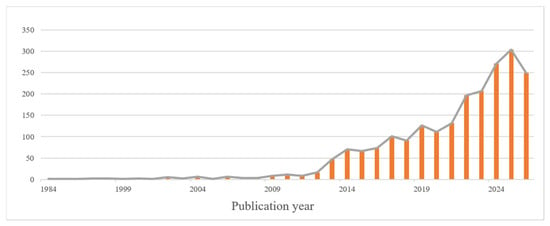
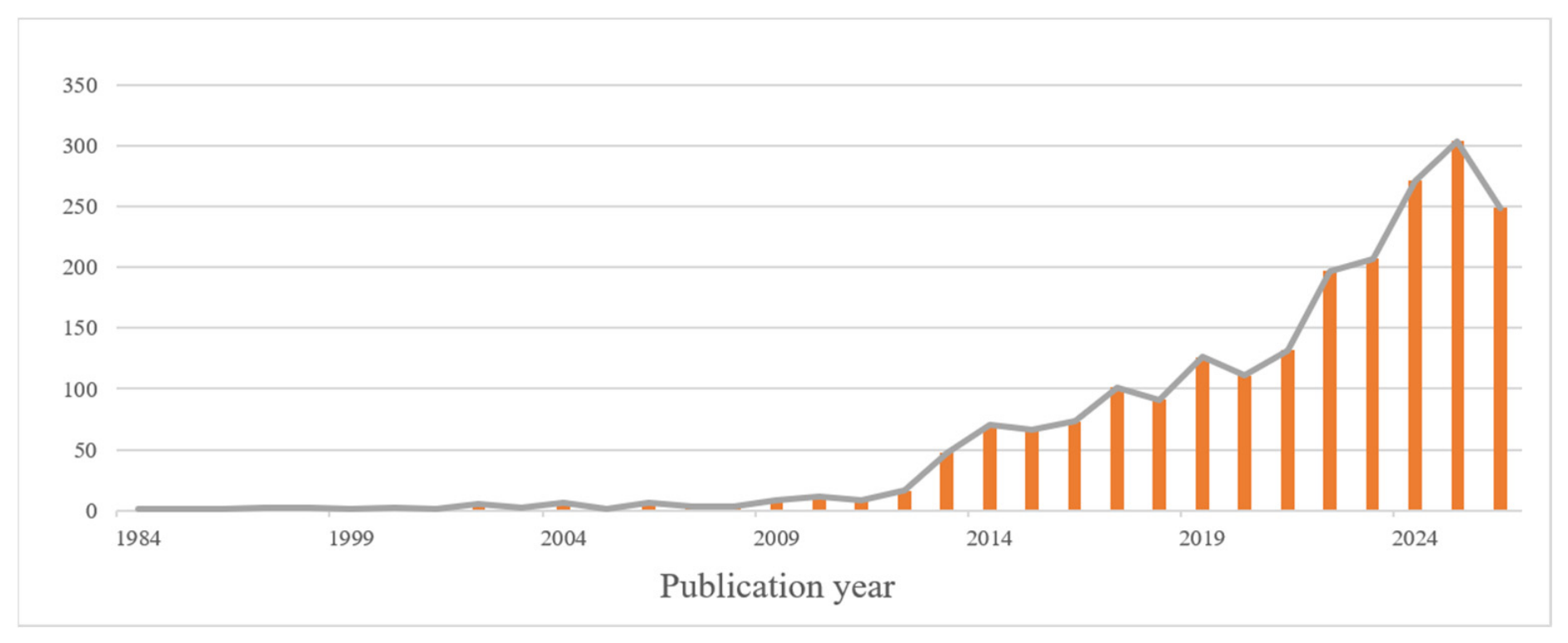
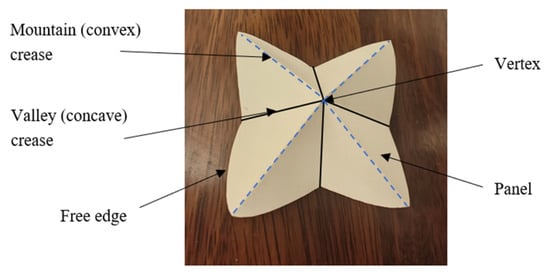
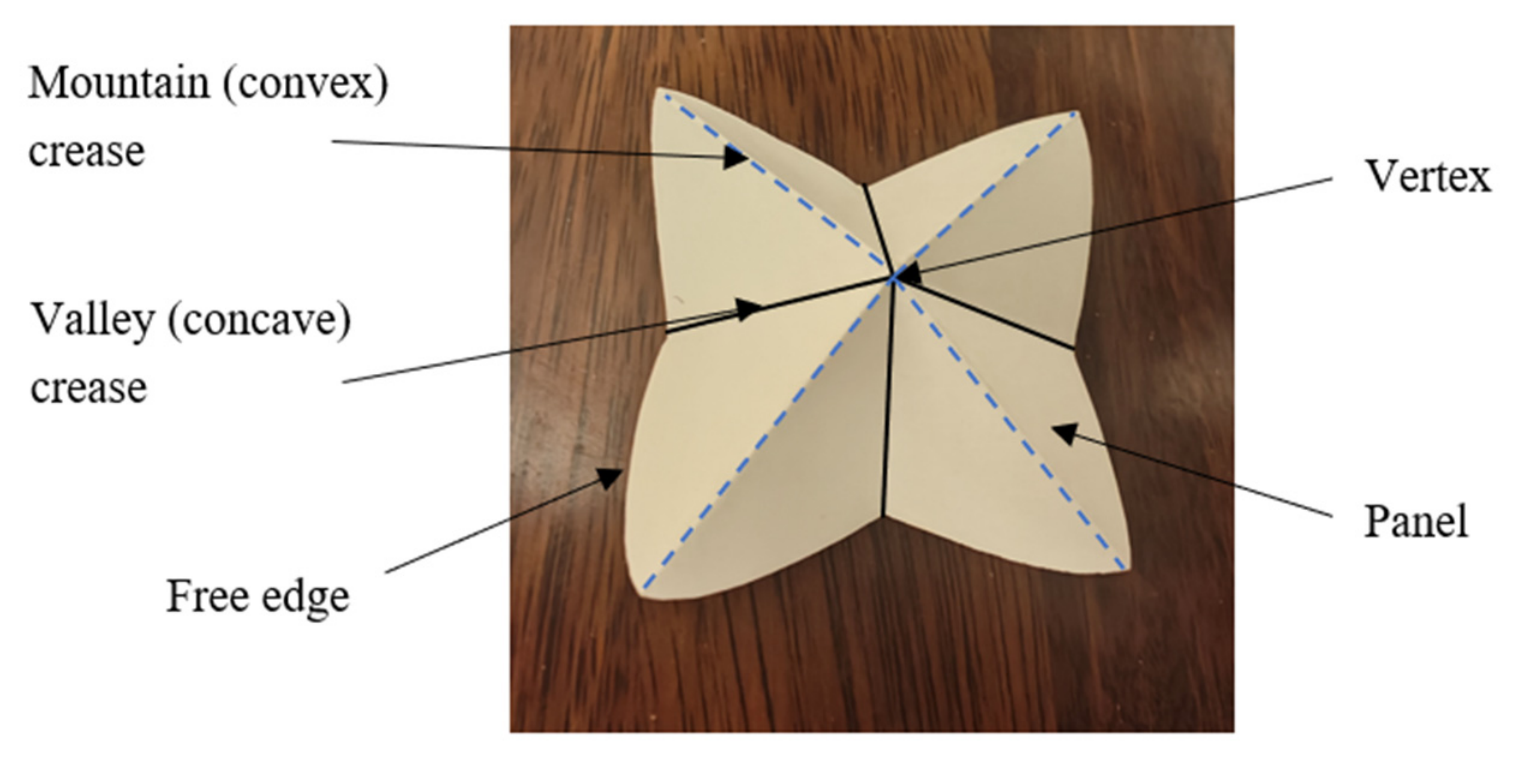
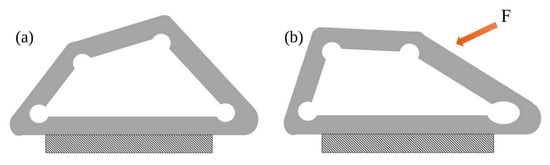
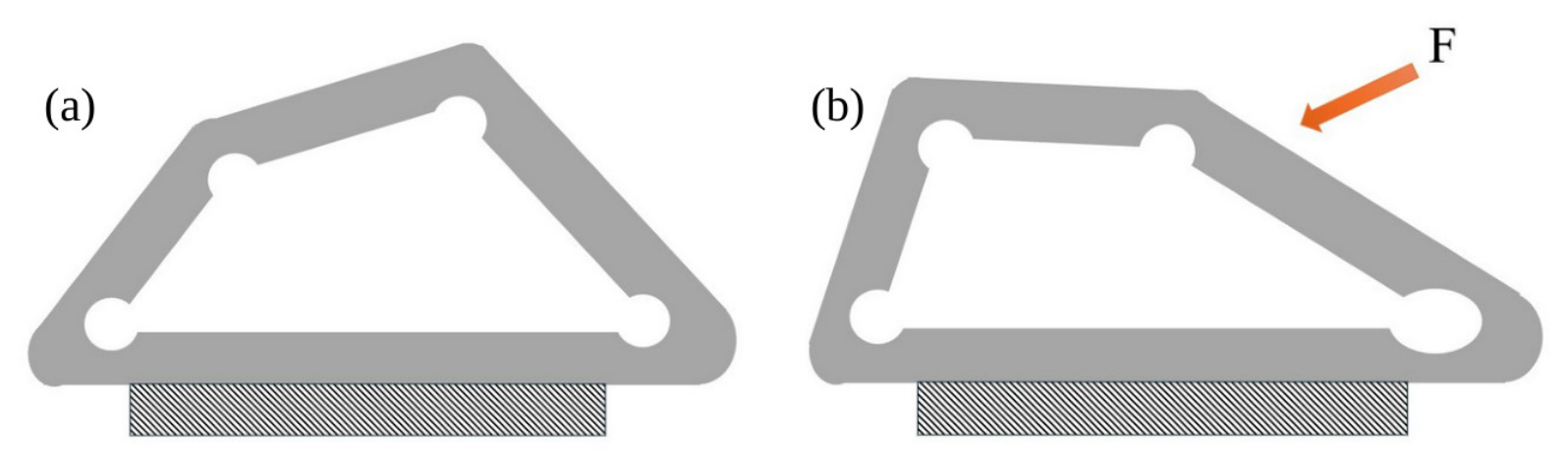
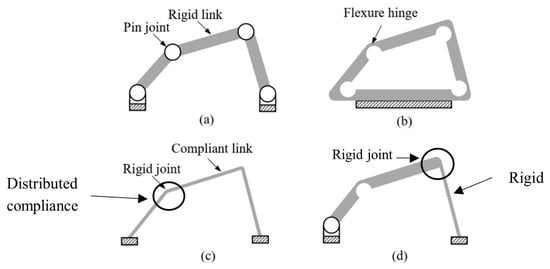
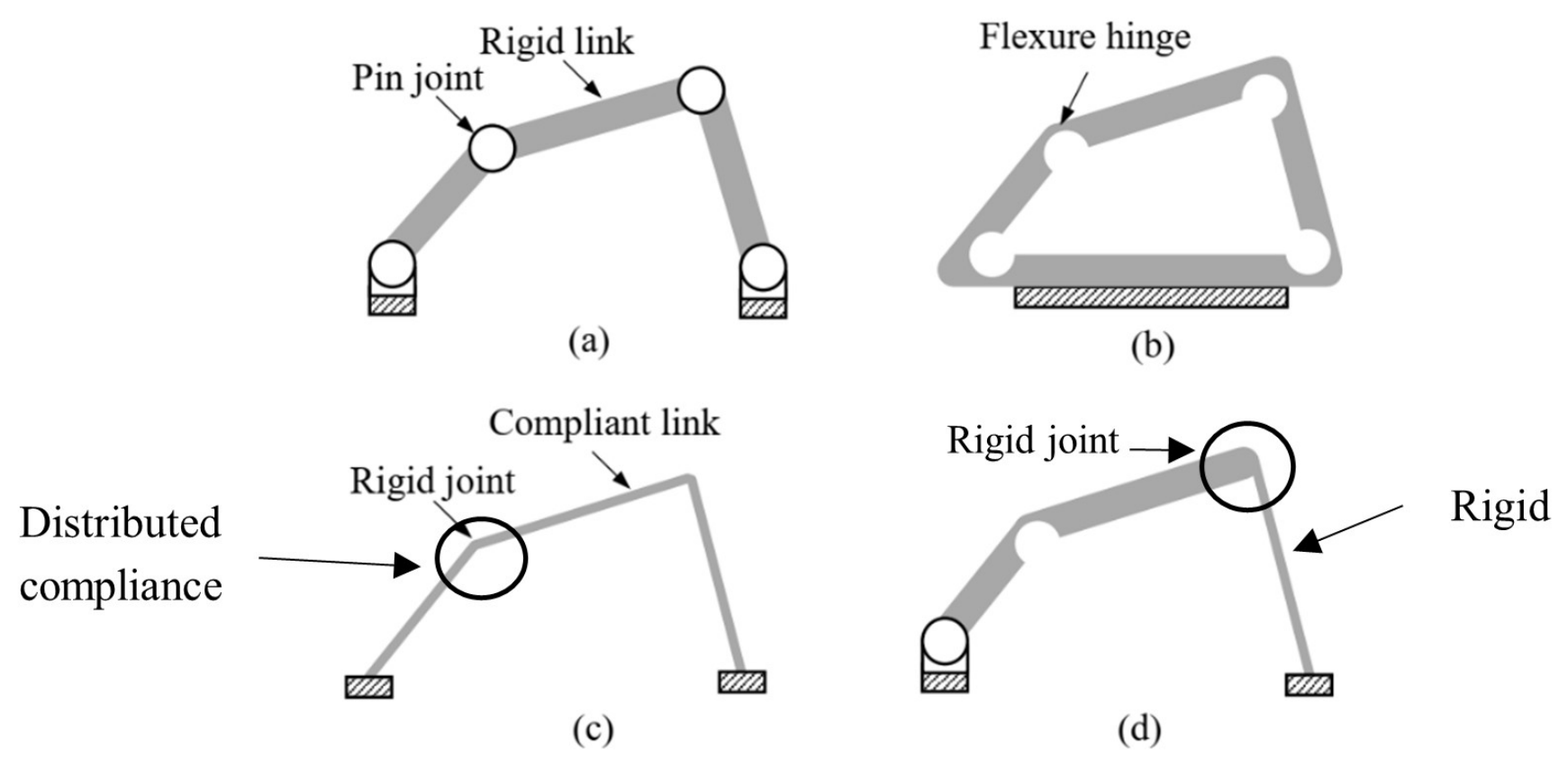
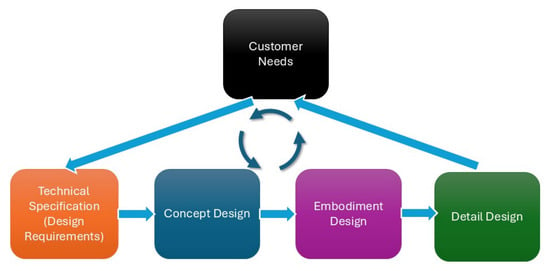
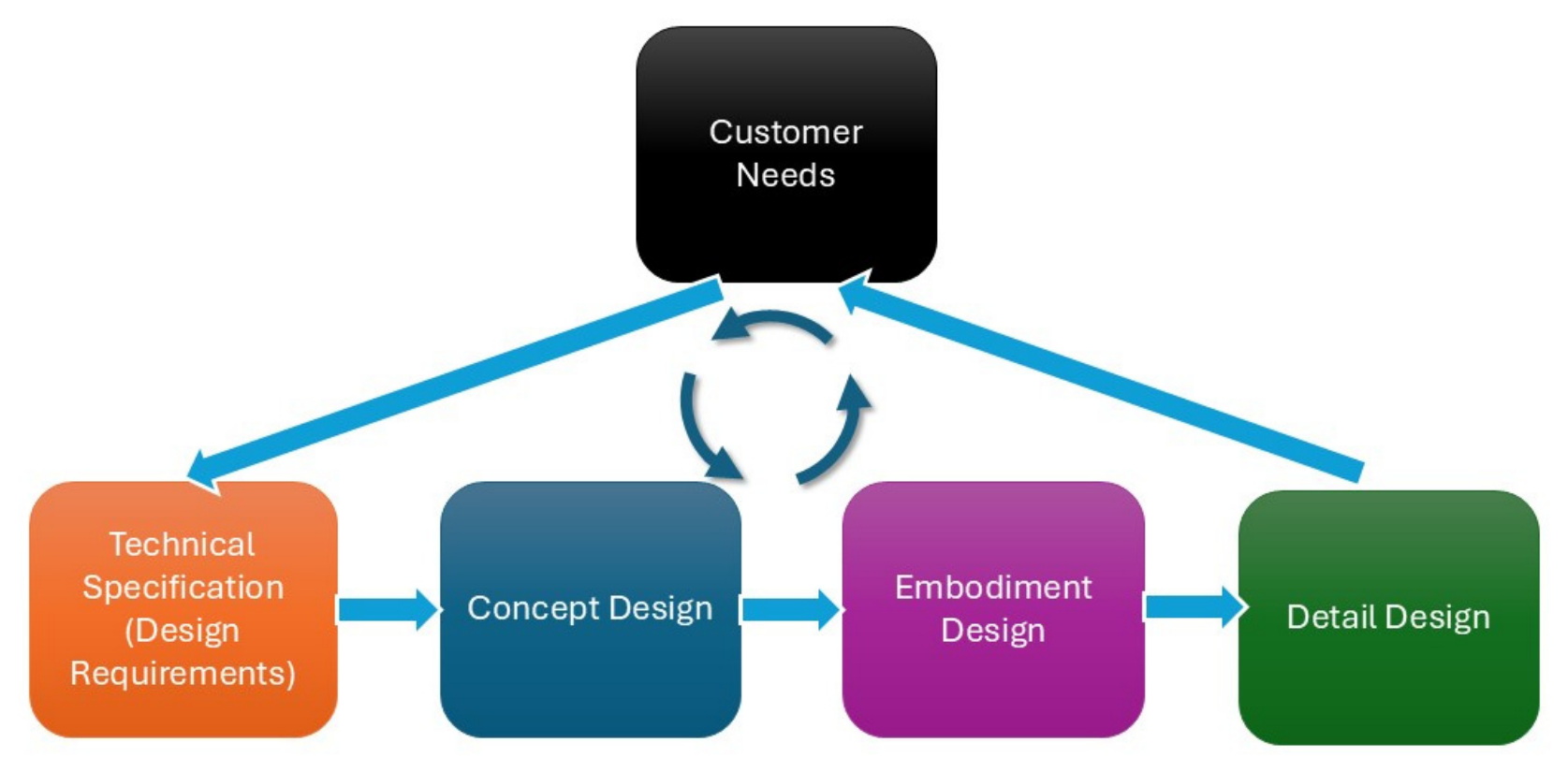
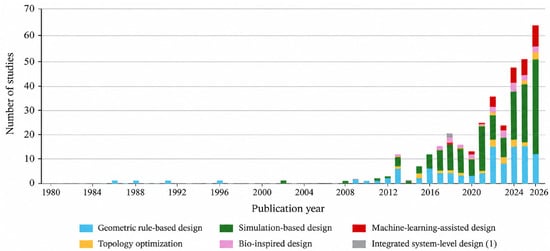
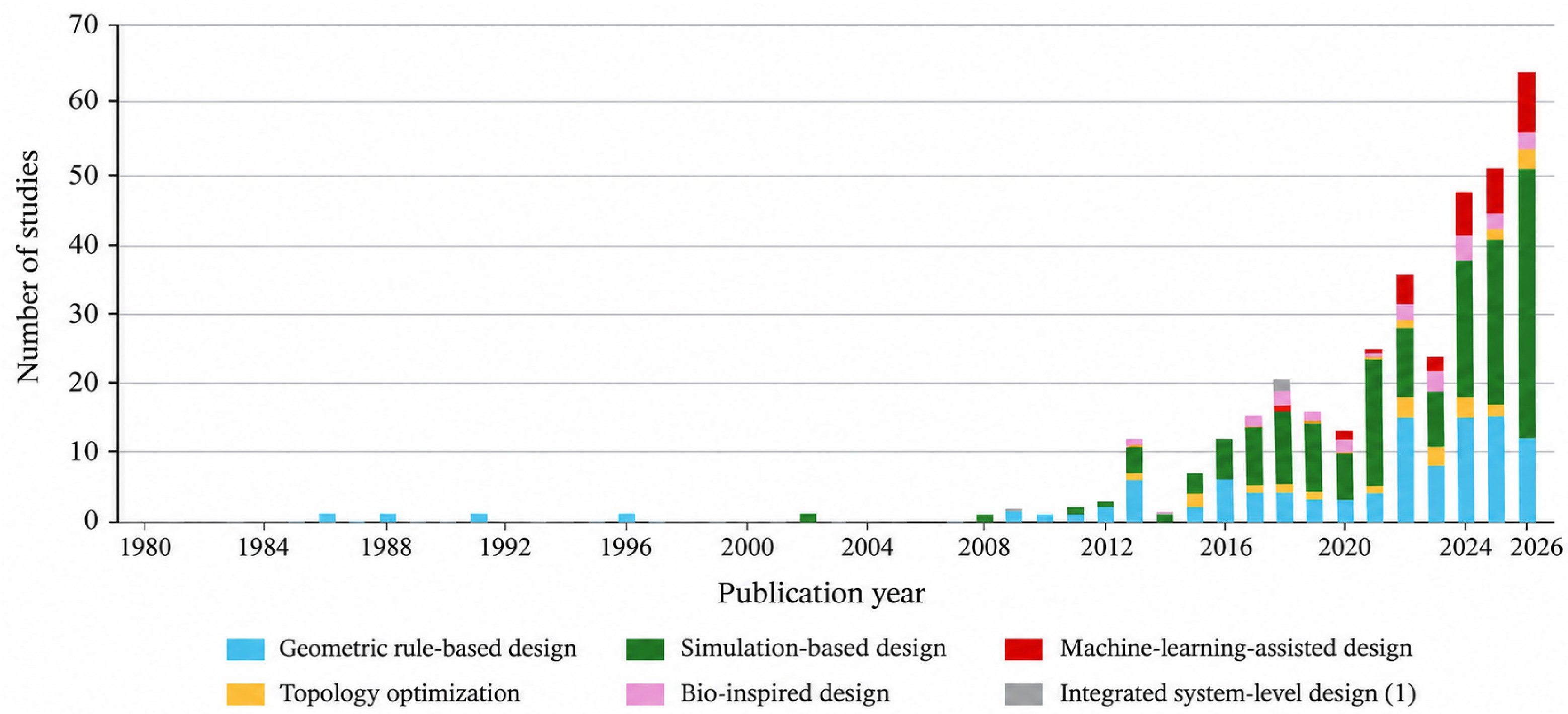
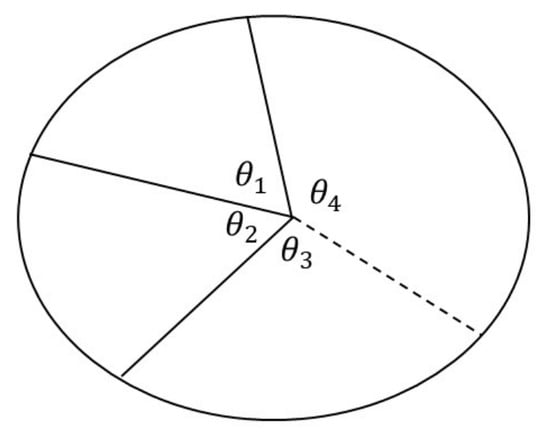
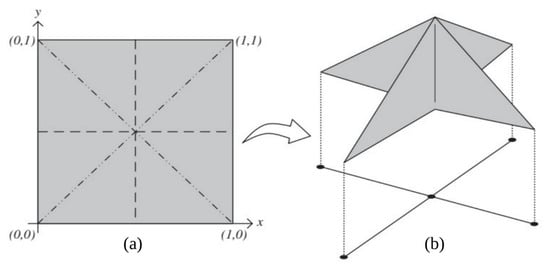
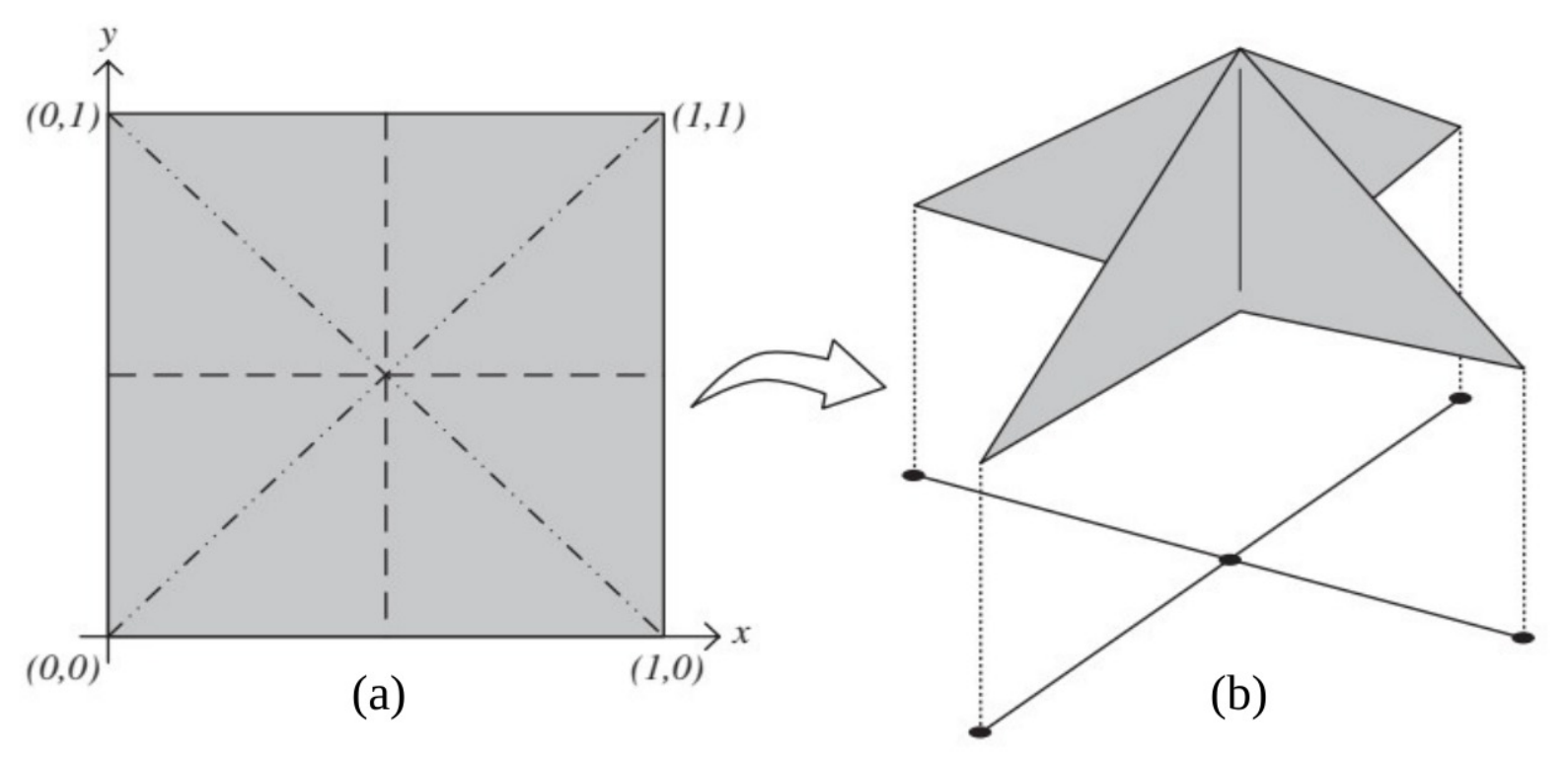
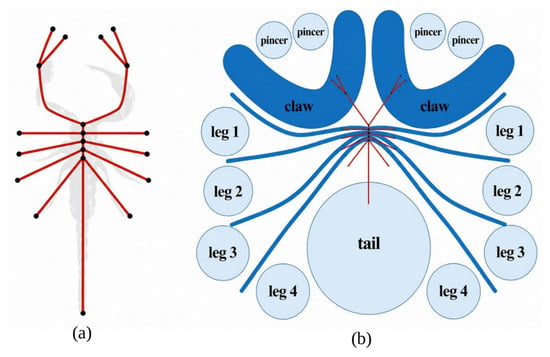
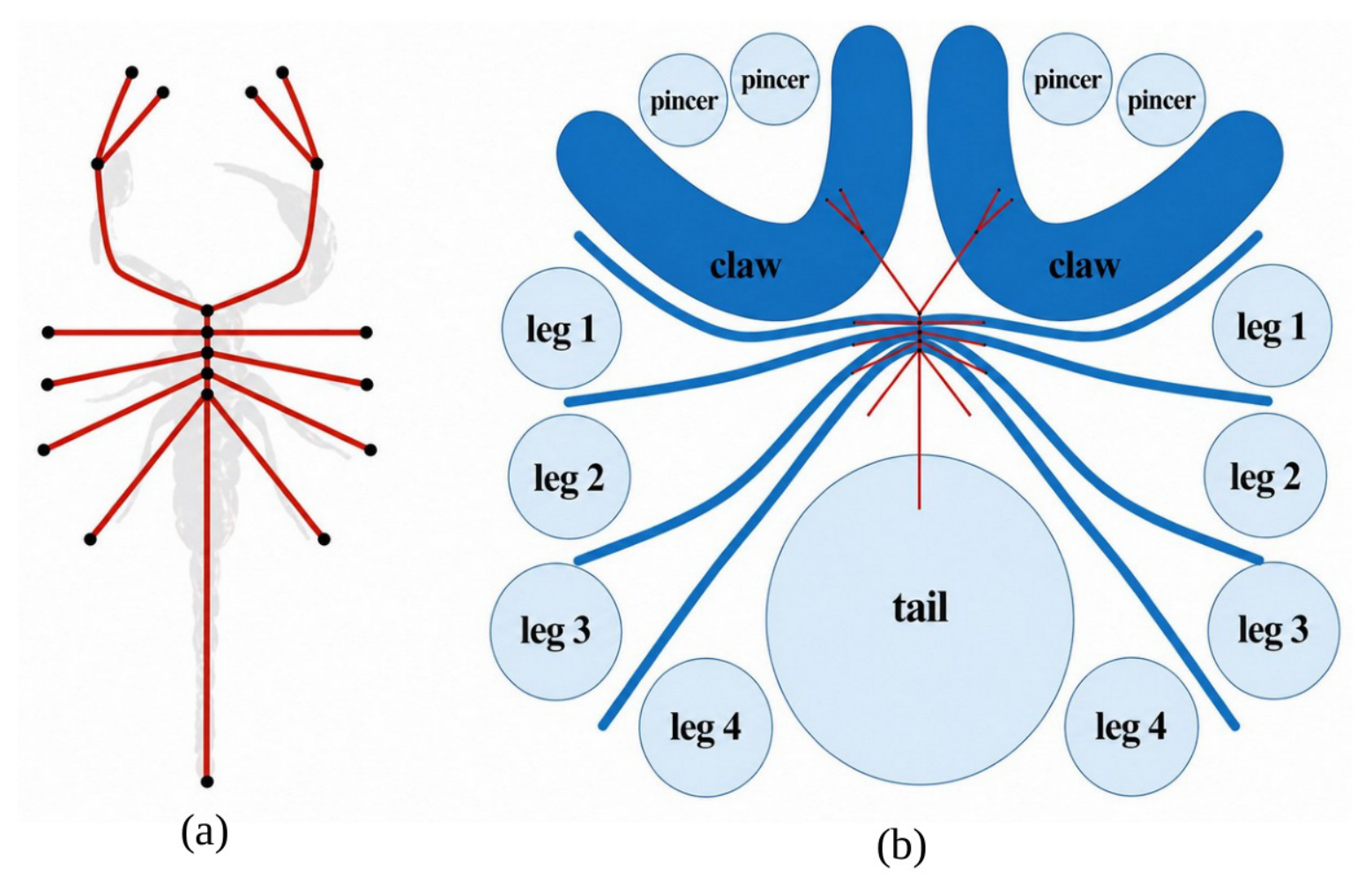
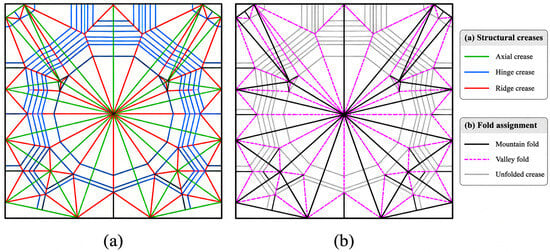
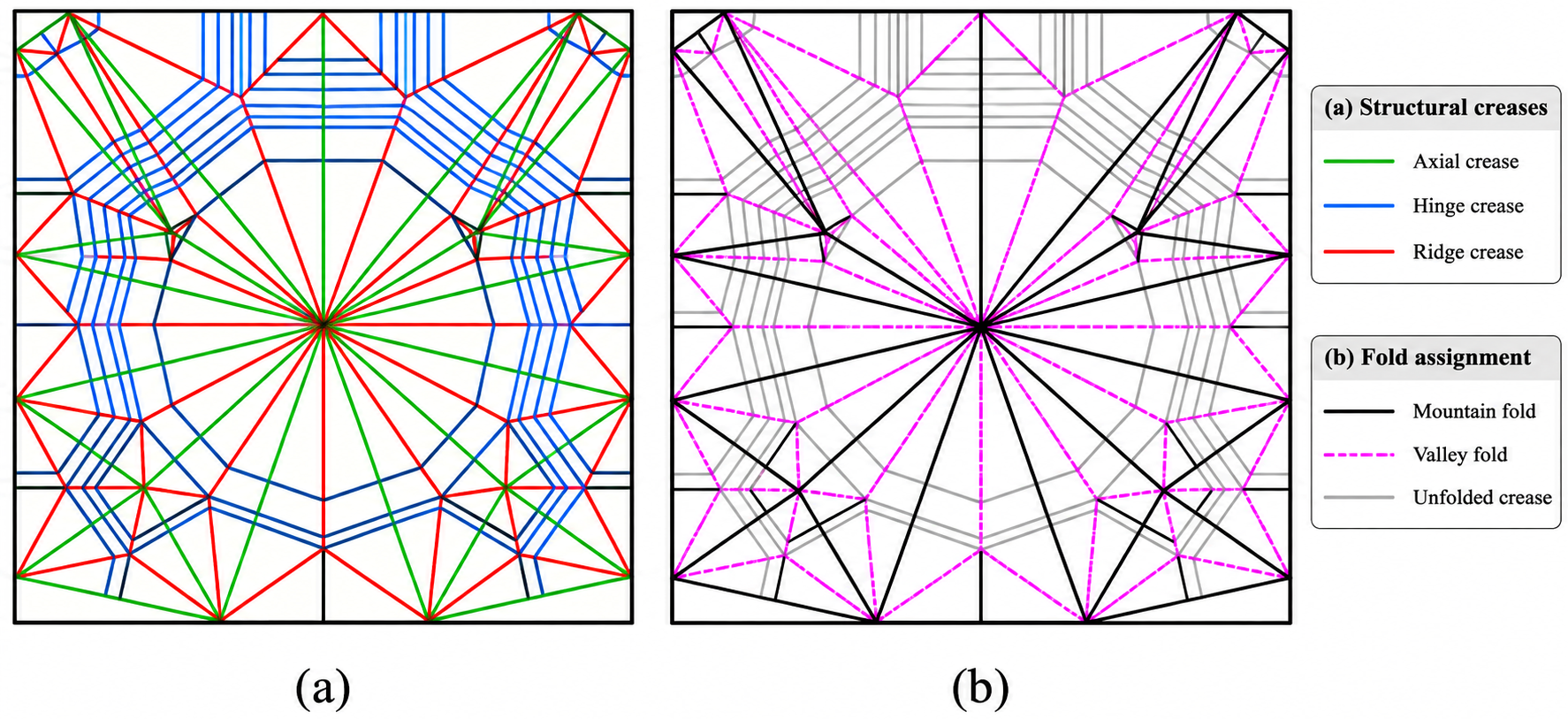
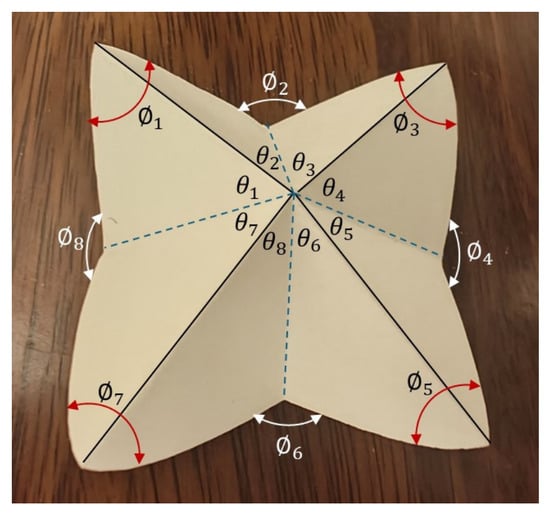
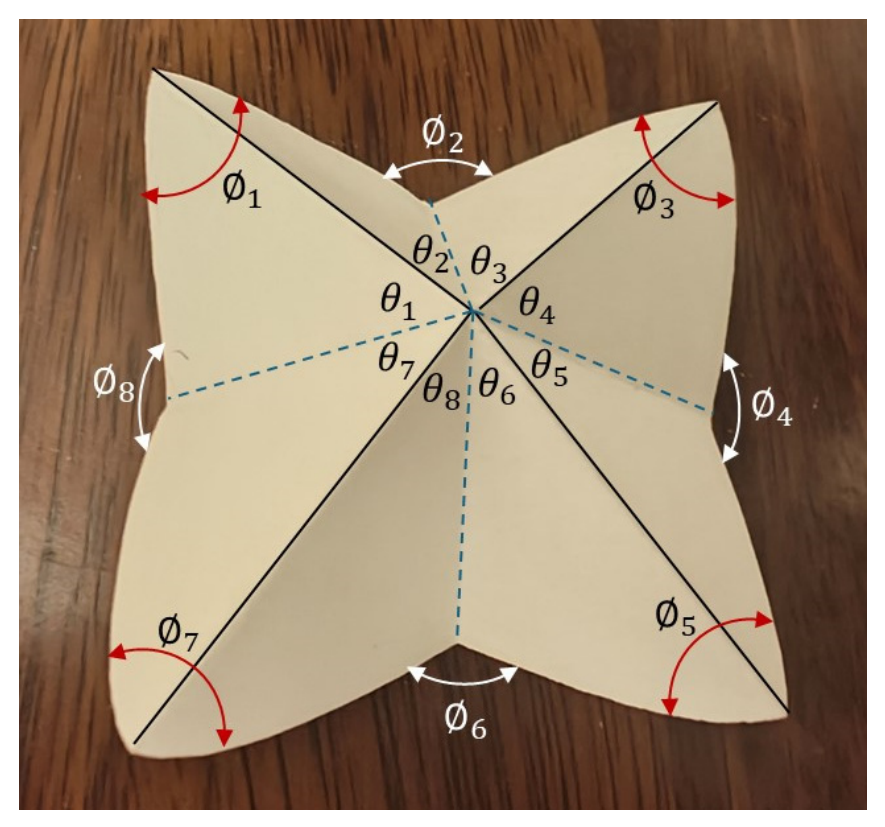
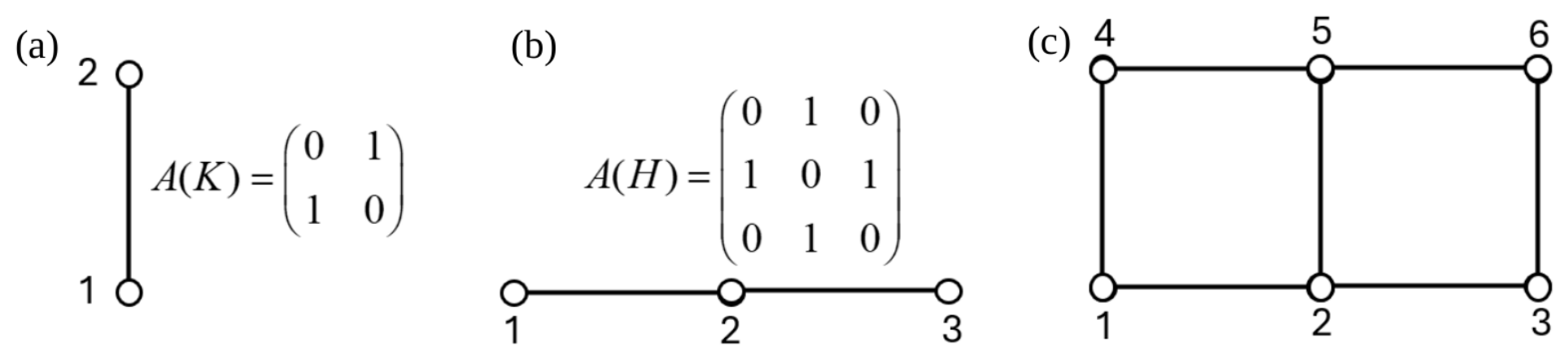
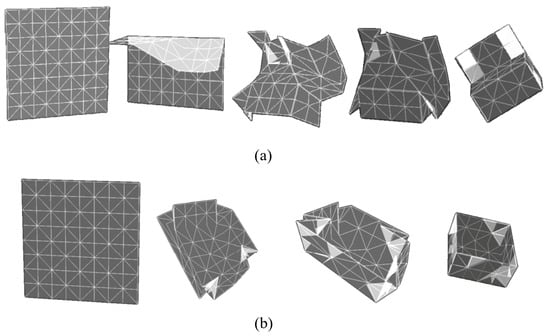
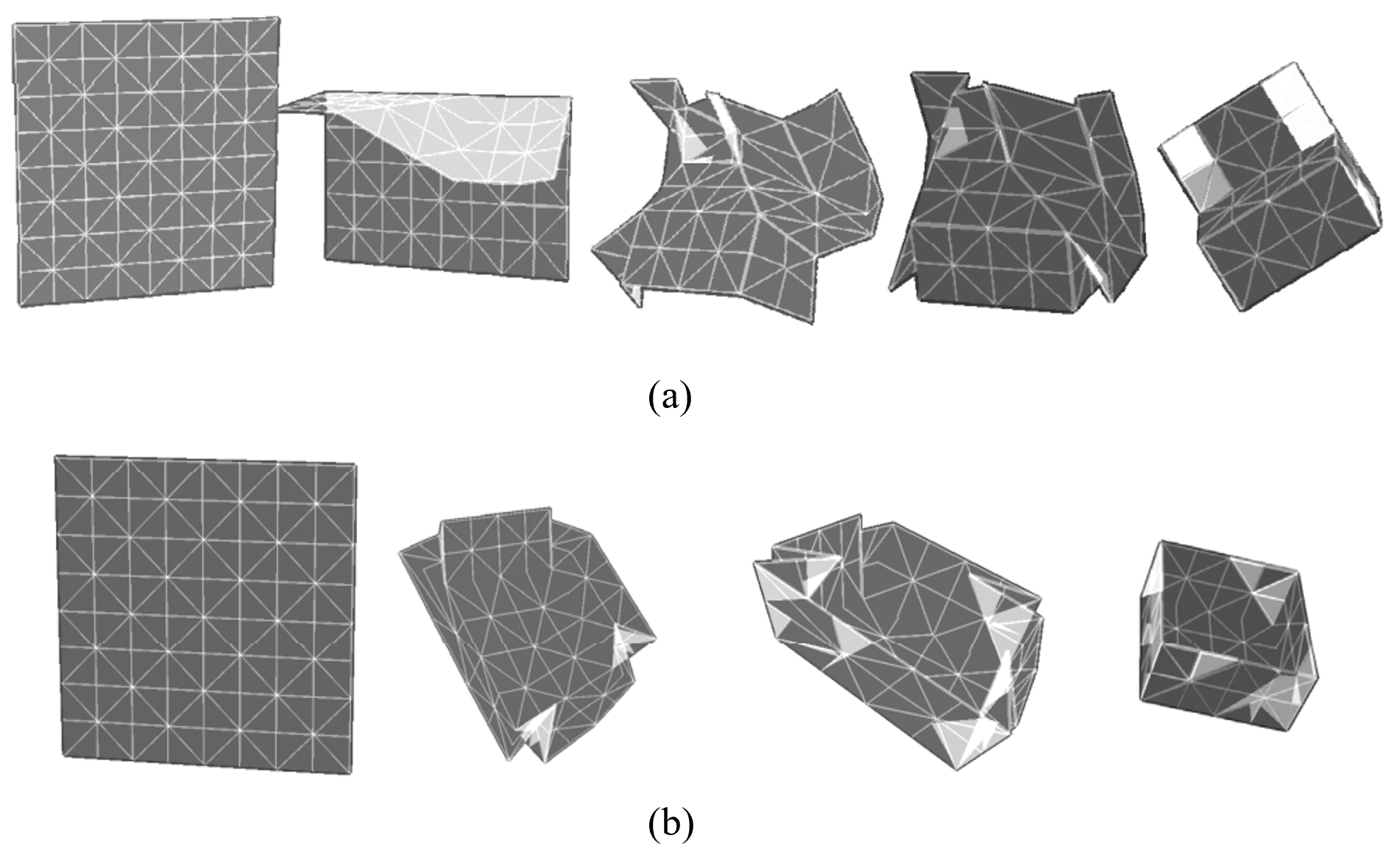
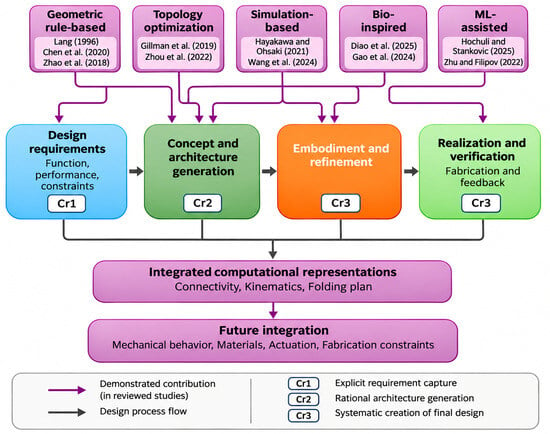
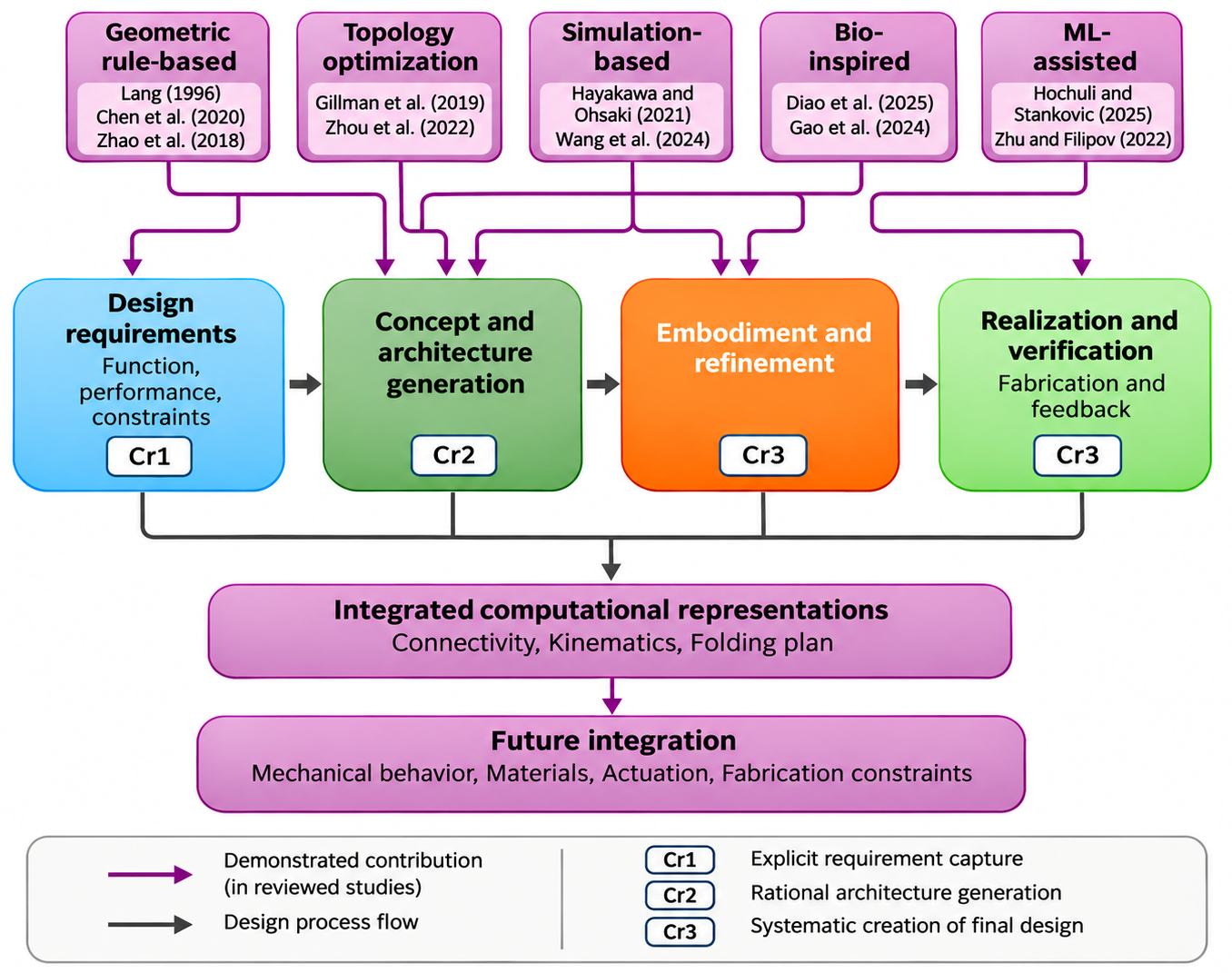

Disclaimer/Publisher’s Note: The statements, opinions and data contained in all publications are solely those of the individual author(s) and contributor(s) and not of MDPI and/or the editor(s). MDPI and/or the editor(s) disclaim responsibility for any injury to people or property resulting from any ideas, methods, instructions or products referred to in the content. |
© 2026 by the authors. Licensee MDPI, Basel, Switzerland. This article is an open access article distributed under the terms and conditions of the Creative Commons Attribution (CC BY) license.