


Abstract
Industrial hydraulics has made extensive use of the electro-hydraulic actuator (EHA) system. However, prevalent limitations such as uncertainties, non-linearities, and disturbances exist in most mechanical systems and restrict the optimal operation of the EHA system. To address these issues effectively, this study proposes a particle swarm optimization (PSO)-tuned fractional-order proportional-integral-derivative (FOPID) controller. Firstly, the EHA system is modeled using system identification. Then, by modifying the fractional order of the proportional-integral-derivative (PID) algorithm, a reliable controller is established and PSO has been applied to obtain the optimal FOPID controller parameters. Finally, the comparison works are conducted through simulation and experiment between the proposed FOPID and the proportional-derivative (PD) and PID controllers. Based on the error analysis evaluated in the designed sinusoidal (0.35 Hz), point-to-point, and chaotic responses, a significant improvement of 97.7%, 98.4%, and 97.8%, respectively, has been achieved by the FOPID controller as compared with the PD controller and 64.7%, 51.8%, and 47.5%, respectively, has been accomplished in comparison to the experiment’s PID controller. Furthermore, under extreme variation conditions, the proposed FOPID controller produced significant system performance improvement by 84.3% relative to the PD controller and 36.8% relative to the PID controller.
1. Introduction
The French physicist Blaise Pascal first detailed the advancement of fluid power technology in 1663, which then led to the invention of the electro-hydraulic actuator (EHA) system at the turn of the 20th century. Merritt first released the comprehensive overview of hydraulic systems, often known as fluid power technology, in 1967 [1]. An open-loop hydraulic actuator was driven by a flow control device in the hydraulic systems of the early generation. Through changing times and the advancement of technology, the hydraulic system jointly together with an electrical system is then formed as EHA system. Using the electrical signal, the electro-hydraulic control valve manages to control the flow of pressurized fluids that are produced from the motor pump to the actuator of the EHA system to achieve precise trajectory tracking. A hydraulic actuator, a hydraulic control valve, and a hydraulic pump constitute a typical EHA system, according to Merritt (1967). A cylinder is the hydraulic actuator that generates linear motion. A hydraulic motor is the hydraulic actuator that generates rotary motion. Through a variety of flexible hoses and small tubes, the EHA system can deliver high force densities to a wide range of hydraulic actuators. Since it can bend, clamp, press, and hoist heavy-duty equipment, the EHA system has gained a lot of popularity in various advanced technology applications, including those in the manufacturing sector [2,3]. The EHA system is also compact and lightweight, which makes it perfect for usage in the automotive and transportation industries [4,5]. Advanced controllers can be used to integrate the EHA system into a practical application, greatly improving the system’s responsiveness.
The most important steps in the engineering design strategy for using new technologies are modeling and control. As a result of the EHA system being intrinsically uncertain, extremely time-varying and non-linear, developing a dynamic model that is accurate is challenging, which makes modeling and controller design more difficult. The actuation system’s non-linearity is greatly influenced by control valve backlash, the characteristics of non-linear flow and pressure, the hydraulic actuator’s internal friction, fluid compressibility variations and confined fluid volume brought on by piston action. Despite the substantial deficiencies of the EHA system, its current applications highlight the importance of hydraulic actuators in current technological advances. The literature shows that because the broad applications of the EHA system, scholars and researchers have published extensively about trajectory tracking control [6,7]. As a result, this research will concentrate on several EHA system control techniques, particularly the control of trajectory tracking.
Owing to their exceptional power-to-weight ratio, high force capacity, and versatile linear actuation, EHA systems are increasingly adopted in industrial applications for example press machines that use hydraulics, work-holding setups, injection molding equipment, electro-hydraulic excavators, and drilling rigs [8]. Driven by the Industry 4.0 framework initiated by the German government in 2013, conventional hydraulic architectures have evolved through enhanced functional specifications to enable intelligent EHA capabilities [9]. The advancement of EHA control systems is essential to fulfilling new demands such as computing devices, electronic devices, and technology for an industry that is always progressing, especially the response at high frequencies, and this became the focus of the research.
Current industrial tracking systems have been the subject of extensive studies relating to the EHA for a range of applications, such as robotics [10], fatigue testing systems [11,12], motion simulators [13], and mining [14]. It is presently anticipated that the process of simulating the EHA systems’ non-linear dynamic behavior would involve investigation under the best circumstances and produce extremely accurate models due to the substantial developments in the technology of the computer and the theory of control technology. As a result, traditional feedback controls, like PID controllers, possess the ability to do tuning with ease [15], and are able to further increase and enable the development of optimal performance trajectory tracking control; additionally, it is the motivation for this study.
Despite offering fast dynamic response times, excellent power-to-weight ratio, and high structural stiffness, EHA systems exhibit severe non-linear behaviors and modeling variations. Factors such as friction, parameter variations, and fluid leakage significantly complicate the development of trajectory tracking control strategies. To address these issues, various advanced control strategies have been extensively investigated in the recent literature. Sliding mode control (SMC) is widely favored for its fast dynamic response and high disturbance rejection, though standard implementations frequently induce high-frequency chattering on hydraulic components, requiring specialized reaching laws or variable surfaces to mitigate [16]. Model predictive control (MPC) offers superior multi-objective optimization and explicit constraint handling, but its real-time implementation is hindered by excessive computational complexity and sensitivity to model mismatches [17]. Adaptive control formulations successfully address state constraints and parameter drift; however, their algorithmic structure introduces high online computational overhead and vulnerability to sensor noise [18]. Additionally, active disturbance rejection control (ADRC) employs extended state observers to estimate and compensate for system uncertainties, yet multi-parameter observer tuning across wide operational envelopes presents practical limitations [19]. On the other hand, as the PID controller gained popularity in industrial fields, researchers were motivated to incorporate the controller into the EHA system especially for trajectory tracking control [20]. However, the PID controller can be further improved in order to obtain effective trajectory tracking control in the EHA system. In addition, numerous researchers find it difficult to obtain optimal control variables of the PID design during the implementation of the controller into practice [21]. Consequently, it is essential to use a proven metaheuristic approach to construct an efficient and reliable controller for the control of the trajectory tracking that relies on the PID approach in the EHA system.
The fractional-order PID (FOPID) controller serves as an exceptionally effective enhancement to the classical PID approach for EHA systems by expanding the traditional three-parameter (kp,ki,kd) design space into a continuous five-dimensional domain through non-integer integration (λ) and differentiation (μ) orders [22]. This structural evolution grants crucial frequency-domain advantages, most notably the iso-damping property, where a flat phase margin around the crossover frequency protects closed-loop stability against gain shifts caused by supply pressure drops or dynamic load variations. In practical EHA applications, FOPID directly addresses severe non-linearities such as fluid compressibility, spool-valve dead zones, and stick-slip friction by eliminating steady-state offset without triggering transient overshoot [23]. Consequently, when evaluated against standard integer-order PID controllers, FOPID consistently delivers superior trajectory tracking precision, faster response times, and higher overall operational resilience under severe parameter perturbations [24].
The expansion of conventional PID to FOPID control introduces two non-integer parameters alongside the proportional, integral, and derivative gains, yielding a five-dimensional, highly non-convex search space that renders traditional analytical tuning unviable [25]. To navigate this complex landscape, metaheuristic optimization algorithms have been extensively explored, revealing distinct convergence behaviors and tuning trade-offs. Genetic algorithms (GA) exhibit reliable global exploration across broad parameter bounds, but suffer from high computational complexity, slow convergence rates, and a tendency toward premature stagnation in fine-tuning stages [26]. Meanwhile, the gray wolf optimizer (GWO) schemes offer reduced parameter dependency and rapid initial search dynamics, yet they remain susceptible to localized entrapment when subjected to non-linear dynamic constraints [27]. In contrast, particle swarm optimization (PSO) achieves an optimal trade-off between global swarm exploration and localized velocity-driven exploitation. Comparative evaluations demonstrate that PSO consistently yields faster convergence velocities, lower computational overhead, and superior dynamic tracking accuracy with minimized performance index errors. Consequently, PSO emerges as the most effective and computationally efficient metaheuristic approach for real-time FOPID parameter tuning [28].
Therefore, this study focuses on improving the trajectory tracking performance of an EHA system through the development of an advanced control strategy. The primary objective is to design a FOPID controller that can effectively handle the non-linear characteristics and dynamic uncertainties commonly present in EHA systems. To simplify the controller design process and achieve optimal control parameters, a PSO algorithm is employed. The PSO technique is utilized to automatically tune the FOPID controller parameters, aiming to enhance tracking accuracy, system stability, and overall control performance while reducing the complexity associated with conventional tuning methods. Beyond theoretical design, this study validates the practical feasibility and performance of the proposed PSO–FOPID strategy through real-time implementation on a laboratory-scale EHA testbed. Experimental validation is conducted under extreme variation conditions to assess the controller’s performance and adaptability to operating disturbances. The proposed PSO-FOPID controller performance is analyzed in accordance with its ability to maintain accurate trajectory tracking despite changes in hydraulic pressure that may affect system dynamics. Through both optimization and experimental testing, the research aims to demonstrate that the PSO-tuned FOPID controller can provide reliable, efficient, and strong control performance under extreme variation conditions for electro-hydraulic actuator applications in real-world operating environments.
2. Methods
This research study’s approach has been meticulously designed, starting with preliminary work on the model identification of an EHA system. For many years, research on EHA systems has utilized local linearization to approximate non-linear dynamics occurring throughout the modeling process [29]. In real situations, the majority of physical systems will exhibit non-linearities and unpredictable dynamic behavior. However, it is necessary to describe the mathematical model and the physical system as a linear model that can, at least within one operational point, capture the key dynamic properties. To achieve optimal trajectory tracking in electro-hydraulic actuator (EHA) systems, studies demonstrate that linear models are often sufficient when paired with advanced control strategies [30,31,32].
As a preliminary work, a linear mathematical model of the EHA system under nominal operating conditions (6 MPa) was derived using the gray-box system identification approach within the MATLAB System Identification Toolbox. Using R2021b MATLAB/SIMULINK, the derived model was simulated for a closed-loop operation without a controller for a sinusoidal trajectory. The model was then validated using closed-loop measurements on the experimental design workbench for the EHA system. At the conclusion of the preliminary study, the resulting model of the EHA system was considered well-established and was used for the design and analytical development of the proposed controller.
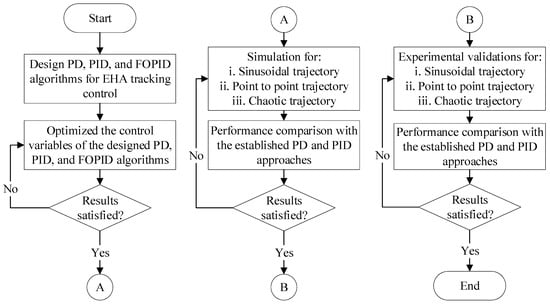
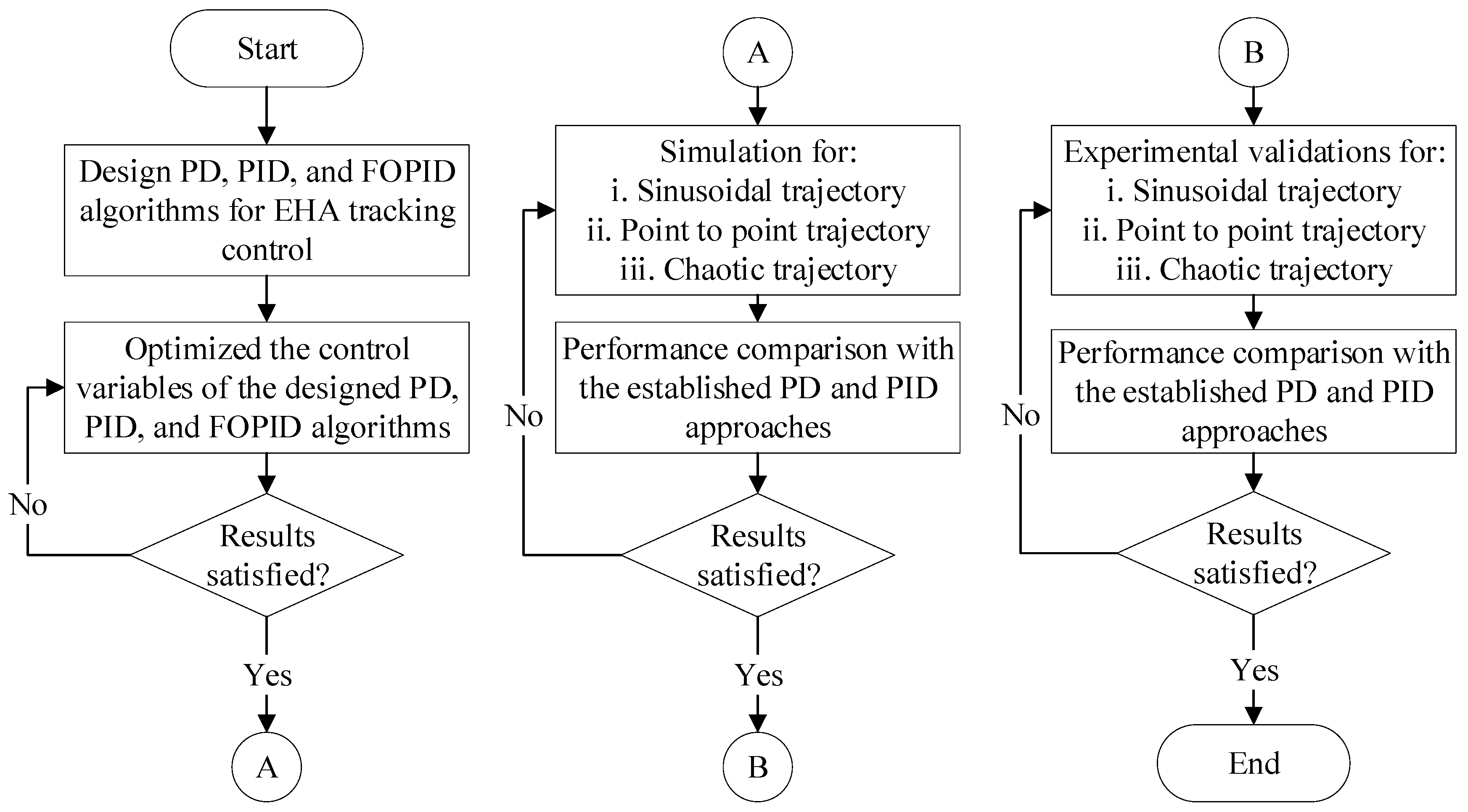
Figure 1 depicts the whole methodological process, which began with designing the algorithms of the controllers, optimizing the control variables of the controllers, and validating the proposed FOPID controller through experimentation. To ensure optimal trajectory tracking performance in the EHA system, the proposed FOPID controller was synthesized across the first two methodological phases. The PSO algorithm, which necessitates fewer mathematical formulations, was used to identify the optimal variables for the FOPID controller. Lastly, the performance between the optimized FOPID controller and the optimized conventional PD and PID approaches, which use the same PSO algorithm, were both analyzed and compared. Through simulations made with the EHA model created in earlier preliminary work and measurements on the EHA system workbench for different trajectories, the trajectory tracking performance of the EHA system using the FOPID controller was examined. The chaotic trajectory was also used to conduct a system performance analysis under extreme variation conditions. The effectiveness of the proposed FOPID controller was then evaluated and compared with that of the conventional PD and PID approaches.
Figure 1.
A structured schematic illustrating the procedural steps, analytical workflow, and experimental design implemented throughout the execution of this research study.
2.1. Simulation and Experimental Tools
The following is a list of the simulation software and experimental equipment that were used in this study:
- To simulate the EHA’s proposed controller, a R2021b software version of MATLAB with SIMULINK were utilized to model and design them. The model was configured for the ode5 (Dormand-Prince) solver with a fixed-step size of 1 ms.
- The hydraulic actuator was driven by a proportional directional valve with the Bosch Rexroth AG, Lohr am Main, Germany model number 4WREE6E08-2X/G24K31/A1V. The maximum flow rate of the proportional directional valve is 80 L per minute. Other specifications include a maximum operating pressure of 31.5 MPa, a solenoid coil resistance of 2.65 ohm, a supply voltage of 24 volts, and a command value range of 0 to 10 volts.
- In this study, a single-rod double-acting cylinder hydraulic actuator made by Bosch Rexroth AG, Lohr am Main, Germany was considered. The hydraulic actuator has a 200 mm stroke, a 25 mm rod, and a 40 mm cylinder bore.
- This study used a hydraulic power pack (Bosch Rexroth AG, Lohr am Main, Germany) with a 60 L tank, a 2200 watt motor, a 16.6 L per minute flow rate, and a nominal supply pressure of 6 MPa.
- For feedback control in this study, a wire displacement sensor made by TE Connectivity Ltd. (Schaffhausen, Switzerland) was used. The wire displacement sensor has a measurement range of 0 to 317 mm, a 30-volt input voltage, and an output signal that is 94% ± 4% of 30 volts.
- A National Instruments PCIe-6321 card (Austin, TX, USA) was utilized as a data acquisition (DAQ) system to gather data for this investigation.
2.2. Experimental Design
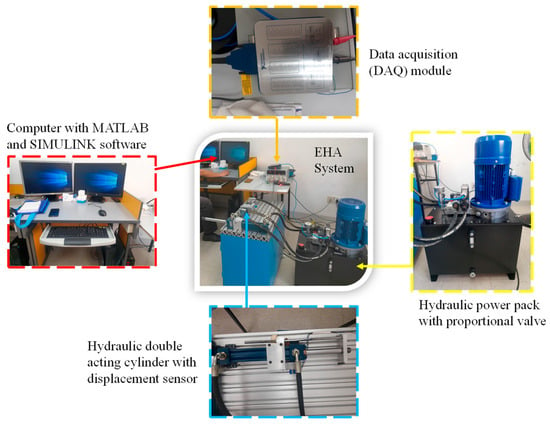
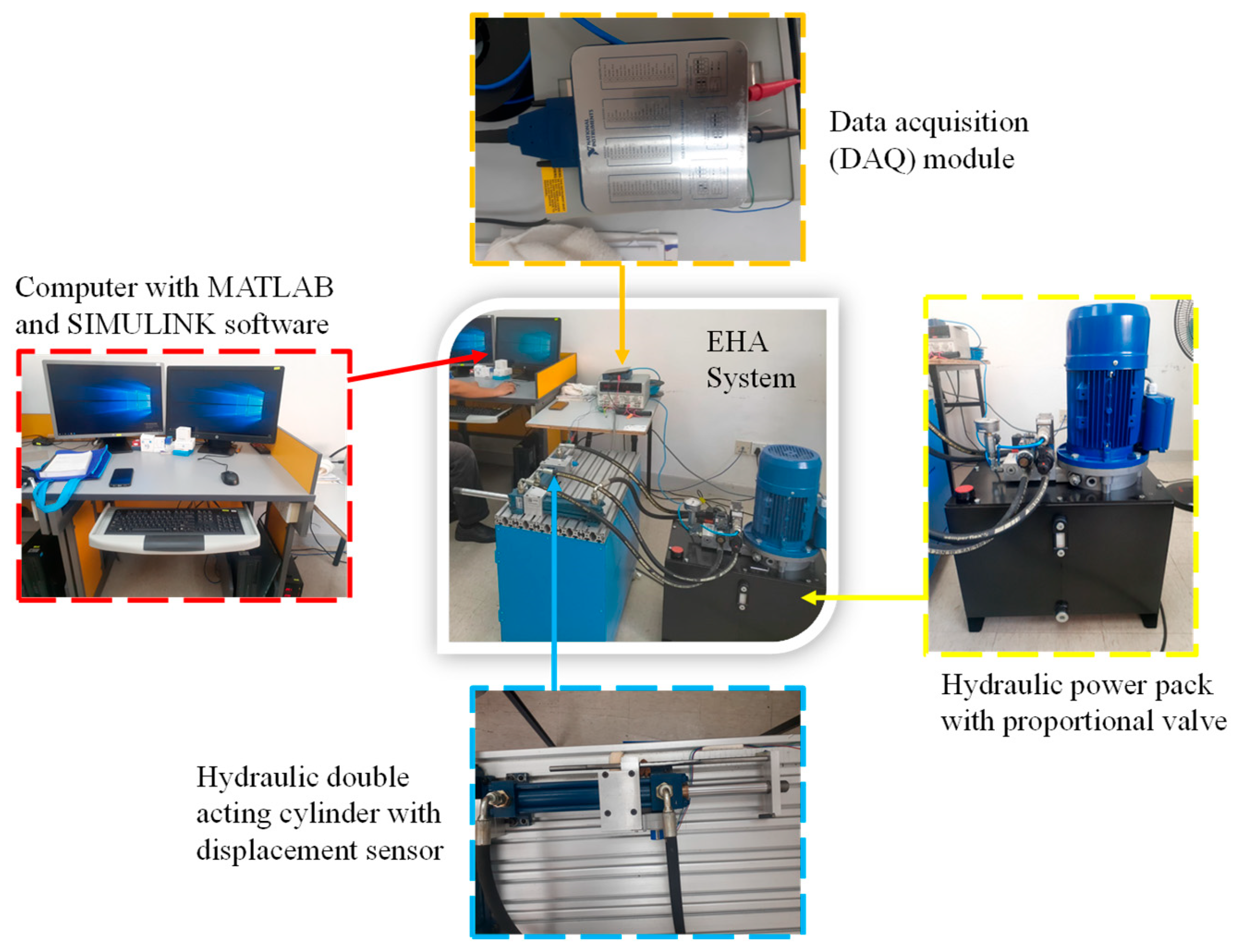
As depicted in Figure 2, an instrumented workbench of the EHA system for the experimental system was designed and installed at the Centre for Robotics and Industrial Automation (CeRIA), Universiti Teknikal Malaysia Melaka (UTeM). The experimental measurements of evaluation and validation use a slow sampling rate of 1 ms.
Figure 2.
A detailed schematic layout illustrating the physical configuration, control interfaces, and essential hardware components forming the electro-hydraulic actuator system setup.
The EHA system utilizes a hydraulic double-acting cylinder with a 40 mm bore diameter and a 25 mm rod diameter, controlled via a proportional directional control valve rated 31.5 MPa for a maximum supply pressure and 80 L/min is the maximum flow rate. Real-time stroke displacement is acquired through a wire displacement sensor. The valve is positioned in close proximity to the double-acting cylinder, rendering pipeline dynamic effects negligible. In low-frequency operation, pipeline effects have little impact on input–output behavior. The structural configuration of the power supply unit is specifically designed to regulate and stabilize system pressure throughout the targeted operating range. To improve dynamic performance, non-linear behavior and system uncertainties were removed using an effectively constructed and designed proportional directional control valve. The hydraulic cylinder’s dynamic response time is slower than that of the proportional directional control valve. As a result, it was never considered [33].
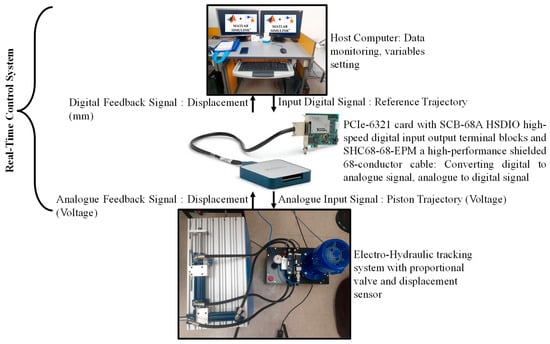
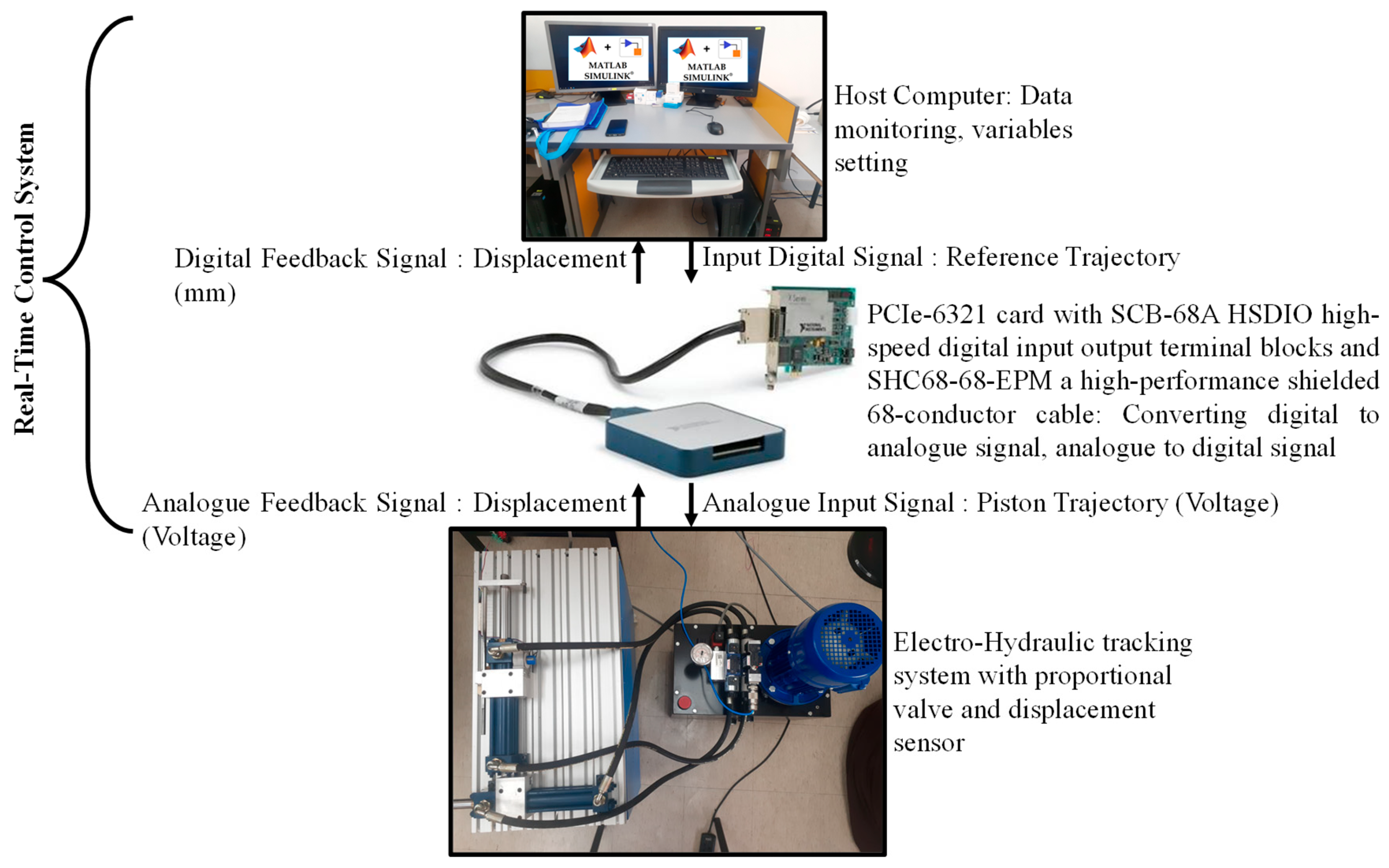
In Figure 3, the EHA system’s control system is physically depicted. It displays the gear and software setup used to collect the research’s data. The experimental control platform consists of a host computer operating as the human–machine interface, a 16-bit PCIe-6321 A/D and D/A card utilized for control signal acquisition and generation and associated peripheral devices. This is realized after it is integrated with the PCIe-6321 card. Using MATLAB/SIMULINK, the host computer then executes the programmed proposed control algorithm along with the comparison designed controllers. The experimental system’s sample rate has been chosen to be 1 kHz to ensure satisfactory performance.
Figure 3.
Control schematic diagram for EHA system workbench.
The DAQ system received digital output from the computer during experiment execution and produced a signal in the form of voltage before it is received by the proportional directional control valve. The double-acting hydraulic actuator receives pressured fluid under control from the proportional directional valve, which causes a controlled displacement of the piston. The piston’s trajectory was measured by the wire displacement sensor. The DAQ system then transferred the sensor signal back to the computer unit after converting it to a digital signal. In order to validate the system performance, experimental measurements gathered during testing were compared directly with time-domain simulation data to evaluate and compare overall response trends. Furthermore, evaluation of the tracking efficacy and dynamic system performance analysis of the proposed controller, the closed-loop experimental trials were executed under extreme variation conditions.
2.3. Gray-Box Identification
Since many years ago, the EHA system has used model linearization to address the non-linearities that can occur throughout the modeling process. Li et al. claimed that many researchers have effectively used linear models for their proposed control strategies design [34]. In real situations, the majority of physical systems will exhibit non-linearities and unpredictable dynamic behavior. The mathematical model can therefore also be stated in a non-linear manner. For further theoretical analysis, the physical system and corresponding mathematical model are linearized at a designated operating point to preserve the dominant system dynamics. Merritt (1967) also came to the conclusion that an EHA system’s linear model is often applicable over a wide range. Consequently, proficient strategies of control must be deployed to achieve precise trajectory tracking in EHA systems, and linear modeling offers a satisfactory framework.
Since it places greater emphasis on the mathematical side of generating a useful linear model of the EHA system, a parametric approach was used in this study. Additionally, a non-parametric approach makes it easy to obtain the results, but the model that emerges from it may occasionally be wrong. In this research, a third-order mathematical model of the EHA system in (1) is regarded as well defined by Knohl and Unbehauen (2000) [35], where a0, a1, and a2 are the parameters that will be estimated using the R2021b MATLAB System Identification Toolbox.
Using a sum of sinusoid input signals, the open-loop experiment was conducted on the EHA system workbench, as shown in Figure 2. Zulfatman and Rahmat had previously used a comparable excitation signal for EHA system identification [36]. The general form of the sum of sinusoidal signals is expressed in Equation (2), where bi represents the signal amplitude, fi is the input frequency, and p denotes the number of model parameters.
As shown in (1), three model parameters must be estimated. Consequently, an open-loop input signal with three distinct frequencies and amplitudes was designed and applied according to (3). Following data acquisition, trend filtering, specifically detrending and high-pass filtering, was applied to the raw dataset within the MATLAB System Identification Toolbox to remove low-frequency drifts and offsets. Finally, parameter estimation and cross-validation were performed by fitting the processed data into the system model structure formulated in (1).
u(t) = 0.5 sin(2π0.05t) + 2sin(2πt) + 1.5 sin(2π0.2t)
2.4. Control Strategy Design for PD, PID, and FOPID
The design algorithm for the proposed FOPID control approach is thoroughly explained and formulated in this section. This contains the approach of utilizing a PSO algorithm to find the best control variables. To further verify the effectiveness and system performance under extreme variation conditions of the proposed controller, the PD and PID approaches are also briefly explained as benchmarking control systems.
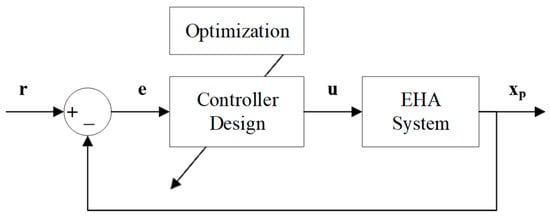
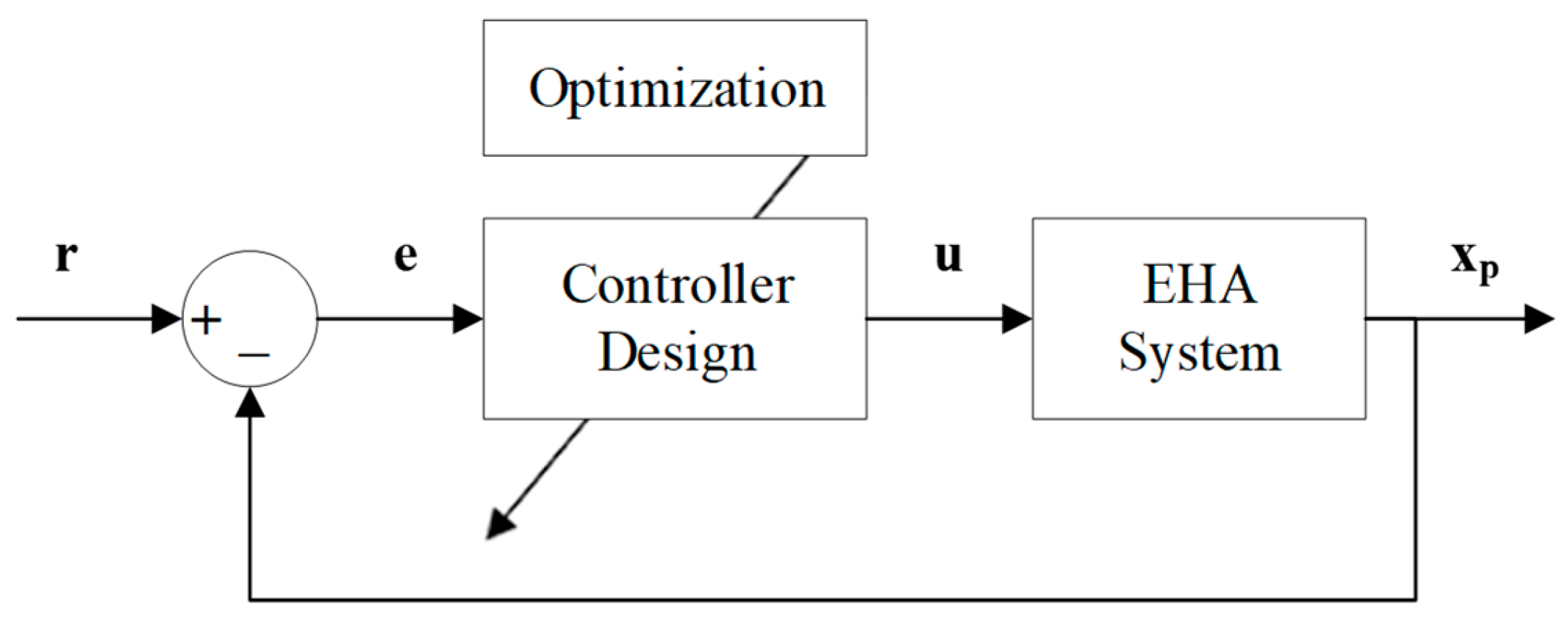
Figure 4 illustrates the complete block diagram of the proposed closed-loop EHA control system. In this architecture, r represents the reference trajectory signal, whereas xp denotes the actual piston displacement output. The primary objective of control is to minimize the deviation between the desired command and the measured response. Thus, the dynamic system tracking error, denoted by e, is defined as
e(t) = r(t) − xp(t)
Figure 4.
A detailed schematic of the electro-hydraulic actuator system, showing the closed-loop feedback control architecture, signal flow, and component interconnections.
2.4.1. PD, PID, and FOPID Designs
The controller design originated with the proportional (P) control algorithm, which generates a control signal directly proportional to the tracking error. Consequently, larger error magnitudes yield proportionally higher control actions, driving the actual response toward the desired reference trajectory. The governing equation for the P controller is formulated as
uP(t) = kpe(t)
Furthermore, the proportional-derivative (PD) control algorithm incorporates rate-of-change feedback to improve transient stability. The governing formulation for the PD controller is expressed as
Conversely, the proportional-integral-derivative (PID) controller maintains a good transient response while eliminating steady-state errors and reducing system setup times. The PID approach’s control algorithm can be determined and stated as
Meanwhile, fractional calculus (FC) and standard integer-order calculus developed concurrently over three centuries ago. However, computational constraints previously restricted FC primarily to theoretical discussions. Driven by advancements in high-performance computing, FC has gained significant attention across international research communities and is increasingly applied in engineering, natural sciences, and complex system modeling. The equation denotes the fractional-order calculus operator, where t represents the upper bound and t0 represents the lower bounds of the calculus, respectively, and α denotes the fractional order. The continuous fractional calculus operator is mathematically defined as
where Re(α) denotes the real part of the order α.
Fractional-order calculus, which is used in dynamic and control systems, was first introduced in the beginning of the 20th century. The flexibility of the fractional-order calculus can be applied to the PID controller to produce the fractional-order PID (FOPID) controller by expanding the general differential equations into the fractional order differential equations. Therefore, the control algorithm for the FOPID controller can be established and expressed as
in which 0 < γ < 1; 0 < μ < 1. Furthermore, the sequence of γ and μ corresponds to an integer number needlessly. In the meantime, if the orders of γ and μ are 1, a conventional PID controller is produced.
uFOPID = kpe(t) + kiD−γe(t) + kdDμe(t)
2.4.2. Optimization
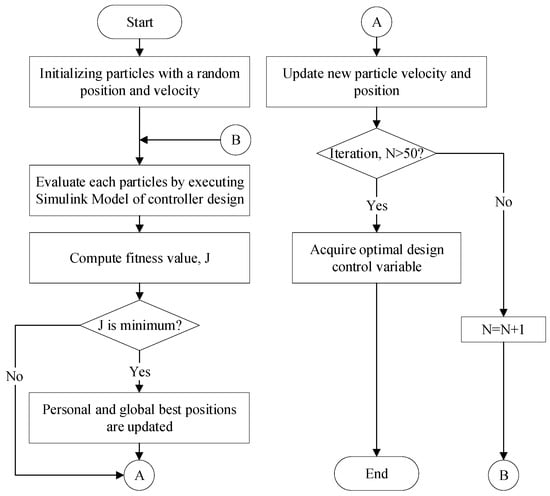
The PSO algorithm was employed to determine the optimal design variables for the PD, PID, and FOPID controllers. Inspired by the collective behavior of bird flocking and fish schooling, PSO maintains a population of candidate solutions, termed particles, i, that navigate a high-dimensional search space among the entire population, ρ, toward the global optimum. Each particle, i, adjusts its trajectory based on its personal historical best position, pbestij, and the swarm’s overall global best position, gbestij. Initialized with random position and velocity vectors in which N denotes the iteration index, the particle velocity and position are iteratively updated accordingly as
where the inertia weight, w, linearly decreases from 0.9 to 0.4 over the maximum iterations according to (12) to balance particle exploration and exploitation. Furthermore, c1 and c2 are positive learning factors regulating the cognitive and social acceleration components, respectively, while r1 and r2 denote uniformly distributed random variables.
Conversely, Figure 5 uses the PSO algorithm to summarize the entire design process. The cognitive coefficient, population size, social coefficient and maximum iteration of the particles were set at 2, 20, 2, and 50, accordingly, during this process. Furthermore, a fitness function, based on sum of square error (SSE) was utilized to assess the accomplishment of each individual particle where the particle was required to have the least fitness value.
Figure 5.
Flowchart of the overall PSO design process, depicting step-by-step swarm updates, objective evaluations, and optimal parameter convergence.
The position, , is provided as in (13), (14), and (15), accordingly, with respect to the PD, PID, and FOPID controller design variables, as shown in (6), (7), and (8).
2.5. Trajectory Tracking Profiles
Tracking control in the EHA system was demonstrated by developing multiple trajectories to show off the efficacy of the proposed control mechanisms. Three different trajectories, each with their own distinct signal design features, were produced through simulation and experimental practices. The tracking control performance of the proposed controller will be measured using sinusoidal, point-to-point, and chaotic trajectories.
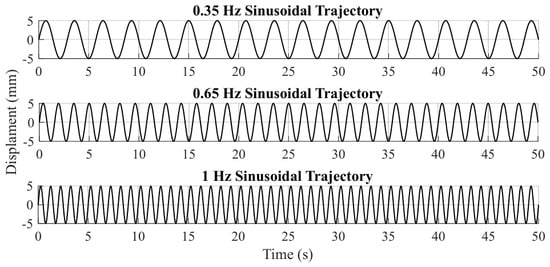
The tracking control bandwidth evaluated via a sinusoidal trajectory defines the maximum frequency at which the controller accurately tracks a reference amplitude. Owing to hardware constraints, the bandwidth test for the EHA system was restricted to an upper limit of 1 Hz. Therefore, three different frequencies, which are 0.35 Hz, 0.65 Hz, and 1 Hz, can be utilized. Consequently, a test frequency of 0.35 Hz was selected to evaluate dynamic performance under realistic operational constraints, taking into account the maximum velocity saturation limits of the EHA system. As a result, the system’s researched performance may be assessed in relation to its constraints and potential under operational circumstances. Additionally, a sinusoidal trajectory (1 Hz frequency, 10 mm amplitude) was employed for model validation. As illustrated in Figure 6, the resulting velocity and acceleration waveforms induce pronounced frictional effects, particularly at low velocities and during actuator motion reversal.
Figure 6.
Time-domain response of the sinusoidal trajectory, demonstrating reference tracking performance, periodic amplitude variations, and smooth continuous motion.
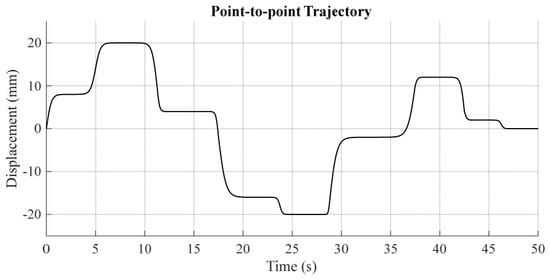
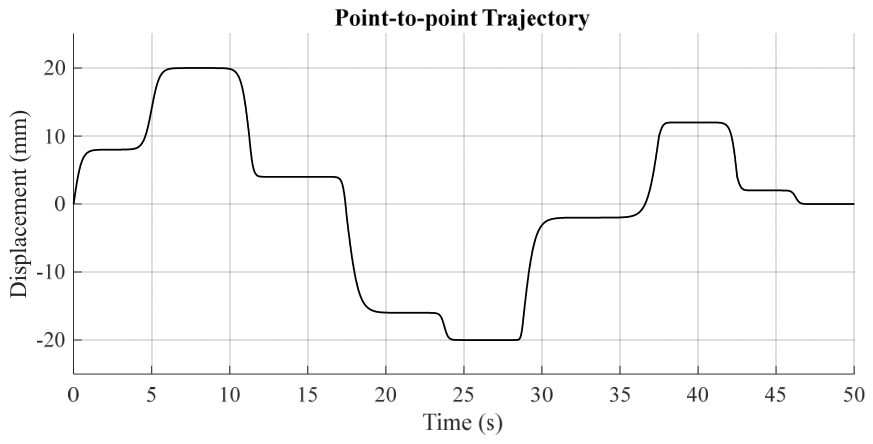
Conversely, point-to-point trajectory tracking is widely adopted in industrial and robotic applications due to its exceptional reliability. To evaluate the controller over the full operating range, a long-stroke point-to-point trajectory was designed, as shown in Figure 7. This trajectory assesses the ability of the proposed control algorithms to maintain precise tracking across diverse setpoints and hold specific actuator positions under varying operational conditions. Point-to-point trajectory tracking is frequently employed in electro-hydraulic actuator (EHA) research to rigorously benchmark control performance [37].
Figure 7.
Point-to-point trajectory profile showing start and end positions, velocity transitions, and smooth motion execution between targeted coordinates.
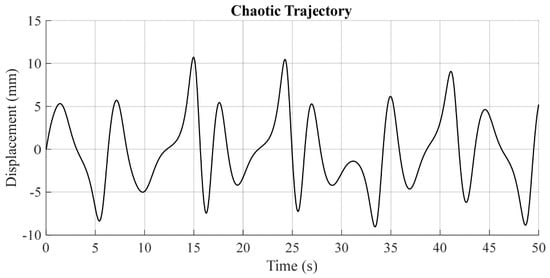
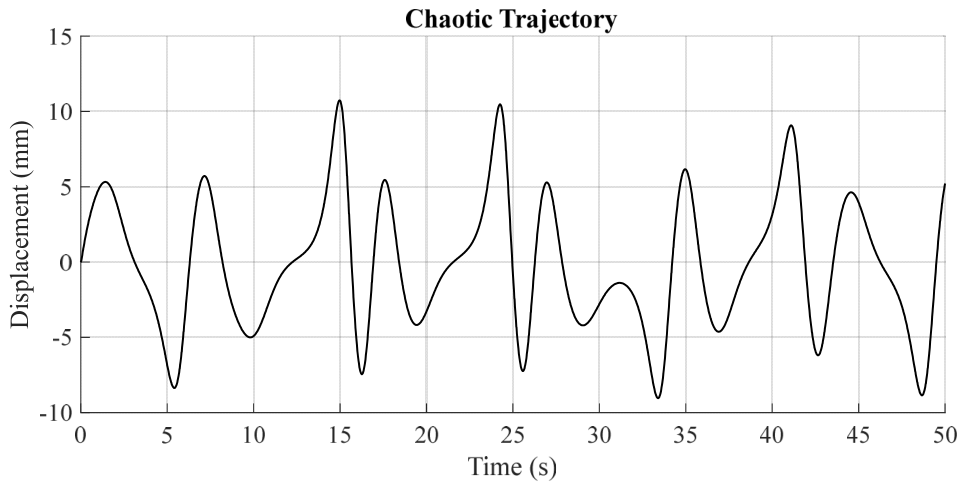
In addition, a compound reference profile was constructed by synthesizing the point-to-point and sinusoidal trajectories, as illustrated in Figure 8. This composite trajectory generates complex operational dynamics to evaluate the controller’s adaptive tracking capabilities under non-repetitive excitation [38]. By evaluating multiple setpoints along the actuator stroke, this reference profile assesses both tracking performance and the system performance analysis under extreme variation conditions of the proposed EHA control mechanisms.
Figure 8.
Dynamic profile of the chaotic trajectory, illustrating non-repetitive motion, ergodic space-filling behavior, and sensitive dependence on initial conditions.
2.6. Performance Indicators
In the time domain, a detailed evaluation and analysis of the suggested controllers’ performance is conducted. Absolute error (AE) [39], root mean square error (RMSE) and mean square error (MSE) [40] are among the primary performance metrics that most tracking investigations within the EHA system offer as a gauge of the controllers’ capabilities. Consequently, performance metrics that demonstrate the time-domain trajectory tracking abilities are provided using the MSE performance indicator outlined in (16).
The efficacy of the proposed control strategies was evaluated using these performance criteria, which incorporate the tracking error defined in (4) and the total number of samples (n). A lower MSE value signifies superior tracking accuracy and control capability within the EHA system.
To evaluate the proposed controller performance under variation conditions, the tracking performance of the EHA system was investigated under extreme variation conditions. The system performance analysis under variation conditions was tested by reducing 50% of the supply pressure to simulate plant parameter variations. The index, RI, measures controller resilience under changing conditions, as expressed in (17). The index relies on three parameters:
- Nominal MSE: The tracking error under normal operating conditions (MSE(r,NOM,T));
- Varied MSE: The tracking error under parameter variations (MSE(r,VAR,T));
- Benchmark Denominator: The normalized nominal MSE (nMSE(r,NOM,T)).
In this study, the nominal MSE of the baseline PD controller serves as the normalized benchmark across all evaluations
in which (T) denotes the tracking evaluation period and (r) represents the reference trajectory. A supply pressure of 6 MPa was established as the nominal (NOM) operating condition, whereas a 50% reduction in supply pressure defined the extreme variation (VAR) condition. The RI was utilized for comparing the performance of trajectory tracking for the EHA system, where a lower RI value indicates superior controller performance against parametric uncertainties and external disturbances.
3. Results and Discussions
This section presents and evaluates the numerical simulation and experimental results of the PD, PID, and FOPID controllers implemented for EHA trajectory tracking. Performance was assessed across three reference profiles: (1) sinusoidal, (2) point-to-point, and (3) chaotic trajectories. Simulations were conducted using a linear continuous-time model of the EHA system in a closed-loop feedback configuration. Concurrently, experimental validation was carried out on the physical EHA testbed to confirm practical tracking capabilities. Furthermore, system performance analysis under extreme variation conditions using chaotic trajectory tracking and dynamic model validation derived via gray-box identification are detailed.
3.1. Gray-Box Identification Implementation
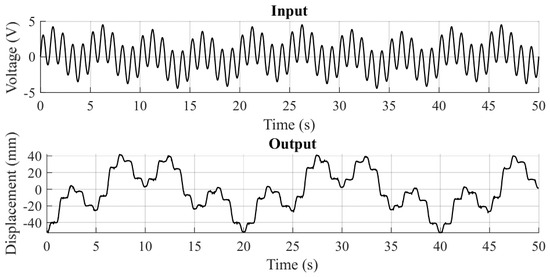
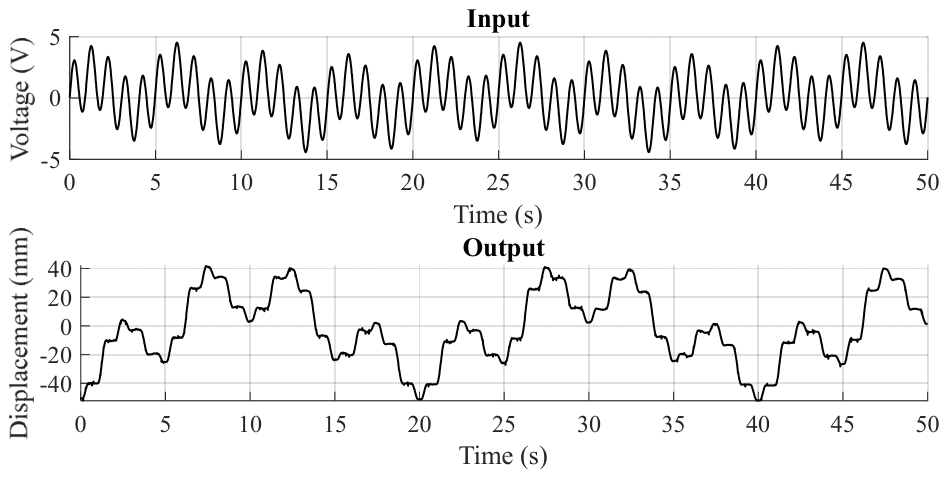
Under nominal operating conditions (hydraulic supply pressure of 6 MPa), a linear mathematical model of the EHA system was derived using a gray-box system identification approach. Parameter estimation was conducted via the MATLAB System Identification Toolbox using open-loop experimental data collected over 50 s at a sampling period of 1 ms. As shown in Figure 9, the raw input–output data were detrended, filtered, and partitioned into two sets of 25,000 samples each. The first subset was applied for parameter estimation, with the identified parameters summarized in Table 1.
Figure 9.
Time-series input voltage and output dynamic response datasets utilized for parameter estimation and empirical model identification of the EHA system.
Table 1.
Summary of fitness accuracy and estimated transfer function parameters (a2, a1, a0) comparing seven search methods for EHA system model identification.
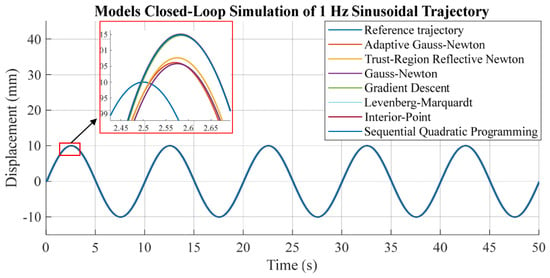
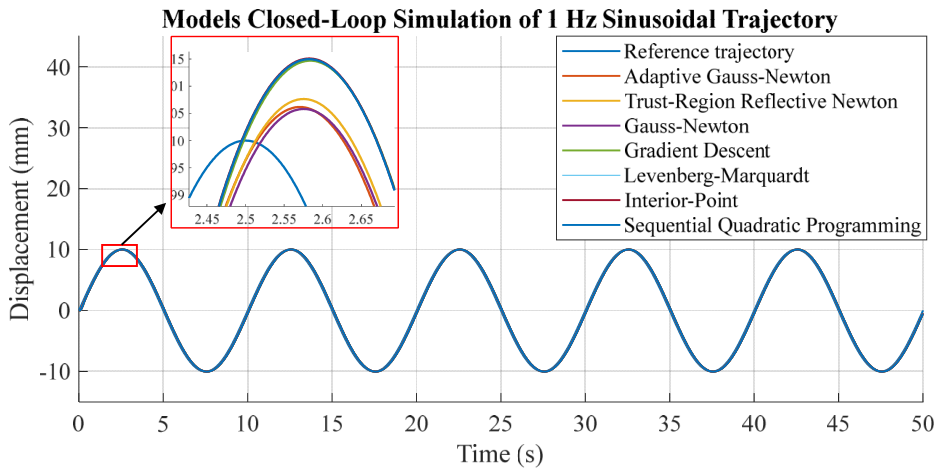
Concurrently, the second data subset was used for model validation, where the residuals between the estimated and measured output signals were evaluated to quantify the goodness of fit. The time domain displacement signals demonstrate strong correlation between the simulated model and the experimental system. The close agreement in signal response for the open-loop uncompensated system is illustrated in Figure 10. Furthermore, the mean square error (MSE) performance of the uncompensated open-loop model across various search methods is summarized in Table 2. The model identified via the Adaptive Gauss–Newton method formulated in (18) yielded the lowest MSE value and was consequently selected to represent the physical EHA system.
Figure 10.
Displacement tracking performance of identified system models undergoing a 1 Hz sinusoidal trajectory simulation without a controller, featuring zoomed-in dynamic evaluation.
Table 2.
Quantitative mean squared error (MSE) tracking analysis for identified dynamic models operating under closed-loop trajectory simulation without feedback control.
In summary, the time-domain performance of the uncompensated open-loop model under nominal operating conditions demonstrates high fidelity to the reference input across all evaluated optimization search methods. The error residuals between the simulated output and the reference trajectories remain minimal, confirming that each parameter estimation technique accurately captures the fundamental dynamic characteristics of the physical EHA system. However, based on Table 1 and Table 2, the estimated parameter value model transfer function for the EHA system is established based on the Adaptive Gauss–Newton search method because it produces the highest fitness percentages and smallest MSE value. Furthermore, the dynamics of the established model must be further examined to verify their ability to represent the real EHA system dynamics under the operating supply pressure of 6 MPa for 50 s of operation duration. Consequently, the findings of the closed-loop dynamic model validation investigations will be presented in the subsequent section.
3.2. Model Dynamic Validation
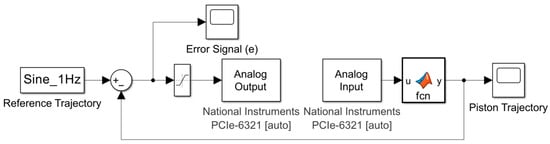
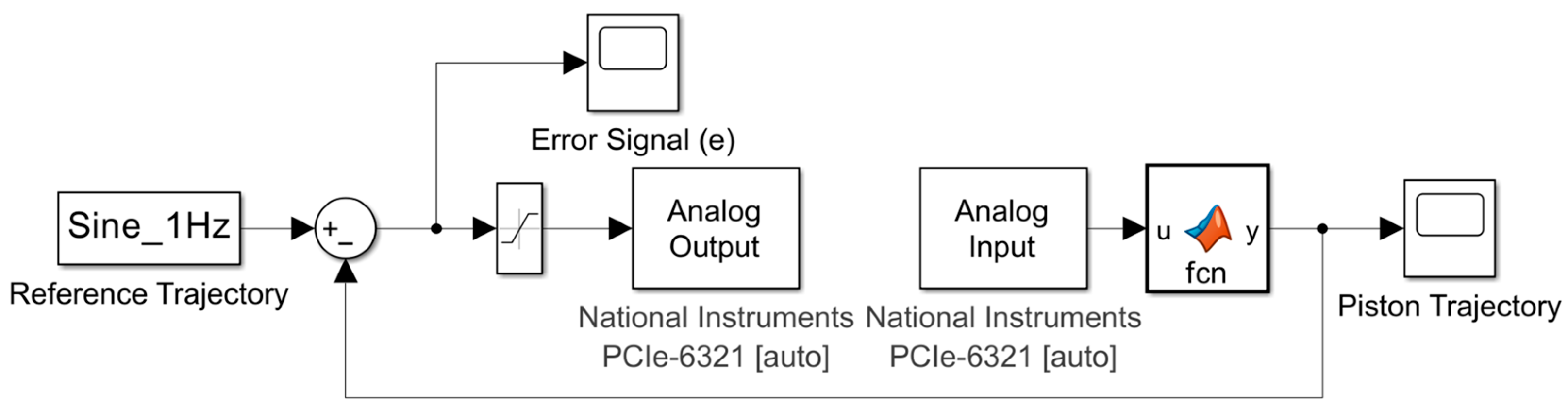
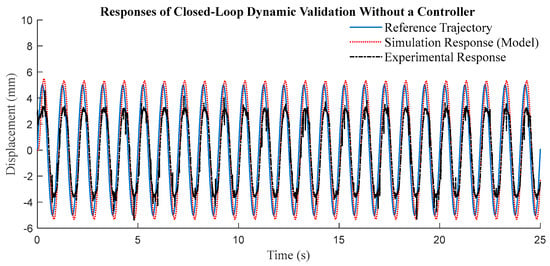
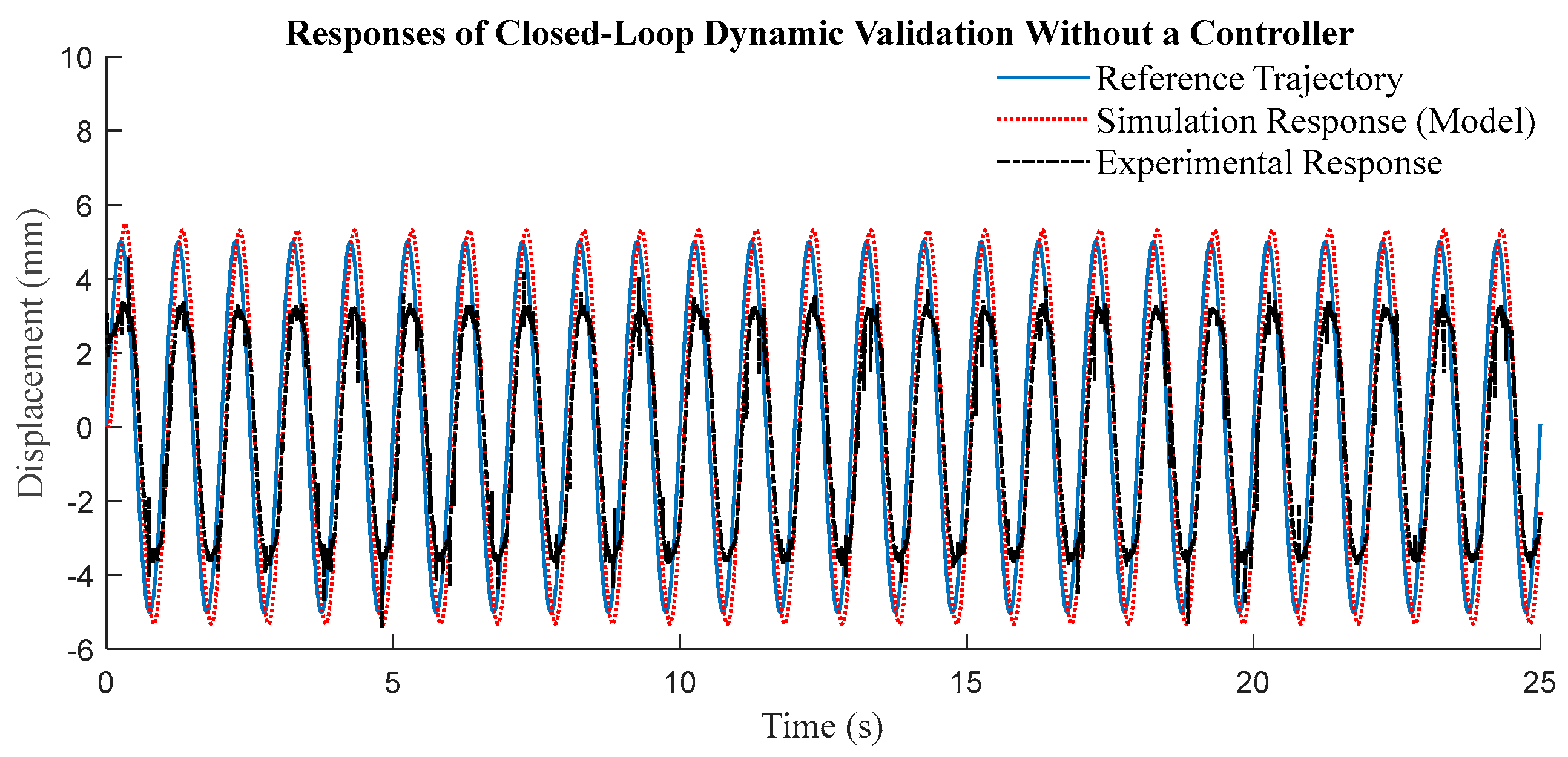
For simulation and experimental implementations, the closed-loop configuration of the EHA system without a controller, as seen in Figure 11, is utilized to validate the dynamic of the model acquired in the previous section. In addition, the validation procedure utilized a 1.0 Hz sinusoidal reference trajectory, which represents the maximum dynamic bandwidth of the experimental testbed due to physical actuator velocity saturation and hydraulic pump flow limits. Furthermore, the experimental implementation was executed for a duration of 50 s throughout the operation using the EHA system workbench. Under nominal conditions, the trajectory tracking responses of the experimental and simulated implementations are depicted in Figure 12, which are plotted for the first 25 s to provide a magnified view of the tracking response. The tracking responses demonstrate strong qualitative agreement, as observed. The results indicated a negligible discrepancy between the experimental and simulated responses, demonstrating that the dynamics of the nominal condition model remain accurate for at least 50 s during operation.
Figure 11.
Simulink block diagram for hardware-in-the-loop closed-loop dynamic validation of sinusoidal piston trajectory tracking without an active controller implementation.
Figure 12.
Comparison of experimental and simulated dynamic displacement responses against a sinusoidal reference trajectory during closed-loop validation without an active controller over a 50 s test (shown truncated to 0–25 s for enhanced visual clarity).
In summary, the results of simulation and experimental implementations show that the trajectory tracking responses of the EHA system under nominal condition demonstrates strong qualitative agreement where the residual between the simulation and experimental responses is significantly small. It is evident that the dynamic of nominal condition model is valid, and the model is claimed to be able to represent the real EHA system dynamics with the operating supply pressure of 6 MPa within 50 s of the operation duration. Overall, the established nominal model for the EHA system may indeed be used with confidence in the design and analysis of control algorithms.
3.3. PSO Algorithm Implementation for PD, PID, and FOPID
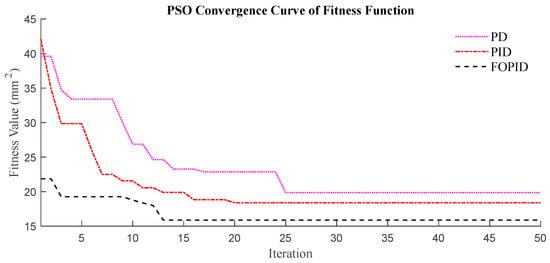
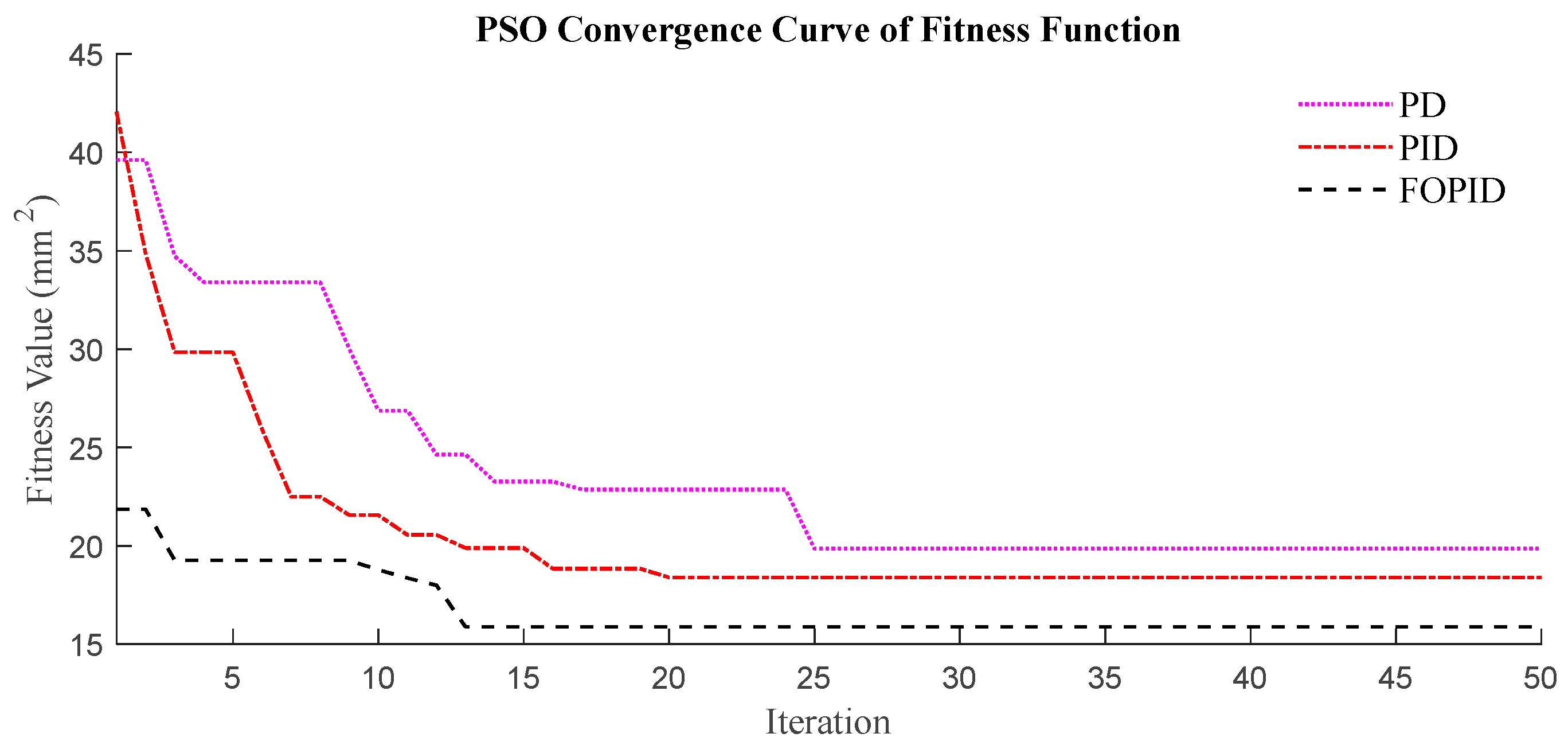
During the PSO execution, the decision variables were iteratively updated to minimize the objective fitness function. Figure 13 illustrates the fitness convergence profiles for each controller. The parameter set for the FOPID controller achieved convergence first at the 13th iteration, followed by the PID controller at the 20th iteration, and the PD controller at the 25th iteration. The effect of fractional order modification in the PID algorithm structure affect the alteration process during the PSO implementation where the FOPID controller converges earliest as compared to the PD and PID controllers.
Figure 13.
Fitness function convergence characteristics during particle swarm optimization tuning for PD, PID, and FOPID controllers across 50 iteration steps.
In summary, across ten independent optimization runs, the parameter values that yielded the minimum fitness score upon convergence were selected as the optimal gains for the designed control algorithms, as listed in Table 3. These optimized parameters were subsequently substituted into (6), (7), and (8) for the numerical simulations and experimental validations detailed in the following section.
Table 3.
Summary of PSO-optimized control parameters and fractional exponents (kp,kd,ki,γ,μ) for comparative PD, PID, and FOPID controller designs.
3.4. Simulation Results
This section presents the simulation results for the EHA system’s trajectory tracking performance using the proposed FOPID controller. The simulation is of the utmost importance because it evaluates the functionalities of the proposed controller, which will be used in the experimental investigation. In order to conduct the simulation, the FOPID control algorithm utilized the values of the variables specified in Table 3 of the preceding section. Experimental and simulated data were acquired at a sampling period of 1 ms, and the trajectory tracking performance of the EHA system was evaluated over a 50 s duration across three reference profiles that are sinusoidal, point-to-point, and chaotic.
Quantitative performance data were recorded alongside qualitative observations of the trajectory tracking response, tracking error, and control effort. Beyond numerical simulations, the practical performance of the FOPID controller was benchmarked against conventional PD and PID architectures by implementing the optimized control parameters listed in Table 4. Trajectory tracking accuracy was evaluated using the MSE metric, where a lower MSE value indicates superior tracking fidelity and dynamic performance in the EHA system.
Table 4.
Quantitative simulation means squared error comparison among PD, PID, and FOPID controllers under sinusoidal, point-to-point, and chaotic trajectory tracking evaluations.
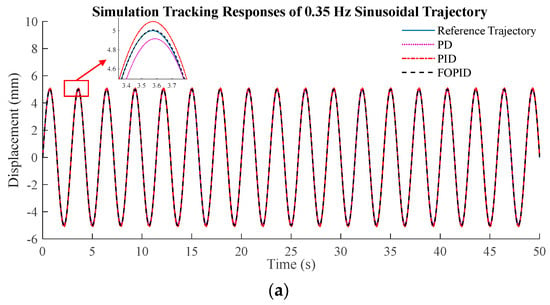
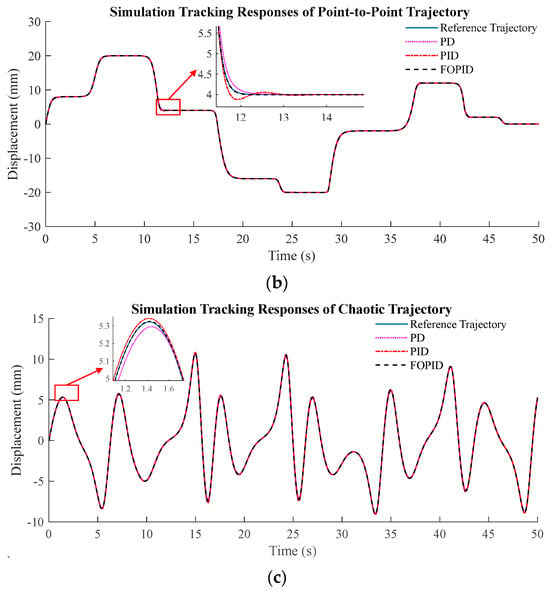
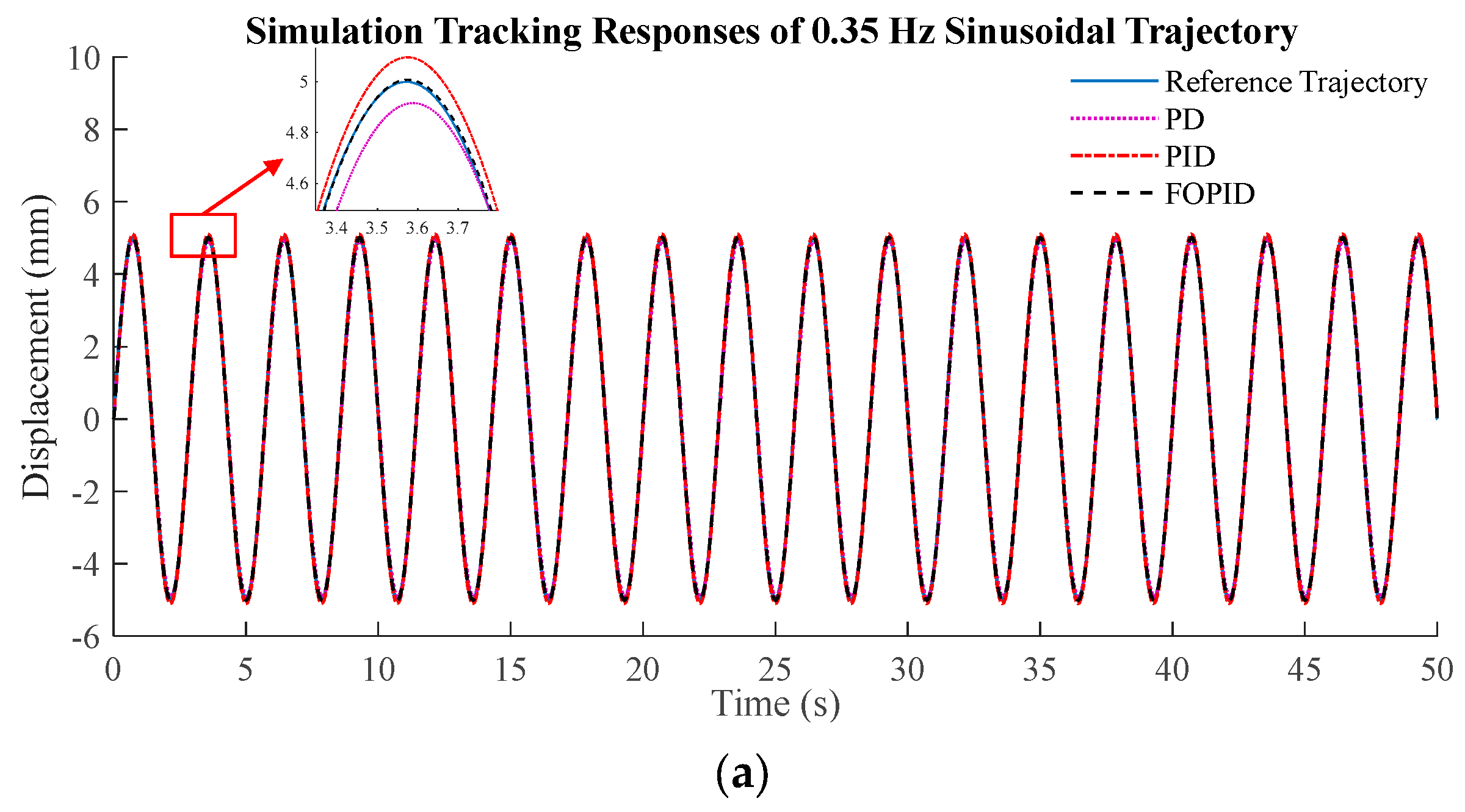
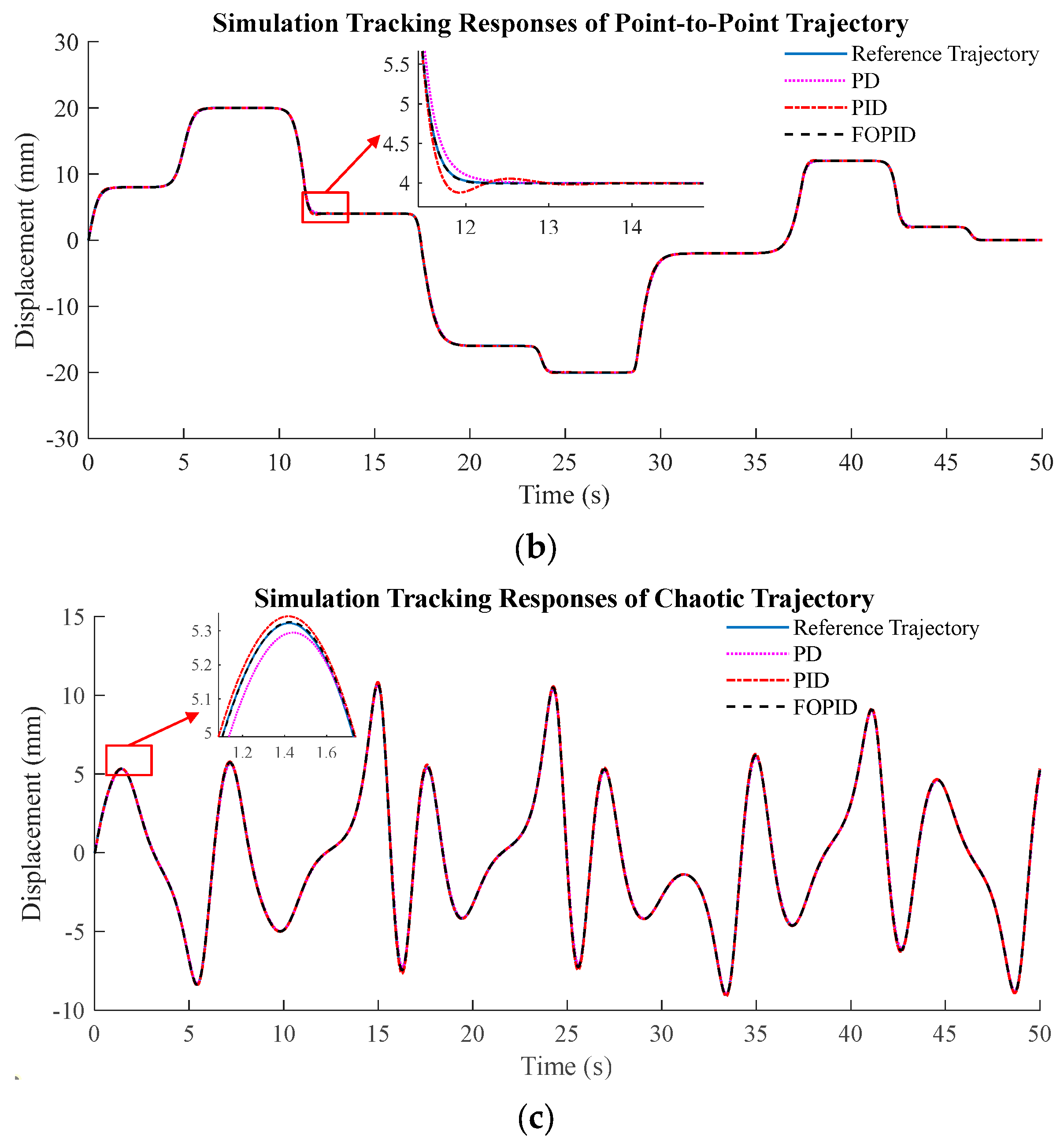
Figure 14 illustrates the EHA system’s simulated trajectory tracking performance with the PD, PID, and FOPID control for the 0.35 Hz sinusoidal, point-to-point, and chaotic trajectories. Across all evaluated reference profiles, the designed FOPID control scheme consistently surpassed the conventional PD and PID control schemes, demonstrating significant effectiveness during trajectory tracking.
Figure 14.
Simulation tracking performance comparison of PD, PID, and FOPID controllers across three reference trajectories: (a) displacement tracking responses under a 0.35 Hz sinusoidal reference trajectory with zoomed peak detail; (b) displacement tracking responses of controllers following a multi-step point-to-point reference trajectory with inset step response detail; (c) displacement tracking responses controllers evaluating a complex chaotic reference trajectory featuring zoomed-in dynamic tracking detail.
Furthermore, Table 4 and Table 5 summarize the MSE metrics and the corresponding percentage improvements in tracking performance for the 0.35 Hz sinusoidal, point-to-point, and chaotic reference trajectories under PD, PID, and FOPID control. The numerical simulations demonstrate that the FOPID controller achieved substantial performance enhancements compared to the baseline approaches, yielding the highest relative improvement during chaotic trajectory tracking. Conversely, the stepwise setpoint changes inherent to the point-to-point trajectory imposed greater dynamic constraints, resulting in comparatively lower percentage improvements across all controllers.
Table 5.
Quantitative tracking performance percentage improvement (MSE) of FOPID controller compared to PD and PID controllers under distinct dynamic trajectory profiles.
Consequently, incorporating fractional order modification into the PID control algorithm yields substantial improvements in EHA trajectory tracking performance. Comparative simulation analyses consistently demonstrate that the designed FOPID control scheme outperforms both baseline PD and PID control schemes across all evaluated operational profiles.
3.5. Experimental Results
This section presents the experimental EHA system’s trajectory tracking performance using the proposed FOPID controller. Hardware-in-the-loop experiments were conducted by implementing the optimized control parameters listed in Table 3. Experimental data were acquired at a sampling interval of 1 ms over a 50 s evaluation period for sinusoidal, point-to-point, and chaotic trajectories. Quantitative performance metrics alongside qualitative observations of displacement responses, tracking errors, and control effort signals were systematically recorded. Real-time tracking performance was quantitatively evaluated using MSE and RI metrics, where a lower RI value signifies superior control under extreme variation conditions.
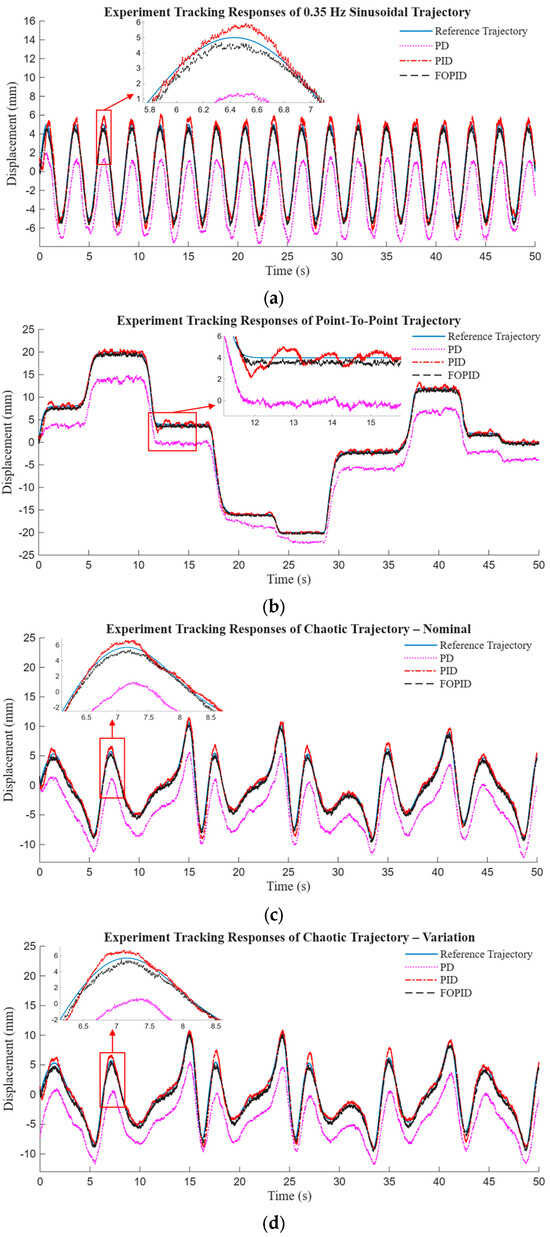
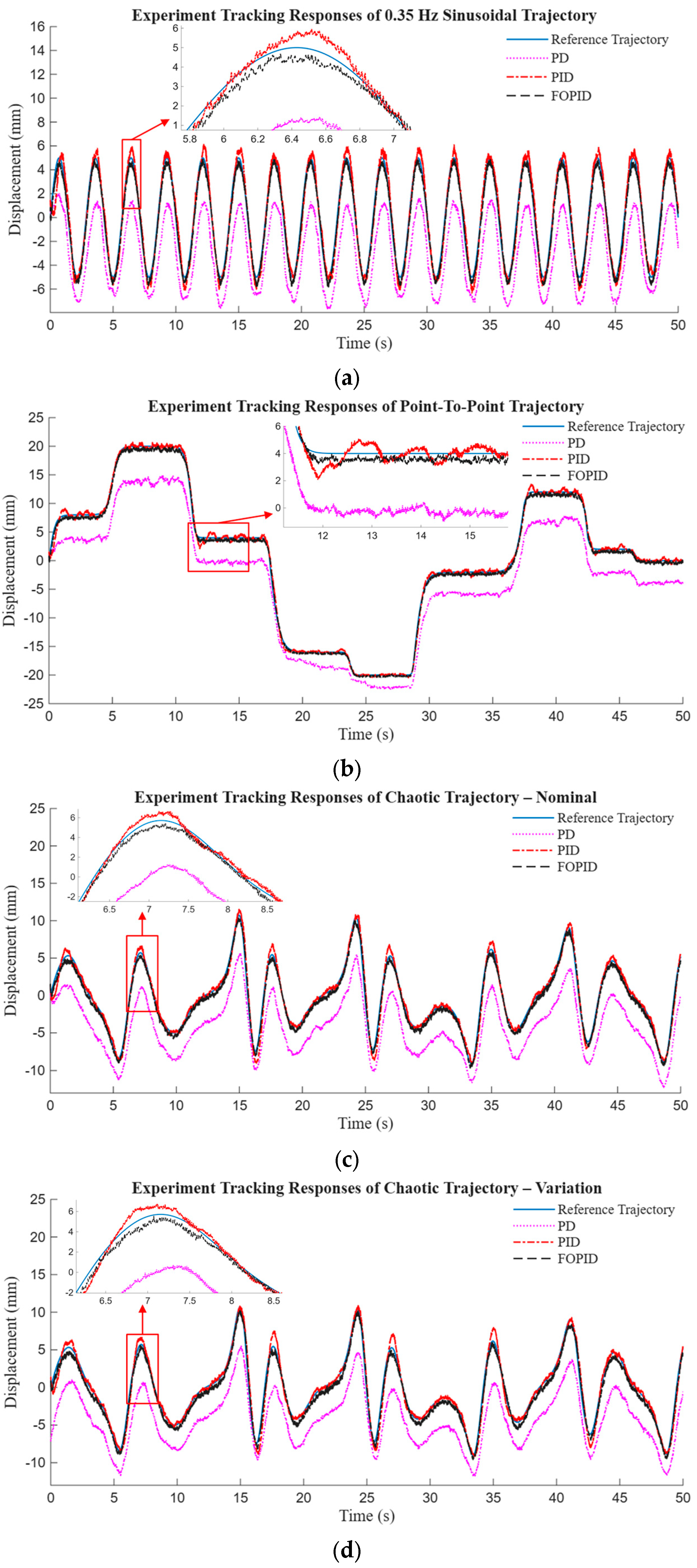
Figure 15 presents the experimental EHA system’s trajectory tracking performance with the PD, PID, and FOPID controllers for the 0.35 Hz sinusoidal, point-to-point, and chaotic trajectories. Across all evaluated profiles, the FOPID controller consistently demonstrated superior trajectory tracking performance compared to the conventional PD and PID control schemes, confirming its enhanced tracking effectiveness under real-time operating conditions.
Figure 15.
Experimental dynamic response comparison for PD, PID, and FOPID controllers tracking sinusoidal, point-to-point, and nominal or variation chaotic trajectories: (a) tracking responses under a 0.35 Hz sinusoidal reference trajectory; (b) tracking responses under a multi-step point-to-point reference trajectory; (c) tracking responses under a nominal dynamic chaotic reference trajectory; (d) tracking responses under a chaotic reference trajectory with parameter variations.
Furthermore, Table 6 and Table 7 summarize the experimental MSE metrics and the corresponding percentage improvements in tracking accuracy and system performance analysis under extreme variation conditions across the 0.35 Hz sinusoidal, point-to-point, and chaotic real-time trajectories under PD, PID, and FOPID control. Experimental execution confirms that the FOPID controller yields substantial performance enhancements over the benchmark controllers across all profiles. The maximum percentage improvement relative to the PD controller was observed during point-to-point trajectory tracking, whereas the highest performance gain relative to the PID controller occurred during the 0.35 Hz sinusoidal trajectory. Observably, the discrete setpoint transitions across varying actuator stroke lengths in the point-to-point trajectory represent the primary constraint limiting further performance gains across all controllers. Additionally, system performance analysis under extreme variation conditions were conducted to analyze the impact of plant parameter variations on closed-loop tracking performance. Quantitative comparison of the RI demonstrates that the FOPID controller exhibits superior performance under extreme variation conditions compared to baseline PD and PID schemes under plant parameter variations. The FOPID controller maintained high tracking performance despite being synthesized for nominal operating conditions. Specifically, real-time experimental implementation demonstrated that the FOPID controller enhanced system performance under extreme variation conditions by 84.3% and 36.8% relative to the PD and PID controllers, respectively. Consequently, the proposed controller is well suited for EHA systems subject to non-linear uncertainties and external disturbances.
Table 6.
Experimental tracking accuracy and RI evaluation comparing PD, PID, and FOPID controllers across sinusoidal, point-to-point, and chaotic trajectories.
Table 7.
Percentage improvement in experimental tracking control effectiveness and RI achieved by the FOPID controller relative to PD and PID controllers.
3.6. Performance Analysis: Simulation and Experimental
Table 8 and Table 9 summarize the MSE metrics and the corresponding percentage improvements in tracking effectiveness and system performance analysis under extreme variation conditions across the 0.35 Hz sinusoidal, point-to-point, and chaotic trajectories for both numerical simulations and real-time trajectories tracking control with PD, PID, and FOPID controllers. A lower MSE value demonstrates superior trajectory tracking effectiveness for the EHA system, whereas a lower RI indicates enhanced controller resilience against supply pressure variations. Based on the MSE metrics, the FOPID controller consistently outclassed both PD and PID approaches across all profiles of trajectories tracking. Furthermore, evaluation of the RI performance during real-time chaotic trajectory tracking confirmed that the FOPID controller exhibits greater performance under extreme variation conditions. Even when designed for nominal operating conditions, the proposed FOPID approach effectively maintains optimal performance despite external disturbances.
Table 8.
Quantitative mean squared error performance comparison between simulation and experimental results for PD, PID, and FOPID controllers under trajectory tracking.
Table 9.
Quantitative simulation and experimental tracking effectiveness and performance analysis under extreme variation conditions, and RI percentage improvements achieved by FOPID controller over conventional PD and PID controllers.
4. Conclusions and Recommendations
High-precision trajectory tracking combined with system performance under extreme variation conditions remains critical to maximizing the operational efficiency of EHA in industrial applications. Due to their exceptional power density, fast transient response, and high load-holding stiffness, EHA systems serve as critical components in modern high-precision motion control applications. Despite this, severe non-linear dynamics and uncertainties of the modeling, for example, the non-linear friction, leakage happening from internal or external, and variation in parameters, present substantial challenges in precise trajectory-tracking design. Although conventional PID controllers are widely implemented in industrial applications, their tracking performance remains subject to further enhancement. To overcome these limitations, this study proposes an optimized FOPID control strategy for a hydraulic double-acting cylinder evaluated within variations in supply pressure and diverse trajectories. The following is a summary of the primary findings of this study:
- The proposed FOPID control scheme relies on a gray-box identified EHA system’s model alongside a modified fractional-order PID algorithm structure. It also involves a complicated procedure and mathematical formulations to obtain the optimal value of the controller variables, which is quite challenging to be implemented by many researchers. To streamline controller synthesis, a PSO algorithm has been applied to design a modified FOPID controller featuring a modified fractional structure. The FOPID controller was formulated using a third-order dynamic model of the hydraulic double-acting cylinder for the EHA system to ensure precise trajectory tracking. For comparative evaluation, conventional PD and PID controllers were synthesized using the identical PSO-based optimization framework.
- Both numerical simulations and experimental validation demonstrated that the FOPID controller yields superior trajectory tracking effectiveness and performance under extreme variation conditions compared to conventional PD and PID control strategies. Controller parameters were optimized using a PSO algorithm. Experimental MSE evaluations across sinusoidal (0.35 Hz), point-to-point, and chaotic trajectories indicated that the FOPID controller improved tracking accuracy by 97.7%, 98.4%, and 97.8% over the PD controller, and by 64.7%, 51.8%, and 47.5% over the PID controller, respectively. Furthermore, under operational parameter variations, the FOPID proposed controller enhanced system performance under extreme variation conditions significantly by 84.3% and 36.8% compared to the PD and PID approaches, respectively.
These results underscore the strong potential of the proposed approach for industrial deployment. To further advance this field, future research directions are recommended as follows:
- Due to experimental bench constraints, evaluations of system performance under variation conditions were restricted to supply pressure variations, while payload variation effects were negligible in the current experimental setup. Future studies should extend the system performance analysis under extreme variation conditions of the proposed controller to encompass a broader spectrum of system uncertainties and external disturbances.
- Developing a comprehensive model that accurately captures EHA system dynamics provides a critical foundation for rigorous theoretical analysis. Consequently, designing controllers for performance under extreme variation conditions based on high-fidelity models ensures reliable physical performance and facilitates direct translation to industrial applications.
Author Contributions
Methodology, R.G.; validation, M.H.F.A.K.; writing—original draft preparation, M.S.H.; writing—review and editing, M.F.G. and A.A.M.F.; supervision, J.O.; project administration, S.M. All authors have read and agreed to the published version of the manuscript.
Funding
This research was funded by the Ministry of Higher Education Malaysia (MOHE) under the Prototype Research Grant Scheme (PRGS, Grant No. R.J130000.7823.5L038) and Universiti Teknologi Malaysia (UTM) through the Research Management Center (RMC) under the UTM Encouragement Research Grant (Grant No. Q.J130000.3823.42J06).
Data Availability Statement
The original contributions presented in this study are included in the article. Further inquiries can be directed to the corresponding author.
Acknowledgments
The authors would like to express their sincere gratitude and appreciation to the Universiti Kuala Lumpur Malaysian Institute of Marine Engineering Technology (UniKL MIMET), the Universiti Kuala Lumpur Malaysia France Institute (UniKL MFI), the Shibaura Institute of Technology, the Universiti Teknologi Malaysia (UTM), the Centre for Artificial Intelligence and Robotics (CAIRO), and the Universiti Teknikal Malaysia Melaka (UTeM) for providing the research facilities, technical assistance, and administrative support that made this work possible.
Conflicts of Interest
The authors declare no conflicts of interest.
References
- Merritt, H.E. Hydraulic Control Systems; John Wiley & Sons: NY, USA, 1967. [Google Scholar]
- Song, H.-G.; Lim, D.-W. Application of the Water-Based Electro-Hydraulic Actuator (EHA) to the Heavy-Duty Collaborative Robot. Actuators 2024, 13, 451. [Google Scholar] [CrossRef] [Scilit]
- Ketelsen, S.; Padovani, D.; Andersen, T.; Ebbesen, M.; Schmidt, L. Classification and Review of Pump-Controlled Differential Cylinder Drives. Energies 2019, 12, 1293. [Google Scholar] [CrossRef] [Scilit]
- Chen, P.; Chen, X. Analysis and Improvement of the Dynamic Characteristics of an Electro-Hydrostatic Actuator Based on a Vehicle’s Active Suspension. World Electr. Veh. J. 2025, 16, 586. [Google Scholar] [CrossRef] [Scilit]
- Hosseinpour, S.; Kinsner, W.; Muthukumarana, S.; Sepehri, N. Fault Detection in an Electro-Hydrostatic Actuator Using Polyscale Complexity Measures and Bayesian Classification. IEEE Open J. Instrum. Meas. 2024, 3, 1–13. [Google Scholar] [CrossRef] [Scilit]
- Gao, B.; Shen, W.; Zheng, L.; Zhang, W.; Zhao, H. A Review of Key Technologies for Friction Nonlinearity in an Electro-Hydraulic Servo System. Machines 2022, 10, 568. [Google Scholar] [CrossRef] [Scilit]
- Xia, Y.; Nie, Y.; Chen, Z.; Lyu, L. Motion Control of a Hydraulic Manipulator with Adaptive Nonlinear Model Compensation and Comparative Experiments. Machines 2022, 10, 214. [Google Scholar] [CrossRef] [Scilit]
- Jensen, K.J.; Ebbesen, M.K.; Hansen, M.R. Novel Concept for Electro-Hydrostatic Actuators for Motion Control of Hydraulic Manipulators. Energies 2021, 14, 6566. [Google Scholar] [CrossRef] [Scilit]
- Hercik, R.; Svoboda, R. Collecting and Pre-Processing Data for Industry 4.0 Implementation Using Hydraulic Press. Data 2023, 8, 72. [Google Scholar] [CrossRef] [Scilit]
- Ge, Y.; Yang, X.; Deng, W.; Yao, J. RISE-Based Composite Adaptive Control of Electro-Hydrostatic Actuator with Asymptotic Stability. Machines 2021, 9, 181. [Google Scholar] [CrossRef] [Scilit]
- Ren, Y.; Bai, J.; Ruan, J. Design, Modeling and Experimental Validation of a Variable Resonant Electro-Hydraulic Fatigue Testing System. IEEE Access 2019, 7, 180835–180845. [Google Scholar] [CrossRef] [Scilit]
- Xuan, J.; Wang, S. Development of Hydraulically Driven Fatigue Testing Machine for Insulators. IEEE Access 2017, 6, 980–988. [Google Scholar] [CrossRef] [Scilit]
- Feng, L.; Yan, H. Nonlinear Adaptive Robust Control of the Electro-Hydraulic Servo System. Appl. Sci. 2020, 10, 4494. [Google Scholar] [CrossRef] [Scilit]
- Casoli, P.; Scolari, F.; Vescovini, C.M.; Rundo, M. Energy Comparison between a Load Sensing System and Electro-Hydraulic Solutions Applied to a 9-Ton Excavator. Energies 2022, 15, 2583. [Google Scholar] [CrossRef] [Scilit]
- Tural, E.; Ergün, R.E. Design and Validation of a Real-Time FPGA-Based PID Control System for Angular Positioning in Servo-Hydraulic Actuators. Machines 2026, 14, 315. [Google Scholar] [CrossRef] [Scilit]
- Sun, C.; Dong, X.; Wang, M.; Li, J. Sliding Mode Control of Electro-Hydraulic Position Servo System Based on Adaptive Reaching Law. Appl. Sci. 2022, 12, 6897. [Google Scholar] [CrossRef] [Scilit]
- Tang, X.; Wu, C.; Xu, X. Learning-Based Nonlinear Model Predictive Controller for Hydraulic Cylinder Control of Ship Steering System. J. Mar. Sci. Eng. 2022, 10, 2033. [Google Scholar] [CrossRef] [Scilit]
- Jiang, C.; Sui, S.; Tong, S. Adaptive NN Control of Electro-Hydraulic System with Full State Constraints. Electronics 2022, 11, 1483. [Google Scholar] [CrossRef] [Scilit]
- Nguyen, M.H.; Dao, H.V.; Ahn, K.K. Active Disturbance Rejection Control for Position Tracking of Electro-Hydraulic Servo Systems under Modeling Uncertainty and External Load. Actuators 2021, 10, 20. [Google Scholar] [CrossRef] [Scilit]
- Zhang, J.; Li, L.; Zhang, X.; Zhang, T.; Yuan, Y. Delay Analysis and the Control of Electro-Hydrostatic Actuators. Appl. Sci. 2022, 12, 3089. [Google Scholar] [CrossRef] [Scilit]
- He, J.; Su, S.; Wang, H.; Chen, F.; Yin, B. Online PID Tuning Strategy for Hydraulic Servo Control Systems via SAC-Based Deep Reinforcement Learning. Machines 2023, 11, 593. [Google Scholar] [CrossRef] [Scilit]
- Monje, C.A.; Vinagre, B.M.; Feliu, V.; Chen, Y.Q. Tuning and auto-tuning of fractional order controllers for industry applications. Control Eng. Pract. 2008, 16, 798–812. [Google Scholar] [CrossRef] [Scilit]
- Altamura, A.; Lino, P.; Maione, G.; Kapetina, M.; Rapaić, M.R.; Jeličić, Z.D. On PID Controllers for a Complex-Order Fractional Model of an Automotive Injection System. IFAC-Pap. 2024, 58, 119–124. [Google Scholar] [CrossRef] [Scilit]
- Coskun, M.Y.; Itik, M. Intelligent and fractional-order PID control with ultra-local model estimation: Application to industrial electro-hydraulic systems. Control Eng. Pract. 2026, 175, 107090. [Google Scholar] [CrossRef] [Scilit]
- Ataşlar-Ayyıldız, B.; Karahan, O.; Yılmaz, S. Control and Robust Stabilization at Unstable Equilibrium by Fractional Controller for Magnetic Levitation Systems. Fractal Fract. 2021, 5, 101. [Google Scholar] [CrossRef] [Scilit]
- Pereira, L.F.d.S.C.; Batista, E.; de Brito, M.A.G.; Godoy, R.B. A Robustness Analysis of a Fuzzy Fractional Order PID Controller Based on Genetic Algorithm for a DC-DC Boost Converter. Electronics 2022, 11, 1894. [Google Scholar] [CrossRef] [Scilit]
- Gao, B.; Guan, H.; Shen, W.; Ye, Y. Application of the Gray Wolf Optimization Algorithm in Active Disturbance Rejection Control Parameter Tuning of an Electro-Hydraulic Servo Unit. Machines 2022, 10, 599. [Google Scholar] [CrossRef] [Scilit]
- Shouran, M.; Alsseid, A. Particle Swarm Optimization Algorithm-Tuned Fuzzy Cascade Fractional Order PI-Fractional Order PD for Frequency Regulation of Dual-Area Power System. Processes 2022, 10, 477. [Google Scholar] [CrossRef] [Scilit]
- Dörr, M.; Leitenberger, F.; Wolter, K.; Matthiesen, S.; Gwosch, T. Model-Based Control Design of an EHA Position Control Based on Multicriteria Optimization. Machines 2022, 10, 1190. [Google Scholar] [CrossRef] [Scilit]
- Han, X.; Fu, Y.; Wang, Y.; Wang, M.; Zhu, D. Dynamic Surface-Based Adaptive Active Disturbance Rejection Control of Electrohydrostatic Actuators. Aerospace 2023, 10, 747. [Google Scholar] [CrossRef] [Scilit]
- Ma, W.; Ma, S.; Qiao, W.; Cao, D.; Yin, C. Research on PID Controller of Excavator Electro-Hydraulic System Based on Improved Differential Evolution. Machines 2023, 11, 143. [Google Scholar] [CrossRef] [Scilit]
- Sahu, G.N.; Singh, S.; Singh, A.; Law, M. Static and Dynamic Characterization and Control of a High-Performance Electro-Hydraulic Actuator. Actuators 2020, 9, 46. [Google Scholar] [CrossRef] [Scilit]
- Jelali, M.; Kroll, A. Hydraulic Servo-Systems: Modelling, Identification and Control; Springer Science & Business Media: London, UK, 2003. [Google Scholar]
- Li, H.; Huang, Y.; Zhu, G.; Lou, Z. Adaptive LQT Valve Timing Control for an Electro-Hydraulic Variable Valve Actuator. IEEE Trans. Control. Syst. Technol. 2018, 27, 2182–2194. [Google Scholar] [CrossRef] [Scilit]
- Knohl, T.; Unbehauen, H. Adaptive position control of electrohydraulic servo systems using ANN. Mechatronics 2000, 10, 127–143. [Google Scholar] [CrossRef] [Scilit]
- Zulfatman; Rahmat, M.F. Application of self-tuning fuzzy PID controller on industrial hydraulic actuator using system identification approach. Int. J. Smart Sens. Intell. Syst. 2009, 2. [Google Scholar] [CrossRef] [Scilit]
- Essa, M.E.-S.M.; Aboelela, M.A.S.; Hassan, M.A.M.; Abdrabbo, S.M. Hardware in the loop of position tracking control of hydraulic servo mechanism. In Proceedings of the 13th International Computer Engineering Conference (ICENCO), Cairo, Egypt, 27–28 December 2017; pp. 160–165. [Google Scholar]
- Loukianov, A.G.; Rivera, J.; Orlov, Y.V.; Teraoka, E.Y.M. Robust Trajectory Tracking for an Electrohydraulic Actuator. IEEE Trans. Ind. Electron. 2008, 56, 3523–3531. [Google Scholar] [CrossRef] [Scilit]
- Palli, G.; Strano, S.; Terzo, M. A novel adaptive-gain technique for high-order sliding-mode observers with application to electro-hydraulic systems. Mech. Syst. Signal Process. 2020, 144, 106875. [Google Scholar] [CrossRef] [Scilit]
- Cheng, L.; Zhu, Z.C.; Shen, G.; Wang, S.; Li, X.; Tang, Y. Real-Time Force Tracking Control of an Electro-Hydraulic System Using a Novel Robust Adaptive Sliding Mode Controller. IEEE Access 2019, 8, 13315–13328. [Google Scholar] [CrossRef] [Scilit]

Disclaimer/Publisher’s Note: The statements, opinions and data contained in all publications are solely those of the individual author(s) and contributor(s) and not of MDPI and/or the editor(s). MDPI and/or the editor(s) disclaim responsibility for any injury to people or property resulting from any ideas, methods, instructions or products referred to in the content. |
© 2026 by the authors. Licensee MDPI, Basel, Switzerland. This article is an open access article distributed under the terms and conditions of the Creative Commons Attribution (CC BY) license.